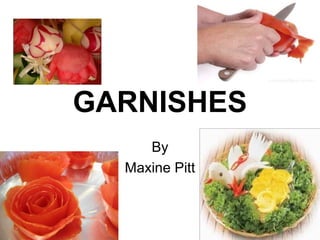
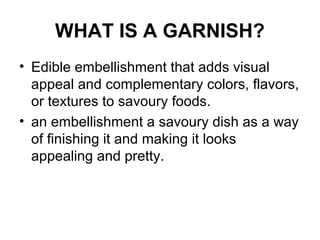
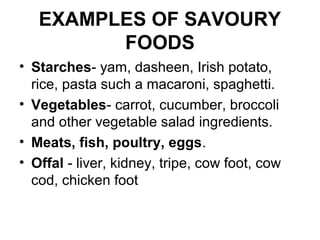
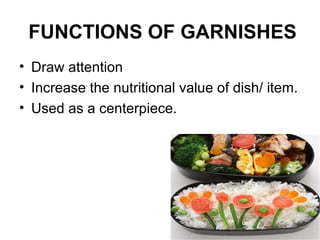
GARNISHES
By
Maxine Pitt
WHAT IS A GARNISH?
• Edible embellishment that adds visual
appeal and complementary colors, flavors,
or textures to savoury foods.
• an embellishment a savoury dish as a way
of finishing it and making it looks
appealing and pretty.
EXAMPLES OF SAVOURY
FOODS
• Starches- yam, dasheen, Irish potato,
rice, pasta such a macaroni, spaghetti.
• Vegetables- carrot, cucumber, broccoli
and other vegetable salad ingredients.
• Meats, fish, poultry, eggs.
• Offal - liver, kidney, tripe, cow foot, cow
cod, chicken foot
FUNCTIONS OF GARNISHES
• Draw attention
• Increase the nutritional value of dish/ item.
• Used as a centerpiece.
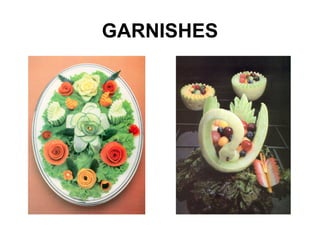
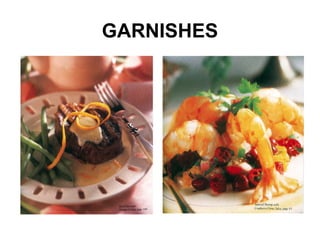
GARNISHES
GARNISHES
CLASSIC FOOD GARNISHES
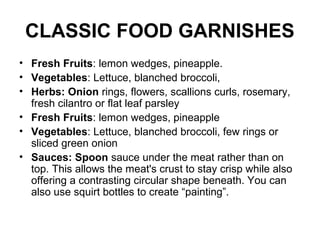
• Fresh Fruits: lemon wedges, pineapple.
• Vegetables: Lettuce, blanched broccoli,
• Herbs: Onion rings, flowers, scallions curls, rosemary,
fresh cilantro or flat leaf parsley
• Fresh Fruits: lemon wedges, pineapple
• Vegetables: Lettuce, blanched broccoli, few rings or
sliced green onion
• Sauces: Spoon sauce under the meat rather than on
top. This allows the meat's crust to stay crisp while also
offering a contrasting circular shape beneath. You can
also use squirt bottles to create “painting”.
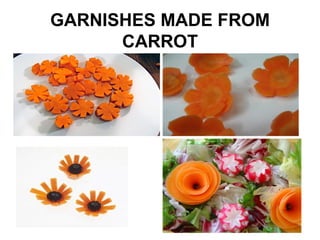
GARNISHES MADE FROM
CARROT
GARNISHES MADE FROM
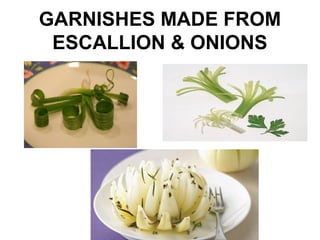
ESCALLION & ONIONS
GARNISHES MADE FROM
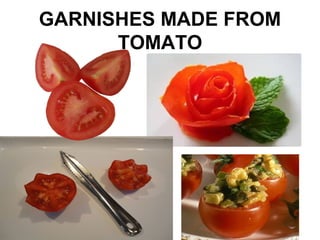
TOMATO
GARNISHES MADE FROM
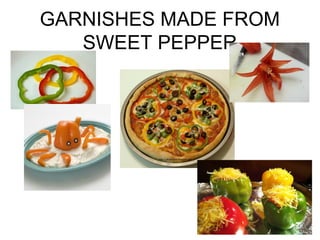
SWEET PEPPER
GARNISHES MADE FROM
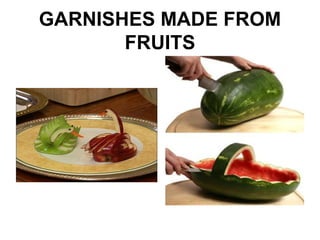
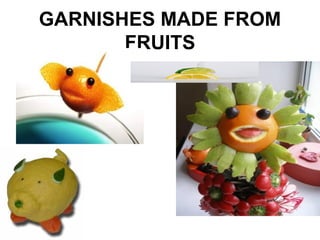
FRUITS
GARNISHES MADE FROM
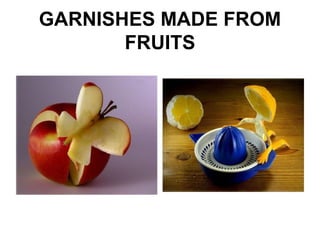
FRUITS
GARNISHES MADE FROM
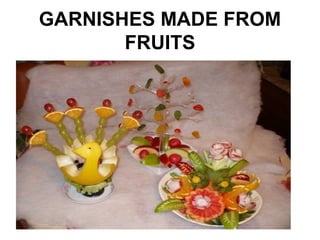
FRUITS
GARNISHES MADE FROM
FRUITS
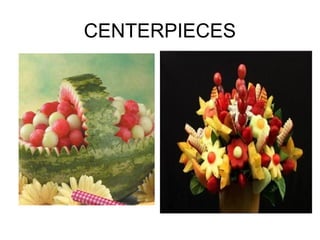
CENTERPIECES
GARNISHING TOOLS
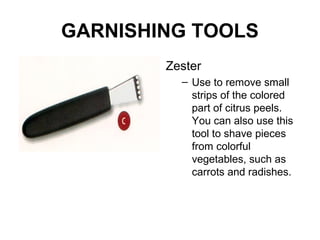
Zester
– Use to remove small
strips of the colored
part of citrus peels.
You can also use this
tool to shave pieces
from colorful
vegetables, such as
carrots and radishes.
GARNISHING TOOLS
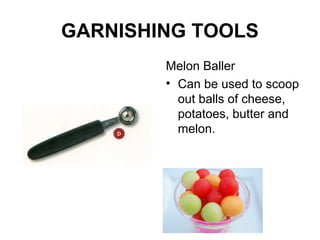
Melon Baller
• Can be used to scoop
out balls of cheese,
potatoes, butter and
melon.
GARNISHES TOOLS
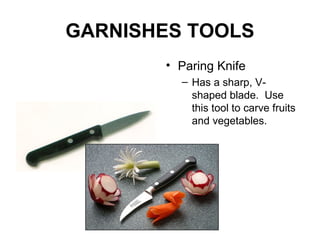
• Paring Knife
– Has a sharp, V-
shaped blade. Use
this tool to carve fruits
and vegetables.
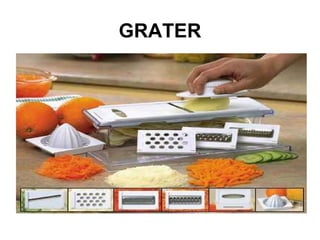
GRATER
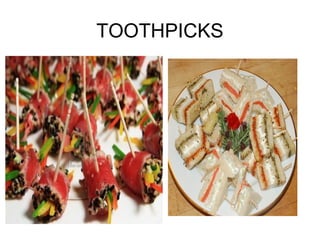
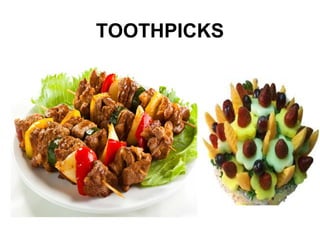
TOOTHPICKS
TOOTHPICKS
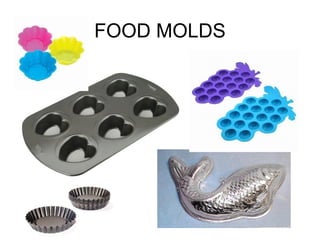
FOOD MOLDS
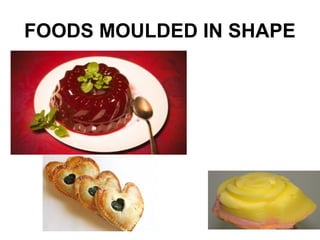
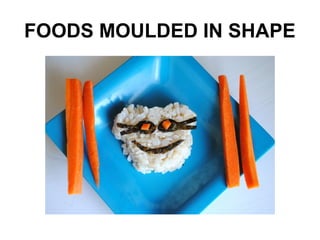
FOODS MOULDED IN SHAPE
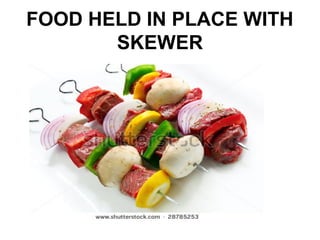
FOOD HELD IN PLACE WITH
SKEWER
GARNISHING GUIDELINES
• Don’t repeat flavors
• Flavor should be compatible with foods.
• Colour should complement foods
• Garnish should not overhang
• Should be edible
• Should be fresh
• Should be arranged artistically
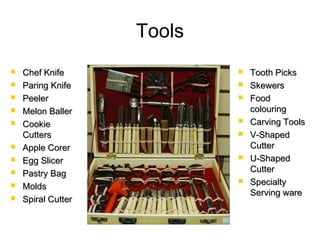
Tools
 Chef KnifeChef Knife
 Paring KnifeParing Knife
 PeelerPeeler
 Melon BallerMelon Baller
 CookieCookie
CuttersCutters
 Apple CorerApple Corer
 Egg SlicerEgg Slicer
 Pastry BagPastry Bag
 MoldsMolds
 Spiral CutterSpiral Cutter
 Tooth PicksTooth Picks
 SkewersSkewers
 FoodFood
colouringcolouring
 Carving ToolsCarving Tools
 V-ShapedV-Shaped
CutterCutter
 U-ShapedU-Shaped
CutterCutter
 SpecialtySpecialty
Serving wareServing ware
OTHER METHODS OF IMPROVING
THE APPERANCE OF FOOD
• Vary colour
• Vary texture
• Vary size and shape of dishes
• Vary Cooking Methods
• Use decorations
• Use colourful sauces
GARNISHING GUIDELINES
• Consider the size of the garnish in relation to the
size of the food and the container. If it’s too
large it may overpower the food.
• Do not over-garnish food
• Keep in mind the cost when working in a food
service operation. The cost of the garnish
should not add too much to the cost of the item.
• Keep food off the rim of the plate.
• Keep space between the items, unless stacking.
Garnishing for Effect
• Don’t rush making garnishes – take your time.Don’t rush making garnishes – take your time.
• Use sharp knives and proper equipmentUse sharp knives and proper equipment
• Ice water preserves some garnishes for a few days.Ice water preserves some garnishes for a few days.
• Some garnishes require you to bend or curl vegetables –Some garnishes require you to bend or curl vegetables –
soak slices in a salt water solution first.soak slices in a salt water solution first.
• Lemon juice can remove the odour from onions and stopLemon juice can remove the odour from onions and stop
an apple from going brown.an apple from going brown.
• Use toothpicks and wooden skewers to hold objectsUse toothpicks and wooden skewers to hold objects
together.together.
• Use vegetables at room temperature because coldUse vegetables at room temperature because cold
vegetables tend to split and break apart.vegetables tend to split and break apart.
MAKING YOUR GARNISH LAST
LONGER
• To maintain and heighten the color of
fresh vegetables, blanch them before
using them to make garnishes. Simply
immerse the produce in boiling water for 1
minute, drain, and plunge into a large bowl
filled with ice water or rinse quickly under
very cold running water. Always dry the
ingredients thoroughly before use.
MAKING YOUR GARNISH LAST
LONGER
• To prevent drying out, keep garnishes
away from air and heat.
• If possible, protect them with an airtight
covering of plastic wrap.
• It's always best to make garnishes just
before serving, but some can be prepared
ahead of time and assembled on the plate
at the last minute.
GUIDELINES FOR SERVING
FOOD
• Plates should be neat and clean.
• Inspect all plates before displaying. Wipe
fingerprints, drops of sauce or specks of
food from their rims with a clean towel.
• When serving food remember :“Hot food
should be placed on a hot plate, cold food
should be placed on a cold plate”
GUIDELINES FOR SERVING
FOOD
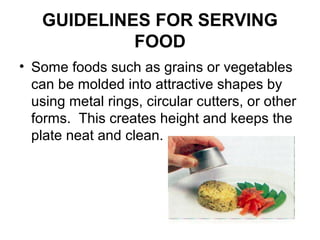
• Some foods such as grains or vegetables
can be molded into attractive shapes by
using metal rings, circular cutters, or other
forms. This creates height and keeps the
plate neat and clean.
GUIDELINES FOR SERVING
FOOD
• Two or three colors on a plate are more
interesting than one.
• Many foods like meats, poultry, and fish have
little color other than shades of brown, gold, or
white. An appropriate addition of color will make
these plates sparkle.
• Even the simplest addition of a sprig of parsley
or watercress adds a lot.
• Shapes: plan for a variety of shapes and forms
as well as colors. Remember, you can prepare
vegetables to give the plate more eye appeal.
GUIDELINES FOR SERVING
FOOD
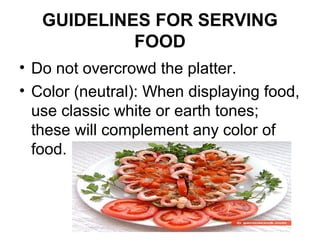
• Do not overcrowd the platter.
• Color (neutral): When displaying food,
use classic white or earth tones;
these will complement any color of
food.
Garnishes for Fish
• Lime slices
• Lime butterfly
• Lime wedges
• Onion cartwheel
• Rings of sweet pepper
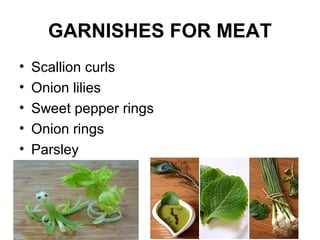
GARNISHES FOR MEAT
• Scallion curls
• Onion lilies
• Sweet pepper rings
• Onion rings
• Parsley
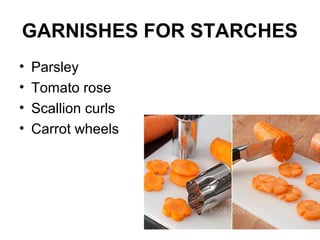
GARNISHES FOR STARCHES
• Parsley
• Tomato rose
• Scallion curls
• Carrot wheels
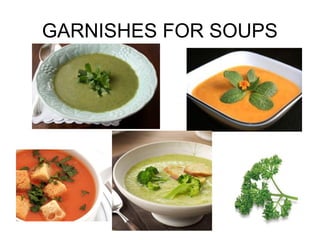
GARNISHES FOR SOUPS
DECORATIONS
By
Mrs. M. Pitt
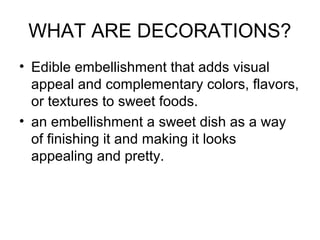
WHAT ARE DECORATIONS?
• Edible embellishment that adds visual
appeal and complementary colors, flavors,
or textures to sweet foods.
• an embellishment a sweet dish as a way
of finishing it and making it looks
appealing and pretty.
EXAMPLES OF SWEET
FOODS
• Cakes
• Pastries
• Fruit salads
• Puddings
• Custards
• Confectioneries
• Juices, punches, drinks
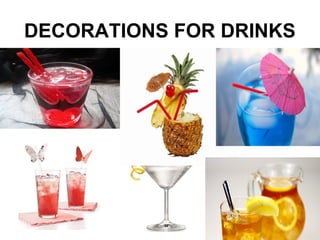
DECORATIONS FOR DRINKS
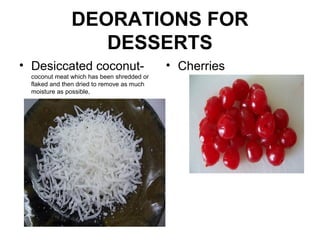
DEORATIONS FOR
DESSERTS
• Desiccated coconut-
coconut meat which has been shredded or
flaked and then dried to remove as much
moisture as possible,
• Cherries
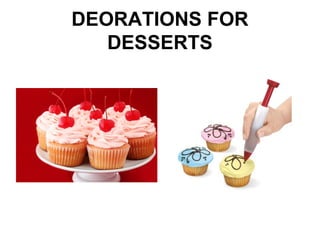
DEORATIONS FOR
DESSERTS
QUOTES
• A garnish is primarily designed to tickle
the eye, but it also should meld
seemlessly with the other flavors on the
plate or contrast with them in a meaningful
way” Barbara Tropp
“Thoughtful presentation… cannot mask
poor-quality, poorly prepared, or bland
tasting food” Labensky p. 1134.

Garnishes pitt maxine

  • 1.
  • 2.
    WHAT IS AGARNISH? • Edible embellishment that adds visual appeal and complementary colors, flavors, or textures to savoury foods. • an embellishment a savoury dish as a way of finishing it and making it looks appealing and pretty.
  • 3.
    EXAMPLES OF SAVOURY FOODS •Starches- yam, dasheen, Irish potato, rice, pasta such a macaroni, spaghetti. • Vegetables- carrot, cucumber, broccoli and other vegetable salad ingredients. • Meats, fish, poultry, eggs. • Offal - liver, kidney, tripe, cow foot, cow cod, chicken foot
  • 4.
    FUNCTIONS OF GARNISHES •Draw attention • Increase the nutritional value of dish/ item. • Used as a centerpiece.
  • 5.
  • 6.
  • 7.
    CLASSIC FOOD GARNISHES •Fresh Fruits: lemon wedges, pineapple. • Vegetables: Lettuce, blanched broccoli, • Herbs: Onion rings, flowers, scallions curls, rosemary, fresh cilantro or flat leaf parsley • Fresh Fruits: lemon wedges, pineapple • Vegetables: Lettuce, blanched broccoli, few rings or sliced green onion • Sauces: Spoon sauce under the meat rather than on top. This allows the meat's crust to stay crisp while also offering a contrasting circular shape beneath. You can also use squirt bottles to create “painting”.
  • 8.
  • 9.
  • 10.
  • 11.
  • 12.
  • 13.
  • 14.
  • 15.
  • 16.
  • 17.
    GARNISHING TOOLS Zester – Useto remove small strips of the colored part of citrus peels. You can also use this tool to shave pieces from colorful vegetables, such as carrots and radishes.
  • 18.
    GARNISHING TOOLS Melon Baller •Can be used to scoop out balls of cheese, potatoes, butter and melon.
  • 19.
    GARNISHES TOOLS • ParingKnife – Has a sharp, V- shaped blade. Use this tool to carve fruits and vegetables.
  • 20.
  • 21.
  • 22.
  • 23.
  • 24.
  • 25.
  • 26.
    FOOD HELD INPLACE WITH SKEWER
  • 27.
    GARNISHING GUIDELINES • Don’trepeat flavors • Flavor should be compatible with foods. • Colour should complement foods • Garnish should not overhang • Should be edible • Should be fresh • Should be arranged artistically
  • 28.
    Tools  Chef KnifeChefKnife  Paring KnifeParing Knife  PeelerPeeler  Melon BallerMelon Baller  CookieCookie CuttersCutters  Apple CorerApple Corer  Egg SlicerEgg Slicer  Pastry BagPastry Bag  MoldsMolds  Spiral CutterSpiral Cutter  Tooth PicksTooth Picks  SkewersSkewers  FoodFood colouringcolouring  Carving ToolsCarving Tools  V-ShapedV-Shaped CutterCutter  U-ShapedU-Shaped CutterCutter  SpecialtySpecialty Serving wareServing ware
  • 29.
    OTHER METHODS OFIMPROVING THE APPERANCE OF FOOD • Vary colour • Vary texture • Vary size and shape of dishes • Vary Cooking Methods • Use decorations • Use colourful sauces
  • 30.
    GARNISHING GUIDELINES • Considerthe size of the garnish in relation to the size of the food and the container. If it’s too large it may overpower the food. • Do not over-garnish food • Keep in mind the cost when working in a food service operation. The cost of the garnish should not add too much to the cost of the item. • Keep food off the rim of the plate. • Keep space between the items, unless stacking.
  • 31.
    Garnishing for Effect •Don’t rush making garnishes – take your time.Don’t rush making garnishes – take your time. • Use sharp knives and proper equipmentUse sharp knives and proper equipment • Ice water preserves some garnishes for a few days.Ice water preserves some garnishes for a few days. • Some garnishes require you to bend or curl vegetables –Some garnishes require you to bend or curl vegetables – soak slices in a salt water solution first.soak slices in a salt water solution first. • Lemon juice can remove the odour from onions and stopLemon juice can remove the odour from onions and stop an apple from going brown.an apple from going brown. • Use toothpicks and wooden skewers to hold objectsUse toothpicks and wooden skewers to hold objects together.together. • Use vegetables at room temperature because coldUse vegetables at room temperature because cold vegetables tend to split and break apart.vegetables tend to split and break apart.
  • 32.
    MAKING YOUR GARNISHLAST LONGER • To maintain and heighten the color of fresh vegetables, blanch them before using them to make garnishes. Simply immerse the produce in boiling water for 1 minute, drain, and plunge into a large bowl filled with ice water or rinse quickly under very cold running water. Always dry the ingredients thoroughly before use.
  • 33.
    MAKING YOUR GARNISHLAST LONGER • To prevent drying out, keep garnishes away from air and heat. • If possible, protect them with an airtight covering of plastic wrap. • It's always best to make garnishes just before serving, but some can be prepared ahead of time and assembled on the plate at the last minute.
  • 34.
    GUIDELINES FOR SERVING FOOD •Plates should be neat and clean. • Inspect all plates before displaying. Wipe fingerprints, drops of sauce or specks of food from their rims with a clean towel. • When serving food remember :“Hot food should be placed on a hot plate, cold food should be placed on a cold plate”
  • 35.
    GUIDELINES FOR SERVING FOOD •Some foods such as grains or vegetables can be molded into attractive shapes by using metal rings, circular cutters, or other forms. This creates height and keeps the plate neat and clean.
  • 36.
    GUIDELINES FOR SERVING FOOD •Two or three colors on a plate are more interesting than one. • Many foods like meats, poultry, and fish have little color other than shades of brown, gold, or white. An appropriate addition of color will make these plates sparkle. • Even the simplest addition of a sprig of parsley or watercress adds a lot. • Shapes: plan for a variety of shapes and forms as well as colors. Remember, you can prepare vegetables to give the plate more eye appeal.
  • 37.
    GUIDELINES FOR SERVING FOOD •Do not overcrowd the platter. • Color (neutral): When displaying food, use classic white or earth tones; these will complement any color of food.
  • 38.
    Garnishes for Fish •Lime slices • Lime butterfly • Lime wedges • Onion cartwheel • Rings of sweet pepper
  • 39.
    GARNISHES FOR MEAT •Scallion curls • Onion lilies • Sweet pepper rings • Onion rings • Parsley
  • 40.
    GARNISHES FOR STARCHES •Parsley • Tomato rose • Scallion curls • Carrot wheels
  • 41.
  • 42.
  • 43.
    WHAT ARE DECORATIONS? •Edible embellishment that adds visual appeal and complementary colors, flavors, or textures to sweet foods. • an embellishment a sweet dish as a way of finishing it and making it looks appealing and pretty.
  • 44.
    EXAMPLES OF SWEET FOODS •Cakes • Pastries • Fruit salads • Puddings • Custards • Confectioneries • Juices, punches, drinks
  • 45.
  • 46.
    DEORATIONS FOR DESSERTS • Desiccatedcoconut- coconut meat which has been shredded or flaked and then dried to remove as much moisture as possible, • Cherries
  • 47.
  • 48.
    QUOTES • A garnishis primarily designed to tickle the eye, but it also should meld seemlessly with the other flavors on the plate or contrast with them in a meaningful way” Barbara Tropp “Thoughtful presentation… cannot mask poor-quality, poorly prepared, or bland tasting food” Labensky p. 1134.