FAQ on Chemical Reaction Engineering
Prepared by- Mr. Vishal B. Thakare
Assistant Professor
(M. Tech Chemical, SVNIT Surat)
vishalbt88@gmail.com
Q.1 What is the rate of reaction?
Rate of reaction is defined as the change in number of moles per
unit volume per unit time.
Q.2 What is negative catalyst?
Catalyst which retards the rate of reaction is called negative
catalyst.
Q.3 What is catalyst promoter?
Catalyst promoter improves the activity of catalyst.
Q.4 How will you know whether a chemical reaction is feasible or
not?
Feasibility of chemical reaction is depending on Gibbs free
energy.
In order for a reaction to be feasible the overall free energy change
ΔGsys must be <0.
Q.5 What is trickle bed reactor?
A trickled bed reactor is one in which all three phases solid, liquid
and gas employed.
Q.6 What is autocatalytic reaction?
Reaction in which one of the product of reaction acts as catalyst
is called autocatalytic reaction.
Q.7 List the different types of chemical reactor
i)Continuous stirred tank reactor
ii)Plug flow reactor
iii)Batch reactor
iv)Semi batch reactor
v) Pack bed reactor
vi)Fluidized bed reactor
Q.8 What is order of reaction?
Order of reaction is summation of powers of concentration of
reactant.
When the rate of reaction is directly proportional to the
concentration of only one reactant, reaction is said to be first order.
If A Product, rate of disappearance of A is given as
-rA = -dCA/dt = KCA
Q.9 What is zero order of reaction?
When the rate of reaction is independent of the concentration
reactant, reaction is said to be zero order.
If A Product, rate of disappearance of A is given as
-rA = -dCA/dt = KC0
A
Q.10 What is half life method?
Time required to reduce the concentration of the reactant to half
of its original value is called half life(t1/2) method.
Q.11 Define space time and space velocity
Space time (τ) – It is time required to process one reactor volume
of feed at specified condition.
Ex.- Space time of 2 min means that every 2 min one reactor
volume of feed being treated.
Space velocity (s)- It is number of reactor volume of feed treated in a
unit time.
Ex.- Space velocity of 4/h means four reactor can be treated in four
hour.
Q.12 What do you mean by constant volume reactor?
If the number of moles of reactant is equal to number of mole of
product, reactor is said to be constant volume batch reactor.
Q.13 What is kinetic data?
Data which is obtained during course of reaction like temperature,
pressure concentration etc. is called kinetic data.
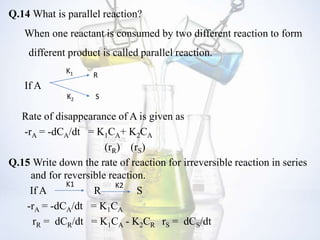
Q.14 What is parallel reaction?
When one reactant is consumed by two different reaction to form
different product is called parallel reaction.
If A
Rate of disappearance of A is given as
-rA = -dCA/dt = K1CA+ K2CA
(rR) (rS)
Q.15 Write down the rate of reaction for irreversible reaction in series
and for reversible reaction.
If A R S
-rA = -dCA/dt = K1CA
rR = dCR/dt = K1CA - K2CR rS = dCS/dt
R
S
K1
K2
K2K1
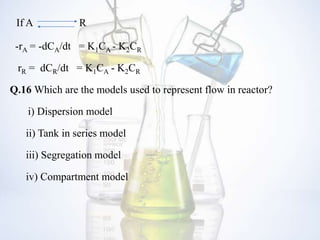
If A R
-rA = -dCA/dt = K1CA - K2CR
rR = dCR/dt = K1CA - K2CR
Q.16 Which are the models used to represent flow in reactor?
i) Dispersion model
ii) Tank in series model
iii) Segregation model
iv) Compartment model
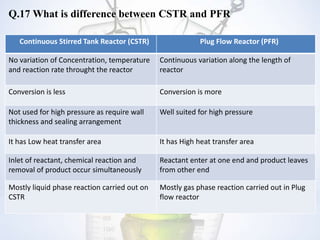
Q.17 What is difference between CSTR and PFR
Continuous Stirred Tank Reactor (CSTR) Plug Flow Reactor (PFR)
No variation of Concentration, temperature
and reaction rate throught the reactor
Continuous variation along the length of
reactor
Conversion is less Conversion is more
Not used for high pressure as require wall
thickness and sealing arrangement
Well suited for high pressure
It has Low heat transfer area It has High heat transfer area
Inlet of reactant, chemical reaction and
removal of product occur simultaneously
Reactant enter at one end and product leaves
from other end
Mostly liquid phase reaction carried out on
CSTR
Mostly gas phase reaction carried out in Plug
flow reactor
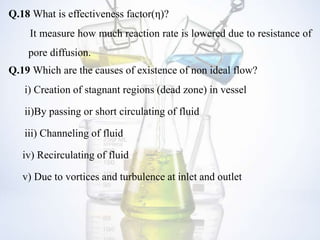
Q.18 What is effectiveness factor(η)?
It measure how much reaction rate is lowered due to resistance of
pore diffusion.
Q.19 Which are the causes of existence of non ideal flow?
i) Creation of stagnant regions (dead zone) in vessel
ii)By passing or short circulating of fluid
iii) Channeling of fluid
iv) Recirculating of fluid
v) Due to vortices and turbulence at inlet and outlet

FAQ on chemical Reaction Engineering

  • 1.
    FAQ on ChemicalReaction Engineering Prepared by- Mr. Vishal B. Thakare Assistant Professor (M. Tech Chemical, SVNIT Surat) vishalbt88@gmail.com
  • 2.
    Q.1 What isthe rate of reaction? Rate of reaction is defined as the change in number of moles per unit volume per unit time. Q.2 What is negative catalyst? Catalyst which retards the rate of reaction is called negative catalyst. Q.3 What is catalyst promoter? Catalyst promoter improves the activity of catalyst. Q.4 How will you know whether a chemical reaction is feasible or not? Feasibility of chemical reaction is depending on Gibbs free energy.
  • 3.
    In order fora reaction to be feasible the overall free energy change ΔGsys must be <0. Q.5 What is trickle bed reactor? A trickled bed reactor is one in which all three phases solid, liquid and gas employed. Q.6 What is autocatalytic reaction? Reaction in which one of the product of reaction acts as catalyst is called autocatalytic reaction.
  • 4.
    Q.7 List thedifferent types of chemical reactor i)Continuous stirred tank reactor ii)Plug flow reactor iii)Batch reactor iv)Semi batch reactor v) Pack bed reactor vi)Fluidized bed reactor
  • 5.
    Q.8 What isorder of reaction? Order of reaction is summation of powers of concentration of reactant. When the rate of reaction is directly proportional to the concentration of only one reactant, reaction is said to be first order. If A Product, rate of disappearance of A is given as -rA = -dCA/dt = KCA Q.9 What is zero order of reaction? When the rate of reaction is independent of the concentration reactant, reaction is said to be zero order.
  • 6.
    If A Product,rate of disappearance of A is given as -rA = -dCA/dt = KC0 A Q.10 What is half life method? Time required to reduce the concentration of the reactant to half of its original value is called half life(t1/2) method. Q.11 Define space time and space velocity Space time (τ) – It is time required to process one reactor volume of feed at specified condition. Ex.- Space time of 2 min means that every 2 min one reactor volume of feed being treated.
  • 7.
    Space velocity (s)-It is number of reactor volume of feed treated in a unit time. Ex.- Space velocity of 4/h means four reactor can be treated in four hour. Q.12 What do you mean by constant volume reactor? If the number of moles of reactant is equal to number of mole of product, reactor is said to be constant volume batch reactor. Q.13 What is kinetic data? Data which is obtained during course of reaction like temperature, pressure concentration etc. is called kinetic data.
  • 8.
    Q.14 What isparallel reaction? When one reactant is consumed by two different reaction to form different product is called parallel reaction. If A Rate of disappearance of A is given as -rA = -dCA/dt = K1CA+ K2CA (rR) (rS) Q.15 Write down the rate of reaction for irreversible reaction in series and for reversible reaction. If A R S -rA = -dCA/dt = K1CA rR = dCR/dt = K1CA - K2CR rS = dCS/dt R S K1 K2 K2K1
  • 9.
    If A R -rA= -dCA/dt = K1CA - K2CR rR = dCR/dt = K1CA - K2CR Q.16 Which are the models used to represent flow in reactor? i) Dispersion model ii) Tank in series model iii) Segregation model iv) Compartment model
  • 10.
    Q.17 What isdifference between CSTR and PFR Continuous Stirred Tank Reactor (CSTR) Plug Flow Reactor (PFR) No variation of Concentration, temperature and reaction rate throught the reactor Continuous variation along the length of reactor Conversion is less Conversion is more Not used for high pressure as require wall thickness and sealing arrangement Well suited for high pressure It has Low heat transfer area It has High heat transfer area Inlet of reactant, chemical reaction and removal of product occur simultaneously Reactant enter at one end and product leaves from other end Mostly liquid phase reaction carried out on CSTR Mostly gas phase reaction carried out in Plug flow reactor
  • 11.
    Q.18 What iseffectiveness factor(η)? It measure how much reaction rate is lowered due to resistance of pore diffusion. Q.19 Which are the causes of existence of non ideal flow? i) Creation of stagnant regions (dead zone) in vessel ii)By passing or short circulating of fluid iii) Channeling of fluid iv) Recirculating of fluid v) Due to vortices and turbulence at inlet and outlet