Five Factors Affecting
Leaning Language
Strategies
Prepared by : Nik Siti Maisarah Binti Abd
Rahman

A143827
Prepared for : Prof. Dr. Mohamed Amin Embi
AND THE FACTORS ARE :
Intelligence
Aptitude
Personality
Motivation and Attitude

Learning Styles
INTELLIGENCE
Referring to performance on certain kinds of
tests.

IQ scores were a good means of predicting
success in LLS which involves analysis and rule
learning.
May play a less important role in classrooms
where the focus on communication and
interaction.
APTITUDE
Special abilities to learn quickly.
Aptitude components ; i) identify and
memorize new sounds, ii) understand
function of words, iii) figure out grammatical
rules , iv) memory for new words
 Learner’s strengths and weaknesses in these

different components may account for their
ability to succeed in different type of
instructional programs.
PERSONALITY
(BY ASHWAQ AL-HARBI)
There are numbers of personality traits that have
been proposed as likely to effect LLS and they are
;
a. Anxiety
b. Extroversion

c. Inhibition, etc …
a. Anxiety
Refers to learners’ feelings of worry and stress
when learning language strategies.

Based on researches, it is dynamic and
dependent on situations or circumstances.
However, it has been argued that not all anxiety
is bad and certain amount of tension can have
positive effect and even facilitate learning. For
example, a learner’s willingness to communicate
has been related to anxiety.
b. Extroversion
This kind of trait is well suited to language learning.
On the other hand, researches are not entirely agree
on this ;a. Some studies have found that success in language

learning is correlated with learners’ scores on
questionnaires measuring characteristics associated
with extroversion such as assertiveness and
adventurousness.
b. While some found that many successful language

learners do no get high scores on measure of
extroversion.
c. Inhibition
Discourage risk-taking which is necessary for
progress in language learning.

A problem for adolescents who are more selfconscious than younger learners.
Alexander Guiora : inhibition is a negative force
at least for second language pronounciation
perfomance.
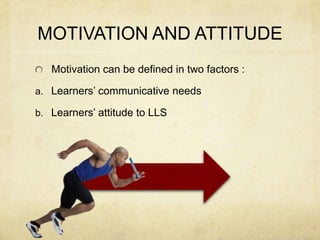
MOTIVATION AND ATTITUDE
Motivation can be defined in two factors :
a. Learners’ communicative needs
b. Learners’ attitude to LLS
MOTIVATION IN THE
CLASSROOM
Levels of motivation in relation to pedagogical
practices :
a. Motivating students into the lesson
b. Varying the activities, tasks and materials
c. Using cooperative rather than competitive goals
LEARNING STYLES
Learning style is an individual’s habits or pattern
in acquiring and processing information in
learning situations.
There are three main learning styles which are ;
a. Visual learners ; sight

b. Auditory learners ; hearing
c. Kinesthetic learners ; physical action
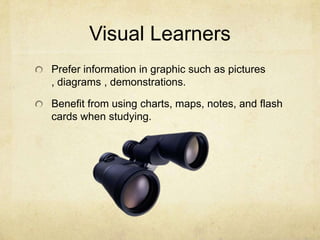
Visual Learners
Prefer information in graphic such as pictures
, diagrams , demonstrations.

Benefit from using charts, maps, notes, and flash
cards when studying.
Auditory Learners
Prefer to hear information spoken.
May read aloud to themselves.
Playing background music while studying.
Often avoid eye contact in order to concentrate.
Kinesthetic Learners
Using physical as primary mode for taking
information.
Prefer writing when collecting important facts.

Role-playing helps to study and remember better.
Creating study sheet connected to vivid
examples.

Five Factors That Affecting Learning Language Strategies

  • 1.
    Five Factors Affecting LeaningLanguage Strategies Prepared by : Nik Siti Maisarah Binti Abd Rahman A143827 Prepared for : Prof. Dr. Mohamed Amin Embi
  • 2.
    AND THE FACTORSARE : Intelligence Aptitude Personality Motivation and Attitude Learning Styles
  • 3.
    INTELLIGENCE Referring to performanceon certain kinds of tests. IQ scores were a good means of predicting success in LLS which involves analysis and rule learning. May play a less important role in classrooms where the focus on communication and interaction.
  • 4.
    APTITUDE Special abilities tolearn quickly. Aptitude components ; i) identify and memorize new sounds, ii) understand function of words, iii) figure out grammatical rules , iv) memory for new words  Learner’s strengths and weaknesses in these different components may account for their ability to succeed in different type of instructional programs.
  • 5.
    PERSONALITY (BY ASHWAQ AL-HARBI) Thereare numbers of personality traits that have been proposed as likely to effect LLS and they are ; a. Anxiety b. Extroversion c. Inhibition, etc …
  • 6.
    a. Anxiety Refers tolearners’ feelings of worry and stress when learning language strategies. Based on researches, it is dynamic and dependent on situations or circumstances. However, it has been argued that not all anxiety is bad and certain amount of tension can have positive effect and even facilitate learning. For example, a learner’s willingness to communicate has been related to anxiety.
  • 7.
    b. Extroversion This kindof trait is well suited to language learning. On the other hand, researches are not entirely agree on this ;a. Some studies have found that success in language learning is correlated with learners’ scores on questionnaires measuring characteristics associated with extroversion such as assertiveness and adventurousness. b. While some found that many successful language learners do no get high scores on measure of extroversion.
  • 8.
    c. Inhibition Discourage risk-takingwhich is necessary for progress in language learning. A problem for adolescents who are more selfconscious than younger learners. Alexander Guiora : inhibition is a negative force at least for second language pronounciation perfomance.
  • 9.
    MOTIVATION AND ATTITUDE Motivationcan be defined in two factors : a. Learners’ communicative needs b. Learners’ attitude to LLS
  • 10.
    MOTIVATION IN THE CLASSROOM Levelsof motivation in relation to pedagogical practices : a. Motivating students into the lesson b. Varying the activities, tasks and materials c. Using cooperative rather than competitive goals
  • 11.
    LEARNING STYLES Learning styleis an individual’s habits or pattern in acquiring and processing information in learning situations. There are three main learning styles which are ; a. Visual learners ; sight b. Auditory learners ; hearing c. Kinesthetic learners ; physical action
  • 12.
    Visual Learners Prefer informationin graphic such as pictures , diagrams , demonstrations. Benefit from using charts, maps, notes, and flash cards when studying.
  • 13.
    Auditory Learners Prefer tohear information spoken. May read aloud to themselves. Playing background music while studying. Often avoid eye contact in order to concentrate.
  • 14.
    Kinesthetic Learners Using physicalas primary mode for taking information. Prefer writing when collecting important facts. Role-playing helps to study and remember better. Creating study sheet connected to vivid examples.