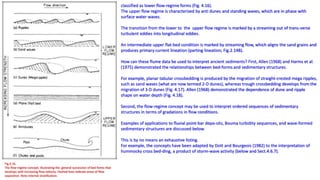
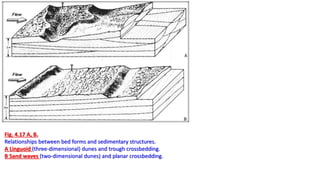
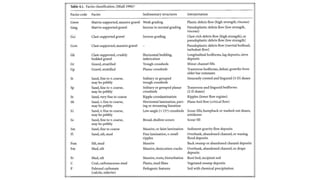
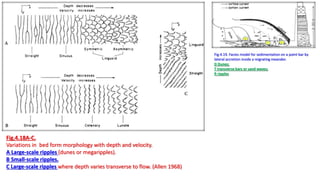
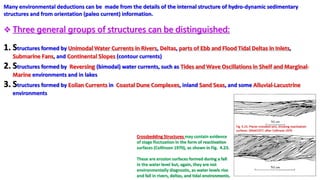
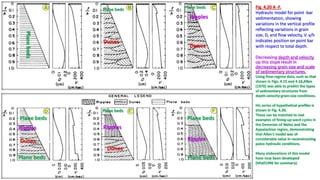
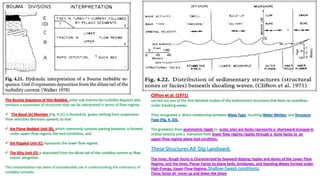
This document discusses the use of flow regime concepts and sedimentary structures to interpret ancient sedimentary environments. It provides examples of how different bedforms relate to flow conditions and produce distinct sedimentary structures. Megaripples produce planar cross-bedding while 3D dunes produce trough cross-bedding. Bouma sequences represent a succession of structures deposited from turbidity currents as flow velocities decrease upwards. Wave structures also relate to flow regime, ranging from ripples to planar beds as energy increases shoreward. These relationships allow ancient strata to be interpreted in terms of processes like river channel migration or turbidity currents.