PART B
Testing of facial nerve
Identification of facial nerve
Complications of facial dissection
Facial nerve lesions
Acquired & congenital anomalies
CONTENTSPART A
Introduction
Embryology
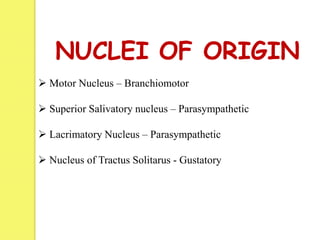
Nuclei of origin
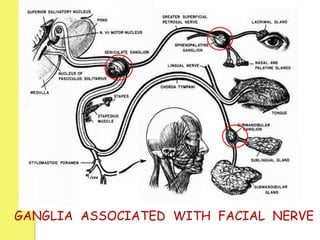
Ganglia associated
Course & relations
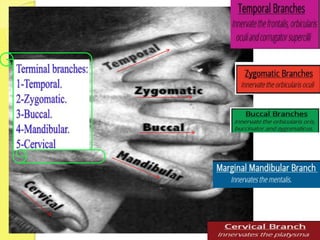
Branches of facial nerve
Functional components
Blood supply
variations of nerve
Age changes
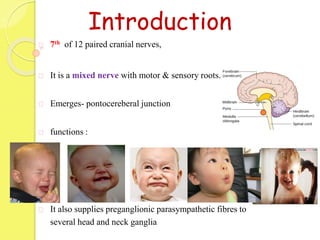
7th of 12 paired cranial nerves,
It is a mixed nerve with motor & sensory roots.
Emerges- pontocereberal junction
functions :
It also supplies preganglionic parasympathetic fibres to
several head and neck ganglia
Introduction
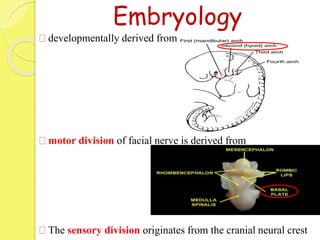
developmentally derived from
motor division of facial nerve is derived from
The sensory division originates from the cranial neural crest
Embryology
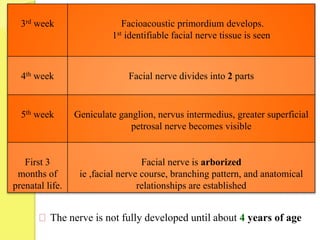
The nerve is not fully developed until about 4 years of age
3rd week Facioacoustic primordium develops.
1st identifiable facial nerve tissue is seen
4th week Facial nerve divides into 2 parts
5th week Geniculate ganglion, nervus intermedius, greater superficial
petrosal nerve becomes visible
First 3
months of
prenatal life.
Facial nerve is arborized
ie ,facial nerve course, branching pattern, and anatomical
relationships are established
NUCLEI OF ORIGIN
ORIGIN OF FACIAL
NERVE
&
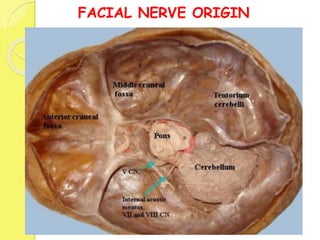
FACIAL NERVE ORIGIN
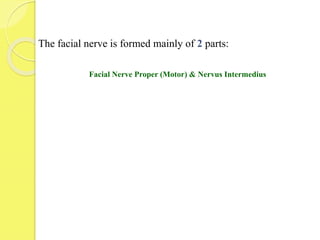
Facial Nerve Proper (Motor) & Nervus Intermedius
The facial nerve is formed mainly of 2 parts:
NUCLEI OF ORIGIN
 Motor Nucleus – Branchiomotor
 Superior Salivatory nucleus – Parasympathetic
 Lacrimatory Nucleus – Parasympathetic
 Nucleus of Tractus Solitarus - Gustatory
GANGLIA ASSOCIATED WITH
THE FACIAL NERVE
Geniculate ganglion
Submandibular ganglion
Pterygopalatine ganglion
GANGLIA ASSOCIATED WITH FACIAL NERVE
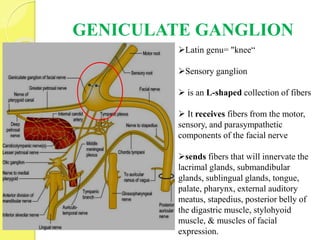
GENICULATE GANGLION
Latin genu= "knee“
Sensory ganglion
 is an L-shaped collection of fibers
 It receives fibers from the motor,
sensory, and parasympathetic
components of the facial nerve
sends fibers that will innervate the
lacrimal glands, submandibular
glands, sublingual glands, tongue,
palate, pharynx, external auditory
meatus, stapedius, posterior belly of
the digastric muscle, stylohyoid
muscle, & muscles of facial
expression.
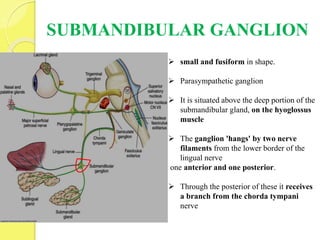
SUBMANDIBULAR GANGLION
 small and fusiform in shape.
 Parasympathetic ganglion
 It is situated above the deep portion of the
submandibular gland, on the hyoglossus
muscle
 The ganglion 'hangs' by two nerve
filaments from the lower border of the
lingual nerve
one anterior and one posterior.
 Through the posterior of these it receives
a branch from the chorda tympani
nerve
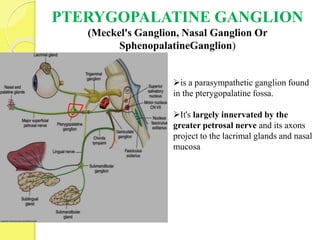
PTERYGOPALATINE GANGLION
(Meckel's Ganglion, Nasal Ganglion Or
SphenopalatineGanglion)
is a parasympathetic ganglion found
in the pterygopalatine fossa.
It's largely innervated by the
greater petrosal nerve and its axons
project to the lacrimal glands and nasal
mucosa
Course & relations:
I- INTRACRANIAL
(INTRAPETROSAL) COURSE
II- EXTRACRANIAL COURSE
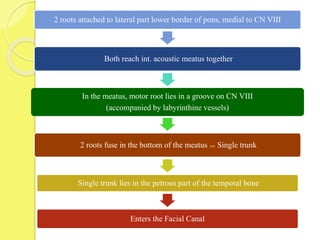
2 roots attached to lateral part lower border of pons, medial to CN VIII
Both reach int. acoustic meatus together
In the meatus, motor root lies in a groove on CN VIII
(accompanied by labyrinthine vessels)
2 roots fuse in the bottom of the meatus Single trunk
Single trunk lies in the petrous part of the temporal bone
Enters the Facial Canal
Overview Of Facial
Nerve Anatomy In
The Skull
Lacerate foramen
Facial
canal
Internal
Acoustic
Meatus
Stylomastoid
Foramen
Hiatus of canal of greater
superficial petrosal nerve
Pterygoid canalGreater
superficial
Petrosal
nerve
(GSPN)
Petrotympanic
fissure
Greater and
lesser palatine
canals
Chorda tympani nerve
Facial nerve
Facial nerve
Posterior
Cranial
Fossa (PCF)
Inferior Orbital Fissure
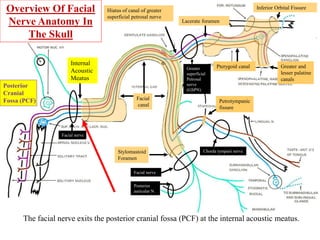
The facial nerve exits the posterior cranial fossa (PCF) at the internal acoustic meatus.
Posterior
auricular N.
Overview of Facial
Nerve anatomy in
the skull
Lacerate foramen
Facial
canal
Internal
Acoustic
Meatus
Stylomastoid
Foramen
Hiatus of canal of greater
superficial petrosal nerve
Pterygoid canalGreater
superficial
Petrosal
nerve
(GSPN)
Petrotympanic
fissure
Greater and
lesser palatine
canals
Chorda tympani
Facial nerve
Facial nerve
Posterior
Cranial
Fossa
Inferior Orbital Fissure
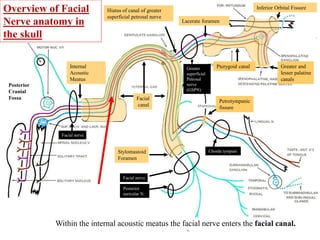
Within the internal acoustic meatus the facial nerve enters the facial canal.
Posterior
auricular N.
Overview of Facial
Nerve anatomy in
the skull
Lacerate foramen
Internal
Acoustic
Meatus
Stylomastoid
Foramen
Hiatus of canal of greater
superficial petrosal nerve
Pterygoid canalGreater
superficial
Petrosal
nerve
(GSPN)
Petrotympanic
fissure
Greater and
lesser palatine
canals
Chorda tympani
Facial nerve
Facial nerve
Posterior
Cranial
Fossa
Inferior Orbital Fissure
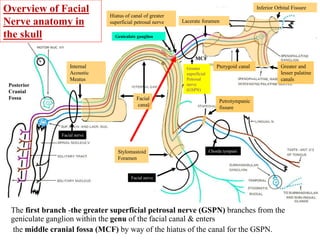
The first branch -the greater superficial petrosal nerve (GSPN) branches from the
geniculate ganglion within the genu of the facial canal & enters
the middle cranial fossa (MCF) by way of the hiatus of the canal for the GSPN.
Geniculate ganglion
Facial
canal
MCF
Overview of Facial
Nerve anatomy in
the skull
Lacerate foramen
Facial
canal
Internal
Acoustic
Meatus
Stylomastoid
Foramen
Hiatus of canal of greater
superficial petrosal nerve
Pterygoid canalGreater
superficial
Petrosal
nerve
(GSPN)
Greater and
lesser palatine
canals
Chorda tympani
Facial nerve
Facial nerve
Posterior
Cranial
Fossa
Inferior Orbital Fissure
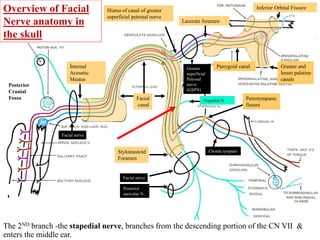
The 2ND branch -the stapedial nerve, branches from the descending portion of the CN VII &
enters the middle ear.
Stapedial N. Petrotympanic
fissure
Posterior
auricular N.
Overview of Facial
Nerve anatomy in
the skull
Lacerate foramen
Facial
canal
Internal
Acoustic
Meatus
Stylomastoid
Foramen
Hiatus of canal of greater
superficial petrosal nerve
Pterygoid canalGreater
superficial
Petrosal
nerve
(GSPN)
Petrotympanic
fissure
Greater and
lesser palatine
canals
Chorda tympani N.
Facial nerve
Facial nerve
Posterior
Cranial
Fossa
Inferior Orbital Fissure
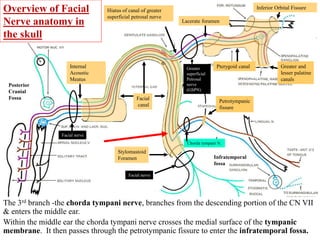
The 3rd branch -the chorda tympani nerve, branches from the descending portion of the CN VII
& enters the middle ear.
Within the middle ear the chorda tympani nerve crosses the medial surface of the tympanic
membrane. It then passes through the petrotympanic fissure to enter the infratemporal fossa.
Infratemporal
fossa
Overview of Facial
Nerve anatomy in
the skull
Lacerate foramen
Facial
canal
Internal
Acoustic
Meatus
Stylomastoid
Foramen
Hiatus of canal of greater
superficial petrosal nerve
Pterygoid canalGreater
superficial
Petrosal
nerve
(GSPN)
Petrotympanic
fissure
Greater and
lesser palatine
canals
Chorda tympani
Facial nerve
Facial nerve
Posterior
Cranial
Fossa
Inferior Orbital Fissure
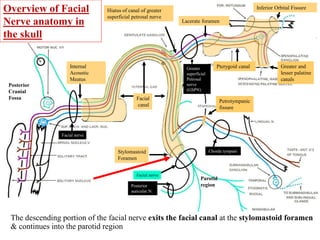
The descending portion of the facial nerve exits the facial canal at the stylomastoid foramen
& continues into the parotid region
Parotid
regionPosterior
auricular N.
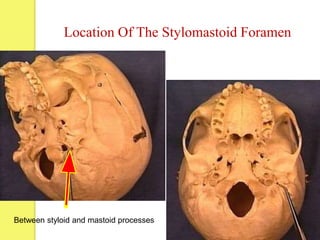
Location Of The Stylomastoid Foramen
Between styloid and mastoid processes
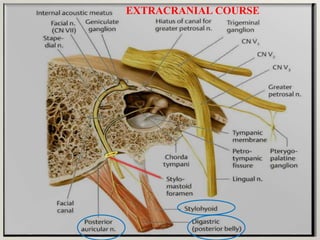
EXTRACRANIAL COURSE
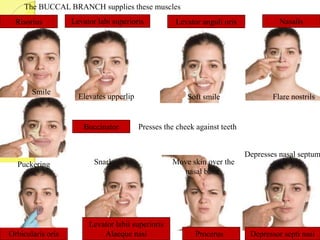
Risorius
Buccinator
Levator labi superioris Levator anguli oris Nasalis
Orbicularis oris Depressor septi nasiProcerus
The BUCCAL BRANCH supplies these muscles
Levator labii superioris
Alaeque nasi
Elevates upperlip
Snarl
Soft smile Flare nostrils
Puckering Move skin over the
nasal bone
Depresses nasal septum
Presses the cheek against teeth
Smile
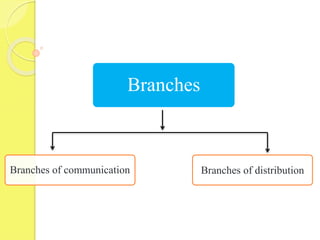
Branches
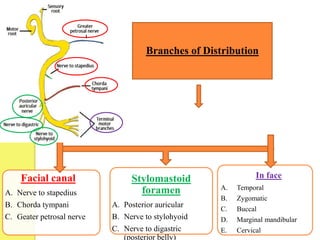
Branches of communication Branches of distribution
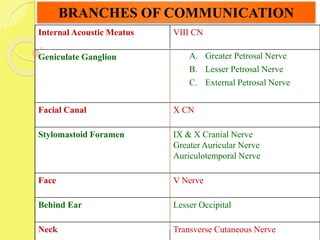
Internal Acoustic Meatus VIII CN
Geniculate Ganglion A. Greater Petrosal Nerve
B. Lesser Petrosal Nerve
C. External Petrosal Nerve
Facial Canal X CN
Stylomastoid Foramen IX & X Cranial Nerve
Greater Auricular Nerve
Auriculotemporal Nerve
Face V Nerve
Behind Ear Lesser Occipital
Neck Transverse Cutaneous Nerve
BRANCHES OF COMMUNICATION
Branches of Distribution
Facial canal
A. Nerve to stapedius
B. Chorda tympani
C. Geater petrosal nerve
In face
A. Temporal
B. Zygomatic
C. Buccal
D. Marginal mandibular
E. Cervical
Stylomastoid
foramen
A. Posterior auricular
B. Nerve to stylohyoid
C. Nerve to digastric
(posterior belly)
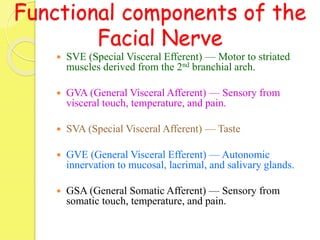
Functional components of the
Facial Nerve
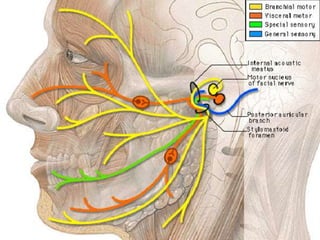
 SVE (Special Visceral Efferent) — Motor to striated
muscles derived from the 2nd branchial arch.
 GVA (General Visceral Afferent) — Sensory from
visceral touch, temperature, and pain.
 SVA (Special Visceral Afferent) — Taste
 GVE (General Visceral Efferent) — Autonomic
innervation to mucosal, lacrimal, and salivary glands.
 GSA (General Somatic Afferent) — Sensory from
somatic touch, temperature, and pain.
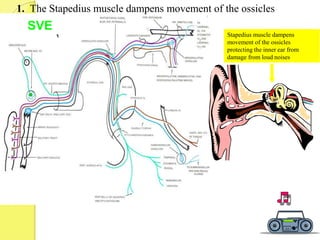
Stapedius muscle dampens
movement of the ossicles
protecting the inner ear from
damage from loud noises
SVE
1. The Stapedius muscle dampens movement of the ossicles
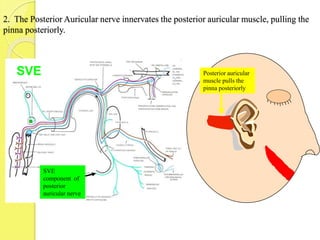
2. The Posterior Auricular nerve innervates the posterior auricular muscle, pulling the
pinna posteriorly.
SVE
component of
posterior
auricular nerve
Posterior auricular
muscle pulls the
pinna posteriorly
SVE
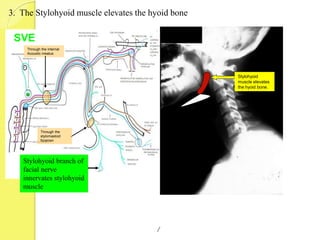
Stylohyoid
muscle elevates
the hyoid bone.
Through the internal
Acoustic meatus
Through the
stylomastoid
foramen
3. The Stylohyoid muscle elevates the hyoid bone
Stylohyoid branch of
facial nerve
innervates stylohyoid
muscle
SVE
Through the
stylomastoid
foramen
4. The Posterior belly of digastric muscle elevates the hyoid bone
Posterior belly
of digastric
branch of facial
nerve
innervates
posterior belly
of digastric
muscle.
Posterior belly of
digastric muscle
elevates the
hyoid bone
SVE
Through the internal
acoustic meatus
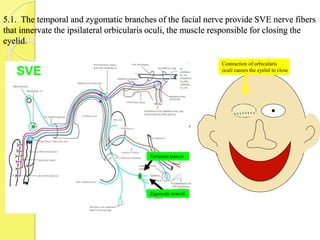
5.1. The temporal and zygomatic branches of the facial nerve provide SVE nerve fibers
that innervate the ipsilateral orbicularis oculi, the muscle responsible for closing the
eyelid.
Temporal branch
Zygomatic branch
SVE
Contraction of orbicularis
oculi causes the eyelid to close
5.2 The zygomatic and buccal branches of the facial nerve innervate the ipsilateral
zygomaticus major muscle, the main muscle responsible for smiling.
Zygomatic branch
SVE
Zygomaticus
major muscle
Contraction of the zygomaticus major
muscle
causes smiling
5.3The buccal branch of the facial nerve innervates the buccinator muscle, the muscle
responsible for holding the cheek against the teeth, thus positioning food for chewing.
Buccal branch of
facial nerve innervates
Buccinator muscle.
SVE
Contraction of the buccinator muscle
causes tensing of the cheek which
helps position food within the occusal
plane
for chewing
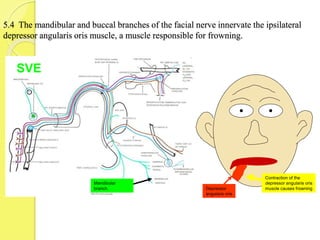
5.4 The mandibular and buccal branches of the facial nerve innervate the ipsilateral
depressor angularis oris muscle, a muscle responsible for frowning.
Mandibular
branch
SVE
Depressor
angularis oris
Contraction of the
depressor angularis oris
muscle causes frowning
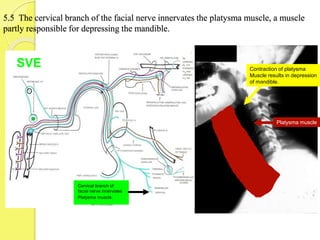
5.5 The cervical branch of the facial nerve innervates the platysma muscle, a muscle
partly responsible for depressing the mandible.
Platysma muscle
Cervical branch of
facial nerve innervates
Platysma muscle.
Contraction of platysma
Muscle results in depression
of mandible.
SVE
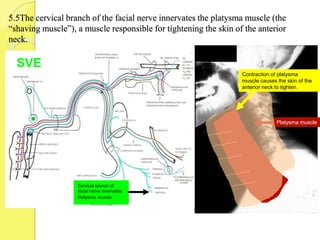
5.5The cervical branch of the facial nerve innervates the platysma muscle (the
“shaving muscle”), a muscle responsible for tightening the skin of the anterior
neck.
Platysma muscle
Cervical branch of
facial nerve innervates
Platysma muscle.
Contraction of platysma
muscle causes the skin of the
anterior neck to tighten.
SVE
Stapedius muscle
dampens
movement of
ossicles.
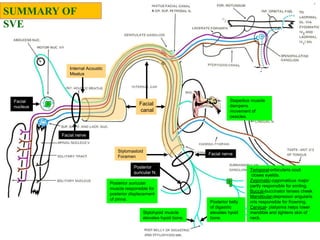
SUMMARY OF
SVE
Facial
canal
Internal Acoustic
Meatus
Stylomastoid
Foramen
Temporal-orbicularis oculi
closes eyelids.
Zygomatic-zygomaticus major
partly responsible for smiling.
Buccal-buccinator tenses cheek
Mandibular-depressor angularis
oris responsible for frowning.
Cervical- platysma helps lower
mandible and tightens skin of
neck.
Posterior auricular
muscle responsible for
posterior displacement
of pinna.
Facial nerve
Facial nerve
Posterior belly
of digastric
elevates hyoid
bone.
Stylohyoid muscle
elevates hyoid bone.
Posterior
auricular N.
Facial
nucleus
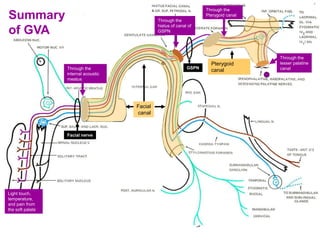
GVA Component of the Facial Nerve
Light touch, temperature, and pain sensation from the soft
palate via the greater superficial petrosal nerve (GSPN).
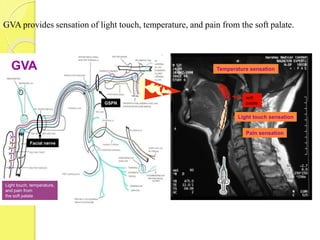
GVA provides sensation of light touch, temperature, and pain from the soft palate.
soft
palate
Light touch, temperature,
and pain from
the soft palate
GVA
Light touch sensation
Temperature sensation
Pain sensation
GSPN
Facial nerve
Through the
hiatus of canal of
GSPN
Light touch,
temperature,
and pain from
the soft palate
Through the
internal acoustic
meatus
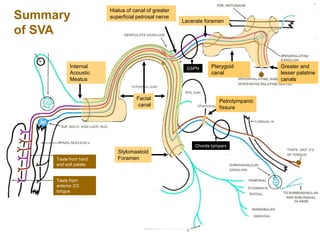
Summary
of GVA
Through the
Pterygoid canal
Pterygoid
canal
Facial
canal
Through the
lesser palatine
canalGSPN
Facial nerve
SVA Component of theFacial Nerve
1. Taste from the hard and soft palate via the greater superficial
petrosal nerve (GSPN).
2. Taste from the anterior 2/3 of the tongue via the chorda tympani
nerve.
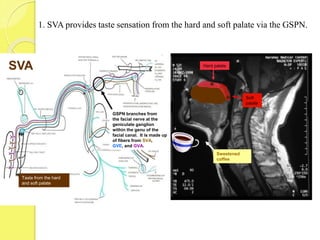
1. SVA provides taste sensation from the hard and soft palate via the GSPN.
Soft
palate
Taste from the hard
and soft palate
Hard palate
Co
Sweetened
coffee
SVA
GSPN branches from
the facial nerve at the
geniculate ganglion
within the genu of the
facial canal. It is made up
of fibers from SVA,
GVE, and GVA.
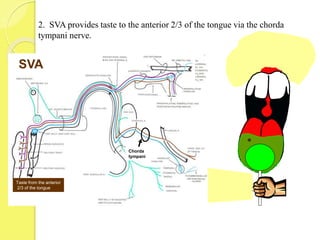
2. SVA provides taste to the anterior 2/3 of the tongue via the chorda
tympani nerve.
Taste from the anterior
2/3 of the tongue
SVA
Chorda
tympani
Taste from hard
and soft palate.
Summary
of SVA
Lacerate foramen
Facial
canal
Internal
Acoustic
Meatus
Stylomastoid
Foramen
Hiatus of canal of greater
superficial petrosal nerve
Taste from
anterior 2/3
tongue.
Pterygoid
canal
Chorda tympani
GSPN
Petrotympanic
fissure
Greater and
lesser palatine
canals
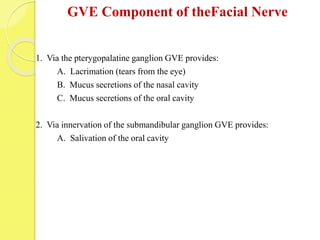
GVE Component of theFacial Nerve
1. Via the pterygopalatine ganglion GVE provides:
A. Lacrimation (tears from the eye)
B. Mucus secretions of the nasal cavity
C. Mucus secretions of the oral cavity
2. Via innervation of the submandibular ganglion GVE provides:
A. Salivation of the oral cavity
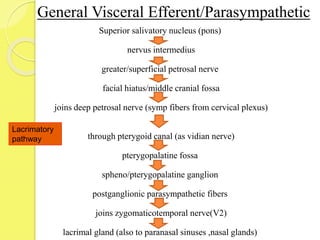
General Visceral Efferent/Parasympathetic
Superior salivatory nucleus (pons)
nervus intermedius
greater/superficial petrosal nerve
facial hiatus/middle cranial fossa
joins deep petrosal nerve (symp fibers from cervical plexus)
through pterygoid canal (as vidian nerve)
pterygopalatine fossa
spheno/pterygopalatine ganglion
postganglionic parasympathetic fibers
joins zygomaticotemporal nerve(V2)
lacrimal gland (also to paranasal sinuses ,nasal glands)
Lacrimatory
pathway
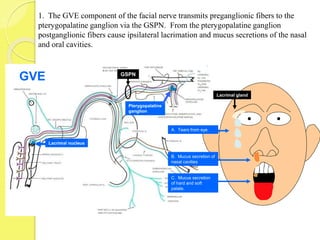
1. The GVE component of the facial nerve transmits preganglionic fibers to the
pterygopalatine ganglion via the GSPN. From the pterygopalatine ganglion
postganglionic fibers cause ipsilateral lacrimation and mucus secretions of the nasal
and oral cavities.
Pterygopalatine
ganglion
Lacrimal nucleus
A. Tears from eye
B. Mucus secretion of
nasal cavities
C. Mucus secretion
of hard and soft
palate.
GVE
Lacrimal gland
GSPN
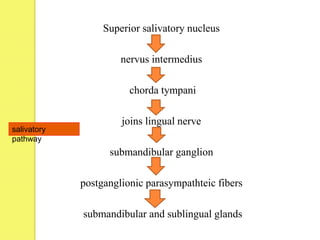
Superior salivatory nucleus
nervus intermedius
chorda tympani
joins lingual nerve
submandibular ganglion
postganglionic parasympathteic fibers
submandibular and sublingual glands
salivatory
pathway
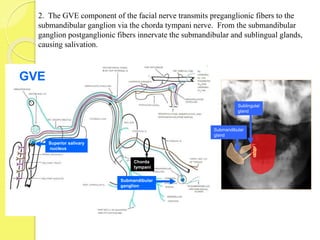
2. The GVE component of the facial nerve transmits preganglionic fibers to the
submandibular ganglion via the chorda tympani nerve. From the submandibular
ganglion postganglionic fibers innervate the submandibular and sublingual glands,
causing salivation.
Superior salivary
nucleus
Submandibular
ganglion
Submandibular
gland
Sublingulal
gland
GVE
Chorda
tympani
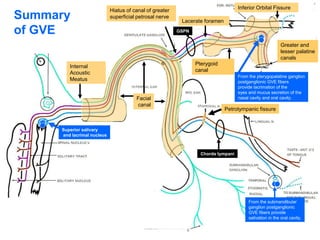
Summary
of GVE
Lacerate foramen
Facial
canal
Internal
Acoustic
Meatus
Superior salivary
and lacrimal nucleus
Pterygoid
canal
From the pterygopalatine ganglion
postganglionic GVE fibers
provide lacrimation of the
eyes and mucus secretion of the
nasal cavity and oral cavity.
From the submandibular
ganglion postganglionic
GVE fibers provide
salivation in the oral cavity.
Petrotympanic fissure
Chorda tympani
GSPN
Hiatus of canal of greater
superficial petrosal nerve
Inferior Orbital Fissure
Greater and
lesser palatine
canals
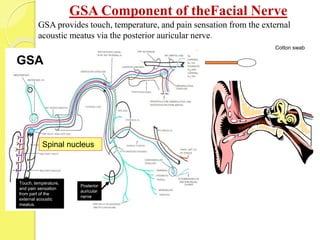
GSA provides touch, temperature, and pain sensation from the external
acoustic meatus via the posterior auricular nerve.
Cotton swab
Touch, temperature,
and pain sensation
from part of the
external acoustic
meatus.
GSA
Posterior
auricular
nerve
Spinal nucleus
GSA Component of theFacial Nerve
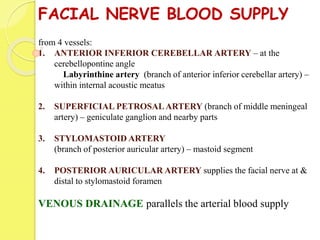
FACIAL NERVE BLOOD SUPPLY
from 4 vessels:
1. ANTERIOR INFERIOR CEREBELLAR ARTERY – at the
cerebellopontine angle
Labyrinthine artery (branch of anterior inferior cerebellar artery) –
within internal acoustic meatus
2. SUPERFICIAL PETROSALARTERY (branch of middle meningeal
artery) – geniculate ganglion and nearby parts
3. STYLOMASTOID ARTERY
(branch of posterior auricular artery) – mastoid segment
4. POSTERIOR AURICULAR ARTERY supplies the facial nerve at &
distal to stylomastoid foramen
VENOUS DRAINAGE parallels the arterial blood supply
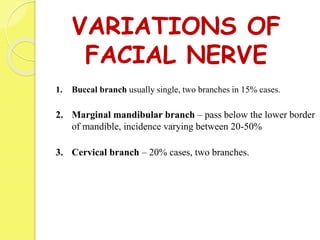
VARIATIONS OF
FACIAL NERVE
1. Buccal branch usually single, two branches in 15% cases.
2. Marginal mandibular branch – pass below the lower border
of mandible, incidence varying between 20-50%
3. Cervical branch – 20% cases, two branches.
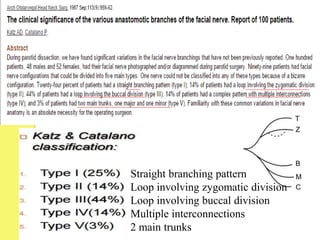
Straight branching pattern
Loop involving zygomatic division
Loop involving buccal division
Multiple interconnections
2 main trunks
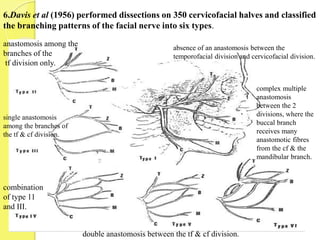
6.Davis et al (1956) performed dissections on 350 cervicofacial halves and classified
the branching patterns of the facial nerve into six types.
absence of an anastomosis between the
temporofacial division and cervicofacial division.
anastomosis among the
branches of the
tf division only.
single anastomosis
among the branches of
the tf & cf division.
combination
of type 11
and III.
double anastomosis between the tf & cf division.
complex multiple
anastomosis
between the 2
divisions, where the
buccal branch
receives many
anastomotic fibres
from the cf & the
mandibular branch.
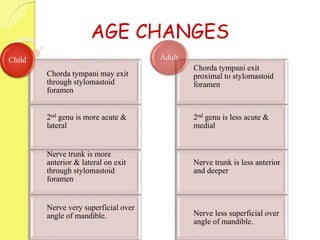
AGE CHANGES
Chorda tympani may exit
through stylomastoid
foramen
2nd genu is more acute &
lateral
Nerve trunk is more
anterior & lateral on exit
through stylomastoid
foramen
Nerve very superficial over
angle of mandible.
Child
Chorda tympani exit
proximal to stylomastoid
foramen
2nd genu is less acute &
medial
Nerve trunk is less anterior
and deeper
Nerve less superficial over
angle of mandible.
Adult
thankyou
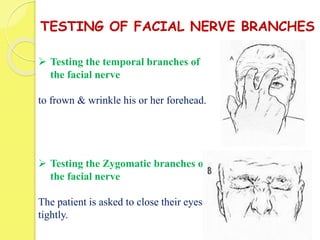
TESTING OF FACIAL NERVE BRANCHES
 Testing the temporal branches of
the facial nerve
to frown & wrinkle his or her forehead.
 Testing the Zygomatic branches of
the facial nerve
The patient is asked to close their eyes
tightly.
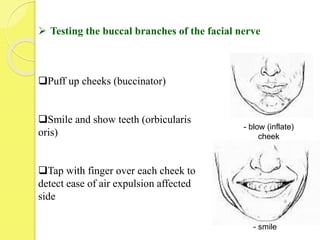
 Testing the buccal branches of the facial nerve
Puff up cheeks (buccinator)
Smile and show teeth (orbicularis
oris)
Tap with finger over each cheek to
detect ease of air expulsion affected
side
- smile
- blow (inflate)
cheek
 The marginal mandibular nerve may be injured during
surgery in the neck region, especially during excision of the
submandibular salivary gland or during neck dissections.
CLINICAL EVALUATION OF INTEGRITY & FUNCTION
Check for –
 sensory function
 motor function
TOPOGNOSTIC TESTING
1. Schirmer test for lacrimation (GSPN)
2. Stapedial reflex test (Stapedial branch)
3. Taste testing (Chorda tympani nerve)
4. Salivary flow rates & pH (Chorda tympani)
ELECTROPHYSIOLOGIC TESTS
1. Nerve excitability test (NET)
2. Electromyography(EMG)
3. Maximal stimulation test (MST)
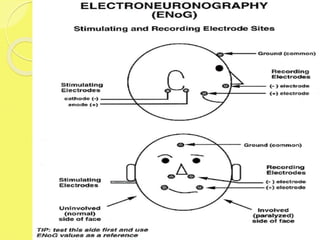
4. Electroneuronography (ENoG)
DYES
Testing of Facial Nerve
TOPOGRAPHIC DIAGNOSIS
To determine the anatomical level of a peripheral
lesion
Lacrimation Geniculate ganglion
Stapedius reflex motor nerve of stapedius muscle
Taste chorda tympani
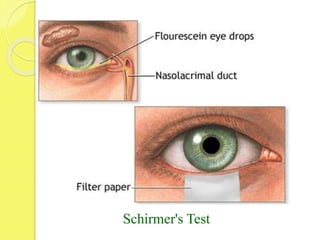
SCHIRMER'S TEST
Geniculate ganglion & petrosal nerve function test
Schirmer’s test +ve when
Affected side shows less than half the amount of lacrimation
seen on the normal side
Sum of the lengths of wetted filter paper for both eyes less than
25 mm
Lesion at or proximal to the geniculate ganglion
Schirmer's Test
STAPEDIUS REFLEX
Nerve to stapedius muscle test
Impedence audiometry can record the presence or absence
of stapedius muscle contraction to sound stimuli 70 to 100
db above hearing threshold
An absence reflex or a reflex less than half the amplitude is
due to a lesion proximal to stapedius nerve
TASTE (ELECTROGUSTOMETRY)
Chorda tympani nerve test
Solution of salt, sugar, citrate, quinine or Electrical stimulation
Compares amount of current require for a response each side
of tongue
Normal : difference < 20 uAmp (thresholds differening by
more than 25%= abnormal)
Total lack of Chorda tympani : No response at 300 uAmp
Disadvantage : False +ve in acute phase of Bell’s palsy
MAXIMUM STIMULATION TEST: MST:
Indication: complete paralysis<3wks
Interpretation:
Marked weakness or no muscle contraction:
advanced degeneration with guarded prognosis
ELECTRONEUROGRAPHY: ENoG
Indication: complete paralysis<3wks
Interpretation: < 90% degeneration: prognosis is
good; > or = 90%: prognosis is a question
Limitation: False-positive results in deblocking phase.
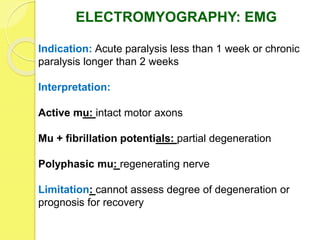
ELECTROMYOGRAPHY: EMG
Indication: Acute paralysis less than 1 week or chronic
paralysis longer than 2 weeks
Interpretation:
Active mu: intact motor axons
Mu + fibrillation potentials: partial degeneration
Polyphasic mu: regenerating nerve
Limitation: cannot assess degree of degeneration or
prognosis for recovery
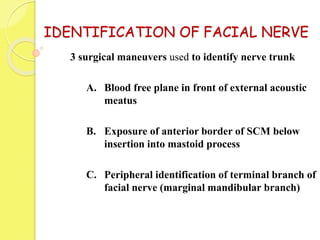
IDENTIFICATION OF FACIAL NERVE
3 surgical maneuvers used to identify nerve trunk
A. Blood free plane in front of external acoustic
meatus
B. Exposure of anterior border of SCM below
insertion into mastoid process
C. Peripheral identification of terminal branch of
facial nerve (marginal mandibular branch)
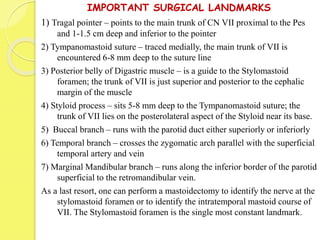
IMPORTANT SURGICAL LANDMARKS
1) Tragal pointer – points to the main trunk of CN VII proximal to the Pes
and 1-1.5 cm deep and inferior to the pointer
2) Tympanomastoid suture – traced medially, the main trunk of VII is
encountered 6-8 mm deep to the suture line
3) Posterior belly of Digastric muscle – is a guide to the Stylomastoid
foramen; the trunk of VII is just superior and posterior to the cephalic
margin of the muscle
4) Styloid process – sits 5-8 mm deep to the Tympanomastoid suture; the
trunk of VII lies on the posterolateral aspect of the Styloid near its base.
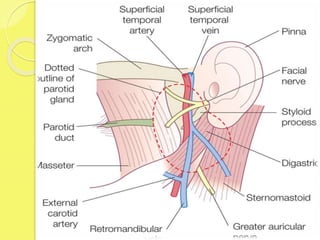
5) Buccal branch – runs with the parotid duct either superiorly or inferiorly
6) Temporal branch – crosses the zygomatic arch parallel with the superficial
temporal artery and vein
7) Marginal Mandibular branch – runs along the inferior border of the parotid
superficial to the retromandibular vein.
As a last resort, one can perform a mastoidectomy to identify the nerve at the
stylomastoid foramen or to identify the intratemporal mastoid course of
VII. The Stylomastoid foramen is the single most constant landmark.
 Damage to facial nerve is possible in severe maxillofacial
surgeries with basilar skull fractures anywhere in the area
of course of the nerve and would result in ipsilateral
paralysis of the muscles of facial expression
 Of concern to the surgeon is the close proximity of the main
trunk of facial nerve where it exits the stylomastoid
foramen and mandibular condyle
Applied Surgical anatomy of
Facial Nerve in
Oral & Maxillofacial Surgery
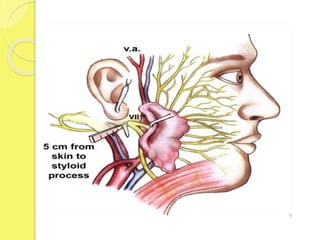
The approximate distance from the lowest point of the
external bony auditory meatus to the bifurcation of the facial
nerve is 2.3 cm
Posterior to the parotid gland,the nerve is atleast 2cm deep
into the skin surface, from this point the two branches curve
around the posterior mandible,where they form plexus
between the parotid gland and the masseter muscle
Temporal branch :
It exits the parotid gland anterior to superficial temporal
artery
During an open approach to the TMJ, violation of this
branch is possible
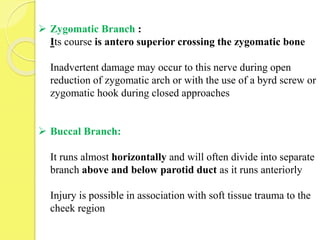
 Zygomatic Branch :
Its course is antero superior crossing the zygomatic bone
Inadvertent damage may occur to this nerve during open
reduction of zygomatic arch or with the use of a byrd screw or
zygomatic hook during closed approaches
 Buccal Branch:
It runs almost horizontally and will often divide into separate
branch above and below parotid duct as it runs anteriorly
Injury is possible in association with soft tissue trauma to the
cheek region
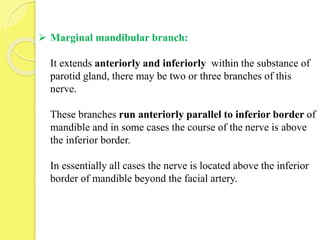
 Marginal mandibular branch:
It extends anteriorly and inferiorly within the substance of
parotid gland, there may be two or three branches of this
nerve.
These branches run anteriorly parallel to inferior border of
mandible and in some cases the course of the nerve is above
the inferior border.
In essentially all cases the nerve is located above the inferior
border of mandible beyond the facial artery.
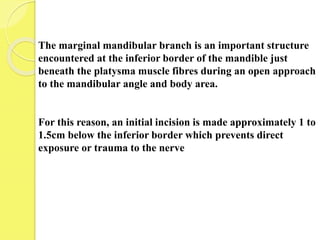
The marginal mandibular branch is an important structure
encountered at the inferior border of the mandible just
beneath the platysma muscle fibres during an open approach
to the mandibular angle and body area.
For this reason, an initial incision is made approximately 1 to
1.5cm below the inferior border which prevents direct
exposure or trauma to the nerve
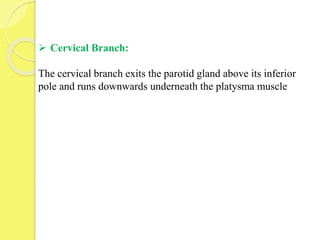
 Cervical Branch:
The cervical branch exits the parotid gland above its inferior
pole and runs downwards underneath the platysma muscle
The surgeon must be mindful of the facial nerves intimate
involvement with the TMJ, specially when performing
surgical approaches to the joint.
The temporal and zygomatic branches are at increased risk
during pre auricular approach
&
the marginal mandibular branch during submandibular
approach
The intra oral approach to the TMJ has minimal risk to the
branches of facial nerve which is its major advantage
COMPLICATIONS OF PAROTID SURGERY
 Intra-operative or post-operative
Post-operative complications can be classified as early and
late (or long-term) complications.
INTRA-OPERATIVE COMPLICATIONS OF
PAROTID GLAND SURGERY
 Intra-operative complications of parotid gland surgery
comprise transection of the facial nerve or one of its
branches, rupture of the capsule of a parotid tumour or
incomplete surgical resection thereof.
 The surgeon has to immediately recognize an intra-operative
complication and management thereof must be performed
without delay.
 In the event of nerve injury, immediate nerve repair is
mandatory. Once the segments have been fully mobilized
and brought together without tension, the two ends should be
sutured together.
 The nerves are gently grasped with a Bishop forceps. With an
8-0 nylon suture and a GS-8 needle, the epineurium is
grasped at one end and then sutured to the other, avoiding
deep cuts in the perineurium
 3 sutures are usually adequate to maintain the anastomosis
 As an alternative to sutures, the surgeon may use fibrin
tissue adhesive.
 If the nerve length is inadequate, a nerve graft of the
greater auricular nerve, can be applied
POST-OPERATIVE COMPLICATIONS OF
PAROTID GLAND SURGERY
Post-operative facial nerve dysfunction involving some or all
of the branches of the nerve is the most frequent early
complication of parotid gland surgery.
Temporary facial nerve paresis, involving all or just one or two
branches of the facial nerve, and permanent total paralysis have
occurred.
The cases of transient facial nerve paresis generally resolved
within 6 months
The incidence of facial nerve paralysis is higher with total,
than with superficial parotidectomy, which may be related to
stretch injury or as result of surgical interference with the vasa
nervorum
The branch of the facial nerve most at risk for injury during
parotidectomy is the marginal mandibular branch.
Older patients appear to be more susceptible to facial nerve
injury
 However, eye protection must be ensured. If facial paresis
causes incomplete closure of the eye, the patient must be
advised to use ophthalmic moisture drops frequently during
the day and an ophthalmic ointment and eye protection at
night.
 Regular follow-up with an ophthalmologist is mandatory
 Moreover, use of botulinum toxin to induce temporary ptosis
avoids the need of surgical tarsorrhaphy.
DISORDERS OF FACIAL NERVE
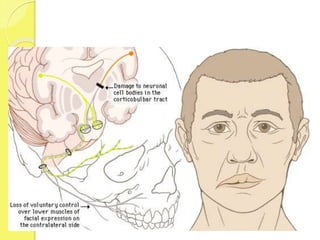
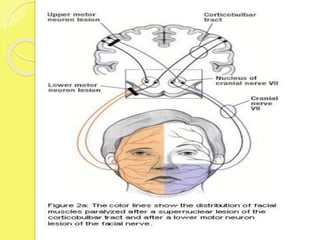
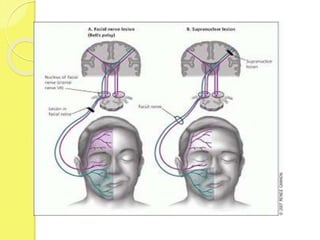
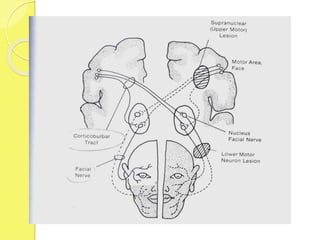
1. SUPRA NUCLEAR TYPE:
Features:
a) Paralysis of lower part of face (opposite side)
b) Partial paralysis of upper part of face
c) Normal taste and saliva secretion
d) Stapedius not paralysed
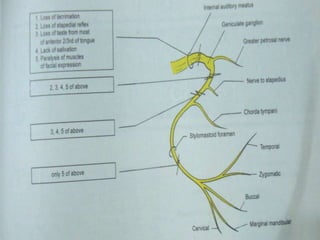
Facial Nerve Lesions
2. NUCLEAR TYPE:
Features:
a) Paralysis of facial muscle (same side)
b) Paralysis of lateral rectus
c) Internal strabismus
3. PERIPHERAL LESION
a) At internal acoustic meatus
Features:
i. Paralysis of secretomotor fibers
ii. Hyper acusis
iii. Loss of corneal reflex
iv. Taste fibers unaffected
v. Facial expression and movements paralysed
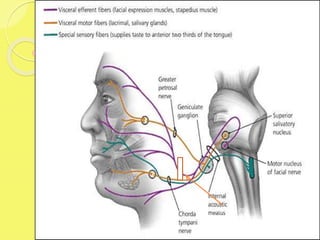
Lesion at int
acoustic meatus
b) Injury distal to geniculate ganglion
Features:
i. Complete motor paralysis (same side)
ii. No hyper acusis
iii. Loss of corneal reflex
iv. Taste fibers affected
v. Facial expression and movements paralysed
vi. Pronounced reaction of degeneration
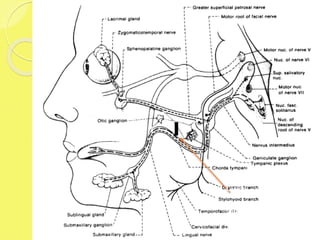
Lesion
distal to
geniculate
ganglion
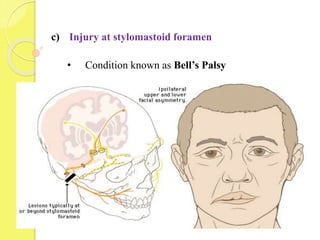
c) Injury at stylomastoid foramen
• Condition known as Bell’s Palsy
Background of BELL’S
PALSY
First described more than a century ago
by Sir Charles Bell
Yet much controversy still surrounds its
etiology and management
Bell palsy is certainly the most common
cause of facial paralysis worldwide
Demographics of Bells palsy
Race: slightly higher in persons of Japanese descent.
Sex: No difference exists
Age: highest in persons aged 15-45 years.
Bell palsy is less common in those younger than 15 years and
in those older than 60 years.
Pathophysiology of Bells palsy
Main cause of Bell's palsy is latent herpes viruses (herpes
simplex virus type 1 and herpes zoster virus), which are
reactivated from cranial nerve ganglia
Polymerase chain reaction techniques have isolated herpes
virus DNA from the facial nerve during acute palsy
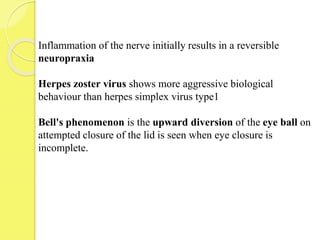
Inflammation of the nerve initially results in a reversible
neuropraxia
Herpes zoster virus shows more aggressive biological
behaviour than herpes simplex virus type1
Bell's phenomenon is the upward diversion of the eye ball on
attempted closure of the lid is seen when eye closure is
incomplete.
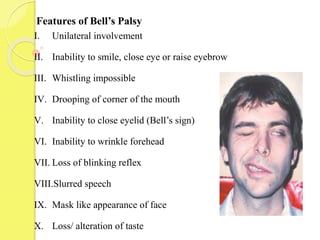
I. Unilateral involvement
II. Inability to smile, close eye or raise eyebrow
III. Whistling impossible
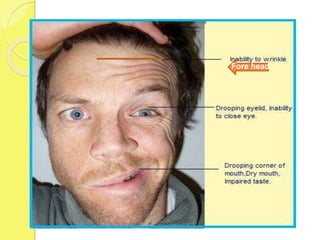
IV. Drooping of corner of the mouth
V. Inability to close eyelid (Bell’s sign)
VI. Inability to wrinkle forehead
VII. Loss of blinking reflex
VIII.Slurred speech
IX. Mask like appearance of face
X. Loss/ alteration of taste
Features of Bell’s Palsy
Fore head
Diagnosis of Bells palsy
By exclusion
Criteria
Paralysis or paresis of all muscle groups of one side of the
face
Sudden onset
Absence of signs of CNS disease
Absence of signs of Ear disease
Management of Bells palsy
It focuses on protecting the cornea from drying and
abrasion due to problems with lid closure and the tearing
mechanism.
Lubricating drops should be applied hourly during the
day and a simple eye ointment should be used at night.
Eye care
Treatment consists of Infra-red radiation on affected
side of the face at 2 ft (60cm) ,followed by interrupted
galvanism on affected side
Treatment was given daily at first few weeks & later thrice
weekly.
All patients are instructed to massage the face daily
There is general agreement that 70-80% of these patients
recover completely,while the reminder develop various sequelae
within one to three months
Medical treatment
Corticosteroids :
Prednisolone 1 mg/kg/day 7-10 days
Corticosteroids combine with antiviral drug is better
Acyclovir 400 mg 5 times/day
Famciclovir and valacyclovir 500 mg bid
Surgical treatment
Facial nerve decompression
Indication:
Completely paralysis
ENoG less than 10% in 2 weeks
Appropriate time for surgery is 2-3 weeks after paralysis
CAUSES OF FACIAL NERVE PARALYSIS
 Peripheral nerve causes (Facial muscle paralysis with
forehead affected)
• Lyme Disease
• Otits Media or Mastoiditis
• Ramsay Hunt Syndrome
• Autoimmune Polyneuropathy (e.g. Guillain-Barre Syndrome,
typically bilateral)
• Head or Neck Mass Lesion (e.g. Cholesteatoma)
 Central/Supranuclear causes
(Facial muscle paralysis with forehead spared)
• Cerebral mass lesion (e.g. tumor)
• Cerebrovascular Accident (typically with ipsilateral
Hemiparesis or Hemiplegia)
• Multiple Sclerosis
Traumatic causes
 Cortical injury
 Temporal BoneFracture
 Brain Stem injury
 Penetrating middle ear injury
 Barotrauma
Altitude paralysis
Scuba Diving
Endocrine causes
 Diabetes Mellitus
 Hyperthyroidism
 Pregnancy
 Hypertension
 Alcohol Abuse (Alcoholic Neuropathy)
Infectious Causes
 Malignant Otitis Externa (skull base Osteomyelitis)
 Acute or Chronic Otitis Media
Gradenigo's Syndrome (CN V or CN VI)
 Mastoiditis
 Varicella Zoster Virus (Chicken Pox)
 Herpes Zoster Oticus (Ramsey-Hunt Syndrome)
Herpetic Vesicles at auricle and external canal
 HIV Infection
 Influenza Vaccine and Influenza
 Parotitis
 Meningitis or Encephalitis
 Mumps
 Mononucleosis
 Leprosy
 Coxsackie virus infection
 Syphilis
 Tuberculosis
 Botulism
 Mucormycosis
Causes due toTumors
 Facial Nerve neuroma
 Cholesteatoma
 Glomus jugular tumor
 Primary Temporal Bone tumors
 Meningiomas
 Hemangioblastoma
 Hemangioma
 Pontine glioma
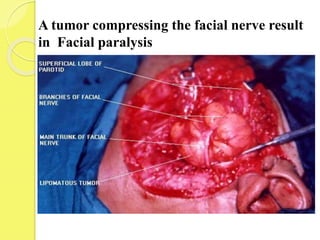
 Parotid tumor
A tumor compressing the facial nerve result
in Facial paralysis
Birth Causes
 Facial Nerve Injury from Birth Trauma
 Trauma (forceps delivery)
 Congenital Facial Palsy
Mobius syndrome
Cardiofacial syndrome
Toxic Causes:
 Thalidomide
 Tetanus
 Diphtheria
 Carbon Monoxide
 Lead Intoxication
Idiopathic Causes:
 Myasthenia Gravis
 Guillain-Barre Syndrome
 Sarcoidosis
 Familial Bell's Palsy
Iatrogenic Causes:
 Antitetanus serum
 Vaccine treatment for Rabies
 Mandibular block anesthesia
 Head and neck surgery
Evaluation of Facial paralysis
Clinical feature
Central VS Peripheral facial paralysis
Complete head and neck examination
Cranial nerve evaluation
Electrodiagnostic testing
Topographic diagnosis
CENTRAL FACIAL
PARALYSIS
Upper motor neuron lesion
Movements of the frontal and upper orbicularis oculi tend to be
spared
Because of uncrossed contributions from ipsilateral
supranuclear areas
Involvement of tongue
Involvement of lacrimation and salivation
Peripheral paralysis
Lower motor neuron lesion
At rest :
less prominent wrinkles on forehead of affected side, eyebrow
drop, flattened nasolabial fold, corner of mouth turned down
Unable to :
wrinkle forehead, raise eyebrow, wrinkle nasolabial fold, purse
lips, show teeth, or completely close eye
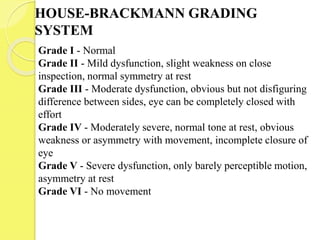
HOUSE-BRACKMANN GRADING
SYSTEM
Grade I - Normal
Grade II - Mild dysfunction, slight weakness on close
inspection, normal symmetry at rest
Grade III - Moderate dysfunction, obvious but not disfiguring
difference between sides, eye can be completely closed with
effort
Grade IV - Moderately severe, normal tone at rest, obvious
weakness or asymmetry with movement, incomplete closure of
eye
Grade V - Severe dysfunction, only barely perceptible motion,
asymmetry at rest
Grade VI - No movement
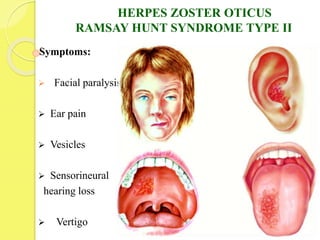
Symptoms:
 Facial paralysis
 Ear pain
 Vesicles
 Sensorineural
hearing loss
 Vertigo
HERPES ZOSTER OTICUS
RAMSAY HUNT SYNDROME TYPE II
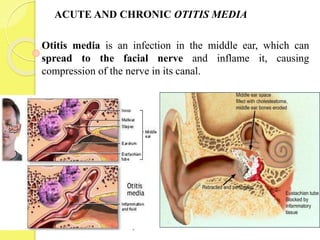
ACUTE AND CHRONIC OTITIS MEDIA
Otitis media is an infection in the middle ear, which can
spread to the facial nerve and inflame it, causing
compression of the nerve in its canal.
NEUROSARCOIDOSIS
Facial nerve paralysis, sometimes bilateral, is a common
manifestation of neurosarcoidosis (sarcoidosis of the nervous
system)..
Itself a rare condition.
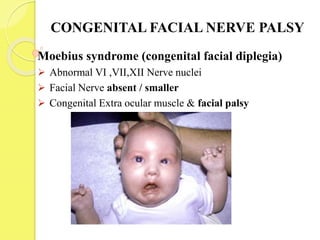
Moebius syndrome (congenital facial diplegia)
 Abnormal VI ,VII,XII Nerve nuclei
 Facial Nerve absent / smaller
 Congenital Extra ocular muscle & facial palsy
CONGENITAL FACIAL NERVE PALSY
CARDIOFACIAL SYNDROME
Unilateral facial paralysis involving only the lower lip
and congenital heart disease
 The facial paralysis in these patients involves only
those muscles concerned with pulling the lower
lip downwards and outwards
 These are the
mentalis, depressor labii inferioris and depressor
anguli oris muscles
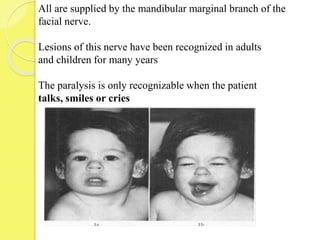
All are supplied by the mandibular marginal branch of the
facial nerve.
Lesions of this nerve have been recognized in adults
and children for many years
The paralysis is only recognizable when the patient
talks, smiles or cries
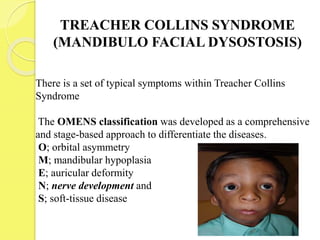
TREACHER COLLINS SYNDROME
(MANDIBULO FACIAL DYSOSTOSIS)
There is a set of typical symptoms within Treacher Collins
Syndrome
The OMENS classification was developed as a comprehensive
and stage-based approach to differentiate the diseases.
O; orbital asymmetry
M; mandibular hypoplasia
E; auricular deformity
N; nerve development and
S; soft-tissue disease
FACIAL NERVE INVOLVEMENT IN
TREACHER COLLINS SYNDROME
N0: No facial nerve involvement
N1: Upper facial nerve involvement (temporal or zygomatic
branches)
N2: Lower facial nerve involvement (buccal, mandibular or
cervical)
N3: All branches affected
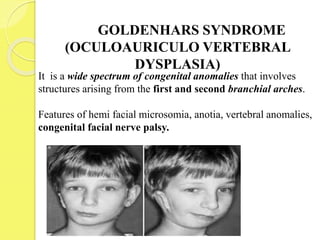
GOLDENHARS SYNDROME
(OCULOAURICULO VERTEBRAL
DYSPLASIA)
It is a wide spectrum of congenital anomalies that involves
structures arising from the first and second branchial arches.
Features of hemi facial microsomia, anotia, vertebral anomalies,
congenital facial nerve palsy.
CONCLUSION
Surgeons have to pay attention to minimize the risk of
complication during parotidectomy.
The best means of reducing iatrogenic facial nerve injury, in
parotid surgery, still remains a clear understanding of the
anatomy, good surgical technique with the use of multiple
anatomic landmarks.
Pre-operative discussion and consent for surgery, tailored
according to the age and health of the patient as well as the
behavior of the tumor, are mandatory
Furthermore, the patient has to be informed about the cosmetic
sequelae of the incision and all patients have to be told that facial
nerve paralysis or paresis is possible and can be partial or total,
temporary or permanent.
References
Fonseca & Walker : Maxillo FacialTrauma 2nd
Edition Vol 1 & 2
Grays Anatomy : 39th Edition
Netters : Colour Atlas of Anatomy
International journal of Oral & maxillofacial
Surgery
THANKYOU

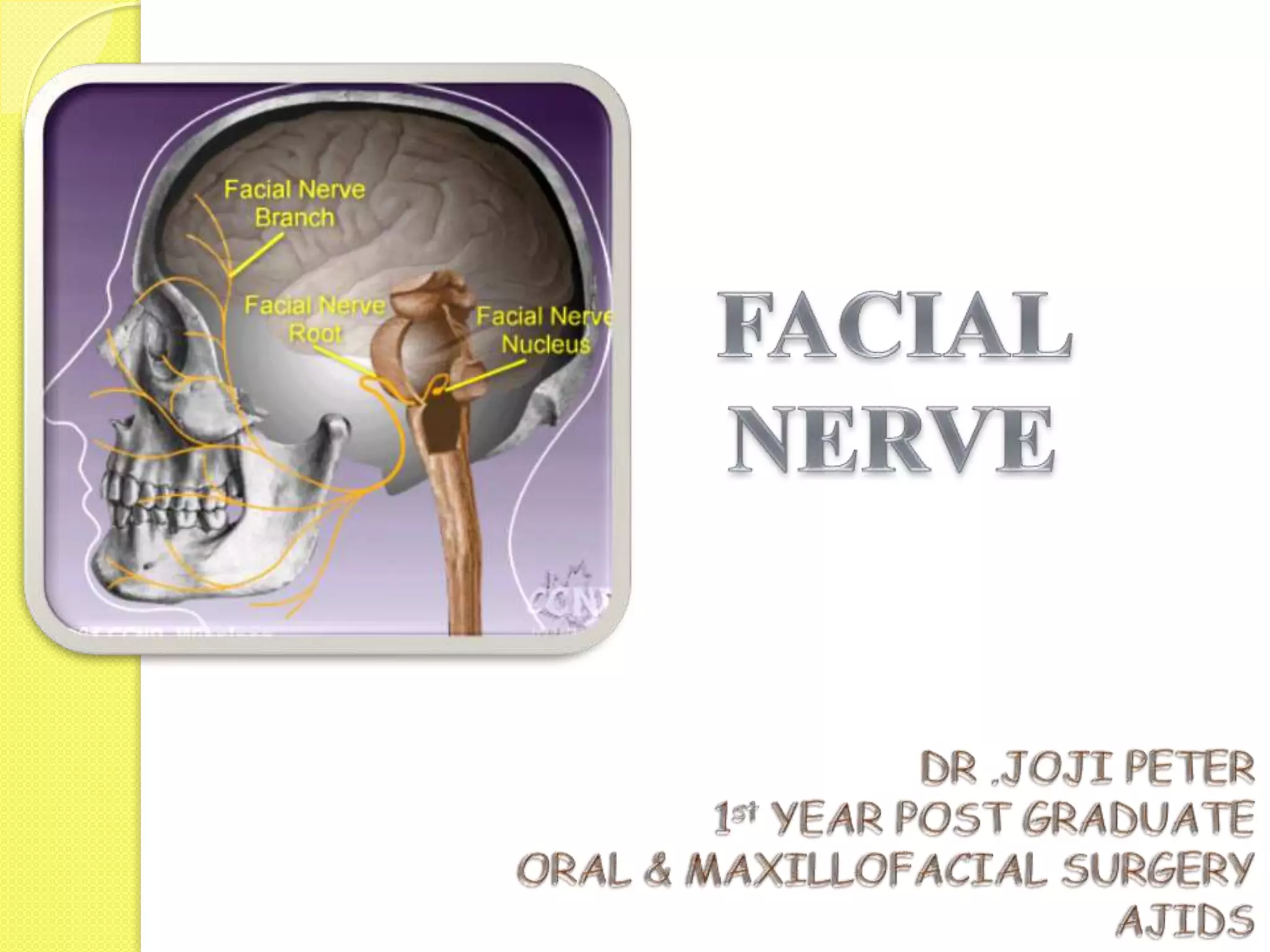
Facialnerve

  • 2.
    PART B Testing offacial nerve Identification of facial nerve Complications of facial dissection Facial nerve lesions Acquired & congenital anomalies CONTENTSPART A Introduction Embryology Nuclei of origin Ganglia associated Course & relations Branches of facial nerve Functional components Blood supply variations of nerve Age changes
  • 3.
    7th of 12paired cranial nerves, It is a mixed nerve with motor & sensory roots. Emerges- pontocereberal junction functions : It also supplies preganglionic parasympathetic fibres to several head and neck ganglia Introduction
  • 4.
    developmentally derived from motordivision of facial nerve is derived from The sensory division originates from the cranial neural crest Embryology
  • 5.
    The nerve isnot fully developed until about 4 years of age 3rd week Facioacoustic primordium develops. 1st identifiable facial nerve tissue is seen 4th week Facial nerve divides into 2 parts 5th week Geniculate ganglion, nervus intermedius, greater superficial petrosal nerve becomes visible First 3 months of prenatal life. Facial nerve is arborized ie ,facial nerve course, branching pattern, and anatomical relationships are established
  • 6.
    NUCLEI OF ORIGIN ORIGINOF FACIAL NERVE &
  • 7.
  • 8.
    Facial Nerve Proper(Motor) & Nervus Intermedius The facial nerve is formed mainly of 2 parts:
  • 9.
    NUCLEI OF ORIGIN Motor Nucleus – Branchiomotor  Superior Salivatory nucleus – Parasympathetic  Lacrimatory Nucleus – Parasympathetic  Nucleus of Tractus Solitarus - Gustatory
  • 10.
    GANGLIA ASSOCIATED WITH THEFACIAL NERVE Geniculate ganglion Submandibular ganglion Pterygopalatine ganglion
  • 11.
  • 12.
    GENICULATE GANGLION Latin genu="knee“ Sensory ganglion  is an L-shaped collection of fibers  It receives fibers from the motor, sensory, and parasympathetic components of the facial nerve sends fibers that will innervate the lacrimal glands, submandibular glands, sublingual glands, tongue, palate, pharynx, external auditory meatus, stapedius, posterior belly of the digastric muscle, stylohyoid muscle, & muscles of facial expression.
  • 13.
    SUBMANDIBULAR GANGLION  smalland fusiform in shape.  Parasympathetic ganglion  It is situated above the deep portion of the submandibular gland, on the hyoglossus muscle  The ganglion 'hangs' by two nerve filaments from the lower border of the lingual nerve one anterior and one posterior.  Through the posterior of these it receives a branch from the chorda tympani nerve
  • 14.
    PTERYGOPALATINE GANGLION (Meckel's Ganglion,Nasal Ganglion Or SphenopalatineGanglion) is a parasympathetic ganglion found in the pterygopalatine fossa. It's largely innervated by the greater petrosal nerve and its axons project to the lacrimal glands and nasal mucosa
  • 15.
    Course & relations: I-INTRACRANIAL (INTRAPETROSAL) COURSE II- EXTRACRANIAL COURSE
  • 16.
    2 roots attachedto lateral part lower border of pons, medial to CN VIII Both reach int. acoustic meatus together In the meatus, motor root lies in a groove on CN VIII (accompanied by labyrinthine vessels) 2 roots fuse in the bottom of the meatus Single trunk Single trunk lies in the petrous part of the temporal bone Enters the Facial Canal
  • 17.
    Overview Of Facial NerveAnatomy In The Skull Lacerate foramen Facial canal Internal Acoustic Meatus Stylomastoid Foramen Hiatus of canal of greater superficial petrosal nerve Pterygoid canalGreater superficial Petrosal nerve (GSPN) Petrotympanic fissure Greater and lesser palatine canals Chorda tympani nerve Facial nerve Facial nerve Posterior Cranial Fossa (PCF) Inferior Orbital Fissure The facial nerve exits the posterior cranial fossa (PCF) at the internal acoustic meatus. Posterior auricular N.
  • 18.
    Overview of Facial Nerveanatomy in the skull Lacerate foramen Facial canal Internal Acoustic Meatus Stylomastoid Foramen Hiatus of canal of greater superficial petrosal nerve Pterygoid canalGreater superficial Petrosal nerve (GSPN) Petrotympanic fissure Greater and lesser palatine canals Chorda tympani Facial nerve Facial nerve Posterior Cranial Fossa Inferior Orbital Fissure Within the internal acoustic meatus the facial nerve enters the facial canal. Posterior auricular N.
  • 19.
    Overview of Facial Nerveanatomy in the skull Lacerate foramen Internal Acoustic Meatus Stylomastoid Foramen Hiatus of canal of greater superficial petrosal nerve Pterygoid canalGreater superficial Petrosal nerve (GSPN) Petrotympanic fissure Greater and lesser palatine canals Chorda tympani Facial nerve Facial nerve Posterior Cranial Fossa Inferior Orbital Fissure The first branch -the greater superficial petrosal nerve (GSPN) branches from the geniculate ganglion within the genu of the facial canal & enters the middle cranial fossa (MCF) by way of the hiatus of the canal for the GSPN. Geniculate ganglion Facial canal MCF
  • 20.
    Overview of Facial Nerveanatomy in the skull Lacerate foramen Facial canal Internal Acoustic Meatus Stylomastoid Foramen Hiatus of canal of greater superficial petrosal nerve Pterygoid canalGreater superficial Petrosal nerve (GSPN) Greater and lesser palatine canals Chorda tympani Facial nerve Facial nerve Posterior Cranial Fossa Inferior Orbital Fissure The 2ND branch -the stapedial nerve, branches from the descending portion of the CN VII & enters the middle ear. Stapedial N. Petrotympanic fissure Posterior auricular N.
  • 21.
    Overview of Facial Nerveanatomy in the skull Lacerate foramen Facial canal Internal Acoustic Meatus Stylomastoid Foramen Hiatus of canal of greater superficial petrosal nerve Pterygoid canalGreater superficial Petrosal nerve (GSPN) Petrotympanic fissure Greater and lesser palatine canals Chorda tympani N. Facial nerve Facial nerve Posterior Cranial Fossa Inferior Orbital Fissure The 3rd branch -the chorda tympani nerve, branches from the descending portion of the CN VII & enters the middle ear. Within the middle ear the chorda tympani nerve crosses the medial surface of the tympanic membrane. It then passes through the petrotympanic fissure to enter the infratemporal fossa. Infratemporal fossa
  • 22.
    Overview of Facial Nerveanatomy in the skull Lacerate foramen Facial canal Internal Acoustic Meatus Stylomastoid Foramen Hiatus of canal of greater superficial petrosal nerve Pterygoid canalGreater superficial Petrosal nerve (GSPN) Petrotympanic fissure Greater and lesser palatine canals Chorda tympani Facial nerve Facial nerve Posterior Cranial Fossa Inferior Orbital Fissure The descending portion of the facial nerve exits the facial canal at the stylomastoid foramen & continues into the parotid region Parotid regionPosterior auricular N.
  • 23.
    Location Of TheStylomastoid Foramen Between styloid and mastoid processes
  • 24.
  • 26.
    Risorius Buccinator Levator labi superiorisLevator anguli oris Nasalis Orbicularis oris Depressor septi nasiProcerus The BUCCAL BRANCH supplies these muscles Levator labii superioris Alaeque nasi Elevates upperlip Snarl Soft smile Flare nostrils Puckering Move skin over the nasal bone Depresses nasal septum Presses the cheek against teeth Smile
  • 27.
    Branches Branches of communicationBranches of distribution
  • 28.
    Internal Acoustic MeatusVIII CN Geniculate Ganglion A. Greater Petrosal Nerve B. Lesser Petrosal Nerve C. External Petrosal Nerve Facial Canal X CN Stylomastoid Foramen IX & X Cranial Nerve Greater Auricular Nerve Auriculotemporal Nerve Face V Nerve Behind Ear Lesser Occipital Neck Transverse Cutaneous Nerve BRANCHES OF COMMUNICATION
  • 29.
    Branches of Distribution Facialcanal A. Nerve to stapedius B. Chorda tympani C. Geater petrosal nerve In face A. Temporal B. Zygomatic C. Buccal D. Marginal mandibular E. Cervical Stylomastoid foramen A. Posterior auricular B. Nerve to stylohyoid C. Nerve to digastric (posterior belly)
  • 30.
    Functional components ofthe Facial Nerve  SVE (Special Visceral Efferent) — Motor to striated muscles derived from the 2nd branchial arch.  GVA (General Visceral Afferent) — Sensory from visceral touch, temperature, and pain.  SVA (Special Visceral Afferent) — Taste  GVE (General Visceral Efferent) — Autonomic innervation to mucosal, lacrimal, and salivary glands.  GSA (General Somatic Afferent) — Sensory from somatic touch, temperature, and pain.
  • 32.
    Stapedius muscle dampens movementof the ossicles protecting the inner ear from damage from loud noises SVE 1. The Stapedius muscle dampens movement of the ossicles
  • 33.
    2. The PosteriorAuricular nerve innervates the posterior auricular muscle, pulling the pinna posteriorly. SVE component of posterior auricular nerve Posterior auricular muscle pulls the pinna posteriorly SVE
  • 34.
    Stylohyoid muscle elevates the hyoidbone. Through the internal Acoustic meatus Through the stylomastoid foramen 3. The Stylohyoid muscle elevates the hyoid bone Stylohyoid branch of facial nerve innervates stylohyoid muscle SVE
  • 35.
    Through the stylomastoid foramen 4. ThePosterior belly of digastric muscle elevates the hyoid bone Posterior belly of digastric branch of facial nerve innervates posterior belly of digastric muscle. Posterior belly of digastric muscle elevates the hyoid bone SVE Through the internal acoustic meatus
  • 36.
    5.1. The temporaland zygomatic branches of the facial nerve provide SVE nerve fibers that innervate the ipsilateral orbicularis oculi, the muscle responsible for closing the eyelid. Temporal branch Zygomatic branch SVE Contraction of orbicularis oculi causes the eyelid to close
  • 37.
    5.2 The zygomaticand buccal branches of the facial nerve innervate the ipsilateral zygomaticus major muscle, the main muscle responsible for smiling. Zygomatic branch SVE Zygomaticus major muscle Contraction of the zygomaticus major muscle causes smiling
  • 38.
    5.3The buccal branchof the facial nerve innervates the buccinator muscle, the muscle responsible for holding the cheek against the teeth, thus positioning food for chewing. Buccal branch of facial nerve innervates Buccinator muscle. SVE Contraction of the buccinator muscle causes tensing of the cheek which helps position food within the occusal plane for chewing
  • 39.
    5.4 The mandibularand buccal branches of the facial nerve innervate the ipsilateral depressor angularis oris muscle, a muscle responsible for frowning. Mandibular branch SVE Depressor angularis oris Contraction of the depressor angularis oris muscle causes frowning
  • 40.
    5.5 The cervicalbranch of the facial nerve innervates the platysma muscle, a muscle partly responsible for depressing the mandible. Platysma muscle Cervical branch of facial nerve innervates Platysma muscle. Contraction of platysma Muscle results in depression of mandible. SVE
  • 41.
    5.5The cervical branchof the facial nerve innervates the platysma muscle (the “shaving muscle”), a muscle responsible for tightening the skin of the anterior neck. Platysma muscle Cervical branch of facial nerve innervates Platysma muscle. Contraction of platysma muscle causes the skin of the anterior neck to tighten. SVE
  • 42.
    Stapedius muscle dampens movement of ossicles. SUMMARYOF SVE Facial canal Internal Acoustic Meatus Stylomastoid Foramen Temporal-orbicularis oculi closes eyelids. Zygomatic-zygomaticus major partly responsible for smiling. Buccal-buccinator tenses cheek Mandibular-depressor angularis oris responsible for frowning. Cervical- platysma helps lower mandible and tightens skin of neck. Posterior auricular muscle responsible for posterior displacement of pinna. Facial nerve Facial nerve Posterior belly of digastric elevates hyoid bone. Stylohyoid muscle elevates hyoid bone. Posterior auricular N. Facial nucleus
  • 43.
    GVA Component ofthe Facial Nerve Light touch, temperature, and pain sensation from the soft palate via the greater superficial petrosal nerve (GSPN).
  • 44.
    GVA provides sensationof light touch, temperature, and pain from the soft palate. soft palate Light touch, temperature, and pain from the soft palate GVA Light touch sensation Temperature sensation Pain sensation GSPN Facial nerve
  • 45.
    Through the hiatus ofcanal of GSPN Light touch, temperature, and pain from the soft palate Through the internal acoustic meatus Summary of GVA Through the Pterygoid canal Pterygoid canal Facial canal Through the lesser palatine canalGSPN Facial nerve
  • 46.
    SVA Component oftheFacial Nerve 1. Taste from the hard and soft palate via the greater superficial petrosal nerve (GSPN). 2. Taste from the anterior 2/3 of the tongue via the chorda tympani nerve.
  • 47.
    1. SVA providestaste sensation from the hard and soft palate via the GSPN. Soft palate Taste from the hard and soft palate Hard palate Co Sweetened coffee SVA GSPN branches from the facial nerve at the geniculate ganglion within the genu of the facial canal. It is made up of fibers from SVA, GVE, and GVA.
  • 48.
    2. SVA providestaste to the anterior 2/3 of the tongue via the chorda tympani nerve. Taste from the anterior 2/3 of the tongue SVA Chorda tympani
  • 49.
    Taste from hard andsoft palate. Summary of SVA Lacerate foramen Facial canal Internal Acoustic Meatus Stylomastoid Foramen Hiatus of canal of greater superficial petrosal nerve Taste from anterior 2/3 tongue. Pterygoid canal Chorda tympani GSPN Petrotympanic fissure Greater and lesser palatine canals
  • 50.
    GVE Component oftheFacial Nerve 1. Via the pterygopalatine ganglion GVE provides: A. Lacrimation (tears from the eye) B. Mucus secretions of the nasal cavity C. Mucus secretions of the oral cavity 2. Via innervation of the submandibular ganglion GVE provides: A. Salivation of the oral cavity
  • 51.
    General Visceral Efferent/Parasympathetic Superiorsalivatory nucleus (pons) nervus intermedius greater/superficial petrosal nerve facial hiatus/middle cranial fossa joins deep petrosal nerve (symp fibers from cervical plexus) through pterygoid canal (as vidian nerve) pterygopalatine fossa spheno/pterygopalatine ganglion postganglionic parasympathetic fibers joins zygomaticotemporal nerve(V2) lacrimal gland (also to paranasal sinuses ,nasal glands) Lacrimatory pathway
  • 52.
    1. The GVEcomponent of the facial nerve transmits preganglionic fibers to the pterygopalatine ganglion via the GSPN. From the pterygopalatine ganglion postganglionic fibers cause ipsilateral lacrimation and mucus secretions of the nasal and oral cavities. Pterygopalatine ganglion Lacrimal nucleus A. Tears from eye B. Mucus secretion of nasal cavities C. Mucus secretion of hard and soft palate. GVE Lacrimal gland GSPN
  • 53.
    Superior salivatory nucleus nervusintermedius chorda tympani joins lingual nerve submandibular ganglion postganglionic parasympathteic fibers submandibular and sublingual glands salivatory pathway
  • 54.
    2. The GVEcomponent of the facial nerve transmits preganglionic fibers to the submandibular ganglion via the chorda tympani nerve. From the submandibular ganglion postganglionic fibers innervate the submandibular and sublingual glands, causing salivation. Superior salivary nucleus Submandibular ganglion Submandibular gland Sublingulal gland GVE Chorda tympani
  • 55.
    Summary of GVE Lacerate foramen Facial canal Internal Acoustic Meatus Superiorsalivary and lacrimal nucleus Pterygoid canal From the pterygopalatine ganglion postganglionic GVE fibers provide lacrimation of the eyes and mucus secretion of the nasal cavity and oral cavity. From the submandibular ganglion postganglionic GVE fibers provide salivation in the oral cavity. Petrotympanic fissure Chorda tympani GSPN Hiatus of canal of greater superficial petrosal nerve Inferior Orbital Fissure Greater and lesser palatine canals
  • 56.
    GSA provides touch,temperature, and pain sensation from the external acoustic meatus via the posterior auricular nerve. Cotton swab Touch, temperature, and pain sensation from part of the external acoustic meatus. GSA Posterior auricular nerve Spinal nucleus GSA Component of theFacial Nerve
  • 57.
    FACIAL NERVE BLOODSUPPLY from 4 vessels: 1. ANTERIOR INFERIOR CEREBELLAR ARTERY – at the cerebellopontine angle Labyrinthine artery (branch of anterior inferior cerebellar artery) – within internal acoustic meatus 2. SUPERFICIAL PETROSALARTERY (branch of middle meningeal artery) – geniculate ganglion and nearby parts 3. STYLOMASTOID ARTERY (branch of posterior auricular artery) – mastoid segment 4. POSTERIOR AURICULAR ARTERY supplies the facial nerve at & distal to stylomastoid foramen VENOUS DRAINAGE parallels the arterial blood supply
  • 58.
    VARIATIONS OF FACIAL NERVE 1.Buccal branch usually single, two branches in 15% cases. 2. Marginal mandibular branch – pass below the lower border of mandible, incidence varying between 20-50% 3. Cervical branch – 20% cases, two branches.
  • 59.
    Straight branching pattern Loopinvolving zygomatic division Loop involving buccal division Multiple interconnections 2 main trunks
  • 61.
    6.Davis et al(1956) performed dissections on 350 cervicofacial halves and classified the branching patterns of the facial nerve into six types. absence of an anastomosis between the temporofacial division and cervicofacial division. anastomosis among the branches of the tf division only. single anastomosis among the branches of the tf & cf division. combination of type 11 and III. double anastomosis between the tf & cf division. complex multiple anastomosis between the 2 divisions, where the buccal branch receives many anastomotic fibres from the cf & the mandibular branch.
  • 62.
    AGE CHANGES Chorda tympanimay exit through stylomastoid foramen 2nd genu is more acute & lateral Nerve trunk is more anterior & lateral on exit through stylomastoid foramen Nerve very superficial over angle of mandible. Child Chorda tympani exit proximal to stylomastoid foramen 2nd genu is less acute & medial Nerve trunk is less anterior and deeper Nerve less superficial over angle of mandible. Adult
  • 63.
  • 66.
    TESTING OF FACIALNERVE BRANCHES  Testing the temporal branches of the facial nerve to frown & wrinkle his or her forehead.  Testing the Zygomatic branches of the facial nerve The patient is asked to close their eyes tightly.
  • 67.
     Testing thebuccal branches of the facial nerve Puff up cheeks (buccinator) Smile and show teeth (orbicularis oris) Tap with finger over each cheek to detect ease of air expulsion affected side - smile - blow (inflate) cheek
  • 68.
     The marginalmandibular nerve may be injured during surgery in the neck region, especially during excision of the submandibular salivary gland or during neck dissections.
  • 69.
    CLINICAL EVALUATION OFINTEGRITY & FUNCTION Check for –  sensory function  motor function
  • 71.
    TOPOGNOSTIC TESTING 1. Schirmertest for lacrimation (GSPN) 2. Stapedial reflex test (Stapedial branch) 3. Taste testing (Chorda tympani nerve) 4. Salivary flow rates & pH (Chorda tympani) ELECTROPHYSIOLOGIC TESTS 1. Nerve excitability test (NET) 2. Electromyography(EMG) 3. Maximal stimulation test (MST) 4. Electroneuronography (ENoG) DYES Testing of Facial Nerve
  • 72.
    TOPOGRAPHIC DIAGNOSIS To determinethe anatomical level of a peripheral lesion Lacrimation Geniculate ganglion Stapedius reflex motor nerve of stapedius muscle Taste chorda tympani
  • 73.
    SCHIRMER'S TEST Geniculate ganglion& petrosal nerve function test Schirmer’s test +ve when Affected side shows less than half the amount of lacrimation seen on the normal side Sum of the lengths of wetted filter paper for both eyes less than 25 mm Lesion at or proximal to the geniculate ganglion
  • 74.
  • 75.
    STAPEDIUS REFLEX Nerve tostapedius muscle test Impedence audiometry can record the presence or absence of stapedius muscle contraction to sound stimuli 70 to 100 db above hearing threshold An absence reflex or a reflex less than half the amplitude is due to a lesion proximal to stapedius nerve
  • 76.
    TASTE (ELECTROGUSTOMETRY) Chorda tympaninerve test Solution of salt, sugar, citrate, quinine or Electrical stimulation Compares amount of current require for a response each side of tongue Normal : difference < 20 uAmp (thresholds differening by more than 25%= abnormal) Total lack of Chorda tympani : No response at 300 uAmp Disadvantage : False +ve in acute phase of Bell’s palsy
  • 77.
    MAXIMUM STIMULATION TEST:MST: Indication: complete paralysis<3wks Interpretation: Marked weakness or no muscle contraction: advanced degeneration with guarded prognosis
  • 78.
    ELECTRONEUROGRAPHY: ENoG Indication: completeparalysis<3wks Interpretation: < 90% degeneration: prognosis is good; > or = 90%: prognosis is a question Limitation: False-positive results in deblocking phase.
  • 80.
    ELECTROMYOGRAPHY: EMG Indication: Acuteparalysis less than 1 week or chronic paralysis longer than 2 weeks Interpretation: Active mu: intact motor axons Mu + fibrillation potentials: partial degeneration Polyphasic mu: regenerating nerve Limitation: cannot assess degree of degeneration or prognosis for recovery
  • 82.
    IDENTIFICATION OF FACIALNERVE 3 surgical maneuvers used to identify nerve trunk A. Blood free plane in front of external acoustic meatus B. Exposure of anterior border of SCM below insertion into mastoid process C. Peripheral identification of terminal branch of facial nerve (marginal mandibular branch)
  • 83.
    IMPORTANT SURGICAL LANDMARKS 1)Tragal pointer – points to the main trunk of CN VII proximal to the Pes and 1-1.5 cm deep and inferior to the pointer 2) Tympanomastoid suture – traced medially, the main trunk of VII is encountered 6-8 mm deep to the suture line 3) Posterior belly of Digastric muscle – is a guide to the Stylomastoid foramen; the trunk of VII is just superior and posterior to the cephalic margin of the muscle 4) Styloid process – sits 5-8 mm deep to the Tympanomastoid suture; the trunk of VII lies on the posterolateral aspect of the Styloid near its base. 5) Buccal branch – runs with the parotid duct either superiorly or inferiorly 6) Temporal branch – crosses the zygomatic arch parallel with the superficial temporal artery and vein 7) Marginal Mandibular branch – runs along the inferior border of the parotid superficial to the retromandibular vein. As a last resort, one can perform a mastoidectomy to identify the nerve at the stylomastoid foramen or to identify the intratemporal mastoid course of VII. The Stylomastoid foramen is the single most constant landmark.
  • 84.
     Damage tofacial nerve is possible in severe maxillofacial surgeries with basilar skull fractures anywhere in the area of course of the nerve and would result in ipsilateral paralysis of the muscles of facial expression  Of concern to the surgeon is the close proximity of the main trunk of facial nerve where it exits the stylomastoid foramen and mandibular condyle Applied Surgical anatomy of Facial Nerve in Oral & Maxillofacial Surgery
  • 86.
    The approximate distancefrom the lowest point of the external bony auditory meatus to the bifurcation of the facial nerve is 2.3 cm Posterior to the parotid gland,the nerve is atleast 2cm deep into the skin surface, from this point the two branches curve around the posterior mandible,where they form plexus between the parotid gland and the masseter muscle
  • 87.
    Temporal branch : Itexits the parotid gland anterior to superficial temporal artery During an open approach to the TMJ, violation of this branch is possible
  • 88.
     Zygomatic Branch: Its course is antero superior crossing the zygomatic bone Inadvertent damage may occur to this nerve during open reduction of zygomatic arch or with the use of a byrd screw or zygomatic hook during closed approaches  Buccal Branch: It runs almost horizontally and will often divide into separate branch above and below parotid duct as it runs anteriorly Injury is possible in association with soft tissue trauma to the cheek region
  • 89.
     Marginal mandibularbranch: It extends anteriorly and inferiorly within the substance of parotid gland, there may be two or three branches of this nerve. These branches run anteriorly parallel to inferior border of mandible and in some cases the course of the nerve is above the inferior border. In essentially all cases the nerve is located above the inferior border of mandible beyond the facial artery.
  • 90.
    The marginal mandibularbranch is an important structure encountered at the inferior border of the mandible just beneath the platysma muscle fibres during an open approach to the mandibular angle and body area. For this reason, an initial incision is made approximately 1 to 1.5cm below the inferior border which prevents direct exposure or trauma to the nerve
  • 91.
     Cervical Branch: Thecervical branch exits the parotid gland above its inferior pole and runs downwards underneath the platysma muscle
  • 92.
    The surgeon mustbe mindful of the facial nerves intimate involvement with the TMJ, specially when performing surgical approaches to the joint. The temporal and zygomatic branches are at increased risk during pre auricular approach & the marginal mandibular branch during submandibular approach The intra oral approach to the TMJ has minimal risk to the branches of facial nerve which is its major advantage
  • 93.
    COMPLICATIONS OF PAROTIDSURGERY  Intra-operative or post-operative Post-operative complications can be classified as early and late (or long-term) complications.
  • 94.
    INTRA-OPERATIVE COMPLICATIONS OF PAROTIDGLAND SURGERY  Intra-operative complications of parotid gland surgery comprise transection of the facial nerve or one of its branches, rupture of the capsule of a parotid tumour or incomplete surgical resection thereof.  The surgeon has to immediately recognize an intra-operative complication and management thereof must be performed without delay.  In the event of nerve injury, immediate nerve repair is mandatory. Once the segments have been fully mobilized and brought together without tension, the two ends should be sutured together.
  • 95.
     The nervesare gently grasped with a Bishop forceps. With an 8-0 nylon suture and a GS-8 needle, the epineurium is grasped at one end and then sutured to the other, avoiding deep cuts in the perineurium  3 sutures are usually adequate to maintain the anastomosis  As an alternative to sutures, the surgeon may use fibrin tissue adhesive.  If the nerve length is inadequate, a nerve graft of the greater auricular nerve, can be applied
  • 96.
    POST-OPERATIVE COMPLICATIONS OF PAROTIDGLAND SURGERY Post-operative facial nerve dysfunction involving some or all of the branches of the nerve is the most frequent early complication of parotid gland surgery. Temporary facial nerve paresis, involving all or just one or two branches of the facial nerve, and permanent total paralysis have occurred. The cases of transient facial nerve paresis generally resolved within 6 months
  • 97.
    The incidence offacial nerve paralysis is higher with total, than with superficial parotidectomy, which may be related to stretch injury or as result of surgical interference with the vasa nervorum The branch of the facial nerve most at risk for injury during parotidectomy is the marginal mandibular branch. Older patients appear to be more susceptible to facial nerve injury
  • 98.
     However, eyeprotection must be ensured. If facial paresis causes incomplete closure of the eye, the patient must be advised to use ophthalmic moisture drops frequently during the day and an ophthalmic ointment and eye protection at night.  Regular follow-up with an ophthalmologist is mandatory  Moreover, use of botulinum toxin to induce temporary ptosis avoids the need of surgical tarsorrhaphy.
  • 101.
    DISORDERS OF FACIALNERVE 1. SUPRA NUCLEAR TYPE: Features: a) Paralysis of lower part of face (opposite side) b) Partial paralysis of upper part of face c) Normal taste and saliva secretion d) Stapedius not paralysed Facial Nerve Lesions
  • 105.
    2. NUCLEAR TYPE: Features: a)Paralysis of facial muscle (same side) b) Paralysis of lateral rectus c) Internal strabismus
  • 106.
    3. PERIPHERAL LESION a)At internal acoustic meatus Features: i. Paralysis of secretomotor fibers ii. Hyper acusis iii. Loss of corneal reflex iv. Taste fibers unaffected v. Facial expression and movements paralysed
  • 107.
  • 108.
    b) Injury distalto geniculate ganglion Features: i. Complete motor paralysis (same side) ii. No hyper acusis iii. Loss of corneal reflex iv. Taste fibers affected v. Facial expression and movements paralysed vi. Pronounced reaction of degeneration
  • 109.
  • 110.
    c) Injury atstylomastoid foramen • Condition known as Bell’s Palsy
  • 111.
    Background of BELL’S PALSY Firstdescribed more than a century ago by Sir Charles Bell Yet much controversy still surrounds its etiology and management Bell palsy is certainly the most common cause of facial paralysis worldwide
  • 112.
    Demographics of Bellspalsy Race: slightly higher in persons of Japanese descent. Sex: No difference exists Age: highest in persons aged 15-45 years. Bell palsy is less common in those younger than 15 years and in those older than 60 years.
  • 113.
    Pathophysiology of Bellspalsy Main cause of Bell's palsy is latent herpes viruses (herpes simplex virus type 1 and herpes zoster virus), which are reactivated from cranial nerve ganglia Polymerase chain reaction techniques have isolated herpes virus DNA from the facial nerve during acute palsy
  • 114.
    Inflammation of thenerve initially results in a reversible neuropraxia Herpes zoster virus shows more aggressive biological behaviour than herpes simplex virus type1 Bell's phenomenon is the upward diversion of the eye ball on attempted closure of the lid is seen when eye closure is incomplete.
  • 115.
    I. Unilateral involvement II.Inability to smile, close eye or raise eyebrow III. Whistling impossible IV. Drooping of corner of the mouth V. Inability to close eyelid (Bell’s sign) VI. Inability to wrinkle forehead VII. Loss of blinking reflex VIII.Slurred speech IX. Mask like appearance of face X. Loss/ alteration of taste Features of Bell’s Palsy
  • 116.
  • 117.
    Diagnosis of Bellspalsy By exclusion Criteria Paralysis or paresis of all muscle groups of one side of the face Sudden onset Absence of signs of CNS disease Absence of signs of Ear disease
  • 118.
    Management of Bellspalsy It focuses on protecting the cornea from drying and abrasion due to problems with lid closure and the tearing mechanism. Lubricating drops should be applied hourly during the day and a simple eye ointment should be used at night. Eye care
  • 119.
    Treatment consists ofInfra-red radiation on affected side of the face at 2 ft (60cm) ,followed by interrupted galvanism on affected side Treatment was given daily at first few weeks & later thrice weekly. All patients are instructed to massage the face daily There is general agreement that 70-80% of these patients recover completely,while the reminder develop various sequelae within one to three months
  • 120.
    Medical treatment Corticosteroids : Prednisolone1 mg/kg/day 7-10 days Corticosteroids combine with antiviral drug is better Acyclovir 400 mg 5 times/day Famciclovir and valacyclovir 500 mg bid
  • 121.
    Surgical treatment Facial nervedecompression Indication: Completely paralysis ENoG less than 10% in 2 weeks Appropriate time for surgery is 2-3 weeks after paralysis
  • 122.
    CAUSES OF FACIALNERVE PARALYSIS  Peripheral nerve causes (Facial muscle paralysis with forehead affected) • Lyme Disease • Otits Media or Mastoiditis • Ramsay Hunt Syndrome • Autoimmune Polyneuropathy (e.g. Guillain-Barre Syndrome, typically bilateral) • Head or Neck Mass Lesion (e.g. Cholesteatoma)
  • 123.
     Central/Supranuclear causes (Facialmuscle paralysis with forehead spared) • Cerebral mass lesion (e.g. tumor) • Cerebrovascular Accident (typically with ipsilateral Hemiparesis or Hemiplegia) • Multiple Sclerosis
  • 124.
    Traumatic causes  Corticalinjury  Temporal BoneFracture  Brain Stem injury  Penetrating middle ear injury  Barotrauma Altitude paralysis Scuba Diving
  • 125.
    Endocrine causes  DiabetesMellitus  Hyperthyroidism  Pregnancy  Hypertension  Alcohol Abuse (Alcoholic Neuropathy)
  • 126.
    Infectious Causes  MalignantOtitis Externa (skull base Osteomyelitis)  Acute or Chronic Otitis Media Gradenigo's Syndrome (CN V or CN VI)  Mastoiditis  Varicella Zoster Virus (Chicken Pox)  Herpes Zoster Oticus (Ramsey-Hunt Syndrome) Herpetic Vesicles at auricle and external canal
  • 127.
     HIV Infection Influenza Vaccine and Influenza  Parotitis  Meningitis or Encephalitis  Mumps  Mononucleosis
  • 128.
     Leprosy  Coxsackievirus infection  Syphilis  Tuberculosis  Botulism  Mucormycosis
  • 129.
    Causes due toTumors Facial Nerve neuroma  Cholesteatoma  Glomus jugular tumor  Primary Temporal Bone tumors  Meningiomas  Hemangioblastoma  Hemangioma  Pontine glioma  Parotid tumor
  • 130.
    A tumor compressingthe facial nerve result in Facial paralysis
  • 131.
    Birth Causes  FacialNerve Injury from Birth Trauma  Trauma (forceps delivery)  Congenital Facial Palsy Mobius syndrome Cardiofacial syndrome
  • 132.
    Toxic Causes:  Thalidomide Tetanus  Diphtheria  Carbon Monoxide  Lead Intoxication
  • 133.
    Idiopathic Causes:  MyastheniaGravis  Guillain-Barre Syndrome  Sarcoidosis  Familial Bell's Palsy
  • 134.
    Iatrogenic Causes:  Antitetanusserum  Vaccine treatment for Rabies  Mandibular block anesthesia  Head and neck surgery
  • 135.
    Evaluation of Facialparalysis Clinical feature Central VS Peripheral facial paralysis Complete head and neck examination Cranial nerve evaluation Electrodiagnostic testing Topographic diagnosis
  • 136.
    CENTRAL FACIAL PARALYSIS Upper motorneuron lesion Movements of the frontal and upper orbicularis oculi tend to be spared Because of uncrossed contributions from ipsilateral supranuclear areas Involvement of tongue Involvement of lacrimation and salivation
  • 137.
    Peripheral paralysis Lower motorneuron lesion At rest : less prominent wrinkles on forehead of affected side, eyebrow drop, flattened nasolabial fold, corner of mouth turned down Unable to : wrinkle forehead, raise eyebrow, wrinkle nasolabial fold, purse lips, show teeth, or completely close eye
  • 139.
    HOUSE-BRACKMANN GRADING SYSTEM Grade I- Normal Grade II - Mild dysfunction, slight weakness on close inspection, normal symmetry at rest Grade III - Moderate dysfunction, obvious but not disfiguring difference between sides, eye can be completely closed with effort Grade IV - Moderately severe, normal tone at rest, obvious weakness or asymmetry with movement, incomplete closure of eye Grade V - Severe dysfunction, only barely perceptible motion, asymmetry at rest Grade VI - No movement
  • 140.
    Symptoms:  Facial paralysis Ear pain  Vesicles  Sensorineural hearing loss  Vertigo HERPES ZOSTER OTICUS RAMSAY HUNT SYNDROME TYPE II
  • 141.
    ACUTE AND CHRONICOTITIS MEDIA Otitis media is an infection in the middle ear, which can spread to the facial nerve and inflame it, causing compression of the nerve in its canal.
  • 142.
    NEUROSARCOIDOSIS Facial nerve paralysis,sometimes bilateral, is a common manifestation of neurosarcoidosis (sarcoidosis of the nervous system).. Itself a rare condition.
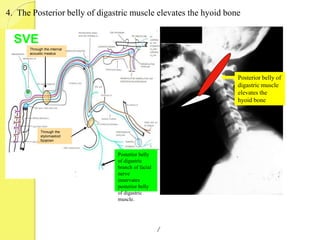
  • 143.
    Moebius syndrome (congenitalfacial diplegia)  Abnormal VI ,VII,XII Nerve nuclei  Facial Nerve absent / smaller  Congenital Extra ocular muscle & facial palsy CONGENITAL FACIAL NERVE PALSY
  • 144.
    CARDIOFACIAL SYNDROME Unilateral facialparalysis involving only the lower lip and congenital heart disease  The facial paralysis in these patients involves only those muscles concerned with pulling the lower lip downwards and outwards  These are the mentalis, depressor labii inferioris and depressor anguli oris muscles
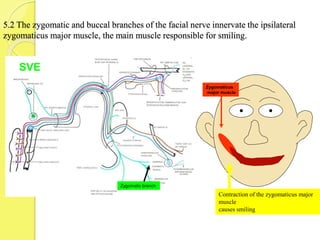
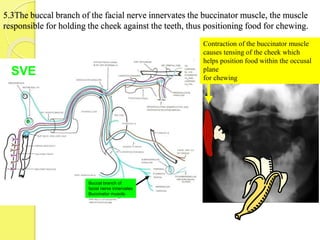
  • 145.
    All are suppliedby the mandibular marginal branch of the facial nerve. Lesions of this nerve have been recognized in adults and children for many years The paralysis is only recognizable when the patient talks, smiles or cries
  • 146.
    TREACHER COLLINS SYNDROME (MANDIBULOFACIAL DYSOSTOSIS) There is a set of typical symptoms within Treacher Collins Syndrome The OMENS classification was developed as a comprehensive and stage-based approach to differentiate the diseases. O; orbital asymmetry M; mandibular hypoplasia E; auricular deformity N; nerve development and S; soft-tissue disease
  • 147.
    FACIAL NERVE INVOLVEMENTIN TREACHER COLLINS SYNDROME N0: No facial nerve involvement N1: Upper facial nerve involvement (temporal or zygomatic branches) N2: Lower facial nerve involvement (buccal, mandibular or cervical) N3: All branches affected
  • 148.
    GOLDENHARS SYNDROME (OCULOAURICULO VERTEBRAL DYSPLASIA) Itis a wide spectrum of congenital anomalies that involves structures arising from the first and second branchial arches. Features of hemi facial microsomia, anotia, vertebral anomalies, congenital facial nerve palsy.
  • 149.
    CONCLUSION Surgeons have topay attention to minimize the risk of complication during parotidectomy. The best means of reducing iatrogenic facial nerve injury, in parotid surgery, still remains a clear understanding of the anatomy, good surgical technique with the use of multiple anatomic landmarks. Pre-operative discussion and consent for surgery, tailored according to the age and health of the patient as well as the behavior of the tumor, are mandatory Furthermore, the patient has to be informed about the cosmetic sequelae of the incision and all patients have to be told that facial nerve paralysis or paresis is possible and can be partial or total, temporary or permanent.
  • 150.
    References Fonseca & Walker: Maxillo FacialTrauma 2nd Edition Vol 1 & 2 Grays Anatomy : 39th Edition Netters : Colour Atlas of Anatomy International journal of Oral & maxillofacial Surgery
  • 151.

Editor's Notes

  • #70 SENSORY FUNCTION Although it is a function of overlapping sensory fibers from the trigeminal, glossopharyngeal, vagus, and greater auricular nerves, abnormal sensation along the posterior aspect of the external auditory canal and tympanic membrane may be an early indication of facial nerve dysfunction. Taste is most reliably tested by electrogustometry, which compares the amounts of electrical current applied to the anterolateral aspect of the tongue necessary to produce taste Perception.