1
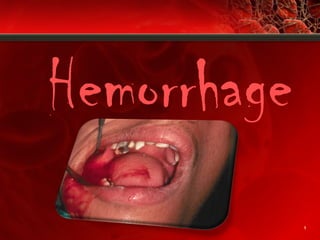
Hemorrhage
What is meant by Hemorrhage ?
Prolonged or uncontrolled bleeding is often referred to as
hemorrhage.
The amount of blood lost as a result of hemorrhage can range
from minimal to significant quantities.
Hemorrhage can occur to a greater or lesser degree during all
surgical procedures and it’s management depends upon
whether the patient is hematologically normal or suffers
from some disturbance in the normal clotting mechanism.
RELEVANCE
1)Oral soft tissues, maxilla & mandible -highly vascular
2)Extraction leaves open wound- allows oozing
3)Impossible to apply pressure during procedure
4)Tongue interference-dislodges clot-secondary bleeding and
negative pressure by sucking
5)Salivary enzymes may lyse clot formation
• The overwhelming majority of patients who undergo oral
surgical procedures are those who have normal haemostatic
mechanism.
• Therefore, significant or major hemorrhages are not that
common in oral surgery except in patients who have a
bleeding / clotting disorder or those who are on
anticoagulants.
Normal Mechanism of Hemostasis
• Hemostasis is a complicated process.
• It involves a number of events
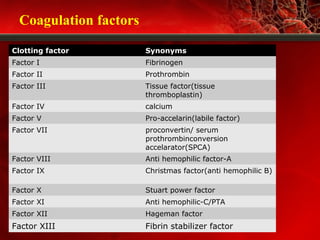
Coagulation factors
Clotting factor Synonyms
Factor I Fibrinogen
Factor II Prothrombin
Factor III Tissue factor(tissue
thromboplastin)
Factor IV calcium
Factor V Pro-accelarin(labile factor)
Factor VII proconvertin/ serum
prothrombinconversion
accelarator(SPCA)
Factor VIII Anti hemophilic factor-A
Factor IX Christmas factor(anti hemophilic B)
Factor X Stuart power factor
Factor XI Anti hemophilic-C/PTA
Factor XII Hageman factor
Factor XIII Fibrin stabilizer factor
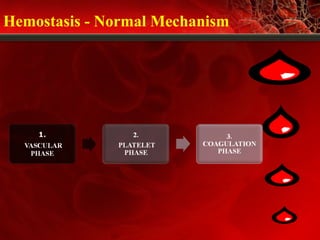
Hemostasis - Normal Mechanism
VASCULAR PHASE
When a blood vessel is damaged,
vasoconstriction results.
PLATELET PHASE
Platelets adhere to the damaged surface and
form a temporary plug.
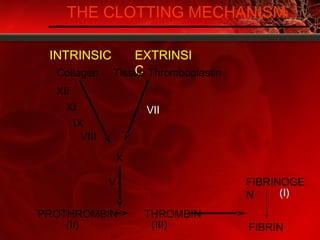
Through two separate pathways, the Intrinsic
and Extrinsic, the conversion of fibrinogen to
fibrin is complete. Fibrin tightly binds the
platelets to form a clot.
COAGULATION PHASE
THE CLOTTING MECHANISM
INTRINSIC EXTRINSI
C
PROTHROMBIN THROMBIN
FIBRINOGE
N
FIBRIN(II) (III)
(I)
V
X
Tissue ThromboplastinCollagen
VII
XII
XI
IX
VIII
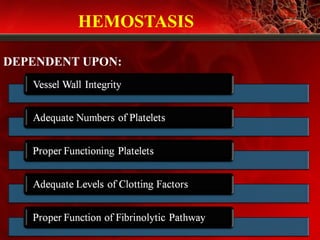
HEMOSTASIS
DEPENDENT UPON:
• Hemorrhage following Oral Surgical procedures can occur
due to local or systemic causes.
• In healthy patients the postoperative bleeding is mainly due
to local causes.
Local causes of hemorrhage in oral surgery
Local causes of hemorrhage originate in either soft tissue or
bone.
Local causes of hemorrhage in oral
surgery –Soft tissue bleeding
• Soft tissue bleeding is either arterial, venous, or capillary in
nature.
• Arterial bleeding is bright red and spurting in nature.
• Arteries in the soft tissues at risk during oral surgical
procedures are the lies posterior portion of hard palate)
greater palatine artery and the buccal artery (lies lateral to
the retromolar pad)
Venous blood is dark red in color and flows steadily and
heavily especially if the vein is large.
Capillary bleeding is bright red in color and is more of a
minimal ooze.
Local causes – Osseous (Bony) bleeding
in oral surgery
Troublesome bone bleeding originates either from nutrient
canals in the alveolar region, central vessels, such as the
inferior alveolar artery, or from central vascular lesions
(Hemangioma or Vascular malformation)
Systemic causes of hemorrhage in oral surgery
• Some patients with hereditary conditions such as
hemophilia, Von Willebrand’s disease are susceptible for
hemorrhage following oral surgical procedures.
• Patients with thrombocytopenia (decreased platelet count) ,
Leukemia e.t.c., are also at risk of prolonged bleeding after
surgery.
• Patients with uncontrolled hypertension.
Systemic causes of hemorrhage in oral
surgery
• Patients with H/O prosthetic heart valve replacement,
Stroke (Cerebrovascular accident) e.t.c., take oral
anticoagulants like Aspirin or Warfarin to prevent the
occurrence of a thromboembolic episode.
• These patients are also at risk of prolonged severe bleeding
during and after an oral surgical procedure.
• Medication: divided into 5 groups-5 A’s
• Aspirin-interferes with platelet formation,prolonged
bleeding due to decreased platelet aggregation and platelet
plug formation .
• Anticoagulants-given to thin their blood to prevent intra
vascular coagulation,e.,.MI.CVA,pulmonary emolism
• Antibiotics-(Broad spectrum)causes changes in intestinal
flora which may decease vitamin k production
• Alcohol-prolonged consumption of alcohol may lead to
cirrhosis of the liver-decreased production of coagulation
factors.
• Anticancer drugs-interferes with haematopoetic system and
reduces the no.of circulatory platelets(increased bleeding
due to decrease number of platelets)
• Enquire about hypertension and drugs etc.
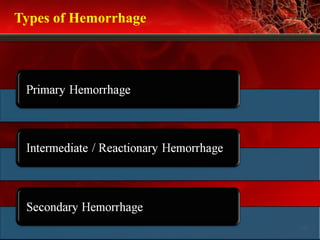
Types of Hemorrhage
26
PRIMARY HEMORRHAGE
This occurs during the surgery, as a result of injury like
cutting or laceration of the artery or bleeding from bone.
This also occurs when surgery is done in an infected area
with a lot of granulation tissue.
It can also occur after a very short period of time
immediately after surgery.
This type of bleeding is really normal and can be controlled
easily.
Intermediate / Reactionary Hemorrhage
This type of bleeding occurs within 24 hours after surgery.
This type of bleeding occurs as a result of failure of
coagulation to occur (as in patients with systemic bleeding
problems or those on anticoagulants)
Patients who have unknowingly disturbed / dislodged the
clot are also prone for this type of bleeding.
Follows primary
CAUSES
-slippage of sutures
-dislodgement of blood clot
-cessation of reflex vasospasm
occurring within 8hrs after stoppage of primary
hemorrhage due to loose bony fragments, calculus,
granulation tissue in socket
Precipitating events- rise in BP, vomiting, cough, restlessness
29
Secondary Hemorrhage
This occurs after 7 to 10 days after surgery.
This is mainly due to partial division of blood vessel in
combination with infection of the wound (Like patient’s
who undergo radical neck dissection e.t.c.,).
This type of bleeding is not very frequently encountered
after oral surgery procedures.
Measurement of acute blood loss
Measuring blood loss
1. Swab weighing 1gm =1ml
2. Hb level
3. Measuring CVP
MANAGEMENT OF PRIMARY
HEMORRHAGE IN NORMAL
PATIENTS
32
MANAGEMENT OF HEMORRHAGE
• Use hemostatic agents-local/systemic
• Local hemostatic measures:
-mechanical
-thermal
-chemical
• Systemic measures
- Hypotensive anesthetics
The management of bleeding during surgery (Primary
bleeding) can be achieved by the following means:
(i) Securing / ligation of blood vessels with silk sutures.
(ii) Use of pressure swab to achieve hemostasis.
(iii) Use of electrocautery to achieve hemostasis.
(iv) Use of hemostatic agents like bone wax, surgicel,e.t.c.,
(v) Hypotensive anaesthesia (G.A) and use of
vasoconstrictors in L.A.
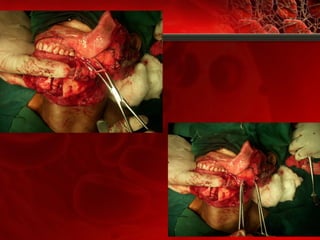
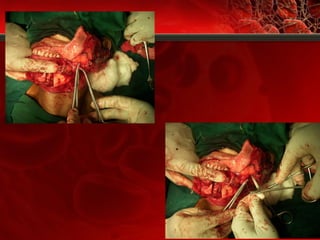
Use of hemostats
• Mosquito Artery-straight & curved(halested’s)is mandatory.
• Moderate sized artery require clamping.
• Lingual and inferior dental artery cannot be clamped-
numbness
After clamping ,tying with 3-0 catgut to hold the bleeding
points.
• Sutures and ligatures:
Transected blood vessels need to be tied with ligatures.
Large pulsating artery-non absorbable 3-0 black silk
Small artery –3-0 catgut or polyglatin
• Embolization of vessels
With angiography bleeding site is found
Agents-gelfoam,alcohol foam,
methylmeth acrylate
Thermal Agents:
• Cautery:
Heat achieves hemostasis by denaturation of protiens-coagulation
of large areas of tissues,e.g.,.electrocautery,ball burnisher
• Electrosurgery:
Occurs by induction from alternating current source-cautery point
-the point is touched to achieve hemostasis and sealing of vessel
-burning smell indicates tissue destruction
-not for large vessels.
• Lasers:
Bloodless surgeries,effectively coagulate small blood vessels
Chemical Agents:
• LOCAL:
• Astringent and styptics:
Tannic acid precipitates protein and causes clot formation(home
remedy-tea bags)
Silver nitrate and ferric chloride in capillary bleeding
• Bone wax:
Bleeding from bone.
Ingredients:beeswax-7 parts
olive oil-2 parts
phenol-1 part
Acts by mechanical occlusion of bony
canal .
Less qty to be used –wax granuloma
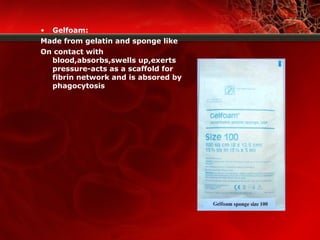
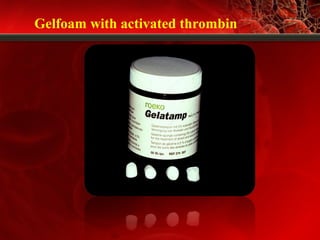
• Gelfoam:
Made from gelatin and sponge like
On contact with
blood,absorbs,swells up,exerts
pressure-acts as a scaffold for
fibrin network and is absored by
phagocytosis
• Oxygel:
Oxidized cellulose on application releases cellulosic acid-affinity for
hemoglobin-formatoon of artificial clot(not for epidermal
surface-produces acid)
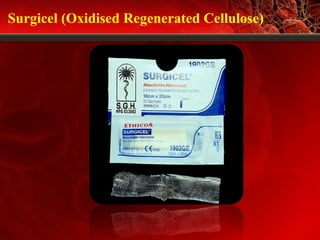
• Surgicel:
Glucose polymer based sterile knitted fabric prepared by
oxidation of regenerated cellulose-depends on binding of
hemoglobin to oxycellulose allowing the dressing to expand to
gelatinous mass
Resorbs within a month.
• Fibrin glue:
Biological adhesive containing thrombin,fibrinogen,factor XII
• Adrenalin:applied topically,induces vasoconstriction,gauze pack
soaked.
1:1ooo
Extensive use –systemic complication e.g.,.cardiac pt,HT pt.
Systemic Agents:
• Whole blood:
Excessive blood loss-hypovolemic shock,indication for whole
blood transfusion(fresh blood-donation within 2 yrs)
Screen for HIV,HbS etc
• Platelet rich plasma:
Adhered to platelet level.
Infusion quickly via short i.v transfusion set.
• Fresh frozen plasma:
Unit(150 ml)fresh frozen plasma has all coagulation factors.
• Cryoprecipitate:15 ml vial of cryoprecipitate contains 100 mg of
factor VIII.
• Ethamsylate:decreases capillary bleeding
HYPOTENSIVE ANESTHESIA
• Applied when working on GA to
reduce bleeding during operation.
• BP lowered by anesthetist and
bleeding is reduced
• Disadv: arteries may be cut without
obvious bleeding and not tied with
catgut
• Damaged vessels bleed profusely
post surgically, risk of thrombosis
Vasoconstriction:
• Prolonged anesthetic effect and
bloodless field to reduce capillary
bleeding under GA.
LA 1:80,000 adrenalin with
halogenated anesthetic agent
• Disadv:may produce cardiac
arrythmias,local tissue cyanosis and
acidity
Post op hematoma formation.
Felypressin used not more than 8-10
ml in adults.
Synthetic Materials
There are several materials that are commercially available that are used
locally for achieving adequate hemostasis.
Surgicel (Oxidised Regenerated Cellulose)
Gelfoam with activated thrombin
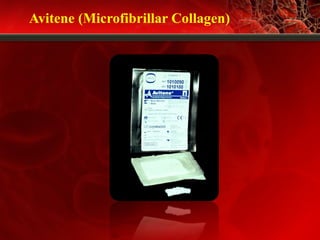
Avitene (Microfibrillar Collagen)
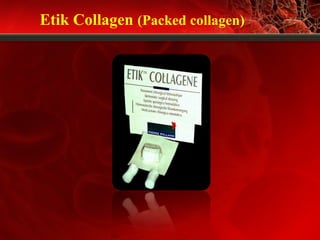
Etik Collagen (Packed collagen)
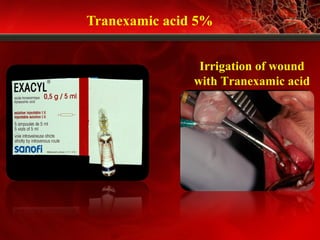
Tranexamic acid 5%
Irrigation of wound
with Tranexamic acid
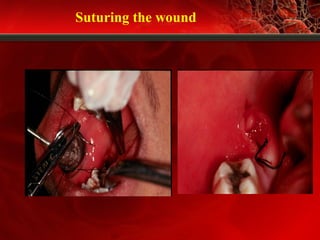
Suturing the wound
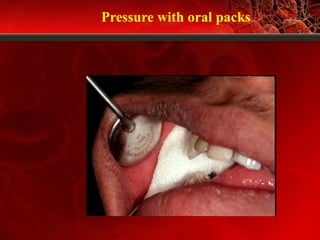
Pressure with oral packs
62
MANAGEMENT OF INTERMEDIATE
HEMORRHAGE IN NORMAL
PATIENTS
Management of Hemorrhage in patients
with bleeding disorders / and those on
anticoagulant therapy
• The usual protocol involved in the treatment of this group of
patients consists of pre-operative blood investigations and
preoperative correction of the underlying deficiency
(Replacement of Clotting factors / platelets) if any in these
patients.
• Subsequently, after this appropriate local measures are used
to decrease the chances of post-operative bleeding.
LABORATORY EVALUATION
• PLATELET COUNT
• BLEEDING TIME (BT)
• PROTHROMBIN TIME (PT)
• PARTIAL THROMBOPLASTIN TIME (PTT)
• THROMBIN TIME (TT)
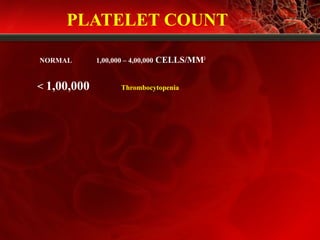
PLATELET COUNT
NORMAL 1,00,000 – 4,00,000 CELLS/MM3
< 1,00,000 Thrombocytopenia
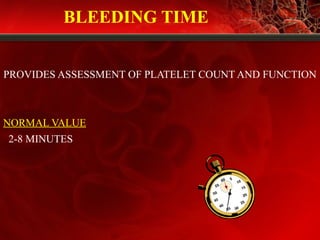
BLEEDING TIME
PROVIDES ASSESSMENT OF PLATELET COUNT AND FUNCTION
NORMAL VALUE
2-8 MINUTES
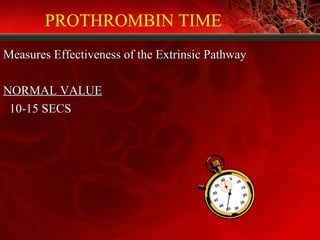
PROTHROMBIN TIME
Measures Effectiveness of the Extrinsic PathwayMeasures Effectiveness of the Extrinsic Pathway
NORMAL VALUENORMAL VALUE
10-15 SECS10-15 SECS
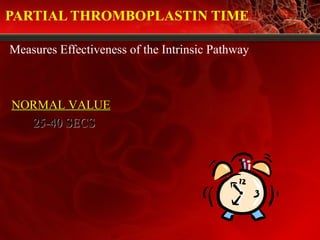
PARTIAL THROMBOPLASTIN TIME
Measures Effectiveness of the Intrinsic Pathway
NORMAL VALUENORMAL VALUE
25-40 SECS25-40 SECS
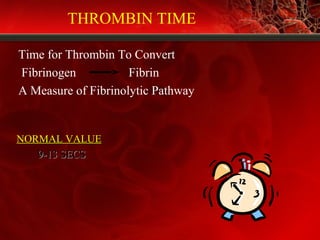
THROMBIN TIME
Time for Thrombin To Convert
Fibrinogen Fibrin
A Measure of Fibrinolytic Pathway
NORMAL VALUENORMAL VALUE
9-13 SECS9-13 SECS
Management of Hemorrhage in patients
with uncontrolled hypertension.
• This group of patients need appropriate medical
consultation for initiation of medical treatment to decrease
their Blood Pressure.
• Thus once their B.P is controlled, then the bleeding
decreases and with local measures the hemorrhage is
controlled.
71
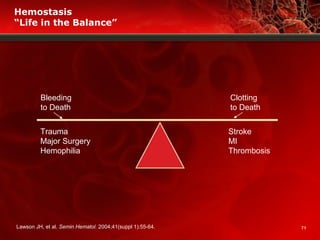
Hemostasis
“Life in the Balance”
Bleeding
to Death
Trauma
Major Surgery
Hemophilia
Clotting
to Death
Stroke
MI
Thrombosis
Lawson JH, et al. Semin Hematol. 2004;41(suppl 1):55-64.
References:
• Textbook of Medical Physiology – Guyton
• Principles of Internal Medicine – Harrison’s.
• Principles and Practice of Medicine – Davidson.
72

Hemorrhage

  • 1.
  • 3.
    What is meantby Hemorrhage ? Prolonged or uncontrolled bleeding is often referred to as hemorrhage. The amount of blood lost as a result of hemorrhage can range from minimal to significant quantities.
  • 4.
    Hemorrhage can occurto a greater or lesser degree during all surgical procedures and it’s management depends upon whether the patient is hematologically normal or suffers from some disturbance in the normal clotting mechanism.
  • 5.
    RELEVANCE 1)Oral soft tissues,maxilla & mandible -highly vascular 2)Extraction leaves open wound- allows oozing 3)Impossible to apply pressure during procedure 4)Tongue interference-dislodges clot-secondary bleeding and negative pressure by sucking 5)Salivary enzymes may lyse clot formation
  • 6.
    • The overwhelmingmajority of patients who undergo oral surgical procedures are those who have normal haemostatic mechanism. • Therefore, significant or major hemorrhages are not that common in oral surgery except in patients who have a bleeding / clotting disorder or those who are on anticoagulants.
  • 7.
    Normal Mechanism ofHemostasis • Hemostasis is a complicated process. • It involves a number of events
  • 8.
    Coagulation factors Clotting factorSynonyms Factor I Fibrinogen Factor II Prothrombin Factor III Tissue factor(tissue thromboplastin) Factor IV calcium Factor V Pro-accelarin(labile factor) Factor VII proconvertin/ serum prothrombinconversion accelarator(SPCA) Factor VIII Anti hemophilic factor-A Factor IX Christmas factor(anti hemophilic B) Factor X Stuart power factor Factor XI Anti hemophilic-C/PTA Factor XII Hageman factor Factor XIII Fibrin stabilizer factor
  • 9.
  • 10.
    VASCULAR PHASE When ablood vessel is damaged, vasoconstriction results.
  • 11.
    PLATELET PHASE Platelets adhereto the damaged surface and form a temporary plug.
  • 12.
    Through two separatepathways, the Intrinsic and Extrinsic, the conversion of fibrinogen to fibrin is complete. Fibrin tightly binds the platelets to form a clot. COAGULATION PHASE
  • 13.
    THE CLOTTING MECHANISM INTRINSICEXTRINSI C PROTHROMBIN THROMBIN FIBRINOGE N FIBRIN(II) (III) (I) V X Tissue ThromboplastinCollagen VII XII XI IX VIII
  • 14.
  • 15.
    • Hemorrhage followingOral Surgical procedures can occur due to local or systemic causes. • In healthy patients the postoperative bleeding is mainly due to local causes.
  • 16.
    Local causes ofhemorrhage in oral surgery Local causes of hemorrhage originate in either soft tissue or bone.
  • 17.
    Local causes ofhemorrhage in oral surgery –Soft tissue bleeding • Soft tissue bleeding is either arterial, venous, or capillary in nature.
  • 18.
    • Arterial bleedingis bright red and spurting in nature. • Arteries in the soft tissues at risk during oral surgical procedures are the lies posterior portion of hard palate) greater palatine artery and the buccal artery (lies lateral to the retromolar pad)
  • 19.
    Venous blood isdark red in color and flows steadily and heavily especially if the vein is large. Capillary bleeding is bright red in color and is more of a minimal ooze.
  • 20.
    Local causes –Osseous (Bony) bleeding in oral surgery Troublesome bone bleeding originates either from nutrient canals in the alveolar region, central vessels, such as the inferior alveolar artery, or from central vascular lesions (Hemangioma or Vascular malformation)
  • 21.
    Systemic causes ofhemorrhage in oral surgery • Some patients with hereditary conditions such as hemophilia, Von Willebrand’s disease are susceptible for hemorrhage following oral surgical procedures. • Patients with thrombocytopenia (decreased platelet count) , Leukemia e.t.c., are also at risk of prolonged bleeding after surgery. • Patients with uncontrolled hypertension.
  • 22.
    Systemic causes ofhemorrhage in oral surgery • Patients with H/O prosthetic heart valve replacement, Stroke (Cerebrovascular accident) e.t.c., take oral anticoagulants like Aspirin or Warfarin to prevent the occurrence of a thromboembolic episode. • These patients are also at risk of prolonged severe bleeding during and after an oral surgical procedure.
  • 23.
    • Medication: dividedinto 5 groups-5 A’s • Aspirin-interferes with platelet formation,prolonged bleeding due to decreased platelet aggregation and platelet plug formation . • Anticoagulants-given to thin their blood to prevent intra vascular coagulation,e.,.MI.CVA,pulmonary emolism
  • 24.
    • Antibiotics-(Broad spectrum)causeschanges in intestinal flora which may decease vitamin k production • Alcohol-prolonged consumption of alcohol may lead to cirrhosis of the liver-decreased production of coagulation factors.
  • 25.
    • Anticancer drugs-interfereswith haematopoetic system and reduces the no.of circulatory platelets(increased bleeding due to decrease number of platelets) • Enquire about hypertension and drugs etc.
  • 26.
  • 27.
    PRIMARY HEMORRHAGE This occursduring the surgery, as a result of injury like cutting or laceration of the artery or bleeding from bone. This also occurs when surgery is done in an infected area with a lot of granulation tissue. It can also occur after a very short period of time immediately after surgery. This type of bleeding is really normal and can be controlled easily.
  • 28.
    Intermediate / ReactionaryHemorrhage This type of bleeding occurs within 24 hours after surgery. This type of bleeding occurs as a result of failure of coagulation to occur (as in patients with systemic bleeding problems or those on anticoagulants) Patients who have unknowingly disturbed / dislodged the clot are also prone for this type of bleeding.
  • 29.
    Follows primary CAUSES -slippage ofsutures -dislodgement of blood clot -cessation of reflex vasospasm occurring within 8hrs after stoppage of primary hemorrhage due to loose bony fragments, calculus, granulation tissue in socket Precipitating events- rise in BP, vomiting, cough, restlessness 29
  • 30.
    Secondary Hemorrhage This occursafter 7 to 10 days after surgery. This is mainly due to partial division of blood vessel in combination with infection of the wound (Like patient’s who undergo radical neck dissection e.t.c.,). This type of bleeding is not very frequently encountered after oral surgery procedures.
  • 31.
    Measurement of acuteblood loss Measuring blood loss 1. Swab weighing 1gm =1ml 2. Hb level 3. Measuring CVP
  • 32.
    MANAGEMENT OF PRIMARY HEMORRHAGEIN NORMAL PATIENTS 32
  • 33.
    MANAGEMENT OF HEMORRHAGE •Use hemostatic agents-local/systemic • Local hemostatic measures: -mechanical -thermal -chemical • Systemic measures - Hypotensive anesthetics
  • 34.
    The management ofbleeding during surgery (Primary bleeding) can be achieved by the following means: (i) Securing / ligation of blood vessels with silk sutures. (ii) Use of pressure swab to achieve hemostasis. (iii) Use of electrocautery to achieve hemostasis. (iv) Use of hemostatic agents like bone wax, surgicel,e.t.c., (v) Hypotensive anaesthesia (G.A) and use of vasoconstrictors in L.A.
  • 35.
    Use of hemostats •Mosquito Artery-straight & curved(halested’s)is mandatory. • Moderate sized artery require clamping. • Lingual and inferior dental artery cannot be clamped- numbness
  • 36.
    After clamping ,tyingwith 3-0 catgut to hold the bleeding points. • Sutures and ligatures: Transected blood vessels need to be tied with ligatures. Large pulsating artery-non absorbable 3-0 black silk Small artery –3-0 catgut or polyglatin
  • 39.
    • Embolization ofvessels With angiography bleeding site is found Agents-gelfoam,alcohol foam, methylmeth acrylate
  • 40.
    Thermal Agents: • Cautery: Heatachieves hemostasis by denaturation of protiens-coagulation of large areas of tissues,e.g.,.electrocautery,ball burnisher
  • 41.
    • Electrosurgery: Occurs byinduction from alternating current source-cautery point -the point is touched to achieve hemostasis and sealing of vessel -burning smell indicates tissue destruction -not for large vessels.
  • 42.
    • Lasers: Bloodless surgeries,effectivelycoagulate small blood vessels
  • 43.
    Chemical Agents: • LOCAL: •Astringent and styptics: Tannic acid precipitates protein and causes clot formation(home remedy-tea bags) Silver nitrate and ferric chloride in capillary bleeding
  • 44.
    • Bone wax: Bleedingfrom bone. Ingredients:beeswax-7 parts olive oil-2 parts phenol-1 part Acts by mechanical occlusion of bony canal . Less qty to be used –wax granuloma
  • 45.
    • Gelfoam: Made fromgelatin and sponge like On contact with blood,absorbs,swells up,exerts pressure-acts as a scaffold for fibrin network and is absored by phagocytosis
  • 46.
    • Oxygel: Oxidized celluloseon application releases cellulosic acid-affinity for hemoglobin-formatoon of artificial clot(not for epidermal surface-produces acid)
  • 47.
    • Surgicel: Glucose polymerbased sterile knitted fabric prepared by oxidation of regenerated cellulose-depends on binding of hemoglobin to oxycellulose allowing the dressing to expand to gelatinous mass Resorbs within a month.
  • 48.
    • Fibrin glue: Biologicaladhesive containing thrombin,fibrinogen,factor XII • Adrenalin:applied topically,induces vasoconstriction,gauze pack soaked. 1:1ooo Extensive use –systemic complication e.g.,.cardiac pt,HT pt.
  • 49.
    Systemic Agents: • Wholeblood: Excessive blood loss-hypovolemic shock,indication for whole blood transfusion(fresh blood-donation within 2 yrs) Screen for HIV,HbS etc
  • 50.
    • Platelet richplasma: Adhered to platelet level. Infusion quickly via short i.v transfusion set. • Fresh frozen plasma: Unit(150 ml)fresh frozen plasma has all coagulation factors.
  • 51.
    • Cryoprecipitate:15 mlvial of cryoprecipitate contains 100 mg of factor VIII. • Ethamsylate:decreases capillary bleeding
  • 52.
    HYPOTENSIVE ANESTHESIA • Appliedwhen working on GA to reduce bleeding during operation. • BP lowered by anesthetist and bleeding is reduced • Disadv: arteries may be cut without obvious bleeding and not tied with catgut • Damaged vessels bleed profusely post surgically, risk of thrombosis
  • 53.
    Vasoconstriction: • Prolonged anestheticeffect and bloodless field to reduce capillary bleeding under GA. LA 1:80,000 adrenalin with halogenated anesthetic agent • Disadv:may produce cardiac arrythmias,local tissue cyanosis and acidity Post op hematoma formation. Felypressin used not more than 8-10 ml in adults.
  • 54.
    Synthetic Materials There areseveral materials that are commercially available that are used locally for achieving adequate hemostasis.
  • 55.
  • 56.
  • 57.
  • 58.
  • 59.
    Tranexamic acid 5% Irrigationof wound with Tranexamic acid
  • 60.
  • 61.
  • 62.
  • 63.
    Management of Hemorrhagein patients with bleeding disorders / and those on anticoagulant therapy • The usual protocol involved in the treatment of this group of patients consists of pre-operative blood investigations and preoperative correction of the underlying deficiency (Replacement of Clotting factors / platelets) if any in these patients. • Subsequently, after this appropriate local measures are used to decrease the chances of post-operative bleeding.
  • 64.
    LABORATORY EVALUATION • PLATELETCOUNT • BLEEDING TIME (BT) • PROTHROMBIN TIME (PT) • PARTIAL THROMBOPLASTIN TIME (PTT) • THROMBIN TIME (TT)
  • 65.
    PLATELET COUNT NORMAL 1,00,000– 4,00,000 CELLS/MM3 < 1,00,000 Thrombocytopenia
  • 66.
    BLEEDING TIME PROVIDES ASSESSMENTOF PLATELET COUNT AND FUNCTION NORMAL VALUE 2-8 MINUTES
  • 67.
    PROTHROMBIN TIME Measures Effectivenessof the Extrinsic PathwayMeasures Effectiveness of the Extrinsic Pathway NORMAL VALUENORMAL VALUE 10-15 SECS10-15 SECS
  • 68.
    PARTIAL THROMBOPLASTIN TIME MeasuresEffectiveness of the Intrinsic Pathway NORMAL VALUENORMAL VALUE 25-40 SECS25-40 SECS
  • 69.
    THROMBIN TIME Time forThrombin To Convert Fibrinogen Fibrin A Measure of Fibrinolytic Pathway NORMAL VALUENORMAL VALUE 9-13 SECS9-13 SECS
  • 70.
    Management of Hemorrhagein patients with uncontrolled hypertension. • This group of patients need appropriate medical consultation for initiation of medical treatment to decrease their Blood Pressure. • Thus once their B.P is controlled, then the bleeding decreases and with local measures the hemorrhage is controlled.
  • 71.
    71 Hemostasis “Life in theBalance” Bleeding to Death Trauma Major Surgery Hemophilia Clotting to Death Stroke MI Thrombosis Lawson JH, et al. Semin Hematol. 2004;41(suppl 1):55-64.
  • 72.
    References: • Textbook ofMedical Physiology – Guyton • Principles of Internal Medicine – Harrison’s. • Principles and Practice of Medicine – Davidson. 72