
Face Recognition and
Gate Opening Assistant
For
Visually Impaired
Submitted To
Mr. Sudhanshu Kulsreshtha
Submitted By:
Shraddha Saxena 9911103559
Ullas Puntambekar 9911103585
In the present scenario the crimes are increasing
exponentially , arising a need of security.
Security can also be described as a condition so that one
can develop and progress freely and with a faith that no
harm may be done.
Visually impaired people are more immune to such
crimes.
Camera is now enormously being used and with the
development of its content that is used in various
applications. One of such is visual surveillance that is in
flagship demand in today’s market.
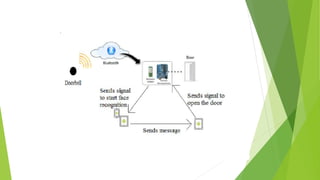
A system which identifies the visitor on the door using face
recognition and informs (via an SMS) the visually impaired user
about it. A door opening assistant that shall allow the user to open
the door (fitted with an electronic lock) and admit the visitor in
his or her home remotely via Bluetooth (for the prototype purpose
only).
Project Objective
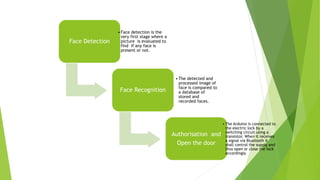
Face Detection
• Face detection is the
very first stage where a
picture is evaluated to
find if any face is
present or not.
Face Recognition
• The detected and
processed image of
face is compared to
a database of
stored and
recorded faces.
Authorisation and
Open the door
• The Arduino is connected to
the electric lock by a
switching circuit using a
transistor. When it receives
a signal via Bluetooth it
shall control the supply and
thus open or close the lock
accordingly
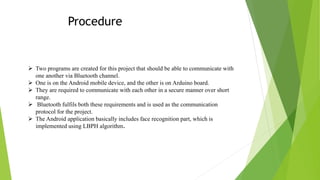
Procedure
 Two programs are created for this project that should be able to communicate with
one another via Bluetooth channel.
 One is on the Android mobile device, and the other is on Arduino board.
 They are required to communicate with each other in a secure manner over short
range.
 Bluetooth fulfils both these requirements and is used as the communication
protocol for the project.
 The Android application basically includes face recognition part, which is
implemented using LBPH algorithm.
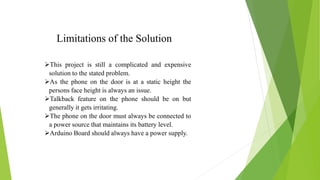
Limitations of the Solution
This project is still a complicated and expensive
solution to the stated problem.
As the phone on the door is at a static height the
persons face height is always an issue.
Talkback feature on the phone should be on but
generally it gets irritating.
The phone on the door must always be connected to
a power source that maintains its battery level.
Arduino Board should always have a power supply.
Conclusion
A system to open the door after face recognition to help
visually impaired people in their daily life. Experimental
results demonstrate that our proposed method performs
satisfactorily. Furthermore, we can say that the system provides
a life quality to visually impaired people. The system is easy to
use. Visually impaired persons need not to depend on others.
Still there is need for faster speech feedback in order reduce
the timing of the process. Also OpenCV is a very powerful and
multi-faceted framework covering many fields which are still
active research areas.
Face Recognition and Door Opening Assistant for Visually Impaired

Face Recognition and Door Opening Assistant for Visually Impaired

  • 1.
    Face Recognition and GateOpening Assistant For Visually Impaired Submitted To Mr. Sudhanshu Kulsreshtha Submitted By: Shraddha Saxena 9911103559 Ullas Puntambekar 9911103585
  • 2.
    In the presentscenario the crimes are increasing exponentially , arising a need of security. Security can also be described as a condition so that one can develop and progress freely and with a faith that no harm may be done. Visually impaired people are more immune to such crimes. Camera is now enormously being used and with the development of its content that is used in various applications. One of such is visual surveillance that is in flagship demand in today’s market.
  • 3.
    A system whichidentifies the visitor on the door using face recognition and informs (via an SMS) the visually impaired user about it. A door opening assistant that shall allow the user to open the door (fitted with an electronic lock) and admit the visitor in his or her home remotely via Bluetooth (for the prototype purpose only). Project Objective
  • 4.
    Face Detection • Facedetection is the very first stage where a picture is evaluated to find if any face is present or not. Face Recognition • The detected and processed image of face is compared to a database of stored and recorded faces. Authorisation and Open the door • The Arduino is connected to the electric lock by a switching circuit using a transistor. When it receives a signal via Bluetooth it shall control the supply and thus open or close the lock accordingly
  • 6.
    Procedure  Two programsare created for this project that should be able to communicate with one another via Bluetooth channel.  One is on the Android mobile device, and the other is on Arduino board.  They are required to communicate with each other in a secure manner over short range.  Bluetooth fulfils both these requirements and is used as the communication protocol for the project.  The Android application basically includes face recognition part, which is implemented using LBPH algorithm.
  • 7.
    Limitations of theSolution This project is still a complicated and expensive solution to the stated problem. As the phone on the door is at a static height the persons face height is always an issue. Talkback feature on the phone should be on but generally it gets irritating. The phone on the door must always be connected to a power source that maintains its battery level. Arduino Board should always have a power supply.
  • 8.
    Conclusion A system toopen the door after face recognition to help visually impaired people in their daily life. Experimental results demonstrate that our proposed method performs satisfactorily. Furthermore, we can say that the system provides a life quality to visually impaired people. The system is easy to use. Visually impaired persons need not to depend on others. Still there is need for faster speech feedback in order reduce the timing of the process. Also OpenCV is a very powerful and multi-faceted framework covering many fields which are still active research areas.