introduction
Mechanical testingprovides the link between the
mechanical properties and performance of
material.
A large range of mechanical tests has been
evolved to characterize the different mechanical
responses of the engineering materials
To predict the performance as realistically as
possible
To select and design of engineering components
The tensile test is the most widely used test of this
category.
3.
The tension test
The tensile test can be used to obtain several
mechanical properties of materials that are
important in design using INSTRON tensile testing
machine.
A specimen is deformed, usually to fracture, with
a gradually increasing tensile load that is applied
uniaxially along the long axis of a specimen.
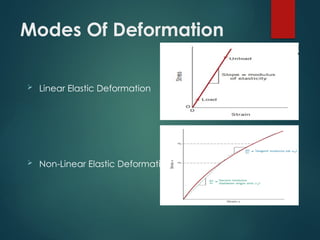
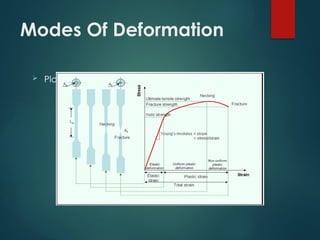
As a result of tensile testing, we get a stress-strain
curve from where we obtain useful information to
determine the mechanical behavior of the
specimen.
4.
Sample specs.
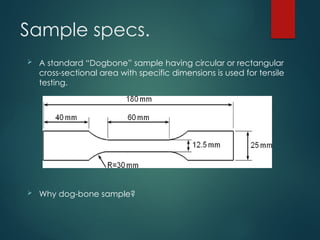
Astandard “Dogbone” sample having circular or rectangular
cross-sectional area with specific dimensions is used for tensile
testing.
Why dog-bone sample?
Important definitions
YieldStrength σy
The level of stress from where plastic deformation begins (maybe
determined by 0.002 strain offset)
Ultimate Tensile Strength σUTS
Maximum stress that can be sustained by a structure in tension
Fracture Strength σF
The level of stress at which fracture or break down of material takes place
Elastic Modulus
Ratio of Engineering stress over Engineering stain under uniaxial tensile
loading
E= σ/ ε.
7.
Important definitions
Yielding
The phenomenon of elastic-plastic transition is called yielding
Proportional Limit
The region of stress-strain curve where Hooke’s law is obeyed.
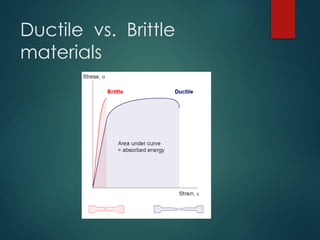
Ductility
It is a measure of the degree of plastic deformation that has been
sustained at fracture.
%Elongation
%E= (Lf-L0)/L0 × 100
%Area Reduction:
%R= (A0-Af)/A0 × 100
LAB ACTIVITY
Demonstrationof tension test on different
materials
Collection and analysis of the data
Comparison of different parameters
Lab report submission