Welcome to our
presentation
Presented
by
Md . Shabuj Hossain
Student id : 192014013
Dept. of textile engineering
Green university of bangladesh
Topic
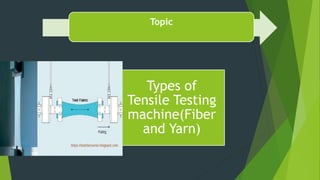
Types of
Tensile Testing
machine(Fiber
and Yarn)
Definition of tensile strength in
textile
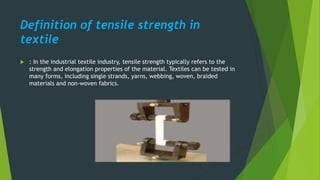
 : In the industrial textile industry, tensile strength typically refers to the
strength and elongation properties of the material. Textiles can be tested in
many forms, including single strands, yarns, webbing, woven, braided
materials and non-woven fabrics.
Tensile Properties of Yarn:
 A yarn’s tensile property can be defined as the maximum force/load that is
required to break the material. It is a parameter of vital importance
regarding the fabrication of yarn because it directly influences the strength of
the developed fabrics. A single yarn strength provides information about the
warping machine and loom efficiency. In order to calculate the combined
strength effect of the yarn, the count lea strength product (CLSP) of the yarn
is calculated. A lea of 120 yards is made using the wrapping reel, and the
weight of the lea is determined in order to calculate the yarn count by using
the formula: number of hanks/pound. The lea strength is determined by using
a lea strength machine that has two jaws, one fixed and the other attached
to the load. Using the constant rate of loading principle, the tensile strength
of the lea can be determined.
Tensile Strength Testing Machines:
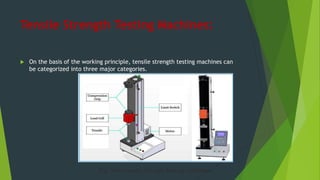
 On the basis of the working principle, tensile strength testing machines can
be categorized into three major categories.
Fig: Yarn tensile strength testing machines
Test Procedure:
 Before the start of the test, the atmospheric conditions of the laboratory
should be maintained according to standard. The settings of the machine
should also be accurate and meet the demands of the standard. Mostly the
USTER TENSORAPID/USTER TENSOJET testing machine is used for this purpose.
The gauge length for the test is 500 mm and pretension is set to 0.5 cN/Tex.
First of all the conditioned yarn is fixed into the USTER TENSORAPID/ USTER
TENSOJET and is adjusted between the two jaws of the machine, one of
which is movable and the other stationary. It works at a speed of 5000 mm/s
and the gauge between the two jaws is 500 mm. The machine is turned on
and the test is started. The tests are performed automatically and stop after
20 have been completed. After completion the result is printed, which gives
the value of the tensile strength and its coefficient of variation.
Test Procedure:
 We require a large number of tests to be performed in less time and with higher
efficiencies and accuracy levels. To meet this requirement USTER Technologies
produces the USTER TENSORAPID/USTER TENSOJET testing machine, which is
frequently used for measuring the single yarn strength. USP or USTER statistics
enable us to compare the results of single yarn strength, whether they fall within
an acceptable range or not. Mostly, the mean strength is not so important, though
the frequency of any weak place is. Due to these weak places, yarn breakage
occurs during subsequent processes of weaving and causes low production
efficiencies or fabric faults that must be avoided to obtain high quality and more
production. In high speed production the weak places still cause problems even if
they occur after hundreds of meters. Therefore, in such cases, the coefficient of
the strength of a single yarn is of greater importance than the mean value.
In order to check greater lengths of yarn the speeds of the machine are kept
higher, otherwise the tests would take longer if the standard test time of 20 s was
used. The greater the number of tests, the better will be the statistical prediction
of weak spots and more precise results of tensile strength will be obtained.
Constant Rate of Extension (CRE):
 The machines have a constant rate of elongation of the specimen; as the load
increases there is negligible movement of the measuring mechanism. The
working principle of the Tensorapid-4, which is used to evaluate the tensile
strength of a single yarn, is a constant rate of elongation.

Constant Rate of Loading (CRL):
 The machines apply the load on the test sample, which is increased
constantly with time. The specimen is free to elongate and its extension
depends on its properties for any applied load. The working principle of the
lea strength machine is of this category.
Constant Rate of Traverse (CRT):
 In this type of machine two pulling clamps are used to evaluate the tensile
strength of the sample. One clamp moves with constant speed and application
of the load is done by the second clamp, which is responsible for the
activation of a load measuring mechanism. Normally old machines use this
mechanism, such as the old fabric tensile strength testing machine.
Tensile testing for fabric
 Tensile Strength:
Test to determine the breaking strength and elongation of most textile
fabrics. Not recommended for knit fabrics or fabrics with high stretch value.
To determine tensile strength of fabric two type of test are done. They are:
 Strip Test (British Standard)
 Grab Test (US standard)
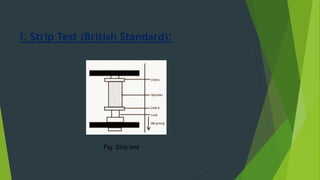
I. Strip Test (British Standard):
Fig: Strip test
Sample Preparation:
 5 samples for warp direction
 5 samples for weft direction
 First taken a sample of (60mmx300)mm and then frayed down to
(50mmx300)mm
 Test Procedure:
 Sample is clamped in the jaws
 CRE 500mm per minute loading
 Gauge length 200mm
Test Result:
 Mean breaking force
 Mean elongation at break
II. Grab Test (US Style):
Sampling Preparation:
 Sample size: 100x1500mm
 Jaw width – 25mm
 Gauge length- 75mm
 Test Procedure:
 Sample is clamped between the jaw
 Speed is adjusted so then the sample is broken in 20±3 seconds.
 Test Results:
 Mean breaking force.
 Mean elongation at break.
Thank

Textile testing & quality control 1(presentation)

  • 1.
  • 2.
    Presented by Md . ShabujHossain Student id : 192014013 Dept. of textile engineering Green university of bangladesh
  • 3.
  • 4.
    Definition of tensilestrength in textile  : In the industrial textile industry, tensile strength typically refers to the strength and elongation properties of the material. Textiles can be tested in many forms, including single strands, yarns, webbing, woven, braided materials and non-woven fabrics.
  • 5.
    Tensile Properties ofYarn:  A yarn’s tensile property can be defined as the maximum force/load that is required to break the material. It is a parameter of vital importance regarding the fabrication of yarn because it directly influences the strength of the developed fabrics. A single yarn strength provides information about the warping machine and loom efficiency. In order to calculate the combined strength effect of the yarn, the count lea strength product (CLSP) of the yarn is calculated. A lea of 120 yards is made using the wrapping reel, and the weight of the lea is determined in order to calculate the yarn count by using the formula: number of hanks/pound. The lea strength is determined by using a lea strength machine that has two jaws, one fixed and the other attached to the load. Using the constant rate of loading principle, the tensile strength of the lea can be determined.
  • 6.
    Tensile Strength TestingMachines:  On the basis of the working principle, tensile strength testing machines can be categorized into three major categories. Fig: Yarn tensile strength testing machines
  • 7.
    Test Procedure:  Beforethe start of the test, the atmospheric conditions of the laboratory should be maintained according to standard. The settings of the machine should also be accurate and meet the demands of the standard. Mostly the USTER TENSORAPID/USTER TENSOJET testing machine is used for this purpose. The gauge length for the test is 500 mm and pretension is set to 0.5 cN/Tex. First of all the conditioned yarn is fixed into the USTER TENSORAPID/ USTER TENSOJET and is adjusted between the two jaws of the machine, one of which is movable and the other stationary. It works at a speed of 5000 mm/s and the gauge between the two jaws is 500 mm. The machine is turned on and the test is started. The tests are performed automatically and stop after 20 have been completed. After completion the result is printed, which gives the value of the tensile strength and its coefficient of variation.
  • 8.
    Test Procedure:  Werequire a large number of tests to be performed in less time and with higher efficiencies and accuracy levels. To meet this requirement USTER Technologies produces the USTER TENSORAPID/USTER TENSOJET testing machine, which is frequently used for measuring the single yarn strength. USP or USTER statistics enable us to compare the results of single yarn strength, whether they fall within an acceptable range or not. Mostly, the mean strength is not so important, though the frequency of any weak place is. Due to these weak places, yarn breakage occurs during subsequent processes of weaving and causes low production efficiencies or fabric faults that must be avoided to obtain high quality and more production. In high speed production the weak places still cause problems even if they occur after hundreds of meters. Therefore, in such cases, the coefficient of the strength of a single yarn is of greater importance than the mean value. In order to check greater lengths of yarn the speeds of the machine are kept higher, otherwise the tests would take longer if the standard test time of 20 s was used. The greater the number of tests, the better will be the statistical prediction of weak spots and more precise results of tensile strength will be obtained.
  • 9.
    Constant Rate ofExtension (CRE):  The machines have a constant rate of elongation of the specimen; as the load increases there is negligible movement of the measuring mechanism. The working principle of the Tensorapid-4, which is used to evaluate the tensile strength of a single yarn, is a constant rate of elongation. 
  • 10.
    Constant Rate ofLoading (CRL):  The machines apply the load on the test sample, which is increased constantly with time. The specimen is free to elongate and its extension depends on its properties for any applied load. The working principle of the lea strength machine is of this category.
  • 11.
    Constant Rate ofTraverse (CRT):  In this type of machine two pulling clamps are used to evaluate the tensile strength of the sample. One clamp moves with constant speed and application of the load is done by the second clamp, which is responsible for the activation of a load measuring mechanism. Normally old machines use this mechanism, such as the old fabric tensile strength testing machine.
  • 12.
    Tensile testing forfabric  Tensile Strength: Test to determine the breaking strength and elongation of most textile fabrics. Not recommended for knit fabrics or fabrics with high stretch value. To determine tensile strength of fabric two type of test are done. They are:  Strip Test (British Standard)  Grab Test (US standard)
  • 13.
    I. Strip Test(British Standard): Fig: Strip test
  • 14.
    Sample Preparation:  5samples for warp direction  5 samples for weft direction  First taken a sample of (60mmx300)mm and then frayed down to (50mmx300)mm  Test Procedure:  Sample is clamped in the jaws  CRE 500mm per minute loading  Gauge length 200mm
  • 15.
    Test Result:  Meanbreaking force  Mean elongation at break II. Grab Test (US Style):
  • 16.
    Sampling Preparation:  Samplesize: 100x1500mm  Jaw width – 25mm  Gauge length- 75mm  Test Procedure:  Sample is clamped between the jaw  Speed is adjusted so then the sample is broken in 20±3 seconds.  Test Results:  Mean breaking force.  Mean elongation at break.
  • 17.