Fabric Strength
Dilshat Rubia Dola
Lecturer
Department of Textile Engineering
BGMEA UNIVERSITY OF FASHION AND TECHNOLOGY (BUFT)
Fabric Strength
The strength of a fabric gives us an idea how much load we can apply on it and it is very important
for fabric. The strength of the fabric is very necessary for it because if the fabric strength is not good
then it will break with excessive tensile force and thus the dresses produced may tear with the
outside force. The strength of a fabric varies with EPI, PPI, and Count Variation. The strength of the
fabric also varies if the length and width of the fabric to be tested is changed. The strength of the
fabric also depends on the construction of the fabric. A plain fabric is stronger than a twill fabric if
made from yarn of same count.
Reasons for Fabric Strength Testing
▪ To check the fabric confirms to specification.
▪ To note the effects of changes in structural details.

▪ To note the effects of physical and chemical treatment, exposure to weather and laundering.
▪ To investigate causes of failure and customer complaints.
▪ To help in the design of a fabric for specific purpose.
▪ To study the interaction of fiber, yarn and fabric properties.
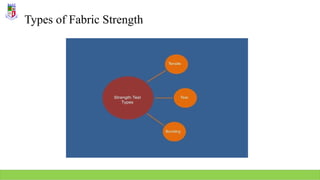
Types of Fabric Strength
Tensile Strength
▪ Tensile strength of a material is defined as a maximum load that it can take before failure without
breaking.
▪ Tensile strength of a woven fabric is one of the most important properties.
▪ The tensile strength of the fabric is defined as the maximum amount of tensile stress and tension
that fabric can take before breaking.
Tensile Strength
Fabric tensile strength depends upon-
▪ Raw Material Characteristics.
▪ Yarn Structure (twist: more twist for more strength)
▪ Fabric Construction
▪ Weave: Plain weave is stronger than floats-satin, sateen which are weaker.
▪ Finish Applied
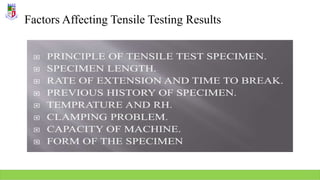
Factors Affecting Tensile Testing Results
Principle of Tensile Testing
There are three principles of tensile testing-
▪ Constant Rate of Loading (CRL)
▪ Constant Rate of Elongation (CRE)
▪ Constant Rate of Traverse (CRT)
CRL or Constant Rate of Loading
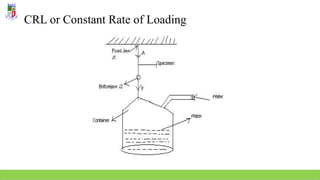
A specimen is gripped between two jaws, the top jaw which is fixed and the bottom jaw which is
moveable. The load on the specimen is initially zero but increases at a constant rate.
Adding a constant rate of water in a container that is attached to the bottom jaw, may increase the load
gradually. Thus, the constant rate of flow gives the constant rate of loading.
In CRL Method
▪ The purpose of applied force is to extend the specimen till there is a breakdown.
▪ Elongation is caused because of loading.
CRL or Constant Rate of Loading
CRE or Constant Rate of Elongation
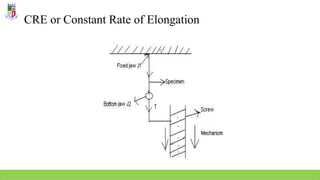
A specimen is gripped between two jaws, the top jaw which is fixed and the bottom jaw which is
moveable in the downward direction at a constant velocity by means of a screw mechanism.
Initially, the tension on the specimen is zero. But, when the bottom jaw moves downwards at a constant
rate, the specimen is extended and an increasing tension is developed until the specimen finally breaks
down. In this case, the extension causes loading.
In CRE Method
▪ The loading is caused as a result of elongation.
▪ This method is usually a screw mechanism..
CRE or Constant Rate of Elongation
Tensile Strength Testing
Fabric tensile strength can be tested using universal tensile strength testing equipment with suitable
sample mounting jaws. There are different methods of tensile testing of fabric, which are as follows:
▪ Strip Test (British Standard)
▪ Grab Test (US standard)
Strip Test:
Strip test are two types.
• Cut Strip Test
• Ravelled Strip Test.
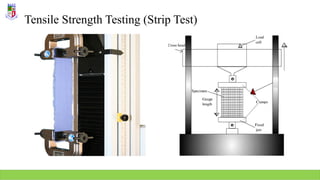
Tensile Strength Testing (Strip Test)
Sample Preparation:
Five fabric samples both in warp and weft direction are prepared .
Sample size :
▪ Length = 8” (200 mm) between the jaws . So enough extra length must be allowed for gripping the
jaws
▪ Width = 2” (50 mm) wide piece of fabric. Prepared by initially cutting the material to a width of
about 2.5” (60 mm) inch and removing threads from both edges until the width has been reduced
to 2’’ (50 mm).
Tensile Strength Testing (Strip Test)
▪ Under optimum conditions, The specimen is mounted centrally, securely gripped along the full
width to prevent slipping.
▪ One jaw is fixed and another jaw is moveable.
▪ Then the movable jaw move outwards till the specimen is tear out.
▪ The load is applied uniformly across the full specimen width.
Tensile Strength Testing (Strip Test)
▪ The rate of extension is set to 50 mm/min and the distance between the jaws is set to 200 mm (8
inch).
▪ If any breaks occur within 0.25 inch (5 mm) of the line of contact of either of the pairs of jaws at a
load substantially less than the average of normal breaks then the result will be recorded but not
used in calculating the breaking load.
▪ The mean breaking force and mean extension as a percentage of initial length are reported.
Tensile Strength Testing (Strip Test)
Tensile Strength Testing (Grab Test)
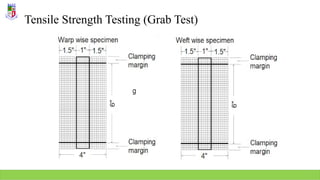
Sample Size
Length = 6” (150 mm)
Width = 4” (100 mm)
Gauge length = 3” (75 mm) and the speed is adjusted so that the sample is broken in 20±3s.
Tensile Strength Testing (Grab Test)
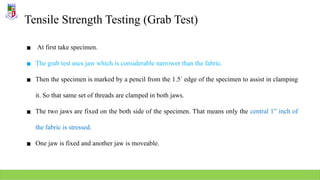
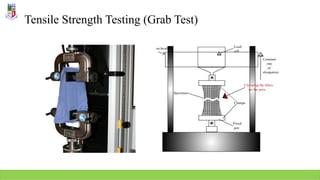
▪ At first take specimen.
▪ The grab test uses jaw which is considerable narrower than the fabric.
▪ Then the specimen is marked by a pencil from the 1.5”
edge of the specimen to assist in clamping
it. So that same set of threads are clamped in both jaws.
▪ The two jaws are fixed on the both side of the specimen. That means only the central 1” inch of
the fabric is stressed.
▪ One jaw is fixed and another jaw is moveable.
Tensile Strength Testing (Grab Test)
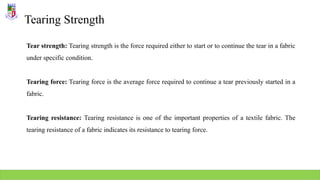
▪ Then the movable jaw move outwards till the specimen is tear out.
▪ The fabric is extended at a constant rate of 50 mm/min until the fabric ruptures, and the
maximum force is recorded in Newton (N).
▪ The gauge length used is 3 inch (75 mm) and the speed is adjusted so that the sample is broken in
20±3s.
Tensile Strength Testing (Grab Test)
Tearing Strength
Tear strength: Tearing strength is the force required either to start or to continue the tear in a fabric
under specific condition.
Tearing force: Tearing force is the average force required to continue a tear previously started in a
fabric.
Tearing resistance: Tearing resistance is one of the important properties of a textile fabric. The
tearing resistance of a fabric indicates its resistance to tearing force.
Types of Tearing Strength Testing
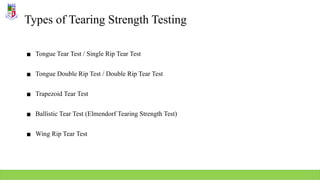
▪ Tongue Tear Test / Single Rip Tear Test
▪ Tongue Double Rip Test / Double Rip Tear Test
▪ Trapezoid Tear Test
▪ Ballistic Tear Test (Elmendorf Tearing Strength Test)
▪ Wing Rip Tear Test
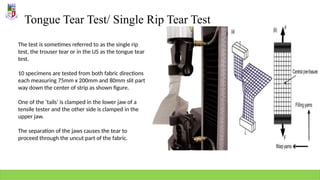
Tongue Tear Test/ Single Rip Tear Test
The test is sometimes referred to as the single rip
test, the trouser tear or in the US as the tongue tear
test.
10 specimens are tested from both fabric directions
each measuring 75mm x 200mm and 80mm slit part
way down the center of strip as shown figure.
One of the ‘tails’ is clamped in the lower jaw of a
tensile tester and the other side is clamped in the
upper jaw.
The separation of the jaws causes the tear to
proceed through the uncut part of the fabric.
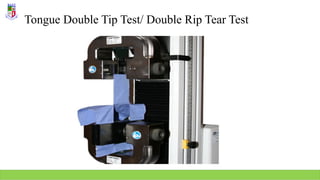
Tongue Double Tip Test/ Double Rip Tear Test
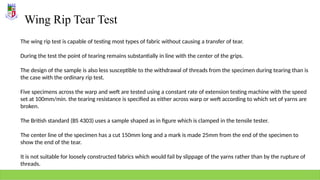
Wing Rip Tear Test
The wing rip test is capable of testing most types of fabric without causing a transfer of tear.
During the test the point of tearing remains substantially in line with the center of the grips.
The design of the sample is also less susceptible to the withdrawal of threads from the specimen during tearing than is
the case with the ordinary rip test.
Five specimens across the warp and weft are tested using a constant rate of extension testing machine with the speed
set at 100mm/min. the tearing resistance is specified as either across warp or weft according to which set of yarns are
broken.
The British standard (BS 4303) uses a sample shaped as in figure which is clamped in the tensile tester.
The center line of the specimen has a cut 150mm long and a mark is made 25mm from the end of the specimen to
show the end of the tear.
It is not suitable for loosely constructed fabrics which would fail by slippage of the yarns rather than by the rupture of
threads.
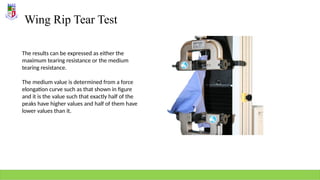
Wing Rip Tear Test
The results can be expressed as either the
maximum tearing resistance or the medium
tearing resistance.
The medium value is determined from a force
elongation curve such as that shown in figure
and it is the value such that exactly half of the
peaks have higher values and half of them have
lower values than it.
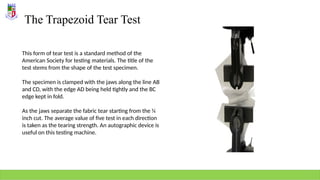
The Trapezoid Tear Test
This form of tear test is a standard method of the
American Society for testing materials. The title of the
test stems from the shape of the test specimen.
The specimen is clamped with the jaws along the line AB
and CD, with the edge AD being held tightly and the BC
edge kept in fold.
As the jaws separate the fabric tear starting from the ¼
inch cut. The average value of five test in each direction
is taken as the tearing strength. An autographic device is
useful on this testing machine.
Bursting Strength
▪ Fabric bursting strength test is an alternative method of measuring strength in which the material
is stressed in all direction at the same time and is therefore more suitable for such material.
▪ Bursting strength is the strength of a fabric against a multi directional flow of pressure.
▪ The bursting strength measures a composite strength of both warp and weft yarns
simultaneously
Example: Parachute fabrics, Filters, Sacks, Nets, paper, and also knitted fabrics.
Types of Bursting Strength Tester
Types of Fabric Bursting Strength Tester
▪ Diaphragm bursting strength tester
• Hydraulic Diaphragm bursting strength tester
• Pneumatic Diaphragm bursting strength tester
▪ Ball bursting strength tester
Hydraulic Bursting Strength Testing
Principle
The pressure in a liquid is exerted in all directions and advantage is taken of this phenomenon in the
hydraulic bursting tester.
Sample Size
▪ The specimen for this test should be cut so that the sample is ½ inch greater in diameter than
the outside diameter of the clamp ring.
▪ The specimen are chosen avoiding inclusion of the same ends in the different specimen.
Hydraulic Bursting Strength Testing
Procedure
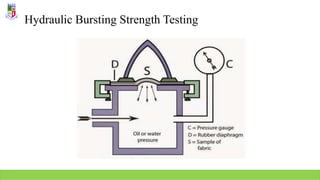
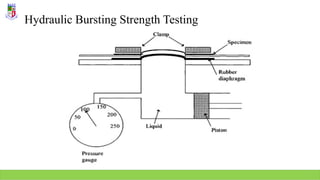
▪ The specimen S is clamped by a ring over a thin flexible rubber diaphragm D, which is clamped
over a circular hole in the upper face of a reservoir.
▪ The liquid used may be water or glycerin.
▪ The hydraulic pressure is increased, by valves or screw driven piston and the diaphragm distends
taking with it the specimen.
▪ At some point the fabric bursts, the pressure being indicated by the gauge G.
▪ Since the rubber diaphragm requires a certain pressure to stretch it, corrections may be made
either by doing a blank test i.e. noting the pressure required to distend the diaphragm the same
amount without the presence of fabric
Hydraulic Bursting Strength Testing
"Understanding Fabric Strength: A Guide to Durability and Performance"

"Understanding Fabric Strength: A Guide to Durability and Performance"

  • 1.
    Fabric Strength Dilshat RubiaDola Lecturer Department of Textile Engineering BGMEA UNIVERSITY OF FASHION AND TECHNOLOGY (BUFT)
  • 2.
    Fabric Strength The strengthof a fabric gives us an idea how much load we can apply on it and it is very important for fabric. The strength of the fabric is very necessary for it because if the fabric strength is not good then it will break with excessive tensile force and thus the dresses produced may tear with the outside force. The strength of a fabric varies with EPI, PPI, and Count Variation. The strength of the fabric also varies if the length and width of the fabric to be tested is changed. The strength of the fabric also depends on the construction of the fabric. A plain fabric is stronger than a twill fabric if made from yarn of same count.
  • 3.
    Reasons for FabricStrength Testing ▪ To check the fabric confirms to specification. ▪ To note the effects of changes in structural details. ▪ To note the effects of physical and chemical treatment, exposure to weather and laundering. ▪ To investigate causes of failure and customer complaints. ▪ To help in the design of a fabric for specific purpose. ▪ To study the interaction of fiber, yarn and fabric properties.
  • 4.
  • 5.
    Tensile Strength ▪ Tensilestrength of a material is defined as a maximum load that it can take before failure without breaking. ▪ Tensile strength of a woven fabric is one of the most important properties. ▪ The tensile strength of the fabric is defined as the maximum amount of tensile stress and tension that fabric can take before breaking.
  • 6.
    Tensile Strength Fabric tensilestrength depends upon- ▪ Raw Material Characteristics. ▪ Yarn Structure (twist: more twist for more strength) ▪ Fabric Construction ▪ Weave: Plain weave is stronger than floats-satin, sateen which are weaker. ▪ Finish Applied
  • 7.
  • 8.
    Principle of TensileTesting There are three principles of tensile testing- ▪ Constant Rate of Loading (CRL) ▪ Constant Rate of Elongation (CRE) ▪ Constant Rate of Traverse (CRT)
  • 9.
    CRL or ConstantRate of Loading A specimen is gripped between two jaws, the top jaw which is fixed and the bottom jaw which is moveable. The load on the specimen is initially zero but increases at a constant rate. Adding a constant rate of water in a container that is attached to the bottom jaw, may increase the load gradually. Thus, the constant rate of flow gives the constant rate of loading. In CRL Method ▪ The purpose of applied force is to extend the specimen till there is a breakdown. ▪ Elongation is caused because of loading.
  • 10.
    CRL or ConstantRate of Loading
  • 11.
    CRE or ConstantRate of Elongation A specimen is gripped between two jaws, the top jaw which is fixed and the bottom jaw which is moveable in the downward direction at a constant velocity by means of a screw mechanism. Initially, the tension on the specimen is zero. But, when the bottom jaw moves downwards at a constant rate, the specimen is extended and an increasing tension is developed until the specimen finally breaks down. In this case, the extension causes loading. In CRE Method ▪ The loading is caused as a result of elongation. ▪ This method is usually a screw mechanism..
  • 12.
    CRE or ConstantRate of Elongation
  • 13.
    Tensile Strength Testing Fabrictensile strength can be tested using universal tensile strength testing equipment with suitable sample mounting jaws. There are different methods of tensile testing of fabric, which are as follows: ▪ Strip Test (British Standard) ▪ Grab Test (US standard) Strip Test: Strip test are two types. • Cut Strip Test • Ravelled Strip Test.
  • 14.
    Tensile Strength Testing(Strip Test) Sample Preparation: Five fabric samples both in warp and weft direction are prepared . Sample size : ▪ Length = 8” (200 mm) between the jaws . So enough extra length must be allowed for gripping the jaws ▪ Width = 2” (50 mm) wide piece of fabric. Prepared by initially cutting the material to a width of about 2.5” (60 mm) inch and removing threads from both edges until the width has been reduced to 2’’ (50 mm).
  • 15.
    Tensile Strength Testing(Strip Test) ▪ Under optimum conditions, The specimen is mounted centrally, securely gripped along the full width to prevent slipping. ▪ One jaw is fixed and another jaw is moveable. ▪ Then the movable jaw move outwards till the specimen is tear out. ▪ The load is applied uniformly across the full specimen width.
  • 16.
    Tensile Strength Testing(Strip Test) ▪ The rate of extension is set to 50 mm/min and the distance between the jaws is set to 200 mm (8 inch). ▪ If any breaks occur within 0.25 inch (5 mm) of the line of contact of either of the pairs of jaws at a load substantially less than the average of normal breaks then the result will be recorded but not used in calculating the breaking load. ▪ The mean breaking force and mean extension as a percentage of initial length are reported.
  • 17.
  • 18.
    Tensile Strength Testing(Grab Test) Sample Size Length = 6” (150 mm) Width = 4” (100 mm) Gauge length = 3” (75 mm) and the speed is adjusted so that the sample is broken in 20±3s.
  • 19.
  • 20.
    Tensile Strength Testing(Grab Test) ▪ At first take specimen. ▪ The grab test uses jaw which is considerable narrower than the fabric. ▪ Then the specimen is marked by a pencil from the 1.5” edge of the specimen to assist in clamping it. So that same set of threads are clamped in both jaws. ▪ The two jaws are fixed on the both side of the specimen. That means only the central 1” inch of the fabric is stressed. ▪ One jaw is fixed and another jaw is moveable.
  • 21.
    Tensile Strength Testing(Grab Test) ▪ Then the movable jaw move outwards till the specimen is tear out. ▪ The fabric is extended at a constant rate of 50 mm/min until the fabric ruptures, and the maximum force is recorded in Newton (N). ▪ The gauge length used is 3 inch (75 mm) and the speed is adjusted so that the sample is broken in 20±3s.
  • 22.
  • 23.
    Tearing Strength Tear strength:Tearing strength is the force required either to start or to continue the tear in a fabric under specific condition. Tearing force: Tearing force is the average force required to continue a tear previously started in a fabric. Tearing resistance: Tearing resistance is one of the important properties of a textile fabric. The tearing resistance of a fabric indicates its resistance to tearing force.
  • 24.
    Types of TearingStrength Testing ▪ Tongue Tear Test / Single Rip Tear Test ▪ Tongue Double Rip Test / Double Rip Tear Test ▪ Trapezoid Tear Test ▪ Ballistic Tear Test (Elmendorf Tearing Strength Test) ▪ Wing Rip Tear Test
  • 25.
    Tongue Tear Test/Single Rip Tear Test The test is sometimes referred to as the single rip test, the trouser tear or in the US as the tongue tear test. 10 specimens are tested from both fabric directions each measuring 75mm x 200mm and 80mm slit part way down the center of strip as shown figure. One of the ‘tails’ is clamped in the lower jaw of a tensile tester and the other side is clamped in the upper jaw. The separation of the jaws causes the tear to proceed through the uncut part of the fabric.
  • 26.
    Tongue Double TipTest/ Double Rip Tear Test
  • 27.
    Wing Rip TearTest The wing rip test is capable of testing most types of fabric without causing a transfer of tear. During the test the point of tearing remains substantially in line with the center of the grips. The design of the sample is also less susceptible to the withdrawal of threads from the specimen during tearing than is the case with the ordinary rip test. Five specimens across the warp and weft are tested using a constant rate of extension testing machine with the speed set at 100mm/min. the tearing resistance is specified as either across warp or weft according to which set of yarns are broken. The British standard (BS 4303) uses a sample shaped as in figure which is clamped in the tensile tester. The center line of the specimen has a cut 150mm long and a mark is made 25mm from the end of the specimen to show the end of the tear. It is not suitable for loosely constructed fabrics which would fail by slippage of the yarns rather than by the rupture of threads.
  • 28.
    Wing Rip TearTest The results can be expressed as either the maximum tearing resistance or the medium tearing resistance. The medium value is determined from a force elongation curve such as that shown in figure and it is the value such that exactly half of the peaks have higher values and half of them have lower values than it.
  • 29.
    The Trapezoid TearTest This form of tear test is a standard method of the American Society for testing materials. The title of the test stems from the shape of the test specimen. The specimen is clamped with the jaws along the line AB and CD, with the edge AD being held tightly and the BC edge kept in fold. As the jaws separate the fabric tear starting from the ¼ inch cut. The average value of five test in each direction is taken as the tearing strength. An autographic device is useful on this testing machine.
  • 30.
    Bursting Strength ▪ Fabricbursting strength test is an alternative method of measuring strength in which the material is stressed in all direction at the same time and is therefore more suitable for such material. ▪ Bursting strength is the strength of a fabric against a multi directional flow of pressure. ▪ The bursting strength measures a composite strength of both warp and weft yarns simultaneously Example: Parachute fabrics, Filters, Sacks, Nets, paper, and also knitted fabrics.
  • 31.
    Types of BurstingStrength Tester Types of Fabric Bursting Strength Tester ▪ Diaphragm bursting strength tester • Hydraulic Diaphragm bursting strength tester • Pneumatic Diaphragm bursting strength tester ▪ Ball bursting strength tester
  • 32.
    Hydraulic Bursting StrengthTesting Principle The pressure in a liquid is exerted in all directions and advantage is taken of this phenomenon in the hydraulic bursting tester. Sample Size ▪ The specimen for this test should be cut so that the sample is ½ inch greater in diameter than the outside diameter of the clamp ring. ▪ The specimen are chosen avoiding inclusion of the same ends in the different specimen.
  • 33.
    Hydraulic Bursting StrengthTesting Procedure ▪ The specimen S is clamped by a ring over a thin flexible rubber diaphragm D, which is clamped over a circular hole in the upper face of a reservoir. ▪ The liquid used may be water or glycerin. ▪ The hydraulic pressure is increased, by valves or screw driven piston and the diaphragm distends taking with it the specimen. ▪ At some point the fabric bursts, the pressure being indicated by the gauge G. ▪ Since the rubber diaphragm requires a certain pressure to stretch it, corrections may be made either by doing a blank test i.e. noting the pressure required to distend the diaphragm the same amount without the presence of fabric
  • 34.
  • 35.