Management information systemThird Year Information TechnologyPart 15Applications of MIS(Manufacturing Sector) Tushar B Kute,Sandip Institute of Technology & Research Centre, Nashiktbkute@gmail.com
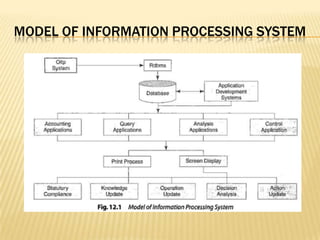
Model of information processing system
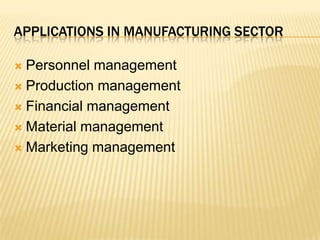
Applications in manufacturing sectorPersonnel managementProduction managementFinancial managementMaterial managementMarketing management
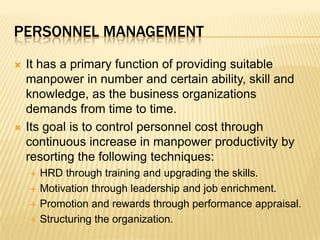
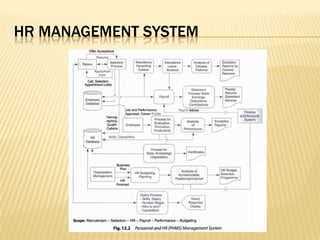
Personnel managementIt has a primary function of providing suitable manpower in number and certain ability, skill and knowledge, as the business organizations demands from time to time.Its goal is to control personnel cost through continuous increase in manpower productivity by resorting the following techniques:HRD through training and upgrading the skills.Motivation through leadership and job enrichment.Promotion and rewards through performance appraisal.Structuring the organization.
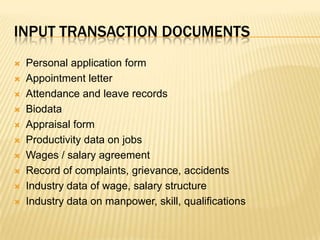
Input transaction documentsPersonal application formAppointment letterAttendance and leave recordsBiodataAppraisal formProductivity data on jobsWages / salary agreementRecord of complaints, grievance, accidentsIndustry data of wage, salary structureIndustry data on manpower, skill, qualifications
applicationsAccounting QueryAnalysisControl
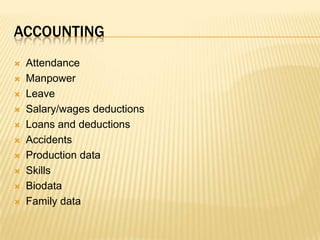
accountingAttendanceManpowerLeaveSalary/wages deductionsLoans and deductionsAccidentsProduction dataSkillsBiodataFamily data
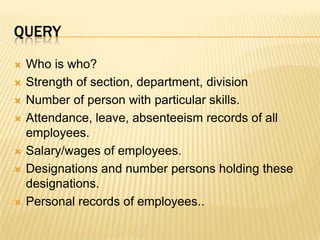
queryWho is who?Strength of section, department, divisionNumber of person with particular skills.Attendance, leave, absenteeism records of all employees.Salary/wages of employees.Designations and number persons holding these designations.Personal records of employees..
analysisAnalysis of attendance by class of employees.Leave analysis by a group of employees.Trend in the leave record.Analysis of accident and type thereof.Analysis of salary/wages structure.Analysis of overtime.
controlProbable absence vs. workload.Projection of personnel cost against manpower increase.Assessment of accident records against safety measures taken.Personnel cost vs. industry cost and its projection.Projection of manpower needs and evolving recruitment and training programs.
reportsStatutory reportsInformation updatesOperation updatesDecision analysisAction reports
Statutory reportsAttendance record (Muster).Strength of employees by category- permanent, trainees, apprentices.Provident funds, ESI reports, ledgers, returns.Accident reports.Income tax forms 16, 24A.Strength of employees to Director General of Technical Development (DGTD)
Information updatesDaily attendance reportEmployee strengthJoining and transfer of employeesPersonnel cost by department, job, product.Periodical statements showing cost by salary/wages, overtime.
Operation updatesDaily attendance to plan the workload.Overtime vs. work completed.Projected absenteeism and distribution of workload.Cost of personnel job or work completed.
Decision analysisAnalysis of attendance for season, festival, and by skills, scheduling of the jobs accordingly.Overtime analysis by department, employees and job to decide the strength of personnel.Analysis of accidents and deciding on safety measures and training.Cost analysis by personnel vs. jobs skills and planning for new recruitment.
Action reportsRecruitment and additional manpower or subcontracting of jobs.Acceptance of orders on the basis of workload.Reduction, transfer and reorganization of employees to control costs.Preparation of training and development programs with specific needs.
Hr management system
Financial management Its function has a primary objective of meeting the financial needs of the business, from time to time, by the way of providing working capital and long-term capital to run the business with the goal of containing the cost of the capital at minimum.Declaration of audit financial results, submit all reports and returns to the Government and Tax authorities.
Fm toolsBreak-even analysisCost analysisCash flow projectionsRatio analysisCapital budgeting and ROI analysisFinancial modelingManagement accountingExpense analysis, auditing and control
Input transaction documentsPayments- to suppliers, authorities, employees, shareholders, financial institutions and others.Receipts- from customers, authorities, employees, shareholders, financial institutions and others.Data from stock exchange of the share prices, consolidated financial results of the other companies.
applicationsAccountingQuery Decision analysisControl
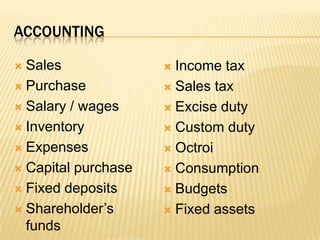
accountingSalesPurchaseSalary / wagesInventoryExpensesCapital purchaseFixed depositsShareholder’s fundsIncome taxSales taxExcise dutyCustom dutyOctroiConsumptionBudgetsFixed assets
queryThe query is processed for the following with respective codes as keys-Main documentSubsidiary accountLocation (Factory, Branch) etc.Document (Bills, Credit note, Delhi note, Receipt etc.)
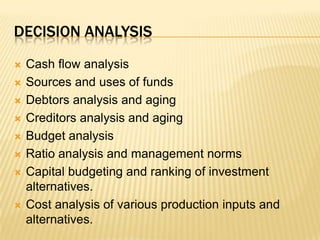
Decision analysisCash flow analysisSources and uses of fundsDebtors analysis and agingCreditors analysis and agingBudget analysisRatio analysis and management normsCapital budgeting and ranking of investment alternatives.Cost analysis of various production inputs and alternatives.
controlThe control is exercised, based on the exceptions found in the business organization-Accounts receivables, outstanding beyond the acceptable norms.Advances to creditors and non realization of obligations.Valuation of non-moving inventory for disposal.Analysis of non-moving accounts and legal actions.Shortage of funds in excess of planned and rescheduling of activities, priorities.Cost overruns beyond the norms and action on alternatives.
reportsStatutory reportsInformation updatesOperation updatesDecision analysisAction reports
Statutory complianceTax returnsRegisters: sale tax, excise tax, tax deducted at source.Declaration of certain results to the financial institutions.Declaration of financial results to the public every six months.Declaration of annual results to the board, shareholders, and public within a stipulated time.
Information updatesMonthly trial balance, balance sheet and profit and loss accountStock valuationAccounts receivables and agingAccounts payables and agingExpenses on major accounts.Cash positionPayments and receipts which are statutory obligations. Sales and purchase of assets by certain classification.Overall business achievements in major lines of business.
Operation updatesFilling statutory returns and reports.Statutory payments such as advance tax, sales tax, octroi, excise duty etc.Transactions executed and accounted in the system.Reports on finished goods, dispatches and invoicing.Reports on material receipts and payment to the suppliers.Obligatory payments- rents, insurance premium, membership fees, interest and dividend.
Decision analysisBreak even analysis for cost price detection.Returns of investment analysis for choice of investment.Trends analysis on price of selected commodities.Cash flow, sources and uses of funds.Analysis of current and fixed assets in terms of use and decision on alternate use or disposal.Analysis of current liabilities and decision on liquidation on priorities basis.
Action updateOverdue receivablesLegal actionTermination of business association.Non supply of goods and services but advance paid.Legal actionRevision of termsTermination of business associationPayments to creditors, where penalties are involved.Poor usage of fixed assets and disposal.Non-moving inventory of more than two years and its disposal.Evolving new systems and procedures to control expenses and implementation.
Production management (Pm)The Objective of PM function is, to provide manufacturing services to the organisation.This involves the manufacture of products of a certain specified quality and within certain costs in a stipulated time fulfilling the promises given to the customer.The PM function is supported by other functions, viz. Production Planning and Control, Industrial Engineering, Maintenance and Quality Control.
Input transaction documentsProduction ProgrammeProduction ScheduleProcess Planning SheetJob CardJob status adviceQuality Assurance rating formFinished goods adviceBreakdown adviceMaterial RequirementMaterial RequisitionCustomer order
applicationsPerformed through Production Planning and ControlBill of material processing Drawing and Process PlanningScheduling and Monitoring systems as support systems
AccountingQuantity of Production with respect to a time periodMaterial requirement and its usageRejection quantity at each intermediate stage and the final stageBreakdown incidenceLabour complement with respect to a period Use of Power, fuel and Consumables.Machine and facilities utilisationLabour hours
QueryThe queries in the PM relate to seeking of status of job or information on fixed entities..+ Status of the job or order in terms of stage and  level of completion+ Production Programme and jobs schedules.+ Load status on Machine, group of machines.+ Status on availability of material.+ Standard information on machines, tools,      specifications.+ Standard information on skills and capacities of       each worker.+ Standard information on products and processes.
Decision AnalysisLong term and Short term PeriodMake or buyMake or subcontractUser of alternative materialUse of alternative processEvolving optimum product mix/job mixRescheduling and loading of jobsPlanning and scheduling of jobsSelection of production facilitiesSelection of alternative maintenance policies
controlThe exceptions which need to be highlighted are:Excessive product rejection on account of material and/or process.Hold up of key jobs beyond a certain limit.Excessive work in process inventory.Continued breakdown of the manufacturing facility beyond a certain period.Utilisation of key facilities below a limit.Continuous significant deviation from standards or norms of production rate.Backlog of a large number of orders and failure to meet promised delivery date.
Reports and screen displayStatutory ComplianceInformation Update Operations UpdatesDecision AnalysisAction Update
materials managementTo provide material for production, maintenance and services at economical prices, in an appropriate quantity and quality with east stockouts and with no extra cost of carrying the inventory.The scope of materials management function is procurement, stocking control of inventory.
Input transaction documentsPurchase acquisitionPurchase order Receipt of goodsReturn of goods to supplierIssue for productionReturn from productionCertification of bill for payment
applicationsForecasting and planningProcurementPurchase orderingGoods receiptIssuing the materialProcessing of returnsBill passing and control
accountingPurchase quantityIssue quantityStocksGood returnsRejectionsPerformanceValue of purchaseAverage or standard rate of accounting
queryQuery in material management largely centered around price, supplier, stock and pending aspect of purchase, returns and payments.It may be on item seeking the latest purchase price or it may be on an item seeking price in a particular purchase order placed on a particular supplier.
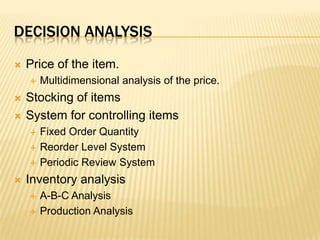
Decision analysisPrice of the item.Multidimensional analysis of the price.Stocking of itemsSystem for controlling itemsFixed Order QuantityReorder Level SystemPeriodic Review SystemInventory analysisA-B-C AnalysisProduction Analysis
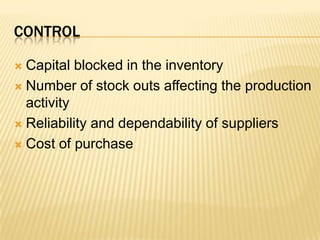
controlCapital blocked in the inventoryNumber of stock outs affecting the production activityReliability and dependability of suppliersCost of purchase
Reports and displayStatutory ComplianceInformation Update Operations UpdatesDecision AnalysisAction Update
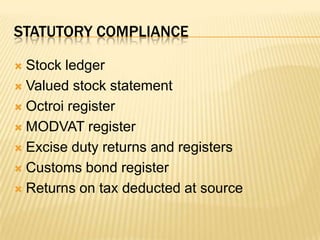
Statutory complianceStock ledgerValued stock statementOctroi registerMODVAT registerExcise duty returns and registersCustoms bond registerReturns on tax deducted at source
Information updatePrice fluctuations and trendInformation of alternative material with specifications and test resultsNew suppliers and sources of suppliersCurrent incidence of taxes and dutiesValue of inventory computed at standard pricePerformance of suppliersStockoutsValue of non-moving inventoryMaterial required for next planning period.
Operations updateDaily goods received registerStatement showing items in short supply or stockoutsReports on purchase acquisitions received but not converted into purchase ordersStatement on suppliers due but not yet receivedStatement on payment due to suppliers but not yet paidStatement of suppliers received and rejected
Decision analysisEmergency procurementRevision of priceTerms of suppliesDisposal of inventoryCutting down the procedure of purchaseSwitching over to new supplier
Action updatesAll the actions are centered around the parameters mentioned in decision analysis.
marketing managementIt deals with satisfying the consumer. The scope of function starts from identifying the need of customer, evolving product concept, designing the product, positioning the product in market and selling in the appropriate price.Activities-Market researchConsumer surveyAdvertisingSales promotion campaignStocking of products
Input transaction documentsCustomer orderOrder acceptanceDelivery noteInvoice, credit note, debit note
applicationsAccountingQuery Decision analysisControl
accountingProduct saleProduct familySales valueSales taxDealerDistributorCustomerExcise dutyZoneAreaInventoryReceivablesMarket segmentExports marketReturnsComplaints
queryHandling customer complaintsPending position followed by stock exists for allocation or notWhether manufacturing order is issued / statusSingle or multidimensional comparisons between two product groups.
Decision analysisDecision taken on PricingAllocation of stocks to ordersDiscounts and commissionsDeciding sale termsDecision building modelsBreak even analysis modelRisk analysis modelDistribution modelNetwork modelProduct launch model
controlCorrect ongoing operational performanceReset the direction trend in the development towards desired goals and objectivesProduct positioning and pricingChoice of market segment
reportsStatutory reportsInformation updatesOperation updatesDecision analysisAction reports
Statutory complianceSales tax registerReturnsExcise duty returns
Information updateProduct sales registerSales summariesAccounts receivablesOrders received and acceptedSales analysisAging of receivablesContribution analysisMarket analysisCompetition analysis
Operation updateReports generated on various marketing operations, daily transactions–Order bookDispatch reportInventory InvoiceCustomer complaintsComplaints disposalGuidance for operating personnel as how they are performing.
Decision analysisIt convey whether the desired/expected results are realized or not.Pre and post-sales campaignChoice for alternative to customersNew product launch
Action updatesAction reportsSales vs. budgetExpenses vs. salesSales growth vs. sales objectivesSales vs. market segment vs. budgetStock vs. budgeted stock levels
referencesWamanJawadekar, "Management Information Systems” , 4th Edition, Tata McGraw-Hill Publishing Company Limited.Tushar B Kute,Sandip Institute of Technology & Research Centre, Nashiktbkute@gmail.com