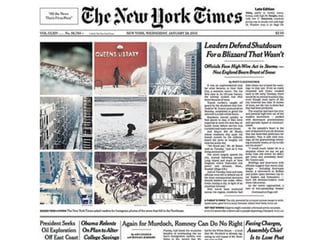
Eyetrack:Photojournalism
What makes 
a photo worth
publishing?
S A R A Q U I N N M E D I A @saraquinn
!
Research for the National Press Photographers Association
“What can you tell me 

about photojournalism 

from Poynter’s 

eyetrack research?”
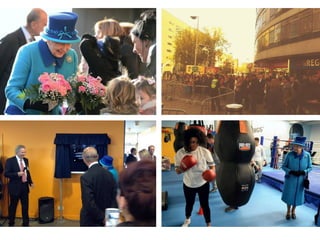
Documentary photos 

get more attention than
static or posed photos.
!
Faces attract a lot
of attention—often 

the first thing looked 

at, in a photograph.
!
Mugshots get only 
a fleeting glance—
purely informational,
unless there is strong,
supporting information in
the presentation.
E A R L I E R P O Y N T E R S T U D I E S
What makes 

a photo worth
publishing?
Eyetrack:Photojournalism
What makes 

a photo worth
publishing?
Eyetrack:Photojournalism
Exploratory
research to start
conversation
about news
photography.
Howdiscerningare

peoplewholookat

journalisticphotos?
Whatdotheyvalue?
Whatdotheyvalue?
Whatdotheyremember?
Dotheytrust
whattheysee?
Whatmakesthemwant
toshareanimage?
Doesqualitymatter?
Whatis“quality?”
Weaskedthem.
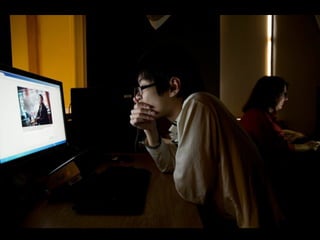
Wewatchedthem.
Andweanalyzed

thewaytheylooked

at200photographs.
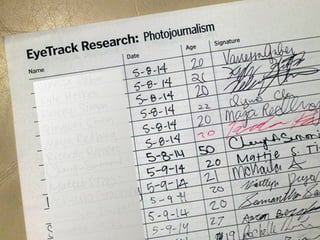
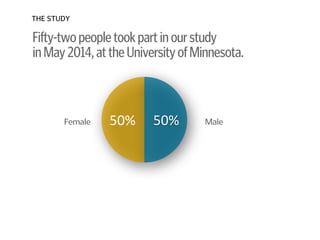
Fifty-twopeopletookpartinourstudy

inMay2014,attheUniversityofMinnesota.
!
!
!
THE STUDY
Female Male50% 50%
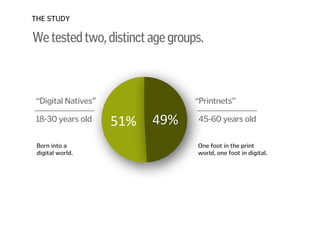
“Digital Natives” “Printnets”
!
18-30 years old 45-60 years old51% 49%
Wetestedtwo,distinctagegroups.
!
!
!
Born into a 

digital world.
One foot in the print 

world, one foot in digital.
THE STUDY
Peopletookpartinfiveelementsoftesting

duringanhourlongsessionwithselected
photographs.
!
!
!
THE STUDY
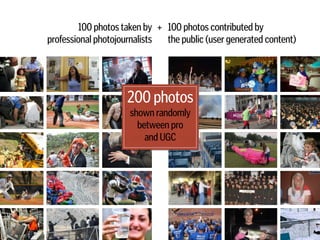
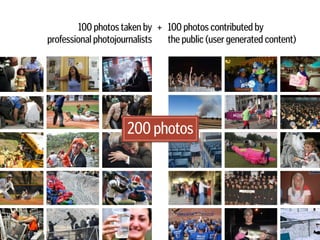
100 photos contributed by

the public (user generated content)
100 photos taken by 

professional photojournalists
+
200 photos
shown randomly
between pro 

and UGC
THE STUDY
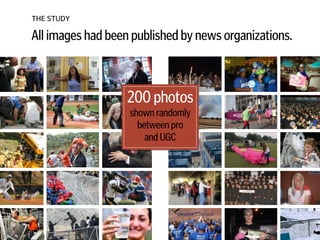
All images had been published by news organizations.
200 photos
shown randomly
between pro 

and UGC
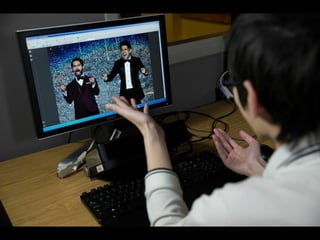
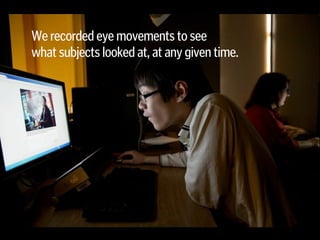
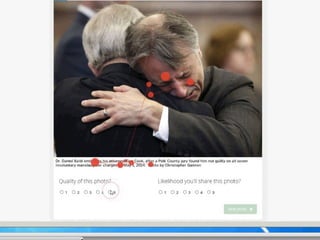
We recorded eye movements to see

what subjects looked at, at any given time.
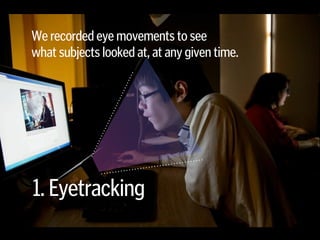
We recorded eye movements to see

what subjects looked at, at any given time.
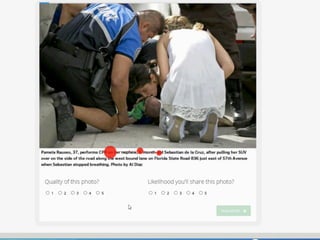
1. Eyetracking
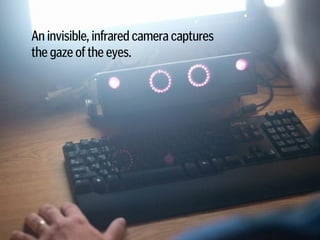
An invisible, infrared camera captures 

the gaze of the eyes.
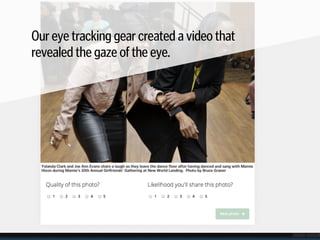
Our eye tracking gear created a video that

revealed the gaze of the eye.
THE STUDY
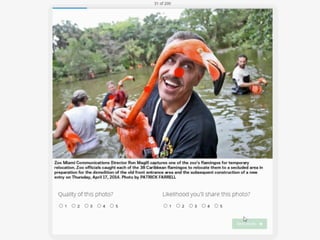
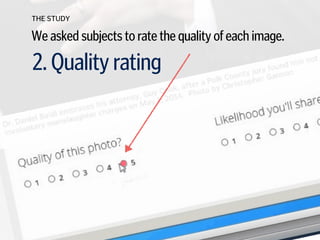
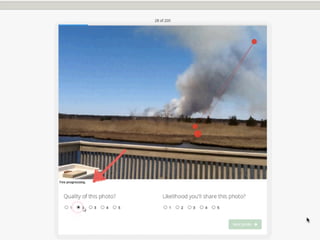
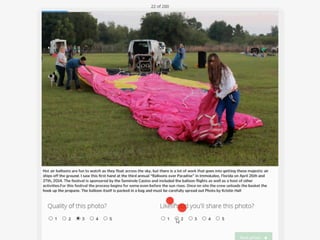
We asked subjects to rate the quality of each image.
2. Quality rating
THE STUDY
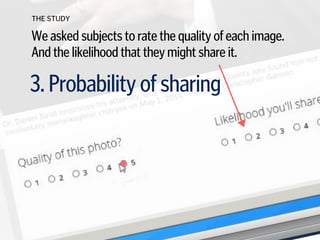
We asked subjects to rate the quality of each image.
And the likelihood that they might share it.
3. Probability of sharing
“Was this photograph taken by a 

professional photojournalist, or not?”
4. Presumption of source
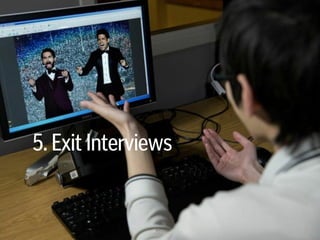
5. Exit Interviews
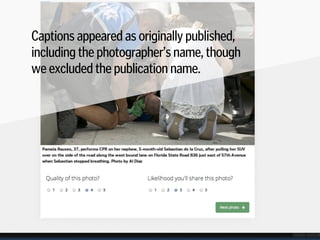
Captions appeared as originally published, 

including the photographer’s name, though 

we excluded the publication name.
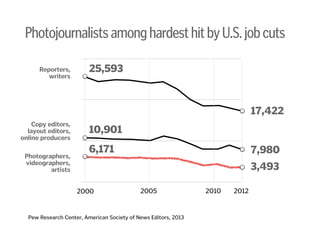
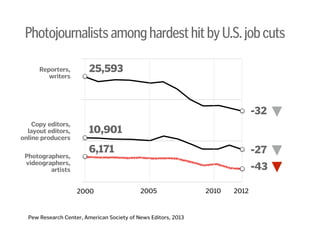
PhotojournalistsamonghardesthitbyU.S.jobcuts
2000 2005 2010 2012
Reporters,
writers
!
!
!
!
!
Copy editors,
layout editors,
online producers
!
Photographers,
videographers,
artists
25,593
!
!
!
!
10,901
!
6,171
17,422
!
!
7,980
!
3,493
Pew Research Center, American Society of News Editors, 2013
PhotojournalistsamonghardesthitbyU.S.jobcuts
2000 2005 2010 2012
Reporters,
writers
!
!
!
!
!
Copy editors,
layout editors,
online producers
!
Photographers,
videographers,
artists
25,593
!
!
!
!
10,901
!
6,171
-32
!
!
-27
!
-43
Pew Research Center, American Society of News Editors, 2013
Major

findings
100 photos contributed by

the public (user generated content)
100 photos taken by 

professional photojournalists
+
200 photos
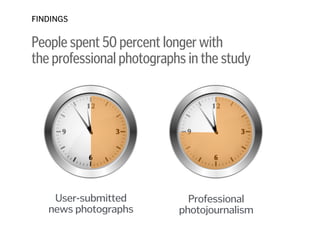
People spent 50 percent longer with 

the professional photographs in the study
FINDINGS
User-submitted

news photographs
Professional

photojournalism
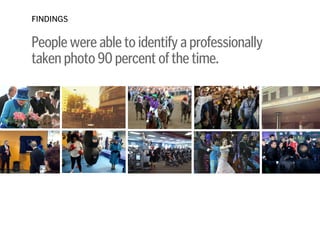
People were able to identify a professionally 

taken photo 90 percent of the time.
!
!
!
FINDINGS
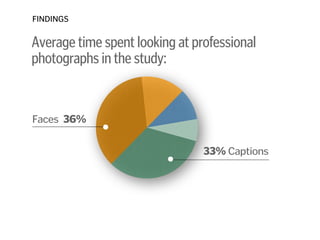
Average time spent looking at professional
photographs in the study:
FINDINGS
Faces 36%
33% Captions
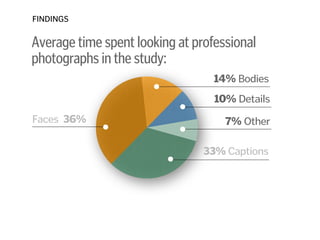
Average time spent looking at professional
photographs in the study:
FINDINGS
14% Bodies
Faces 36%
33% Captions
10% Details
7% Other
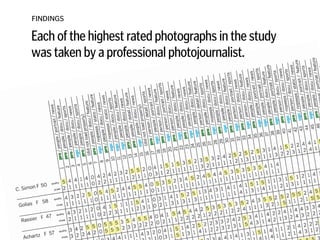
FINDINGS
Each of the highest rated photographs in the study 

was taken by a professional photojournalist.
FINDINGS
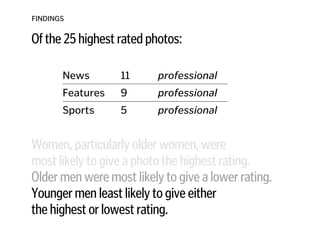
Of the 25 highest rated photos:
!
!
!
!
!
!
Women, particularly older women, were 

most likely to give a photo the highest rating.
Older men were most likely to give a lower rating.
Younger men least likely to give either
the highest or lowest rating.
!
News
!
Features
!
Sports
11
!
9
!
5
professional
!
professional
!
professional
FINDINGS
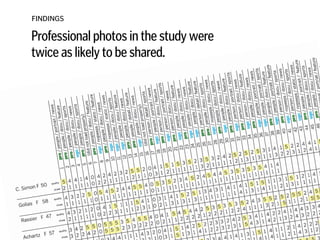
Professional photos in the study were

twice as likely to be shared.
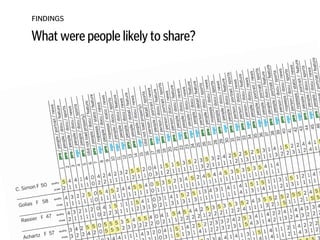
What were people likely to share?
FINDINGS
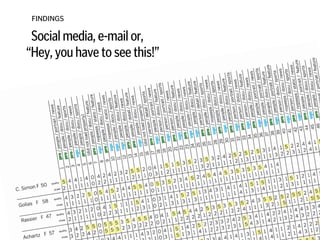
Social media, e-mail or, 

“Hey, you have to see this!”
FINDINGS
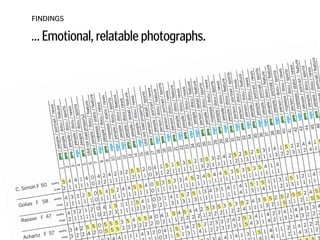
… Emotional, relatable photographs.
FINDINGS
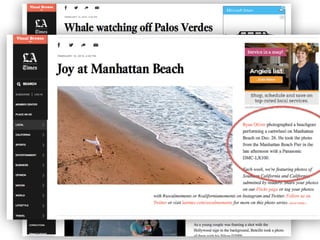
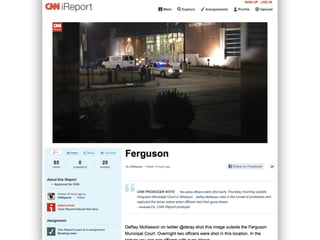
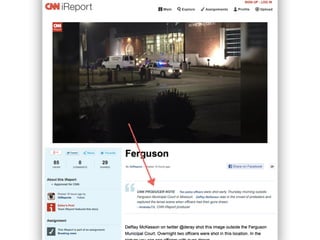
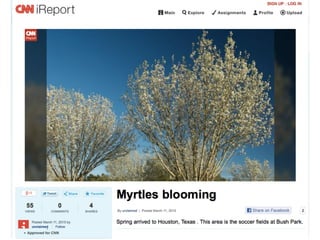
This dog, “Otto,” was the only UGC photograph 

to make the list of most shareable photos.
.
OBSERVATIONS:
People were drawn to faces, first,
even in a complex image.
People were drawn to faces first,
even in a complex image.
OBSERVATIONS:
People were drawn to faces, first,
even in a complex image.
OBSERVATIONS:
People were drawn first, to faces.
OBSERVATIONS:
People were drawn first, to faces.
OBSERVATIONS:
People were drawn first, to faces.
FINDINGS
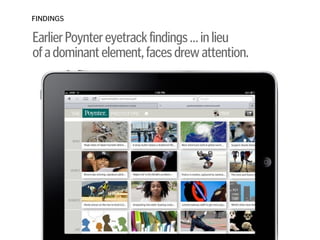
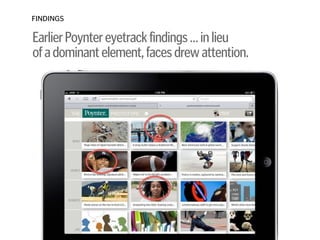
EarlierPoyntereyetrackfindings…inlieu

ofadominantelement,facesdrewattention.
FINDINGS
EarlierPoyntereyetrackfindings…inlieu

ofadominantelement,facesdrewattention.
FINDINGS
EarlierPoyntereyetrackfindings…inlieu

ofadominantelement,facesdrewattention.
FINDINGS
EarlierPoyntereyetrackfindings…inlieu

ofadominantelement,facesdrewattention.
FINDINGS
EarlierPoyntereyetrackfindings…inlieu

ofadominantelement,facesdrewattention.
FINDINGS
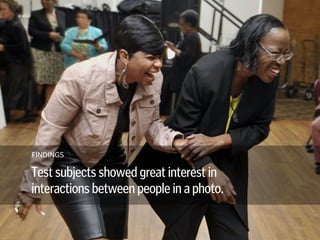
Test subjects showed great interest in

interactions between people in a photo.
They were also interested in the 

interaction between people in the frame.
FINDINGS
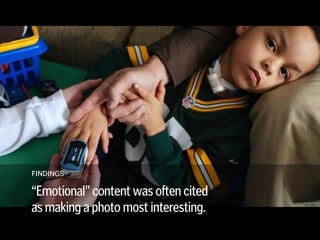
“Emotional” content was often cited 

as making a photo most interesting.
FINDINGS
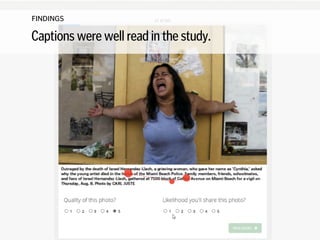
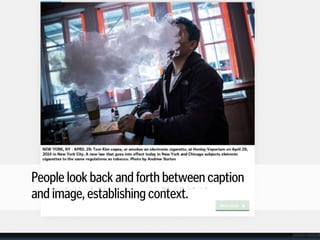
Captions were well read in the study.
FINDINGS
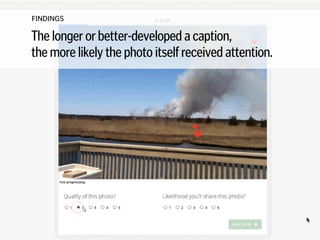
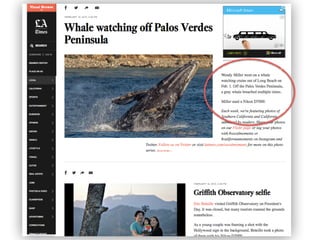
The longer or better-developed a caption, 

the more likely the photo itself received attention.
OBSERVATIONS:
People look back and forth between caption 

and image, establishing context.
FINDINGS
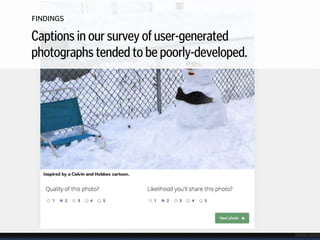
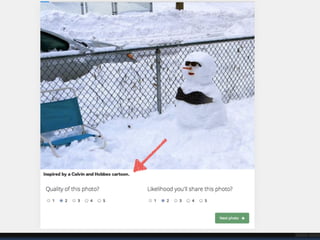
Captions in our survey of user-generated 

photographs tended to be poorly-developed.
Mostmemorable?
FINDINGS
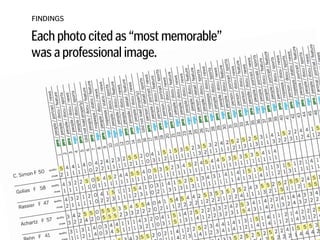
Each photo cited as “most memorable”
was a professional image.
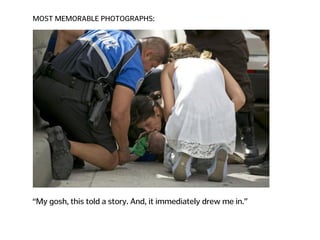
MOST MEMORABLE PHOTOGRAPHS:
“My gosh, this told a story. And, it immediately drew me in.”
MOST MEMORABLE PHOTOGRAPHS:
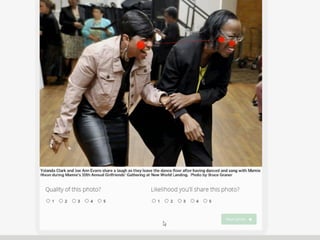
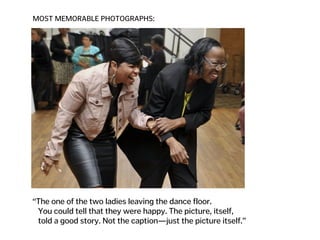
“The one of the two ladies leaving the dance floor. 

You could tell that they were happy. The picture, itself, 

told a good story. Not the caption—just the picture itself.”
MOST MEMORABLE PHOTOGRAPHS:
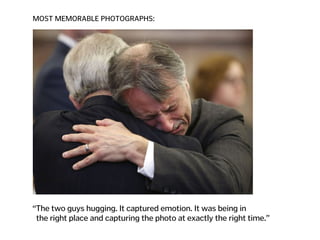
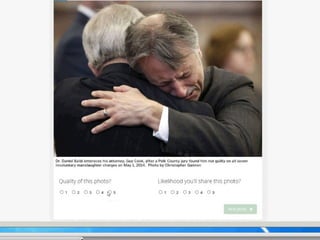
“The two guys hugging. It captured emotion. It was being in 

the right place and capturing the photo at exactly the right time.”
MOST MEMORABLE PHOTOGRAPHS:
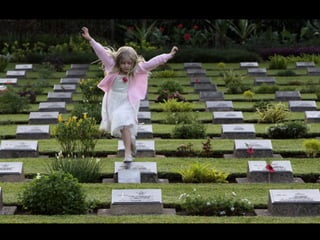
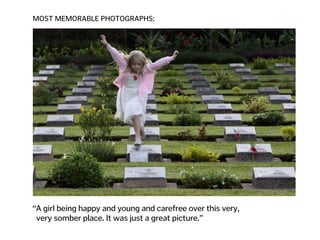
“A girl being happy and young and carefree over this very, 

very somber place. It was just a great picture.”
MOST MEMORABLE PHOTOGRAPHS:
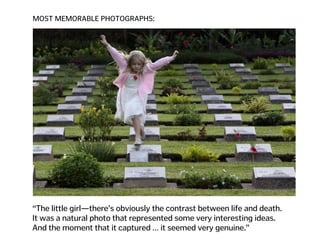
“The little girl—there’s obviously the contrast between life and death. 

It was a natural photo that represented some very interesting ideas. 

And the moment that it captured … it seemed very genuine.”
MOST MEMORABLE PHOTOGRAPHS:
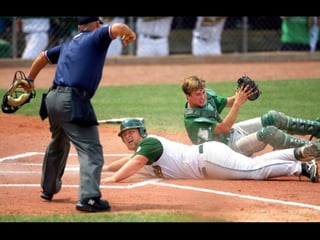
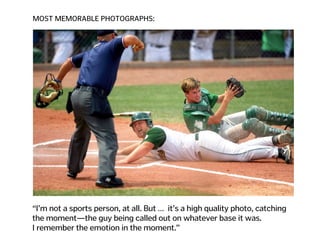
“I’m not a sports person, at all. But … it’s a high quality photo, catching
the moment—the guy being called out on whatever base it was. 

I remember the emotion in the moment.”
MOST MEMORABLE PHOTOGRAPHS:
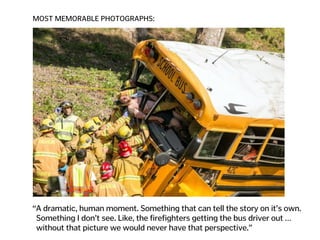
“A dramatic, human moment. Something that can tell the story on it’s own. 

Something I don’t see. Like, the firefighters getting the bus driver out … 

without that picture we would never have that perspective.”
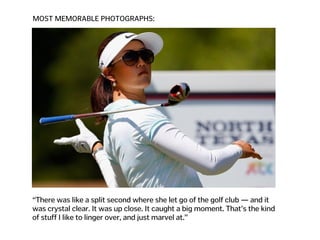
MOST MEMORABLE PHOTOGRAPHS:
“There was like a split second where she let go of the golf club — and it 

was crystal clear. It was up close. It caught a big moment. That’s the kind 

of stuff I like to linger over, and just marvel at.”
MOST MEMORABLE PHOTOGRAPHS:
“Rich and beautifully colored. Technical perfection. Clarity of focus.”
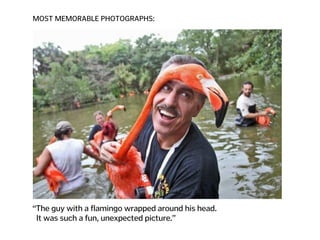
MOST MEMORABLE PHOTOGRAPHS:
“The guy with a flamingo wrapped around his head. 

It was such a fun, unexpected picture.”
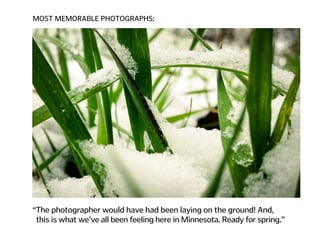
MOST MEMORABLE PHOTOGRAPHS:
“The photographer would have had been laying on the ground! And,
this is what we’ve all been feeling here in Minnesota. Ready for spring.”
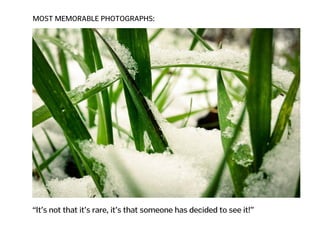
MOST MEMORABLE PHOTOGRAPHS:
“It’s not that it’s rare, it’s that someone has decided to see it!”
What is
quality?
FROM EXIT INTERVIEWS:
People weren’t shy when describing
what they didn’t like:
— nothing of interest in that photo to me, personally
— just the backs of heads

— just another, every day moment
— just someone smiling at the camera, posed

— just a crowd shot

— just another snapshot

— just a cell phone picture

— a line-up of people, rather than a moment

— PR pictures, social media pictures
— too far away from the subject
— cropped funny
— no story to it
— not enough information
FROM EXIT INTERVIEWS:
People weren’t shy when describing
what they didn’t like:
— nothing of interest in that photo to me, personally
— just the backs of heads

— just another, every day moment
— just someone smiling at the camera, posed

— just a crowd shot

— just another snapshot

— just a cell phone picture

— a line-up of people, rather than a moment

— PR pictures, social media pictures
— too far away from the subject
— cropped funny
— no story to it
— not enough information
FROM EXIT INTERVIEWS:
People weren’t shy when describing
what they didn’t like:
— nothing of interest in that photo to me, personally
— just the backs of heads

— just another, every day moment
— just someone smiling at the camera, posed

— just a crowd shot

— just another snapshot

— just a cell phone picture

— a line-up of people, rather than a moment

— PR pictures, social media pictures
— too far away from the subject
— cropped funny
— no story to it
— not enough information
FROM EXIT INTERVIEWS:
People weren’t shy when describing
what they didn’t like:
— nothing of interest in that photo to me, personally
— just the backs of heads

— just another, every day moment
— just someone smiling at the camera, posed

— just a crowd shot

— just another snapshot

— just a cell phone picture

— a line-up of people, rather than a moment

— PR pictures, social media pictures
— too far away from the subject
— cropped funny
— no story to it
— not enough information
FROM EXIT INTERVIEWS:
People weren’t shy when describing
what they didn’t like:
— nothing of interest in that photo to me, personally
— just the backs of heads

— just another, every day moment
— just someone smiling at the camera, posed

— just a crowd shot

— just another snapshot

— just a cell phone picture

— a line-up of people, rather than a moment

— PR pictures, social media pictures
— too far away from the subject
— cropped funny
— no story to it
— not enough information
FROM EXIT INTERVIEWS:
People weren’t shy when describing
what they didn’t like:
— nothing of interest in that photo to me, personally
— just the backs of heads

— just another, every day moment
— just someone smiling at the camera, posed

— just a crowd shot

— just another snapshot

— just a cell phone picture

— a line-up of people, rather than a moment

— PR pictures, social media pictures
— too far away from the subject
— cropped funny
— no story to it
— not enough information
FROM EXIT INTERVIEWS:
People weren’t shy when describing
what they didn’t like:
— nothing of interest in that photo to me, personally
— just the backs of heads

— just another, every day moment
— just someone smiling at the camera, posed

— just a crowd shot

— just another snapshot

— just a cell phone picture

— a line-up of people, rather than a moment

— PR pictures, social media pictures
— too far away from the subject
— cropped funny
— no story to it
— not enough information
FROM EXIT INTERVIEWS:
“Poor quality”
“TV stations that say, 

‘Hey, send us pictures 

from your backyard!’ ”
!
!
!
!
FROM EXIT INTERVIEWS:
“A few grip-and-grins, 

and people holding up fish.”
!
!
!
!
!
“Poor quality”
FROM EXIT INTERVIEWS:
Words to describe “less than quality” photos:
“A few grip-and-grins, 

and people holding up fish.”
!
!
!
!
!
FROM EXIT INTERVIEWS:
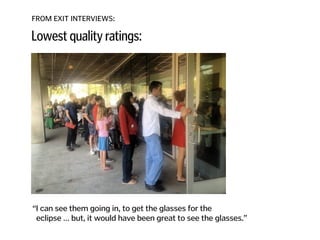
“I can see them going in, to get the glasses for the 

eclipse … but, it would have been great to see the glasses.”
Lowest quality ratings:
FROM EXIT INTERVIEWS:
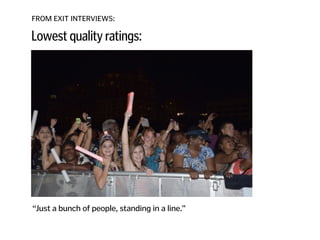
“Just a bunch of people, standing in a line.”
Lowest quality ratings:
FROM EXIT INTERVIEWS:
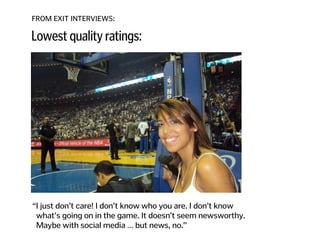
“I just don’t care! I don’t know who you are. I don’t know

what’s going on in the game. It doesn’t seem newsworthy.
Maybe with social media … but news, no.”
Lowest quality ratings:
FROM EXIT INTERVIEWS:
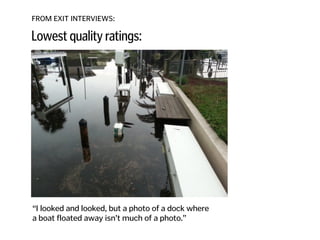
“I looked and looked, but a photo of a dock where 

a boat floated away isn’t much of a photo.”
Lowest quality ratings:
FROM EXIT INTERVIEWS:
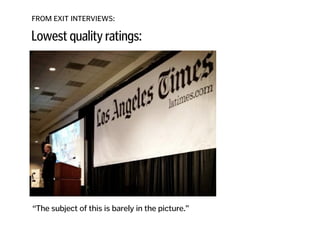
“The subject of this is barely in the picture.”
Lowest quality ratings:
FROM EXIT INTERVIEWS:
“Quality” photos:
— tells me a story vs. just capturing a scene
!
— the right place at the right time
!
— kismet, in terms of the moment
!
— subject matter that has some currency or relevance
!
— capturing the exact moment that’s crucial to the action

— dramatic, human moments
!
— makes you say “wow”
!
— a perspective I might never see
!
!
!
FROM EXIT INTERVIEWS:
“Quality” photos:
— tells me a story vs. just capturing a scene
!
— the right place at the right time
!
— kismet, in terms of the moment
!
— subject matter that has some currency or relevance
!
— capturing the exact moment that’s crucial to the action

— dramatic, human moments
!
— makes you say “wow”
!
— a perspective I might never see
!
!
!
FROM EXIT INTERVIEWS:
“Quality” photos:
— tells me a story vs. just capturing a scene
!
— the right place at the right time
!
— kismet, in terms of the moment
!
— subject matter that has some currency or relevance
!
— capturing the exact moment that’s crucial to the action

— dramatic, human moments
!
— makes you say “wow”
!
— a perspective I might never see
!
!
!
FROM EXIT INTERVIEWS:
“Quality” photos:
— tells me a story vs. just capturing a scene
!
— the right place at the right time
!
— kismet, in terms of the moment
!
— subject matter that has some currency or relevance
!
— capturing the exact moment that’s crucial to the action

— dramatic, human moments
!
— makes you say “wow”
!
— a perspective I might never see
!
!
!
FROM EXIT INTERVIEWS:
“Quality” photos:
— tells me a story vs. just capturing a scene
!
— the right place at the right time
!
— kismet, in terms of the moment
!
— subject matter that has some currency or relevance
!
— capturing the exact moment that’s crucial to the action

— dramatic, human moments
!
— makes you say “wow”
!
— a perspective I might never see
!
!
!
FROM EXIT INTERVIEWS:
“Quality” photos:
— tells me a story vs. just capturing a scene
!
— the right place at the right time
!
— kismet, in terms of the moment
!
— subject matter that has some currency or relevance
!
— capturing the exact moment that’s crucial to the action

— dramatic, human moments
!
— makes you say “wow”
!
— a perspective I might never see
!
!
!
What makes 

a photo worth
publishing?
SELECTED COMMENTS FROM EXIT INTERVIEWS:
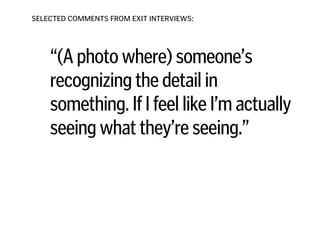
“(A photo where) someone’s
recognizing the detail in
something. If I feel like I’m actually
seeing what they’re seeing.”
!
!
!
!
Here’s why
this was worth
your time.
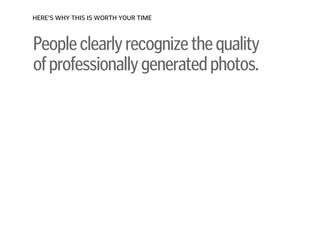
Peopleclearlyrecognizethequality

ofprofessionallygeneratedphotos.
HERE’S WHY THIS IS WORTH YOUR TIME
Themostmemorablephotosin

thisstudyweretakenbyprofessionals.
HERE’S WHY THIS IS WORTH YOUR TIME
Peopleequatequalityphotography
withcontext,emotionandstorytelling.
HERE’S WHY THIS IS WORTH YOUR TIME
Peopleshowinterestininteractions
betweenpeopleinaphoto.
HERE’S WHY THIS IS WORTH YOUR TIME
Moreattentionisdrawntophotos

ofrealpeople,doingthingsinrealtime
—ratherthanstaticorposedphotos.
HERE’S WHY THIS IS WORTH YOUR TIME
Goodcaptionsmatterforcontext.
HERE’S WHY THIS IS WORTH YOUR TIME
Captionswithprofessionalimages

aregenerallymoredevelopedthan
UGCimages.
HERE’S WHY THIS IS WORTH YOUR TIME
Moretimeisspentwithphotographs
thathavestrongcontext:
!
a genuine moment
!
interaction/relationships
!
emotion
!
well-developed caption
!
rare perspective
!
storytelling
!
HERE’S WHY THIS IS WORTH YOUR TIME
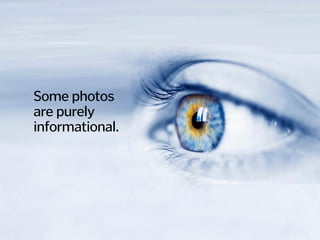
Some photos
are purely
informational.
Others show

us time, place,
moment and
story.
Questions?
@saraquinn
!
#eyetrackphoto
nppa.org
Questions?
@saraquinn @kmcbride

Eyetracking Photojournalism Research by Sara Quinn