S 
Photojournalism 
People doing things
World of photography 
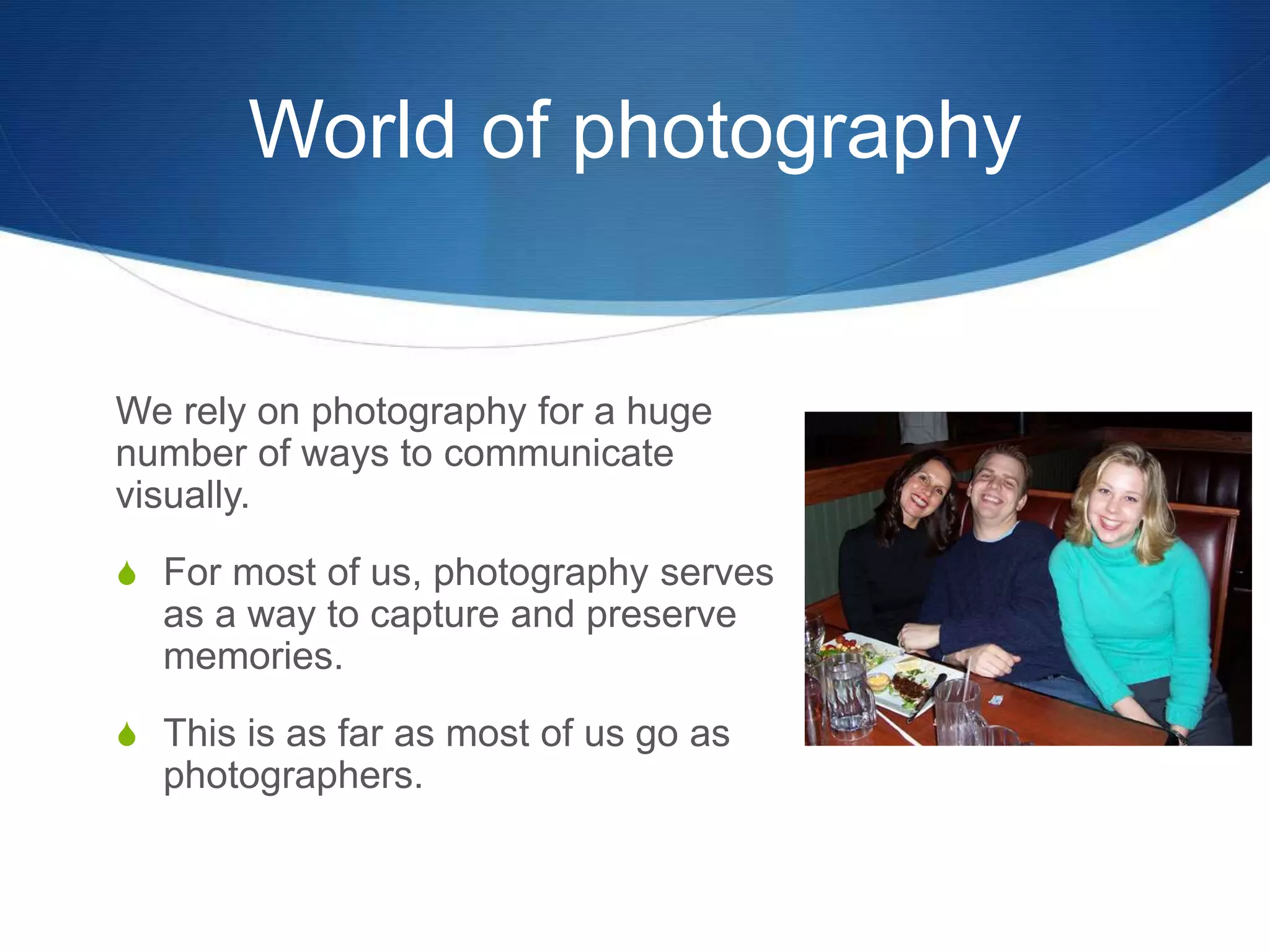
We rely on photography for a huge 
number of ways to communicate 
visually. 
S For most of us, photography serves 
as a way to capture and preserve 
memories. 
S This is as far as most of us go as 
photographers.
Professional photography 
S Others use photography for technical purposes, such as 
illustrating technical information. 
S Studio and portrait photographers offer polished views 
reflecting professional standards to capture our 
memories. 
S Artists use photography to communicate their vision. 
S Advertisers use photography to sell things.
Photojournalism 
But photojournalists use photography for another purpose: 
to tell a story. 
S The approach is similar to that of journalists. 
S A reporter tells a story using words based on accepted 
news values. 
S A photojournalist does the same thing, based on a 
universal language, pictures.
Photojournalism 
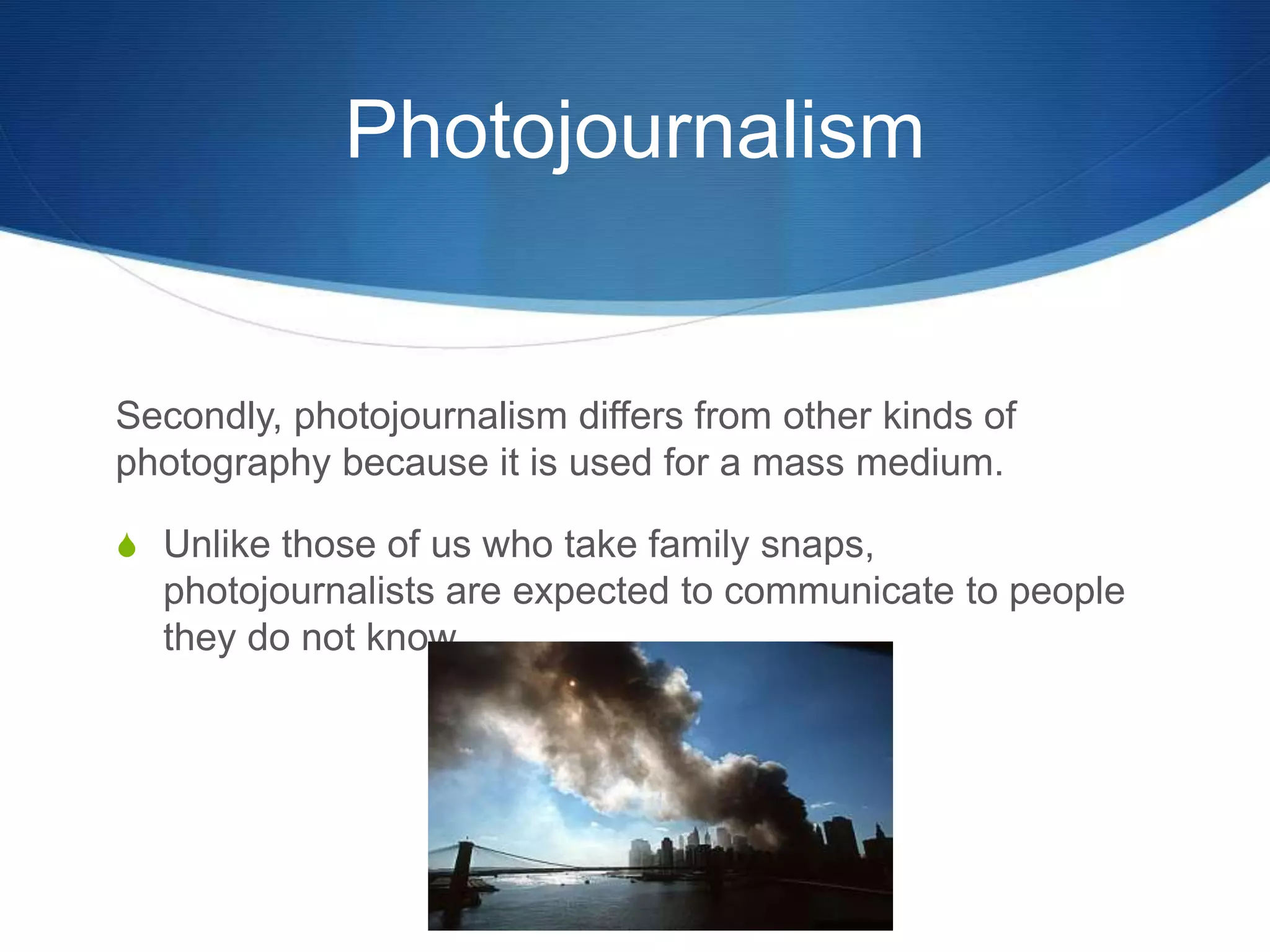
Secondly, photojournalism differs from other kinds of 
photography because it is used for a mass medium. 
S Unlike those of us who take family snaps, 
photojournalists are expected to communicate to people 
they do not know.
Photojournalism 
S Actually, the idea that photojournalism ought to be a 
separate field is fairly recent. 
S The word “photojournalism” was not coined until the 
1940s, by journalism historian Frank Luther Mott.
Photojournalism 
S Before the 1930s, editors did not consider the power of 
photography. 
S The words were important; photos were extra. 
S Today most editors will not accept stories without photos, 
illustrations or video. We live in a photo-saturated world.
Photojournalism 
S Photojournalism, of course, is a non-fiction creation. We 
are supposed to believe photojournalists, like journalists, 
to be dealing with facts. 
S This has led to controversy over the extent of 
manipulation permissible using software such as 
Photoshop. 
S If you can make a change, should you?
Photojournalism 
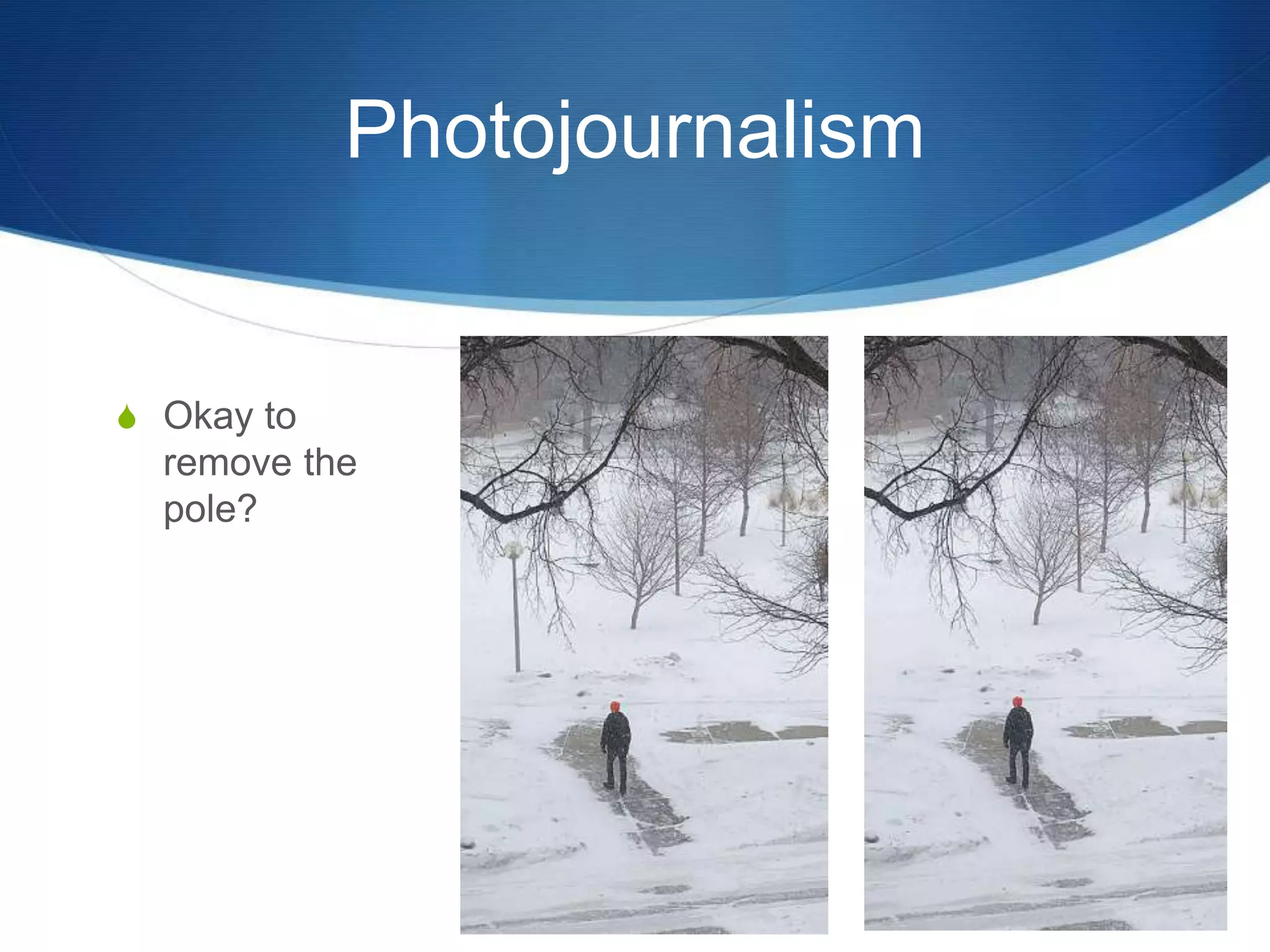
Can you crop the background? Can you darken a face? Can 
you remove the light pole? 
There are no rules, but we do have a guideline as 
photojournalists: Don’t lie. 
What about the next slide? Fact or fiction?
Photojournalism 
S Okay to 
remove the 
pole?
Photojournalism 
S The debate over what is permissible is important 
because photojournalism has so much power. 
S Words communicate in a language bound by the culture 
that created it. They add context, explain, talk about the 
past and the future.
Photojournalism 
S Pictures, on the other hand, appeal to a universal visual 
language which transcends culture. 
S They have no past. They have no future. 
S They show one instant pulled from the human sea, a 
“slice of life.”
Photojournalism 
S Meaning in words is gained through methodological 
reading, in linear fashion. 
S Meaning in pictures is conveyed all at once. 
S Photo reach beyond reason to directly strike our 
emotions.
Photojournalism 
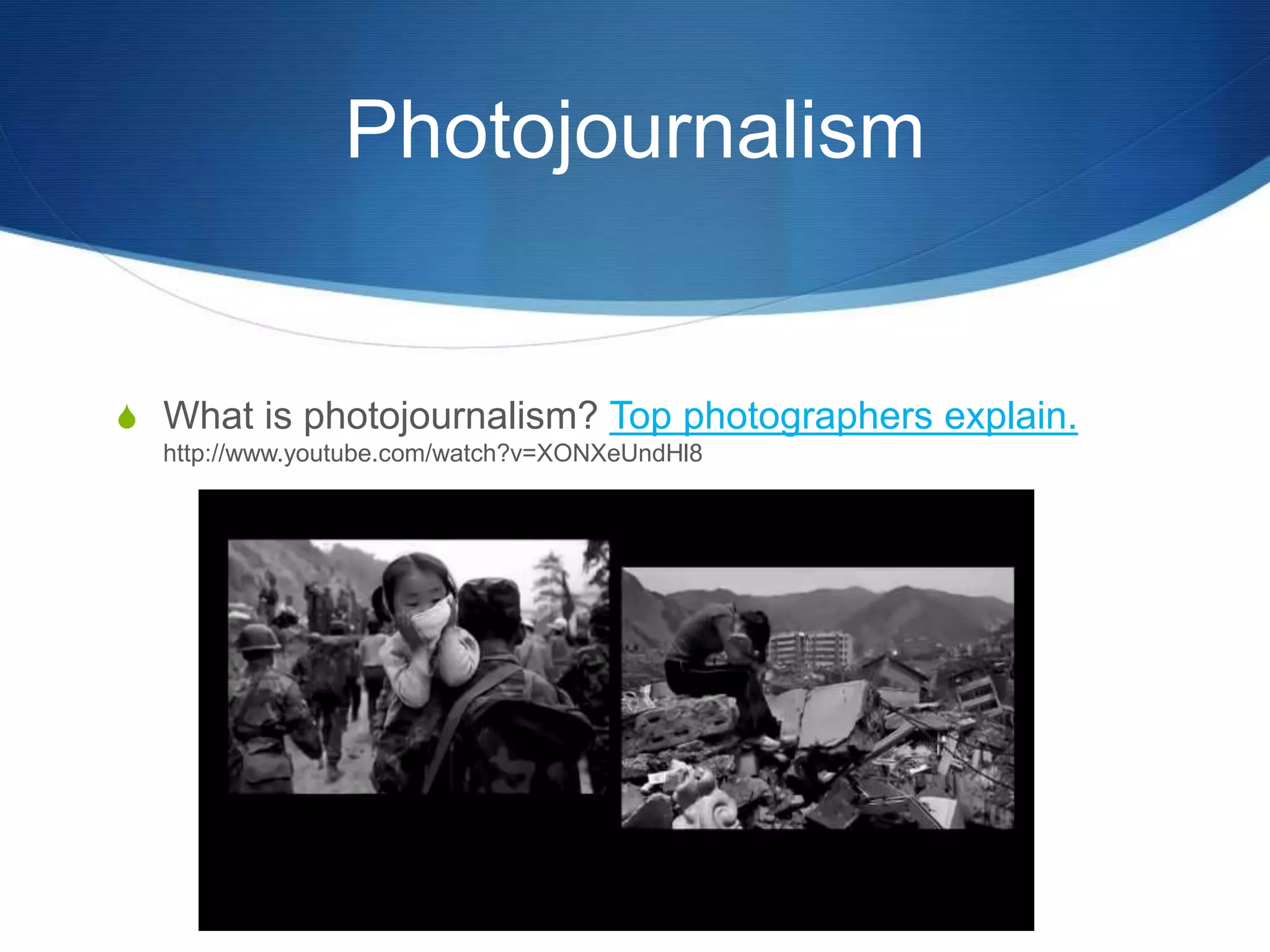
S What is photojournalism? Top photographers explain. 
http://www.youtube.com/watch?v=XONXeUndHl8
Photo memory 
S Many of us who grew up with media can’t remember a 
particular article or television show about an event. 
S But if we think of that event, we may recall a picture 
instead.
Events in photography 
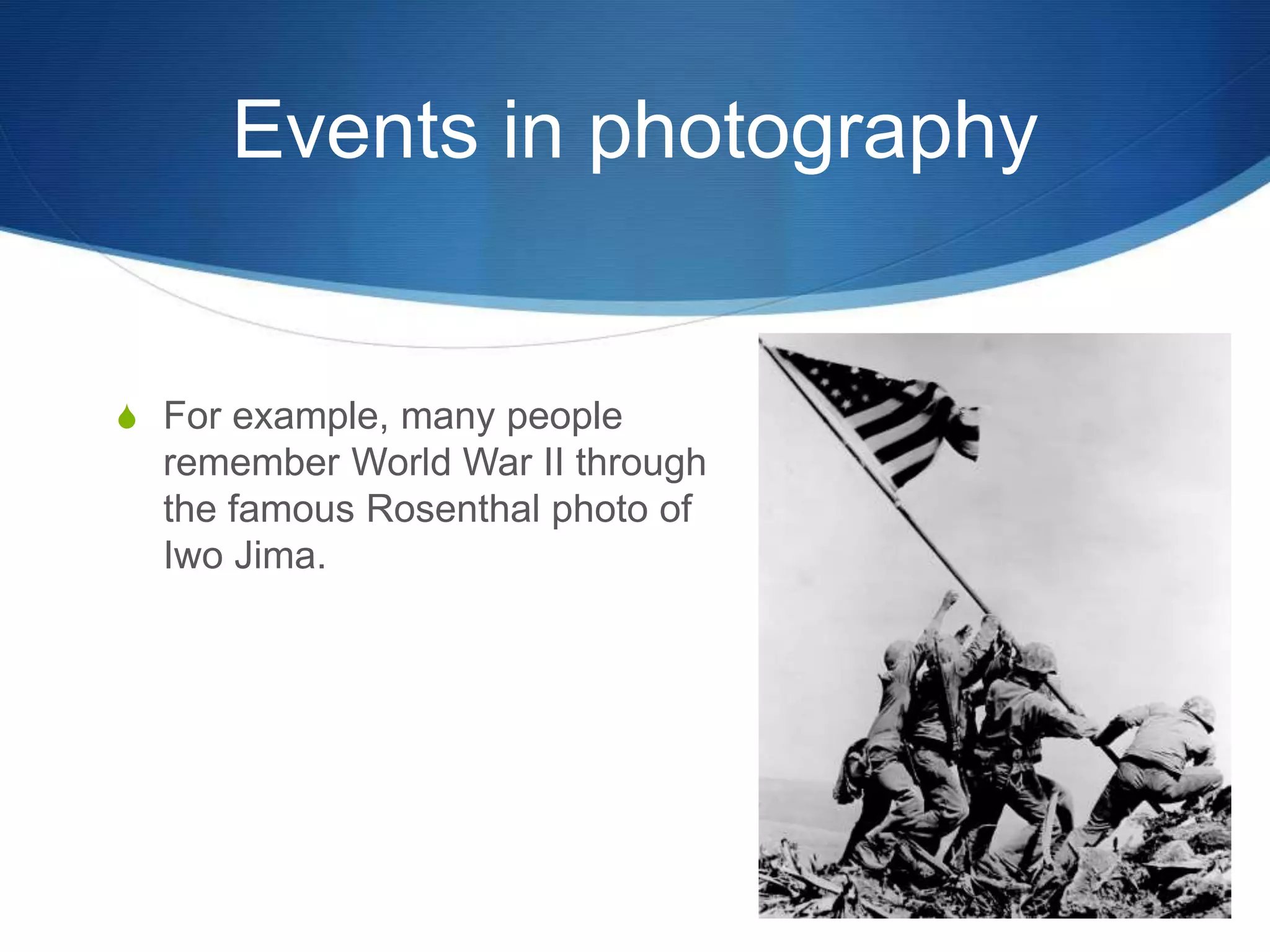
S For example, many people 
remember World War II through 
the famous Rosenthal photo of 
Iwo Jima.
Events in photography 
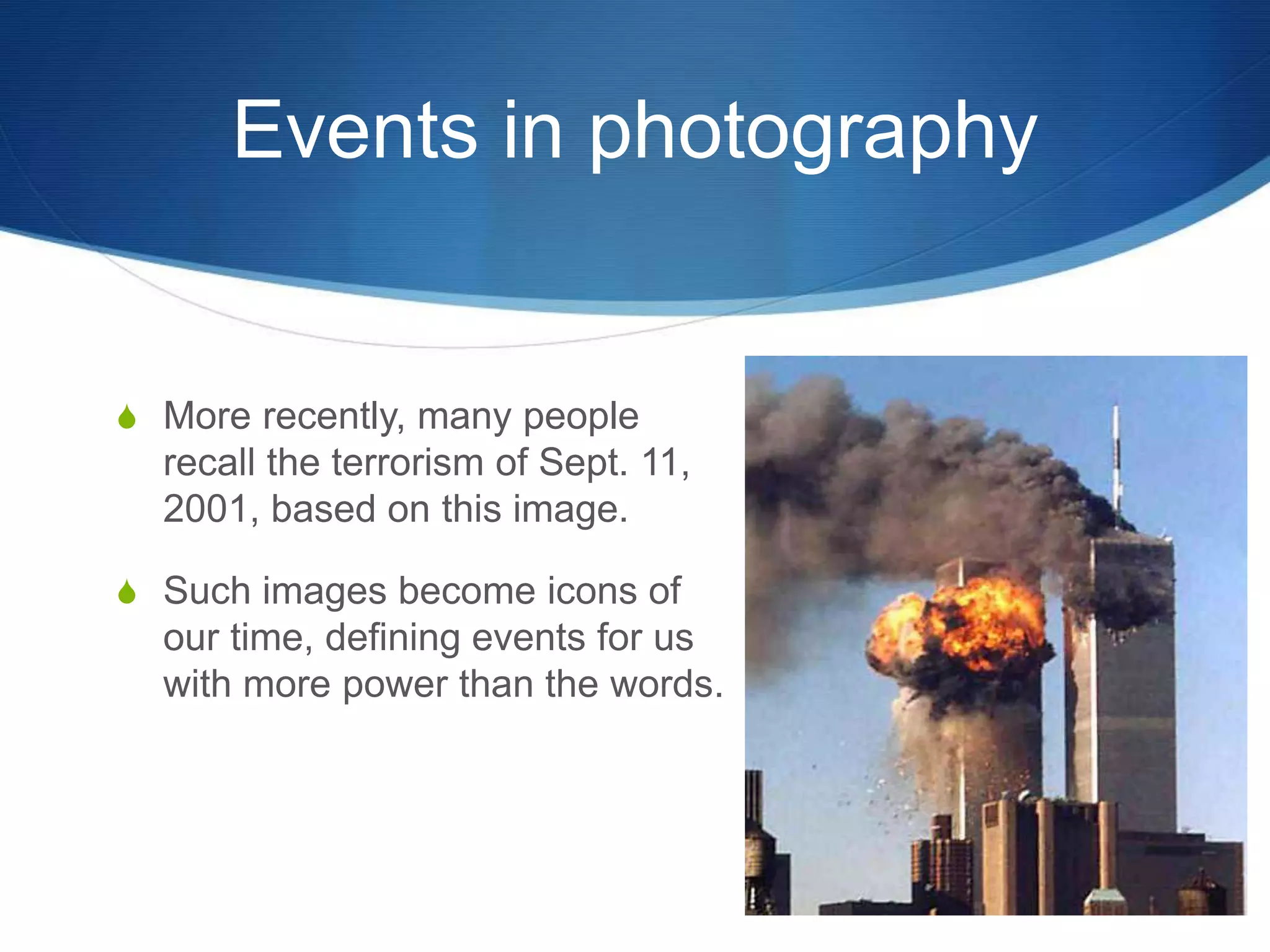
S More recently, many people 
recall the terrorism of Sept. 11, 
2001, based on this image. 
S Such images become icons of 
our time, defining events for us 
with more power than the words.
Photojournalism jobs 
Who took these photos? 
S Photojournalists work for a variety of publications or 
agencies. 
S Most widespread employer of photojournalists are 
newspapers.
Photojournalism jobs 
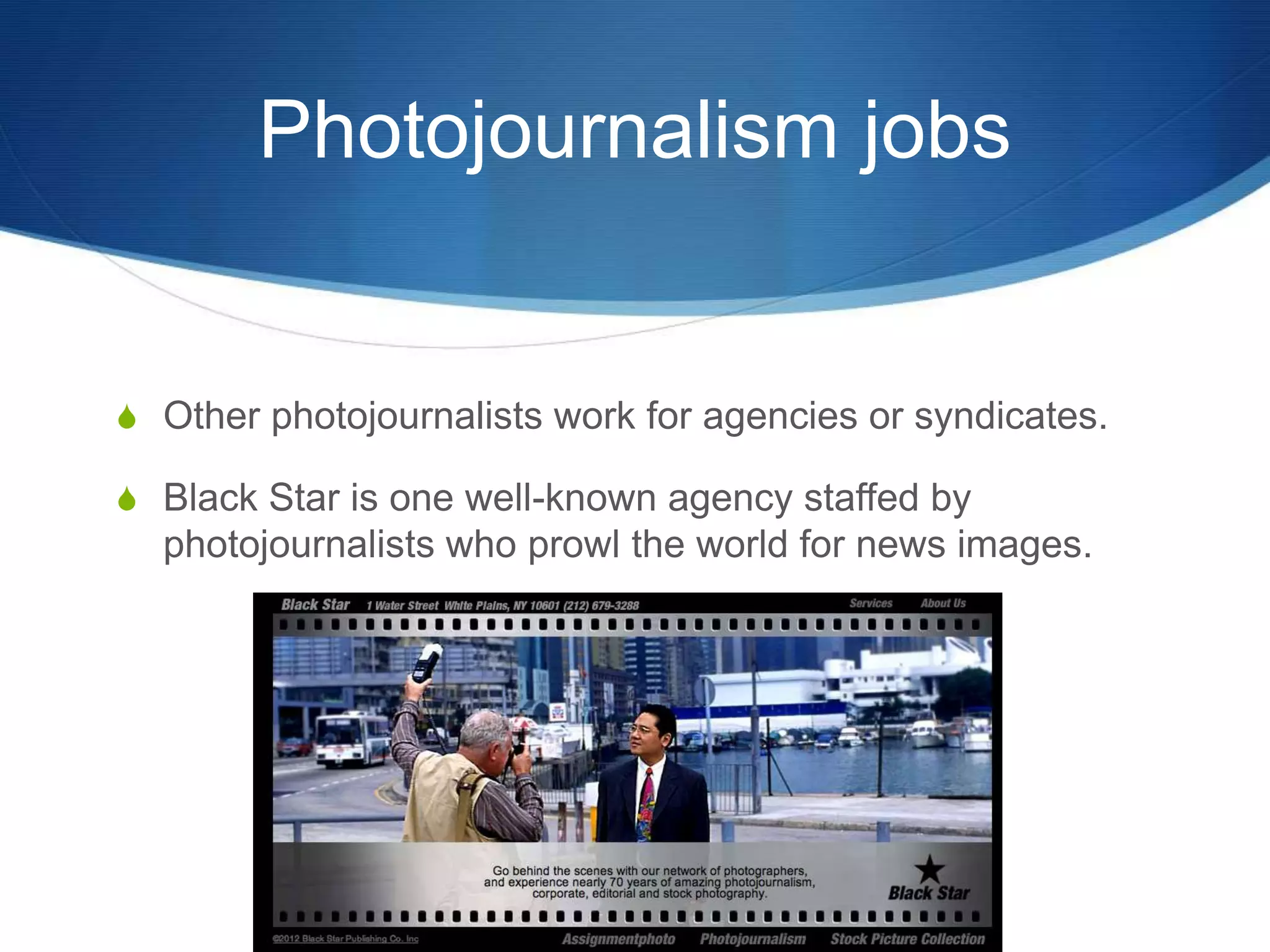
S Other photojournalists work for agencies or syndicates. 
S Black Star is one well-known agency staffed by 
photojournalists who prowl the world for news images.
Photojournalism jobs 
S Magazines may have staff photographers. But usually 
they hire free-lance photojournalists. 
S Many photographers find free-lancing the most exciting 
and independent way to produce images. But becoming 
established is tough. Most began as newspaper 
photographers probably working in both print and online.
Photojournalism jobs 
S Unlike most studio photographers, photojournalists are 
expected to be more versatile. 
S They should know technical, portrait, studio and street 
photography. 
S More and more they need to know video photography, as 
the Web becomes a dominant place to display their work.
Photojournalism 
S The top of the heap is the free-lancer who does jobs for 
the great photo publications, such as National 
Geographic, or great agencies such as Magnum Photo. 
S But lots of photojournalists free-lance part time.
The free-lance game 
S Even you can be a free-lance photographer: 
professionals can’t be everywhere, and most 
news operations will pay for professional-quality 
photos of a major news event. 
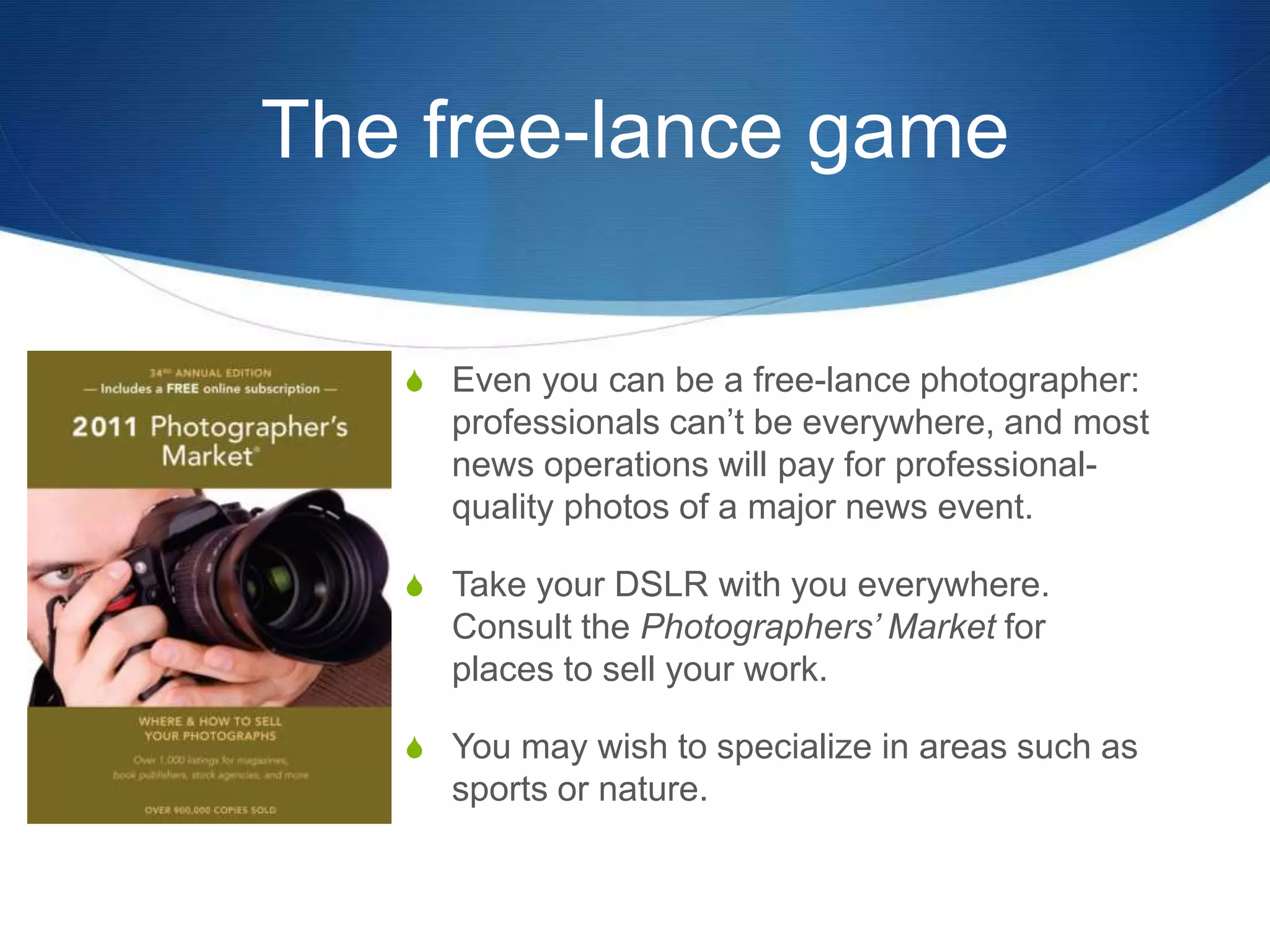
S Take your DSLR with you everywhere. 
Consult the Photographers’ Market for 
places to sell your work. 
S You may wish to specialize in areas such as 
sports or nature.
Stock agencies 
S Some photojournalists shoot mostly for stock. 
S Stock agencies offer fairly generic images used mostly by 
magazines. 
S Editors turn to stock to save money over hiring a free-lancer.
Stock vs. web 
S Many editors prefer to work with stock agencies because they 
offer top-quality work, with all legal permissions secured. 
S Images pulled from the web often can’t be legally used in print 
without permission and royalty fees. 
S In particular, photos for advertising must be backed by legal 
releases. 
S Generic digital clip art usually does not meet professional 
standards.
Careers 
So what is a photojournalism career like? 
S It is perhaps the most exciting of all journalism jobs. 
S Reporters can get their stories on the phone, or by email. 
Photographers have to be there. 
S Photojournalists have access to top sports teams, big 
celebrities, and places an average person never gets to 
see or experience.
Careers 
S Photojournalists may literally see the world, from Kosovo 
to Karachi. 
S But it’s not easy to break into the field.
Careers 
S Photojournalism is in fact not a growing field, despite the 
proliferation of visual images in the media. More media 
are cutting photo staffs, often relying on “crowd sourced” 
photos from readers. 
S Digital cameras make it easier for anyone to take a 
technically proficient photo, and people can just upload to 
the Web without needing to process film. But can 
amateurs do what professionals can do? Often not.
Careers 
S Most photojournalists have a university degree, usually in 
journalism. They have at least one or two good 
internships. They have a strong file of clips from photos 
they took for student publications or programs. 
S It’s a career that demands sacrifice and passion. But few 
careers are more exciting.
Other photojournalism 
S If course, a lot of people who work in media-related fields 
may not be photojournalists—but still are expected to 
produce professional-quality photos. 
S More and more media operations are asking reporters to 
take photos and video. 
S In public relations, professional photo skills may be highly 
valued. PR operations seldom have staff photographers.
Value of the skill 
S All students interested in a media-related career should include 
some photography in their portfolio. 
S The ability to take respectable photos—and to understand the 
standards of what’s respectable—may mean the difference 
between getting the job or not. 
S How to get started? Consult Ross’s Ten Tips for 
Photojournalists. Website link: 
http://www.rossfcollins.com/242photojournalism/Principles.html

Whatisphotojournalism copy

  • 1.
  • 2.
    World of photography We rely on photography for a huge number of ways to communicate visually. S For most of us, photography serves as a way to capture and preserve memories. S This is as far as most of us go as photographers.
  • 3.
    Professional photography SOthers use photography for technical purposes, such as illustrating technical information. S Studio and portrait photographers offer polished views reflecting professional standards to capture our memories. S Artists use photography to communicate their vision. S Advertisers use photography to sell things.
  • 4.
    Photojournalism But photojournalistsuse photography for another purpose: to tell a story. S The approach is similar to that of journalists. S A reporter tells a story using words based on accepted news values. S A photojournalist does the same thing, based on a universal language, pictures.
  • 5.
    Photojournalism Secondly, photojournalismdiffers from other kinds of photography because it is used for a mass medium. S Unlike those of us who take family snaps, photojournalists are expected to communicate to people they do not know.
  • 6.
    Photojournalism S Actually,the idea that photojournalism ought to be a separate field is fairly recent. S The word “photojournalism” was not coined until the 1940s, by journalism historian Frank Luther Mott.
  • 7.
    Photojournalism S Beforethe 1930s, editors did not consider the power of photography. S The words were important; photos were extra. S Today most editors will not accept stories without photos, illustrations or video. We live in a photo-saturated world.
  • 8.
    Photojournalism S Photojournalism,of course, is a non-fiction creation. We are supposed to believe photojournalists, like journalists, to be dealing with facts. S This has led to controversy over the extent of manipulation permissible using software such as Photoshop. S If you can make a change, should you?
  • 9.
    Photojournalism Can youcrop the background? Can you darken a face? Can you remove the light pole? There are no rules, but we do have a guideline as photojournalists: Don’t lie. What about the next slide? Fact or fiction?
  • 10.
    Photojournalism S Okayto remove the pole?
  • 11.
    Photojournalism S Thedebate over what is permissible is important because photojournalism has so much power. S Words communicate in a language bound by the culture that created it. They add context, explain, talk about the past and the future.
  • 12.
    Photojournalism S Pictures,on the other hand, appeal to a universal visual language which transcends culture. S They have no past. They have no future. S They show one instant pulled from the human sea, a “slice of life.”
  • 13.
    Photojournalism S Meaningin words is gained through methodological reading, in linear fashion. S Meaning in pictures is conveyed all at once. S Photo reach beyond reason to directly strike our emotions.
  • 14.
    Photojournalism S Whatis photojournalism? Top photographers explain. http://www.youtube.com/watch?v=XONXeUndHl8
  • 15.
    Photo memory SMany of us who grew up with media can’t remember a particular article or television show about an event. S But if we think of that event, we may recall a picture instead.
  • 16.
    Events in photography S For example, many people remember World War II through the famous Rosenthal photo of Iwo Jima.
  • 17.
    Events in photography S More recently, many people recall the terrorism of Sept. 11, 2001, based on this image. S Such images become icons of our time, defining events for us with more power than the words.
  • 18.
    Photojournalism jobs Whotook these photos? S Photojournalists work for a variety of publications or agencies. S Most widespread employer of photojournalists are newspapers.
  • 19.
    Photojournalism jobs SOther photojournalists work for agencies or syndicates. S Black Star is one well-known agency staffed by photojournalists who prowl the world for news images.
  • 20.
    Photojournalism jobs SMagazines may have staff photographers. But usually they hire free-lance photojournalists. S Many photographers find free-lancing the most exciting and independent way to produce images. But becoming established is tough. Most began as newspaper photographers probably working in both print and online.
  • 21.
    Photojournalism jobs SUnlike most studio photographers, photojournalists are expected to be more versatile. S They should know technical, portrait, studio and street photography. S More and more they need to know video photography, as the Web becomes a dominant place to display their work.
  • 22.
    Photojournalism S Thetop of the heap is the free-lancer who does jobs for the great photo publications, such as National Geographic, or great agencies such as Magnum Photo. S But lots of photojournalists free-lance part time.
  • 23.
    The free-lance game S Even you can be a free-lance photographer: professionals can’t be everywhere, and most news operations will pay for professional-quality photos of a major news event. S Take your DSLR with you everywhere. Consult the Photographers’ Market for places to sell your work. S You may wish to specialize in areas such as sports or nature.
  • 24.
    Stock agencies SSome photojournalists shoot mostly for stock. S Stock agencies offer fairly generic images used mostly by magazines. S Editors turn to stock to save money over hiring a free-lancer.
  • 25.
    Stock vs. web S Many editors prefer to work with stock agencies because they offer top-quality work, with all legal permissions secured. S Images pulled from the web often can’t be legally used in print without permission and royalty fees. S In particular, photos for advertising must be backed by legal releases. S Generic digital clip art usually does not meet professional standards.
  • 26.
    Careers So whatis a photojournalism career like? S It is perhaps the most exciting of all journalism jobs. S Reporters can get their stories on the phone, or by email. Photographers have to be there. S Photojournalists have access to top sports teams, big celebrities, and places an average person never gets to see or experience.
  • 27.
    Careers S Photojournalistsmay literally see the world, from Kosovo to Karachi. S But it’s not easy to break into the field.
  • 28.
    Careers S Photojournalismis in fact not a growing field, despite the proliferation of visual images in the media. More media are cutting photo staffs, often relying on “crowd sourced” photos from readers. S Digital cameras make it easier for anyone to take a technically proficient photo, and people can just upload to the Web without needing to process film. But can amateurs do what professionals can do? Often not.
  • 29.
    Careers S Mostphotojournalists have a university degree, usually in journalism. They have at least one or two good internships. They have a strong file of clips from photos they took for student publications or programs. S It’s a career that demands sacrifice and passion. But few careers are more exciting.
  • 30.
    Other photojournalism SIf course, a lot of people who work in media-related fields may not be photojournalists—but still are expected to produce professional-quality photos. S More and more media operations are asking reporters to take photos and video. S In public relations, professional photo skills may be highly valued. PR operations seldom have staff photographers.
  • 31.
    Value of theskill S All students interested in a media-related career should include some photography in their portfolio. S The ability to take respectable photos—and to understand the standards of what’s respectable—may mean the difference between getting the job or not. S How to get started? Consult Ross’s Ten Tips for Photojournalists. Website link: http://www.rossfcollins.com/242photojournalism/Principles.html