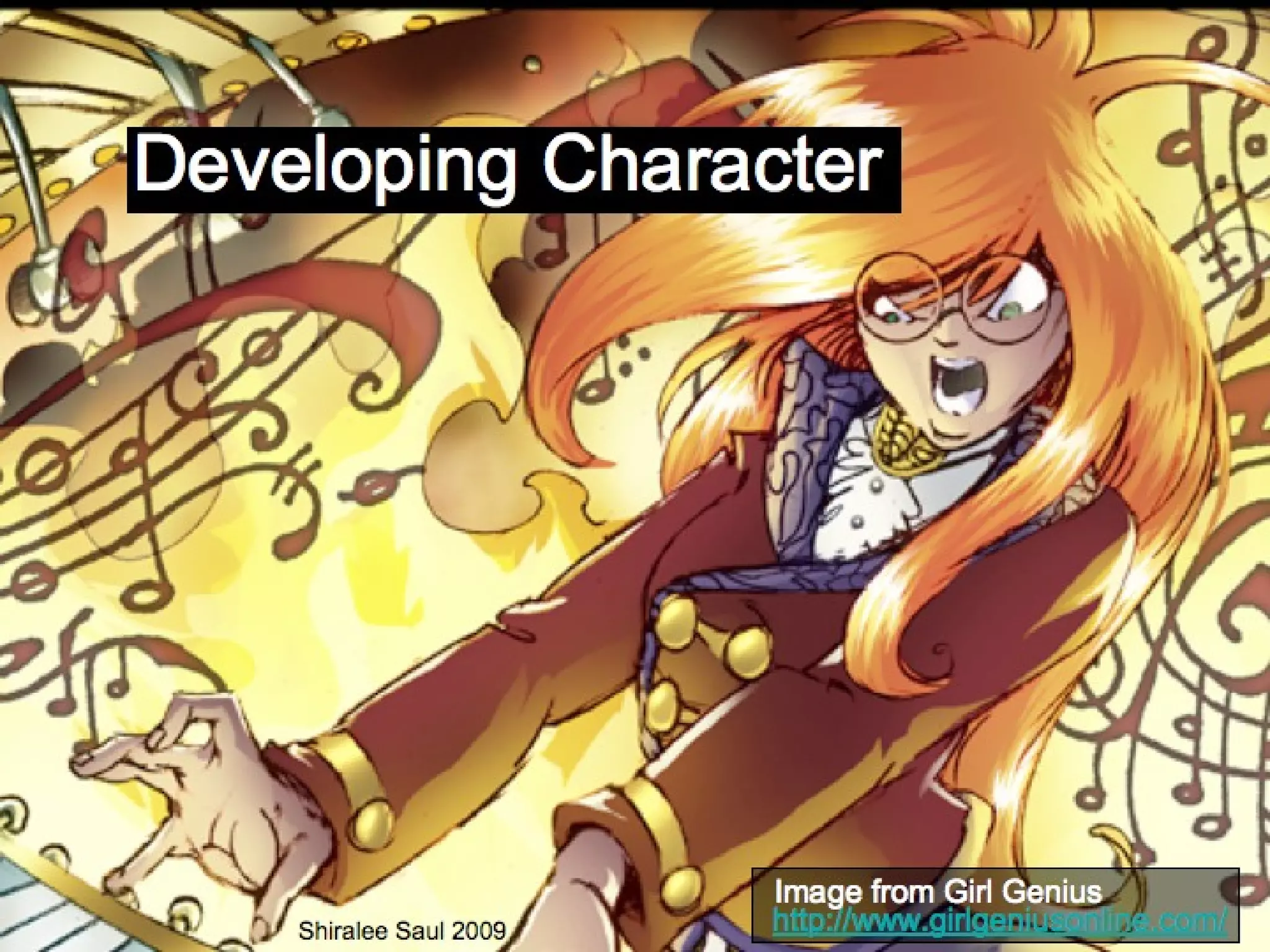
Developing   Character http://www.girlgeniusonline.com/ Image from Girl Genius Shiralee Saul 2009
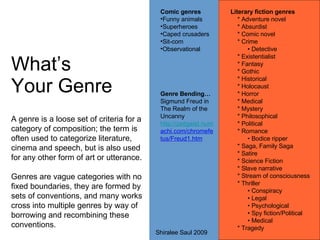
What’s Your Genre A genre is a loose set of criteria for a category of composition; the term is often used to categorize literature, cinema and speech, but is also used for any other form of art or utterance.  Genres are vague categories with no fixed boundaries, they are formed by sets of conventions, and many works cross into multiple genres by way of borrowing and recombining these conventions.  Literary fiction genres * Adventure novel * Absurdist * Comic novel * Crime •  Detective * Existentialist * Fantasy * Gothic * Historical * Holocaust * Horror * Medical * Mystery * Philosophical * Political * Romance •  Bodice ripper * Saga, Family Saga * Satire * Science Fiction * Slave narrative * Stream of consciousness * Thriller •  Conspiracy •  Legal •  Psychological •  Spy fiction/Political •  Medical * Tragedy Comic genres Funny animals Superheroes Caped crusaders Sit-com Observational Genre Bending… Sigmund Freud in  The Realm of the Uncanny http://zeitgeist.num achi.com/chromefe tus/Freud1.htm Shiralee Saul 2009
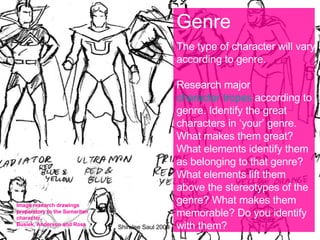
Genre The type of character will vary according to genre. Research major  character tropes  according to genre. Identify the great characters in ‘your’ genre. What makes them great? What elements identify them as belonging to that genre? What elements lift them above the stereotypes of the genre? What makes them memorable? Do you identify with them? Image research drawings preparatory to the Samaritan character. Busiek, Anderson and Ross Shiralee Saul 2009
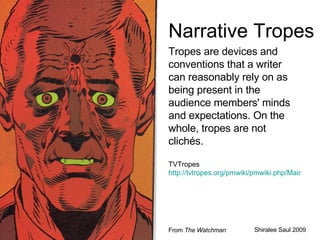
Narrative Tropes Tropes are devices and conventions that a writer can reasonably rely on as being present in the audience members' minds and expectations. On the whole, tropes are not clichés.  TVTropes  http://tvtropes.org/pmwiki/pmwiki.php/Main/HomePage Shiralee Saul 2009 From  The Watchman
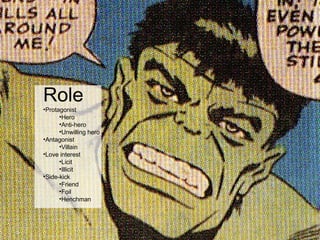
Role Protagonist  Hero Anti-hero Unwilling hero Antagonist  Villain Love interest Licit Illicit Side-kick  Friend Foil Henchman
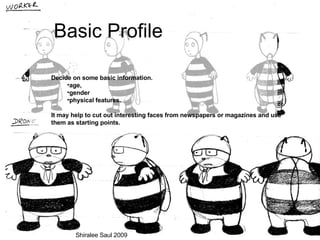
Basic Profile Decide on some basic information.  age,  gender  physical features.  It may help to cut out interesting faces from newspapers or magazines and use them as starting points. Shiralee Saul 2009
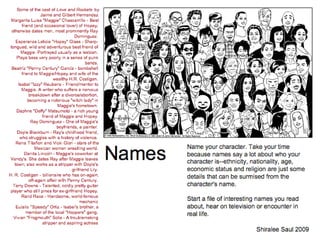
Names Name your character. Take your time because names say a lot about who your character is--ethnicity, nationality, age, economic status and religion are just some details that can be surmised from the character's name.  Start a file of interesting names you read about, hear on television or encounter in real life. Some of the cast of  Love and Rockets  by Jaime and Gilbert Hernandez Margarita Luisa "Maggie" Chascarrillo - Best friend (and occasional lover) of Hopey; otherwise dates men, most prominently Ray Dominguez.  Esperanza Leticia "Hopey" Glass - Sharp-tongued, wild and adventurous best friend of Maggie. Portrayed usually as a lesbian. Plays bass very poorly in a series of punk bands. Beatríz "Penny Century" García - bombshell friend to Maggie/Hopey and wife of the wealthy H.R. Costigan. Isabel "Izzy" Reubens - Friend/mentor to Maggie. A writer who suffers a nervous breakdown after a divorce/abortion, becoming a notorious "witch lady" in Maggie's hometown. Daphne "Daffy" Matsumoto - a rich young friend of Maggie and Hopey. Ray Dominguez - One of Maggie's boyfriends, a painter.  Doyle Blackburn - Ray's childhood friend, who struggles with a history of violence. Rena Titañon and Vicki Glori - stars of the Mexican women wrestling world.  Danita Lincoln - Maggie's coworker at Vandy's. She dates Ray after Maggie leaves town; also works as a stripper with Doyle's girlfriend Lily. H. R. Costigan - billionaire who has on-again, off-again affair with Penny Century. Terry Downe - Talented, coldly pretty guitar player who still pines for ex-girlfriend Hopey. Rand Race - Handsome, world-famous mechanic Eulalio "Speedy" Ortiz - Isabel's brother, a member of the local "Hoppers" gang,  Vivian "Frogmouth" Solis - A troublemaking stripper and aspiring actress Shiralee Saul 2009
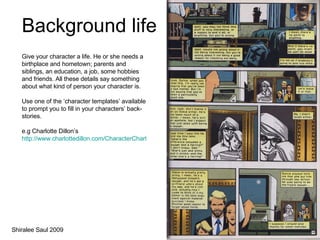
Background life Give your character a life. He or she needs a birthplace and hometown; parents and siblings, an education, a job, some hobbies and friends. All these details say something about what kind of person your character is. Use one of the ‘character templates’ available to prompt you to fill in your characters’ back-stories.  e.g Charlotte Dillon’s  http://www.charlottedillon.com/CharacterChart.html Shiralee Saul 2009
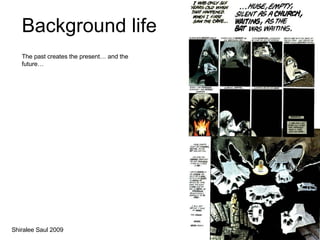
Background life The past creates the present… and the future… Shiralee Saul 2009
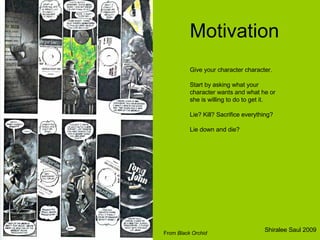
Motivation Give your character character.  Start by asking what your character wants and what he or she is willing to do to get it.  Lie? Kill? Sacrifice everything?  Lie down and die? From  Black Orchid Shiralee Saul 2009
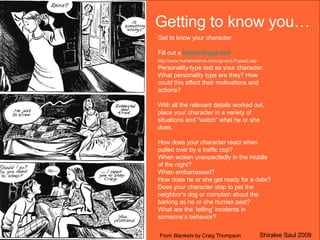
Getting to know you… Get to know your character. Fill out a  Myers-Briggs test  http://www.humanmetrics.com/cgi-win/JTypes2.asp  Personality-type test as your character. What personality type are they? How could this affect their motivations and actions? With all the relevant details worked out, place your character in a variety of situations and "watch" what he or she does.  How does your character react when pulled over by a traffic cop?  When woken unexpectedly in the middle of the night? When embarrassed? How does he or she get ready for a date?  Does your character stop to pet the neighbor's dog or complain about the barking as he or she hurries past? What are the ‘telling’ incidents in someone’s behavior? From  Blankets  by Craig Thompson Shiralee Saul 2009
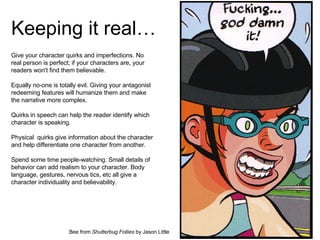
Keeping it real… Give your character quirks and imperfections. No real person is perfect; if your characters are, your readers won't find them believable.  Equally no-one is totally evil. Giving your antagonist redeeming features will humanize them and make the narrative more complex. Quirks in speech can help the reader identify which character is speaking.  Physical  quirks give information about the character and help differentiate one character from another. Spend some time people-watching. Small details of behavior can add realism to your character. Body language, gestures, nervous tics, etc all give a character individuality and believability. Bee from  Shutterbug Follies  by Jason Little
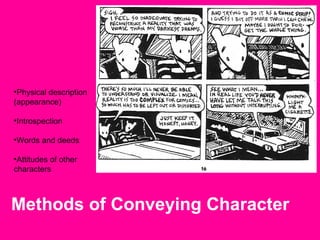
Methods of Conveying Character Physical description  (appearance) Introspection Words and deeds Attitudes of other  characters
Visual development Parallels the character development process
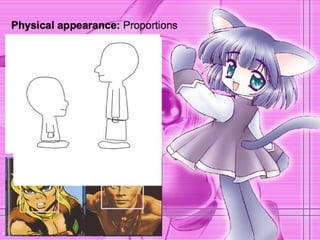
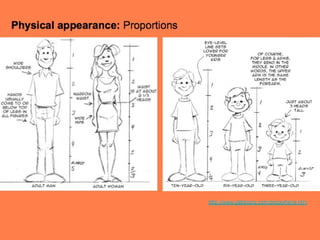
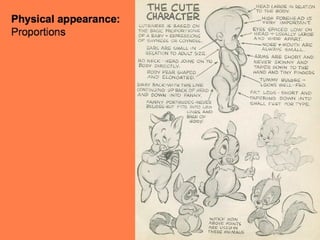
Physical appearance:  Proportions
Physical appearance:  Proportions http://www.zebtoonz.com/proportions.htm
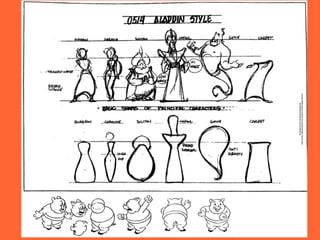
Physical appearance:  Proportions
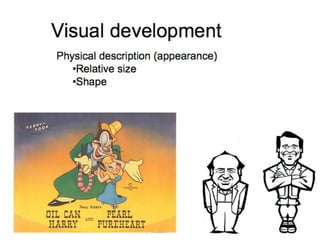
Visual development Physical description (appearance) Relative size  Shape
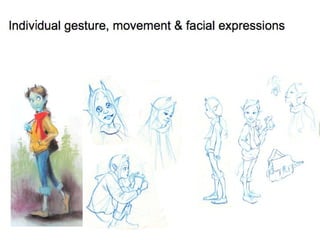
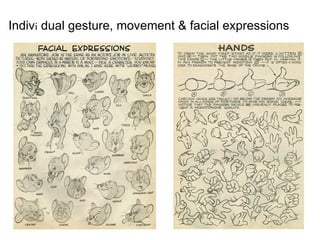
Indiv i dual gesture, movement & facial expressions
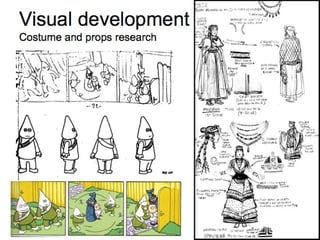
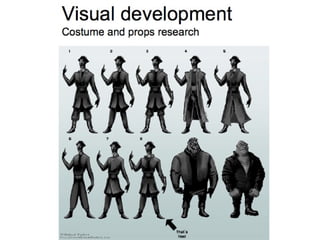
Visual development Costume and props research
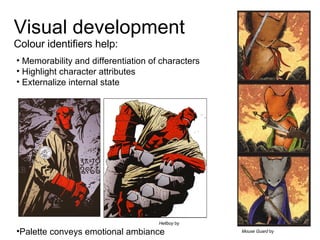
Visual development Colour identifiers help: Memorability and differentiation of characters Highlight character attributes Externalize internal state Palette conveys emotional ambiance Mouse Guard  by  Hellboy  by
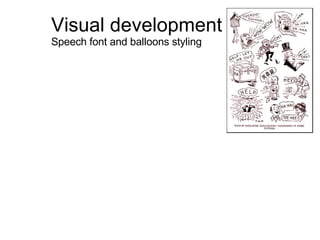
Visual development  Speech font and balloons styling
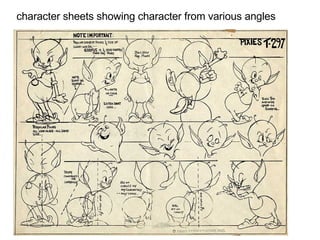
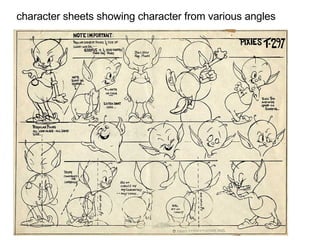
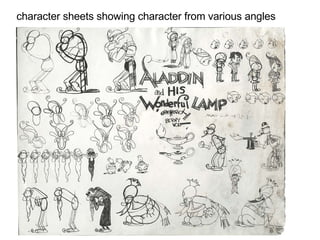
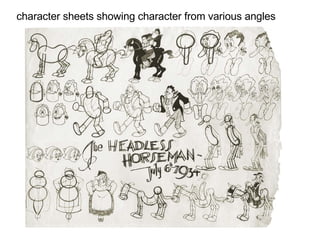
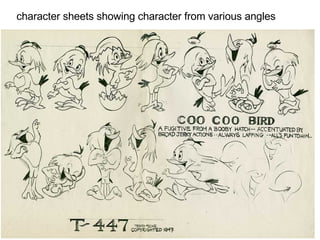
character sheets showing character from various angles

Character development

  • 1.
    Developing Character http://www.girlgeniusonline.com/ Image from Girl Genius Shiralee Saul 2009
  • 2.
    What’s Your GenreA genre is a loose set of criteria for a category of composition; the term is often used to categorize literature, cinema and speech, but is also used for any other form of art or utterance. Genres are vague categories with no fixed boundaries, they are formed by sets of conventions, and many works cross into multiple genres by way of borrowing and recombining these conventions. Literary fiction genres * Adventure novel * Absurdist * Comic novel * Crime • Detective * Existentialist * Fantasy * Gothic * Historical * Holocaust * Horror * Medical * Mystery * Philosophical * Political * Romance • Bodice ripper * Saga, Family Saga * Satire * Science Fiction * Slave narrative * Stream of consciousness * Thriller • Conspiracy • Legal • Psychological • Spy fiction/Political • Medical * Tragedy Comic genres Funny animals Superheroes Caped crusaders Sit-com Observational Genre Bending… Sigmund Freud in The Realm of the Uncanny http://zeitgeist.num achi.com/chromefe tus/Freud1.htm Shiralee Saul 2009
  • 3.
    Genre The typeof character will vary according to genre. Research major character tropes according to genre. Identify the great characters in ‘your’ genre. What makes them great? What elements identify them as belonging to that genre? What elements lift them above the stereotypes of the genre? What makes them memorable? Do you identify with them? Image research drawings preparatory to the Samaritan character. Busiek, Anderson and Ross Shiralee Saul 2009
  • 4.
    Narrative Tropes Tropesare devices and conventions that a writer can reasonably rely on as being present in the audience members' minds and expectations. On the whole, tropes are not clichés. TVTropes http://tvtropes.org/pmwiki/pmwiki.php/Main/HomePage Shiralee Saul 2009 From The Watchman
  • 5.
    Role Protagonist Hero Anti-hero Unwilling hero Antagonist Villain Love interest Licit Illicit Side-kick Friend Foil Henchman
  • 6.
    Basic Profile Decideon some basic information. age, gender physical features. It may help to cut out interesting faces from newspapers or magazines and use them as starting points. Shiralee Saul 2009
  • 7.
    Names Name yourcharacter. Take your time because names say a lot about who your character is--ethnicity, nationality, age, economic status and religion are just some details that can be surmised from the character's name. Start a file of interesting names you read about, hear on television or encounter in real life. Some of the cast of Love and Rockets by Jaime and Gilbert Hernandez Margarita Luisa "Maggie" Chascarrillo - Best friend (and occasional lover) of Hopey; otherwise dates men, most prominently Ray Dominguez. Esperanza Leticia "Hopey" Glass - Sharp-tongued, wild and adventurous best friend of Maggie. Portrayed usually as a lesbian. Plays bass very poorly in a series of punk bands. Beatríz "Penny Century" García - bombshell friend to Maggie/Hopey and wife of the wealthy H.R. Costigan. Isabel "Izzy" Reubens - Friend/mentor to Maggie. A writer who suffers a nervous breakdown after a divorce/abortion, becoming a notorious "witch lady" in Maggie's hometown. Daphne "Daffy" Matsumoto - a rich young friend of Maggie and Hopey. Ray Dominguez - One of Maggie's boyfriends, a painter. Doyle Blackburn - Ray's childhood friend, who struggles with a history of violence. Rena Titañon and Vicki Glori - stars of the Mexican women wrestling world. Danita Lincoln - Maggie's coworker at Vandy's. She dates Ray after Maggie leaves town; also works as a stripper with Doyle's girlfriend Lily. H. R. Costigan - billionaire who has on-again, off-again affair with Penny Century. Terry Downe - Talented, coldly pretty guitar player who still pines for ex-girlfriend Hopey. Rand Race - Handsome, world-famous mechanic Eulalio "Speedy" Ortiz - Isabel's brother, a member of the local "Hoppers" gang, Vivian "Frogmouth" Solis - A troublemaking stripper and aspiring actress Shiralee Saul 2009
  • 8.
    Background life Giveyour character a life. He or she needs a birthplace and hometown; parents and siblings, an education, a job, some hobbies and friends. All these details say something about what kind of person your character is. Use one of the ‘character templates’ available to prompt you to fill in your characters’ back-stories. e.g Charlotte Dillon’s http://www.charlottedillon.com/CharacterChart.html Shiralee Saul 2009
  • 9.
    Background life Thepast creates the present… and the future… Shiralee Saul 2009
  • 10.
    Motivation Give yourcharacter character. Start by asking what your character wants and what he or she is willing to do to get it. Lie? Kill? Sacrifice everything? Lie down and die? From Black Orchid Shiralee Saul 2009
  • 11.
    Getting to knowyou… Get to know your character. Fill out a Myers-Briggs test http://www.humanmetrics.com/cgi-win/JTypes2.asp Personality-type test as your character. What personality type are they? How could this affect their motivations and actions? With all the relevant details worked out, place your character in a variety of situations and "watch" what he or she does. How does your character react when pulled over by a traffic cop? When woken unexpectedly in the middle of the night? When embarrassed? How does he or she get ready for a date? Does your character stop to pet the neighbor's dog or complain about the barking as he or she hurries past? What are the ‘telling’ incidents in someone’s behavior? From Blankets by Craig Thompson Shiralee Saul 2009
  • 12.
    Keeping it real…Give your character quirks and imperfections. No real person is perfect; if your characters are, your readers won't find them believable. Equally no-one is totally evil. Giving your antagonist redeeming features will humanize them and make the narrative more complex. Quirks in speech can help the reader identify which character is speaking. Physical quirks give information about the character and help differentiate one character from another. Spend some time people-watching. Small details of behavior can add realism to your character. Body language, gestures, nervous tics, etc all give a character individuality and believability. Bee from Shutterbug Follies by Jason Little
  • 13.
    Methods of ConveyingCharacter Physical description (appearance) Introspection Words and deeds Attitudes of other characters
  • 14.
    Visual development Parallelsthe character development process
  • 15.
  • 16.
    Physical appearance: Proportions http://www.zebtoonz.com/proportions.htm
  • 17.
  • 18.
  • 19.
    Visual development Physicaldescription (appearance) Relative size Shape
  • 20.
    Indiv i dualgesture, movement & facial expressions
  • 21.
    Indiv i dualgesture, movement & facial expressions
  • 22.
    Visual development Costumeand props research
  • 23.
    Visual development Costumeand props research
  • 24.
    Visual development Colouridentifiers help: Memorability and differentiation of characters Highlight character attributes Externalize internal state Palette conveys emotional ambiance Mouse Guard by Hellboy by
  • 25.
    Visual development Speech font and balloons styling
  • 26.
    character sheets showingcharacter from various angles
  • 27.
    character sheets showingcharacter from various angles
  • 28.
    character sheets showingcharacter from various angles
  • 29.
    character sheets showingcharacter from various angles
  • 30.
    character sheets showingcharacter from various angles