An Academic presentation by
Dr. Nancy Agnes, Head, Technical Operations, FoodResearchLab
Group:  www.foodresearchlab.com
Email: info@foodresearchlab.com
FOOD ENCAPSULATION
IN THE FOOD
INDUSTRY
Introduction
Purpose of Encapsulation
Process In-detail
Coacervation
Spray Drying
Fluidized bed
Molecular Inclusion
Innovative Applications Research in Encapsulation Developments
Today's Discussion
OUTLINE
Encapsulation is a key process of trapping
components (active) into a secondary material
(encapsulant), resulting in small solid particles
which will be able to release the active
component at specific condition.
This process is used commonly in the FMCG
industry for masking unwanted flavours or to
protect healthy ingredient during the shelf life of
the product during new product development.
Introduction
Contd...
Encapsulation process or encapsulated ingredients
are used in every food product category such as
confectionery, beverages, dairy, ready to eat
snacks or mainly in convenience foods.
Encapsulation in the food industry is projected to
grow at a CAGR rate of 13.1% from 2017 to 2022.
In the food ingredient market, the functional
ingredients market has the largest share as the
biomolecules are highly reactive.
Contd...
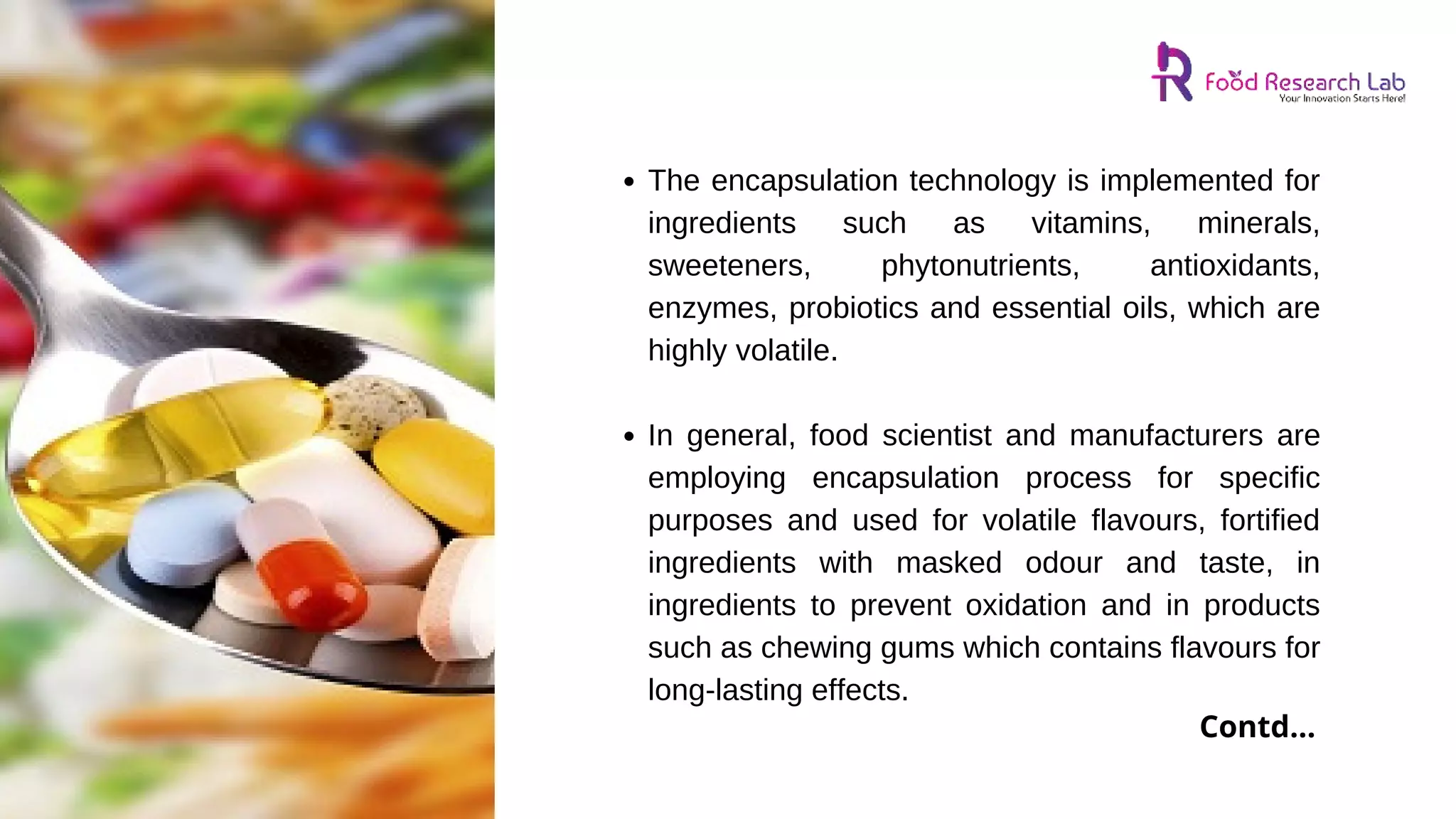
The encapsulation technology is implemented for
ingredients such as vitamins, minerals,
sweeteners, phytonutrients, antioxidants,
enzymes, probiotics and essential oils, which are
highly volatile.
In general, food scientist and manufacturers are
employing encapsulation process for specific
purposes and used for volatile flavours, fortified
ingredients with masked odour and taste, in
ingredients to prevent oxidation and in products
such as chewing gums which contains flavours for
long-lasting effects.
Contd...
For instance, ingredients that are encapsulated
include vitamins that need protection from the
external atmosphere, moisture and flavourings
that need to be released during mastication.
Some researchers are experimenting with protein
isolates, gums and carrageenan to protect
cardamom essential oils in a dry powder,
enhancing its hand ability and storability.
There are other examples of encapsulation
technology ingredients in consumer packaged
goods.
NutraShield™ caffeine technology was used to
improve the taste of the caffeine.
Proprietary consultation technologies to make
Season-ettes™ granules less prone to moisture
migration have shown better temperature stability.
FlavorCell encapsulated liquid and solid flavourings
where the flavour matrix was protected from heat,
oxidation and more importantly moisture.
A positive outlook for nutraceuticals is achieved and
accompanied by encapsulation and market growth.
In general, food scientist and food development
companies are employing encapsulation process
for specific purposes and used for volatile
flavours, fortified ingredients with masked odour
and taste, in ingredients to prevent oxidation and
in products such as chewing gums which contains
flavours for long-lasting effects.
For instance, ingredients that are encapsulated
include vitamins that need protection from the
external atmosphere, moisture and flavourings
that need to be released during mastication.
Purpose of Encapsulation
Contd...
Some researchers are experimenting with protein
isolates, gums and carrageenan to protect
cardamom essential oils in a dry powder,
enhancing its hand ability and storability.
There are other examples of encapsulation
technology ingredients in consumer packaged
goods.
NutraShield™ caffeine technology was used to
improve the taste of the caffeine.
Contd...
Proprietary consultation technologies to make
Season-ettes™ granules less prone to moisture
migration have shown better temperature stability.
FlavorCell encapsulated liquid and solid
flavourings where the flavour matrix was
protected from heat, oxidation and more
importantly moisture.
A positive outlook for nutraceuticals is achieved
and accompanied by encapsulation and market
growth.
Contd...
Process In-detail
The very first stage in the encapsulation process
is the mixing of the active material with an
encapsulant to form an emulsion.
This emulsion is then dried to produce
microcapsules of various sizes based on the
preparation method.
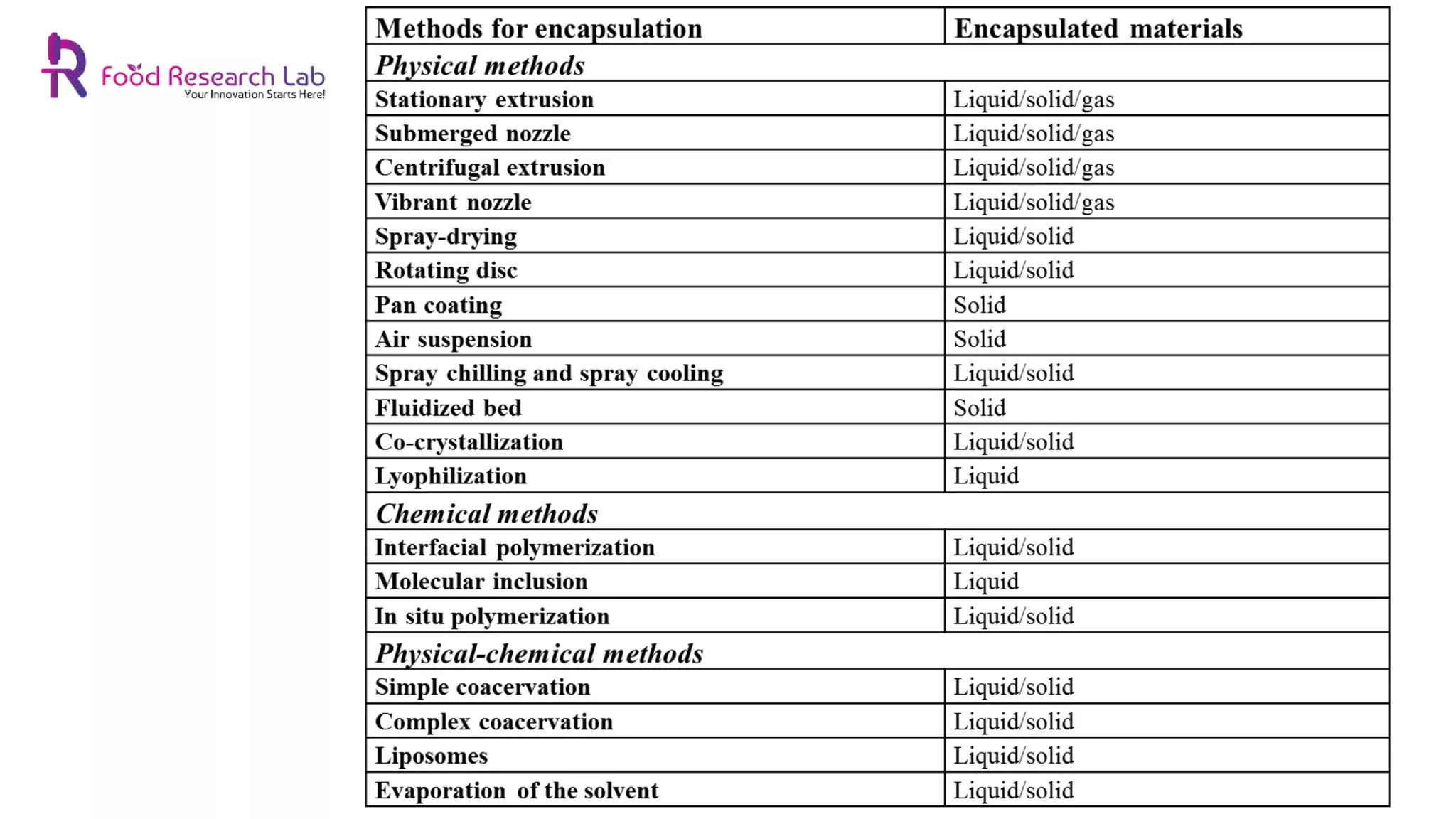
Under the physiochemical method, there are
simple or a complex coacervation method,
splitting of organic and liposomal wrapping could
be done.
Contd...
Under the Physical method, the commonly done
method is spray drying, fluidized bed, extrusion
and lyophilization.
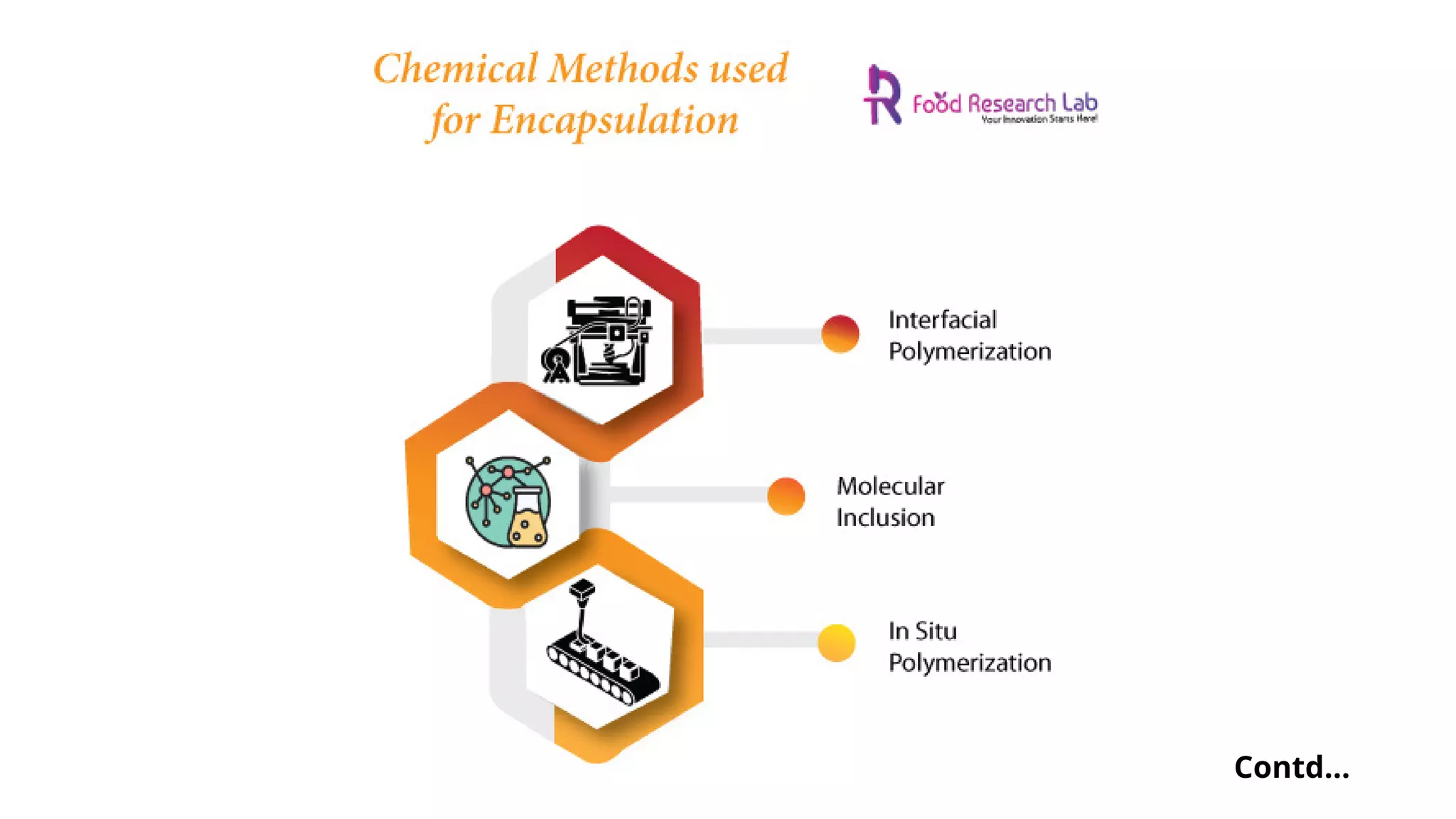
Finally, chemical methods are also available
which will create interfacial polymerization and
inclusion for the microencapsulation to be done.
Contd...
Contd...
Contd...
Coacervation
This method is achieved when the
encapsulant material is made from polymeric
chain units, which reacts with other chains in
the vicinity and results in aggregates forming
high-intensity attraction forces.
Then the aggregated polymer chains are
deposited around the droplets of the
hydrophobic phase dispersed in the emulsion
to form a protective film.
Contd...
Key things to understand in this method are that
these particles are irregular in structure as the
encapsulant is not equally distributed over the
active component.
The diameter size range expected in complex
coacervation is 1 to 500 μm and for simple
coacervation is from 20 to 500 μm.
Spray Drying
This method is widely used in the industry for
products such as juice, pulp, vegetal extracts, due
to the low cost and easy application.
During this process, a homogenous mixture of the
active component and the encapsulant in a water-
based or organic solvent is made.
This wet mixture is subjected to a hot airstream
which will evaporate the outer solvent and dry the
microcapsules and leaves no solvent residue.
Contd...
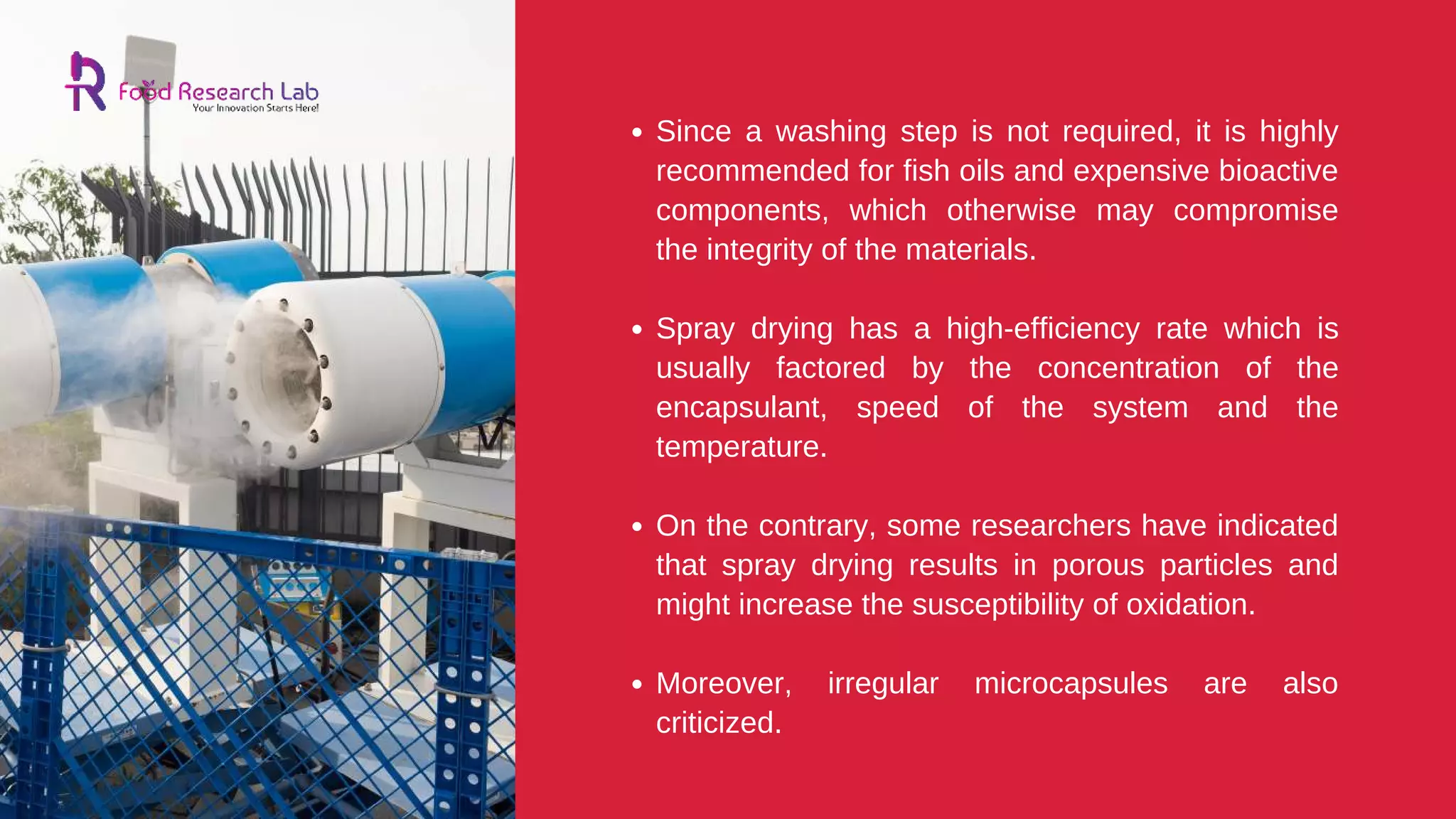
Since a washing step is not required, it is highly
recommended for fish oils and expensive bioactive
components, which otherwise may compromise
the integrity of the materials.
Spray drying has a high-efficiency rate which is
usually factored by the concentration of the
encapsulant, speed of the system and the
temperature.
On the contrary, some researchers have indicated
that spray drying results in porous particles and
might increase the susceptibility of oxidation.
Moreover, irregular microcapsules are also
criticized.
Fluidized bed
In this food encapsulation technology the
active component is suspended and the
encapsulant is atomized into the chamber
which gets deposited on the core.
When the particles reach the top of the
column, they are released into a column of
air, reaching the fluidized bed once again.
Contd...
This time the microcapsules are coated gain,
dried and allowed to harden ensuring a
uniform coating.
The fluidized bed encapsulation technique
allows active components to be encapsulated
with any wall materials, ranging from proteins,
emulsifier, proteins and even fat.
Molecular Inclusion
Molecular inclusion is considered to be a
promising possibility for flavour stabilization in the
formation of an inclusion complex with β-
cyclodextrin.
Studies have shown that β-cyclodextrin is
thermally destroyed at 260 ℃ and to achieve
thermal stability it is included with γ-cyclodextrins.
For instance, essential oils of lemon orange and
chamomile have used a combination of both
cyclodextrins.
Contd...
The release of the active component from the wall
material regardless of the method of encapsulation
will depend on factors such as pH, temperature,
solubility, and biodegradation.
Moreover, the final thickness of the wall material
also affected the solubility and stability of
microcapsules.
Innovative Applications
Research in Encapsulation
Developments
a. Fish oil without the fishy taste
1. Building wide ingredient options to build
encapsulation shells
2. Preventing flavour and aroma loss for volatile
compounds
3. Nutrient enhances ingredients
4. Improved flavour stability
Contd...
10. Fighting food adulteration
5. Functional encapsulated ingredients
a. Reduced bitterness in caffeine
6. Controlled ingredient release
7. Better leavening and baking is achieved
8. Better matrices are built using starches
9. Protecting multi nutrients from thermal and
biochemical degradation
+44- 74248 10299
UNITED KINGDOM
+91 9566299022
EMAIL
INDIA
info@foodresearchlab.com
Contact Us

encapsulation in the food industry

  • 1.
    An Academic presentationby Dr. Nancy Agnes, Head, Technical Operations, FoodResearchLab Group:  www.foodresearchlab.com Email: info@foodresearchlab.com FOOD ENCAPSULATION IN THE FOOD INDUSTRY
  • 2.
    Introduction Purpose of Encapsulation ProcessIn-detail Coacervation Spray Drying Fluidized bed Molecular Inclusion Innovative Applications Research in Encapsulation Developments Today's Discussion OUTLINE
  • 3.
    Encapsulation is akey process of trapping components (active) into a secondary material (encapsulant), resulting in small solid particles which will be able to release the active component at specific condition. This process is used commonly in the FMCG industry for masking unwanted flavours or to protect healthy ingredient during the shelf life of the product during new product development. Introduction Contd...
  • 4.
    Encapsulation process orencapsulated ingredients are used in every food product category such as confectionery, beverages, dairy, ready to eat snacks or mainly in convenience foods. Encapsulation in the food industry is projected to grow at a CAGR rate of 13.1% from 2017 to 2022. In the food ingredient market, the functional ingredients market has the largest share as the biomolecules are highly reactive. Contd...
  • 5.
    The encapsulation technologyis implemented for ingredients such as vitamins, minerals, sweeteners, phytonutrients, antioxidants, enzymes, probiotics and essential oils, which are highly volatile. In general, food scientist and manufacturers are employing encapsulation process for specific purposes and used for volatile flavours, fortified ingredients with masked odour and taste, in ingredients to prevent oxidation and in products such as chewing gums which contains flavours for long-lasting effects. Contd...
  • 6.
    For instance, ingredientsthat are encapsulated include vitamins that need protection from the external atmosphere, moisture and flavourings that need to be released during mastication. Some researchers are experimenting with protein isolates, gums and carrageenan to protect cardamom essential oils in a dry powder, enhancing its hand ability and storability. There are other examples of encapsulation technology ingredients in consumer packaged goods.
  • 7.
    NutraShield™ caffeine technologywas used to improve the taste of the caffeine. Proprietary consultation technologies to make Season-ettes™ granules less prone to moisture migration have shown better temperature stability. FlavorCell encapsulated liquid and solid flavourings where the flavour matrix was protected from heat, oxidation and more importantly moisture. A positive outlook for nutraceuticals is achieved and accompanied by encapsulation and market growth.
  • 8.
    In general, foodscientist and food development companies are employing encapsulation process for specific purposes and used for volatile flavours, fortified ingredients with masked odour and taste, in ingredients to prevent oxidation and in products such as chewing gums which contains flavours for long-lasting effects. For instance, ingredients that are encapsulated include vitamins that need protection from the external atmosphere, moisture and flavourings that need to be released during mastication. Purpose of Encapsulation Contd...
  • 9.
    Some researchers areexperimenting with protein isolates, gums and carrageenan to protect cardamom essential oils in a dry powder, enhancing its hand ability and storability. There are other examples of encapsulation technology ingredients in consumer packaged goods. NutraShield™ caffeine technology was used to improve the taste of the caffeine. Contd...
  • 10.
    Proprietary consultation technologiesto make Season-ettes™ granules less prone to moisture migration have shown better temperature stability. FlavorCell encapsulated liquid and solid flavourings where the flavour matrix was protected from heat, oxidation and more importantly moisture. A positive outlook for nutraceuticals is achieved and accompanied by encapsulation and market growth. Contd...
  • 11.
    Process In-detail The veryfirst stage in the encapsulation process is the mixing of the active material with an encapsulant to form an emulsion. This emulsion is then dried to produce microcapsules of various sizes based on the preparation method. Under the physiochemical method, there are simple or a complex coacervation method, splitting of organic and liposomal wrapping could be done. Contd...
  • 12.
    Under the Physicalmethod, the commonly done method is spray drying, fluidized bed, extrusion and lyophilization. Finally, chemical methods are also available which will create interfacial polymerization and inclusion for the microencapsulation to be done. Contd...
  • 13.
  • 14.
  • 16.
    Coacervation This method isachieved when the encapsulant material is made from polymeric chain units, which reacts with other chains in the vicinity and results in aggregates forming high-intensity attraction forces. Then the aggregated polymer chains are deposited around the droplets of the hydrophobic phase dispersed in the emulsion to form a protective film. Contd...
  • 17.
    Key things tounderstand in this method are that these particles are irregular in structure as the encapsulant is not equally distributed over the active component. The diameter size range expected in complex coacervation is 1 to 500 μm and for simple coacervation is from 20 to 500 μm.
  • 18.
    Spray Drying This methodis widely used in the industry for products such as juice, pulp, vegetal extracts, due to the low cost and easy application. During this process, a homogenous mixture of the active component and the encapsulant in a water- based or organic solvent is made. This wet mixture is subjected to a hot airstream which will evaporate the outer solvent and dry the microcapsules and leaves no solvent residue. Contd...
  • 19.
    Since a washingstep is not required, it is highly recommended for fish oils and expensive bioactive components, which otherwise may compromise the integrity of the materials. Spray drying has a high-efficiency rate which is usually factored by the concentration of the encapsulant, speed of the system and the temperature. On the contrary, some researchers have indicated that spray drying results in porous particles and might increase the susceptibility of oxidation. Moreover, irregular microcapsules are also criticized.
  • 20.
    Fluidized bed In thisfood encapsulation technology the active component is suspended and the encapsulant is atomized into the chamber which gets deposited on the core. When the particles reach the top of the column, they are released into a column of air, reaching the fluidized bed once again. Contd...
  • 21.
    This time themicrocapsules are coated gain, dried and allowed to harden ensuring a uniform coating. The fluidized bed encapsulation technique allows active components to be encapsulated with any wall materials, ranging from proteins, emulsifier, proteins and even fat.
  • 22.
    Molecular Inclusion Molecular inclusionis considered to be a promising possibility for flavour stabilization in the formation of an inclusion complex with β- cyclodextrin. Studies have shown that β-cyclodextrin is thermally destroyed at 260 ℃ and to achieve thermal stability it is included with γ-cyclodextrins. For instance, essential oils of lemon orange and chamomile have used a combination of both cyclodextrins. Contd...
  • 23.
    The release ofthe active component from the wall material regardless of the method of encapsulation will depend on factors such as pH, temperature, solubility, and biodegradation. Moreover, the final thickness of the wall material also affected the solubility and stability of microcapsules.
  • 24.
    Innovative Applications Research inEncapsulation Developments a. Fish oil without the fishy taste 1. Building wide ingredient options to build encapsulation shells 2. Preventing flavour and aroma loss for volatile compounds 3. Nutrient enhances ingredients 4. Improved flavour stability Contd...
  • 25.
    10. Fighting foodadulteration 5. Functional encapsulated ingredients a. Reduced bitterness in caffeine 6. Controlled ingredient release 7. Better leavening and baking is achieved 8. Better matrices are built using starches 9. Protecting multi nutrients from thermal and biochemical degradation
  • 26.
    +44- 74248 10299 UNITEDKINGDOM +91 9566299022 EMAIL INDIA info@foodresearchlab.com Contact Us