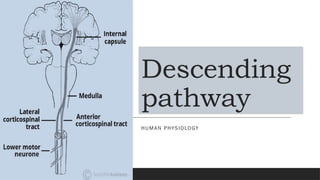
Descending
pathway
HUMAN PHYSIOLOGY
INTRODUCTION
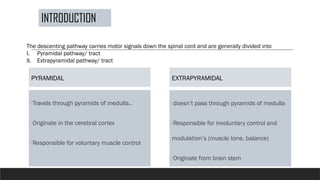
The descenting pathway carries motor signals down the spinal cord and are generally divided into
I. Pyramidal pathway/ tract
II. Extrapyramidal pathway/ tract
PYRAMIDAL
oTravels through pyramids of medulla..
oOriginate in the cerebral cortex
oResponsible for voluntary muscle control
EXTRAPYRAMIDAL
odoesn’t pass through pyramids of medulla
oResponsible for involuntary control and
modulation’s (muscle tone, balance)
oOriginate from brain stem
Pyramidal
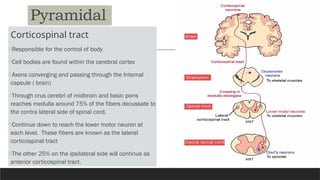
Corticospinal tract
oResponsible for the control of body
oCell bodies are found within the cerebral cortex
oAxons converging and passing through the Internal
capsule ( brain)
oThrough crus cerebri of midbrain and basic pons
reaches medulla around 75% of the fibers decussate to
the contra lateral side of spinal cord.
oContinue down to reach the lower motor neuron at
each level. These fibers are known as the lateral
corticospinal tract
oThe other 25% on the ipsilateral side will continue as
anterior corticospinal tract.
Pyramidal
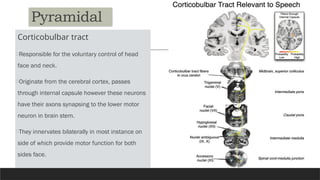
Corticobulbar tract
oResponsible for the voluntary control of head
face and neck.
oOriginate from the cerebral cortex, passes
through internal capsule however these neurons
have their axons synapsing to the lower motor
neuron in brain stem.
oThey innervates bilaterally in most instance on
side of which provide motor function for both
sides face.
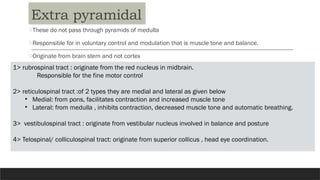
Extra pyramidal
oThese do not pass through pyramids of medulla
oResponsible for in voluntary control and modulation that is muscle tone and balance.
oOriginate from brain stem and not cortex
1> rubrospinal tract : originate from the red nucleus in midbrain.
Responsible for the fine motor control
2> reticulospinal tract :of 2 types they are medial and lateral as given below
• Medial: from pons, facilitates contraction and increased muscle tone
• Lateral: from medulla , inhibits contraction, decreased muscle tone and automatic breathing.
3> vestibulospinal tract : originate from vestibular nucleus involved in balance and posture
4> Telospinal/ colliculospinal tract: originate from superior collicus , head eye coordination.
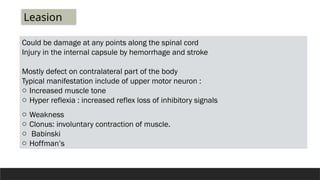
Leasion
Could be damage at any points along the spinal cord
Injury in the internal capsule by hemorrhage and stroke
Mostly defect on contralateral part of the body
Typical manifestation include of upper motor neuron :
o Increased muscle tone
o Hyper reflexia : increased reflex loss of inhibitory signals
o Weakness
o Clonus: involuntary contraction of muscle.
o Babinski
o Hoffman’s
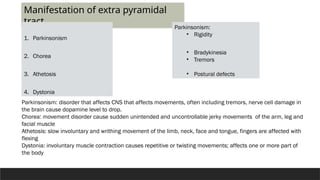
Manifestation of extra pyramidal
tract
1. Parkinsonism
2. Chorea
3. Athetosis
4. Dystonia
Parkinsonism:
• Rigidity
• Bradykinesia
• Tremors
• Postural defects
Parkinsonism: disorder that affects CNS that affects movements, often including tremors, nerve cell damage in
the brain cause dopamine level to drop.
Chorea: movement disorder cause sudden unintended and uncontrollable jerky movements of the arm, leg and
facial muscle
Athetosis: slow involuntary and writhing movement of the limb, neck, face and tongue, fingers are affected with
flexing
Dystonia: involuntary muscle contraction causes repetitive or twisting movements; affects one or more part of
the body
Thank you
MIDHUN THIRUMANGALATH | ASSIST. PROFESSOR |@CIHS MYSURU

human physiology- desenting pathway;pyramidal and extra pyramidal.pptx

  • 1.
  • 2.
    INTRODUCTION The descenting pathwaycarries motor signals down the spinal cord and are generally divided into I. Pyramidal pathway/ tract II. Extrapyramidal pathway/ tract PYRAMIDAL oTravels through pyramids of medulla.. oOriginate in the cerebral cortex oResponsible for voluntary muscle control EXTRAPYRAMIDAL odoesn’t pass through pyramids of medulla oResponsible for involuntary control and modulation’s (muscle tone, balance) oOriginate from brain stem
  • 3.
    Pyramidal Corticospinal tract oResponsible forthe control of body oCell bodies are found within the cerebral cortex oAxons converging and passing through the Internal capsule ( brain) oThrough crus cerebri of midbrain and basic pons reaches medulla around 75% of the fibers decussate to the contra lateral side of spinal cord. oContinue down to reach the lower motor neuron at each level. These fibers are known as the lateral corticospinal tract oThe other 25% on the ipsilateral side will continue as anterior corticospinal tract.
  • 4.
    Pyramidal Corticobulbar tract oResponsible forthe voluntary control of head face and neck. oOriginate from the cerebral cortex, passes through internal capsule however these neurons have their axons synapsing to the lower motor neuron in brain stem. oThey innervates bilaterally in most instance on side of which provide motor function for both sides face.
  • 5.
    Extra pyramidal oThese donot pass through pyramids of medulla oResponsible for in voluntary control and modulation that is muscle tone and balance. oOriginate from brain stem and not cortex 1> rubrospinal tract : originate from the red nucleus in midbrain. Responsible for the fine motor control 2> reticulospinal tract :of 2 types they are medial and lateral as given below • Medial: from pons, facilitates contraction and increased muscle tone • Lateral: from medulla , inhibits contraction, decreased muscle tone and automatic breathing. 3> vestibulospinal tract : originate from vestibular nucleus involved in balance and posture 4> Telospinal/ colliculospinal tract: originate from superior collicus , head eye coordination.
  • 6.
    Leasion Could be damageat any points along the spinal cord Injury in the internal capsule by hemorrhage and stroke Mostly defect on contralateral part of the body Typical manifestation include of upper motor neuron : o Increased muscle tone o Hyper reflexia : increased reflex loss of inhibitory signals o Weakness o Clonus: involuntary contraction of muscle. o Babinski o Hoffman’s
  • 7.
    Manifestation of extrapyramidal tract 1. Parkinsonism 2. Chorea 3. Athetosis 4. Dystonia Parkinsonism: • Rigidity • Bradykinesia • Tremors • Postural defects Parkinsonism: disorder that affects CNS that affects movements, often including tremors, nerve cell damage in the brain cause dopamine level to drop. Chorea: movement disorder cause sudden unintended and uncontrollable jerky movements of the arm, leg and facial muscle Athetosis: slow involuntary and writhing movement of the limb, neck, face and tongue, fingers are affected with flexing Dystonia: involuntary muscle contraction causes repetitive or twisting movements; affects one or more part of the body
  • 8.
    Thank you MIDHUN THIRUMANGALATH| ASSIST. PROFESSOR |@CIHS MYSURU