EXTRACTION
&
GALENICALS
PRESENTED BY – CHANDAN KUMAR SAHOO
ROLL NO- 10
D.PHARM 1st YEAR
AUROSRI INSTITUTE OF PHARMACEUTICAL EDUCATION
& RESEARCH (AIPER)
KADEI ,TANGI , CUTTACK
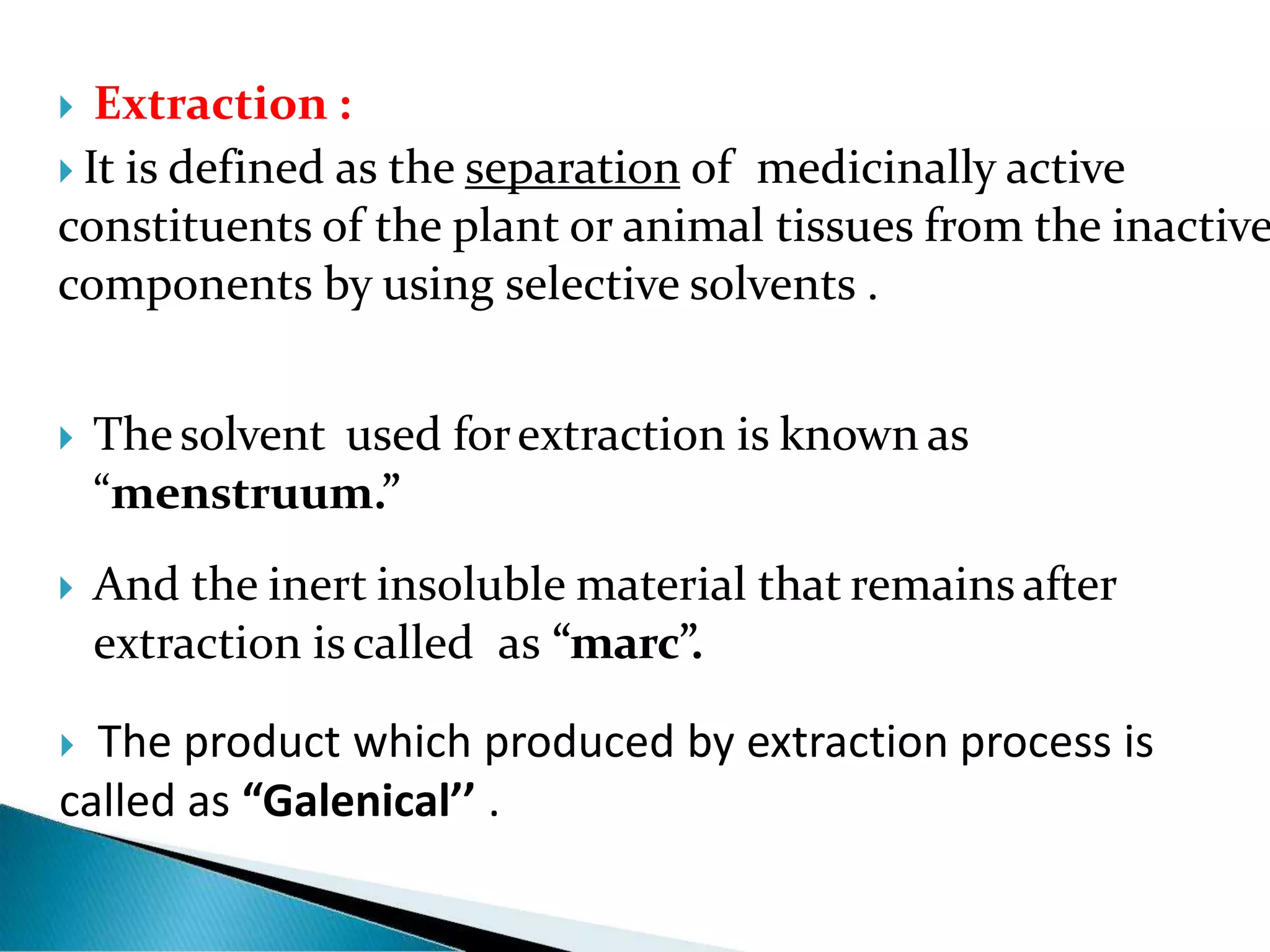
 Extraction :
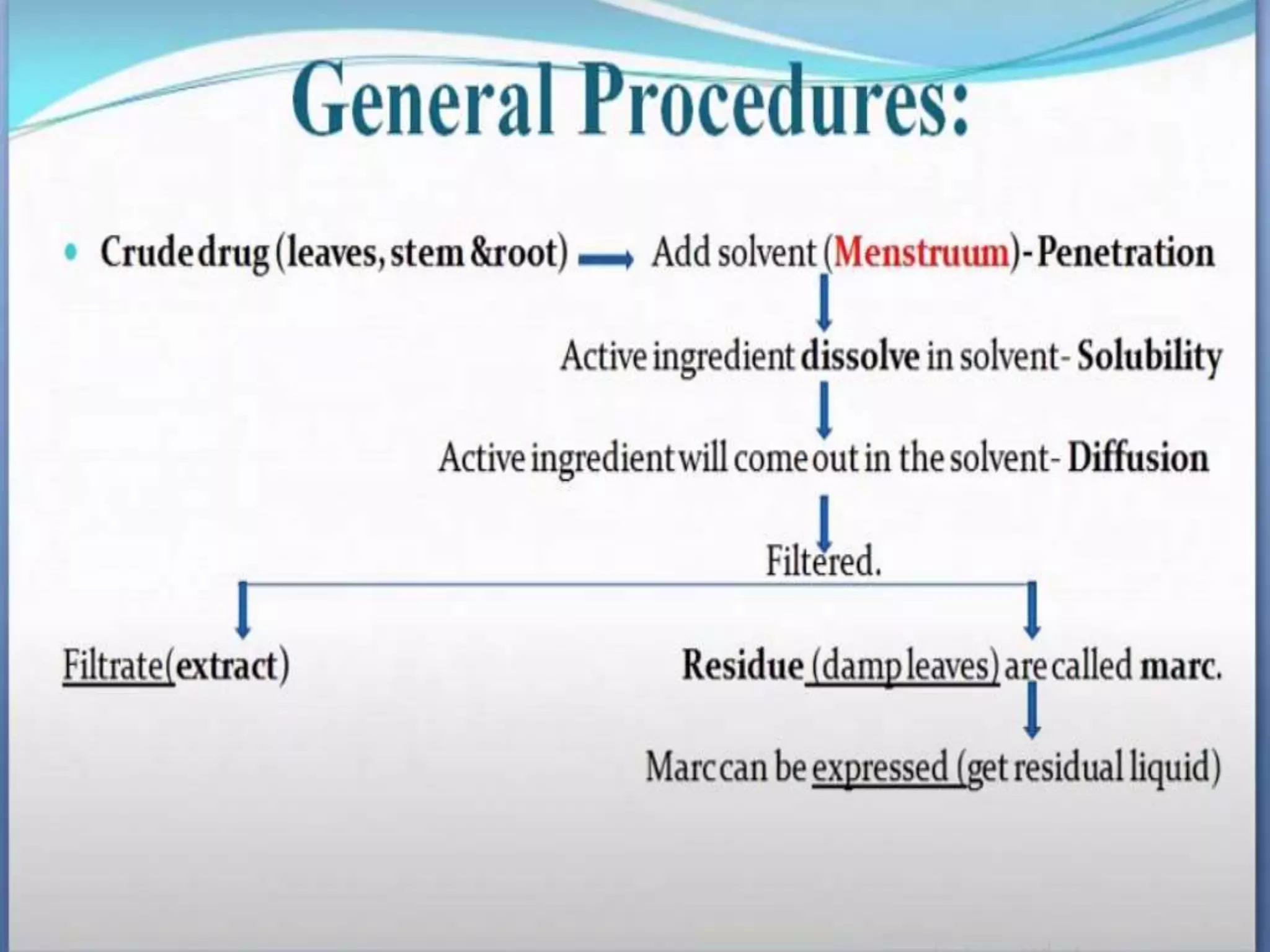
 It is defined as the separation of medicinally active
constituents of the plant or animal tissues from the inactive
components by using selective solvents .
 Thesolvent used forextraction is known as
“menstruum.”
 And the inert insoluble material that remains after
extraction iscalled as “marc”.
 The product which produced by extraction process is
called as “Galenical’’ .
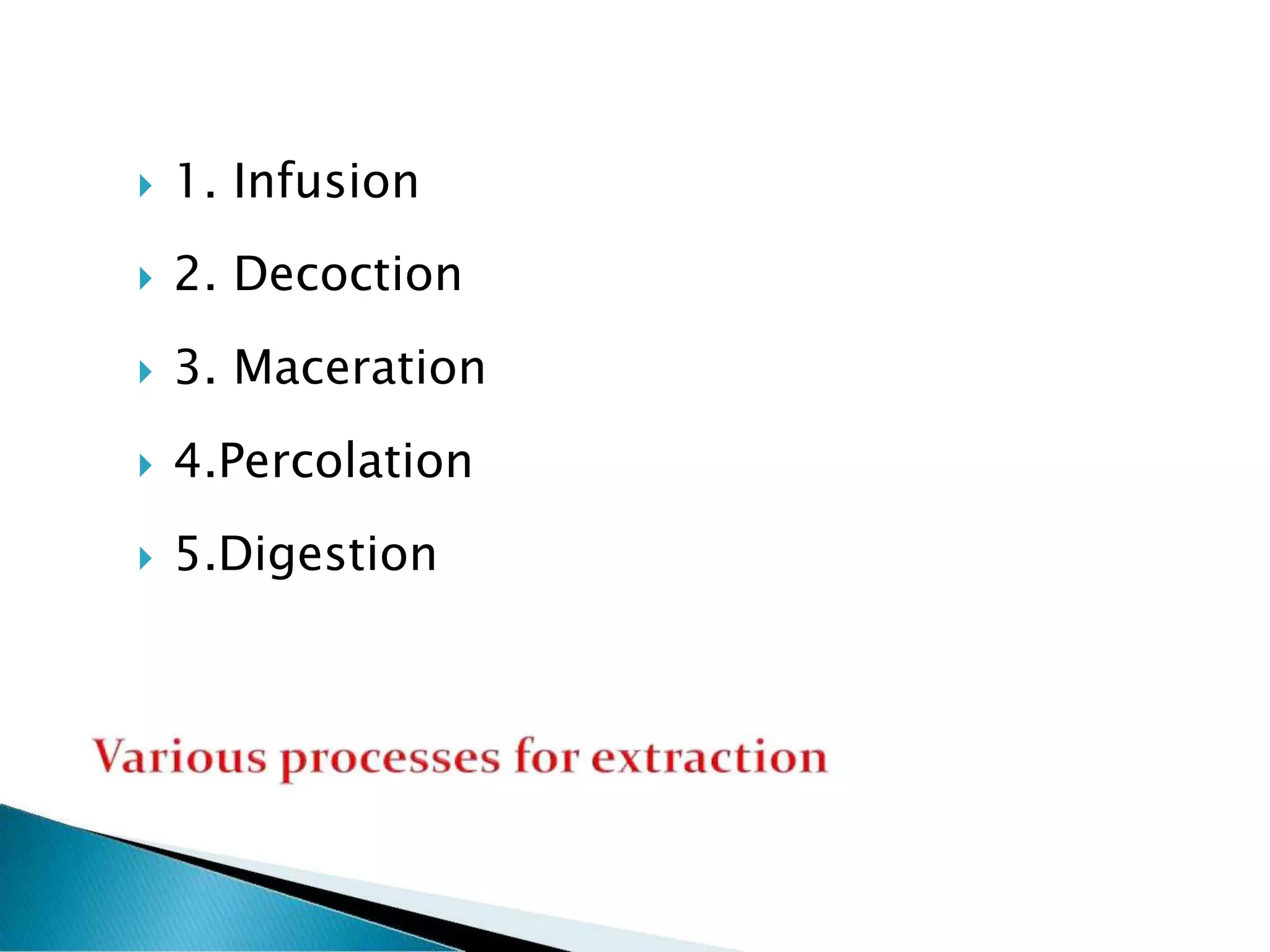
 1. Infusion
 2. Decoction
 3. Maceration
 4.Percolation
 5.Digestion
 1. Water :
 Water is a solvent for protein , colouring matter,
gums, glycosides, sugars, alkaloidal salts, enzymes,
many organic acids and mostof the organic salts.
 Waxes ,fats ,fixed oils and mostalkaloids are
insoluble in water.
 It is cheap.
 It has a wide solvent action.
 It is non-toxic.
 It is non-inflammable.
 Disadvantages:
 It has a wide solvent action.
 Water helps in growth of mould and bacteria . Hence ,
some preservative is needed during extraction of crude
drugs.
 Watercauses hydrolysis of many substances.
 Largeamount of heat is required to concentrate the
aqueous preparation than non-aqueous preparation.
 2. Alcohol :
 Alcohol is solvent foralkaloids , glycosides, volatile
oils and resins.
 Alcohol does not dissolvealbuminous matter ,gums,
waxes, fats, fixed oils and sugar.
 The mould and bacteria cannot grow in a solution in which
alcohol concentration is 20% or more.
 A small amount of heat is required toconcentrate the
alcoholic preparation.
 It is non-toxic in the concentration mostly present in the
preparations.
 Disadvantages :
 The preparation becomes costly when alcohol is used as
solvent forextraction of API.
 Various types of maceration process:
 1. A process for tincture made from organised drug e.g.
roots,stem,leavesetc. This process is called ‘Simple
Maceration’.
 2.A process for tincture made from unorganised drugs
such as oleo resins and gum resins. This process is
known as ‘Maceration with Adjustment’.
 3. Process forconcentrated preparations which
includes both ‘Double maceration’ and ‘Triple
maceration’.
 Apparatus:
 A wide mouth bottleorany othercontainerwhich can be
well stoppered is used for maceration process.
 A closed container is essential to prevent the evaporation
of menstruum which is mostlyconcentrated alcohol.
 No adjustment in volume is made.
 Crude drug is placed with the whole of the menstruum in a
Stoppered container for 3 -7 days.
 During this period shaking isdoneoccasionally.
 Aftersevendays ,the liquid is strained and marc is
pressed.
 Theexpressed liquid is mixed with strained liquid .
 It is then filtered to makea clear liquid.
 The final volume is notadjusted.
 1.Tincture of Orange .
 2.Tinctureof Lemon.
 3.Tinctureof Squill.
 2. Maceration process for Unorganised Drugs or
Maceration with Adjustment.
 Method :
 Unorganised drug is placed with 4/5th of the
menstruum in a closed vessel for period of 2-7 days.
 Shaking isdone occasionally.
 After stated period ,liquid is filtered and final
volume is made up by passing remaining 1/5th of
mentruum. The marc is not pressed.
 1. Tincture of tolu
 2. compound tincture of benzoin
 3. Maceration process for Concentrated Preparation
or Multiple Maceration process.
 Maceration process is carried out in the same way as
simple maceration process ,
 but the menstruum used is divided into two parts in
double maceration process and into three parts in
triple maceration process.
 Drug is macerated twice by using the menstruum
which is divided into parts in such a manner that the
samevolume is used foreach maceration.
 Thequantity of menstruum required for two
macerations are calculated as :
 1) Volumeof menstruum required for first
maceration=
 Total vol.of menstruum – Vol.to be retained Vol. to
 by drug + be retained by drug
 2
 II) Vol.of menstruum required for second maceration=
total vol.of menstruum – vol. of menstruum used in first
maceration.
 In double maceration process, the whole of thedrug is
macerated for 48 hrs with qtyof menstruum required for first
maceration .
 Strain the liquid and press the marc.
 Macerated again for 24 hrs with remaining menstruum
required forsecond maceration.
 Strain the liquid and press the marc.
 Mix the liquid obtained from two macerations and allow it to
stand for 14 days and then filter.
 Example –
 1. concentrated infusion of orange
 2. concentrated compound infusion of chirata
 3. concentrated compound infusion of gelatin.
In this maceration process, the drug is macerated thrice by
using the menstruum which is divided into three parts in
such a manner that the samevolume is used forsuch
each maceration.
Thequantity of menstruum required for three maceration
is calculated as follows:
I)Vol. of menstruum required for first maceration=
Total vol.of - vol. to beretained
menstruum by thedrug
3
+ vol. to beretained bydrug
 II) vol. of menstruum required for 2nd &3rd maceration=
 Total vol. of menstruum- Vol. of menstruum used in 1st
maceration
2
Thewholeof the drug is macerated forone hour with a
part of menstruum required for first maceration and
strained.
Macerate again for one hour with part of menstruum
required for second maceration and strained.
Macerate again for one hour with part of menstruum
required for third maceration & strained.
 Press the marc lightly.
 Then combine the liquid obtained from second &third
maceration &evaporate it to specified extend.
 Mix itwith liquid obtained from first maceration .
 Add alcohol 90% equal to 1/4th of thevolumeof the
finished product .
 Adjustvolumewith water.
 Allow it to stand for 14 days and filter.
 1.Concentrated infusion of Quassia.
 2.Liquid Extract of Senna.
 Percolation Processes :
 The various percolation processes used for the extraction
of drugs:
 1. Simple percolation or petroleum process for tinctures.
 2. Percolation processes for concentrated preparation
such as:
 A)Reserve percolation process
 B) Modified percolation process
 3. Continuous hot percolation or soxhelation.
 Apparatus:
 Three types of percolators are used.
 1. Conical Percolators:
 The percolator is made of glass orof metal, usually
copper ,which is tinned inside.
 It is conical in shape having lowerdiameter not less
than half of upperdiameter.
 Thereare less chances of choking percolator in case
the drug swells up, becausea drug can slopeagainst
the wall of the percolator.
 The percolator is cylindrical in shape i.e. Upperand
lowerdiameters are same.
 When a higherconcentration of alcohol orany other
volatile solvent is used as menstruum a cylindrical
percolator is preferred.
 3. Steam jacketed percolator:
 When percolation is carried a higher temperature ,in order to
increase the solvent action of the menstruum, the percolator
is heated by steam.
 Simple percolation process is used forthe
preparation of tincture.
 There are three stages in the official method for the
preparation of tincture :
 A) Imbibition
 B) Maceration
 C)Percolation
 A) Imbibition :
 The powdered drug is moistened with sufficientquantity
of menstruum and allowed to stand for 4 hrs in closed
vessel.
 Pack the moistened drug into percolators & add sufficient
 Quantityof menstruum to saturate the material.
 When liquid starts coming out from outlet of percolators, the
outlet isclosed.
 Then the sufficientquantityof menstruum is added in order to
leavea layerabove the drug.
 B) Maceration :
 The moistened drug is left in contact with menstruum for 24 hrs.
 During this period ,the menstruum dissolves theactive
constituents of the drug and becomes almost saturated with it.
 It consist of downward displacement of saturated solution
formed in maceration and extraction of the remaining active
constituents present in the drug by slow passage of the
menstruum through the column of the drug .
 Aftercollecting ¾ of the required volume of the finished
product orwhen drug is completely exhausted, the marc is
pressed.
 Mix the expressed liquid with percolate.
 Add sufficientquantityof menstruum to produce required
volume and then filter.
Packing of the percolator
 During the period of 24 hours of maceration, the menstruum
penetrates into the tissues of the drug and dissolves the active
constituents.
 A short maceration before percolation enables theextraction
of activeconstituents of thedrug with considerably less
quantityof the menstruum.
 After 24 hours of the maceration, open theoutlet of the
percolator And collect the percolatewhich measures about ¾
of thevolume required for the finished product.
 The exhaustion of drug may be tested by doing the
specified chemical test depending on the
constituents present in the drug or absence of colour
in percolator.
 After exhaustion of the drug or after collecting the
required quantity of the percolator, the marc is taken
out from percolator. It is pressed to recover costly
solvent.
 Theexpressed liquid is mixed with percolateand then
final volume is made by adding more of menstruum.
 The preparation is filtered in order to free it from
cell debris orother material which interferewith
clarity of the preparation.
 Example -
 1.Tincture of belladonna.
 2.Compound tincture of cardamom
 3.Strong tincture of ginger
 Percolation processes forconcentrated preparation are
used for preparing liquid extracts and solid extracts.
 Thevarious processes used for the preparing
concentrated preparations are:
 A)Reserve percolation process
 B)Modified percolation process
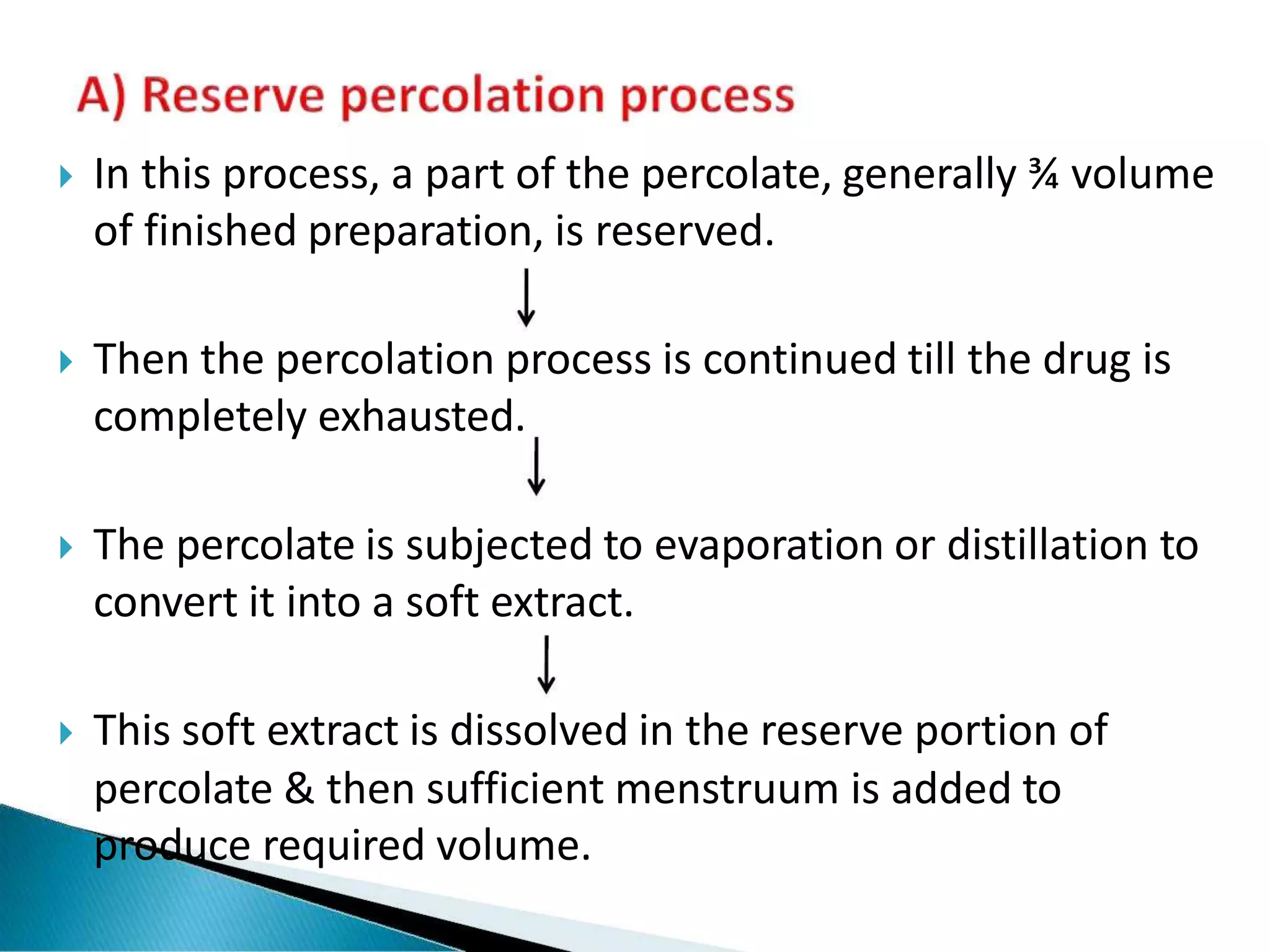
 In this process, a part of the percolate, generally ¾ volume
of finished preparation, is reserved.
 Then the percolation process is continued till the drug is
completely exhausted.
 The percolate is subjected to evaporation or distillation to
convert it into a soft extract.
 This soft extract is dissolved in the reserve portion of
percolate & then sufficient menstruum is added to
produce required volume.
 In percolation process for preparation of tincture, the
drug/percolate (d/p) ratio is about 1:4.
 Thed/p ratio is reduced to 1:3 by modifying
percolation process & hence there is lot of saving in
heat, time & menstruum.
 Percolation is a displacement process.
 Thestrong solution of activeconstituentsof drug
formed during maceration is displaced bya fresh
 Menstruum when percolation process is started.
 It is proved that stationary menstruum (menstruum
remaining in contact with drug ) dissolves more matter
than flowing menstruum.
 Hence ,more menstruum is required to exhaust the
drug when simple percolation process is used.
 But if continuous percolation stage has suitable breaks
by short maceration stages, thed/p ratio can be
reduced to 1:3.
 E.g. In simple percolation process:
Imbibition Maceration
(200 g) (for 4 hrs)
 Drug Percolation
(for 24 hrs) & Collect the percolate ,
i.e 3/4th of thevolume
of finished preparation.
In modified percolation process :
Drug Imbibition Maceration Percolation &
collect 1000 ml
percolate
(1000g) (for 4 hrs) (for 24 hrs)
 Maceration Percolation & collect 1000
(for 12 hrs)
Maceration
ml of percolate
Percolation & collect
1000ml of percolate



Drug : Percolate
1000 gm: 3000 ml
d/p = 1:3
 When activeconstituents of the drugs are not freely soluble in
the solvent or difficult to be displaced from the cells of the
drug, then it becomes necessary to extract thecrude by the
action of hot menstruum forconsiderable length of time.
 The fixed oils from seeds and alkaloids from thedrugs are
extracted by continuous hot percolation process using
benzene, chloroform, petroleum,etheretc.
 The apparatus used forcontinuous hot percolation process is
soxhlet apparatuswhich consist of three parts:
 A. Flask containing the boiling solvent .
 B. Soxhlet Extractor in which drug to be extracted is packed.
 It has side tube which carries vapours of the solvent from the
flask to the condenser and syphon tube which syphon over the
extract from soxhlet extractor to the flask .
 C. A condenser in which thevapours of the solvent are
condensed again into solvent.
 The drug to be extracted is packed in a papercylinder made
from a filterpaper & it is placed in the body of soxhlet
extractor.
 The solvent is placed in the flask and apparatus is then fitted.
 When solvent is boiled on heating the flask, itgets converted
intovapours.
 Thesevapours enter into condenser trough the side tube &
get condensed into hot liquid which falls on thecolumn of
the drug.
 When extractorgets filled with the solvent , the level of
syphon tube also raises up to its top.
 Thesolventcontaining API in the syphon tube syphon
over & run into the flask , thus emptying the body of
extractor.
 Thisaltering of filling and emptying the body of
extractorgoes on continuously.
 This process is repeated until drug is exhausted.
 The process is repeated about 15 times forcomplete exhaustion
of thedrug.
 Limitation of continuous Hot Percolation Process:
 Physical characterof thedrug :
 The physical characterof the drug is such that it would block
the soxhletapparatus in case it is used for its extraction by
this method
 E.g opium , gum, resin, orange peel etc
 Solvent : only pure solvent orconstant boiling mixturecan be
used for this process.
 Chemical constituent of thedrug: The process is unsuitable
fordrugs having thermolabileactiveconstituents such as
enzymes ,alkaloids, antraquinone derivatives etc.
 1.Character of drug
 2.Therapeutic value of the drug
 3.Cost of drug
 4.Stability of drug
 5.Solvent
 6.Concentration of product.
INTRODUCTION TO
AYURVEDIC DOSAGE FORMS
 Ayurvedic medicines are intended for
internal or external use, for the diagnosis ,
prevention, treatment of disease or
disorder in human beings or animals.
 Ayurvedic Drugs are obtained from the
natural source that is animal, plants and
minerals sources.
 Dosage form: It is a finished product of a
drug contain the active drug in
association with excipients.
Introduction;-
AYURVEDIC DOSAGE FORMS
 Ayurvedic Dosages forms are classified in to
four groups
- Solid Dosage Forms: Gutika, Vati.
- Semi-solid Dosage Forms: Avleha, Lepa,
Ghrita.
- Liquid Dosage Forms: Asava, Arista, Arak,
Taila, Netrabindu.
- Powder Dosage Forms: Bhasma, Satva, Churna,
Pisty, Anjan, Kshara.
Solid Dosage Forms
 Vati or Gutika :
Medicaments in the form of Tablets or pills are
known as vati or Gutika.
Lepa
The preparations in the form of paste meant for external
applications on the body are known as Lepa.

Semi-solid Dosage Forms
Avleha
 Avleha or Leha is a Semi-solid preparations of
drugs prepared by addition of sugar or sugar
candy and boiled with prescribed drug juice or
decoction
Ghrita
These are preparations in which ghee in boiled with
the prescribed quantity of the decoction and fine
paste of the drug as specified in the formula.
Asava and Arista
Asavas and Aristas are alcoholic preparations, prepared
either by soaking the powdered drugs or the decoction of
a drug, in a solution of jaggery along with a fermenter for
a specified period of time, during which it undergoes
fermentation to produce alcohol..
Arak
These are distilled essences or liquors made by soaking
drugs in water for 24-48 hours and distilling the same .
The distillate collected is called ‘Arak’ . Arak are just
like aromatic waters prepared by distillation. Arak is
used in fever, dyspepsia and as cooling lotion when it is
applied externally
Liquid dosage form
Taila (Oils)
Tailas are the preparations in which tailas (Fixed Oils)
is boiled with specified decoction and fine paste of
the drug as mentioned in the prescribed formula.
.
e.g.: Bhrangaraja Taila, Maha Narayan Taila.
Netrabindu : Netrabindu is made by dissolving the
specified drugs in water or honey and used as eye
drops.
Cont….

 Bhasma
The powdered form of the substances, obtained by
calcinations of metals, minerals or animal products by
a special process in closed crucibles in pits covered
with cow dung cake (Puta) is known as Bhasma.
e.g.: Loha Bhasma , Swaran Bhasma.
 Satva: Water extractable solid substances obtained
from drugs are known as Satva.
e.g.: Gulvel Satva.
 Churna
Churna is the type of ayurvedic medicines in which
single herb or a specific number of herbs are ground in
mortar pestle to make a fine powder..
Powder Dosage Forms
 Ksharas
Alkaline substances obtained from the ash of drugs are
known as Ksharas.
Drugs are cut in to small pieces and burnt to get ash. Ash
is dissolved in water, stained again evaporated to get rid
of water while salty solid obtained is known as Kshara.
e.g.: Yav Kshara, Palsa Kshara.
Anjan : Anjans are very fine powders of medicaments
to be used in eyes for their local effect .

Cont….
 Pisty ;It is prepared by mixing various stones with the
rose arak or kavera arak till it is converted into a fine
powder.
Extraction & galenicals

Extraction & galenicals

  • 1.
    EXTRACTION & GALENICALS PRESENTED BY –CHANDAN KUMAR SAHOO ROLL NO- 10 D.PHARM 1st YEAR AUROSRI INSTITUTE OF PHARMACEUTICAL EDUCATION & RESEARCH (AIPER) KADEI ,TANGI , CUTTACK
  • 2.
     Extraction : It is defined as the separation of medicinally active constituents of the plant or animal tissues from the inactive components by using selective solvents .  Thesolvent used forextraction is known as “menstruum.”  And the inert insoluble material that remains after extraction iscalled as “marc”.  The product which produced by extraction process is called as “Galenical’’ .
  • 4.
     1. Infusion 2. Decoction  3. Maceration  4.Percolation  5.Digestion
  • 5.
     1. Water:  Water is a solvent for protein , colouring matter, gums, glycosides, sugars, alkaloidal salts, enzymes, many organic acids and mostof the organic salts.  Waxes ,fats ,fixed oils and mostalkaloids are insoluble in water.
  • 6.
     It ischeap.  It has a wide solvent action.  It is non-toxic.  It is non-inflammable.  Disadvantages:  It has a wide solvent action.  Water helps in growth of mould and bacteria . Hence , some preservative is needed during extraction of crude drugs.  Watercauses hydrolysis of many substances.
  • 7.
     Largeamount ofheat is required to concentrate the aqueous preparation than non-aqueous preparation.  2. Alcohol :  Alcohol is solvent foralkaloids , glycosides, volatile oils and resins.  Alcohol does not dissolvealbuminous matter ,gums, waxes, fats, fixed oils and sugar.
  • 8.
     The mouldand bacteria cannot grow in a solution in which alcohol concentration is 20% or more.  A small amount of heat is required toconcentrate the alcoholic preparation.  It is non-toxic in the concentration mostly present in the preparations.  Disadvantages :  The preparation becomes costly when alcohol is used as solvent forextraction of API.
  • 9.
     Various typesof maceration process:  1. A process for tincture made from organised drug e.g. roots,stem,leavesetc. This process is called ‘Simple Maceration’.  2.A process for tincture made from unorganised drugs such as oleo resins and gum resins. This process is known as ‘Maceration with Adjustment’.  3. Process forconcentrated preparations which includes both ‘Double maceration’ and ‘Triple maceration’.
  • 10.
     Apparatus:  Awide mouth bottleorany othercontainerwhich can be well stoppered is used for maceration process.  A closed container is essential to prevent the evaporation of menstruum which is mostlyconcentrated alcohol.  No adjustment in volume is made.
  • 11.
     Crude drugis placed with the whole of the menstruum in a Stoppered container for 3 -7 days.  During this period shaking isdoneoccasionally.  Aftersevendays ,the liquid is strained and marc is pressed.  Theexpressed liquid is mixed with strained liquid .  It is then filtered to makea clear liquid.  The final volume is notadjusted.
  • 12.
     1.Tincture ofOrange .  2.Tinctureof Lemon.  3.Tinctureof Squill.  2. Maceration process for Unorganised Drugs or Maceration with Adjustment.  Method :  Unorganised drug is placed with 4/5th of the menstruum in a closed vessel for period of 2-7 days.  Shaking isdone occasionally.  After stated period ,liquid is filtered and final volume is made up by passing remaining 1/5th of mentruum. The marc is not pressed.
  • 13.
     1. Tinctureof tolu  2. compound tincture of benzoin  3. Maceration process for Concentrated Preparation or Multiple Maceration process.  Maceration process is carried out in the same way as simple maceration process ,  but the menstruum used is divided into two parts in double maceration process and into three parts in triple maceration process.
  • 14.
     Drug ismacerated twice by using the menstruum which is divided into parts in such a manner that the samevolume is used foreach maceration.  Thequantity of menstruum required for two macerations are calculated as :  1) Volumeof menstruum required for first maceration=  Total vol.of menstruum – Vol.to be retained Vol. to  by drug + be retained by drug  2  II) Vol.of menstruum required for second maceration= total vol.of menstruum – vol. of menstruum used in first maceration.
  • 15.
     In doublemaceration process, the whole of thedrug is macerated for 48 hrs with qtyof menstruum required for first maceration .  Strain the liquid and press the marc.  Macerated again for 24 hrs with remaining menstruum required forsecond maceration.  Strain the liquid and press the marc.  Mix the liquid obtained from two macerations and allow it to stand for 14 days and then filter.  Example –  1. concentrated infusion of orange  2. concentrated compound infusion of chirata  3. concentrated compound infusion of gelatin.
  • 16.
    In this macerationprocess, the drug is macerated thrice by using the menstruum which is divided into three parts in such a manner that the samevolume is used forsuch each maceration. Thequantity of menstruum required for three maceration is calculated as follows: I)Vol. of menstruum required for first maceration= Total vol.of - vol. to beretained menstruum by thedrug 3 + vol. to beretained bydrug
  • 17.
     II) vol.of menstruum required for 2nd &3rd maceration=  Total vol. of menstruum- Vol. of menstruum used in 1st maceration 2 Thewholeof the drug is macerated forone hour with a part of menstruum required for first maceration and strained. Macerate again for one hour with part of menstruum required for second maceration and strained. Macerate again for one hour with part of menstruum required for third maceration & strained.
  • 18.
     Press themarc lightly.  Then combine the liquid obtained from second &third maceration &evaporate it to specified extend.  Mix itwith liquid obtained from first maceration .  Add alcohol 90% equal to 1/4th of thevolumeof the finished product .  Adjustvolumewith water.  Allow it to stand for 14 days and filter.
  • 19.
     1.Concentrated infusionof Quassia.  2.Liquid Extract of Senna.  Percolation Processes :  The various percolation processes used for the extraction of drugs:  1. Simple percolation or petroleum process for tinctures.  2. Percolation processes for concentrated preparation such as:  A)Reserve percolation process  B) Modified percolation process  3. Continuous hot percolation or soxhelation.
  • 20.
     Apparatus:  Threetypes of percolators are used.  1. Conical Percolators:  The percolator is made of glass orof metal, usually copper ,which is tinned inside.  It is conical in shape having lowerdiameter not less than half of upperdiameter.  Thereare less chances of choking percolator in case the drug swells up, becausea drug can slopeagainst the wall of the percolator.
  • 21.
     The percolatoris cylindrical in shape i.e. Upperand lowerdiameters are same.  When a higherconcentration of alcohol orany other volatile solvent is used as menstruum a cylindrical percolator is preferred.  3. Steam jacketed percolator:  When percolation is carried a higher temperature ,in order to increase the solvent action of the menstruum, the percolator is heated by steam.
  • 22.
     Simple percolationprocess is used forthe preparation of tincture.  There are three stages in the official method for the preparation of tincture :  A) Imbibition  B) Maceration  C)Percolation  A) Imbibition :  The powdered drug is moistened with sufficientquantity of menstruum and allowed to stand for 4 hrs in closed vessel.  Pack the moistened drug into percolators & add sufficient
  • 23.
     Quantityof menstruumto saturate the material.  When liquid starts coming out from outlet of percolators, the outlet isclosed.  Then the sufficientquantityof menstruum is added in order to leavea layerabove the drug.  B) Maceration :  The moistened drug is left in contact with menstruum for 24 hrs.  During this period ,the menstruum dissolves theactive constituents of the drug and becomes almost saturated with it.
  • 24.
     It consistof downward displacement of saturated solution formed in maceration and extraction of the remaining active constituents present in the drug by slow passage of the menstruum through the column of the drug .  Aftercollecting ¾ of the required volume of the finished product orwhen drug is completely exhausted, the marc is pressed.  Mix the expressed liquid with percolate.  Add sufficientquantityof menstruum to produce required volume and then filter.
  • 25.
    Packing of thepercolator
  • 26.
     During theperiod of 24 hours of maceration, the menstruum penetrates into the tissues of the drug and dissolves the active constituents.  A short maceration before percolation enables theextraction of activeconstituents of thedrug with considerably less quantityof the menstruum.  After 24 hours of the maceration, open theoutlet of the percolator And collect the percolatewhich measures about ¾ of thevolume required for the finished product.
  • 27.
     The exhaustionof drug may be tested by doing the specified chemical test depending on the constituents present in the drug or absence of colour in percolator.  After exhaustion of the drug or after collecting the required quantity of the percolator, the marc is taken out from percolator. It is pressed to recover costly solvent.  Theexpressed liquid is mixed with percolateand then final volume is made by adding more of menstruum.
  • 28.
     The preparationis filtered in order to free it from cell debris orother material which interferewith clarity of the preparation.  Example -  1.Tincture of belladonna.  2.Compound tincture of cardamom  3.Strong tincture of ginger
  • 29.
     Percolation processesforconcentrated preparation are used for preparing liquid extracts and solid extracts.  Thevarious processes used for the preparing concentrated preparations are:  A)Reserve percolation process  B)Modified percolation process
  • 30.
     In thisprocess, a part of the percolate, generally ¾ volume of finished preparation, is reserved.  Then the percolation process is continued till the drug is completely exhausted.  The percolate is subjected to evaporation or distillation to convert it into a soft extract.  This soft extract is dissolved in the reserve portion of percolate & then sufficient menstruum is added to produce required volume.
  • 31.
     In percolationprocess for preparation of tincture, the drug/percolate (d/p) ratio is about 1:4.  Thed/p ratio is reduced to 1:3 by modifying percolation process & hence there is lot of saving in heat, time & menstruum.  Percolation is a displacement process.  Thestrong solution of activeconstituentsof drug formed during maceration is displaced bya fresh
  • 32.
     Menstruum whenpercolation process is started.  It is proved that stationary menstruum (menstruum remaining in contact with drug ) dissolves more matter than flowing menstruum.  Hence ,more menstruum is required to exhaust the drug when simple percolation process is used.  But if continuous percolation stage has suitable breaks by short maceration stages, thed/p ratio can be reduced to 1:3.
  • 33.
     E.g. Insimple percolation process: Imbibition Maceration (200 g) (for 4 hrs)  Drug Percolation (for 24 hrs) & Collect the percolate , i.e 3/4th of thevolume of finished preparation. In modified percolation process : Drug Imbibition Maceration Percolation & collect 1000 ml percolate (1000g) (for 4 hrs) (for 24 hrs)
  • 34.
     Maceration Percolation& collect 1000 (for 12 hrs) Maceration ml of percolate Percolation & collect 1000ml of percolate    Drug : Percolate 1000 gm: 3000 ml d/p = 1:3
  • 35.
     When activeconstituentsof the drugs are not freely soluble in the solvent or difficult to be displaced from the cells of the drug, then it becomes necessary to extract thecrude by the action of hot menstruum forconsiderable length of time.  The fixed oils from seeds and alkaloids from thedrugs are extracted by continuous hot percolation process using benzene, chloroform, petroleum,etheretc.
  • 36.
     The apparatusused forcontinuous hot percolation process is soxhlet apparatuswhich consist of three parts:  A. Flask containing the boiling solvent .  B. Soxhlet Extractor in which drug to be extracted is packed.  It has side tube which carries vapours of the solvent from the flask to the condenser and syphon tube which syphon over the extract from soxhlet extractor to the flask .  C. A condenser in which thevapours of the solvent are condensed again into solvent.
  • 38.
     The drugto be extracted is packed in a papercylinder made from a filterpaper & it is placed in the body of soxhlet extractor.  The solvent is placed in the flask and apparatus is then fitted.  When solvent is boiled on heating the flask, itgets converted intovapours.  Thesevapours enter into condenser trough the side tube & get condensed into hot liquid which falls on thecolumn of the drug.
  • 39.
     When extractorgetsfilled with the solvent , the level of syphon tube also raises up to its top.  Thesolventcontaining API in the syphon tube syphon over & run into the flask , thus emptying the body of extractor.  Thisaltering of filling and emptying the body of extractorgoes on continuously.  This process is repeated until drug is exhausted.
  • 40.
     The processis repeated about 15 times forcomplete exhaustion of thedrug.  Limitation of continuous Hot Percolation Process:  Physical characterof thedrug :  The physical characterof the drug is such that it would block the soxhletapparatus in case it is used for its extraction by this method  E.g opium , gum, resin, orange peel etc  Solvent : only pure solvent orconstant boiling mixturecan be used for this process.  Chemical constituent of thedrug: The process is unsuitable fordrugs having thermolabileactiveconstituents such as enzymes ,alkaloids, antraquinone derivatives etc.
  • 41.
     1.Character ofdrug  2.Therapeutic value of the drug  3.Cost of drug  4.Stability of drug  5.Solvent  6.Concentration of product.
  • 42.
    INTRODUCTION TO AYURVEDIC DOSAGEFORMS  Ayurvedic medicines are intended for internal or external use, for the diagnosis , prevention, treatment of disease or disorder in human beings or animals.  Ayurvedic Drugs are obtained from the natural source that is animal, plants and minerals sources.  Dosage form: It is a finished product of a drug contain the active drug in association with excipients. Introduction;-
  • 43.
    AYURVEDIC DOSAGE FORMS Ayurvedic Dosages forms are classified in to four groups - Solid Dosage Forms: Gutika, Vati. - Semi-solid Dosage Forms: Avleha, Lepa, Ghrita. - Liquid Dosage Forms: Asava, Arista, Arak, Taila, Netrabindu. - Powder Dosage Forms: Bhasma, Satva, Churna, Pisty, Anjan, Kshara.
  • 44.
    Solid Dosage Forms Vati or Gutika : Medicaments in the form of Tablets or pills are known as vati or Gutika.
  • 45.
    Lepa The preparations inthe form of paste meant for external applications on the body are known as Lepa.  Semi-solid Dosage Forms Avleha  Avleha or Leha is a Semi-solid preparations of drugs prepared by addition of sugar or sugar candy and boiled with prescribed drug juice or decoction Ghrita These are preparations in which ghee in boiled with the prescribed quantity of the decoction and fine paste of the drug as specified in the formula.
  • 46.
    Asava and Arista Asavasand Aristas are alcoholic preparations, prepared either by soaking the powdered drugs or the decoction of a drug, in a solution of jaggery along with a fermenter for a specified period of time, during which it undergoes fermentation to produce alcohol.. Arak These are distilled essences or liquors made by soaking drugs in water for 24-48 hours and distilling the same . The distillate collected is called ‘Arak’ . Arak are just like aromatic waters prepared by distillation. Arak is used in fever, dyspepsia and as cooling lotion when it is applied externally Liquid dosage form
  • 47.
    Taila (Oils) Tailas arethe preparations in which tailas (Fixed Oils) is boiled with specified decoction and fine paste of the drug as mentioned in the prescribed formula. . e.g.: Bhrangaraja Taila, Maha Narayan Taila. Netrabindu : Netrabindu is made by dissolving the specified drugs in water or honey and used as eye drops. Cont…. 
  • 48.
     Bhasma The powderedform of the substances, obtained by calcinations of metals, minerals or animal products by a special process in closed crucibles in pits covered with cow dung cake (Puta) is known as Bhasma. e.g.: Loha Bhasma , Swaran Bhasma.  Satva: Water extractable solid substances obtained from drugs are known as Satva. e.g.: Gulvel Satva.  Churna Churna is the type of ayurvedic medicines in which single herb or a specific number of herbs are ground in mortar pestle to make a fine powder.. Powder Dosage Forms
  • 49.
     Ksharas Alkaline substancesobtained from the ash of drugs are known as Ksharas. Drugs are cut in to small pieces and burnt to get ash. Ash is dissolved in water, stained again evaporated to get rid of water while salty solid obtained is known as Kshara. e.g.: Yav Kshara, Palsa Kshara. Anjan : Anjans are very fine powders of medicaments to be used in eyes for their local effect .  Cont….  Pisty ;It is prepared by mixing various stones with the rose arak or kavera arak till it is converted into a fine powder.