Galanicals
Swati G. Patil
M. Pharm (Pharmaceutics)
K.Y.D.S.C.Ts College of Pharmacy ,
Sakegaon.
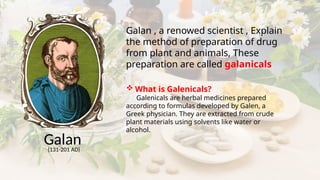
Galan
(131-201 AD)
Galan , a renowed scientist , Explain
the method of preparation of drug
from plant and animals, These
preparation are called galanicals
 What is Galenicals?
Galenicals are herbal medicines prepared
according to formulas developed by Galen, a
Greek physician. They are extracted from crude
plant materials using solvents like water or
alcohol.
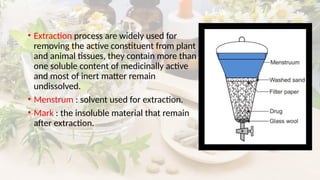
• Extraction process are widely used for
removing the active constituent from plant
and animal tissues, they contain more than
one soluble content of medicinally active
and most of inert matter remain
undissolved.
• Menstrum : solvent used for extraction.
• Mark : the insoluble material that remain
after extraction.
EXTRACT:
Extracts can be defined as preparations of crude drugs which contain all the
constituents which are soluble in the solvent.
TYPES OF EXTRACTS:
1)Dry extract (Tab, cap.) Ex: belladonna extract
2)Soft (Ointment, suppository) Ex: glycerrhiza extract.
3)Liquid: As tincture.
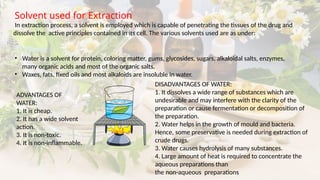
Solvent used for Extraction
In extraction process, a solvent is employed which is capable of penetrating the tissues of the drug and
dissolve the active principles contained in its cell. The various solvents used are as under:
1)Water :
• Water is a solvent for protein, coloring matter, gums, glycosides, sugars, alkaloidal salts, enzymes,
many organic acids and most of the organic salts.
• Waxes, fats, fixed oils and most alkaloids are insoluble in water.
ADVANTAGES OF
WATER:
1. It is cheap.
2. It has a wide solvent
action.
3. It is non-toxic.
4. It is non-inflammable.
DISADVANTAGES OF WATER:
1. It dissolves a wide range of substances which are
undesirable and may interfere with the clarity of the
preparation or cause fermentation or decomposition of
the preparation.
2. Water helps in the growth of mould and bacteria.
Hence, some preservative is needed during extraction of
crude drugs.
3. Water causes hydrolysis of many substances.
4. Large amount of heat is required to concentrate the
aqueous preparations than
the non-aqueous preparations
Alcohol is a solvent of alkaloids, alkaloidal salts, glycosides, volatile oils and resins.
Alcohol also dissolves many forms of coloring matter, tannins, many organic acids
and salts. Alcohol does not dissolve albuminous matter, gums, waxes, fats, fixed
and sugar.
ADVANTAGES OF ALCOHOL AS A SOLVENT:
1. The mould and bacteria cannot grow in a solution in which alcohol
concentration is 20% or more.
2. It is neutral and hence extraction products obtained from it arc compatible
with other products.
3. It is non-toxic in the concentration mostly present in the preparations.
4. A small amount of heat is required to concentrate the alcoholic preparation
5. It dissolves selective active constituents of drugs.
2) Alcohol
DISADVANTAGES OF ALCOHOL AS A SOLVENT:
1. The preparation becomes costly when alcohol is used as solvent for extraction of active constituents of the drug.
2. Solvents such as solvent ether, chloroform, light petroleum, certain acids are used rarely for extraction of active
constituents from crude drugs.
FACTORS AFFECTING
EXTRACTION PROCESS:
1. Nature
2. Solvent
3. Temperature
4. pH
5. Particle size METHODS OF EXTRACTION:
1. Infusion
2. Decoction
3. Digestion
4. Maceration
5. Percolation
6. Continues hot extraction
7. Supercritical fluid extraction
8. Counter current extraction
9. Microwave assisted extraction
10.Ultrasonication-Assisted Extraction
• It consists of pouring water over the drugs and then allowing it to keep in contact
with water for the stated period, usually 15 minutes, with occasional stirring and
finally filtering off the liquid.
• The marc is not pressed.
• The boiling water is commonly used as a solvent, since it has a greater solvent
action than cold water.
INFUSION
TYPES OF INFUSION
1. Fresh Infusion. Ex:
Infusion of orange.
2. Concentrated
Infusion. Ex: Conc.
infusion of Quassia.
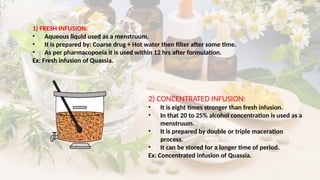
 For the preparation of infusions
the coffee pots or tea pots or special infusion pots are
used.
1. In that, firstly drug is placed in bottom of the pot.
2. Then add hot water & stirred three or four times
during the period of infusion.
3. Infusion also prepared in muslin cloth. In that drug is
placed in muslin cloth & enclose & then suspending
it just below the level of the water in a beaker.
1) FRESH INFUSION:
• Aqueous liquid used as a menstruum.
• It is prepared by: Coarse drug + Hot water then filter after some time.
• As per pharmacopoeia it is used within 12 hrs after formulation.
Ex: Fresh infusion of Quassia.
2) CONCENTRATED INFUSION:
• It is eight times stronger than fresh infusion.
• In that 20 to 25% alcohol concentration is used as a
menstruum.
• It is prepared by double or triple maceration
process.
• It can be stored for a longer time of period.
Ex: Concentrated infusion of Quassia.
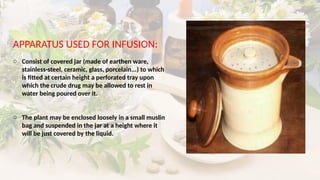
APPARATUS USED FOR INFUSION:
o Consist of covered jar (made of earthen ware,
stainless-steel, ceramic, glass, porcelain...) to which
is fitted at certain height a perforated tray upon
which the crude drug may be allowed to rest in
water being poured over it.
o The plant may be enclosed loosely in a small muslin
bag and suspended in the jar at a height where it
will be just covered by the liquid.
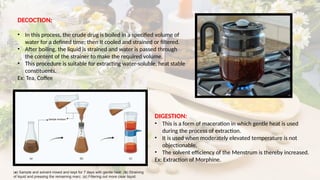
DECOCTION:
• In this process, the crude drug is boiled in a specified volume of
water for a defined time; then It cooled and strained or filtered.
• After boiling, the liquid is strained and water is passed through
the content of the strainer to make the required volume.
• This procedure is suitable for extracting water-soluble, heat stable
constituents.
Ex: Tea, Coffee
DIGESTION:
• This is a form of maceration in which gentle heat is used
during the process of extraction.
• It is used when moderately elevated temperature is not
objectionable.
• The solvent efficiency of the Menstrum is thereby increased.
Ex: Extraction of Morphine.
(a) Sample and solvent mixed and kept for 7 days with gentle heat. (b) Straining
of liquid and pressing the remaining marc. (c) Filtering out more clear liquid.
MACERATION:
• In this process solid ingredients are placed
in a stoppered container with the whole of
the solvent and allowed to stand for a
period of at least 3 days (3 - 7 days) with
frequent agitation, until soluble matter is
dissolved.
• The mixture is then strained (through sieves
/ nets), the marc is pressed and the
combined liquids clarified (cleaned by
filtration) or by decantation, after standing.
PROCESS OF MACERATION:
Plant Material (Crushed or cut small or
moderately coarse powder)
↓
Placed in a closed vessels
↓
Whole of the selected solvent
(Menstruum) added
↓
Allowed to stand for 3-7 days shaking
occasionally
↓
Liquid strained off
↓
Solid residue (marc) pressed (Recover as
much as occluded solution)
↓
Strained and expressed liquids mixed
↓
Clarified by subsidence or filtration
↓
Evaporation and Concentration
TYPES OF MACERATION:
1. Simple maceration: for organized and unorganized
Crude drug.
2. Ex: Tincture of Orange ,Tincture of Lemon.
3. Double maceration: Concentrated infusion of orange.
4. Triple maceration: The maceration process may
be carried out with help of heat or stirring.
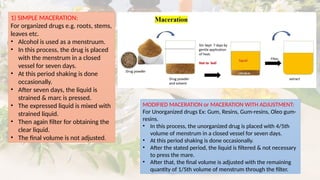
1) SIMPLE MACERATION:
For organized drugs e.g. roots, stems,
leaves etc.
• Alcohol is used as a menstruum.
• In this process, the drug is placed
with the menstrum in a closed
vessel for seven days.
• At this period shaking is done
occasionally.
• After seven days, the liquid is
strained & marc is pressed.
• The expressed liquid is mixed with
strained liquid.
• Then again filter for obtaining the
clear liquid.
• The final volume is not adjusted.
MODIFIED MACERATION or MACERATION WITH ADJUSTMENT:
For Unorganized drugs Ex: Gum, Resins, Gum-resins, Oleo gum-
resins.
• In this process, the unorganized drug is placed with 4/5th
volume of menstrum in a closed vessel for seven days.
• At this period shaking is done occasionally.
• After the stated period, the liquid is filtered & not necessary
to press the mare.
• After that, the final volume is adjusted with the remaining
quantity of 1/5th volume of menstrum through the filter.
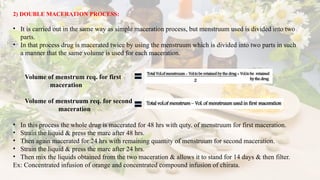
2) DOUBLE MACERATION PROCESS:
• It is carried out in the same way as simple maceration process, but menstruum used is divided into two
parts.
• In that process drug is macerated twice by using the menstruum which is divided into two parts in such
a manner that the same volume is used for each maceration.
Volume of menstrum req. for first
maceration
Volume of menstruum req. for second
maceration
• In this process the whole drug is macerated for 48 hrs with quty. of menstruum for first maceration.
• Strain the liquid & press the marc after 48 hrs.
• Then again macerated for 24 hrs with remaining quantity of menstruum for second maceration.
• Strain the liquid & press the marc after 24 hrs.
• Then mix the liquids obtained from the two maceration & allows it to stand for 14 days & then filter.
Ex: Concentrated infusion of orange and concentrated compound infusion of chirata.
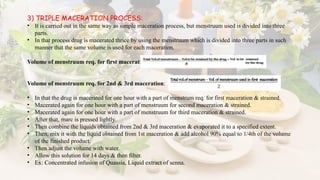
3) TRIPLE MACERATION PROCESS:
• It is carried out in the same way as simple maceration process, but menstruum used is divided into three
parts.
• In that process drug is macerated thrice by using the menstruum which is divided into three parts in such
manner that the same volume is used for each maceration.
Volume of menstruum req. for first maceration:
Volume of menstruum req. for 2nd & 3rd maceration:
• In that the drug is macerated for one hour with a part of menstrum req. for first maceration & strained.
• Macerated again for one hour with a part of menstruum for second maceration & strained.
• Macerated again for one hour with a part of menstruum for third maceration & strained.
• After that, marc is pressed lightly.
• Then combine the liquids obtained from 2nd & 3rd maceration & evaporated it to a specified extent.
• Then, mix it with the liquid obtained from 1st maceration & add alcohol 90% equal to 1/4th of the volume
of the finished product.
• Then adjust the volume with water.
• Allow this solution for 14 days & then filter.
• Ex: Concentrated infusion of Quassia, Liquid extract of senna.
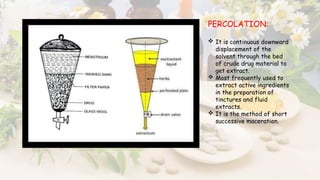
PERCOLATION:
 It is continuous downward
displacement of the
solvent through the bed
of crude drug material to
get extract.
 Most frequently used to
extract active ingredients
in the preparation of
tinctures and fluid
extracts.
 It is the method of short
successive maceration.
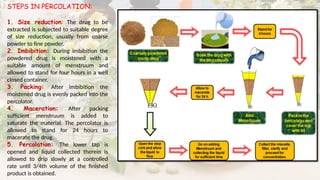
STEPS IN PERCOLATION:
1. Size reduction: The drug to be
extracted is subjected to suitable degree
of size reduction, usually from coarse
powder to fine powder.
2. Imbibition: During imbibition the
powdered drug is moistened with a
suitable amount of menstruum and
allowed to stand for four hours in a well
closed container.
3. Packing: After imbibition the
moistened drug is evenly packed into the
percolator.
4. Maceration: After packing
sufficient menstruum is added to
saturate the material. The percolator is
allowed to stand for 24 hours to
macerate the drug.
5. Percolation: The lower tap is
opened and liquid collected therein is
allowed to drip slowly at a controlled
rate until 3/4th volume of the finished
product is obtained.
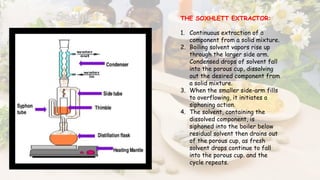
THE SOXHLETT EXTRACTOR:
1. Continuous extraction of a
component from a solid mixture.
2. Boiling solvent vapors rise up
through the larger side arm.
Condensed drops of solvent fall
into the porous cup, dissolving
out the desired component from
a solid mixture.
3. When the smaller side-arm fills
to overflowing, it initiates a
siphoning action.
4. The solvent, containing the
dissolved component, is
siphoned into the boiler below
residual solvent then drains out
of the porous cup, as fresh
solvent drops continue to fall
into the porous cup. and the
cycle repeats.
Soxhlet
MERITS:
1. Soxhlet extraction allows for efficient separation
of compounds due to the continuous cycling of
fresh solvent over the sample.
2. Large amount of drug can be extracted with much
smaller quantity of solvent.
3. Small scale & used a batch-process.
4. Becomes more economical when converted into
continuous extraction.
5. Once set up, it requires minimal monitoring, making
it convenient for long extraction periods.
DEMERITS:
1. Physical nature of drug.
2. It's a relatively slow process
3. Requires significant amounts of solvent
4. can degrade heat-sensitive compounds.
Galanicals                         .pptx

Galanicals .pptx

  • 1.
    Galanicals Swati G. Patil M.Pharm (Pharmaceutics) K.Y.D.S.C.Ts College of Pharmacy , Sakegaon.
  • 2.
    Galan (131-201 AD) Galan ,a renowed scientist , Explain the method of preparation of drug from plant and animals, These preparation are called galanicals  What is Galenicals? Galenicals are herbal medicines prepared according to formulas developed by Galen, a Greek physician. They are extracted from crude plant materials using solvents like water or alcohol.
  • 3.
    • Extraction processare widely used for removing the active constituent from plant and animal tissues, they contain more than one soluble content of medicinally active and most of inert matter remain undissolved. • Menstrum : solvent used for extraction. • Mark : the insoluble material that remain after extraction.
  • 4.
    EXTRACT: Extracts can bedefined as preparations of crude drugs which contain all the constituents which are soluble in the solvent. TYPES OF EXTRACTS: 1)Dry extract (Tab, cap.) Ex: belladonna extract 2)Soft (Ointment, suppository) Ex: glycerrhiza extract. 3)Liquid: As tincture.
  • 5.
    Solvent used forExtraction In extraction process, a solvent is employed which is capable of penetrating the tissues of the drug and dissolve the active principles contained in its cell. The various solvents used are as under: 1)Water : • Water is a solvent for protein, coloring matter, gums, glycosides, sugars, alkaloidal salts, enzymes, many organic acids and most of the organic salts. • Waxes, fats, fixed oils and most alkaloids are insoluble in water. ADVANTAGES OF WATER: 1. It is cheap. 2. It has a wide solvent action. 3. It is non-toxic. 4. It is non-inflammable. DISADVANTAGES OF WATER: 1. It dissolves a wide range of substances which are undesirable and may interfere with the clarity of the preparation or cause fermentation or decomposition of the preparation. 2. Water helps in the growth of mould and bacteria. Hence, some preservative is needed during extraction of crude drugs. 3. Water causes hydrolysis of many substances. 4. Large amount of heat is required to concentrate the aqueous preparations than the non-aqueous preparations
  • 6.
    Alcohol is asolvent of alkaloids, alkaloidal salts, glycosides, volatile oils and resins. Alcohol also dissolves many forms of coloring matter, tannins, many organic acids and salts. Alcohol does not dissolve albuminous matter, gums, waxes, fats, fixed and sugar. ADVANTAGES OF ALCOHOL AS A SOLVENT: 1. The mould and bacteria cannot grow in a solution in which alcohol concentration is 20% or more. 2. It is neutral and hence extraction products obtained from it arc compatible with other products. 3. It is non-toxic in the concentration mostly present in the preparations. 4. A small amount of heat is required to concentrate the alcoholic preparation 5. It dissolves selective active constituents of drugs. 2) Alcohol DISADVANTAGES OF ALCOHOL AS A SOLVENT: 1. The preparation becomes costly when alcohol is used as solvent for extraction of active constituents of the drug. 2. Solvents such as solvent ether, chloroform, light petroleum, certain acids are used rarely for extraction of active constituents from crude drugs.
  • 7.
    FACTORS AFFECTING EXTRACTION PROCESS: 1.Nature 2. Solvent 3. Temperature 4. pH 5. Particle size METHODS OF EXTRACTION: 1. Infusion 2. Decoction 3. Digestion 4. Maceration 5. Percolation 6. Continues hot extraction 7. Supercritical fluid extraction 8. Counter current extraction 9. Microwave assisted extraction 10.Ultrasonication-Assisted Extraction
  • 8.
    • It consistsof pouring water over the drugs and then allowing it to keep in contact with water for the stated period, usually 15 minutes, with occasional stirring and finally filtering off the liquid. • The marc is not pressed. • The boiling water is commonly used as a solvent, since it has a greater solvent action than cold water. INFUSION TYPES OF INFUSION 1. Fresh Infusion. Ex: Infusion of orange. 2. Concentrated Infusion. Ex: Conc. infusion of Quassia.  For the preparation of infusions the coffee pots or tea pots or special infusion pots are used. 1. In that, firstly drug is placed in bottom of the pot. 2. Then add hot water & stirred three or four times during the period of infusion. 3. Infusion also prepared in muslin cloth. In that drug is placed in muslin cloth & enclose & then suspending it just below the level of the water in a beaker.
  • 9.
    1) FRESH INFUSION: •Aqueous liquid used as a menstruum. • It is prepared by: Coarse drug + Hot water then filter after some time. • As per pharmacopoeia it is used within 12 hrs after formulation. Ex: Fresh infusion of Quassia. 2) CONCENTRATED INFUSION: • It is eight times stronger than fresh infusion. • In that 20 to 25% alcohol concentration is used as a menstruum. • It is prepared by double or triple maceration process. • It can be stored for a longer time of period. Ex: Concentrated infusion of Quassia.
  • 10.
    APPARATUS USED FORINFUSION: o Consist of covered jar (made of earthen ware, stainless-steel, ceramic, glass, porcelain...) to which is fitted at certain height a perforated tray upon which the crude drug may be allowed to rest in water being poured over it. o The plant may be enclosed loosely in a small muslin bag and suspended in the jar at a height where it will be just covered by the liquid.
  • 11.
    DECOCTION: • In thisprocess, the crude drug is boiled in a specified volume of water for a defined time; then It cooled and strained or filtered. • After boiling, the liquid is strained and water is passed through the content of the strainer to make the required volume. • This procedure is suitable for extracting water-soluble, heat stable constituents. Ex: Tea, Coffee DIGESTION: • This is a form of maceration in which gentle heat is used during the process of extraction. • It is used when moderately elevated temperature is not objectionable. • The solvent efficiency of the Menstrum is thereby increased. Ex: Extraction of Morphine. (a) Sample and solvent mixed and kept for 7 days with gentle heat. (b) Straining of liquid and pressing the remaining marc. (c) Filtering out more clear liquid.
  • 12.
    MACERATION: • In thisprocess solid ingredients are placed in a stoppered container with the whole of the solvent and allowed to stand for a period of at least 3 days (3 - 7 days) with frequent agitation, until soluble matter is dissolved. • The mixture is then strained (through sieves / nets), the marc is pressed and the combined liquids clarified (cleaned by filtration) or by decantation, after standing. PROCESS OF MACERATION: Plant Material (Crushed or cut small or moderately coarse powder) ↓ Placed in a closed vessels ↓ Whole of the selected solvent (Menstruum) added ↓ Allowed to stand for 3-7 days shaking occasionally ↓ Liquid strained off ↓ Solid residue (marc) pressed (Recover as much as occluded solution) ↓ Strained and expressed liquids mixed ↓ Clarified by subsidence or filtration ↓ Evaporation and Concentration
  • 13.
    TYPES OF MACERATION: 1.Simple maceration: for organized and unorganized Crude drug. 2. Ex: Tincture of Orange ,Tincture of Lemon. 3. Double maceration: Concentrated infusion of orange. 4. Triple maceration: The maceration process may be carried out with help of heat or stirring.
  • 14.
    1) SIMPLE MACERATION: Fororganized drugs e.g. roots, stems, leaves etc. • Alcohol is used as a menstruum. • In this process, the drug is placed with the menstrum in a closed vessel for seven days. • At this period shaking is done occasionally. • After seven days, the liquid is strained & marc is pressed. • The expressed liquid is mixed with strained liquid. • Then again filter for obtaining the clear liquid. • The final volume is not adjusted. MODIFIED MACERATION or MACERATION WITH ADJUSTMENT: For Unorganized drugs Ex: Gum, Resins, Gum-resins, Oleo gum- resins. • In this process, the unorganized drug is placed with 4/5th volume of menstrum in a closed vessel for seven days. • At this period shaking is done occasionally. • After the stated period, the liquid is filtered & not necessary to press the mare. • After that, the final volume is adjusted with the remaining quantity of 1/5th volume of menstrum through the filter.
  • 15.
    2) DOUBLE MACERATIONPROCESS: • It is carried out in the same way as simple maceration process, but menstruum used is divided into two parts. • In that process drug is macerated twice by using the menstruum which is divided into two parts in such a manner that the same volume is used for each maceration. Volume of menstrum req. for first maceration Volume of menstruum req. for second maceration • In this process the whole drug is macerated for 48 hrs with quty. of menstruum for first maceration. • Strain the liquid & press the marc after 48 hrs. • Then again macerated for 24 hrs with remaining quantity of menstruum for second maceration. • Strain the liquid & press the marc after 24 hrs. • Then mix the liquids obtained from the two maceration & allows it to stand for 14 days & then filter. Ex: Concentrated infusion of orange and concentrated compound infusion of chirata.
  • 16.
    3) TRIPLE MACERATIONPROCESS: • It is carried out in the same way as simple maceration process, but menstruum used is divided into three parts. • In that process drug is macerated thrice by using the menstruum which is divided into three parts in such manner that the same volume is used for each maceration. Volume of menstruum req. for first maceration: Volume of menstruum req. for 2nd & 3rd maceration: • In that the drug is macerated for one hour with a part of menstrum req. for first maceration & strained. • Macerated again for one hour with a part of menstruum for second maceration & strained. • Macerated again for one hour with a part of menstruum for third maceration & strained. • After that, marc is pressed lightly. • Then combine the liquids obtained from 2nd & 3rd maceration & evaporated it to a specified extent. • Then, mix it with the liquid obtained from 1st maceration & add alcohol 90% equal to 1/4th of the volume of the finished product. • Then adjust the volume with water. • Allow this solution for 14 days & then filter. • Ex: Concentrated infusion of Quassia, Liquid extract of senna.
  • 17.
    PERCOLATION:  It iscontinuous downward displacement of the solvent through the bed of crude drug material to get extract.  Most frequently used to extract active ingredients in the preparation of tinctures and fluid extracts.  It is the method of short successive maceration.
  • 18.
    STEPS IN PERCOLATION: 1.Size reduction: The drug to be extracted is subjected to suitable degree of size reduction, usually from coarse powder to fine powder. 2. Imbibition: During imbibition the powdered drug is moistened with a suitable amount of menstruum and allowed to stand for four hours in a well closed container. 3. Packing: After imbibition the moistened drug is evenly packed into the percolator. 4. Maceration: After packing sufficient menstruum is added to saturate the material. The percolator is allowed to stand for 24 hours to macerate the drug. 5. Percolation: The lower tap is opened and liquid collected therein is allowed to drip slowly at a controlled rate until 3/4th volume of the finished product is obtained.
  • 20.
    THE SOXHLETT EXTRACTOR: 1.Continuous extraction of a component from a solid mixture. 2. Boiling solvent vapors rise up through the larger side arm. Condensed drops of solvent fall into the porous cup, dissolving out the desired component from a solid mixture. 3. When the smaller side-arm fills to overflowing, it initiates a siphoning action. 4. The solvent, containing the dissolved component, is siphoned into the boiler below residual solvent then drains out of the porous cup, as fresh solvent drops continue to fall into the porous cup. and the cycle repeats. Soxhlet
  • 21.
    MERITS: 1. Soxhlet extractionallows for efficient separation of compounds due to the continuous cycling of fresh solvent over the sample. 2. Large amount of drug can be extracted with much smaller quantity of solvent. 3. Small scale & used a batch-process. 4. Becomes more economical when converted into continuous extraction. 5. Once set up, it requires minimal monitoring, making it convenient for long extraction periods. DEMERITS: 1. Physical nature of drug. 2. It's a relatively slow process 3. Requires significant amounts of solvent 4. can degrade heat-sensitive compounds.