Miss Rajdeo Archana Vitthal
M.Pharm
Assistant Prof.
PRES’S Institute of Pharmacy Loni
EXTRACTION PROCESS
Extraction :
It defined as the treatment of the plant or animal
tissues with solvent , whereby the medicinally active
constituents are dissolved and most of the inert matter
remains undissolved.
The solvent used for extraction is known as
“menstruum.”
And the inert insoluble material that remains after
extraction is called “marc”.
1. Infusion
2. Decoction
3. Maceration
4.Percolation
5.Digestion
1. Water :
Water is a solvent for protein , colouring matter, gums,
glycosides, sugars, alkaloidal salts, enzymes, many
organic acids and most of the organic salts.
Waxes ,fats ,fixed oils and most alkaloids are insoluble
in water.
It is cheap.
Is has a wide solvent action.
It is non-toxic.
It is non-inflammable.
 Disadvantages:
Water helps in growth of moulds and bacteria. Hence,some
preservative is needed during extraction of crude drugs.
Water causes hydrolysis of many substances.
Large amount of heat is required to concentrate the
aqueous preparation than non-aqueous preparation.
2. Alcohol :
Alcohol is solvent for alkaloids , glycosides, volatile
oils and resins.
Alcohol does not dissolve albuminous matter
,gums,waxes, fats, fixed oils andsugar.
The mould and bacteria cannot grow in a solution in
which alcohol concentration is 20% ormore.
It is neutral and hence extraction products obtained from
it are compatible with other products.
Asmall amount of heat is required to concentrate
the alcoholic preparation.
It is non-toxic in the concentration mostly present in the
preparations.
Disadvantages :
The preparation becomes costly when alcohol is
used as solvent for extractionof API.
Infusion :
It consist of pouring water over the drugs and
Then allowing it to keep in contact with water for the
stated period ,usually 15 minutes ,with occasional
stirring and
finally filtering off the liquid.
 Drug is placed at the bottom of the pot.
 Water is added and it is well stirred 3 or 4 time
 Infusion can also be prepared by enclosing the drug in a
muslin bag and then suspending it just below the level
of the water in a beaker.
 Stirring is not required bcz water slowly circulate due to
increase in specific gravity of water near the drug.
 When water comes in contact with the drug ,it dissolves
API and become heavier.Heavier layer come down and
their place is taken by fresh water.As a result ,there is slow
circulation of water &hence stirring is not required.
Afresh infusion is an aqueous solution of active
constituents of a vegetable drug prepared by the process
of infusion .
e.g fresh infusion ofQuassia.
Coarse powder isused
Water is used as menstruum bcz it has more penetration power
&dissolves the API.
Pharmacopoeia states that fresh infusion should be used within
12 hrs after its preparation bcz it gets spoiled due to fungal or
bacterial growth.
It is prepared by double or triple maceration process.
Conc. Infusions are 8 times stronger than fresh infusion.
Alcohol in the conc of 20-25% is used as menstruum.
Hence these preparation can be stored for longer period
due to preservatives action of alcohol.
E.g conc infusion of Quassia &conc compound infusion of
chirata.
Special pots known as ‘infusion pot’ used for preparation
of infusion .
There are two type of infusion:
1.Fresh infusion
2. Concentrated infusion
Drug is boiled with water for stated period usually
10 minutes.
After boiling ,the liquid is strained and water is
passed through the content of the strainer to make
the required volume.
This process is mainly used for vegetables drugs of
hard and woody nature having thermostable water
soluble constituents.
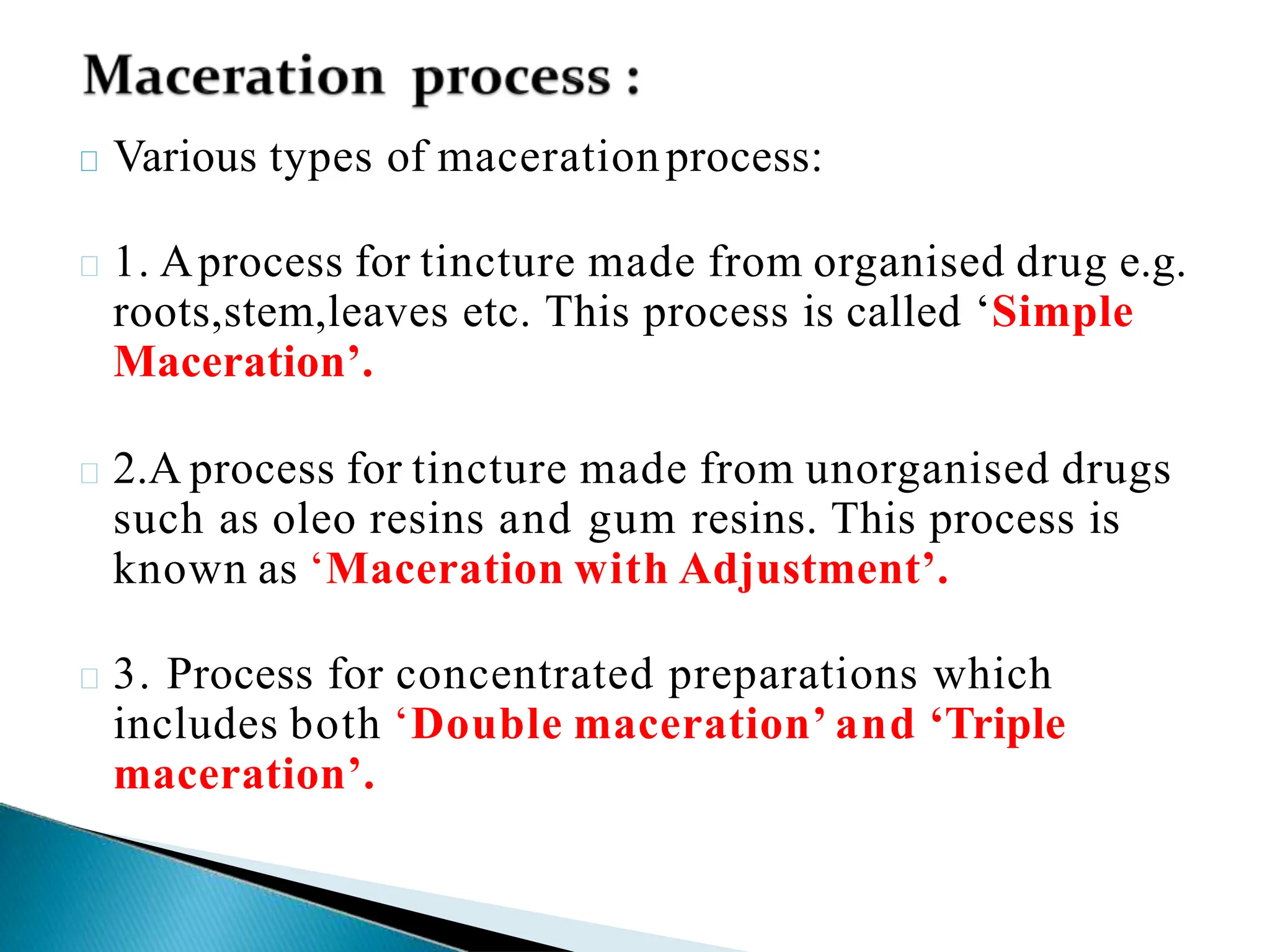
Various types of macerationprocess:
1. Aprocess for tincture made from organised drug e.g.
roots,stem,leaves etc. This process is called ‘Simple
Maceration’.
2.A process for tincture made from unorganised drugs
such as oleo resins and gum resins. This process is
known as ‘Maceration with Adjustment’.
3. Process for concentrated preparations which
includes both ‘Double maceration’ and ‘Triple
maceration’.
• Drug is placed with the whole of the menstruum in a
closed vessel for seven days.
• During this period shaking is done occasionally.
• After seven days ,the liquid is strained and marc is
pressed.
• The expressed liquid is mixed with strained liquid .
• It is then filtered to make a clear liquid.
• The final volume is not adjusted.
• Example:
1.Tincture of Orange .
2.Tincture of Lemon.
3.Tincture of Squill.
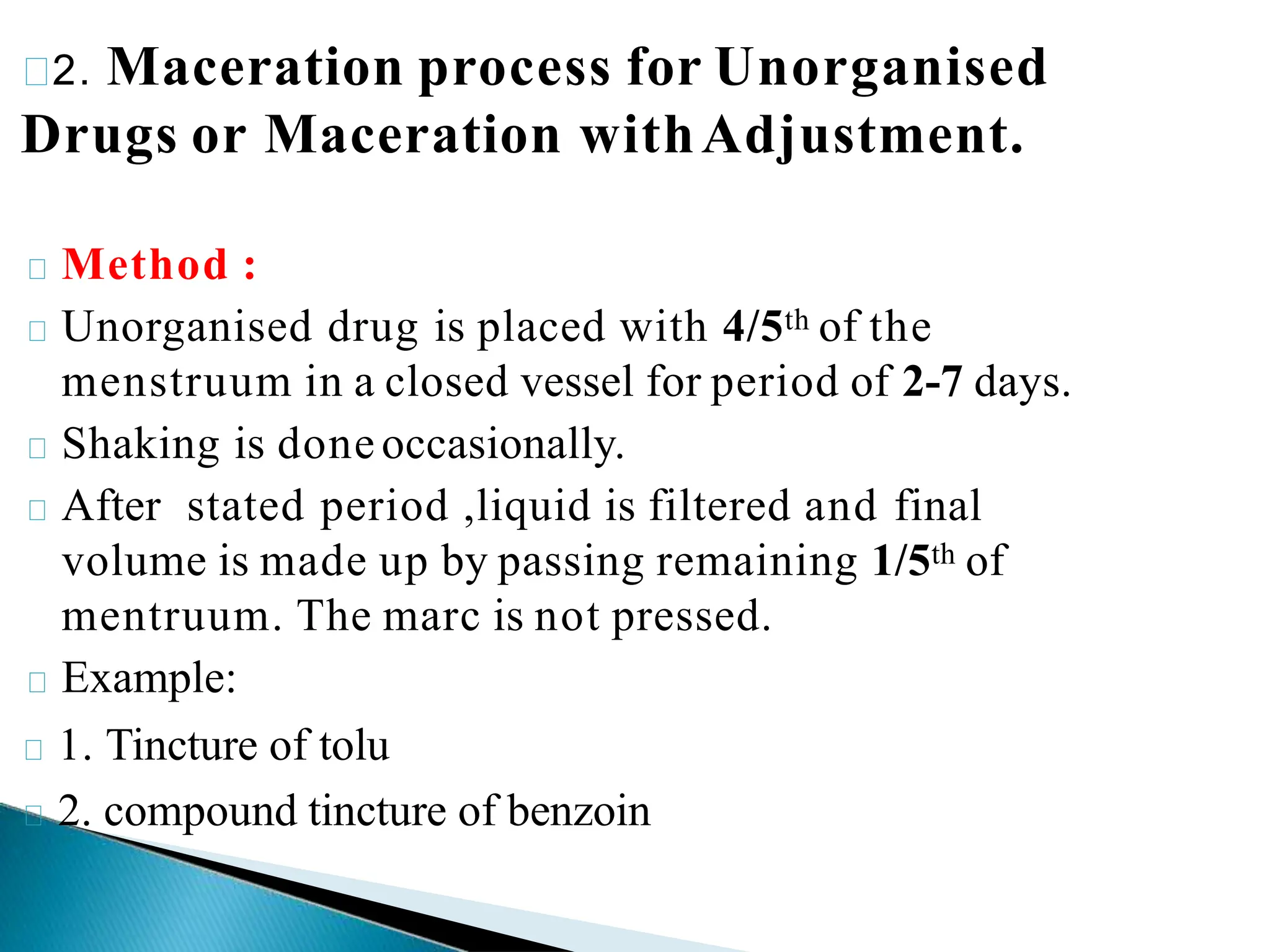
2. Maceration process for Unorganised
Drugs or Maceration withAdjustment.
Method :
Unorganised drug is placed with 4/5th of the
menstruum in a closed vessel for period of 2-7 days.
Shaking is done occasionally.
After stated period ,liquid is filtered and final
volume is made up by passing remaining 1/5th of
mentruum. The marc is not pressed.
Example:
1. Tincture of tolu
2. compound tincture of benzoin
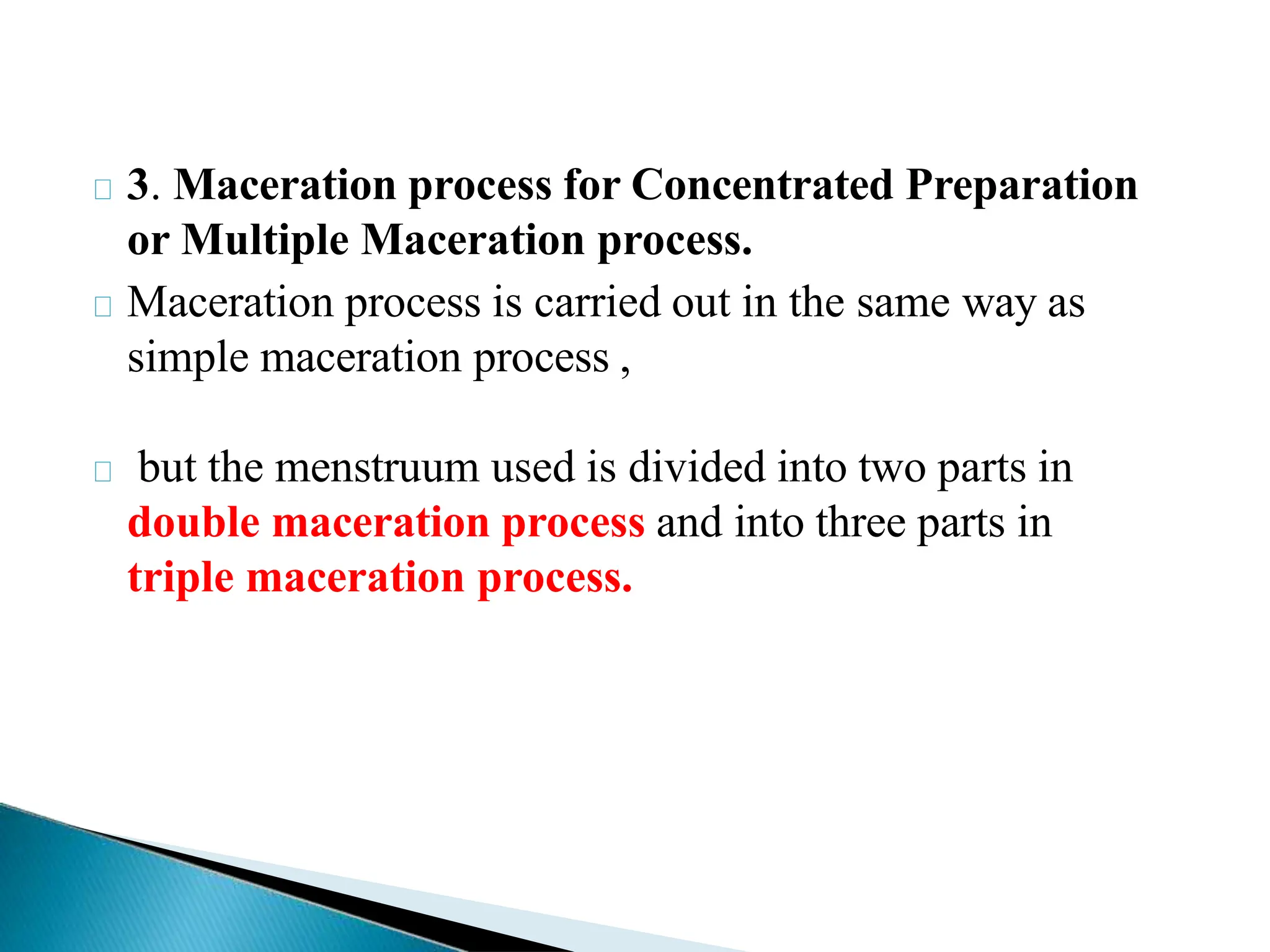
3. Maceration process for Concentrated Preparation
or Multiple Maceration process.
Maceration process is carried out in the same way as
simple maceration process ,
but the menstruum used is divided into two parts in
double maceration process and into three parts in
triple maceration process.
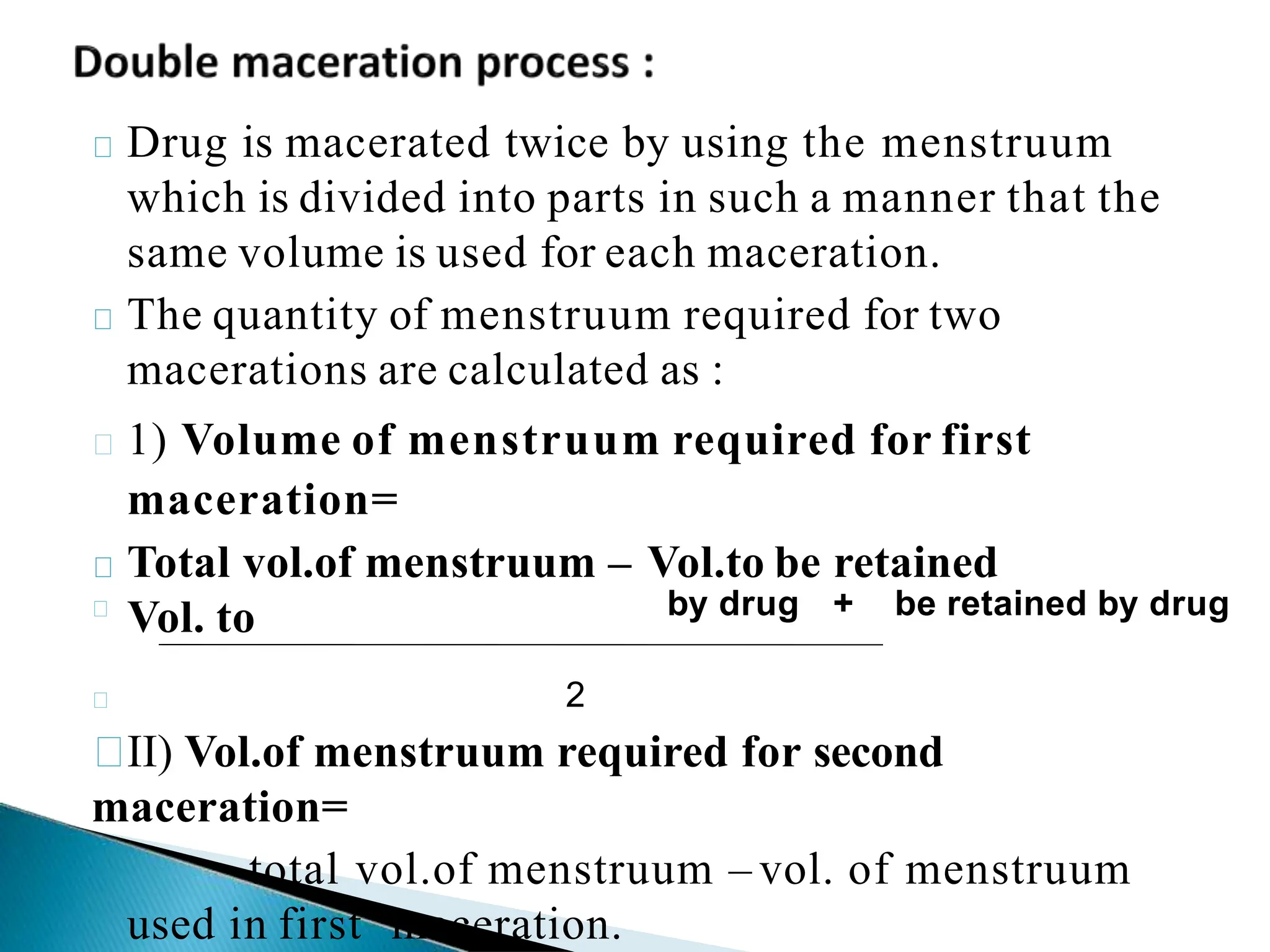
Drug is macerated twice by using the menstruum
which is divided into parts in such a manner that the
same volume is used for each maceration.
The quantity of menstruum required for two
macerations are calculated as :
1) Volume of menstruum required for first
maceration=
Total vol.of menstruum – Vol.to be retained
Vol. to by drug + be retained by drug
2
II) Vol.of menstruum required for second
maceration=
total vol.of menstruum – vol. of menstruum
used in first maceration.
In this maceration process, the drug is macerated thrice by
using the menstruum which is divided into three parts in
such a manner that the same volume is used for such
each maceration.
The quantity of menstruum required for three maceration
is calculated asfollows:
I)Vol. of menstruum required for first maceration=
Total vol.of - vol. to be retained
maceration by thedrug
3
+ vol. to be retained by drug
II) vol. of menstruum required for 2nd &3rd
maceration=
Total vol. of menstruum- Vol. of menstruum used in 1st
maceration
2
The whole of the drug is macerated for one hour with a
part of menstruum required for first maceration and
strained.
Press the marclightly.
Then combine the liquid obtained from second &third
maceration &evaporate it to specified extend.
Mix it with liquid obtained from first maceration .
Add alcohol 90% equal to 1/4th of the volume of the
finished product .
Adjust volume with water.
Allow it to stand for 14 days and filter.
Apparatus:
Three types of percolators are used.
1. Conical Percolators:
The percolator is made of glass or of metal, usually
copper ,which is tinnedinside.
It is conical in shape having lower diameter not less
than half of upperdiameter.
There are less chances of choking percolator in case
the drug swells up, because a drug can slope against
the wall of thepercolator.
The percolator is cylindrical in shape i.e. Upper and
lower diameters are same.
When a higher concentration of alcohol or any other
volatile solvent is used as menstruum a cylindrical
percolator is preferred.
3. Steam jacketed percolator:
When percolation is a carried is carried at higher temperature
,in order to increase the solvent action of the menstruum, the
percolator is heated by steam.
Simple percolation process is used for
the preparation of tincture.
There are three stages in the official method for
the preparation of tincture :
A) Imbibition
B) Maceration
C)Percolation
A) Imbibition :
The powdered drug is moistened with sufficient
quantity of menstruum and allowed to stand for 4
hrs in closed vessel.
Pack the moistened drug into percolators &add
sufficient
Quantity of menstruum to saturate the material.
When liquid starts coming out from outlet of percolators, the
outlet isclosed.
Then the sufficient quantity of menstruum is added in order
to
leave a layer above the drug.
B) Maceration :
The moistened drug is left in contact with menstruum for 24
hrs.
During this period ,the menstruum dissolves the active
constituents of the drug and becomes almost saturated with it.
C)Percolation:
It consist of downward displacement of saturated
solution formed in maceration and extraction of the
remaining active constituents present in the drug by
slow passage of the menstruum through the column
of the drug .
After collecting ¾ of the required volume of the
finished product or when drug is completely
exhausted, the marc is pressed.
Mix the expressed liquid with percolate.Add sufficient
quantity of menstruum to produce required volume
and then filter.
During the period of 24 hours of maceration, the
menstruum penetrates into the tissues of the drug
and dissolves the active constituents.
Ashort maceration before percolation enables the
extraction of active constituents of the drug with
considerably less quantity of the menstruum.
After 24 hours of the maceration, open the outlet of the
percolator And collect the percolate which measures
about ¾ of the volume required for the finished
product.
The exhaustion of drug may be tested by doing the
specified chemical test depending on the constituents
present in the drug or absenceof colour in percolator.
After exhaustion of the drug or after collecting the
required quantity of the percolator, the marc is taken
out from percolator. It is pressed to recover costly
solvent.
The expressed liquid is mixed with percolate and then
final volume is made by adding more of menstruum.
The preparation is filtered in order to free it from
cell debris or other material which interfere with
clarity of the preparation.
Example -
1.Tincture of belladonna.
2.Compound tincture of cardamom
3.Strong tincture of ginger
Percolation processes for concentrated preparation are
used for preparing liquid extracts and solid extracts.
The various processes used for the preparing
concentrated preparations are:
A)Reserve percolation process
B)Modified percolation process
In this process, a part of the percolate, generally ¾ volume of
finished preparation, is reserved.
Then the percolation process is continued till the drug is
completely exhausted.
The percolate is subjected to evaporation or distillation to
convert it into a soft extract.
This soft extract is dissolved in the reserve portion of
percolate & then sufficient menstruum is added to
produce required volume.
In percolation process for preparation of tincture, the
drug/percolate (d/p) ratio is about 1:4.
The d/p ratio is reduced to 1:3 by modifying
percolation process &hence there is lot of saving in
heat, time &menstruum.
Percolation is a displacement process.
The strong solution of active constituents of drug
formed during maceration is displaced by a fresh
When active constituents of the drugs are not freely
soluble in the solvent or difficult to be displaced from
the cells of the drug, then it becomes necessary to
extract the crude by the action of hot menstruum for
considerable length of time.
The fixed oils from seeds and alkaloids from the
drugs are extracted by continuous hot percolation
process using benzene, chloroform, petroleum,ether
etc.
The apparatus used for continuous hot percolation process
is soxhlet apparatus which consist of three parts:
A. Flask containing the boiling solvent .
B. Soxhlet Extractor in which drug to be extracted is
packed.
It has side tube which carries vapours of the solvent from the
flask to the condenser and syphon tube which syphon over
the
extract from soxhlet extractor to the flask .
C. Acondenser in which the vapours of the solvent
are condensed again into solvent.
• The drug to be extracted is packed in a paper cylinder
made from a filter paper &it is placed in the body of
soxhlet extractor.
• The solvent is placed in the flask and apparatus is then
fitted.
• When solvent is boiled on heating the flask, it gets
converted into vapours.
• These vapours enter into condenser trough the side tube
&get condensed into hot liquid which falls on the
column of the drug.
• When extractor gets filled with the solvent , the level of
syphon tube also raises up to its top.
• The solvent containing API in the syphon tube syphon
over&run into the flask , thus emptying the body of
extractor.
• This altering of filling and emptying the body of
extractor goes on continuously.
• This process is repeated until drug is exhausted.
The process is repeated about 15times for complete
exhaustion of the drug.
Limitation of continuous Hot Percolation Process:
Physical character of the drug :
The physical character of the drug is such that it would
block the soxhlet apparatus in case it is used for its
extraction by this method
E.g opium , gum, resin, orange peel etc
Solvent :only pure solvent or constant boiling mixture
can be used for this process.
Chemical constituent of the drug: The process is
unsuitable for drugs having thermolabile active
constituents such as enzymes ,alkaloids, antraquinone
derivatives etc.
• In digestion process, the drug is extracted by heating at a
particular pressure.
• This will increase the penetration power of the
menstruum , so that there is complete extraction of the
drug.
• Precaution should be taken so that increased temperature
may not harm the active constituents of the drug.
• The apparatus known as “Digestor” is used for extraction of
the drug by this method.
• It is a vessel made up of metal.
• The whole of the drug along with the menstruum is placed
in the body of the digestor.
• Place the cover over it and bolt it with the help of nuts.
• The drug is treated with menstruum for a definite period
under specified condition of temperature and pressure.
1.Character of drug
2.Therapeutic value of the drug
3.Cost of drug
4.Stability of drug
5.Solvent
6.Concentration of product.
Introduction to Ayurvedic Dosage Form
1.Anjan- These are medicated fine powder intended to
beusedin eyes for their local effect
2.Araks- These are distilled essences or liqours made by
soaking drugs in water for 24-48 hours and then distilling the
same the distillate collected is called ‘Araks’
3.Aristas- These are weak alcoholic preparations prepared by
making a decoction of the drugs and then allowing them to
undergo fermentation by the help of raw sugar or honey. The
fermentation is done for a period of 7-10 days in hot weather
and for 15-30 days in cold weather.
4.Asavas- These are medicated alcoholic liqours prepared by
the fermentation of raw vegetable juices with honey or
jaggery or treacle.
5.Avalehas- These are thick extracts of the drugs. The decoction
of the drug is prepared and after straining it is again boiled
down to a thick soft consistency with sugar or honey. In case
sugar is used in the preparation , the quantity used should be
four times that of the drugs, Avalehas are used for digestive
troubles, respiratory problems and as a general tonic.
6.Bhasmas- These are ashes which are prepared from vegetable
and mineral substances. The vegetable drugs are cut into a
coarse powder or pieces and then burnt till they are completely
reduced to ashes. The mineral ashes are prepared from metals
7.Churnas- these are powdered mixtures preparedby mixing dry
mineral, animal or vegetable substances in apestle mortar. The
powdered mixture is then passed through cloth, linen or fine
sieve.
8.Ghan: it is a semisolid preparation prepared by evaporation of
quaths to semisolid consistency.ghans are meant for converting
9. Ghritas: These are medicated ghees or clarified butter is heated
on a fire to remove water. It is meant for internal use
10.Gutikas: These are large pills These are prepared from pill mass
11.Kalkas: It is a paste which is prepared by grinding dry or fresh
whole vegetable substances, moistened with water on a flat stone
or slab with a muller. It is then mixed with honey , ghee or oil
which should be double the quantity of drug. In case sugar or
jaggery is to be mixed its proportion should be the same as that of
drug.
12.Kanjika: It is a sour liquid produced from the fermentation of
powdered paddy and other grains.It is cooling useful as adrink in
fever and burning of the body etc.
13. Ksharas: Medicinal plants or herbs or specified parts of them
are wholly or completely burnt and their ashes are allowed to
dissolve or mix in water. It is filtered and then evaporated to a fine
white residue, which is called kshar. This is very efefctive
preparation used in liver and spleen ailments
14. kshirpaka- it is a decoctiopn in milk which is prepared by
boiling one part of drug in 8 parts of milk and 32 parts of water till
the milk alone remains. The decoction is then strain
15.Kvaths- It is also a decoction and is generally prepared by
boiling one part of vegetable substance or drug in coarse powder or
cut or sliced into small pieces with 8 or 16 parts water in earthen
pot till the whole is reduced to 1/4th or 1/8th or 1/16th quantity of
water. Kvath should be prepared fresh every day.
16.malamas- these are called ointments these are semisold or soft
preparations meant for local application for various lesions
17. manda-it is decoction which is prepared in 14 parts of water
and one part of cereal, usually rice.
18.Murambas- these are preparations of drugs or fruits made by
soaking them in syrup or honey
19.paniyas-these are weak forms of decoction prepared by boiling
one part of medicinal substances in 32 or 64 parts of water till
water is reduced to half the quantity, strained and given to appease
thirst.
21. Paka
22.Pisty
23.Rasas
24.Satvas
25.Svarasas
26.Tailas
27.vatikas
28.Varti
Extraction process Pharmaceutics I 20111

Extraction process Pharmaceutics I 20111

  • 1.
    Miss Rajdeo ArchanaVitthal M.Pharm Assistant Prof. PRES’S Institute of Pharmacy Loni EXTRACTION PROCESS
  • 2.
    Extraction : It definedas the treatment of the plant or animal tissues with solvent , whereby the medicinally active constituents are dissolved and most of the inert matter remains undissolved. The solvent used for extraction is known as “menstruum.” And the inert insoluble material that remains after extraction is called “marc”.
  • 3.
    1. Infusion 2. Decoction 3.Maceration 4.Percolation 5.Digestion
  • 4.
    1. Water : Wateris a solvent for protein , colouring matter, gums, glycosides, sugars, alkaloidal salts, enzymes, many organic acids and most of the organic salts. Waxes ,fats ,fixed oils and most alkaloids are insoluble in water.
  • 5.
    It is cheap. Ishas a wide solvent action. It is non-toxic. It is non-inflammable.  Disadvantages: Water helps in growth of moulds and bacteria. Hence,some preservative is needed during extraction of crude drugs. Water causes hydrolysis of many substances. Large amount of heat is required to concentrate the aqueous preparation than non-aqueous preparation.
  • 6.
    2. Alcohol : Alcoholis solvent for alkaloids , glycosides, volatile oils and resins. Alcohol does not dissolve albuminous matter ,gums,waxes, fats, fixed oils andsugar.
  • 7.
    The mould andbacteria cannot grow in a solution in which alcohol concentration is 20% ormore. It is neutral and hence extraction products obtained from it are compatible with other products. Asmall amount of heat is required to concentrate the alcoholic preparation. It is non-toxic in the concentration mostly present in the preparations. Disadvantages : The preparation becomes costly when alcohol is used as solvent for extractionof API.
  • 8.
    Infusion : It consistof pouring water over the drugs and Then allowing it to keep in contact with water for the stated period ,usually 15 minutes ,with occasional stirring and finally filtering off the liquid.
  • 9.
     Drug isplaced at the bottom of the pot.  Water is added and it is well stirred 3 or 4 time  Infusion can also be prepared by enclosing the drug in a muslin bag and then suspending it just below the level of the water in a beaker.  Stirring is not required bcz water slowly circulate due to increase in specific gravity of water near the drug.  When water comes in contact with the drug ,it dissolves API and become heavier.Heavier layer come down and their place is taken by fresh water.As a result ,there is slow circulation of water &hence stirring is not required.
  • 10.
    Afresh infusion isan aqueous solution of active constituents of a vegetable drug prepared by the process of infusion . e.g fresh infusion ofQuassia. Coarse powder isused Water is used as menstruum bcz it has more penetration power &dissolves the API. Pharmacopoeia states that fresh infusion should be used within 12 hrs after its preparation bcz it gets spoiled due to fungal or bacterial growth.
  • 11.
    It is preparedby double or triple maceration process. Conc. Infusions are 8 times stronger than fresh infusion. Alcohol in the conc of 20-25% is used as menstruum. Hence these preparation can be stored for longer period due to preservatives action of alcohol. E.g conc infusion of Quassia &conc compound infusion of chirata. Special pots known as ‘infusion pot’ used for preparation of infusion . There are two type of infusion: 1.Fresh infusion 2. Concentrated infusion
  • 12.
    Drug is boiledwith water for stated period usually 10 minutes. After boiling ,the liquid is strained and water is passed through the content of the strainer to make the required volume. This process is mainly used for vegetables drugs of hard and woody nature having thermostable water soluble constituents.
  • 13.
    Various types ofmacerationprocess: 1. Aprocess for tincture made from organised drug e.g. roots,stem,leaves etc. This process is called ‘Simple Maceration’. 2.A process for tincture made from unorganised drugs such as oleo resins and gum resins. This process is known as ‘Maceration with Adjustment’. 3. Process for concentrated preparations which includes both ‘Double maceration’ and ‘Triple maceration’.
  • 14.
    • Drug isplaced with the whole of the menstruum in a closed vessel for seven days. • During this period shaking is done occasionally. • After seven days ,the liquid is strained and marc is pressed. • The expressed liquid is mixed with strained liquid . • It is then filtered to make a clear liquid. • The final volume is not adjusted. • Example: 1.Tincture of Orange . 2.Tincture of Lemon. 3.Tincture of Squill.
  • 15.
    2. Maceration processfor Unorganised Drugs or Maceration withAdjustment. Method : Unorganised drug is placed with 4/5th of the menstruum in a closed vessel for period of 2-7 days. Shaking is done occasionally. After stated period ,liquid is filtered and final volume is made up by passing remaining 1/5th of mentruum. The marc is not pressed. Example: 1. Tincture of tolu 2. compound tincture of benzoin
  • 16.
    3. Maceration processfor Concentrated Preparation or Multiple Maceration process. Maceration process is carried out in the same way as simple maceration process , but the menstruum used is divided into two parts in double maceration process and into three parts in triple maceration process.
  • 17.
    Drug is maceratedtwice by using the menstruum which is divided into parts in such a manner that the same volume is used for each maceration. The quantity of menstruum required for two macerations are calculated as : 1) Volume of menstruum required for first maceration= Total vol.of menstruum – Vol.to be retained Vol. to by drug + be retained by drug 2 II) Vol.of menstruum required for second maceration= total vol.of menstruum – vol. of menstruum used in first maceration.
  • 18.
    In this macerationprocess, the drug is macerated thrice by using the menstruum which is divided into three parts in such a manner that the same volume is used for such each maceration. The quantity of menstruum required for three maceration is calculated asfollows: I)Vol. of menstruum required for first maceration= Total vol.of - vol. to be retained maceration by thedrug 3 + vol. to be retained by drug
  • 19.
    II) vol. ofmenstruum required for 2nd &3rd maceration= Total vol. of menstruum- Vol. of menstruum used in 1st maceration 2 The whole of the drug is macerated for one hour with a part of menstruum required for first maceration and strained.
  • 20.
    Press the marclightly. Thencombine the liquid obtained from second &third maceration &evaporate it to specified extend. Mix it with liquid obtained from first maceration . Add alcohol 90% equal to 1/4th of the volume of the finished product . Adjust volume with water. Allow it to stand for 14 days and filter.
  • 21.
    Apparatus: Three types ofpercolators are used. 1. Conical Percolators: The percolator is made of glass or of metal, usually copper ,which is tinnedinside. It is conical in shape having lower diameter not less than half of upperdiameter. There are less chances of choking percolator in case the drug swells up, because a drug can slope against the wall of thepercolator.
  • 22.
    The percolator iscylindrical in shape i.e. Upper and lower diameters are same. When a higher concentration of alcohol or any other volatile solvent is used as menstruum a cylindrical percolator is preferred. 3. Steam jacketed percolator: When percolation is a carried is carried at higher temperature ,in order to increase the solvent action of the menstruum, the percolator is heated by steam.
  • 23.
    Simple percolation processis used for the preparation of tincture. There are three stages in the official method for the preparation of tincture : A) Imbibition B) Maceration C)Percolation A) Imbibition : The powdered drug is moistened with sufficient quantity of menstruum and allowed to stand for 4 hrs in closed vessel. Pack the moistened drug into percolators &add sufficient
  • 24.
    Quantity of menstruumto saturate the material. When liquid starts coming out from outlet of percolators, the outlet isclosed. Then the sufficient quantity of menstruum is added in order to leave a layer above the drug. B) Maceration : The moistened drug is left in contact with menstruum for 24 hrs. During this period ,the menstruum dissolves the active constituents of the drug and becomes almost saturated with it.
  • 25.
    C)Percolation: It consist ofdownward displacement of saturated solution formed in maceration and extraction of the remaining active constituents present in the drug by slow passage of the menstruum through the column of the drug . After collecting ¾ of the required volume of the finished product or when drug is completely exhausted, the marc is pressed. Mix the expressed liquid with percolate.Add sufficient quantity of menstruum to produce required volume and then filter.
  • 27.
    During the periodof 24 hours of maceration, the menstruum penetrates into the tissues of the drug and dissolves the active constituents. Ashort maceration before percolation enables the extraction of active constituents of the drug with considerably less quantity of the menstruum. After 24 hours of the maceration, open the outlet of the percolator And collect the percolate which measures about ¾ of the volume required for the finished product.
  • 28.
    The exhaustion ofdrug may be tested by doing the specified chemical test depending on the constituents present in the drug or absenceof colour in percolator. After exhaustion of the drug or after collecting the required quantity of the percolator, the marc is taken out from percolator. It is pressed to recover costly solvent. The expressed liquid is mixed with percolate and then final volume is made by adding more of menstruum.
  • 29.
    The preparation isfiltered in order to free it from cell debris or other material which interfere with clarity of the preparation. Example - 1.Tincture of belladonna. 2.Compound tincture of cardamom 3.Strong tincture of ginger
  • 30.
    Percolation processes forconcentrated preparation are used for preparing liquid extracts and solid extracts. The various processes used for the preparing concentrated preparations are: A)Reserve percolation process B)Modified percolation process
  • 31.
    In this process,a part of the percolate, generally ¾ volume of finished preparation, is reserved. Then the percolation process is continued till the drug is completely exhausted. The percolate is subjected to evaporation or distillation to convert it into a soft extract. This soft extract is dissolved in the reserve portion of percolate & then sufficient menstruum is added to produce required volume.
  • 32.
    In percolation processfor preparation of tincture, the drug/percolate (d/p) ratio is about 1:4. The d/p ratio is reduced to 1:3 by modifying percolation process &hence there is lot of saving in heat, time &menstruum. Percolation is a displacement process. The strong solution of active constituents of drug formed during maceration is displaced by a fresh
  • 33.
    When active constituentsof the drugs are not freely soluble in the solvent or difficult to be displaced from the cells of the drug, then it becomes necessary to extract the crude by the action of hot menstruum for considerable length of time. The fixed oils from seeds and alkaloids from the drugs are extracted by continuous hot percolation process using benzene, chloroform, petroleum,ether etc.
  • 34.
    The apparatus usedfor continuous hot percolation process is soxhlet apparatus which consist of three parts: A. Flask containing the boiling solvent . B. Soxhlet Extractor in which drug to be extracted is packed. It has side tube which carries vapours of the solvent from the flask to the condenser and syphon tube which syphon over the extract from soxhlet extractor to the flask . C. Acondenser in which the vapours of the solvent are condensed again into solvent.
  • 36.
    • The drugto be extracted is packed in a paper cylinder made from a filter paper &it is placed in the body of soxhlet extractor. • The solvent is placed in the flask and apparatus is then fitted. • When solvent is boiled on heating the flask, it gets converted into vapours. • These vapours enter into condenser trough the side tube &get condensed into hot liquid which falls on the column of the drug. • When extractor gets filled with the solvent , the level of syphon tube also raises up to its top.
  • 37.
    • The solventcontaining API in the syphon tube syphon over&run into the flask , thus emptying the body of extractor. • This altering of filling and emptying the body of extractor goes on continuously. • This process is repeated until drug is exhausted.
  • 38.
    The process isrepeated about 15times for complete exhaustion of the drug. Limitation of continuous Hot Percolation Process: Physical character of the drug : The physical character of the drug is such that it would block the soxhlet apparatus in case it is used for its extraction by this method E.g opium , gum, resin, orange peel etc Solvent :only pure solvent or constant boiling mixture can be used for this process. Chemical constituent of the drug: The process is unsuitable for drugs having thermolabile active constituents such as enzymes ,alkaloids, antraquinone derivatives etc.
  • 39.
    • In digestionprocess, the drug is extracted by heating at a particular pressure. • This will increase the penetration power of the menstruum , so that there is complete extraction of the drug. • Precaution should be taken so that increased temperature may not harm the active constituents of the drug. • The apparatus known as “Digestor” is used for extraction of the drug by this method. • It is a vessel made up of metal. • The whole of the drug along with the menstruum is placed in the body of the digestor. • Place the cover over it and bolt it with the help of nuts. • The drug is treated with menstruum for a definite period under specified condition of temperature and pressure.
  • 40.
    1.Character of drug 2.Therapeuticvalue of the drug 3.Cost of drug 4.Stability of drug 5.Solvent 6.Concentration of product.
  • 41.
    Introduction to AyurvedicDosage Form 1.Anjan- These are medicated fine powder intended to beusedin eyes for their local effect 2.Araks- These are distilled essences or liqours made by soaking drugs in water for 24-48 hours and then distilling the same the distillate collected is called ‘Araks’ 3.Aristas- These are weak alcoholic preparations prepared by making a decoction of the drugs and then allowing them to undergo fermentation by the help of raw sugar or honey. The fermentation is done for a period of 7-10 days in hot weather and for 15-30 days in cold weather. 4.Asavas- These are medicated alcoholic liqours prepared by the fermentation of raw vegetable juices with honey or jaggery or treacle.
  • 42.
    5.Avalehas- These arethick extracts of the drugs. The decoction of the drug is prepared and after straining it is again boiled down to a thick soft consistency with sugar or honey. In case sugar is used in the preparation , the quantity used should be four times that of the drugs, Avalehas are used for digestive troubles, respiratory problems and as a general tonic. 6.Bhasmas- These are ashes which are prepared from vegetable and mineral substances. The vegetable drugs are cut into a coarse powder or pieces and then burnt till they are completely reduced to ashes. The mineral ashes are prepared from metals 7.Churnas- these are powdered mixtures preparedby mixing dry mineral, animal or vegetable substances in apestle mortar. The powdered mixture is then passed through cloth, linen or fine sieve. 8.Ghan: it is a semisolid preparation prepared by evaporation of quaths to semisolid consistency.ghans are meant for converting
  • 43.
    9. Ghritas: Theseare medicated ghees or clarified butter is heated on a fire to remove water. It is meant for internal use 10.Gutikas: These are large pills These are prepared from pill mass 11.Kalkas: It is a paste which is prepared by grinding dry or fresh whole vegetable substances, moistened with water on a flat stone or slab with a muller. It is then mixed with honey , ghee or oil which should be double the quantity of drug. In case sugar or jaggery is to be mixed its proportion should be the same as that of drug. 12.Kanjika: It is a sour liquid produced from the fermentation of powdered paddy and other grains.It is cooling useful as adrink in fever and burning of the body etc. 13. Ksharas: Medicinal plants or herbs or specified parts of them are wholly or completely burnt and their ashes are allowed to dissolve or mix in water. It is filtered and then evaporated to a fine white residue, which is called kshar. This is very efefctive preparation used in liver and spleen ailments
  • 44.
    14. kshirpaka- itis a decoctiopn in milk which is prepared by boiling one part of drug in 8 parts of milk and 32 parts of water till the milk alone remains. The decoction is then strain 15.Kvaths- It is also a decoction and is generally prepared by boiling one part of vegetable substance or drug in coarse powder or cut or sliced into small pieces with 8 or 16 parts water in earthen pot till the whole is reduced to 1/4th or 1/8th or 1/16th quantity of water. Kvath should be prepared fresh every day. 16.malamas- these are called ointments these are semisold or soft preparations meant for local application for various lesions 17. manda-it is decoction which is prepared in 14 parts of water and one part of cereal, usually rice. 18.Murambas- these are preparations of drugs or fruits made by soaking them in syrup or honey 19.paniyas-these are weak forms of decoction prepared by boiling one part of medicinal substances in 32 or 64 parts of water till water is reduced to half the quantity, strained and given to appease
  • 45.