Extra Cellular Matrix(ECM)
•Extracellular matrix (ECM) is a network of extracellular
macro-molecules, such as collagen, enzymes,
and glycoproteins, that provide structural and
biochemical support to surrounding cells
•ECM includes the interstitial matrix and the basement
membrane
•Gels of polysaccharides and fibrous proteins fill
the interstitial space and act as a compression buffer
against the stress placed on the ECM
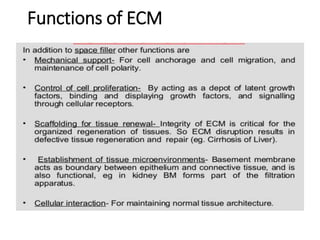
Functions of ECM
•ECM provides support, segregate tissues from one
another, and regulate intercellular communication.
•It sequesters a wide range of cellular growth factors and
acts as a local store for them.
•Changes in physiological conditions can
trigger protease activities that cause local release of
them rapidly.
•It is essential for growth, wound healing and fibrosis
Functions of ECM
• The stiffness and elasticity of the ECM is implicated in cell migration, gene
expression, and differentiation.
• Cells actively sense ECM rigidity and migrate preferentially towards stiffer
surfaces in a phenomenon called durotaxis .
• Cell-to-ECM adhesion is regulated by specific cell-surface cellular adhesion
molecules (CAM) known as integrins.
• The attachment of fibronectin to the extracellular domain initiates
intracellular signalling pathways as well as association with the cellular
cytoskeleton via a set of adaptor molecules such as actin
•Extracellular matrix has been found to cause
regrowth and healing of tissue.
•ECM works with stem cells to grow and regrow
all parts of fetuses that gets damaged in the
womb.
•It prevents the immune system from triggering
from the injury
•It facilitates the surrounding cells to repair the
tissue instead of forming scar tissue
Medical applications of ECM
• ECM is extracted from pig bladders used regularly to treat ulcers by
closing the hole in the stomach
• ECM from pig small intestine is used to repair "atrial septal defects"
(ASD), "patent foramen ovale" (PFO) and inguinal hernia.
• ECM proteins used in cell culture systems to maintain stem and
precursor cells in an undifferentiated state
• ECM used to induce differentiation of epithelial, endothelial and
smooth muscle cells in vitro.
ECM molecules
• Basement membranes are sheet-like depositions of ECM on which
various epithelial cells rest.
• Collagen fibers and bone mineral comprise the ECM of bone tissue.
• Reticular fibers and ground substance comprise the ECM of loose
connective tissue;
• Blood plasma is the ECM of blood.
• Some single-celled organisms adopt multicellular biofilms in which the
cells are embedded in an ECM composed primarily of extracellular
polymeric substances (EPS)
GAGs
•Components of the ECM are produced
intracellularly by resident cells and secreted into
the ECM via exocytosis.
•They then aggregate with the existing matrix.
• ECM is composed of an interlocking mesh of
fibrous proteins and glycosaminoglycans(GAGs).
•Glycosaminoglycans (GAGs) are attached to
ECM proteins to form proteoglycans (Except
hyaluronic acid).
ECM as a store of growth factors
•Proteoglycans have a net negative
charge
•It attracts positively charged sodium
ions (Na+)
•This attracts water molecules via
osmosis, keeping the ECM and
resident cells hydrated.
•Proteoglycans help to trap and
store growth factors within the ECM.
Heparan sulfate
• Heparan sulfate (HS) as a proteoglycan (PG) attached in close proximity
to cell surface or ECM proteins.
• It regulates a wide variety of biological activities,
including developmental process, angiogenesis, blood coagulation and
tumor metastasis.
• In ECM, to basement membrane proteins such as agrin, perlecan and
collagen XVIII , heparan sulfate is attached.
•Chondroitin sulfates contribute to the tensile
strength of cartilage, tendons, ligaments and
walls of the aorta. They have also been
known to affect neuroplasticity
•Keratan sulfates have a variable sulfate
content and, unlike many other GAGs, do not
contain uronic acid.
•They are present in the cornea,
cartilage, bones and the horns of animals.
Non-proteoglycan polysaccharide- Hyaluronic
acid
• Hyaluronic acid resist compression by providing a
counteracting turgor (swelling) force by absorbing significant amounts
of water.
• It is found in abundance in the ECM of load-bearing joints.
• It regulates cell behavior during embryonic development, healing
processes, inflammation, and tumor development.
• It interacts with a specific trans-membrane receptor, CD44
Collagen
• Collagen is the main structural protein in the extracellular matrix in
the various connective tissues
• It is the most abundant protein in mammals-25% to 35% of the
whole-body protein content.
• It is a triple helix of elongated fibril called collagen helix.
• It is mostly found in fibrous tissues such as tendons, ligaments,
and skin.
• The fibroblast is the most common cell that produces collagen
Collagen amino acids
•Glycine is found at almost every
third residue.
•Proline makes up about 17% of collagen.
•Hydroxyproline derived from proline
• Hydroxylysine derived from lysine -
depending on the type of collagen, varying
numbers of hydroxylysines are glycosylated
•Cortisol stimulates degradation of (skin)
collagen into amino acids.
Collagen types and functions
• 30 types of collagen are identified.
• The five most common types are:
• Type I- skin, tendon vasculature, organs, bone (main component of the
organic part of bone)
• Type II- cartilage (main collagenous component of cartilage)
• Type III - reticulate (main component of reticular fibers), commonly
found alongside type I
• Type IV : forms basal lamina, the epithelium-secreted layer of
the basement membrane
• Type V: cell surfaces, hair, and placenta
Fibroblasts produce collagen fiber. Epithelial and smooth muscle cells produce
type IV collagen
Collagen synthesis
• Inside the cell
• two types of alpha chains – alpha-1 and alpha 2, are formed
during translation on ribosomes along the rough endoplasmic
reticulum (RER).
• These are preprocollagen having registration peptides one on each end
and a signal peptide on N-terminal side.
• Polypeptide chains are released into the lumen of the RER.
• Signal peptides are cleaved inside the RER and the chains are now
known as pro-alpha chains.
• Hydroxylation of lysine and proline amino acids occurs inside the lumen.
This process is dependent on ascorbic acid (vitamin C) as a cofactor,
 In scurvy, the lack of hydroxylation of prolines and lysines causes a looser triple
helix .
• Glycosylation of specific hydroxylysine residues occurs.
Collagen synthesis
• Now two alpha-1 chains and one alpha-2 chain form triple helical
structure - procollagen inside the RER.
• Procollagen is sent to Golgi apparatus, where it is packaged and secreted
by exocytosis.
• Outside the cell
• Registration peptides are cleaved and tropocollagen is formed
by procollagen peptidase.
• Multiple tropocollagen molecules form collagen fibrils, via covalent cross-
linking (aldol reaction) by lysyl oxidase ( copper dependent ) which links
hydroxylysine and lysine residues.
• Multiple collagen fibrils form into collagen fibers.
• Collagen may be attached to cell membranes via several types of
protein, fibronectin, laminin, fibulin and integrin.
Collagen synthesis
Prolyl and lysyl hydroxylase – vitamin C
Vitamin C deficiency
Collagen Medical applications
• The collagenous cardiac skeleton - four heart valve rings,
interventrivular septum, atrio ventricular septum are histologically,
elastically and uniquely bound to cardiac muscle.
• The collagenous structure dividing the upper chambers of the heart
from the lower chambers is an impermeable membrane that excludes
both blood and electrical impulses
• Collagen has been widely used in cosmetic surgery, as a healing aid for
burn patients, for reconstruction of bone and variety of dental,
orthopedic, and surgical purposes.
Medical applications
• Collagen is used in bone grafting as it has a triple helical structure,
making it a very strong molecule.
• Collagen scaffolds are used in tissue regeneration, as sponges, thin
sheets, or gels.
• Collagen is used as a natural wound dressing .
• It is resistant against bacteria,
• It helps to keep the wound sterile, because of its natural ability to fight
infection.
• Collagen is used for cell culture, studying cell behavior and cellular
interactions with the extracellular environment
Osteogenesis imperfecta (OI)
• OI is a group of genetic disorders that mainly affect the bones. - means
imperfect bone formation
• Mutations in the COL1A1 and COL1A2 genes cause type I collagen defect
• Bones fracture easily, often from mild trauma or with no apparent
cause.
• Multiple fractures are common, even before birth.
• Other features are blue sclerae of the eyes, short stature, curvature of
the spine (scoliosis), joint deformities (contractures), hearing loss,
respiratory problems, and a disorder of tooth development
called dentinogenesis imperfecta.
OI X ray –OI and Normal
Ehlers-Danlos syndrome
• A group of rare genetic connective tissue disorders
• Symptoms include loose joints, joint pain, stretchy velvety skin, and
abnormal scar formation.
• At birth or in early childhood.
• Complications may include aortic dissection,joint
dislocations, scoliosis, chronic pain, or osteoarthritis.
• AR or AD manner
• Musculoskeletal symptoms include hyperflexible joints that are unstable and
prone to sprain ,dislocation, subluxation, and hyperextension.
Ehlers-Danlos syndrome – Hyperflexible joints ,
laxity of skin
Alport syndrome
• It is a glomerular basement membrane disease caused by a defect in
collagen IV - Nephritis
• X-linked dominant commonly or recessive disorder
• ocular features are corneal opacities, anterior lenticonus and cataract,
central perimacular and peripheral coalescing fleck retinopathies, and
temporal retinal thinning.
• Rarely a macular hole, or a maculopathy impairs vision
• Deafness
• Nephritis,Hematuria, later renal failure
Alport syndrome -Lenticonus, macular hole
Dystrophic Epidermolysis Bullosa (DEB)
• DEB is characterised by the site of blister formation in
the lamina densa within the basement membrane zone and the
upper dermis.
• It causes generalised blistering of the skin and internal mucous
membranes such as the oesophagus, stomach and respiratory tract and
leads to scar formation
• DEB is due to mutationsin COL7A1 gene encoding collagen type VII,
either AR or AD
• Blisters occur with minor trauma or friction and are painful.
• It can be mild to fatal and cause squamous cell cancer.
DEB
Chondrodysplasias
• Rare autosomal recessive Chondrodysplasia or acromesomelic
dysplasia characterized by severe dwarfism at birth.
• Epiphyseal and metaphyseal abnormalities
• Abnormalities confined to limbs
• Severe shortening and deformity of long bones
• Fusion or absence of carpal and tarsal bones, ball shaped fingers
• Occasionally, polydactyly and absent joints.
• Facial features and intelligence are normal.
• Type II collagen defect
Spondyloepiphyseal dysplasia (SED) is a group of disorders with
primary involvement of the vertebrae and epiphyseal centers
resulting in a short-trunk disproportionate dwarfism.
Spondylo- refers to the spine, epiphyseal refers to the growing
ends of bones, and dysplasia refers to abnormal growth.
Collagen vascular diseases
•Ankylosing spondylitis.
•Dermatomyositis.
•Polyarteritis nodosa.
•Psoriatic arthritis.
•Rheumatoid arthritis.
•Scleroderma.
•Systemic lupus erythematosus.
Collagen vascular diseases
Scleroderma
• A group of autoimmune diseases affecting the skin, blood
vessels, muscles, and internal organs.
• The disease can be either localized to skin or involve other organs
• There will be areas of thickened skin, stiffness, feeling tired, and
poor blood flow to the fingers or toes with cold exposure.
• A form CREST syndrome classically results in
• Calcium deposits, Raynaud's syndrome,
• Esophageal problems, Sclerodactyly thickening of the skin of the
fingers and toes
• Telengiectasias (areas of small dilated blood vessels.)
• An abnormal immune response due to certain genetic factors, and
exposure to silica cause abnormal growth of connective tissue
Scleroderma- CREST syndrome
Scleroderma
Localized collagen defects
 Hypertrophic scar – excess collagen , raised scar
 Keloid – scar goes beyond wound boundaries does not regress
 Beal’s syndrome- contracture of
hip, knee, elbow ankle joints
Peyronie’s disease – deposition
of abnormal type 1 and III
collagen in the
penis
Elastin
• It is highly elastic and present in connective tissue allowing many tissues
to resume their shape after stretching or contracting.
• It helps skin to return to its original position when it is poked or
pinched.
• ELN mutations are autosomal dominant .
• Abnormally long version of the tropoelastin protein interferes with the
formation of mature elastin and the assembly of elastic fibers.
• It weakens connective tissue in the skin and causes cutis laxa.
• Elastin is encoded by the ELN gene.
Skin
Defective Elastin - Cutis laxa
• Fibrillin is a glycoprotein, which is essential for the formation of elastic
fibers found in connective tissue.
• It is secreted into the extracellular matrix by fibroblasts
• Gets incorporated into the insoluble microfibrils, a scaffold for deposition
of elastin
• Fibrillin-1 is a major component of the microfibrils that form a sheath
surrounding the amorphous elastin.
• Marfan syndrome is due to defective FBN1 gene.
• Mutations in FBN1 and FBN2 are also associated with adolescent
idiopathic scoliosis
Fibrilin
Marfan syndrome (MFS)
• MFS is caused by a mutation in FBN1, that makes fibrillin, results in
abnormal connective tissue. AR disorder
• Patient tends to be tall and thin, with long arms, legs, fingers and toes.
• They also have flexible joints and scoliosis.
• An increased risk of mitral valve prolapse and aortic aneurysm.
• The lungs, eyes, bones, and the covering of the spinal cord are also
commonly affected
Marfan syndrome
• A positive wrist sign in a person with Marfan syndrome (the thumb
and little finger overlap when grasping the wrist of the opposite
hand)
• A positive thumb sign
Marfan syndrome
Syndecan
Fibronectin
Fibronectin
Laminin
Laminin
Laminin
Integrin
Integrin functions
Integrin
integrin
Clinical importance of ECM
THANK YOU

ecm-extra cellular matrix and its function.pptx

  • 1.
  • 2.
    •Extracellular matrix (ECM)is a network of extracellular macro-molecules, such as collagen, enzymes, and glycoproteins, that provide structural and biochemical support to surrounding cells •ECM includes the interstitial matrix and the basement membrane •Gels of polysaccharides and fibrous proteins fill the interstitial space and act as a compression buffer against the stress placed on the ECM
  • 4.
  • 6.
    •ECM provides support,segregate tissues from one another, and regulate intercellular communication. •It sequesters a wide range of cellular growth factors and acts as a local store for them. •Changes in physiological conditions can trigger protease activities that cause local release of them rapidly. •It is essential for growth, wound healing and fibrosis
  • 7.
    Functions of ECM •The stiffness and elasticity of the ECM is implicated in cell migration, gene expression, and differentiation. • Cells actively sense ECM rigidity and migrate preferentially towards stiffer surfaces in a phenomenon called durotaxis . • Cell-to-ECM adhesion is regulated by specific cell-surface cellular adhesion molecules (CAM) known as integrins. • The attachment of fibronectin to the extracellular domain initiates intracellular signalling pathways as well as association with the cellular cytoskeleton via a set of adaptor molecules such as actin
  • 8.
    •Extracellular matrix hasbeen found to cause regrowth and healing of tissue. •ECM works with stem cells to grow and regrow all parts of fetuses that gets damaged in the womb. •It prevents the immune system from triggering from the injury •It facilitates the surrounding cells to repair the tissue instead of forming scar tissue
  • 9.
    Medical applications ofECM • ECM is extracted from pig bladders used regularly to treat ulcers by closing the hole in the stomach • ECM from pig small intestine is used to repair "atrial septal defects" (ASD), "patent foramen ovale" (PFO) and inguinal hernia. • ECM proteins used in cell culture systems to maintain stem and precursor cells in an undifferentiated state • ECM used to induce differentiation of epithelial, endothelial and smooth muscle cells in vitro.
  • 11.
  • 14.
    • Basement membranesare sheet-like depositions of ECM on which various epithelial cells rest. • Collagen fibers and bone mineral comprise the ECM of bone tissue. • Reticular fibers and ground substance comprise the ECM of loose connective tissue; • Blood plasma is the ECM of blood. • Some single-celled organisms adopt multicellular biofilms in which the cells are embedded in an ECM composed primarily of extracellular polymeric substances (EPS)
  • 15.
    GAGs •Components of theECM are produced intracellularly by resident cells and secreted into the ECM via exocytosis. •They then aggregate with the existing matrix. • ECM is composed of an interlocking mesh of fibrous proteins and glycosaminoglycans(GAGs). •Glycosaminoglycans (GAGs) are attached to ECM proteins to form proteoglycans (Except hyaluronic acid).
  • 16.
    ECM as astore of growth factors •Proteoglycans have a net negative charge •It attracts positively charged sodium ions (Na+) •This attracts water molecules via osmosis, keeping the ECM and resident cells hydrated. •Proteoglycans help to trap and store growth factors within the ECM.
  • 17.
    Heparan sulfate • Heparansulfate (HS) as a proteoglycan (PG) attached in close proximity to cell surface or ECM proteins. • It regulates a wide variety of biological activities, including developmental process, angiogenesis, blood coagulation and tumor metastasis. • In ECM, to basement membrane proteins such as agrin, perlecan and collagen XVIII , heparan sulfate is attached.
  • 18.
    •Chondroitin sulfates contributeto the tensile strength of cartilage, tendons, ligaments and walls of the aorta. They have also been known to affect neuroplasticity •Keratan sulfates have a variable sulfate content and, unlike many other GAGs, do not contain uronic acid. •They are present in the cornea, cartilage, bones and the horns of animals.
  • 19.
    Non-proteoglycan polysaccharide- Hyaluronic acid •Hyaluronic acid resist compression by providing a counteracting turgor (swelling) force by absorbing significant amounts of water. • It is found in abundance in the ECM of load-bearing joints. • It regulates cell behavior during embryonic development, healing processes, inflammation, and tumor development. • It interacts with a specific trans-membrane receptor, CD44
  • 20.
    Collagen • Collagen isthe main structural protein in the extracellular matrix in the various connective tissues • It is the most abundant protein in mammals-25% to 35% of the whole-body protein content. • It is a triple helix of elongated fibril called collagen helix. • It is mostly found in fibrous tissues such as tendons, ligaments, and skin. • The fibroblast is the most common cell that produces collagen
  • 21.
    Collagen amino acids •Glycineis found at almost every third residue. •Proline makes up about 17% of collagen. •Hydroxyproline derived from proline • Hydroxylysine derived from lysine - depending on the type of collagen, varying numbers of hydroxylysines are glycosylated •Cortisol stimulates degradation of (skin) collagen into amino acids.
  • 22.
    Collagen types andfunctions • 30 types of collagen are identified. • The five most common types are: • Type I- skin, tendon vasculature, organs, bone (main component of the organic part of bone) • Type II- cartilage (main collagenous component of cartilage) • Type III - reticulate (main component of reticular fibers), commonly found alongside type I • Type IV : forms basal lamina, the epithelium-secreted layer of the basement membrane • Type V: cell surfaces, hair, and placenta
  • 23.
    Fibroblasts produce collagenfiber. Epithelial and smooth muscle cells produce type IV collagen
  • 24.
    Collagen synthesis • Insidethe cell • two types of alpha chains – alpha-1 and alpha 2, are formed during translation on ribosomes along the rough endoplasmic reticulum (RER). • These are preprocollagen having registration peptides one on each end and a signal peptide on N-terminal side. • Polypeptide chains are released into the lumen of the RER. • Signal peptides are cleaved inside the RER and the chains are now known as pro-alpha chains. • Hydroxylation of lysine and proline amino acids occurs inside the lumen. This process is dependent on ascorbic acid (vitamin C) as a cofactor,  In scurvy, the lack of hydroxylation of prolines and lysines causes a looser triple helix . • Glycosylation of specific hydroxylysine residues occurs.
  • 25.
    Collagen synthesis • Nowtwo alpha-1 chains and one alpha-2 chain form triple helical structure - procollagen inside the RER. • Procollagen is sent to Golgi apparatus, where it is packaged and secreted by exocytosis. • Outside the cell • Registration peptides are cleaved and tropocollagen is formed by procollagen peptidase. • Multiple tropocollagen molecules form collagen fibrils, via covalent cross- linking (aldol reaction) by lysyl oxidase ( copper dependent ) which links hydroxylysine and lysine residues. • Multiple collagen fibrils form into collagen fibers. • Collagen may be attached to cell membranes via several types of protein, fibronectin, laminin, fibulin and integrin.
  • 26.
  • 27.
    Prolyl and lysylhydroxylase – vitamin C
  • 29.
  • 30.
    Collagen Medical applications •The collagenous cardiac skeleton - four heart valve rings, interventrivular septum, atrio ventricular septum are histologically, elastically and uniquely bound to cardiac muscle. • The collagenous structure dividing the upper chambers of the heart from the lower chambers is an impermeable membrane that excludes both blood and electrical impulses • Collagen has been widely used in cosmetic surgery, as a healing aid for burn patients, for reconstruction of bone and variety of dental, orthopedic, and surgical purposes.
  • 31.
    Medical applications • Collagenis used in bone grafting as it has a triple helical structure, making it a very strong molecule. • Collagen scaffolds are used in tissue regeneration, as sponges, thin sheets, or gels. • Collagen is used as a natural wound dressing . • It is resistant against bacteria, • It helps to keep the wound sterile, because of its natural ability to fight infection. • Collagen is used for cell culture, studying cell behavior and cellular interactions with the extracellular environment
  • 32.
    Osteogenesis imperfecta (OI) •OI is a group of genetic disorders that mainly affect the bones. - means imperfect bone formation • Mutations in the COL1A1 and COL1A2 genes cause type I collagen defect • Bones fracture easily, often from mild trauma or with no apparent cause. • Multiple fractures are common, even before birth. • Other features are blue sclerae of the eyes, short stature, curvature of the spine (scoliosis), joint deformities (contractures), hearing loss, respiratory problems, and a disorder of tooth development called dentinogenesis imperfecta.
  • 33.
    OI X ray–OI and Normal
  • 34.
    Ehlers-Danlos syndrome • Agroup of rare genetic connective tissue disorders • Symptoms include loose joints, joint pain, stretchy velvety skin, and abnormal scar formation. • At birth or in early childhood. • Complications may include aortic dissection,joint dislocations, scoliosis, chronic pain, or osteoarthritis. • AR or AD manner • Musculoskeletal symptoms include hyperflexible joints that are unstable and prone to sprain ,dislocation, subluxation, and hyperextension.
  • 35.
    Ehlers-Danlos syndrome –Hyperflexible joints , laxity of skin
  • 36.
    Alport syndrome • Itis a glomerular basement membrane disease caused by a defect in collagen IV - Nephritis • X-linked dominant commonly or recessive disorder • ocular features are corneal opacities, anterior lenticonus and cataract, central perimacular and peripheral coalescing fleck retinopathies, and temporal retinal thinning. • Rarely a macular hole, or a maculopathy impairs vision • Deafness • Nephritis,Hematuria, later renal failure
  • 37.
  • 38.
    Dystrophic Epidermolysis Bullosa(DEB) • DEB is characterised by the site of blister formation in the lamina densa within the basement membrane zone and the upper dermis. • It causes generalised blistering of the skin and internal mucous membranes such as the oesophagus, stomach and respiratory tract and leads to scar formation • DEB is due to mutationsin COL7A1 gene encoding collagen type VII, either AR or AD • Blisters occur with minor trauma or friction and are painful. • It can be mild to fatal and cause squamous cell cancer.
  • 39.
  • 41.
    Chondrodysplasias • Rare autosomalrecessive Chondrodysplasia or acromesomelic dysplasia characterized by severe dwarfism at birth. • Epiphyseal and metaphyseal abnormalities • Abnormalities confined to limbs • Severe shortening and deformity of long bones • Fusion or absence of carpal and tarsal bones, ball shaped fingers • Occasionally, polydactyly and absent joints. • Facial features and intelligence are normal. • Type II collagen defect
  • 43.
    Spondyloepiphyseal dysplasia (SED)is a group of disorders with primary involvement of the vertebrae and epiphyseal centers resulting in a short-trunk disproportionate dwarfism. Spondylo- refers to the spine, epiphyseal refers to the growing ends of bones, and dysplasia refers to abnormal growth.
  • 44.
    Collagen vascular diseases •Ankylosingspondylitis. •Dermatomyositis. •Polyarteritis nodosa. •Psoriatic arthritis. •Rheumatoid arthritis. •Scleroderma. •Systemic lupus erythematosus.
  • 45.
  • 46.
    Scleroderma • A groupof autoimmune diseases affecting the skin, blood vessels, muscles, and internal organs. • The disease can be either localized to skin or involve other organs • There will be areas of thickened skin, stiffness, feeling tired, and poor blood flow to the fingers or toes with cold exposure. • A form CREST syndrome classically results in • Calcium deposits, Raynaud's syndrome, • Esophageal problems, Sclerodactyly thickening of the skin of the fingers and toes • Telengiectasias (areas of small dilated blood vessels.) • An abnormal immune response due to certain genetic factors, and exposure to silica cause abnormal growth of connective tissue
  • 47.
  • 48.
  • 49.
    Localized collagen defects Hypertrophic scar – excess collagen , raised scar  Keloid – scar goes beyond wound boundaries does not regress  Beal’s syndrome- contracture of hip, knee, elbow ankle joints Peyronie’s disease – deposition of abnormal type 1 and III collagen in the penis
  • 50.
    Elastin • It ishighly elastic and present in connective tissue allowing many tissues to resume their shape after stretching or contracting. • It helps skin to return to its original position when it is poked or pinched. • ELN mutations are autosomal dominant . • Abnormally long version of the tropoelastin protein interferes with the formation of mature elastin and the assembly of elastic fibers. • It weakens connective tissue in the skin and causes cutis laxa. • Elastin is encoded by the ELN gene.
  • 52.
  • 53.
  • 54.
    • Fibrillin isa glycoprotein, which is essential for the formation of elastic fibers found in connective tissue. • It is secreted into the extracellular matrix by fibroblasts • Gets incorporated into the insoluble microfibrils, a scaffold for deposition of elastin • Fibrillin-1 is a major component of the microfibrils that form a sheath surrounding the amorphous elastin. • Marfan syndrome is due to defective FBN1 gene. • Mutations in FBN1 and FBN2 are also associated with adolescent idiopathic scoliosis
  • 55.
  • 56.
    Marfan syndrome (MFS) •MFS is caused by a mutation in FBN1, that makes fibrillin, results in abnormal connective tissue. AR disorder • Patient tends to be tall and thin, with long arms, legs, fingers and toes. • They also have flexible joints and scoliosis. • An increased risk of mitral valve prolapse and aortic aneurysm. • The lungs, eyes, bones, and the covering of the spinal cord are also commonly affected
  • 57.
    Marfan syndrome • Apositive wrist sign in a person with Marfan syndrome (the thumb and little finger overlap when grasping the wrist of the opposite hand) • A positive thumb sign
  • 58.
  • 59.
  • 60.
  • 61.
  • 62.
  • 63.
  • 64.
  • 65.
  • 66.
  • 67.
  • 68.
  • 69.
  • 72.