DATA ENTRY IN HOSPITAL
Data entry is the process of electronically
capturing and recording various types of
information crucial for patient care,
administrative purposes, and billing
IMPORTANCE OF DATA ENTRY
Reduce Errors
Enhanced Communication
Reduced Administrative Burden
Improved Scheduling
Faster Billing and Reimbursement
Easy storing and managing patient information
TYPES OF DATA ENTRY IN
HOSPITAL
Hospital Records Data Entry
Surgical Records Data Entry
Tests or Lab Records Data Entry
Clinical and Healthcare Records
Patient Information
Patient Appointments Data Entry
Medical Insurance Claim Forms
Image Record Data Entry
Patient Account Details Entry
HOSPITAL MEDICAL DATA ENTRY
Vital Signs:
Recording patient vitals like temperature, blood pressure, heart rate, and respiration
rate into electronic health records (EHR) or charts.
Intake and Output:
Documenting fluid intake and output to monitor patient hydration status.
Pain Assessments:
Entering pain scores using standardized scales.
Medication Administration:
Recording medications administered to patients, including dosage, route, and time.
Nurses Notes:
Documenting observations, assessments, interventions, and patient responses
throughout the shift.
HOSPITAL MEDICAL DATA ENTRY
Indirect Data Entry:
Verifying Information:
Nurses review pre-populated patient information for accuracy
and update as needed.
Providing Additional Details:
Nurses may clarify or add details to physician orders or progress
notes.
Flagging Inconsistencies:
Identifying discrepancies in the patient record and notifying the
appropriate personnel.
SURGICAL DATA ENTRY
•Pre-operative Data
• Pre-surgical assessment
findings
• Allergies and medications
• Informed consent
documentation
•Intra-operative Data
• Time of incision and
closure
• Blood loss
• Type of anesthesia used
• Instruments and supplies
used
• Details of the surgical
procedure
•Post-operative Data
• Vital signs
• Pain assessments
• Fluid intake and output
• Medications administered
TYPES OF DATA ENTERED IN
LABORATORY
•Patient demographics (name, ID, date of
birth)
•Test ordered (complete name, test code)
•Specimen information (type of sample,
collection time)
•Test results (numerical values,
positive/negative indicators)
•Reference ranges (normal values for the
specific test)
CLINICAL AND HEALTH CARE
RECORDS
•Electronic Medical Records (EMR): Digital records containing patient
demographics, medical history, diagnoses, medications, allergies,
immunizations, procedures, and laboratory results.
•Patient Demographics: Basic patient information like name, address, date
of birth, insurance details.
•Clinical Notes: Physician notes, nursing assessments, progress notes,
discharge summaries.
•Imaging Results: X-rays, MRIs, CT scans, and other diagnostic images.
•Laboratory Results: Blood tests, urine tests, pathology reports.
PATIENT INFORMATION
1.Demographic Information: This includes basic details about the patient
that are essential for identification and administrative purposes. Here are
some common examples:
1. Full Name
2. Date of Birth
3. Address
4. Phone Number
5. Email Address (optional)
6. Emergency Contact Information
7. Gender
8. Insurance Details
MEDICAL INFORMATION
This encompasses a more comprehensive set of data related to the
patient's health history and current medical condition.
Here are some key elements of medical information:
Medical History:
1.Past surgeries and procedures
2.Past illnesses and chronic conditions
3.Allergies to medications or substances
4.Immunization records
5.Family medical history (when relevant)
MEDICAL INFORMATION
Current Medical Condition:
1.Presenting symptoms and complaints
2.Vital signs (temperature, blood pressure, heart rate,
respiration rate)
3.Medications currently taken (prescription and over-the-
counter)
4.Social history (smoking habits, alcohol consumption, etc.)
5.Lab test results
6.Imaging results (X-rays, MRIs, etc.)
7.Nursing assessments and progress notes
8.Physician diagnoses and treatment plans
INFORMATION COLLECTED DURING
APPOINTMENT SCHEDULING
Patient Demographics: Name, date of birth, contact information (phone
number, email).
Reason for Visit: Brief description of the patient's concern or the type of
appointment needed.
Insurance Information: Insurance provider and policy details for billing
purposes.
Referral Information: Referral details if the patient is referred by another
healthcare provider.
Appointment Availability: Discussing available appointment slots with the
patient and their preferences
Online Appointment Scheduling: Some facilities allow patients to
schedule appointments online through a patient portal.
DATA ENTRY IN MEDICAL
INSURANCE CLAIM FORM
•Patient Information: Insured's name, address, date of birth, policy
information.
•Insurance Information: Insurance company details, policy number,
group number (if applicable).
•Provider Information: Physician or facility name, address, tax ID
number.
•Patient Encounter Information: Date of service, place of service
(office, hospital), diagnosis codes, procedure codes, charges for
services rendered.
•Certification: Physician or authorized provider's signature and
attesting statement.
IMAGE RECORD DATA ENTRY
•Patient demographics
•Date of imaging study
•Type of imaging modality (X-ray, CT scan, etc.)
•Body part or area imaged
•Referring physician or ordering provider
•Findings or preliminary interpretations (based on
physician notes)
PATIENT BILLING DATA ENTRY
Patient Demographic Information:
•Full Name
•Date of Birth
•Address
•Phone Number (optional)
•Email Address (optional)
•Emergency Contact Information
•Gender
•Insurance Details (Insurance provider name, policy number, subscriber
information)
PATIENT BILLING DATA ENTRY
Encounter Information:
•Date of Service
•Place of Service (e.g., emergency room, outpatient
clinic, inpatient room)
•Referring Physician (if applicable)
•Attending Physician
PATIENT BILLING DATA ENTRY
Clinical Information:
•Diagnosis Codes (ICD-10): Standardized codes representing the
patient's diagnoses based on the International Classification of
Diseases.
•Procedure Codes (CPT): Standardized codes representing the
procedures performed during the healthcare service based on the
Current Procedural Terminology.
•Other Relevant Clinical Details: This may include information
documented in the medical record that supports the codes used for
billing, such as lab test results, imaging results, and physician notes
(summaries or specific details depending on the situation).
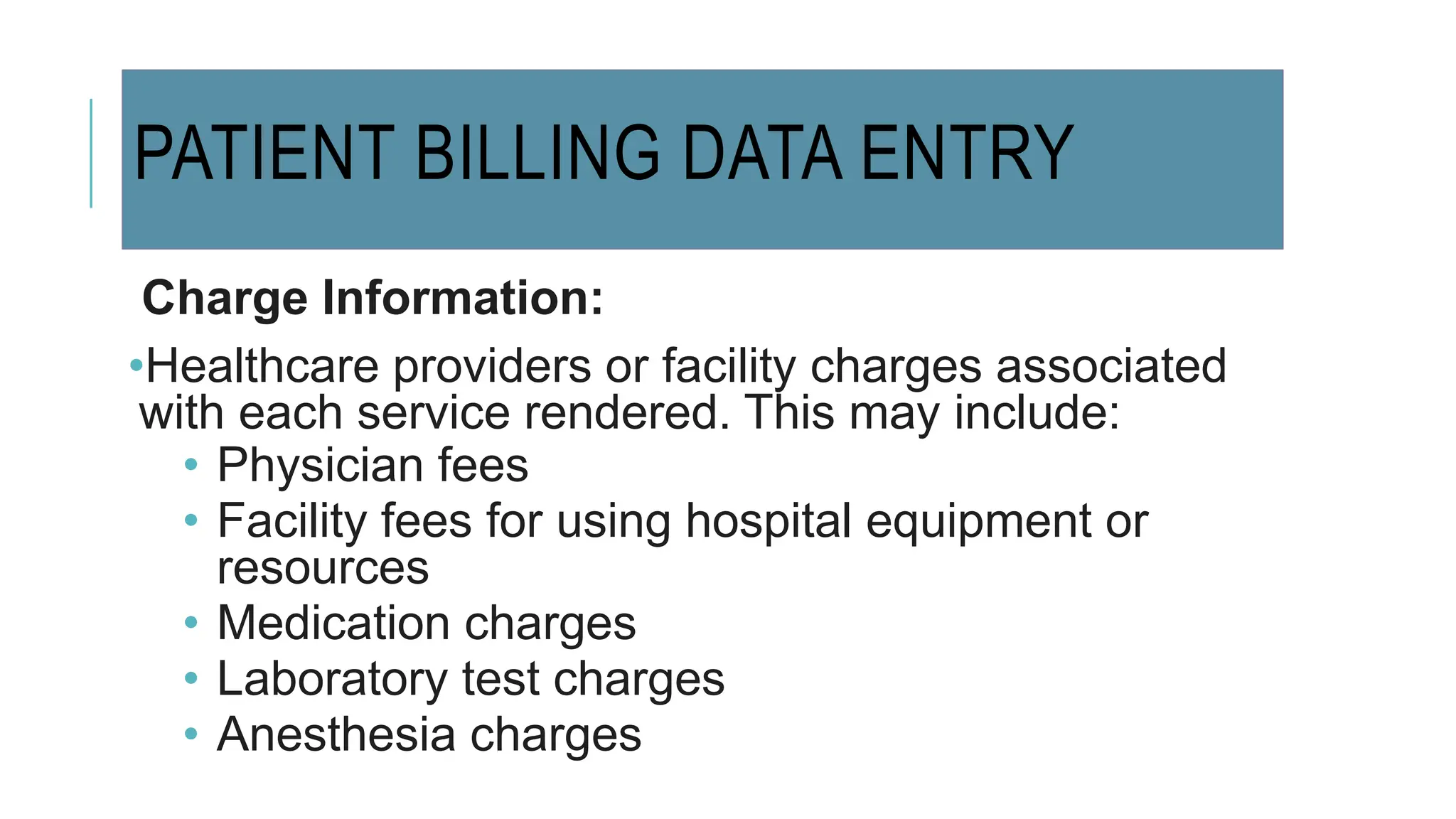
PATIENT BILLING DATA ENTRY
Charge Information:
•Healthcare providers or facility charges associated
with each service rendered. This may include:
• Physician fees
• Facility fees for using hospital equipment or
resources
• Medication charges
• Laboratory test charges
• Anesthesia charges

20. Data Entry in hospital .pptx

  • 1.
    DATA ENTRY INHOSPITAL
  • 2.
    DATA ENTRY INHOSPITAL Data entry is the process of electronically capturing and recording various types of information crucial for patient care, administrative purposes, and billing
  • 3.
    IMPORTANCE OF DATAENTRY Reduce Errors Enhanced Communication Reduced Administrative Burden Improved Scheduling Faster Billing and Reimbursement Easy storing and managing patient information
  • 4.
    TYPES OF DATAENTRY IN HOSPITAL Hospital Records Data Entry Surgical Records Data Entry Tests or Lab Records Data Entry Clinical and Healthcare Records Patient Information Patient Appointments Data Entry Medical Insurance Claim Forms Image Record Data Entry Patient Account Details Entry
  • 5.
    HOSPITAL MEDICAL DATAENTRY Vital Signs: Recording patient vitals like temperature, blood pressure, heart rate, and respiration rate into electronic health records (EHR) or charts. Intake and Output: Documenting fluid intake and output to monitor patient hydration status. Pain Assessments: Entering pain scores using standardized scales. Medication Administration: Recording medications administered to patients, including dosage, route, and time. Nurses Notes: Documenting observations, assessments, interventions, and patient responses throughout the shift.
  • 6.
    HOSPITAL MEDICAL DATAENTRY Indirect Data Entry: Verifying Information: Nurses review pre-populated patient information for accuracy and update as needed. Providing Additional Details: Nurses may clarify or add details to physician orders or progress notes. Flagging Inconsistencies: Identifying discrepancies in the patient record and notifying the appropriate personnel.
  • 7.
    SURGICAL DATA ENTRY •Pre-operativeData • Pre-surgical assessment findings • Allergies and medications • Informed consent documentation •Intra-operative Data • Time of incision and closure • Blood loss • Type of anesthesia used • Instruments and supplies used • Details of the surgical procedure •Post-operative Data • Vital signs • Pain assessments • Fluid intake and output • Medications administered
  • 8.
    TYPES OF DATAENTERED IN LABORATORY •Patient demographics (name, ID, date of birth) •Test ordered (complete name, test code) •Specimen information (type of sample, collection time) •Test results (numerical values, positive/negative indicators) •Reference ranges (normal values for the specific test)
  • 9.
    CLINICAL AND HEALTHCARE RECORDS •Electronic Medical Records (EMR): Digital records containing patient demographics, medical history, diagnoses, medications, allergies, immunizations, procedures, and laboratory results. •Patient Demographics: Basic patient information like name, address, date of birth, insurance details. •Clinical Notes: Physician notes, nursing assessments, progress notes, discharge summaries. •Imaging Results: X-rays, MRIs, CT scans, and other diagnostic images. •Laboratory Results: Blood tests, urine tests, pathology reports.
  • 10.
    PATIENT INFORMATION 1.Demographic Information:This includes basic details about the patient that are essential for identification and administrative purposes. Here are some common examples: 1. Full Name 2. Date of Birth 3. Address 4. Phone Number 5. Email Address (optional) 6. Emergency Contact Information 7. Gender 8. Insurance Details
  • 11.
    MEDICAL INFORMATION This encompassesa more comprehensive set of data related to the patient's health history and current medical condition. Here are some key elements of medical information: Medical History: 1.Past surgeries and procedures 2.Past illnesses and chronic conditions 3.Allergies to medications or substances 4.Immunization records 5.Family medical history (when relevant)
  • 12.
    MEDICAL INFORMATION Current MedicalCondition: 1.Presenting symptoms and complaints 2.Vital signs (temperature, blood pressure, heart rate, respiration rate) 3.Medications currently taken (prescription and over-the- counter) 4.Social history (smoking habits, alcohol consumption, etc.) 5.Lab test results 6.Imaging results (X-rays, MRIs, etc.) 7.Nursing assessments and progress notes 8.Physician diagnoses and treatment plans
  • 13.
    INFORMATION COLLECTED DURING APPOINTMENTSCHEDULING Patient Demographics: Name, date of birth, contact information (phone number, email). Reason for Visit: Brief description of the patient's concern or the type of appointment needed. Insurance Information: Insurance provider and policy details for billing purposes. Referral Information: Referral details if the patient is referred by another healthcare provider. Appointment Availability: Discussing available appointment slots with the patient and their preferences Online Appointment Scheduling: Some facilities allow patients to schedule appointments online through a patient portal.
  • 14.
    DATA ENTRY INMEDICAL INSURANCE CLAIM FORM •Patient Information: Insured's name, address, date of birth, policy information. •Insurance Information: Insurance company details, policy number, group number (if applicable). •Provider Information: Physician or facility name, address, tax ID number. •Patient Encounter Information: Date of service, place of service (office, hospital), diagnosis codes, procedure codes, charges for services rendered. •Certification: Physician or authorized provider's signature and attesting statement.
  • 15.
    IMAGE RECORD DATAENTRY •Patient demographics •Date of imaging study •Type of imaging modality (X-ray, CT scan, etc.) •Body part or area imaged •Referring physician or ordering provider •Findings or preliminary interpretations (based on physician notes)
  • 16.
    PATIENT BILLING DATAENTRY Patient Demographic Information: •Full Name •Date of Birth •Address •Phone Number (optional) •Email Address (optional) •Emergency Contact Information •Gender •Insurance Details (Insurance provider name, policy number, subscriber information)
  • 17.
    PATIENT BILLING DATAENTRY Encounter Information: •Date of Service •Place of Service (e.g., emergency room, outpatient clinic, inpatient room) •Referring Physician (if applicable) •Attending Physician
  • 18.
    PATIENT BILLING DATAENTRY Clinical Information: •Diagnosis Codes (ICD-10): Standardized codes representing the patient's diagnoses based on the International Classification of Diseases. •Procedure Codes (CPT): Standardized codes representing the procedures performed during the healthcare service based on the Current Procedural Terminology. •Other Relevant Clinical Details: This may include information documented in the medical record that supports the codes used for billing, such as lab test results, imaging results, and physician notes (summaries or specific details depending on the situation).
  • 19.
    PATIENT BILLING DATAENTRY Charge Information: •Healthcare providers or facility charges associated with each service rendered. This may include: • Physician fees • Facility fees for using hospital equipment or resources • Medication charges • Laboratory test charges • Anesthesia charges