Autora: Marta GarcíaT.
WEATHERING
Weathering takes place as rocks are broken down
into progressively smaller pieces by the effects of
atmospheric agents (water, ice, wind) and living
beings.
These pieces do not move to a
new location, they simply break down.
Autora: Marta GarcíaT.
There are three types of weathering:
Chemical Weathering: is the descomposition of rocks
through chemical reactions that change its mineral
composition. It is caused by water, mainly.
For example: Oxidation.
Autora: Marta GarcíaT.
Mechanical Weathering: it takes place when rocks are
broken down without any change in its chemical nature.
The rocks are essentially torn apart by physical forces
(of water, wind or living things).
For ex: Freeze-thaw weathering: when water in rocks
freezes, it expands, breaking down materials.
Autora: Marta GarcíaT.
Biological Weathering: it is caused by living
organisms.
http://www.uky.edu/AS/Geology/howell/goodies/elearn
Autora: Marta GarcíaT.
AGENTS THAT SHAPE LANDSCAPE
The agents that shape landscape are water, wind, ice,
gravity and ocean movements. They are responsible for
these geological processes:
1. Erosion: it moves small pieces of weathering rocks to
another place.
2. Transportation: it moves the eroded roch material.
3. Deposition: rock materials are deposited. It occurs
when the transporting agent looses energy.
Autora: Marta GarcíaT.
Which geological process…?
Autora: Marta GarcíaT.
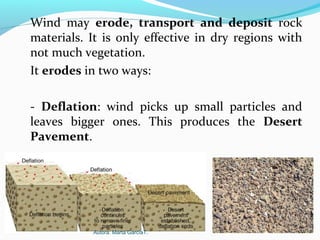
Wind may erode, transport and deposit rock
materials. It is only effective in dry regions with
not much vegetation.
It erodes in two ways:
- Deflation: wind picks up small particles and
leaves bigger ones. This produces the Desert
Pavement.
Autora: Marta GarcíaT.
Abrasion: Small particles carried by the wind erode the
rocks. The results are Mushroom-shaped Rocks and
Arches.
Autora: Marta GarcíaT.
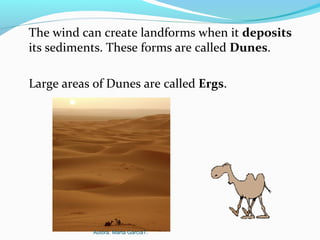
The wind can create landforms when it deposits
its sediments. These forms are called Dunes.
Large areas of Dunes are called Ergs.
Autora: Marta GarcíaT.
Glaciers are masses of moving ice.
We can find them in alpine and polar regions.
The move from high areas to low areas by the
force of gravity.
http://www.youtube.com/watch?v=qm43zJz6SWI&feature=related
Autora: Marta GarcíaT.
Glaciars erode landscape creating:
 Striations: grooves in the bedrock.
Galcial Valleys: U-shaped valleys.
Autora: Marta GarcíaT.
 Glacial Cirques: rounded depressions where snows
accumulate.
http://www.brainpop.com/science/earthsystem/glaciers/
Autora: Marta GarcíaT.
Ice forms Glacial Tongues which carry and deposite rock
material.
http://www.uky.edu/AS/Geology/howell/goodies
/elearning/module13swf.swf
Autora: Marta GarcíaT.
Main glacial deposits are called Moraines (ridges
of material).
Autora: Marta GarcíaT.
Rivers are masses of current water.
They erode, transport and deposit material. The
predominant process on each course depends on
the velocity of water:
Autora: Marta GarcíaT.
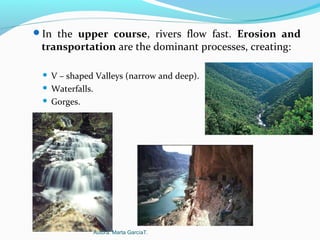
In the upper course, rivers flow fast. Erosion and
transportation are the dominant processes, creating:
 V – shaped Valleys (narrow and deep).
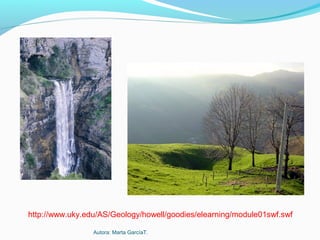
 Waterfalls.
 Gorges.
Autora: Marta GarcíaT.
In the middle course the velocity decreases and
transportation is dominant.
Valleys are wade.
Water forms deep bends called Meanders.
http://www.wwnorton.com/college
/geo/egeo/animations/ch14.htm
Autora: Marta GarcíaT.
In the lower course rivers are slow and deposition
is dominant. Here is the river’s mouth.
If deposited material is pushed into the sea, a Delta
will be formed.
http://www.brainpop.com/science/earthsystem/rivers/
Autora: Marta GarcíaT.
Estuaries and Marshes are coastal areas where fresh
water and salt water meet. They have a very special
biodiversity because of the their particular salt content.
http://iessuel.org/ccnn/flash/cuenca.swf
Autora: Marta GarcíaT.
Karst Landscapes
They are landscapes produced by the dissolving
action of water on soluble rocks (carbonate).
Water dissolves carbonates creating geological
structures on and under the ground surface.
CaCO3 + CO2 + H2O  2 (HCO3)-
+ Ca2+
When water drips inside caves, the dissolved
calcium carbonate forms deposits.
Autora: Marta GarcíaT.
http://esp.brainpop.com/category_45/subcategory_445/subjects_3922/pr
eview.weml
Autora: Marta GarcíaT.
Find a definition for each term
Large underground cavities.
Depressions produced by the
collapse of underground cavities.
Natural resurgence of
groundwater.
Deposits which grow downward
from the cave ceiling.
Horizontal galery.
Deposits which grow upward
from the cave floor.
Vertical galery.
Spring
Stalactite
Doline
Cave
Stalagmite
Tunnel
Shaft
Autora: Marta GarcíaT.
http://www.uky.edu/AS/Geology/howell/goodies/elearning/module01swf.swf
Autora: Marta GarcíaT.
There are three types of water motion in oceans that
model coastal areas:
1. Waves: are mainly caused by the wind. They erode,
transport and deposit materials.
2. Tides: caused by the gravitational atraction of the Moon
and the Sun. They transport materials.
3. Currents: caused by differences of temperature. They
transport materials.
http://www.brainpop.com/science/earthsystem/tides/
Autora: Marta GarcíaT.
Erosion Landforms:
Bays
http://www.brainpop.co
m/science/earthsystem/
oceancurrents/
Autora: Marta GarcíaT.
Cliffs.
Archs.
Stacks
Autora: Marta GarcíaT.
Deposition Landforms:
Beaches.
Spits.
Sandbars.
Autora: Marta GarcíaT.
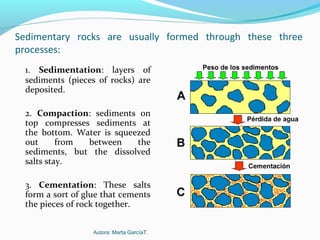
Sedimentary rocks are usually formed through these three
processes:
1. Sedimentation: layers of
sediments (pieces of rocks) are
deposited.
2. Compaction: sediments on
top compresses sediments at
the bottom. Water is squeezed
out from between the
sediments, but the dissolved
salts stay.
3. Cementation: These salts
form a sort of glue that cements
the pieces of rock together.
Autora: Marta GarcíaT.

External dynamics

  • 1.
  • 2.
    WEATHERING Weathering takes placeas rocks are broken down into progressively smaller pieces by the effects of atmospheric agents (water, ice, wind) and living beings. These pieces do not move to a new location, they simply break down. Autora: Marta GarcíaT.
  • 3.
    There are threetypes of weathering: Chemical Weathering: is the descomposition of rocks through chemical reactions that change its mineral composition. It is caused by water, mainly. For example: Oxidation. Autora: Marta GarcíaT.
  • 4.
    Mechanical Weathering: ittakes place when rocks are broken down without any change in its chemical nature. The rocks are essentially torn apart by physical forces (of water, wind or living things). For ex: Freeze-thaw weathering: when water in rocks freezes, it expands, breaking down materials. Autora: Marta GarcíaT.
  • 5.
    Biological Weathering: itis caused by living organisms. http://www.uky.edu/AS/Geology/howell/goodies/elearn Autora: Marta GarcíaT.
  • 6.
    AGENTS THAT SHAPELANDSCAPE The agents that shape landscape are water, wind, ice, gravity and ocean movements. They are responsible for these geological processes: 1. Erosion: it moves small pieces of weathering rocks to another place. 2. Transportation: it moves the eroded roch material. 3. Deposition: rock materials are deposited. It occurs when the transporting agent looses energy. Autora: Marta GarcíaT.
  • 7.
  • 8.
  • 9.
    Wind may erode,transport and deposit rock materials. It is only effective in dry regions with not much vegetation. It erodes in two ways: - Deflation: wind picks up small particles and leaves bigger ones. This produces the Desert Pavement. Autora: Marta GarcíaT.
  • 10.
    Abrasion: Small particlescarried by the wind erode the rocks. The results are Mushroom-shaped Rocks and Arches. Autora: Marta GarcíaT.
  • 11.
    The wind cancreate landforms when it deposits its sediments. These forms are called Dunes. Large areas of Dunes are called Ergs. Autora: Marta GarcíaT.
  • 12.
  • 13.
    Glaciers are massesof moving ice. We can find them in alpine and polar regions. The move from high areas to low areas by the force of gravity. http://www.youtube.com/watch?v=qm43zJz6SWI&feature=related Autora: Marta GarcíaT.
  • 14.
    Glaciars erode landscapecreating:  Striations: grooves in the bedrock. Galcial Valleys: U-shaped valleys. Autora: Marta GarcíaT.
  • 15.
     Glacial Cirques:rounded depressions where snows accumulate. http://www.brainpop.com/science/earthsystem/glaciers/ Autora: Marta GarcíaT.
  • 16.
    Ice forms GlacialTongues which carry and deposite rock material. http://www.uky.edu/AS/Geology/howell/goodies /elearning/module13swf.swf Autora: Marta GarcíaT.
  • 17.
    Main glacial depositsare called Moraines (ridges of material). Autora: Marta GarcíaT.
  • 18.
  • 19.
    Rivers are massesof current water. They erode, transport and deposit material. The predominant process on each course depends on the velocity of water: Autora: Marta GarcíaT.
  • 20.
    In the uppercourse, rivers flow fast. Erosion and transportation are the dominant processes, creating:  V – shaped Valleys (narrow and deep).  Waterfalls.  Gorges. Autora: Marta GarcíaT.
  • 21.
    In the middlecourse the velocity decreases and transportation is dominant. Valleys are wade. Water forms deep bends called Meanders. http://www.wwnorton.com/college /geo/egeo/animations/ch14.htm Autora: Marta GarcíaT.
  • 22.
    In the lowercourse rivers are slow and deposition is dominant. Here is the river’s mouth. If deposited material is pushed into the sea, a Delta will be formed. http://www.brainpop.com/science/earthsystem/rivers/ Autora: Marta GarcíaT.
  • 23.
    Estuaries and Marshesare coastal areas where fresh water and salt water meet. They have a very special biodiversity because of the their particular salt content. http://iessuel.org/ccnn/flash/cuenca.swf Autora: Marta GarcíaT.
  • 24.
  • 25.
    Karst Landscapes They arelandscapes produced by the dissolving action of water on soluble rocks (carbonate). Water dissolves carbonates creating geological structures on and under the ground surface. CaCO3 + CO2 + H2O  2 (HCO3)- + Ca2+ When water drips inside caves, the dissolved calcium carbonate forms deposits. Autora: Marta GarcíaT.
  • 26.
  • 27.
  • 28.
    Find a definitionfor each term Large underground cavities. Depressions produced by the collapse of underground cavities. Natural resurgence of groundwater. Deposits which grow downward from the cave ceiling. Horizontal galery. Deposits which grow upward from the cave floor. Vertical galery. Spring Stalactite Doline Cave Stalagmite Tunnel Shaft Autora: Marta GarcíaT.
  • 29.
  • 30.
  • 31.
    There are threetypes of water motion in oceans that model coastal areas: 1. Waves: are mainly caused by the wind. They erode, transport and deposit materials. 2. Tides: caused by the gravitational atraction of the Moon and the Sun. They transport materials. 3. Currents: caused by differences of temperature. They transport materials. http://www.brainpop.com/science/earthsystem/tides/ Autora: Marta GarcíaT.
  • 32.
  • 33.
  • 34.
  • 35.
  • 36.
  • 37.
    Sedimentary rocks areusually formed through these three processes: 1. Sedimentation: layers of sediments (pieces of rocks) are deposited. 2. Compaction: sediments on top compresses sediments at the bottom. Water is squeezed out from between the sediments, but the dissolved salts stay. 3. Cementation: These salts form a sort of glue that cements the pieces of rock together. Autora: Marta GarcíaT.
  • 38.