EROSION IS THE PROCESS BY WHICH
NATURAL FORCES MOVE WEATHERED ROCK
AND SOIL FROM ONE PLACE TO ANOTHER.
GRAVITY, RUNNING WATER, GLACIERS,
WAVES, AND WIND ALL CAUSE EROSION. THE
MATERIAL MOVED BY EROSION IS
SEDIMENT. WHEN THE AGENTS OF EROSION
LAY DOWN SEDIMENT, DEPOSITION OCCURS.
Erosion
Soil Erosion
Deposition
 Deposition changes the shape of the land.
Weathering, erosion, and deposition act together
in a cycle that wears down and builds up Earth's
surface. This cycle, called the geologic cycle, has
continued for billions of years.
 Erosion and deposition are at work everywhere on
Earth.
Deposition
Erosion and Deposition
 Gravity pulls everything toward the center of Earth. Gravity is
the force that moves rock and other
 materials downhill. Gravity causes mass movement, any one
of several processes that move sediment
 downhill. The different types of mass movement include
landslides, mudflows, slump, and creep.
 Mass movement can be rapid or slow.
 A landslide is a kind of mass movement that occurs when rock
and soil slide rapidly down a steep
 slope. Some landslides contain huge masses of rock, while others
may contain only a small amount of
 rock and soil.
Erosion and Deposition
 A mudflow is the rapid downhill movement of a
mixture of water, rock, and soil. The amount of
water
 in a mudflow can be as high as 60 percent.
Mudflows often occur after heavy rains in a
normally dry area.
 In clay soils with a high water content, mudflows
may occur even on very gentle slopes. An
earthquake
 can trigger both mudflows and landslides.
Erosion and Deposition
 A slump is a type of mass movement in which a mass
of rock and soil rapidly slips down a slope. It
 looks as if someone pulled the bottom out from
under part of the slope. A slump often occurs when
water
 soaks the base of a mass of soil that is rich in clay.
Erosion and Deposition
 Creep is the very slow downhill movement of rock and
soil. It occurs most often on gentle slopes.
 Creep often results from the freezing and thawing of
water in cracked layers of rock beneath the soil.
 Creep is so slow that you can barely notice it, but you
can see its effects in objects such as telephone
 poles, gravestones, and fenceposts. Creep may tilt
these objects at spooky angles.
Water Erosion
 Water running downhill is the major agent of erosion that has
shaped Earth's land surface. The force of a falling raindrop can loosen
and pick up soil particles. As water moves over land, it carries these
particles with it. This moving water is called runoff, which is water that
moves over Earth's surface.
 The amount of runoff in an area depends on five main factors: amount of
rain, amount of vegetation, type of soil, shape of the land, and how people
use the land. As runoff travels, it forms tiny grooves in the soil called rills.
 Rills flow into one another and form larger grooves, called gullies. A gully
is a large groove, or channel, in the soil that carries runoff after a
rainstorm. Gullies join together to form streams.
 A stream is a channel along which water is continually flowing down a
Water Eroded Landforms
Land Forms
Water Erosion
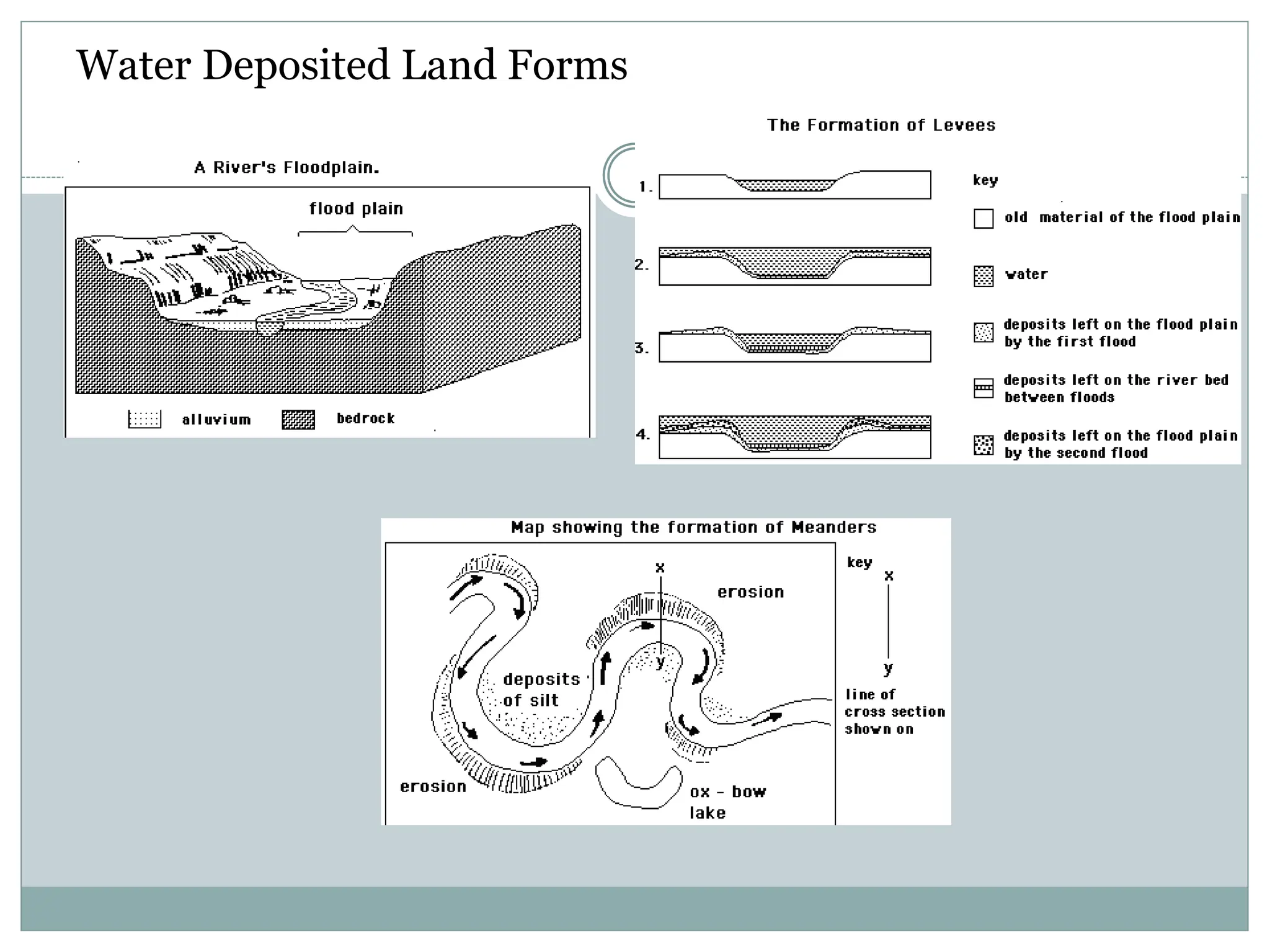
 Through erosion, a river creates valleys, waterfalls, flood
plains, meanders, and oxbow lakes.
 A river's water has energy. Energy is the ability to do work or cause
change. All along a river, the water's energy does work. Rivers often
form on steep mountain slopes. There, a river generally follows a
straight, narrow course, creating a deep, V-shaped valley. Lower down,
a river usually flows over more gently sloping land. The river spreads
out, forming a wide river valley. The flat, wide area of land along a river
is a flood plain. A meander is a looplike bend in the course of a
river. Sometimes a meandering river forms an oxbow lake, a meander
that has been cut off from the river.
Water Deposition
 As water moves, it carries sediment with it. Whenever moving
water slows down, it deposits sediment. Deposition creates
landforms such as alluvial fans and deltas. It can also
add soil to a river's flood plain. When a river flows out of a
mountain valley, the water slows down. Then sediments are
deposited in an alluvial fan, a wide, sloping deposit formed
where a stream leaves a mountain range. A river ends when it
flows into a still body of water, such as an ocean or a lake. There
the water slows down and deposits sediment. This sediment
builds up a landform called a delta. Deposition also occurs
during floods.
Water Deposited Land Forms
Water Deposition
 The ability of a river to cause erosion and carry
sediment depends on several factors. A river is a
dynamic system. A river's slope, volume of
flow, and the shape of its streambed all affect
how fast the river flows and how much
sediment it can erode. The amount of sediment
that a river carries is its load.
Waves and Wind
 Ocean waves contain energy—sometimes a great deal of energy. The
energy in waves comes from wind that blows across the water's
surface.
 Waves are a major force of erosion along coasts. Waves shape the coast
through erosion by breaking down rock and transporting sand
and other sediment. When large waves hit the shore, their
energy can break apart rocks.
 Waves also erode by abrasion. When a sediment-carrying wave hits land,
the sediment wears away rock like sandpaper wearing away wood.
 The energy of incoming waves is concentrated on the headlands. A
headland is a part of the shore that sticks out into the ocean. Over time,
waves erode the headlands and even out the shoreline.
Waves and Wind
 Waves shape a coast when they deposit sediment, forming
coastal features such as beaches, spits, sandbars, and barrier
beaches. As waves reach the shore, they drop the sediment they carry,
forming a beach. A beach is an area of wave-washed sediment along a
coast. As angled waves repeatedly hit the beach, some of the beach
sediment moves down the beach in a process called longshore drift.
One result of longshore drift is the formation of a spit. A spit is a beach
that projects like a finger out into the water. Spits occur where a
headland or another obstacle interrupts longshore drift. Incoming
waves carrying sand may build up sandbars, which are long ridges of
sand parallel to shore. A barrier beach is similar to a sand bar.
Waves and Wind
 A sand dune is a deposit of wind-blown sand. Wind is the
weakest agent of erosion. Yet wind can be a powerful force
in shaping the land in areas where there are few plants to
hold the soil in place.
 Wind causes erosion by deflation and abrasion.
Geologists define deflation as the process by which wind
removes surface materials. Deflation does not usually have
a great effect on the land. In deserts, though, deflation can
sometimes create an area of rock fragments called desert
pavement.
 Abrasion by wind-carried sand can polish rock, but it
causes little erosion.
Land Forms by Wind Action
Waves and Wind
 All sediment picked up by wind eventually falls to
the ground. This happens when wind slows down
or some obstacle, such as a boulder or clump of
grass, traps the windblown sand and other
sediment.
 Wind erosion and deposition may form
sand dunes and loess deposits. Sand dunes
can be seen on beaches and in deserts where
windblown sediment has built up. Sediment that is
finer than sand is sometimes deposited in layers
far from its source. This fine, wind-deposited
sediment is loess.
Glaciers
 A glacier is any large mass of ice that moves slowly
over land. There are two kinds of glaciers—
continental glaciers and valley glaciers.
 A continental glacier is a glacier that covers much
of a continent or large island. Today, continental
glaciers cover about 10 percent of Earth's land,
including Antarctica and most of Greenland.
Continental glaciers can flow in all directions.
Glaciers
 Many times in the past, continental glaciers have
covered large parts of Earth's surface. These times are
known as ice ages. Beginning about 2.5 million years
ago, continental glaciers advanced and retreated, or
melted back, several times. They finally retreated
about 10,000 years ago. A valley glacier is a long,
narrow glacier that forms when snow and ice build up
high in a mountain valley. Valley glaciers are found on
many high mountains.
Glaciers
 Glaciers can form only in an area where more
snow falls than melts. Once the depth of snow
and ice reaches more than 30 to 40 meters,
gravity begins to pull the glacier downhill.
Valley glaciers move, or flow, at a rate of a few
centimeters to a few meters per day. Sometimes a
valley glacier slides down more quickly in what is
called a surge.
Glaciers
 The movement of a glacier changes the land
beneath it. Although glaciers work slowly, they are
a major force of erosion. The two processes by
which glaciers erode the land are plucking
and abrasion. As a glacier flows over the land, it
picks up rocks in a process called plucking.
Plucking can move even huge boulders. Many
rocks remain on the bottom of a glacier, and the
glacier drags them across the land. This process,
called abrasion, gouges and scratches the bedrock.
Glaciers
 A glacier gathers huge amounts of rock and soil as it moves.
When a glacier melts, it deposits the sediment it
eroded from the land, creating various landforms.
The mixture of sediments that a glacier deposits directly on
the surface is called till. The till deposited at the edges of a
glacier forms a ridge called a moraine. A terminal
moraine is the ridge of till at the farthest point reached by a
glacier. Retreating glaciers also create features called
kettles. A kettle is a small depression that forms when a
chunk of ice is left in glacial till. When the ice melts, the
kettle remains. A kettle that is filled with water is called a
kettle lake.
Erosion and Deposition
 A. Erosion: Process by which weathered rock is
removed
 B. Deposition: Process by which sediments are laid
down in a new location
 C. 5 Agents of Erosion
Gravity: Mass Wasting
 1. Rapid: Landslides and Mudslides
 2. Slow: Earth flows and Soil creep
Running water
1. The major cause of erosion
2. Runoff and Erosion
a. Rain can: Evaporate, Soak into soil or RUNOFF
b. Amount of runoff affected by:
i. Amount of rainfall
ii. Plant population
iii. Shape of the land
iv. Soil saturation
c. Rills – Gullies - Stream- Tributaries- Rivers
Running water
 d. Load: Sediment/debris carried by the stream
i. Tumbled across the stream bottom
ii. Carried in the water column
iii. Dissolved
 e. River Systems
i. Drainage System: network of the actual streams,
tributaries and rivers
ii. Drainage Basin: the area drained by the drainage
System
iii. Divides: Continental divide
 f. Life Cycle of a River
Running water
 i. Immature
1. Steep Sided “V” shaped valleys
2. Waterfalls and Rapids
3. Narrow valleys
4. Fast moving > erosion and loads
 ii. Mature
1. Very wide valleys
2. Slow moving
3. few rapids or waterfalls
4. Meandering and oxbows
5. < load and erosion
Running water
 g. Deposits by the River
i. Erode outside of curve
ii. Deposit on inside of curve
iii. Oxbow lakes develop
iv. Alluvial fans: sediments deposited when fast river
leaves mountains and dumps into slow valley
v. Delta: River leaves valley and dumps into the ocean
vi. Flood Plains and Levees
1. Levees: floods ridge like deposits of large particles
2. Flood Plains: very fertile soil from flooded water
Waves
 Crash against rocks cause erosion in three ways
a. Abrasion
b. Hydraulics: water can’t be compressed- forced
into cracks breaks rock
c. Salt water dissolves rock
Wind
1. Erosion by abrasion
2. Most common in deserts and beaches
3. Dunes: Windward, crest and slipface sides
4. Loess: Wind carried many kilometers away:
Mississippi River valley and Gobi Desert
Large mass of moving Ice and Snow
1. Erode by abrasion
2. Load: mixture of Till
3. Terminal Moraine: End point of glacier
4. Lateral Moraine: side deposit
5. Drumlin: Oval mounds of Till
6. Meltwater Stream: stream formed when
glacier melts
7. Outwash Plains: “floodplain” of the glacier
8. Kettle Lakes
Physical elements of Erosion & Deposition

Physical elements of Erosion & Deposition

  • 2.
    EROSION IS THEPROCESS BY WHICH NATURAL FORCES MOVE WEATHERED ROCK AND SOIL FROM ONE PLACE TO ANOTHER. GRAVITY, RUNNING WATER, GLACIERS, WAVES, AND WIND ALL CAUSE EROSION. THE MATERIAL MOVED BY EROSION IS SEDIMENT. WHEN THE AGENTS OF EROSION LAY DOWN SEDIMENT, DEPOSITION OCCURS. Erosion
  • 3.
  • 5.
    Deposition  Deposition changesthe shape of the land. Weathering, erosion, and deposition act together in a cycle that wears down and builds up Earth's surface. This cycle, called the geologic cycle, has continued for billions of years.  Erosion and deposition are at work everywhere on Earth.
  • 6.
  • 7.
    Erosion and Deposition Gravity pulls everything toward the center of Earth. Gravity is the force that moves rock and other  materials downhill. Gravity causes mass movement, any one of several processes that move sediment  downhill. The different types of mass movement include landslides, mudflows, slump, and creep.  Mass movement can be rapid or slow.  A landslide is a kind of mass movement that occurs when rock and soil slide rapidly down a steep  slope. Some landslides contain huge masses of rock, while others may contain only a small amount of  rock and soil.
  • 8.
    Erosion and Deposition A mudflow is the rapid downhill movement of a mixture of water, rock, and soil. The amount of water  in a mudflow can be as high as 60 percent. Mudflows often occur after heavy rains in a normally dry area.  In clay soils with a high water content, mudflows may occur even on very gentle slopes. An earthquake  can trigger both mudflows and landslides.
  • 9.
    Erosion and Deposition A slump is a type of mass movement in which a mass of rock and soil rapidly slips down a slope. It  looks as if someone pulled the bottom out from under part of the slope. A slump often occurs when water  soaks the base of a mass of soil that is rich in clay.
  • 10.
    Erosion and Deposition Creep is the very slow downhill movement of rock and soil. It occurs most often on gentle slopes.  Creep often results from the freezing and thawing of water in cracked layers of rock beneath the soil.  Creep is so slow that you can barely notice it, but you can see its effects in objects such as telephone  poles, gravestones, and fenceposts. Creep may tilt these objects at spooky angles.
  • 11.
    Water Erosion  Waterrunning downhill is the major agent of erosion that has shaped Earth's land surface. The force of a falling raindrop can loosen and pick up soil particles. As water moves over land, it carries these particles with it. This moving water is called runoff, which is water that moves over Earth's surface.  The amount of runoff in an area depends on five main factors: amount of rain, amount of vegetation, type of soil, shape of the land, and how people use the land. As runoff travels, it forms tiny grooves in the soil called rills.  Rills flow into one another and form larger grooves, called gullies. A gully is a large groove, or channel, in the soil that carries runoff after a rainstorm. Gullies join together to form streams.  A stream is a channel along which water is continually flowing down a
  • 12.
  • 13.
    Water Erosion  Througherosion, a river creates valleys, waterfalls, flood plains, meanders, and oxbow lakes.  A river's water has energy. Energy is the ability to do work or cause change. All along a river, the water's energy does work. Rivers often form on steep mountain slopes. There, a river generally follows a straight, narrow course, creating a deep, V-shaped valley. Lower down, a river usually flows over more gently sloping land. The river spreads out, forming a wide river valley. The flat, wide area of land along a river is a flood plain. A meander is a looplike bend in the course of a river. Sometimes a meandering river forms an oxbow lake, a meander that has been cut off from the river.
  • 14.
    Water Deposition  Aswater moves, it carries sediment with it. Whenever moving water slows down, it deposits sediment. Deposition creates landforms such as alluvial fans and deltas. It can also add soil to a river's flood plain. When a river flows out of a mountain valley, the water slows down. Then sediments are deposited in an alluvial fan, a wide, sloping deposit formed where a stream leaves a mountain range. A river ends when it flows into a still body of water, such as an ocean or a lake. There the water slows down and deposits sediment. This sediment builds up a landform called a delta. Deposition also occurs during floods.
  • 15.
  • 16.
    Water Deposition  Theability of a river to cause erosion and carry sediment depends on several factors. A river is a dynamic system. A river's slope, volume of flow, and the shape of its streambed all affect how fast the river flows and how much sediment it can erode. The amount of sediment that a river carries is its load.
  • 17.
    Waves and Wind Ocean waves contain energy—sometimes a great deal of energy. The energy in waves comes from wind that blows across the water's surface.  Waves are a major force of erosion along coasts. Waves shape the coast through erosion by breaking down rock and transporting sand and other sediment. When large waves hit the shore, their energy can break apart rocks.  Waves also erode by abrasion. When a sediment-carrying wave hits land, the sediment wears away rock like sandpaper wearing away wood.  The energy of incoming waves is concentrated on the headlands. A headland is a part of the shore that sticks out into the ocean. Over time, waves erode the headlands and even out the shoreline.
  • 18.
    Waves and Wind Waves shape a coast when they deposit sediment, forming coastal features such as beaches, spits, sandbars, and barrier beaches. As waves reach the shore, they drop the sediment they carry, forming a beach. A beach is an area of wave-washed sediment along a coast. As angled waves repeatedly hit the beach, some of the beach sediment moves down the beach in a process called longshore drift. One result of longshore drift is the formation of a spit. A spit is a beach that projects like a finger out into the water. Spits occur where a headland or another obstacle interrupts longshore drift. Incoming waves carrying sand may build up sandbars, which are long ridges of sand parallel to shore. A barrier beach is similar to a sand bar.
  • 19.
    Waves and Wind A sand dune is a deposit of wind-blown sand. Wind is the weakest agent of erosion. Yet wind can be a powerful force in shaping the land in areas where there are few plants to hold the soil in place.  Wind causes erosion by deflation and abrasion. Geologists define deflation as the process by which wind removes surface materials. Deflation does not usually have a great effect on the land. In deserts, though, deflation can sometimes create an area of rock fragments called desert pavement.  Abrasion by wind-carried sand can polish rock, but it causes little erosion.
  • 20.
    Land Forms byWind Action
  • 21.
    Waves and Wind All sediment picked up by wind eventually falls to the ground. This happens when wind slows down or some obstacle, such as a boulder or clump of grass, traps the windblown sand and other sediment.  Wind erosion and deposition may form sand dunes and loess deposits. Sand dunes can be seen on beaches and in deserts where windblown sediment has built up. Sediment that is finer than sand is sometimes deposited in layers far from its source. This fine, wind-deposited sediment is loess.
  • 22.
    Glaciers  A glacieris any large mass of ice that moves slowly over land. There are two kinds of glaciers— continental glaciers and valley glaciers.  A continental glacier is a glacier that covers much of a continent or large island. Today, continental glaciers cover about 10 percent of Earth's land, including Antarctica and most of Greenland. Continental glaciers can flow in all directions.
  • 23.
    Glaciers  Many timesin the past, continental glaciers have covered large parts of Earth's surface. These times are known as ice ages. Beginning about 2.5 million years ago, continental glaciers advanced and retreated, or melted back, several times. They finally retreated about 10,000 years ago. A valley glacier is a long, narrow glacier that forms when snow and ice build up high in a mountain valley. Valley glaciers are found on many high mountains.
  • 24.
    Glaciers  Glaciers canform only in an area where more snow falls than melts. Once the depth of snow and ice reaches more than 30 to 40 meters, gravity begins to pull the glacier downhill. Valley glaciers move, or flow, at a rate of a few centimeters to a few meters per day. Sometimes a valley glacier slides down more quickly in what is called a surge.
  • 25.
    Glaciers  The movementof a glacier changes the land beneath it. Although glaciers work slowly, they are a major force of erosion. The two processes by which glaciers erode the land are plucking and abrasion. As a glacier flows over the land, it picks up rocks in a process called plucking. Plucking can move even huge boulders. Many rocks remain on the bottom of a glacier, and the glacier drags them across the land. This process, called abrasion, gouges and scratches the bedrock.
  • 26.
    Glaciers  A glaciergathers huge amounts of rock and soil as it moves. When a glacier melts, it deposits the sediment it eroded from the land, creating various landforms. The mixture of sediments that a glacier deposits directly on the surface is called till. The till deposited at the edges of a glacier forms a ridge called a moraine. A terminal moraine is the ridge of till at the farthest point reached by a glacier. Retreating glaciers also create features called kettles. A kettle is a small depression that forms when a chunk of ice is left in glacial till. When the ice melts, the kettle remains. A kettle that is filled with water is called a kettle lake.
  • 27.
    Erosion and Deposition A. Erosion: Process by which weathered rock is removed  B. Deposition: Process by which sediments are laid down in a new location  C. 5 Agents of Erosion
  • 28.
    Gravity: Mass Wasting 1. Rapid: Landslides and Mudslides  2. Slow: Earth flows and Soil creep
  • 29.
    Running water 1. Themajor cause of erosion 2. Runoff and Erosion a. Rain can: Evaporate, Soak into soil or RUNOFF b. Amount of runoff affected by: i. Amount of rainfall ii. Plant population iii. Shape of the land iv. Soil saturation c. Rills – Gullies - Stream- Tributaries- Rivers
  • 30.
    Running water  d.Load: Sediment/debris carried by the stream i. Tumbled across the stream bottom ii. Carried in the water column iii. Dissolved  e. River Systems i. Drainage System: network of the actual streams, tributaries and rivers ii. Drainage Basin: the area drained by the drainage System iii. Divides: Continental divide  f. Life Cycle of a River
  • 31.
    Running water  i.Immature 1. Steep Sided “V” shaped valleys 2. Waterfalls and Rapids 3. Narrow valleys 4. Fast moving > erosion and loads  ii. Mature 1. Very wide valleys 2. Slow moving 3. few rapids or waterfalls 4. Meandering and oxbows 5. < load and erosion
  • 32.
    Running water  g.Deposits by the River i. Erode outside of curve ii. Deposit on inside of curve iii. Oxbow lakes develop iv. Alluvial fans: sediments deposited when fast river leaves mountains and dumps into slow valley v. Delta: River leaves valley and dumps into the ocean vi. Flood Plains and Levees 1. Levees: floods ridge like deposits of large particles 2. Flood Plains: very fertile soil from flooded water
  • 33.
    Waves  Crash againstrocks cause erosion in three ways a. Abrasion b. Hydraulics: water can’t be compressed- forced into cracks breaks rock c. Salt water dissolves rock
  • 34.
    Wind 1. Erosion byabrasion 2. Most common in deserts and beaches 3. Dunes: Windward, crest and slipface sides 4. Loess: Wind carried many kilometers away: Mississippi River valley and Gobi Desert
  • 35.
    Large mass ofmoving Ice and Snow 1. Erode by abrasion 2. Load: mixture of Till 3. Terminal Moraine: End point of glacier 4. Lateral Moraine: side deposit 5. Drumlin: Oval mounds of Till 6. Meltwater Stream: stream formed when glacier melts 7. Outwash Plains: “floodplain” of the glacier 8. Kettle Lakes