s
DEPARTMENT OF CIVIL ENINEERING
VISVESVARAYA TECHNOLOGICAL UNIVERSITY
Jnana Sangama, Belagavi – 590014
PROJECT REPORT
ON
“EXTENSIVE SURVEY PROJECT-18CVEP68”
(From 29/03/2021 to 12/04/2021 Held at Kempegowda Layout, Bengaluru)
Submitted in the partial fulfillment of the requirement for the 6th
semester
BACHELOR OF ENGINEERING
In
CIVIL ENGINEERING
Submitted by
SATHISH CHOUDARY 1DB16CV038
RANJAN GOWDA M 1DB18CV425
MD SHUKRULLA KHAN 1DB18CV019
SANDESH K GOWDA 1DB18CV031
SUVARNA 1DB18CV039
POORVIKA M R 1DB18CV406
SATHISH T C 1DB19CV408
CAMP OFFICER:
Mr. Sadashivaiah
Assistant Professor
DEPARTMENT OF CIVIL ENGINEERING
DON BOSCO INSTITUTE OF TECHNOLOGY
Kumbalagodu, Mysore road, Bengaluru-74
2020-2021
EXTENSIVE SURVEY PROJECT(18CVEP68) 2020
DEPT. OF CIVIL ENGG, DBIT , Bengaluru
VISVESVARAYA TECHNOL
“Jnana Sangama
DEPARTMENT OF CIVIL ENGINEERING
DON BOSCO INSTITUTE OF TECHNOLOGY
Kumbalagodu, Mysore road, Bengaluru
This is to certify that SATHISH CHOUDARY
SHUKRULLA KHAN(1DB18CV019), SANDESH K GOWDA
M R(1DB19CV406), SATHISH T C(1DB19CV408)
SURVEY PROJECT-18CVEP68”
Bengaluru, prescribed by the Visvesvaraya Technological University as a
academic requirement for6th
Engineeringcurriculum for the year 2020
Mr. Sadashivaiah
Assistant Professor
(Camp Officer)
Examiner-1………………..
Examiner-2………………..
(18CVEP68) 2020
CIVIL ENGG, DBIT , Bengaluru-560074
VISVESVARAYA TECHNOLOGICAL UNIVERSITY
Jnana Sangama”, Belagavi 590018
DEPARTMENT OF CIVIL ENGINEERING
DON BOSCO INSTITUTE OF TECHNOLOGY
Kumbalagodu, Mysore road, Bengaluru-74
CERTIFICATE
SATHISH CHOUDARY(1DB16CV038),RANJAN GOWDA M(1DB18CV425),
SANDESH K GOWDA(1DB18CV031), SUVARNA(1DB18CV039),
(1DB19CV408) have successfully completed the
18CVEP68” from 29/03/2021 to 12/04/2021 held at Kempegowda Layout,
Bengaluru, prescribed by the Visvesvaraya Technological University as a partial fulfillment
th
semester of Bachelorof Engineering in Civil
curriculum for the year 2020-2021.
Dr. R L Ramesh Dr.Hemadri
Professor & HOD
(18CVEP68) 2020-21
Page 2
OGICAL UNIVERSITY
DON BOSCO INSTITUTE OF TECHNOLOGY
(1DB18CV425), MD
(1DB18CV039), POORVIKA
have successfully completed the “EXTENSIVE
held at Kempegowda Layout,
partial fulfillment of
Bachelorof Engineering in Civil
Dr.HemadriNaidu T
Principal
EXTENSIVE SURVEY PROJECT(18CVEP68) 2020
DEPT. OF CIVIL ENGG, DBIT , Bengaluru
VISVESVARAYA TECHNOL
“JnanaSangama
DON BOSCO INSTITUTE OF TECHNOLOGY
Kumbalagodu, Mysore road, Bengaluru
DEPARTMENT OF CIVIL ENGINEERING
We SATHISH CHOUDARY(1DB16CV038),
KHAN(1DB18CV019), SANDESH K GOWDA
R(1DB19CV406), SATHISH T C(1DB19CV408)
Don Bosco Institute of Technology,
“EXTENSIVE SURVEY PROJECT
partial fulfilment of the 6th
semesterAcademic requirement of
Visvesvaraya Technological Universi
the matter embodied in this report,has not been submitted previously by anybody or to any other
university.
SATHISH CHOUDARY(1DB16CV038)
(18CVEP68) 2020
CIVIL ENGG, DBIT , Bengaluru-560074
VISVESVARAYA TECHNOLOGICAL UNIVERSITY
JnanaSangama”, Belagavi 590018
DON BOSCO INSTITUTE OF TECHNOLOGY
Kumbalagodu, Mysore road, Bengaluru-74
DEPARTMENT OF CIVIL ENGINEERING
DECLARATION
(1DB16CV038), RANJAN GOWDA M(1DB18CV425),
SANDESH K GOWDA(1DB18CV031), SUVARNA(1DB18CV039),
(1DB19CV408) Students of sixth semester, B. E in Civil Engineering,
Don Bosco Institute of Technology,hereby declare that the entire work embodied in this
“EXTENSIVE SURVEY PROJECT-18CVEP68”has been carried out by usand submitted in
semesterAcademic requirement of B. E. in Civil Engineering,
Visvesvaraya Technological University, Belagavi, during the academic year 2020
the matter embodied in this report,has not been submitted previously by anybody or to any other
Signature of the Candidate
RANJAN GOWDA M(1DB18CV425
(18CVEP68) 2020-21
Page 3
OGICAL UNIVERSITY
DON BOSCO INSTITUTE OF TECHNOLOGY
MD SHUKRULLA
(1DB18CV039), POORVIKA M
, B. E in Civil Engineering,
hereby declare that the entire work embodied in this
has been carried out by usand submitted in
B. E. in Civil Engineering,
2020-2021. Further
the matter embodied in this report,has not been submitted previously by anybody or to any other
Signature of the Candidate
1DB18CV425)
EXTENSIVE SURVEY PROJECT(18CVEP68) 2020-21
DEPT. OF CIVIL ENGG, DBIT , Bengaluru-560074 Page 4
MD SHUKRULLA KHAN(1DB18CV019) SANDESH K GOWDA(1DB18CV031
AKNOWLEDGEMENT
The satisfaction and euphoria that accompany the successful completion of any task would be in
complete without mention of the people who made it possible and under whose constant guidance
and encouragement the task was complete
We express ourgratitude to the Chairman Mr.B. Bylappa. Executive Director Mr.P.B.Manjunath,
and Secretary Mr.RaghavBylappa for providing a very good Infrastructure and Opportunity to
complete my academic requirements in this esteemed organization.
We express our sincere gratitude to Dr. Hemadri Naidu T, Principal, Don Bosco Institute of
Technology, Bengaluru for his timely help and inspiration during the tenure of the course.
We expressour profuse Gratitude to Dr. R L Ramesh,Professor and Head of the Departmentof
Civil Engineering, Don Bosco Institute of Technology, Bengaluru, for his timely co-operation while
carryingout this project work.
We would like to express our deep felt gratitude to Camp Officer Mr. Sadashivaiah, Asst.
Professor, Department of Civil Engineering, Don Bosco Institute of Technology, Bengaluru, for
his guidance, encouragement and support throughout the course of this work.
We would like to express our sincere gratitude to all teaching faculties, Department of Civil
Engineering, Don Bosco Institute of Technology, Bengaluru, for their guidance, encouragement and
support throughout the course of this work.
We would like to express our sincere gratitude to all non-teaching staff, Department of Civil
Engineering, Don Bosco Institute of Technology, Bengaluru,who havedirectly or indirectly helped
throughout the course of this work.
Finally, we express our whole hearted thanks to our Parents and Friends for their support and care
in completion of project work successfully.
EXTENSIVE SURVEY PROJECT(18CVEP68) 2020-21
DEPT. OF CIVIL ENGG, DBIT , Bengaluru-560074 Page 5
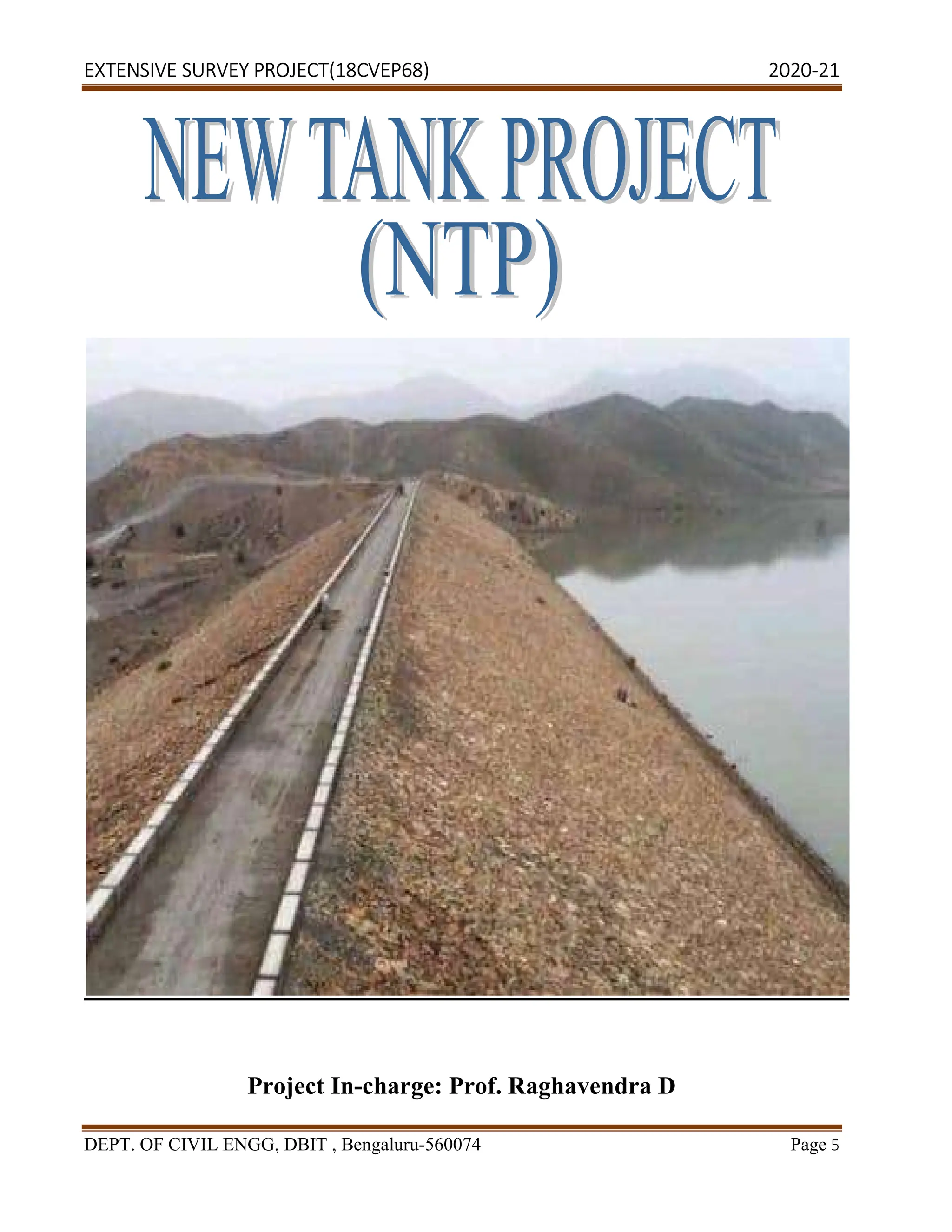
Project In-charge: Prof. Raghavendra D
EXTENSIVE SURVEY PROJECT(18CVEP68) 2020-21
DEPT. OF CIVIL ENGG, DBIT , Bengaluru-560074 Page 6
CONTENTS
SL NO, PARTICULARS Page No
1. INTRODUCTION
2. OBJECTIVE
3. STUDY OF THE TOPOSHEET
4. RESERVIOR
5. DAM
6. CANAL
7. SURVEY CONDUCTION FOR NEW TANK PROJECT
8. INVESTIGATION FOR RESERVOIR PLANNING
9. SELECTION SITE FOR RESERVOIR
10. WEIR
11. SELECTION SITE FOR WEIR
12. REQUIREMENTS OF CANAL LINING MATERIAL
13. SELECTION OF EARTHAN DAM
14. DESIGN AND CALCULATION
EXTENSIVE SURVEY PROJECT(18CVEP68) 2020-21
DEPT. OF CIVIL ENGG, DBIT , Bengaluru-560074 Page 7
1.Introduction
New tanks are constructed to provide water for multipurpose. Tanks and reservoirs
requires careful planning, design, and operation for which certain observations relating to
selection of site, relative merits of different types of tanks, storage capacity, coordinated use of
storage for different purposes etc. are studied in detail.
The formation of new tank near SHREE KSHETRA MUKTHI NAGA TEMPLE has taken up
as mini project work as per university regulations.
2.Object of New Tank Project
The main object of the new tank is to construct an earthen dam across the steam for the
purpose of irrigation. Since the land to be irrigated is very small and population of the town is
very less, it is not necessary to construct a major work but it is sufficient to provide minor tank
project.
The new tank project (NTP) involves three major operations.
• The Selection of site for proposed dam
• The selection of site for waste weir
• The selection of site for canal alignment
3. Study of Toposheet
This sheet gives the topographical features of the locality like alignment of a railway line,
roadway, streams and its distributaries and permanent structures located in that locality. This
map helps in selecting the site for a new tank and also gives clear picture of transportation to the
proposed area in proposed site for the transportation of men and material for their construction.
From this we can know the approximate catchment area of site. This map has to be study before
reconnaissance survey.
EXTENSIVE SURVEY PROJECT(18CVEP68) 2020-21
DEPT. OF CIVIL ENGG, DBIT , Bengaluru-560074 Page 8
4.Reservoir
A storage structure for irrigation is formed by an embankment or dam across a natural
water course or river and the water collected on the upper side of the structure. Water is drawn
by means of the sluices in the dam, through the channels which supply water to the irrigation
land.
 Necessity:
Storage reservoirs are very much necessary for the following reasons;
• When in an area, the usual rainfall is not enough for the crops; water is stored in
reservoirs and allowed to lands whenever necessary.
• In some areas, the rainfall may be confined to certain parts of the year, and even
here water will have to be first stored and then distributed to the lands during the other
periods of the year.
• In the places like Baluchistan and Rajasthan, where the streams flow like
torrents for only a few days in the year, storage is a necessity to endure the proper water
supply to the crops.
 Requirements of A Storage Reservoir
An ideal reservoir should satisfy the following conditions:
• It should have a channel bringing down an ample supply of water
• There should be a board expense of nearly level ground in front of embankment
or dam to form the bed of the reservoir, having a slight dip towards the bund.
• The land to the rear or the downstream side of the bund should be much greater
extent than the bed and slightly lower in level, in order that every portion of it may be
commanded by the tank and the water to the fields.
• Rock or other foundation, impervious to water, should be met at only a small
depth from the surface.
EXTENSIVE SURVEY PROJECT(18CVEP68) 2020-21
DEPT. OF CIVIL ENGG, DBIT , Bengaluru-560074 Page 9
• Stone, fuel, lime and other materials required for the construction should be
available within a reasonable distance for a masonry dam and good suitable earth, as
well as stones for pitching, for an earthen dam.
• The soil for the construction of earthen dam for the reservoir should be retentive
nature.
• Valuable garden lands or wells or village sites submerged under the reservoir
contour.
• The site selected should give the required storage with the shortest length of the
dam.
• The site should be favourable to locate the waste weir preferably in a saddle, so as
to pass off all the flood water into the natural drainage steam without artificial ones and
protects the embankment.
5.Dam
A Dam is an impregnable and impervious barrier thrown across a natural drainage line
to impound water up to a certain limiting height which is usually lower than the top of the dam
on its upstream side. Its main function is to store water either for irrigation or water supply or
produce power.
Choice of the type of the dam: -
 Classification of Dams
Dams are usually classified as
Rigid dams.
1. Gravity dam
2. Arched dam
3. Arched buttress dam
4. Steel dam
5. Timber dam
6. Reinforced cement concrete panel and buttress dams.
EXTENSIVE SURVEY PROJECT(18CVEP68) 2020-21
DEPT. OF CIVIL ENGG, DBIT , Bengaluru-560074 Page 10
Non – rigid dams
1. Earthen dams.
2. Rock fill dams.
 Earthen Dams
Earthen dams and earthen embankments are the most ancient type of embankments as they
can be built with the natural materials with a minimum of processing and with primitive equipment.
Earthen dams are classified as follows:
Type A – Homogeneous embankment type
Type B – Zoned embankment type
Type C – Diaphragm type
 Homogeneous embankment:
The simplest type of earthen embankment consists of a single material and is homogeneous
throughout sometimes a blanket of impervious material may be placed on the upstream face. A
purely homogeneous section is used when only one type of material is economically or locally
available such sections is used for low to moderately high dams and for large dams are designed as
homogeneous embankment.
 Zoned embankment:
Zoned embankments are usually provided with a central previous core, covered by a
comparatively previous transition zone which is finally surrounded by much more previous outer
zone. The outer zone gives stability to the central impervious fill and also distributes the load over a
layer area of foundation.
 Diaphragm embankment: -
Diaphragm type embankment has a thin impervious core, which is surrounded by earth or
rock fill. The impervious core called diaphragm is made up of impervious soil, concrete, steel,
timber or any other materials. Its acts as a water barrier to prevent escape through the dam. The
diaphragm may be placed either at the central or at the upstream face as a blanket.
EXTENSIVE SURVEY PROJECT(18CVEP68) 2020-21
DEPT. OF CIVIL ENGG, DBIT , Bengaluru-560074 Page 11
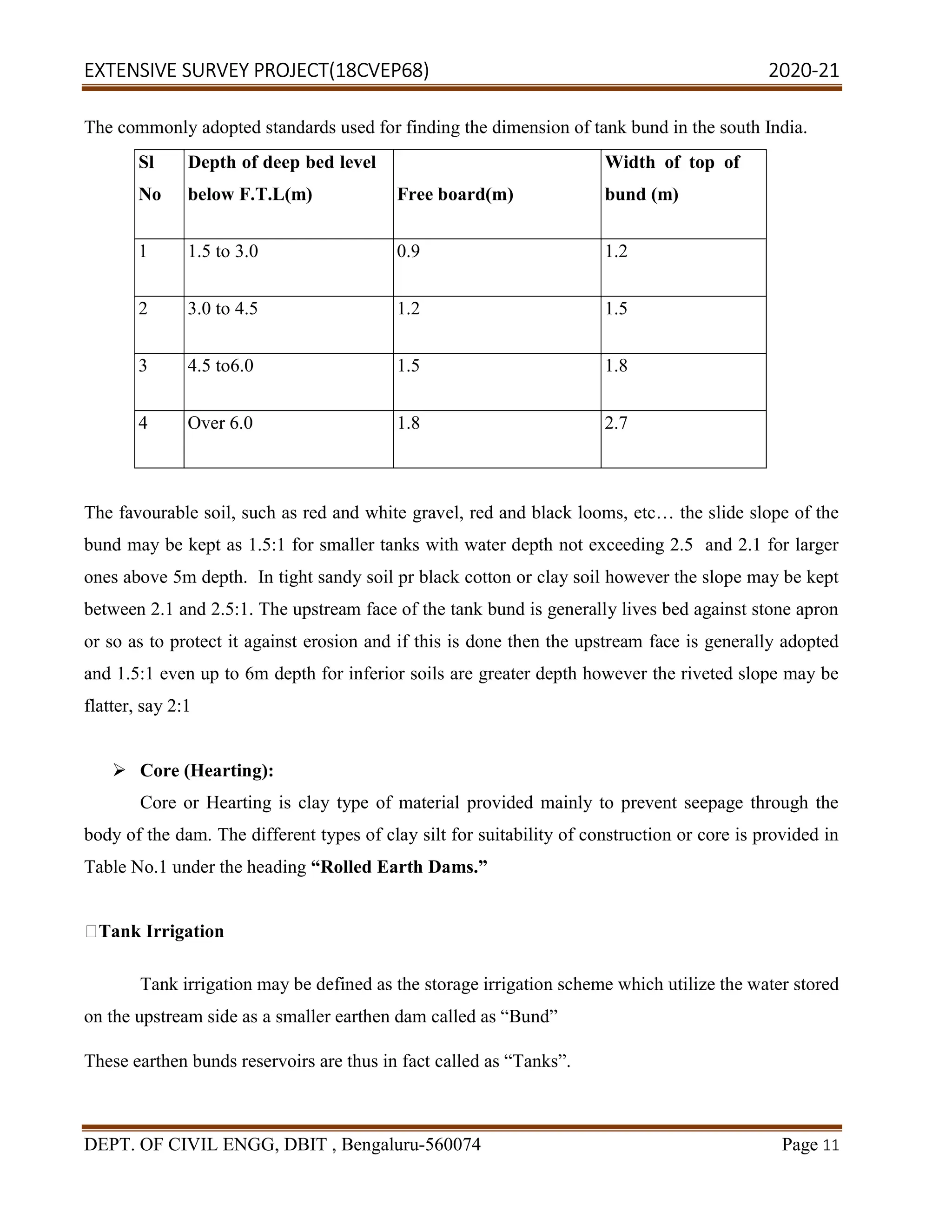
The commonly adopted standards used for finding the dimension of tank bund in the south India.
Sl
No
Depth of deep bed level
below F.T.L(m) Free board(m)
Width of top of
bund (m)
1 1.5 to 3.0 0.9 1.2
2 3.0 to 4.5 1.2 1.5
3 4.5 to6.0 1.5 1.8
4 Over 6.0 1.8 2.7
The favourable soil, such as red and white gravel, red and black looms, etc… the slide slope of the
bund may be kept as 1.5:1 for smaller tanks with water depth not exceeding 2.5 and 2.1 for larger
ones above 5m depth. In tight sandy soil pr black cotton or clay soil however the slope may be kept
between 2.1 and 2.5:1. The upstream face of the tank bund is generally lives bed against stone apron
or so as to protect it against erosion and if this is done then the upstream face is generally adopted
and 1.5:1 even up to 6m depth for inferior soils are greater depth however the riveted slope may be
flatter, say 2:1
 Core (Hearting):
Core or Hearting is clay type of material provided mainly to prevent seepage through the
body of the dam. The different types of clay silt for suitability of construction or core is provided in
Table No.1 under the heading “Rolled Earth Dams.”
Tank Irrigation
Tank irrigation may be defined as the storage irrigation scheme which utilize the water stored
on the upstream side as a smaller earthen dam called as “Bund”
These earthen bunds reservoirs are thus in fact called as “Tanks”.
EXTENSIVE SURVEY PROJECT(18CVEP68) 2020-21
DEPT. OF CIVIL ENGG, DBIT , Bengaluru-560074 Page 12
Especially in south India, where such works are very common. This terminology is limited
to India only. There is no technical relationship between the reservoir and tank except that a large
sized tank will be termed as reservoirs. More over a reservoir will be generally formed by dam of
any materials such as masonry dam. Concrete dam, earthen dam (tank) is generally said to be
formed to earthen dam as earthen bund. Most of the existing tank in South India passes a maximum
depth of 4.5m while a few is as deep as 7.5m to 9.5m and only a few are exceptional one which
exceeds 11m depth. When the depth of the tank exceeds 12m or so then the tank is generally said to
be reservoir.
Like all earthen bunds, tank bunds are generally provided with sluice or outlets for
discharging water from the tank for irrigation and other purposes. These tank sluice may be pipes or
rectangular as arched opening passing near the base of the bund. For carrying the water to the dam
downstream side channel below the bund transporting at distance where required through pipes or
canals. Sometimes these supply sluices may not be carried adjacent to it through hill side one end of
the bond.
Similarly, tanks are provided with the arrangements for the spilling the excess, surplus water that
may be enter into the tank so as to avoid over lapping of the tank bund. These surplus escape
arrangements may be in the form of the tank bund or some other arrangements like siphon spillway
may be provided in the case of the earthen dam project. The surplus escape weir in a masonry weir
with its top i.e. crest level equal to full tank level [F.T.L] when the tank is full of up to F.T.L and
extra water come in, then it is discharged over the surplus escape weir, surplus escape weir will also
be designed that water level in the tank never exceeds the maximum water level, the top of the tank
bund will be kept at a level so as provided a suitable free board and the maximum water level
[M.W.L].
Since the surplus escape weir is a masonry weir then it will have to be properly connected to the
earthen bund by suitably designed tank connection.
Types of Levelling
Direct levelling
Indirect levelling
EXTENSIVE SURVEY PROJECT(18CVEP68) 2020-21
DEPT. OF CIVIL ENGG, DBIT , Bengaluru-560074 Page 13
Direct Levelling
1. Simple Levelling:
When the difference of the level between two points is determined by setting the
levelling instrument between the points. This process is called as simple levelling.
Suppose it is required to know the difference of level between A and B. The instrument
is setup at ‘O’ exactly mid in between A and B after proper adjustment. The staff reading
on A and B are taken. The difference of these reading gives the difference in level
between A and B.
2. Differential Levelling:
This is adopted when The points are at a great distance apart.
• The difference of elevation between the points is large.
• There are obstacles between the points.
This method is also known as a compound levelling or continuous levelling. In this method, the
level is setup at several comfortable positions and staff readings are taken at these points.
3. Fly levelling:
When the differential levelling is done in order to connect a benchmark to the starting point
of alignment of any project is called as fly levelling.
In such levelling only, back sight and fore sight readings are taken at every setup of the level and
known distances are measured along the direction of levelling. The level should setup just mid
where between back sight and fore sight.
4. Longitudinal or Profile Levelling:
The operation of taking levels along the centre line of any alignment (Roadway, Railway,
Central) at regular intervals is known as longitudinal levelling or profile levelling.
EXTENSIVE SURVEY PROJECT(18CVEP68) 2020-21
DEPT. OF CIVIL ENGG, DBIT , Bengaluru-560074 Page 14
In this operation, the back sight, intermediate and fore sight readings are taken at regular intervals at
every setup of the instrument. The chainage of points is noted in the level book. This operation is
carried out in order to determine the undulation of the ground surface along the profile line.
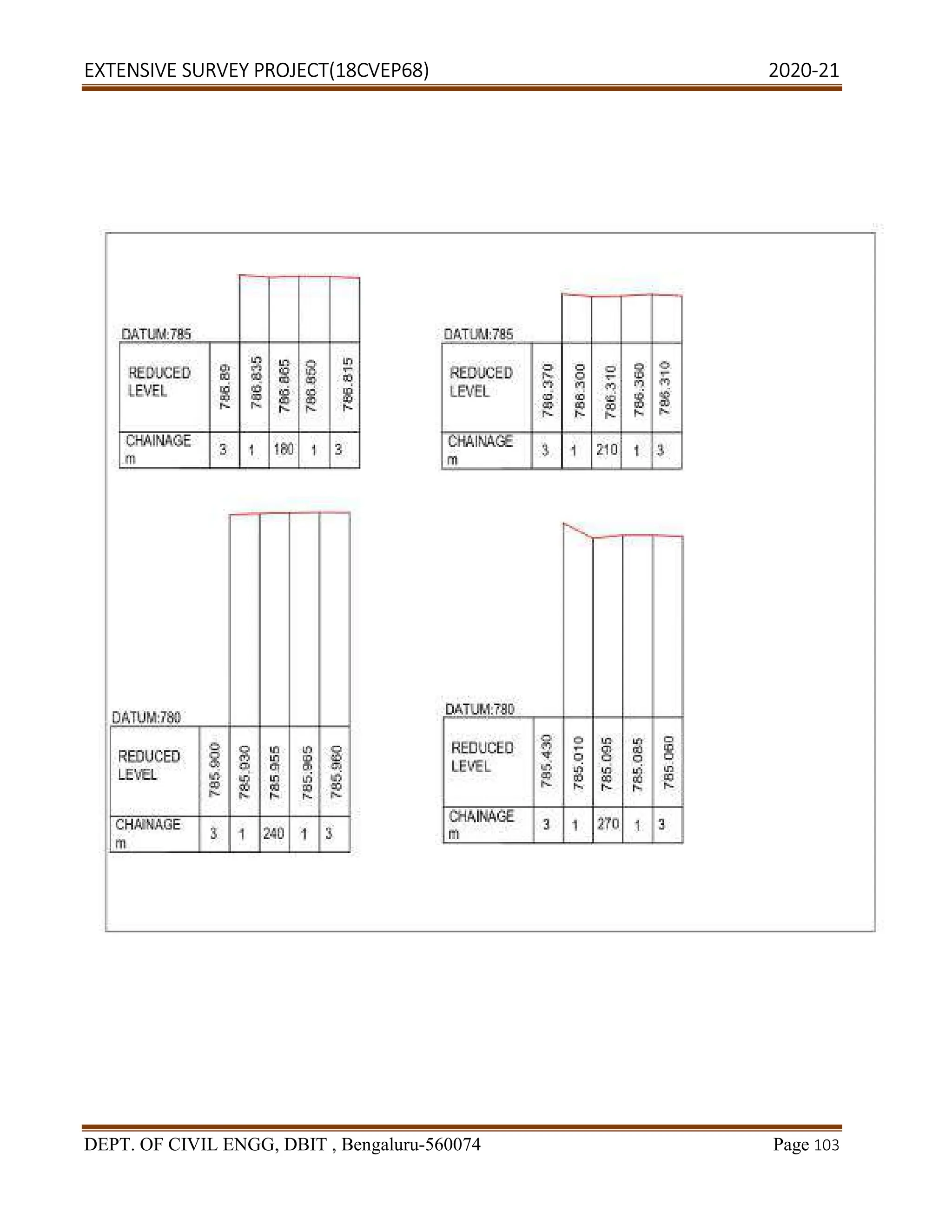
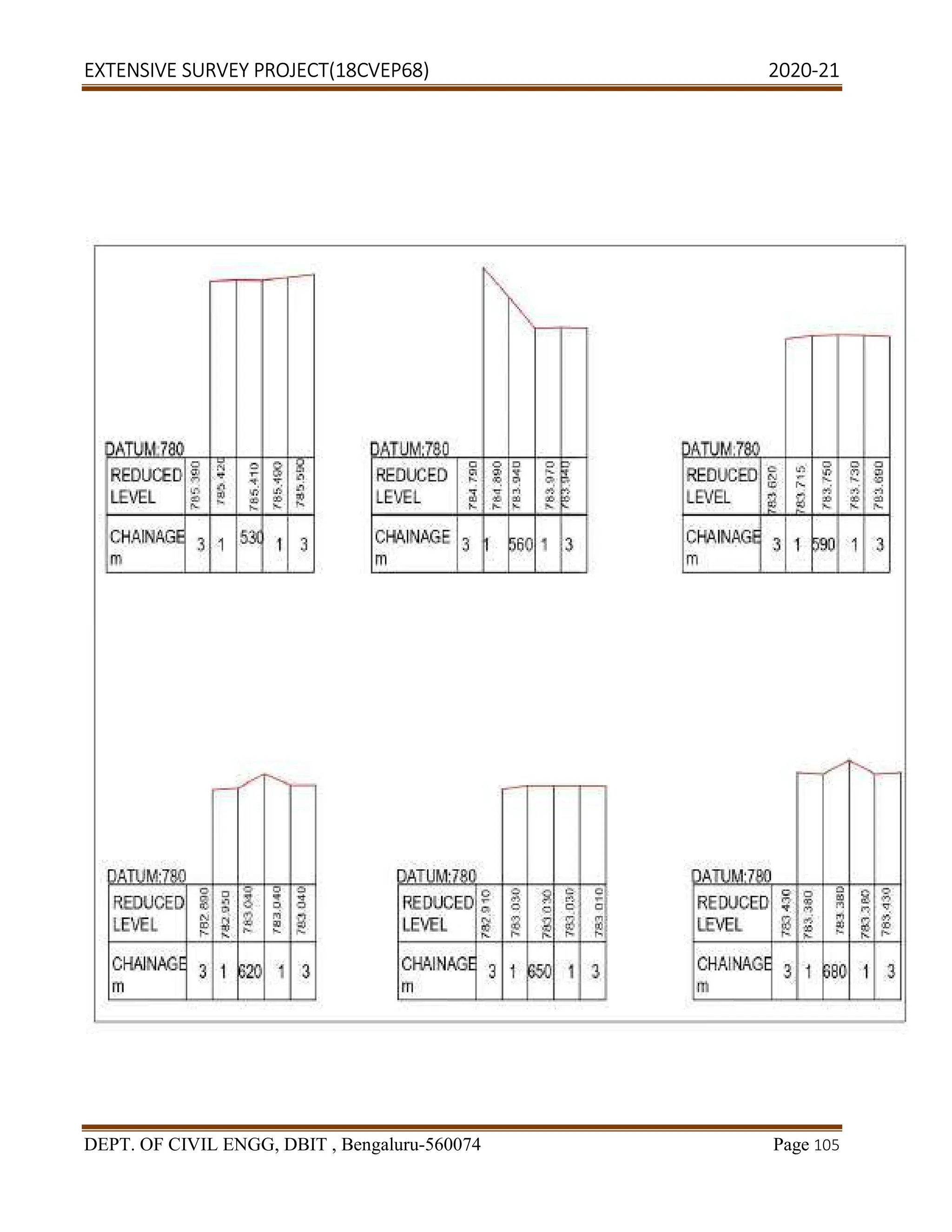
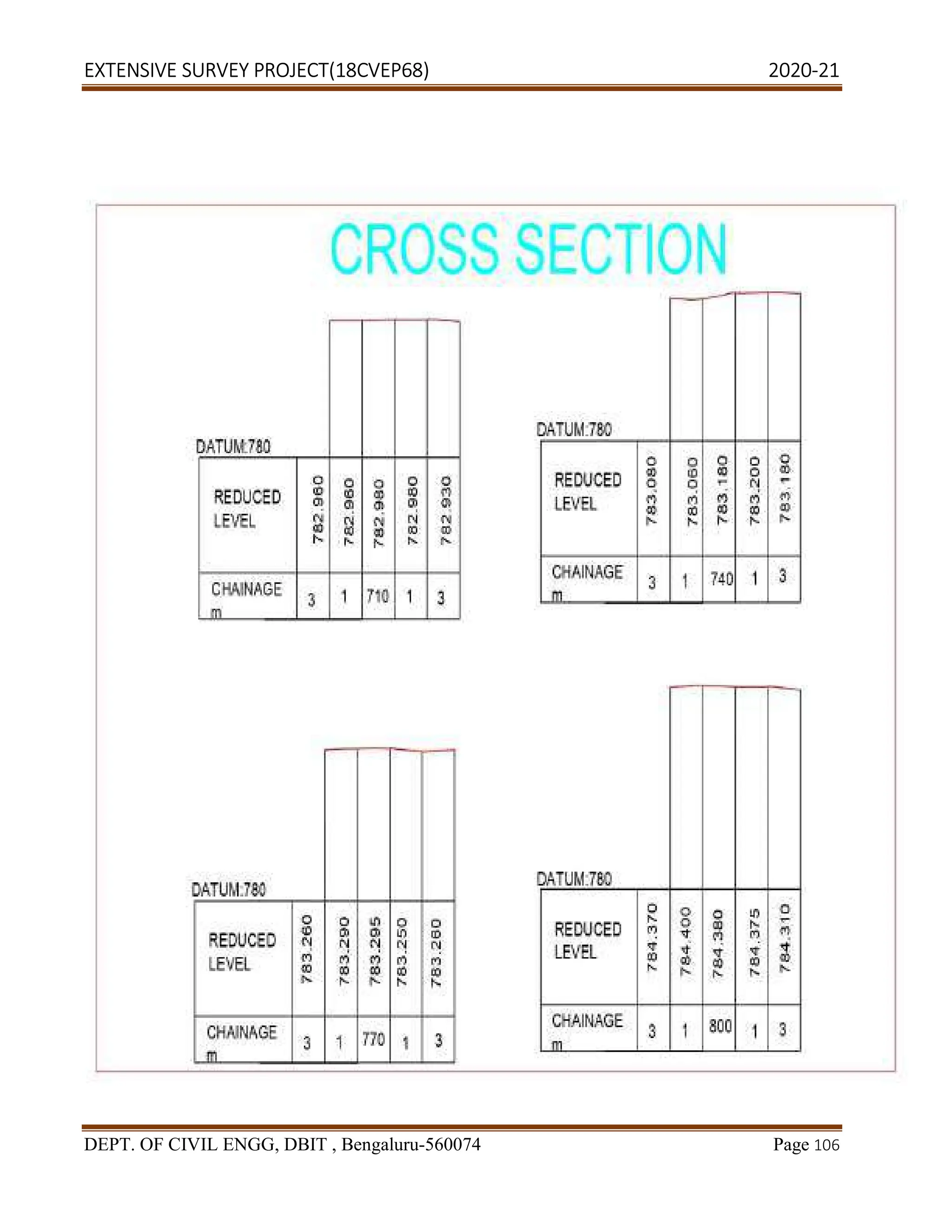
5. Cross – Sectional Levelling:
The operation of taking levels transverse to the direction of the longitudinal level is
known as cross – sectional levelling.
The cross – sectional are taken at regular intervals along the alignment.
Cross - sectional levelling done in order to know the nature of the ground across the centreline of
any alignment.
6. Check Levelling:
The fly levelling is done at the end of the day’s work to connect the finishing point with
the starting point on that particular day is known as check levelling.
It is undertaken in order to check the accuracy of the day’s work.
Irrigation:
Irrigation may be defined as the process of artificial supply of water to soil for raising crop.
It is a science of planning and designed of effective low cost, economical irrigation system tailored
to fit the natural conditions. It is the engineering process of controlling the various natural sources
of the water by the construction of dam and reservoir, canal and headwork and finally distributing
the water to the agricultural field. Irrigation engineering involves the study and design of work in
connection with river-controlled drainage of water logged areas and generation of the hydroelectric
power.
Methods of Irrigation
Irrigation is classified as two methods;
1. Flow irrigation
2. Lift irrigation
EXTENSIVE SURVEY PROJECT(18CVEP68) 2020-21
DEPT. OF CIVIL ENGG, DBIT , Bengaluru-560074 Page 15
1.Flow irrigation:
Flow irrigation is the method of taking water to the land to be irrigated by the flow of
gravitation. The water is stored at such a level in reservoirs, tanks that it can be easily transmitted to
the irrigating lands by gravitation through canals.
The classifications of flow irrigation are:
• Perennial irrigation
• Inundation irrigation
• Direct irrigation or River canal irrigation
• Tank irrigation or Storage irrigation
2.Lift irrigation:
When the water available for irrigation is at a lower level than the land, then it has to be
lifted by pumps or other water lifting devices and this method is known as lift irrigation. This water
is sometimes stored in the tanks and then distributed to the lands by gravity system.
6.CANAL:
Canal is passage for the flow of the water from reservoir or tank to an irrigational field or any
other field necessary. Water in a canal flow under gravity and the upper most surface of the water is
sometimes stored in the tanks and then distributed to the lands by gravity system.
 Classification of Canal
1.Based on The Canal Alignment
• Contour canal
• Water shed canal
• Side slope canal
EXTENSIVE SURVEY PROJECT(18CVEP68) 2020-21
DEPT. OF CIVIL ENGG, DBIT , Bengaluru-560074 Page 16
2.Based on Distribution System
• Main canal
• Branch canal
• Major distributary Minor distributary Water courses.
 Guidelines for Aligning A Canal
• The alignment should follow a falling contour and shall be in ‘cutting’. The
depth of the cutting should be minimum.
• Alignment should be straight.
• Curve should be long, minimum radius should be twenty times the bed width of
the canal.
• Number of cross drainage works should be minimum.
• Longitudinal slope of the canal bed should provide non – silting and non – scoring
velocity of flow.
• Alignment shall progress as far away from natural drain to yield large command
area.
1.Longitudinal Slope for Canal
Longitudinal slope shall be as possible and guided by minimum permissible velocity in the
channel should neither be silting non – scoring. The value generally varied from 1 in 2500. It
depends on natural terrain and type of the canal.
2.Slide Slope of The Canal
Slide slope of the canal is an important feature in canal generally steeper slope section,
narrower, deeper, increased velocity and discharge permits width. It also decreases evaporation and
percolation loss. Slide slope is falling 1.5:1 is generally used in the hard and rocky soils.
EXTENSIVE SURVEY PROJECT(18CVEP68) 2020-21
DEPT. OF CIVIL ENGG, DBIT , Bengaluru-560074 Page 17
3.Type of Canal Cross - Section
1.Fully embankment
2. Partial cutting and partial filling
3. Fully cutting
7.Surveys Conducted for The New Tank Project
Reconnaissance
A site for the new project will be fixed based on the following preliminary investigations.
• Catchment area of a place
• Average rainfall of a place
• Suitable site for the bunds, weirs and sluice Extent land to be irrigation with
nature of the crop.
• Available of the construction materials.
• Financial feasibility of the project.
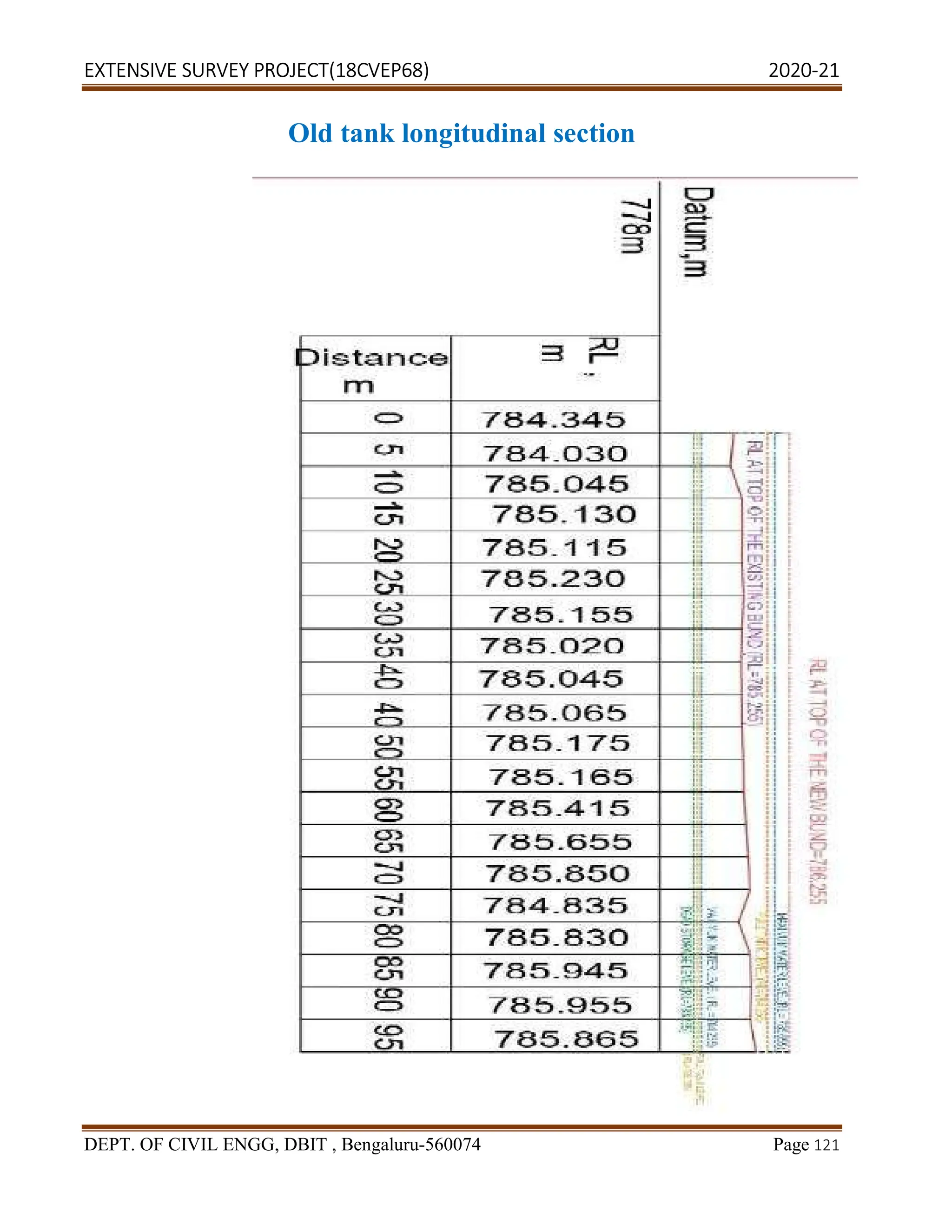
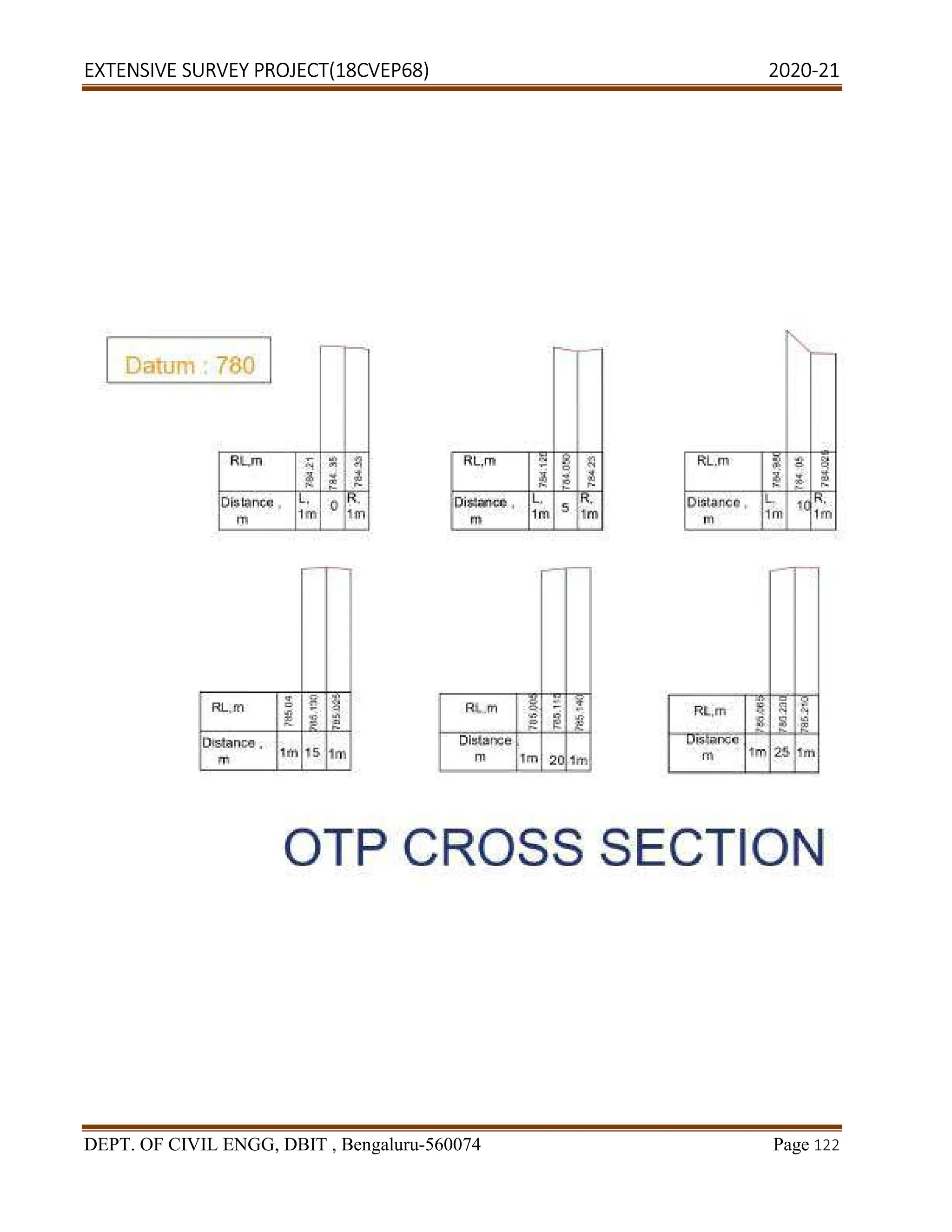
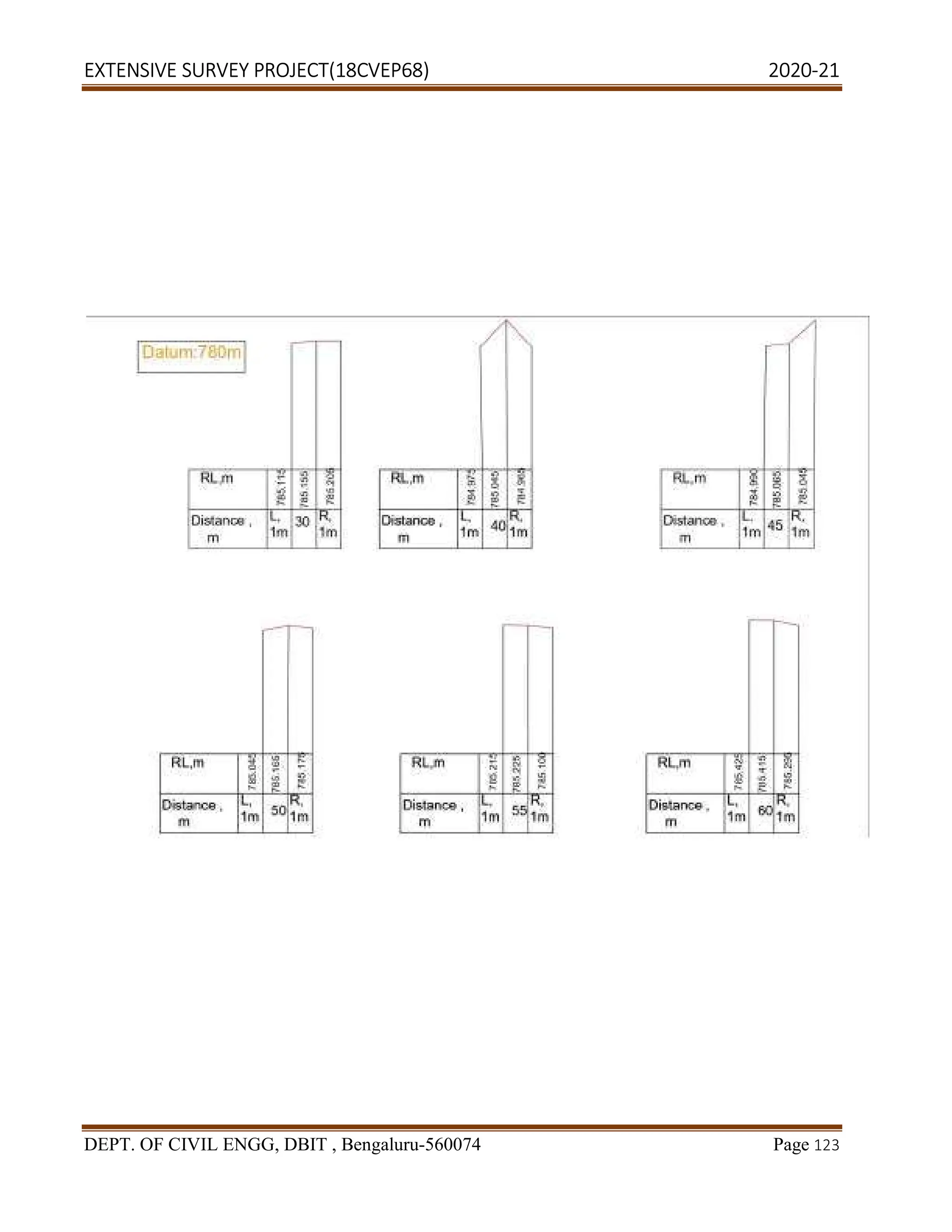
Longitudinal and Cross Section Along the Centre Line Of The Bund
• From the permanent benchmark fly levels are carried out to establish a benchmark on
the left bank or right bank wherever the work is to be started.
• The end points of the bund are fixed and the wooden pegs are driven at regular
intervals.
• The centre line bearing is noted using prismatic compass
• From both the ends of bund bearing to the permanent object such as transformer,
electric pole, building etc...
• Above the centreline of the bund already fixed longitudinal section at every 15m
interval on centreline and cross section at 30m interval up to or beyond the
embankment cases on either side taken 5m interval.
Height of the bund = tank bund level = ground level base = width of the bund =
EXTENSIVE SURVEY PROJECT(18CVEP68) 2020-21
DEPT. OF CIVIL ENGG, DBIT , Bengaluru-560074 Page 18
[U/S slope X Height + Top width + D/S slope X height] .............(1)
The day’s work is constructed at temporary benchmark established.
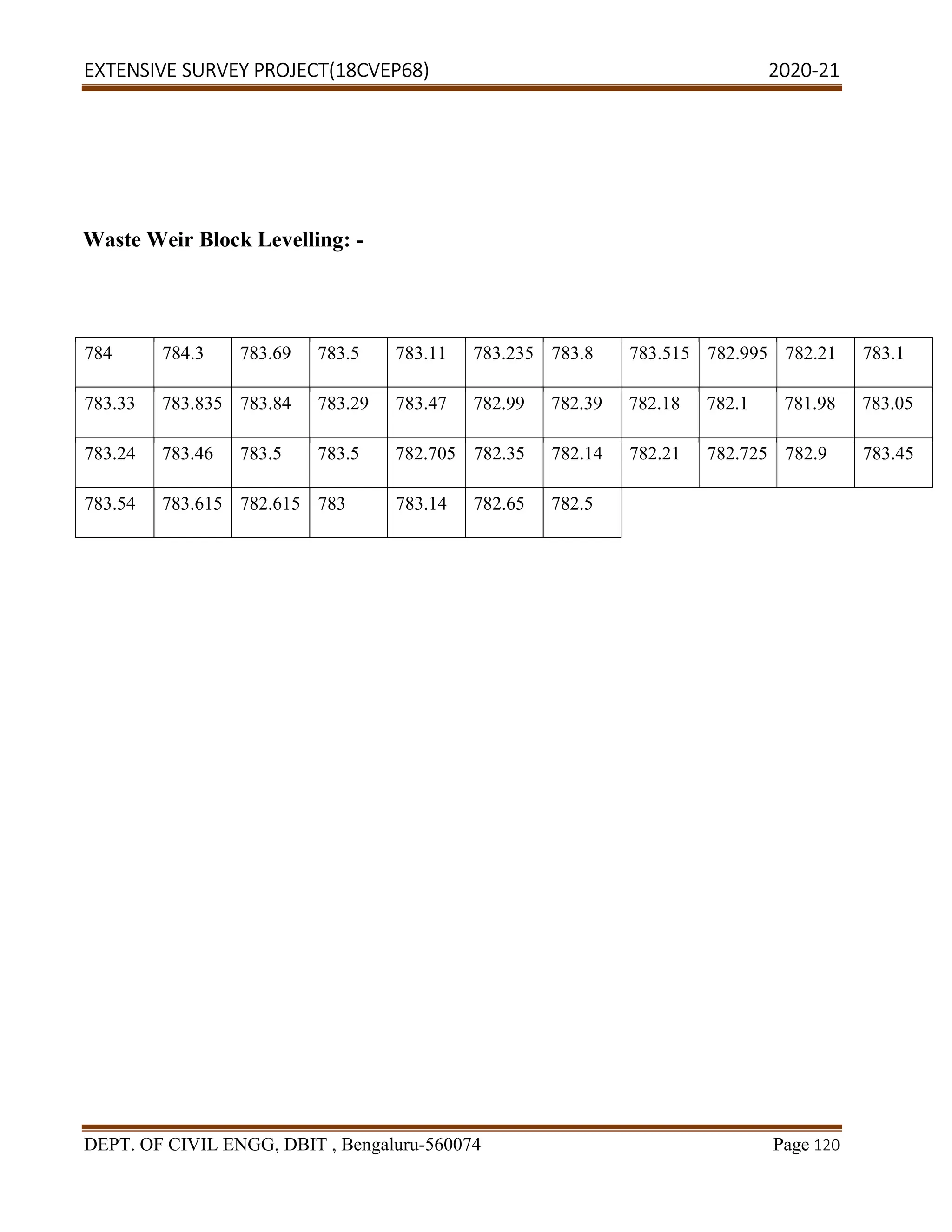
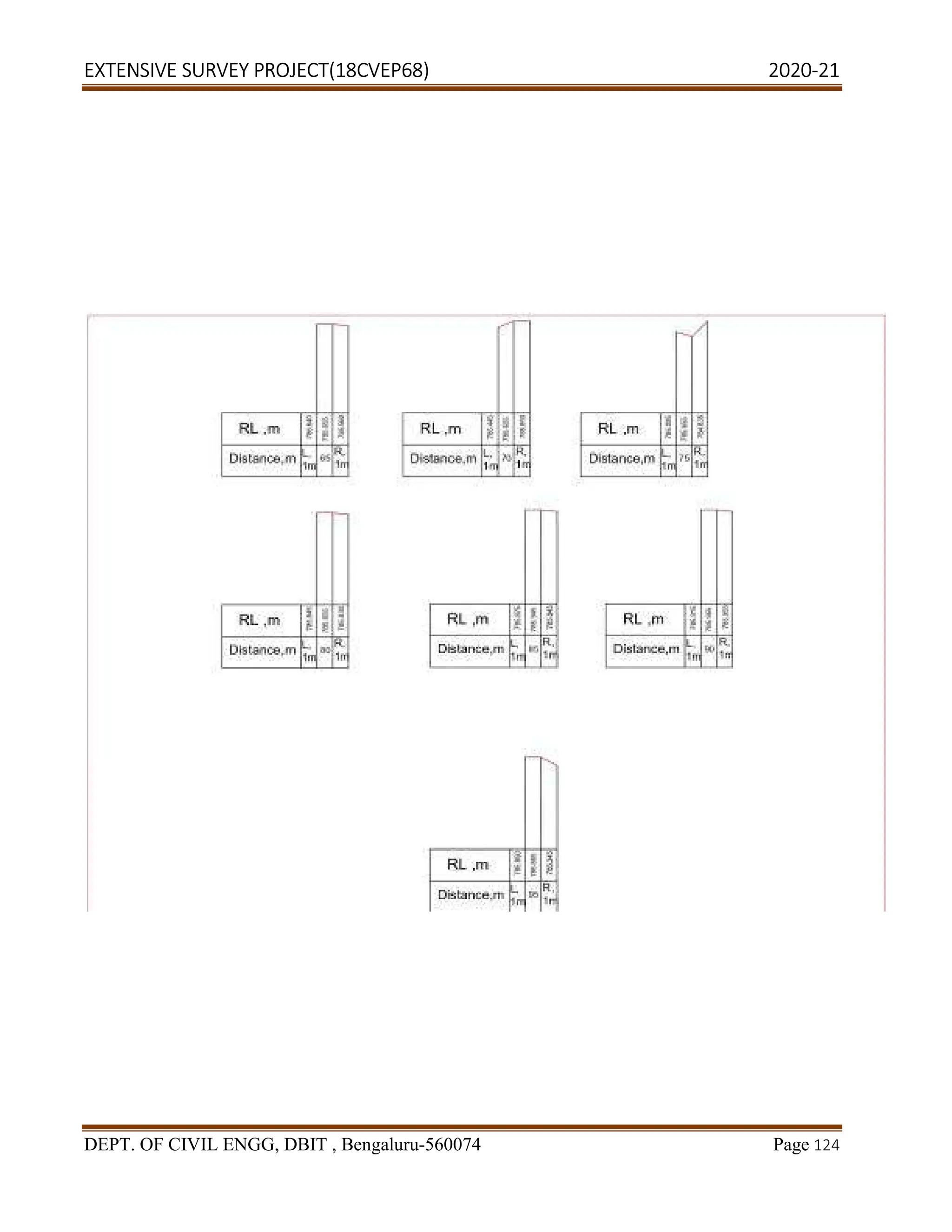
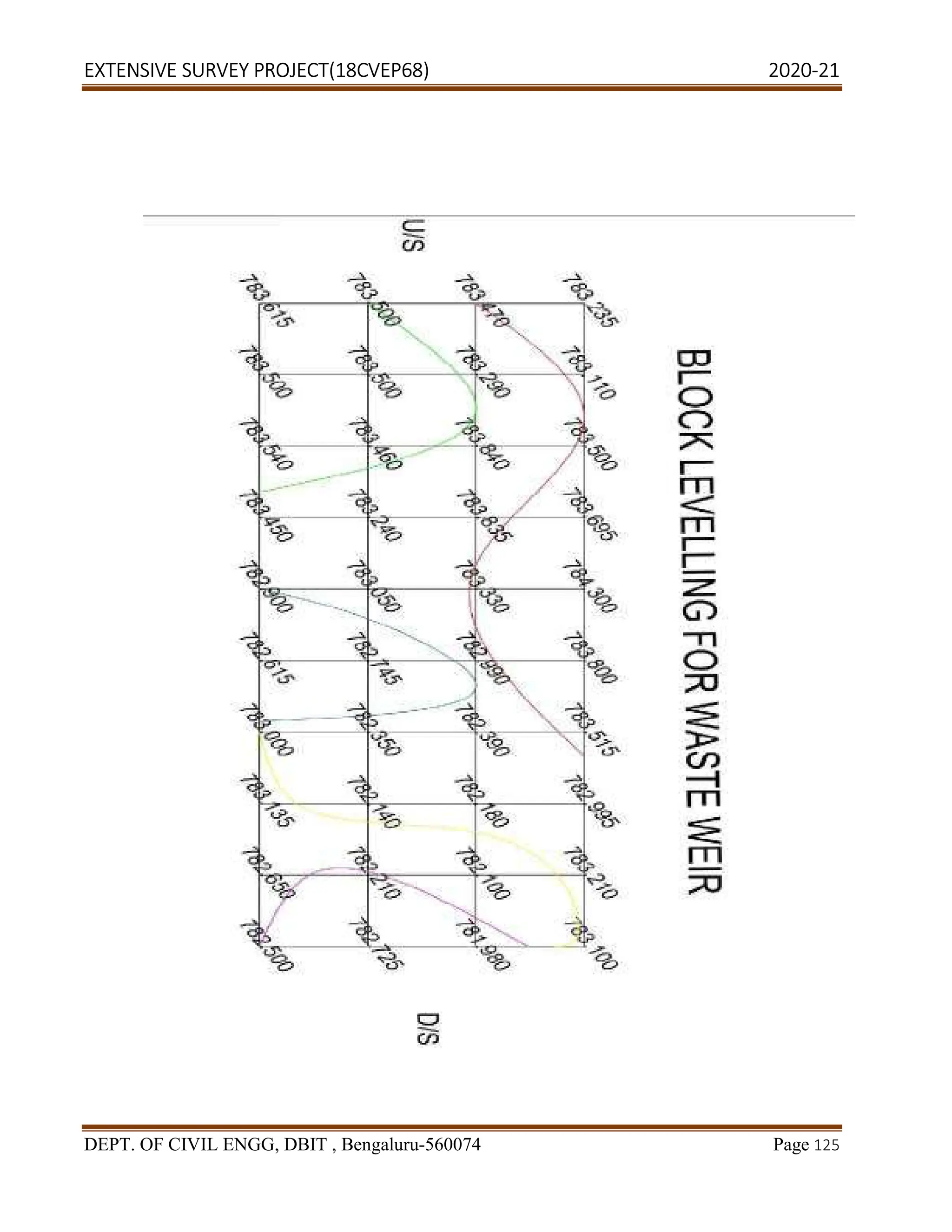
 Bench Levelling at Waste Weir
• The top of the weir should be at FTL. Fix the centreline and mark left and right
points.
• Construct a block of 60m length on U/S side and 40m length D/S side.
• Carry out block levelling at every 5m interval.
• Work is started and closed at established bench mark.
 Block Levelling at Tank Sluice
• RL of the canal at tank, take a point on the centre line of the bund.
• Construct a block of 30m along the centre line and 60m on side of the centreline.
• Divide this entire area into smaller block of 5m X 5m Carryout the block
levelling along the point.
• Start and close down the work with respect to the permanent benchmark.
 Survey for The Capacity Contour
In order to plot the contour FTL, LWL, MWL, surveying for water spread contours was conducted
due to certain physical constraints, indirect levelling is adopted.
Radial levelling is carried out at U/S side using the following procedure:
• Prismatic compass was fixed on the centreline of the bund such that main area
could be covered on the U/S side.
• Radial lines at an angle of 0,30,60,90,120,150 and 180 were set out from the
compass point.
• Fly levelling was adopted to carry benchmark from permanent benchmark to
compass point.
• Staff readings were taken along the radial lines at 15m interval.
EXTENSIVE SURVEY PROJECT(18CVEP68) 2020-21
DEPT. OF CIVIL ENGG, DBIT , Bengaluru-560074 Page 19
• Cross – section were taken along with radial lines at 15m intervals.
• The cross section was increased along the radial lines such that the whole
upstream side is covered.
• The work is closed by the fly levelling on established benchmark.
 Impartment Definition
 Crop Period:
it is the time taken by crop from the instant of its sowing to harvesting.
 Base Period:
It is the period during which the water supplied to the crops to bring the crop to maturity. The
base period is slightly less than the crop period. It is donated by the letter B.
 Duty of Water:
It is defined as number of hectares brought to maturity by a constant flow of water per
second during the crop period or it is the relationship between the volume of water and area of crop
brought to maturity. It includes both cultivable and non-cultivable area. It is given by the formula
D= 864 B/∆
Where,
∆in Cm. [delta]
B in days [Base period]
D in hectares /cumecs. [Duty]
 Delta:
Each crop requires certain quantity of water at regular intervals of time throughout its
period. If this total quantity of water is made to stand without any lose on an area, the depth
of water required per hectare for the full growth of crop is called as delta. It is expected by a
symbol.
EXTENSIVE SURVEY PROJECT(18CVEP68) 2020-21
DEPT. OF CIVIL ENGG, DBIT , Bengaluru-560074 Page 20
Delta = depth of each watering X number of watering
 Water Requirement of Crops
For the successful growth of the crops, every crops require a definite quantity of the water,
suitable agricultural soil, good irrigation and the proper method of cultivation. The total quantity of
water required by a crop from the instant of sowing till it comes to the harvesting is known as water
requirement of crops. It depends upon the following.
• The season in which the crop is growing
• Its period of the growth i.e., its crop period
• The climate condition of the region
• The rainfall in the season
• The water requirement of a crop varies from the place to place from season to
season
8. Investigation for The Reservoir Planning
The following investigations are required for reservoir planning;
1. Engineering survey
2. Geological investigation
3. Hydrological survey
1.Engineering Survey: - The area of the tank site is surveyed in detail and a control point is
prepared from the plan. The following physical characteristics are obtained.
• Area of elevation curve
• Storage elevation curve
• Map of the area
• Suitable site selection for tanks
EXTENSIVE SURVEY PROJECT(18CVEP68) 2020-21
DEPT. OF CIVIL ENGG, DBIT , Bengaluru-560074 Page 21
2.Geological Investigation: - In almost all civil engineering projects geological advice is most
essential. Geological investigation cost very little in the comparison to the total cost of the project.
Geological investigations are required to give detailed information about the following points.
• Water tightness of reservoir basis
• Suitability for foundation of the bund.
• Geological and structural features as floods and faults Type and depth of the rocks
at basin.
• Location of permeable and soluble rocks if any.
3.Hydrological Investigation: The hydrological investigations are very important aspects of
reservoir planning. These investigations may be designed in two needs.
• Study of run – off patterns at the proposal bund site to determine the storage
capacity corresponding to the given demand.
• Determination of hydrograph of the worst flood at reservoir site to determine the
spillways capacity and design’.
 Storage Zones of Reservoir
• Dead Storage:
It is the volume of the space provided for the deposition of the sediments in a
reservoir. It is the level below which water is not stored. It is not of much use in the
operation reservoir.
• Live Storage:
The volume of the water stored between dead storage and full tank level is called the
live storage. Live storage assures the supply of water for specified period of time to meet the
demand.
• Maximum Water Level:
The maximum level to which the water level rises during high flood is known as
maximum water level. During floods, the maximum water level run – off will take place and
water level rises to this level.
EXTENSIVE SURVEY PROJECT(18CVEP68) 2020-21
DEPT. OF CIVIL ENGG, DBIT , Bengaluru-560074 Page 22
• Full Tank Level:
It is the maximum elevation to which the reservoir water surface rises during normal
operation condition.
• Sill Level of Sluice:
It is provided at the minimum storage as dead storage level.
• Top of the bund level:
It is fixed considering the aspects of the free board to prevent overtopping of the
dam.
9. Selection of Site for The Reservoir
The final selection if site for a reservoir depends upon the following factors;
1. The geological conditions of the catchment area should be such that percolation
losses are minimum and maximum runoff is obtained.
2. The reservoir site should be such that quantity of the leakage through it is
minimum, reservoir site having the presence of the highly permeable rocks reduce the
tightness of the reservoir.
3. Suitable dam site must exist. The dam should be founded on water tight rocks
base and percolation below the dam should be minimum. The cost of the dam is often a
controlling factor in selection of the site.
4. The reservoir basin should make narrow opening in the valley so that length of
the dam is less.
5. The cost of the real estate for reservoir including road, soil, road welling, etc..,
must be less as for as possible.
6. The topography of the reservoir site should be such that it has adequate capacity
without submerging excessive properties.
7. The reservoir site should be such that it avoids as excludes water from these
tributaries which carry high percentage of silt in the water.
8. The reservoir should be such that the water stored in it, suitable for the purpose
for which the project is undertaken.
EXTENSIVE SURVEY PROJECT(18CVEP68) 2020-21
DEPT. OF CIVIL ENGG, DBIT , Bengaluru-560074 Page 23
10. Weir
Weir is a structure constructed at right angles to the direction of the flow. Its purpose is to
raise the water level and then divert it into the canal. As the tanks are the small storage works
constructed to meet the local requirements obvious by attempting is not made to contain full run off
coming down from the catchment area. It is therefore necessary to make suitable arrangement to
pass from the excess water beyond F.T.L. The structure constructed to provide passage to excess
water is called as “escape weir”. It is also called as a “Tank surplus weir”.
The Water starts spilling over the weir as soon as tank is filled up to its crest. However temporarily
due to rush of incoming water. The level in the tank raises above F.T.L., the new level is reached is
called as “maximum water level” [M.W.L.]. It depends on the extent of the flood for the design
purpose M.W.L is calculated taking into the account maximum flood discharge likely to carry and
water may be available at the site for escape weir. The surplus as spill way water is carried down
through a channel which is generally a natural discharge and has an enough capacity. As weir may
be constructed in the masonry, rock fill, cement concrete etc.
 Types of Weir
Escape weir constructed in the tank irrigation system is similar to a diversion weir are
constructed across the river channel.
It may be classified as following types;
1.Masonry Weir
• Masonry with the horizontal floor.
• Masonry weir with depressed floor.
• Masonry weir with stepped floor.
2.Rock Fill Weir
3.Concrete Weir
EXTENSIVE SURVEY PROJECT(18CVEP68) 2020-21
DEPT. OF CIVIL ENGG, DBIT , Bengaluru-560074 Page 24
11. Selection of Site for A Weir
Following are the point may be taken into consideration while selecting a site for a tank weir.
• Tank weir performs the function of the surplus excess flow therefore it is
preferable to locate the weir in a natural saddle away from the tank bund.
• To carry surplus flow existence of a well-defined escape channel is very
necessary at a site selected for the construction of a weir.
• The saddle where natural surface level us approximately same as tank level [FTL]
should be given first performance.
• Hard foundation if available at the site reduces the cost of the construction.
• When a site is away from the tank bund is not available as for as possible weir
may be located on one end of the tank bund.
• Surplus weir may be hosed in the body of the tank bund only as a last resort.
• Care should be taken to see that escape channel surplus water is not likely to
damage cultivated land.
12. Lining of Canal
The impervious layer which protects the beds and sides of the canal is called canal lining.
 Necessity of Canal Lining
Following are the necessity of the canal lining.
• To minimize the seepage losses in the canal.
• To increase the discharge in canal selection by increasing the velocity.
• To prevent erosion of the bed and sides due to high velocity.
• To reduce maintenance of canal.
EXTENSIVE SURVEY PROJECT(18CVEP68) 2020-21
DEPT. OF CIVIL ENGG, DBIT , Bengaluru-560074 Page 25
 Requirement of Canal Lining Materials
• The materials used for lining should provide the water tightness The materials
chosen should be strong and durable.
• The materials should withstand the high velocity.
• The materials used should resist to the growth of weeds and attack of animals.
• The material should permit the construction of the required slope easily.
Types of Canal Lining
The Canal lining are of following types:
• Cement concrete lining.
• Brick lining
• Cement mortar lining
• Asphaltic lining
• Soil – Cement lining
• Sodium – carbonate lining
• Precast concrete block lining
 Reservoir Sedimentation
The deposition of sediment in the reservoir is known as “reservoir silting” or “reservoir
sedimentation”. Every river carries certain amount of sedimentation load. The sediment particles
try to settle down at the bottom of the reservoir due to gravitational force that may be kept in the
suspension due to upward currents in the turbulent flow which may overcome the gravity force.
These sediments will settle down in the reservoir because of less velocity inside the reservoir.
The deposition of the sediment will automatically reduce the storage capacity of the reservoir and if
this process of deposition continues longer stage like to reach when the whole reservoir gets silted
up and becomes useless.
EXTENSIVE SURVEY PROJECT(18CVEP68) 2020-21
DEPT. OF CIVIL ENGG, DBIT , Bengaluru-560074 Page 26
In order to see the capacity of reservoir does not fall short for requirements even during the design
period. The silting should be taken into the account, the total volume of the silt likely to be
deposited during the designed life period of the dam, therefore estimated approximately that much of
volume is left as unused to allow the silting, it is known as a dead storage.
 Silting of Canal
Silt is allowed into the canal causes much annoyance and expense. Instance are not rare,
where the silt, etc… carried into the canal during high floods, so depleted its capacity, that it could
not carry the water needed for irrigation and it becomes necessary to close the canal and clean it
during the height of irrigation season at great expenses and to the great injury to the crops. Hence
measures should be adopted to prevent the entrance of silt and sand into the canal. Water carrying
capacity of the canal gets reduced due to the deposition of the silt.
Silts Are of Two Types-
 Bed Silt-
which is also called which is also called the dragged or rolled silt
 Suspended Silt –
The nature of silt depends upon topography of the area and rainfall. Silt must be prevented as
far as possible from entering into the canal, but it is impractical to do so, measures should be
adopted to remove the same from the canal.
Following are the measures adopted to remove the silt-
• When the canal is not carrying the water, the silt is removed by the
manual labour
• Silt is removed by increasing the velocity of the water Using dredges
silt can be removed
1. Silt entry into the canal can be prevented by the silt excluder
EXTENSIVE SURVEY PROJECT(18CVEP68) 2020-21
DEPT. OF CIVIL ENGG, DBIT , Bengaluru-560074 Page 27
2. Silt ejector is used to remove the silt that has entered into the canal
13. Selecting A Suitable Preliminary Selection of An Earthen Dam
Bund
In this new tank project, it is proposed to have a homogeneous earthen bund across the
stream. The stored water is used to irrigate the nearby lands with the help of canal.
The selection of bund is made considering the following factors:
1. The site selected is such that there is a narrow opening to reduce the length of the dam.
2. The land selected is such that it is unimportant and submergence of Roadways or
Railways are unobjectionable.
3. The proposed site is located at about 1.0kms from Kaiwara temple.
4. A V-shaped valley is capable of storing the maximum amount of water for the catchment
and has good runoff at the proposed site.
5. The saddle between the hillocks is the best suited since it is suited for surplus water
works with a minimum cost of construction. A preliminary design of an earthen dam is done
on the basis of existing dams of similar characteristics and the design is finalized by checking
the adequacy of the selected section from the worst loading condition. Empirical rules are
frequently used in these designs. A few recommendations, for selecting suitable values of top
width, free board, upstream and downstream slopes, drainage arrangements, etc., are given
below for preliminary designs.
 Freeboard:
Free board or minimum free board is the vertical distance between the maximum reservoir
level and the top bund level (i.e., the crown or crest of dam). The dam vertical distance between
normal pool level or spillway crest and the top of the dam is termed as normal free board. The
minimum height of the free board for wave action is generally taken to be equal to 1.5Hw where.
Hw= Maximum height of wave
EXTENSIVE SURVEY PROJECT(18CVEP68) 2020-21
DEPT. OF CIVIL ENGG, DBIT , Bengaluru-560074 Page 28
 Width:
The top width of large earthen dams should be sufficient to keep the seepage line well within
the dam, when the reservoir is full. It should also be sufficient to withstand earthquake shocks and
wave action. For small dams, this top width is generally governed by minimum roadway width
requirements.
 Upstream and Down Stream Slopes:
The side slopes depend upon various factors such as the type and nature of dam and
foundation materials, height of dam etc., The various dimensions of low earth dams for preliminary
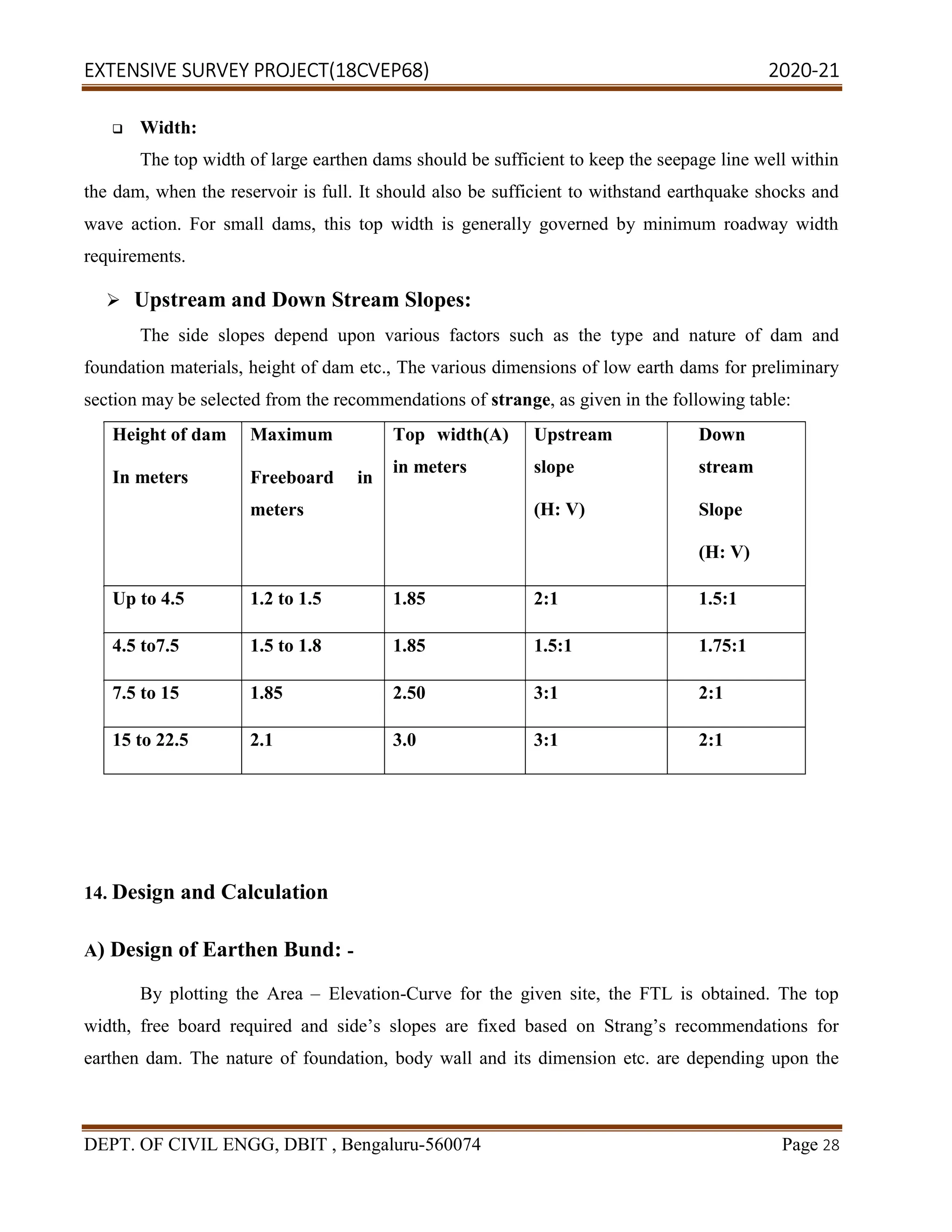
section may be selected from the recommendations of strange, as given in the following table:
Height of dam
In meters
Maximum
Freeboard in
meters
Top width(A)
in meters
Upstream
slope
(H: V)
Down
stream
Slope
(H: V)
Up to 4.5 1.2 to 1.5 1.85 2:1 1.5:1
4.5 to7.5 1.5 to 1.8 1.85 1.5:1 1.75:1
7.5 to 15 1.85 2.50 3:1 2:1
15 to 22.5 2.1 3.0 3:1 2:1
14. Design and Calculation
A) Design of Earthen Bund: -
By plotting the Area – Elevation-Curve for the given site, the FTL is obtained. The top
width, free board required and side’s slopes are fixed based on Strang’s recommendations for
earthen dam. The nature of foundation, body wall and its dimension etc. are depending upon the
EXTENSIVE SURVEY PROJECT(18CVEP68) 2020-21
DEPT. OF CIVIL ENGG, DBIT , Bengaluru-560074 Page 29
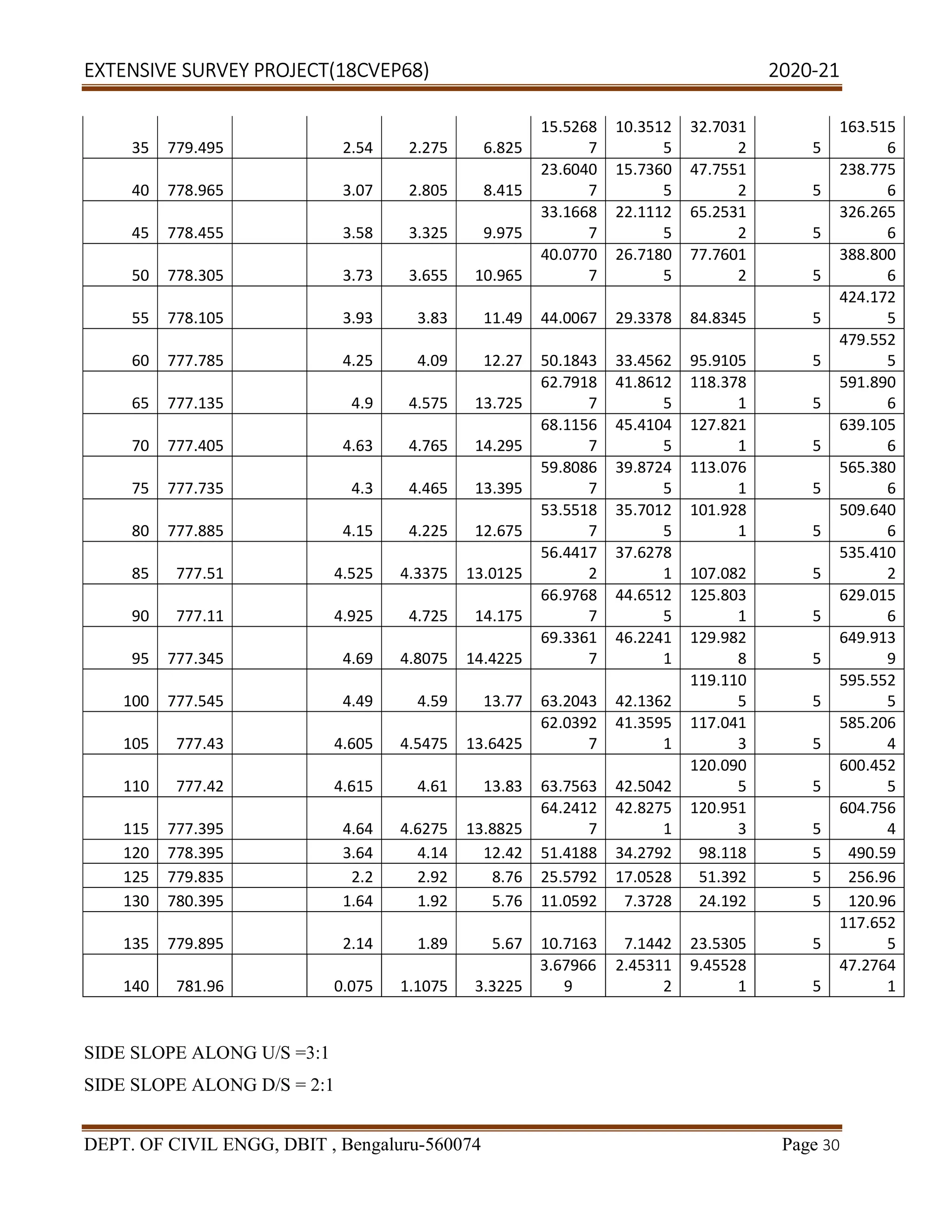
geological formation at the site, availability of construction materials. It is decided to have the
following features:
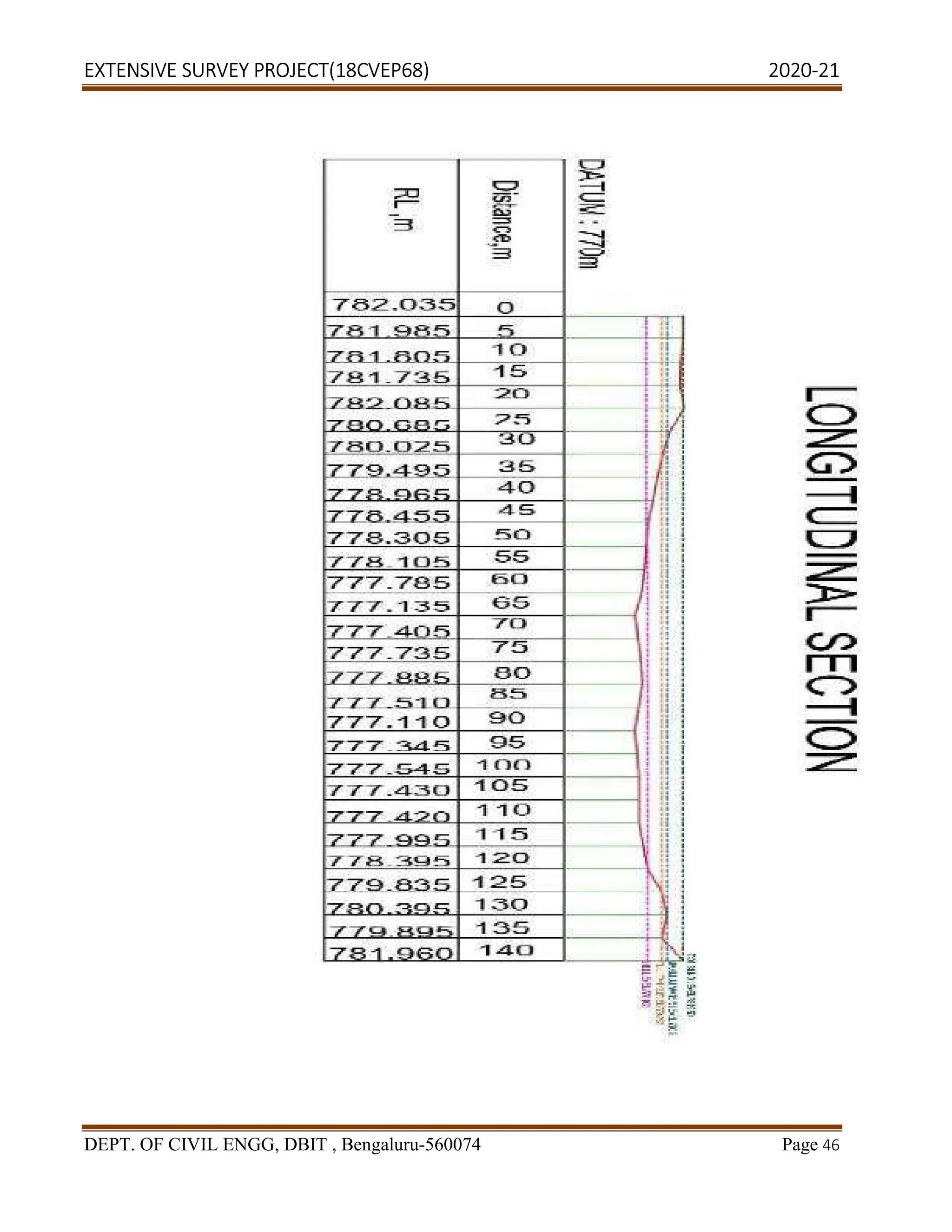
o Top Level of Bund(TBL) = 781.960 m
o Full Tank Level (FTL) = 779.390 m
o Maximum Water Level (MWL ) = 780.395m
o Deepest Bed Level (DBL) =788.150 m
o Maximum Depth of Water Storage = FTL – DBL
=779.395─778.105 = 2.29 m
o Maximum Height of The Bund = TBL– DBL
= 781.960 ─778.105= 3.885 m
o Height of Free Board Is Taken As 1.85m (According to Strang’s recommendation) Top
width of the bund is taken as 3m.
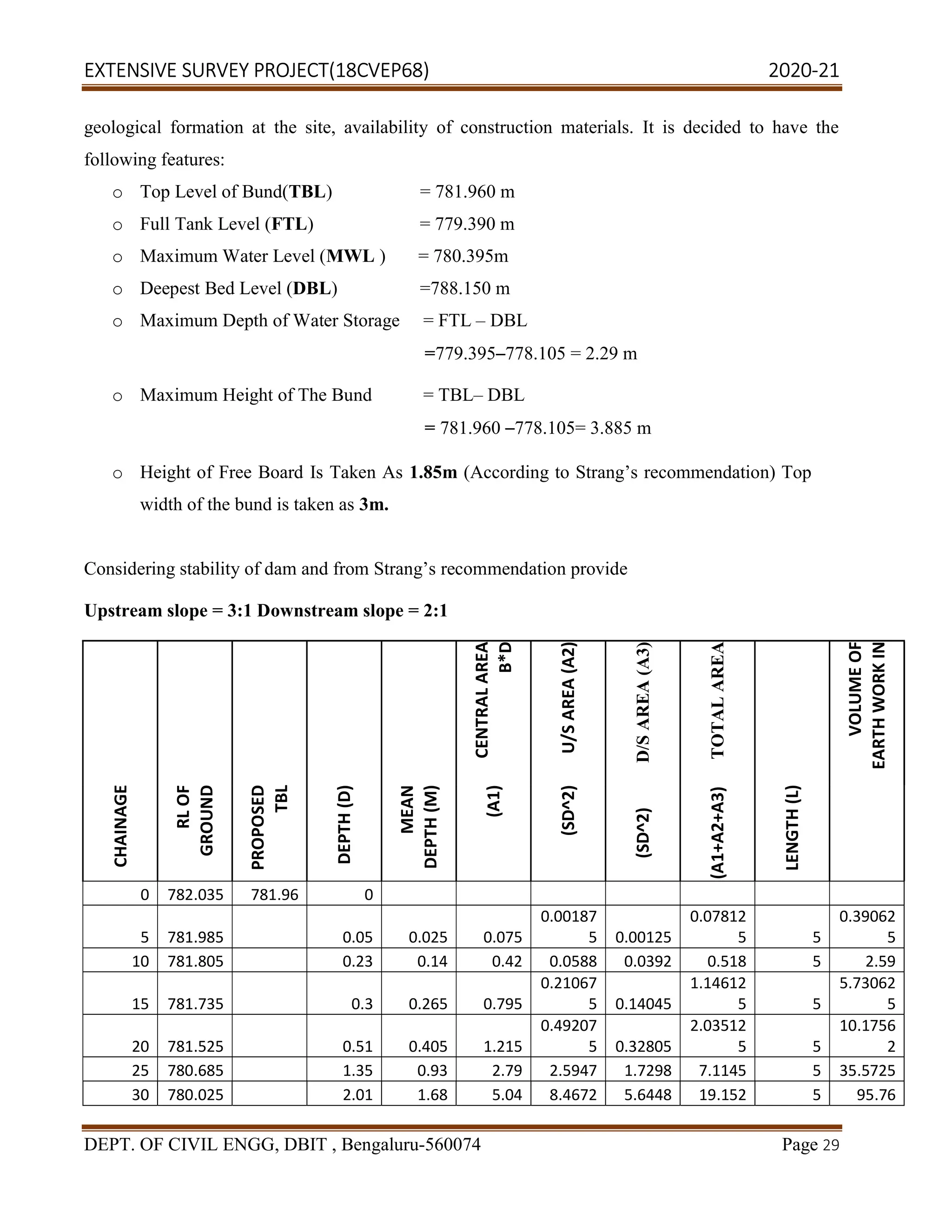
Considering stability of dam and from Strang’s recommendation provide
Upstream slope = 3:1 Downstream slope = 2:1
CENTRAL
AREA
B*D
U/S
AREA
(A2)
D/S
AREA
(A3)
TOTAL
AREA
VOLUME
OF
EARTH
WORK
IN
CHAINAGE
RL
OF
GROUND
PROPOSED
TBL
DEPTH
(D)
MEAN
DEPTH
(M)
(A1)
(SD^2)
(SD^2)
(A1+A2+A3)
LENGTH
(L)
0 782.035 781.96 0
5 781.985 0.05 0.025 0.075
0.00187
5 0.00125
0.07812
5 5
0.39062
5
10 781.805 0.23 0.14 0.42 0.0588 0.0392 0.518 5 2.59
15 781.735 0.3 0.265 0.795
0.21067
5 0.14045
1.14612
5 5
5.73062
5
20 781.525 0.51 0.405 1.215
0.49207
5 0.32805
2.03512
5 5
10.1756
2
25 780.685 1.35 0.93 2.79 2.5947 1.7298 7.1145 5 35.5725
30 780.025 2.01 1.68 5.04 8.4672 5.6448 19.152 5 95.76
EXTENSIVE SURVEY PROJECT(18CVEP68) 2020-21
DEPT. OF CIVIL ENGG, DBIT , Bengaluru-560074 Page 30
35 779.495 2.54 2.275 6.825
15.5268
7
10.3512
5
32.7031
2 5
163.515
6
40 778.965 3.07 2.805 8.415
23.6040
7
15.7360
5
47.7551
2 5
238.775
6
45 778.455 3.58 3.325 9.975
33.1668
7
22.1112
5
65.2531
2 5
326.265
6
50 778.305 3.73 3.655 10.965
40.0770
7
26.7180
5
77.7601
2 5
388.800
6
55 778.105 3.93 3.83 11.49 44.0067 29.3378 84.8345 5
424.172
5
60 777.785 4.25 4.09 12.27 50.1843 33.4562 95.9105 5
479.552
5
65 777.135 4.9 4.575 13.725
62.7918
7
41.8612
5
118.378
1 5
591.890
6
70 777.405 4.63 4.765 14.295
68.1156
7
45.4104
5
127.821
1 5
639.105
6
75 777.735 4.3 4.465 13.395
59.8086
7
39.8724
5
113.076
1 5
565.380
6
80 777.885 4.15 4.225 12.675
53.5518
7
35.7012
5
101.928
1 5
509.640
6
85 777.51 4.525 4.3375 13.0125
56.4417
2
37.6278
1 107.082 5
535.410
2
90 777.11 4.925 4.725 14.175
66.9768
7
44.6512
5
125.803
1 5
629.015
6
95 777.345 4.69 4.8075 14.4225
69.3361
7
46.2241
1
129.982
8 5
649.913
9
100 777.545 4.49 4.59 13.77 63.2043 42.1362
119.110
5 5
595.552
5
105 777.43 4.605 4.5475 13.6425
62.0392
7
41.3595
1
117.041
3 5
585.206
4
110 777.42 4.615 4.61 13.83 63.7563 42.5042
120.090
5 5
600.452
5
115 777.395 4.64 4.6275 13.8825
64.2412
7
42.8275
1
120.951
3 5
604.756
4
120 778.395 3.64 4.14 12.42 51.4188 34.2792 98.118 5 490.59
125 779.835 2.2 2.92 8.76 25.5792 17.0528 51.392 5 256.96
130 780.395 1.64 1.92 5.76 11.0592 7.3728 24.192 5 120.96
135 779.895 2.14 1.89 5.67 10.7163 7.1442 23.5305 5
117.652
5
140 781.96 0.075 1.1075 3.3225
3.67966
9
2.45311
2
9.45528
1 5
47.2764
1
SIDE SLOPE ALONG U/S =3:1
SIDE SLOPE ALONG D/S = 2:1
EXTENSIVE SURVEY PROJECT(18CVEP68) 2020-21
DEPT. OF CIVIL ENGG, DBIT , Bengaluru-560074 Page 31
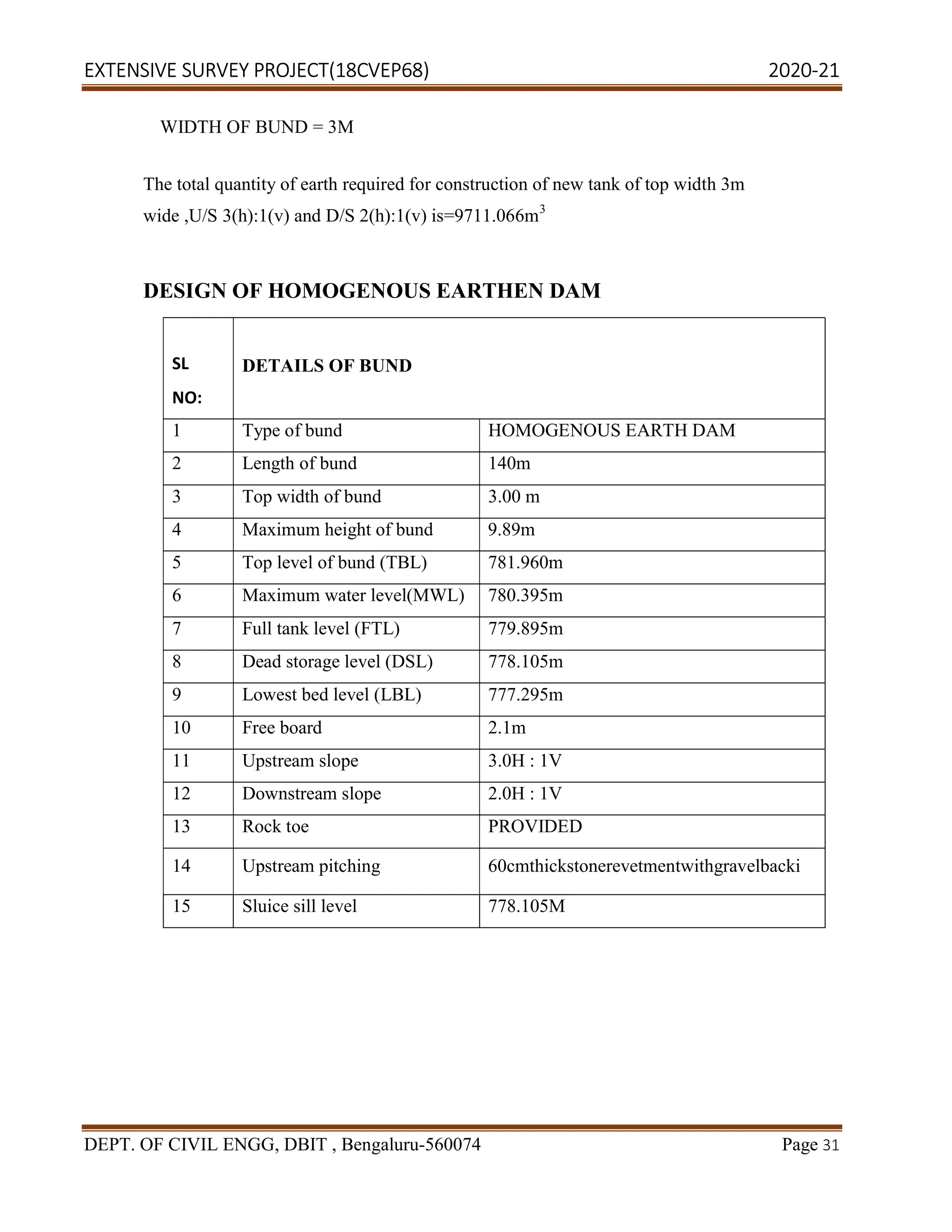
WIDTH OF BUND = 3M
The total quantity of earth required for construction of new tank of top width 3m
wide ,U/S 3(h):1(v) and D/S 2(h):1(v) is=9711.066m3
DESIGN OF HOMOGENOUS EARTHEN DAM
SL
NO:
DETAILS OF BUND
1 Type of bund HOMOGENOUS EARTH DAM
2 Length of bund 140m
3 Top width of bund 3.00 m
4 Maximum height of bund 9.89m
5 Top level of bund (TBL) 781.960m
6 Maximum water level(MWL) 780.395m
7 Full tank level (FTL) 779.895m
8 Dead storage level (DSL) 778.105m
9 Lowest bed level (LBL) 777.295m
10 Free board 2.1m
11 Upstream slope 3.0H : 1V
12 Downstream slope 2.0H : 1V
13 Rock toe PROVIDED
14 Upstream pitching 60cmthickstonerevetmentwithgravelbacki
15 Sluice sill level 778.105M
EXTENSIVE SURVEY PROJECT(18CVEP68) 2020
DEPT. OF CIVIL ENGG, DBIT , Bengaluru
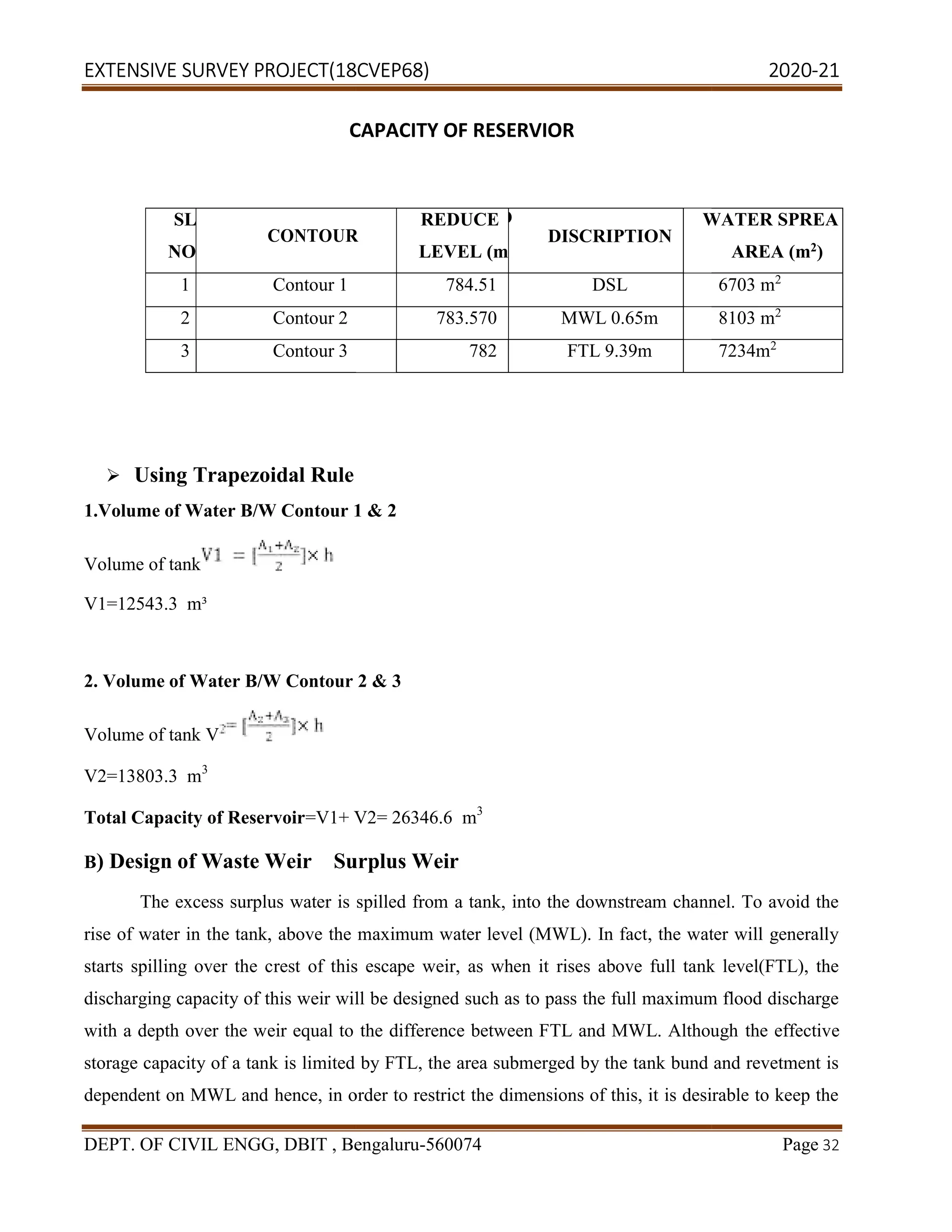
CAPACITY OF RESERVIOR
SL
NO
CONTOUR
1 Contour 1
2 Contour 2
3 Contour 3
 Using Trapezoidal Rule
1.Volume of Water B/W Contour 1 & 2
Volume of tank
V1=12543.3 m³
2. Volume of Water B/W Contour 2 & 3
Volume of tank V
V2=13803.3 m3
Total Capacity of Reservoir=V1+ V2= 26346.6
B) Design of Waste Weir Surplus Weir
The excess surplus water is spilled from a tank, into the downstream channel. To avoid the
rise of water in the tank, above the maximum water level (MWL). In fact, the water will generally
starts spilling over the crest of this escape weir, as when it rises above full tank level(FTL), the
discharging capacity of this weir will be designed such as to pass the full maximum flood discharge
with a depth over the weir equal to the difference between FTL and MWL. Although
storage capacity of a tank is limited by FTL, the area submerged by the tank bund and revetment is
dependent on MWL and hence, in order to restrict the dimensions of this, it is desirable to keep the
(18CVEP68) 2020
CIVIL ENGG, DBIT , Bengaluru-560074
CAPACITY OF RESERVIOR
CONTOUR
REDUCE
LEVEL (m
D
DISCRIPTION
WATER SPREA
784.51 DSL
783.570 MWL 0.65m
782 FTL 9.39m
Using Trapezoidal Rule
1.Volume of Water B/W Contour 1 & 2
2. Volume of Water B/W Contour 2 & 3
=V1+ V2= 26346.6 m3
) Design of Waste Weir Surplus Weir
The excess surplus water is spilled from a tank, into the downstream channel. To avoid the
rise of water in the tank, above the maximum water level (MWL). In fact, the water will generally
rest of this escape weir, as when it rises above full tank level(FTL), the
discharging capacity of this weir will be designed such as to pass the full maximum flood discharge
with a depth over the weir equal to the difference between FTL and MWL. Although
storage capacity of a tank is limited by FTL, the area submerged by the tank bund and revetment is
dependent on MWL and hence, in order to restrict the dimensions of this, it is desirable to keep the
(18CVEP68) 2020-21
Page 32
WATER SPREA
AREA (m2)
6703 m2
8103 m2
7234m2
The excess surplus water is spilled from a tank, into the downstream channel. To avoid the
rise of water in the tank, above the maximum water level (MWL). In fact, the water will generally
rest of this escape weir, as when it rises above full tank level(FTL), the
discharging capacity of this weir will be designed such as to pass the full maximum flood discharge
with a depth over the weir equal to the difference between FTL and MWL. Although the effective
storage capacity of a tank is limited by FTL, the area submerged by the tank bund and revetment is
dependent on MWL and hence, in order to restrict the dimensions of this, it is desirable to keep the
EXTENSIVE SURVEY PROJECT(18CVEP68) 2020-21
DEPT. OF CIVIL ENGG, DBIT , Bengaluru-560074 Page 33
difference between FTL and MWL to a smaller value. The usual difference between FTL and MWL
is 1m or smaller value.
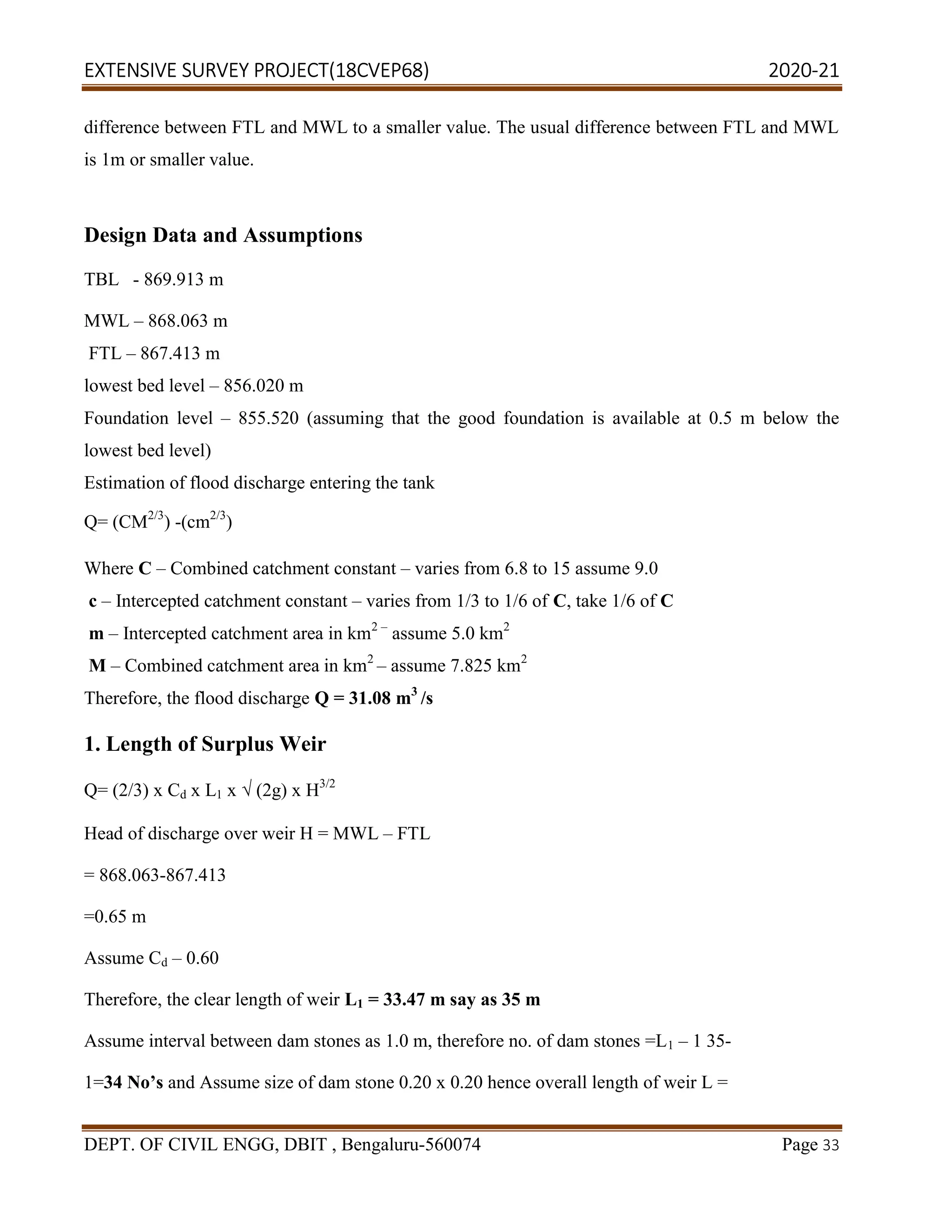
Design Data and Assumptions
TBL - 869.913 m
MWL – 868.063 m
FTL – 867.413 m
lowest bed level – 856.020 m
Foundation level – 855.520 (assuming that the good foundation is available at 0.5 m below the
lowest bed level)
Estimation of flood discharge entering the tank
Q= (CM2/3
) -(cm2/3
)
Where C – Combined catchment constant – varies from 6.8 to 15 assume 9.0
c – Intercepted catchment constant – varies from 1/3 to 1/6 of C, take 1/6 of C
m – Intercepted catchment area in km2 –
assume 5.0 km2
M – Combined catchment area in km2
– assume 7.825 km2
Therefore, the flood discharge Q = 31.08 m3
/s
1. Length of Surplus Weir
Q= (2/3) x Cd x L1 x √ (2g) x H3/2
Head of discharge over weir H = MWL – FTL
= 868.063-867.413
=0.65 m
Assume Cd – 0.60
Therefore, the clear length of weir L1 = 33.47 m say as 35 m
Assume interval between dam stones as 1.0 m, therefore no. of dam stones =L1 – 1 35-
1=34 No’s and Assume size of dam stone 0.20 x 0.20 hence overall length of weir L =
EXTENSIVE SURVEY PROJECT(18CVEP68) 2020
DEPT. OF CIVIL ENGG, DBIT , Bengaluru
[L1+ (width of dam stone x no’s of stones)]
L=[35+(0.20 X 34)] = 41.80 m.
2. Dimensions of Weir
Structural height of weir
Crest level- 867.413 m (FTL)
Top of dam stone – 868.063 m(MWL)
Ground level – 856.020 m
Downstream-
Top of foundation concrete TFL
Height of weir above foundation H = (FTL
Structural height of weir = H + (top of dam stone
Crest width / top width
a =0.55(√ (H) +√ (h))
Where: h = head over weir = (MWL
Therefore, top width of weir
Where:
specific weight of masonry, S = 2.4kN/m3
Therefore, base width of weir
3. Protection Work
Abutment
Height of abutment above foundation (TBL
Top width = 0.50 m (min)
(18CVEP68) 2020
CIVIL ENGG, DBIT , Bengaluru-560074
[L1+ (width of dam stone x no’s of stones)]
m(MWL)
foundation concrete TFL – 855.520 m
oundation H = (FTL – TFL) = 11.890 m
Structural height of weir = H + (top of dam stone level – crest level) = 12.543 m
ead over weir = (MWL – FTL) = 0.65m
Therefore, top width of weir a =2.34say as 2.4m
specific weight of masonry, S = 2.4kN/m3
Therefore, base width of weir b = 10.60 m
Height of abutment above foundation (TBL-TFL) Ha= 14.393m
(18CVEP68) 2020-21
Page 34
m
EXTENSIVE SURVEY PROJECT(18CVEP68) 2020-21
DEPT. OF CIVIL ENGG, DBIT , Bengaluru-560074 Page 35
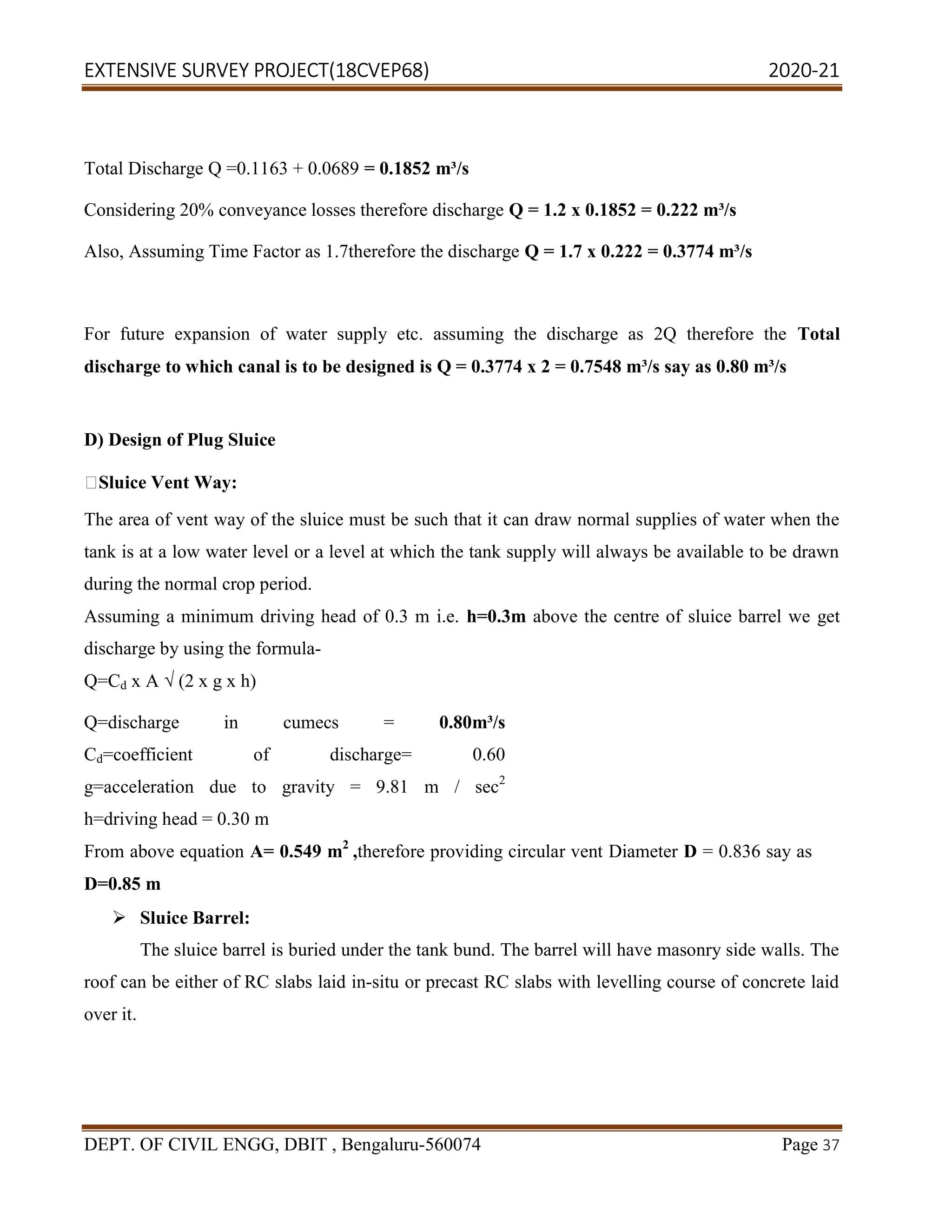
Bottom width (0.4xHa) = 5.75 m Provide 6.00m
Upstream Wing Wall and Return Wall
Height of U/S wing wall above foundation
HU/S = (MWL+0.3) -(TFL) = 12.843m
Top width = 0.50 m (min)
Bottom width (0.4XHU/S) = 5.13 m say 5.2 m
Provide a splay of 3: 1
Downstream Wing Wall and Return Wall
Height of D/S wing wall above foundation
HD/S W =(MWL)-(TFL) = 12.543 m
Top width = 0.50 m (min)
Bottom width (0.4X HD/S W) = 5.00 m
Provide a splay of 5:1
Design of Apron
1. Upstream apron
The apron is designed based on the seepage theory therefore the max seepage
pressure is given by
Max seepage pressure (Total uplift head acting) = (MWL-GL) = 12.043 m
Assuming hydraulic gradient (HG) = 5.0
Length of apron = uplift head x HG = 39.02 m say as 60.215m since the length of apron is too long
from structural consideration provide length of apron about half the value
i.e., length of apron = 30.10m
Provide two stepped apron of length L1= 15m and L2 = 15m
EXTENSIVE SURVEY PROJECT(18CVEP68) 2020-21
DEPT. OF CIVIL ENGG, DBIT , Bengaluru-560074 Page 36
Thickness of solid apron = residual seepage pressure / (Sc – 1)
Where: residual seepage pressure = max seepage pressure – seepage pressure lost
= max seepage pressure – (seepage length / HG)
Note: Seepage length = length of apron therefore residual seepage pressure = 2.005
Sc= specific gravity of concrete = 2.25
Therefore, thickness of 1st
apron = 1.604 m
Hence provide thickness of 2nd
apron of about 50% of 1st
apron i.e.=0.802 m
Downstream Apron
Generally, no aprons are required on D/S side of weir however, cement grouting and sheet piling is
done on the area immediately above weir to avoid percolation of water into soil
C) Determination of Discharge Required
Assume,
Culturally Commanded Area= 600 hectares
Area under Crop 1 (Ragi) = 60 % of CCA
Crop 2 (Vegetables) = 40 % of CCA
The major crops grown in this region and necessary data are calculated and tabulated below
CROPS RAGI VEGETABLES
AREA UNDER[A] CROP - hectares 402 268
BASE PERIOD[B]- days 120 90
AMOUNT OF WATER REQUIRED (∆ -
m)
0.30 0.20
DUTY[D] D = 3.64 x (B / ∆) (hectare/cumecs) 3456 3888
DISCHARGE[Q] Q = A / D (m3
/sec) 0.1163 0.0689
EXTENSIVE SURVEY PROJECT(18CVEP68) 2020-21
DEPT. OF CIVIL ENGG, DBIT , Bengaluru-560074 Page 37
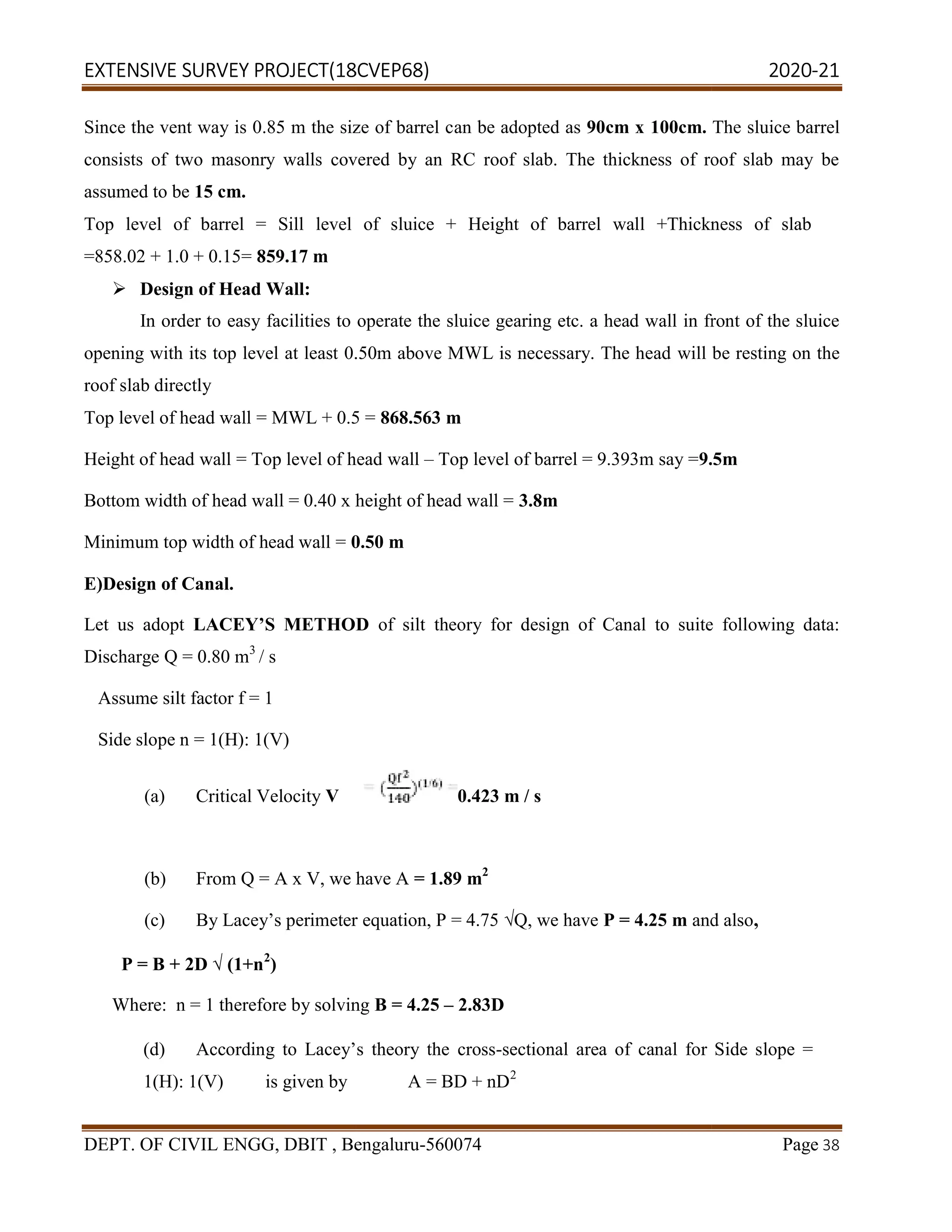
Total Discharge Q =0.1163 + 0.0689 = 0.1852 m³/s
Considering 20% conveyance losses therefore discharge Q = 1.2 x 0.1852 = 0.222 m³/s
Also, Assuming Time Factor as 1.7therefore the discharge Q = 1.7 x 0.222 = 0.3774 m³/s
For future expansion of water supply etc. assuming the discharge as 2Q therefore the Total
discharge to which canal is to be designed is Q = 0.3774 x 2 = 0.7548 m³/s say as 0.80 m³/s
D) Design of Plug Sluice
Sluice Vent Way:
The area of vent way of the sluice must be such that it can draw normal supplies of water when the
tank is at a low water level or a level at which the tank supply will always be available to be drawn
during the normal crop period.
Assuming a minimum driving head of 0.3 m i.e. h=0.3m above the centre of sluice barrel we get
discharge by using the formula-
Q=Cd x A √ (2 x g x h)
Q=discharge in cumecs = 0.80m³/s
Cd=coefficient of discharge= 0.60
g=acceleration due to gravity = 9.81 m / sec2
h=driving head = 0.30 m
From above equation A= 0.549 m2
,therefore providing circular vent Diameter D = 0.836 say as
D=0.85 m
 Sluice Barrel:
The sluice barrel is buried under the tank bund. The barrel will have masonry side walls. The
roof can be either of RC slabs laid in-situ or precast RC slabs with levelling course of concrete laid
over it.
EXTENSIVE SURVEY PROJECT(18CVEP68) 2020
DEPT. OF CIVIL ENGG, DBIT , Bengaluru
Since the vent way is 0.85 m the size of barrel c
consists of two masonry walls covered by an RC roof slab. The thickness of roof slab may be
assumed to be 15 cm.
Top level of barrel = Sill level of sluice + Height of barrel wall +Thickness of slab
=858.02 + 1.0 + 0.15= 859.17 m
 Design of Head Wall:
In order to easy facilities to operate the sluice gearing etc. a head wall in front of the sluice
opening with its top level at least 0.50m above MWL is necessary. The head
roof slab directly
Top level of head wall = MWL + 0.5 =
Height of head wall = Top level of head
Bottom width of head wall = 0.40 x height of head wall =
Minimum top width of head wall = 0.50 m
E)Design of Canal.
Let us adopt LACEY’S METHOD
Discharge Q = 0.80 m3
/ s
Assume silt factor f = 1
Side slope n = 1(H): 1(V)
(a) Critical Velocity V
(b) From Q = A x V, we have A
(c) By Lacey’s perimeter equation, P = 4.75
P = B + 2D √ (1+n2
)
Where: n = 1 therefore by solving
(d) According to Lacey’s theory the
1(H): 1(V) is given by A = BD + nD
(18CVEP68) 2020
CIVIL ENGG, DBIT , Bengaluru-560074
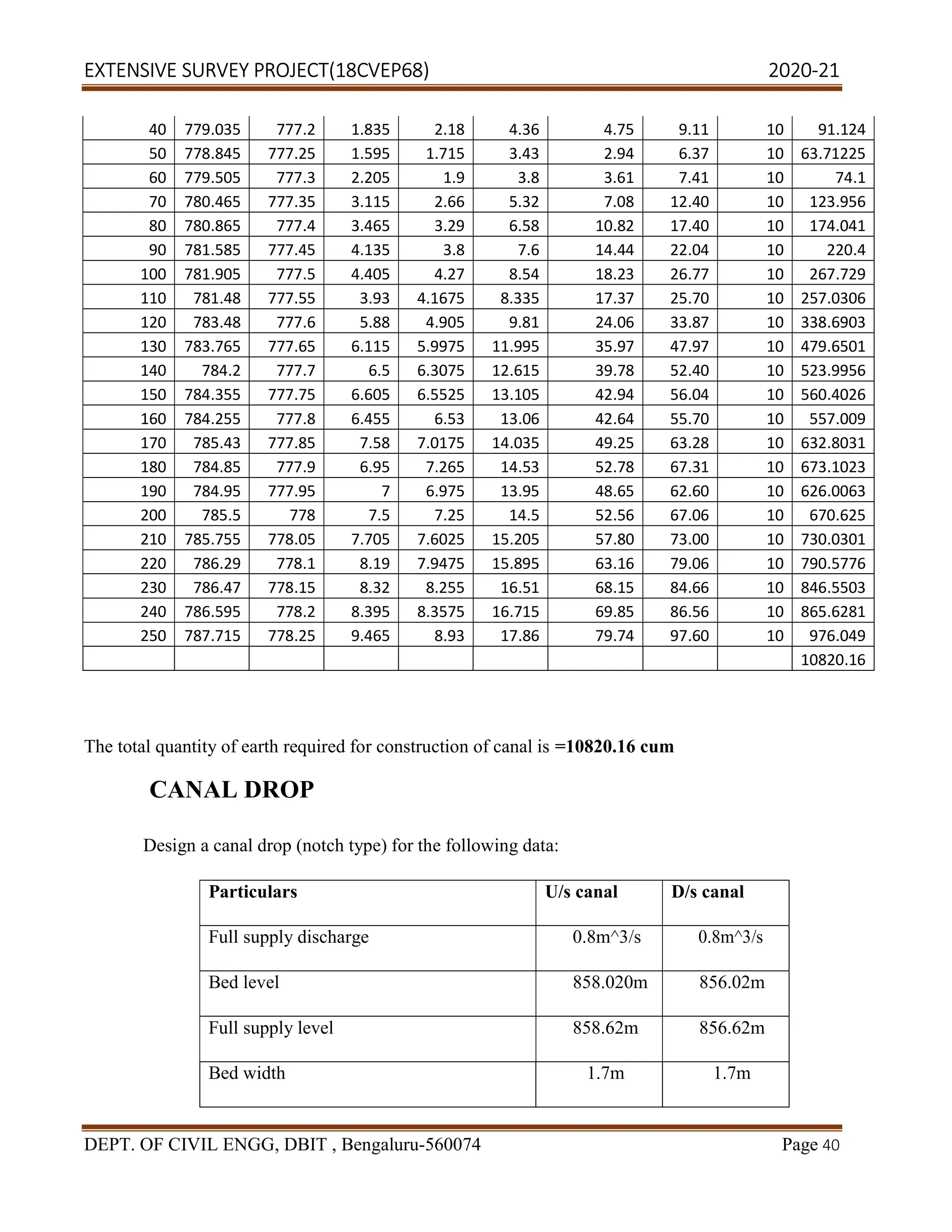
Since the vent way is 0.85 m the size of barrel can be adopted as 90cm x 100cm.
consists of two masonry walls covered by an RC roof slab. The thickness of roof slab may be
Top level of barrel = Sill level of sluice + Height of barrel wall +Thickness of slab
In order to easy facilities to operate the sluice gearing etc. a head wall in front of the sluice
opening with its top level at least 0.50m above MWL is necessary. The head will be resting on the
Top level of head wall = MWL + 0.5 = 868.563 m
Height of head wall = Top level of head wall – Top level of barrel = 9.393m say =9.5m
Bottom width of head wall = 0.40 x height of head wall = 3.8m
0.50 m
LACEY’S METHOD of silt theory for design of Canal to suite following data:
0.423 m / s
From Q = A x V, we have A = 1.89 m2
By Lacey’s perimeter equation, P = 4.75 √Q, we have P = 4.25 m and also
Where: n = 1 therefore by solving B = 4.25 – 2.83D
According to Lacey’s theory the cross-sectional area of canal for Side slope =
1(H): 1(V) is given by A = BD + nD2
(18CVEP68) 2020-21
Page 38
The sluice barrel
consists of two masonry walls covered by an RC roof slab. The thickness of roof slab may be
Top level of barrel = Sill level of sluice + Height of barrel wall +Thickness of slab
In order to easy facilities to operate the sluice gearing etc. a head wall in front of the sluice
will be resting on the
.5m
of silt theory for design of Canal to suite following data:
and also,
sectional area of canal for Side slope =
EXTENSIVE SURVEY PROJECT(18CVEP68) 2020-21
DEPT. OF CIVIL ENGG, DBIT , Bengaluru-560074 Page 39
1.89= (4.25-2.83D) D + 1xD2
solving for D we have D = 0.599m say as 0.60 m thus by Providing
0.30 m free board total depth of canal is 0.90 m.
Therefore, the bed width of canal is B = 4.25 – 2.83x0.9 = 1.703 say as 1.70 m
(e) Bed slope S = f5/3
/ (3340 x Q1/6)
Therefore S = 1 in 3218 say as 1 in 3200,
 Check for Design
W.k.t Hydraulic mean depth R= A / P i.e. R = 0.444 m
Also, from Lacey’s equation we have hydraulic mean depth R = 5V2
/ 2f, i.e. R = 0.447mSince
the hydraulic mean depths from two equations are same. Hence the above design values of
canal [from (a) to (e)] based on Lacey’s silt theory is correct.
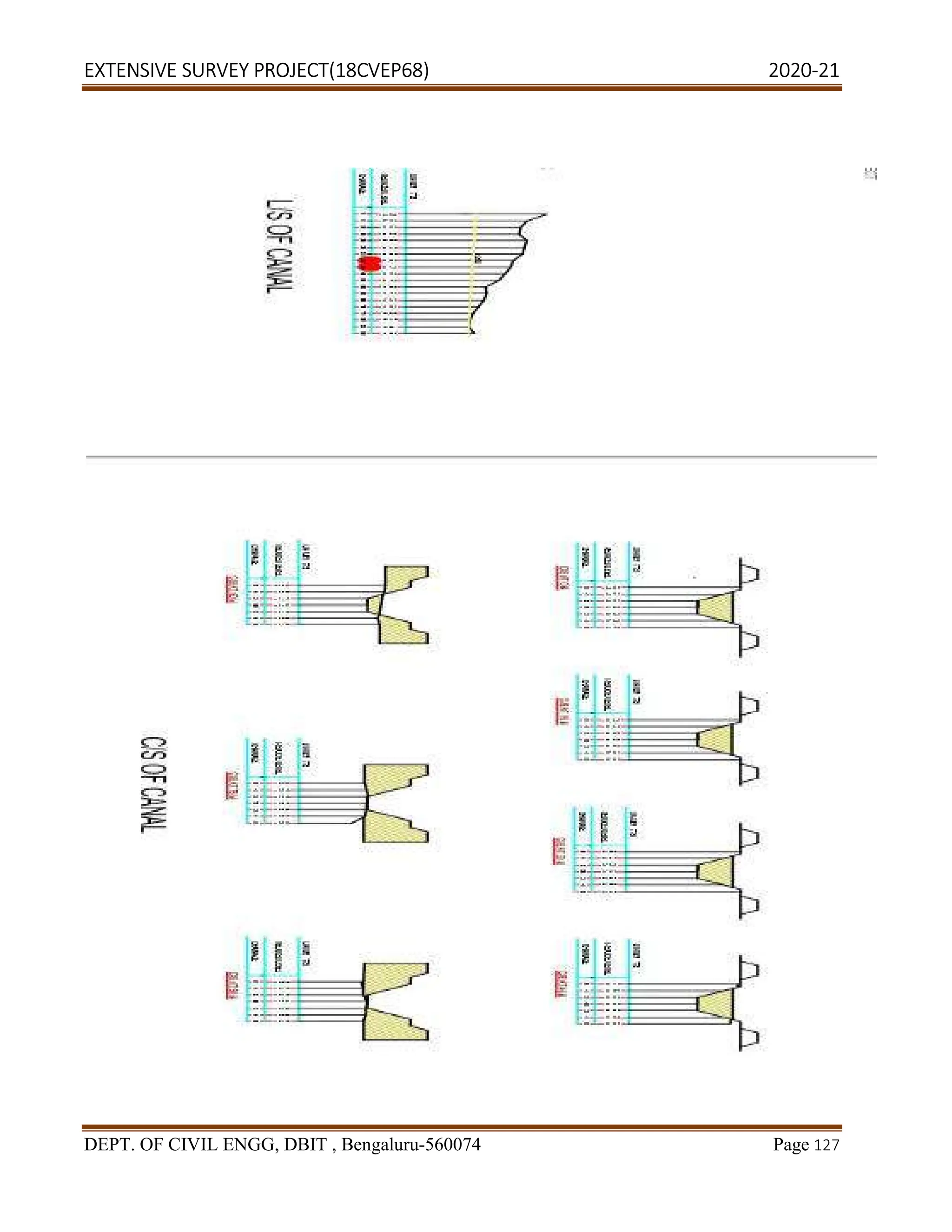
Earthwork Calculation of Canal
BED WIDTH = 2 M
SLOPE= 1:1
LENGTH 10M
CENTRAL
AREA
B*D
TOTAL
AREA
EARTH
WORK
IN
CUTTING
CHAINAGE
RL
OF
GROUND
RL
OF
FL
DEPTH
OF
CUTTING
(D)
MEAN
DEPTH
(M)
(A1)
(SD^2)
(A1+A2)
LENGTH
(L)
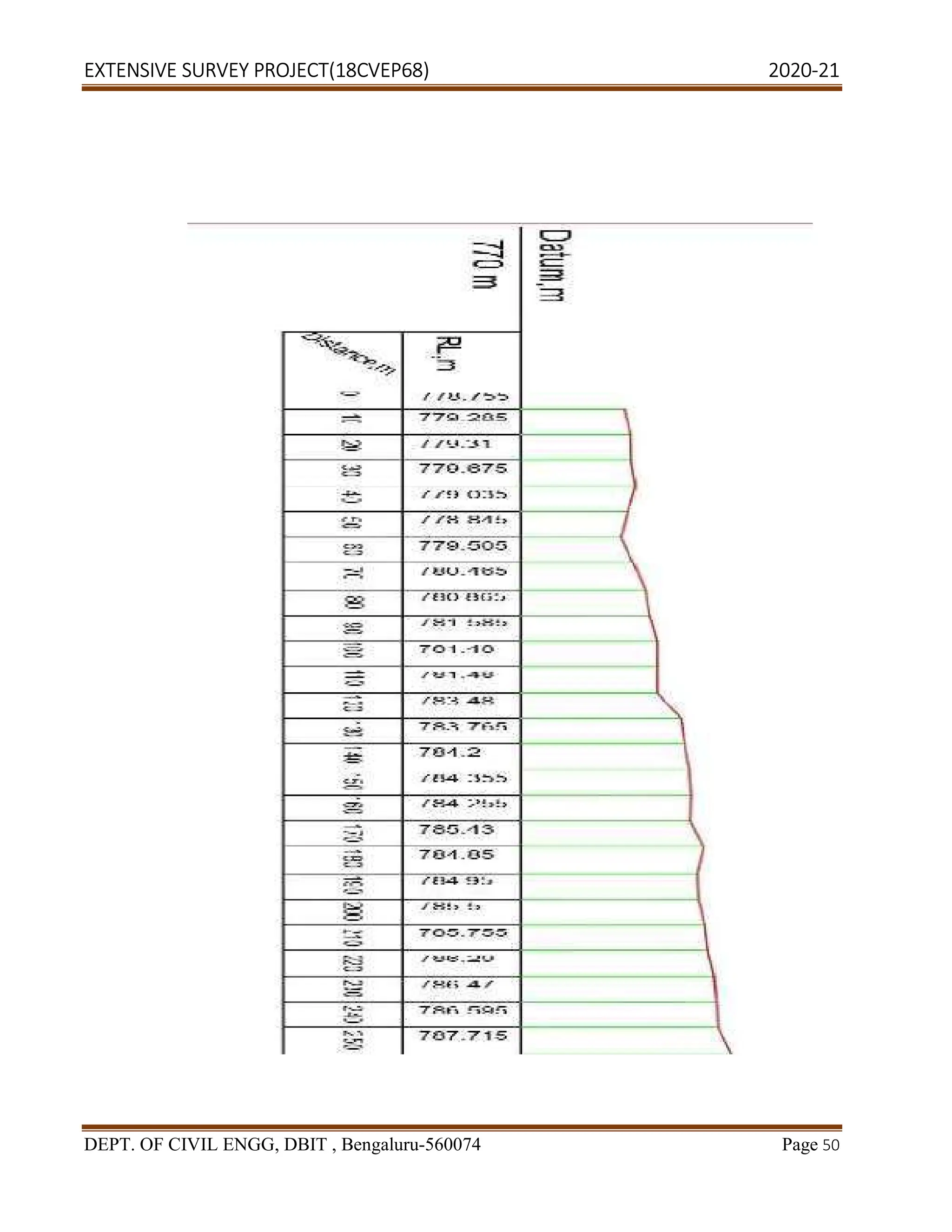
0 778.755 777 1.755
10 779.285 777.05 2.235 1.995 3.99 3.98 7.97 10 79.70025
20 779.31 777.1 2.21 2.2225 4.445 4.94 9.38 10 93.84506
30 779.675 777.15 2.525 2.3675 4.735 5.61 10.34 10 103.4006
EXTENSIVE SURVEY PROJECT(18CVEP68) 2020-21
DEPT. OF CIVIL ENGG, DBIT , Bengaluru-560074 Page 40
40 779.035 777.2 1.835 2.18 4.36 4.75 9.11 10 91.124
50 778.845 777.25 1.595 1.715 3.43 2.94 6.37 10 63.71225
60 779.505 777.3 2.205 1.9 3.8 3.61 7.41 10 74.1
70 780.465 777.35 3.115 2.66 5.32 7.08 12.40 10 123.956
80 780.865 777.4 3.465 3.29 6.58 10.82 17.40 10 174.041
90 781.585 777.45 4.135 3.8 7.6 14.44 22.04 10 220.4
100 781.905 777.5 4.405 4.27 8.54 18.23 26.77 10 267.729
110 781.48 777.55 3.93 4.1675 8.335 17.37 25.70 10 257.0306
120 783.48 777.6 5.88 4.905 9.81 24.06 33.87 10 338.6903
130 783.765 777.65 6.115 5.9975 11.995 35.97 47.97 10 479.6501
140 784.2 777.7 6.5 6.3075 12.615 39.78 52.40 10 523.9956
150 784.355 777.75 6.605 6.5525 13.105 42.94 56.04 10 560.4026
160 784.255 777.8 6.455 6.53 13.06 42.64 55.70 10 557.009
170 785.43 777.85 7.58 7.0175 14.035 49.25 63.28 10 632.8031
180 784.85 777.9 6.95 7.265 14.53 52.78 67.31 10 673.1023
190 784.95 777.95 7 6.975 13.95 48.65 62.60 10 626.0063
200 785.5 778 7.5 7.25 14.5 52.56 67.06 10 670.625
210 785.755 778.05 7.705 7.6025 15.205 57.80 73.00 10 730.0301
220 786.29 778.1 8.19 7.9475 15.895 63.16 79.06 10 790.5776
230 786.47 778.15 8.32 8.255 16.51 68.15 84.66 10 846.5503
240 786.595 778.2 8.395 8.3575 16.715 69.85 86.56 10 865.6281
250 787.715 778.25 9.465 8.93 17.86 79.74 97.60 10 976.049
10820.16
The total quantity of earth required for construction of canal is =10820.16 cum
CANAL DROP
Design a canal drop (notch type) for the following data:
Particulars U/s canal D/s canal
Full supply discharge 0.8m^3/s 0.8m^3/s
Bed level 858.020m 856.02m
Full supply level 858.62m 856.62m
Bed width 1.7m 1.7m
EXTENSIVE SURVEY PROJECT(18CVEP68) 2020-21
DEPT. OF CIVIL ENGG, DBIT , Bengaluru-560074 Page 41
TBL 858.920m 856.92m
Top width of embankment 3m 3m
Side slope cutting 1:1 1:1
Average ground level 856.920m 856.920m
Hard soil for foundation available at 856.52m 856.52m
Half supply depth 0.45m 0.45m
specific gravityof concrete/masonry 2.25
Cd for the notches 0.7
Bligh’s crap co-efficient 5
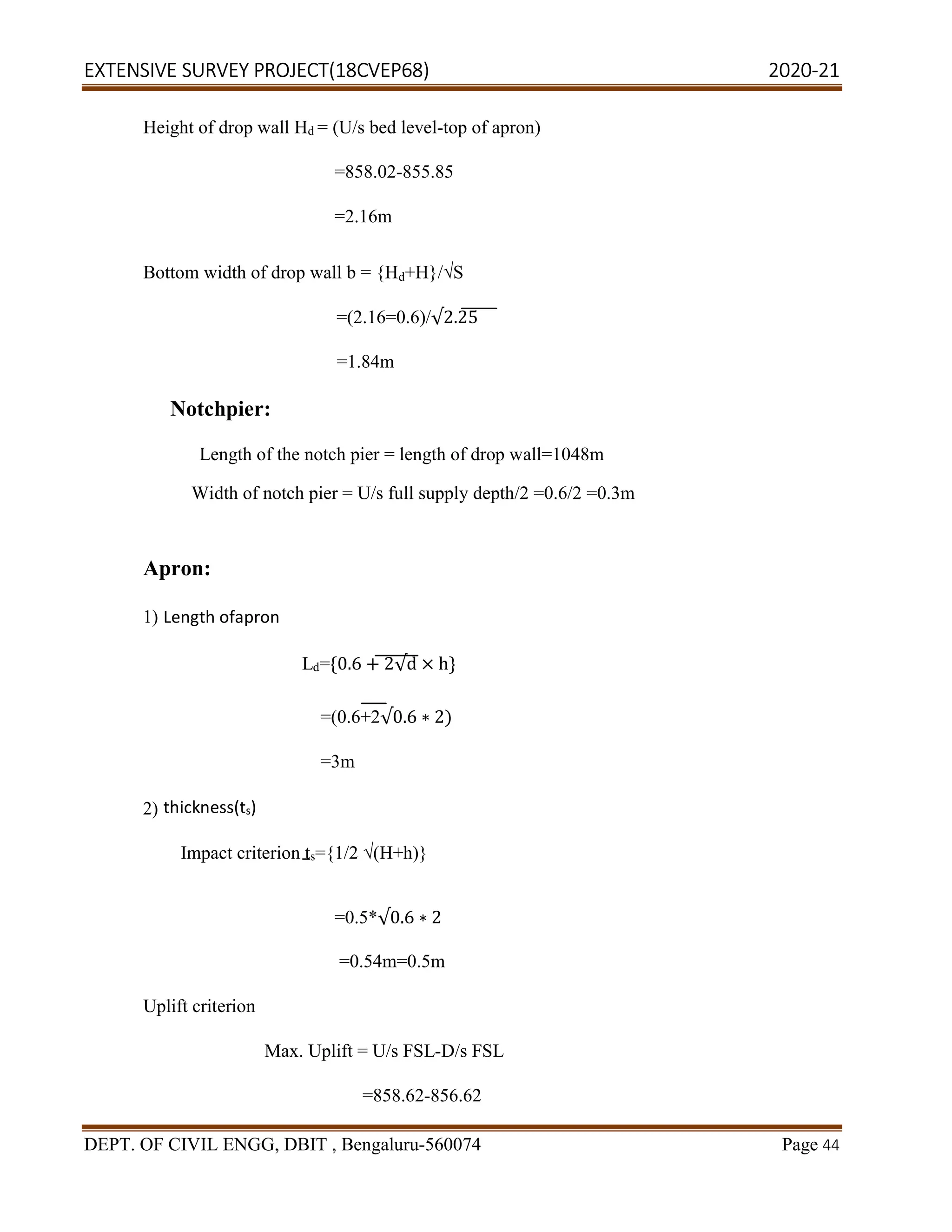
First of all it is necessary to know whether the drop is free or submerged,
this can be done by comparing the upstream bed level with the downstream full
supply level. If the upstream bed is above the d/s full supply level, the drop is
free, otherwise it is submerged.
EXTENSIVE SURVEY PROJECT(18CVEP68) 2020-21
DEPT. OF CIVIL ENGG, DBIT , Bengaluru-560074 Page 42
NOTCHES:
Fully supply discharge in the canal=0.8m^3/s
Assuming 2 notches
Fully supply discharge per month Q=0.8/2=0.4m^3/s
Fully supply depth over the notch H=upstream FSL-upstream bed level
=858.62-858.02=0.6m
Fully supply discharge per notch Q1=Q/2=0.4/2=0.2m^3/s
Half supply depth over the notch H1=0.45m(given)
For a trapezoidal notch
Q={2/3 cd√2gLH3/2
+ 8/15 cd√2gH5/2
tanθ}
Substituting the full supply and half supply conditions For full supply condition,
0.4=(2/3*0.7*√2∗9.81*L*(0.6)^(3/2))+(8/15*0.7*√2∗9.81*(0.6)^(5/2)tanθ)
0.4=0.96L+0.46tanθ →eqn1
For half supply condition,
0.2=(2/3*0.7*√2 ∗ 9.81*L*(0.45)^(3/2))+(8/15*0.7*√2 ∗ 9.81*(0.45)^(5/2)tanθ
0.2=0.623L+0.22tanθ → eqn2
Solving equations 1 & 2,
L1=0.291m
Tanθ=0.0823
Top width=(L+2Htanθ)
EXTENSIVE SURVEY PROJECT(18CVEP68) 2020-21
DEPT. OF CIVIL ENGG, DBIT , Bengaluru-560074 Page 43
=(0.5+(2*0.6)*0.0823) =0.598m
Drop wall
Ld=length=
7
× band width of upstream canal
8
=(7/8)*107
=1.488m
Top width a={full supply depth/2 +0.15 to 0.3} metres
a= ((0.6/2)+0.2)
a=0.5m
depth of water cushion(X)
(X+d)=0.9H√h
Where, d = D/s full supply depth =0.6m
H = U/s full supply depth =0.6m
h = height of drop =2m
X = depth of water cushion
(x+0.6)=0.9*0.6*√2
X=0.1636m
Top of apron=Downstream bed level-x
=856.02-0.1636
=855.856m
EXTENSIVE SURVEY PROJECT(18CVEP68) 2020-21
DEPT. OF CIVIL ENGG, DBIT , Bengaluru-560074 Page 44
Height of drop wall Hd = (U/s bed level-top of apron)
=858.02-855.85
=2.16m
Bottom width of drop wall b = {Hd+H}/√S
=(2.16=0.6)/√2.25
=1.84m
Notchpier:
Length of the notch pier = length of drop wall=1048m
Width of notch pier = U/s full supply depth/2 =0.6/2 =0.3m
Apron:
1) Length ofapron
Ld={0.6 + 2√d × h}
=(0.6+2√0.6 ∗ 2)
=3m
2) thickness(ts)
Impact criterion ts={1/2 √(H+h)}
=0.5*√0.6 ∗ 2
=0.54m=0.5m
Uplift criterion
Max. Uplift = U/s FSL-D/s FSL
=858.62-856.62
EXTENSIVE SURVEY PROJECT(18CVEP68) 2020-21
DEPT. OF CIVIL ENGG, DBIT , Bengaluru-560074 Page 45
=2m
Protection works
a) abutment(A)(B)
Height = 858.92-855.856=3.046m
Bottom width =0.4*height=1.2256m
Top width=0.5m (min)
a) U/s wing wall(B)(C)
Height of wing wall=858.92-
856.52=2.4m Bottom width
= 0.4*2.4=0.96m
Top width =0.5m (min)
Splay 1:1
b) D/s wing wall(A)(D)
Section of wing wall at A will be same as the abutment
(heights are same) Height of the wing wall at D
=856.92-855.856=1.046m
Bottom width
=0.4(height)=0.42
5m Top width
=0.5m (min)
EXTENSIVE SURVEY PROJECT(18CVEP68) 2020-21
DEPT. OF CIVIL ENGG, DBIT , Bengaluru-560074 Page 46
EXTENSIVE SURVEY PROJECT(18CVEP68) 2020-21
DEPT. OF CIVIL ENGG, DBIT , Bengaluru-560074 Page 47
EXTENSIVE SURVEY PROJECT(18CVEP68) 2020-21
DEPT. OF CIVIL ENGG, DBIT , Bengaluru-560074 Page 48
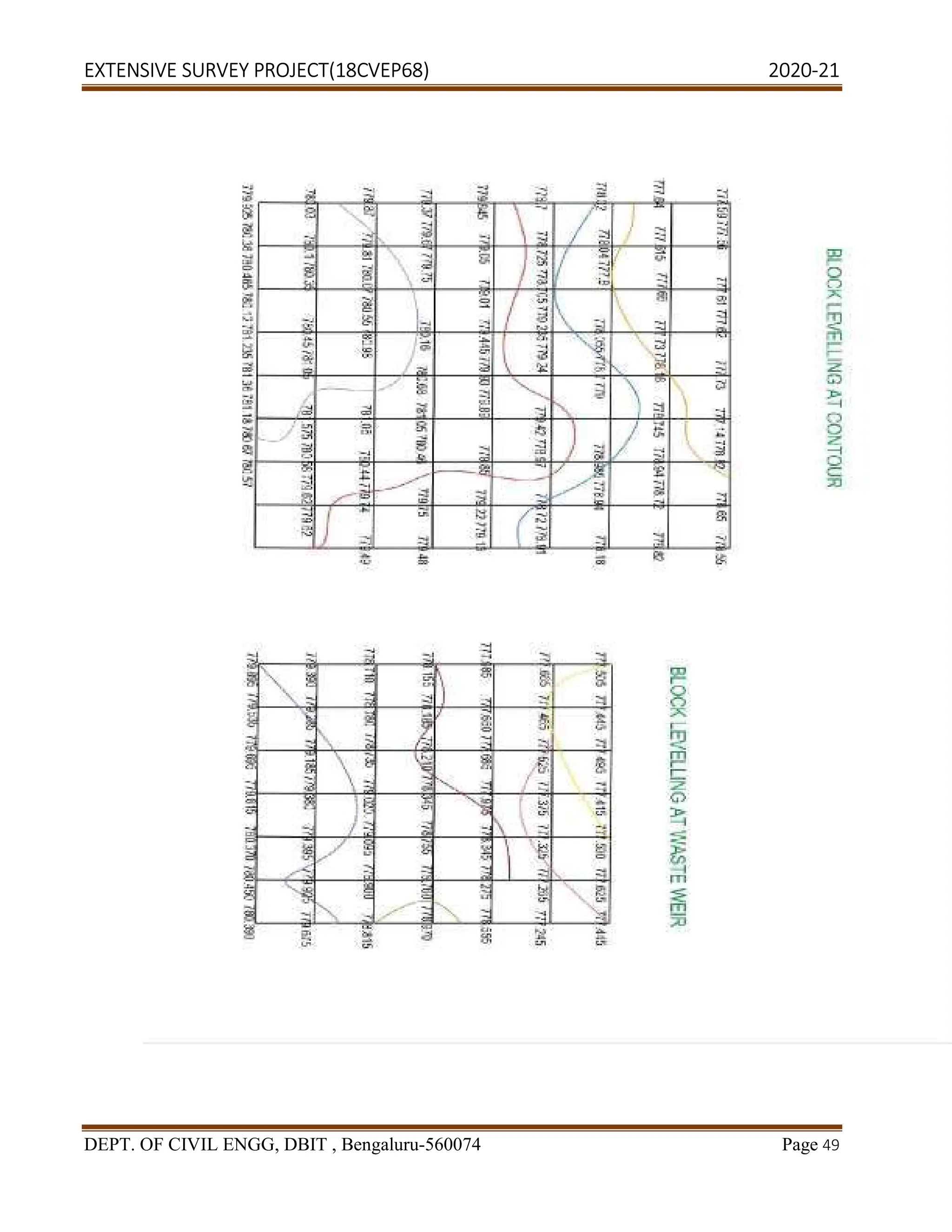
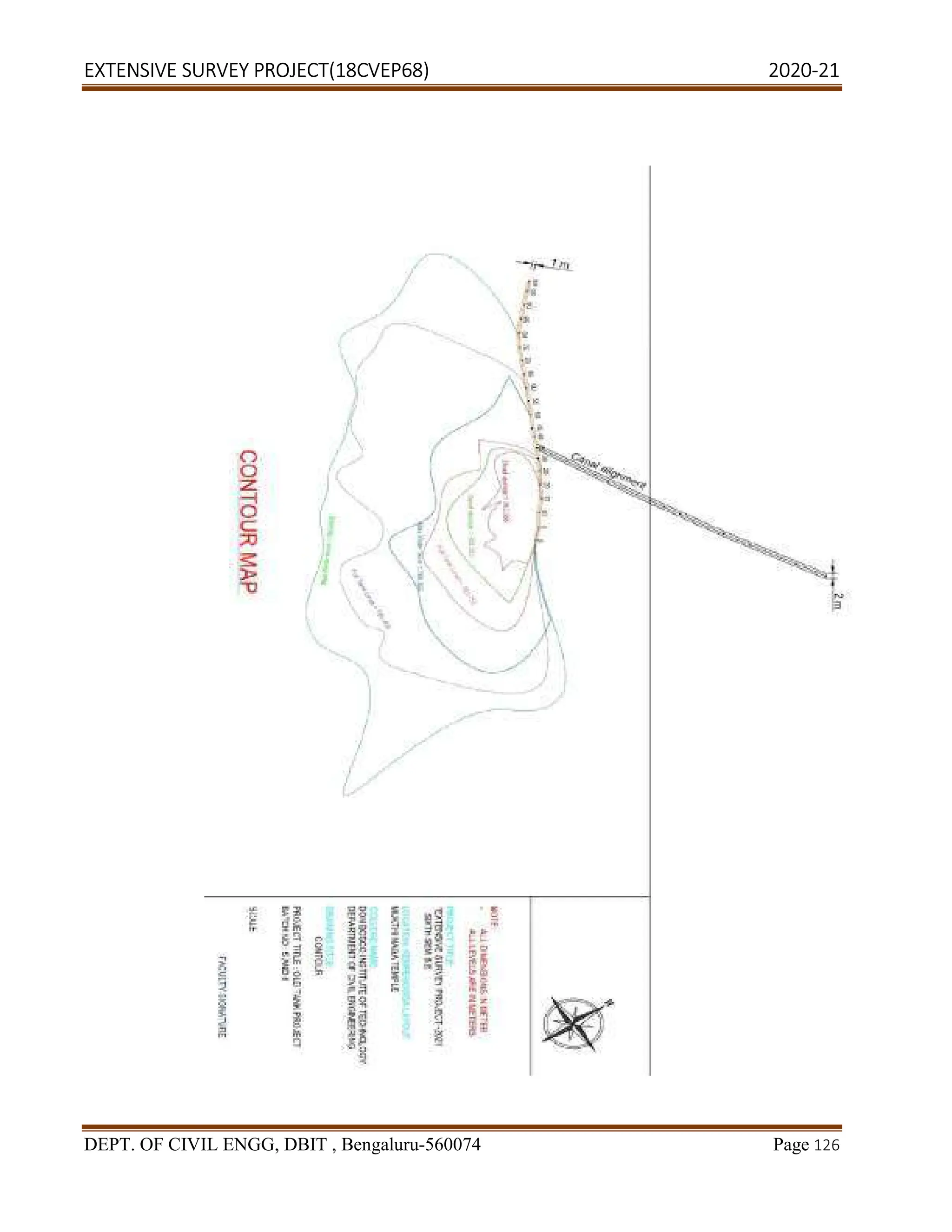
CONTOUR
EXTENSIVE SURVEY PROJECT(18CVEP68) 2020-21
DEPT. OF CIVIL ENGG, DBIT , Bengaluru-560074 Page 49
EXTENSIVE SURVEY PROJECT(18CVEP68) 2020-21
DEPT. OF CIVIL ENGG, DBIT , Bengaluru-560074 Page 50
EXTENSIVE SURVEY PROJECT(18CVEP68) 2020-21
DEPT. OF CIVIL ENGG, DBIT , Bengaluru-560074 Page 51
CONCLUSION
1. The Survey carried out at “SHREE KSHETRA MUKTHI NAGA TEMPLE” near ramohalli
was effective as the site is suitable for the proposal of dam and reservoir.
2. Carrying out the survey work with the help of necessary instruments, the dam and reservoir
can be effectively and successfully designed.
3. The project carried out involving various surveys is helpful in estimating and calculating
various data like runoff, total reservoir capacity, ground feature etc, for the dam or reservoir
to be economical and effective.
4. A new communication road over the dam is proposed to connect right bank and left bank.
EXTENSIVE SURVEY PROJECT(18CVEP68) 2020-21
DEPT. OF CIVIL ENGG, DBIT , Bengaluru-560074 Page 52
Bibliography
Book Author
 Irrigation and Water Power
Engineering
Dr. B.C. Punmia and Dr.Pande B.B. Lal
 Irrigation Engineering and Hydraulic
Structures
Santosh Kumar Garg
 Surveying Dr. B.C. Punmia
 Surveying Dr. K.R. Arora
 Soil Mechanics & Foundation
Engineering
Dr. B.C. Punmia
 Soil Mechanics & Foundation
Engineering
Prof. V.N.S. Murthy
 Engineering Hydrology K. Subramanyam
EXTENSIVE SURVEY PROJECT(18CVEP68) 2020-21
DEPT. OF CIVIL ENGG, DBIT , Bengaluru-560074 Page 53
Project In-Charge: 1. Prof. Gobinath S
2. Prof. Savitha A L
EXTENSIVE SURVEY PROJECT(18CVEP68) 2020-21
DEPT. OF CIVIL ENGG, DBIT , Bengaluru-560074 Page 54
CONTENTS
SL NO, PARTICULARS Page No
1. INTRODUCTION
2. SURVEYS CONDUCTED FOR THE PROJECT
3. POPULATION FORECAST
4. DESIGN OF RISING MAIN
5. DESIGN OF PUMP
6. DESIGN OF TREATMENT UNITS
EXTENSIVE SURVEY PROJECT(18CVEP68) 2020-21
DEPT. OF CIVIL ENGG, DBIT , Bengaluru-560074 Page 55
INTRODUCTION:
DETAILS OF EXISTING WATER SUPPLY PROJECT AREA:
The project area is located around the mukti naga temple in ramohalli villege .villege is
located in Bangalore.the project area is locted around 1kilometer away from the temple. Village is
located on a terrain.
Ramohalli is an in Bangalore west, Bangalore,Bangalore Urban District, Karnataka, India,
560074. Kengeri hobli(4.68km), Anchepalya(6.95km),Kumbalgodu(7.03km),Kengeri satellite
town(8.33km), Thavarekere(8.37km) are the nearby areas to Ramohalli.
Present population is average…..
The source of water supply is from overhead tank through borewell to all over layout.
OBJECTIVES:
 Examining the sources of water supply and calculation of required quantity of water based
on existing and projected population.
 Preparing village map and locating sites for ground level overhead tanks
DIAMETER OF THE MAIN PIPE 7.5 cm
DIAMETER OF THE DISTRIBUTION PIPE 2.5 cm
EXTENSIVE SURVEY PROJECT(18CVEP68) 2020-21
DEPT. OF CIVIL ENGG, DBIT , Bengaluru-560074 Page 56
 To formulate and design water supply scheme to , considering water available from borewell
which is the main source of supply.
 To ensure treated water availability at all times of year at adequate pressure.
SURVEYS CONDUCTED FOR THE PROJECT:
1. MAP STUDY
2. RECONNAISSANCE
3. PRLIMINARY SURVEY
FOLLOWING ARE THE SURVEYS WORK TO BE CONDUCTED:
a) Longitudinal section and cross section of transmission main.
b) Village traverse.
EQUIPMENT USED IN PROJECT:
a) Chain
b) Tape
c) Arrows
d) Ranging rod
e) Plane table
f) Plumbing fork and plumb bob
g) Level and staff
h) Alidade
i) Compass
j) Spirit level
k) Drawing papers with a rain proof cover
EXTENSIVE SURVEY PROJECT(18CVEP68) 2020-21
DEPT. OF CIVIL ENGG, DBIT , Bengaluru-560074 Page 57
POPULATION FORECAST:
Based on the census report , of 2021 population of ……. Was found to be about……….
The future population of……. In 2061 is estimated from the available data, got from local
authorities. The following are population details of ……..for the past four decades.
ARITHMETIC INCREASE METHOD :
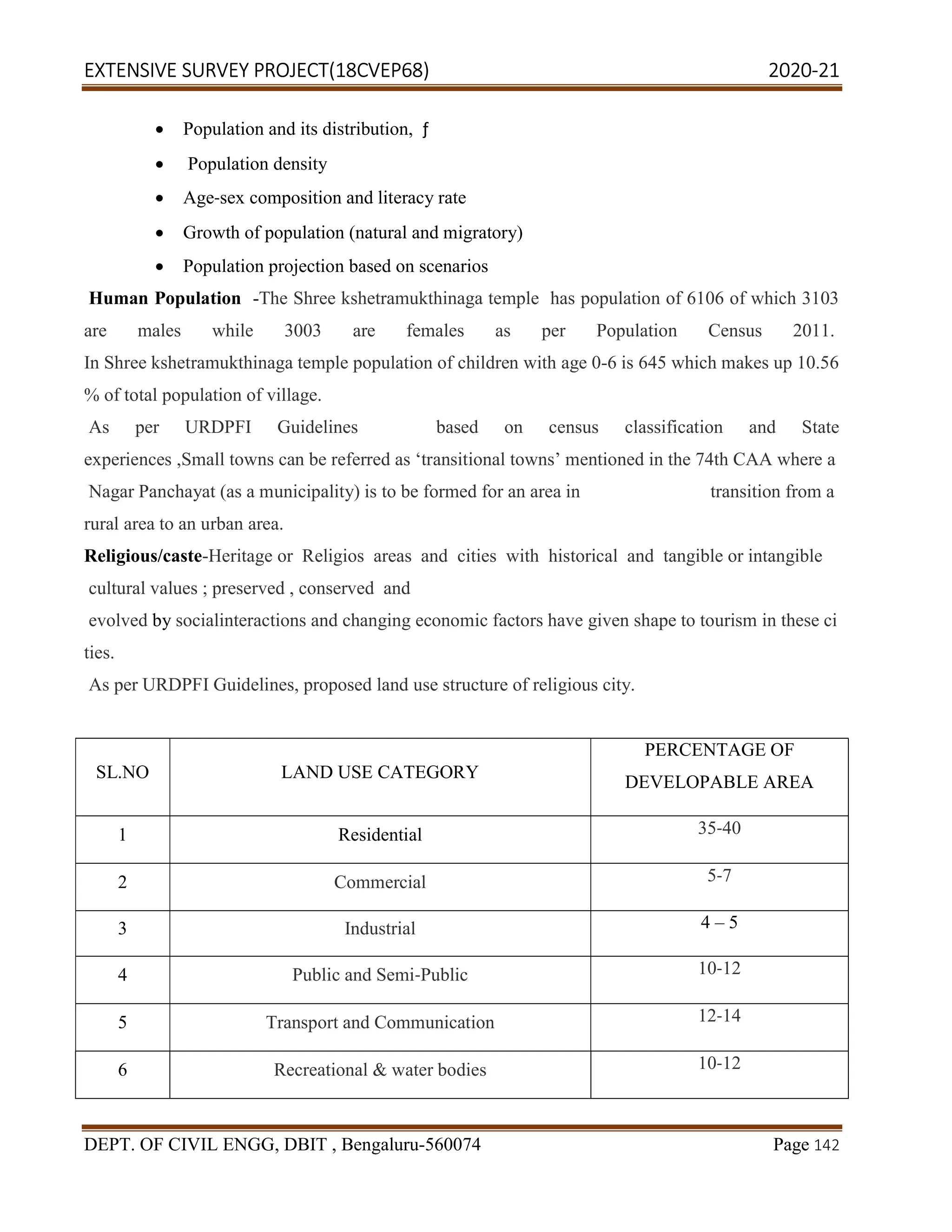
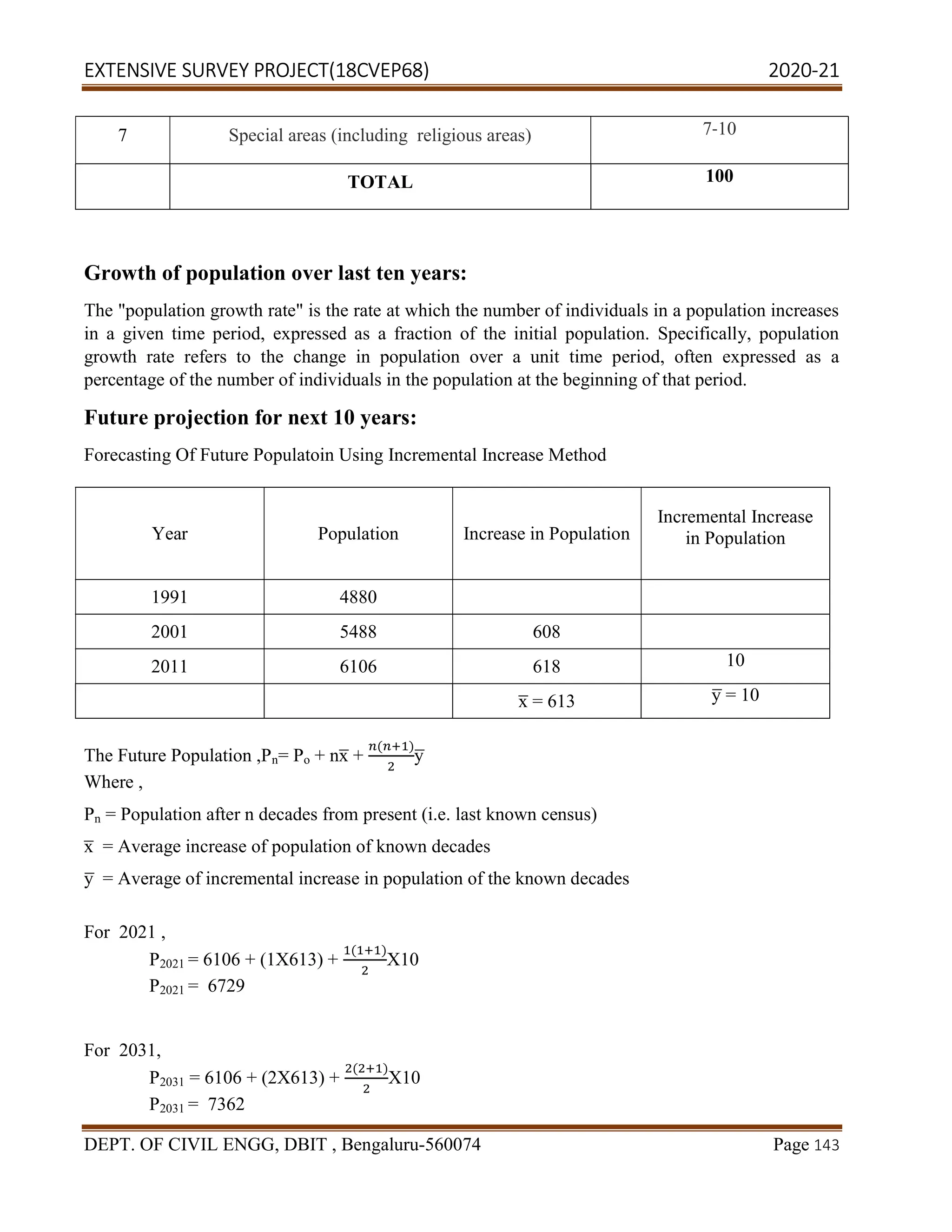
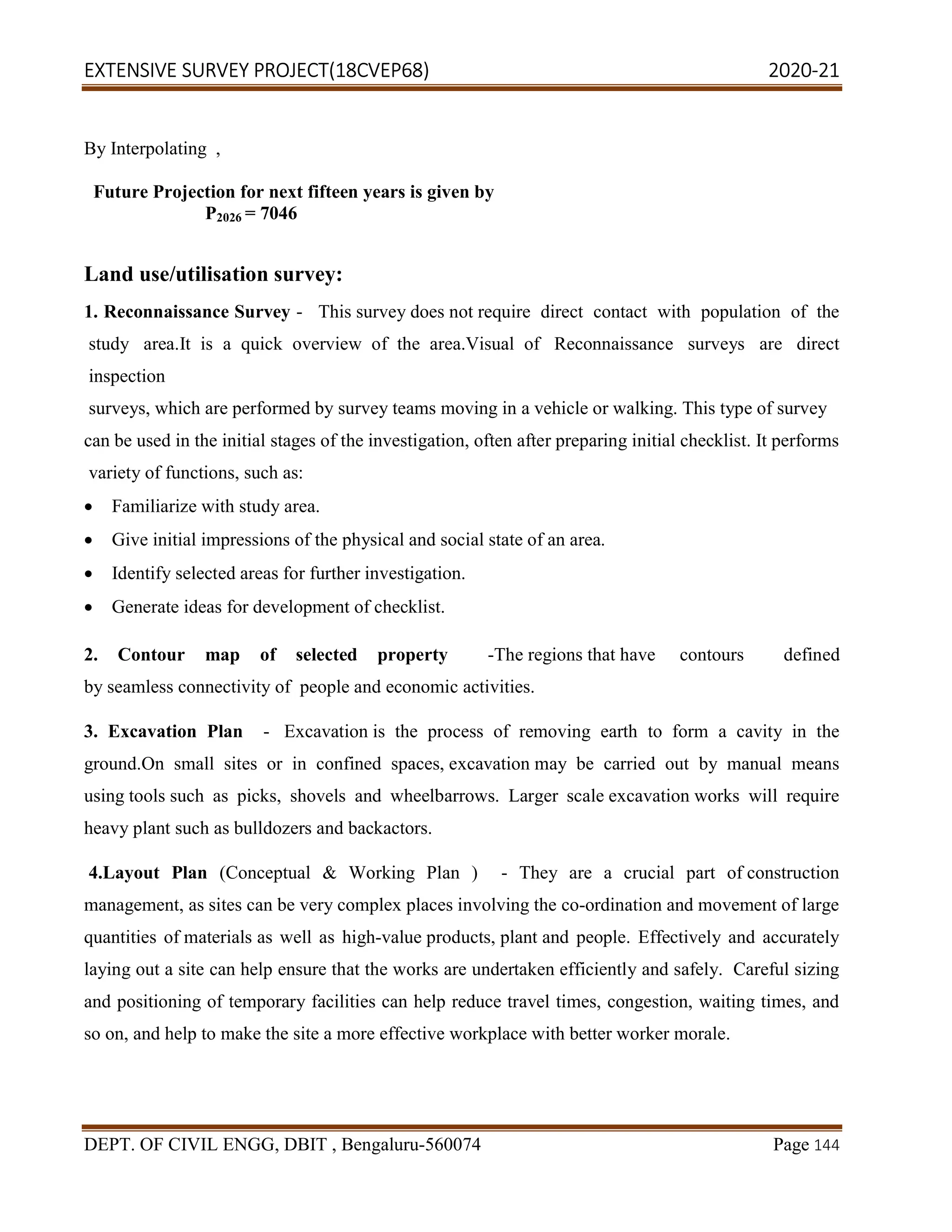
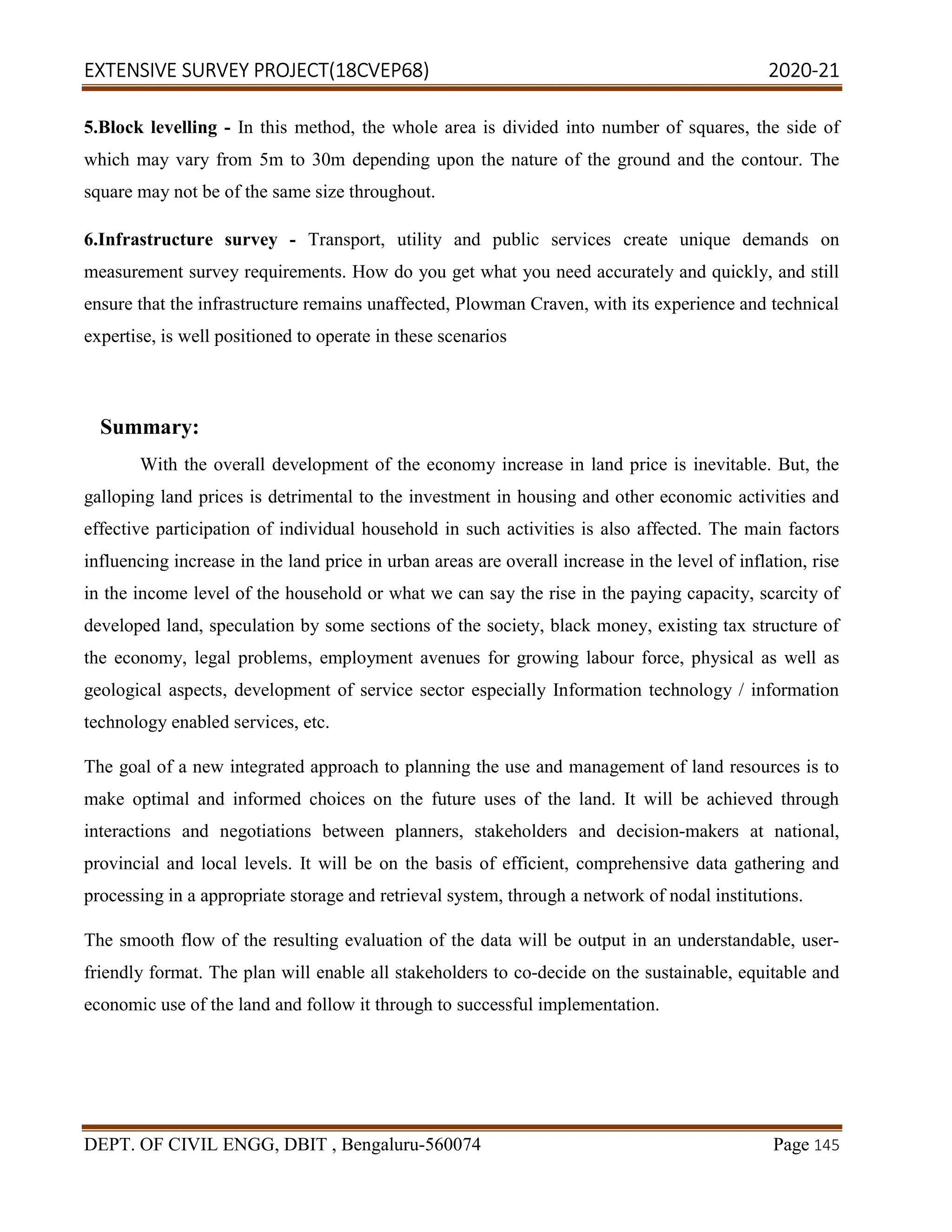
SL.NO YEAR POPULATION INCREASE IN POPULATION
1 1971 200 -
2 1981 300 100
3 1991 450 150
4 2001 500 50
5 2011 600 100
TOTAL INCREASE IN POPULATION 400
Number of decades :
Average increase per decade : 400/4 = 100
Population at end of 2021 = 400 + 1* 100 = 500
Population at end of 2031 = 400 +2*100 = 600
Population at the end of 2041 = 400 + 3*100 = 700
Poplation at the end of 2051 = 400 + 4*100 = 800
Sl. No YEAR POPULATION
1 1971 200
2 1981 300
3 1991 450
4 2001 500
5 2011 600
EXTENSIVE SURVEY PROJECT(18CVEP68) 2020-21
DEPT. OF CIVIL ENGG, DBIT , Bengaluru-560074 Page 58
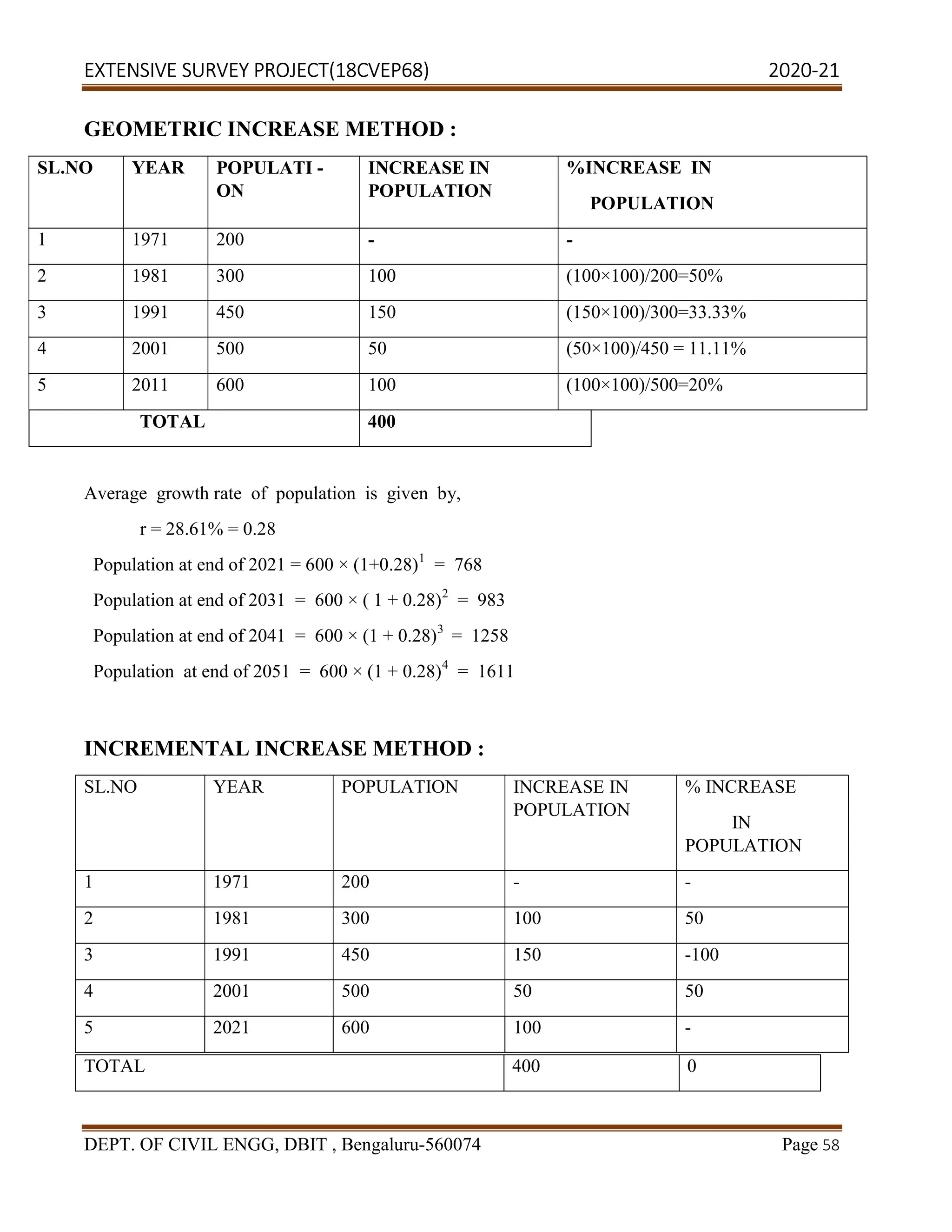
GEOMETRIC INCREASE METHOD :
SL.NO YEAR POPULATI -
ON
INCREASE IN
POPULATION
%INCREASE IN
POPULATION
1 1971 200 - -
2 1981 300 100 (100×100)/200=50%
3 1991 450 150 (150×100)/300=33.33%
4 2001 500 50 (50×100)/450 = 11.11%
5 2011 600 100 (100×100)/500=20%
TOTAL 400
Average growth rate of population is given by,
r = 28.61% = 0.28
Population at end of 2021 = 600 × (1+0.28)1
= 768
Population at end of 2031 = 600 × ( 1 + 0.28)2
= 983
Population at end of 2041 = 600 × (1 + 0.28)3
= 1258
Population at end of 2051 = 600 × (1 + 0.28)4
= 1611
INCREMENTAL INCREASE METHOD :
SL.NO YEAR POPULATION INCREASE IN
POPULATION
% INCREASE
IN
POPULATION
1 1971 200 - -
2 1981 300 100 50
3 1991 450 150 -100
4 2001 500 50 50
5 2021 600 100 -
TOTAL 400 0
EXTENSIVE SURVEY PROJECT(18CVEP68) 2020-21
DEPT. OF CIVIL ENGG, DBIT , Bengaluru-560074 Page 59
AVERAGE DECADE = 400/4 = 100
AND = 0/3 = 0
Population at end of 2021 = 600 +1× 100+(1×(1+1)/2 )×0
= 700
Population at end of 2031 = 600 + 2×100 + (2×(2+1)/2)×0
= 800
Population at end of 2041 = 600 + 3×100 + ( 3 ×(3+1)/2)×0
= 900
Population at end of 2051 = 600 + 4×100 + (4×(4+1)/2)×0
= 1000
The population of Ramohalli layout can be taken as 1000 in the year of 2051
FLOATING POPULATION :
DAILY PILGRIMS 100
MARRIAGE PARTY 5
EDUCATION CAMP 3
TOTAL 108
CATTLE POPULATION = 100 ( ASSUMED)
DESIGN OF RISING MAIN
PER CAPITA RATE OF SUPPLY
Human 130 liters/day/person
Cattle 50 liters /day/capita
Quantity required per day
Human [1000+108] × 130 =144040
[100 × 50] 5000 liters/day
Total quantity of water 144040 liters/day (144.04m3
/day)
EXTENSIVE SURVEY PROJECT(18CVEP68) 2020-21
DEPT. OF CIVIL ENGG, DBIT , Bengaluru-560074 Page 60
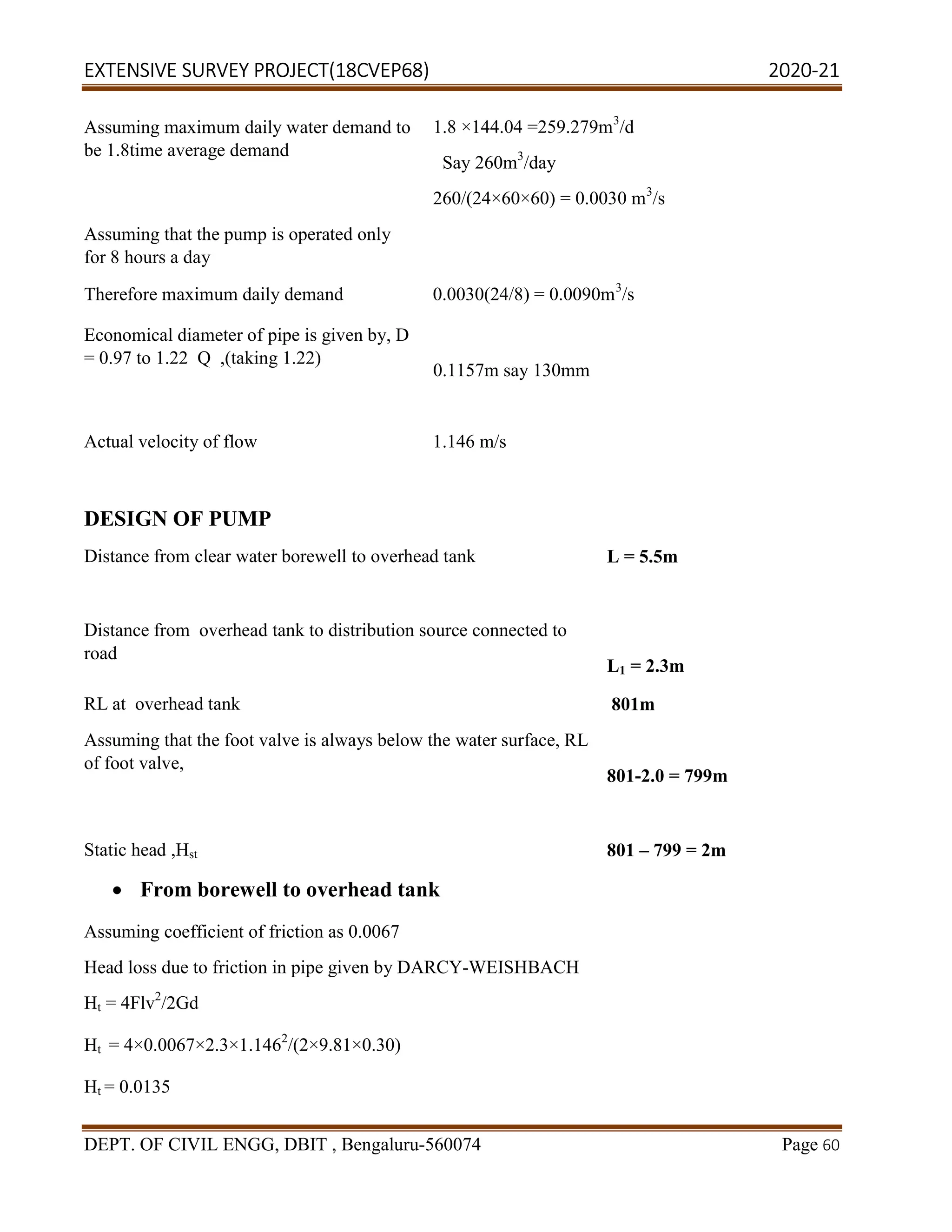
Assuming maximum daily water demand to
be 1.8time average demand
1.8 ×144.04 =259.279m3
/d
Say 260m3
/day
260/(24×60×60) = 0.0030 m3
/s
Assuming that the pump is operated only
for 8 hours a day
Therefore maximum daily demand 0.0030(24/8) = 0.0090m3
/s
Economical diameter of pipe is given by, D
= 0.97 to 1.22 Q ,(taking 1.22)
0.1157m say 130mm
Actual velocity of flow 1.146 m/s
DESIGN OF PUMP
Distance from clear water borewell to overhead tank L = 5.5m
Distance from overhead tank to distribution source connected to
road
L1 = 2.3m
RL at overhead tank 801m
Assuming that the foot valve is always below the water surface, RL
of foot valve,
801-2.0 = 799m
Static head ,Hst 801 – 799 = 2m
 From borewell to overhead tank
Assuming coefficient of friction as 0.0067
Head loss due to friction in pipe given by DARCY-WEISHBACH
Ht = 4Flv2
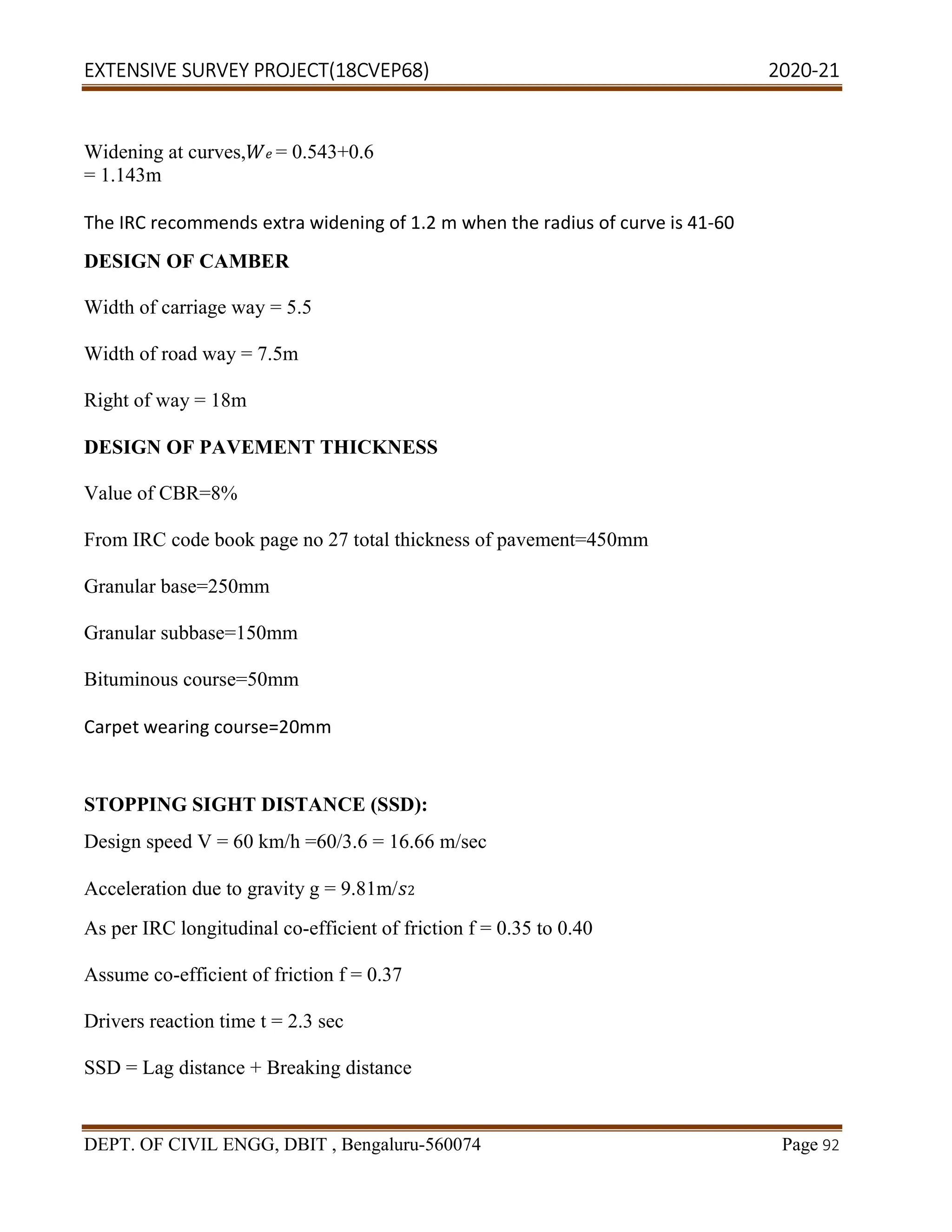
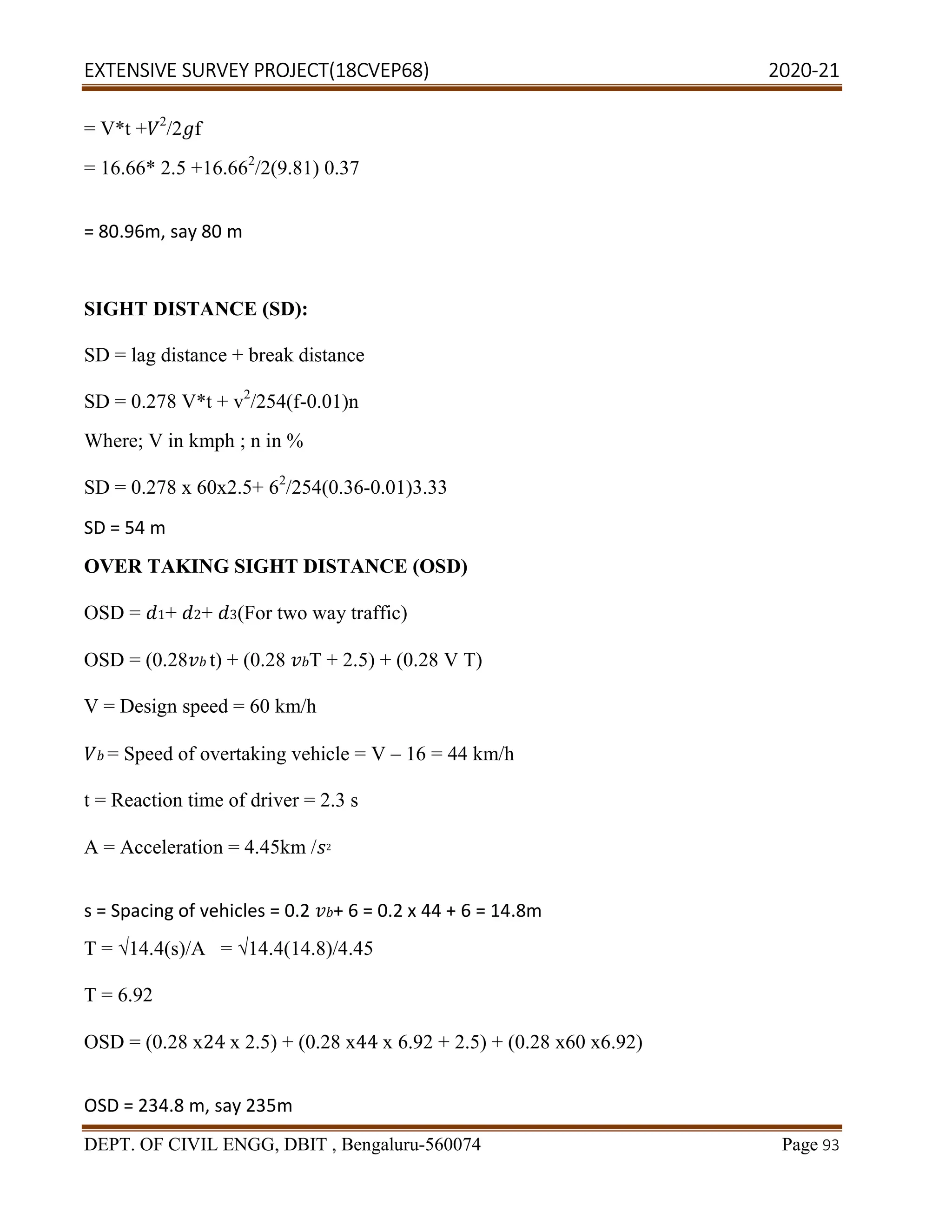
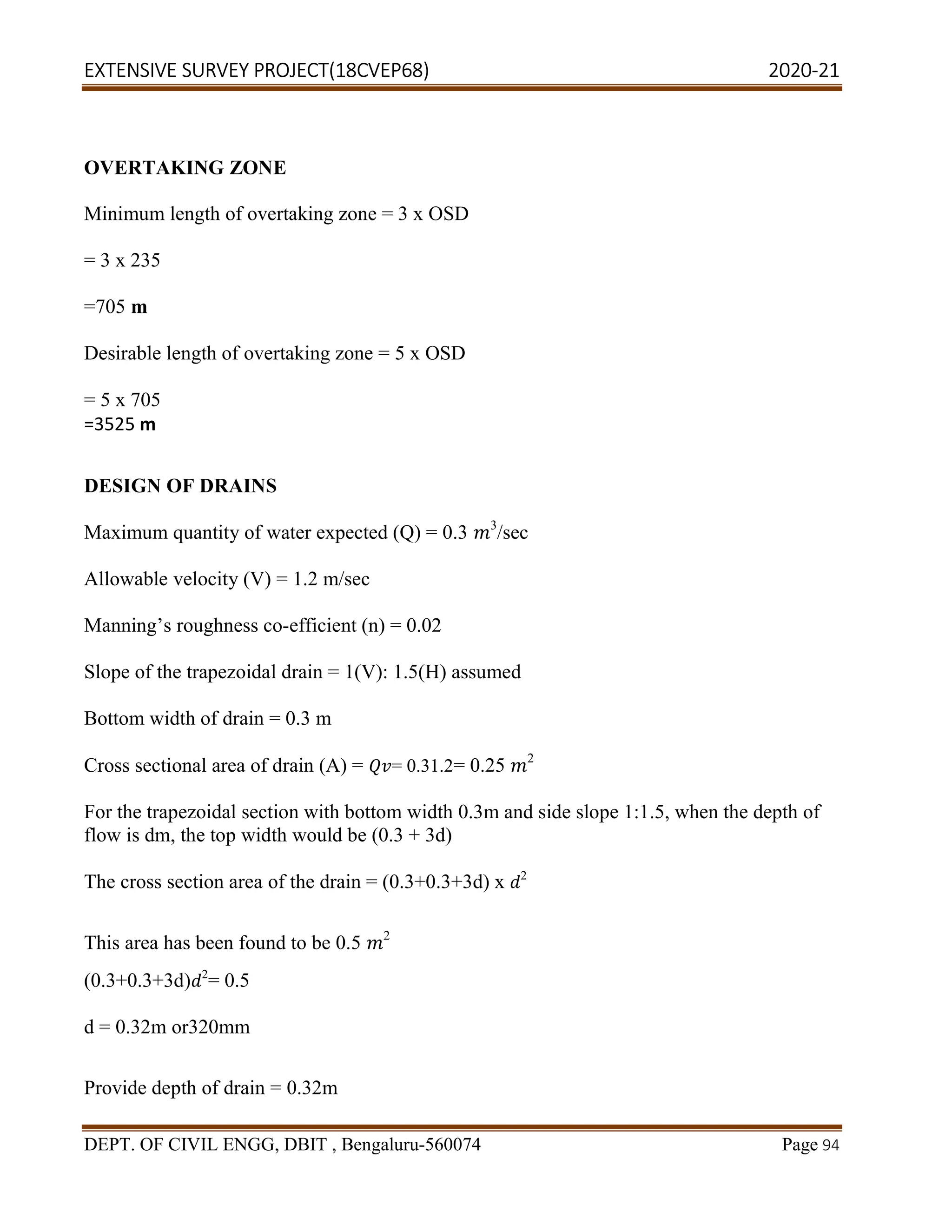
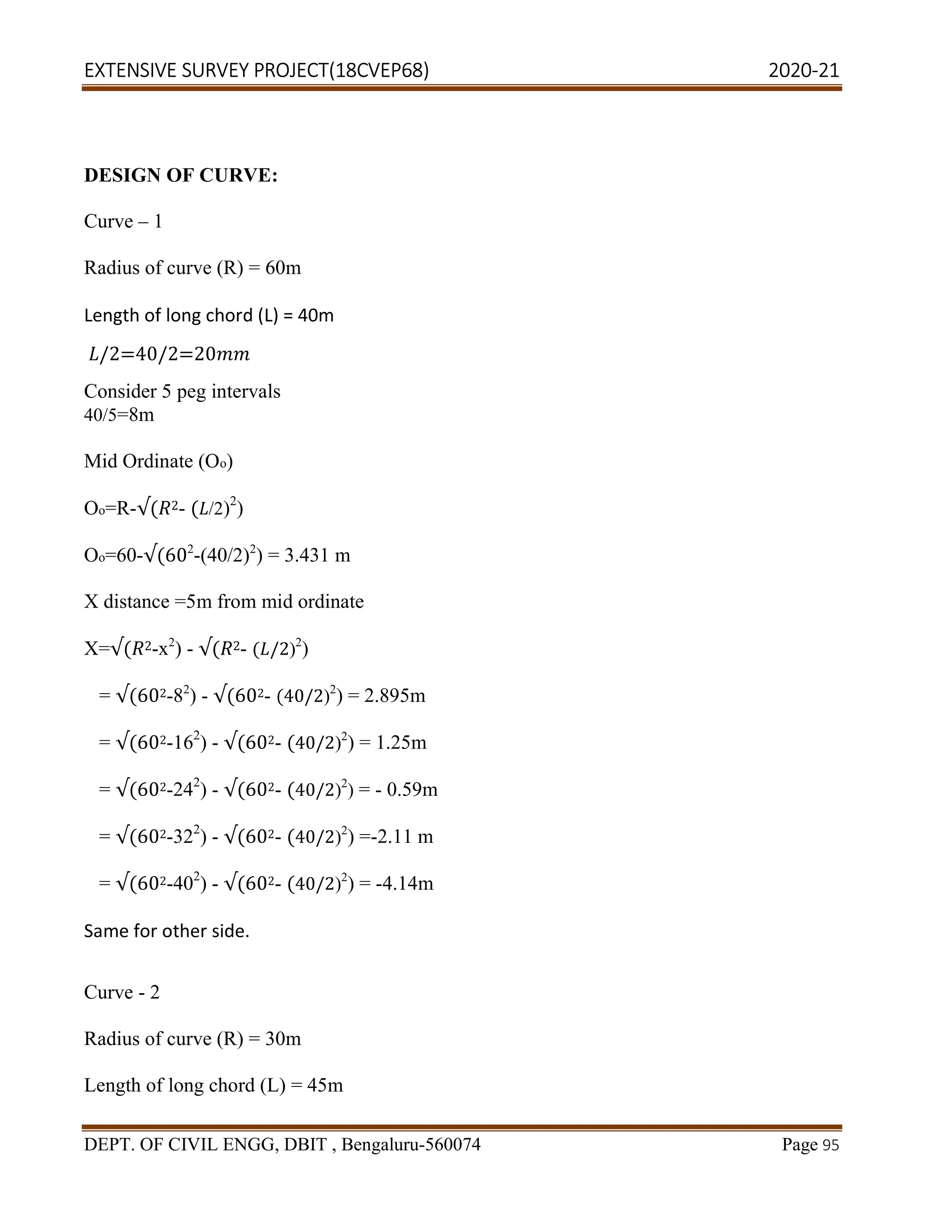
/2Gd
Ht = 4×0.0067×2.3×1.1462
/(2×9.81×0.30)
Ht = 0.0135
EXTENSIVE SURVEY PROJECT(18CVEP68) 2020-21
DEPT. OF CIVIL ENGG, DBIT , Bengaluru-560074 Page 61
Velocity head ,
Vh = V2
/2g = 1.1462
/2×9.81 = 0.067m
Total Head loss , H = 2 – ( 0.0135+0.067) = 1.91m
Assuming pump efficiency as 70% power required to run the pump
P = Q w H/ 75 η
BHP = 0.0090×1000×1.91/(75×0.70)
BHP = 0.327 HP
Therefore provide 2 units of 0.165HP.One unit of 0.327HP may be provided a stand by unit.
 To find gradient
Using Hazen’s Williams formula
V = 0.85 CH R0.63
S0.54
S0.54
= V/(0.85 CH R0.63
S0.54
= 1.2/(0.85 × 130 × 0.075)
S0.54
= 0.0555
Where , CH = Coefficient of hydraulic capacity (For concrete pipe CH = 130)
R = Hydraulic mean depth D/4 for circular pipes i.e 0.30/4 = 0.075
V = velocity of flow (assume 1.2m/s)
S = SLOPE OF ENERGY LINE.
Therefore provide a gradient of 1 in 20
DESIGN OF TREATMENT UNITS
The layout of the treatment plant is shown in drawing. Care has been taken that gravity flow occurs
from one unit to the other.
Design of screens
Intake is designed to work for 8 hours per day and screens are designed for maximum daily demand.
EXTENSIVE SURVEY PROJECT(18CVEP68) 2020-21
DEPT. OF CIVIL ENGG, DBIT , Bengaluru-560074 Page 62
Flow through intake ,
260/(24×60×60) = 0.0030m3
/s
Assuming V = 0.1m/sec
Area of screens , Q / V = 0.039/0.1 = 0.27 m2
Provide 2 screens for each penstock entance
Area of each screen , 0.27/2 = 0.135m2
Diameter of each circular screen
√(0.135×4)/π = 0.415m
~ 0.425 m
Design of sedimentation tank
Max. Water to be treated in 24 hours = 260*103
lit/d
Quantity of water to be treated during the detention period of 6 hours
260*103
/24*6=65*103
=65m2
Velocity of floe to be maintained through the tank = 0.2 m/minute
The length of the tank required = velocity of floe X detention period
= 0.2 x (6 x 60) = 72 m
Cross sectional area of the required = (65 / 72) = 0.902 m2
Assuming water depth in the tank to be 3 m
Width of the tank = 0.902 / 3 = 0.03 m
Using a free board of 0.5 m
The overall size of the tank = 72 x 2.75 x 3.5 m
EXTENSIVE SURVEY PROJECT(18CVEP68) 2020-21
DEPT. OF CIVIL ENGG, DBIT , Bengaluru-560074 Page 63
DESIGN OF RAPID SAND FILTER:
Max.Water to be treated in 24 hours = 260 m3
/d
Assuming 5% of water is required for washing of filters, we have filtered water required per
day
120+260 = 380m3
/d
Assuming that 0.5 hours lost every day , total filtered
Water required per hour 380/23.5 = 16.17m3
/hr
Assuming rate of filtration = 3000/hr/m2
Therefore area of filter provided, =16.7×1000/(3000)
= 5.5 m2
Let,
L = 1.5 B
1.5 B2
= 5.5 m2
B = 1.91 ~ 2m
L = 1.5 × 2 = 3m
Hence a tank of dimension (2m×3m) is provided.
DISINFECTION :
Bleaching powder is used as a disinfectant.
Dosage of chlorine is 0.3mg/liter
Amount of chlorine required = 0.3×260×1000/(106
)
= 0.078 kg/day
The chlorine content in bleaching powder = 30%
Amount of bleaching powder required =0.078 × 1000/30
= 2.6 kg/day
Amount consumption of bleaching powder
EXTENSIVE SURVEY PROJECT(18CVEP68) 2020-21
DEPT. OF CIVIL ENGG, DBIT , Bengaluru-560074 Page 64
2.6 × 360 = 936kg/year
Hence annual bleaching powder consumption is 936 kg.
EXTENSIVE SURVEY PROJECT(18CVEP68) 2020-21
DEPT. OF CIVIL ENGG, DBIT , Bengaluru-560074 Page 65
EXTENSIVE SURVEY PROJECT(18CVEP68) 2020-21
DEPT. OF CIVIL ENGG, DBIT , Bengaluru-560074 Page 66
CROSS SECTION
EXTENSIVE SURVEY PROJECT(18CVEP68) 2020-21
DEPT. OF CIVIL ENGG, DBIT , Bengaluru-560074 Page 67
LAYOUT PLAN
EXTENSIVE SURVEY PROJECT(18CVEP68) 2020-21
DEPT. OF CIVIL ENGG, DBIT , Bengaluru-560074 Page 68
WATER PIPE AND SEWAGE PIPE PLANING
EXTENSIVE SURVEY PROJECT(18CVEP68) 2020-21
DEPT. OF CIVIL ENGG, DBIT , Bengaluru-560074 Page 69
CONCLUSION
Every village, town or city needs water and sanitary supply system and that’s what we did
Extensive Survey Project. The water is carried to an overhead tank near MUKTHI NAGA TEMPLE
in Ramohalli.
Then the water is supplied to a distribution system which distributes the water to every
place in the layout whenever required. A sanitary system was also established to take away the
waste water from different places.
EXTENSIVE SURVEY PROJECT(18CVEP68) 2020-21
DEPT. OF CIVIL ENGG, DBIT , Bengaluru-560074 Page 70
BIBILOGRAPHY: -
 Dr. B. C. Punmia and Dr. Pande B. B. Lal “Irrigation and Water Power
Engineering”, Laxmi
Publications, 2009.
 Santosh Kumar Garg “Irrigation Engineering and Hydraulic Structures”,
Khanna Publications, 2006.
 Dr. B. C. Punmia,” Surveying”, Laxmi Publications, 2005.
 Dr. B. C. Punmia “Soil Mechanics & Foundation Engineering”, “Laxmi
Publications, 2005.
K. Subramanya “Engineering Hydrology”, Tata McGraw-Hill Education, 2008.Dutt “Estimation and
costing”.
EXTENSIVE SURVEY PROJECT(18CVEP68) 2020-21
DEPT. OF CIVIL ENGG, DBIT , Bengaluru-560074 Page 71
Project In-Charge: 1. Prof. Sudha K
2. Prof. Bushra Era
EXTENSIVE SURVEY PROJECT(18CVEP68) 2020-21
DEPT. OF CIVIL ENGG, DBIT , Bengaluru-560074 Page 72
SL.NO PARTICULARS PAGE NO.
1. INTRODUCTION l
2. HIGHWAY ENGINEERING n
3. HIGHWAY GEOMETRIC DESIGN m
4. DESIGN OF HORIZONTAL ALIGNMENT m
6. DESIGN OF VERTICAL ALIGNMENT m
7. PAVEMENT DESIGN m
8. DRAWINGS AND REPORT m
9. DESIGN CALCULATIONS FOR HIGHWAY u
10. HIGHWAY DRAWINGS m
EXTENSIVE SURVEY PROJECT(18CVEP68) 2020-21
DEPT. OF CIVIL ENGG, DBIT , Bengaluru-560074 Page 73
1. INTRODUCTION
ROLE OF TRANSPORTATION
India is a developing Country. Transportation plays a huge role in development, among all the
mode of transport, road transport is nearest to the people. The passengers and the goods have to be first
transported by road before reaching a railway station, a port or an airport. The road network can serve the
remotest villages of a vast country like ours.
In the present era, planning is considered as a pre-requisite before attempting any developmental
program. This is particularly true for any engineering work, as planning is the basic requirement for any
new project or an expansion program. Thus, highway planning is also a basic need for highway
development, particularly when the funds available are limited.
Transportation contributes to the economic, industrial, social and cultural development of any country.
Transportation is vital for economic development of any region since every commodity produced
whether it is food, clothing, industrial products or medicines needs transport at the production and
distribution stages. In the production stage, transportation is required for carrying raw materials like
seeds, manure, coal, steel etc. in the distribution stage, transportation is required from the production
centres viz. farms and factories to the marketing centres for distribution to the retailers and consumers.
The inadequate transportation facilities retard the process of socio-economic development of the
development.
The main advantages of transportation can be summarized as follows…
• Transportation is for the advancement of the community.
• Transportation is essential for the economic prosperity and general development of the country.
• Transportation is essential for the strategic movement in emergency for defence of the country and to
maintain law and order.
In developing countries like India, 80% of the population is living in villages. As a result of this,
development cannot be brought about developing urban centres alone, but also the rural areas with the
help of a good transportation system.
EXTENSIVE SURVEY PROJECT(18CVEP68) 2020-21
DEPT. OF CIVIL ENGG, DBIT , Bengaluru-560074 Page 74
HIGHWAY ENGINEERING:
Highway engineering is a branch of engineering that deals with the development of a system of roads,
which can used by vehicles and peoples, for the transportation of peoples and materials.
The road pavements are generally constructed on small embankment, slightly above the general ground
level wherever possible, in order to avoid the difficult drainage and maintenance problems. The term
‘road’ or ‘roadways’ has therefore been termed ‘Highway’ and the science and technology dealing with
road engineering is called ‘Highway engineering’.
In a nutshell, highway engineering deals with various phases like development, planning, alignment,
highway geometric design and location, highway traffic operation and its control, materials, pavement
design, constructing and maintenance, finance and administration of a road system.
Characteristics of Road:
• For short distance it saves time.
• Speed of movement is directly related with casualty.
• It is the only means of transport that offers itself to the whole community alike.
Classification of Road:
• National highway (NH)
• State highway((SH)
• Major district roads(MDR)
• Other district roads(ODR)
• Village roads(VR)
EXTENSIVE SURVEY PROJECT(18CVEP68) 2020-21
DEPT. OF CIVIL ENGG, DBIT , Bengaluru-560074 Page 75
HIGHWAY GEOMETRIC DESIGN:
The geometric design of a highway deals with the dimensions and layout of visible features of the
highway such as alignment, sight distance and intersections.
The geometric of highway should be designed to provide optimum efficiency in traffic operations
with maximum safety at reasonable cost. Geometric design of highways deals with the following
elements:
• Cross section elements
• Sight distance considerations
• Horizontal and vertical alignment details
Intersection elements
Highway geometrics are greatly influenced by the topography, locality, traffic characteristics and the
requirements. The factors which control the geometric design requirements are speed, road user and
vehicular characteristics, design traffic, traffic capacity and benefit cost considerations. However, speed
is the one factor which is important, governing most of the geometric design elements of roads.
The geometric design of highways depends on several factors, the most important of which are:
Design speed
Topography
Traffic factors
Design hourly volume and capacity
Environmental and other factors
HIGHWAY CROSS-SECTION ELEMENTS:
PAVEMENT SURFACE CHARACTERICS:
The pavement surface depends on the pavement type which is based on the availability of
materials and funds, volume and composition of traffic, sub grade and climatic conditions, construction
EXTENSIVE SURVEY PROJECT(18CVEP68) 2020-21
DEPT. OF CIVIL ENGG, DBIT , Bengaluru-560074 Page 76
facilities and cost consideration. The important surface characteristics of the pavement are friction,
unevenness, light reflecting characteristics and drainage of surface water.
CROSS SLOPE OR CAMBER:
Cross slope or camber is the slope provided to the road surface in the transverse direction to drain off the
rain water from the road surface. Usually the camber is provided on the straight roads by raising the
centre of the carriageway with respect to the edges, forming a crown or highest point along the centre
line.
The values of camber recommended by the IRC for different types of road surfaces are given in the
below table. A range of values are given with a view that in localities with lower rainfall, a flatter camber
and in places with high rainfall, a steeper camber can be adopted.
Shapes of Cross Slope
Table(4.1): Recommended values of camber for different types of road surfaces (page No 77) :
Sl.
No.
Type of road surface Range of camber in areas of
Heavy rain fall Low rain fall
1. Cement concrete and high type
bituminous surface
1 in 50 or 2.0% 1 in 60 or 1.7%
2. Thin bituminous surface 1 in 40 or 2.5% 1 in 50 or 2.0%
3. Water bound Macadam and
gravel pavement
1 in 33 or 3.0% 1 in 40 or 2.5%
4. Earth road 1 in 25 or 4.0% 1 in 33 or 3.0%
Width of Pavement or carriageway:
EXTENSIVE SURVEY PROJECT(18CVEP68) 2020-21
DEPT. OF CIVIL ENGG, DBIT , Bengaluru-560074 Page 77
The pavement or carriageway width depends on the width of traffic lane and the number of
lanes. The lane width is determined based on the width of the vehicle and the minimum side clearance
which may be provided for safety. Keeping these and other factors in view, the width of the carriageway
for various classes of roads has been standardized by the Indian Road Congress.
Medians/Traffic separators:
In highways with divided carriageway, a median is provided between two sets of traffic lanes
intended to divide the traffic moving in opposite directions. The main function of the median is to
prevent head-on collision between vehicles moving in opposite directions on adjacent lanes. The median
is also called as traffic separator.
Kerbs:
Kerb indicates the boundary between the pavement and median or foot path or island or
shoulder. It is desirable to provide kerbs on urban roads. Kerbs may be mainly divided into three groups
based on their functions they are ‘Low kerb’ or ‘mountable type kerb’, ‘Semi-barrier type kerb’ and
‘Barrier type kerb’.
Road Margins:
The various elements included in the road margins are shoulder, guard rail, foot path, drive way,
cycle track, parking lane, bus bay, lay-bye, frontage road and embankment slope.
Width of Formation or Roadway:
Width of formation or roadway is the sum of widths of pavement or carriageway including
separators, if any and the shoulders. Formation or roadway width is the top width of the highway
embankment or the bottom width of highway cutting excluding the side drains.
Right of Way and Land Width:
Right of way is the area of land acquired for the road, along its alignment. The width of the
acquired land for right of way is known as ‘land width’ and it depends on the importance of the road and
possible future development.
DESIGN OF HORIZONTAL ALIGNMENT:
Often changes in the direction are necessitated in highway alignment due to various reasons
such as topographic considerations, obligatory points, etc. The geometric design elements pertaining to
horizontal alignment of highways should consider safe and comfortable movement of vehicles at the
designated design speed of the highway. It is therefore necessary to avoid sudden changes in direction
with sharp curves or reverse curves which could not be safely and conveniently negotiated by the
vehicles at design speed. Improper design of horizontal alignment of roads would necessitate speed
changes resulting in higher accident rate and increase in vehicle operation cost.
EXTENSIVE SURVEY PROJECT(18CVEP68) 2020-21
DEPT. OF CIVIL ENGG, DBIT , Bengaluru-560074 Page 78
Various design elements to be considered in the horizontal alignment are design speed, radius of
circular curve, type and length of transition curves, superelevation, widening of pavement on curves and
required set-back distance for fulfilling sight distance requirements.
Design Speed:
The design speed is the main factor on which geometric design elements depends. In other
words, the geometric details of a highway mainly depend on the design speed. All the important
geometric elements such as sight distances, radius of horizontal curve, length of horizontal transition
curve, rate of superelevation, extra widening of pavement at horizontal curve, length of summit and
valley curves are dependent on the design speed.
The ruling and minimum design speed values standardized by the IRC for different classes of
roads on different terrains in rural(non-urban) areas are given in table below.
Table(4.8): Design speeds on rural highways(Page No:104):
Classification
of road
Design speed in kmph for various terrains
plain rolling mountain steep
Ruling
min
Abs
min
Ruling
min
Abs
min
Ruling
min
Abs
min
Ruling min
Expressways 120 100 100 80 80 60 80 60
National &
State
Highways
100 80 80 65 50 40 40 30
Major
District
Roads
80 65 65 50 40 30 30 20
Other
District
Roads
65 50 50 40 30 25 25 20
Village
Roads
50 40 40 35 25 20 25 20
EXTENSIVE SURVEY PROJECT(18CVEP68) 2020-21
DEPT. OF CIVIL ENGG, DBIT , Bengaluru-560074 Page 79
Horizontal Curves:
A horizontal curve is a curve in plan to provide change in direction to the centre line of a
road. A simple circular curve may be designated by either the radius, R of the curve in metres or the
degree, D of the curve.
When a vehicle traverses a horizontal curve, the centrifugal force acts horizontally outwards
through the centre of gravity of the vehicle. This centrifugal force is counteracted by the transverse
frictional resistance developed between the tyres and the pavement.
Superelevation:
In order to counteract the effect of centrifugal force and to reduce the tendency of the vehicle
to overturn or skid, the outer edge of the pavement is raised with respect to the inner edge, thus providing
a transverse slope throughout the length of the horizontal curve. This transverse inclination to the
pavement surface is known as ‘Superelevation’ or cant or banking.
Super elevation to be provided on curves is calculated from the following equation.
e = V2
/127R-f
Where,
e = super elevation
V = design speed, kmph
R = radius of horizontal curve, m
Radius of Horizontal Curve:
Horizontal curves of highways are generally designed for the specified ruling design speed of
the highway. However if this is not possible due to site restrictions, the horizontal curves may be
designed considering the specified minimum design speed of the highway. For a particular speed of
vehicle the centrifugal force is dependent on the radius of the horizontal curve.
The ruling minimum and absolute minimum values of radii of horizontal curves for different
classes of roads in different classes of roads in different terrains as per the IRC specifications are given in
Table below:
EXTENSIVE SURVEY PROJECT(18CVEP68) 2020-21
DEPT. OF CIVIL ENGG, DBIT , Bengaluru-560074 Page 80
Table(4.10): Minimum radii of horizontal curves for different terrain condition(Page No:119):
Classificat
ion of
road
plain terrain rolling terrain mountain terrain steep terrain
Area not
affected by
snow
snow bound
area
Area not
affected by
snow
snow bound
area
Rulin
g min
Abs
min
Rulin
g min
Abs
min
Rulin
g min
Abs
min
Rulin
g min
Abs
min
Rulin
g min
Abs
min
Rulin
g min
Abs
min
NH &SH 360 230 230 15 80 50 90 60 50 130 60 33
MDR 230 155 155 90 50 30 60 33 30 14 33 15
ODR 155 90 90 60 30 20 33 23 20 14 23 15
VR 90 60 60 45 20 14 23 15 20 14 23 15
Widening of Pavement on Horizontal Curves:
On horizontal curves, especially when they are not of very large radii, it is a common practice
to widen the pavement slightly more than the normal width. The extra widening of pavement on
horizontal curves is divided into two parts (1) mechanical and (2) psychological widening.
The extra width recommended by the IRC for single and two lane pavements are:
Table(4.11): Extra width of pavement at horizontal curves(Page No 122):
Radius of
curve, m
Up to 20 20 to 40 41 to 60 61 to 100 101 to 300 Above 300
Extra width
on two-lane
pavement, m
1.5 1.5 1.2 0.9 0.6 Nil
Extra width
on single
lane
pavement, m
0.9 0.6 0.6 Nil Nil Nil
Note: For multi-lane roads, the pavement widening is calculated by adding half the extra width of two-
lane roads to each lane of the multi-lane road.
EXTENSIVE SURVEY PROJECT(18CVEP68) 2020-21
DEPT. OF CIVIL ENGG, DBIT , Bengaluru-560074 Page 81
Widening of Pavement on Sharp Curve
Extra Widening of Pavement on Horizontal Curve
Horizontal Transition Curves:
There is a necessary for smooth entry of vehicles from a straight into circular curve. Therefore a
transition curve has a radius which decreases from infinity at the tangent point to a designed radius of the
circular curve. When a transition curve is introduced between a straight and circular curve, the radius of
the transition curve decreases and becomes minimum at the beginning of the circular curve. The rate of
change of radius of the transition curve will depend on the shape of the curve adopted and the equation of
the curve.
The transition curves also improve the aesthetic appearance of the road, besides permitting gradual
application of the super elevation and extra widening at curves. The types of transition curves commonly
adopted in horizontal alignment of highways are:
a) Spiral
b) Lemniscate
c) Cubic parabola
EXTENSIVE SURVEY PROJECT(18CVEP68) 2020-21
DEPT. OF CIVIL ENGG, DBIT , Bengaluru-560074 Page 82
The minimum length of transition curves for various values of radius of curve and design speeds
recommended by the IRC for plain and rolling terrains and also for mountainous and steep terrains
Transition Curve in Horizontal Alignment
EXTENSIVE SURVEY PROJECT(18CVEP68) 2020-21
DEPT. OF CIVIL ENGG, DBIT , Bengaluru-560074 Page 83
Table(4.12): Minimum length of transition curve for different speeds and radii(Page No:129):
Curve
radius
R(m)
plain and rolling terrain Mountainous and steep terrain
Design speed(kmph)
Curve
radius
R(m)
Design speed(kmph)
100 80 65 50 40 35 50 40 30 25 20
45 - - - - NA 70 17 - - - NA 30
60 - - - NA 75 55 20 - - - 35 20
90 - - - 75 50 40 25 - - NA 25 20
100 - - NA 70 45 35 30 - - 30 25 15
150 - - 80 45 30 25 40 - NA 25 20 15
170 - - 70 40 25 20 50 - 40 20 15 15
200 - NA 60 35 25 20 55 - 40 20 15 15
240 -
90
50 30 20 NR 70 NA 30 15 15 15
300 NA
75
40 25 NR - 80 55 25 15 15 NR
360 130 60 35 20 - - 90 45 25 15 15 -
400 115 55 30 20 - - 100 45 20 15 15 -
500 95
45
25 NR - - 125 35 15 15 NR -
600 80
35
20 - - - 150 30 15 15 - -
700 70
35
20 - - - 170 25 15 NA - -
800 60
30
NR - - - 200 20 15 - - -
900 55
30
- - - - 250 15 15 - - -
1000 50 30 - - - - 300 15 NR - - -
1200 40 NR - - - - 400 15 - - - -
1500 35 - - - - - 500 NR - - - -
1800 30 - - - -
2000 NR - - - -
EXTENSIVE SURVEY PROJECT(18CVEP68) 2020-21
DEPT. OF CIVIL ENGG, DBIT , Bengaluru-560074 Page 84
Stopping Sight Distance(SSD):
The minimum sight distance available on a highway at any spot should be of sufficient length
to stop a vehicle traveling at design speed, safely without collision with any other obstruction. The
absolute minimum sight distance is therefore equal to the stopping sight distance, which is also
sometimes called non-passing sight distance.
The sight distance available on a road to a driver at any instance depends on
1) Features of the road ahead,
2) Height of the driver’s eye above the road surface
3) Height of the object above the road surface
Table (4.5): Recommended stopping sight distance values for different speeds(Page No 92):
Design speed,
kmph
20 25 30 40 50 60 65 80 100
Safe stopping
sight distance for
design, m
20 25 30 45 60 80 90 120 180
DESIGN OF VERTICAL ALIGNMENT:
In order to have smooth vehicle movements on the roads, the changes in the gradient should be
smoothened out by the vertical curves. The vertical alignment is the elevation or profile of the centre line
of the road. The vertical alignment consists of grades and vertical curves. The vertical alignment of a
highway influences: 1) vehicle speed 2) acceleration and deceleration 3) stopping distance 4) sight
distance 5) comfort while travelling at high speeds and 6) vehicle operation cost.
Gradient:
Gradient is the rate of rise or fall along the length of the road with respect to the horizontal. It is
expressed as a ratio of 1 in x (1 vertical unit to x horizontal units); the gradient is also expressed as a
percentage, such as n%, the slope being n vertical units to 100 horizontal units.
While aligning a highway, the gradients are decided for designing the vertical curve. Very steep
gradients are avoided as it is not only difficult to climb the grade, but also the vehicle operation cost is
increased. The highway engineer has to consider all aspects such as construction costs, practical
problems in construction at the site and the vehicle operation cost while considering different alternative
alignments before finalizing the gradients and vertical alignment of the highway.
EXTENSIVE SURVEY PROJECT(18CVEP68) 2020-21
DEPT. OF CIVIL ENGG, DBIT , Bengaluru-560074 Page 85
Types of gradient:
Gradients are divided into four categories: (1) Ruling gradient (2) Limiting gradient (3) Exceptional
gradient and (4) Minimum gradient.
The maximum values of ruling, limiting and exceptional gradients recommended by the IRC in different
terrains are given in Table below:
Table(4.13): Gradients for roads in different terrains(Page No 142):
Type of terrain Ruling gradient Limiting gradient Exceptional gradient
Plain or rolling
3.3 percent
(1 in 30)
5 percent
(1 in 20)
6.7 percent
(1 in 15)
Mountainous terrain,
and steep terrain having
elevation more than
3,000 m above the
mean sea level
5 percent
(1 in 20)
6 percent
(1 in 16.7)
7 percent
(1 in 14.3)
Steep terrain up to
3,000 m height above
mean sea level
6 percent
(1 in 16.7)
7 percent
(1 in 14.3)
8 percent
(1 in 12.5)
From the drainage point of view, it is desirable to have a certain ‘minimum gradient’ on roads
provided topography favours this. The minimum gradient would depend on the amount of rain fall, type of
soil, run off, topography and other site conditions. A minimum gradient of about 1 in 500 may be sufficient
to drain water in concrete drains or gutter; but on inferior surfaces of drains a slope of 1 in 200 or 0.5
percent may be needed where as on kutcha open drains or soil drains, steeper slopes up to 1 in 100 or 1.0
percent may be needed depending on the soil type.
Vertical Curves:
Due to changes in grade in the vertical alignment of highway, it is necessary to introduce
vertical curve at the intersections of different grades to smoothen out the vertical profile and thus ease off
the changes in gradients for the fast moving vehicles.
The vertical curves used in highway may be classified into two categories:
a) Summit curves or crest curves with convexity upwards
b) Valley curves or sag curves with concavity upwards
EXTENSIVE SURVEY PROJECT(18CVEP68) 2020-21
DEPT. OF CIVIL ENGG, DBIT , Bengaluru-560074 Page 86
a) Summit curves:
Summit curves with convexity upwards are formed in any one of the case illustrated in fig.
The deviation angle between the two interacting gradients is equal to the algebraic difference between
them. Of all the cases, the deviation angle will be maximum when an ascending gradient meets with a
descending gradient i.e N=n1 - (-n2) = ( n1+ n2 ) .
Summit Curve
b) Valley curves:
Valley curves or sag curve are formed in anyone of the cases illustrated in fig. In all the cases
the maximum possible deviation angle is obtained when a descending gradient meets with an ascending
gradient.
There is no problem of restriction to sight distance in valley curves during day light, However ,
during night driving under head lights of the vehicles, the sight distance available at valley curve
decreased.
Valley Curve
EXTENSIVE SURVEY PROJECT(18CVEP68) 2020-21
DEPT. OF CIVIL ENGG, DBIT , Bengaluru-560074 Page 87
Table(4.14): Minimum length of vertical curves(page No 147):
Design speed, kmph Maximum grade
change(percent) not requiring a
vertical curve
Minimum length of vertical
curve, m(for higher grade
change values)
35 1.5 15
40 1.2 20
50 1.0 30
65 0.8 40
80 0.6 50
100 0.5 60
PAVEMENT DESIGN:
Based on the structural behavior, road pavements are generally classified into two categories,
namely:
1) Flexible pavement
2) Rigid pavements
Other types of pavement structure include (a) ‘semi-rigid pavement’ or ‘composite pavement’ and (b)
Interlocking cement Concrete Block Pavement (ICBP). However these types of pavements are less
common when compared to flexible and rigid pavements.
1) Flexible pavements:
Flexible pavements are those, which on the whole have low or negligible flexural strength
and are rather flexible in their structural action under the loads. The components of a typical flexible
pavement structure (from the bottom to the top) consist of:
a) Prepared soil sub grade
b) Granular sub-base cum drainage layer
c) Granular base course
d) Bituminous binder and/or surface course
EXTENSIVE SURVEY PROJECT(18CVEP68) 2020-21
DEPT. OF CIVIL ENGG, DBIT , Bengaluru-560074 Page 88
Flexible pavements
2) Rigid pavements:
Rigid pavements are those which possess noteworthy flexural strength or flexural rigidity. The
rigid pavements are generally made of Portland cement concrete (CC) and are therefore called ‘CC
pavements’. The components of a typical rigid pavement or cement concrete (CC) pavement structure
(from bottom towards the top) consist of:
a)Compacted soil sub grade at the bottom or lower layer
b) Granular sub-base(GSB) course and drainage layer
c) Base course
d) CC/PQC pavement slab
Rigid pavements
EXTENSIVE SURVEY PROJECT(18CVEP68) 2020-21
DEPT. OF CIVIL ENGG, DBIT , Bengaluru-560074 Page 89
CBR TEST
Flexible pavement design usig CBR design charts
Indian roads congress, vide IRC 37-2001 ‘Guidelines for the design if Flexible Pavements’(second
revision) has presented two design charts for the determination of total thickness of the flexible
pavements, considering use of subgrade soil with CBR values in the range of 2 to 10%.
The first design chart is usefull to design flexible pavements of roads with low to moderate flow of
heavy vehicles for design CSA values of 1 to 10 msa. In this chart the CSA value are plotted on the X
axis and the total pavement thickness on the Y axis, both in arithmetic scale. Nine different curves are
given for different subgrade CBR value in the range of 2 to 10%
CBR design chart for determination of total pavement thickness for traffic with
CSA of 1.0 to 10 msa
DRAWINGS AND REPORT:
Drawings:
The following drawings are usually prepared in a highway project:
• Key map
EXTENSIVE SURVEY PROJECT(18CVEP68) 2020-21
DEPT. OF CIVIL ENGG, DBIT , Bengaluru-560074 Page 90
• Index map
• Preliminary survey plans
• Detailed plan and longitudinal section
• Detailed cross section
• Land acquisition plans
• Drawings of cross drainage and other retaining structures
• Drawings of road intersections
• Land plans showing quarries, etc.

Estimates:
The project estimates should consist of general abstract of cost and detailed estimates for each
major head. If the project work is proposed to be executed in stages, the estimate should be prepared for
each stage separately.
Project Report:
The first phase of project report soon after completing the preliminary surveys, feasibility and
EIA studies is to prepare a ‘Feasibility Report’.
The Detailed Project Report (DPR) should be prepared after completing all the detailed studies
including final location survey, preparation of longitudinal and cross sections, soil and material surveys,
drainage studies, etc...The design details of the pavements and all CD structures including major bridges
should be carried out and the relevant drawings prepared as specified in term of reference for the project
preparation.
DESIGN OF HIGHWAY
DESIGN DETAILS OF ALIGNMENT OF VILLAGE ROAD
Design speed (v) = 60 km/h
Rate of super elevation (e) = 0.07
Co-efficient of friction (f) = 0.15
Ruling radius R= v2
/127(e+f)
EXTENSIVE SURVEY PROJECT(18CVEP68) 2020-21
DEPT. OF CIVIL ENGG, DBIT , Bengaluru-560074 Page 91
=602
/127(0.07+0.15)
= 57.26 m say 60m
Ruling radius of 60m at horizontal is to facilitate any vehicle to negotiate the curve at design
speed.
CHECK FOR SUPER ELEVATION
Super elevation e = V2/225R
=402/225*60
= 0.1185> 0.07
Therefore, the value of Super Elevation is greater than the maximum ‘e’ of 0.07. So super
elevation to be provided is 0.07
CHECK FOR FRICTION DEVELOPED
e + f =V2/127R
0.07 + f =0.21
f = 0.139>>0.14 < 0.15
Therefore the value of friction is lesser than the maximum ‘f’ of 0.15
So it is safe to provide f = 0.14
WIDENING AT CURVES
Widening at curves = psychological widening+ extra width for mechanics
= + S
Wps = V/9.5√R = 40/9.5√60= 0.543
Wm=nl2/2R= 0.6
No. of lanes n = 2
Maximum length of vehicle L = 6m
EXTENSIVE SURVEY PROJECT(18CVEP68) 2020-21
DEPT. OF CIVIL ENGG, DBIT , Bengaluru-560074 Page 92
Widening at curves, = 0.543+0.6
= 1.143m
The IRC recommends extra widening of 1.2 m when the radius of curve is 41-60
DESIGN OF CAMBER
Width of carriage way = 5.5
Width of road way = 7.5m
Right of way = 18m
DESIGN OF PAVEMENT THICKNESS
Value of CBR=8%
From IRC code book page no 27 total thickness of pavement=450mm
Granular base=250mm
Granular subbase=150mm
Bituminous course=50mm
Carpet wearing course=20mm
STOPPING SIGHT DISTANCE (SSD):
Design speed V = 60 km/h =60/3.6 = 16.66 m/sec
Acceleration due to gravity g = 9.81m/ 2
As per IRC longitudinal co-efficient of friction f = 0.35 to 0.40
Assume co-efficient of friction f = 0.37
Drivers reaction time t = 2.3 sec
SSD = Lag distance + Breaking distance
EXTENSIVE SURVEY PROJECT(18CVEP68) 2020-21
DEPT. OF CIVIL ENGG, DBIT , Bengaluru-560074 Page 93
= V*t + 2
/2 f
= 16.66* 2.5 +16.662
/2(9.81) 0.37
= 80.96m, say 80 m
SIGHT DISTANCE (SD):
SD = lag distance + break distance
SD = 0.278 V*t + v2
/254(f-0.01)n
Where; V in kmph ; n in %
SD = 0.278 x 60x2.5+ 62
/254(0.36-0.01)3.33
SD = 54 m
OVER TAKING SIGHT DISTANCE (OSD)
OSD = 1+ 2+ 3(For two way traffic)
OSD = (0.28 t) + (0.28 T + 2.5) + (0.28 V T)
V = Design speed = 60 km/h
= Speed of overtaking vehicle = V – 16 = 44 km/h
t = Reaction time of driver = 2.3 s
A = Acceleration = 4.45km / 2
s = Spacing of vehicles = 0.2 + 6 = 0.2 x 44 + 6 = 14.8m
T = √14.4(s)/A = √14.4(14.8)/4.45
T = 6.92
OSD = (0.28 x24 x 2.5) + (0.28 x44 x 6.92 + 2.5) + (0.28 x60 x6.92)
OSD = 234.8 m, say 235m
EXTENSIVE SURVEY PROJECT(18CVEP68) 2020-21
DEPT. OF CIVIL ENGG, DBIT , Bengaluru-560074 Page 94
OVERTAKING ZONE
Minimum length of overtaking zone = 3 x OSD
= 3 x 235
=705 m
Desirable length of overtaking zone = 5 x OSD
= 5 x 705
=3525 m
DESIGN OF DRAINS
Maximum quantity of water expected (Q) = 0.3 3
/sec
Allowable velocity (V) = 1.2 m/sec
Manning’s roughness co-efficient (n) = 0.02
Slope of the trapezoidal drain = 1(V): 1.5(H) assumed
Bottom width of drain = 0.3 m
Cross sectional area of drain (A) = = 0.31.2= 0.25 2
For the trapezoidal section with bottom width 0.3m and side slope 1:1.5, when the depth of
flow is dm, the top width would be (0.3 + 3d)
The cross section area of the drain = (0.3+0.3+3d) x 2
This area has been found to be 0.5 2
(0.3+0.3+3d) 2
= 0.5
d = 0.32m or320mm
Provide depth of drain = 0.32m
EXTENSIVE SURVEY PROJECT(18CVEP68) 2020-21
DEPT. OF CIVIL ENGG, DBIT , Bengaluru-560074 Page 95
DESIGN OF CURVE:
Curve – 1
Radius of curve (R) = 60m
Length of long chord (L) = 40m
/2=40/2=20
Consider 5 peg intervals
40/5=8m
Mid Ordinate (Oo)
Oo=R-√( 2- ( /2)2
)
Oo=60-√(602
-(40/2)2
) = 3.431 m
X distance =5m from mid ordinate
X=√( 2-x2
) - √( 2- ( /2)2
)
= √(602-82
) - √(602- (40/2)2
) = 2.895m
= √(602-162
) - √(602- (40/2)2
) = 1.25m
= √(602-242
) - √(602- (40/2)2
) = - 0.59m
= √(602-322
) - √(602- (40/2)2
) =-2.11 m
= √(602-402
) - √(602- (40/2)2
) = -4.14m
Same for other side.
Curve - 2
Radius of curve (R) = 30m
Length of long chord (L) = 45m
EXTENSIVE SURVEY PROJECT(18CVEP68) 2020-21
DEPT. OF CIVIL ENGG, DBIT , Bengaluru-560074 Page 96
/2=45/2=22.5
Consider 5 peg intervals
22.5/5=4.5m
Mid Ordinate (Oo)
Oo=R-√( 2- ( /2)2
)
Oo=40-√(402
-(45/2)2
) =10.156 m
X distance =4.5m from mid ordinate
X=√( 2
-x2
) - √( 2- ( /2)2
)
4.5 = √(302
-4.52
) - √(302
- (45/2)2
) = 9.82m
9 = √(302-92
) - √(302- (45/2) 2
) = 8.778m
13.5 = √(302-13.52
) - √(302- (45/2)2
) = 6.950m
18 = √(302-182
) - √(302- (45/2)2
) = 4.16m
22.5 = √(302-22.52
) - √(302- (45/2)2
) = 0m
Same for other side.
EXTENSIVE SURVEY PROJECT(18CVEP68) 2020-21
DEPT. OF CIVIL ENGG, DBIT , Bengaluru-560074 Page 97
EARTH WORK CALCULATION
Chainage
RL of
GL(m) FL(m) Height Bd Sd^2 Bd+Sd^2 L Q=(Bd+Sd^2)L
0 791 780 -11 -39.6 121 81.4 Cutting Banking
10 792.12 780.003 -12.117 -43.6212 146.8217 103.2005 10 1032.005
20 789.61 780.0033 -9.6067 -34.5841 92.28868 57.70456 10 577.0456
30 789.29 780.0063 -9.2837 -33.4213 86.18709 52.76577 10 527.6577
40 789.08 780.0066 -9.0734 -32.6642 82.32659 49.66235 10 496.6235
50 788.895 780.0096 -8.8854 -31.9874 78.95033 46.96289 10 469.6289
60 788.74 780.0099 -8.7301 -31.4284 76.21465 44.78629 10 447.8629
70 788.59 780.0129 -8.5771 -30.8776 73.56664 42.68908 10 426.8908
80 788.42 780.0132 -8.4068 -30.2645 70.67429 40.40981 10 404.0981
90 788.25 780.0162 -8.2338 -29.6417 67.79546 38.15378 10 381.5378
100 788.12 780.0165 -8.1035 -29.1726 65.66671 36.49411 10 364.9411
110 788.03 780.0195 -8.0105 -28.8378 64.16811 35.33031 10 353.3031
120 787.94 780.0198 -7.9202 -28.5127 62.72957 34.21685 10 342.1685
130 787.845 780.0228 -7.8222 -28.1599 61.18681 33.02689 10 330.2689
140 787.725 780.0231 -7.7019 -27.7268 59.31926 31.59242 10 315.9242
150 787.61 780.0261 -7.5839 -27.302 57.51554 30.2135 10 302.135
160 787.415 780.0264 -7.3886 -26.599 54.59141 27.99245 10 279.9245
170 786.145 780.0294 -6.1156 -22.0162 37.40056 15.3844 10 153.844
180 786.865 780.0297 -6.8353 -24.6071 46.72133 22.11425 10 221.1425
190 784.86 780.0327 -4.8273 -17.3783 23.30283 5.924545 10 59.24545
200 786 780.033 -6 -23.0508 40.99841 17.94761 10 179.4761
210 786.31 780.036 -6.274 -22.5864 39.36308 16.77668 10 167.7668
220 786.26 780.0363 -6.2237 -22.4053 38.73444 16.32912 10 163.2912
230 786.14 780.0393 -6.1007 -21.9625 37.21854 15.25602 10 152.5602
240 785.955 780.0396 -5.9154 -21.2954 34.99196 13.69652 10 136.9652
250 785.735 780.0426 -5.6924 -20.4926 32.40342 11.91078 10 119.1078
260 785.495 780.0429 -5.4521 -19.6276 29.72539 10.09783 10 100.9783
270 785 780.0459 -5.0491 -18.1768 25.49341 7.316651 10 73.16651
280 784,340 780.0462 -7.835 -28.206 61.38723 33.18123 10 331.8123
290 781.5 780.0492 -1.4508 -5.22288 2.104821 -3.11806 10 -31.1806
300 784.02 780.0495 -3.9705 -14.2938 15.76487 1.47107 10 14.7107
310 790 0 0 10 0
310 786 790.0047 4 14.4 16 30.4 10 304
320 783.11 790.0094 6.8994 24.83784 47.60172 72.43956 10 62.43956
330 782.97 790.0141 7.0441 25.35876 49.61934 74.9781 10 749.781
EXTENSIVE SURVEY PROJECT(18CVEP68) 2020-21
DEPT. OF CIVIL ENGG, DBIT , Bengaluru-560074 Page 98
340 783 790.0188 7.3888 26.59968 54.59437 81.19405 10 71.19405
350 782 790.0235 7.5635 27.2286 57.20653 84.43513 10 844.3513
360 782.3 790.0282 7.7282 27.82152 59.72508 87.5466 10 77.5466
370 782.25 790.0329 7.7829 28.01844 60.57353 88.59197 10 885.9197
380 781.88 790.0376 8.1576 29.36736 66.54644 95.9138 10 85.9138
390 781.63 790.0423 8.4123 30.28428 70.76679 101.0511 10 1010.511
400 781.53 790.047 8.517 30.6612 72.53929 103.2005 10 93.20049
410 781.53 790.0517 8.5217 30.67812 72.61937 103.2975 10 1032.975
420 781.545 790.0564 8.5114 30.64104 72.44393 103.085 10 93.08497
430 781.66 790.0611 8.4011 30.24396 70.57848 100.8224 10 1008.224
440 781.9 790.0658 8.1658 29.39688 66.68029 96.07717 10 86.07717
450 782.08 790.0705 7.9905 28.7658 63.84809 92.61389 10 926.1389
460 782.3 790.0752 7.7752 27.99072 60.45374 88.44446 10 78.44446
470 782.8 790.0799 7.2799 26.20764 52.99694 79.20458 10 792.0458
480 783.35 790.0846 6.7346 24.24456 45.35484 69.5994 10 59.5994
490 783.4 790.0893 6.6893 24.08148 44.74673 68.82821 10 688.2821
500 784.67 790.094 5.424 19.5264 29.41978 48.94618 10 38.94618
510 785.35 790.0987 4.7487 17.09532 22.55015 39.64547 10 396.4547
0 780 0 0 10 0
520 786.94 780.00769
-
6.93231 -24.9563 48.05692 23.10061 10 231.0061
530 785.41 780.01538
-
5.39462 -19.4206 29.10192 9.681293 10 96.81293
540 785.04 780.02307
-
5.01693 -18.0609 25.16959 7.108639 10 71.08639
550 784.8 780.03076
-
4.76924 -17.1693 22.74565 5.576386 10 55.76386
560 783.94 780.03845
-
3.90155 -14.0456 15.22209 1.176512 10 11.76512
570 781.49 780.04614
-
1.44386 -5.1979 2.084732 -3.11316 10 -31.1316
580 784.21 780.05383
-
4.15617 -14.9622 17.27375 2.311537 10 23.11537
590 783.7 780.06152
-
3.63848 -13.0985 13.23854 0.140009 10 1.400087
600 783.49 780.06921
-
3.42079 -12.3148 11.7018 -0.61304 10 -6.1304
610 783.25 780.0769 -3.1731 -11.4232 10.06856 -1.3546 10 -13.546
620 783.04 780.08459
-
2.95541 -10.6395 8.734448 -1.90503 10 -19.0503
630 782.99 780.09228
-
2.89772 -10.4318 8.396781 -2.03501 10 -20.3501
640 783.28 780.09997
-
3.18003 -11.4481 10.11259 -1.33552 10 -13.3552
EXTENSIVE SURVEY PROJECT(18CVEP68) 2020-21
DEPT. OF CIVIL ENGG, DBIT , Bengaluru-560074 Page 99
650 783.03 780.10766
-
2.92234 -10.5204 8.540071 -1.98035 10 -19.8035
0 790 0 0 10 0
660 783.1 790.006 6.906 24.8616 47.69284 72.55444 10 725.5444
670 783.26 790.012 6.752 24.3072 45.5895 69.8967 10 698.967
680 783.38 790.018 6.638 23.8968 44.06304 67.95984 10 679.5984
690 783.73 790.024 6.294 22.6584 39.61444 62.27284 10 622.7284
700 783.39 790.03 6.64 23.904 44.0896 67.9936 10 679.936
710 782.98 790.036 7.056 25.4016 49.78714 75.18874 10 751.8874
720 782.93 790.042 7.112 25.6032 50.58054 76.18374 10 761.8374
730 782.98 790.048 7.068 25.4448 49.95662 75.40142 10 754.0142
740 783.18 790.054 6.874 24.7464 47.25188 71.99828 10 719.9828
750 783.1 790.06 6.96 25.056 48.4416 73.4976 10 734.976
760 722.86 790.066 67.206 241.9416 4516.646 4758.588 10 47585.88
770 783.29 790.072 6.782 24.4152 45.99552 70.41072 10 704.1072
780 783.66 790.078 6.418 23.1048 41.19072 64.29552 10 642.9552
790 783.92 790.084 6.164 22.1904 37.9949 60.1853 10 601.853
800 784.38 790.09 5.71 20.556 32.6041 53.1601 10 531.601
B=3.6 m
S=1, banking and cutting
EXTENSIVE SURVEY PROJECT(18CVEP68) 2020-21
DEPT. OF CIVIL ENGG, DBIT , Bengaluru-560074 Page 100
LONGITUDINAL SECTION
EXTENSIVE SURVEY PROJECT(18CVEP68) 2020-21
DEPT. OF CIVIL ENGG, DBIT , Bengaluru-560074 Page 101
EXTENSIVE SURVEY PROJECT(18CVEP68) 2020-21
DEPT. OF CIVIL ENGG, DBIT , Bengaluru-560074 Page 102
EXTENSIVE SURVEY PROJECT(18CVEP68) 2020-21
DEPT. OF CIVIL ENGG, DBIT , Bengaluru-560074 Page 103
EXTENSIVE SURVEY PROJECT(18CVEP68) 2020-21
DEPT. OF CIVIL ENGG, DBIT , Bengaluru-560074 Page 104
EXTENSIVE SURVEY PROJECT(18CVEP68) 2020-21
DEPT. OF CIVIL ENGG, DBIT , Bengaluru-560074 Page 105
EXTENSIVE SURVEY PROJECT(18CVEP68) 2020-21
DEPT. OF CIVIL ENGG, DBIT , Bengaluru-560074 Page 106
EXTENSIVE SURVEY PROJECT(18CVEP68) 2020-21
DEPT. OF CIVIL ENGG, DBIT , Bengaluru-560074 Page 107
HIGHWAY ALIGNMENT
EXTENSIVE SURVEY PROJECT(18CVEP68) 2020-21
DEPT. OF CIVIL ENGG, DBIT , Bengaluru-560074 Page 108
Project In-Charge: 1. Prof. Manjularani P
2. Prof. Sandhya Rani G M
EXTENSIVE SURVEY PROJECT(18CVEP68) 2020-21
DEPT. OF CIVIL ENGG, DBIT , Bengaluru-560074 Page 109
CONTENTS
1. INTRODUCTION 117
2. NECESSITY FOR RESTORATION 117
3. CAPACITY CONTOUR SURVEY 121
4. CALCULATION OF EARTHWORK 123
5. BIBILOGRAPHY 126
SL NO PARTICULARS Page No
EXTENSIVE SURVEY PROJECT(18CVEP68) 2020-21
DEPT. OF CIVIL ENGG, DBIT , Bengaluru-560074 Page 110
1.Introduction:
Tanks are very small storage reservoir created on the upstream of a small earthen dam,
construction across the stream. The depth of water in the tank is usually less than 4m. However, in
exceptional cases; it may be more than but not greater than 12m. When the depth of water exceeds
12m, the tank is termed as reservoir.
An irrigation tank generally consists of the following
 An earthen bund across the valley creating storage.
 A surplus weir to dispose of hard storage.
 Sluice to feed the channel to feed the command area.
The general problems of an irrigation tank are
 Reduction in the gross storage capacity of the tank due to silting.
 Reduction in the safety of the bund due to working out of standard dimensions of the bund.
The above problem can be overcome by restoring the tank. Restoration of the tank is done by raising
the height of existing bund, thereby allowing increasing the storage and improving the safety of the
bund.
.
 Aim:
Restoration of old tanking is necessary to improve the capacity of the tank which is reduced by
silting and also to improve the conditions of the bund.
 Necessity for Restoration of Tank:
Construction of old tank bund across the stream at a river would facilitate in creating a reservoir on
the upstream of the bund. The water gets arrested within the barrier their by tapping the sediment in
the reservoir. Due to progressive silting in the reservoir its storage capacity gets reduced. The
demand for irrigation water cannot be met due to the reduced storage.
Further, in future there may be demand for water cultivation of large area. In view of these two
factors it becomes necessary to restore the storage capacity of the reservoir to a value equal to its
original value.
The storage capacity is increased in two ways;
EXTENSIVE SURVEY PROJECT(18CVEP68) 2020-21
DEPT. OF CIVIL ENGG, DBIT , Bengaluru-560074 Page 111
 Raising F.T.L of the reservoir after making suitable modifications in the profile of the
existing one.
 De-silting the reservoir: This would require the employment of sophisticated equipment such
as hydraulic dredges. Before taking up the project, it is necessary to study whether the proposal
would yield minimum cost to restore the original capacity of the reservoir.
Weir or Barrage
Weir is a solid obstruction placed across the river. Its main function is to raise the water level so that
water can be diverted by canal to crop field due to difference of head. Barrage practically a low weir
with an adjustable gate over this low weir. Heading up of water is affected by the gate.
Types of Weir
Weir may be of different types based on materials of construction, design features and types of soil
foundation as:
Vertical Drop Weir:
It is a vertical drop weir without a crest gate. A crest gate may be provided to store more water
during flood period. At the upstream and downstream ends of impervious floor cut off piles are
provided. Launching aprons are provided both at upstream and downstream ends of floor to safe
guard against scouring action. A graded filter is provided immediately at the downstream end of
impervious floor to release the uplift pressure. This type of weir is suitable for any type of
foundation.
Sloping Weir of Concrete
This type is suitable for soft sandy foundation. It is used where difference in weir crest and
downstream river bed is not more than 3m. Hydraulic jump is formed when water passes over the
sloping glacis. Weir of this type is of recent origin.
EXTENSIVE SURVEY PROJECT(18CVEP68) 2020-21
DEPT. OF CIVIL ENGG, DBIT , Bengaluru-560074 Page 112
Parabolic Weir
A parabolic weir is almost similar to spillway section of dam. The weir or body wall for this weir is
designed as low dam. A cistern is provided at downstream.
Dry Stone Sloping Weir
It is a dry stone or rock fill weir. It consists of body wall and upstream and downstream dry stones
are laid in the form of glacis with some intervening core wall. This weir is constructed in Yamuna
River (near Delhi) at Okhla.
Surplus Weir:
The excess water is spilled from tank into the downstream channel so as to avoid the raise of water
above the maximum water level. In fact, the water will generally spill over the crest of this escape
weir, as and when it rises above full tank level and discharge capacity of this weir will be designed
such as to pass the full maximum flood discharge with the depth over the weir equal to the difference
between full tank level and maximum water level. Although the effective the storage capacity of the
tank is limited by full tank level, the area submerged by the tank bund and revetment is dependent on
maximum water level. And hence in order to restrict the dimensions of these, it is desirable to keep
the difference between full tank level and maximum water level to a smaller value which is kept from
0.3m to 0.6m and it is rarely allowed to exceed 0.9m.
Tank Sluice:
A tank sluice is an opening in the form of a culvert or a pipe running through or under the tank bund
and supplying water to the tank and to the distributor channel below to meet the irrigation and other
water requirements as and when needed. The size of the culvert will depend on maximum quantity of
water. It is required to covey, but in no case should be less than 0.6m wide and 0.75m high, so as to
allow the man to enter it for examination and repairs or removal of obstructions.
EXTENSIVE SURVEY PROJECT(18CVEP68) 2020-21
DEPT. OF CIVIL ENGG, DBIT , Bengaluru-560074 Page 113
Types of Sluice:
 Flap Sluice Gate:
A fully automatic type, which is controlled by the pressure head across it; operation is similar
to that of check valve. It is a gate hinged at the top. When pressure is from one side, the gate is kept
closed; a pressure from other side opens the sluice when a threshold pressure is surpassed.
 Vertical Rising Sluice:
A plate sliding in the vertical direction, controlled by machinery.
 Rising Sector Sluice:
Also, a part of cylindrical surface, which rests at the bottom of the channel and rises by rotating
around its centre.
 Radial Sluice:
A structure, where a small part of cylindrical surface serves as a gate, supported by radial
constructions going through the cylinders radius. On occasion, a counter weight is provided.
 Needle Sluice:
A sluice formed by number of thin needles held against a solid frame through pressure as in a needle
dam.
Survey to Be Carried Out:
 Longitudinal sectioning and cross section along the existing bund.
 Details of existing and waste weir and sluice points including block levelling of waste weir.
 Water spread contour to explore the quantity.
EXTENSIVE SURVEY PROJECT(18CVEP68) 2020-21
DEPT. OF CIVIL ENGG, DBIT , Bengaluru-560074 Page 114
Longitudinal and Profile Levelling:
The process of determining the elevations of a series of points at measured intervals along a line such
as the centre line of the proposed ditch or road or the central line of a natural feature such as a stream
bed is called PROFILE LEVELLING.
 In this operation levels are taken along the centre line of any alignment (roads, railways etc.)
at regular intervals.
 The back sight, intermediate sight and fore sight readings are taken at regular intervals at
every setup of the instruments. The chainages of the points are noted in the level book.
 This operation is under taken to determine the undulation if the ground surface along the
profile line.

Cross Sectional Levelling:
Cross sectioning is defined as determining the elevations of points on a succession of lines running at
right angles to the length wise line of the highway.
 Here the levels are taken under the transverse direction.
 The cross section are taken at regular intervals (3m,6m, 9m etc) along the alignment.
 This operation is done in order to know the nature of the ground across the centre line of any
alignment.
Contour:
A contour is defined as an imaginary line of constant elevations on the ground surface.
A contour line joins points of equal elevation (height) above the given level, such as mean sea level.
EXTENSIVE SURVEY PROJECT(18CVEP68) 2020-21
DEPT. OF CIVIL ENGG, DBIT , Bengaluru-560074 Page 115
Capacity Contour Survey:
Objective:
To draw the capacity contour map of the catchment and estimate the quantity of water that can be
stored.
Following are the aspects to be considered while fixing the capacity of the reservoir:
 The catchment at the site proposed receives sufficient rain to cater the demand and if the
proposed site can hold the required quantity of water then required height of the bund can be
constructed.
 The catchment at the site proposed receives sufficient rain to cater the demand and if the
proposed site cannot hold the required quantity of water then required height of the bund shall
be restricted to the site conditions.
 The catchment at the site proposed receives less rain which cannot cater the demand and any
height of the bund can be constructed, then the height of the bund is fixed to store maximum
water. The catchment at the site proposed receives less rain which cannot cater the demand and
any height of the bund can be restricted because of the site condition, then the height is fixed
taken the site condition. In all the above cases it is necessary to compute the yield of catchment
Existing and Proposed Features of Old Tank Project:
Existing Features:
Length of bund =95 m
Top of bund level=785.265 m
Maximum water level=784.225 m
Full tank level=783.755 m
Dead storage=783.225 m
Slope (U/S & D/S) =1:1
Width of bund=2m
EXTENSIVE SURVEY PROJECT(18CVEP68) 2020-21
DEPT. OF CIVIL ENGG, DBIT , Bengaluru-560074 Page 116
Height=1.5 m
Proposed features:
Proposed full tank level=784.255 m
Proposed maximum water level=785.655 m
Proposed top bund level=786.255 m
Width of bund=5m
Rise of bund=2m
Slope (U/S & D/S) =1:1
Contour Areas:
 Area of contour at RL 784.255 = 3676 m2
(Proposed full tank level after rising the bund)
 Area of contour at RL 783.755 =2128 m2
(Full tank level of existing bund)
 Area of contour at RL 783.255 = 701 m2
(Existing waste weir level)
 Area of contour at RL817.890= 3562.580m2
(Below existing waste weir)
EXTENSIVE SURVEY PROJECT(18CVEP68) 2020-21
DEPT. OF CIVIL ENGG, DBIT , Bengaluru-560074 Page 117
Calculation of Rise Bund Volume
Total volume of 5m bund
V= (Bd+Sd2
) L
= (5*5+1*52
)*95
= 4750 m3
Volume of Earthwork Required for Filling
=4750-1837.3
=2912.7 m3
NEW PROPOSED BUND
EXISTING BUND
5
5
3
2
8
15
TOTAL VOLUME OF NEW BUND=4750 m^3
EXISTING BUND VOLUME = 1837.3 m^3
EXTENSIVE SURVEY PROJECT(18CVEP68) 2020-21
DEPT. OF CIVIL ENGG, DBIT , Bengaluru-560074 Page 118
EARTHWORK REQUIRED FOR FILLED= 2912.7 m^3
EXTENSIVE SURVEY PROJECT(18CVEP68) 2020-21
DEPT. OF CIVIL ENGG, DBIT , Bengaluru-560074 Page 119
CALCULATION OF EXISTING BUND VOLUME
Chainage
in(
m)
Rl
of
ground
level
(m)
FL
of
existing
bund
(m)
Height
(m)
Top
width
d
(m)
Central
area
bd
(m
2
)
side
slope
side
area
sd
2
Total
sectional
area
(Bd+Sd
2
)
m
3
Length
in
m
Volume
in
m3
(Bd+Sd
2
)
L
0 784.34 782 2.34 2 4.68 1 5.47 10.15 5 50.75
5 784.93 782 2.94 2 5.86 1 8.93 14.79 5 73.95
10 785.04 782 3.04 2 6.09 1 9.24 15.33 5 76.65
15 785.13 782 3.13 2 6.26 1 9.79 16.05 5 80.25
20 785.11 782 3.11 2 6.23 1 9.70 15.93 5 79.65
25 785.23 782 3.23 2 6.46 1 10.43 16.89 5 84.45
30 785.15 782 3.155 2 6.31 1 9.95 16.26 5 81.3
35 785.05 782 3.05 2 6.1 1 9.30 15.40 5 77
40 785.04 782 3.04 2 6.09 1 9.24 15.33 5 76.65
45 785.06 782 3.06 2 6.12 1 9.36 15.48 5 77.4
50 785.16 782 3.16 2 6.44 1 10.36 16.8 5 84
55 785.22 782 3.22 2 6.82 1 11.62 18.44 5 92.2
60 785.41 782 3.41 2 7.3 1 13.32 20.62 5 103.1
65 785.65 782 3.65 2 7.7 1 14.82 22.52 5 112.6
70 785.85 782 3.85 2 5.66 1 8.0 13.66 5 68.3
75 784.83 782 2.83 2 7.66 1 14.66 22.32 5 111.6
80 785.83 782 3.83 2 7.66 1 15.52 23.4 5 117
85 785.94 782 3.94 2 7.9 1 15.60 23.5 5 117.5
90 785.99 782 3.95 2 7.9 1 14.89 22.61 5 113.05
95 785.86 782 3.85 2 7.7 1 14.8 22.5 5 112.5
EXTENSIVE SURVEY PROJECT(18CVEP68) 2020-21
DEPT. OF CIVIL ENGG, DBIT , Bengaluru-560074 Page 120
Waste Weir Block Levelling: -
784 784.3 783.69 783.5 783.11 783.235 783.8 783.515 782.995 782.21 783.1
783.33 783.835 783.84 783.29 783.47 782.99 782.39 782.18 782.1 781.98 783.05
783.24 783.46 783.5 783.5 782.705 782.35 782.14 782.21 782.725 782.9 783.45
783.54 783.615 782.615 783 783.14 782.65 782.5
EXTENSIVE SURVEY PROJECT(18CVEP68) 2020-21
DEPT. OF CIVIL ENGG, DBIT , Bengaluru-560074 Page 121
Old tank longitudinal section
EXTENSIVE SURVEY PROJECT(18CVEP68) 2020-21
DEPT. OF CIVIL ENGG, DBIT , Bengaluru-560074 Page 122
EXTENSIVE SURVEY PROJECT(18CVEP68) 2020-21
DEPT. OF CIVIL ENGG, DBIT , Bengaluru-560074 Page 123
EXTENSIVE SURVEY PROJECT(18CVEP68) 2020-21
DEPT. OF CIVIL ENGG, DBIT , Bengaluru-560074 Page 124
EXTENSIVE SURVEY PROJECT(18CVEP68) 2020-21
DEPT. OF CIVIL ENGG, DBIT , Bengaluru-560074 Page 125
EXTENSIVE SURVEY PROJECT(18CVEP68) 2020-21
DEPT. OF CIVIL ENGG, DBIT , Bengaluru-560074 Page 126
EXTENSIVE SURVEY PROJECT(18CVEP68) 2020-21
DEPT. OF CIVIL ENGG, DBIT , Bengaluru-560074 Page 127
EXTENSIVE SURVEY PROJECT(18CVEP68) 2020-21
DEPT. OF CIVIL ENGG, DBIT , Bengaluru-560074 Page 128
CONCLUSION
1. The Survey carried out at “SHREE KSHETRA MUKTHI NAGA TEMPLE” near ramohalli
was effective as the site is suitable for the proposal of restoring the old tank reservoir.
2. Carrying out the survey work with the help of necessary instruments, the old tank reservoir
can be effectively and successfully modified.
3. The project carried out involving various surveys is helpful in estimating and calculating
various data like runoff, total reservoir capacity, ground feature etc, for the reservoir to be
economical and effective.
4. A new communication road over the reservior is proposed to connect right bank and left
bank.
EXTENSIVE SURVEY PROJECT(18CVEP68) 2020-21
DEPT. OF CIVIL ENGG, DBIT , Bengaluru-560074 Page 129
BIBILOGRAPHY: -
 Dr. B. C. Punmia and Dr.Pande B. B. Lal “Irrigation and Water Power Engineering”, Laxmi
Publications, 2009.
 Santosh Kumar Garg “Irrigation Engineering and Hydraulic Structures”, Khanna Publications,
2006.
 Dr. B. C. Punmia,” Surveying”, Laxmi Publications, 2005.
 Dr. B. C. Punmia “Soil Mechanics & Foundation Engineering”, “Laxmi Publications, 2005.
 K. Subramanya “Engineering Hydrology”, Tata McGraw-Hill Education, 2008.
 Dutt “Estimation and costing”
EXTENSIVE SURVEY PROJECT(18CVEP68) 2020-21
DEPT. OF CIVIL ENGG, DBIT , Bengaluru-560074 Page 130
Project In-Charge: Prof. Sadashivaiah
EXTENSIVE SURVEY PROJECT(18CVEP68) 2020-21
DEPT. OF CIVIL ENGG, DBIT , Bengaluru-560074 Page 131
CONTENTS
SL.NO, PARTICULARS PAGE NO
1 Introduction
2 Statutory guidelines
3 Surveys Conducted
4 Design of layout elements
5 Design of layout elements
6 Reference
EXTENSIVE SURVEY PROJECT(18CVEP68) 2020-21
DEPT. OF CIVIL ENGG, DBIT , Bengaluru-560074 Page 132
1.Introduction:
Town planning in India is not new. The planning of towns and villages was done in a scientific manner even in
Vedic times. Some of the principles on which this was based, are valid even today. The science of ancient town
planning is expounded in the Shilpa Shastras, Niti Shastras and Smriti Shastras and also in the treatises on
astrology and astronomy. Descriptions of towns and villages occur very frequently in the Vedas. Vedic
civilization recorded remarkable progress in village and town planning. The content of all treatises on Shilpa
Shastras reveal that the problems of town planning and architecture were resolved scientifically. It reflects
scientific knowledge, methodical treatment and implementation of Shastras in planning towns and building
edifices. The Shilpa Shastras stressed on town planning schemes to be carried out according to its suitability and
with reasons (Yukta). An individual was allowed full play for his imagination within the norms laid down by
Shilpa Shastras. The profession of Sthapati (Architect, Town Planner) was well recognized and the Sthapati and
his sub-ordinates were considered the upper crust of society.
The scope of ancient Indian town planning included all relevant requirements for a healthy civic life. It includes
descriptions of temples (mandira, devalaya), market (apana), streets and lanes (path, vithi), royal palaces,
housing of citizens (sarvajana-grihavasa), arched gateways, sheds for drinking water (prapa), pleasure garden
(aram-griha), tanks and reservoirs, wells, city wall, moats, forts, etc.
HISTORY OF SHRI MUKTHI NAGA KSHETRA:
Shri Mukthi Naga Kshetra has long been home to the Serpent Deity. For the past 200 years, the
residents of this region have been referring to this place as “JunjappanaBayalu” (Junjappa’s Field).
In accordance with Lord Subrahmanya’s divine will, the construction of the Mukthi Naga Temple is
being carried out at this place. This place, which is a veritable abode of serpents, is a heaven of
peace and serenity to all who come here. Temple is situated at Ramohalli, 18 kilometers from the
Bangalore bus stand. It is located 5 kilometers from the Bangalore-Mysore road, after one passes
Kengeri, on the way to the Big Banyan Tree. One kilometer from the Ramohalli bus stand is the
place where the place where Mukthi Naga Temple is present.
Definition:
Town planning is a technical and political process concerned with the development and use of land, planning
permission, protection and use of the environment, public welfare, and the design of the urban environment,
including air, water, and the infrastructure passing into and out of urban areas, such
as transportation, communications, and distribution networks.
Urban planning is also referred to as urban and regional planning, regional planning, town planning, city
planning, rural planning, urban development . It is considered an interdisciplinary field that includes social,
engineering and design sciences.
Urban planning is closely related to the field of urban design and some urban planners provide designs for
streets, parks, buildings and other urban areas.
EXTENSIVE SURVEY PROJECT(18CVEP68) 2020-21
DEPT. OF CIVIL ENGG, DBIT , Bengaluru-560074 Page 133
Importance:
Planning the town involves the intricate details of understanding the requirements of the towns and its various
divisions and utilizing the land to the best of benefit. It is like promoting development by implementing
decisions and turning the town into a planned city, without interfering with the environmental features. The
planners work in two ways to go about the planning. They either chalk out the structure of a brand new area of
the town or inject suitable ways to reform the existing land to ensure spatial relief to the eyes, adequate light
everywhere, proper drainage system and clean drinking water.
In broad terms Town Planning can be separated up into two parts; strategic planning and land use management.
Strategic planning is a long term plan of what will be happening in a year, or two years etc. This is used for
future developments in Town Planning for whole new towns and also, for redesigning or developing existing
towns. Land use management is what each part of land will be used for, this is includes building restrictions,
zoning, water systems, sewerage etc.
Town planning can be the most interesting subject for an architect or an engineer. It is one of those rare
moments that you can cherish for life of being a part of something that’s creative and fulfilling. The task of
town planning will involve several aspects of modern life that have to be considered and even included within
its purview as well as leave enough scope for the inclusion of newer developments with time for the betterment
of its people.
If planning is not done then houses may emerged before installation of electricity grids and water supply
systems. Hospitals can be raised at the unapproachable area and industries may raise before installation of the
transportation system. And it is important to keep in mind that town planning is not limited to the development
of streets and civic amenities. It’s motto shall be encompassing all the facilities with aesthetic surroundings and
to provide the better standards of living to the people.
 Environmental protection is also one of the reasons why companies offer urban planning services
 Sustainable infrastructure is one of the reason why most of the urban areas are seeking the
services of urban planning companies
 There is need for urban areas to implement effective plans that aim to make the urban areas
more conducive for human population
 Urban planning aims at reducing some of the problems such as pollution that is usually caused
by human activities
 One of the importance of urban planning is to enable corrections of mistakes that had earlier
being made in design of urban areas.
Objectives:
 To create and promote healthy conditions and environments for all the people.
 To make right use of the land for the right purpose by zoning.
 To ensure orderly development
 To avoid encroachment of one zone over the other social, economic, cultural and recreational
amenities,etc.
EXTENSIVE SURVEY PROJECT(18CVEP68) 2020-21
DEPT. OF CIVIL ENGG, DBIT , Bengaluru-560074 Page 134
 Recreational amenities - open spaces, parks, gardens & playgrounds, town halls stadiums
community centers, cinema houses, and theatres.
 To preserve the individuality of the town.
 To preserve the aesthetics in the design of all elements of town or city plan.
 To promote planned, economic, scientific and artistic development of towns, cities and rural areas.
 To promote the general interests of those engaged in the practice in town and country
planning.
 To foster the teaching of subjects related to town and country planning and assist in
providing such teaching.
Types of survey:
These are broadly classified as
1. Socio‐Economic Survey :
Demographic survey is concerned with collection of socio economic data regarding
characteristics of human populations, such as growth, density, distribution, and vital
statistics. This survey forms base for not only understanding current socio demographic
characteristics of specific area but also projections of future population and related
infrastructure.
2. Land Use / Utilization Survey :
Land use survey is commonly undertaken with the purpose to identifydeveloped and
undeveloped areas for analysis of physical distribution andcondition of existing development
for future projections. In case of ground verification of the land use map prepared by
remote access or by various secondary sources.
3. Density Survey :
Density surveys are done to understand the relationship between built up area and population
density. It is taken up for assessment of infrastructure
requirement to reduce congestion, appropriate availability of land for activities and services
required by residents for good quality of life.
4.Infrastructure Surveys :
Infrastructure survey includes the survey of existing infrastructure within and surrounding
the study area in terms of its population.
Physical infrastructure indicators: transportation, water supply, wastewater,sewerage, and solid
waste management infrastructure.
Social infrastructure indicators: educational, civic and utilities, health care.
Zoning and importance of zoning:
Zoning is the process of dividing land in a municipality into zones (e.g. residential, industrial) in
which certain land uses are permitted or prohibited. The type of zone determines whether planning
permission for a given development is granted. Zoning may specify a variety of outright and
conditional uses of land. It may also indicate the size and dimensions of land area as well as the form
and scale of buildings. These guidelines are set in order to guide urban growth and development.
EXTENSIVE SURVEY PROJECT(18CVEP68) 2020-21
DEPT. OF CIVIL ENGG, DBIT , Bengaluru-560074 Page 135
Areas of land are divided by appropriate authorities into zones within which various uses are
permitted.[4]
Thus, zoning is a technique of land-use planning as a tool of urban planning used by
local governments in most developed countries. The word is derived from the practice of designating
mapped zones which regulate the use, form, design and compatibility of development. Legally, a
zoning plan is usually enacted as a by-law with the respective procedures. In some countries, e. g.
Canada (Ontario) or Germany, zoning plans must comply with upper-tier (regional, state, provincial)
planning and policy statements.
There are a great variety of zoning types, some of which focus on regulating building form and the
relation of buildings to the street with mixed-uses, known as form-based, others with separating land
uses, known as use-based or a combination thereof.
The reasons that good land use guidance is important can include preserving property values that
might decline if someone pops an undesirable business down in the middle of a residential
neighbourhood.
The regulation of matters such as setbacks (meaning the number of feet from a street or an adjoining
property line that must be maintained free of structures) helps with a solid urban design. Two homes
inappropriately close together in a neighbourhood where there is some real room to roam around
each house would tend to detract from the neighbourhood and therefore property values.
IMPORTANCE :
 Provides stability for land market by predicting future land uses
 Fosters economic development
 Protects aesthetic and environmental resources
 Provides efficient provision of public services
 Protects community character
 The population is distributed throughout the town by zoning regulation so that there is no
concentration of population in any one particular zone
 It prevents encroachment of one zone upon another adjacent to it
 Business or commercial areas are also separately located with their garages and service stations
at a distance from the residential areas
2. Statutory Guidelines:
URDPFI GUIDELINES:[Urban And Rural Development Plans Formulation and
Implementation]
Introduction: The first National level planning guidelines ‘The Urban Development Plans
Formulations and Implementation Guidelines’ (UDPFI) were framed in 1996. Since then, many
changes have taken place in the field of urban development especially in view of emerging needs
and requirements of urban settlements due to rapid population growth and other reasons like
globalization and liberalization. The towns and cities have been more dynamic in nature and are
subject to unprecedented changes in terms of requirements of infrastructure and other basic services/
amenities. Besides, new emerging aspects like inclusive planning, sustainable habitat, land use and
transport integration at planning stage, preparation of Comprehensive Mobility Plans (CMP) for
EXTENSIVE SURVEY PROJECT(18CVEP68) 2020-21
DEPT. OF CIVIL ENGG, DBIT , Bengaluru-560074 Page 136
urban transport, Service Level Benchmarks, disaster management, environmentally sustainable
transport and urban reforms have given a new dimension to the planning process. Therefore ,it
necessitated to revisit the UDPFI Guidelines,1996.
Need of guidelines:
 System that is dynamic, flexible and efficient.
 Process that is less time consuming.
 Innovative ideas of land assembly and fiscal resource mobilization.
 Simple and effective form of laws, rules and regulations.
It consist of :
1.Perspective Plan - To develop vision and provide a policy framework for urban and regional
development and further detailing
 20-30 years & Long Term Perspective
2.Development Plan - To prepare a comprehensive Development plan for urban areas, peri urban
areas under control of Development authority/ metropolitan planning Committee
 20-30 years
3.Annual plan - To translate Development Plan in the context of annual physical & fiscal resource
requriment. To monitor plan implementation with performance milstone
 1 year
4. Project/ Research - To focus on project related investments, Costing and returns & for the
studies required to or post plan formulation. This should be a continous process to support planning
and implemention
 5-20 years.
EXTENSIVE SURVEY PROJECT(18CVEP68) 2020
DEPT. OF CIVIL ENGG, DBIT , Bengaluru
STRUCTURE OF THE URDPFI GUIDELINES:
(18CVEP68) 2020
CIVIL ENGG, DBIT , Bengaluru-560074
STRUCTURE OF THE URDPFI GUIDELINES:
(18CVEP68) 2020-21
Page 137
EXTENSIVE SURVEY PROJECT(18CVEP68) 2020-21
DEPT. OF CIVIL ENGG, DBIT , Bengaluru-560074 Page 138
BBMP Byelaws:
Byelaw is the construction of any building, certain restrictions are laid down by municipal bodies,
urban development authorities and other government departments as town planning trusts to clear
open space to be left around the building.
Objectives of building byelaws:
 Allows systematic and disciplined growth of buildings and towns.
 Protect safety of public against fire, noise, health hazards and structural failures.
 Provides proper utilisation of space. Hence maximum efficiency in planning can be derived
from these byelaws.
 They give guidelines to the architect or an engineer in effective planning and useful in pre-
planning the building activities.
 They provide health, safety and comfort to the people who live in buildings
 Due to these byelaws, each building will have proper approaches light, air and ventilation
which are essential for health, safety and comfort.
Some Terminologies :
 Amenities : It means the roads, open spaces, parks, recreational grounds, gardens, water supply,
electric supply, lighting, sewerage and conveniences
 Apartment : It means a part of the property intended for any type of independent use including
one or more rooms in building intended to be used for residential and other purposes
 Authority : It means the Commissioner of the Bangalore MahanagaraPalike to whom the power
of sanction of building licenses are delegated by the Commisioner
 Balcony : It means a horizontal cantilever projection including a handrail or balustrade, to serve
as passage or sit out place
 Building : It is a house, out-house, stable, privy, shed, well, verandah, fixed platform, plinth,
door step and any other such structure whether of masonry, bricks, wood, mud, metal or any
other material whatsoever
 Building line : It means the line upto which the plinth of buildings may lawfully extend within
the plot on a street or an extension of a street and includes the line prescribed, if any, or in any
scheme
 Common wall : It is a wall built on land belonging to two adjoining owners, the wall being the
joint property of both owners.
 Corporation : It is the Bangalore MahanagaraPalike established under the Act, which is also
called as the Bangalore MahanagaraPalike
EXTENSIVE SURVEY PROJECT(18CVEP68) 2020-21
DEPT. OF CIVIL ENGG, DBIT , Bengaluru-560074 Page 139
 Covered area : It is the area covered by building / buildings immediately above the plinth level
 Floor area ratio(FAR) : It is the quotient obtained by dividing the total covered area of all floors
by the area of the plot. Floor area includes the mezzanine floor also.
 Frontage : It is the width of the site abutting the access road
 Height of Building : It is the vertical distance measured, in the case of flat roofs, from the
average level of the ground around and contiguous to the building up to the highest point of
building
 High rise building or Multi-Storeyed Building : It is a building of a height of 24meters or more
above the average surrounding ground level
 Licence :It is a permission or authorisation in writing by the Authority to carry out work
regulated by the bye-laws
 Open space : It is an area forming an integral part of the plot, left open to sky.
BDA Master plan: [Bangalore Development Authority]
Introduction : A Master Plan is a comprehensive document which provides the broad framework
and direction for the growth and development of the city
Aim :
 A Master Plan aims to integrate the various sectoral plans taking into consideration the overall
requirements in terms of land, infrastructure services, physical and social amenities,
environmental aspects etc. over a 10-20 year time frame
 The plan aims to project the population, lay down the overall space, and provide direction for the
future growth and development of City keeping in view the larger perceptive
Contents :
 PART 1 - Legal Provisions, Scope, Content, Limitations and FAQs
 PART 2 - Extent Of Local Planning Area Op Bangalore Development Authority
 PART 3 - Population Projections
 PART 4 - Rationalization Of Jurisdictions Of Planning Districts For RMP 2031
 PART 5 - Transport Sector
EXTENSIVE SURVEY PROJECT(18CVEP68) 2020-21
DEPT. OF CIVIL ENGG, DBIT , Bengaluru-560074 Page 140
 PART 6 - Water And Waste Weir
 PART 7 - Solid Waste Management
 PART 8 - Electricity/Powe Supply
 PART 9 - Development Scenarios
 PART 10 - Tentaive Schedule For Stakeholders Consultants
Karnataka municipalities model building byelaws-2017:
Karnataka Municipalities Model Building Bye where the Government of Karnataka proposes to
make in exercise of the powers conferred by sub section 325 of the Karnataka Municipalities Act,
1964 (Karnataka Act 22 of 1964) is published as required by sub-section (1) of section 325 of the
said Act. All mandatory Master Plan or Zonal Regulations regarding use, land use, coverage, FAR,
setback or open space, height, number of stories, number of dwelling units, parking standards etc. for
various categories of buildings including modification are available in these Bye-Laws
2.4.2 Contents :
 Title, Commencement, Application
 Definitions
 Jurisdiction/Applicability And Procedural Requirements For Obtained Building License
 Development Regulations
 General Building Requirements And Services
 Provisions For High Rise Development
 Provisions For Structural Safety
 Land Use Zones
 Provisions For Differently-Abled, Elderly Persons And Children
 Rain Water Harvesting
 Green Buildings And Sustainability Provision
 Fire Protection And Fire Safety Requirements
 Conservation Of Heritage Sites Including Heritage Buildings, Heritage Precincts And Natural
Feature Areas
 Streamlining Of Building Plan Approvals
 Climate Resilient Construction – Integration Of Environmental Clearance With Sanction.
EXTENSIVE SURVEY PROJECT(18CVEP68) 2020-21
DEPT. OF CIVIL ENGG, DBIT , Bengaluru-560074 Page 141
National building code (NBC-2016):
Introduction:
The Natinal Building Code of India is a national instrument providing guidelines for regulating the
buiding construction activities across the country . The Code mainly contains administrative
regulations, development control rules and general building requirements, fire safety requirements,
stipulation regarding materials, structural design and construction and building and plumbing service
Salient Features of NBC :
 Inclusion of a complete philosophy and direction for successfully accomplishing the building
projects through integrated multidisciplinary
Approach right from conceptual stage through planning, designing, construction, operation and
maintenance stages
 A series of reforms in building permit process
 Provision for ensuring safety of buildings against natural disaster & certificate of structural
sufficiency by structural engineering
 Permission of two stage permit for high rise residential and special buildings
 Fire safety norms completely revamped through detailed provisions on fire prevention,life safety
and fire protection.
 Promotion to new or innovative building materials or technologies
 Up gradation of provision of safety in construction
 Provision on rain water harvesting.
3.Surveys conducted:
Socio-Economic Survey :
Demography Survey -Demographic survey is concerned with collection of socio-economic
data regarding characteristics of human populations, such as growth, density, distribution,
and vital statistics.This survey is to be done in rare cases only as Census of India provides detailed
information of demography.It includesƒ
EXTENSIVE SURVEY PROJECT(18CVEP68) 2020-21
DEPT. OF CIVIL ENGG, DBIT , Bengaluru-560074 Page 142
 Population and its distribution, ƒ
 Population density
 Age-sex composition and literacy rate
 Growth of population (natural and migratory)
 Population projection based on scenarios
Human Population -The Shree kshetramukthinaga temple has population of 6106 of which 3103
are males while 3003 are females as per Population Census 2011.
In Shree kshetramukthinaga temple population of children with age 0-6 is 645 which makes up 10.56
% of total population of village.
As per URDPFI Guidelines based on census classification and State
experiences ,Small towns can be referred as ‘transitional towns’ mentioned in the 74th CAA where a
Nagar Panchayat (as a municipality) is to be formed for an area in transition from a
rural area to an urban area.
Religious/caste-Heritage or Religios areas and cities with historical and tangible or intangible
cultural values ; preserved , conserved and
evolved by socialinteractions and changing economic factors have given shape to tourism in these ci
ties.
As per URDPFI Guidelines, proposed land use structure of religious city.
SL.NO LAND USE CATEGORY
PERCENTAGE OF
DEVELOPABLE AREA
1 Residential 35-40
2 Commercial 5-7
3 Industrial 4 – 5
4 Public and Semi-Public 10-12
5 Transport and Communication 12-14
6 Recreational & water bodies 10-12
EXTENSIVE SURVEY PROJECT(18CVEP68) 2020-21
DEPT. OF CIVIL ENGG, DBIT , Bengaluru-560074 Page 143
7 Special areas (including religious areas) 7-10
TOTAL 100
Growth of population over last ten years:
The "population growth rate" is the rate at which the number of individuals in a population increases
in a given time period, expressed as a fraction of the initial population. Specifically, population
growth rate refers to the change in population over a unit time period, often expressed as a
percentage of the number of individuals in the population at the beginning of that period.
Future projection for next 10 years:
Forecasting Of Future Populatoin Using Incremental Increase Method
Year Population Increase in Population
Incremental Increase
in Population
1991 4880
2001 5488 608
2011 6106 618 10
x
̅ = 613 y
̅ = 10
The Future Population ,Pn= Po + nx
̅ +
( )
y
̅
Where ,
Pn = Population after n decades from present (i.e. last known census)
x
̅ = Average increase of population of known decades
y
̅ = Average of incremental increase in population of the known decades
For 2021 ,
P2021 = 6106 + (1X613) +
( )
X10
P2021 = 6729
For 2031,
P2031 = 6106 + (2X613) +
( )
X10
P2031 = 7362
EXTENSIVE SURVEY PROJECT(18CVEP68) 2020-21
DEPT. OF CIVIL ENGG, DBIT , Bengaluru-560074 Page 144
By Interpolating ,
Future Projection for next fifteen years is given by
P2026 = 7046
Land use/utilisation survey:
1. Reconnaissance Survey - This survey does not require direct contact with population of the
study area.It is a quick overview of the area.Visual of Reconnaissance surveys are direct
inspection
surveys, which are performed by survey teams moving in a vehicle or walking. This type of survey
can be used in the initial stages of the investigation, often after preparing initial checklist. It performs
variety of functions, such as:
 Familiarize with study area.
 Give initial impressions of the physical and social state of an area.
 Identify selected areas for further investigation.
 Generate ideas for development of checklist.
2. Contour map of selected property -The regions that have contours defined
by seamless connectivity of people and economic activities.
3. Excavation Plan - Excavation is the process of removing earth to form a cavity in the
ground.On small sites or in confined spaces, excavation may be carried out by manual means
using tools such as picks, shovels and wheelbarrows. Larger scale excavation works will require
heavy plant such as bulldozers and backactors.
4.Layout Plan (Conceptual & Working Plan ) - They are a crucial part of construction
management, as sites can be very complex places involving the co-ordination and movement of large
quantities of materials as well as high-value products, plant and people. Effectively and accurately
laying out a site can help ensure that the works are undertaken efficiently and safely. Careful sizing
and positioning of temporary facilities can help reduce travel times, congestion, waiting times, and
so on, and help to make the site a more effective workplace with better worker morale.
EXTENSIVE SURVEY PROJECT(18CVEP68) 2020-21
DEPT. OF CIVIL ENGG, DBIT , Bengaluru-560074 Page 145
5.Block levelling - In this method, the whole area is divided into number of squares, the side of
which may vary from 5m to 30m depending upon the nature of the ground and the contour. The
square may not be of the same size throughout.
6.Infrastructure survey - Transport, utility and public services create unique demands on
measurement survey requirements. How do you get what you need accurately and quickly, and still
ensure that the infrastructure remains unaffected, Plowman Craven, with its experience and technical
expertise, is well positioned to operate in these scenarios
Summary:
With the overall development of the economy increase in land price is inevitable. But, the
galloping land prices is detrimental to the investment in housing and other economic activities and
effective participation of individual household in such activities is also affected. The main factors
influencing increase in the land price in urban areas are overall increase in the level of inflation, rise
in the income level of the household or what we can say the rise in the paying capacity, scarcity of
developed land, speculation by some sections of the society, black money, existing tax structure of
the economy, legal problems, employment avenues for growing labour force, physical as well as
geological aspects, development of service sector especially Information technology / information
technology enabled services, etc.
The goal of a new integrated approach to planning the use and management of land resources is to
make optimal and informed choices on the future uses of the land. It will be achieved through
interactions and negotiations between planners, stakeholders and decision-makers at national,
provincial and local levels. It will be on the basis of efficient, comprehensive data gathering and
processing in a appropriate storage and retrieval system, through a network of nodal institutions.
The smooth flow of the resulting evaluation of the data will be output in an understandable, user-
friendly format. The plan will enable all stakeholders to co-decide on the sustainable, equitable and
economic use of the land and follow it through to successful implementation.
EXTENSIVE SURVEY PROJECT(18CVEP68) 2020-21
DEPT. OF CIVIL ENGG, DBIT , Bengaluru-560074 Page 146
EXTENSIVE SURVEY PROJECT(18CVEP68) 2020-21
DEPT. OF CIVIL ENGG, DBIT , Bengaluru-560074 Page 147
CONCLUSION
Town planning is where a city’s form and function converge. By implementing well conceived
design principles,communities are not only beautifying their streets, they are encouraging their
neighborhood to operate better, safer and more efficiently.
6.Reference:
 URDPFI Guidelines
 BBMP Byelaws
 BDA Master Plan
 Karnataka Municipalities Model Building Bye Laws – 2017
 National Building Code(NBC – 2016)
 Indian Roads Congress(IRC) Code 37
EXTENSIVE SURVEY PROJECT(18CVEP68) 2020-21
DEPT. OF CIVIL ENGG, DBIT , Bengaluru-560074 Page 148

Extensive survey project vtu pdfproject1

  • 1.
    s DEPARTMENT OF CIVILENINEERING VISVESVARAYA TECHNOLOGICAL UNIVERSITY Jnana Sangama, Belagavi – 590014 PROJECT REPORT ON “EXTENSIVE SURVEY PROJECT-18CVEP68” (From 29/03/2021 to 12/04/2021 Held at Kempegowda Layout, Bengaluru) Submitted in the partial fulfillment of the requirement for the 6th semester BACHELOR OF ENGINEERING In CIVIL ENGINEERING Submitted by SATHISH CHOUDARY 1DB16CV038 RANJAN GOWDA M 1DB18CV425 MD SHUKRULLA KHAN 1DB18CV019 SANDESH K GOWDA 1DB18CV031 SUVARNA 1DB18CV039 POORVIKA M R 1DB18CV406 SATHISH T C 1DB19CV408 CAMP OFFICER: Mr. Sadashivaiah Assistant Professor DEPARTMENT OF CIVIL ENGINEERING DON BOSCO INSTITUTE OF TECHNOLOGY Kumbalagodu, Mysore road, Bengaluru-74 2020-2021
  • 2.
    EXTENSIVE SURVEY PROJECT(18CVEP68)2020 DEPT. OF CIVIL ENGG, DBIT , Bengaluru VISVESVARAYA TECHNOL “Jnana Sangama DEPARTMENT OF CIVIL ENGINEERING DON BOSCO INSTITUTE OF TECHNOLOGY Kumbalagodu, Mysore road, Bengaluru This is to certify that SATHISH CHOUDARY SHUKRULLA KHAN(1DB18CV019), SANDESH K GOWDA M R(1DB19CV406), SATHISH T C(1DB19CV408) SURVEY PROJECT-18CVEP68” Bengaluru, prescribed by the Visvesvaraya Technological University as a academic requirement for6th Engineeringcurriculum for the year 2020 Mr. Sadashivaiah Assistant Professor (Camp Officer) Examiner-1……………….. Examiner-2……………….. (18CVEP68) 2020 CIVIL ENGG, DBIT , Bengaluru-560074 VISVESVARAYA TECHNOLOGICAL UNIVERSITY Jnana Sangama”, Belagavi 590018 DEPARTMENT OF CIVIL ENGINEERING DON BOSCO INSTITUTE OF TECHNOLOGY Kumbalagodu, Mysore road, Bengaluru-74 CERTIFICATE SATHISH CHOUDARY(1DB16CV038),RANJAN GOWDA M(1DB18CV425), SANDESH K GOWDA(1DB18CV031), SUVARNA(1DB18CV039), (1DB19CV408) have successfully completed the 18CVEP68” from 29/03/2021 to 12/04/2021 held at Kempegowda Layout, Bengaluru, prescribed by the Visvesvaraya Technological University as a partial fulfillment th semester of Bachelorof Engineering in Civil curriculum for the year 2020-2021. Dr. R L Ramesh Dr.Hemadri Professor & HOD (18CVEP68) 2020-21 Page 2 OGICAL UNIVERSITY DON BOSCO INSTITUTE OF TECHNOLOGY (1DB18CV425), MD (1DB18CV039), POORVIKA have successfully completed the “EXTENSIVE held at Kempegowda Layout, partial fulfillment of Bachelorof Engineering in Civil Dr.HemadriNaidu T Principal
  • 3.
    EXTENSIVE SURVEY PROJECT(18CVEP68)2020 DEPT. OF CIVIL ENGG, DBIT , Bengaluru VISVESVARAYA TECHNOL “JnanaSangama DON BOSCO INSTITUTE OF TECHNOLOGY Kumbalagodu, Mysore road, Bengaluru DEPARTMENT OF CIVIL ENGINEERING We SATHISH CHOUDARY(1DB16CV038), KHAN(1DB18CV019), SANDESH K GOWDA R(1DB19CV406), SATHISH T C(1DB19CV408) Don Bosco Institute of Technology, “EXTENSIVE SURVEY PROJECT partial fulfilment of the 6th semesterAcademic requirement of Visvesvaraya Technological Universi the matter embodied in this report,has not been submitted previously by anybody or to any other university. SATHISH CHOUDARY(1DB16CV038) (18CVEP68) 2020 CIVIL ENGG, DBIT , Bengaluru-560074 VISVESVARAYA TECHNOLOGICAL UNIVERSITY JnanaSangama”, Belagavi 590018 DON BOSCO INSTITUTE OF TECHNOLOGY Kumbalagodu, Mysore road, Bengaluru-74 DEPARTMENT OF CIVIL ENGINEERING DECLARATION (1DB16CV038), RANJAN GOWDA M(1DB18CV425), SANDESH K GOWDA(1DB18CV031), SUVARNA(1DB18CV039), (1DB19CV408) Students of sixth semester, B. E in Civil Engineering, Don Bosco Institute of Technology,hereby declare that the entire work embodied in this “EXTENSIVE SURVEY PROJECT-18CVEP68”has been carried out by usand submitted in semesterAcademic requirement of B. E. in Civil Engineering, Visvesvaraya Technological University, Belagavi, during the academic year 2020 the matter embodied in this report,has not been submitted previously by anybody or to any other Signature of the Candidate RANJAN GOWDA M(1DB18CV425 (18CVEP68) 2020-21 Page 3 OGICAL UNIVERSITY DON BOSCO INSTITUTE OF TECHNOLOGY MD SHUKRULLA (1DB18CV039), POORVIKA M , B. E in Civil Engineering, hereby declare that the entire work embodied in this has been carried out by usand submitted in B. E. in Civil Engineering, 2020-2021. Further the matter embodied in this report,has not been submitted previously by anybody or to any other Signature of the Candidate 1DB18CV425)
  • 4.
    EXTENSIVE SURVEY PROJECT(18CVEP68)2020-21 DEPT. OF CIVIL ENGG, DBIT , Bengaluru-560074 Page 4 MD SHUKRULLA KHAN(1DB18CV019) SANDESH K GOWDA(1DB18CV031 AKNOWLEDGEMENT The satisfaction and euphoria that accompany the successful completion of any task would be in complete without mention of the people who made it possible and under whose constant guidance and encouragement the task was complete We express ourgratitude to the Chairman Mr.B. Bylappa. Executive Director Mr.P.B.Manjunath, and Secretary Mr.RaghavBylappa for providing a very good Infrastructure and Opportunity to complete my academic requirements in this esteemed organization. We express our sincere gratitude to Dr. Hemadri Naidu T, Principal, Don Bosco Institute of Technology, Bengaluru for his timely help and inspiration during the tenure of the course. We expressour profuse Gratitude to Dr. R L Ramesh,Professor and Head of the Departmentof Civil Engineering, Don Bosco Institute of Technology, Bengaluru, for his timely co-operation while carryingout this project work. We would like to express our deep felt gratitude to Camp Officer Mr. Sadashivaiah, Asst. Professor, Department of Civil Engineering, Don Bosco Institute of Technology, Bengaluru, for his guidance, encouragement and support throughout the course of this work. We would like to express our sincere gratitude to all teaching faculties, Department of Civil Engineering, Don Bosco Institute of Technology, Bengaluru, for their guidance, encouragement and support throughout the course of this work. We would like to express our sincere gratitude to all non-teaching staff, Department of Civil Engineering, Don Bosco Institute of Technology, Bengaluru,who havedirectly or indirectly helped throughout the course of this work. Finally, we express our whole hearted thanks to our Parents and Friends for their support and care in completion of project work successfully.
  • 5.
    EXTENSIVE SURVEY PROJECT(18CVEP68)2020-21 DEPT. OF CIVIL ENGG, DBIT , Bengaluru-560074 Page 5 Project In-charge: Prof. Raghavendra D
  • 6.
    EXTENSIVE SURVEY PROJECT(18CVEP68)2020-21 DEPT. OF CIVIL ENGG, DBIT , Bengaluru-560074 Page 6 CONTENTS SL NO, PARTICULARS Page No 1. INTRODUCTION 2. OBJECTIVE 3. STUDY OF THE TOPOSHEET 4. RESERVIOR 5. DAM 6. CANAL 7. SURVEY CONDUCTION FOR NEW TANK PROJECT 8. INVESTIGATION FOR RESERVOIR PLANNING 9. SELECTION SITE FOR RESERVOIR 10. WEIR 11. SELECTION SITE FOR WEIR 12. REQUIREMENTS OF CANAL LINING MATERIAL 13. SELECTION OF EARTHAN DAM 14. DESIGN AND CALCULATION
  • 7.
    EXTENSIVE SURVEY PROJECT(18CVEP68)2020-21 DEPT. OF CIVIL ENGG, DBIT , Bengaluru-560074 Page 7 1.Introduction New tanks are constructed to provide water for multipurpose. Tanks and reservoirs requires careful planning, design, and operation for which certain observations relating to selection of site, relative merits of different types of tanks, storage capacity, coordinated use of storage for different purposes etc. are studied in detail. The formation of new tank near SHREE KSHETRA MUKTHI NAGA TEMPLE has taken up as mini project work as per university regulations. 2.Object of New Tank Project The main object of the new tank is to construct an earthen dam across the steam for the purpose of irrigation. Since the land to be irrigated is very small and population of the town is very less, it is not necessary to construct a major work but it is sufficient to provide minor tank project. The new tank project (NTP) involves three major operations. • The Selection of site for proposed dam • The selection of site for waste weir • The selection of site for canal alignment 3. Study of Toposheet This sheet gives the topographical features of the locality like alignment of a railway line, roadway, streams and its distributaries and permanent structures located in that locality. This map helps in selecting the site for a new tank and also gives clear picture of transportation to the proposed area in proposed site for the transportation of men and material for their construction. From this we can know the approximate catchment area of site. This map has to be study before reconnaissance survey.
  • 8.
    EXTENSIVE SURVEY PROJECT(18CVEP68)2020-21 DEPT. OF CIVIL ENGG, DBIT , Bengaluru-560074 Page 8 4.Reservoir A storage structure for irrigation is formed by an embankment or dam across a natural water course or river and the water collected on the upper side of the structure. Water is drawn by means of the sluices in the dam, through the channels which supply water to the irrigation land.  Necessity: Storage reservoirs are very much necessary for the following reasons; • When in an area, the usual rainfall is not enough for the crops; water is stored in reservoirs and allowed to lands whenever necessary. • In some areas, the rainfall may be confined to certain parts of the year, and even here water will have to be first stored and then distributed to the lands during the other periods of the year. • In the places like Baluchistan and Rajasthan, where the streams flow like torrents for only a few days in the year, storage is a necessity to endure the proper water supply to the crops.  Requirements of A Storage Reservoir An ideal reservoir should satisfy the following conditions: • It should have a channel bringing down an ample supply of water • There should be a board expense of nearly level ground in front of embankment or dam to form the bed of the reservoir, having a slight dip towards the bund. • The land to the rear or the downstream side of the bund should be much greater extent than the bed and slightly lower in level, in order that every portion of it may be commanded by the tank and the water to the fields. • Rock or other foundation, impervious to water, should be met at only a small depth from the surface.
  • 9.
    EXTENSIVE SURVEY PROJECT(18CVEP68)2020-21 DEPT. OF CIVIL ENGG, DBIT , Bengaluru-560074 Page 9 • Stone, fuel, lime and other materials required for the construction should be available within a reasonable distance for a masonry dam and good suitable earth, as well as stones for pitching, for an earthen dam. • The soil for the construction of earthen dam for the reservoir should be retentive nature. • Valuable garden lands or wells or village sites submerged under the reservoir contour. • The site selected should give the required storage with the shortest length of the dam. • The site should be favourable to locate the waste weir preferably in a saddle, so as to pass off all the flood water into the natural drainage steam without artificial ones and protects the embankment. 5.Dam A Dam is an impregnable and impervious barrier thrown across a natural drainage line to impound water up to a certain limiting height which is usually lower than the top of the dam on its upstream side. Its main function is to store water either for irrigation or water supply or produce power. Choice of the type of the dam: -  Classification of Dams Dams are usually classified as Rigid dams. 1. Gravity dam 2. Arched dam 3. Arched buttress dam 4. Steel dam 5. Timber dam 6. Reinforced cement concrete panel and buttress dams.
  • 10.
    EXTENSIVE SURVEY PROJECT(18CVEP68)2020-21 DEPT. OF CIVIL ENGG, DBIT , Bengaluru-560074 Page 10 Non – rigid dams 1. Earthen dams. 2. Rock fill dams.  Earthen Dams Earthen dams and earthen embankments are the most ancient type of embankments as they can be built with the natural materials with a minimum of processing and with primitive equipment. Earthen dams are classified as follows: Type A – Homogeneous embankment type Type B – Zoned embankment type Type C – Diaphragm type  Homogeneous embankment: The simplest type of earthen embankment consists of a single material and is homogeneous throughout sometimes a blanket of impervious material may be placed on the upstream face. A purely homogeneous section is used when only one type of material is economically or locally available such sections is used for low to moderately high dams and for large dams are designed as homogeneous embankment.  Zoned embankment: Zoned embankments are usually provided with a central previous core, covered by a comparatively previous transition zone which is finally surrounded by much more previous outer zone. The outer zone gives stability to the central impervious fill and also distributes the load over a layer area of foundation.  Diaphragm embankment: - Diaphragm type embankment has a thin impervious core, which is surrounded by earth or rock fill. The impervious core called diaphragm is made up of impervious soil, concrete, steel, timber or any other materials. Its acts as a water barrier to prevent escape through the dam. The diaphragm may be placed either at the central or at the upstream face as a blanket.
  • 11.
    EXTENSIVE SURVEY PROJECT(18CVEP68)2020-21 DEPT. OF CIVIL ENGG, DBIT , Bengaluru-560074 Page 11 The commonly adopted standards used for finding the dimension of tank bund in the south India. Sl No Depth of deep bed level below F.T.L(m) Free board(m) Width of top of bund (m) 1 1.5 to 3.0 0.9 1.2 2 3.0 to 4.5 1.2 1.5 3 4.5 to6.0 1.5 1.8 4 Over 6.0 1.8 2.7 The favourable soil, such as red and white gravel, red and black looms, etc… the slide slope of the bund may be kept as 1.5:1 for smaller tanks with water depth not exceeding 2.5 and 2.1 for larger ones above 5m depth. In tight sandy soil pr black cotton or clay soil however the slope may be kept between 2.1 and 2.5:1. The upstream face of the tank bund is generally lives bed against stone apron or so as to protect it against erosion and if this is done then the upstream face is generally adopted and 1.5:1 even up to 6m depth for inferior soils are greater depth however the riveted slope may be flatter, say 2:1  Core (Hearting): Core or Hearting is clay type of material provided mainly to prevent seepage through the body of the dam. The different types of clay silt for suitability of construction or core is provided in Table No.1 under the heading “Rolled Earth Dams.” Tank Irrigation Tank irrigation may be defined as the storage irrigation scheme which utilize the water stored on the upstream side as a smaller earthen dam called as “Bund” These earthen bunds reservoirs are thus in fact called as “Tanks”.
  • 12.
    EXTENSIVE SURVEY PROJECT(18CVEP68)2020-21 DEPT. OF CIVIL ENGG, DBIT , Bengaluru-560074 Page 12 Especially in south India, where such works are very common. This terminology is limited to India only. There is no technical relationship between the reservoir and tank except that a large sized tank will be termed as reservoirs. More over a reservoir will be generally formed by dam of any materials such as masonry dam. Concrete dam, earthen dam (tank) is generally said to be formed to earthen dam as earthen bund. Most of the existing tank in South India passes a maximum depth of 4.5m while a few is as deep as 7.5m to 9.5m and only a few are exceptional one which exceeds 11m depth. When the depth of the tank exceeds 12m or so then the tank is generally said to be reservoir. Like all earthen bunds, tank bunds are generally provided with sluice or outlets for discharging water from the tank for irrigation and other purposes. These tank sluice may be pipes or rectangular as arched opening passing near the base of the bund. For carrying the water to the dam downstream side channel below the bund transporting at distance where required through pipes or canals. Sometimes these supply sluices may not be carried adjacent to it through hill side one end of the bond. Similarly, tanks are provided with the arrangements for the spilling the excess, surplus water that may be enter into the tank so as to avoid over lapping of the tank bund. These surplus escape arrangements may be in the form of the tank bund or some other arrangements like siphon spillway may be provided in the case of the earthen dam project. The surplus escape weir in a masonry weir with its top i.e. crest level equal to full tank level [F.T.L] when the tank is full of up to F.T.L and extra water come in, then it is discharged over the surplus escape weir, surplus escape weir will also be designed that water level in the tank never exceeds the maximum water level, the top of the tank bund will be kept at a level so as provided a suitable free board and the maximum water level [M.W.L]. Since the surplus escape weir is a masonry weir then it will have to be properly connected to the earthen bund by suitably designed tank connection. Types of Levelling Direct levelling Indirect levelling
  • 13.
    EXTENSIVE SURVEY PROJECT(18CVEP68)2020-21 DEPT. OF CIVIL ENGG, DBIT , Bengaluru-560074 Page 13 Direct Levelling 1. Simple Levelling: When the difference of the level between two points is determined by setting the levelling instrument between the points. This process is called as simple levelling. Suppose it is required to know the difference of level between A and B. The instrument is setup at ‘O’ exactly mid in between A and B after proper adjustment. The staff reading on A and B are taken. The difference of these reading gives the difference in level between A and B. 2. Differential Levelling: This is adopted when The points are at a great distance apart. • The difference of elevation between the points is large. • There are obstacles between the points. This method is also known as a compound levelling or continuous levelling. In this method, the level is setup at several comfortable positions and staff readings are taken at these points. 3. Fly levelling: When the differential levelling is done in order to connect a benchmark to the starting point of alignment of any project is called as fly levelling. In such levelling only, back sight and fore sight readings are taken at every setup of the level and known distances are measured along the direction of levelling. The level should setup just mid where between back sight and fore sight. 4. Longitudinal or Profile Levelling: The operation of taking levels along the centre line of any alignment (Roadway, Railway, Central) at regular intervals is known as longitudinal levelling or profile levelling.
  • 14.
    EXTENSIVE SURVEY PROJECT(18CVEP68)2020-21 DEPT. OF CIVIL ENGG, DBIT , Bengaluru-560074 Page 14 In this operation, the back sight, intermediate and fore sight readings are taken at regular intervals at every setup of the instrument. The chainage of points is noted in the level book. This operation is carried out in order to determine the undulation of the ground surface along the profile line. 5. Cross – Sectional Levelling: The operation of taking levels transverse to the direction of the longitudinal level is known as cross – sectional levelling. The cross – sectional are taken at regular intervals along the alignment. Cross - sectional levelling done in order to know the nature of the ground across the centreline of any alignment. 6. Check Levelling: The fly levelling is done at the end of the day’s work to connect the finishing point with the starting point on that particular day is known as check levelling. It is undertaken in order to check the accuracy of the day’s work. Irrigation: Irrigation may be defined as the process of artificial supply of water to soil for raising crop. It is a science of planning and designed of effective low cost, economical irrigation system tailored to fit the natural conditions. It is the engineering process of controlling the various natural sources of the water by the construction of dam and reservoir, canal and headwork and finally distributing the water to the agricultural field. Irrigation engineering involves the study and design of work in connection with river-controlled drainage of water logged areas and generation of the hydroelectric power. Methods of Irrigation Irrigation is classified as two methods; 1. Flow irrigation 2. Lift irrigation
  • 15.
    EXTENSIVE SURVEY PROJECT(18CVEP68)2020-21 DEPT. OF CIVIL ENGG, DBIT , Bengaluru-560074 Page 15 1.Flow irrigation: Flow irrigation is the method of taking water to the land to be irrigated by the flow of gravitation. The water is stored at such a level in reservoirs, tanks that it can be easily transmitted to the irrigating lands by gravitation through canals. The classifications of flow irrigation are: • Perennial irrigation • Inundation irrigation • Direct irrigation or River canal irrigation • Tank irrigation or Storage irrigation 2.Lift irrigation: When the water available for irrigation is at a lower level than the land, then it has to be lifted by pumps or other water lifting devices and this method is known as lift irrigation. This water is sometimes stored in the tanks and then distributed to the lands by gravity system. 6.CANAL: Canal is passage for the flow of the water from reservoir or tank to an irrigational field or any other field necessary. Water in a canal flow under gravity and the upper most surface of the water is sometimes stored in the tanks and then distributed to the lands by gravity system.  Classification of Canal 1.Based on The Canal Alignment • Contour canal • Water shed canal • Side slope canal
  • 16.
    EXTENSIVE SURVEY PROJECT(18CVEP68)2020-21 DEPT. OF CIVIL ENGG, DBIT , Bengaluru-560074 Page 16 2.Based on Distribution System • Main canal • Branch canal • Major distributary Minor distributary Water courses.  Guidelines for Aligning A Canal • The alignment should follow a falling contour and shall be in ‘cutting’. The depth of the cutting should be minimum. • Alignment should be straight. • Curve should be long, minimum radius should be twenty times the bed width of the canal. • Number of cross drainage works should be minimum. • Longitudinal slope of the canal bed should provide non – silting and non – scoring velocity of flow. • Alignment shall progress as far away from natural drain to yield large command area. 1.Longitudinal Slope for Canal Longitudinal slope shall be as possible and guided by minimum permissible velocity in the channel should neither be silting non – scoring. The value generally varied from 1 in 2500. It depends on natural terrain and type of the canal. 2.Slide Slope of The Canal Slide slope of the canal is an important feature in canal generally steeper slope section, narrower, deeper, increased velocity and discharge permits width. It also decreases evaporation and percolation loss. Slide slope is falling 1.5:1 is generally used in the hard and rocky soils.
  • 17.
    EXTENSIVE SURVEY PROJECT(18CVEP68)2020-21 DEPT. OF CIVIL ENGG, DBIT , Bengaluru-560074 Page 17 3.Type of Canal Cross - Section 1.Fully embankment 2. Partial cutting and partial filling 3. Fully cutting 7.Surveys Conducted for The New Tank Project Reconnaissance A site for the new project will be fixed based on the following preliminary investigations. • Catchment area of a place • Average rainfall of a place • Suitable site for the bunds, weirs and sluice Extent land to be irrigation with nature of the crop. • Available of the construction materials. • Financial feasibility of the project. Longitudinal and Cross Section Along the Centre Line Of The Bund • From the permanent benchmark fly levels are carried out to establish a benchmark on the left bank or right bank wherever the work is to be started. • The end points of the bund are fixed and the wooden pegs are driven at regular intervals. • The centre line bearing is noted using prismatic compass • From both the ends of bund bearing to the permanent object such as transformer, electric pole, building etc... • Above the centreline of the bund already fixed longitudinal section at every 15m interval on centreline and cross section at 30m interval up to or beyond the embankment cases on either side taken 5m interval. Height of the bund = tank bund level = ground level base = width of the bund =
  • 18.
    EXTENSIVE SURVEY PROJECT(18CVEP68)2020-21 DEPT. OF CIVIL ENGG, DBIT , Bengaluru-560074 Page 18 [U/S slope X Height + Top width + D/S slope X height] .............(1) The day’s work is constructed at temporary benchmark established.  Bench Levelling at Waste Weir • The top of the weir should be at FTL. Fix the centreline and mark left and right points. • Construct a block of 60m length on U/S side and 40m length D/S side. • Carry out block levelling at every 5m interval. • Work is started and closed at established bench mark.  Block Levelling at Tank Sluice • RL of the canal at tank, take a point on the centre line of the bund. • Construct a block of 30m along the centre line and 60m on side of the centreline. • Divide this entire area into smaller block of 5m X 5m Carryout the block levelling along the point. • Start and close down the work with respect to the permanent benchmark.  Survey for The Capacity Contour In order to plot the contour FTL, LWL, MWL, surveying for water spread contours was conducted due to certain physical constraints, indirect levelling is adopted. Radial levelling is carried out at U/S side using the following procedure: • Prismatic compass was fixed on the centreline of the bund such that main area could be covered on the U/S side. • Radial lines at an angle of 0,30,60,90,120,150 and 180 were set out from the compass point. • Fly levelling was adopted to carry benchmark from permanent benchmark to compass point. • Staff readings were taken along the radial lines at 15m interval.
  • 19.
    EXTENSIVE SURVEY PROJECT(18CVEP68)2020-21 DEPT. OF CIVIL ENGG, DBIT , Bengaluru-560074 Page 19 • Cross – section were taken along with radial lines at 15m intervals. • The cross section was increased along the radial lines such that the whole upstream side is covered. • The work is closed by the fly levelling on established benchmark.  Impartment Definition  Crop Period: it is the time taken by crop from the instant of its sowing to harvesting.  Base Period: It is the period during which the water supplied to the crops to bring the crop to maturity. The base period is slightly less than the crop period. It is donated by the letter B.  Duty of Water: It is defined as number of hectares brought to maturity by a constant flow of water per second during the crop period or it is the relationship between the volume of water and area of crop brought to maturity. It includes both cultivable and non-cultivable area. It is given by the formula D= 864 B/∆ Where, ∆in Cm. [delta] B in days [Base period] D in hectares /cumecs. [Duty]  Delta: Each crop requires certain quantity of water at regular intervals of time throughout its period. If this total quantity of water is made to stand without any lose on an area, the depth of water required per hectare for the full growth of crop is called as delta. It is expected by a symbol.
  • 20.
    EXTENSIVE SURVEY PROJECT(18CVEP68)2020-21 DEPT. OF CIVIL ENGG, DBIT , Bengaluru-560074 Page 20 Delta = depth of each watering X number of watering  Water Requirement of Crops For the successful growth of the crops, every crops require a definite quantity of the water, suitable agricultural soil, good irrigation and the proper method of cultivation. The total quantity of water required by a crop from the instant of sowing till it comes to the harvesting is known as water requirement of crops. It depends upon the following. • The season in which the crop is growing • Its period of the growth i.e., its crop period • The climate condition of the region • The rainfall in the season • The water requirement of a crop varies from the place to place from season to season 8. Investigation for The Reservoir Planning The following investigations are required for reservoir planning; 1. Engineering survey 2. Geological investigation 3. Hydrological survey 1.Engineering Survey: - The area of the tank site is surveyed in detail and a control point is prepared from the plan. The following physical characteristics are obtained. • Area of elevation curve • Storage elevation curve • Map of the area • Suitable site selection for tanks
  • 21.
    EXTENSIVE SURVEY PROJECT(18CVEP68)2020-21 DEPT. OF CIVIL ENGG, DBIT , Bengaluru-560074 Page 21 2.Geological Investigation: - In almost all civil engineering projects geological advice is most essential. Geological investigation cost very little in the comparison to the total cost of the project. Geological investigations are required to give detailed information about the following points. • Water tightness of reservoir basis • Suitability for foundation of the bund. • Geological and structural features as floods and faults Type and depth of the rocks at basin. • Location of permeable and soluble rocks if any. 3.Hydrological Investigation: The hydrological investigations are very important aspects of reservoir planning. These investigations may be designed in two needs. • Study of run – off patterns at the proposal bund site to determine the storage capacity corresponding to the given demand. • Determination of hydrograph of the worst flood at reservoir site to determine the spillways capacity and design’.  Storage Zones of Reservoir • Dead Storage: It is the volume of the space provided for the deposition of the sediments in a reservoir. It is the level below which water is not stored. It is not of much use in the operation reservoir. • Live Storage: The volume of the water stored between dead storage and full tank level is called the live storage. Live storage assures the supply of water for specified period of time to meet the demand. • Maximum Water Level: The maximum level to which the water level rises during high flood is known as maximum water level. During floods, the maximum water level run – off will take place and water level rises to this level.
  • 22.
    EXTENSIVE SURVEY PROJECT(18CVEP68)2020-21 DEPT. OF CIVIL ENGG, DBIT , Bengaluru-560074 Page 22 • Full Tank Level: It is the maximum elevation to which the reservoir water surface rises during normal operation condition. • Sill Level of Sluice: It is provided at the minimum storage as dead storage level. • Top of the bund level: It is fixed considering the aspects of the free board to prevent overtopping of the dam. 9. Selection of Site for The Reservoir The final selection if site for a reservoir depends upon the following factors; 1. The geological conditions of the catchment area should be such that percolation losses are minimum and maximum runoff is obtained. 2. The reservoir site should be such that quantity of the leakage through it is minimum, reservoir site having the presence of the highly permeable rocks reduce the tightness of the reservoir. 3. Suitable dam site must exist. The dam should be founded on water tight rocks base and percolation below the dam should be minimum. The cost of the dam is often a controlling factor in selection of the site. 4. The reservoir basin should make narrow opening in the valley so that length of the dam is less. 5. The cost of the real estate for reservoir including road, soil, road welling, etc.., must be less as for as possible. 6. The topography of the reservoir site should be such that it has adequate capacity without submerging excessive properties. 7. The reservoir site should be such that it avoids as excludes water from these tributaries which carry high percentage of silt in the water. 8. The reservoir should be such that the water stored in it, suitable for the purpose for which the project is undertaken.
  • 23.
    EXTENSIVE SURVEY PROJECT(18CVEP68)2020-21 DEPT. OF CIVIL ENGG, DBIT , Bengaluru-560074 Page 23 10. Weir Weir is a structure constructed at right angles to the direction of the flow. Its purpose is to raise the water level and then divert it into the canal. As the tanks are the small storage works constructed to meet the local requirements obvious by attempting is not made to contain full run off coming down from the catchment area. It is therefore necessary to make suitable arrangement to pass from the excess water beyond F.T.L. The structure constructed to provide passage to excess water is called as “escape weir”. It is also called as a “Tank surplus weir”. The Water starts spilling over the weir as soon as tank is filled up to its crest. However temporarily due to rush of incoming water. The level in the tank raises above F.T.L., the new level is reached is called as “maximum water level” [M.W.L.]. It depends on the extent of the flood for the design purpose M.W.L is calculated taking into the account maximum flood discharge likely to carry and water may be available at the site for escape weir. The surplus as spill way water is carried down through a channel which is generally a natural discharge and has an enough capacity. As weir may be constructed in the masonry, rock fill, cement concrete etc.  Types of Weir Escape weir constructed in the tank irrigation system is similar to a diversion weir are constructed across the river channel. It may be classified as following types; 1.Masonry Weir • Masonry with the horizontal floor. • Masonry weir with depressed floor. • Masonry weir with stepped floor. 2.Rock Fill Weir 3.Concrete Weir
  • 24.
    EXTENSIVE SURVEY PROJECT(18CVEP68)2020-21 DEPT. OF CIVIL ENGG, DBIT , Bengaluru-560074 Page 24 11. Selection of Site for A Weir Following are the point may be taken into consideration while selecting a site for a tank weir. • Tank weir performs the function of the surplus excess flow therefore it is preferable to locate the weir in a natural saddle away from the tank bund. • To carry surplus flow existence of a well-defined escape channel is very necessary at a site selected for the construction of a weir. • The saddle where natural surface level us approximately same as tank level [FTL] should be given first performance. • Hard foundation if available at the site reduces the cost of the construction. • When a site is away from the tank bund is not available as for as possible weir may be located on one end of the tank bund. • Surplus weir may be hosed in the body of the tank bund only as a last resort. • Care should be taken to see that escape channel surplus water is not likely to damage cultivated land. 12. Lining of Canal The impervious layer which protects the beds and sides of the canal is called canal lining.  Necessity of Canal Lining Following are the necessity of the canal lining. • To minimize the seepage losses in the canal. • To increase the discharge in canal selection by increasing the velocity. • To prevent erosion of the bed and sides due to high velocity. • To reduce maintenance of canal.
  • 25.
    EXTENSIVE SURVEY PROJECT(18CVEP68)2020-21 DEPT. OF CIVIL ENGG, DBIT , Bengaluru-560074 Page 25  Requirement of Canal Lining Materials • The materials used for lining should provide the water tightness The materials chosen should be strong and durable. • The materials should withstand the high velocity. • The materials used should resist to the growth of weeds and attack of animals. • The material should permit the construction of the required slope easily. Types of Canal Lining The Canal lining are of following types: • Cement concrete lining. • Brick lining • Cement mortar lining • Asphaltic lining • Soil – Cement lining • Sodium – carbonate lining • Precast concrete block lining  Reservoir Sedimentation The deposition of sediment in the reservoir is known as “reservoir silting” or “reservoir sedimentation”. Every river carries certain amount of sedimentation load. The sediment particles try to settle down at the bottom of the reservoir due to gravitational force that may be kept in the suspension due to upward currents in the turbulent flow which may overcome the gravity force. These sediments will settle down in the reservoir because of less velocity inside the reservoir. The deposition of the sediment will automatically reduce the storage capacity of the reservoir and if this process of deposition continues longer stage like to reach when the whole reservoir gets silted up and becomes useless.
  • 26.
    EXTENSIVE SURVEY PROJECT(18CVEP68)2020-21 DEPT. OF CIVIL ENGG, DBIT , Bengaluru-560074 Page 26 In order to see the capacity of reservoir does not fall short for requirements even during the design period. The silting should be taken into the account, the total volume of the silt likely to be deposited during the designed life period of the dam, therefore estimated approximately that much of volume is left as unused to allow the silting, it is known as a dead storage.  Silting of Canal Silt is allowed into the canal causes much annoyance and expense. Instance are not rare, where the silt, etc… carried into the canal during high floods, so depleted its capacity, that it could not carry the water needed for irrigation and it becomes necessary to close the canal and clean it during the height of irrigation season at great expenses and to the great injury to the crops. Hence measures should be adopted to prevent the entrance of silt and sand into the canal. Water carrying capacity of the canal gets reduced due to the deposition of the silt. Silts Are of Two Types-  Bed Silt- which is also called which is also called the dragged or rolled silt  Suspended Silt – The nature of silt depends upon topography of the area and rainfall. Silt must be prevented as far as possible from entering into the canal, but it is impractical to do so, measures should be adopted to remove the same from the canal. Following are the measures adopted to remove the silt- • When the canal is not carrying the water, the silt is removed by the manual labour • Silt is removed by increasing the velocity of the water Using dredges silt can be removed 1. Silt entry into the canal can be prevented by the silt excluder
  • 27.
    EXTENSIVE SURVEY PROJECT(18CVEP68)2020-21 DEPT. OF CIVIL ENGG, DBIT , Bengaluru-560074 Page 27 2. Silt ejector is used to remove the silt that has entered into the canal 13. Selecting A Suitable Preliminary Selection of An Earthen Dam Bund In this new tank project, it is proposed to have a homogeneous earthen bund across the stream. The stored water is used to irrigate the nearby lands with the help of canal. The selection of bund is made considering the following factors: 1. The site selected is such that there is a narrow opening to reduce the length of the dam. 2. The land selected is such that it is unimportant and submergence of Roadways or Railways are unobjectionable. 3. The proposed site is located at about 1.0kms from Kaiwara temple. 4. A V-shaped valley is capable of storing the maximum amount of water for the catchment and has good runoff at the proposed site. 5. The saddle between the hillocks is the best suited since it is suited for surplus water works with a minimum cost of construction. A preliminary design of an earthen dam is done on the basis of existing dams of similar characteristics and the design is finalized by checking the adequacy of the selected section from the worst loading condition. Empirical rules are frequently used in these designs. A few recommendations, for selecting suitable values of top width, free board, upstream and downstream slopes, drainage arrangements, etc., are given below for preliminary designs.  Freeboard: Free board or minimum free board is the vertical distance between the maximum reservoir level and the top bund level (i.e., the crown or crest of dam). The dam vertical distance between normal pool level or spillway crest and the top of the dam is termed as normal free board. The minimum height of the free board for wave action is generally taken to be equal to 1.5Hw where. Hw= Maximum height of wave
  • 28.
    EXTENSIVE SURVEY PROJECT(18CVEP68)2020-21 DEPT. OF CIVIL ENGG, DBIT , Bengaluru-560074 Page 28  Width: The top width of large earthen dams should be sufficient to keep the seepage line well within the dam, when the reservoir is full. It should also be sufficient to withstand earthquake shocks and wave action. For small dams, this top width is generally governed by minimum roadway width requirements.  Upstream and Down Stream Slopes: The side slopes depend upon various factors such as the type and nature of dam and foundation materials, height of dam etc., The various dimensions of low earth dams for preliminary section may be selected from the recommendations of strange, as given in the following table: Height of dam In meters Maximum Freeboard in meters Top width(A) in meters Upstream slope (H: V) Down stream Slope (H: V) Up to 4.5 1.2 to 1.5 1.85 2:1 1.5:1 4.5 to7.5 1.5 to 1.8 1.85 1.5:1 1.75:1 7.5 to 15 1.85 2.50 3:1 2:1 15 to 22.5 2.1 3.0 3:1 2:1 14. Design and Calculation A) Design of Earthen Bund: - By plotting the Area – Elevation-Curve for the given site, the FTL is obtained. The top width, free board required and side’s slopes are fixed based on Strang’s recommendations for earthen dam. The nature of foundation, body wall and its dimension etc. are depending upon the
  • 29.
    EXTENSIVE SURVEY PROJECT(18CVEP68)2020-21 DEPT. OF CIVIL ENGG, DBIT , Bengaluru-560074 Page 29 geological formation at the site, availability of construction materials. It is decided to have the following features: o Top Level of Bund(TBL) = 781.960 m o Full Tank Level (FTL) = 779.390 m o Maximum Water Level (MWL ) = 780.395m o Deepest Bed Level (DBL) =788.150 m o Maximum Depth of Water Storage = FTL – DBL =779.395─778.105 = 2.29 m o Maximum Height of The Bund = TBL– DBL = 781.960 ─778.105= 3.885 m o Height of Free Board Is Taken As 1.85m (According to Strang’s recommendation) Top width of the bund is taken as 3m. Considering stability of dam and from Strang’s recommendation provide Upstream slope = 3:1 Downstream slope = 2:1 CENTRAL AREA B*D U/S AREA (A2) D/S AREA (A3) TOTAL AREA VOLUME OF EARTH WORK IN CHAINAGE RL OF GROUND PROPOSED TBL DEPTH (D) MEAN DEPTH (M) (A1) (SD^2) (SD^2) (A1+A2+A3) LENGTH (L) 0 782.035 781.96 0 5 781.985 0.05 0.025 0.075 0.00187 5 0.00125 0.07812 5 5 0.39062 5 10 781.805 0.23 0.14 0.42 0.0588 0.0392 0.518 5 2.59 15 781.735 0.3 0.265 0.795 0.21067 5 0.14045 1.14612 5 5 5.73062 5 20 781.525 0.51 0.405 1.215 0.49207 5 0.32805 2.03512 5 5 10.1756 2 25 780.685 1.35 0.93 2.79 2.5947 1.7298 7.1145 5 35.5725 30 780.025 2.01 1.68 5.04 8.4672 5.6448 19.152 5 95.76
  • 30.
    EXTENSIVE SURVEY PROJECT(18CVEP68)2020-21 DEPT. OF CIVIL ENGG, DBIT , Bengaluru-560074 Page 30 35 779.495 2.54 2.275 6.825 15.5268 7 10.3512 5 32.7031 2 5 163.515 6 40 778.965 3.07 2.805 8.415 23.6040 7 15.7360 5 47.7551 2 5 238.775 6 45 778.455 3.58 3.325 9.975 33.1668 7 22.1112 5 65.2531 2 5 326.265 6 50 778.305 3.73 3.655 10.965 40.0770 7 26.7180 5 77.7601 2 5 388.800 6 55 778.105 3.93 3.83 11.49 44.0067 29.3378 84.8345 5 424.172 5 60 777.785 4.25 4.09 12.27 50.1843 33.4562 95.9105 5 479.552 5 65 777.135 4.9 4.575 13.725 62.7918 7 41.8612 5 118.378 1 5 591.890 6 70 777.405 4.63 4.765 14.295 68.1156 7 45.4104 5 127.821 1 5 639.105 6 75 777.735 4.3 4.465 13.395 59.8086 7 39.8724 5 113.076 1 5 565.380 6 80 777.885 4.15 4.225 12.675 53.5518 7 35.7012 5 101.928 1 5 509.640 6 85 777.51 4.525 4.3375 13.0125 56.4417 2 37.6278 1 107.082 5 535.410 2 90 777.11 4.925 4.725 14.175 66.9768 7 44.6512 5 125.803 1 5 629.015 6 95 777.345 4.69 4.8075 14.4225 69.3361 7 46.2241 1 129.982 8 5 649.913 9 100 777.545 4.49 4.59 13.77 63.2043 42.1362 119.110 5 5 595.552 5 105 777.43 4.605 4.5475 13.6425 62.0392 7 41.3595 1 117.041 3 5 585.206 4 110 777.42 4.615 4.61 13.83 63.7563 42.5042 120.090 5 5 600.452 5 115 777.395 4.64 4.6275 13.8825 64.2412 7 42.8275 1 120.951 3 5 604.756 4 120 778.395 3.64 4.14 12.42 51.4188 34.2792 98.118 5 490.59 125 779.835 2.2 2.92 8.76 25.5792 17.0528 51.392 5 256.96 130 780.395 1.64 1.92 5.76 11.0592 7.3728 24.192 5 120.96 135 779.895 2.14 1.89 5.67 10.7163 7.1442 23.5305 5 117.652 5 140 781.96 0.075 1.1075 3.3225 3.67966 9 2.45311 2 9.45528 1 5 47.2764 1 SIDE SLOPE ALONG U/S =3:1 SIDE SLOPE ALONG D/S = 2:1
  • 31.
    EXTENSIVE SURVEY PROJECT(18CVEP68)2020-21 DEPT. OF CIVIL ENGG, DBIT , Bengaluru-560074 Page 31 WIDTH OF BUND = 3M The total quantity of earth required for construction of new tank of top width 3m wide ,U/S 3(h):1(v) and D/S 2(h):1(v) is=9711.066m3 DESIGN OF HOMOGENOUS EARTHEN DAM SL NO: DETAILS OF BUND 1 Type of bund HOMOGENOUS EARTH DAM 2 Length of bund 140m 3 Top width of bund 3.00 m 4 Maximum height of bund 9.89m 5 Top level of bund (TBL) 781.960m 6 Maximum water level(MWL) 780.395m 7 Full tank level (FTL) 779.895m 8 Dead storage level (DSL) 778.105m 9 Lowest bed level (LBL) 777.295m 10 Free board 2.1m 11 Upstream slope 3.0H : 1V 12 Downstream slope 2.0H : 1V 13 Rock toe PROVIDED 14 Upstream pitching 60cmthickstonerevetmentwithgravelbacki 15 Sluice sill level 778.105M
  • 32.
    EXTENSIVE SURVEY PROJECT(18CVEP68)2020 DEPT. OF CIVIL ENGG, DBIT , Bengaluru CAPACITY OF RESERVIOR SL NO CONTOUR 1 Contour 1 2 Contour 2 3 Contour 3  Using Trapezoidal Rule 1.Volume of Water B/W Contour 1 & 2 Volume of tank V1=12543.3 m³ 2. Volume of Water B/W Contour 2 & 3 Volume of tank V V2=13803.3 m3 Total Capacity of Reservoir=V1+ V2= 26346.6 B) Design of Waste Weir Surplus Weir The excess surplus water is spilled from a tank, into the downstream channel. To avoid the rise of water in the tank, above the maximum water level (MWL). In fact, the water will generally starts spilling over the crest of this escape weir, as when it rises above full tank level(FTL), the discharging capacity of this weir will be designed such as to pass the full maximum flood discharge with a depth over the weir equal to the difference between FTL and MWL. Although storage capacity of a tank is limited by FTL, the area submerged by the tank bund and revetment is dependent on MWL and hence, in order to restrict the dimensions of this, it is desirable to keep the (18CVEP68) 2020 CIVIL ENGG, DBIT , Bengaluru-560074 CAPACITY OF RESERVIOR CONTOUR REDUCE LEVEL (m D DISCRIPTION WATER SPREA 784.51 DSL 783.570 MWL 0.65m 782 FTL 9.39m Using Trapezoidal Rule 1.Volume of Water B/W Contour 1 & 2 2. Volume of Water B/W Contour 2 & 3 =V1+ V2= 26346.6 m3 ) Design of Waste Weir Surplus Weir The excess surplus water is spilled from a tank, into the downstream channel. To avoid the rise of water in the tank, above the maximum water level (MWL). In fact, the water will generally rest of this escape weir, as when it rises above full tank level(FTL), the discharging capacity of this weir will be designed such as to pass the full maximum flood discharge with a depth over the weir equal to the difference between FTL and MWL. Although storage capacity of a tank is limited by FTL, the area submerged by the tank bund and revetment is dependent on MWL and hence, in order to restrict the dimensions of this, it is desirable to keep the (18CVEP68) 2020-21 Page 32 WATER SPREA AREA (m2) 6703 m2 8103 m2 7234m2 The excess surplus water is spilled from a tank, into the downstream channel. To avoid the rise of water in the tank, above the maximum water level (MWL). In fact, the water will generally rest of this escape weir, as when it rises above full tank level(FTL), the discharging capacity of this weir will be designed such as to pass the full maximum flood discharge with a depth over the weir equal to the difference between FTL and MWL. Although the effective storage capacity of a tank is limited by FTL, the area submerged by the tank bund and revetment is dependent on MWL and hence, in order to restrict the dimensions of this, it is desirable to keep the
  • 33.
    EXTENSIVE SURVEY PROJECT(18CVEP68)2020-21 DEPT. OF CIVIL ENGG, DBIT , Bengaluru-560074 Page 33 difference between FTL and MWL to a smaller value. The usual difference between FTL and MWL is 1m or smaller value. Design Data and Assumptions TBL - 869.913 m MWL – 868.063 m FTL – 867.413 m lowest bed level – 856.020 m Foundation level – 855.520 (assuming that the good foundation is available at 0.5 m below the lowest bed level) Estimation of flood discharge entering the tank Q= (CM2/3 ) -(cm2/3 ) Where C – Combined catchment constant – varies from 6.8 to 15 assume 9.0 c – Intercepted catchment constant – varies from 1/3 to 1/6 of C, take 1/6 of C m – Intercepted catchment area in km2 – assume 5.0 km2 M – Combined catchment area in km2 – assume 7.825 km2 Therefore, the flood discharge Q = 31.08 m3 /s 1. Length of Surplus Weir Q= (2/3) x Cd x L1 x √ (2g) x H3/2 Head of discharge over weir H = MWL – FTL = 868.063-867.413 =0.65 m Assume Cd – 0.60 Therefore, the clear length of weir L1 = 33.47 m say as 35 m Assume interval between dam stones as 1.0 m, therefore no. of dam stones =L1 – 1 35- 1=34 No’s and Assume size of dam stone 0.20 x 0.20 hence overall length of weir L =
  • 34.
    EXTENSIVE SURVEY PROJECT(18CVEP68)2020 DEPT. OF CIVIL ENGG, DBIT , Bengaluru [L1+ (width of dam stone x no’s of stones)] L=[35+(0.20 X 34)] = 41.80 m. 2. Dimensions of Weir Structural height of weir Crest level- 867.413 m (FTL) Top of dam stone – 868.063 m(MWL) Ground level – 856.020 m Downstream- Top of foundation concrete TFL Height of weir above foundation H = (FTL Structural height of weir = H + (top of dam stone Crest width / top width a =0.55(√ (H) +√ (h)) Where: h = head over weir = (MWL Therefore, top width of weir Where: specific weight of masonry, S = 2.4kN/m3 Therefore, base width of weir 3. Protection Work Abutment Height of abutment above foundation (TBL Top width = 0.50 m (min) (18CVEP68) 2020 CIVIL ENGG, DBIT , Bengaluru-560074 [L1+ (width of dam stone x no’s of stones)] m(MWL) foundation concrete TFL – 855.520 m oundation H = (FTL – TFL) = 11.890 m Structural height of weir = H + (top of dam stone level – crest level) = 12.543 m ead over weir = (MWL – FTL) = 0.65m Therefore, top width of weir a =2.34say as 2.4m specific weight of masonry, S = 2.4kN/m3 Therefore, base width of weir b = 10.60 m Height of abutment above foundation (TBL-TFL) Ha= 14.393m (18CVEP68) 2020-21 Page 34 m
  • 35.
    EXTENSIVE SURVEY PROJECT(18CVEP68)2020-21 DEPT. OF CIVIL ENGG, DBIT , Bengaluru-560074 Page 35 Bottom width (0.4xHa) = 5.75 m Provide 6.00m Upstream Wing Wall and Return Wall Height of U/S wing wall above foundation HU/S = (MWL+0.3) -(TFL) = 12.843m Top width = 0.50 m (min) Bottom width (0.4XHU/S) = 5.13 m say 5.2 m Provide a splay of 3: 1 Downstream Wing Wall and Return Wall Height of D/S wing wall above foundation HD/S W =(MWL)-(TFL) = 12.543 m Top width = 0.50 m (min) Bottom width (0.4X HD/S W) = 5.00 m Provide a splay of 5:1 Design of Apron 1. Upstream apron The apron is designed based on the seepage theory therefore the max seepage pressure is given by Max seepage pressure (Total uplift head acting) = (MWL-GL) = 12.043 m Assuming hydraulic gradient (HG) = 5.0 Length of apron = uplift head x HG = 39.02 m say as 60.215m since the length of apron is too long from structural consideration provide length of apron about half the value i.e., length of apron = 30.10m Provide two stepped apron of length L1= 15m and L2 = 15m
  • 36.
    EXTENSIVE SURVEY PROJECT(18CVEP68)2020-21 DEPT. OF CIVIL ENGG, DBIT , Bengaluru-560074 Page 36 Thickness of solid apron = residual seepage pressure / (Sc – 1) Where: residual seepage pressure = max seepage pressure – seepage pressure lost = max seepage pressure – (seepage length / HG) Note: Seepage length = length of apron therefore residual seepage pressure = 2.005 Sc= specific gravity of concrete = 2.25 Therefore, thickness of 1st apron = 1.604 m Hence provide thickness of 2nd apron of about 50% of 1st apron i.e.=0.802 m Downstream Apron Generally, no aprons are required on D/S side of weir however, cement grouting and sheet piling is done on the area immediately above weir to avoid percolation of water into soil C) Determination of Discharge Required Assume, Culturally Commanded Area= 600 hectares Area under Crop 1 (Ragi) = 60 % of CCA Crop 2 (Vegetables) = 40 % of CCA The major crops grown in this region and necessary data are calculated and tabulated below CROPS RAGI VEGETABLES AREA UNDER[A] CROP - hectares 402 268 BASE PERIOD[B]- days 120 90 AMOUNT OF WATER REQUIRED (∆ - m) 0.30 0.20 DUTY[D] D = 3.64 x (B / ∆) (hectare/cumecs) 3456 3888 DISCHARGE[Q] Q = A / D (m3 /sec) 0.1163 0.0689
  • 37.
    EXTENSIVE SURVEY PROJECT(18CVEP68)2020-21 DEPT. OF CIVIL ENGG, DBIT , Bengaluru-560074 Page 37 Total Discharge Q =0.1163 + 0.0689 = 0.1852 m³/s Considering 20% conveyance losses therefore discharge Q = 1.2 x 0.1852 = 0.222 m³/s Also, Assuming Time Factor as 1.7therefore the discharge Q = 1.7 x 0.222 = 0.3774 m³/s For future expansion of water supply etc. assuming the discharge as 2Q therefore the Total discharge to which canal is to be designed is Q = 0.3774 x 2 = 0.7548 m³/s say as 0.80 m³/s D) Design of Plug Sluice Sluice Vent Way: The area of vent way of the sluice must be such that it can draw normal supplies of water when the tank is at a low water level or a level at which the tank supply will always be available to be drawn during the normal crop period. Assuming a minimum driving head of 0.3 m i.e. h=0.3m above the centre of sluice barrel we get discharge by using the formula- Q=Cd x A √ (2 x g x h) Q=discharge in cumecs = 0.80m³/s Cd=coefficient of discharge= 0.60 g=acceleration due to gravity = 9.81 m / sec2 h=driving head = 0.30 m From above equation A= 0.549 m2 ,therefore providing circular vent Diameter D = 0.836 say as D=0.85 m  Sluice Barrel: The sluice barrel is buried under the tank bund. The barrel will have masonry side walls. The roof can be either of RC slabs laid in-situ or precast RC slabs with levelling course of concrete laid over it.
  • 38.
    EXTENSIVE SURVEY PROJECT(18CVEP68)2020 DEPT. OF CIVIL ENGG, DBIT , Bengaluru Since the vent way is 0.85 m the size of barrel c consists of two masonry walls covered by an RC roof slab. The thickness of roof slab may be assumed to be 15 cm. Top level of barrel = Sill level of sluice + Height of barrel wall +Thickness of slab =858.02 + 1.0 + 0.15= 859.17 m  Design of Head Wall: In order to easy facilities to operate the sluice gearing etc. a head wall in front of the sluice opening with its top level at least 0.50m above MWL is necessary. The head roof slab directly Top level of head wall = MWL + 0.5 = Height of head wall = Top level of head Bottom width of head wall = 0.40 x height of head wall = Minimum top width of head wall = 0.50 m E)Design of Canal. Let us adopt LACEY’S METHOD Discharge Q = 0.80 m3 / s Assume silt factor f = 1 Side slope n = 1(H): 1(V) (a) Critical Velocity V (b) From Q = A x V, we have A (c) By Lacey’s perimeter equation, P = 4.75 P = B + 2D √ (1+n2 ) Where: n = 1 therefore by solving (d) According to Lacey’s theory the 1(H): 1(V) is given by A = BD + nD (18CVEP68) 2020 CIVIL ENGG, DBIT , Bengaluru-560074 Since the vent way is 0.85 m the size of barrel can be adopted as 90cm x 100cm. consists of two masonry walls covered by an RC roof slab. The thickness of roof slab may be Top level of barrel = Sill level of sluice + Height of barrel wall +Thickness of slab In order to easy facilities to operate the sluice gearing etc. a head wall in front of the sluice opening with its top level at least 0.50m above MWL is necessary. The head will be resting on the Top level of head wall = MWL + 0.5 = 868.563 m Height of head wall = Top level of head wall – Top level of barrel = 9.393m say =9.5m Bottom width of head wall = 0.40 x height of head wall = 3.8m 0.50 m LACEY’S METHOD of silt theory for design of Canal to suite following data: 0.423 m / s From Q = A x V, we have A = 1.89 m2 By Lacey’s perimeter equation, P = 4.75 √Q, we have P = 4.25 m and also Where: n = 1 therefore by solving B = 4.25 – 2.83D According to Lacey’s theory the cross-sectional area of canal for Side slope = 1(H): 1(V) is given by A = BD + nD2 (18CVEP68) 2020-21 Page 38 The sluice barrel consists of two masonry walls covered by an RC roof slab. The thickness of roof slab may be Top level of barrel = Sill level of sluice + Height of barrel wall +Thickness of slab In order to easy facilities to operate the sluice gearing etc. a head wall in front of the sluice will be resting on the .5m of silt theory for design of Canal to suite following data: and also, sectional area of canal for Side slope =
  • 39.
    EXTENSIVE SURVEY PROJECT(18CVEP68)2020-21 DEPT. OF CIVIL ENGG, DBIT , Bengaluru-560074 Page 39 1.89= (4.25-2.83D) D + 1xD2 solving for D we have D = 0.599m say as 0.60 m thus by Providing 0.30 m free board total depth of canal is 0.90 m. Therefore, the bed width of canal is B = 4.25 – 2.83x0.9 = 1.703 say as 1.70 m (e) Bed slope S = f5/3 / (3340 x Q1/6) Therefore S = 1 in 3218 say as 1 in 3200,  Check for Design W.k.t Hydraulic mean depth R= A / P i.e. R = 0.444 m Also, from Lacey’s equation we have hydraulic mean depth R = 5V2 / 2f, i.e. R = 0.447mSince the hydraulic mean depths from two equations are same. Hence the above design values of canal [from (a) to (e)] based on Lacey’s silt theory is correct. Earthwork Calculation of Canal BED WIDTH = 2 M SLOPE= 1:1 LENGTH 10M CENTRAL AREA B*D TOTAL AREA EARTH WORK IN CUTTING CHAINAGE RL OF GROUND RL OF FL DEPTH OF CUTTING (D) MEAN DEPTH (M) (A1) (SD^2) (A1+A2) LENGTH (L) 0 778.755 777 1.755 10 779.285 777.05 2.235 1.995 3.99 3.98 7.97 10 79.70025 20 779.31 777.1 2.21 2.2225 4.445 4.94 9.38 10 93.84506 30 779.675 777.15 2.525 2.3675 4.735 5.61 10.34 10 103.4006
  • 40.
    EXTENSIVE SURVEY PROJECT(18CVEP68)2020-21 DEPT. OF CIVIL ENGG, DBIT , Bengaluru-560074 Page 40 40 779.035 777.2 1.835 2.18 4.36 4.75 9.11 10 91.124 50 778.845 777.25 1.595 1.715 3.43 2.94 6.37 10 63.71225 60 779.505 777.3 2.205 1.9 3.8 3.61 7.41 10 74.1 70 780.465 777.35 3.115 2.66 5.32 7.08 12.40 10 123.956 80 780.865 777.4 3.465 3.29 6.58 10.82 17.40 10 174.041 90 781.585 777.45 4.135 3.8 7.6 14.44 22.04 10 220.4 100 781.905 777.5 4.405 4.27 8.54 18.23 26.77 10 267.729 110 781.48 777.55 3.93 4.1675 8.335 17.37 25.70 10 257.0306 120 783.48 777.6 5.88 4.905 9.81 24.06 33.87 10 338.6903 130 783.765 777.65 6.115 5.9975 11.995 35.97 47.97 10 479.6501 140 784.2 777.7 6.5 6.3075 12.615 39.78 52.40 10 523.9956 150 784.355 777.75 6.605 6.5525 13.105 42.94 56.04 10 560.4026 160 784.255 777.8 6.455 6.53 13.06 42.64 55.70 10 557.009 170 785.43 777.85 7.58 7.0175 14.035 49.25 63.28 10 632.8031 180 784.85 777.9 6.95 7.265 14.53 52.78 67.31 10 673.1023 190 784.95 777.95 7 6.975 13.95 48.65 62.60 10 626.0063 200 785.5 778 7.5 7.25 14.5 52.56 67.06 10 670.625 210 785.755 778.05 7.705 7.6025 15.205 57.80 73.00 10 730.0301 220 786.29 778.1 8.19 7.9475 15.895 63.16 79.06 10 790.5776 230 786.47 778.15 8.32 8.255 16.51 68.15 84.66 10 846.5503 240 786.595 778.2 8.395 8.3575 16.715 69.85 86.56 10 865.6281 250 787.715 778.25 9.465 8.93 17.86 79.74 97.60 10 976.049 10820.16 The total quantity of earth required for construction of canal is =10820.16 cum CANAL DROP Design a canal drop (notch type) for the following data: Particulars U/s canal D/s canal Full supply discharge 0.8m^3/s 0.8m^3/s Bed level 858.020m 856.02m Full supply level 858.62m 856.62m Bed width 1.7m 1.7m
  • 41.
    EXTENSIVE SURVEY PROJECT(18CVEP68)2020-21 DEPT. OF CIVIL ENGG, DBIT , Bengaluru-560074 Page 41 TBL 858.920m 856.92m Top width of embankment 3m 3m Side slope cutting 1:1 1:1 Average ground level 856.920m 856.920m Hard soil for foundation available at 856.52m 856.52m Half supply depth 0.45m 0.45m specific gravityof concrete/masonry 2.25 Cd for the notches 0.7 Bligh’s crap co-efficient 5 First of all it is necessary to know whether the drop is free or submerged, this can be done by comparing the upstream bed level with the downstream full supply level. If the upstream bed is above the d/s full supply level, the drop is free, otherwise it is submerged.
  • 42.
    EXTENSIVE SURVEY PROJECT(18CVEP68)2020-21 DEPT. OF CIVIL ENGG, DBIT , Bengaluru-560074 Page 42 NOTCHES: Fully supply discharge in the canal=0.8m^3/s Assuming 2 notches Fully supply discharge per month Q=0.8/2=0.4m^3/s Fully supply depth over the notch H=upstream FSL-upstream bed level =858.62-858.02=0.6m Fully supply discharge per notch Q1=Q/2=0.4/2=0.2m^3/s Half supply depth over the notch H1=0.45m(given) For a trapezoidal notch Q={2/3 cd√2gLH3/2 + 8/15 cd√2gH5/2 tanθ} Substituting the full supply and half supply conditions For full supply condition, 0.4=(2/3*0.7*√2∗9.81*L*(0.6)^(3/2))+(8/15*0.7*√2∗9.81*(0.6)^(5/2)tanθ) 0.4=0.96L+0.46tanθ →eqn1 For half supply condition, 0.2=(2/3*0.7*√2 ∗ 9.81*L*(0.45)^(3/2))+(8/15*0.7*√2 ∗ 9.81*(0.45)^(5/2)tanθ 0.2=0.623L+0.22tanθ → eqn2 Solving equations 1 & 2, L1=0.291m Tanθ=0.0823 Top width=(L+2Htanθ)
  • 43.
    EXTENSIVE SURVEY PROJECT(18CVEP68)2020-21 DEPT. OF CIVIL ENGG, DBIT , Bengaluru-560074 Page 43 =(0.5+(2*0.6)*0.0823) =0.598m Drop wall Ld=length= 7 × band width of upstream canal 8 =(7/8)*107 =1.488m Top width a={full supply depth/2 +0.15 to 0.3} metres a= ((0.6/2)+0.2) a=0.5m depth of water cushion(X) (X+d)=0.9H√h Where, d = D/s full supply depth =0.6m H = U/s full supply depth =0.6m h = height of drop =2m X = depth of water cushion (x+0.6)=0.9*0.6*√2 X=0.1636m Top of apron=Downstream bed level-x =856.02-0.1636 =855.856m
  • 44.
    EXTENSIVE SURVEY PROJECT(18CVEP68)2020-21 DEPT. OF CIVIL ENGG, DBIT , Bengaluru-560074 Page 44 Height of drop wall Hd = (U/s bed level-top of apron) =858.02-855.85 =2.16m Bottom width of drop wall b = {Hd+H}/√S =(2.16=0.6)/√2.25 =1.84m Notchpier: Length of the notch pier = length of drop wall=1048m Width of notch pier = U/s full supply depth/2 =0.6/2 =0.3m Apron: 1) Length ofapron Ld={0.6 + 2√d × h} =(0.6+2√0.6 ∗ 2) =3m 2) thickness(ts) Impact criterion ts={1/2 √(H+h)} =0.5*√0.6 ∗ 2 =0.54m=0.5m Uplift criterion Max. Uplift = U/s FSL-D/s FSL =858.62-856.62
  • 45.
    EXTENSIVE SURVEY PROJECT(18CVEP68)2020-21 DEPT. OF CIVIL ENGG, DBIT , Bengaluru-560074 Page 45 =2m Protection works a) abutment(A)(B) Height = 858.92-855.856=3.046m Bottom width =0.4*height=1.2256m Top width=0.5m (min) a) U/s wing wall(B)(C) Height of wing wall=858.92- 856.52=2.4m Bottom width = 0.4*2.4=0.96m Top width =0.5m (min) Splay 1:1 b) D/s wing wall(A)(D) Section of wing wall at A will be same as the abutment (heights are same) Height of the wing wall at D =856.92-855.856=1.046m Bottom width =0.4(height)=0.42 5m Top width =0.5m (min)
  • 46.
    EXTENSIVE SURVEY PROJECT(18CVEP68)2020-21 DEPT. OF CIVIL ENGG, DBIT , Bengaluru-560074 Page 46
  • 47.
    EXTENSIVE SURVEY PROJECT(18CVEP68)2020-21 DEPT. OF CIVIL ENGG, DBIT , Bengaluru-560074 Page 47
  • 48.
    EXTENSIVE SURVEY PROJECT(18CVEP68)2020-21 DEPT. OF CIVIL ENGG, DBIT , Bengaluru-560074 Page 48 CONTOUR
  • 49.
    EXTENSIVE SURVEY PROJECT(18CVEP68)2020-21 DEPT. OF CIVIL ENGG, DBIT , Bengaluru-560074 Page 49
  • 50.
    EXTENSIVE SURVEY PROJECT(18CVEP68)2020-21 DEPT. OF CIVIL ENGG, DBIT , Bengaluru-560074 Page 50
  • 51.
    EXTENSIVE SURVEY PROJECT(18CVEP68)2020-21 DEPT. OF CIVIL ENGG, DBIT , Bengaluru-560074 Page 51 CONCLUSION 1. The Survey carried out at “SHREE KSHETRA MUKTHI NAGA TEMPLE” near ramohalli was effective as the site is suitable for the proposal of dam and reservoir. 2. Carrying out the survey work with the help of necessary instruments, the dam and reservoir can be effectively and successfully designed. 3. The project carried out involving various surveys is helpful in estimating and calculating various data like runoff, total reservoir capacity, ground feature etc, for the dam or reservoir to be economical and effective. 4. A new communication road over the dam is proposed to connect right bank and left bank.
  • 52.
    EXTENSIVE SURVEY PROJECT(18CVEP68)2020-21 DEPT. OF CIVIL ENGG, DBIT , Bengaluru-560074 Page 52 Bibliography Book Author  Irrigation and Water Power Engineering Dr. B.C. Punmia and Dr.Pande B.B. Lal  Irrigation Engineering and Hydraulic Structures Santosh Kumar Garg  Surveying Dr. B.C. Punmia  Surveying Dr. K.R. Arora  Soil Mechanics & Foundation Engineering Dr. B.C. Punmia  Soil Mechanics & Foundation Engineering Prof. V.N.S. Murthy  Engineering Hydrology K. Subramanyam
  • 53.
    EXTENSIVE SURVEY PROJECT(18CVEP68)2020-21 DEPT. OF CIVIL ENGG, DBIT , Bengaluru-560074 Page 53 Project In-Charge: 1. Prof. Gobinath S 2. Prof. Savitha A L
  • 54.
    EXTENSIVE SURVEY PROJECT(18CVEP68)2020-21 DEPT. OF CIVIL ENGG, DBIT , Bengaluru-560074 Page 54 CONTENTS SL NO, PARTICULARS Page No 1. INTRODUCTION 2. SURVEYS CONDUCTED FOR THE PROJECT 3. POPULATION FORECAST 4. DESIGN OF RISING MAIN 5. DESIGN OF PUMP 6. DESIGN OF TREATMENT UNITS
  • 55.
    EXTENSIVE SURVEY PROJECT(18CVEP68)2020-21 DEPT. OF CIVIL ENGG, DBIT , Bengaluru-560074 Page 55 INTRODUCTION: DETAILS OF EXISTING WATER SUPPLY PROJECT AREA: The project area is located around the mukti naga temple in ramohalli villege .villege is located in Bangalore.the project area is locted around 1kilometer away from the temple. Village is located on a terrain. Ramohalli is an in Bangalore west, Bangalore,Bangalore Urban District, Karnataka, India, 560074. Kengeri hobli(4.68km), Anchepalya(6.95km),Kumbalgodu(7.03km),Kengeri satellite town(8.33km), Thavarekere(8.37km) are the nearby areas to Ramohalli. Present population is average….. The source of water supply is from overhead tank through borewell to all over layout. OBJECTIVES:  Examining the sources of water supply and calculation of required quantity of water based on existing and projected population.  Preparing village map and locating sites for ground level overhead tanks DIAMETER OF THE MAIN PIPE 7.5 cm DIAMETER OF THE DISTRIBUTION PIPE 2.5 cm
  • 56.
    EXTENSIVE SURVEY PROJECT(18CVEP68)2020-21 DEPT. OF CIVIL ENGG, DBIT , Bengaluru-560074 Page 56  To formulate and design water supply scheme to , considering water available from borewell which is the main source of supply.  To ensure treated water availability at all times of year at adequate pressure. SURVEYS CONDUCTED FOR THE PROJECT: 1. MAP STUDY 2. RECONNAISSANCE 3. PRLIMINARY SURVEY FOLLOWING ARE THE SURVEYS WORK TO BE CONDUCTED: a) Longitudinal section and cross section of transmission main. b) Village traverse. EQUIPMENT USED IN PROJECT: a) Chain b) Tape c) Arrows d) Ranging rod e) Plane table f) Plumbing fork and plumb bob g) Level and staff h) Alidade i) Compass j) Spirit level k) Drawing papers with a rain proof cover
  • 57.
    EXTENSIVE SURVEY PROJECT(18CVEP68)2020-21 DEPT. OF CIVIL ENGG, DBIT , Bengaluru-560074 Page 57 POPULATION FORECAST: Based on the census report , of 2021 population of ……. Was found to be about………. The future population of……. In 2061 is estimated from the available data, got from local authorities. The following are population details of ……..for the past four decades. ARITHMETIC INCREASE METHOD : SL.NO YEAR POPULATION INCREASE IN POPULATION 1 1971 200 - 2 1981 300 100 3 1991 450 150 4 2001 500 50 5 2011 600 100 TOTAL INCREASE IN POPULATION 400 Number of decades : Average increase per decade : 400/4 = 100 Population at end of 2021 = 400 + 1* 100 = 500 Population at end of 2031 = 400 +2*100 = 600 Population at the end of 2041 = 400 + 3*100 = 700 Poplation at the end of 2051 = 400 + 4*100 = 800 Sl. No YEAR POPULATION 1 1971 200 2 1981 300 3 1991 450 4 2001 500 5 2011 600
  • 58.
    EXTENSIVE SURVEY PROJECT(18CVEP68)2020-21 DEPT. OF CIVIL ENGG, DBIT , Bengaluru-560074 Page 58 GEOMETRIC INCREASE METHOD : SL.NO YEAR POPULATI - ON INCREASE IN POPULATION %INCREASE IN POPULATION 1 1971 200 - - 2 1981 300 100 (100×100)/200=50% 3 1991 450 150 (150×100)/300=33.33% 4 2001 500 50 (50×100)/450 = 11.11% 5 2011 600 100 (100×100)/500=20% TOTAL 400 Average growth rate of population is given by, r = 28.61% = 0.28 Population at end of 2021 = 600 × (1+0.28)1 = 768 Population at end of 2031 = 600 × ( 1 + 0.28)2 = 983 Population at end of 2041 = 600 × (1 + 0.28)3 = 1258 Population at end of 2051 = 600 × (1 + 0.28)4 = 1611 INCREMENTAL INCREASE METHOD : SL.NO YEAR POPULATION INCREASE IN POPULATION % INCREASE IN POPULATION 1 1971 200 - - 2 1981 300 100 50 3 1991 450 150 -100 4 2001 500 50 50 5 2021 600 100 - TOTAL 400 0
  • 59.
    EXTENSIVE SURVEY PROJECT(18CVEP68)2020-21 DEPT. OF CIVIL ENGG, DBIT , Bengaluru-560074 Page 59 AVERAGE DECADE = 400/4 = 100 AND = 0/3 = 0 Population at end of 2021 = 600 +1× 100+(1×(1+1)/2 )×0 = 700 Population at end of 2031 = 600 + 2×100 + (2×(2+1)/2)×0 = 800 Population at end of 2041 = 600 + 3×100 + ( 3 ×(3+1)/2)×0 = 900 Population at end of 2051 = 600 + 4×100 + (4×(4+1)/2)×0 = 1000 The population of Ramohalli layout can be taken as 1000 in the year of 2051 FLOATING POPULATION : DAILY PILGRIMS 100 MARRIAGE PARTY 5 EDUCATION CAMP 3 TOTAL 108 CATTLE POPULATION = 100 ( ASSUMED) DESIGN OF RISING MAIN PER CAPITA RATE OF SUPPLY Human 130 liters/day/person Cattle 50 liters /day/capita Quantity required per day Human [1000+108] × 130 =144040 [100 × 50] 5000 liters/day Total quantity of water 144040 liters/day (144.04m3 /day)
  • 60.
    EXTENSIVE SURVEY PROJECT(18CVEP68)2020-21 DEPT. OF CIVIL ENGG, DBIT , Bengaluru-560074 Page 60 Assuming maximum daily water demand to be 1.8time average demand 1.8 ×144.04 =259.279m3 /d Say 260m3 /day 260/(24×60×60) = 0.0030 m3 /s Assuming that the pump is operated only for 8 hours a day Therefore maximum daily demand 0.0030(24/8) = 0.0090m3 /s Economical diameter of pipe is given by, D = 0.97 to 1.22 Q ,(taking 1.22) 0.1157m say 130mm Actual velocity of flow 1.146 m/s DESIGN OF PUMP Distance from clear water borewell to overhead tank L = 5.5m Distance from overhead tank to distribution source connected to road L1 = 2.3m RL at overhead tank 801m Assuming that the foot valve is always below the water surface, RL of foot valve, 801-2.0 = 799m Static head ,Hst 801 – 799 = 2m  From borewell to overhead tank Assuming coefficient of friction as 0.0067 Head loss due to friction in pipe given by DARCY-WEISHBACH Ht = 4Flv2 /2Gd Ht = 4×0.0067×2.3×1.1462 /(2×9.81×0.30) Ht = 0.0135
  • 61.
    EXTENSIVE SURVEY PROJECT(18CVEP68)2020-21 DEPT. OF CIVIL ENGG, DBIT , Bengaluru-560074 Page 61 Velocity head , Vh = V2 /2g = 1.1462 /2×9.81 = 0.067m Total Head loss , H = 2 – ( 0.0135+0.067) = 1.91m Assuming pump efficiency as 70% power required to run the pump P = Q w H/ 75 η BHP = 0.0090×1000×1.91/(75×0.70) BHP = 0.327 HP Therefore provide 2 units of 0.165HP.One unit of 0.327HP may be provided a stand by unit.  To find gradient Using Hazen’s Williams formula V = 0.85 CH R0.63 S0.54 S0.54 = V/(0.85 CH R0.63 S0.54 = 1.2/(0.85 × 130 × 0.075) S0.54 = 0.0555 Where , CH = Coefficient of hydraulic capacity (For concrete pipe CH = 130) R = Hydraulic mean depth D/4 for circular pipes i.e 0.30/4 = 0.075 V = velocity of flow (assume 1.2m/s) S = SLOPE OF ENERGY LINE. Therefore provide a gradient of 1 in 20 DESIGN OF TREATMENT UNITS The layout of the treatment plant is shown in drawing. Care has been taken that gravity flow occurs from one unit to the other. Design of screens Intake is designed to work for 8 hours per day and screens are designed for maximum daily demand.
  • 62.
    EXTENSIVE SURVEY PROJECT(18CVEP68)2020-21 DEPT. OF CIVIL ENGG, DBIT , Bengaluru-560074 Page 62 Flow through intake , 260/(24×60×60) = 0.0030m3 /s Assuming V = 0.1m/sec Area of screens , Q / V = 0.039/0.1 = 0.27 m2 Provide 2 screens for each penstock entance Area of each screen , 0.27/2 = 0.135m2 Diameter of each circular screen √(0.135×4)/π = 0.415m ~ 0.425 m Design of sedimentation tank Max. Water to be treated in 24 hours = 260*103 lit/d Quantity of water to be treated during the detention period of 6 hours 260*103 /24*6=65*103 =65m2 Velocity of floe to be maintained through the tank = 0.2 m/minute The length of the tank required = velocity of floe X detention period = 0.2 x (6 x 60) = 72 m Cross sectional area of the required = (65 / 72) = 0.902 m2 Assuming water depth in the tank to be 3 m Width of the tank = 0.902 / 3 = 0.03 m Using a free board of 0.5 m The overall size of the tank = 72 x 2.75 x 3.5 m
  • 63.
    EXTENSIVE SURVEY PROJECT(18CVEP68)2020-21 DEPT. OF CIVIL ENGG, DBIT , Bengaluru-560074 Page 63 DESIGN OF RAPID SAND FILTER: Max.Water to be treated in 24 hours = 260 m3 /d Assuming 5% of water is required for washing of filters, we have filtered water required per day 120+260 = 380m3 /d Assuming that 0.5 hours lost every day , total filtered Water required per hour 380/23.5 = 16.17m3 /hr Assuming rate of filtration = 3000/hr/m2 Therefore area of filter provided, =16.7×1000/(3000) = 5.5 m2 Let, L = 1.5 B 1.5 B2 = 5.5 m2 B = 1.91 ~ 2m L = 1.5 × 2 = 3m Hence a tank of dimension (2m×3m) is provided. DISINFECTION : Bleaching powder is used as a disinfectant. Dosage of chlorine is 0.3mg/liter Amount of chlorine required = 0.3×260×1000/(106 ) = 0.078 kg/day The chlorine content in bleaching powder = 30% Amount of bleaching powder required =0.078 × 1000/30 = 2.6 kg/day Amount consumption of bleaching powder
  • 64.
    EXTENSIVE SURVEY PROJECT(18CVEP68)2020-21 DEPT. OF CIVIL ENGG, DBIT , Bengaluru-560074 Page 64 2.6 × 360 = 936kg/year Hence annual bleaching powder consumption is 936 kg.
  • 65.
    EXTENSIVE SURVEY PROJECT(18CVEP68)2020-21 DEPT. OF CIVIL ENGG, DBIT , Bengaluru-560074 Page 65
  • 66.
    EXTENSIVE SURVEY PROJECT(18CVEP68)2020-21 DEPT. OF CIVIL ENGG, DBIT , Bengaluru-560074 Page 66 CROSS SECTION
  • 67.
    EXTENSIVE SURVEY PROJECT(18CVEP68)2020-21 DEPT. OF CIVIL ENGG, DBIT , Bengaluru-560074 Page 67 LAYOUT PLAN
  • 68.
    EXTENSIVE SURVEY PROJECT(18CVEP68)2020-21 DEPT. OF CIVIL ENGG, DBIT , Bengaluru-560074 Page 68 WATER PIPE AND SEWAGE PIPE PLANING
  • 69.
    EXTENSIVE SURVEY PROJECT(18CVEP68)2020-21 DEPT. OF CIVIL ENGG, DBIT , Bengaluru-560074 Page 69 CONCLUSION Every village, town or city needs water and sanitary supply system and that’s what we did Extensive Survey Project. The water is carried to an overhead tank near MUKTHI NAGA TEMPLE in Ramohalli. Then the water is supplied to a distribution system which distributes the water to every place in the layout whenever required. A sanitary system was also established to take away the waste water from different places.
  • 70.
    EXTENSIVE SURVEY PROJECT(18CVEP68)2020-21 DEPT. OF CIVIL ENGG, DBIT , Bengaluru-560074 Page 70 BIBILOGRAPHY: -  Dr. B. C. Punmia and Dr. Pande B. B. Lal “Irrigation and Water Power Engineering”, Laxmi Publications, 2009.  Santosh Kumar Garg “Irrigation Engineering and Hydraulic Structures”, Khanna Publications, 2006.  Dr. B. C. Punmia,” Surveying”, Laxmi Publications, 2005.  Dr. B. C. Punmia “Soil Mechanics & Foundation Engineering”, “Laxmi Publications, 2005. K. Subramanya “Engineering Hydrology”, Tata McGraw-Hill Education, 2008.Dutt “Estimation and costing”.
  • 71.
    EXTENSIVE SURVEY PROJECT(18CVEP68)2020-21 DEPT. OF CIVIL ENGG, DBIT , Bengaluru-560074 Page 71 Project In-Charge: 1. Prof. Sudha K 2. Prof. Bushra Era
  • 72.
    EXTENSIVE SURVEY PROJECT(18CVEP68)2020-21 DEPT. OF CIVIL ENGG, DBIT , Bengaluru-560074 Page 72 SL.NO PARTICULARS PAGE NO. 1. INTRODUCTION l 2. HIGHWAY ENGINEERING n 3. HIGHWAY GEOMETRIC DESIGN m 4. DESIGN OF HORIZONTAL ALIGNMENT m 6. DESIGN OF VERTICAL ALIGNMENT m 7. PAVEMENT DESIGN m 8. DRAWINGS AND REPORT m 9. DESIGN CALCULATIONS FOR HIGHWAY u 10. HIGHWAY DRAWINGS m
  • 73.
    EXTENSIVE SURVEY PROJECT(18CVEP68)2020-21 DEPT. OF CIVIL ENGG, DBIT , Bengaluru-560074 Page 73 1. INTRODUCTION ROLE OF TRANSPORTATION India is a developing Country. Transportation plays a huge role in development, among all the mode of transport, road transport is nearest to the people. The passengers and the goods have to be first transported by road before reaching a railway station, a port or an airport. The road network can serve the remotest villages of a vast country like ours. In the present era, planning is considered as a pre-requisite before attempting any developmental program. This is particularly true for any engineering work, as planning is the basic requirement for any new project or an expansion program. Thus, highway planning is also a basic need for highway development, particularly when the funds available are limited. Transportation contributes to the economic, industrial, social and cultural development of any country. Transportation is vital for economic development of any region since every commodity produced whether it is food, clothing, industrial products or medicines needs transport at the production and distribution stages. In the production stage, transportation is required for carrying raw materials like seeds, manure, coal, steel etc. in the distribution stage, transportation is required from the production centres viz. farms and factories to the marketing centres for distribution to the retailers and consumers. The inadequate transportation facilities retard the process of socio-economic development of the development. The main advantages of transportation can be summarized as follows… • Transportation is for the advancement of the community. • Transportation is essential for the economic prosperity and general development of the country. • Transportation is essential for the strategic movement in emergency for defence of the country and to maintain law and order. In developing countries like India, 80% of the population is living in villages. As a result of this, development cannot be brought about developing urban centres alone, but also the rural areas with the help of a good transportation system.
  • 74.
    EXTENSIVE SURVEY PROJECT(18CVEP68)2020-21 DEPT. OF CIVIL ENGG, DBIT , Bengaluru-560074 Page 74 HIGHWAY ENGINEERING: Highway engineering is a branch of engineering that deals with the development of a system of roads, which can used by vehicles and peoples, for the transportation of peoples and materials. The road pavements are generally constructed on small embankment, slightly above the general ground level wherever possible, in order to avoid the difficult drainage and maintenance problems. The term ‘road’ or ‘roadways’ has therefore been termed ‘Highway’ and the science and technology dealing with road engineering is called ‘Highway engineering’. In a nutshell, highway engineering deals with various phases like development, planning, alignment, highway geometric design and location, highway traffic operation and its control, materials, pavement design, constructing and maintenance, finance and administration of a road system. Characteristics of Road: • For short distance it saves time. • Speed of movement is directly related with casualty. • It is the only means of transport that offers itself to the whole community alike. Classification of Road: • National highway (NH) • State highway((SH) • Major district roads(MDR) • Other district roads(ODR) • Village roads(VR)
  • 75.
    EXTENSIVE SURVEY PROJECT(18CVEP68)2020-21 DEPT. OF CIVIL ENGG, DBIT , Bengaluru-560074 Page 75 HIGHWAY GEOMETRIC DESIGN: The geometric design of a highway deals with the dimensions and layout of visible features of the highway such as alignment, sight distance and intersections. The geometric of highway should be designed to provide optimum efficiency in traffic operations with maximum safety at reasonable cost. Geometric design of highways deals with the following elements: • Cross section elements • Sight distance considerations • Horizontal and vertical alignment details Intersection elements Highway geometrics are greatly influenced by the topography, locality, traffic characteristics and the requirements. The factors which control the geometric design requirements are speed, road user and vehicular characteristics, design traffic, traffic capacity and benefit cost considerations. However, speed is the one factor which is important, governing most of the geometric design elements of roads. The geometric design of highways depends on several factors, the most important of which are: Design speed Topography Traffic factors Design hourly volume and capacity Environmental and other factors HIGHWAY CROSS-SECTION ELEMENTS: PAVEMENT SURFACE CHARACTERICS: The pavement surface depends on the pavement type which is based on the availability of materials and funds, volume and composition of traffic, sub grade and climatic conditions, construction
  • 76.
    EXTENSIVE SURVEY PROJECT(18CVEP68)2020-21 DEPT. OF CIVIL ENGG, DBIT , Bengaluru-560074 Page 76 facilities and cost consideration. The important surface characteristics of the pavement are friction, unevenness, light reflecting characteristics and drainage of surface water. CROSS SLOPE OR CAMBER: Cross slope or camber is the slope provided to the road surface in the transverse direction to drain off the rain water from the road surface. Usually the camber is provided on the straight roads by raising the centre of the carriageway with respect to the edges, forming a crown or highest point along the centre line. The values of camber recommended by the IRC for different types of road surfaces are given in the below table. A range of values are given with a view that in localities with lower rainfall, a flatter camber and in places with high rainfall, a steeper camber can be adopted. Shapes of Cross Slope Table(4.1): Recommended values of camber for different types of road surfaces (page No 77) : Sl. No. Type of road surface Range of camber in areas of Heavy rain fall Low rain fall 1. Cement concrete and high type bituminous surface 1 in 50 or 2.0% 1 in 60 or 1.7% 2. Thin bituminous surface 1 in 40 or 2.5% 1 in 50 or 2.0% 3. Water bound Macadam and gravel pavement 1 in 33 or 3.0% 1 in 40 or 2.5% 4. Earth road 1 in 25 or 4.0% 1 in 33 or 3.0% Width of Pavement or carriageway:
  • 77.
    EXTENSIVE SURVEY PROJECT(18CVEP68)2020-21 DEPT. OF CIVIL ENGG, DBIT , Bengaluru-560074 Page 77 The pavement or carriageway width depends on the width of traffic lane and the number of lanes. The lane width is determined based on the width of the vehicle and the minimum side clearance which may be provided for safety. Keeping these and other factors in view, the width of the carriageway for various classes of roads has been standardized by the Indian Road Congress. Medians/Traffic separators: In highways with divided carriageway, a median is provided between two sets of traffic lanes intended to divide the traffic moving in opposite directions. The main function of the median is to prevent head-on collision between vehicles moving in opposite directions on adjacent lanes. The median is also called as traffic separator. Kerbs: Kerb indicates the boundary between the pavement and median or foot path or island or shoulder. It is desirable to provide kerbs on urban roads. Kerbs may be mainly divided into three groups based on their functions they are ‘Low kerb’ or ‘mountable type kerb’, ‘Semi-barrier type kerb’ and ‘Barrier type kerb’. Road Margins: The various elements included in the road margins are shoulder, guard rail, foot path, drive way, cycle track, parking lane, bus bay, lay-bye, frontage road and embankment slope. Width of Formation or Roadway: Width of formation or roadway is the sum of widths of pavement or carriageway including separators, if any and the shoulders. Formation or roadway width is the top width of the highway embankment or the bottom width of highway cutting excluding the side drains. Right of Way and Land Width: Right of way is the area of land acquired for the road, along its alignment. The width of the acquired land for right of way is known as ‘land width’ and it depends on the importance of the road and possible future development. DESIGN OF HORIZONTAL ALIGNMENT: Often changes in the direction are necessitated in highway alignment due to various reasons such as topographic considerations, obligatory points, etc. The geometric design elements pertaining to horizontal alignment of highways should consider safe and comfortable movement of vehicles at the designated design speed of the highway. It is therefore necessary to avoid sudden changes in direction with sharp curves or reverse curves which could not be safely and conveniently negotiated by the vehicles at design speed. Improper design of horizontal alignment of roads would necessitate speed changes resulting in higher accident rate and increase in vehicle operation cost.
  • 78.
    EXTENSIVE SURVEY PROJECT(18CVEP68)2020-21 DEPT. OF CIVIL ENGG, DBIT , Bengaluru-560074 Page 78 Various design elements to be considered in the horizontal alignment are design speed, radius of circular curve, type and length of transition curves, superelevation, widening of pavement on curves and required set-back distance for fulfilling sight distance requirements. Design Speed: The design speed is the main factor on which geometric design elements depends. In other words, the geometric details of a highway mainly depend on the design speed. All the important geometric elements such as sight distances, radius of horizontal curve, length of horizontal transition curve, rate of superelevation, extra widening of pavement at horizontal curve, length of summit and valley curves are dependent on the design speed. The ruling and minimum design speed values standardized by the IRC for different classes of roads on different terrains in rural(non-urban) areas are given in table below. Table(4.8): Design speeds on rural highways(Page No:104): Classification of road Design speed in kmph for various terrains plain rolling mountain steep Ruling min Abs min Ruling min Abs min Ruling min Abs min Ruling min Expressways 120 100 100 80 80 60 80 60 National & State Highways 100 80 80 65 50 40 40 30 Major District Roads 80 65 65 50 40 30 30 20 Other District Roads 65 50 50 40 30 25 25 20 Village Roads 50 40 40 35 25 20 25 20
  • 79.
    EXTENSIVE SURVEY PROJECT(18CVEP68)2020-21 DEPT. OF CIVIL ENGG, DBIT , Bengaluru-560074 Page 79 Horizontal Curves: A horizontal curve is a curve in plan to provide change in direction to the centre line of a road. A simple circular curve may be designated by either the radius, R of the curve in metres or the degree, D of the curve. When a vehicle traverses a horizontal curve, the centrifugal force acts horizontally outwards through the centre of gravity of the vehicle. This centrifugal force is counteracted by the transverse frictional resistance developed between the tyres and the pavement. Superelevation: In order to counteract the effect of centrifugal force and to reduce the tendency of the vehicle to overturn or skid, the outer edge of the pavement is raised with respect to the inner edge, thus providing a transverse slope throughout the length of the horizontal curve. This transverse inclination to the pavement surface is known as ‘Superelevation’ or cant or banking. Super elevation to be provided on curves is calculated from the following equation. e = V2 /127R-f Where, e = super elevation V = design speed, kmph R = radius of horizontal curve, m Radius of Horizontal Curve: Horizontal curves of highways are generally designed for the specified ruling design speed of the highway. However if this is not possible due to site restrictions, the horizontal curves may be designed considering the specified minimum design speed of the highway. For a particular speed of vehicle the centrifugal force is dependent on the radius of the horizontal curve. The ruling minimum and absolute minimum values of radii of horizontal curves for different classes of roads in different classes of roads in different terrains as per the IRC specifications are given in Table below:
  • 80.
    EXTENSIVE SURVEY PROJECT(18CVEP68)2020-21 DEPT. OF CIVIL ENGG, DBIT , Bengaluru-560074 Page 80 Table(4.10): Minimum radii of horizontal curves for different terrain condition(Page No:119): Classificat ion of road plain terrain rolling terrain mountain terrain steep terrain Area not affected by snow snow bound area Area not affected by snow snow bound area Rulin g min Abs min Rulin g min Abs min Rulin g min Abs min Rulin g min Abs min Rulin g min Abs min Rulin g min Abs min NH &SH 360 230 230 15 80 50 90 60 50 130 60 33 MDR 230 155 155 90 50 30 60 33 30 14 33 15 ODR 155 90 90 60 30 20 33 23 20 14 23 15 VR 90 60 60 45 20 14 23 15 20 14 23 15 Widening of Pavement on Horizontal Curves: On horizontal curves, especially when they are not of very large radii, it is a common practice to widen the pavement slightly more than the normal width. The extra widening of pavement on horizontal curves is divided into two parts (1) mechanical and (2) psychological widening. The extra width recommended by the IRC for single and two lane pavements are: Table(4.11): Extra width of pavement at horizontal curves(Page No 122): Radius of curve, m Up to 20 20 to 40 41 to 60 61 to 100 101 to 300 Above 300 Extra width on two-lane pavement, m 1.5 1.5 1.2 0.9 0.6 Nil Extra width on single lane pavement, m 0.9 0.6 0.6 Nil Nil Nil Note: For multi-lane roads, the pavement widening is calculated by adding half the extra width of two- lane roads to each lane of the multi-lane road.
  • 81.
    EXTENSIVE SURVEY PROJECT(18CVEP68)2020-21 DEPT. OF CIVIL ENGG, DBIT , Bengaluru-560074 Page 81 Widening of Pavement on Sharp Curve Extra Widening of Pavement on Horizontal Curve Horizontal Transition Curves: There is a necessary for smooth entry of vehicles from a straight into circular curve. Therefore a transition curve has a radius which decreases from infinity at the tangent point to a designed radius of the circular curve. When a transition curve is introduced between a straight and circular curve, the radius of the transition curve decreases and becomes minimum at the beginning of the circular curve. The rate of change of radius of the transition curve will depend on the shape of the curve adopted and the equation of the curve. The transition curves also improve the aesthetic appearance of the road, besides permitting gradual application of the super elevation and extra widening at curves. The types of transition curves commonly adopted in horizontal alignment of highways are: a) Spiral b) Lemniscate c) Cubic parabola
  • 82.
    EXTENSIVE SURVEY PROJECT(18CVEP68)2020-21 DEPT. OF CIVIL ENGG, DBIT , Bengaluru-560074 Page 82 The minimum length of transition curves for various values of radius of curve and design speeds recommended by the IRC for plain and rolling terrains and also for mountainous and steep terrains Transition Curve in Horizontal Alignment
  • 83.
    EXTENSIVE SURVEY PROJECT(18CVEP68)2020-21 DEPT. OF CIVIL ENGG, DBIT , Bengaluru-560074 Page 83 Table(4.12): Minimum length of transition curve for different speeds and radii(Page No:129): Curve radius R(m) plain and rolling terrain Mountainous and steep terrain Design speed(kmph) Curve radius R(m) Design speed(kmph) 100 80 65 50 40 35 50 40 30 25 20 45 - - - - NA 70 17 - - - NA 30 60 - - - NA 75 55 20 - - - 35 20 90 - - - 75 50 40 25 - - NA 25 20 100 - - NA 70 45 35 30 - - 30 25 15 150 - - 80 45 30 25 40 - NA 25 20 15 170 - - 70 40 25 20 50 - 40 20 15 15 200 - NA 60 35 25 20 55 - 40 20 15 15 240 - 90 50 30 20 NR 70 NA 30 15 15 15 300 NA 75 40 25 NR - 80 55 25 15 15 NR 360 130 60 35 20 - - 90 45 25 15 15 - 400 115 55 30 20 - - 100 45 20 15 15 - 500 95 45 25 NR - - 125 35 15 15 NR - 600 80 35 20 - - - 150 30 15 15 - - 700 70 35 20 - - - 170 25 15 NA - - 800 60 30 NR - - - 200 20 15 - - - 900 55 30 - - - - 250 15 15 - - - 1000 50 30 - - - - 300 15 NR - - - 1200 40 NR - - - - 400 15 - - - - 1500 35 - - - - - 500 NR - - - - 1800 30 - - - - 2000 NR - - - -
  • 84.
    EXTENSIVE SURVEY PROJECT(18CVEP68)2020-21 DEPT. OF CIVIL ENGG, DBIT , Bengaluru-560074 Page 84 Stopping Sight Distance(SSD): The minimum sight distance available on a highway at any spot should be of sufficient length to stop a vehicle traveling at design speed, safely without collision with any other obstruction. The absolute minimum sight distance is therefore equal to the stopping sight distance, which is also sometimes called non-passing sight distance. The sight distance available on a road to a driver at any instance depends on 1) Features of the road ahead, 2) Height of the driver’s eye above the road surface 3) Height of the object above the road surface Table (4.5): Recommended stopping sight distance values for different speeds(Page No 92): Design speed, kmph 20 25 30 40 50 60 65 80 100 Safe stopping sight distance for design, m 20 25 30 45 60 80 90 120 180 DESIGN OF VERTICAL ALIGNMENT: In order to have smooth vehicle movements on the roads, the changes in the gradient should be smoothened out by the vertical curves. The vertical alignment is the elevation or profile of the centre line of the road. The vertical alignment consists of grades and vertical curves. The vertical alignment of a highway influences: 1) vehicle speed 2) acceleration and deceleration 3) stopping distance 4) sight distance 5) comfort while travelling at high speeds and 6) vehicle operation cost. Gradient: Gradient is the rate of rise or fall along the length of the road with respect to the horizontal. It is expressed as a ratio of 1 in x (1 vertical unit to x horizontal units); the gradient is also expressed as a percentage, such as n%, the slope being n vertical units to 100 horizontal units. While aligning a highway, the gradients are decided for designing the vertical curve. Very steep gradients are avoided as it is not only difficult to climb the grade, but also the vehicle operation cost is increased. The highway engineer has to consider all aspects such as construction costs, practical problems in construction at the site and the vehicle operation cost while considering different alternative alignments before finalizing the gradients and vertical alignment of the highway.
  • 85.
    EXTENSIVE SURVEY PROJECT(18CVEP68)2020-21 DEPT. OF CIVIL ENGG, DBIT , Bengaluru-560074 Page 85 Types of gradient: Gradients are divided into four categories: (1) Ruling gradient (2) Limiting gradient (3) Exceptional gradient and (4) Minimum gradient. The maximum values of ruling, limiting and exceptional gradients recommended by the IRC in different terrains are given in Table below: Table(4.13): Gradients for roads in different terrains(Page No 142): Type of terrain Ruling gradient Limiting gradient Exceptional gradient Plain or rolling 3.3 percent (1 in 30) 5 percent (1 in 20) 6.7 percent (1 in 15) Mountainous terrain, and steep terrain having elevation more than 3,000 m above the mean sea level 5 percent (1 in 20) 6 percent (1 in 16.7) 7 percent (1 in 14.3) Steep terrain up to 3,000 m height above mean sea level 6 percent (1 in 16.7) 7 percent (1 in 14.3) 8 percent (1 in 12.5) From the drainage point of view, it is desirable to have a certain ‘minimum gradient’ on roads provided topography favours this. The minimum gradient would depend on the amount of rain fall, type of soil, run off, topography and other site conditions. A minimum gradient of about 1 in 500 may be sufficient to drain water in concrete drains or gutter; but on inferior surfaces of drains a slope of 1 in 200 or 0.5 percent may be needed where as on kutcha open drains or soil drains, steeper slopes up to 1 in 100 or 1.0 percent may be needed depending on the soil type. Vertical Curves: Due to changes in grade in the vertical alignment of highway, it is necessary to introduce vertical curve at the intersections of different grades to smoothen out the vertical profile and thus ease off the changes in gradients for the fast moving vehicles. The vertical curves used in highway may be classified into two categories: a) Summit curves or crest curves with convexity upwards b) Valley curves or sag curves with concavity upwards
  • 86.
    EXTENSIVE SURVEY PROJECT(18CVEP68)2020-21 DEPT. OF CIVIL ENGG, DBIT , Bengaluru-560074 Page 86 a) Summit curves: Summit curves with convexity upwards are formed in any one of the case illustrated in fig. The deviation angle between the two interacting gradients is equal to the algebraic difference between them. Of all the cases, the deviation angle will be maximum when an ascending gradient meets with a descending gradient i.e N=n1 - (-n2) = ( n1+ n2 ) . Summit Curve b) Valley curves: Valley curves or sag curve are formed in anyone of the cases illustrated in fig. In all the cases the maximum possible deviation angle is obtained when a descending gradient meets with an ascending gradient. There is no problem of restriction to sight distance in valley curves during day light, However , during night driving under head lights of the vehicles, the sight distance available at valley curve decreased. Valley Curve
  • 87.
    EXTENSIVE SURVEY PROJECT(18CVEP68)2020-21 DEPT. OF CIVIL ENGG, DBIT , Bengaluru-560074 Page 87 Table(4.14): Minimum length of vertical curves(page No 147): Design speed, kmph Maximum grade change(percent) not requiring a vertical curve Minimum length of vertical curve, m(for higher grade change values) 35 1.5 15 40 1.2 20 50 1.0 30 65 0.8 40 80 0.6 50 100 0.5 60 PAVEMENT DESIGN: Based on the structural behavior, road pavements are generally classified into two categories, namely: 1) Flexible pavement 2) Rigid pavements Other types of pavement structure include (a) ‘semi-rigid pavement’ or ‘composite pavement’ and (b) Interlocking cement Concrete Block Pavement (ICBP). However these types of pavements are less common when compared to flexible and rigid pavements. 1) Flexible pavements: Flexible pavements are those, which on the whole have low or negligible flexural strength and are rather flexible in their structural action under the loads. The components of a typical flexible pavement structure (from the bottom to the top) consist of: a) Prepared soil sub grade b) Granular sub-base cum drainage layer c) Granular base course d) Bituminous binder and/or surface course
  • 88.
    EXTENSIVE SURVEY PROJECT(18CVEP68)2020-21 DEPT. OF CIVIL ENGG, DBIT , Bengaluru-560074 Page 88 Flexible pavements 2) Rigid pavements: Rigid pavements are those which possess noteworthy flexural strength or flexural rigidity. The rigid pavements are generally made of Portland cement concrete (CC) and are therefore called ‘CC pavements’. The components of a typical rigid pavement or cement concrete (CC) pavement structure (from bottom towards the top) consist of: a)Compacted soil sub grade at the bottom or lower layer b) Granular sub-base(GSB) course and drainage layer c) Base course d) CC/PQC pavement slab Rigid pavements
  • 89.
    EXTENSIVE SURVEY PROJECT(18CVEP68)2020-21 DEPT. OF CIVIL ENGG, DBIT , Bengaluru-560074 Page 89 CBR TEST Flexible pavement design usig CBR design charts Indian roads congress, vide IRC 37-2001 ‘Guidelines for the design if Flexible Pavements’(second revision) has presented two design charts for the determination of total thickness of the flexible pavements, considering use of subgrade soil with CBR values in the range of 2 to 10%. The first design chart is usefull to design flexible pavements of roads with low to moderate flow of heavy vehicles for design CSA values of 1 to 10 msa. In this chart the CSA value are plotted on the X axis and the total pavement thickness on the Y axis, both in arithmetic scale. Nine different curves are given for different subgrade CBR value in the range of 2 to 10% CBR design chart for determination of total pavement thickness for traffic with CSA of 1.0 to 10 msa DRAWINGS AND REPORT: Drawings: The following drawings are usually prepared in a highway project: • Key map
  • 90.
    EXTENSIVE SURVEY PROJECT(18CVEP68)2020-21 DEPT. OF CIVIL ENGG, DBIT , Bengaluru-560074 Page 90 • Index map • Preliminary survey plans • Detailed plan and longitudinal section • Detailed cross section • Land acquisition plans • Drawings of cross drainage and other retaining structures • Drawings of road intersections • Land plans showing quarries, etc.  Estimates: The project estimates should consist of general abstract of cost and detailed estimates for each major head. If the project work is proposed to be executed in stages, the estimate should be prepared for each stage separately. Project Report: The first phase of project report soon after completing the preliminary surveys, feasibility and EIA studies is to prepare a ‘Feasibility Report’. The Detailed Project Report (DPR) should be prepared after completing all the detailed studies including final location survey, preparation of longitudinal and cross sections, soil and material surveys, drainage studies, etc...The design details of the pavements and all CD structures including major bridges should be carried out and the relevant drawings prepared as specified in term of reference for the project preparation. DESIGN OF HIGHWAY DESIGN DETAILS OF ALIGNMENT OF VILLAGE ROAD Design speed (v) = 60 km/h Rate of super elevation (e) = 0.07 Co-efficient of friction (f) = 0.15 Ruling radius R= v2 /127(e+f)
  • 91.
    EXTENSIVE SURVEY PROJECT(18CVEP68)2020-21 DEPT. OF CIVIL ENGG, DBIT , Bengaluru-560074 Page 91 =602 /127(0.07+0.15) = 57.26 m say 60m Ruling radius of 60m at horizontal is to facilitate any vehicle to negotiate the curve at design speed. CHECK FOR SUPER ELEVATION Super elevation e = V2/225R =402/225*60 = 0.1185> 0.07 Therefore, the value of Super Elevation is greater than the maximum ‘e’ of 0.07. So super elevation to be provided is 0.07 CHECK FOR FRICTION DEVELOPED e + f =V2/127R 0.07 + f =0.21 f = 0.139>>0.14 < 0.15 Therefore the value of friction is lesser than the maximum ‘f’ of 0.15 So it is safe to provide f = 0.14 WIDENING AT CURVES Widening at curves = psychological widening+ extra width for mechanics = + S Wps = V/9.5√R = 40/9.5√60= 0.543 Wm=nl2/2R= 0.6 No. of lanes n = 2 Maximum length of vehicle L = 6m
  • 92.
    EXTENSIVE SURVEY PROJECT(18CVEP68)2020-21 DEPT. OF CIVIL ENGG, DBIT , Bengaluru-560074 Page 92 Widening at curves, = 0.543+0.6 = 1.143m The IRC recommends extra widening of 1.2 m when the radius of curve is 41-60 DESIGN OF CAMBER Width of carriage way = 5.5 Width of road way = 7.5m Right of way = 18m DESIGN OF PAVEMENT THICKNESS Value of CBR=8% From IRC code book page no 27 total thickness of pavement=450mm Granular base=250mm Granular subbase=150mm Bituminous course=50mm Carpet wearing course=20mm STOPPING SIGHT DISTANCE (SSD): Design speed V = 60 km/h =60/3.6 = 16.66 m/sec Acceleration due to gravity g = 9.81m/ 2 As per IRC longitudinal co-efficient of friction f = 0.35 to 0.40 Assume co-efficient of friction f = 0.37 Drivers reaction time t = 2.3 sec SSD = Lag distance + Breaking distance
  • 93.
    EXTENSIVE SURVEY PROJECT(18CVEP68)2020-21 DEPT. OF CIVIL ENGG, DBIT , Bengaluru-560074 Page 93 = V*t + 2 /2 f = 16.66* 2.5 +16.662 /2(9.81) 0.37 = 80.96m, say 80 m SIGHT DISTANCE (SD): SD = lag distance + break distance SD = 0.278 V*t + v2 /254(f-0.01)n Where; V in kmph ; n in % SD = 0.278 x 60x2.5+ 62 /254(0.36-0.01)3.33 SD = 54 m OVER TAKING SIGHT DISTANCE (OSD) OSD = 1+ 2+ 3(For two way traffic) OSD = (0.28 t) + (0.28 T + 2.5) + (0.28 V T) V = Design speed = 60 km/h = Speed of overtaking vehicle = V – 16 = 44 km/h t = Reaction time of driver = 2.3 s A = Acceleration = 4.45km / 2 s = Spacing of vehicles = 0.2 + 6 = 0.2 x 44 + 6 = 14.8m T = √14.4(s)/A = √14.4(14.8)/4.45 T = 6.92 OSD = (0.28 x24 x 2.5) + (0.28 x44 x 6.92 + 2.5) + (0.28 x60 x6.92) OSD = 234.8 m, say 235m
  • 94.
    EXTENSIVE SURVEY PROJECT(18CVEP68)2020-21 DEPT. OF CIVIL ENGG, DBIT , Bengaluru-560074 Page 94 OVERTAKING ZONE Minimum length of overtaking zone = 3 x OSD = 3 x 235 =705 m Desirable length of overtaking zone = 5 x OSD = 5 x 705 =3525 m DESIGN OF DRAINS Maximum quantity of water expected (Q) = 0.3 3 /sec Allowable velocity (V) = 1.2 m/sec Manning’s roughness co-efficient (n) = 0.02 Slope of the trapezoidal drain = 1(V): 1.5(H) assumed Bottom width of drain = 0.3 m Cross sectional area of drain (A) = = 0.31.2= 0.25 2 For the trapezoidal section with bottom width 0.3m and side slope 1:1.5, when the depth of flow is dm, the top width would be (0.3 + 3d) The cross section area of the drain = (0.3+0.3+3d) x 2 This area has been found to be 0.5 2 (0.3+0.3+3d) 2 = 0.5 d = 0.32m or320mm Provide depth of drain = 0.32m
  • 95.
    EXTENSIVE SURVEY PROJECT(18CVEP68)2020-21 DEPT. OF CIVIL ENGG, DBIT , Bengaluru-560074 Page 95 DESIGN OF CURVE: Curve – 1 Radius of curve (R) = 60m Length of long chord (L) = 40m /2=40/2=20 Consider 5 peg intervals 40/5=8m Mid Ordinate (Oo) Oo=R-√( 2- ( /2)2 ) Oo=60-√(602 -(40/2)2 ) = 3.431 m X distance =5m from mid ordinate X=√( 2-x2 ) - √( 2- ( /2)2 ) = √(602-82 ) - √(602- (40/2)2 ) = 2.895m = √(602-162 ) - √(602- (40/2)2 ) = 1.25m = √(602-242 ) - √(602- (40/2)2 ) = - 0.59m = √(602-322 ) - √(602- (40/2)2 ) =-2.11 m = √(602-402 ) - √(602- (40/2)2 ) = -4.14m Same for other side. Curve - 2 Radius of curve (R) = 30m Length of long chord (L) = 45m
  • 96.
    EXTENSIVE SURVEY PROJECT(18CVEP68)2020-21 DEPT. OF CIVIL ENGG, DBIT , Bengaluru-560074 Page 96 /2=45/2=22.5 Consider 5 peg intervals 22.5/5=4.5m Mid Ordinate (Oo) Oo=R-√( 2- ( /2)2 ) Oo=40-√(402 -(45/2)2 ) =10.156 m X distance =4.5m from mid ordinate X=√( 2 -x2 ) - √( 2- ( /2)2 ) 4.5 = √(302 -4.52 ) - √(302 - (45/2)2 ) = 9.82m 9 = √(302-92 ) - √(302- (45/2) 2 ) = 8.778m 13.5 = √(302-13.52 ) - √(302- (45/2)2 ) = 6.950m 18 = √(302-182 ) - √(302- (45/2)2 ) = 4.16m 22.5 = √(302-22.52 ) - √(302- (45/2)2 ) = 0m Same for other side.
  • 97.
    EXTENSIVE SURVEY PROJECT(18CVEP68)2020-21 DEPT. OF CIVIL ENGG, DBIT , Bengaluru-560074 Page 97 EARTH WORK CALCULATION Chainage RL of GL(m) FL(m) Height Bd Sd^2 Bd+Sd^2 L Q=(Bd+Sd^2)L 0 791 780 -11 -39.6 121 81.4 Cutting Banking 10 792.12 780.003 -12.117 -43.6212 146.8217 103.2005 10 1032.005 20 789.61 780.0033 -9.6067 -34.5841 92.28868 57.70456 10 577.0456 30 789.29 780.0063 -9.2837 -33.4213 86.18709 52.76577 10 527.6577 40 789.08 780.0066 -9.0734 -32.6642 82.32659 49.66235 10 496.6235 50 788.895 780.0096 -8.8854 -31.9874 78.95033 46.96289 10 469.6289 60 788.74 780.0099 -8.7301 -31.4284 76.21465 44.78629 10 447.8629 70 788.59 780.0129 -8.5771 -30.8776 73.56664 42.68908 10 426.8908 80 788.42 780.0132 -8.4068 -30.2645 70.67429 40.40981 10 404.0981 90 788.25 780.0162 -8.2338 -29.6417 67.79546 38.15378 10 381.5378 100 788.12 780.0165 -8.1035 -29.1726 65.66671 36.49411 10 364.9411 110 788.03 780.0195 -8.0105 -28.8378 64.16811 35.33031 10 353.3031 120 787.94 780.0198 -7.9202 -28.5127 62.72957 34.21685 10 342.1685 130 787.845 780.0228 -7.8222 -28.1599 61.18681 33.02689 10 330.2689 140 787.725 780.0231 -7.7019 -27.7268 59.31926 31.59242 10 315.9242 150 787.61 780.0261 -7.5839 -27.302 57.51554 30.2135 10 302.135 160 787.415 780.0264 -7.3886 -26.599 54.59141 27.99245 10 279.9245 170 786.145 780.0294 -6.1156 -22.0162 37.40056 15.3844 10 153.844 180 786.865 780.0297 -6.8353 -24.6071 46.72133 22.11425 10 221.1425 190 784.86 780.0327 -4.8273 -17.3783 23.30283 5.924545 10 59.24545 200 786 780.033 -6 -23.0508 40.99841 17.94761 10 179.4761 210 786.31 780.036 -6.274 -22.5864 39.36308 16.77668 10 167.7668 220 786.26 780.0363 -6.2237 -22.4053 38.73444 16.32912 10 163.2912 230 786.14 780.0393 -6.1007 -21.9625 37.21854 15.25602 10 152.5602 240 785.955 780.0396 -5.9154 -21.2954 34.99196 13.69652 10 136.9652 250 785.735 780.0426 -5.6924 -20.4926 32.40342 11.91078 10 119.1078 260 785.495 780.0429 -5.4521 -19.6276 29.72539 10.09783 10 100.9783 270 785 780.0459 -5.0491 -18.1768 25.49341 7.316651 10 73.16651 280 784,340 780.0462 -7.835 -28.206 61.38723 33.18123 10 331.8123 290 781.5 780.0492 -1.4508 -5.22288 2.104821 -3.11806 10 -31.1806 300 784.02 780.0495 -3.9705 -14.2938 15.76487 1.47107 10 14.7107 310 790 0 0 10 0 310 786 790.0047 4 14.4 16 30.4 10 304 320 783.11 790.0094 6.8994 24.83784 47.60172 72.43956 10 62.43956 330 782.97 790.0141 7.0441 25.35876 49.61934 74.9781 10 749.781
  • 98.
    EXTENSIVE SURVEY PROJECT(18CVEP68)2020-21 DEPT. OF CIVIL ENGG, DBIT , Bengaluru-560074 Page 98 340 783 790.0188 7.3888 26.59968 54.59437 81.19405 10 71.19405 350 782 790.0235 7.5635 27.2286 57.20653 84.43513 10 844.3513 360 782.3 790.0282 7.7282 27.82152 59.72508 87.5466 10 77.5466 370 782.25 790.0329 7.7829 28.01844 60.57353 88.59197 10 885.9197 380 781.88 790.0376 8.1576 29.36736 66.54644 95.9138 10 85.9138 390 781.63 790.0423 8.4123 30.28428 70.76679 101.0511 10 1010.511 400 781.53 790.047 8.517 30.6612 72.53929 103.2005 10 93.20049 410 781.53 790.0517 8.5217 30.67812 72.61937 103.2975 10 1032.975 420 781.545 790.0564 8.5114 30.64104 72.44393 103.085 10 93.08497 430 781.66 790.0611 8.4011 30.24396 70.57848 100.8224 10 1008.224 440 781.9 790.0658 8.1658 29.39688 66.68029 96.07717 10 86.07717 450 782.08 790.0705 7.9905 28.7658 63.84809 92.61389 10 926.1389 460 782.3 790.0752 7.7752 27.99072 60.45374 88.44446 10 78.44446 470 782.8 790.0799 7.2799 26.20764 52.99694 79.20458 10 792.0458 480 783.35 790.0846 6.7346 24.24456 45.35484 69.5994 10 59.5994 490 783.4 790.0893 6.6893 24.08148 44.74673 68.82821 10 688.2821 500 784.67 790.094 5.424 19.5264 29.41978 48.94618 10 38.94618 510 785.35 790.0987 4.7487 17.09532 22.55015 39.64547 10 396.4547 0 780 0 0 10 0 520 786.94 780.00769 - 6.93231 -24.9563 48.05692 23.10061 10 231.0061 530 785.41 780.01538 - 5.39462 -19.4206 29.10192 9.681293 10 96.81293 540 785.04 780.02307 - 5.01693 -18.0609 25.16959 7.108639 10 71.08639 550 784.8 780.03076 - 4.76924 -17.1693 22.74565 5.576386 10 55.76386 560 783.94 780.03845 - 3.90155 -14.0456 15.22209 1.176512 10 11.76512 570 781.49 780.04614 - 1.44386 -5.1979 2.084732 -3.11316 10 -31.1316 580 784.21 780.05383 - 4.15617 -14.9622 17.27375 2.311537 10 23.11537 590 783.7 780.06152 - 3.63848 -13.0985 13.23854 0.140009 10 1.400087 600 783.49 780.06921 - 3.42079 -12.3148 11.7018 -0.61304 10 -6.1304 610 783.25 780.0769 -3.1731 -11.4232 10.06856 -1.3546 10 -13.546 620 783.04 780.08459 - 2.95541 -10.6395 8.734448 -1.90503 10 -19.0503 630 782.99 780.09228 - 2.89772 -10.4318 8.396781 -2.03501 10 -20.3501 640 783.28 780.09997 - 3.18003 -11.4481 10.11259 -1.33552 10 -13.3552
  • 99.
    EXTENSIVE SURVEY PROJECT(18CVEP68)2020-21 DEPT. OF CIVIL ENGG, DBIT , Bengaluru-560074 Page 99 650 783.03 780.10766 - 2.92234 -10.5204 8.540071 -1.98035 10 -19.8035 0 790 0 0 10 0 660 783.1 790.006 6.906 24.8616 47.69284 72.55444 10 725.5444 670 783.26 790.012 6.752 24.3072 45.5895 69.8967 10 698.967 680 783.38 790.018 6.638 23.8968 44.06304 67.95984 10 679.5984 690 783.73 790.024 6.294 22.6584 39.61444 62.27284 10 622.7284 700 783.39 790.03 6.64 23.904 44.0896 67.9936 10 679.936 710 782.98 790.036 7.056 25.4016 49.78714 75.18874 10 751.8874 720 782.93 790.042 7.112 25.6032 50.58054 76.18374 10 761.8374 730 782.98 790.048 7.068 25.4448 49.95662 75.40142 10 754.0142 740 783.18 790.054 6.874 24.7464 47.25188 71.99828 10 719.9828 750 783.1 790.06 6.96 25.056 48.4416 73.4976 10 734.976 760 722.86 790.066 67.206 241.9416 4516.646 4758.588 10 47585.88 770 783.29 790.072 6.782 24.4152 45.99552 70.41072 10 704.1072 780 783.66 790.078 6.418 23.1048 41.19072 64.29552 10 642.9552 790 783.92 790.084 6.164 22.1904 37.9949 60.1853 10 601.853 800 784.38 790.09 5.71 20.556 32.6041 53.1601 10 531.601 B=3.6 m S=1, banking and cutting
  • 100.
    EXTENSIVE SURVEY PROJECT(18CVEP68)2020-21 DEPT. OF CIVIL ENGG, DBIT , Bengaluru-560074 Page 100 LONGITUDINAL SECTION
  • 101.
    EXTENSIVE SURVEY PROJECT(18CVEP68)2020-21 DEPT. OF CIVIL ENGG, DBIT , Bengaluru-560074 Page 101
  • 102.
    EXTENSIVE SURVEY PROJECT(18CVEP68)2020-21 DEPT. OF CIVIL ENGG, DBIT , Bengaluru-560074 Page 102
  • 103.
    EXTENSIVE SURVEY PROJECT(18CVEP68)2020-21 DEPT. OF CIVIL ENGG, DBIT , Bengaluru-560074 Page 103
  • 104.
    EXTENSIVE SURVEY PROJECT(18CVEP68)2020-21 DEPT. OF CIVIL ENGG, DBIT , Bengaluru-560074 Page 104
  • 105.
    EXTENSIVE SURVEY PROJECT(18CVEP68)2020-21 DEPT. OF CIVIL ENGG, DBIT , Bengaluru-560074 Page 105
  • 106.
    EXTENSIVE SURVEY PROJECT(18CVEP68)2020-21 DEPT. OF CIVIL ENGG, DBIT , Bengaluru-560074 Page 106
  • 107.
    EXTENSIVE SURVEY PROJECT(18CVEP68)2020-21 DEPT. OF CIVIL ENGG, DBIT , Bengaluru-560074 Page 107 HIGHWAY ALIGNMENT
  • 108.
    EXTENSIVE SURVEY PROJECT(18CVEP68)2020-21 DEPT. OF CIVIL ENGG, DBIT , Bengaluru-560074 Page 108 Project In-Charge: 1. Prof. Manjularani P 2. Prof. Sandhya Rani G M
  • 109.
    EXTENSIVE SURVEY PROJECT(18CVEP68)2020-21 DEPT. OF CIVIL ENGG, DBIT , Bengaluru-560074 Page 109 CONTENTS 1. INTRODUCTION 117 2. NECESSITY FOR RESTORATION 117 3. CAPACITY CONTOUR SURVEY 121 4. CALCULATION OF EARTHWORK 123 5. BIBILOGRAPHY 126 SL NO PARTICULARS Page No
  • 110.
    EXTENSIVE SURVEY PROJECT(18CVEP68)2020-21 DEPT. OF CIVIL ENGG, DBIT , Bengaluru-560074 Page 110 1.Introduction: Tanks are very small storage reservoir created on the upstream of a small earthen dam, construction across the stream. The depth of water in the tank is usually less than 4m. However, in exceptional cases; it may be more than but not greater than 12m. When the depth of water exceeds 12m, the tank is termed as reservoir. An irrigation tank generally consists of the following  An earthen bund across the valley creating storage.  A surplus weir to dispose of hard storage.  Sluice to feed the channel to feed the command area. The general problems of an irrigation tank are  Reduction in the gross storage capacity of the tank due to silting.  Reduction in the safety of the bund due to working out of standard dimensions of the bund. The above problem can be overcome by restoring the tank. Restoration of the tank is done by raising the height of existing bund, thereby allowing increasing the storage and improving the safety of the bund. .  Aim: Restoration of old tanking is necessary to improve the capacity of the tank which is reduced by silting and also to improve the conditions of the bund.  Necessity for Restoration of Tank: Construction of old tank bund across the stream at a river would facilitate in creating a reservoir on the upstream of the bund. The water gets arrested within the barrier their by tapping the sediment in the reservoir. Due to progressive silting in the reservoir its storage capacity gets reduced. The demand for irrigation water cannot be met due to the reduced storage. Further, in future there may be demand for water cultivation of large area. In view of these two factors it becomes necessary to restore the storage capacity of the reservoir to a value equal to its original value. The storage capacity is increased in two ways;
  • 111.
    EXTENSIVE SURVEY PROJECT(18CVEP68)2020-21 DEPT. OF CIVIL ENGG, DBIT , Bengaluru-560074 Page 111  Raising F.T.L of the reservoir after making suitable modifications in the profile of the existing one.  De-silting the reservoir: This would require the employment of sophisticated equipment such as hydraulic dredges. Before taking up the project, it is necessary to study whether the proposal would yield minimum cost to restore the original capacity of the reservoir. Weir or Barrage Weir is a solid obstruction placed across the river. Its main function is to raise the water level so that water can be diverted by canal to crop field due to difference of head. Barrage practically a low weir with an adjustable gate over this low weir. Heading up of water is affected by the gate. Types of Weir Weir may be of different types based on materials of construction, design features and types of soil foundation as: Vertical Drop Weir: It is a vertical drop weir without a crest gate. A crest gate may be provided to store more water during flood period. At the upstream and downstream ends of impervious floor cut off piles are provided. Launching aprons are provided both at upstream and downstream ends of floor to safe guard against scouring action. A graded filter is provided immediately at the downstream end of impervious floor to release the uplift pressure. This type of weir is suitable for any type of foundation. Sloping Weir of Concrete This type is suitable for soft sandy foundation. It is used where difference in weir crest and downstream river bed is not more than 3m. Hydraulic jump is formed when water passes over the sloping glacis. Weir of this type is of recent origin.
  • 112.
    EXTENSIVE SURVEY PROJECT(18CVEP68)2020-21 DEPT. OF CIVIL ENGG, DBIT , Bengaluru-560074 Page 112 Parabolic Weir A parabolic weir is almost similar to spillway section of dam. The weir or body wall for this weir is designed as low dam. A cistern is provided at downstream. Dry Stone Sloping Weir It is a dry stone or rock fill weir. It consists of body wall and upstream and downstream dry stones are laid in the form of glacis with some intervening core wall. This weir is constructed in Yamuna River (near Delhi) at Okhla. Surplus Weir: The excess water is spilled from tank into the downstream channel so as to avoid the raise of water above the maximum water level. In fact, the water will generally spill over the crest of this escape weir, as and when it rises above full tank level and discharge capacity of this weir will be designed such as to pass the full maximum flood discharge with the depth over the weir equal to the difference between full tank level and maximum water level. Although the effective the storage capacity of the tank is limited by full tank level, the area submerged by the tank bund and revetment is dependent on maximum water level. And hence in order to restrict the dimensions of these, it is desirable to keep the difference between full tank level and maximum water level to a smaller value which is kept from 0.3m to 0.6m and it is rarely allowed to exceed 0.9m. Tank Sluice: A tank sluice is an opening in the form of a culvert or a pipe running through or under the tank bund and supplying water to the tank and to the distributor channel below to meet the irrigation and other water requirements as and when needed. The size of the culvert will depend on maximum quantity of water. It is required to covey, but in no case should be less than 0.6m wide and 0.75m high, so as to allow the man to enter it for examination and repairs or removal of obstructions.
  • 113.
    EXTENSIVE SURVEY PROJECT(18CVEP68)2020-21 DEPT. OF CIVIL ENGG, DBIT , Bengaluru-560074 Page 113 Types of Sluice:  Flap Sluice Gate: A fully automatic type, which is controlled by the pressure head across it; operation is similar to that of check valve. It is a gate hinged at the top. When pressure is from one side, the gate is kept closed; a pressure from other side opens the sluice when a threshold pressure is surpassed.  Vertical Rising Sluice: A plate sliding in the vertical direction, controlled by machinery.  Rising Sector Sluice: Also, a part of cylindrical surface, which rests at the bottom of the channel and rises by rotating around its centre.  Radial Sluice: A structure, where a small part of cylindrical surface serves as a gate, supported by radial constructions going through the cylinders radius. On occasion, a counter weight is provided.  Needle Sluice: A sluice formed by number of thin needles held against a solid frame through pressure as in a needle dam. Survey to Be Carried Out:  Longitudinal sectioning and cross section along the existing bund.  Details of existing and waste weir and sluice points including block levelling of waste weir.  Water spread contour to explore the quantity.
  • 114.
    EXTENSIVE SURVEY PROJECT(18CVEP68)2020-21 DEPT. OF CIVIL ENGG, DBIT , Bengaluru-560074 Page 114 Longitudinal and Profile Levelling: The process of determining the elevations of a series of points at measured intervals along a line such as the centre line of the proposed ditch or road or the central line of a natural feature such as a stream bed is called PROFILE LEVELLING.  In this operation levels are taken along the centre line of any alignment (roads, railways etc.) at regular intervals.  The back sight, intermediate sight and fore sight readings are taken at regular intervals at every setup of the instruments. The chainages of the points are noted in the level book.  This operation is under taken to determine the undulation if the ground surface along the profile line.  Cross Sectional Levelling: Cross sectioning is defined as determining the elevations of points on a succession of lines running at right angles to the length wise line of the highway.  Here the levels are taken under the transverse direction.  The cross section are taken at regular intervals (3m,6m, 9m etc) along the alignment.  This operation is done in order to know the nature of the ground across the centre line of any alignment. Contour: A contour is defined as an imaginary line of constant elevations on the ground surface. A contour line joins points of equal elevation (height) above the given level, such as mean sea level.
  • 115.
    EXTENSIVE SURVEY PROJECT(18CVEP68)2020-21 DEPT. OF CIVIL ENGG, DBIT , Bengaluru-560074 Page 115 Capacity Contour Survey: Objective: To draw the capacity contour map of the catchment and estimate the quantity of water that can be stored. Following are the aspects to be considered while fixing the capacity of the reservoir:  The catchment at the site proposed receives sufficient rain to cater the demand and if the proposed site can hold the required quantity of water then required height of the bund can be constructed.  The catchment at the site proposed receives sufficient rain to cater the demand and if the proposed site cannot hold the required quantity of water then required height of the bund shall be restricted to the site conditions.  The catchment at the site proposed receives less rain which cannot cater the demand and any height of the bund can be constructed, then the height of the bund is fixed to store maximum water. The catchment at the site proposed receives less rain which cannot cater the demand and any height of the bund can be restricted because of the site condition, then the height is fixed taken the site condition. In all the above cases it is necessary to compute the yield of catchment Existing and Proposed Features of Old Tank Project: Existing Features: Length of bund =95 m Top of bund level=785.265 m Maximum water level=784.225 m Full tank level=783.755 m Dead storage=783.225 m Slope (U/S & D/S) =1:1 Width of bund=2m
  • 116.
    EXTENSIVE SURVEY PROJECT(18CVEP68)2020-21 DEPT. OF CIVIL ENGG, DBIT , Bengaluru-560074 Page 116 Height=1.5 m Proposed features: Proposed full tank level=784.255 m Proposed maximum water level=785.655 m Proposed top bund level=786.255 m Width of bund=5m Rise of bund=2m Slope (U/S & D/S) =1:1 Contour Areas:  Area of contour at RL 784.255 = 3676 m2 (Proposed full tank level after rising the bund)  Area of contour at RL 783.755 =2128 m2 (Full tank level of existing bund)  Area of contour at RL 783.255 = 701 m2 (Existing waste weir level)  Area of contour at RL817.890= 3562.580m2 (Below existing waste weir)
  • 117.
    EXTENSIVE SURVEY PROJECT(18CVEP68)2020-21 DEPT. OF CIVIL ENGG, DBIT , Bengaluru-560074 Page 117 Calculation of Rise Bund Volume Total volume of 5m bund V= (Bd+Sd2 ) L = (5*5+1*52 )*95 = 4750 m3 Volume of Earthwork Required for Filling =4750-1837.3 =2912.7 m3 NEW PROPOSED BUND EXISTING BUND 5 5 3 2 8 15 TOTAL VOLUME OF NEW BUND=4750 m^3 EXISTING BUND VOLUME = 1837.3 m^3
  • 118.
    EXTENSIVE SURVEY PROJECT(18CVEP68)2020-21 DEPT. OF CIVIL ENGG, DBIT , Bengaluru-560074 Page 118 EARTHWORK REQUIRED FOR FILLED= 2912.7 m^3
  • 119.
    EXTENSIVE SURVEY PROJECT(18CVEP68)2020-21 DEPT. OF CIVIL ENGG, DBIT , Bengaluru-560074 Page 119 CALCULATION OF EXISTING BUND VOLUME Chainage in( m) Rl of ground level (m) FL of existing bund (m) Height (m) Top width d (m) Central area bd (m 2 ) side slope side area sd 2 Total sectional area (Bd+Sd 2 ) m 3 Length in m Volume in m3 (Bd+Sd 2 ) L 0 784.34 782 2.34 2 4.68 1 5.47 10.15 5 50.75 5 784.93 782 2.94 2 5.86 1 8.93 14.79 5 73.95 10 785.04 782 3.04 2 6.09 1 9.24 15.33 5 76.65 15 785.13 782 3.13 2 6.26 1 9.79 16.05 5 80.25 20 785.11 782 3.11 2 6.23 1 9.70 15.93 5 79.65 25 785.23 782 3.23 2 6.46 1 10.43 16.89 5 84.45 30 785.15 782 3.155 2 6.31 1 9.95 16.26 5 81.3 35 785.05 782 3.05 2 6.1 1 9.30 15.40 5 77 40 785.04 782 3.04 2 6.09 1 9.24 15.33 5 76.65 45 785.06 782 3.06 2 6.12 1 9.36 15.48 5 77.4 50 785.16 782 3.16 2 6.44 1 10.36 16.8 5 84 55 785.22 782 3.22 2 6.82 1 11.62 18.44 5 92.2 60 785.41 782 3.41 2 7.3 1 13.32 20.62 5 103.1 65 785.65 782 3.65 2 7.7 1 14.82 22.52 5 112.6 70 785.85 782 3.85 2 5.66 1 8.0 13.66 5 68.3 75 784.83 782 2.83 2 7.66 1 14.66 22.32 5 111.6 80 785.83 782 3.83 2 7.66 1 15.52 23.4 5 117 85 785.94 782 3.94 2 7.9 1 15.60 23.5 5 117.5 90 785.99 782 3.95 2 7.9 1 14.89 22.61 5 113.05 95 785.86 782 3.85 2 7.7 1 14.8 22.5 5 112.5
  • 120.
    EXTENSIVE SURVEY PROJECT(18CVEP68)2020-21 DEPT. OF CIVIL ENGG, DBIT , Bengaluru-560074 Page 120 Waste Weir Block Levelling: - 784 784.3 783.69 783.5 783.11 783.235 783.8 783.515 782.995 782.21 783.1 783.33 783.835 783.84 783.29 783.47 782.99 782.39 782.18 782.1 781.98 783.05 783.24 783.46 783.5 783.5 782.705 782.35 782.14 782.21 782.725 782.9 783.45 783.54 783.615 782.615 783 783.14 782.65 782.5
  • 121.
    EXTENSIVE SURVEY PROJECT(18CVEP68)2020-21 DEPT. OF CIVIL ENGG, DBIT , Bengaluru-560074 Page 121 Old tank longitudinal section
  • 122.
    EXTENSIVE SURVEY PROJECT(18CVEP68)2020-21 DEPT. OF CIVIL ENGG, DBIT , Bengaluru-560074 Page 122
  • 123.
    EXTENSIVE SURVEY PROJECT(18CVEP68)2020-21 DEPT. OF CIVIL ENGG, DBIT , Bengaluru-560074 Page 123
  • 124.
    EXTENSIVE SURVEY PROJECT(18CVEP68)2020-21 DEPT. OF CIVIL ENGG, DBIT , Bengaluru-560074 Page 124
  • 125.
    EXTENSIVE SURVEY PROJECT(18CVEP68)2020-21 DEPT. OF CIVIL ENGG, DBIT , Bengaluru-560074 Page 125
  • 126.
    EXTENSIVE SURVEY PROJECT(18CVEP68)2020-21 DEPT. OF CIVIL ENGG, DBIT , Bengaluru-560074 Page 126
  • 127.
    EXTENSIVE SURVEY PROJECT(18CVEP68)2020-21 DEPT. OF CIVIL ENGG, DBIT , Bengaluru-560074 Page 127
  • 128.
    EXTENSIVE SURVEY PROJECT(18CVEP68)2020-21 DEPT. OF CIVIL ENGG, DBIT , Bengaluru-560074 Page 128 CONCLUSION 1. The Survey carried out at “SHREE KSHETRA MUKTHI NAGA TEMPLE” near ramohalli was effective as the site is suitable for the proposal of restoring the old tank reservoir. 2. Carrying out the survey work with the help of necessary instruments, the old tank reservoir can be effectively and successfully modified. 3. The project carried out involving various surveys is helpful in estimating and calculating various data like runoff, total reservoir capacity, ground feature etc, for the reservoir to be economical and effective. 4. A new communication road over the reservior is proposed to connect right bank and left bank.
  • 129.
    EXTENSIVE SURVEY PROJECT(18CVEP68)2020-21 DEPT. OF CIVIL ENGG, DBIT , Bengaluru-560074 Page 129 BIBILOGRAPHY: -  Dr. B. C. Punmia and Dr.Pande B. B. Lal “Irrigation and Water Power Engineering”, Laxmi Publications, 2009.  Santosh Kumar Garg “Irrigation Engineering and Hydraulic Structures”, Khanna Publications, 2006.  Dr. B. C. Punmia,” Surveying”, Laxmi Publications, 2005.  Dr. B. C. Punmia “Soil Mechanics & Foundation Engineering”, “Laxmi Publications, 2005.  K. Subramanya “Engineering Hydrology”, Tata McGraw-Hill Education, 2008.  Dutt “Estimation and costing”
  • 130.
    EXTENSIVE SURVEY PROJECT(18CVEP68)2020-21 DEPT. OF CIVIL ENGG, DBIT , Bengaluru-560074 Page 130 Project In-Charge: Prof. Sadashivaiah
  • 131.
    EXTENSIVE SURVEY PROJECT(18CVEP68)2020-21 DEPT. OF CIVIL ENGG, DBIT , Bengaluru-560074 Page 131 CONTENTS SL.NO, PARTICULARS PAGE NO 1 Introduction 2 Statutory guidelines 3 Surveys Conducted 4 Design of layout elements 5 Design of layout elements 6 Reference
  • 132.
    EXTENSIVE SURVEY PROJECT(18CVEP68)2020-21 DEPT. OF CIVIL ENGG, DBIT , Bengaluru-560074 Page 132 1.Introduction: Town planning in India is not new. The planning of towns and villages was done in a scientific manner even in Vedic times. Some of the principles on which this was based, are valid even today. The science of ancient town planning is expounded in the Shilpa Shastras, Niti Shastras and Smriti Shastras and also in the treatises on astrology and astronomy. Descriptions of towns and villages occur very frequently in the Vedas. Vedic civilization recorded remarkable progress in village and town planning. The content of all treatises on Shilpa Shastras reveal that the problems of town planning and architecture were resolved scientifically. It reflects scientific knowledge, methodical treatment and implementation of Shastras in planning towns and building edifices. The Shilpa Shastras stressed on town planning schemes to be carried out according to its suitability and with reasons (Yukta). An individual was allowed full play for his imagination within the norms laid down by Shilpa Shastras. The profession of Sthapati (Architect, Town Planner) was well recognized and the Sthapati and his sub-ordinates were considered the upper crust of society. The scope of ancient Indian town planning included all relevant requirements for a healthy civic life. It includes descriptions of temples (mandira, devalaya), market (apana), streets and lanes (path, vithi), royal palaces, housing of citizens (sarvajana-grihavasa), arched gateways, sheds for drinking water (prapa), pleasure garden (aram-griha), tanks and reservoirs, wells, city wall, moats, forts, etc. HISTORY OF SHRI MUKTHI NAGA KSHETRA: Shri Mukthi Naga Kshetra has long been home to the Serpent Deity. For the past 200 years, the residents of this region have been referring to this place as “JunjappanaBayalu” (Junjappa’s Field). In accordance with Lord Subrahmanya’s divine will, the construction of the Mukthi Naga Temple is being carried out at this place. This place, which is a veritable abode of serpents, is a heaven of peace and serenity to all who come here. Temple is situated at Ramohalli, 18 kilometers from the Bangalore bus stand. It is located 5 kilometers from the Bangalore-Mysore road, after one passes Kengeri, on the way to the Big Banyan Tree. One kilometer from the Ramohalli bus stand is the place where the place where Mukthi Naga Temple is present. Definition: Town planning is a technical and political process concerned with the development and use of land, planning permission, protection and use of the environment, public welfare, and the design of the urban environment, including air, water, and the infrastructure passing into and out of urban areas, such as transportation, communications, and distribution networks. Urban planning is also referred to as urban and regional planning, regional planning, town planning, city planning, rural planning, urban development . It is considered an interdisciplinary field that includes social, engineering and design sciences. Urban planning is closely related to the field of urban design and some urban planners provide designs for streets, parks, buildings and other urban areas.
  • 133.
    EXTENSIVE SURVEY PROJECT(18CVEP68)2020-21 DEPT. OF CIVIL ENGG, DBIT , Bengaluru-560074 Page 133 Importance: Planning the town involves the intricate details of understanding the requirements of the towns and its various divisions and utilizing the land to the best of benefit. It is like promoting development by implementing decisions and turning the town into a planned city, without interfering with the environmental features. The planners work in two ways to go about the planning. They either chalk out the structure of a brand new area of the town or inject suitable ways to reform the existing land to ensure spatial relief to the eyes, adequate light everywhere, proper drainage system and clean drinking water. In broad terms Town Planning can be separated up into two parts; strategic planning and land use management. Strategic planning is a long term plan of what will be happening in a year, or two years etc. This is used for future developments in Town Planning for whole new towns and also, for redesigning or developing existing towns. Land use management is what each part of land will be used for, this is includes building restrictions, zoning, water systems, sewerage etc. Town planning can be the most interesting subject for an architect or an engineer. It is one of those rare moments that you can cherish for life of being a part of something that’s creative and fulfilling. The task of town planning will involve several aspects of modern life that have to be considered and even included within its purview as well as leave enough scope for the inclusion of newer developments with time for the betterment of its people. If planning is not done then houses may emerged before installation of electricity grids and water supply systems. Hospitals can be raised at the unapproachable area and industries may raise before installation of the transportation system. And it is important to keep in mind that town planning is not limited to the development of streets and civic amenities. It’s motto shall be encompassing all the facilities with aesthetic surroundings and to provide the better standards of living to the people.  Environmental protection is also one of the reasons why companies offer urban planning services  Sustainable infrastructure is one of the reason why most of the urban areas are seeking the services of urban planning companies  There is need for urban areas to implement effective plans that aim to make the urban areas more conducive for human population  Urban planning aims at reducing some of the problems such as pollution that is usually caused by human activities  One of the importance of urban planning is to enable corrections of mistakes that had earlier being made in design of urban areas. Objectives:  To create and promote healthy conditions and environments for all the people.  To make right use of the land for the right purpose by zoning.  To ensure orderly development  To avoid encroachment of one zone over the other social, economic, cultural and recreational amenities,etc.
  • 134.
    EXTENSIVE SURVEY PROJECT(18CVEP68)2020-21 DEPT. OF CIVIL ENGG, DBIT , Bengaluru-560074 Page 134  Recreational amenities - open spaces, parks, gardens & playgrounds, town halls stadiums community centers, cinema houses, and theatres.  To preserve the individuality of the town.  To preserve the aesthetics in the design of all elements of town or city plan.  To promote planned, economic, scientific and artistic development of towns, cities and rural areas.  To promote the general interests of those engaged in the practice in town and country planning.  To foster the teaching of subjects related to town and country planning and assist in providing such teaching. Types of survey: These are broadly classified as 1. Socio‐Economic Survey : Demographic survey is concerned with collection of socio economic data regarding characteristics of human populations, such as growth, density, distribution, and vital statistics. This survey forms base for not only understanding current socio demographic characteristics of specific area but also projections of future population and related infrastructure. 2. Land Use / Utilization Survey : Land use survey is commonly undertaken with the purpose to identifydeveloped and undeveloped areas for analysis of physical distribution andcondition of existing development for future projections. In case of ground verification of the land use map prepared by remote access or by various secondary sources. 3. Density Survey : Density surveys are done to understand the relationship between built up area and population density. It is taken up for assessment of infrastructure requirement to reduce congestion, appropriate availability of land for activities and services required by residents for good quality of life. 4.Infrastructure Surveys : Infrastructure survey includes the survey of existing infrastructure within and surrounding the study area in terms of its population. Physical infrastructure indicators: transportation, water supply, wastewater,sewerage, and solid waste management infrastructure. Social infrastructure indicators: educational, civic and utilities, health care. Zoning and importance of zoning: Zoning is the process of dividing land in a municipality into zones (e.g. residential, industrial) in which certain land uses are permitted or prohibited. The type of zone determines whether planning permission for a given development is granted. Zoning may specify a variety of outright and conditional uses of land. It may also indicate the size and dimensions of land area as well as the form and scale of buildings. These guidelines are set in order to guide urban growth and development.
  • 135.
    EXTENSIVE SURVEY PROJECT(18CVEP68)2020-21 DEPT. OF CIVIL ENGG, DBIT , Bengaluru-560074 Page 135 Areas of land are divided by appropriate authorities into zones within which various uses are permitted.[4] Thus, zoning is a technique of land-use planning as a tool of urban planning used by local governments in most developed countries. The word is derived from the practice of designating mapped zones which regulate the use, form, design and compatibility of development. Legally, a zoning plan is usually enacted as a by-law with the respective procedures. In some countries, e. g. Canada (Ontario) or Germany, zoning plans must comply with upper-tier (regional, state, provincial) planning and policy statements. There are a great variety of zoning types, some of which focus on regulating building form and the relation of buildings to the street with mixed-uses, known as form-based, others with separating land uses, known as use-based or a combination thereof. The reasons that good land use guidance is important can include preserving property values that might decline if someone pops an undesirable business down in the middle of a residential neighbourhood. The regulation of matters such as setbacks (meaning the number of feet from a street or an adjoining property line that must be maintained free of structures) helps with a solid urban design. Two homes inappropriately close together in a neighbourhood where there is some real room to roam around each house would tend to detract from the neighbourhood and therefore property values. IMPORTANCE :  Provides stability for land market by predicting future land uses  Fosters economic development  Protects aesthetic and environmental resources  Provides efficient provision of public services  Protects community character  The population is distributed throughout the town by zoning regulation so that there is no concentration of population in any one particular zone  It prevents encroachment of one zone upon another adjacent to it  Business or commercial areas are also separately located with their garages and service stations at a distance from the residential areas 2. Statutory Guidelines: URDPFI GUIDELINES:[Urban And Rural Development Plans Formulation and Implementation] Introduction: The first National level planning guidelines ‘The Urban Development Plans Formulations and Implementation Guidelines’ (UDPFI) were framed in 1996. Since then, many changes have taken place in the field of urban development especially in view of emerging needs and requirements of urban settlements due to rapid population growth and other reasons like globalization and liberalization. The towns and cities have been more dynamic in nature and are subject to unprecedented changes in terms of requirements of infrastructure and other basic services/ amenities. Besides, new emerging aspects like inclusive planning, sustainable habitat, land use and transport integration at planning stage, preparation of Comprehensive Mobility Plans (CMP) for
  • 136.
    EXTENSIVE SURVEY PROJECT(18CVEP68)2020-21 DEPT. OF CIVIL ENGG, DBIT , Bengaluru-560074 Page 136 urban transport, Service Level Benchmarks, disaster management, environmentally sustainable transport and urban reforms have given a new dimension to the planning process. Therefore ,it necessitated to revisit the UDPFI Guidelines,1996. Need of guidelines:  System that is dynamic, flexible and efficient.  Process that is less time consuming.  Innovative ideas of land assembly and fiscal resource mobilization.  Simple and effective form of laws, rules and regulations. It consist of : 1.Perspective Plan - To develop vision and provide a policy framework for urban and regional development and further detailing  20-30 years & Long Term Perspective 2.Development Plan - To prepare a comprehensive Development plan for urban areas, peri urban areas under control of Development authority/ metropolitan planning Committee  20-30 years 3.Annual plan - To translate Development Plan in the context of annual physical & fiscal resource requriment. To monitor plan implementation with performance milstone  1 year 4. Project/ Research - To focus on project related investments, Costing and returns & for the studies required to or post plan formulation. This should be a continous process to support planning and implemention  5-20 years.
  • 137.
    EXTENSIVE SURVEY PROJECT(18CVEP68)2020 DEPT. OF CIVIL ENGG, DBIT , Bengaluru STRUCTURE OF THE URDPFI GUIDELINES: (18CVEP68) 2020 CIVIL ENGG, DBIT , Bengaluru-560074 STRUCTURE OF THE URDPFI GUIDELINES: (18CVEP68) 2020-21 Page 137
  • 138.
    EXTENSIVE SURVEY PROJECT(18CVEP68)2020-21 DEPT. OF CIVIL ENGG, DBIT , Bengaluru-560074 Page 138 BBMP Byelaws: Byelaw is the construction of any building, certain restrictions are laid down by municipal bodies, urban development authorities and other government departments as town planning trusts to clear open space to be left around the building. Objectives of building byelaws:  Allows systematic and disciplined growth of buildings and towns.  Protect safety of public against fire, noise, health hazards and structural failures.  Provides proper utilisation of space. Hence maximum efficiency in planning can be derived from these byelaws.  They give guidelines to the architect or an engineer in effective planning and useful in pre- planning the building activities.  They provide health, safety and comfort to the people who live in buildings  Due to these byelaws, each building will have proper approaches light, air and ventilation which are essential for health, safety and comfort. Some Terminologies :  Amenities : It means the roads, open spaces, parks, recreational grounds, gardens, water supply, electric supply, lighting, sewerage and conveniences  Apartment : It means a part of the property intended for any type of independent use including one or more rooms in building intended to be used for residential and other purposes  Authority : It means the Commissioner of the Bangalore MahanagaraPalike to whom the power of sanction of building licenses are delegated by the Commisioner  Balcony : It means a horizontal cantilever projection including a handrail or balustrade, to serve as passage or sit out place  Building : It is a house, out-house, stable, privy, shed, well, verandah, fixed platform, plinth, door step and any other such structure whether of masonry, bricks, wood, mud, metal or any other material whatsoever  Building line : It means the line upto which the plinth of buildings may lawfully extend within the plot on a street or an extension of a street and includes the line prescribed, if any, or in any scheme  Common wall : It is a wall built on land belonging to two adjoining owners, the wall being the joint property of both owners.  Corporation : It is the Bangalore MahanagaraPalike established under the Act, which is also called as the Bangalore MahanagaraPalike
  • 139.
    EXTENSIVE SURVEY PROJECT(18CVEP68)2020-21 DEPT. OF CIVIL ENGG, DBIT , Bengaluru-560074 Page 139  Covered area : It is the area covered by building / buildings immediately above the plinth level  Floor area ratio(FAR) : It is the quotient obtained by dividing the total covered area of all floors by the area of the plot. Floor area includes the mezzanine floor also.  Frontage : It is the width of the site abutting the access road  Height of Building : It is the vertical distance measured, in the case of flat roofs, from the average level of the ground around and contiguous to the building up to the highest point of building  High rise building or Multi-Storeyed Building : It is a building of a height of 24meters or more above the average surrounding ground level  Licence :It is a permission or authorisation in writing by the Authority to carry out work regulated by the bye-laws  Open space : It is an area forming an integral part of the plot, left open to sky. BDA Master plan: [Bangalore Development Authority] Introduction : A Master Plan is a comprehensive document which provides the broad framework and direction for the growth and development of the city Aim :  A Master Plan aims to integrate the various sectoral plans taking into consideration the overall requirements in terms of land, infrastructure services, physical and social amenities, environmental aspects etc. over a 10-20 year time frame  The plan aims to project the population, lay down the overall space, and provide direction for the future growth and development of City keeping in view the larger perceptive Contents :  PART 1 - Legal Provisions, Scope, Content, Limitations and FAQs  PART 2 - Extent Of Local Planning Area Op Bangalore Development Authority  PART 3 - Population Projections  PART 4 - Rationalization Of Jurisdictions Of Planning Districts For RMP 2031  PART 5 - Transport Sector
  • 140.
    EXTENSIVE SURVEY PROJECT(18CVEP68)2020-21 DEPT. OF CIVIL ENGG, DBIT , Bengaluru-560074 Page 140  PART 6 - Water And Waste Weir  PART 7 - Solid Waste Management  PART 8 - Electricity/Powe Supply  PART 9 - Development Scenarios  PART 10 - Tentaive Schedule For Stakeholders Consultants Karnataka municipalities model building byelaws-2017: Karnataka Municipalities Model Building Bye where the Government of Karnataka proposes to make in exercise of the powers conferred by sub section 325 of the Karnataka Municipalities Act, 1964 (Karnataka Act 22 of 1964) is published as required by sub-section (1) of section 325 of the said Act. All mandatory Master Plan or Zonal Regulations regarding use, land use, coverage, FAR, setback or open space, height, number of stories, number of dwelling units, parking standards etc. for various categories of buildings including modification are available in these Bye-Laws 2.4.2 Contents :  Title, Commencement, Application  Definitions  Jurisdiction/Applicability And Procedural Requirements For Obtained Building License  Development Regulations  General Building Requirements And Services  Provisions For High Rise Development  Provisions For Structural Safety  Land Use Zones  Provisions For Differently-Abled, Elderly Persons And Children  Rain Water Harvesting  Green Buildings And Sustainability Provision  Fire Protection And Fire Safety Requirements  Conservation Of Heritage Sites Including Heritage Buildings, Heritage Precincts And Natural Feature Areas  Streamlining Of Building Plan Approvals  Climate Resilient Construction – Integration Of Environmental Clearance With Sanction.
  • 141.
    EXTENSIVE SURVEY PROJECT(18CVEP68)2020-21 DEPT. OF CIVIL ENGG, DBIT , Bengaluru-560074 Page 141 National building code (NBC-2016): Introduction: The Natinal Building Code of India is a national instrument providing guidelines for regulating the buiding construction activities across the country . The Code mainly contains administrative regulations, development control rules and general building requirements, fire safety requirements, stipulation regarding materials, structural design and construction and building and plumbing service Salient Features of NBC :  Inclusion of a complete philosophy and direction for successfully accomplishing the building projects through integrated multidisciplinary Approach right from conceptual stage through planning, designing, construction, operation and maintenance stages  A series of reforms in building permit process  Provision for ensuring safety of buildings against natural disaster & certificate of structural sufficiency by structural engineering  Permission of two stage permit for high rise residential and special buildings  Fire safety norms completely revamped through detailed provisions on fire prevention,life safety and fire protection.  Promotion to new or innovative building materials or technologies  Up gradation of provision of safety in construction  Provision on rain water harvesting. 3.Surveys conducted: Socio-Economic Survey : Demography Survey -Demographic survey is concerned with collection of socio-economic data regarding characteristics of human populations, such as growth, density, distribution, and vital statistics.This survey is to be done in rare cases only as Census of India provides detailed information of demography.It includesƒ
  • 142.
    EXTENSIVE SURVEY PROJECT(18CVEP68)2020-21 DEPT. OF CIVIL ENGG, DBIT , Bengaluru-560074 Page 142  Population and its distribution, ƒ  Population density  Age-sex composition and literacy rate  Growth of population (natural and migratory)  Population projection based on scenarios Human Population -The Shree kshetramukthinaga temple has population of 6106 of which 3103 are males while 3003 are females as per Population Census 2011. In Shree kshetramukthinaga temple population of children with age 0-6 is 645 which makes up 10.56 % of total population of village. As per URDPFI Guidelines based on census classification and State experiences ,Small towns can be referred as ‘transitional towns’ mentioned in the 74th CAA where a Nagar Panchayat (as a municipality) is to be formed for an area in transition from a rural area to an urban area. Religious/caste-Heritage or Religios areas and cities with historical and tangible or intangible cultural values ; preserved , conserved and evolved by socialinteractions and changing economic factors have given shape to tourism in these ci ties. As per URDPFI Guidelines, proposed land use structure of religious city. SL.NO LAND USE CATEGORY PERCENTAGE OF DEVELOPABLE AREA 1 Residential 35-40 2 Commercial 5-7 3 Industrial 4 – 5 4 Public and Semi-Public 10-12 5 Transport and Communication 12-14 6 Recreational & water bodies 10-12
  • 143.
    EXTENSIVE SURVEY PROJECT(18CVEP68)2020-21 DEPT. OF CIVIL ENGG, DBIT , Bengaluru-560074 Page 143 7 Special areas (including religious areas) 7-10 TOTAL 100 Growth of population over last ten years: The "population growth rate" is the rate at which the number of individuals in a population increases in a given time period, expressed as a fraction of the initial population. Specifically, population growth rate refers to the change in population over a unit time period, often expressed as a percentage of the number of individuals in the population at the beginning of that period. Future projection for next 10 years: Forecasting Of Future Populatoin Using Incremental Increase Method Year Population Increase in Population Incremental Increase in Population 1991 4880 2001 5488 608 2011 6106 618 10 x ̅ = 613 y ̅ = 10 The Future Population ,Pn= Po + nx ̅ + ( ) y ̅ Where , Pn = Population after n decades from present (i.e. last known census) x ̅ = Average increase of population of known decades y ̅ = Average of incremental increase in population of the known decades For 2021 , P2021 = 6106 + (1X613) + ( ) X10 P2021 = 6729 For 2031, P2031 = 6106 + (2X613) + ( ) X10 P2031 = 7362
  • 144.
    EXTENSIVE SURVEY PROJECT(18CVEP68)2020-21 DEPT. OF CIVIL ENGG, DBIT , Bengaluru-560074 Page 144 By Interpolating , Future Projection for next fifteen years is given by P2026 = 7046 Land use/utilisation survey: 1. Reconnaissance Survey - This survey does not require direct contact with population of the study area.It is a quick overview of the area.Visual of Reconnaissance surveys are direct inspection surveys, which are performed by survey teams moving in a vehicle or walking. This type of survey can be used in the initial stages of the investigation, often after preparing initial checklist. It performs variety of functions, such as:  Familiarize with study area.  Give initial impressions of the physical and social state of an area.  Identify selected areas for further investigation.  Generate ideas for development of checklist. 2. Contour map of selected property -The regions that have contours defined by seamless connectivity of people and economic activities. 3. Excavation Plan - Excavation is the process of removing earth to form a cavity in the ground.On small sites or in confined spaces, excavation may be carried out by manual means using tools such as picks, shovels and wheelbarrows. Larger scale excavation works will require heavy plant such as bulldozers and backactors. 4.Layout Plan (Conceptual & Working Plan ) - They are a crucial part of construction management, as sites can be very complex places involving the co-ordination and movement of large quantities of materials as well as high-value products, plant and people. Effectively and accurately laying out a site can help ensure that the works are undertaken efficiently and safely. Careful sizing and positioning of temporary facilities can help reduce travel times, congestion, waiting times, and so on, and help to make the site a more effective workplace with better worker morale.
  • 145.
    EXTENSIVE SURVEY PROJECT(18CVEP68)2020-21 DEPT. OF CIVIL ENGG, DBIT , Bengaluru-560074 Page 145 5.Block levelling - In this method, the whole area is divided into number of squares, the side of which may vary from 5m to 30m depending upon the nature of the ground and the contour. The square may not be of the same size throughout. 6.Infrastructure survey - Transport, utility and public services create unique demands on measurement survey requirements. How do you get what you need accurately and quickly, and still ensure that the infrastructure remains unaffected, Plowman Craven, with its experience and technical expertise, is well positioned to operate in these scenarios Summary: With the overall development of the economy increase in land price is inevitable. But, the galloping land prices is detrimental to the investment in housing and other economic activities and effective participation of individual household in such activities is also affected. The main factors influencing increase in the land price in urban areas are overall increase in the level of inflation, rise in the income level of the household or what we can say the rise in the paying capacity, scarcity of developed land, speculation by some sections of the society, black money, existing tax structure of the economy, legal problems, employment avenues for growing labour force, physical as well as geological aspects, development of service sector especially Information technology / information technology enabled services, etc. The goal of a new integrated approach to planning the use and management of land resources is to make optimal and informed choices on the future uses of the land. It will be achieved through interactions and negotiations between planners, stakeholders and decision-makers at national, provincial and local levels. It will be on the basis of efficient, comprehensive data gathering and processing in a appropriate storage and retrieval system, through a network of nodal institutions. The smooth flow of the resulting evaluation of the data will be output in an understandable, user- friendly format. The plan will enable all stakeholders to co-decide on the sustainable, equitable and economic use of the land and follow it through to successful implementation.
  • 146.
    EXTENSIVE SURVEY PROJECT(18CVEP68)2020-21 DEPT. OF CIVIL ENGG, DBIT , Bengaluru-560074 Page 146
  • 147.
    EXTENSIVE SURVEY PROJECT(18CVEP68)2020-21 DEPT. OF CIVIL ENGG, DBIT , Bengaluru-560074 Page 147 CONCLUSION Town planning is where a city’s form and function converge. By implementing well conceived design principles,communities are not only beautifying their streets, they are encouraging their neighborhood to operate better, safer and more efficiently. 6.Reference:  URDPFI Guidelines  BBMP Byelaws  BDA Master Plan  Karnataka Municipalities Model Building Bye Laws – 2017  National Building Code(NBC – 2016)  Indian Roads Congress(IRC) Code 37
  • 148.
    EXTENSIVE SURVEY PROJECT(18CVEP68)2020-21 DEPT. OF CIVIL ENGG, DBIT , Bengaluru-560074 Page 148