
SARDAR PATEL COLLEGE OF
ENGINEERING-BAKROL
REPAIR AND
RESTORATION OF
STRUCTURE
PREPARED BY: FACULTY NAME:
KAPADIA ISSAR B. (141240106026) PROF. JUGAL
MISTRY
CHAKRABORTY ANKIT S.
SHAH RAJ
CONCRETE TECHNOLOGYCONCRETE TECHNOLOGY
OUTLINE
• INTRODUCTION
• CAUSES OF DETERIORATION IN BUILDINGS IN GENERAL
• REPAIRS
• REPAIR METHODOLOGY
• STAGES OF REPAIR
• MATERIALS FOR CRACK REPAIR
• NON DESTRUCTIVE EVALUATION : NDE
• NON-DESTRUCTIVE TECHNIQUES
• RESTORATION
• RESTORATION MATERIALS
• RESTORATION TECHNIQUES
• GROUTING
• SEISMIC STRENGTHENING (RETROFITTING)
• CASE STUDY : NON DESTRUCTIVE TEST
• REFERENCES
INTRODUCTION
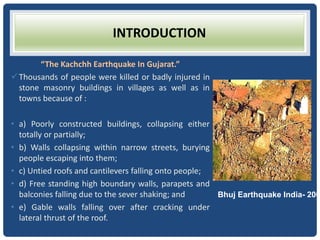
“The Kachchh Earthquake In Gujarat.”
Thousands of people were killed or badly injured in
stone masonry buildings in villages as well as in
towns because of :
• a) Poorly constructed buildings, collapsing either
totally or partially;
• b) Walls collapsing within narrow streets, burying
people escaping into them;
• c) Untied roofs and cantilevers falling onto people;
• d) Free standing high boundary walls, parapets and
balconies falling due to the sever shaking; and
• e) Gable walls falling over after cracking under
lateral thrust of the roof.
Bhuj Earthquake India- 200
CAUSES OF DETERIORATION IN BUILDINGS IN
GENERAL
• The primary source and causes of deterioration and decay in structures
and buildings can be listed as follows:
1.Human 2.Chemical
3. Atmospheric 4.Structural
5. Moisture 6.Fire
7.Faulty Design 8. Faulty Construction
9. Faulty Materials 10. Faulty System
11. Cleaning 12. Vandalism
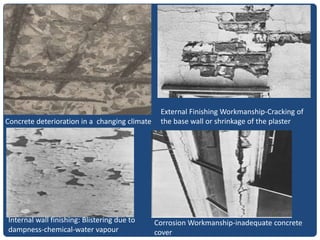
Concrete deterioration in a changing climate
External Finishing Workmanship-Cracking of
the base wall or shrinkage of the plaster
Internal wall finishing: Blistering due to
dampness-chemical-water vapour
Corrosion Workmanship-inadequate concrete
cover
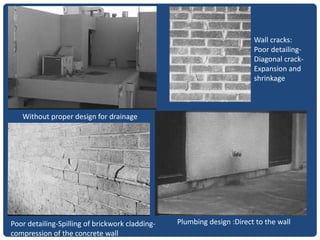
Without proper design for drainage
Plumbing design :Direct to the wallPoor detailing-Spilling of brickwork cladding-
compression of the concrete wall
Wall cracks:
Poor detailing-
Diagonal crack-
Expansion and
shrinkage
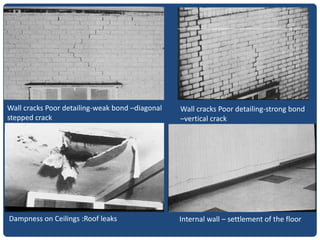
Wall cracks Poor detailing-weak bond –diagonal
stepped crack
Wall cracks Poor detailing-strong bond
–vertical crack
Dampness on Ceilings :Roof leaks Internal wall – settlement of the floor
REPAIRS
• Repairs: The main purpose of repairs is to bring back the architectural
shape of the building so that all services start working and the functioning
of building is resumed quickly. Repair does not pretend to improve the
structural strength of the building and can be very deceptive for meeting
the strength requirements of the next earthquake.
‘’ To bring back the position of the structure to its previous condition so it
gives performance same as previously.
It doesn’t cover the strength aspect of the structures.’’
THE ACTIONS FOR REPAIR WILL INCLUDE THE FOLLOWING:
1. Patching up of defects such as cracks and fall of plaster.
2. Repairing doors, windows, replacement of glass panes.
3. Checking and repairing electric wiring.
4. Checking and repairing gas pipes, water pipes and plumbing services.
5. Re-building non-structural walls, smoke chimneys, boundary walls, etc.
6. Re-plastering of walls as required.
7. Rearranging disturbed roofing tiles.
8. Relaying cracked flooring at ground level.
9. Redecoration —whitewashing, painting, etc.
REPAIR METHODOLOGY
 Evaluation
 Relating observation to causes
 Selecting methods and materials
 Preparation of drawings and specifications
 Selection of a contractor
 Execution of the work
 Quality Control
STAGES OF REPAIR
• Repair of concrete structure is carried out in the following
stages:
1) Removal of damaged concrete
2) Pre treatment of surfaces and reinforcement
3) Application of repair materials
4) Restoring the integrity of individual sections and
strengthening of structure as a whole.
MATERIALS FOR CRACK REPAIR
• The various materials used for repairs of cracks are:
 Cement Slurry
 Cement Mortar
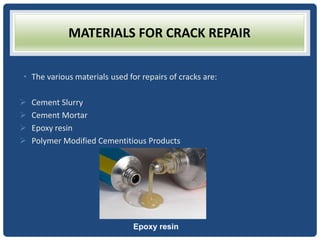
 Epoxy resin
 Polymer Modified Cementitious Products
Epoxy resin
CRACK REPAIR TECHNIQUES
 Epoxy-injection Grouting
 Routing and Sealing
 Flexible Sealing
 Stitching: this is done to repair of brickwork
 Providing additional Reinforcement
 Drilling and plugging
 Prestressing steel
 Grouting
 Dry packing
 Surface Coatings
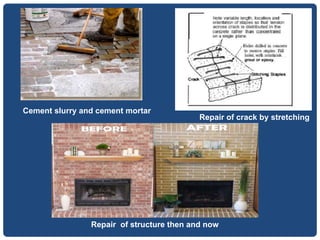
Repair of crack by stretching
Cement slurry and cement mortar
Repair of structure then and now
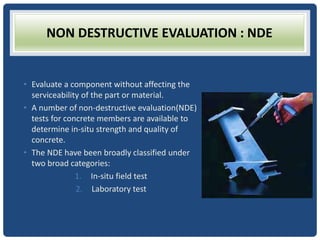
NON DESTRUCTIVE EVALUATION : NDE
• Evaluate a component without affecting the
serviceability of the part or material.
• A number of non-destructive evaluation(NDE)
tests for concrete members are available to
determine in-situ strength and quality of
concrete.
• The NDE have been broadly classified under
two broad categories:
1. In-situ field test
2. Laboratory test
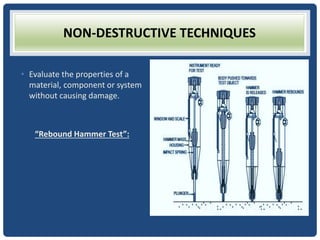
NON-DESTRUCTIVE TECHNIQUES
• Evaluate the properties of a
material, component or system
without causing damage.
“Rebound Hammer Test”:
NON-DESTRUCTIVE TECHNIQUES
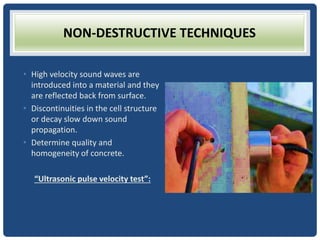
• High velocity sound waves are
introduced into a material and they
are reflected back from surface.
• Discontinuities in the cell structure
or decay slow down sound
propagation.
• Determine quality and
homogeneity of concrete.
“Ultrasonic pulse velocity test”:
RESTORATION
• This includes actions taken for restoring the lost strength of structural
elements of the building.
 This is done by making the columns, piers, beams and walls at least as
strong as originally provided as follows:
1. Removal of portions of cracked masonry walls and piers, and
rebuilding them in richer mortar. Use of non-
shrinking mortar will be preferable.
2. Addition of reinforcing mesh on both faces of the cracked wall,
holding it to the wall through spikes or bolts and then covering
it suitably with micro-concrete or 1:3 cement -coarse sand plaster.
“Relates to the strength aspect of structures”
3. Injecting neat cement slurry or epoxy like material, which is
strong in tension, into the cracks in walls, columns,
beams etc.
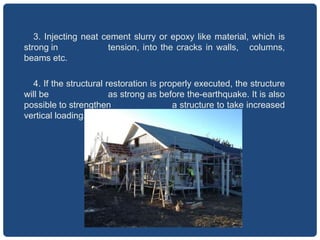
4. If the structural restoration is properly executed, the structure
will be as strong as before the-earthquake. It is also
possible to strengthen a structure to take increased
vertical loading, if required.
RESTORATION MATERIALS
• Repointing practices such as ranking(manual or machine) expansion
groove, mortar joint section repointing.
• Mineral grout, polymer injection, anti staining coating and techniques.
• Portland cement mortars and grouts
• Lime cement mortars and grouts
• Pozzolanic mortars and grouts
• Epoxy resin mortars and grouts
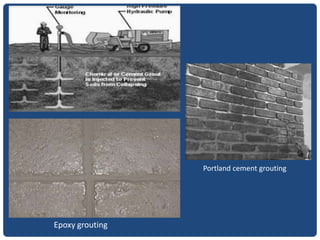
Portland cement grouting
Epoxy grouting
RESTORATION
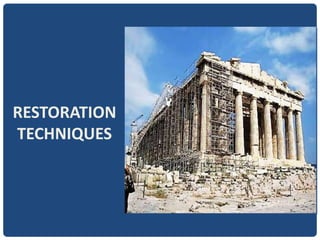
TECHNIQUES
GENERAL MEASURES
• Reduction of unwanted load
• Removal of natural growth
• Injection of appropriate grouts
• Re-plastering
• Replacing damaged parts
• Reconstruction
GROUTING
GROUTING
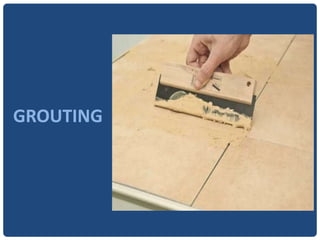
• Grouting is a process of injecting mixture of cement, sand water at high
pressure in the cracks, joints, voids etc.
• Purpose of Grouting:
I. To strengthen the porous Concrete
II. To prevent the seepage in dam and water retaining structures
III. To reduce uplift pressure below dam
IV. To fill the cracks in concrete structure
SEISMIC STRENGTHENING (RETROFITTING)
• It will involve actions for upgrading the seismic resistance of an existing
building so that becomes safer under the occurrence of probable future
earthquakes.
• The seismic behavior of existing buildings is affected by their original
structural inadequacies, material degradation due to aging and alterations
carried out during use over time.
• The complete replacement of such buildings in a given area is just not
possible due to a number of social, cultural and financial problems.
Therefore, seismic strengthening of existing undamaged or damaged
buildings is a definite requirement.
 The main items of seismic strengthening could be some or all of that
following actions:
• Modification of roofs,
• Substitution or strengthening of floors,
• Modification in the building plan,
• Strengthening of walls including provision of horizontal and vertical bands or
belts, introduction of header stones in thick stone walls, and injection
grouting etc.,
• Adding to the sections of beams and columns by casing or jacketing etc.,
• Adding shear walls or diagonal bracings, Strengthening of foundations if
found necessary (but very difficult and expensive).
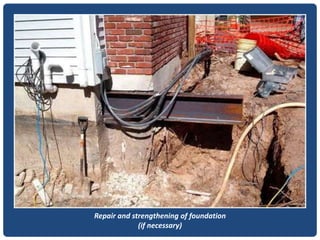
Repair and strengthening of foundation
(if necessary)
SR.
NO.
MEMBER
CLASSIFICATI
ON
SURFA
CE
POSITION AVERAGE
READING
QUALITY
OF
CONCRET
E
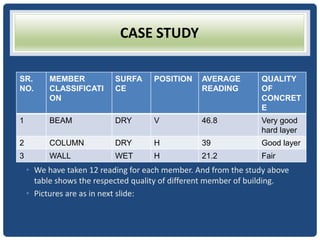
1 BEAM DRY V 46.8 Very good
hard layer
2 COLUMN DRY H 39 Good layer
3 WALL WET H 21.2 Fair
“Rebound Hammer Test”: RESULTCASE STUDY
• We have taken 12 reading for each member. And from the study above
table shows the respected quality of different member of building.
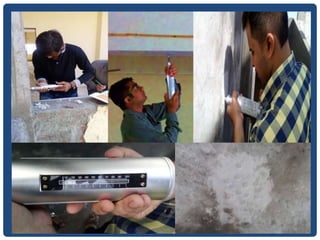
• Pictures are as in next slide:
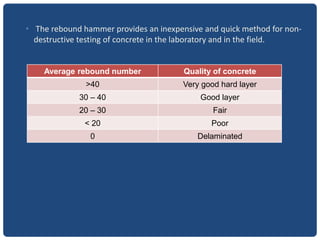
• The rebound hammer provides an inexpensive and quick method for non-
destructive testing of concrete in the laboratory and in the field.
Average rebound number Quality of concrete
>40 Very good hard layer
30 – 40 Good layer
20 – 30 Fair
< 20 Poor
0 Delaminated
REFERENCES
• Pardeep K. Gupta, Niharika Gupta and Amandeep Singh., “Case
study of strength evaluation of structural concrete using
rebound hammer test”, The Indian Concrete Journal August 2015
• “HANDBOOK ON REPAIR AND REHABILITATION OF RCC
BUILDINGS”, Pardeep K. Gupta, Niharika Gupta and Amandeep
Singh.
• Textbook of concrete technology by M.S. Shetty.
• Textbook of concrete technology by M.L.Gambhir.
• Www.Google.Com
Seminar_Repair & Restoration_of_Structure

Seminar_Repair & Restoration_of_Structure

  • 1.
    SARDAR PATEL COLLEGEOF ENGINEERING-BAKROL REPAIR AND RESTORATION OF STRUCTURE PREPARED BY: FACULTY NAME: KAPADIA ISSAR B. (141240106026) PROF. JUGAL MISTRY CHAKRABORTY ANKIT S. SHAH RAJ CONCRETE TECHNOLOGYCONCRETE TECHNOLOGY
  • 2.
    OUTLINE • INTRODUCTION • CAUSESOF DETERIORATION IN BUILDINGS IN GENERAL • REPAIRS • REPAIR METHODOLOGY • STAGES OF REPAIR • MATERIALS FOR CRACK REPAIR • NON DESTRUCTIVE EVALUATION : NDE • NON-DESTRUCTIVE TECHNIQUES • RESTORATION • RESTORATION MATERIALS • RESTORATION TECHNIQUES • GROUTING • SEISMIC STRENGTHENING (RETROFITTING) • CASE STUDY : NON DESTRUCTIVE TEST • REFERENCES
  • 3.
    INTRODUCTION “The Kachchh EarthquakeIn Gujarat.” Thousands of people were killed or badly injured in stone masonry buildings in villages as well as in towns because of : • a) Poorly constructed buildings, collapsing either totally or partially; • b) Walls collapsing within narrow streets, burying people escaping into them; • c) Untied roofs and cantilevers falling onto people; • d) Free standing high boundary walls, parapets and balconies falling due to the sever shaking; and • e) Gable walls falling over after cracking under lateral thrust of the roof. Bhuj Earthquake India- 200
  • 4.
    CAUSES OF DETERIORATIONIN BUILDINGS IN GENERAL • The primary source and causes of deterioration and decay in structures and buildings can be listed as follows: 1.Human 2.Chemical 3. Atmospheric 4.Structural 5. Moisture 6.Fire 7.Faulty Design 8. Faulty Construction 9. Faulty Materials 10. Faulty System 11. Cleaning 12. Vandalism
  • 5.
    Concrete deterioration ina changing climate External Finishing Workmanship-Cracking of the base wall or shrinkage of the plaster Internal wall finishing: Blistering due to dampness-chemical-water vapour Corrosion Workmanship-inadequate concrete cover
  • 6.
    Without proper designfor drainage Plumbing design :Direct to the wallPoor detailing-Spilling of brickwork cladding- compression of the concrete wall Wall cracks: Poor detailing- Diagonal crack- Expansion and shrinkage
  • 7.
    Wall cracks Poordetailing-weak bond –diagonal stepped crack Wall cracks Poor detailing-strong bond –vertical crack Dampness on Ceilings :Roof leaks Internal wall – settlement of the floor
  • 8.
    REPAIRS • Repairs: Themain purpose of repairs is to bring back the architectural shape of the building so that all services start working and the functioning of building is resumed quickly. Repair does not pretend to improve the structural strength of the building and can be very deceptive for meeting the strength requirements of the next earthquake. ‘’ To bring back the position of the structure to its previous condition so it gives performance same as previously. It doesn’t cover the strength aspect of the structures.’’
  • 9.
    THE ACTIONS FORREPAIR WILL INCLUDE THE FOLLOWING: 1. Patching up of defects such as cracks and fall of plaster. 2. Repairing doors, windows, replacement of glass panes. 3. Checking and repairing electric wiring. 4. Checking and repairing gas pipes, water pipes and plumbing services. 5. Re-building non-structural walls, smoke chimneys, boundary walls, etc. 6. Re-plastering of walls as required. 7. Rearranging disturbed roofing tiles. 8. Relaying cracked flooring at ground level. 9. Redecoration —whitewashing, painting, etc.
  • 10.
    REPAIR METHODOLOGY  Evaluation Relating observation to causes  Selecting methods and materials  Preparation of drawings and specifications  Selection of a contractor  Execution of the work  Quality Control
  • 11.
    STAGES OF REPAIR •Repair of concrete structure is carried out in the following stages: 1) Removal of damaged concrete 2) Pre treatment of surfaces and reinforcement 3) Application of repair materials 4) Restoring the integrity of individual sections and strengthening of structure as a whole.
  • 12.
    MATERIALS FOR CRACKREPAIR • The various materials used for repairs of cracks are:  Cement Slurry  Cement Mortar  Epoxy resin  Polymer Modified Cementitious Products Epoxy resin
  • 13.
    CRACK REPAIR TECHNIQUES Epoxy-injection Grouting  Routing and Sealing  Flexible Sealing  Stitching: this is done to repair of brickwork  Providing additional Reinforcement  Drilling and plugging  Prestressing steel  Grouting  Dry packing  Surface Coatings
  • 14.
    Repair of crackby stretching Cement slurry and cement mortar Repair of structure then and now
  • 15.
    NON DESTRUCTIVE EVALUATION: NDE • Evaluate a component without affecting the serviceability of the part or material. • A number of non-destructive evaluation(NDE) tests for concrete members are available to determine in-situ strength and quality of concrete. • The NDE have been broadly classified under two broad categories: 1. In-situ field test 2. Laboratory test
  • 16.
    NON-DESTRUCTIVE TECHNIQUES • Evaluatethe properties of a material, component or system without causing damage. “Rebound Hammer Test”:
  • 17.
    NON-DESTRUCTIVE TECHNIQUES • Highvelocity sound waves are introduced into a material and they are reflected back from surface. • Discontinuities in the cell structure or decay slow down sound propagation. • Determine quality and homogeneity of concrete. “Ultrasonic pulse velocity test”:
  • 18.
    RESTORATION • This includesactions taken for restoring the lost strength of structural elements of the building.  This is done by making the columns, piers, beams and walls at least as strong as originally provided as follows: 1. Removal of portions of cracked masonry walls and piers, and rebuilding them in richer mortar. Use of non- shrinking mortar will be preferable. 2. Addition of reinforcing mesh on both faces of the cracked wall, holding it to the wall through spikes or bolts and then covering it suitably with micro-concrete or 1:3 cement -coarse sand plaster. “Relates to the strength aspect of structures”
  • 19.
    3. Injecting neatcement slurry or epoxy like material, which is strong in tension, into the cracks in walls, columns, beams etc. 4. If the structural restoration is properly executed, the structure will be as strong as before the-earthquake. It is also possible to strengthen a structure to take increased vertical loading, if required.
  • 20.
    RESTORATION MATERIALS • Repointingpractices such as ranking(manual or machine) expansion groove, mortar joint section repointing. • Mineral grout, polymer injection, anti staining coating and techniques. • Portland cement mortars and grouts • Lime cement mortars and grouts • Pozzolanic mortars and grouts • Epoxy resin mortars and grouts
  • 21.
  • 22.
  • 23.
    GENERAL MEASURES • Reductionof unwanted load • Removal of natural growth • Injection of appropriate grouts • Re-plastering • Replacing damaged parts • Reconstruction
  • 24.
  • 25.
    GROUTING • Grouting isa process of injecting mixture of cement, sand water at high pressure in the cracks, joints, voids etc. • Purpose of Grouting: I. To strengthen the porous Concrete II. To prevent the seepage in dam and water retaining structures III. To reduce uplift pressure below dam IV. To fill the cracks in concrete structure
  • 26.
    SEISMIC STRENGTHENING (RETROFITTING) •It will involve actions for upgrading the seismic resistance of an existing building so that becomes safer under the occurrence of probable future earthquakes. • The seismic behavior of existing buildings is affected by their original structural inadequacies, material degradation due to aging and alterations carried out during use over time. • The complete replacement of such buildings in a given area is just not possible due to a number of social, cultural and financial problems. Therefore, seismic strengthening of existing undamaged or damaged buildings is a definite requirement.
  • 27.
     The mainitems of seismic strengthening could be some or all of that following actions: • Modification of roofs, • Substitution or strengthening of floors, • Modification in the building plan, • Strengthening of walls including provision of horizontal and vertical bands or belts, introduction of header stones in thick stone walls, and injection grouting etc., • Adding to the sections of beams and columns by casing or jacketing etc., • Adding shear walls or diagonal bracings, Strengthening of foundations if found necessary (but very difficult and expensive).
  • 28.
    Repair and strengtheningof foundation (if necessary)
  • 29.
    SR. NO. MEMBER CLASSIFICATI ON SURFA CE POSITION AVERAGE READING QUALITY OF CONCRET E 1 BEAMDRY V 46.8 Very good hard layer 2 COLUMN DRY H 39 Good layer 3 WALL WET H 21.2 Fair “Rebound Hammer Test”: RESULTCASE STUDY • We have taken 12 reading for each member. And from the study above table shows the respected quality of different member of building. • Pictures are as in next slide:
  • 31.
    • The reboundhammer provides an inexpensive and quick method for non- destructive testing of concrete in the laboratory and in the field. Average rebound number Quality of concrete >40 Very good hard layer 30 – 40 Good layer 20 – 30 Fair < 20 Poor 0 Delaminated
  • 32.
    REFERENCES • Pardeep K.Gupta, Niharika Gupta and Amandeep Singh., “Case study of strength evaluation of structural concrete using rebound hammer test”, The Indian Concrete Journal August 2015 • “HANDBOOK ON REPAIR AND REHABILITATION OF RCC BUILDINGS”, Pardeep K. Gupta, Niharika Gupta and Amandeep Singh. • Textbook of concrete technology by M.S. Shetty. • Textbook of concrete technology by M.L.Gambhir. • Www.Google.Com

Editor's Notes

  • #4 The Kachchh earthquake in Gujarat occurred on the 26 January, 2001 and caused massive destruction to property and loss of life in the towns of Bhachau, Anjar, Rapar, Bhuj and Gandhidham as well as thousands of villages. This earthquake had a Richter Magnitude of 6.9 and surface magnitude Ms = 7.7 (USGS) and struck the region at 8.46 am local time, with the shaking lasting for a few minutes. Other major cities in Gujarat e.g., Ahmedabad and Jamnagar, which are hundreds of kilometres away, were also affected by the earthquake.
  • #5 Vamdalism: Lack of security - Failure to promote awareness among occupants of the consequences of vandalism - Incorrect selection of materials and finishes in circulation areas which are prone to vandalism - Failure to maintain or repair areas of damage by vandals thus encouraging more vandalism. Cleaning: Failure to carry out routing cleaning operations - Use of incorrect cleaning materials and/or techniques …..
  • #6 Example of Decay(Deterioration) in structure
  • #7 Example of decay(Deterioration) in structure….
  • #8 Examples of decays(Deterioration) in structure….
  • #15 Active crack and dormant crack
  • #18 There are also having in situ concrete test : windsor probe, pull out test, load test
  • #22 Images show the grouting with types of material
  • #29 Source Google using helical piles
  • #31 Pictures taken during study shows to check the compressive strength using non destructive technique as Rebound hammer test on wall, column and beam.