RCCSlabSitereport
Shaikh Munazzar Arshad
2nd Year B.Arch.
Ramesh Phirodia College of Architecture
Introduction :
This is the report of Site visit of Reinforced Concrete Slab Carried out in order to
understand how the theoretical knowledge is fitted in practice.
Objectives :
✓ To get an understanding how the theoretical technical details are worked out
on the site.
✓ To understand how one way, two way, sunken slab are worked on the site.
✓ To understand the placing of Steel on the site.
✓ To get thorough understanding of RCC slab construction, Concrete cover,
beam sizes and placing, column workouts, intersection of beams and columns.
Reason for choosing this site :
✓ The main reason for choosing this site for observation process and to see the
theoretical knowledge being fitted in practice is that this construction site was
implementing all that theory we have gone through at this stage.
Site report:
The building site we chose was a bungalow being constructed.
Building Site :
NAME Bungalow of Mr.Vishwakarma
TYPE OF BUILDING A one story bungalow
LOCATION Kedgaon, Ahmednagar
RCC CONSULTANT Pankaj Zaware
DATE OF SITEVISIT 4 Feb 2020
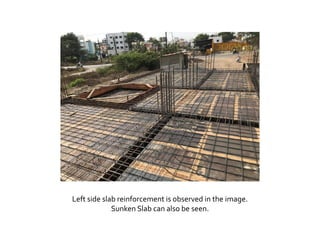
Left side slab reinforcement is observed in the image.
Sunken Slab can also be seen.
Right side slab reinforcement is observed in the image.
Sunken Slab can also be seen.
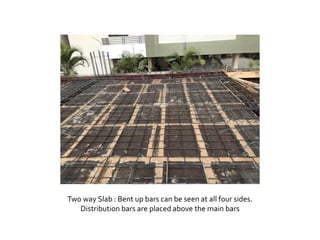
Two way Slab : Bent up bars can be seen at all four sides.
Distribution bars are placed above the main bars
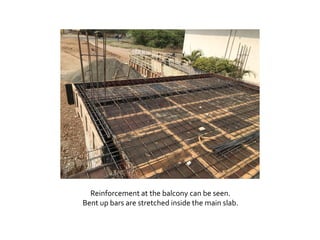
Reinforcement at the balcony can be seen.
Bent up bars are stretched inside the main slab.
The Placing of bent up bars is seen here.
The bent up bars are placed alternately.
Distribution bars are placed over main
bars.Top bars are can also be seen.
Stirrups are being seen in the image.
The folding of Stirrups around the main bars is observed in
the image.
The 25 mm concrete cover is placed very below the
reinforcement
The Placing of bent up bars is seen here.
The bent up bars are placed alternately.
Distribution bars are placed over main
bars.Top bars are can also be seen.
The intersection of columns and beams are
observed in the image along with the
reinforcement of slab.
View of the beams, stirrups, top bars,
bottom bars.
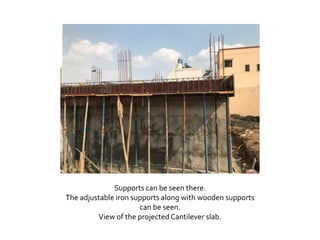
Supports can be seen there.
The adjustable iron supports along with wooden supports
can be seen.
View of the projected Cantilever slab.
View of the basement
Building Site :Questions asked on the site :
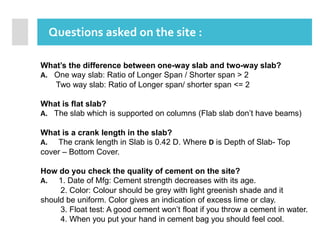
What’s the difference between one-way slab and two-way slab?
A. One way slab: Ratio of Longer Span / Shorter span > 2
Two way slab: Ratio of Longer span/ shorter span <= 2
What is flat slab?
A. The slab which is supported on columns (Flab slab don’t have beams)
What is a crank length in the slab?
A. The crank length in Slab is 0.42 D. Where D is Depth of Slab- Top
cover – Bottom Cover.
How do you check the quality of cement on the site?
A. 1. Date of Mfg: Cement strength decreases with its age.
2. Color: Colour should be grey with light greenish shade and it
should be uniform. Color gives an indication of excess lime or clay.
3. Float test: A good cement won’t float if you throw a cement in water.
4. When you put your hand in cement bag you should feel cool.
Building Site :Questions asked on the site :
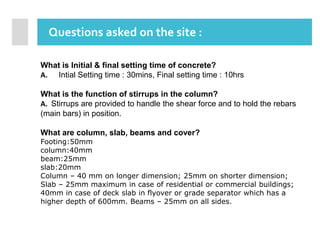
What is Initial & final setting time of concrete?
A. Intial Setting time : 30mins, Final setting time : 10hrs
What is the function of stirrups in the column?
A. Stirrups are provided to handle the shear force and to hold the rebars
(main bars) in position.
What are column, slab, beams and cover?
Footing:50mm
column:40mm
beam:25mm
slab:20mm
Column – 40 mm on longer dimension; 25mm on shorter dimension;
Slab – 25mm maximum in case of residential or commercial buildings;
40mm in case of deck slab in flyover or grade separator which has a
higher depth of 600mm. Beams – 25mm on all sides.
Building Site :Conclusions :
RCC refers to reinforced cement concrete.
Hence an RCC slab comprises of carefully worked out steel
reinforcements in order to provide tensile strength to the structure as it's
an obvious fact that concrete mainly withstands compression load and is
tremendously weak in withstanding tensile loads.The tensile loads end up
being taken by the steel reinforcements so that the concrete can sustain
without too much damage. RCC slabs are most prevalent in normal
construction practices and can easily be located in any of the common
buildings.

Slab site report

  • 1.
    RCCSlabSitereport Shaikh Munazzar Arshad 2ndYear B.Arch. Ramesh Phirodia College of Architecture
  • 2.
    Introduction : This isthe report of Site visit of Reinforced Concrete Slab Carried out in order to understand how the theoretical knowledge is fitted in practice. Objectives : ✓ To get an understanding how the theoretical technical details are worked out on the site. ✓ To understand how one way, two way, sunken slab are worked on the site. ✓ To understand the placing of Steel on the site. ✓ To get thorough understanding of RCC slab construction, Concrete cover, beam sizes and placing, column workouts, intersection of beams and columns. Reason for choosing this site : ✓ The main reason for choosing this site for observation process and to see the theoretical knowledge being fitted in practice is that this construction site was implementing all that theory we have gone through at this stage. Site report:
  • 3.
    The building sitewe chose was a bungalow being constructed. Building Site : NAME Bungalow of Mr.Vishwakarma TYPE OF BUILDING A one story bungalow LOCATION Kedgaon, Ahmednagar RCC CONSULTANT Pankaj Zaware DATE OF SITEVISIT 4 Feb 2020
  • 4.
    Left side slabreinforcement is observed in the image. Sunken Slab can also be seen.
  • 5.
    Right side slabreinforcement is observed in the image. Sunken Slab can also be seen.
  • 6.
    Two way Slab: Bent up bars can be seen at all four sides. Distribution bars are placed above the main bars
  • 7.
    Reinforcement at thebalcony can be seen. Bent up bars are stretched inside the main slab.
  • 8.
    The Placing ofbent up bars is seen here. The bent up bars are placed alternately. Distribution bars are placed over main bars.Top bars are can also be seen.
  • 9.
    Stirrups are beingseen in the image. The folding of Stirrups around the main bars is observed in the image. The 25 mm concrete cover is placed very below the reinforcement
  • 10.
    The Placing ofbent up bars is seen here. The bent up bars are placed alternately. Distribution bars are placed over main bars.Top bars are can also be seen.
  • 11.
    The intersection ofcolumns and beams are observed in the image along with the reinforcement of slab.
  • 12.
    View of thebeams, stirrups, top bars, bottom bars.
  • 13.
    Supports can beseen there. The adjustable iron supports along with wooden supports can be seen. View of the projected Cantilever slab.
  • 14.
    View of thebasement
  • 15.
    Building Site :Questionsasked on the site : What’s the difference between one-way slab and two-way slab? A. One way slab: Ratio of Longer Span / Shorter span > 2 Two way slab: Ratio of Longer span/ shorter span <= 2 What is flat slab? A. The slab which is supported on columns (Flab slab don’t have beams) What is a crank length in the slab? A. The crank length in Slab is 0.42 D. Where D is Depth of Slab- Top cover – Bottom Cover. How do you check the quality of cement on the site? A. 1. Date of Mfg: Cement strength decreases with its age. 2. Color: Colour should be grey with light greenish shade and it should be uniform. Color gives an indication of excess lime or clay. 3. Float test: A good cement won’t float if you throw a cement in water. 4. When you put your hand in cement bag you should feel cool.
  • 16.
    Building Site :Questionsasked on the site : What is Initial & final setting time of concrete? A. Intial Setting time : 30mins, Final setting time : 10hrs What is the function of stirrups in the column? A. Stirrups are provided to handle the shear force and to hold the rebars (main bars) in position. What are column, slab, beams and cover? Footing:50mm column:40mm beam:25mm slab:20mm Column – 40 mm on longer dimension; 25mm on shorter dimension; Slab – 25mm maximum in case of residential or commercial buildings; 40mm in case of deck slab in flyover or grade separator which has a higher depth of 600mm. Beams – 25mm on all sides.
  • 17.
    Building Site :Conclusions: RCC refers to reinforced cement concrete. Hence an RCC slab comprises of carefully worked out steel reinforcements in order to provide tensile strength to the structure as it's an obvious fact that concrete mainly withstands compression load and is tremendously weak in withstanding tensile loads.The tensile loads end up being taken by the steel reinforcements so that the concrete can sustain without too much damage. RCC slabs are most prevalent in normal construction practices and can easily be located in any of the common buildings.