Micro-teaching is a technique used to train teachers that breaks teaching down into its component parts. It involves teaching a short lesson to a small group of students while being recorded on video. The teacher then reviews the video with a supervisor who provides feedback. This process is repeated through multiple cycles of planning, teaching, observation, and feedback to help teachers improve specific skills like questioning, reinforcement, and use of instructional aids. Micro-teaching aims to give teachers experience practicing skills individually before teaching full lessons.
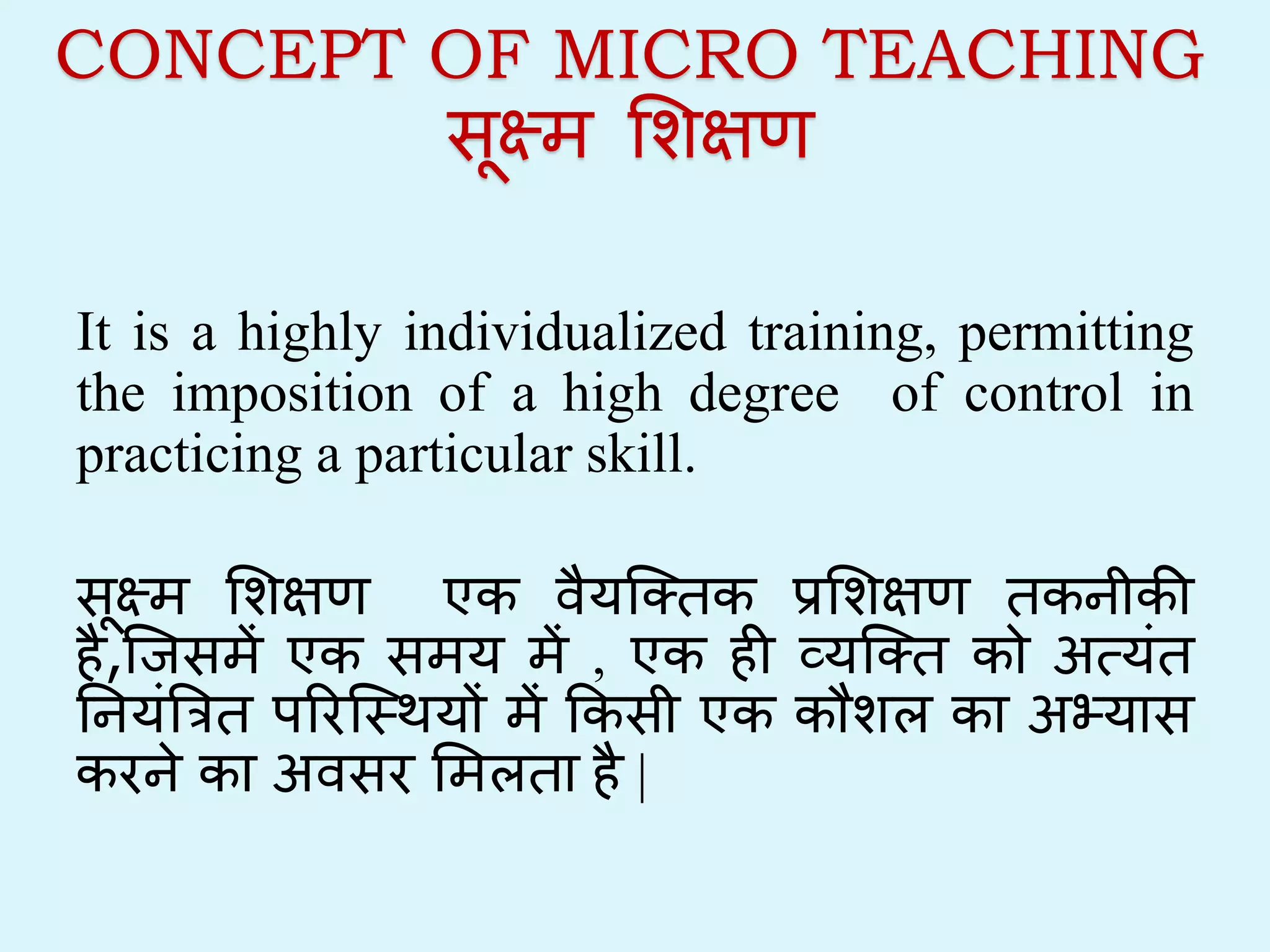
Presented by Dr. Nimisha Srivastava, this slide discusses the individualized training technique called micro-teaching, emphasizing its high degree of control.
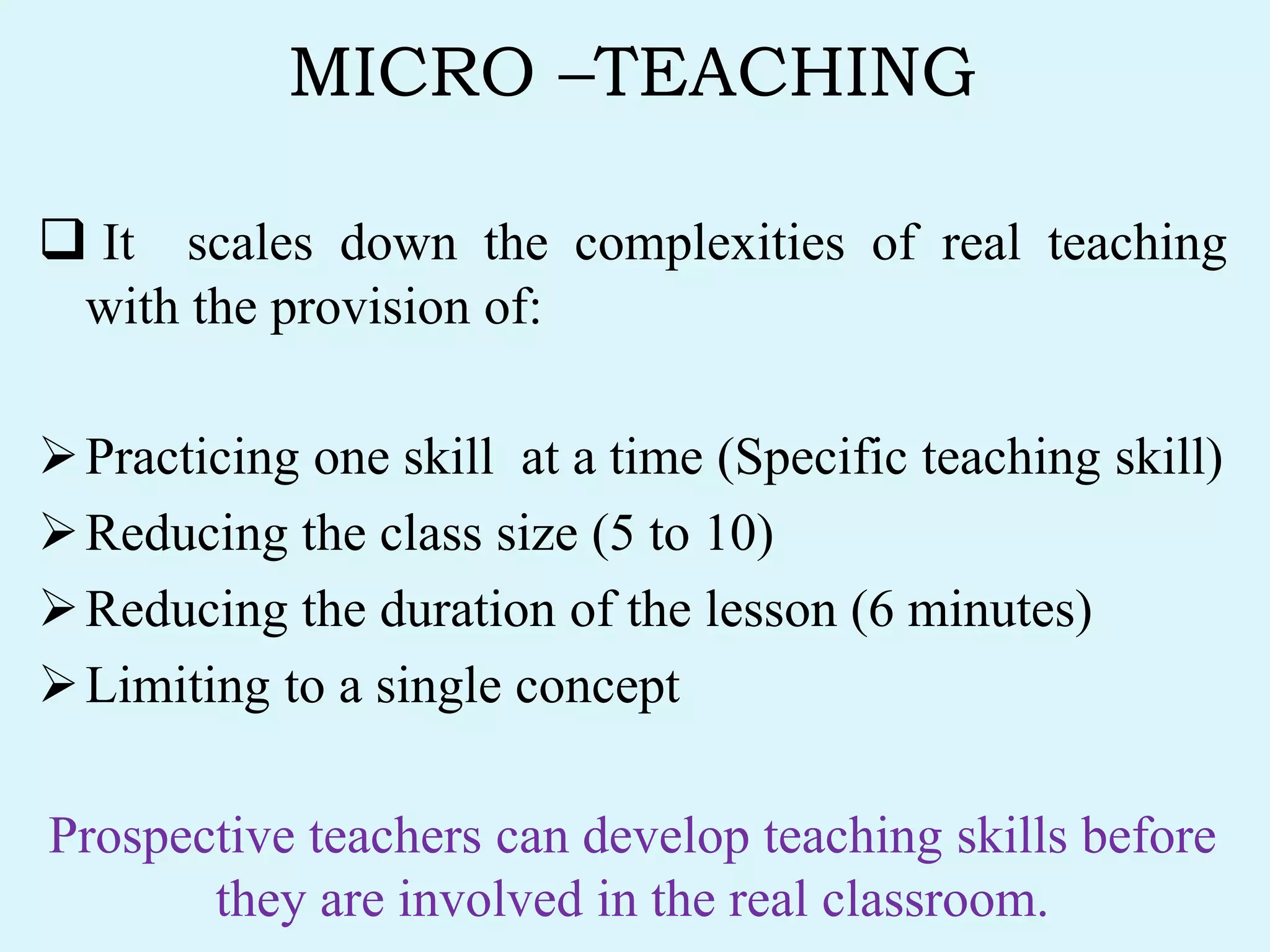
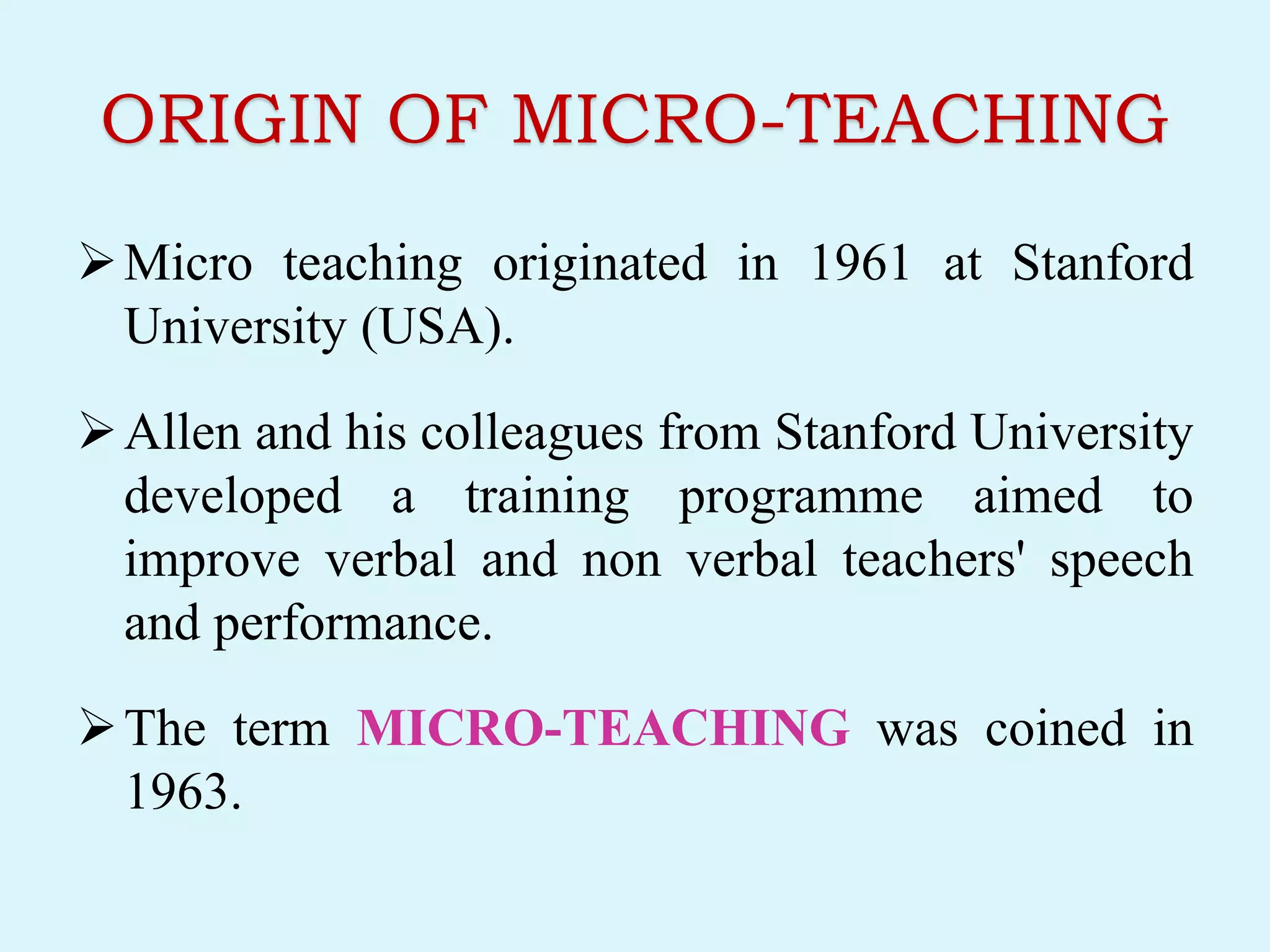
Micro-teaching simplifies real teaching by focusing on one skill, smaller class sizes, and shorter lesson durations. It originated in 1961 at Stanford for enhancing teaching skills.
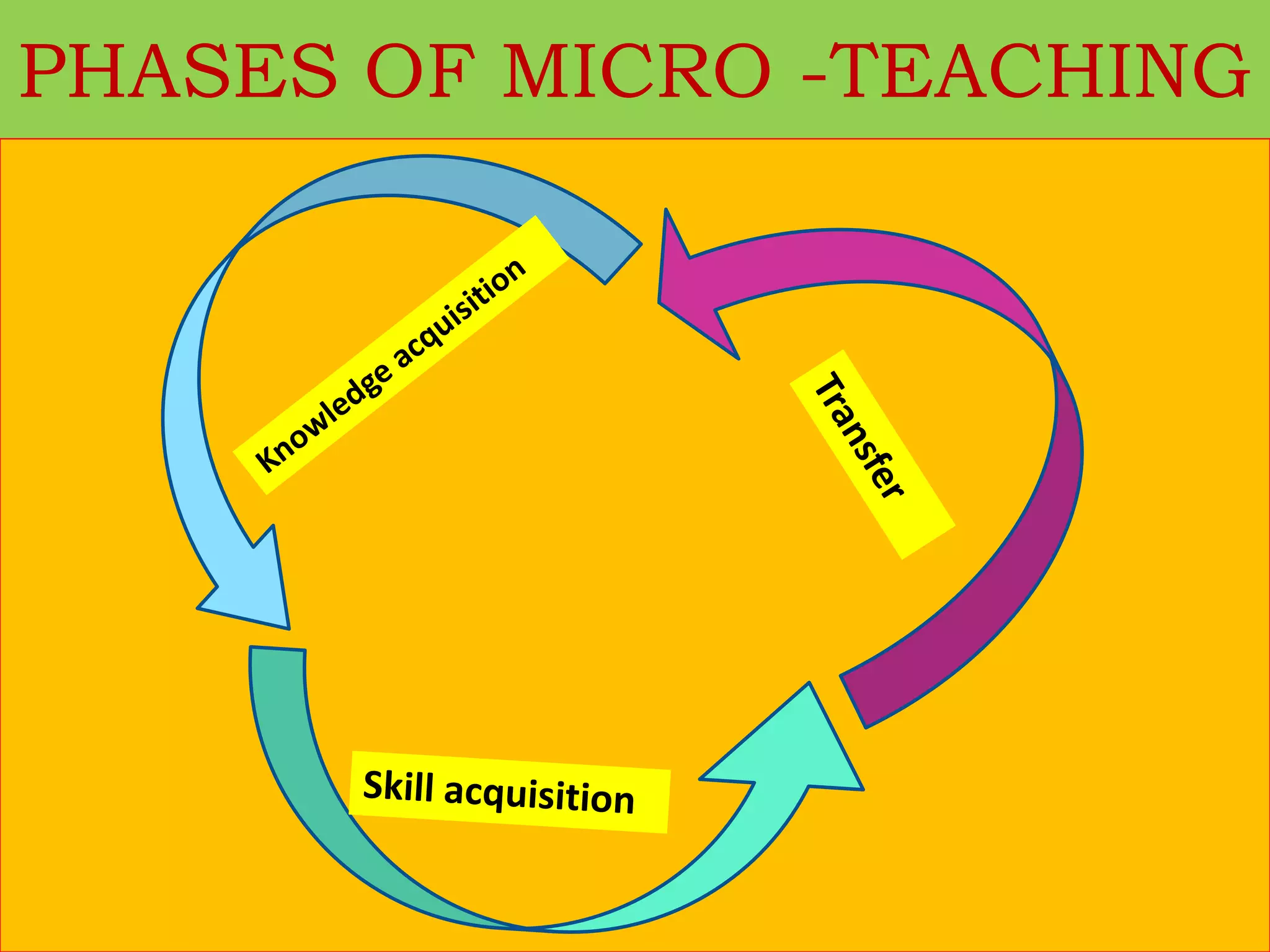
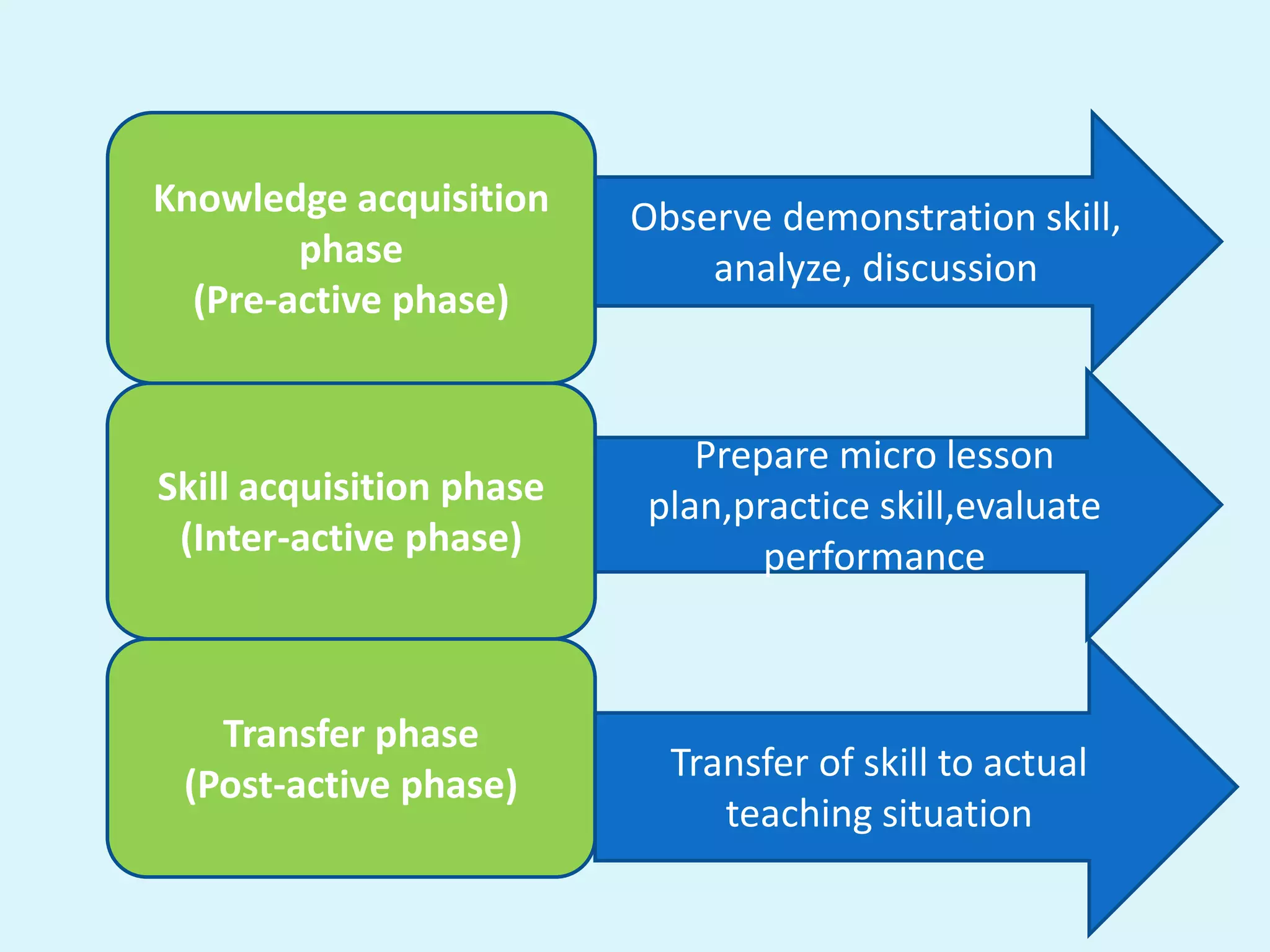
Micro-teaching consists of three phases: Knowledge acquisition, Skill acquisition, and Transfer, each with specific activities and goals related to teaching mastery.
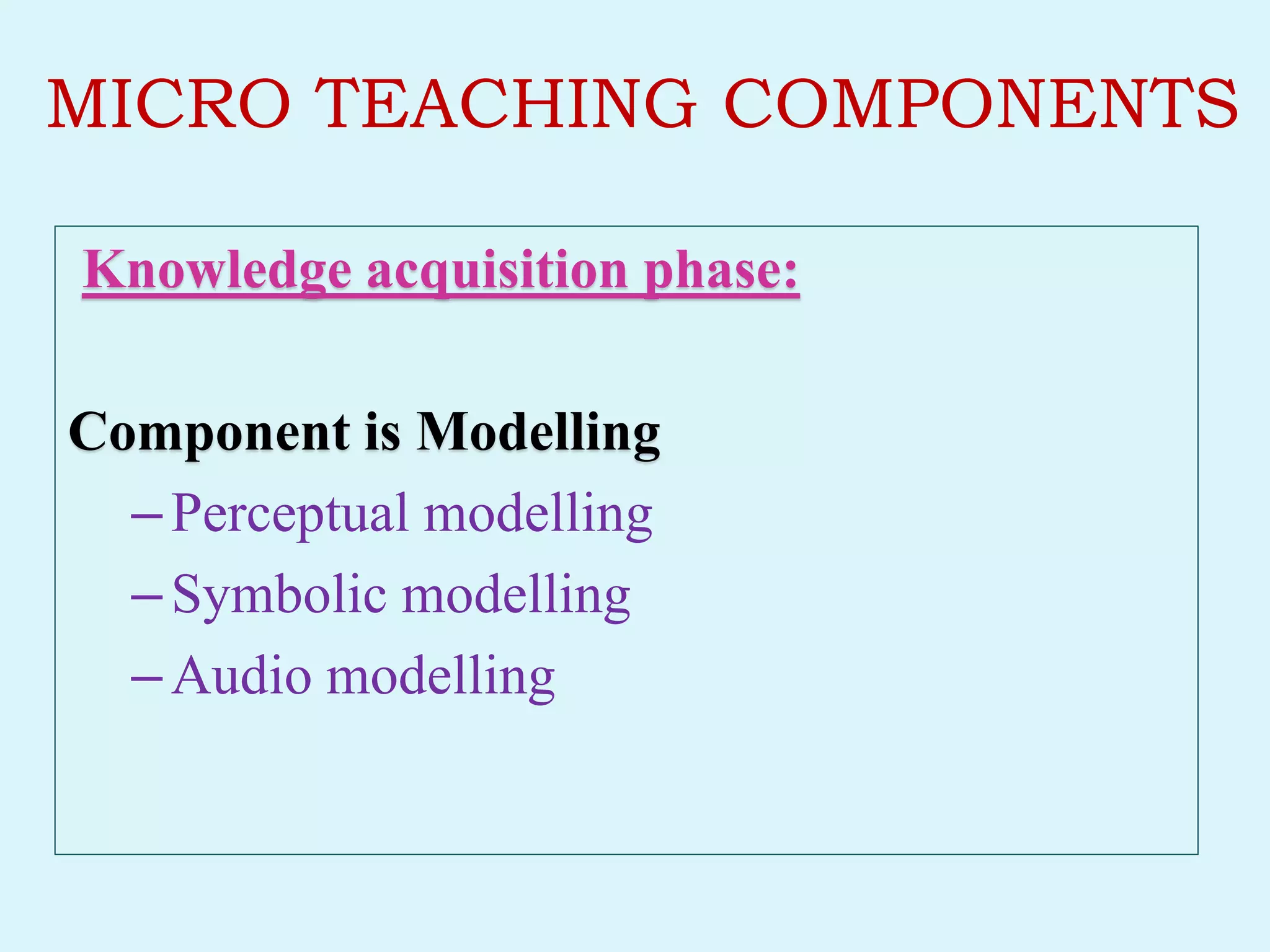
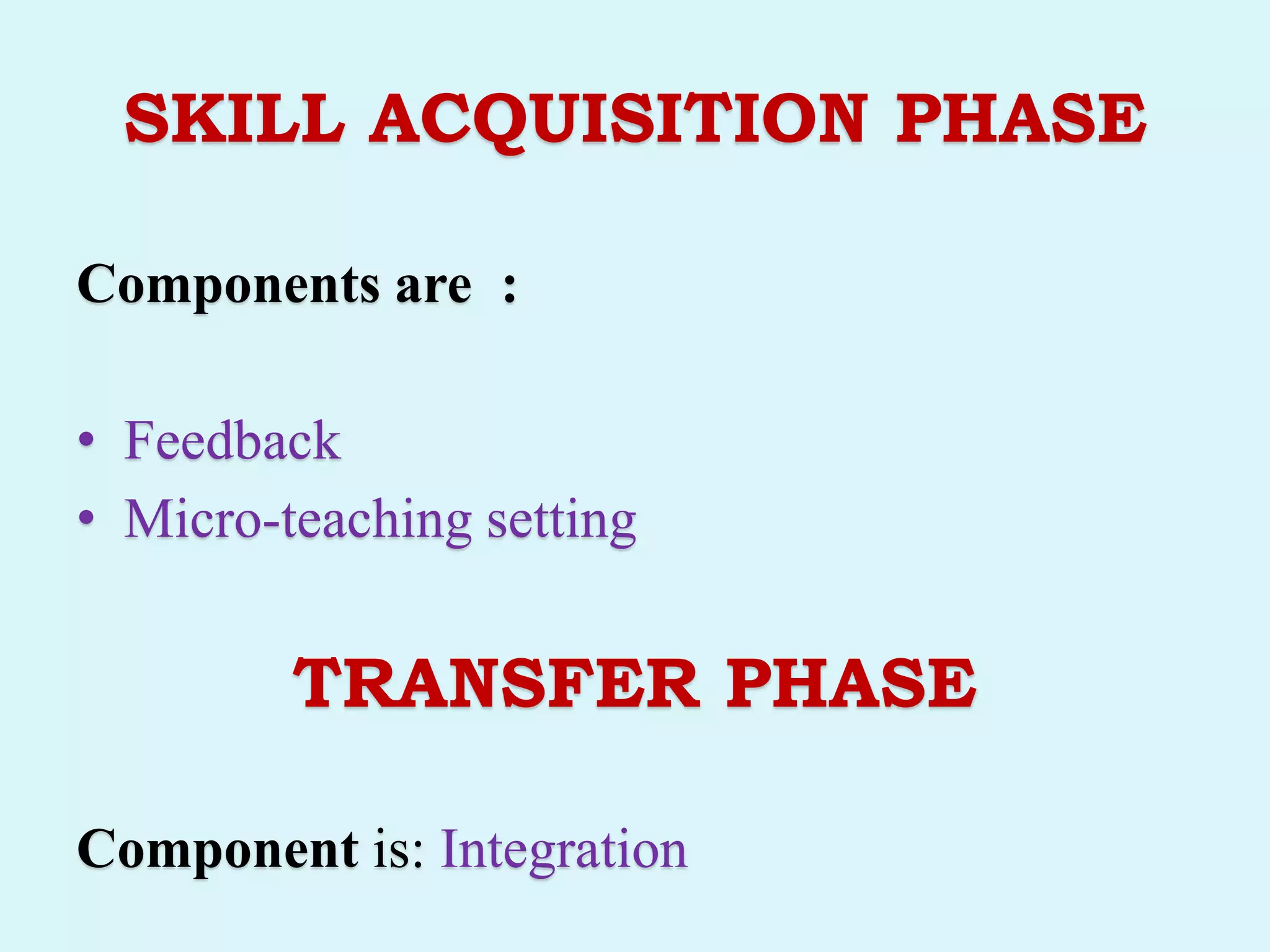
Components of micro-teaching include modelling during knowledge acquisition, feedback during skill acquisition, and skill integration in the transfer phase.
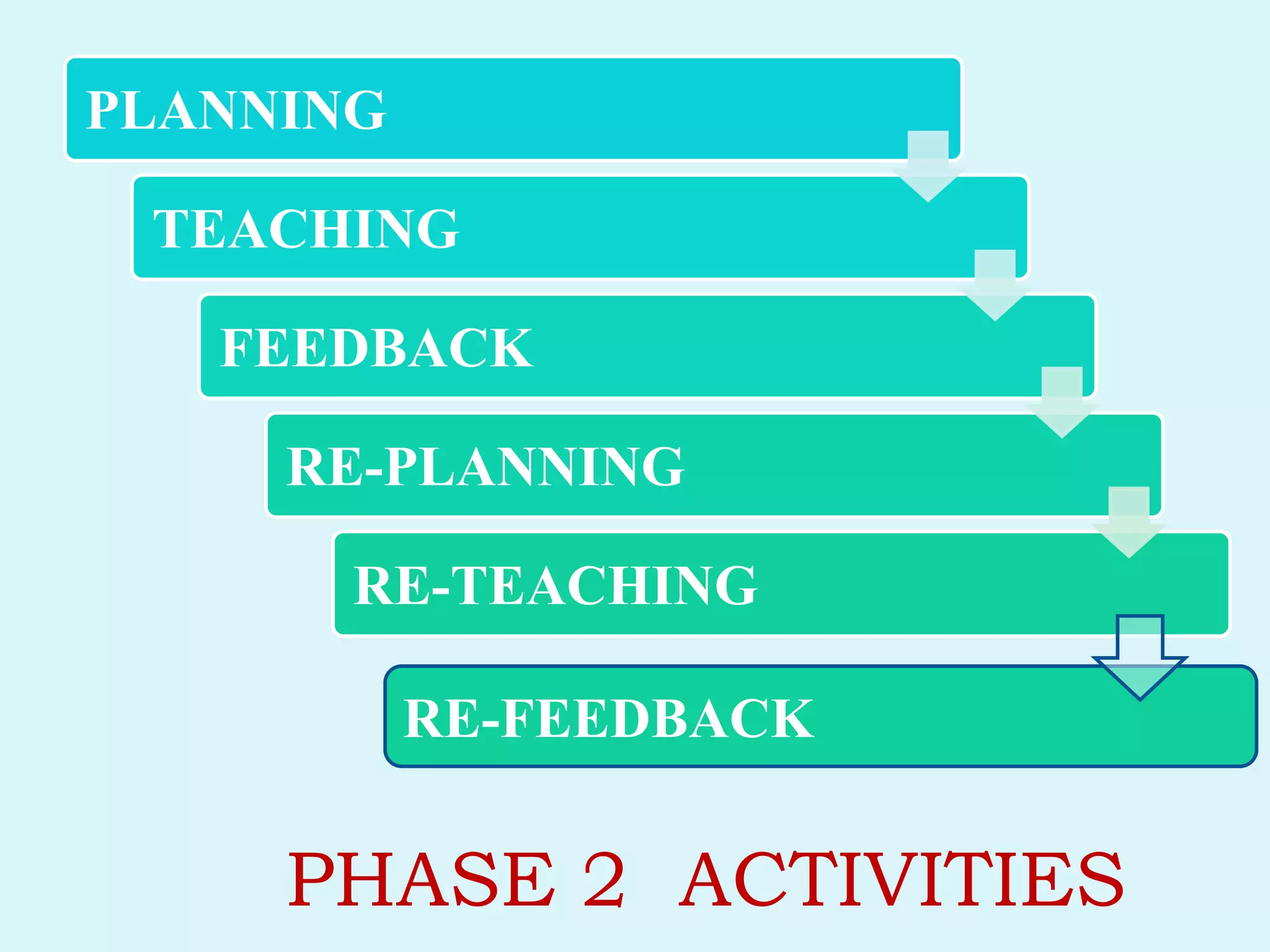
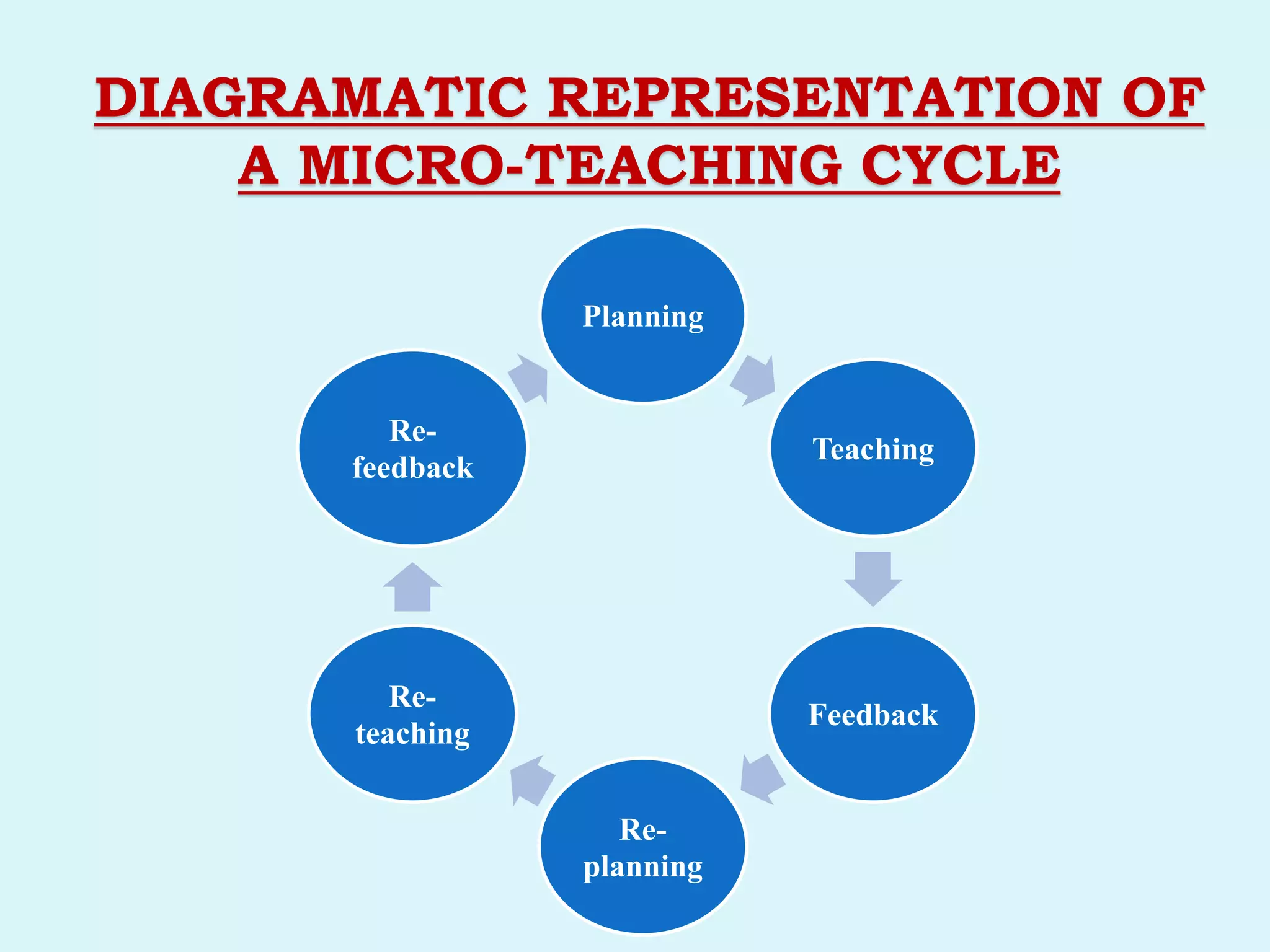
The micro-teaching cycle includes planning, teaching, feedback, re-planning, and re-teaching to enhance teaching effectiveness.
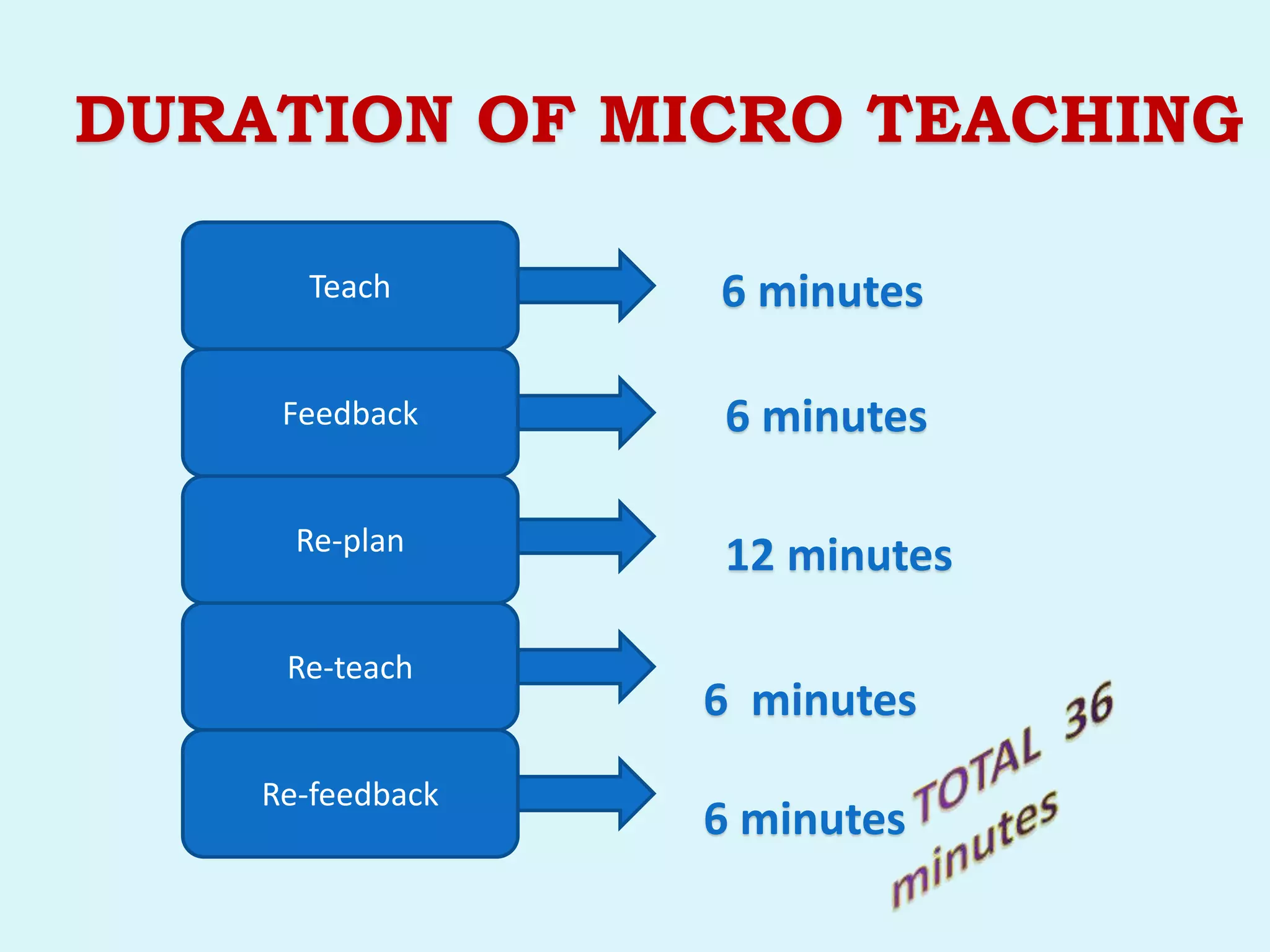
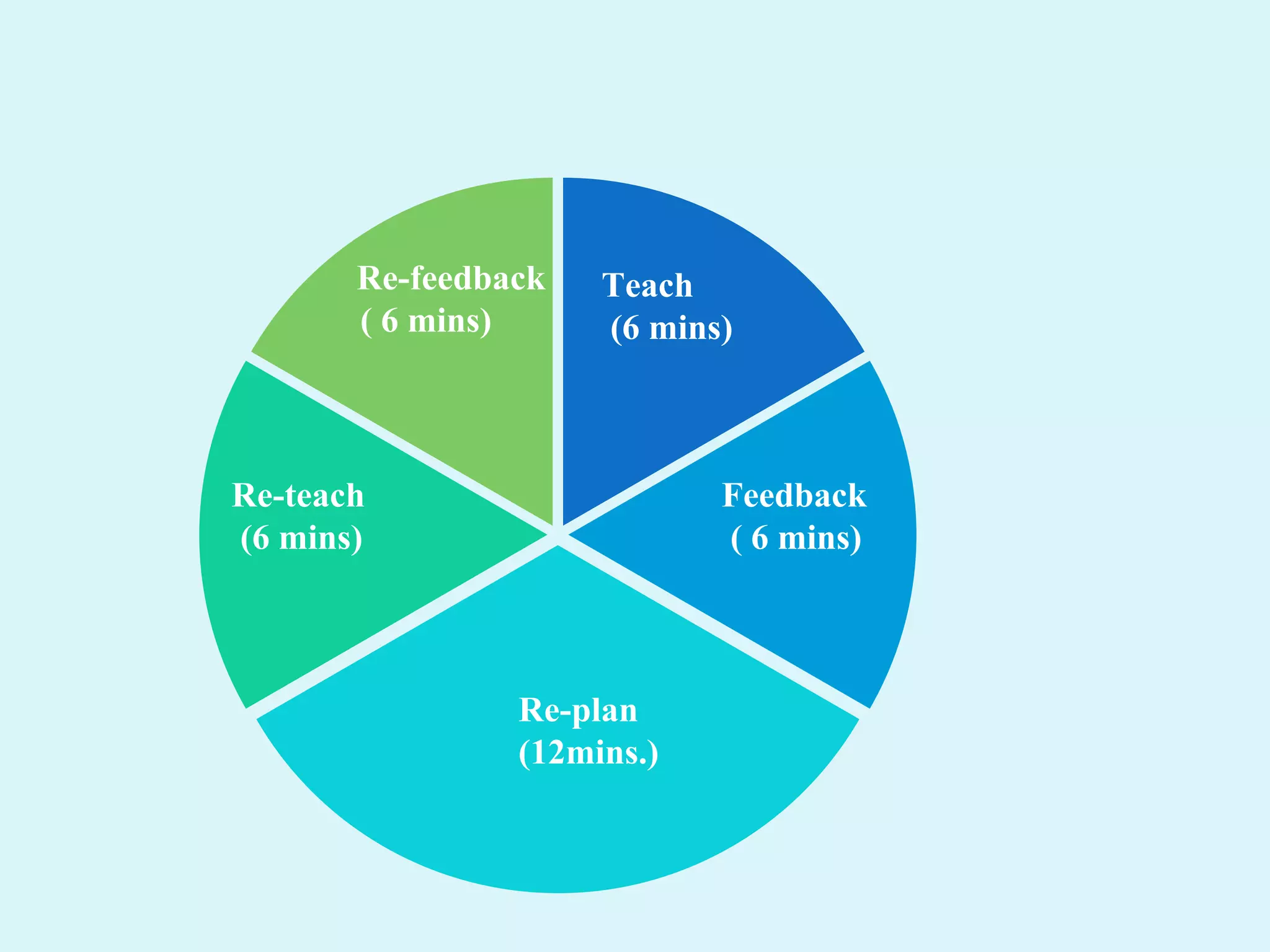
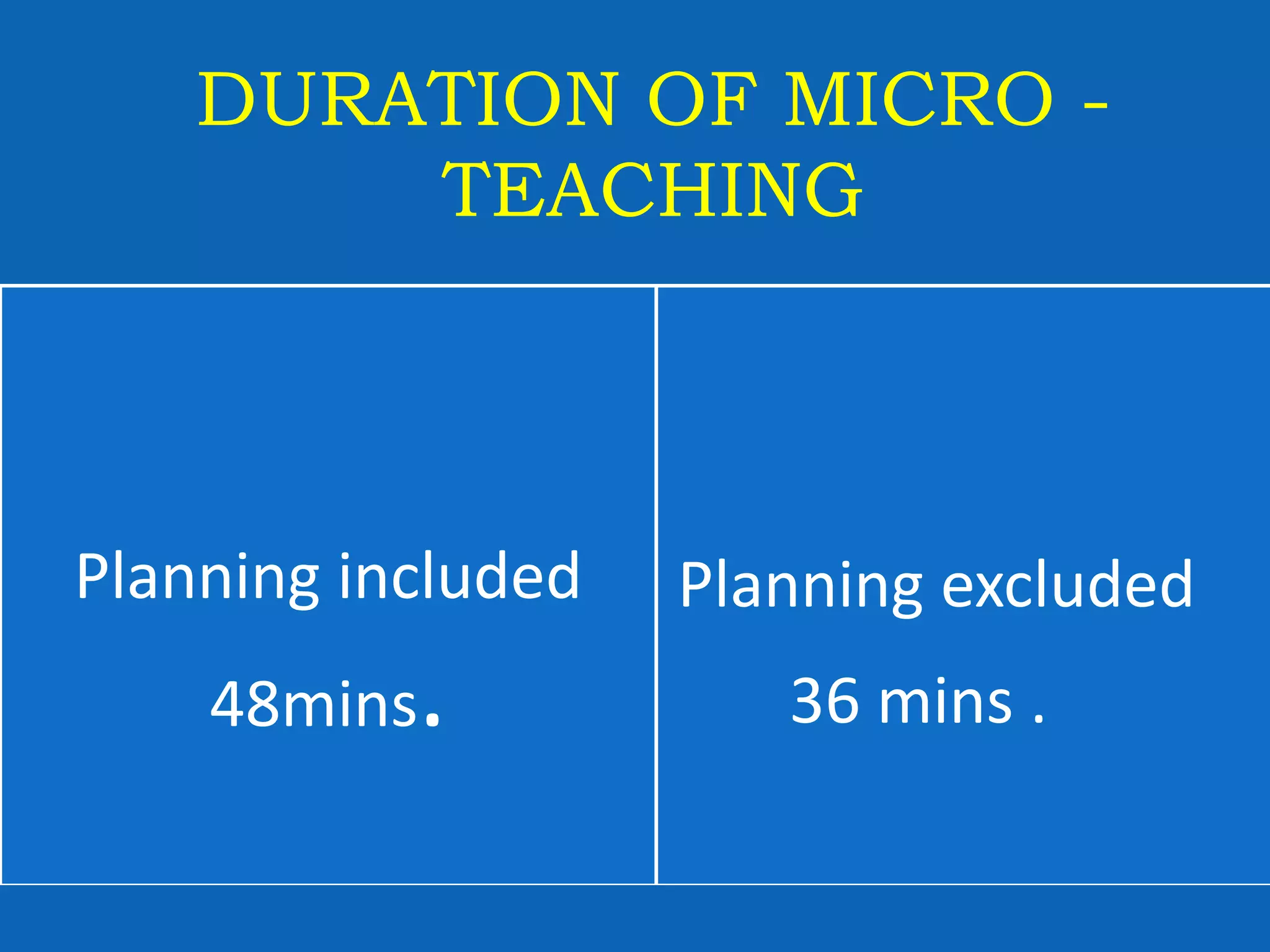
The structured duration includes various teaching segments, totaling 48 minutes with planning, 36 minutes excluding planning, and indicates detailed timing for each phase.
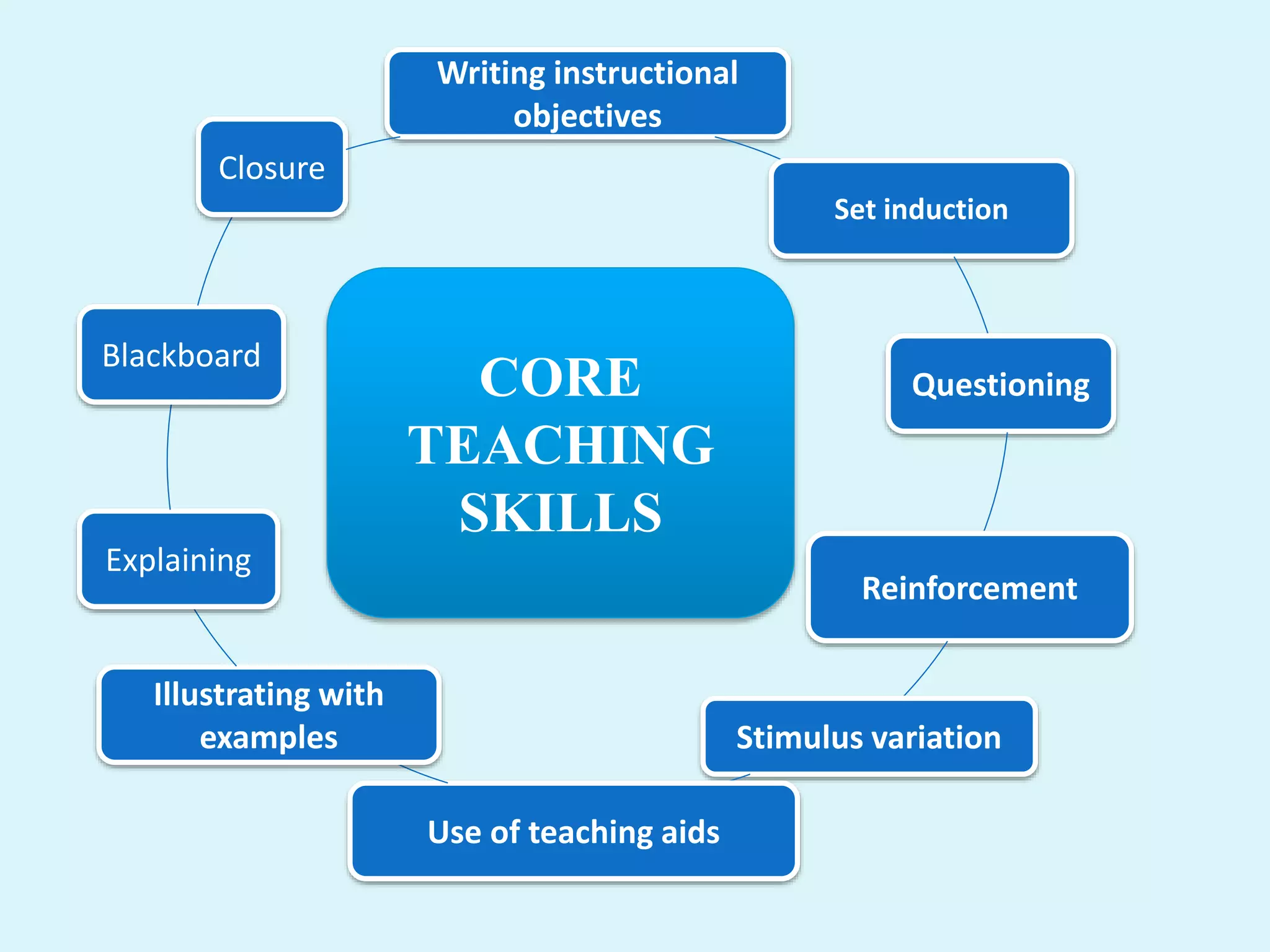
Essential teaching skills listed include stimulus variation, questioning techniques, and use of teaching aids, which are crucial for effective teaching methods.
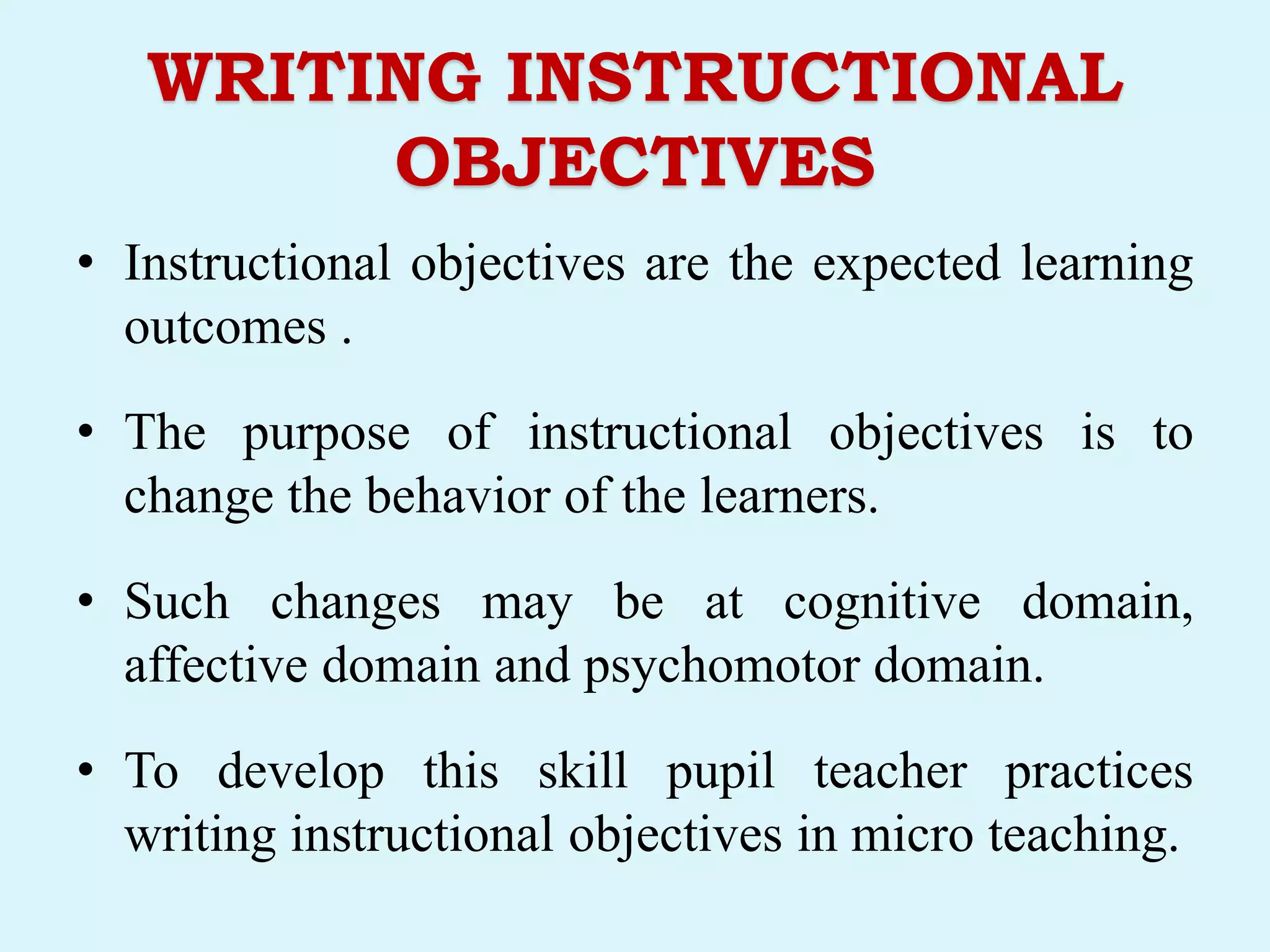
Instructional objectives focus on expected learning outcomes, aiming to change student behavior across cognitive, affective, and psychomotor domains.
Effective teaching introductions link new knowledge with prior knowledge, involving components like greeting and arousal of motivation to engage students.
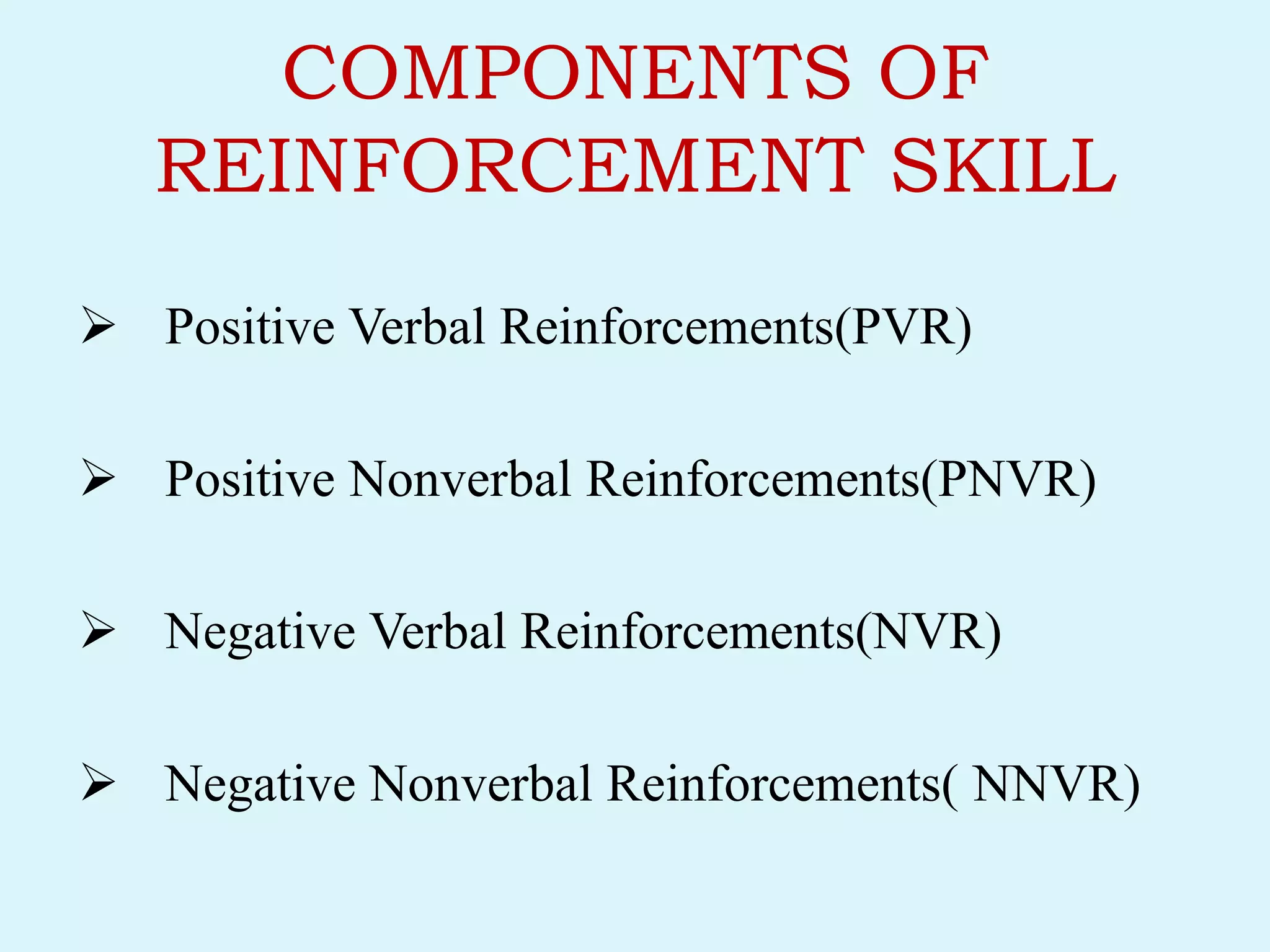
Reinforcement strategies, both positive and negative, strengthen desired behaviors in students during the learning process.
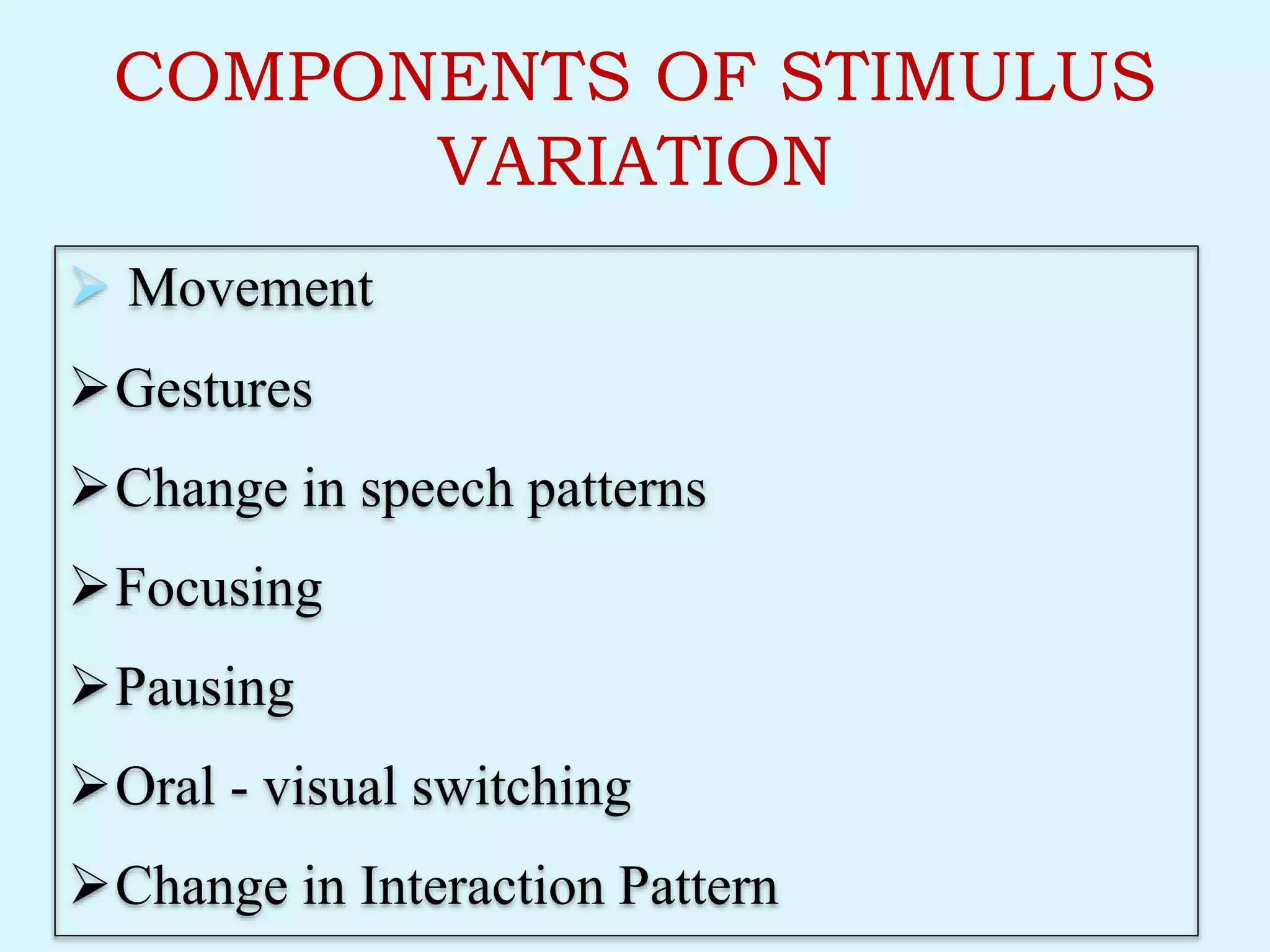
Variety in teaching stimuli, including gestures and changes in speech, is essential for maintaining student interest and attention.
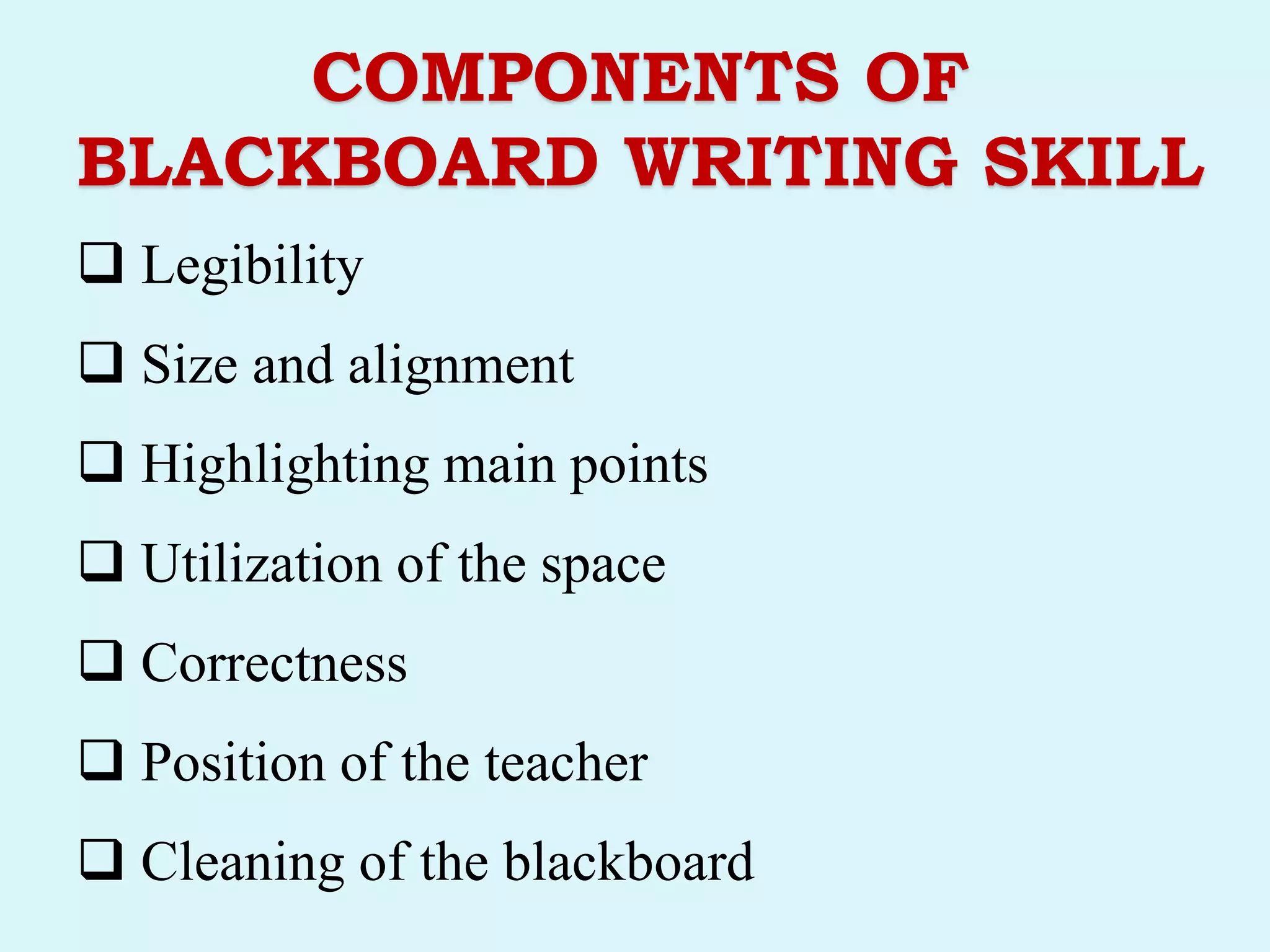
Blackboard writing is an accessible teaching aid, with components such as legibility and correct utilization of space crucial for effective communication.
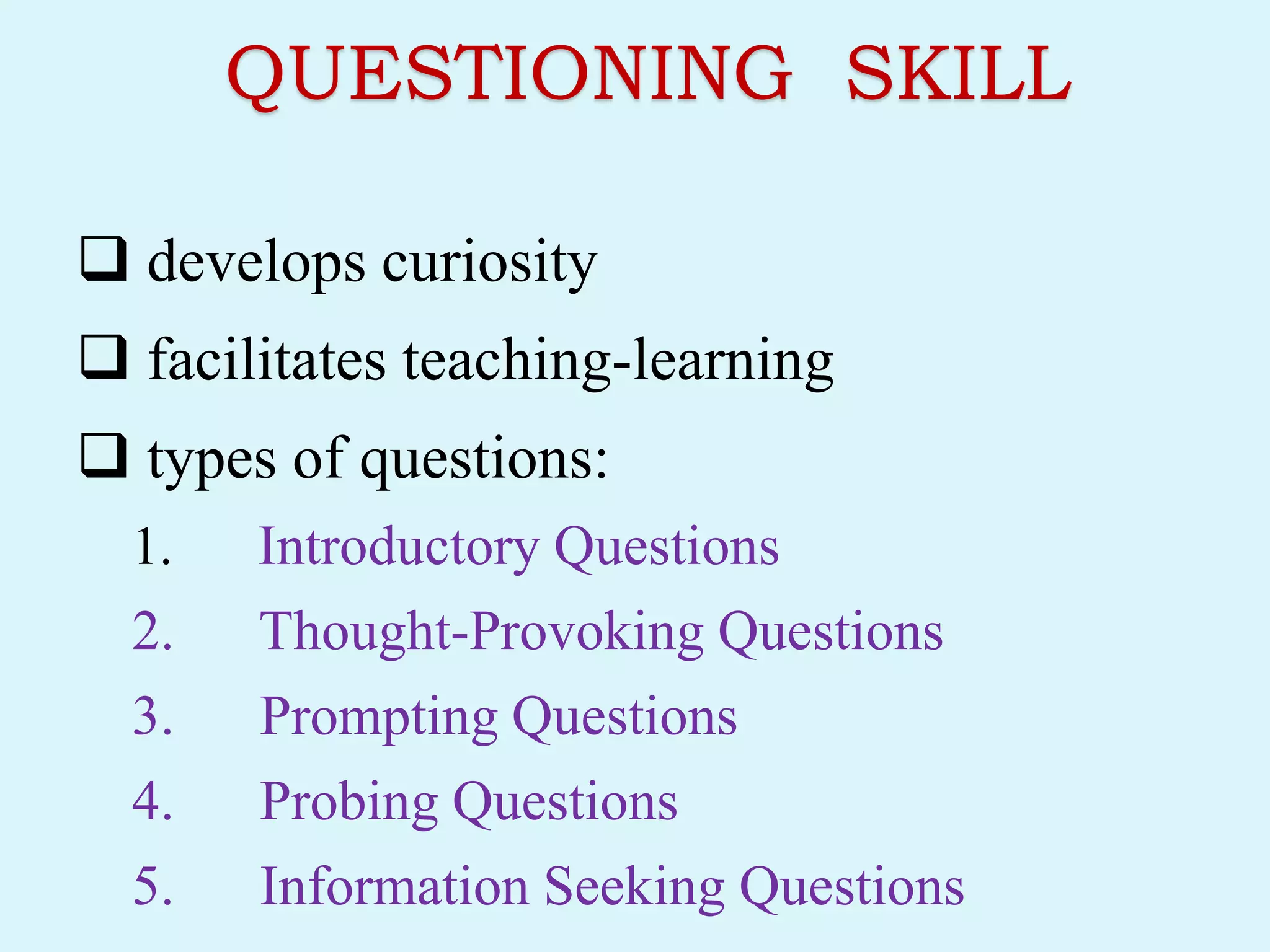
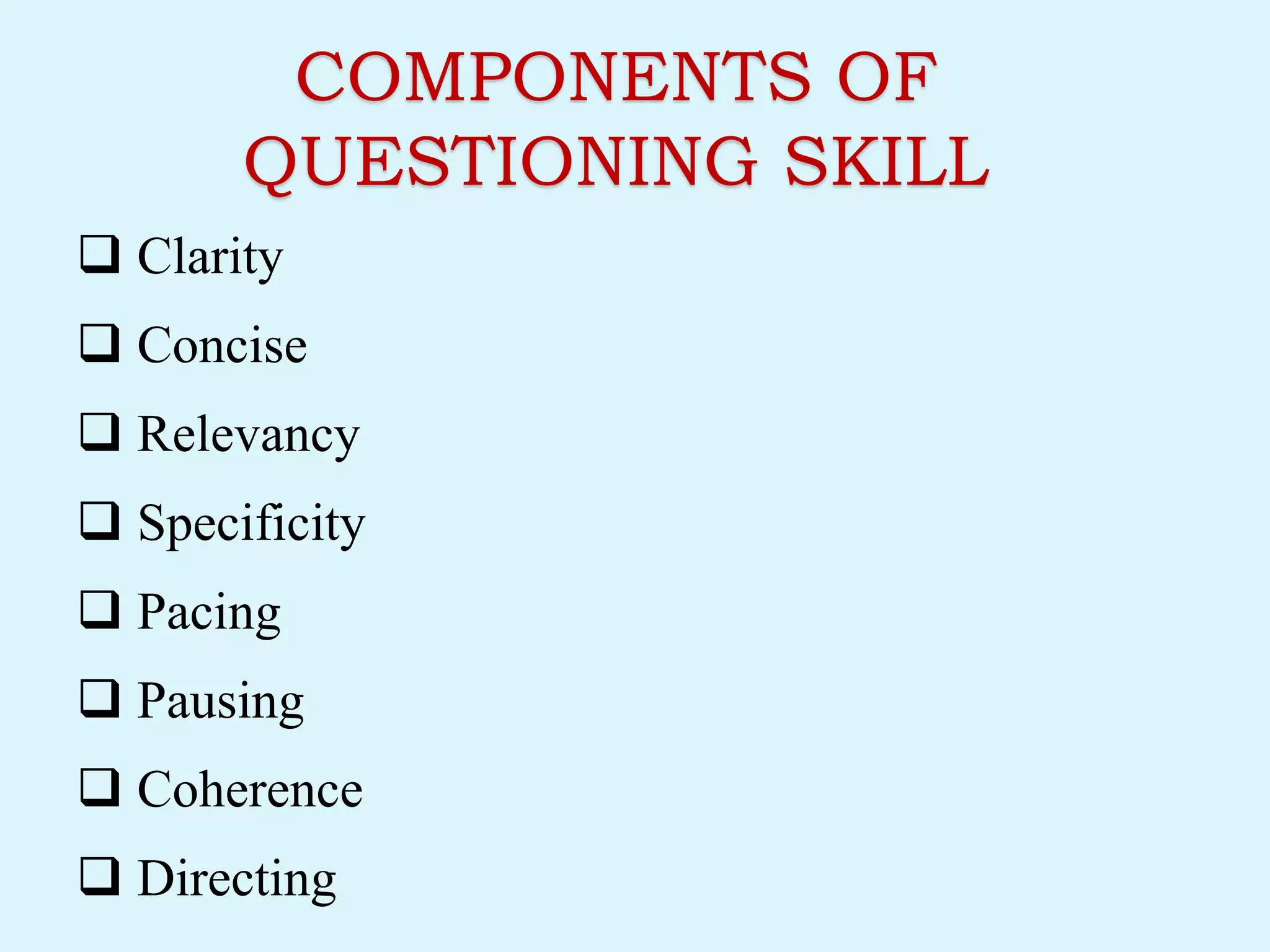
Developing effective questioning techniques is vital for fostering curiosity and facilitating the teaching-learning process.
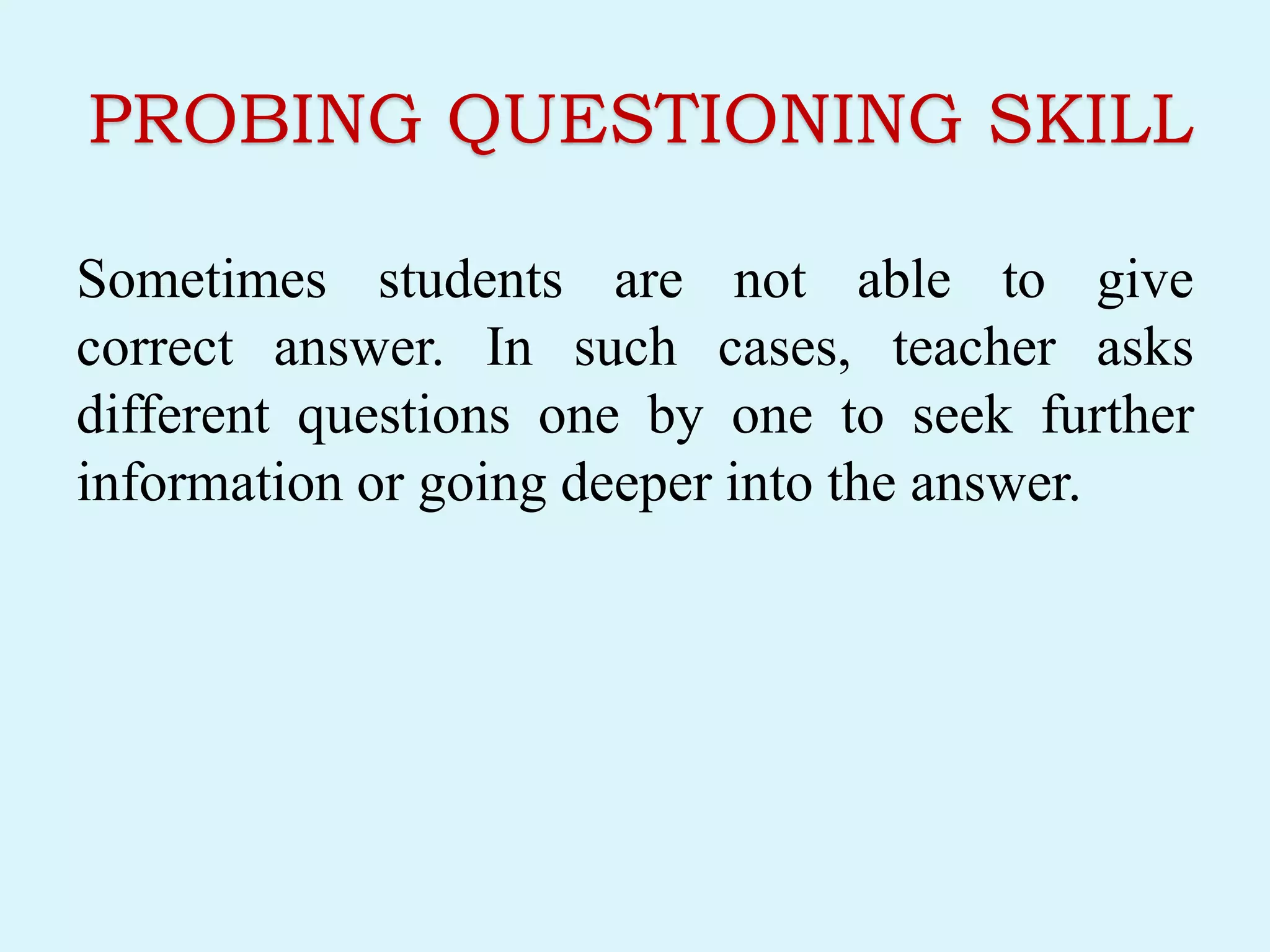
Probing questioning helps teachers guide students to deeper responses and enhance their critical thinking skills.
The importance of ICT in using audio-visual aids for diverse learning styles, necessitating teacher training for effective application.
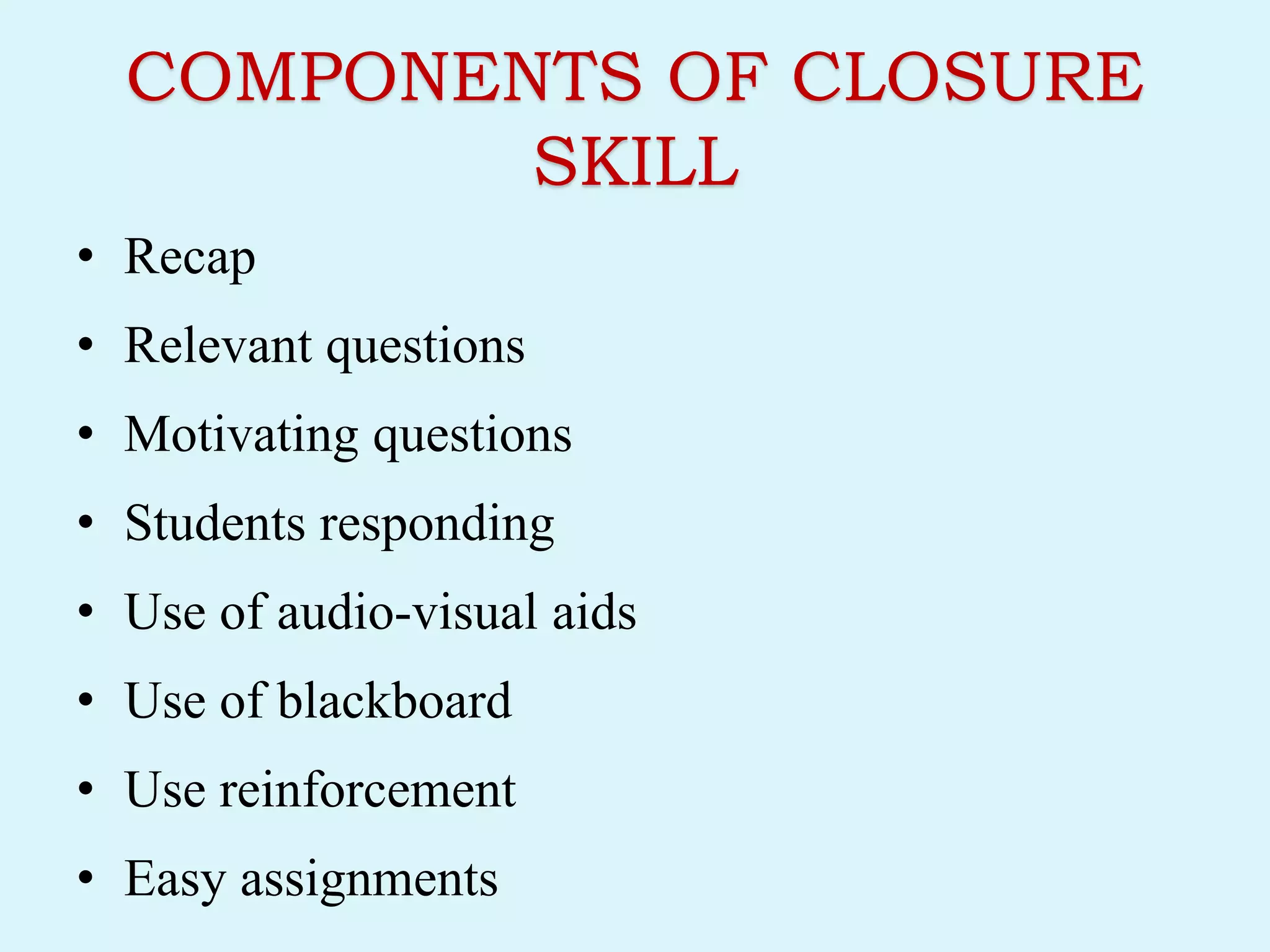
Closure summarizes lessons and aids retention through techniques such as questions and visual aids, vital for reinforcing learning.
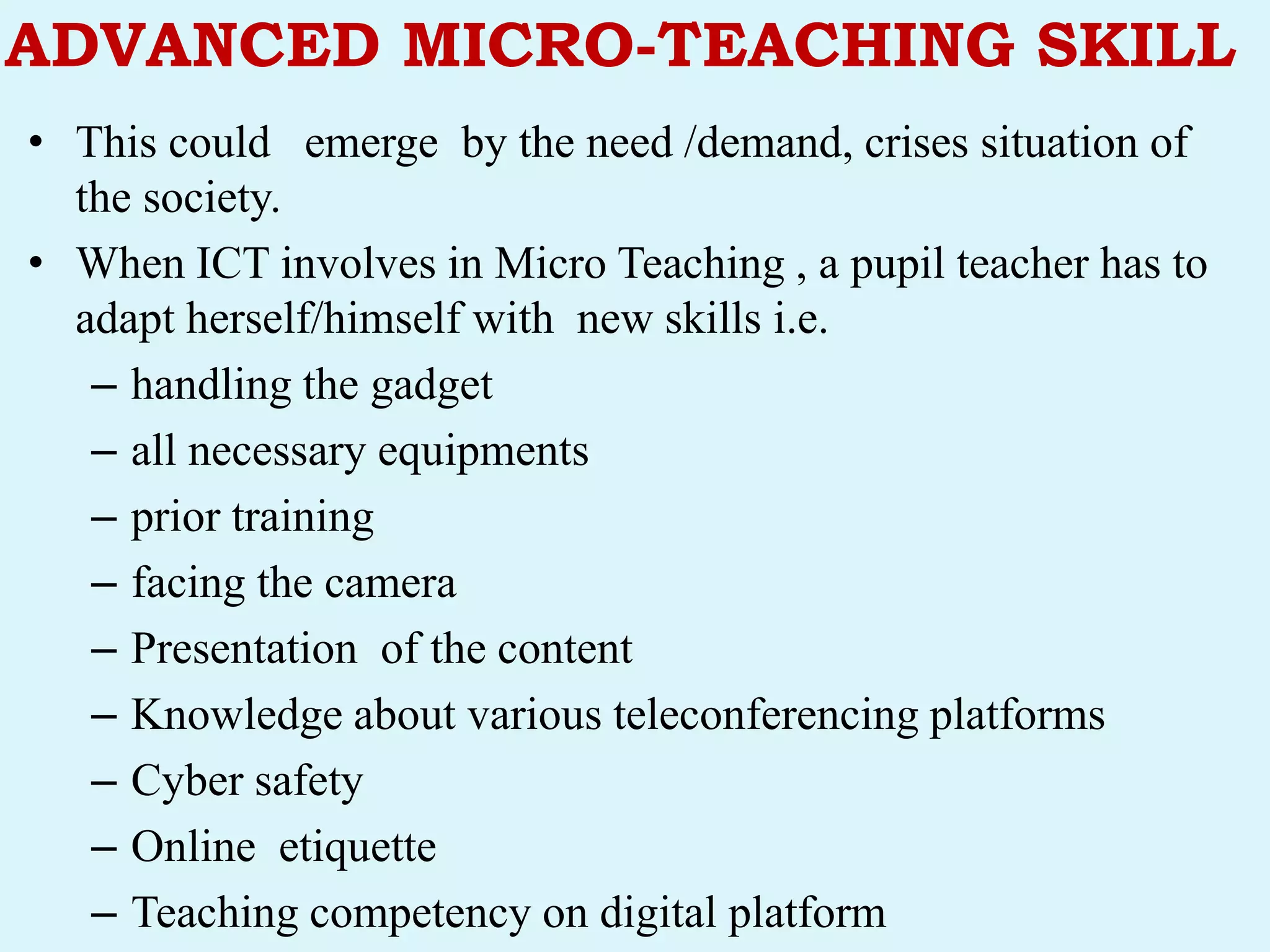
Emerging needs in micro-teaching with ICT require new skills like handling technology and understanding cyber safety, enhancing teaching competency.
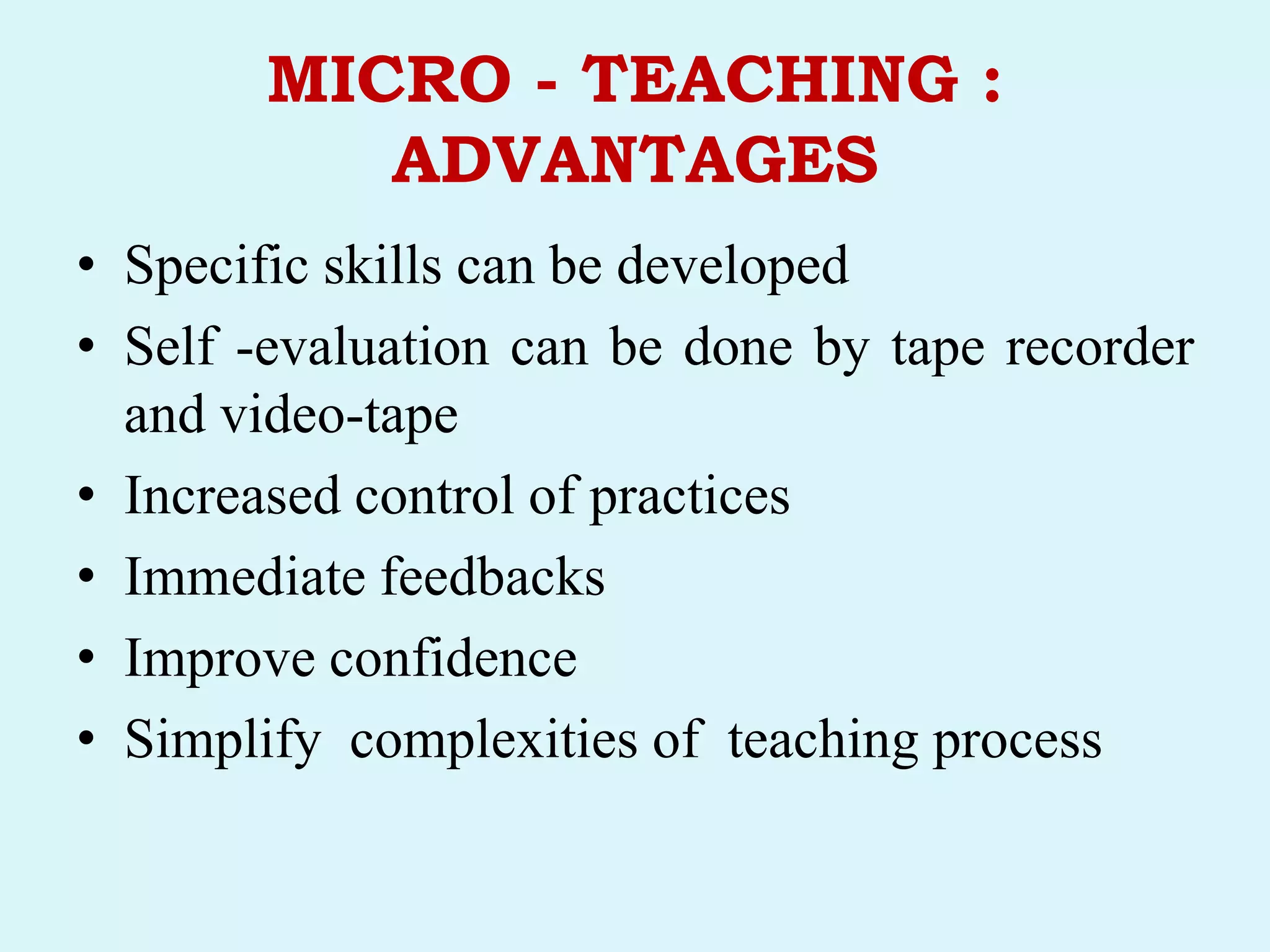
Micro-teaching allows specific skill development and self-evaluation with immediate feedback but has limitations like time requirements and potential costs.
CONCEPT OF MICROTEACHING
सूक्ष्म शिक्षण
It is a highly individualized training, permitting
the imposition of a high degree of control in
practicing a particular skill.
सूक्ष्म शिक्षण एक वैयक्तिक प्रशिक्षण िकनीकी
है,क्िसमें एक समय में , एक ही व्यक्ति को अत्यंि
ननयंत्रिि परिक्थियों में ककसी एक कौिल का अभ्यास
किने का अवसि शमलिा है |
3.
MICRO –TEACHING
Itscales down the complexities of real teaching
with the provision of:
Practicing one skill at a time (Specific teaching skill)
Reducing the class size (5 to 10)
Reducing the duration of the lesson (6 minutes)
Limiting to a single concept
Prospective teachers can develop teaching skills before
they are involved in the real classroom.
4.
ORIGIN OF MICRO-TEACHING
Microteaching originated in 1961 at Stanford
University (USA).
Allen and his colleagues from Stanford University
developed a training programme aimed to
improve verbal and non verbal teachers' speech
and performance.
The term MICRO-TEACHING was coined in
1963.
5.
VIDEO TAPE
• Micro-teachinginvolves technology in the
form of video and audio tapes.
• Voice recording provides an opportunity to the
prospective teachers to evaluate themselves
and improve their competencies.
6.
MICRO-TEACHING IN INDIA
•D. D. Tiwari was the first to take up this work in
1967 at the Government Central Pedagogical
Institute at Allahabad.
• The micro-teaching was conducted in different parts
of the nation.
• It was found that it is a good practice technique for
prospective teachers.
• The first book on micro-teaching in India was
written by N. L. Dosajh under the caption ‘
Modification of Teacher Behaviour through Micro-
teaching(1977)'.
Knowledge acquisition
phase
(Pre-active phase)
Skillacquisition phase
(Inter-active phase)
Transfer phase
(Post-active phase)
Observe demonstration skill,
analyze, discussion
Prepare micro lesson
plan,practice skill,evaluate
performance
Transfer of skill to actual
teaching situation
9.
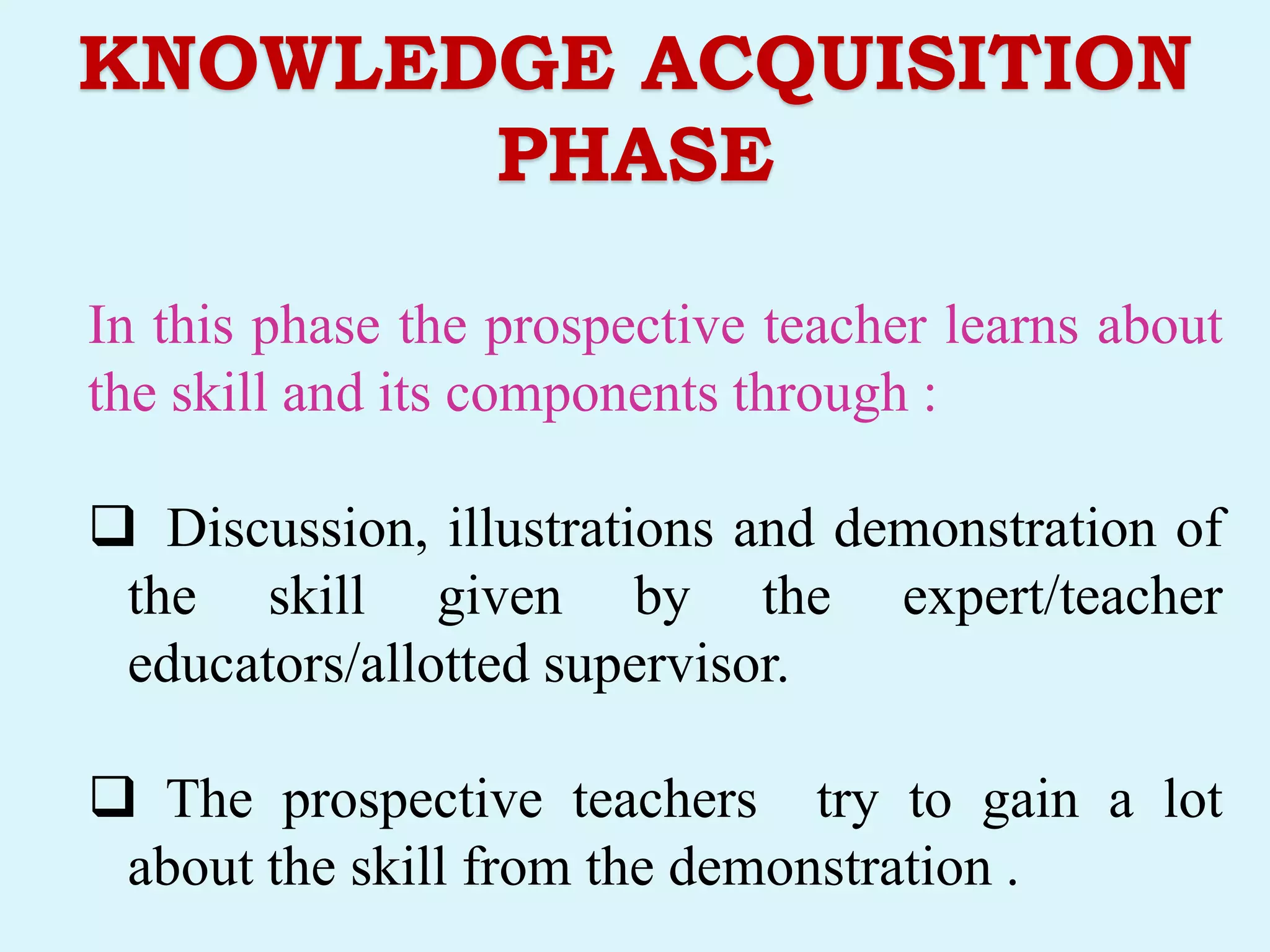
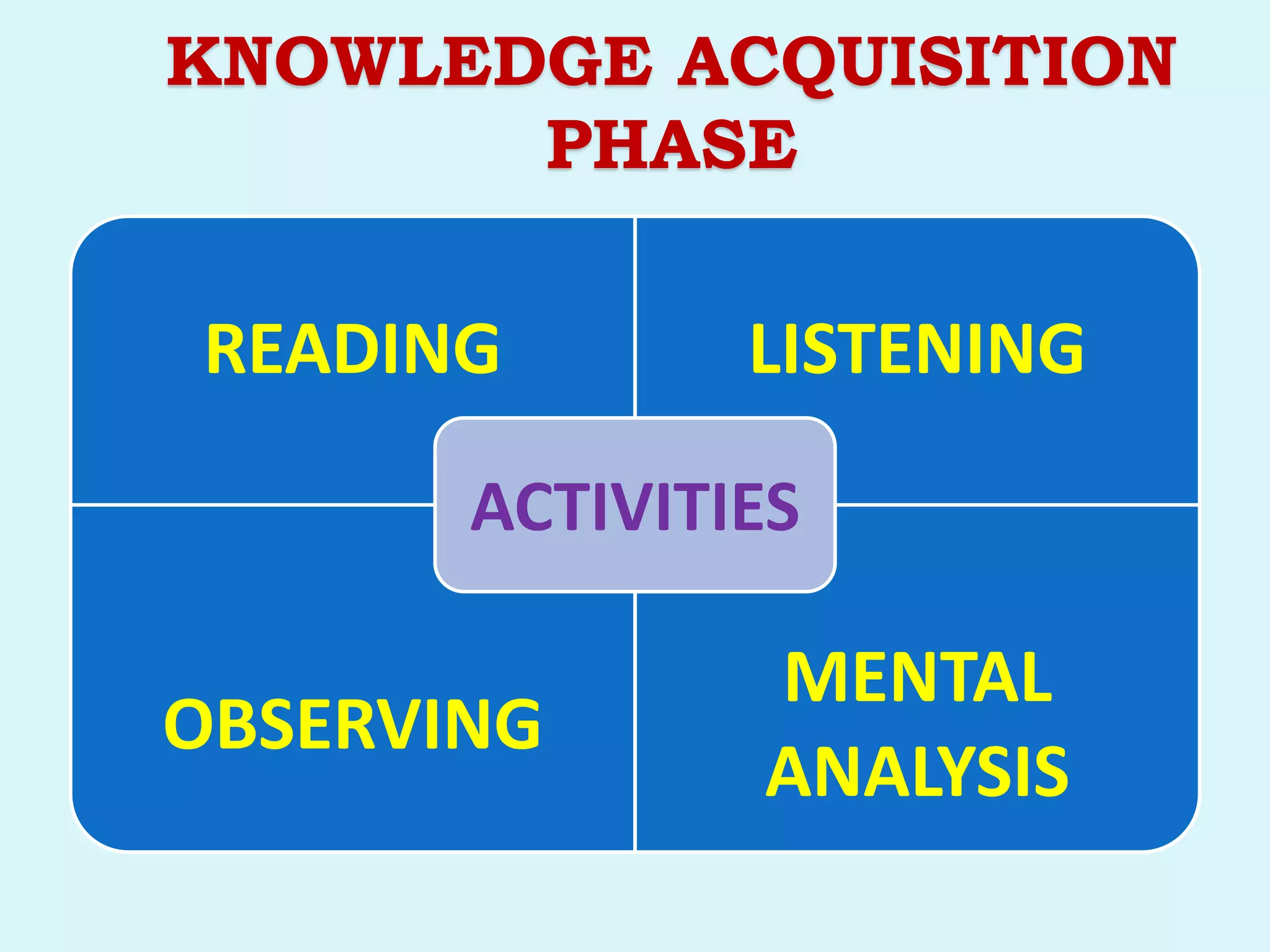
KNOWLEDGE ACQUISITION
PHASE
In thisphase the prospective teacher learns about
the skill and its components through :
Discussion, illustrations and demonstration of
the skill given by the expert/teacher
educators/allotted supervisor.
The prospective teachers try to gain a lot
about the skill from the demonstration .
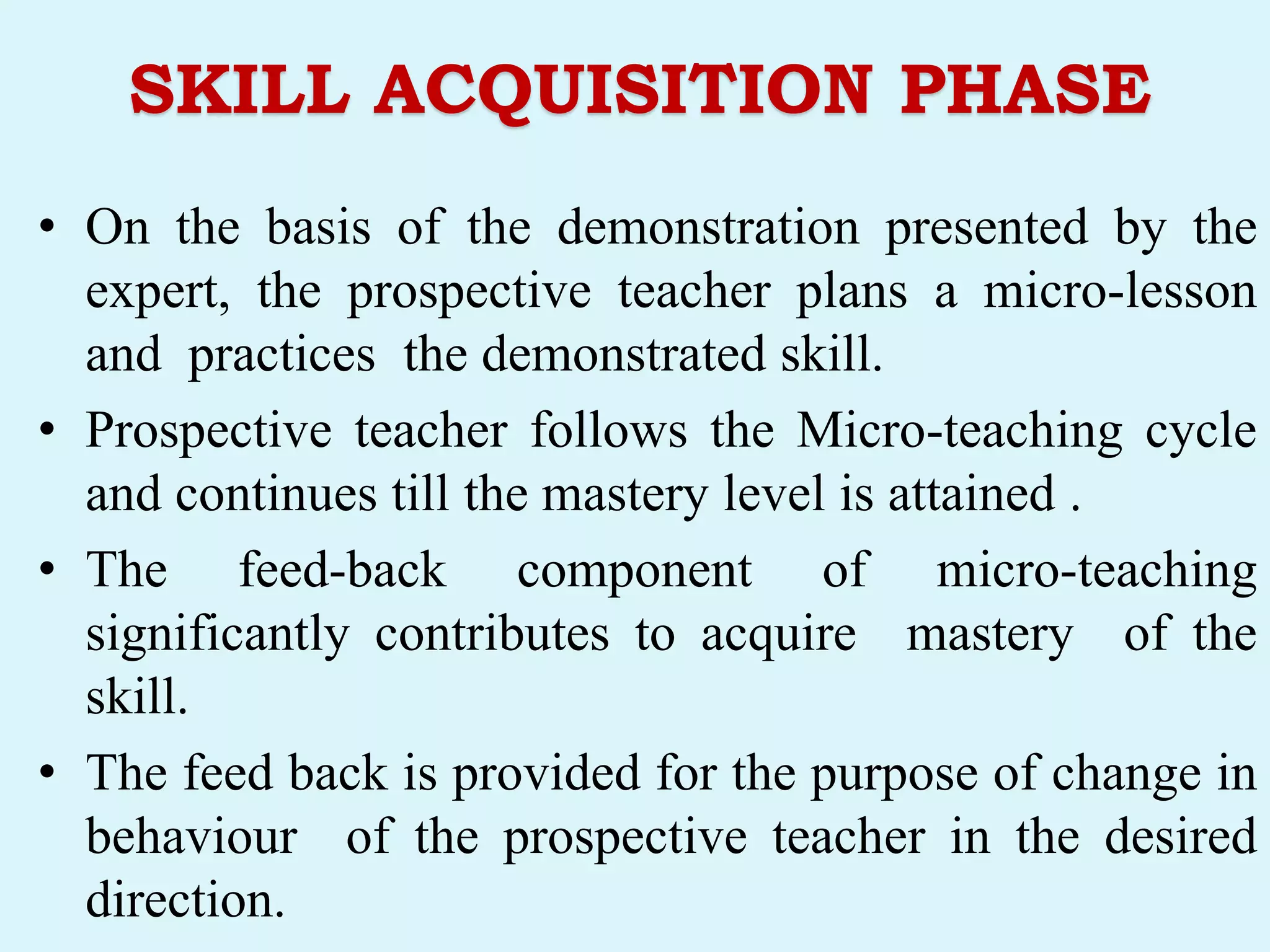
SKILL ACQUISITION PHASE
•On the basis of the demonstration presented by the
expert, the prospective teacher plans a micro-lesson
and practices the demonstrated skill.
• Prospective teacher follows the Micro-teaching cycle
and continues till the mastery level is attained .
• The feed-back component of micro-teaching
significantly contributes to acquire mastery of the
skill.
• The feed back is provided for the purpose of change in
behaviour of the prospective teacher in the desired
direction.
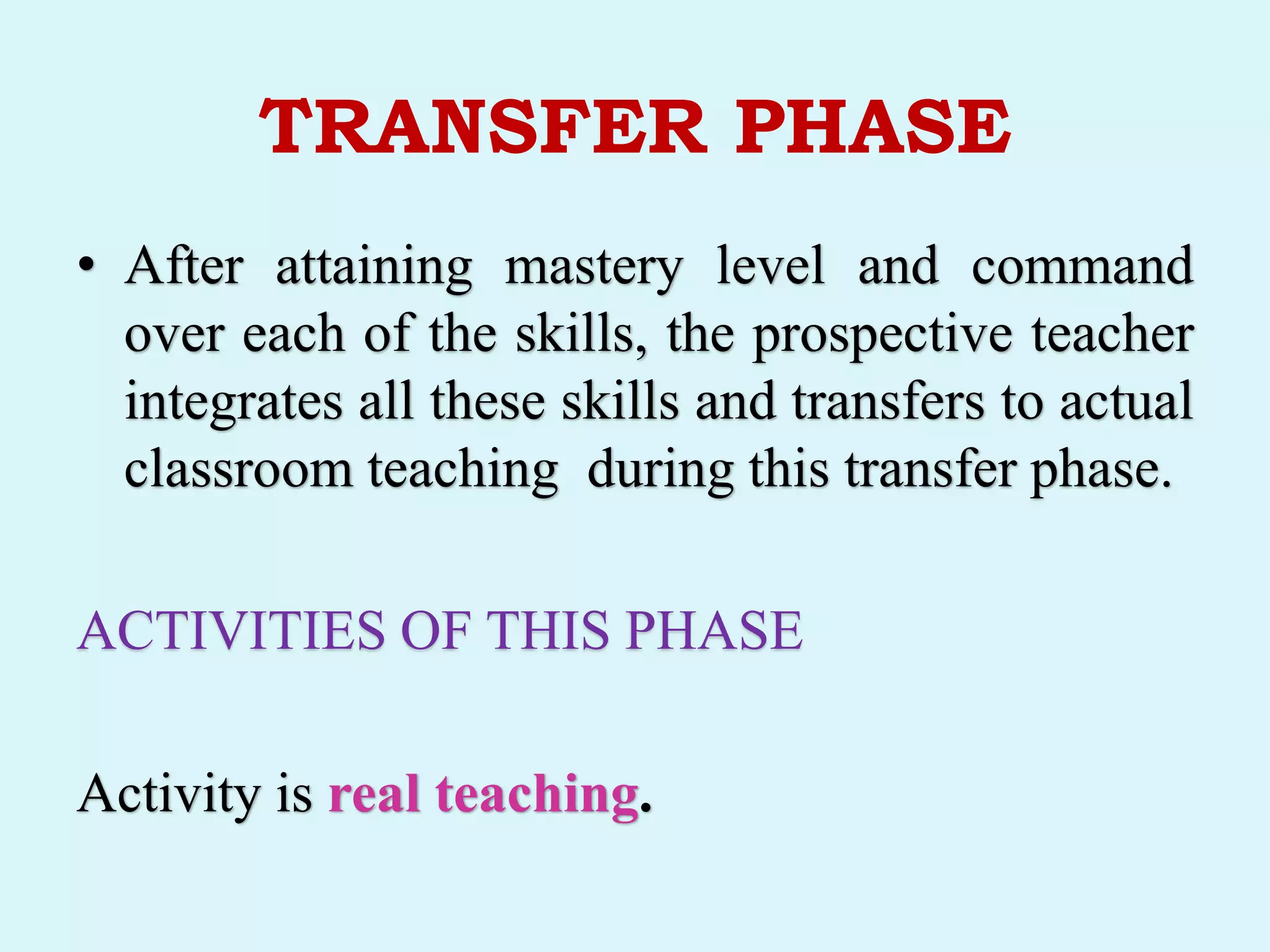
TRANSFER PHASE
• Afterattaining mastery level and command
over each of the skills, the prospective teacher
integrates all these skills and transfers to actual
classroom teaching during this transfer phase.
ACTIVITIES OF THIS PHASE
Activity is real teaching.
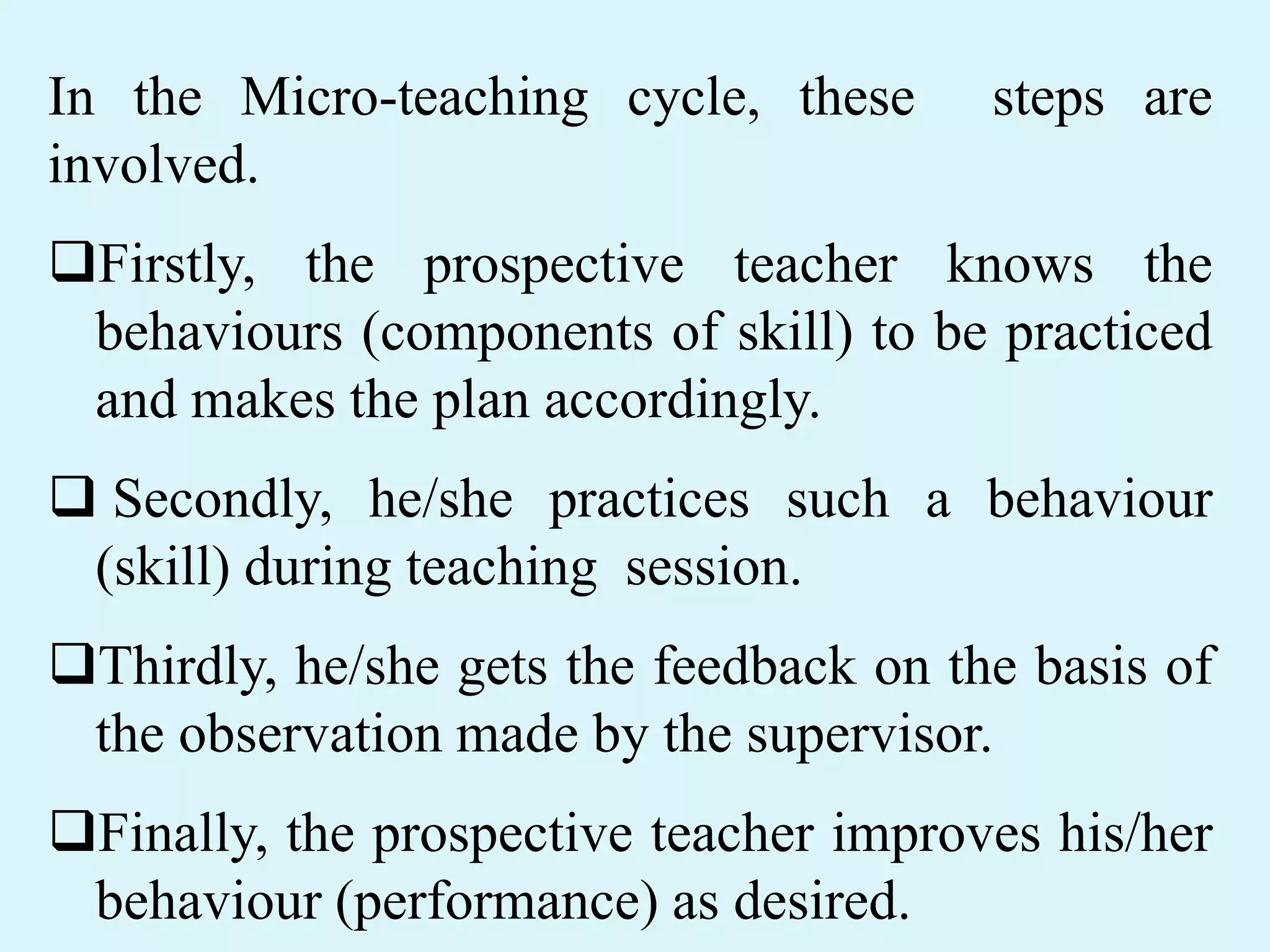
In the Micro-teachingcycle, these steps are
involved.
Firstly, the prospective teacher knows the
behaviours (components of skill) to be practiced
and makes the plan accordingly.
Secondly, he/she practices such a behaviour
(skill) during teaching session.
Thirdly, he/she gets the feedback on the basis of
the observation made by the supervisor.
Finally, the prospective teacher improves his/her
behaviour (performance) as desired.
DURATION OF MICRO-
TEACHING
Planning included
48mins.
Planning excluded
36 mins .
21.
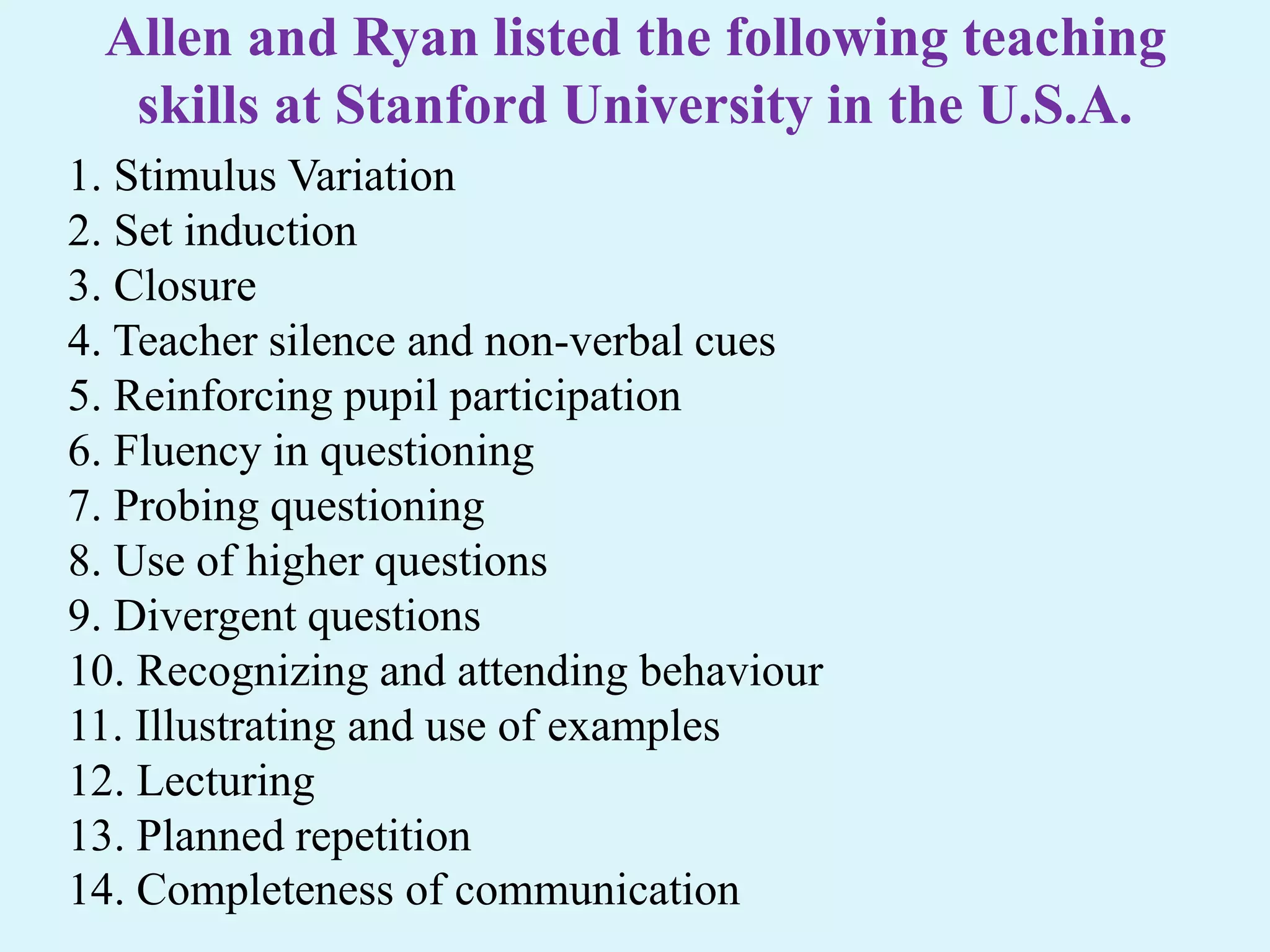
Allen and Ryanlisted the following teaching
skills at Stanford University in the U.S.A.
1. Stimulus Variation
2. Set induction
3. Closure
4. Teacher silence and non-verbal cues
5. Reinforcing pupil participation
6. Fluency in questioning
7. Probing questioning
8. Use of higher questions
9. Divergent questions
10. Recognizing and attending behaviour
11. Illustrating and use of examples
12. Lecturing
13. Planned repetition
14. Completeness of communication
WRITING INSTRUCTIONAL
OBJECTIVES
• Instructionalobjectives are the expected learning
outcomes .
• The purpose of instructional objectives is to
change the behavior of the learners.
• Such changes may be at cognitive domain,
affective domain and psychomotor domain.
• To develop this skill pupil teacher practices
writing instructional objectives in micro teaching.
24.
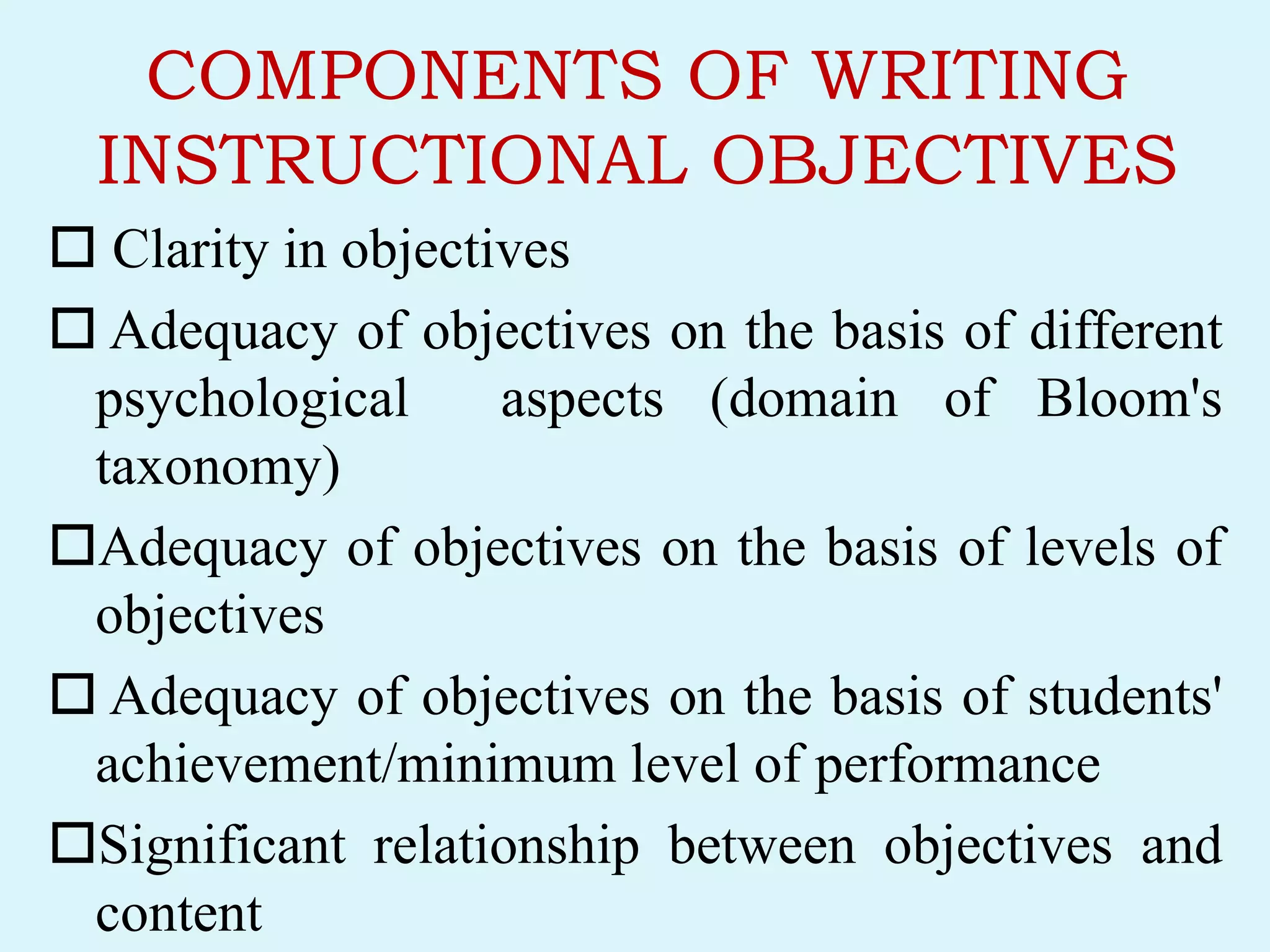
COMPONENTS OF WRITING
INSTRUCTIONALOBJECTIVES
Clarity in objectives
Adequacy of objectives on the basis of different
psychological aspects (domain of Bloom's
taxonomy)
Adequacy of objectives on the basis of levels of
objectives
Adequacy of objectives on the basis of students'
achievement/minimum level of performance
Significant relationship between objectives and
content
25.
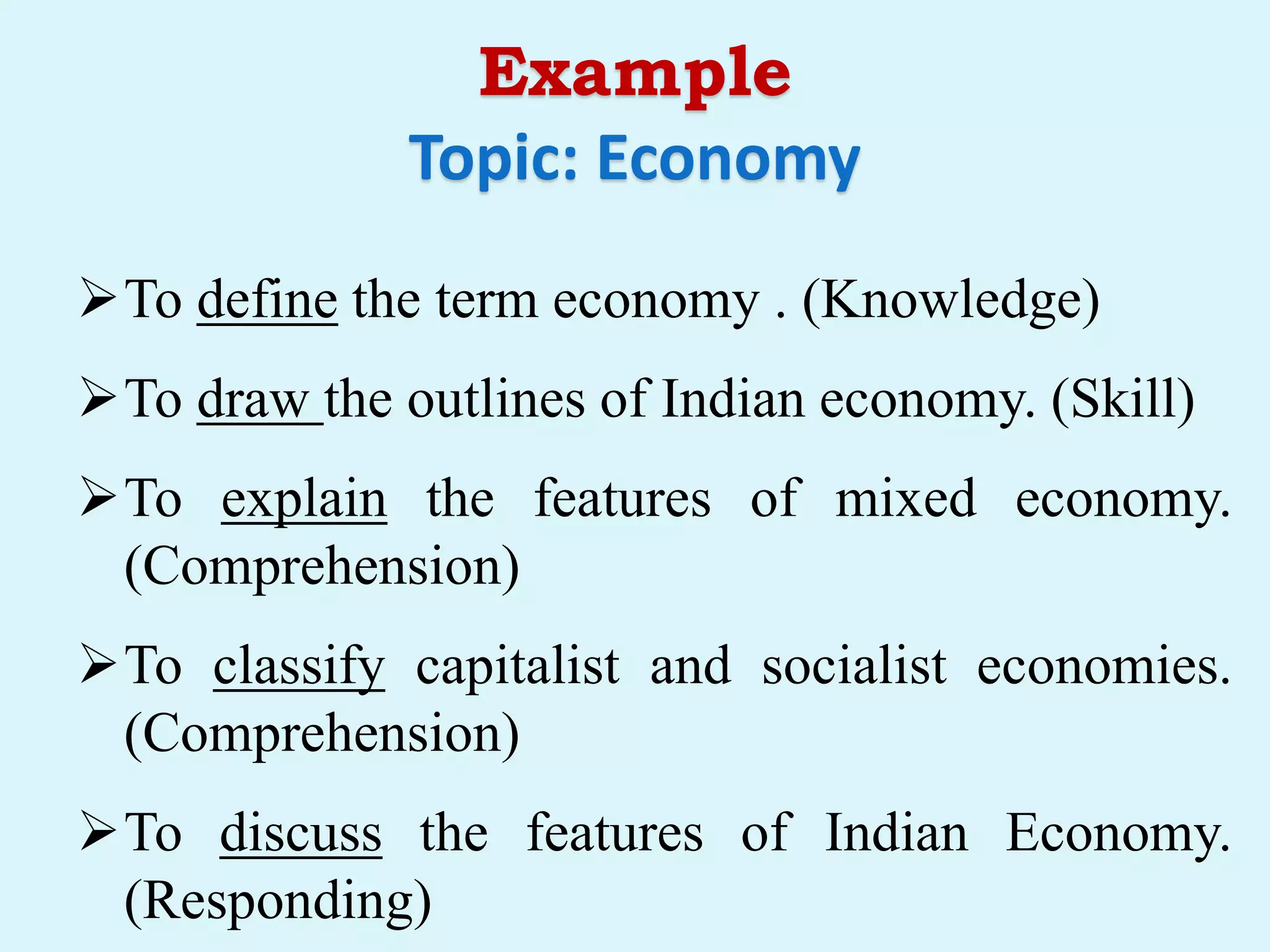
Example
Topic: Economy
To definethe term economy . (Knowledge)
To draw the outlines of Indian economy. (Skill)
To explain the features of mixed economy.
(Comprehension)
To classify capitalist and socialist economies.
(Comprehension)
To discuss the features of Indian Economy.
(Responding)
26.
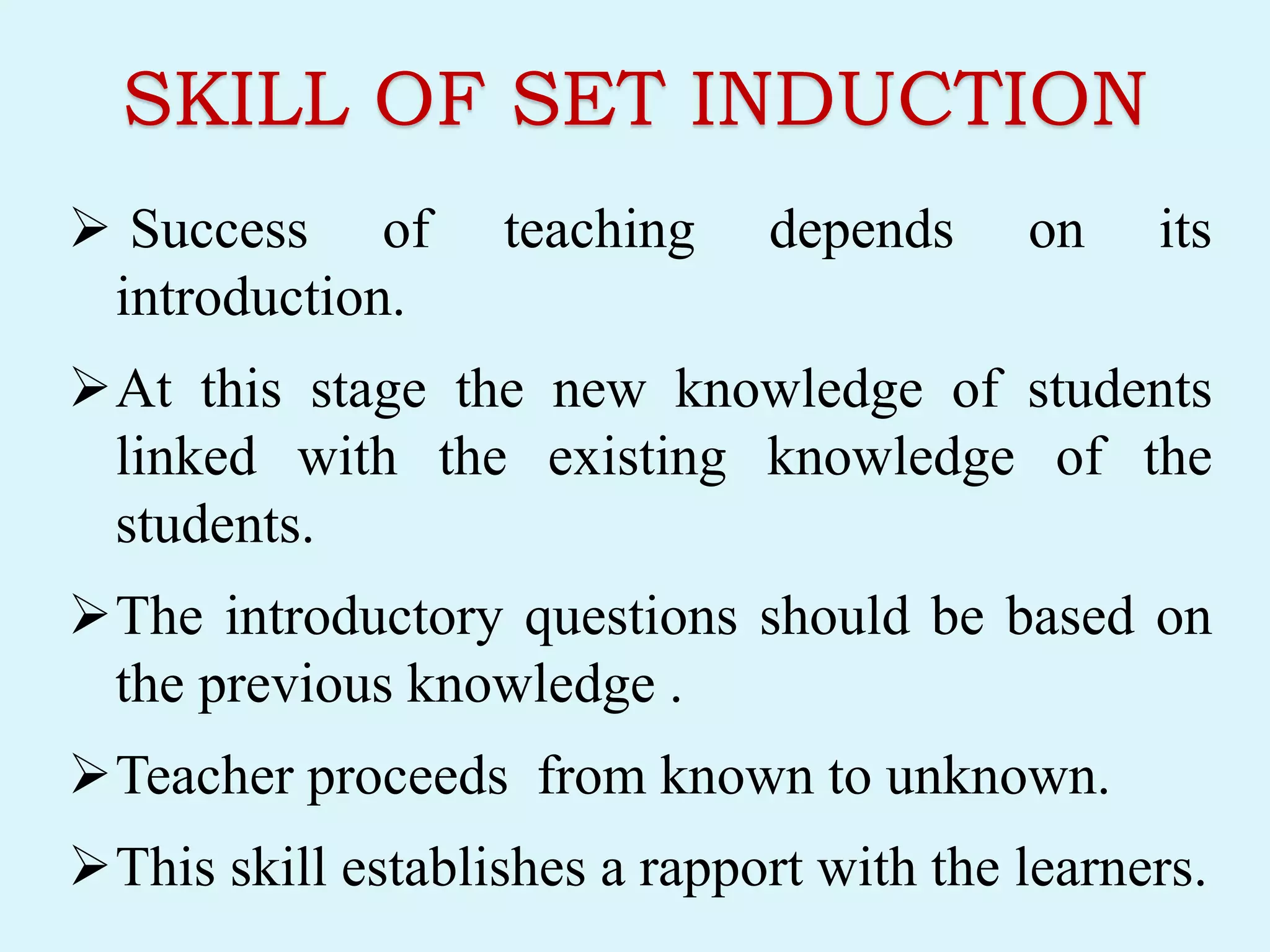
SKILL OF SETINDUCTION
Success of teaching depends on its
introduction.
At this stage the new knowledge of students
linked with the existing knowledge of the
students.
The introductory questions should be based on
the previous knowledge .
Teacher proceeds from known to unknown.
This skill establishes a rapport with the learners.
27.
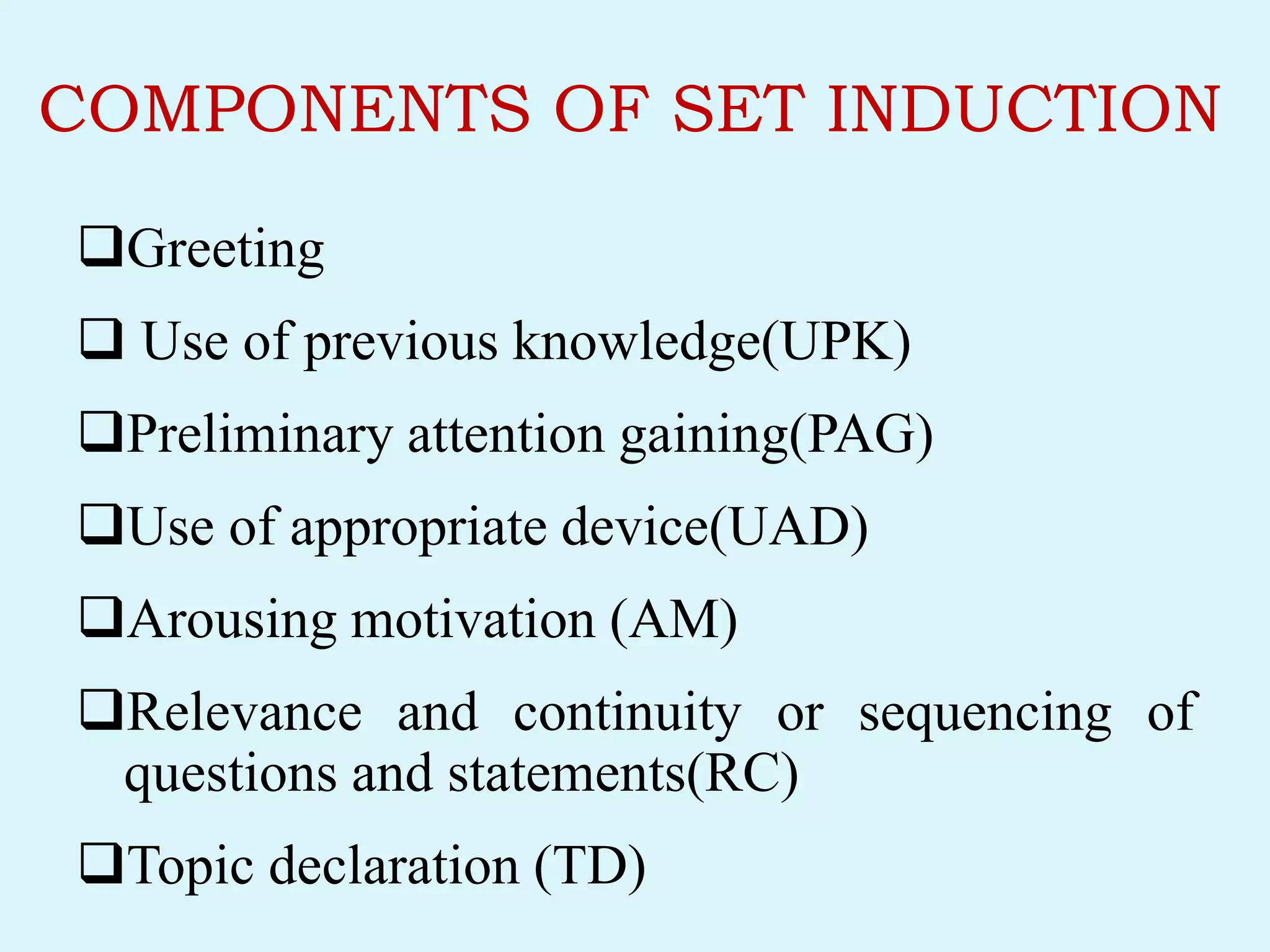
COMPONENTS OF SETINDUCTION
Greeting
Use of previous knowledge(UPK)
Preliminary attention gaining(PAG)
Use of appropriate device(UAD)
Arousing motivation (AM)
Relevance and continuity or sequencing of
questions and statements(RC)
Topic declaration (TD)
28.
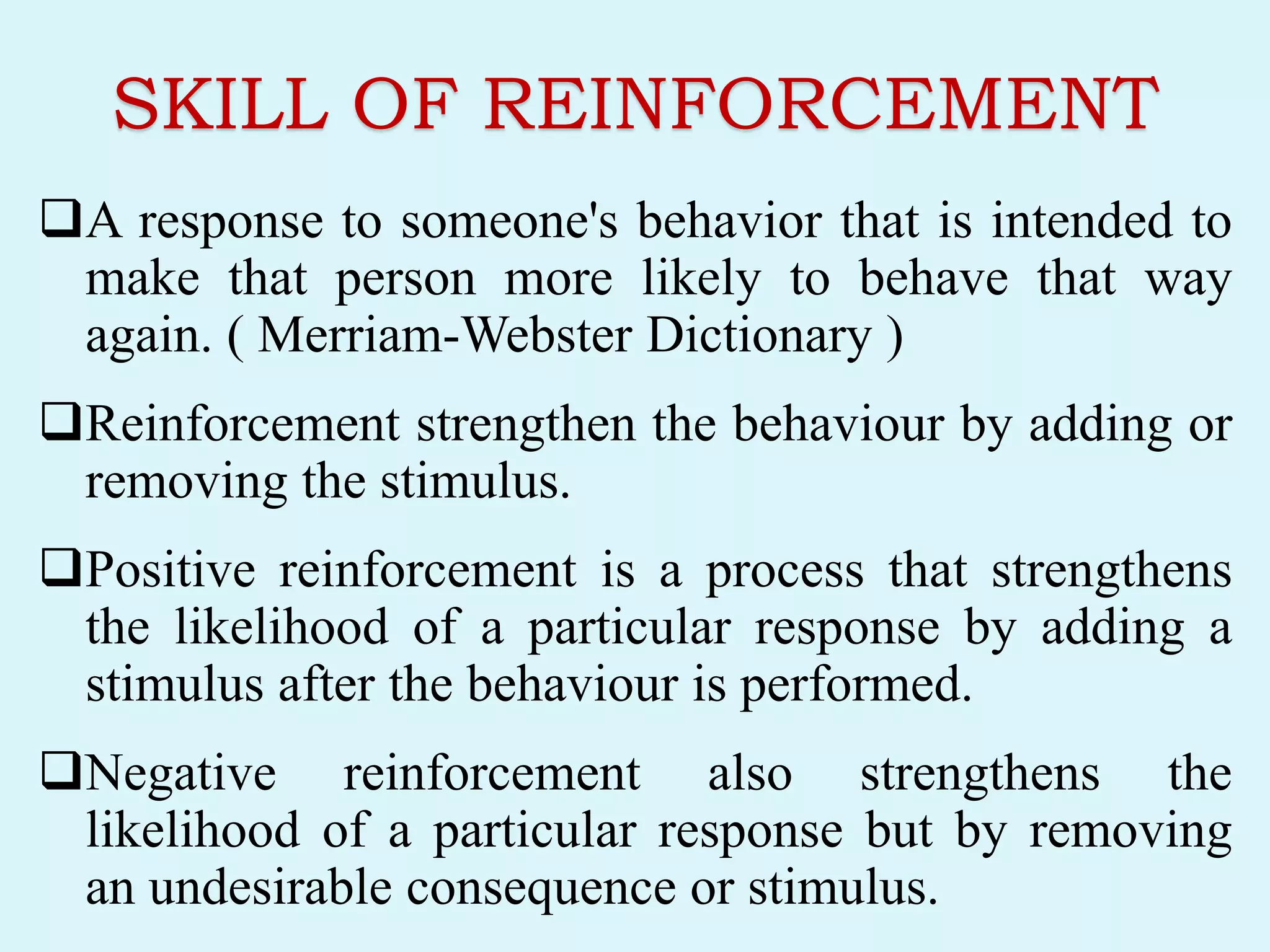
SKILL OF REINFORCEMENT
Aresponse to someone's behavior that is intended to
make that person more likely to behave that way
again. ( Merriam-Webster Dictionary )
Reinforcement strengthen the behaviour by adding or
removing the stimulus.
Positive reinforcement is a process that strengthens
the likelihood of a particular response by adding a
stimulus after the behaviour is performed.
Negative reinforcement also strengthens the
likelihood of a particular response but by removing
an undesirable consequence or stimulus.
SKILL OF STIMULUSVARIATION
Continuous use of a particular stimulus for a
long period reduces the attention .
Variation in stimulus makes class more lively.
31.
COMPONENTS OF STIMULUS
VARIATION
Movement
Gestures
Change in speech patterns
Focusing
Pausing
Oral - visual switching
Change in Interaction Pattern
32.
BLACKBOARD WRITING SKILL
easilyavailable teaching aid
note down the important points
difficult content can be clarified
diagrams and calculations can be easily shown
33.
COMPONENTS OF
BLACKBOARD WRITINGSKILL
Legibility
Size and alignment
Highlighting main points
Utilization of the space
Correctness
Position of the teacher
Cleaning of the blackboard
PROBING QUESTIONING SKILL
Sometimesstudents are not able to give
correct answer. In such cases, teacher asks
different questions one by one to seek further
information or going deeper into the answer.
37.
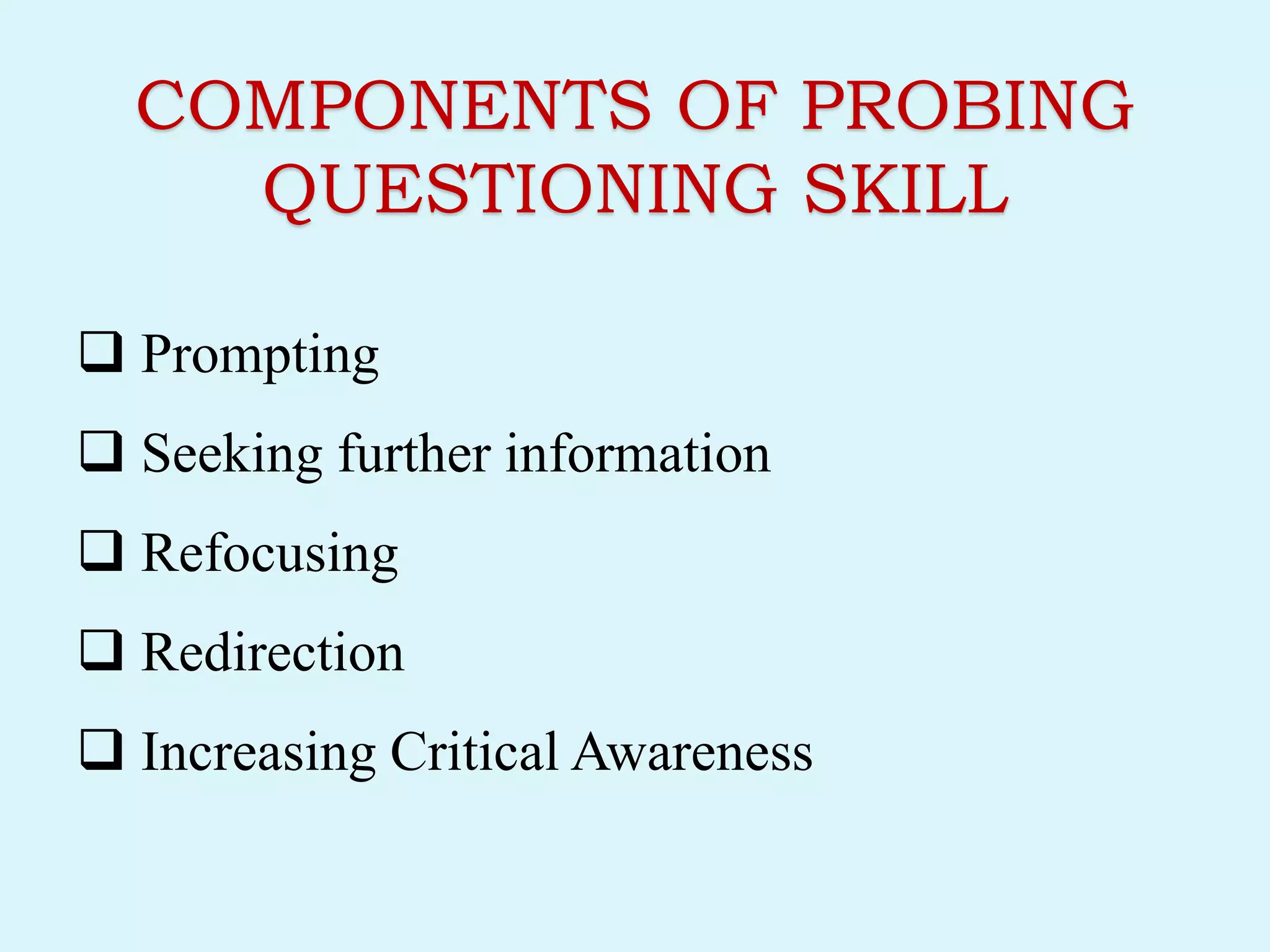
COMPONENTS OF PROBING
QUESTIONINGSKILL
Prompting
Seeking further information
Refocusing
Redirection
Increasing Critical Awareness
38.
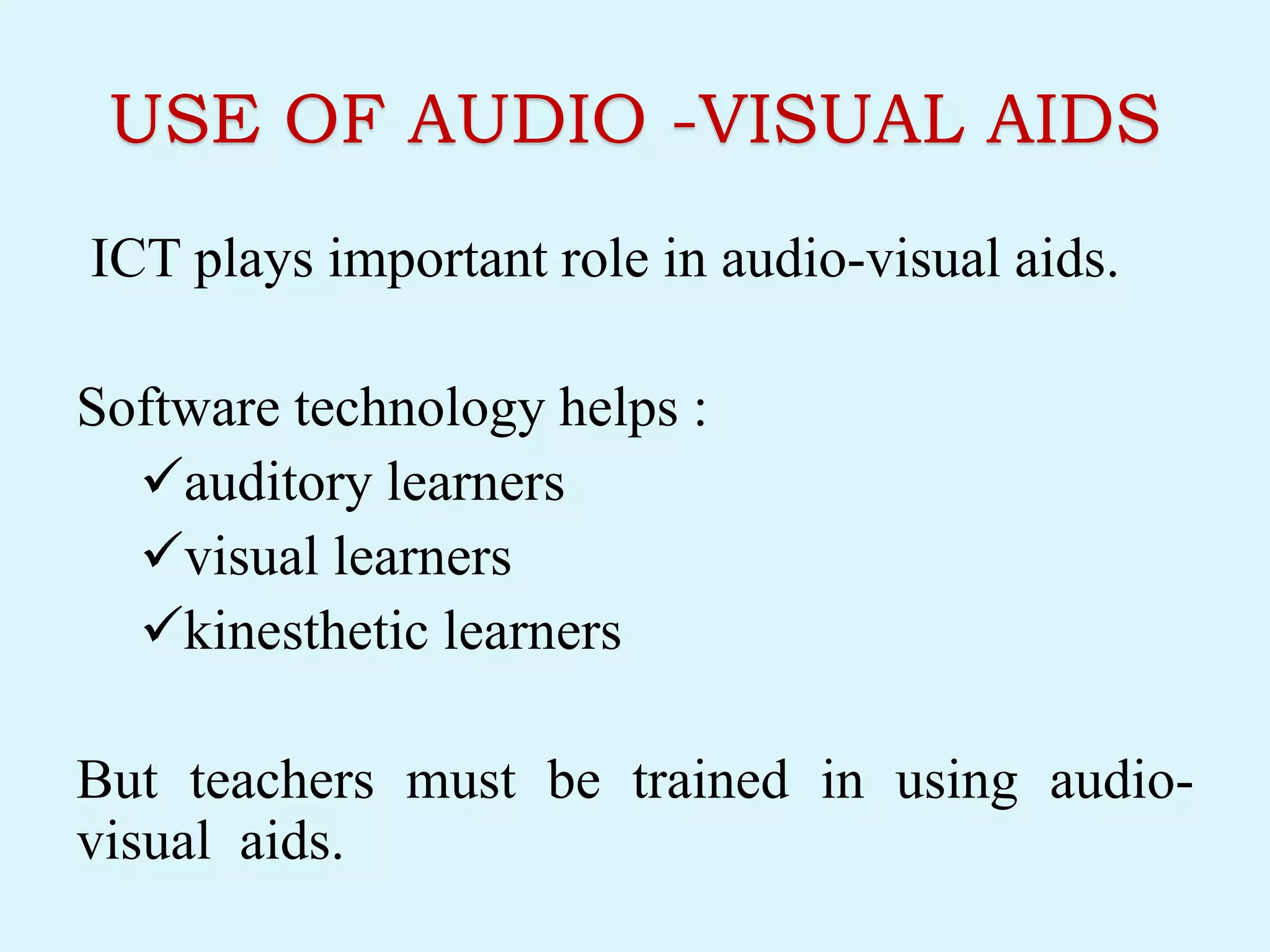
USE OF AUDIO-VISUAL AIDS
ICT plays important role in audio-visual aids.
Software technology helps :
auditory learners
visual learners
kinesthetic learners
But teachers must be trained in using audio-
visual aids.
39.
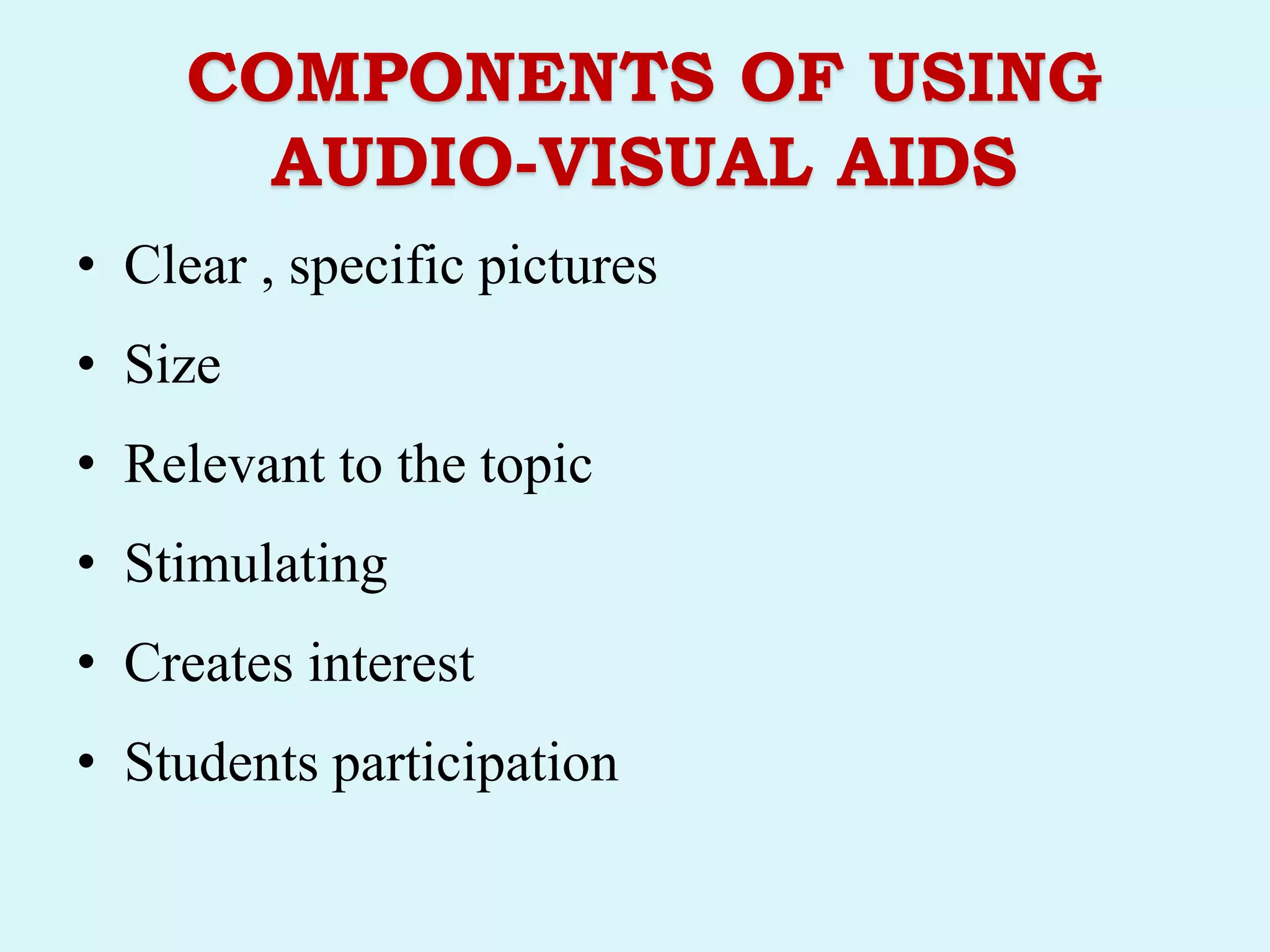
COMPONENTS OF USING
AUDIO-VISUALAIDS
• Clear , specific pictures
• Size
• Relevant to the topic
• Stimulating
• Creates interest
• Students participation
40.
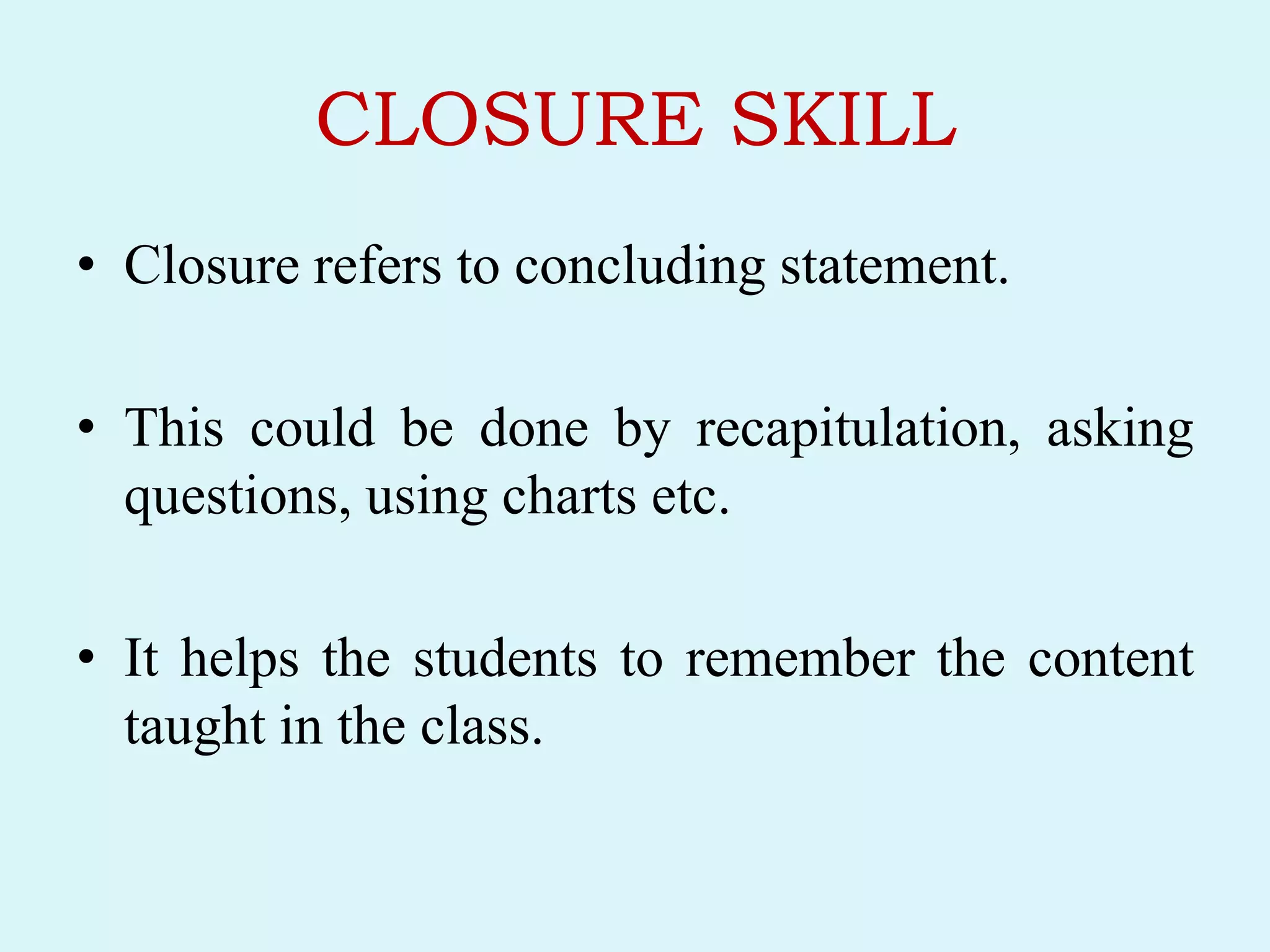
CLOSURE SKILL
• Closurerefers to concluding statement.
• This could be done by recapitulation, asking
questions, using charts etc.
• It helps the students to remember the content
taught in the class.
41.
COMPONENTS OF CLOSURE
SKILL
•Recap
• Relevant questions
• Motivating questions
• Students responding
• Use of audio-visual aids
• Use of blackboard
• Use reinforcement
• Easy assignments
42.
ADVANCED MICRO-TEACHING SKILL
•This could emerge by the need /demand, crises situation of
the society.
• When ICT involves in Micro Teaching , a pupil teacher has to
adapt herself/himself with new skills i.e.
– handling the gadget
– all necessary equipments
– prior training
– facing the camera
– Presentation of the content
– Knowledge about various teleconferencing platforms
– Cyber safety
– Online etiquette
– Teaching competency on digital platform
43.
MICRO - TEACHING:
ADVANTAGES
• Specific skills can be developed
• Self -evaluation can be done by tape recorder
and video-tape
• Increased control of practices
• Immediate feedbacks
• Improve confidence
• Simplify complexities of teaching process