Edited by Foxit Reader 
Copyright(C) by Foxit Software Company,2005-2008 
For Evaluation Only. 
1 
Four Node Iso-parametric Quadrilateral Element 
- Four-node iso-parametric finite element is one of the most commonly used elements. 
- Eight unknowns: two displacements per each node. 
- Iso-parametric: the same interpolation method is used for displacement and geometry. 
- Mapping relation from physical element to reference element. 
- Numerical integration 
Iso-parametric Mapping 
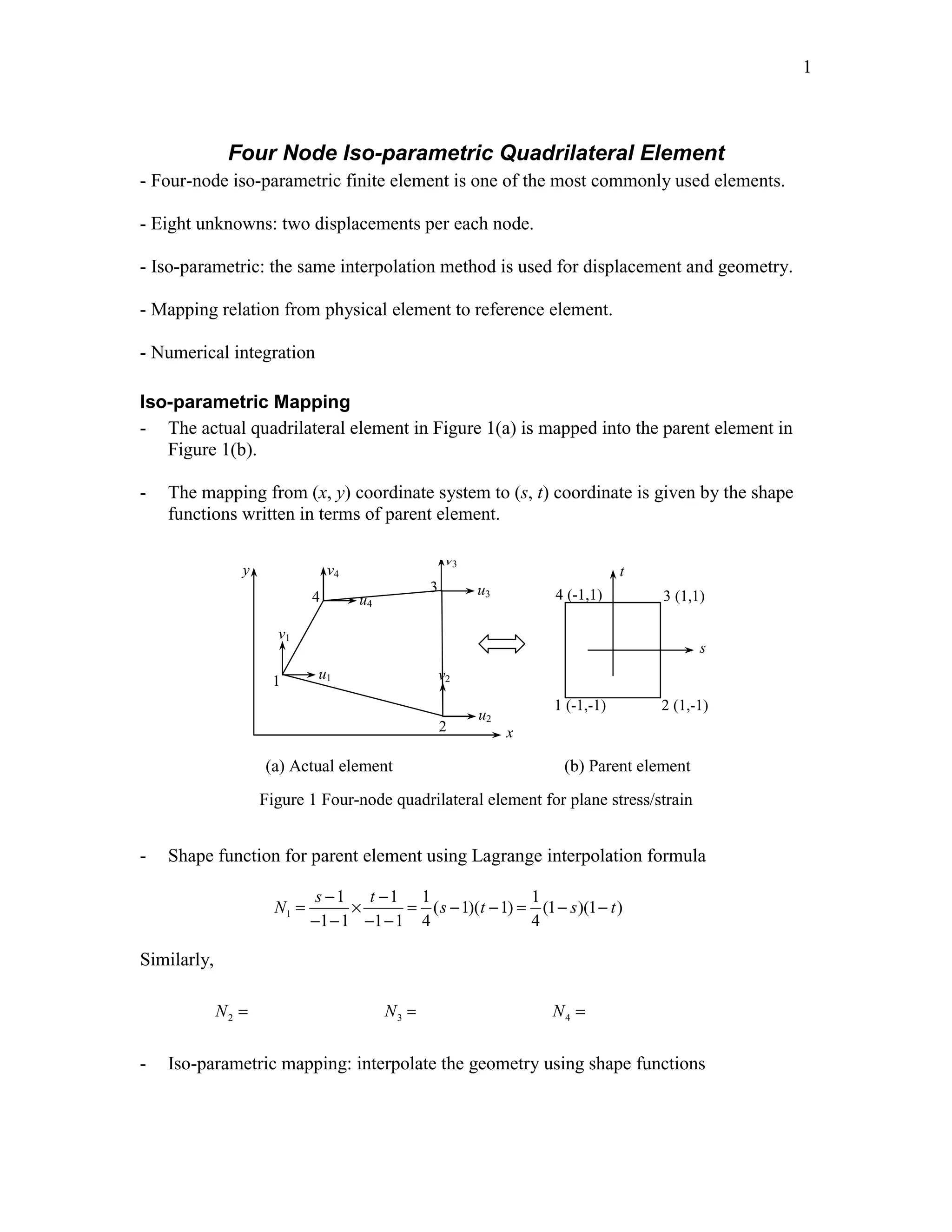
- The actual quadrilateral element in Figure 1(a) is mapped into the parent element in 
Figure 1(b). 
- The mapping from (x, y) coordinate system to (s, t) coordinate is given by the shape 
functions written in terms of parent element. 
u1 
v1 
v3 
3 4 (-1,1) 
u2 
v2 
u4 
v4 
4 
1 
2 x 
y 
u3 
3 (1,1) 
s 
t 
1 (-1,-1) 2 (1,-1) 
(a) Actual element (b) Parent element 
Figure 1 Four-node quadrilateral element for plane stress/strain 
- Shape function for parent element using Lagrange interpolation formula 
N s t s t 
= − × − = − − = − − 
1 
1 1 1 1 
( 1)( 1) (1 )(1 ) 
s t 
− − − − 
1 1 1 1 4 4 
Similarly, 
1 1 1 
(1 )(1 ), (1 )(1 ), (1 )(1 ) 
4 4 4 
N = + s − t N = + s + t N = − s + t 
2 3 4 
- Iso-parametric mapping: interpolate the geometry using shape functions 
http://swiftmemberreview.com
Edited by Foxit Reader 
Copyright(C) by Foxit Software Company,2005-2008 
For Evaluation Only. 
2 
 x   y 
 
1 1 
x =   y 
[ ]  2  , =   [ ] 
 2 
 
x N N N N y N N N N 
1 2 3 4 1 2 3 4 
x y 
x y 
 3   3 
 
 4   4 
 
- In order to approximate strain and stress, the derivatives of shape functions with 
respect to coordinate directions are required. Since shape functions depend on s and t 
coordinates, chain rule of differentiation must be used. 
∂ = ∂ ∂ + ∂ ∂ ∂ = ∂ ∂ + ∂ ∂ 
∂ ∂ ∂ ∂ ∂ ∂ ∂ ∂ ∂ ∂ 
i i i , i i i N N x N y N N x N y 
s x s y s t x t y t 
In the matrix form: 
 ∂ N   ∂ x ∂ y  ∂ N   ∂ N 
 i i i 
 ∂   ∂  s  =  s ∂ s   ∂ x   ∂ x 
  ∂   ≡ [ J 
] 
  N i  ∂ x ∂ y  ∂ N i  ∂ N 
i 
 
 ∂ t   ∂ t ∂ t   ∂ y   ∂ y 
 
 
where [J] is the Jacobian matrix and its determinant is called the Jacobian. By inverting 
the Jacobian matrix, the desired derivatives with respect to x and y can be obtained: 
∂ N  i ∂ N   ∂ y − ∂ y  ∂ N 
   ∂ x  i       i 
  = − 
 1 ∂ s  = 1 
∂ t ∂ s  ∂ s 
  ∂ [ J 
] 
     N i  ∂ N  J 
− ∂ x ∂ x  ∂  N 
i i 
  ∂ y   ∂ t   ∂ t ∂ s   ∂ t 
 
where |J| is the Jacobian (or determinant) and is defined by 
= ∂ ∂ − ∂ ∂ 
∂ ∂ ∂ ∂ 
x y x y 
s t t s 
J 
- Since the Jacobian appears in the denominator in the above equation, it must not be 
zero anywhere over the domain (–1 s, t 1). 
- The mapping is not valid if |J| is zero anywhere over the element. 
Examples 
(1) Check the validity of iso-parametric mapping for the element shown in Figure 2 
http://swiftmemberreview.com
Edited by Foxit Reader 
Copyright(C) by Foxit Software Company,2005-2008 
For Evaluation Only. 
3 
1(0, 0) 2(1, 0) 
3(2, 2) 
4(0, 1) 
x 
y 
Figure 2 Four-node quadrilateral element 
- Nodal coordinates: 
= = = = 
= = = = 
0, 1, 2, 0 
0, 1, 2, 1 
x x x x 
y y y y 
1 2 3 4 
1 2 3 4 
- Iso-parametric mapping: 
= + + + = + = + ++ 
x N x N x N x N x N N s t st 
1 1 2 2 3 3 4 4 2 3 
= + + + = + = + + + 
y N y N y N y N y N N s t st 
1 1 2 2 3 3 4 4 3 4 
1 
2 (33 ) 
4 
1 
2 (3 3 ) 
4 
- Jacobian: 
∂ x ∂ y 
 
 ∂ s ∂ s  1  3 + t 1 
+ t 
 =   = ∂ x ∂ y  + s + s 
    
 ∂ t ∂ t 
 
[ ] 
4 1 3 
J 
1 11 1 
[(3 )(3 ) (1 )(1 )] 
4 28 8 
J = + t + s − + t + s = + s + t 
Thus, it is clear that |J| > 0 for –1 s 1 and –1 t 1. 
Figure 3 Element shape obtained from the iso-parametric mapping 
http://swiftmemberreview.com
Edited by Foxit Reader 
Copyright(C) by Foxit Software Company,2005-2008 
For Evaluation Only. 
4 
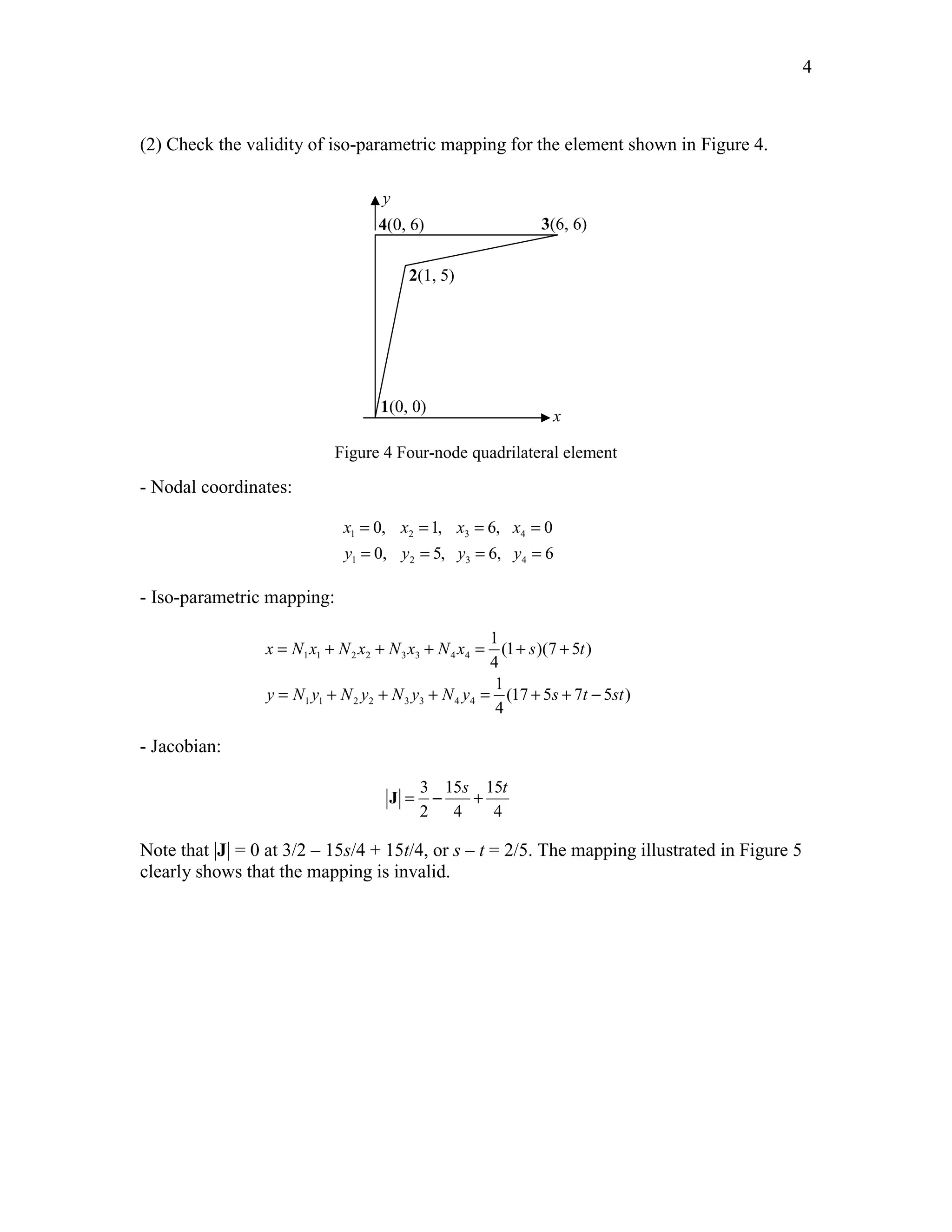
(2) Check the validity of iso-parametric mapping for the element shown in Figure 4. 
4(0, 6) 3(6, 6) 
2(1, 5) 
1(0, 0) 
x 
y 
Figure 4 Four-node quadrilateral element 
- Nodal coordinates: 
= = = = 
= = = = 
0, 1, 6, 0 
0, 5, 6, 6 
x x x x 
y y y y 
1 2 3 4 
1 2 3 4 
- Iso-parametric mapping: 
= + + + = + + 
1 1 2 2 3 3 4 4 
= + + + = + + − 
1 1 2 2 3 3 4 4 
1 
(1 )(7 5 ) 
4 
1 
(17 5 7 5 ) 
4 
x Nx N x Nx N x s t 
y N y N y N y N y s t st 
- Jacobian: 
3 15 15 
2 4 4 
s t J = − + 
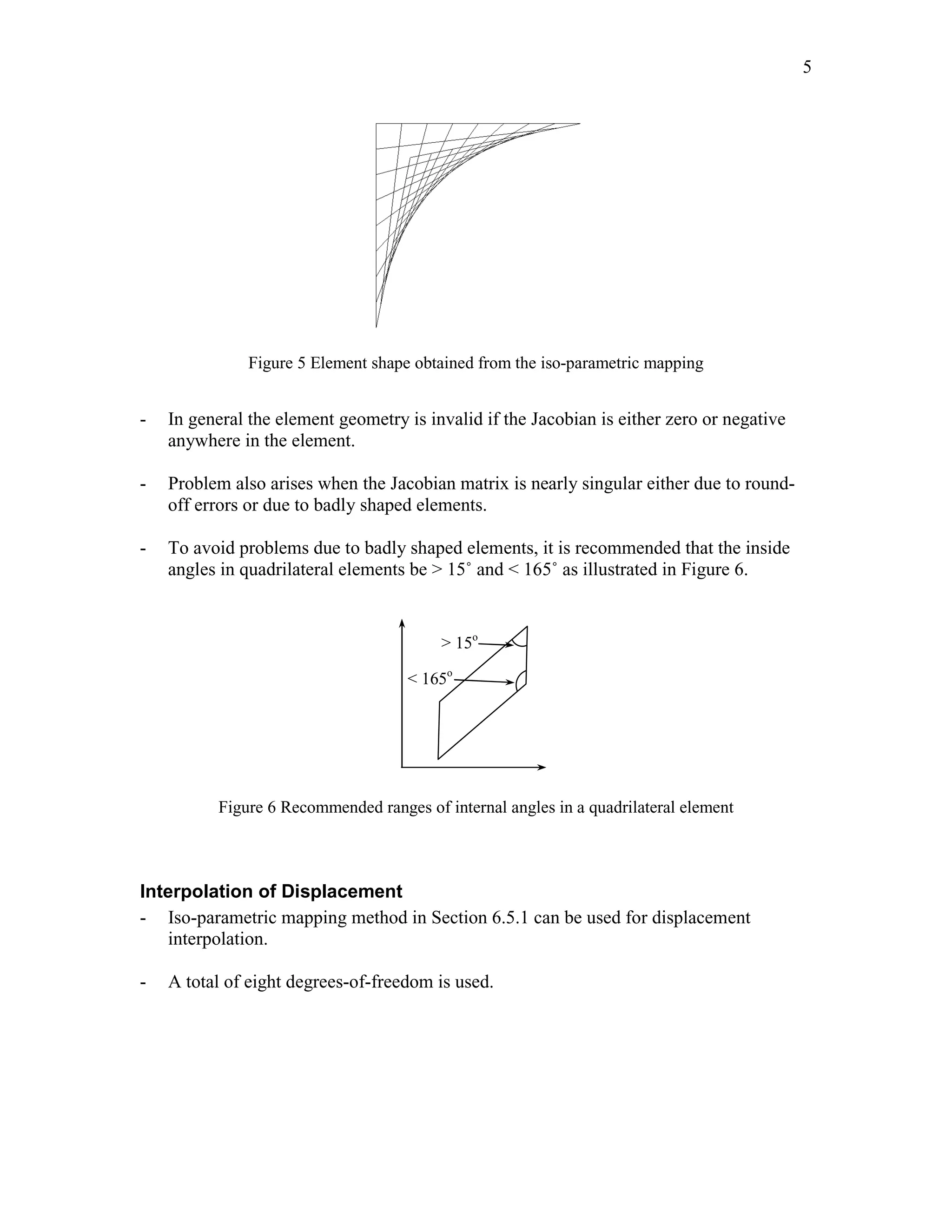
Note that |J| = 0 at 3/2 – 15s/4 + 15t/4, or s – t = 2/5. The mapping illustrated in Figure 5 
clearly shows that the mapping is invalid. 
http://swiftmemberreview.com
Edited by Foxit Reader 
Copyright(C) by Foxit Software Company,2005-2008 
For Evaluation Only. 
5 
Figure 5 Element shape obtained from the iso-parametric mapping 
- In general the element geometry is invalid if the Jacobian is either zero or negative 
anywhere in the element. 
- Problem also arises when the Jacobian matrix is nearly singular either due to round-off 
errors or due to badly shaped elements. 
- To avoid problems due to badly shaped elements, it is recommended that the inside 
angles in quadrilateral elements be > 15˚ and < 165˚ as illustrated in Figure 6. 
> 15o 
< 165o 
Figure 6 Recommended ranges of internal angles in a quadrilateral element 
Interpolation of Displacement 
- Iso-parametric mapping method in Section 6.5.1 can be used for displacement 
interpolation. 
- A total of eight degrees-of-freedom is used. 
http://swiftmemberreview.com
Edited by Foxit Reader 
Copyright(C) by Foxit Software Company,2005-2008 
For Evaluation Only. 
6 
  
 1 
 
 1 
 
  
 2 
 
      =  1 2 3 4  2 
    = 
  1 2 3 4  3 
 
  
 3 
 
 4 
 
 4 
 
0 0 0 0 
[ ]{ } 
0 0 0 0 
u 
v 
u 
u N N N N v 
v N N N N u 
v 
u 
v 
N d 
where the same shape functions in geometric interpolation can be used for displacement 
interpolation: 
 
 = − − 1 
 
= + − 2 
3 
4 
1 
(1 )(1 ) 
4 
1 
(1 )(1 ) 
4 
1 
(1 )(1 ) 
4 
1 
(1 )(1 ) 
4 
N s t 
N s t 
= + + 
N s t 
N s t 
 
= − + 
 
- Jacobian Matrix 
∂ ∂  
 ∂ ∂  ∂ ∂ ∂ ∂ =   = − 
∂ ∂  ∂ ∂ ∂ ∂ 
 ∂ ∂  
x y 
s s x y x y 
x y s t t s 
t t 
J J 
[ ] , 
where 
x  x 
 
1 1 
 
∂∂ ∂ x = N ∂ N ∂ N ∂ N  x  1 
 x 
 [ 1 2 3 4 ]  2  = [− 1 + t 1 − t 1 + t − 1 − t 
] 
 2 
 
∂ s ∂ s ∂ s ∂ s s x  4 
x 
3 3 
 
 x   x 
 
4 4 
  
1 
∂ = − + − − + −   2 
  
∂  3 
 
  
4 
1 
[ 1 1 1 1 ] 
4 
x 
x x 
s s s sx 
t 
x 
Similar expressions can be written for derivatives of y with respect to s and t. In general, 
the determinant of the Jacobian matrix can be expressed as 
http://swiftmemberreview.com
7 
 0 1 − t − s + t − 1 
+ s   y 
 
− 1 + t 0 1 
+ s − s − t  1 
 y 
 = 1 [ x x x x 
] 
T 
  2 
8 1 2 3 4 
 s − t − 1 − s 0 1 
+ t     y 
 3 
  1 −  s s + t − 1 − t 0 
  y 
 
 4 
J 
- Displacement-strain relationship 
/ 
/ 1 0 0 0 
/ 
{ } / 0 0 0 1 
/ 
/ / 01 1 0/ 
xx 
yy 
xy 
u x 
u x 
u y 
v y 
v x 
u y v x 
v y 
ε 
ε 
γ 
∂ ∂  
   ∂ ∂            ∂ ∂  =   =  ∂ ∂  =         ∂ ∂    ∂ ∂ + ∂ ∂      ∂ ∂  
ε 
∂ u   ∂ y − ∂ y  ∂ u 
   ∂ x   1 
 = ∂ t ∂ s      ∂   ∂   s 
  u  J 
− ∂ x ∂ x  ∂ u 
  ∂ y   ∂ t ∂ s   ∂ t 
 
∂ v   ∂ y − ∂ y  ∂ v 
  ∂ x   1 
 = ∂ t ∂ s      ∂   ∂   s 
  v  J 
− ∂ x ∂ x  ∂ v 
 ∂ y   ∂ t ∂ s   ∂ t 
 
Writing the two equations together: 
∂ u / ∂ x   ∂ y / ∂ t −∂ y / ∂ s 0 0  ∂ u / 
∂ s 
 
∂ u / ∂ y  −∂ x / ∂ t ∂ x / ∂ s 0 0  ∂ u / 
∂ t 
   = 1   ∂   v / ∂ x  J 
 0 0 ∂ y / ∂ t −∂ y / ∂ s  ∂ v / 
∂ s 
  ∂ v / ∂ y      0 0 −∂ x / ∂ t ∂ x / ∂ s  ∂ v / 
∂ t 
  
The strain can now be expressed as 
 ∂ y / ∂ t −∂ y / ∂ s 0 0  ∂ u / ∂ s  ∂ u / 
∂ s 
  ε 
  1 0 0 0 
  xx 
       ε 
= 1   −∂ x / ∂ t ∂ x / ∂ s 0 0  ∂ u / ∂ t  ∂ u / 
∂ t 
 0 0 0 1 ≡  [ A 
] 
yy 
       J 
   0 0 ∂ y / ∂ t −∂ y / ∂ s  ∂ v / ∂ s ∂ v / 
∂ s 
 γ 
0 1 1 0 
  xy 
     0 0 −∂ x / ∂ t ∂ x / ∂  s   ∂ v / ∂ t    ∂ v / 
∂ t 
 
 The derivative of the trial solution with respect to s and t are easy to compute:
Edited by Foxit Reader 
Copyright(C) by Foxit Software Company,2005-2008 
For Evaluation Only. 
8 
  
 1 
 
 1 
 
∂ ∂  − + − + − −    
   2 
 ∂ ∂  − + − − + −    ∂ ∂  =    2 
 ≡    − + − + − −   3 
  ∂ ∂   − + − − + −      3 
 
4 
4 
/ 1 0 1 0 1 0 1 0 
/ 1 1 0 1 0 1 0 1 0 
[ ]{ } 
/ 4 0 1 0 1 0 1 0 1 
/ 0 1 0 1 0 1 0 1 
u 
v 
u s t t t t u 
u t s s s s v 
v s t t t t u 
v t s s s s v 
u 
v 
  
  
G d 
The displacement-strain matrix [B] can now be written as follows: 
/ 
/ 
[ ] [ ][ ]{ } [ ]{ } 
/ 
/ 
xx 
yy 
xy 
u s 
u t 
v s 
v t 
ε 
ε 
γ 
∂ ∂  
      ∂ ∂    =   = ≡   ∂ ∂  
  ∂ ∂    
A AG d B d 
- The displacement-strain matrix [B] is not constant. Thus, the value of strain and 
stress within an element changes as a function of position. 
Finite Element Matrix Equation 
- The element stiffness matrix is: 
1 1 
k = ∫∫ B C B ≡ ∫ ∫ B C B J (0.1) 
[ ] [ ]T [ ][ ] [ ]T [ ][ ] 
h dA h dsdt 
1 1 
A 
− − 
- Different from the triangular element, the element stiffness matrix is not constant 
within an element. Thus, analytical integration is not trivial. Numerical integration 
ethod using Gaussian quadrature will be discussed in the next section. 
- Work done by concentrated forces: 
NF x y x y x y x y NF W = F u + F v + F u + F v + F u + F v + F u + F v ≡ d Q 
1 1 1 1 2 2 2 2 3 3 3 3 4 4 4 4 { }T{ } 
NF x y x y x y x y Q = F F F F F F F F is the vector of applied nodal 
where 1 1 2 2 3 3 4 4 { } [ ]T 
forces. 
- Work done by distributed load: 
W = d h∫ N T dS = d Q 
{ }T [ ]T{ } { }T{ } 
T T 
S 
http://swiftmemberreview.com
Edited by Foxit Reader 
Copyright(C) by Foxit Software Company,2005-2008 
For Evaluation Only. 
9 
4 
1 
3 
2 
4 
3 
1 2 
s 
s 
s 
s 
S 
S 
S 
S 
Tx 
Ty 
Figure 7 Coordinates for evaluation of boundary integrals 
Side 1-2: 
 (1 − s ) / 2 0 (1 + s 
) / 2 0 0 0 0 0 
 
=  − +  − ≤ ≤   
[ ] , 1 1 
0 (1 )/2 0 (1 )/2 0 0 0 0 
s 
s s 
N 
Side 2-3: 
 0 0 (1 − s ) / 2 0 (1 + s 
) / 2 0 0 0 
 
=   − ≤ ≤  − +  
[ ] , 1 1 
0 0 0 (1 )/2 0 (1 )/2 0 0 
s 
s s 
N 
Side 3-4: 
 0 0 0 0 (1 − s )/2 0 (1 + s 
)/2 0 
 
=  − +  − ≤ ≤   
[ ] , 1 1 
0 0 0 0 0 (1 )/2 0 (1 )/2 
s 
s s 
N 
Side 4-1: 
 (1 + s )/2 0 0 0 0 0 (1 − s 
)/2 0 
 
=  + −  − ≤ ≤   
[ ] , 1 1 
0 (1 )/2 0 0 0 0 0 (1 )/2 
s 
s s 
N 
- As an example, consider side 2-3, as shown in Figure 7. The iso-parametric 
mapping for side 2-3 is 
1 − s 1 + s 1 − s 1 
+ 
s 
x = x + x , 
y = y + y 
2 3 2 3 
2 2 2 2 
dx x x x x 
3 2 3 2 
1 1 
x x dx ds 
2 3 
or 
2 2 2 2 
ds 
dy y y y y 
3 2 3 2 
or 
dy ds 
2 2 
ds 
= − + = − = − 
= − = − 
The Jacobian of the transformation from S to s is defined as 
side2-3 
dS 
J 
ds 
= 
with reference to Figure 8 it can be developed as follows. From geometry 
http://swiftmemberreview.com
10 
-1 
(x2, y2) 
1 
s 
(x3, y3) 
dx 
dy 
S 
dS 
Side 2-3 of parent element 
Figure 8 Evaluation of work done by applied pressure along side 2-3 
1 1 
dS = dx 2 + dy 2 = ( x − x ) 2 + ( y − y ) 
2 
ds = L ds 
3 2 3 2 23 
2 2 
Thus, the Jacobian for each side is equal to half the length of that side. Thus, 
  
  
  
 −  
1 1 
 −    = T = T =   x 
 +      
  ,side 2-3 23 23 
side 2 3 1 1 
0 0 
0 0 
(1 ) / 2 0 
1 0 (1 ) / 2 1 
{ } [ ] { } [ ] { } 
2 (1 ) / 2 0 2 
0 (1 )/2 
0 0 
0 0 
T 
y 
s 
s T 
h dS h L ds h L ds 
s T 
s 
− − − 
 +  
  
  
  
Q ∫ N T ∫ N T ∫ 
Carrying out the integration gives 
hL 
Q = 23 
T T T T 
,side2-3 { } [0 0 0 0] 
2 
T 
T x y x y 
- Similar to the linear triangular element, this equation says that total pressure along a 
side is divided equally among the two nodes along the side. 
- All quantities needed for the potential energy have now been expressed in terms of 
nodal unknowns. From the principle of minimum total potential energy, 
[ ]{ } { } NT T k d = Q +Q 
where [k] is 8×8 element stiffness matrix, {d} is 8×1 nodal displacement vector, and 
{QNT+QT} is 8×1 applied nodal force vector.
11 
Numerical Integration 
- Numerical integration evaluates the integrals involved in the element stiffness matrix 
and distributed force. 
- In the finite element literature, the Gauss quadrature is usually preferred because it 
requires fewer function evaluations as compared to other methods. 
- In the Gauss quadrature, the integrand is evaluated at predefined points (called Gauss 
points). The sum of this integrand values, multiplied by appropriate weights (called 
Gauss weight) gives an approximation to the integral: 
1 
n 
= ∫ ≈Σ 
( ) ( ) 
I f s ds w f s 
− = 
1 1 
i i 
i 
where n = number of Gauss points, si = Gauss points, wi = Gauss weights, and f(si) = 
function value at the Gauss point si. 
- The locations of Gauss points and weights are derived in such a way that with n 
points, a polynomial of degree 2n–1 is integrated exactly. 
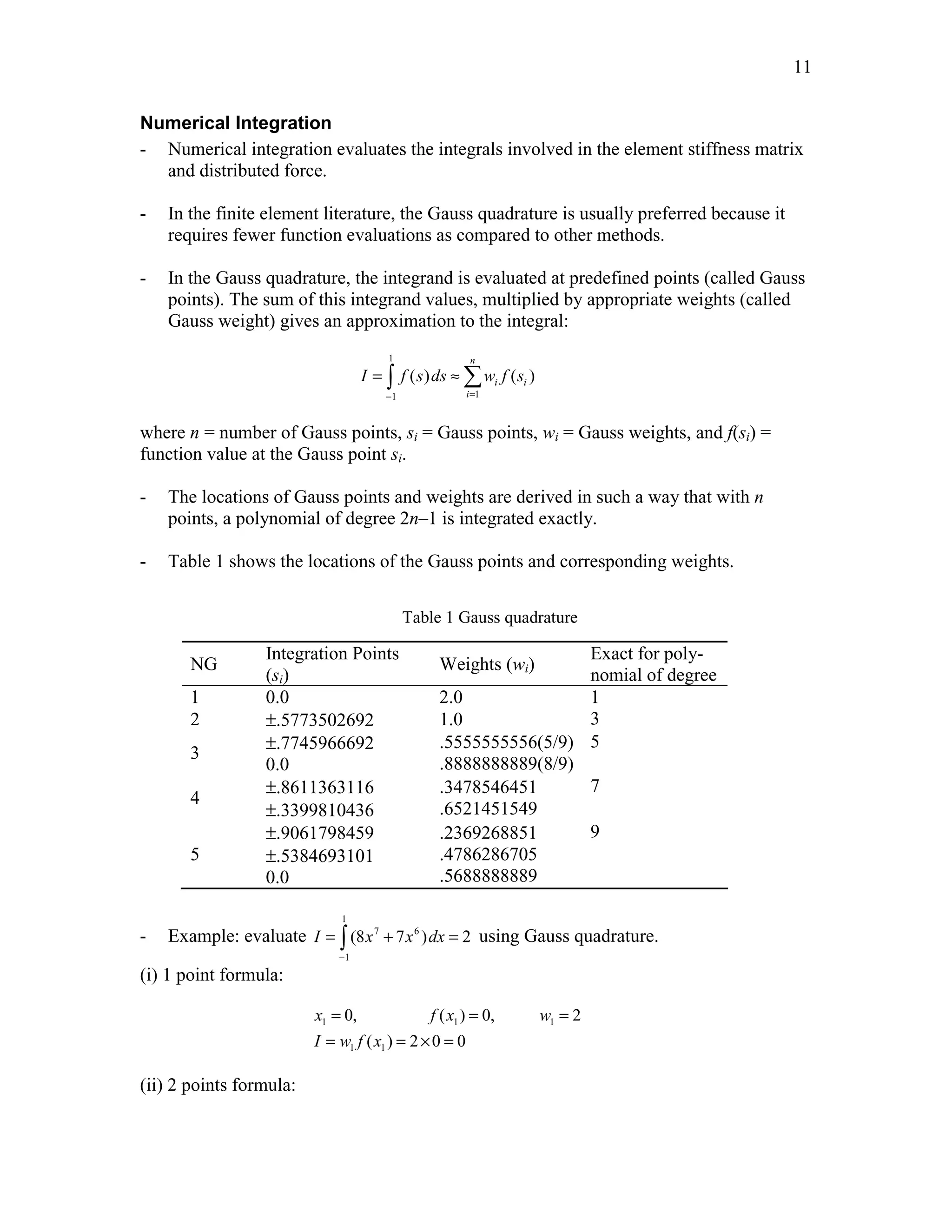
- Table 1 shows the locations of the Gauss points and corresponding weights. 
Table 1 Gauss quadrature 
NG 
Integration Points 
(si) 
Weights (wi) 
Exact for poly-nomial 
of degree 
1 0.0 2.0 1 
2 ±.5773502692 1.0 3 
3 ±.7745966692 
0.0 
.5555555556(5/9) 
.8888888889(8/9) 
5 
4 ±.8611363116 
±.3399810436 
.3478546451 
.6521451549 
7 
5 
±.9061798459 
±.5384693101 
0.0 
.2369268851 
.4786286705 
.5688888889 
9 
- Example: evaluate 
1 
= ∫ 7 + 6 
= using Gauss quadrature. 
I (8x 7x )dx 2 
1 
− 
(i) 1 point formula: 
= = = 
= =×= 
0, ( ) 0, 2 
x fx w 
I wf x 
1 1 1 
( ) 2 0 0 
1 1 
(ii) 2 points formula:
12 
= − = − 7 + − 6 
= = 
= = + = = 
= + = + = 
.57735, ( ) 8( .57735) 7( .57735) .0881925, 1 
.57735, ( ) 8(.57735) 7(.57735) .430326, 1 
( ) ( ) .0881925 .430326 .5185185 
x fx w 
x fx w 
I w f x w f x 
1 1 1 
7 6 
2 2 2 
1 1 2 2 
(iii) 3 points formula: 
= − .774596669, ( ) = .173497, = 
.5556 
= 0.0, ( ) = 0.0 = 
.8889 
= .774596669, ( ) = 2.8505, = 
.5556 
= + + = + = 
x fx w 
x fx w 
x fx w 
I w f x w f x w f x 
1 1 1 
2 2 2 
3 3 3 
( ) ( ) ( ) .5556(.173497 2.8505) 1.68001 
1 1 2 2 3 3 
(iv) 4 points formula: 
= − = = 
= − = = 
= = = 
= = = 
= + + + = 
.86113631, ( ) .0452273, .347855 
.33998104, ( ) .00660979, .652145 
.33998104, ( ) .0150102, .652145 
.86113631, ( ) 5.66376, .347855 
( ) ( ) ( ) ( ) 2.0 
x fx w 
x fx w 
x fx w 
x fx w 
I w f x w f x w f x w f x 
1 1 1 
2 2 2 
3 3 3 
3 3 3 
1 1 2 2 3 3 4 4 
It can be easily verified that this is the exact value of the integral. 
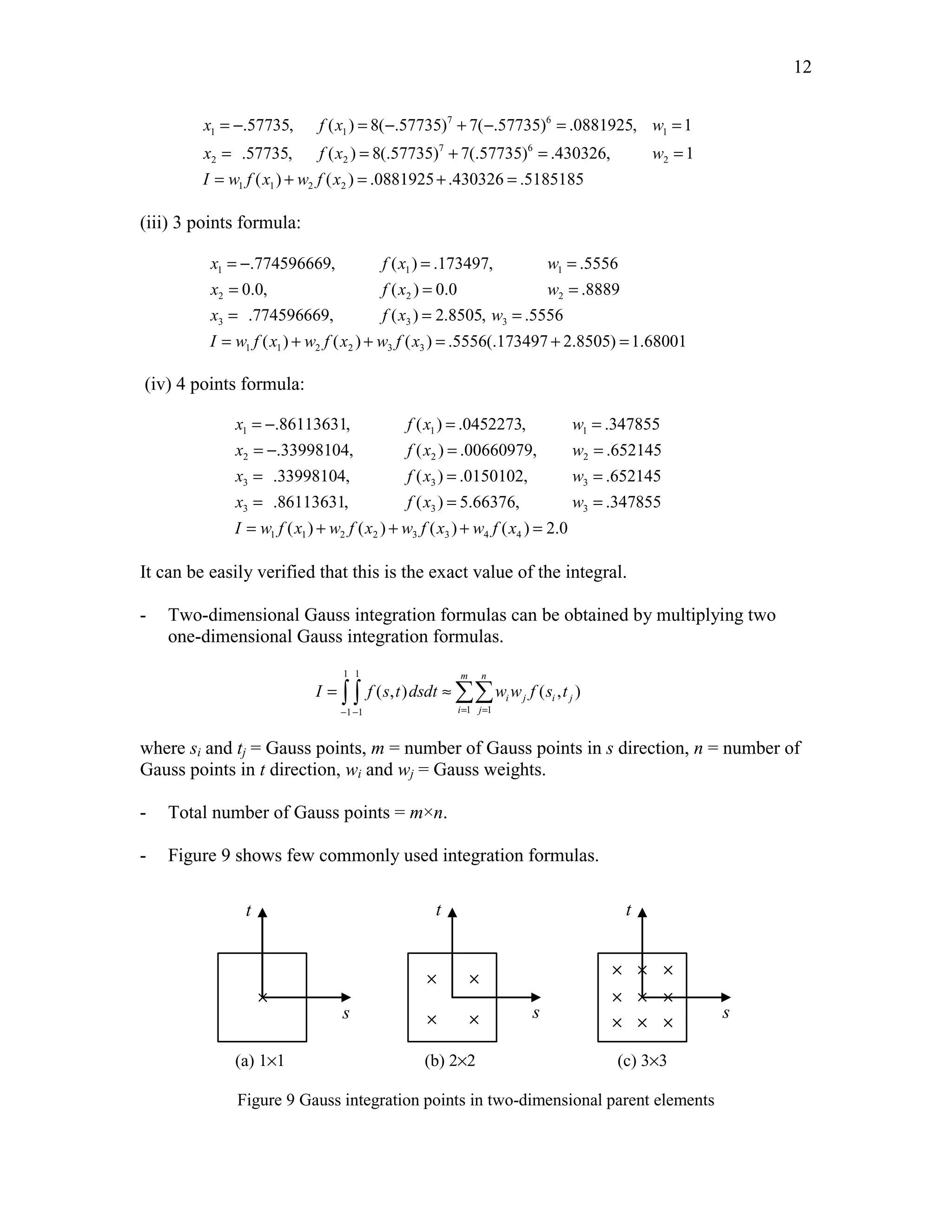
- Two-dimensional Gauss integration formulas can be obtained by multiplying two 
one-dimensional Gauss integration formulas. 
1 1 
m n 
= ∫ ∫ ≈ΣΣ 
( , ) ( , ) 
I f s t dsdt ww f s t 
− − = = 
1 1 1 1 
i j i j 
i j 
where si and tj = Gauss points, m = number of Gauss points in s direction, n = number of 
Gauss points in t direction, wi and wj = Gauss weights. 
- Total number of Gauss points = m×n. 
- Figure 9 shows few commonly used integration formulas. 
s 
t 
s 
t 
s 
t 
(a) 1×1 (b) 2×2 (c) 3×3 
Figure 9 Gauss integration points in two-dimensional parent elements
13 
- The element stiffness matrix can be evaluated using 2×2 Gauss integration formulas: 
1 1 2 2 
k = ∫ ∫ B C B J ≈ ΣΣ B C B J 
[ ] [ ][ ][ ]T [ ( , )][ ][ ( , )]T ( , ) 
h dsdt h ww s t s t s t 
− 1 − 1 = 1 = 
1 
i j i j i j i j 
i j 
Example: Interpolation using Quadrilateral Element 
For a rectangular element shown in the figure, displacements at four nodes are given 
by {u1, v1, u2, v2, u3, v3, u4, v4} = {0.0, 0.0, 1.0, 0.0, 2.0, 1.0, 0.0, 2.0}. Calculate 
displacement and strain at point (s, t) = (1/3, 0). 
x 
y 
4 (0,2) 3 (3,2) 
1 (0,0) 2 (3,0) 
s 
t 
4 (-1,1) 3 (1,1) 
1 (-1,-1) 2 (1,-1) 
First, the shape functions are given in the parent element as 
 = − − = + −  
 = + + = − +  
1 1 
(1 )(1 ), (1 )(1 ) 
4 4 
1 1 
(1 )(1 ), (1 )(1 ) 
4 4 
N s t N s t 
1 2 
N s t N s t 
3 4 
Especially when (s, t) = (1/3, 0), 
1 1 1 1 
, , , 
6 3 3 6 
N = N = N = N = 
1 2 3 4 
Interpolation of geometry [find physical coordinates corresponding to (s, t) = (1/3, 0)]: 
4 
x  Σ 
Nx 
1 
4 
y = Ny 
= ⋅ + ⋅ + ⋅ + ⋅ = 1 
1 1 1 1 
0 3 3 0 2 
6 3 3 6 
1 1 1 1 
0 0 2 2 1 
6 3 3 6 
I I 
I 
I I 
I 
= 
= 
 
= = ⋅ + ⋅ + ⋅ + ⋅ =  
Σ 
Displacement interpolation (Same shape function for geometry interpolation: Iso-parametric)
14 
 
Σ 
 
4 
u = Nu 
= ⋅ + ⋅ + ⋅ + ⋅ = 1 
v = Σ 
4 
Nv 
= ⋅ + ⋅ + ⋅ + ⋅ = 1 
 
1 1 1 1 
0 1 2 0 1 
6 3 3 6 
1 1 1 1 2 
0 0 1 2 
6 3 3 6 3 
I I 
I 
I I 
I 
= 
= 
Derivatives of shape functions (Note shape functions depend on s and t): 
 ∂ = − − = −  ∂ = − − = −  ∂  ∂   
∂ = − = ∂ = − + = −  ∂  ∂ 
 ∂  ∂  = + =  = + = 
 ∂  ∂ 
∂ ∂  = − + = −  = − =  ∂  ∂ 
1 1 1 1 
(1 ) (1 ) 
4 4 4 6 
1 1 1 1 
(1 ) (1 ) 
4 4 4 3 
1 1 1 1 
(1 ) (1 ) 
4 4 4 3 
1 1 1 1 
N N 
1 1 
t s 
s t 
N N 
2 2 
t s 
s t 
N N 
3 3 
t s 
s t 
N N 
4 4 
(1 t ) (1 s 
) 
4 4 4 6 
s t 
Jacobian matrix: 
∂ = − ⋅ + ⋅ + ⋅ − ⋅ =  ∂  
∂ = − ⋅ + ⋅ + ⋅ − ⋅ =  ∂ 
∂  =− ⋅ − ⋅ + ⋅ + ⋅ = 
 ∂ 
∂  = − ⋅ − ⋅ + ⋅ + ⋅ =  ∂ 
1 1 1 1 3 
0 3 3 0 
4 4 4 4 2 
1 1 1 1 
0 0 2 2 0 
4 4 4 4 
1 1 1 1 
0 3 3 0 0 
6 3 3 6 
1 1 1 1 
0 0 2 2 1 
6 3 3 6 
x 
s 
y 
s 
x 
t 
y 
t 
∂ ∂     3   2 
 0 0 
=  ∂ ∂  =   1 
=   ∂ ∂       ∂ ∂      
[ ] 2 , [ ] 3 
0 1 0 1 
x y 
s s 
x y 
t t 
− 
J J 
Derivative of shape functions: 
∂ N = ∂ N ∂ x + ∂ N ∂ y I I I ∂ ⇒ N  ∂ N 
 I I 
 ∂ s ∂ x ∂ s ∂ y ∂ s  ∂ s  =  ∂ x 
  [ J 
] 
∂ N = ∂ N ∂     x + ∂ N ∂ y ∂ N ∂ N 
I I I I  I 
  ∂ t ∂ x ∂ t ∂ y ∂ t   ∂ t    ∂ y 
 
∂ N  I ∂ N  ∂   N   2 
∂ N 
    I  ∂ x     2 
0   I I 
=       ∂  [ J 
] − 
1 
∂ s  =   ∂ ∂ ∂  3 
 s  =  3 s 
  N I   N  ∂ N I  0 1 
  I   ∂ N 
I 
  ∂ y   ∂ t   ∂ t   ∂ t 

15 
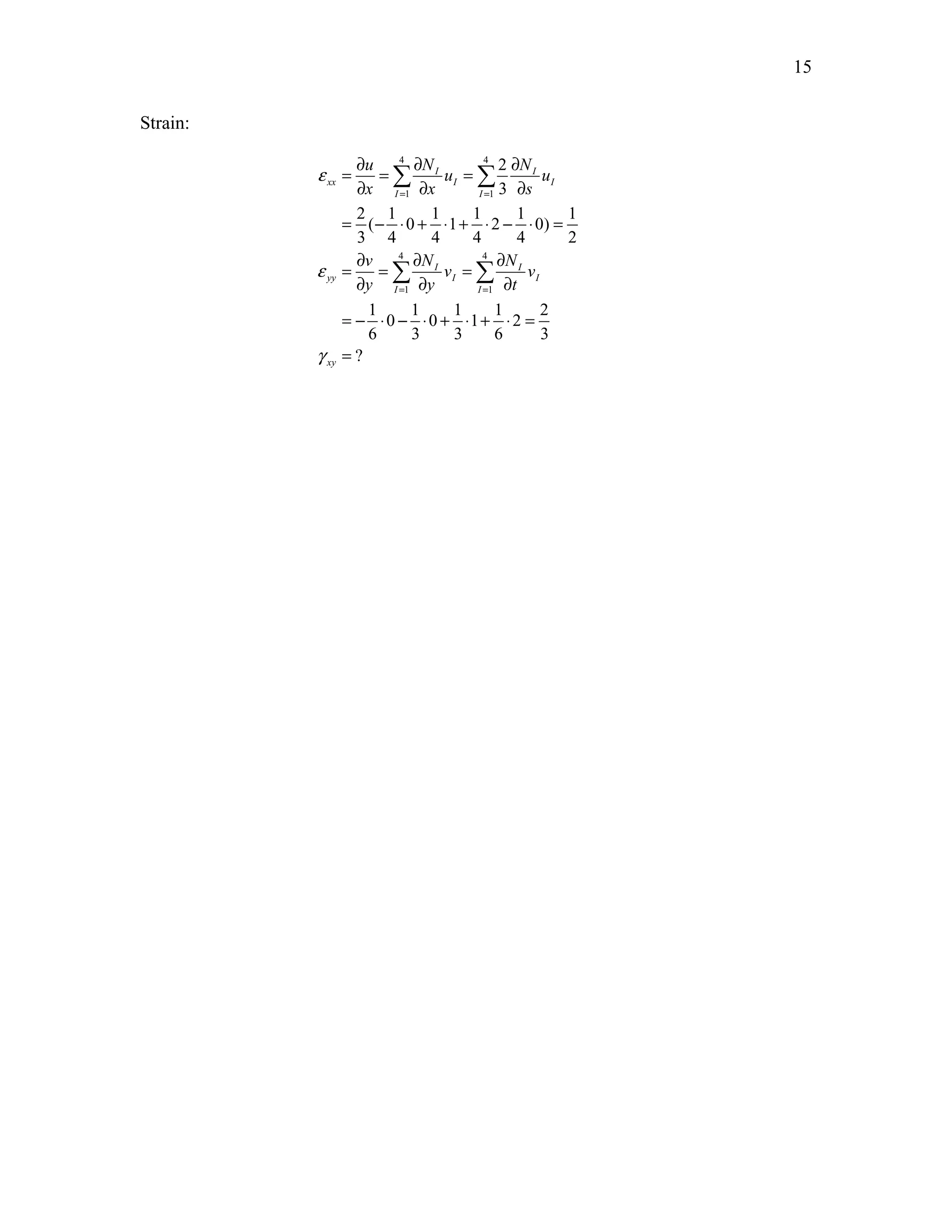
Strain: 
∂ Σ 4 ∂ Σ 
4 
= = = ∂ 
I I 
∂ ∂ ∂ 
= − ⋅ + ⋅ + ⋅ − ⋅ = 
xx I I 
1 1 
I I 
∂ Σ 4 ∂ Σ 
4 
= = = ∂ 
I I 
∂ ∂ ∂ 
=− ⋅ − ⋅ + ⋅ + ⋅ = 
= 
yy I I 
1 1 
2 
3 
2 1 1 1 1 1 
( 0 1 2 0) 
3 4 4 4 4 2 
I I 
1 1 1 1 2 
0 0 1 2 
6 3 3 6 3 
? 
xy 
u N N 
u u 
x x s 
v N N 
v v 
y y t 
ε 
ε 
γ 
= = 
= =

Isoparametric mapping

  • 1.
    Edited by FoxitReader Copyright(C) by Foxit Software Company,2005-2008 For Evaluation Only. 1 Four Node Iso-parametric Quadrilateral Element - Four-node iso-parametric finite element is one of the most commonly used elements. - Eight unknowns: two displacements per each node. - Iso-parametric: the same interpolation method is used for displacement and geometry. - Mapping relation from physical element to reference element. - Numerical integration Iso-parametric Mapping - The actual quadrilateral element in Figure 1(a) is mapped into the parent element in Figure 1(b). - The mapping from (x, y) coordinate system to (s, t) coordinate is given by the shape functions written in terms of parent element. u1 v1 v3 3 4 (-1,1) u2 v2 u4 v4 4 1 2 x y u3 3 (1,1) s t 1 (-1,-1) 2 (1,-1) (a) Actual element (b) Parent element Figure 1 Four-node quadrilateral element for plane stress/strain - Shape function for parent element using Lagrange interpolation formula N s t s t = − × − = − − = − − 1 1 1 1 1 ( 1)( 1) (1 )(1 ) s t − − − − 1 1 1 1 4 4 Similarly, 1 1 1 (1 )(1 ), (1 )(1 ), (1 )(1 ) 4 4 4 N = + s − t N = + s + t N = − s + t 2 3 4 - Iso-parametric mapping: interpolate the geometry using shape functions http://swiftmemberreview.com
  • 2.
    Edited by FoxitReader Copyright(C) by Foxit Software Company,2005-2008 For Evaluation Only. 2  x   y  1 1 x =   y [ ]  2  , =   [ ]  2  x N N N N y N N N N 1 2 3 4 1 2 3 4 x y x y  3   3   4   4  - In order to approximate strain and stress, the derivatives of shape functions with respect to coordinate directions are required. Since shape functions depend on s and t coordinates, chain rule of differentiation must be used. ∂ = ∂ ∂ + ∂ ∂ ∂ = ∂ ∂ + ∂ ∂ ∂ ∂ ∂ ∂ ∂ ∂ ∂ ∂ ∂ ∂ i i i , i i i N N x N y N N x N y s x s y s t x t y t In the matrix form:  ∂ N   ∂ x ∂ y  ∂ N   ∂ N  i i i  ∂   ∂  s  =  s ∂ s   ∂ x   ∂ x   ∂   ≡ [ J ]   N i  ∂ x ∂ y  ∂ N i  ∂ N i   ∂ t   ∂ t ∂ t   ∂ y   ∂ y   where [J] is the Jacobian matrix and its determinant is called the Jacobian. By inverting the Jacobian matrix, the desired derivatives with respect to x and y can be obtained: ∂ N  i ∂ N   ∂ y − ∂ y  ∂ N    ∂ x  i       i   = −  1 ∂ s  = 1 ∂ t ∂ s  ∂ s   ∂ [ J ]      N i  ∂ N  J − ∂ x ∂ x  ∂  N i i   ∂ y   ∂ t   ∂ t ∂ s   ∂ t  where |J| is the Jacobian (or determinant) and is defined by = ∂ ∂ − ∂ ∂ ∂ ∂ ∂ ∂ x y x y s t t s J - Since the Jacobian appears in the denominator in the above equation, it must not be zero anywhere over the domain (–1 s, t 1). - The mapping is not valid if |J| is zero anywhere over the element. Examples (1) Check the validity of iso-parametric mapping for the element shown in Figure 2 http://swiftmemberreview.com
  • 3.
    Edited by FoxitReader Copyright(C) by Foxit Software Company,2005-2008 For Evaluation Only. 3 1(0, 0) 2(1, 0) 3(2, 2) 4(0, 1) x y Figure 2 Four-node quadrilateral element - Nodal coordinates: = = = = = = = = 0, 1, 2, 0 0, 1, 2, 1 x x x x y y y y 1 2 3 4 1 2 3 4 - Iso-parametric mapping: = + + + = + = + ++ x N x N x N x N x N N s t st 1 1 2 2 3 3 4 4 2 3 = + + + = + = + + + y N y N y N y N y N N s t st 1 1 2 2 3 3 4 4 3 4 1 2 (33 ) 4 1 2 (3 3 ) 4 - Jacobian: ∂ x ∂ y   ∂ s ∂ s  1  3 + t 1 + t  =   = ∂ x ∂ y  + s + s      ∂ t ∂ t  [ ] 4 1 3 J 1 11 1 [(3 )(3 ) (1 )(1 )] 4 28 8 J = + t + s − + t + s = + s + t Thus, it is clear that |J| > 0 for –1 s 1 and –1 t 1. Figure 3 Element shape obtained from the iso-parametric mapping http://swiftmemberreview.com
  • 4.
    Edited by FoxitReader Copyright(C) by Foxit Software Company,2005-2008 For Evaluation Only. 4 (2) Check the validity of iso-parametric mapping for the element shown in Figure 4. 4(0, 6) 3(6, 6) 2(1, 5) 1(0, 0) x y Figure 4 Four-node quadrilateral element - Nodal coordinates: = = = = = = = = 0, 1, 6, 0 0, 5, 6, 6 x x x x y y y y 1 2 3 4 1 2 3 4 - Iso-parametric mapping: = + + + = + + 1 1 2 2 3 3 4 4 = + + + = + + − 1 1 2 2 3 3 4 4 1 (1 )(7 5 ) 4 1 (17 5 7 5 ) 4 x Nx N x Nx N x s t y N y N y N y N y s t st - Jacobian: 3 15 15 2 4 4 s t J = − + Note that |J| = 0 at 3/2 – 15s/4 + 15t/4, or s – t = 2/5. The mapping illustrated in Figure 5 clearly shows that the mapping is invalid. http://swiftmemberreview.com
  • 5.
    Edited by FoxitReader Copyright(C) by Foxit Software Company,2005-2008 For Evaluation Only. 5 Figure 5 Element shape obtained from the iso-parametric mapping - In general the element geometry is invalid if the Jacobian is either zero or negative anywhere in the element. - Problem also arises when the Jacobian matrix is nearly singular either due to round-off errors or due to badly shaped elements. - To avoid problems due to badly shaped elements, it is recommended that the inside angles in quadrilateral elements be > 15˚ and < 165˚ as illustrated in Figure 6. > 15o < 165o Figure 6 Recommended ranges of internal angles in a quadrilateral element Interpolation of Displacement - Iso-parametric mapping method in Section 6.5.1 can be used for displacement interpolation. - A total of eight degrees-of-freedom is used. http://swiftmemberreview.com
  • 6.
    Edited by FoxitReader Copyright(C) by Foxit Software Company,2005-2008 For Evaluation Only. 6    1   1     2        =  1 2 3 4  2     =   1 2 3 4  3     3   4   4  0 0 0 0 [ ]{ } 0 0 0 0 u v u u N N N N v v N N N N u v u v N d where the same shape functions in geometric interpolation can be used for displacement interpolation:   = − − 1  = + − 2 3 4 1 (1 )(1 ) 4 1 (1 )(1 ) 4 1 (1 )(1 ) 4 1 (1 )(1 ) 4 N s t N s t = + + N s t N s t  = − +  - Jacobian Matrix ∂ ∂   ∂ ∂  ∂ ∂ ∂ ∂ =   = − ∂ ∂  ∂ ∂ ∂ ∂  ∂ ∂  x y s s x y x y x y s t t s t t J J [ ] , where x  x  1 1  ∂∂ ∂ x = N ∂ N ∂ N ∂ N  x  1  x  [ 1 2 3 4 ]  2  = [− 1 + t 1 − t 1 + t − 1 − t ]  2  ∂ s ∂ s ∂ s ∂ s s x  4 x 3 3   x   x  4 4   1 ∂ = − + − − + −   2   ∂  3    4 1 [ 1 1 1 1 ] 4 x x x s s s sx t x Similar expressions can be written for derivatives of y with respect to s and t. In general, the determinant of the Jacobian matrix can be expressed as http://swiftmemberreview.com
  • 7.
    7  01 − t − s + t − 1 + s   y  − 1 + t 0 1 + s − s − t  1  y  = 1 [ x x x x ] T   2 8 1 2 3 4  s − t − 1 − s 0 1 + t     y  3   1 −  s s + t − 1 − t 0   y   4 J - Displacement-strain relationship / / 1 0 0 0 / { } / 0 0 0 1 / / / 01 1 0/ xx yy xy u x u x u y v y v x u y v x v y ε ε γ ∂ ∂     ∂ ∂            ∂ ∂  =   =  ∂ ∂  =         ∂ ∂    ∂ ∂ + ∂ ∂      ∂ ∂  ε ∂ u   ∂ y − ∂ y  ∂ u    ∂ x   1  = ∂ t ∂ s      ∂   ∂   s   u  J − ∂ x ∂ x  ∂ u   ∂ y   ∂ t ∂ s   ∂ t  ∂ v   ∂ y − ∂ y  ∂ v   ∂ x   1  = ∂ t ∂ s      ∂   ∂   s   v  J − ∂ x ∂ x  ∂ v  ∂ y   ∂ t ∂ s   ∂ t  Writing the two equations together: ∂ u / ∂ x   ∂ y / ∂ t −∂ y / ∂ s 0 0  ∂ u / ∂ s  ∂ u / ∂ y  −∂ x / ∂ t ∂ x / ∂ s 0 0  ∂ u / ∂ t    = 1   ∂   v / ∂ x  J  0 0 ∂ y / ∂ t −∂ y / ∂ s  ∂ v / ∂ s   ∂ v / ∂ y      0 0 −∂ x / ∂ t ∂ x / ∂ s  ∂ v / ∂ t   The strain can now be expressed as  ∂ y / ∂ t −∂ y / ∂ s 0 0  ∂ u / ∂ s  ∂ u / ∂ s   ε   1 0 0 0   xx        ε = 1   −∂ x / ∂ t ∂ x / ∂ s 0 0  ∂ u / ∂ t  ∂ u / ∂ t  0 0 0 1 ≡  [ A ] yy        J    0 0 ∂ y / ∂ t −∂ y / ∂ s  ∂ v / ∂ s ∂ v / ∂ s  γ 0 1 1 0   xy      0 0 −∂ x / ∂ t ∂ x / ∂  s   ∂ v / ∂ t    ∂ v / ∂ t   The derivative of the trial solution with respect to s and t are easy to compute:
  • 8.
    Edited by FoxitReader Copyright(C) by Foxit Software Company,2005-2008 For Evaluation Only. 8    1   1  ∂ ∂  − + − + − −       2  ∂ ∂  − + − − + −    ∂ ∂  =    2  ≡    − + − + − −   3   ∂ ∂   − + − − + −      3  4 4 / 1 0 1 0 1 0 1 0 / 1 1 0 1 0 1 0 1 0 [ ]{ } / 4 0 1 0 1 0 1 0 1 / 0 1 0 1 0 1 0 1 u v u s t t t t u u t s s s s v v s t t t t u v t s s s s v u v     G d The displacement-strain matrix [B] can now be written as follows: / / [ ] [ ][ ]{ } [ ]{ } / / xx yy xy u s u t v s v t ε ε γ ∂ ∂        ∂ ∂    =   = ≡   ∂ ∂    ∂ ∂    A AG d B d - The displacement-strain matrix [B] is not constant. Thus, the value of strain and stress within an element changes as a function of position. Finite Element Matrix Equation - The element stiffness matrix is: 1 1 k = ∫∫ B C B ≡ ∫ ∫ B C B J (0.1) [ ] [ ]T [ ][ ] [ ]T [ ][ ] h dA h dsdt 1 1 A − − - Different from the triangular element, the element stiffness matrix is not constant within an element. Thus, analytical integration is not trivial. Numerical integration ethod using Gaussian quadrature will be discussed in the next section. - Work done by concentrated forces: NF x y x y x y x y NF W = F u + F v + F u + F v + F u + F v + F u + F v ≡ d Q 1 1 1 1 2 2 2 2 3 3 3 3 4 4 4 4 { }T{ } NF x y x y x y x y Q = F F F F F F F F is the vector of applied nodal where 1 1 2 2 3 3 4 4 { } [ ]T forces. - Work done by distributed load: W = d h∫ N T dS = d Q { }T [ ]T{ } { }T{ } T T S http://swiftmemberreview.com
  • 9.
    Edited by FoxitReader Copyright(C) by Foxit Software Company,2005-2008 For Evaluation Only. 9 4 1 3 2 4 3 1 2 s s s s S S S S Tx Ty Figure 7 Coordinates for evaluation of boundary integrals Side 1-2:  (1 − s ) / 2 0 (1 + s ) / 2 0 0 0 0 0  =  − +  − ≤ ≤   [ ] , 1 1 0 (1 )/2 0 (1 )/2 0 0 0 0 s s s N Side 2-3:  0 0 (1 − s ) / 2 0 (1 + s ) / 2 0 0 0  =   − ≤ ≤  − +  [ ] , 1 1 0 0 0 (1 )/2 0 (1 )/2 0 0 s s s N Side 3-4:  0 0 0 0 (1 − s )/2 0 (1 + s )/2 0  =  − +  − ≤ ≤   [ ] , 1 1 0 0 0 0 0 (1 )/2 0 (1 )/2 s s s N Side 4-1:  (1 + s )/2 0 0 0 0 0 (1 − s )/2 0  =  + −  − ≤ ≤   [ ] , 1 1 0 (1 )/2 0 0 0 0 0 (1 )/2 s s s N - As an example, consider side 2-3, as shown in Figure 7. The iso-parametric mapping for side 2-3 is 1 − s 1 + s 1 − s 1 + s x = x + x , y = y + y 2 3 2 3 2 2 2 2 dx x x x x 3 2 3 2 1 1 x x dx ds 2 3 or 2 2 2 2 ds dy y y y y 3 2 3 2 or dy ds 2 2 ds = − + = − = − = − = − The Jacobian of the transformation from S to s is defined as side2-3 dS J ds = with reference to Figure 8 it can be developed as follows. From geometry http://swiftmemberreview.com
  • 10.
    10 -1 (x2,y2) 1 s (x3, y3) dx dy S dS Side 2-3 of parent element Figure 8 Evaluation of work done by applied pressure along side 2-3 1 1 dS = dx 2 + dy 2 = ( x − x ) 2 + ( y − y ) 2 ds = L ds 3 2 3 2 23 2 2 Thus, the Jacobian for each side is equal to half the length of that side. Thus,        −  1 1  −    = T = T =   x  +        ,side 2-3 23 23 side 2 3 1 1 0 0 0 0 (1 ) / 2 0 1 0 (1 ) / 2 1 { } [ ] { } [ ] { } 2 (1 ) / 2 0 2 0 (1 )/2 0 0 0 0 T y s s T h dS h L ds h L ds s T s − − −  +        Q ∫ N T ∫ N T ∫ Carrying out the integration gives hL Q = 23 T T T T ,side2-3 { } [0 0 0 0] 2 T T x y x y - Similar to the linear triangular element, this equation says that total pressure along a side is divided equally among the two nodes along the side. - All quantities needed for the potential energy have now been expressed in terms of nodal unknowns. From the principle of minimum total potential energy, [ ]{ } { } NT T k d = Q +Q where [k] is 8×8 element stiffness matrix, {d} is 8×1 nodal displacement vector, and {QNT+QT} is 8×1 applied nodal force vector.
  • 11.
    11 Numerical Integration - Numerical integration evaluates the integrals involved in the element stiffness matrix and distributed force. - In the finite element literature, the Gauss quadrature is usually preferred because it requires fewer function evaluations as compared to other methods. - In the Gauss quadrature, the integrand is evaluated at predefined points (called Gauss points). The sum of this integrand values, multiplied by appropriate weights (called Gauss weight) gives an approximation to the integral: 1 n = ∫ ≈Σ ( ) ( ) I f s ds w f s − = 1 1 i i i where n = number of Gauss points, si = Gauss points, wi = Gauss weights, and f(si) = function value at the Gauss point si. - The locations of Gauss points and weights are derived in such a way that with n points, a polynomial of degree 2n–1 is integrated exactly. - Table 1 shows the locations of the Gauss points and corresponding weights. Table 1 Gauss quadrature NG Integration Points (si) Weights (wi) Exact for poly-nomial of degree 1 0.0 2.0 1 2 ±.5773502692 1.0 3 3 ±.7745966692 0.0 .5555555556(5/9) .8888888889(8/9) 5 4 ±.8611363116 ±.3399810436 .3478546451 .6521451549 7 5 ±.9061798459 ±.5384693101 0.0 .2369268851 .4786286705 .5688888889 9 - Example: evaluate 1 = ∫ 7 + 6 = using Gauss quadrature. I (8x 7x )dx 2 1 − (i) 1 point formula: = = = = =×= 0, ( ) 0, 2 x fx w I wf x 1 1 1 ( ) 2 0 0 1 1 (ii) 2 points formula:
  • 12.
    12 = −= − 7 + − 6 = = = = + = = = + = + = .57735, ( ) 8( .57735) 7( .57735) .0881925, 1 .57735, ( ) 8(.57735) 7(.57735) .430326, 1 ( ) ( ) .0881925 .430326 .5185185 x fx w x fx w I w f x w f x 1 1 1 7 6 2 2 2 1 1 2 2 (iii) 3 points formula: = − .774596669, ( ) = .173497, = .5556 = 0.0, ( ) = 0.0 = .8889 = .774596669, ( ) = 2.8505, = .5556 = + + = + = x fx w x fx w x fx w I w f x w f x w f x 1 1 1 2 2 2 3 3 3 ( ) ( ) ( ) .5556(.173497 2.8505) 1.68001 1 1 2 2 3 3 (iv) 4 points formula: = − = = = − = = = = = = = = = + + + = .86113631, ( ) .0452273, .347855 .33998104, ( ) .00660979, .652145 .33998104, ( ) .0150102, .652145 .86113631, ( ) 5.66376, .347855 ( ) ( ) ( ) ( ) 2.0 x fx w x fx w x fx w x fx w I w f x w f x w f x w f x 1 1 1 2 2 2 3 3 3 3 3 3 1 1 2 2 3 3 4 4 It can be easily verified that this is the exact value of the integral. - Two-dimensional Gauss integration formulas can be obtained by multiplying two one-dimensional Gauss integration formulas. 1 1 m n = ∫ ∫ ≈ΣΣ ( , ) ( , ) I f s t dsdt ww f s t − − = = 1 1 1 1 i j i j i j where si and tj = Gauss points, m = number of Gauss points in s direction, n = number of Gauss points in t direction, wi and wj = Gauss weights. - Total number of Gauss points = m×n. - Figure 9 shows few commonly used integration formulas. s t s t s t (a) 1×1 (b) 2×2 (c) 3×3 Figure 9 Gauss integration points in two-dimensional parent elements
  • 13.
    13 - Theelement stiffness matrix can be evaluated using 2×2 Gauss integration formulas: 1 1 2 2 k = ∫ ∫ B C B J ≈ ΣΣ B C B J [ ] [ ][ ][ ]T [ ( , )][ ][ ( , )]T ( , ) h dsdt h ww s t s t s t − 1 − 1 = 1 = 1 i j i j i j i j i j Example: Interpolation using Quadrilateral Element For a rectangular element shown in the figure, displacements at four nodes are given by {u1, v1, u2, v2, u3, v3, u4, v4} = {0.0, 0.0, 1.0, 0.0, 2.0, 1.0, 0.0, 2.0}. Calculate displacement and strain at point (s, t) = (1/3, 0). x y 4 (0,2) 3 (3,2) 1 (0,0) 2 (3,0) s t 4 (-1,1) 3 (1,1) 1 (-1,-1) 2 (1,-1) First, the shape functions are given in the parent element as  = − − = + −   = + + = − +  1 1 (1 )(1 ), (1 )(1 ) 4 4 1 1 (1 )(1 ), (1 )(1 ) 4 4 N s t N s t 1 2 N s t N s t 3 4 Especially when (s, t) = (1/3, 0), 1 1 1 1 , , , 6 3 3 6 N = N = N = N = 1 2 3 4 Interpolation of geometry [find physical coordinates corresponding to (s, t) = (1/3, 0)]: 4 x  Σ Nx 1 4 y = Ny = ⋅ + ⋅ + ⋅ + ⋅ = 1 1 1 1 1 0 3 3 0 2 6 3 3 6 1 1 1 1 0 0 2 2 1 6 3 3 6 I I I I I I = =  = = ⋅ + ⋅ + ⋅ + ⋅ =  Σ Displacement interpolation (Same shape function for geometry interpolation: Iso-parametric)
  • 14.
    14  Σ  4 u = Nu = ⋅ + ⋅ + ⋅ + ⋅ = 1 v = Σ 4 Nv = ⋅ + ⋅ + ⋅ + ⋅ = 1  1 1 1 1 0 1 2 0 1 6 3 3 6 1 1 1 1 2 0 0 1 2 6 3 3 6 3 I I I I I I = = Derivatives of shape functions (Note shape functions depend on s and t):  ∂ = − − = −  ∂ = − − = −  ∂  ∂   ∂ = − = ∂ = − + = −  ∂  ∂  ∂  ∂  = + =  = + =  ∂  ∂ ∂ ∂  = − + = −  = − =  ∂  ∂ 1 1 1 1 (1 ) (1 ) 4 4 4 6 1 1 1 1 (1 ) (1 ) 4 4 4 3 1 1 1 1 (1 ) (1 ) 4 4 4 3 1 1 1 1 N N 1 1 t s s t N N 2 2 t s s t N N 3 3 t s s t N N 4 4 (1 t ) (1 s ) 4 4 4 6 s t Jacobian matrix: ∂ = − ⋅ + ⋅ + ⋅ − ⋅ =  ∂  ∂ = − ⋅ + ⋅ + ⋅ − ⋅ =  ∂ ∂  =− ⋅ − ⋅ + ⋅ + ⋅ =  ∂ ∂  = − ⋅ − ⋅ + ⋅ + ⋅ =  ∂ 1 1 1 1 3 0 3 3 0 4 4 4 4 2 1 1 1 1 0 0 2 2 0 4 4 4 4 1 1 1 1 0 3 3 0 0 6 3 3 6 1 1 1 1 0 0 2 2 1 6 3 3 6 x s y s x t y t ∂ ∂     3   2  0 0 =  ∂ ∂  =   1 =   ∂ ∂       ∂ ∂      [ ] 2 , [ ] 3 0 1 0 1 x y s s x y t t − J J Derivative of shape functions: ∂ N = ∂ N ∂ x + ∂ N ∂ y I I I ∂ ⇒ N  ∂ N  I I  ∂ s ∂ x ∂ s ∂ y ∂ s  ∂ s  =  ∂ x   [ J ] ∂ N = ∂ N ∂     x + ∂ N ∂ y ∂ N ∂ N I I I I  I   ∂ t ∂ x ∂ t ∂ y ∂ t   ∂ t    ∂ y  ∂ N  I ∂ N  ∂   N   2 ∂ N     I  ∂ x     2 0   I I =       ∂  [ J ] − 1 ∂ s  =   ∂ ∂ ∂  3  s  =  3 s   N I   N  ∂ N I  0 1   I   ∂ N I   ∂ y   ∂ t   ∂ t   ∂ t 
  • 15.
    15 Strain: ∂Σ 4 ∂ Σ 4 = = = ∂ I I ∂ ∂ ∂ = − ⋅ + ⋅ + ⋅ − ⋅ = xx I I 1 1 I I ∂ Σ 4 ∂ Σ 4 = = = ∂ I I ∂ ∂ ∂ =− ⋅ − ⋅ + ⋅ + ⋅ = = yy I I 1 1 2 3 2 1 1 1 1 1 ( 0 1 2 0) 3 4 4 4 4 2 I I 1 1 1 1 2 0 0 1 2 6 3 3 6 3 ? xy u N N u u x x s v N N v v y y t ε ε γ = = = =