FINITE ELEMENT ANALYSIS OF
SPRING ASSEMBLY
BY-
Ms. JAPE ANUJA S.
ASSISTANT PROFESSOR,
CIVIL ENGINEERING DEPARTMENT,
SRES, SANJIVANI COLLEGE OF ENGINEERING,
KOPARGAON-423603.
MAID ID: anujajape@gmail.com
japeanujacivil@sanjivani.org.in
FINITE ELEMENT ANALYSIS OF SPRING ASSEMBLY
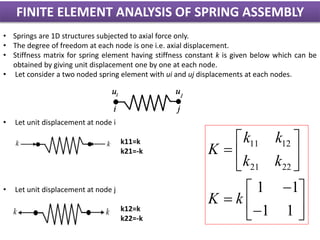
• Springs are 1D structures subjected to axial force only.
• The degree of freedom at each node is one i.e. axial displacement.
• Stiffness matrix for spring element having stiffness constant k is given below which can be
obtained by giving unit displacement one by one at each node.
• Let consider a two noded spring element with ui and uj displacements at each nodes.
• Let unit displacement at node i
k11=k
k21=-k
• Let unit displacement at node j
k12=k
k22=-k
11 12
21 22
1 1
1 1
k k
K
k k
K k
 
  
 
 
   
FINITE ELEMENT ANALYSIS OF SPRING ASSEMBLY
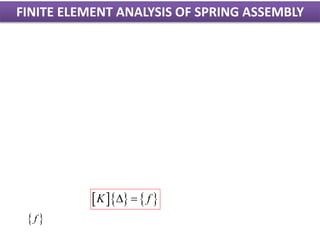
    K f 
 f
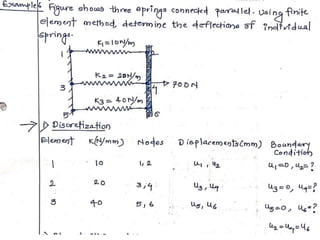
EXAMPLE
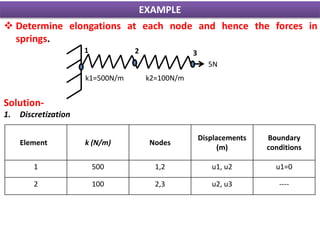
 Determine elongations at each node and hence the forces in
springs.
Solution-
1. Discretization
5N
k1=500N/m k2=100N/m
1 2 3
Element k (N/m) Nodes
Displacements
(m)
Boundary
conditions
1 500 1,2 u1, u2 u1=0
2 100 2,3 u2, u3 ----
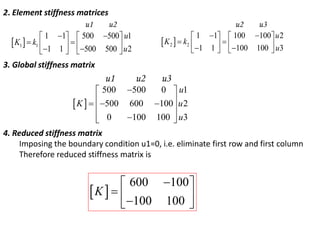
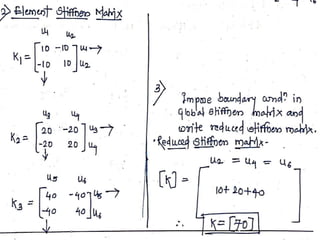
2. Element stiffness matrices
u1 u2 u2 u3
3. Global stiffness matrix
u1 u2 u3
4. Reduced stiffness matrix
Imposing the boundary condition u1=0, i.e. eliminate first row and first column
Therefore reduced stiffness matrix is
 1 1
1 1 500 500 1
1 1 500 500 2
u
K k
u
    
        
 2 2
1 1 100 100 2
1 1 100 100 3
u
K k
u
    
        
 
500 500 0 1
500 600 100 2
0 100 100 3
u
K u
u
 
    
  
 
600 100
100 100
K
 
   
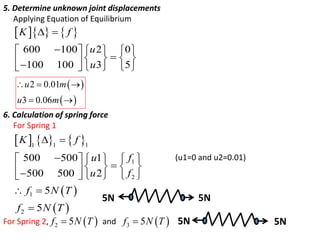
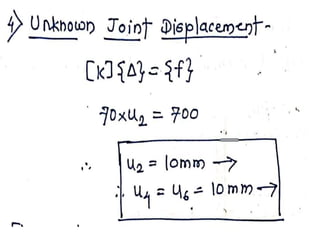
5. Determine unknown joint displacements
Applying Equation of Equilibrium
6. Calculation of spring force
For Spring 1
(u1=0 and u2=0.01)
For Spring 2, and
    
600 100 2 0
100 100 3 5
K f
u
u
 
     
         
     
 
 
1 11
1
2
1
2
500 500 1
500 500 2
5
5
K f
fu
fu
f N T
f N T
 
     
         
 

 2 5f N T  3 5f N T
 
 
2 0.01
3 0.06
u m
u m
  
 
5N5N
5N5N
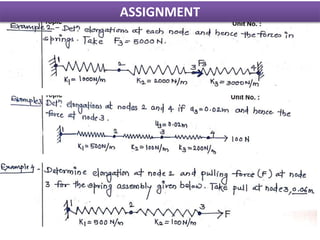
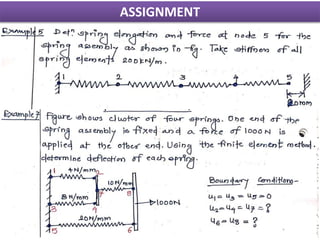
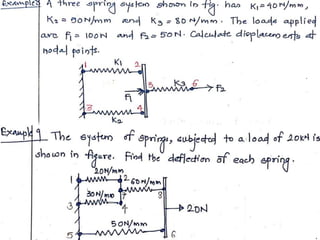
ASSIGNMENT
ASSIGNMENT
Finite Element analysis of Spring Assembly

Finite Element analysis of Spring Assembly

  • 1.
    FINITE ELEMENT ANALYSISOF SPRING ASSEMBLY BY- Ms. JAPE ANUJA S. ASSISTANT PROFESSOR, CIVIL ENGINEERING DEPARTMENT, SRES, SANJIVANI COLLEGE OF ENGINEERING, KOPARGAON-423603. MAID ID: anujajape@gmail.com japeanujacivil@sanjivani.org.in
  • 2.
    FINITE ELEMENT ANALYSISOF SPRING ASSEMBLY • Springs are 1D structures subjected to axial force only. • The degree of freedom at each node is one i.e. axial displacement. • Stiffness matrix for spring element having stiffness constant k is given below which can be obtained by giving unit displacement one by one at each node. • Let consider a two noded spring element with ui and uj displacements at each nodes. • Let unit displacement at node i k11=k k21=-k • Let unit displacement at node j k12=k k22=-k 11 12 21 22 1 1 1 1 k k K k k K k             
  • 3.
    FINITE ELEMENT ANALYSISOF SPRING ASSEMBLY     K f   f
  • 4.
    EXAMPLE  Determine elongationsat each node and hence the forces in springs. Solution- 1. Discretization 5N k1=500N/m k2=100N/m 1 2 3 Element k (N/m) Nodes Displacements (m) Boundary conditions 1 500 1,2 u1, u2 u1=0 2 100 2,3 u2, u3 ----
  • 5.
    2. Element stiffnessmatrices u1 u2 u2 u3 3. Global stiffness matrix u1 u2 u3 4. Reduced stiffness matrix Imposing the boundary condition u1=0, i.e. eliminate first row and first column Therefore reduced stiffness matrix is  1 1 1 1 500 500 1 1 1 500 500 2 u K k u                2 2 1 1 100 100 2 1 1 100 100 3 u K k u                 500 500 0 1 500 600 100 2 0 100 100 3 u K u u             600 100 100 100 K      
  • 6.
    5. Determine unknownjoint displacements Applying Equation of Equilibrium 6. Calculation of spring force For Spring 1 (u1=0 and u2=0.01) For Spring 2, and      600 100 2 0 100 100 3 5 K f u u                             1 11 1 2 1 2 500 500 1 500 500 2 5 5 K f fu fu f N T f N T                       2 5f N T  3 5f N T     2 0.01 3 0.06 u m u m      5N5N 5N5N
  • 10.
  • 11.