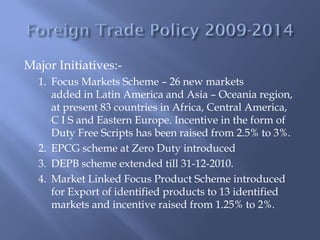
Major Initiatives:-
  1. Focus Markets Scheme – 26 new markets
     added in Latin America and Asia – Oceania region,
     at present 83 countries in Africa, Central America,
     C I S and Eastern Europe. Incentive in the form of
     Duty Free Scripts has been raised from 2.5% to 3%.
  2. EPCG scheme at Zero Duty introduced
  3. DEPB scheme extended till 31-12-2010.
  4. Market Linked Focus Product Scheme introduced
     for Export of identified products to 13 identified
     markets and incentive raised from 1.25% to 2%.
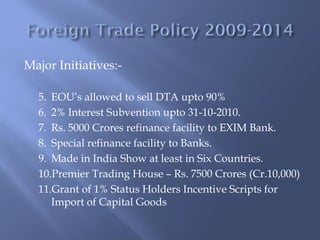
Major Initiatives:-

  5. EOU’s allowed to sell DTA upto 90%
  6. 2% Interest Subvention upto 31-10-2010.
  7. Rs. 5000 Crores refinance facility to EXIM Bank.
  8. Special refinance facility to Banks.
  9. Made in India Show at least in Six Countries.
  10.Premier Trading House – Rs. 7500 Crores (Cr.10,000)
  11.Grant of 1% Status Holders Incentive Scripts for
     Import of Capital Goods
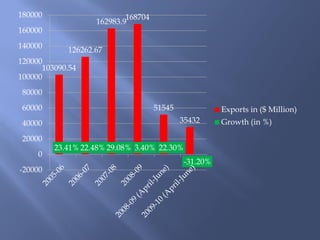
180000                     168704
                   162983.9
160000
140000
            126262.67
120000
      103090.54
100000
 80000
 60000                              51545              Exports in ($ Million)
 40000                                      35432      Growth (in %)

 20000
         23.41% 22.48% 29.08% 3.40% 22.30%
     0
                                             -31.20%
-20000
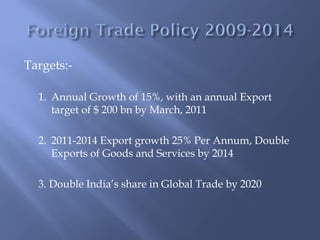
Targets:-

  1. Annual Growth of 15%, with an annual Export
     target of $ 200 bn by March, 2011

  2. 2011-2014 Export growth 25% Per Annum, Double
     Exports of Goods and Services by 2014

  3. Double India’s share in Global Trade by 2020
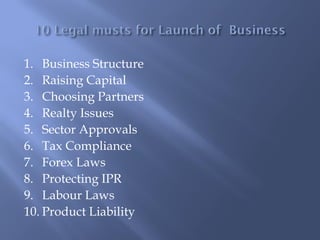
1. Business Structure
2. Raising Capital
3. Choosing Partners
4. Realty Issues
5. Sector Approvals
6. Tax Compliance
7. Forex Laws
8. Protecting IPR
9. Labour Laws
10. Product Liability
Buyer
Study
Execution of an Export Order

 Successful execution of an
 Export Order at least in the
 context of SME’s in our
 Country it is mostly a verbal
 or a very sketchy, often even
 an e-mail order.
It neither contains full
details        normally
desirable    for     an
Exporter, nor the basis
on which this order is
received.
I am referring to an export
Order conforming to the
elements of an Export
contract. If not it may lead
to Trade Disputes in future,
which often result in
non-payment  delay in
payment by the buyer.
So friends in the
changed scenario, i.e.
when we have very little
knowledge about the
character and credit
worthiness of buyer,
It is imperative to have
at least an confirmed
order which should be
based    on     properly
negotiated terms and
conditions under which
We will Export. The
least we can do is to
know about
1. Product - Full
  Details, Specification,
  Size, Number
  i.e. Quantity
2. Pre-Shipment
   Inspection
3. INCO-Terms like FCA,
  FAS, CPT, CIP, FOB, CIF, DDP
4. Taxes, Charges etc.
5. Period of Delivery
 - Mode of Transport
6. Currency – Rate of
  exchange – Fluctuations –
  Mode of Payment
7. Discount,
   Commissions, Packing,
   Licences Requirments
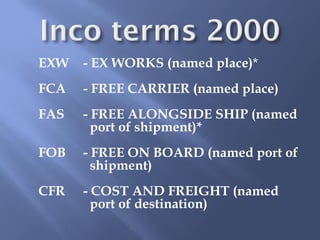
EXW   - EX WORKS (named place)*
FCA   - FREE CARRIER (named place)
FAS   - FREE ALONGSIDE SHIP (named
        port of shipment)*
FOB   - FREE ON BOARD (named port of
        shipment)
CFR   - COST AND FREIGHT (named
        port of destination)
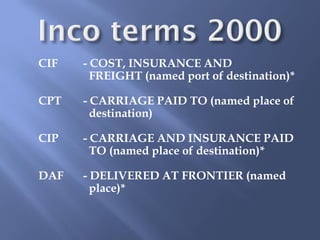
CIF   - COST, INSURANCE AND
        FREIGHT (named port of destination)*

CPT   - CARRIAGE PAID TO (named place of
        destination)

CIP   - CARRIAGE AND INSURANCE PAID
        TO (named place of destination)*

DAF   - DELIVERED AT FRONTIER (named
        place)*
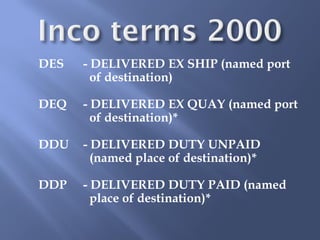
DES   - DELIVERED EX SHIP (named port
        of destination)

DEQ   - DELIVERED EX QUAY (named port
        of destination)*

DDU   - DELIVERED DUTY UNPAID
        (named place of destination)*

DDP   - DELIVERED DUTY PAID (named
        place of destination)*
ICC recommends that
"Incoterms 2000" be referred to
specifically whenever the terms are
used, together with a location. For
example, the term "Delivered at
Frontier" (DAF) should always be
accompanied by a reference to an
exact place and the frontier to which
delivery is to be made.
Here are three examples of
  correct use of Incoterms:
FCA Kuala Lumpur Incoterms 2000

FOB Liverpool Incoterms 2000

DDU Frankfurt Schmidt GmbH Warehouse 4
 Incoterms 2000
1. Advance Payments
2. Documents against Payments
3. Documents against Acceptance
 (a) Provision of Credit without
      Acceptance
4. Letter of Credit
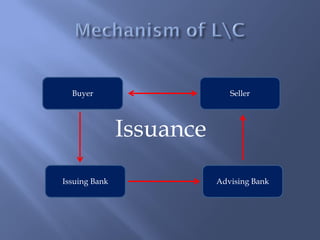
A documentary credit is a signed
instrument        embodying        an
undertaking by the banker of a buyer
to pay his seller a certain sum of
money on presentation of documents
evidencing shipment of specified
goods and subject to compliance with
the stipulated terms and conditions.
Buyer                      Seller


               Issuance
Issuing Bank              Advising Bank
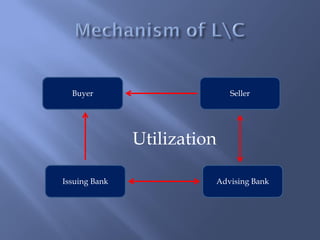
Buyer                      Seller


               Utilization

Issuing Bank             Advising Bank
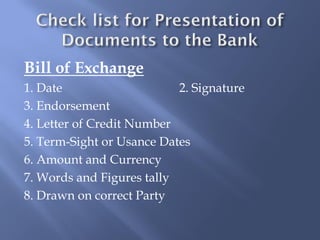
Bill of Exchange
1. Date                    2. Signature
3. Endorsement
4. Letter of Credit Number
5. Term-Sight or Usance Dates
6. Amount and Currency
7. Words and Figures tally
8. Drawn on correct Party
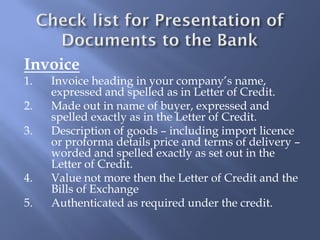
Invoice
1.   Invoice heading in your company’s name,
     expressed and spelled as in Letter of Credit.
2.   Made out in name of buyer, expressed and
     spelled exactly as in the Letter of Credit.
3.   Description of goods – including import licence
     or proforma details price and terms of delivery –
     worded and spelled exactly as set out in the
     Letter of Credit.
4.   Value not more then the Letter of Credit and the
     Bills of Exchange
5.   Authenticated as required under the credit.
Transport Document
1. Type of transport Documents
2. Consignor – can be different from beneficiary
3. Consignee’s name and spelling
4. Places and Ports
5. Clauses
6. On-Deck shipment
Insurance Documents
1. Type e.g. a Certificate
2. Correct amount e.g. CIF or CIP plus per cent
3. Same currency as the Letter of Credit unless otherwise
   stipulated in the Letter of Credit
4. Risks covered
5. Date – not later then date of issue of the transport
   document.
6. Endorsed if necessary
7. The insurance document must indicate the risks are
   covered at least between the place of taking in charge
   or shipment and the place of discharge or final
   destination as stated in credit.
Once the discrepant documents are
tendered to the negotiating bank. The
element of delay is introduced in the
transaction and if the discrepancies are
beyond correction, the security afforded
by the documentary credit is lost and the
seller is solely at the mercy of the buyer.
The buyer has the following options
    available to him
   The buyer take up the documents despite
    discrepancies
   The buyer may use discrepant document as a
    means to delay the payments
   One of the virtues of LC is “insurance against
    renegotiation”
   The buyer might like to wriggle out or
    transaction
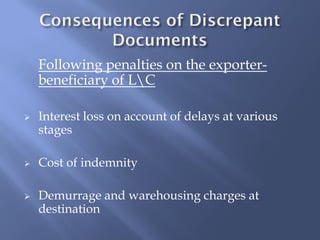
Following penalties on the exporter-
    beneficiary of LC

   Interest loss on account of delays at various
    stages

   Cost of indemnity

   Demurrage and warehousing charges at
    destination
Cost of
Funds
Cost of discount
 either offered or
 foregone
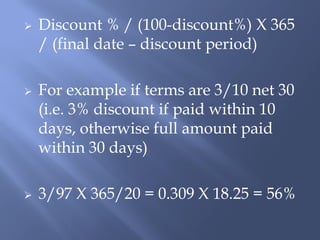
   Discount % / (100-discount%) X 365
    / (final date – discount period)

   For example if terms are 3/10 net 30
    (i.e. 3% discount if paid within 10
    days, otherwise full amount paid
    within 30 days)

   3/97 X 365/20 = 0.309 X 18.25 = 56%
Working
  Capital
Management
Management
     of
 Receivables
Inventory
Management
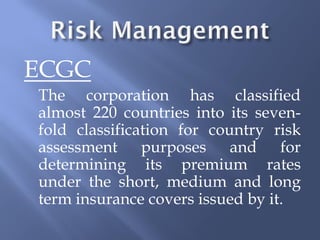
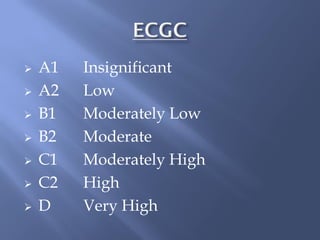
ECGC
The corporation has classified
almost 220 countries into its seven-
fold classification for country risk
assessment purposes and for
determining its premium rates
under the short, medium and long
term insurance covers issued by it.
   A1   Insignificant
   A2   Low
   B1   Moderately Low
   B2   Moderate
   C1   Moderately High
   C2   High
   D    Very High
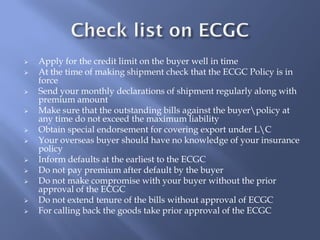
   Apply for the credit limit on the buyer well in time
   At the time of making shipment check that the ECGC Policy is in
    force
   Send your monthly declarations of shipment regularly along with
    premium amount
   Make sure that the outstanding bills against the buyerpolicy at
    any time do not exceed the maximum liability
   Obtain special endorsement for covering export under LC
   Your overseas buyer should have no knowledge of your insurance
    policy
   Inform defaults at the earliest to the ECGC
   Do not pay premium after default by the buyer
   Do not make compromise with your buyer without the prior
    approval of the ECGC
   Do not extend tenure of the bills without approval of ECGC
   For calling back the goods take prior approval of the ECGC
Covering the Foreign Exchange
risk is termed as hedging the
risk. If the company dose not
want to hedge, it means it is
taking a view that the future
movements of exchange rate will
move in its favour.
Banks offer forward exchange contracts both
for sale and purchase transactions to
customers with a maturity date for a fixed
amount at a determined rate of exchange at
the outset. Normally contracts are entered in
India for a period where the maturity period
of the hedge dose not exceed the maturity of
the underlying transaction. The customer has
the option to choose the currency of hedge
and tenor.
An Exporter may need finance for execution of an
Export Order from the date of receipt of an Export-
Order till the date of realization of the Export
proceeds at any stage. Financial assistance
extended to the Exporter from the date of receipt
of Export Order till the date of shipment is known
as pre-shipment credit. This finance is extended to
an exporter for the purpose of procuring raw
materials processing, packing transporting,
warehousing of goods meant for exports. Credit
facility extended to an Exporter from the date of
shipment of goods till the realization of the Export
proceeds is known as post-shipment credit.
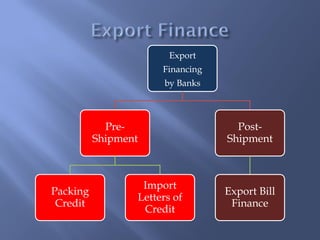
Export
                      Financing
                       by Banks


            Pre-                    Post-
          Shipment                Shipment


                  Import
Packing                           Export Bill
                 Letters of
 Credit                            Finance
                  Credit

Export pro, fin & doc

  • 2.
    Major Initiatives:- 1. Focus Markets Scheme – 26 new markets added in Latin America and Asia – Oceania region, at present 83 countries in Africa, Central America, C I S and Eastern Europe. Incentive in the form of Duty Free Scripts has been raised from 2.5% to 3%. 2. EPCG scheme at Zero Duty introduced 3. DEPB scheme extended till 31-12-2010. 4. Market Linked Focus Product Scheme introduced for Export of identified products to 13 identified markets and incentive raised from 1.25% to 2%.
  • 3.
    Major Initiatives:- 5. EOU’s allowed to sell DTA upto 90% 6. 2% Interest Subvention upto 31-10-2010. 7. Rs. 5000 Crores refinance facility to EXIM Bank. 8. Special refinance facility to Banks. 9. Made in India Show at least in Six Countries. 10.Premier Trading House – Rs. 7500 Crores (Cr.10,000) 11.Grant of 1% Status Holders Incentive Scripts for Import of Capital Goods
  • 4.
    180000 168704 162983.9 160000 140000 126262.67 120000 103090.54 100000 80000 60000 51545 Exports in ($ Million) 40000 35432 Growth (in %) 20000 23.41% 22.48% 29.08% 3.40% 22.30% 0 -31.20% -20000
  • 5.
    Targets:- 1.Annual Growth of 15%, with an annual Export target of $ 200 bn by March, 2011 2. 2011-2014 Export growth 25% Per Annum, Double Exports of Goods and Services by 2014 3. Double India’s share in Global Trade by 2020
  • 6.
    1. Business Structure 2.Raising Capital 3. Choosing Partners 4. Realty Issues 5. Sector Approvals 6. Tax Compliance 7. Forex Laws 8. Protecting IPR 9. Labour Laws 10. Product Liability
  • 7.
  • 8.
    Execution of anExport Order Successful execution of an Export Order at least in the context of SME’s in our Country it is mostly a verbal or a very sketchy, often even an e-mail order.
  • 9.
    It neither containsfull details normally desirable for an Exporter, nor the basis on which this order is received.
  • 10.
    I am referringto an export Order conforming to the elements of an Export contract. If not it may lead to Trade Disputes in future, which often result in non-payment delay in payment by the buyer.
  • 11.
    So friends inthe changed scenario, i.e. when we have very little knowledge about the character and credit worthiness of buyer,
  • 12.
    It is imperativeto have at least an confirmed order which should be based on properly negotiated terms and conditions under which
  • 13.
    We will Export.The least we can do is to know about 1. Product - Full Details, Specification, Size, Number i.e. Quantity
  • 14.
    2. Pre-Shipment Inspection 3. INCO-Terms like FCA, FAS, CPT, CIP, FOB, CIF, DDP 4. Taxes, Charges etc. 5. Period of Delivery - Mode of Transport
  • 15.
    6. Currency –Rate of exchange – Fluctuations – Mode of Payment 7. Discount, Commissions, Packing, Licences Requirments
  • 16.
    EXW - EX WORKS (named place)* FCA - FREE CARRIER (named place) FAS - FREE ALONGSIDE SHIP (named port of shipment)* FOB - FREE ON BOARD (named port of shipment) CFR - COST AND FREIGHT (named port of destination)
  • 17.
    CIF - COST, INSURANCE AND FREIGHT (named port of destination)* CPT - CARRIAGE PAID TO (named place of destination) CIP - CARRIAGE AND INSURANCE PAID TO (named place of destination)* DAF - DELIVERED AT FRONTIER (named place)*
  • 18.
    DES - DELIVERED EX SHIP (named port of destination) DEQ - DELIVERED EX QUAY (named port of destination)* DDU - DELIVERED DUTY UNPAID (named place of destination)* DDP - DELIVERED DUTY PAID (named place of destination)*
  • 19.
    ICC recommends that "Incoterms2000" be referred to specifically whenever the terms are used, together with a location. For example, the term "Delivered at Frontier" (DAF) should always be accompanied by a reference to an exact place and the frontier to which delivery is to be made.
  • 20.
    Here are threeexamples of correct use of Incoterms: FCA Kuala Lumpur Incoterms 2000 FOB Liverpool Incoterms 2000 DDU Frankfurt Schmidt GmbH Warehouse 4 Incoterms 2000
  • 21.
    1. Advance Payments 2.Documents against Payments 3. Documents against Acceptance (a) Provision of Credit without Acceptance 4. Letter of Credit
  • 22.
    A documentary creditis a signed instrument embodying an undertaking by the banker of a buyer to pay his seller a certain sum of money on presentation of documents evidencing shipment of specified goods and subject to compliance with the stipulated terms and conditions.
  • 23.
    Buyer Seller Issuance Issuing Bank Advising Bank
  • 24.
    Buyer Seller Utilization Issuing Bank Advising Bank
  • 25.
    Bill of Exchange 1.Date 2. Signature 3. Endorsement 4. Letter of Credit Number 5. Term-Sight or Usance Dates 6. Amount and Currency 7. Words and Figures tally 8. Drawn on correct Party
  • 26.
    Invoice 1. Invoice heading in your company’s name, expressed and spelled as in Letter of Credit. 2. Made out in name of buyer, expressed and spelled exactly as in the Letter of Credit. 3. Description of goods – including import licence or proforma details price and terms of delivery – worded and spelled exactly as set out in the Letter of Credit. 4. Value not more then the Letter of Credit and the Bills of Exchange 5. Authenticated as required under the credit.
  • 27.
    Transport Document 1. Typeof transport Documents 2. Consignor – can be different from beneficiary 3. Consignee’s name and spelling 4. Places and Ports 5. Clauses 6. On-Deck shipment
  • 28.
    Insurance Documents 1. Typee.g. a Certificate 2. Correct amount e.g. CIF or CIP plus per cent 3. Same currency as the Letter of Credit unless otherwise stipulated in the Letter of Credit 4. Risks covered 5. Date – not later then date of issue of the transport document. 6. Endorsed if necessary 7. The insurance document must indicate the risks are covered at least between the place of taking in charge or shipment and the place of discharge or final destination as stated in credit.
  • 29.
    Once the discrepantdocuments are tendered to the negotiating bank. The element of delay is introduced in the transaction and if the discrepancies are beyond correction, the security afforded by the documentary credit is lost and the seller is solely at the mercy of the buyer.
  • 30.
    The buyer hasthe following options available to him  The buyer take up the documents despite discrepancies  The buyer may use discrepant document as a means to delay the payments  One of the virtues of LC is “insurance against renegotiation”  The buyer might like to wriggle out or transaction
  • 31.
    Following penalties onthe exporter- beneficiary of LC  Interest loss on account of delays at various stages  Cost of indemnity  Demurrage and warehousing charges at destination
  • 32.
  • 33.
    Cost of discount either offered or foregone
  • 34.
    Discount % / (100-discount%) X 365 / (final date – discount period)  For example if terms are 3/10 net 30 (i.e. 3% discount if paid within 10 days, otherwise full amount paid within 30 days)  3/97 X 365/20 = 0.309 X 18.25 = 56%
  • 35.
  • 36.
    Management of Receivables
  • 37.
  • 38.
    ECGC The corporation hasclassified almost 220 countries into its seven- fold classification for country risk assessment purposes and for determining its premium rates under the short, medium and long term insurance covers issued by it.
  • 39.
    A1 Insignificant  A2 Low  B1 Moderately Low  B2 Moderate  C1 Moderately High  C2 High  D Very High
  • 40.
    Apply for the credit limit on the buyer well in time  At the time of making shipment check that the ECGC Policy is in force  Send your monthly declarations of shipment regularly along with premium amount  Make sure that the outstanding bills against the buyerpolicy at any time do not exceed the maximum liability  Obtain special endorsement for covering export under LC  Your overseas buyer should have no knowledge of your insurance policy  Inform defaults at the earliest to the ECGC  Do not pay premium after default by the buyer  Do not make compromise with your buyer without the prior approval of the ECGC  Do not extend tenure of the bills without approval of ECGC  For calling back the goods take prior approval of the ECGC
  • 41.
    Covering the ForeignExchange risk is termed as hedging the risk. If the company dose not want to hedge, it means it is taking a view that the future movements of exchange rate will move in its favour.
  • 42.
    Banks offer forwardexchange contracts both for sale and purchase transactions to customers with a maturity date for a fixed amount at a determined rate of exchange at the outset. Normally contracts are entered in India for a period where the maturity period of the hedge dose not exceed the maturity of the underlying transaction. The customer has the option to choose the currency of hedge and tenor.
  • 43.
    An Exporter mayneed finance for execution of an Export Order from the date of receipt of an Export- Order till the date of realization of the Export proceeds at any stage. Financial assistance extended to the Exporter from the date of receipt of Export Order till the date of shipment is known as pre-shipment credit. This finance is extended to an exporter for the purpose of procuring raw materials processing, packing transporting, warehousing of goods meant for exports. Credit facility extended to an Exporter from the date of shipment of goods till the realization of the Export proceeds is known as post-shipment credit.
  • 44.
    Export Financing by Banks Pre- Post- Shipment Shipment Import Packing Export Bill Letters of Credit Finance Credit