Submitted by

                    Sagar Anand
                           PGDM –IB
                           Roll No-05


IN PARTIAL FULFILMENT OF PGDM IN INTERNATIONAL
   BUSINESS FOR THE ACADEMIC YEAR -2008-10.

                    Under the guidance of

                       Dr. R. Chandran

                    PIMSR, NEW PANVEL


PILLAI’S INSTITUTE OF MANAGEMENT STUDIES & RESEARCH
                  NEW PANVEL, NAVI MUMBAI

(A recognized institute and given A rank by NACC and affiliated to AICTE)
Export Process & Documentation   2


                        COVER PAGE


EXPORT PROCESS
AND
DOCUMENTATION
PROJECT REPORT

This project report entitled “Export Process and
Documentation” based on my knowledge and two
month work experience with committed cargo care
Pvt. Ltd. as a summer trainee.

SAGAR ANAND
7/6/2009


                                      PIMSR
Export Process & Documentation                  3


                       ACKNOWLEDGEMENT


                 Life of human beings is full of interactions.
No one    is self-sufficient by himself whenever anyone    is doing
some serious and       important work a lot of help from the people
concerned is needed & one less specially obliged towards them. I
cannot forget acknowledging them in few words as without        the
guidance & co-ordination of them in my project report     would not
have been possible.

          A large number of individual contributed to this project.
I am thankful to all of them for their help and encouragement.
My writing in this project report has also been influenced by a
number of website and standard textbooks. As far as possible, they
have been fully acknowledged at    the appropriate place .I express
my gratitude to all of them.

            First of all I owe my heartfelt gratitude to my guide prof.
Mr. Guha and prof. Betty for his noble guidance throughout the
completion of the Project.

           I would like to extend my heartfelt thanks to Mr. Vikram
singh rawat, Branch Manager of committed cargo pvt. Ltd. Navi
Mumbai Branch for giving me an opportunity to work on this project.

            I would also like to thank Ms. Kirti, Senior Executive, of
committed cargo pvt. Ltd. for his guidance, inspiration, and
constructive suggestions, which helped me in the Project.

            I must also thank the management of committed cargo
pvt. Ltd. to provide excellent opportunity and environment to be able
to pull my project through. Cooperation of the staff is also gratefully
acknowledged.

             Last but not least, also give my sincere thanks to all the
people to directly indirectly have help and encourage me in finding the
way to us collecting the requisite information and completing the
project effectively and timely.


Sagar Anand
PGDM (IB)
Roll no. - 05


                                  PIMSR
Export Process & Documentation                         4


                 GUIDE CERTIFICATE

              TO WHOMESOEVER IT MAY CONCERN


         This is to certify that the project report titled
“Export    Process      and      Documentation”            Offered        by
Committed cargo Pvt. Ltd.           has been prepared by Sagar
Anand, Roll No.- 05,       a     student         of        PGDM (Post
Graduation Diploma in Management), session (2008-10)
with International Business as major area of specialization.
The study was conducted with special reference to
committed cargo care Pvt. Ltd. C.B.D. Belapur, Navi
Mumbai. I recommend this project for evaluation.


Place:

Date:                                                 (Dr. R. Chandran)
                                                           Director


                                 PIMSR
Export Process & Documentation   5


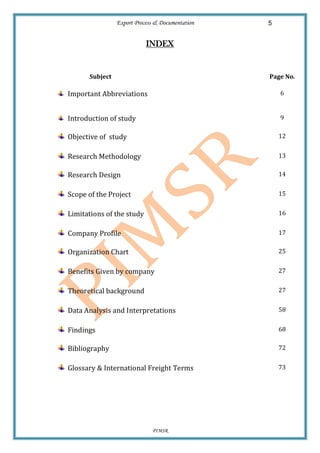
                           INDEX


      Subject                                    Page No.

Important Abbreviations                              6


Introduction of study                                9


Objective of study                                   12


Research Methodology                                 13


Research Design                                      14


Scope of the Project                                 15


Limitations of the study                             16


Company Profile                                      17


Organization Chart                                   25


Benefits Given by company                            27


Theoretical background                               27


Data Analysis and Interpretations                    58


Findings                                             68


Bibliography                                         72


Glossary & International Freight Terms               73


                             PIMSR
Export Process & Documentation   6


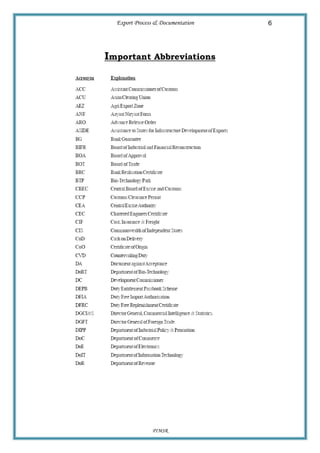
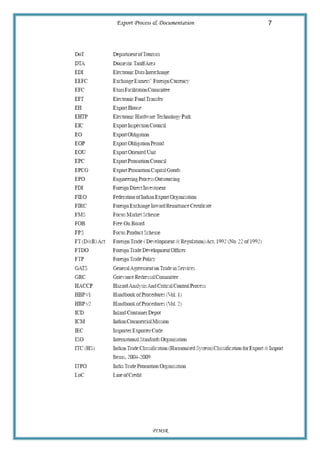
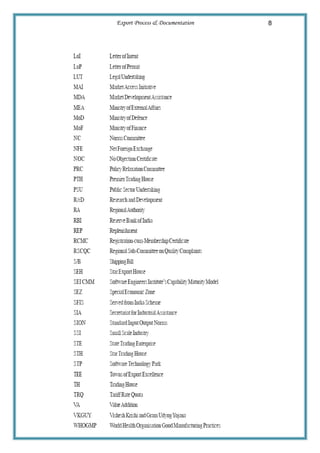
Important Abbreviations


               PIMSR
Export Process & Documentation   7


             PIMSR
Export Process & Documentation   8


             PIMSR
Export Process & Documentation               9


              INTRODUCTION OF STUDY


     This project is all about to know about export import
procedure/ documentation of shipment. This project puts
more focus on to know custom clearness, to make export -
import invoice, to get shipping bill number from custom
department etc. This project will also find out how
Committed cargo Pvt. Ltd. could sustain in the competitive
world by providing vast range of cargo handling through all
instruments which flexible prompt and               innovative in
meeting the requirement of the customer. The purpose of
the study was to know about export – import documentation
of seaway in the committed cargo Pvt. Ltd.

      The India International Coir Fair-2009, which is
coinciding with the golden jubilee celebrations of the Central
Coir Research Institute, is expected to give further fillip to
coir exports from the country by providing better visibility to
coir products in the global market. The celebration of the
International Year of the Natural Fibre is also expected to
draw greater attention to coir and coir products.

Exceeding target

At a meeting of representatives of the coir exporters with the
Board officials to discuss issues related to exports, Mr V.S.
Vijayaraghavan, Chairman of Coir Board, thanked exporters
for their collective efforts in surpassing the export target last
year, both in quantity and value, despite tremendous odds
and conspicuous global impediments.


                                PIMSR
Export Process & Documentation             10


Forex Earnings

Indian coir exports during 2008-09 had touched 1,94,791
tonnes valued at Rs 634 crore, exceeding the target set for
the year.

Coir export was 1,87,566 tonnes valued at Rs 592 crore
during the previous year.

Performance hopes

With the conduct of the India International Coir Fair-2009
and the celebration of the International Year of Natural
Fibre, the Coir Board was confident of better performance
this year.

Mr Vijayaraghavan hoped that the Coir Exporters
Federation would play a leading role in enhancing the
growth of the coir industry in all its dimensions and assured
of the board's full support in taking timely action to redress
the problems of the exporters.

The need to obtain timely governmental sanction to
participate in overseas fairs to achieve greater mileage in the
export market, setting up of a container freight station at
Pollalchi, Tamil Nadu, in view of its growing contribution to
exports and increasing the frequency of the meeting of
exporters with Board officials also received attention at the
meeting held on Monday. It was decided to hold the next
executive committee meeting of the Board at Bangalore on
May 26.


                                PIMSR
Export Process & Documentation            11


Sales turnover

The 30-odd Coir Board showrooms spread over the country
had achieved a sales turnover of Rs 11.19 crore, accounting
for 86.10 per cent of the Rs 13-crore target fixed for the year
2008-09. The meeting also considered suggestions to
revamp these showrooms and sales depots through out the
country in tune with the growing expectations of all
sections, especially the upper strata of society in order to
remain competitive in the domestic market. In this
background, Mr Vijayaraghavan was confident of achieving
the revised sales target of Rs 15 crore set for the showrooms
in the country for the current year.


                                PIMSR
Export Process & Documentation        12


             OBJECTIVE OF THE STUDY


The main objectives of the research were:


    To know about export import process.


    To know what are the documents required before and
      after sailing the cargo.


    To know different type of container used in shipment.


                               PIMSR
Export Process & Documentation   13


            RESEARCH METHODOLOGY


Collect data/information about cargo through:

   Primary data collection:-

                 E-mail

                 Telephone

                 Invoice

                 Packing List


     Secondary data collection:-

                 Invoice

                 Packaging list

                 Shipping bill

                 Internet


                             PIMSR
Export Process & Documentation                 14


                     RESEARCH DESIGN


      Research design is the based framework, which provides
guidelines for the research process. It is a map or blue print according
to which the research is to be conducts. The research design specifies
the methods for data collection & data analysis determine the source
of data. Most specifically it was a kind of “Descriptive conclusive
research” who takes care of who, when, where, what, how and why
aspects of the investigation further the researcher used the statistical
method to serve he purpose of project, it permitted the research to
derive more accurate generalization whose reliability could be
measured.


      CENTRE                         : ALL OVER INDIA

      RESEARCH                        : EXPLORATORY

      RESEARCH TECHNIQUE              : QUALITATIVE & QUANNTATIVE

      TOOL USED                    : TELEPHONIC & E-MAIL

      DATA SOURCE                      : PRIMARY & SECONDARY


                                   PIMSR
Export Process & Documentation                     15


                    SCOPE OF THE STUDY


The scope of marketing research could cover the business
problems relating to the followings.

   Types of consumers that compromise present and potential markets.

   Buying habits and pattern of consumption

   Size and location of different markets, not only in India but also
     overseas.

   The prospects for growth or construction for the current markets being
     served.

   New mantras of emerging segments.

   Marketing and manufacturing capabilities of competitors.

   Most suitable entry timing.

   The current and prospective competitive position.

   Chances of improvement of current channels.


                                   PIMSR
Export Process & Documentation   16


          LIMITATIONS OF THE STUDY


 Not a panacea

 Not an exact science

 Limitation of time

 Erroneous findings

 Not exact tool for forecasting

 In experience research staff

 Narrow conception of marketing research


                               PIMSR
Export Process & Documentation                  17


                     COMPANY PROFILE

             INTRODUCTION OF THE ORGANIZATION


Overview

          An ISO 9001:2000 Company Incorporated head quarter in
the national capital Delhi, India and specializes in handling Import &
Export Cargo. Earning and maintaining a reputation for dependable
and complete worldwide cargo movement solutions with the motto
―Customer Pride‖ achieved this longevity in the volatile cargo industry.

Committed Group has established its hub at Los Angeles, Toronto,
Shanghai, Mumbai, Jaipur, Ludhiana and a reliable network of
associate offices in India and world over and is specialized in
forwarding of cargos choosing the most convenient and cost effective
transportation method by air, courier, sea and truck any time &
anywhere around the globe.

Committed Group management has the right mix of experience and
commitment and is fast to adapt to new emerging technology. Its well-
established network and tracking software enables to provide fast and
reliable information to its client. Thus capable of handling –

    Packaging

    Warehousing

    Freight forwarding

    Clearance of Export and Import Cargo

    Commercial, Diplomatic and Non-Diplomatic Consignment.

    Projects


Mission Statement

―To be focused as a pro-active cargo gateway by anticipating and
reacting to each stage of a shipment's transit with commitment and to
experience strategic growth of a highly respected and recognized cargo
company in the Industry‖.


                                  PIMSR
Export Process & Documentation                  18


Team

The Committed Group management team brings together leaders with
a wealth of expertise from various industries, including
transportation, logistics, cargo management, professional services and
customer service.

             These individuals form a strong foundation that provides
vision and support to a growing team of talented, dedicated
professionals working to adopt and deliver professional freight
forwarding solutions and custom clearance.

The Operational team at Committed Group comprising of more than
50 in-house trained energetic and aggressive group of employees with
several years of experience in the international freight forwarding plus
an protracted experience in the reputable shipping lines and airlines.

Thus, with strong gamut of professional from cargo industry under
one roof help Committed Group to adopt the "Total Freight
Management" approach, a feature of which is the handling of client
cargo on a door-to-door basis.

            This approach ensures the correct management of cargo in
a cost-efficient and professional way at competitive price and feels
Committed Group is the RIGHT PARTNER FOR YOU.


Services


    Air Freight

    Custom Clearance

    Document Processing

    Multi Modal Facility

    3 PL & Supply Chain Management

    Packaging & Warehousing

    Tracking & Tracing


                                  PIMSR
Export Process & Documentation               19


Multi Modal Facility

At Committed Group it is a single window contract for the carriage of
goods by at least two or more different modes of transport. Thus,
providing a permutation-combination between air- ocean-surface
modes to reduce the cost of transportation. This includes Door pick to
Door delivery and a complete logistics support constituting of:

»   Origin Pickup/Trucking.
»   Warehousing if required.
»   Customs Clearance & Documentation at origin.
»   Origin charges payable like THC, B/L Fee etc.
»   Carriage by Sea or Air by payment of Freight.
»   Inland Trucking if required.
»   Customs Clearing of goods at destination and Warehousing if need be.
»   Door Delivery of the cargo.

Committed Group operates as Multimodal Transport Operator (MTO)
providing the end 2 end services like:

DDP: Delivered Duty Paid Shipments.

DDU: Delivered Duty Unpaid Shipments.

CI Shipments: Cargo picked up on cost and insurances terms

CF Shipments: Cargo picked up on cost and freight paid terms

CIF Shipments: Cargo picked up on cost Insurance and freight paid
terms.

FOB: Free on Board Shipment. Only Port to port or Apt to Apt service
by Carrier.

Ex Works: Pick up if cargo from shipper’s warehouse/factory.

Multimodal Transport (MT) Document
Services along with logistic documentation evidencing a multimodal
transport contract which can be replaced by electronic data
interchange messages insofar as permitted by applicable law and be

(a)Issued in a negotiable form or,

(b) Issued in a non-negotiable form indicating a named consignee.

Taken in charge means that the goods have been handed over to and
accepted for carriage by the MTO for delivery.


                                     PIMSR
Export Process & Documentation                 20


Delivery of the Cargo through Multimodal facility

This is done after completion of various documentation and
formalities after the arrival of the shipment at destination.

The Cargo delivery is subject to various terms and conditions to be
fulfilled by the consignee as listed below:

1. Payment of all applicable charges to the delivery agent of the
carrier.
2. On presentation of Duly Endorsed Original Bill of Lading (for Sea /
Ocean                                                     Shipments).
3. For Air shipments, an Authority Letter is required.
4.                              Original                          DIC.
5. In case of shipments under L/C, the designated Bank need to
endorse the Bill of Lading or issue
     A   Bank      Release    Order    in favour   of   the    carrier.

Committed Group as an MTO undertakes to perform or to procure the
performance of all acts necessary to ensure delivery of the goods /
cargo                      with                       responsibility:

   (a) When the MT document has been issued in a negotiable form
       "to bearer", to the person surrendering one original of the
       document, or

   (b) When the MT document has been issued in a negotiable form
   "to order", to the person surrendering one original of the document
   duly endorsed, or

(c) When the MT document has been issued in a negotiable form to a
named person, to that person upon

   Proof of his identity and surrender of one original document; if
such document has been transferred "to Order" or in blank the
provisions of (b) above apply, or

(d) When the MT document has been issued in a non-negotiable form,
to the person named as consignee in the document upon proof of his
identity, or

(e) When no document has been issued, to a person as instructed by
the consignor or by a person who has acquired the consignor's or the
consignee's rights under the multimodal transport contract to give
such                                                   instructions.


                                  PIMSR
Export Process & Documentation                    21


Period of responsibility

        The responsibility of Committed Cargo Care Pvt. Ltd. as a
Multimodal Transport Operator (MTO) for the goods under these Rules
covers the period from the time the MTO has taken the goods in his
charge       to      the       time      of     their      delivery.

         The multimodal transport operator shall be responsible for
the acts and omissions of its employee or agents, when any such
employee or agent is acting within the scope of his employment, or of
any other person of whose services he makes use for the performance
of the contract, as if such acts and omissions were his own.


Packaging & Warehousing


Packaging at Committed Group

    Committed Group employs professional packers and experienced
supervisors who are trained packing and packaging. We specialize in
handling fragile / heavy / oversized cargo. For packaging, we use
material like craft paper / soft papers, corrugated rolls & boxes, air
bubble pack rolls, polythene & polypropylene, and masking tape, etc.
depending upon the requirement.

       We design fabrication and assembly of crating material for
packaging machinery and equipment for storage or shipment and
usage of correct primary protective packing materials to insulate
machinery and equipment from moisture, corrosion and excessive
shock. Crating and the use of machines to execute packing and
moving operations has resulted in accolades and sustained patronage
by clients in India and abroad.

Warehousing at Committed Group

   Committed Group offer warehousing facilities to support export -
import activities. The warehousing facilities are very helpful to
accelerate the transportation of goods, especially for cargos with LCL
Status.   We   use    authorised      warehouses      located   worldwide.


    Further to our covered warehousing facilities are provided for
storing of FMCG, industrial and high-end sophisticated products on
transit. The warehouses are equipped with dedicated loading and
unloading                                                            bays.


                                   PIMSR
Export Process & Documentation               22


At Committed Group storage areas of warehouses are demarcated to
identify each location. Our distribution centres offer ample space for
palletizing, crating and packing services according to customers’
specifications.

3 PL & Supply Chain Management


      At Committed Group, we define functional experience, expertise,
speed, flexibility, and ingenuity to manage your freight efficiently
everytime.

       As an experienced provider of 3PL (Third Party Logistics) 24 x 7,
we provide a total supply chain solution for your logistics and freight
management needs. Our ongoing goal is to simplify the shipping
process for our clients by finding the best rates and then smoothly
coordinating all aspects of the shipment from pick-up to ship to
delivery for our E2E, B2E, B2B, B2C and C2C clientele base.

        At Committed Group, we practice logistics. We can develop a
comprehensive project plan for your organization, deploy a project
team, and remain with your team through the implementation and
start-up. We analyze existing processes, from initiation of an order
through fulfillment, and evaluate modal selection, carrier utilization,
and existing cost structures. We formulate a customized solution for
your unique needs.
Committed group is a hub-based third party fulfilment and logistics
company servicing both domestic and international needs.

   Services include: Complete Supply Chain Operations: End-to-
   End

    Full   Case Pick Modules

    Split Case Pick Modules

    Tilt      Tray Sorter

    Sliding        Shoe Sorter

    CAPS         Line

    Pick-to-Light

    Kitting

    Product/Process QA Management


                                      PIMSR
Export Process & Documentation                   23


    Performance-driven Controls

    Standard and Customized Reporting

    Inventory control

    Private and Public Delivery Network


      Invoicing

    Call Centre Support

    Diverse Product Categories Returns processing

    Assembly and inbound / outbound freight management.

    Accounts Management, and advanced in-house Systems
     Support.

    A-frame and Real-Time RF-Controlled Inventory System

       Along with state-of-the-art distribution, our 3PL and SCM
services offers clients around the clock full service fulfilment support.
Additional services available: extensive print support, product
packaging and ware housing.


Our 3PL solution and Supply Chain Management enables cost savings
and better route planning


    Ability to connect customers and their supply chain partners
     through a real-time information hub

    10-15% reduction in transportation costs

    Real-time monitoring of inventory, orders and events

      Intelligent order sourcing across multiple stocking locations

    10-15% cost improvement for fleets


Tracking & Tracing

        Committed Group big advantages offer to our customers is the
one stop online track and trace facility. Through this site you now


                                   PIMSR
Export Process & Documentation                  24


have the ability to monitor your consignments online or web access at
any time, day or night, without the need to constantly refer back to
your forwarder. Our system offers access on a 24/7 basis for all
consignments       shipped        by        road,      sea   and     air.


       Updated daily, the moment you entrust your consignment
given a reference number and subsequently logged on our system the
same day. All customers are assigned unique login details to allow
immediate tracking of their consignments. The unique login codes
ensure total security by baring others from viewing the same
information. The accessible information is kept on a secure location
and is accessed through a strict password system. The information
available from our track and trace facility is flexible and can be
tailored to your individual needs. Thus, a global network of contacts
and our combined wealth of experience ensure that your shipments
are transported effectively and efficiently. Committed Group Track and
Trace facility is available for obtaining your freight consignment status
with most major Airlines.


                                   PIMSR
Export Process & Documentation   25


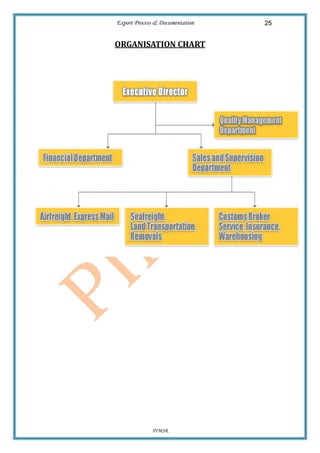
ORGANISATION CHART


             PIMSR
Export Process & Documentation       26


       BENEFITS GIVEN BY COMPANY


 Origin Pickup/Trucking.

 Warehousing if required.

 Customs Clearance & Documentation at origin.

 Origin charges payable like THC, B/L Fee etc.

 Carriage by Sea or Air by payment of Freight.

 Inland Trucking if required.

 Customs Clearing of goods at destination and
  Warehousing if need be.

 Door Delivery of the cargo.


                          PIMSR
Export Process & Documentation                   27


              THEORETICAL BACKGROUND

LOGISTICS SYSTEM

      Logistics is defined by the council of Logistics, Ohio USA as the

Process of planning, implementing and controlling the efficient, co-
effective flow and storage flow and storage of raw materials, in process
inventory finished goods and related information from point of origin
to point consumption. More simply, the objective of Logistics System
is that the right products reach the right place in the right quantity at
the right time to satisfy customer demand.


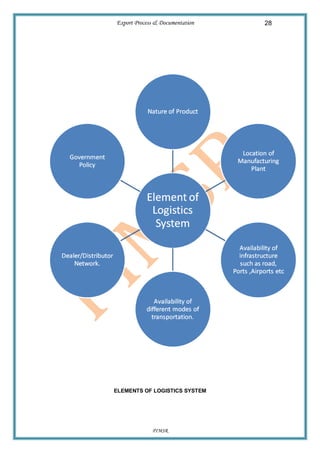
ELEMENTS OF LOGISTICS SYSTEM


 Nature of Product


 Location of Manufacturing Plant


 Availability of infrastructure such as Road


 Availability of different modes of transportation


 Dealer/Distributor Network


 Government Policy


                                   PIMSR
Export Process & Documentation   28


ELEMENTS OF LOGISTICS SYSTEM


             PIMSR
Export Process & Documentation                     29


MODE OF TRANSPORTATION


   AIR TRANSPORT

   OCEAN TRANSPORT

   RAIL TRANSPORT

   ROAD TRANSPORT


  OCEAN TRANSPORT

  More than 95 per cent of international trade is conduced by sea
  routes since ancient times, sea routes are being used for
  transportation of cargo from one continent or country to Coastal
  shipping is also used for transporting the cargo from one port
  within the country to another.


  For example in India the cargo can be transported from Chennai
  port to Visakhapatnam port using the costal shipping route.


                     Sea    routes     are    used   for   carrying   bulj
  commodities like such as coaling and thermal coal mires, fertilizers
  rock phosphate etc, and liquid go like crude oil ammonium acids
  etc Ideally the goods with high volume and kiw vakye are suited
  die ocean transport in the era of containerisation even the high
  value cargo can be safely enabled the cargo carrying capacities of
  the ship to increase many fold.


                     In 1956, the first containerised ship belonging
  to sea land corp. carried 58 twenty feet containers. The modern
  ships have the capacity to carry 7000 containers.


                                 PIMSR
Export Process & Documentation             30


                          One of the biggest ships owned by Maersk-sea
    land is 1,138 feet long from end to end and 140 feet wide at mid
    ship. Such ships are called Post-Panamax ship.


                Cargo     ship categorised into followings:-


     Liners ships : Liners ship represent the organized sector of the
shipping industries due to their fixed schedules of arrival and
departure, Pre-determined voyages and trade routes and published
ocean freight rates. Liner shipping is governed by shipping conference
and offers the following advantage to shippers:-

       Regular sailings to scheduled ports of call.

       Stable freight rates for a long period of time which helps the
            shipper to quote C & F prices with confidence.

       Uniform rates for all shippers.

       Coverage of wide range of ports.

       Rebates of freight rates based on loyalty agreements.


     Tramp ships:- Tramp ships on the other hand have the
following      characteristics –


                They are free to move anywhere on the high seas at their
                  will.


                Their voyage routes and schedules are flexible.


                                       PIMSR
Export Process & Documentation                  31


 They    travel from the port to another port o various trade
   routes looking for the cargo and carrying the same to various
   routes looking for the cargo and carrying the same to various
   destinations around the world.


 They arrive or depart without a fixed route or schedule.


 They fix their voyages according to availability of cargo
   and as per the requirement of the shippers of these
   cargoes.


 The freight rates of tram ships depend upon the
   demand and supply conditions in the shipping
   industry. If there is a glut of shipping space the tramp
   freight rates plummet. Whereas in case of shortage of
   shipping space, the tramp freight rates shoot up.


 The cargo space on the tramps is booked by the
   brokers located in major port cities like New York,
   London, Rotterdam Hamburg, and Hong- Kong etc.
   They work as a link between tramp operators and
   shippers.


                      PIMSR
Export Process & Documentation              32


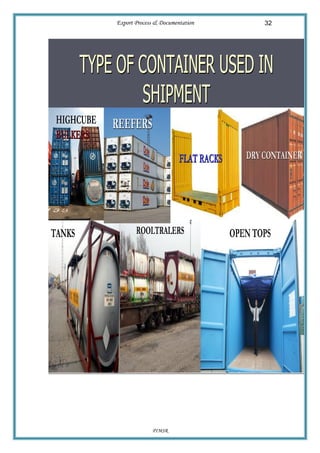
        TYPE OF CONTAINER USED IN
                 SHIPMENT
 HIGHCUBE   REEFERS
 BULKERS
                                    FLAT RACKS      DRY CONTAINER


TANKS              ROOLTRALERS                   OPEN TOPS


                         PIMSR
Export Process & Documentation                               33


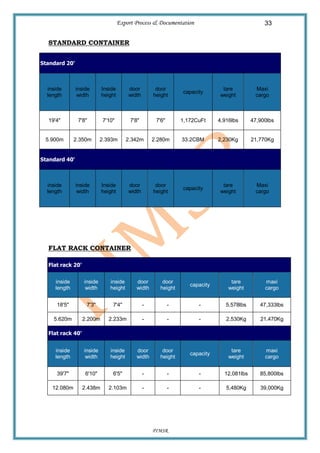
  STANDARD CONTAINER
  STANDARD CONTAINERS:

Standard 20'


  inside       inside      Inside       door         door                      tare          Maxi
                                                                capacity
  length        width      height       width       height                    weight         cargo


  19'4"         7'8"       7'10"         7'8"        7'6"       1,172CuFt     4,916lbs      47,900lbs


 5.900m       2.350m       2.393m      2.342m       2.280m      33.2CBM       2,230Kg       21,770Kg


Standard 40'


  inside       inside      Inside       door         door                      tare          Maxi
                                                                capacity
  length        width      height       width       height                    weight         cargo


  FLAT RACK CONTAINER

  Flat rack 20'


     inside       inside      inside       door        door                        tare          maxi
                                                                   capacity
     length        width      height       width      height                      weight         cargo


     18'5"         7'3"        7'4"             -           -         -          5,578lbs      47,333lbs

    5.620m        2.200m      2.233m            -           -         -          2,530Kg       21,470Kg

  Flat rack 40'


     inside       inside      inside       door        door                        tare          maxi
                                                                   capacity
     length        width      height       width      height                      weight         cargo


     39'7"         6'10"       6'5"             -           -         -         12,081lbs      85,800lbs

    12.080m       2.438m      2.103m            -           -         -          5,480Kg       39,000Kg


                                                    PIMSR
Export Process & Documentation                                   34


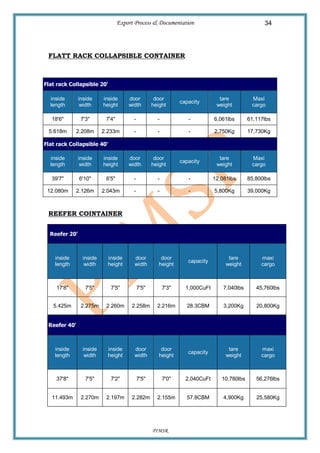
 FLATT RACK COLLAPSIBLE CONTAINER


Flat rack Collapsible 20'

  inside       inside    inside      door          door                        tare          Maxi
                                                               capacity
  length        width    height      width        height                      weight         cargo

   18'6"        7'3"      7'4"         -            -             -          6,061lbs       61,117lbs

 5.618m      2.208m      2.233m        -            -             -          2,750Kg        17,730Kg

Flat rack Collapsible 40'

  inside       inside    inside      door          door                        tare          Maxi
                                                               capacity
  length        width    height      width        height                      weight         cargo

   39'7"       6'10"      6'5"         -            -             -          12,081lbs      85,800lbs

 12.080m     2.126m      2.043m        -            -             -          5,800Kg        39,000Kg


 REEFER COINTAINER


  Reefer 20'


    inside      inside     inside       door          door                         tare          maxi
                                                                  capacity
    length       width     height       width        height                       weight         cargo


    17'8"         7'5"      7'5"           7'5"         7'3"     1,000CuFt       7,040lbs      45,760lbs


   5.425m       2.275m    2.260m      2.258m        2.216m       28.3CBM         3,200Kg       20,800Kg


 Reefer 40'


    inside      inside     inside       door          door                         tare          maxi
                                                                  capacity
    length       width     height       width        height                       weight         cargo


    37'8"         7'5"      7'2"           7'5"         7'0"     2,040CuFt      10,780lbs      56,276lbs


   11.493m      2.270m    2.197m      2.282m        2.155m       57.8CBM         4,900Kg       25,580Kg


                                                  PIMSR
Export Process & Documentation                      35


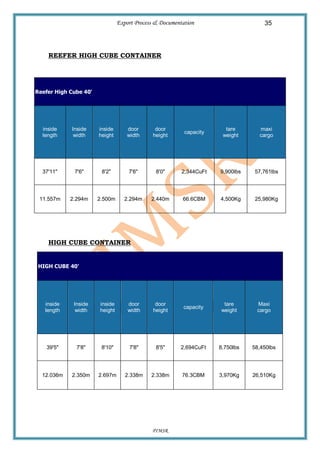
    REEFER HIGH CUBE CONTAINER


Reefer High Cube 40'


  inside    Inside     inside       door       door                    tare       maxi
                                                          capacity
  length     width     height       width     height                  weight      cargo


  37'11"     7'6"       8'2"        7'6"       8'0"      2,344CuFt   9,900lbs   57,761lbs


 11.557m    2.294m     2.500m      2.294m    2.440m      66.6CBM     4,500Kg     25,980Kg


    HIGH CUBE CONTAINER


 HIGH CUBE 40'


   inside    Inside    inside       door       door                   tare       Maxi
                                                          capacity
   length     width    height       width     height                 weight      cargo


    39'5"     7'8"      8'10"        7'8"      8'5"     2,694CuFt    8,750lbs   58,450lbs


  12.036m   2.350m     2.697m      2.338m    2.338m      76.3CBM     3,970Kg    26,510Kg


                                             PIMSR
Export Process & Documentation                       36


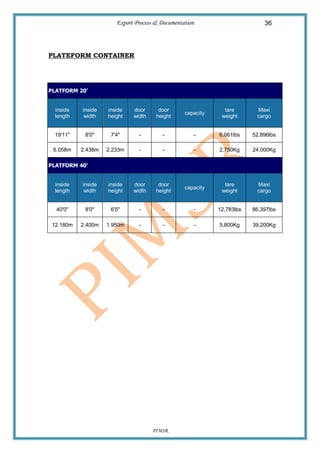
PLATEFORM CONTAINER


PLATFORM 20'


  inside   inside   inside   door      door                   tare       Maxi
                                                 capacity
  length    width   height   width    height                 weight      cargo


 19'11"     8'0"     7'4"      -        -           -       6,061lbs    52,896lbs

 6.058m    2.438m   2.233m     -        -           -       2,750Kg     24,000Kg

PLATFORM 40'


  inside   inside   inside   door      door                   tare       Maxi
                                                 capacity
  length    width   height   width    height                 weight      cargo


  40'0"     8'0"     6'5"      -        -           -       12,783lbs   86,397lbs

 12.180m   2.400m   1.950m     -        -           -       5,800Kg     39,200Kg


                                     PIMSR
Export Process & Documentation   37


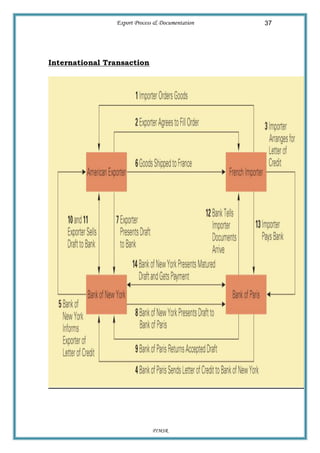
International Transaction


                             PIMSR
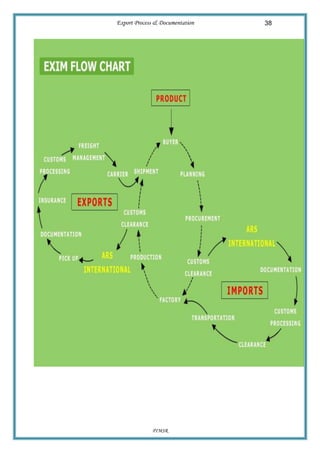
Export Process & Documentation   38


             PIMSR
Export Process & Documentation   39


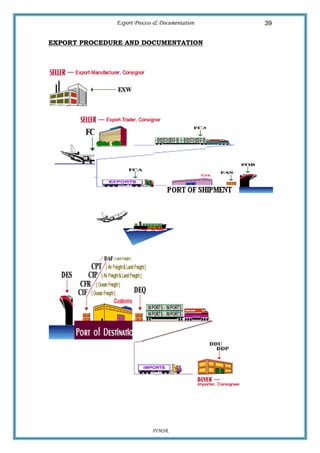
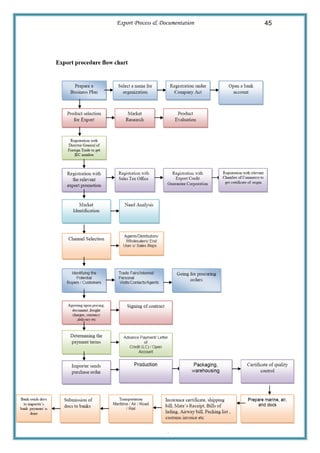
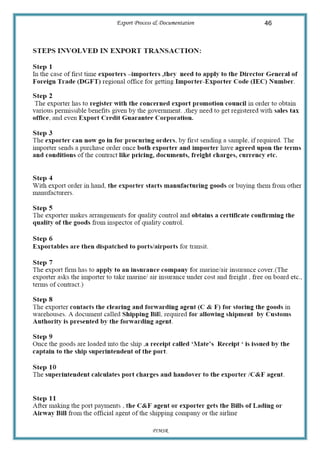
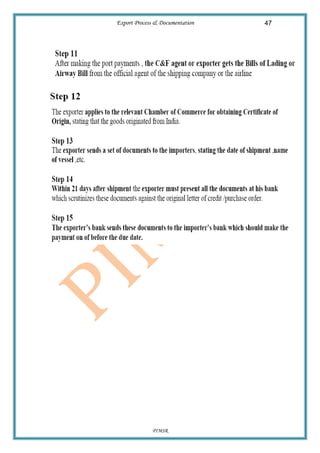
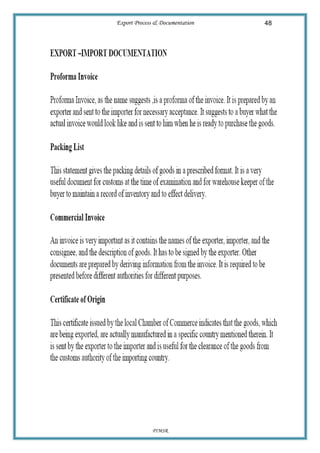
EXPORT PROCEDURE AND DOCUMENTATION


                            PIMSR
Export Process & Documentation                    40


In India, ships transport more than 90 per cent of the cargo. It
therefore interesting to study the export processed by ship
documentation related to it.
Processing of an export order-----

  i. Exporter operation starts with the receipt of enquiry by the
       exporter from importer. Bar on the enquiry exporter submits his
       offer giving complete details of products technical specific price
       delivery payment terms etc.

 ii. After the process negotiations importer sends a purchase order
       follow by letter of credit (if applicable).

 iii. The exporter manufactures the goods              according   to   the
        specification given in purchase order.

 iv. As soon as the      goods are ready the exporters invites the
       representative of Export inspections agency (EIA) for pre
       shipment inspection and obtain the certificate of inspection.

 v. After that, the exporter prepared following documents:----

          INVOICE
          PACKING LIST
          ARE1 FROM EXSICE DEPARTMENT
          MARINE INSURANCE POLICY
          COPY OF PURCHASE ORDER / L/C
 vi. Above those documentation sends to CHA by exporter.

vii. Based on these documents CHA agent completes the octroi
      formalities, obtain port permit and prepare shipping bill which
      is a customs documents.

viii. Custom department check the export cargo on the basis of
       information provided on the shipping bill. If satisfy then cargo
       allow to loaded on the board of ship.

 ix. The shipping line gives mate receipts to CHA agents after the
       payment of ocean freights and port due obtains the bill of lading


                                   PIMSR
Export Process & Documentation                 41


     (B/L) from shipping line .B/L is a proof of dispatch of cargo and
     also a negotiable document.

 x. After that, CHA agent send various documents back to exporter
      which is—
          Customs attested invoice

         Copy of shipping bill

         Full set of non board bill of lading.

         Copy of purchase order or L/C

         Copies of ARE1 Form

         SDF form

xi. After that the exporter submitted above these documents for
      negotiation to the bank which include :----
          Commercial invoice

         Packing list

         SDF form

         Original copy of purchases order

         Certificate of origin

         Bill of exchange

         Shipment advice


   After that, bank scrutinizes these documents and if found correct
make payment to exporter against documentations.


                                  PIMSR
Export Process & Documentation                      42


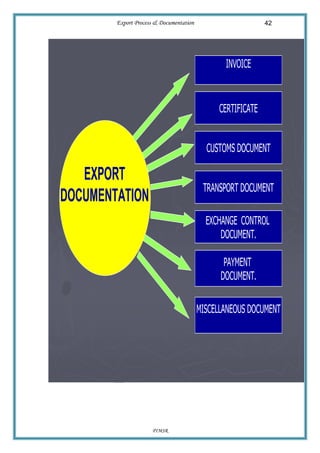
                                                INVOICE


                                              CERTIFICATE


                                           CUSTOMS DOCUMENT

   EXPORT
                                          TRANSPORT DOCUMENT
DOCUMENTATION
                                           EXCHANGE CONTROL
                                               DOCUMENT.

                                                PAYMENT
                                               DOCUMENT.

                                         MISCELLANEOUS DOCUMENT


                     PIMSR
Export Process & Documentation   43


                           EXPORT INVOICE


ELEMENT OF EXPORT INVOICE:-

   Exporter

   Consignee

   Invoice No. and Date

   Exporter Ref.

   Buyer order no and date

   Other reference

   Buyer (other than consignee)

   Country of origin of goods

   Country of final destination

   Terms of delivery and Payment

   Pre-carriage by

   Place of receipt by pre-carrier

   Vessel/ Flight no.

   Port of loading

   Port of discharge

   Final Destination

   Marks and Nos. / No & Kind of pkgs.


                                   PIMSR
Export Process & Documentation   44


 Item code

 Description of goods

 Net weight

 Gross weight

 Quantity

 Rate CIF EURO

 Amount CIF EURO

 Amount in words

 Declaration:

 Authorised signature


                               PIMSR
Export Process & Documentation   45


             PIMSR
Export Process & Documentation   46


             PIMSR
Export Process & Documentation   47


             PIMSR
Export Process & Documentation   48


             PIMSR
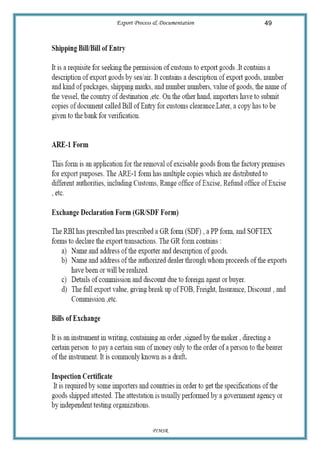
Export Process & Documentation   49


             PIMSR
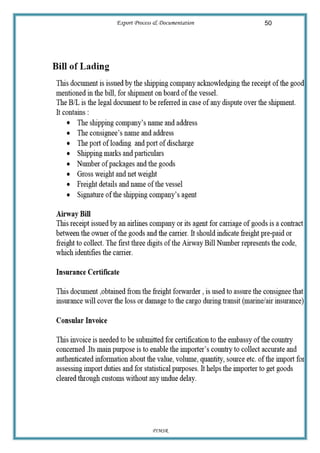
Export Process & Documentation   50


             PIMSR
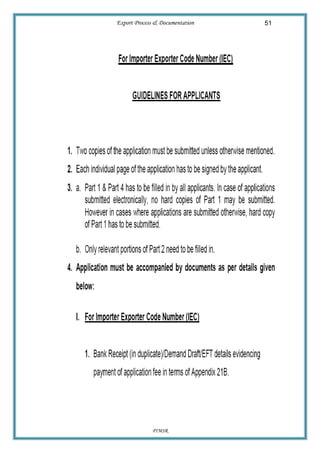
Export Process & Documentation   51


             PIMSR
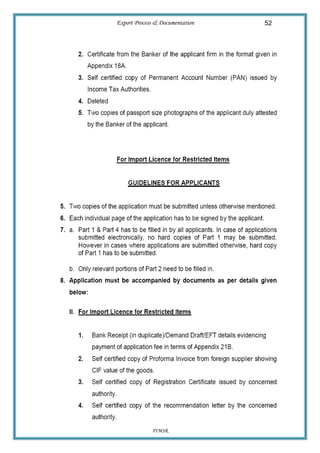
Export Process & Documentation   52


             PIMSR
Export Process & Documentation   53


             PIMSR
Export Process & Documentation   54


             PIMSR
Export Process & Documentation   55


             PIMSR
Export Process & Documentation   56


             PIMSR
Export Process & Documentation   57


             PIMSR
Export Process & Documentation                      58


                     DATA ANALYSIS


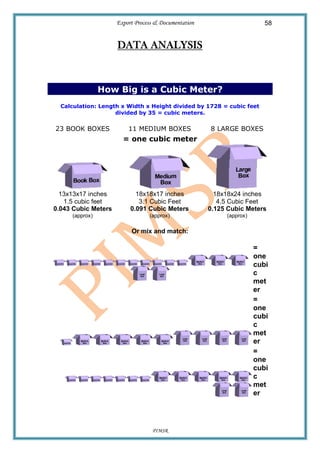
                How Big is a Cubic Meter?
  Calculation: Length x Width x Height divided by 1728 = cubic feet
                    divided by 35 = cubic meters.


23 BOOK BOXES            11 MEDIUM BOXES              8 LARGE BOXES
                       = one cubic meter


  13x13x17 inches           18x18x17 inches             18x18x24 inches
   1.5 cubic feet            3.1 Cubic Feet              4.5 Cubic Feet
0.043 Cubic Meters        0.091 Cubic Meters          0.125 Cubic Meters
     (approx)                    (approx)                  (approx)

                          Or mix and match:

                                                                      =
                                                                      one
                                                                      cubi
                                                                      c
                                                                      met
                                                                      er
                                                                      =
                                                                      one
                                                                      cubi
                                                                      c
                                                                      met
                                                                      er
                                                                      =
                                                                      one
                                                                      cubi
                                                                      c
                                                                      met
                                                                      er


                                  PIMSR
Export Process & Documentation           59


Air freight calculation

Introduction

Airlines that are members of the International Air Transport
Association (IATA) are bound by their membership to
comply with tariffs issued by IATA. However since 11th
September 2002, airfreight rates are now extremely
negotiable. Airfreight rates cover transportation from the
airport of loading to the airport of discharge.

These rates do not include the following:

     Collection of air cargo from the consignor's/exporters
      premises
     Delivery of cargo from the airport of destination to the
      consignee's premises
     Storage of cargo before or after loading
     Customs clearance in the country of destination
     Any duties and taxes that may have to be paid
     Insurance

Chargeable/volumetric weight

Airline freight rates are based on a "chargeable weight",
because the volume or weight that can be loaded into an
aircraft is limited. The chargeable weight of a shipment will
be either the "actual gross mass" or the "volumetric weight",
whichever is the highest. The chargeable weight is
calculated as follows: 1 metric ton = 6 cubic metres. In
order to establish if the cargo will be a weight or volumetric
based shipment.


                                PIMSR
Export Process & Documentation           60


Step 1

Measure the parcel/cargo along the greatest length, width
and height of that parcel. For example; 100 cm (L) X 100 cm
(W) X 100 cm (H) = 1 000 000 cm3. Next, weigh the parcel;
assume it weighs 150kg.

Step 2

Now divide the 1 000 000 cm3 by 6 000 = 166,66 kg. You
have now converted the centimeters (cm) into kilograms (kg)

Step 3

Now compare the weight to the volume. If the weight is 150
kg then the airline would base the freight on the higher
amount being: 166,66 kg

Air freight calculations

The airline calculates freight based on weight or volume,
which ever yields the greatest amount. Airlines quote freight
rates based on the following rate structures:

     A basic minimum charge per shipment.
     General cargo rates quoted for per kilogram. This rate
      applies without reference to the nature or description
      of the parcel, which is to be freighted.
     Specific commodity rates apply to certain goods of
      specific descriptions, such as fresh produce. These
      rates are lower than the general cargo rate, and they
      provide breakpoints at which the level of the rate
      reduces further.

Example:
0 - 50 Kg @ R22.00/per kg
50 - 100 Kg @ R19.00 per kg
100 - 150 Kg @ R17.00 per kg

Unit Load Device charges

These rates are charged per container/ULD without
reference to the commodity loaded therein. Calculation of
freight rates:

                               PIMSR
Export Process & Documentation            61


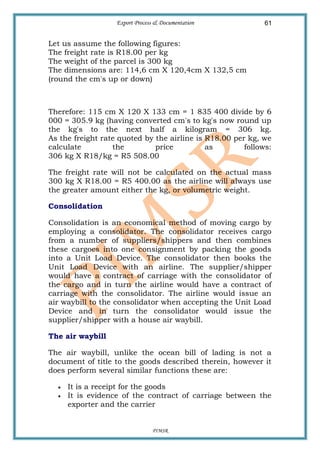
Let us assume the following figures:
The freight rate is R18.00 per kg
The weight of the parcel is 300 kg
The dimensions are: 114,6 cm X 120,4cm X 132,5 cm
(round the cm's up or down)


Therefore: 115 cm X 120 X 133 cm = 1 835 400 divide by 6
000 = 305.9 kg (having converted cm's to kg's now round up
the kg's to the next half a kilogram = 306 kg.
As the freight rate quoted by the airline is R18.00 per kg, we
calculate         the         price          as        follows:
306 kg X R18/kg = R5 508.00

The freight rate will not be calculated on the actual mass
300 kg X R18.00 = R5 400.00 as the airline will always use
the greater amount either the kg, or volumetric weight.

Consolidation

Consolidation is an economical method of moving cargo by
employing a consolidator. The consolidator receives cargo
from a number of suppliers/shippers and then combines
these cargoes into one consignment by packing the goods
into a Unit Load Device. The consolidator then books the
Unit Load Device with an airline. The supplier/shipper
would have a contract of carriage with the consolidator of
the cargo and in turn the airline would have a contract of
carriage with the consolidator. The airline would issue an
air waybill to the consolidator when accepting the Unit Load
Device and in turn the consolidator would issue the
supplier/shipper with a house air waybill.

The air waybill

The air waybill, unlike the ocean bill of lading is not a
document of title to the goods described therein, however it
does perform several similar functions these are:

     It is a receipt for the goods
     It is evidence of the contract of carriage between the
      exporter and the carrier


                                PIMSR
Export Process & Documentation          62


     It incorporates full details of the consignor/shipper,
      the consignee/receiver and the consignment/goods
     It is an invoice showing the full freight amount
     It must be produced, be it in an electronic format, at
      the airport of discharge for clearing purposes

All copies of the air waybill, together with the commercial
invoice, packing list, certificate of origin and any other
document which may be necessary for clearing the goods
through customs, these documents are carried in the flight
captain's bag.


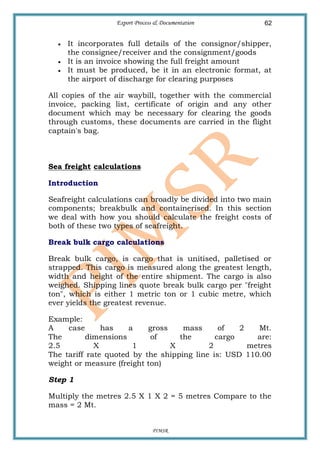
Sea freight calculations

Introduction

Seafreight calculations can broadly be divided into two main
components; breakbulk and containerised. In this section
we deal with how you should calculate the freight costs of
both of these two types of seafreight.

Break bulk cargo calculations

Break bulk cargo, is cargo that is unitised, palletised or
strapped. This cargo is measured along the greatest length,
width and height of the entire shipment. The cargo is also
weighed. Shipping lines quote break bulk cargo per "freight
ton", which is either 1 metric ton or 1 cubic metre, which
ever yields the greatest revenue.

Example:
A    case      has    a    gross    mass      of   2    Mt.
The        dimensions       of     the       cargo     are:
2.5          X         1         X         2         metres
The tariff rate quoted by the shipping line is: USD 110.00
weight or measure (freight ton)

Step 1

Multiply the metres 2.5 X 1 X 2 = 5 metres Compare to the
mass = 2 Mt.


                               PIMSR
Export Process & Documentation           63


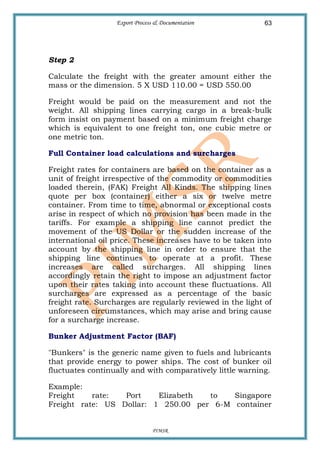
Step 2

Calculate the freight with the greater amount either the
mass or the dimension. 5 X USD 110.00 = USD 550.00

Freight would be paid on the measurement and not the
weight. All shipping lines carrying cargo in a break-bulk
form insist on payment based on a minimum freight charge
which is equivalent to one freight ton, one cubic metre or
one metric ton.

Full Container load calculations and surcharges

Freight rates for containers are based on the container as a
unit of freight irrespective of the commodity or commodities
loaded therein, (FAK) Freight All Kinds. The shipping lines
quote per box (container) either a six or twelve metre
container. From time to time, abnormal or exceptional costs
arise in respect of which no provision has been made in the
tariffs. For example a shipping line cannot predict the
movement of the US Dollar or the sudden increase of the
international oil price. These increases have to be taken into
account by the shipping line in order to ensure that the
shipping line continues to operate at a profit. These
increases are called surcharges. All shipping lines
accordingly retain the right to impose an adjustment factor
upon their rates taking into account these fluctuations. All
surcharges are expressed as a percentage of the basic
freight rate. Surcharges are regularly reviewed in the light of
unforeseen circumstances, which may arise and bring cause
for a surcharge increase.

Bunker Adjustment Factor (BAF)

"Bunkers" is the generic name given to fuels and lubricants
that provide energy to power ships. The cost of bunker oil
fluctuates continually and with comparatively little warning.

Example:
Freight    rate:  Port    Elizabeth  to   Singapore
Freight rate: US Dollar: 1 250.00 per 6-M container


                                PIMSR
Export Process & Documentation               64


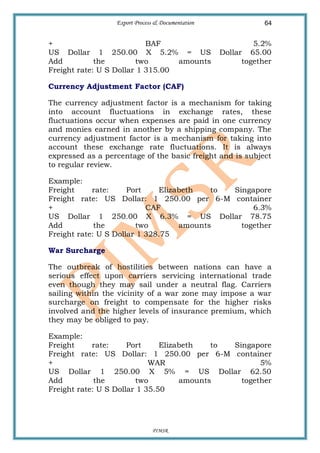
+                          BAF                              5.2%
US Dollar 1 250.00 X 5.2% = US                     Dollar 65.00
Add          the        two       amounts                together
Freight rate: U S Dollar 1 315.00

Currency Adjustment Factor (CAF)

The currency adjustment factor is a mechanism for taking
into account fluctuations in exchange rates, these
fluctuations occur when expenses are paid in one currency
and monies earned in another by a shipping company. The
currency adjustment factor is a mechanism for taking into
account these exchange rate fluctuations. It is always
expressed as a percentage of the basic freight and is subject
to regular review.

Example:
Freight     rate:     Port    Elizabeth   to Singapore
Freight rate: US Dollar: 1 250.00 per 6-M container
+                          CAF                    6.3%
US Dollar 1 250.00 X 6.3% = US Dollar 78.75
Add          the        two        amounts     together
Freight rate: U S Dollar 1 328.75

War Surcharge

The outbreak of hostilities between nations can have a
serious effect upon carriers servicing international trade
even though they may sail under a neutral flag. Carriers
sailing within the vicinity of a war zone may impose a war
surcharge on freight to compensate for the higher risks
involved and the higher levels of insurance premium, which
they may be obliged to pay.

Example:
Freight     rate:     Port     Elizabeth   to Singapore
Freight rate: US Dollar: 1 250.00 per 6-M container
+                           WAR                      5%
US Dollar 1 250.00 X 5% = US Dollar 62.50
Add          the        two         amounts     together
Freight rate: U S Dollar 1 35.50


                               PIMSR
Export Process & Documentation            65


All of the above surcharges may be applied to a single
freight rate.

Example:
Freight    rate:     Port     Elizabeth    to  Singapore
Freight rate: US Dollar: 1 250.00 per 6-M container
+                         BAF                      5.2%
+                         CAF                      6.3%
+                         WAR                        5%
Total       amount         of        surcharge    16.5%
US Dollar 1 250.00 X 16.5% = US Dollar 206.25
(add              to               freight          rate)
US Dollar 1 456.25

Port Congestion Surcharge

Congestion in a port for a period of time can involve
considerable idle time for vessels serving that port. When a
ship lies idle, this creates a huge amount of loss for the
ship's owner. Shipping lines therefore have the right to
impose a surcharge on the freight to recover revenue lost.
Another factor which influences port congestion surcharge
would be labour disputes. Port congestion surcharges are
calculated as a percentage of the freight rate as expressed in
the previous examples.

Consolidation services

The consolidator or groupage operator hires a container
from a shipping line and then sells that space to his
clients/exporters. The benefit for the exporter is that small
quantities which, would not fill a full container load, can be
shipped by sea freight in a shipping container as an
alternative to air freighting the goods. The consolidator
would charge per metric ton or cubic metre, which ever
yields the greatest. Example: US Dollar 89.00 Weight or
Measure. The shipping line would have a contract of
carriage with the consolidator and in turn the consolidator
would have a contract of carriage with the exporter. The
consolidator would be issued with an combined through bill
of lading from the shipping line and then present the
exporter with a house bill of lading (See bill of lading below)


                                PIMSR
Export Process & Documentation          66


The bill of lading

The bill of lading performs the following functions:

     A contract of carriage between the shipper of the cargo
      and the carrying shipping company.
     The name of the shipper and the receiver of the goods
      the consignee.
     The contents of the packages as declared by the
      shipper.
     Shipping details such as: port of loading and the port
      of discharge.
     The bill of lading is a freight invoice and indicates if
      the freight costs have been prepaid by the exporter or
      will be paid by the importer, "freight collect".
     The bill of lading states the number of packages,
      weight and dimension of the shipment.
     It is a document of title to the goods stated thereon.

Every original bill of lading signed by or on behalf of the
shipping company is a document of title to the underlying
goods. This special function of a bill of lading is achieved by
a form of words which state: "In witness whereof the
undersigned on behalf of the shipping company has signed
three bills of lading all of this tenor and date, one of which
being    accomplished       the    others    to   stand   void".
"Accomplishing" the bill of lading requires the surrender to
the shipping line or its agents in the port or place of
destination one of the signed original bills of lading duly
endorsed by the consignee/importer. Unless and until one
of the original bills of lading as described above is
surrendered, the shipping line will not release the cargo to
the consignee/importer. Upon surrender of any one of the
originals the other originals bills of lading become void.

Endorsed Bills of Lading

Bills of lading can only be issued with the words "shipped
on board", if the cargo has actually been loaded onto the
named vessel at the port of loading. By insisting that the
exporter supplies the importer with a "shipped on board" bill
of lading, the importer obtains conclusive evidence that the
goods have been loaded on board the intended vessel.

                                  PIMSR
Export Process & Documentation            67


Some importers insist that the exporter presents "shipped
on board" bills as a condition for payment. "Received for
shipment", bills of lading can be issued as soon as the goods
have been delivered into the custody of the carrying
shipping company or its agent either at the point of receipt
or at the port of loading. Thus, a 'received for shipment", bill
of lading will only indicate the ship in which the cargo is
intended to be loaded on. The risk remains that the loading
may, for many reasons delayed or the cargo may not be
loaded at all.

Banks responsible for the payment of funds in payment for
goods under letters of credit will not release the funds if the
bill of lading has been endorsed "received for shipment".


                                PIMSR
Export Process & Documentation   68


        FINDINGS


             PIMSR
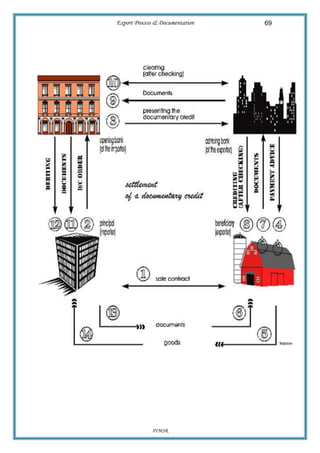
Export Process & Documentation   69


             PIMSR
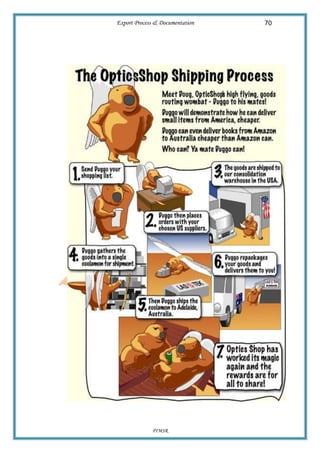
Export Process & Documentation   70


             PIMSR
Export Process & Documentation                    71


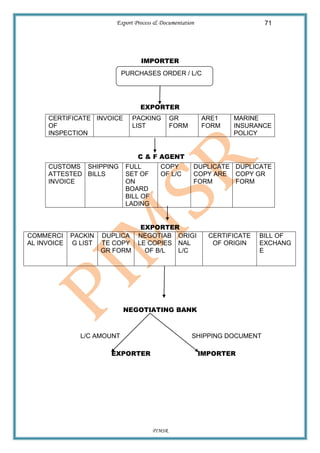
                                  IMPORTER
                            PURCHASES ORDER / L/C


                                  EXPORTER
     CERTIFICATE INVOICE        PACKING        GR         ARE1    MARINE
     OF                         LIST           FORM       FORM    INSURANCE
     INSPECTION                                                   POLICY


                                 C & F AGENT
     CUSTOMS SHIPPING        FULL         COPY        DUPLICATE DUPLICATE
     ATTESTED BILLS          SET OF       OF L/C      COPY ARE COPY GR
     INVOICE                 ON                       FORM      FORM
                             BOARD
                             BILL OF
                             LADING


                                  EXPORTER
COMMERCI     PACKIN   DUPLICA    NEGOTIAB ORIGI             CERTIFICATE   BILL OF
AL INVOICE   G LIST   TE COPY    LE COPIES NAL               OF ORIGIN    EXCHANG
                      GR FORM      OF B/L  L/C                            E


                            NEGOTIATING BANK


               L/C AMOUNT                             SHIPPING DOCUMENT

                        EXPORTER                          IMPORTER


                                       PIMSR
Export Process & Documentation                 72


                               BIBLIOGRAPHY


Export Import Documentation                - Prof. D.C. pai
Logistics in International Business        - Prof. Rajeev Aserkar


                       REFERENCES – INTERNET


www.committedgroup.com
www.google.co.in
www.ask.com
www.exit.net


                                  PIMSR
Export Process & Documentation                      73


    GLOSSARY INTERNATIONAL FREIGHT
                 TERMS
ABI - Automated Brokerage Interface: Is a system available to U.S.
Customs Brokers with the computer capabilities and customs certification
to transmit and exchange customs entries and other information, facilitating
prompt release of imported cargo.
Acceptance: A time draft (or bill of exchange) which the drawee has
accepted and is unconditionally obligated to pay at maturity. Drawee's act
in receiving a draft and thus entering into the obligation to pay its value at
maturity. An agreement to purchase goods under specified terms.
Add Hoc Charter: A one-off charter operated at the necessity of an airline
or charterer.
Ad Valorem ("according to the value"): A fixed percentage of the value of
goods that is used to calculate customs duties and taxes.
Admiralty Court: Is a court having jurisdiction over maritime questions
pertaining to ocean transport, including contracts, charters, collisions, and
cargo damages.
Advance Against Documents: Load made on the security of the documents
covering the shipment.
Advising Bank: A bank that receives a letter of credit from an issuing bank,
verifies its authenticity, and forwards the original letter of credit to the
exporter without obligation to pay.
Advisory Capacity: A term indicating that a shipper's agent or
representative is not empowered to make definite decisions or adjustment
without the approval of the group or individual represented.
Affiliate: Is a company that controls, or is controlled by another company,
or is one of two or more commonly controlled companies.
Airfreightment: An agreement by a steamship line to provide cargo space
on a vessel at a specified time and for a specified price to accommodate an
exporter or importer, who then becomes liable for payment even though
he is later unable to make the shipment.
Agency Agreement: The steamship line appoints the steamship agent and
defines the specific duties and areas of responsibility of that agent.
Air Cargo Agent: Is a type of freight forwarder who specializes in air cargo
and acts for airlines that pay him a fee (usually 5%). He is registered with
theInternational Air Transport Association, IATA (See also Air Freight
Forwarder; Forwarder, Freight Forwarder, Foreign Freight Forwarder).
Air Freight Forwarder: Is a type of freight forwarder who specializes in air
cargo. He usually consolidates the air shipments of various exporters,
charging them for actual weight and deriving his profit by paying the airline


                                    PIMSR
Export Process & Documentation                     74


the lower consolidated rate. He issues his own air waybills to the exporters,
is licensed by the CAB (Civil Aeronautics Board) and has the status of an
indirect air carrier (See also Air Cargo Agent, Forwarder, Freight
Forwarder, Foreign Freight Forwarder.)
Air Waybill: A bill of landing that covers both international and domestic
flights transporting goods to a specified destination. This is a non-
negotiable documents of air transport that serves as a receipt for the
shipper, indicating that the carrier has accepted the goods listed and
obligates itself to carry the consignment to the airport of destination
according to specified conditions.
AITA: International Air Transport Association, IATA, (French, German).
All-Risk Clause: Is an insurance provision that all loss or damage to goods
is insured except that of inherent vice (self caused). (See All Risk
Insurance).
All Risk Insurance: Is a clause included in marine insurance policies to
cover loss and damage from external causes, such as fire, collision,
pilferage, etc. but not against innate flaws in the goods, such as decay,
germination, nor against faulty packaging, improper packing/ loading or
loss of market, nor against war, strikes, riots and civil commotions (See
Marine Insurance)
Alongside: A phrase referring to the side of a ship. Goods to be delivered
"alongside" are to be placed on the dock or barge within reach of the
transport ship's tackle so that they can be loaded abroad the ship.
Arbitration Clause: Is a standard clause to be included in the contracts of
exporters and importers, as suggested by the American Arbitration
Association. It states that any controversy or claim will be settled by
arbitration in accordance with the rules of the American Arbitration
Association.
Assignment: The transfer of the rights, duties, responsibilities and/or
benefits of an agreement, contract, or financial instrument to third party.
Assignment of Proceeds: A stipulation within a letter of credit in which
some or all of the proceeds are assigned from the original beneficiary to
one or more additional beneficiaries.
A.T.: American Terms (Marine Insurance) A term used to differentiate
between the conditions of American Policies from those of other nations,
principally England.
Automated Brokerage Interface (ABI): An electronic system allowing
customhouse brokers and importers to interface via computer with the US
Customs Service for transmitting entry and entry summary data on
imported merchandise.
Automated Commercial System (ACS): The electronic system of the US
Customs Service, encompassing a variety of industry sectors, that permits
online access to information in selected areas.


                                    PIMSR
Export Process & Documentation                      75


Automated Manifest System (AMS): The electronic system allowing a
manifest inventory to be transmitted to the US Customs Service data center
by carrier, port authority or service center computers.
BAA: British Airports Authority
BACA: Baltic Air Charter Association
Balance of Trade: The difference between a country's total imports and
exports; if exports exceed imports, favorable balance of trade exists, if not,
a trade deficit is said to exist.
Barter: Trade in which merchandise is exchanged directly for other
merchandise without use of money. Barter is an important means of trade
with countries using currency that is not readily convertible.
B/B: (See Break-Bulk Cargo)
Belly Cargo: Freight accommodation below the main deck.
Beneficiary: A firm or person on whom a letter of credit has been drawn.
The beneficiary is usually the seller or exporter.
Bermuda Agreement: An agreement concluded in 1946 between the U.K.
and the U.S., designed to regulate future international air traffic. Most
governments accept its principles and follow it inter alia by limiting traffic
rights on international routes to one or two carriers.
Berth: Is the place beside a pier, quay or wharf where a vessel can be
loaded or discharged.
Berth Liner Service: Is a regular scheduled steamship line with regular
published schedules (port of call ) from and to defined trade areas.
Berth or Liner Terms: Is an expression covering assessment of ocean
freight rates generally implying that loading and discharging expenses will
be for ship owner's account, and usually apply from the end of ship's tackle
in port of loading to the end of ship's tackle in port of discharge.
Bill of Lading: A document that establishes the terms of a contract between
a shipper and a transportation company under which freight is to be
moved between specified points for a specified charge. Usually prepared
by the shipper on forms issued by the carrier, it serves as a document of
title, contract of carriage, and a receipt for goods. Also see Air Waybill and
Ocean Bill of Lading.
Bonded Warehouse: A warehouse storage area or manufacturing facility in
which imported goods may be stored or processed without payment of
customs duties.
Brussels Tariff Nomenclature Number (BTN): The customs tariff number
used by most European nations. The United States does not use the BTN,
but a similar system known as the Harmonize Tariff Schedule.
CAA: Is the Civil Aviation Authority. Government body responsible for
regulating
U.K. airlines.


                                    PIMSR
Export Process & Documentation                      76


Cabotage: Is where cargo is carried on what is essentially a domestic flight
and therefore not subject to international agreements that fix set rates.
Cabotage rates are negotiable between shipper and airline and apply on
flights within a country and to its overseas territories.
CAD Can have two meanings in the industry
CAD: The acronym meaning "cash against documents," a method of
payment for goods in which documents transferring title are given to the
buyer upon payment of cash to an intermediary acting for the seller.
CAD/CAM: Computer Aided Design/Computer Aided Manufacturing.
Cage: The transporting of goods by truck to or from a vessel, aircraft, or
bonded warehouse, all under customs custody.
Cargo: Is merchandise/commodities/freight carried by means of
transportation.
Cargo Receipt: Is a receipt of cargo for shipment by a consolidator (used in
ocean freight).
Carnet: A customs document permitting the holder to carry or send
merchandise temporarily into certain foreign countries (for display,
demonstration, or similar purpose) without paying duties or posting bonds.
Carriers(s) Containers or Shipper(s) Containers: The term Carrier(s)
Container(s) or Shipper(s) Container(s) means containers over which the
carrier or the shipper has control either by ownership or by the acquisition
thereof under lease or rental from container companies or container
suppliers or from similar sources. Carriers are prohibited from purchasing,
leasing or renting shipper owned containers.
Carrier, Common: A public or privately owned firm or corporation that
transports the goods of others over land, sea, or through the air, for a stated
freight rate. By government regulation, a common carrier is required to
carry all goods offered if accommodations are available and the established
rate is paid.
Cartel: Is an association of several independent national or international
business organizations that regulates competition by controlling the prices,
the production, or the marketing of a product or an industry.
Cash in Advance (C.I.A.): Payment for goods in which the price is paid in
full before shipment is made. This method is usually used only for small
purchases or when the goods are built to order.
Cash Against Documents (CAD): Payment for goods in which a
commission house, or other intermediary, transfers title documents to the
buyer upon payment in cash.
C.C.E.F.: Is a Customs Centralized Examination Facility.
Certificate of Analysis: Is a certificate required by some countries as proof
of the quality and composition of food products or pharmaceuticals. The
required analysis may be made by a private or government health agency.
The certificate must be legalized by a foreign consul of the country


                                     PIMSR
Export Process & Documentation                     77


concerned, as is the case with such similar certificates as the phytosanitary
certificate.
Certificate of Inspection: A document certifying that the goods were in
apparent good condition immediately prior to shipment.
Certificate of Manufacture: A statement in which a producer specifies
where his goods were manufactured, certifies that manufacturing has been
completed, and confirms that the goods are at the buyer's disposal.
Certificate of Origin: A statement signed by the exporter, or his agent, and
attested to by a local Chamber of Commerce, indicating that the goods
being shipped, or a major percentage of them, originated and were
produced in the exporter's country.
CES: Is a Customs Examination Station
C&F: Is a quoted price includes cost of goods and freight.
C & I: Is a quoted price includes cost of goods and insurance.
CFS (Container Freight Station): The term CFS at loading port means the
location designated by carriers for the receiving of cargo to be packed into
containers by the carrier. At discharge ports, the term CFS means the
bonded location designated by carriers in the port area for unpacking and
delivery of cargo.
CFS/CFS (Pier to Pier): The term CFS/CFS means cargo delivered by
break bulk to Carrier's CFS to be packed by Carrier into containers and to
be unpacked by Carrier from the container at Carrier's destination port
CFS.
CFS/CY (Pier to House): The term CFS/CY means cargo delivered break-
bulk to Carrier's CFS to be packed by Carrier into containers and accepted
by consignee at Carrier's CY and unpacked by the consignee off Carrier's
premises, all at consignee's risk and expense.
CFS CHARGE (Container Freight Charge): The term CFS Charge means
the charge assessed for services performed at the loading or discharging
port in packing or unpacking of cargo into/from containers at CFS.
CFS Receiving Service: The term "CFS Receiving Services" means the
service performed at loading port in receiving and packing cargo into
containers from CFS to CY or shipside. "CFS Receiving Services" referred
herein are restricted to the following
1. Moving empty containers from CY to CFS
2. Drayage of loaded containers from CFS to CY and/or ship's tackle
3. Tallying
4. Issuing dock receipt/shipping order
5. Physical movement of cargo into, out of and within CFS
6. Stuffing, sealing and marking containers
7. Storage
8. Ordinary sorting and stacking
9. Preparing carrier's internal container load plan


                                    PIMSR
Export Process & Documentation                      78


CIF (cost, insurance and freight): Seller is responsible for inland freight,
ocean/air freight, and marine/air insurance to the port of final entry in the
buyer's country. The buyer is responsible for inland transportation to his or
her location.
Chargeable Kilo: Rate for goods where volume exceeds six cubic metres to
the tonne.
Charter: Originally meant a flight where a shipper contracted hire of an
aircraft from an airline. Has usually come to mean any non-scheduled
commercial service.
Charter Party: The contract between the owner of a ship and the individual
or company chartering it. Among other specifications, the contract usually
stipulates the exact obligations of the ship-owner (loading the goods,
carrying the goods to a certain point, returning to the charterer with other
goods, etc.); or it provides for an outright leasing of the vessel to the
charterer, who then is responsible for his own loading and delivery. In
either case, the charter party sets forth the exact conditions and
requirements agreed upon by both sides.
Charter party Bill of Lading: A bill of lading issued under a charter party. It
is not acceptable by banks under letters of credit unless so authorized in
the credit.
Chassis: A wheel assemble including bogies constructed to accept
mounting of containers.
CIA: The acronym meaning "cash in advance," a method of payment for
goods whereby buyer pays seller in advance of shipment of goods.
C.I.F.: Is a quoted price includes cost of goods, insurance and freight.
C.I.T.E.S.: Committee on International Trade of Endangered Species.
Class Rates: A class of goods or commodities is a large grouping of various
items under one general heading. All items in the group make up a class.
The freight rates that apply to all items in the class are called class rates.
Classification: Is a customs term. The placement of an item under the
correct number in the customs tariff for duty purposes. At times this
procedure becomes highly complicated; it is not uncommon for importers
to resort to litigation over the correct duty to be assessed by the customs on
a given item.
Claused Bill of Lading: Is a bill of lading which has exemptions to the
receipt of merchandise in "apparent good order" noted.
Clean Bill of Lading: Is a bill of lading which covers goods received in
"apparent good order and condition" and without qualification.
Clean Draft: Is a draft to which no documents have been attached.
cm: Centimeters
CNS: Cargo Network Services, an IATA company. See IATA.
Collective Paper: All documents (commercial invoices, bills of lading, etc.)
submitted to a buyer for the purpose of receiving payment for a shipment.


                                     PIMSR
Export Process & Documentation                      79


Commercial Risk: Risk carried by the exporter (unless insurance is
secured) that the foreign buyer may not be able to pay for goods delivered
on an open account basis.
Confirmed Letter of Credit: A letter of credit, issued by a foreign bank,
with validity confirmed by a U.S. bank. An exporter who requires a
confirmed letter of credit from the buyer is assured of payment by the U.S.
bank even if the foreign buyer or the foreign bank defaults.
Conference: A group of vessel operators joined together for the purpose of
establishing freight rates.
• RoRo/Container Vessel - Ship designed to accommodate containers and
roll-on roll-off cargo. It can be self sustaining.
• RoRo/Container/Break-bulk Vessel - Designated to accommodate three
types of cargo, usually self sustaining.
Commercial Code: A published code designed to reduce the total number
of words required in a cablegram.
Commodity Specialist: An official authorized by the U.S. Treasury to
determine proper tariff and value of imported goods.
Consignee: Person or firm to whom goods are shipped under a bill of
landing.
Consular Declaration: A formal statement, made to the consul of a foreign
country, describing goods to be shipped.
Consular Invoice: A document, required by some foreign countries,
describing a shipment of goods and showing information such as the
consignor, consignee, and value of the shipment. Certified by consular
official of the foreign, it is used by the country's customs official to verify
the value, quantity, and nature of the shipment.
Combi: Is an aircraft with pallet or container capacity on its main deck as
well as in its belly holds.
Combination Vessels: Container/Break-bulk vessel - this type of ship
accommodates both container and break-bulk cargo. It can be either self
sustaining or non-self sustaining.
Commercial Invoice: An itemized list of goods shipped, usually included
among an exporter's collection papers.
Common Carrier: A firm or individual that transports persons or goods for
compensation.
Confirmed Letter of Credit: A letter of credit, issued by a foreign bank
with validity confirmed by a U.S. bank.
Confiscation: The taking and holding of private property by a government
or an agency acting for a government. Compensation may or may not be
given to the owner of the property.
Consignee: The individual or company to whom a seller or sipper sends


                                     PIMSR
Export Process & Documentation                        80


merchandise and who, upon presentation of necessary documents, is
recognized as merchandise owner for the purpose of declaring and paying
customs duties.
Consignee Marks: A symbol laced on packages for identification purposes;
generally consisting of a triangle, square, circle, diamond, cross, with letters
and/or numbers as well as port of discharge.
Consignment: Is the physical transfer of goods from a seller (consignor)
with whom the title remains, to another legal entity (consignee) who acts as
a selling agent, selling the goods and remitting the new proceeds to the
consignor.
Consignor: A term used to describe any person who consigns goods to
himself or to another party in a bill of lading or equivalent document. A
consignor might be the owner of the goods, or a freight forwarder who
consigns goods on behalf of his principal.
Consolidated Shipment: An arrangement whereby various shippers pool
their boxed goods on the same shipment, sharing the total weight charge
for the shipment.
Consolidator: An agent which brings together a number of shipments for
one destination to qualify for preferential airline rates.
Consortium: The name for an agreement under which several nations or
nationals (usually corporations) of more than one nation, join together for
a common purpose. It could be for management or exploitation of a
natural resource, as in the case of some international petroleum
consortiums.
Consul: A government official residing in a foreign country, charged with
representing the interests of his or her country and its nationals.
Consular Documents: Special forms signed by the consul of a country to
which cargo is destined.
Consular Invoice: A document, required by some foreign countries,
describing a shipment of goods and showing information such as the
consignor, consignee, and value of the shipment. Certified by a consular
official of the foreign country, it is used by the country's customs officials to
verify the value, quantity and nature of the shipment.
Container: The term container means a single rigid, non-disposable dry
cargo, insulated, temperature controlled flatrack, vehicle rack portable
liquid tank, or open top container without wheels or bogies attached,
having not less than 350 cubic feet capacity, having a closure or
permanently hinged door that allows ready access to the cargo (closure or
permanently hinged door not applicable to flatrack vehicle rack or portable
liquid tank). All types of containers will have constructions, fittings and
fastenings able to withstand without permanent distortion, all the stresses
that may be applied in normal service use of continuous transportation. All
containers must bear manufacturer's specifications.


                                     PIMSR
Export Process & Documentation                     81


Container Ship: Ocean going ship designed to carry containers both
internally and on deck. Some are self sustaining.
Containerization: Is a concept for the ultimate unitizing of cargo used by
both steamship lines and air cargo lines. Containers allow a greater amount
of cargo protection from weather, damage, and theft.
Containers (Air Cargo): Many types of air cargo containers are offered:
The containers are designed in various sizes and irregular shapes to
conform to the inside dimensions of a specific aircraft.
Containers (Ocean): Are designed to be moved inland on its own chassis
and can be loaded at the shippers plant for shipment overseas. Basic types
of containers are; dry van, open top, half high, hi cube, flat rock, tank
container, refrigerated container, insulated container, tilting container.
Average outside dimensions are generally 20, 35, and 40 feet in length, 8
feet wide and 8 feet high standard.
Continuous Bond: Is an annual customs bond insuring compliance with all
regulations and requirements.
Contract Rate: Is a charge levied by carriers selling capacity forward over a
given route to a shipper of forwarder; the client is therefore assured of
capacity, which must be paid for regardless of load carried.
Coordinating Committee for Export Controls (COCOM): An informal
group of 15 western countries established to prevent the export of certain
strategic products to potentially hostile nations.
Correspondent Bank: A bank that, in its own country, handles the business
of a foreign bank.
Countertrade: Is a reciprocal trading arrangement, which includes a variety
of transactions involving two or more parties.
Countervailing Duties: Is a special duties imposed on imports to offset the
benefits of subsidies to producers or exporters of the exporting country.
Credit Risk Insurance: Insurance designed to cover risks of nonpayment
for delivered goods.
Customs Bonded Warehouse: Is a warehouse where imported goods may
be stored for a total of three years without the payment of duty or taxes.
Customhouse Broker: An individual or firm licensed to enter and clear
goods through Customs.
Customs Court: Is the court to which importers might appeal or protest
decisions made by Customs officers.
Customs Tariff: Is a schedule of charges assessed by the federal
government on imported goods.
Customs Union: Is an agreement between two or more countries in which
they arrange to abolish tariffs and other import restrictions on each other's
goods and establish a common tariff for the imports of all other countries.


                                    PIMSR
Export Process & Documentation                      82


CWO: The acronym meaning "cash with order," a method of payment for
goods where cash is paid at the time of order and the transaction becomes
binding on both buyer and seller.
CY (Container Yard): The term CY means the location designated by
Carrier in the port terminal area for receiving, assembling, holding, storing
and delivering containers, and where containers may be picked up by
shippers or re-delivered by consignees. No container yard (CY) shall be a
shipper's, consignee's,
NVOCC's, or a forwarder's place of business, unless otherwise provided.
CY/CFS (House to Pier): The term CY/CFS means containers packed by
shipper of carrier's premises and delivered by shipper to Carrier's CY, all at
shipper's risk and expense and unpacked by Carrier at the destination port
CFS.
CY/CY (House to House): The term CY/CY means containers packed by
shipper off Carrier's premises and delivered by shipper to Carrier's CY and
accepted by consignee a t Carrier's CY and unpacked by consignee off
Carrier's premises, all at the risk and expense of cargo.
Dangerous Goods: Articles or substance capable of posing a significant risk
to health, safety or property, and that ordinarily require special attention
when being transported.
DAT: Dangerous articles tariff.
Date Draft: Draft that matures in a specified number of days after the date
it is issued, without regard to the date of Acceptance. See Draft.
DCA: Department of Civil Aviation. Commonly used term to denote the
government department of any foreign country that is responsible for
aviation regulation and granting traffic rights.
DDP: Delivered duty paid. Also known as "free domicile."
DDU: Delivered duty unpaid. Reflects the emergence of "door-to-door"
intermodal or courier contracts or carriage where only the destination
customs duty and taxes (if any) are paid by consignee.
Dead Leg: Is a sector flown without payload.
Dead Freight: Is freight charges paid by the charterer of vessel for the
contracted space, which is left partially unoccupied.
Deck Cargo: Is cargo carried on deck rather than stowed under deck. On
deck carriage is required for certain commodities, such as explosives.
Deferred Payment Credit: Type of letter of credit providing for payment
some time after presentation of shipping documents by exporter.
Deferred Rebate: The return of a portion of the freight charges by a carrier
or a conference shipper in exchange for the shipper giving all or most of
his shipments to the carrier or conference over a specified period of time
(usually 6 months). Payment of the rate is deferred for a further similar
period, during which the shipper must continue to give all or most of his
shipments to the rebating carrier or conference. The shipper thus earns a


                                    PIMSR
Export Process & Documentation                      83


further rebate which will not, however, be paid without an additional
period of exclusive or almost exclusive patronage with the carrier of
conference. In this way, the shipper becomes tied to the rebating carrier or
conference. Although, the deferred rebate system is illegal in U.S. foreign
commerce, it generally is accepted in the ocean trade between foreign
countries.
Demurrage: A penalty for exceeding free time allowed for loading or
unloading at a pier or freight terminal. Also a charge for undue detention
of transportation equipment or carriers in port while loading or unloading.
Density: Density means pounds per cubic foot. The cubage of loose
articles or pieces, or packaged articles of a rectangular, elliptical or square
shape on one plane shall be determined by multiplying the greatest straight
line dimensions of length, width and depth in inches, including all
projections, and dividing the total by 1728 (to obtain cubic feet). The
density is the weight of the article divided by the cubic feet thus obtained.
DEQ: Delivered ex quay/duty paid.
Destination Control Statement: Any of various statements that the U.S.
government requires to be displayed on export shipments and that specify
the destination for which export of the shipment has been authorized.
D.F.: Dead Freight
DGR: Dangerous Goods Requirement.
Dim Weight: (Dimensionalized Weight) Determined by calculating length
x width x height and dividing by 166. Charged when actual weight is less
than the dim. weight.
Dock Receipt: When cargo is delivered to a steamship company at the
pier, the receiving clerk issues a dock receipt.
Documents Against Acceptance (D/A): Instructions given by a shipper to a
bank indicating that documents transferring title goods should be delivered
to the buyer (or drawee) only upon the buyer's acceptance of the attached
draft.
DOT: Department of Transportation
Draft (or Bill of Exchange): An unconditional order in writing from one
person (the drawer) to another (the drawee), directing the Drawee to pay a
specified amount to a named Drawer at a fixed or determinable future
date.
Drawback: A U.S. customs law that permits an American exporter to
recover duties paid on imported foreign raw materials or components
included in products that are subsequently exported out of the United
States.
Drawee: The individual or firm on whom a draft is drawn and who owes
the stated amount to the drawer.
Dry Lease: The rental of a "clean" aircraft without crew, ground staff or
supporting equipment.


                                     PIMSR
Export Process & Documentation                     84


DST: The acronym meaning "double stack train" service, which is the
transport rail between two points of a trainload of containers with two
containers, one on top of the other, per chassis.
d.w.: Deadweight (tons of 2,240 lbs.)
d.w.c.: Deadweight for cargo
E.A.O.N.: Except as otherwise noted.
EDI or EDIFACT: Electronic Data Interchange for Administration,
Commerce and Transport, from the UN-backed electronic data
interchange standards body, to create electronic versions of common
business documents that will work on a global scale. One digital document
under consideration, the International Forwarding and Transport Message
will do the jobs of six different electronic messages currently in use.
Empty Leg: Results from an aircraft primarily chartered outbound having
cargo capacity inbound or vice versa. A cheap form of airfreight.
Endorsement in Blank: Commonly used on a bank check, an
endorsement in blank is an endorsement to the bearer. It contains only the
name of the endorser and specifies no particular payee. Also, a common
means of endorsing bills of lading dawn to the order of the shipper. The
bills are endorsed "For..." (see Bill of Lading, Order).
Eurodollars: U.S. dollars on deposit outside of the United States to include
dollars on deposit at foreign branches of U.S. banks, and dollars on
deposit with foreign banks.
"Ex": Signifies that the quoted price applies only at the indicated point of
origin (e.g. "price ex factory" means that the quoted price is for the goods
available at the factory gate of the seller).
Ex. B.L.: Exchange bill of lading.
Export Broker: The individual who brings together buyer and seller for a
fee, eventually withdrawing from any transaction.
Export Declaration: A form to be completed by the exporter or their
authorized agent and filed in triplicate by a carrier with the United State
Collector of customs at the point of exit. It serves a twofold purpose:
1. Primarily, it is used by the U.S. Bureau of Census for the compilation of
export statistics on United States foreign trade (for this reason an export
declaration is required for practically all shipments from the United States
to foreign countries and the United States possessions, except for mail
shipments of small value, or for those of a non commercial character);
2. The declaration also serves as an export control document because it
must be presented, together with the export license, to the United States
Customs at the port of export. If the goods may be exported under general
export license, this fact must be stated on the export declaration.
Export License: A document secured from a government, authorizing an
exporter to export a specific quantity of a particular commodity to a certain


                                    PIMSR
Export Process & Documentation                      85


country. An export license is often required if a government has place
embargoes or other restrictions upon exports. See General Export License.
Export Trading Company: A corporation or other business unit organized
and operated primarily for the purpose of exporting goods and services, or
of providing export related services to other companies.
Express: Premium-rated service for urgent deliveries.
EXW: Ex works. Same as the former "Ex Works."FAK: Freight All Kinds
– uniform airline charging scale applying to a number of commodities; as
opposed to SCR (Specific Commodity Rate) applying to one commodity
only.
FAS (free alongside ship): Seller is responsible for inland freight costs until
goods are located alongside the vessel/aircraft for loading. Buyer is
responsible for loading costs, ocean /air freight and marine/air insurance.
Fathom: (Nautical) Conversion equivalents: 6 feet; 1.83 meters.
F.C.L.: Full container load, full car load.
F.c.s.: Free of capture and seizure.
f.c.s.r.c.c.: Free of capture, seizure, riots and civil commotions.
F.&.D.: Freight and demurrage.
FEU: Forty foot equivalent
FIATA: International Federation of Freight Forwarders Associations.
Fifth Freedom Flight: Where cargo is carried by an airline between two
countries in neither of which it is based.
F.i.b.: Free in bunkers; free into barge.
Flag Carrier: An airline of one national registry whose government gives it
partial or total monopoly over international routes.
FOB (free on board): Seller is responsible for inland freight and all other
costs until the cargo has been loaded on the vessel/aircraft. Buyer is
responsible for ocean/air freight and marine/air insurance.
F.o.d. : Free of damage
Folded: An article folded in such a manner as to reduce its bulk 33 1/3%
from its normal shipping cubage when not folded.
Force Majeure: The title of a standard clause found in marine contracts
exempting the parties for nonfulfillment of their obligations by reasons of
occurrences beyond their control, such as earthquakes, floods or war.
Foreign Trade Zone: A free port in the United Stated divorced from
Customs authority but under Federal control. Merchandise, except that
which is prohibited, may be stored in the zone without being subjected to
the United States tariff regulation. Also called Free Trade Zone.
Foreign Trade Zone Entry: A form declaring goods which are brought duty
free into a Foreign Trade Zone for further processing or storage and
subsequent exportation.
Forwarder, Freight Forwarder, Foreign Freight Forwarder: An independent


                                     PIMSR
Export Process & Documentation                        86


business that dispatches shipments for exporters for a fee. The firm may
ship by land, air, or sea, or it may specialize. Usually it handles all the
services connected with an export shipment; preparation of documents,
booking cargo space, warehouse, pier delivery and export clearance. The
firm may also handle banking and insurance services on behalf of a client.
The U.S. forwarder is licensed by the Federal Maritime Commission for
ocean shipments.
Foul Bill of Landing: A receipt for goods issued by a carrier with an
indication that the goods were damaged when received.
F. P.A.A.C. F.p.a. (A.C.) : Free of Particular Average, American
Conditions- (Marine Insurance Term). The American form of clause
commonly used, as distinguished from that used by the English
underwriters. Under the American clause the underwriter does not assume
responsibility for partial losses unless caused by stranding, sinking, burning
or collision with another vessel whereas under the English clause, the
underwriter assumes responsibility for partial losses if the vessel be
stranded, sunk, burnt or in collision even though such anevent did not
actually cause the damage suffered by the goods. Conditions (See
F.P.A.A.C.).
F.P.A.: Free of Particular Average (Marine Insurance Term). A term used
in marine insurance policies to indicate that while the underwriter is
unwilling to assume liability for ordinary partial losses due to the peculiar
qualities of the particular article or to its form of package, he is willing to
bear partial losses, the direct result of stranding, sinking, burning, collision,
or other named peril
Free Alongside: Quoted price includes the cost of delivering the goods
alongside a designated vessel.
Free In (F.I.): Cost of loading a vessel is borne by the charterer.
Free In and Out (F.I.O.): Cost of loading and unloading a vessel is borne
by the charterer.
Free of Capture and Seizure (F.C.& S.): An insurance clause providing that
loss is not insured if due to capture, seizure, confiscation and like actions,
whether legal or not , or from such acts as piracy, civil war, rebellion and
civil strife.
Free of Particular Average (F.P.A.): A marine insurance clause providing
that partial loss or damage is not insured American conditions
(F.P.A.A.C.). Partial loss is not insured unless caused by the vessel being
sunk, stranded, burned, on fire, or in collision. English conditions (F.P.
A.E.C.). Partial loss not insured unless a result of the vessel being sunk,
stranded, burned, on fire, or in collision.
Free Out (F.O.): Cost of unloading a vessel is borne by the charterer.


                                     PIMSR
Export Process & Documentation                     87


Free Port: A port which is a foreign trade zone, open to all traders on
equal terms; more specifically a port where merchandise may be stored
duty-free, pending re-export or sale within that country.
Free Trade Zone: A port designated by the government of a country for
duty-free entry of any non-prohibited goods. Merchandise may be stored,
displayed, used for manufacturing, within the zone and re-exported without
duties being paid. Duties are imposed on the merchandise (or items
manufactured from the merchandise) only when the goods pass from the
zone into an area of the country subject to the Customs Authority.
Freight Forwarder: An individual or company , acting on the behalf of a
shipper, who arranges all necessary details of shipping and documentation
for a manufacturer or exporter, which includes employing the services of a
carrier of carriers.
Gang: Group of stevedores usually 4 to 5 members with supervisor
assigned to a hold or portion of the vessel being loaded or unloaded.
Gateway: Port of entry into a country or region.
GATT: General Agreement on Tariffs and Trade, a multilateral treaty
intended to help reduce trade barriers and promote tariff concessions.
GCR: General Cargo Rate. The basic tariff category which was introduced
to cover most air cargo now covers only a minority, the remainder being
under SCR or class rates.
General Average: When damage to cargo on board a vessel exceeds
carrier's insurance, carrier will release cargo only with an acceptance
agreement to claim only a general percentage of all the damage sustained.
General Export License: Any of various export licenses covering export
commodities for which validated export licenses are not required. No
formal application or written authorization is needed to ship exports under
a general export license.
General Order: Government contract warehouse for the storage of cargoes
left unclaimed for ten working days after availability. Unclaimed cargoes
are auctioned publicly after one year.
Gross Weight: Entire weight of goods, packing, and container,, ready for
shipment.
G.R.Wt./G.W.: Gross Weight.
GSA: General Sales Agent acting on behalf of an airline. Usually Broker or
Forwarder.
Harmonized Code: An internationally accepted and uniform description
system for classifying goods for customs, statistical and other purposes.
Harmonized Systems: A key provision of the recently signed trade bill,
effective Jan. 1, 1989, that establishes international uniformity for product
classifications. Most U.S. Trading partners adopted it a year earlier, and it
was drafted in Brussels a decade ago with U.S. representatives' input. In


                                    PIMSR
Export Process & Documentation                      88


essence, it is a new tariff schedule in that it changes methods of rating some
items.
Hatch: The cover of - or opening- in the deck of a vessel, through which
cargo is loaded.
Heavy Lifts: Freight too heavy to be handled by regular ship's tackle.
Heavy Lift Vessel: Specifically designed to be self sustaining with heavy lift
cranes, to handle unusually heavy and/or out-sized cargoes.
House Air Waybill: An air waybill issued by a freight consolidator. See Air
Waybill.
Hub: A central location to which traffic from many cities is directed and
from which traffic is fed to other areas.
Hundredweight (cwt.): A short ton hundredweight = 100 pounds. Long ton
hundredweight = 112 pounds.
Husbanding: Term used by steamship lines, agents, or port captains who
are appointed to handle all matters in assisting the master of the vessel
while in port to obtain bunkering, fresh water, food and supplies, payroll
for the crew, doctors appointments, ship repair, etc.
IATA: International Air Transport Association.
ICAO: International Civil Aviation Organization. A specialized agency of
the United Nations, with headquarters in Montreal. Its task is to promote
general development of civil aviation (e.g. aircraft design and operation,
safety procedures, contractual agreements).
ICC: International Chamber of Commerce
I.C.T.F.: Intermodal Container Transfer Facility, an on-dock facility for
moving containers from ship to rail or truck.
IFF: Institute of Freight Forwarders.
Igloo: Container designed to occupy full main deck width of carrying
aircraft.
Import License: A certificate, issued by countries exercising import
controls, that permits importation of the articles stated in the license. The
issuance of such a permit frequently is connected with the release of
foreign exchange needed to pay for the shipment for which the import
license has been requested.
In-Bond: A customs program for inland ports that provide for cargo
arriving at a
seaport to be shipped under a Customs bond to a more conveniently
located inland port where the entry documents have been filed. Customs
clears the shipment there, and the cargo is trucked to its destination, which
normally is close to the inland port.
Independent Action: A move by whereby a member of a shipping
conference elect to depart from the specific service rates set forth by the
conference, giving ten calendar days notice of such action. The conference


                                    PIMSR
Export Process & Documentation                        89


member's new schedule of rate, or rates, officially takes effect no later than
ten days after receipt of notice by the conference.
Inducement: Some steamship lines publish in their schedules the name of
a port and the words by inducement in parentheses. This means the vessel
will call at the port if there is sufficient amount of profitable cargo available
and booked.
Inland Carrier: A transportation line which hauls export or import traffic
between ports and inland points.
I.p.a.: Including particular average
Inspection Certificate: A document certifying that merchandise (such as
perishable goods) was in goods condition immediately prior to shipment.
Integrated Carrier: Forwarder which uses own aircraft, whether owned or
leased, rather than scheduled airlines.
Intellectual Property: Ownership of the legal rights to possess, use or
dispose of products created by human ingenuity, including patents,
trademarks and copyrights.
Interline: Mutual agreement between airlines to link their route network.
Intermeddle: Referring to the capacity to go from ship to train to truck, or
the like, the adjective generally refers to containerized shipping or the
capacity to handle same.
ISO: International Standards Organization also referred to as the
International
Organizational for Standardization.
Incoterms: A codification of terms used in foreign trade contracts that is
maintained by the International Chamber of Commerce.
Incremental Cost to Export: The additional costs incurred while
manufacturing and preparing a product for export ( e.g., product
modifications, special export packaging and export administration costs.)
This does not include the costs to manufacture a standard domestic
product, export crating and transportation to the foreign market.
Irrevocable Letter of Credit: A letter of credit with a fixed expiration date
that carries the irrevocable obligation of the issuing bank to pay the
exporter when all of the terms and conditions of the letter of credit have
been met.
J.&W.O.: Jettison and washing overboard
JETSAM: Goods from a ship's cargo, or parts of its equipment, that have
been thrown overboard to lighten the load in time of danger, or to set a
stranded ship adrift.
Joint Venture: A form of business partnership involving joint management
and the sharing of risks and profits between enterprises sometimes based
in different countries.
Just-In-Time (JIT): The principle of production and inventory control in
which goods arrive when needed for production or use.


                                     PIMSR
Export Process & Documentation                     90


K.D.C.L.: Knocked down in carload lots
KD Flat: An article taken apart, folded, or telescoped to reduce its bulk at
least 66 2/3% below its assembled size.
K.D.L.C.L.: Knocked down in less than carload lots.
Knock Down (KD): An article taken apart, folded or telescoped in such a
manner as to reduce its bulk at least 33 1/3% below its assembled bulk.
Knot (Nautical): The unit of speed equivalent to one nautical mile, or
6,080.20 feet per hour or 1.85 kilometers per hour.
L/C - Letter of Credit: A document issued by a bank per instructions by a
buyer of goods, authorizing the seller to draw a specified sum of money
under specified terms. Issued as revocable or irrevocable.
L. & D.: Loss and damage
Lagan: Cargo or equipment to which an identifying marker or buoy is
fastened, thrown over-board in time of danger to lighten a ship's load.
Under maritime law if the goods are later found they must be returned to
the owner whose marker is attached; the owner must make a salvage
payment.
Lash: Lighter Aboard Ship (see Lighter)
Lash Vessel: Designed to load internally, barges specifically designed for
the vessel. The concept is to quickly float the barges to the vessel (using
tugs or ships wenches) load these barges through the rear of the vessel,
then sails. Upon arrival at the foreign port, the reverse happens; Barges are
quickly floated away from the vessel and another set of waiting barges
quickly are loaded. Designed for quick vessel turn-around. Usually crane-
equipped; handles mostly breakbulk cargo.
Lay Days: The dates between which a chartered vessel is to be available in
a port for loading of cargo.
L.C.L.: Less than container load; less than car load.
Legal Weight: The weight of the goods plus any immediate wrappings
which are sold along with the goods: e.g., the weight of a tin can as well as
its contents.
(See Gross Weight).
Less than Truck Load (LTL): Rates applicable when the quantity of freight
is less than the volume or truckload minimum weight.
Letter of Credit: A document issued by a bank at a buyer's request
honoring debt obligations to the seller upon receipt of the document.
Lighter: An open or covered barge equipped with a crane and towed by a
tugboat. Used mostly in harbors and inland waterways.
Lighterage: The cost of loading or unloading a vessel by means of barges
alongside.
Liner: The word "liner" is derived from the term "line traffic" which denotes


                                    PIMSR
Export Process & Documentation                      91


operation along definite routes on the basis of definite, fixed schedules; a
liner thus is a vessel that engages in this kind of transportation, which
generally involves the haulage of general cargo as distinct from bulk cargo.
Liquidation: The finalization of a customs entry.
Livestock: Common farm animals.
Lkg. & Bkg.: Leakage and breakage.
Load Factor: Capacity sold as against capacity available, expressed as a
percentage.
Lo/Lo: The acronym meaning "lift-on,lift-off," denoting the method by
which cargo is loaded onto and discharged from an ocean vessel, which in
this case is by the use of a crane.
l.t. or l.tn.: Long ton (2240 lbs.).
Ltge.: Lighterage
LTL: Less than truckload
Letter of Credit - payment by sight draft: The exporter receives guaranteed
payment from the confirming bank in the U.S. upon presentation of the
sight draft and documents required by the letter of credit.
Manifest: A list of the goods being transported by a carrier.
Marine Insurance: An insurance which will compensate the owner of
goods transported overseas in the event of loss which cannot be legally
recovered from the carrier.
Maritime Administration (MARAD): A US government agency, while not
actively involved in vessel operation, administers laws for maintenance of
merchant marine for the purposes of defense and commerce.
Mark: As used on containers in foreign trade, a symbol or initials shown
together with the port of importation and the final destination, if different.
Example: A.G. y
Cia., Bogota via Barranquilla. Marks are registered at appropriate customs
houses; they also appear on bills of lading and invoices. In domestic trade,
it is common to mark containers with the name and address of the
recipient, but this is rarely done in foreign trade.
Marking: Every article of foreign origin, or its container, imported into the
United States shall be permanently marked in a conspicuous place in a
manner which would indicate to the ultimate purchaser the English name
of the country of origin of the article.
Mate's Receipt: Receipt of cargo by the vessel, signed by the mate (similar
to dock receipt).
Measurement Ton: The measurement ton (also known as the cargo ton or
freight ton) is a space measurement, usually 40 cubic feet or one cubic
meter. The cargo is assessed a certain rate for every 40 cubic feet or 1
cubic meter it occupies.
Min. B/L: Minimum bill of lading
M.M.: Mercantile marine


                                    PIMSR
Export Process & Documentation                        92


MFN (Most Favored Nation): Designation for countries which receive
preferential tariff rates. This is no longer the best tariff structure available.
M/R: Mate's Receipt
M/T: Metric Ton (2204 lbs.)
mt.: Empty
M/V or M.V.: Motor vessel
MW: Minimum weight factor
National Carrier: A flag carrier owned or controlled by the state.
n.e.m.: Not elsewhere mentioned (English)
n.e.s.: Not elsewhere specified
Nested: Three or more different sizes of an article are placed within each
other so that each article will not project above the next lower article by
more than 33 1/3% of its height.
Nested Solid: Three of more different sizes of an article are placed within
each other so that each article will not project above the next lower article
by more than 1/4 inch.
Net Terms: Free of charters' commission
Net Weight: (Actual Net Weight) Weight of goods alone without any
immediate wrappings; e.g., the weight of the contents of a tin can without
the weight of the can.
NMFC: National Motor Freight Classification
No Objection Certificate: Document provided by scheduled or national
airlines of many countries declaring no objection to a proposed charter
flight operated by another airline. Often demanded by government
authorities before they grant permission for a charter flight to take place.
No Objection Fee: Sum of money paid by a charter airline normally to a
scheduled airline in order that it waives its right of objection to its
government, thus allowing a charter to take place. Tantamount to a bribe.
The amount is usually a fixed percentage of the gross cost of a charter.
Common practice in the Middle East and Africa.
N.O.E.: Not otherwise enumerated
N.O.H.P.: Not otherwise herein provided
N.O.I.: Not more specifically described
N.O.I.B.N.: Not otherwise indicated by number; Not otherwise indicated
by name.
Non-Scheduled Flight: See scheduled flight.
Non-Tariff Barriers (NTB): Economic, political, administrative or legal
impediments to trade other than duties, taxes and import quotas
Non-Vessel Operation Common Carrier (NVOCC): An F.M.C. registered
cargo consolidator of small shipments in ocean trade, generally soliciting
business and arranging for or performing containerization functions at the
port. These carriers issue their own bill of lading referred to as a house bill
of lading.


                                     PIMSR
Export Process & Documentation                       93


N.O.S.: Not otherwise specified
N.T.: Net tons
Ocean Bill of Lading: A receipt for cargo in transit, and a contract between
the exporter and an ocean carrier for transportation and delivery of goods
to a specified party at a specified foreign destination. Issued after the vessel
has sailed and the cargo has been entered in the ship's manifest.
O.D.: Outside diameter
ODS: An acronym commonly used for the term "operating differential
subsidy," which is a payment to an American-flag carrier by the federal
government to offset the difference in operating costs between US and
foreign vessels.
Off-Line: Describes an airline that sells in a market to which it does not
operate. An Off-Line carrier will use another operator to link with its
network.
O/N: Order notify; own name
O/o: Order of
Open Account: A high-risk trade arrangement in which goods are shipped
to a foreign buyer without guarantee of payment.
Open Policy: A cargo insurance policy that is an open contract; i.e., it
provides protection for all an exporter's shipments afloat or in transit within
a specified geographical trade area for an unlimited period of time, until
the policy is cancelled by the insured or by the insurance company. It is
"open" because the goods that are shipped are also detailed at that time.
This usually is shown in a document called a marine insurance certificate.

Original Equipment Manufacturers (OEM accounts): Customers who
incorporate the exporter's product into their own merchandise for resale
under their own brand names.
O/R : Owner's risk
O. & R.: Ocean and Rail
O.r.b.: Owner's risk or breakage
O.R. Det.: Owner's risk of deterioration
O.R.F.: Owner's risk of fire or freezing
O.R.L.: Owner's risk of leakage
O.R.W.: Owner's risk of becoming wet
O.S. & D.: Over, short and damage
Ocean Bill of Lading: A receipt for cargo in transit, and a contract between
the exporter and an ocean carrier for transportation and delivery of goods
to a specified party at a specified foreign destination. Issued after the vessel
has sailed and the cargo has been entered in the ship's manifest.
O.D.: Outside diameter


                                     PIMSR
Export Process & Documentation                      94


ODS: An acronym commonly used for the term "operating differential
subsidy," which is a payment to an American-flag carrier by the federal
government to
offset the difference in operating costs between US and foreign vessels.
Off-Line: Describes an airline that sells in a market to which it does not
operate. An Off-Line carrier will use another operator to link with its
network.
O/N: Order notify; own name
O/o: Order of
Open Account: A high-risk trade arrangement in which goods are shipped
to a foreign buyer without guarantee of payment.
Open Policy: A cargo insurance policy that is an open contract; i.e., it
provides protection for all an exporter's shipments afloat or in transit within
a specified geographical trade area for an unlimited period of time, until
the policy is cancelled by the insured or by the insurance company. It is
"open" because the goods that are shipped are also detailed at that time.
This usually is shown in a document called a marine insurance certificate.
Original Equipment Manufacturers (OEM accounts): Customers who
incorporate the exporter's product into their own merchandise for resale
under their own brand names.
O/R : Owner's risk
O. & R.: Ocean and Rail
O.r.b.: Owner's risk or breakage
O.R. Det.: Owner's risk of deterioration
O.R.F.: Owner's risk of fire or freezing
O.R.L.: Owner's risk of leakage
O.R.W.: Owner's risk of becoming wet
O.S. & D.: Over, short and damage
P.A. : Particular average
Paired: Port of Arrival Immediate Release and Enforcement
Determination. A U.S. Customs program that allows entry documentation
for an import shipment to be filed at one location, usually an inland city,
while the merchandise is cleared by Customs at the port of entry, normally
a seaport. May be ineffective with certain types of high-risk cargoes, such as
quota-regulated textiles or shipments from drug-production regions. Cities
where there is a natural flow of cargo are actually "paired" in the program;
e.g., Atlanta, an inland city, is linked with Savannah, a seaport. Tested in
'87-'88, it became generally available in mid- '88.
Pallet: Load carrying platform to which loose cargo is secured before
placing aboard the aircraft.
Pallet Extender: Fashionable metal or cardboard device to increase pallet
capacity.


                                     PIMSR
Export Process & Documentation                      95


Paperless Release: Under ABI, certain commodities from low-risk
countries not designated for examination may be released through an ABI-
certified broker without the actual submission of documentation.
Part Charter: Where part of an airline's scheduled flight is sold as if it were
a charter in its own right (Often wrongly used as a synonym for split
charter).
Part Load Charter: Where a part of an aircraft's load is discharged at one
destination and a part of it at another. This is distinct from a split charter
where a number of consignments are carried to the same destination.
Inbound, part loads are treated as single entity charters under the
regulations of most countries.
Particular Average: Partial loss or damage to goods.
Perils of the Sea: Most losses covered by a marine insurance policy come
within the comprehensive expression "perils of the sea," which refers to
damage caused by heavy weather, strandings, strikings on rocks or on
bottom, collision with other vessels, contacts with floating objects, etc.
Perishables: Any cargo that loses considerable value if it is delayed in
transportation (Usually refers to fresh fruit and vegetables).
Phytosanitary Inspection Certificate: A certificate issued by the U.S.
Department of Agriculture indicating that a shipment has been inspected
and is free of harmful pests and plant diseases.
Pilferage: As used in marine insurance policies, the term denotes petty
thievery, the taking of small parts of a shipment, as opposed to the theft of
a whole shipment or large unit. Many ordinary marine insurance policies
do not cover against pilferage, and when this coverage is desired, it must be
added to the policy.
Pivot Weight: That weight of a ULD above which a higher tariff applies; in
effect, an incentive to maximize cargo density.
Place: A particular street address or other designation of a factory, store,
warehouse, place of business, private residence, construction camp or the
like, at a point.
Place of Rest: The term "Place of Rest" as used in the Containerized Cargo
Rules means that location on the floor, dock, platform or doorway at the
CFS to which cargo is first delivered by shipper or agent thereof.
Point: A particular city, town, village or other community or area which is
treated as a unit for the application of rates.
Port Authority: A government body (city, county or state) which in
international shipping maintains various airports and/or ocean cargo pier
facilities, transit sheds, loading equipment warehouses for air cargo, etc.
Has the power to levy dockage and wharfage charges, landing fees, etc.
Port Marks: An identifying set of letters numbers and/or geometric
symbols followed by the name of the port of destination, which are placed


                                     PIMSR
Export Process & Documentation                     96


on export shipments. Foreign government requirements may be
exceedingly strict in the matter of port marks.
Port of Discharge: Port where vessel is off loaded and cargo discharges.
Port of Entry: A port at which foreign goods are re-admitted into the
receiving country.
Port of Loading: Port where cargo is loaded aboard the vessel lashed and
stowed.
Power of Attorney: A document that authorizes a customs broker to sign
all customs documents on behalf of an importer.
Pre-Advice: Preliminary advice that a letter of credit has been established
in the form of a brief authenticated wire message. It is not an operative
instrument and is usually followed by the actual letter of credit.
Prepaid Freight: Generally speaking, freight charges both in ocean and air
transport may be either prepaid in the currency of the country of export or
they may be billed collect for payment by the consignee in his local
currency.
However, on shipments to some countries freight charges must be prepaid
because of foreign exchange regulations of the country of import and/or
rules of steamship companies or airlines.
Pre-Slung Cargo: Cargo shipped already in a cargo sling or net. Usually
prepared and loaded at pier ready for arrival of vessel and subsequent
loading
(i.e. coffee in bags, coconut shells, etc).
Price Quotation/Proforma Invoice: An invoice prepared by the seller in
advance of shipment that documents the cost of goods sold, freight,
insurance, and other related charges. It is often used by the buyer to secure
a letter of credit, an import license or a foreign currency allocation.
Prima Facie: Latin, "on first appearance." A term frequently encountered in
foreign trade. When a steamship company issues a clean bill of lading, it
acknowledges that the goods were received "in apparent good order and
condition" and this is said by the courts to constitute prima facie evidence
of the conditions of the containers; that is, if nothing to the contrary
appears, it must be inferred that the cargo was in good condition when
received by the carrier.
Proforma: When used with the title of a document, the term refers to an
informal document presented in advance of the arrival, or preparation of
the required document, in order to satisfy a customs requirement.
Pro Number: A number assigned by the carrier to a single shipment, used
in all cases where the shipment must be referred to. Usually assigned at
once.
Proof of Delivery: Add-on service in express market, delivered either by
phone or courier. Often offered free.


                                    PIMSR
Export Process & Documentation                      97


Protest: Customs form 19 allows for a refund of an overpayment of duty if
filed within 90 days of liquidation.
P.W.: Packed weight
R. & C. : Rail and Canal
R/C: Reconsigned
r. & c.c.: Riots and civil commotions
r.c.c. & s.: Riots, civil commotions and strikes
Rebate: A deduction taken from a set payment or charge. As a rebate is
given after payment of the full amount has been made, it differs from a
discount which is deducted in advance of the payment. In foreign trade, a
full or partial rebate may be given on import duties paid on goods which
are later re-exported.
Reciprocity: A practice by which governments extend similar concessions
to one another.
Red Clause Letter of Credit: A letter of credit that allows the exporter to
receive a percentage of the face value of the letter of credit in advance of
shipment. This enables the exporter to purchase inventory and pay other
costs associated with producing and preparing the export order.
REFG.: Refrigerating; Refrigeration
Regs.: Registered Tonnage
Retaliation: Action taken by a country to restrain its imports from another
country that has increased a tariff or imposed other measures that
adversely affects the firsts country's exports.
RORO (ROLL ON-ROLL OFF) : Direct drive on/drive off wheeled
vehicles on specially-designed ocean-going vessels.
Route: an established air passage, from point of departure to terminating
station.
Royalty: a charge on charter flights levied by some governments before
traffic rights are granted. Sometimes called a "no objection fee." Usually a
fixed proportion of a total charter value.
Salvage: Rescue of goods from loss at sea or by fire; also, goods so saved,
or payment made or due for their rescue.
Sanitary and Health Certificate: A statement signed by a health
organization official certifying the degree of purity, cleanliness, or spoilage
of goods, and the health of live animals.
Schedule B: Refers to "Schedule B, Statistical Classification of Domestic
and Foreign Commodities Exported from the United States." Being
replaced under the Harmonized System.
Scheduled Flight: Any service that operates to a set timetable.
SCR: Specified Commodity Rate. Applied to narrowly specified
commodities. Usually granted on relatively large shipments. Theoretically
is of limited time duration.
Sector: Distance between two ground points within a route.


                                     PIMSR
Export Process & Documentation                       98


Self-Sustaining: Vessel has its own cranes and equipment mounted on
board for loading/unloading. Used in ports where shore cranes and
equipment are lacking.
Service: The defined, regular pattern of calls made by a carrier in the pick-
up and discharge of cargo.
Service Contract: A contract between a shipper and an ocean carrier of
conference, in which the shipper makes a commitment to provide a
minimum quantity of cargo over a fixed time period.
Set Up: Articles in their assembled condition.
S. & F.A.: Shipping and forwarding agent.
Shipment: Freight tendered to a carrier by one consignor at one piece at
one time for delivery to one consignee at one place on one bill of lading.
Shipper: Term used to describe exporter. Mostly manufacturing
companies.
Shipper's Export Declaration: A form required by the Treasury
Department and completed by a shipper showing the value, weight,
consignee, destination, etc., of export shipments as well as Schedule B
identification number.
Ship's Manifest: An instrument in writing containing a list of the shipments
comprising the cargo of the vessel.
Ship's Tackle: All rigging, etc., utilized on a ship to load or discharge cargo.
Short-Shipped: Cargo manifested but not loaded.
Single Entry Charter: A non-scheduled flight carrying the cargo of one
shipper.
Sight Draft: A draft payable upon presentation to the drawee. Compare
date draft and time draft.
S.I.T.: Stopped in Transit
Site: A particular platform or location for loading or unloading at a place.
S.L. & C. : Shipper's Load and Count
S.L. & T.: Shipper's Load and Tally
S/N: Shipping Note
S.O.L.: Ship Owner'Liability
Split Charter: Where a number of consignments from different shippers
are carried on the same non-scheduled aircraft. Under U.K. regulations a
nonscheduled flight chartered by a single forwarder or agent on behalf of a
number of shippers is still classified as a split charter. Under U.S.
regulations, a forwarder chartered flight is classified as a single entity
although it can consolidate.
S.R: Shipping Receipt
S.R. & C.C.: Strikes, riots, and civil commotions.
SS: Steamship; steam powered ship (Steam driven turbines)
Standard International Trade Classification (SITC) : A standard numerical


                                     PIMSR
Export Process & Documentation                      99


code system developed by the United Nations to classify commodities used
in international trade.
S.tn.: Short ton
Steamship Agent: A duly appointed and authorized representative in a
specified
territory acting in behalf of a steamship line or lines and attending to all
matters relating to the vessels owned by his principals.
Steamship Line: Company is usually composed of the following
departments; vessel operations, container operations, tariff department,
booking, outbound rates, inward rates and sales. the company can maintain
its own in country U.S. offices to handle regional sales, operations and/or
other matters or appoint steamship agents to represent them doing same.
Some lines have liner offices in several regions and have appointed agents
in others.
Stowage: The lacing of cargo in a vessel in such a manner as to provide the
utmost safety and efficiency for the ship and the goods it carries.
Strikes, Riots, and Civil Commotions: An insurance clause referring to loss
or damage directly caused by strikers, locked-out workmen, persons
participation in labor disturbances, and riots of various kinds. The ordinary
marine insurance policy does not cover this risk; coverage against it can be
added only by endorsement.
Subsidy: An economic benefit granted by a government to producers of
goods or services, often to strengthen their competitive position.
Sue & Labor Clause: A provision in marine insurance obligating the
assured to do things necessary after a loss to prevent further loss and to act
in the best interests of the insurer.
Surety Bond: A bond insuring against loss or damage or for the completion
of obligations.
Surety Company: An insurance company
S.W.: Shipper's weights
Tally Sheet: List of cargo, incoming and outgoing, checked by Tally clerk
on dock.
Tare Weight: The weight of the container and/or packing materials only -
excluding the weight of the goods inside the container.
Tariff: A general term for any listing of rates, charges, etc. the tariffs most
frequently encountered in foreign trade are: tariffs of the international
transportation companies operating on sea, on land, and in the air; tariffs
of the international cable, radio, and telephone companies; and the
customs tariffs of the various countries, which list goods that are duty free
and those subject to import duty, giving the rate of duty in each case. There
are various classes of customs duties.
T.B.L.: Through bill of lading


                                     PIMSR
Export Process & Documentation                       100


Temperature Controlled Cargo: Any cargo requiring carriage under
controlled temperature.
TEU: Twenty foot equivalent.
Third Freedom Right: Where cargo is carried by an airline, from the
country in which it is based, to a foreign country.
T.I.B.: Temporary Import Entry.
Time Draft: A draft that matures in a certain number of days, either from
acceptance or date of the draft.
Title, Passing: The passing of title to exported goods is determined in large
measure by the selling terms. For example, if an exporter sells goods c.i.f
he may be presumed to pass ownership and tender of documents.
However, he may ship on a bill of lading drawn to his own order, to
prevent the buyer from gaining possession of the goods until the draft is
paid or accepted. In this case he retains a security title to the goods; that is,
a title for security purposes only, until the financial arrangement is carried
out. Caution: depending on the laws of the buyer's country, you may not be
able to force passage of title without payment having been received or the
buyer having accepted delivery of the goods or a clear understanding by the
buyer being understood and accepted.
TL: Truckload
Ton: Freight rates for liner cargo generally are quoted on the basis of a
certain rate per ton, depending on the nature of the commodity. This ton,
however, may be weight ton or a measurement ton.
Ton-Deadweight: Indicates the carrying capacity of the ship in terms of the
weight in tons of the cargo, fuel, provisions and passengers which a vessel
can carry.
Ton-Displacement: The weight of the volume of water which the fully
loaded ship displaces.
Ton-Kilometer: Measure of airline freight capacity.
Ton-Registered: Indicates the cubical contents or burden of a vessel in tons
of
100 cubic feet. The space within a vessel in units of 100 cubic feet.
Tracking: A carrier's system of recording movement intervals of shipments
from origin to destination.
Trade: A term used to define a geographic area or specific route served by
carriers.
Traffic Conferences: Rate-fixing machinery operated by IATA.
Tramp: A tramp is a vessel that does not operate along a definite route on
a fixed schedule, but calls at any port where cargo is available.
Transferable Letter of Credit: A letter of credit that allows all or a portion
of the proceeds to be transferred from the original beneficiary to one or
more additional beneficiaries.
Transshipment: The transfer of a shipment from one carrier to another in


                                     PIMSR
Export Process & Documentation                      101


international trade, most frequently from one ship to another. In as much
as the unloading and reloading of delicate merchandise is likely to cause
damage, transshipments are avoided whenever possible.
Transport Index: The number expressing the maximum radiation level in
a package of ULD.
Truckload: Truckload rates apply where the tariff shows a truckload
minimum weight. Charges will be at the truckload minimum weight unless
weight is higher.
Trust Receipt: Release of merchandise by a bank to a buyer for
manufacturing or sales purposes in which the bank retains title to the
merchandise.
Turnkey Project: Capital construction projects in which the supplier
(contractor) designs and builds the physical plant, trains the local personnel
on how to manage and operate the facility and presents the buyer with a
self-sustaining project (all the buyer has to do is "turn the Key").
UKACC: United Kingdom Air Cargo Club.
ULD: Unit Load Device. Pallet or Container for freight.
Unclean Bill of Lading: A bill containing reservations as to the good order
and condition of the goods, or the packaging, or both. Examples: "bags
torn;" "drums leaking;" "one case damaged;" "rolls chafed."
Unitisation: The packing of single or multiple consignments into ULDs or
pallets.
Universal Postal Union: Organization which negotiates international mail
charges.
VAT (Value-Added Tax): A sales or consumption tax which the end user
pays. Typically, this is a "hidden" tax, added to the list price of the goods in
question.
Valuation Charges: Transportation charges assessed shippers who declare
a value of goods higher than value of carrier's' limits of liability.
Ves.: Vessel
Visa: An invoice properly validated by the Minister of Trade in regard to
quota entries.
Volume Weight: Used when calculating air freight when the size of the
carton is greater than the average weight, calculated by multiplying the
length times the width times the height and dividing by 166.
W.A.: With Average
Warehouse Receipt: A receipt of commodities deposited in a warehouse,
identifying the commodities deposited. It is non-negotiable if permitting
delivery only to a specified person or firm, but it is negotiable if made out
to the order of a person or firm or to a bearer. Endorsement (without
endorsement if made out to bearer) and delivery of a negotiable warehouse
receipt serves to transfer the property covered by the receipt serves to


                                     PIMSR
Export Process & Documentation                    102


transfer the property covered by the receipt. Warehouse receipts are
common documents in international banking.
Warehouse-to-Warehouse: A clause in marine insurance policy whereby
the underwriter agrees to cover the goods while in transit between the
initial point of shipment and the point of destination, with certain
limitations, and also subject to the law of insurable interest. When it was
first introduced, the warehouse-towarehouse clause was extremely
important, but now its importance is diminished by the marine extension
clauses, which override its provisions.
War Risk: The possible aggressive actions against a ship and its cargo by a
belligerent government. This risk can be insured by a marine policy with a
risk clause.
War Risk Insurance: Insurance issued by marine underwriters against war-
like operations specifically described in the policy. In former times, war
risk insurance was taken out only in times of war, but currently many
exporter cover most of their shipments with war risk insurance as a
protection against losses from derelict torpedoes and floating mines placed
during former wars, and also as a safeguard against unforeseen warlike
developments. In the United states, war risk insurance is written in a
separate policy from the ordinary marine insurance; it is desirable to take
out both policies with the same underwriter in order to avoid the ill effects
of a possible dispute between underwriters as to the cause (marine
peril or war peril) of a given loss.
Weight: Gross - The weight of the goods including packing, wrappers, or
containers, internal and external. The total weight as shipped.
• Net - The weight of the goods themselves without the inclusion of any
wrapper.
• Tare - The weight of the packaging or container.
• Weight/Measurement Ton - In many cases, a rate is shown per
weight/measurement ton, carrier's option. This means that the rate will be
assessed on either a weight ton or measurement ton basis, whichever will
yield the carrier the greater revenue. As example, the rate may be quoted
on the basis of 2,240 pounds or 40 cubic feet or of 1 metric ton or 1 cubic
meter.
• Weight Ton - There are three types of weight ton; the short ton,
weighing 2,000 pounds; the long ton, weighing 2,240 pounds; and the
metric ton weight 2,204.68 pounds. The last is frequently quoted for cargo
being exported from Europe.
Weight, Legal: Net weight of goods, plus inside packing.
Weight Load Factor: Payload achieved as against available, expressed as a
percentage. Cargo is frequently limited by volume rather than weight; load
factors of 100% are rarely achieved.
Wet Lease: An arrangement for renting an aircraft under which the owner


                                    PIMSR
Export Process & Documentation                  103


provides crews, ground support equipment, fuel and so on (of dry lease).
w.g.: Weight guaranteed
Wharfage: A charge assessed by a pier or dock owner against the cargo or
a steamship company for use of the pier or dock.
W. & I.: Weighing and Inspection
With Average: A marine insurance term meaning that shipment is
protected for partial damage whenever the damage exceeds a stated
percentage.
Without Reserve: A term indicating shipper's agent or representative is
empowered to make definitive decisions and adjustments abroad without
approval of the group or individual represented. See advisory capacity.
With Particular Average (W.P.A.) : An insurance term meaning that partial
loss or damage of goods is insured. Generally must be caused by sea water.
Many have a minimum percentage of damage before payment. May be
extended to cover loss by theft, pilferage, delivery, leakage, and breakage.
W/M: Weight and/or measurement
W.P.A.: With Particular Average
W/R: Warehouse receipt
W.R.: War Risk
X Heavy: Extra Heavy
X Strong: Extra strong
XX Heavy: Double extra heavy
XX Strong: Double extra strong
Y/A: York-Antwerp Rules - A code of rules adopted by an international
convention in 1890, amended in 1924 and again in 1950, for the purpose
of establishing a uniform basis for adjusting general average. Certain
nationalities decline to observe certain of the rules adopted. United States
shipping interests generally abide by general rule "F" and numbered rules 1
to 15 and 17 to 22, inclusive and specifically set this forth in a Bill Of
Lading Clause.

Yield: Revenue, not necessarily profitable, per unit of traffic.


                                     PIMSR

A PROJECT REPORT ON EXPORT PROCESS AND DOCUMENTATION

  • 1.
    Submitted by Sagar Anand PGDM –IB Roll No-05 IN PARTIAL FULFILMENT OF PGDM IN INTERNATIONAL BUSINESS FOR THE ACADEMIC YEAR -2008-10. Under the guidance of Dr. R. Chandran PIMSR, NEW PANVEL PILLAI’S INSTITUTE OF MANAGEMENT STUDIES & RESEARCH NEW PANVEL, NAVI MUMBAI (A recognized institute and given A rank by NACC and affiliated to AICTE)
  • 2.
    Export Process &Documentation 2 COVER PAGE EXPORT PROCESS AND DOCUMENTATION PROJECT REPORT This project report entitled “Export Process and Documentation” based on my knowledge and two month work experience with committed cargo care Pvt. Ltd. as a summer trainee. SAGAR ANAND 7/6/2009 PIMSR
  • 3.
    Export Process &Documentation 3 ACKNOWLEDGEMENT Life of human beings is full of interactions. No one is self-sufficient by himself whenever anyone is doing some serious and important work a lot of help from the people concerned is needed & one less specially obliged towards them. I cannot forget acknowledging them in few words as without the guidance & co-ordination of them in my project report would not have been possible. A large number of individual contributed to this project. I am thankful to all of them for their help and encouragement. My writing in this project report has also been influenced by a number of website and standard textbooks. As far as possible, they have been fully acknowledged at the appropriate place .I express my gratitude to all of them. First of all I owe my heartfelt gratitude to my guide prof. Mr. Guha and prof. Betty for his noble guidance throughout the completion of the Project. I would like to extend my heartfelt thanks to Mr. Vikram singh rawat, Branch Manager of committed cargo pvt. Ltd. Navi Mumbai Branch for giving me an opportunity to work on this project. I would also like to thank Ms. Kirti, Senior Executive, of committed cargo pvt. Ltd. for his guidance, inspiration, and constructive suggestions, which helped me in the Project. I must also thank the management of committed cargo pvt. Ltd. to provide excellent opportunity and environment to be able to pull my project through. Cooperation of the staff is also gratefully acknowledged. Last but not least, also give my sincere thanks to all the people to directly indirectly have help and encourage me in finding the way to us collecting the requisite information and completing the project effectively and timely. Sagar Anand PGDM (IB) Roll no. - 05 PIMSR
  • 4.
    Export Process &Documentation 4 GUIDE CERTIFICATE TO WHOMESOEVER IT MAY CONCERN This is to certify that the project report titled “Export Process and Documentation” Offered by Committed cargo Pvt. Ltd. has been prepared by Sagar Anand, Roll No.- 05, a student of PGDM (Post Graduation Diploma in Management), session (2008-10) with International Business as major area of specialization. The study was conducted with special reference to committed cargo care Pvt. Ltd. C.B.D. Belapur, Navi Mumbai. I recommend this project for evaluation. Place: Date: (Dr. R. Chandran) Director PIMSR
  • 5.
    Export Process &Documentation 5 INDEX Subject Page No. Important Abbreviations 6 Introduction of study 9 Objective of study 12 Research Methodology 13 Research Design 14 Scope of the Project 15 Limitations of the study 16 Company Profile 17 Organization Chart 25 Benefits Given by company 27 Theoretical background 27 Data Analysis and Interpretations 58 Findings 68 Bibliography 72 Glossary & International Freight Terms 73 PIMSR
  • 6.
    Export Process &Documentation 6 Important Abbreviations PIMSR
  • 7.
    Export Process &Documentation 7 PIMSR
  • 8.
    Export Process &Documentation 8 PIMSR
  • 9.
    Export Process &Documentation 9 INTRODUCTION OF STUDY This project is all about to know about export import procedure/ documentation of shipment. This project puts more focus on to know custom clearness, to make export - import invoice, to get shipping bill number from custom department etc. This project will also find out how Committed cargo Pvt. Ltd. could sustain in the competitive world by providing vast range of cargo handling through all instruments which flexible prompt and innovative in meeting the requirement of the customer. The purpose of the study was to know about export – import documentation of seaway in the committed cargo Pvt. Ltd. The India International Coir Fair-2009, which is coinciding with the golden jubilee celebrations of the Central Coir Research Institute, is expected to give further fillip to coir exports from the country by providing better visibility to coir products in the global market. The celebration of the International Year of the Natural Fibre is also expected to draw greater attention to coir and coir products. Exceeding target At a meeting of representatives of the coir exporters with the Board officials to discuss issues related to exports, Mr V.S. Vijayaraghavan, Chairman of Coir Board, thanked exporters for their collective efforts in surpassing the export target last year, both in quantity and value, despite tremendous odds and conspicuous global impediments. PIMSR
  • 10.
    Export Process &Documentation 10 Forex Earnings Indian coir exports during 2008-09 had touched 1,94,791 tonnes valued at Rs 634 crore, exceeding the target set for the year. Coir export was 1,87,566 tonnes valued at Rs 592 crore during the previous year. Performance hopes With the conduct of the India International Coir Fair-2009 and the celebration of the International Year of Natural Fibre, the Coir Board was confident of better performance this year. Mr Vijayaraghavan hoped that the Coir Exporters Federation would play a leading role in enhancing the growth of the coir industry in all its dimensions and assured of the board's full support in taking timely action to redress the problems of the exporters. The need to obtain timely governmental sanction to participate in overseas fairs to achieve greater mileage in the export market, setting up of a container freight station at Pollalchi, Tamil Nadu, in view of its growing contribution to exports and increasing the frequency of the meeting of exporters with Board officials also received attention at the meeting held on Monday. It was decided to hold the next executive committee meeting of the Board at Bangalore on May 26. PIMSR
  • 11.
    Export Process &Documentation 11 Sales turnover The 30-odd Coir Board showrooms spread over the country had achieved a sales turnover of Rs 11.19 crore, accounting for 86.10 per cent of the Rs 13-crore target fixed for the year 2008-09. The meeting also considered suggestions to revamp these showrooms and sales depots through out the country in tune with the growing expectations of all sections, especially the upper strata of society in order to remain competitive in the domestic market. In this background, Mr Vijayaraghavan was confident of achieving the revised sales target of Rs 15 crore set for the showrooms in the country for the current year. PIMSR
  • 12.
    Export Process &Documentation 12 OBJECTIVE OF THE STUDY The main objectives of the research were:  To know about export import process.  To know what are the documents required before and after sailing the cargo.  To know different type of container used in shipment. PIMSR
  • 13.
    Export Process &Documentation 13 RESEARCH METHODOLOGY Collect data/information about cargo through:  Primary data collection:-  E-mail  Telephone  Invoice  Packing List  Secondary data collection:-  Invoice  Packaging list  Shipping bill  Internet PIMSR
  • 14.
    Export Process &Documentation 14 RESEARCH DESIGN Research design is the based framework, which provides guidelines for the research process. It is a map or blue print according to which the research is to be conducts. The research design specifies the methods for data collection & data analysis determine the source of data. Most specifically it was a kind of “Descriptive conclusive research” who takes care of who, when, where, what, how and why aspects of the investigation further the researcher used the statistical method to serve he purpose of project, it permitted the research to derive more accurate generalization whose reliability could be measured. CENTRE : ALL OVER INDIA RESEARCH : EXPLORATORY RESEARCH TECHNIQUE : QUALITATIVE & QUANNTATIVE TOOL USED : TELEPHONIC & E-MAIL DATA SOURCE : PRIMARY & SECONDARY PIMSR
  • 15.
    Export Process &Documentation 15 SCOPE OF THE STUDY The scope of marketing research could cover the business problems relating to the followings.  Types of consumers that compromise present and potential markets.  Buying habits and pattern of consumption  Size and location of different markets, not only in India but also overseas.  The prospects for growth or construction for the current markets being served.  New mantras of emerging segments.  Marketing and manufacturing capabilities of competitors.  Most suitable entry timing.  The current and prospective competitive position.  Chances of improvement of current channels. PIMSR
  • 16.
    Export Process &Documentation 16 LIMITATIONS OF THE STUDY  Not a panacea  Not an exact science  Limitation of time  Erroneous findings  Not exact tool for forecasting  In experience research staff  Narrow conception of marketing research PIMSR
  • 17.
    Export Process &Documentation 17 COMPANY PROFILE INTRODUCTION OF THE ORGANIZATION Overview An ISO 9001:2000 Company Incorporated head quarter in the national capital Delhi, India and specializes in handling Import & Export Cargo. Earning and maintaining a reputation for dependable and complete worldwide cargo movement solutions with the motto ―Customer Pride‖ achieved this longevity in the volatile cargo industry. Committed Group has established its hub at Los Angeles, Toronto, Shanghai, Mumbai, Jaipur, Ludhiana and a reliable network of associate offices in India and world over and is specialized in forwarding of cargos choosing the most convenient and cost effective transportation method by air, courier, sea and truck any time & anywhere around the globe. Committed Group management has the right mix of experience and commitment and is fast to adapt to new emerging technology. Its well- established network and tracking software enables to provide fast and reliable information to its client. Thus capable of handling –  Packaging  Warehousing  Freight forwarding  Clearance of Export and Import Cargo  Commercial, Diplomatic and Non-Diplomatic Consignment.  Projects Mission Statement ―To be focused as a pro-active cargo gateway by anticipating and reacting to each stage of a shipment's transit with commitment and to experience strategic growth of a highly respected and recognized cargo company in the Industry‖. PIMSR
  • 18.
    Export Process &Documentation 18 Team The Committed Group management team brings together leaders with a wealth of expertise from various industries, including transportation, logistics, cargo management, professional services and customer service. These individuals form a strong foundation that provides vision and support to a growing team of talented, dedicated professionals working to adopt and deliver professional freight forwarding solutions and custom clearance. The Operational team at Committed Group comprising of more than 50 in-house trained energetic and aggressive group of employees with several years of experience in the international freight forwarding plus an protracted experience in the reputable shipping lines and airlines. Thus, with strong gamut of professional from cargo industry under one roof help Committed Group to adopt the "Total Freight Management" approach, a feature of which is the handling of client cargo on a door-to-door basis. This approach ensures the correct management of cargo in a cost-efficient and professional way at competitive price and feels Committed Group is the RIGHT PARTNER FOR YOU. Services  Air Freight  Custom Clearance  Document Processing  Multi Modal Facility  3 PL & Supply Chain Management  Packaging & Warehousing  Tracking & Tracing PIMSR
  • 19.
    Export Process &Documentation 19 Multi Modal Facility At Committed Group it is a single window contract for the carriage of goods by at least two or more different modes of transport. Thus, providing a permutation-combination between air- ocean-surface modes to reduce the cost of transportation. This includes Door pick to Door delivery and a complete logistics support constituting of: » Origin Pickup/Trucking. » Warehousing if required. » Customs Clearance & Documentation at origin. » Origin charges payable like THC, B/L Fee etc. » Carriage by Sea or Air by payment of Freight. » Inland Trucking if required. » Customs Clearing of goods at destination and Warehousing if need be. » Door Delivery of the cargo. Committed Group operates as Multimodal Transport Operator (MTO) providing the end 2 end services like: DDP: Delivered Duty Paid Shipments. DDU: Delivered Duty Unpaid Shipments. CI Shipments: Cargo picked up on cost and insurances terms CF Shipments: Cargo picked up on cost and freight paid terms CIF Shipments: Cargo picked up on cost Insurance and freight paid terms. FOB: Free on Board Shipment. Only Port to port or Apt to Apt service by Carrier. Ex Works: Pick up if cargo from shipper’s warehouse/factory. Multimodal Transport (MT) Document Services along with logistic documentation evidencing a multimodal transport contract which can be replaced by electronic data interchange messages insofar as permitted by applicable law and be (a)Issued in a negotiable form or, (b) Issued in a non-negotiable form indicating a named consignee. Taken in charge means that the goods have been handed over to and accepted for carriage by the MTO for delivery. PIMSR
  • 20.
    Export Process &Documentation 20 Delivery of the Cargo through Multimodal facility This is done after completion of various documentation and formalities after the arrival of the shipment at destination. The Cargo delivery is subject to various terms and conditions to be fulfilled by the consignee as listed below: 1. Payment of all applicable charges to the delivery agent of the carrier. 2. On presentation of Duly Endorsed Original Bill of Lading (for Sea / Ocean Shipments). 3. For Air shipments, an Authority Letter is required. 4. Original DIC. 5. In case of shipments under L/C, the designated Bank need to endorse the Bill of Lading or issue A Bank Release Order in favour of the carrier. Committed Group as an MTO undertakes to perform or to procure the performance of all acts necessary to ensure delivery of the goods / cargo with responsibility: (a) When the MT document has been issued in a negotiable form "to bearer", to the person surrendering one original of the document, or (b) When the MT document has been issued in a negotiable form "to order", to the person surrendering one original of the document duly endorsed, or (c) When the MT document has been issued in a negotiable form to a named person, to that person upon Proof of his identity and surrender of one original document; if such document has been transferred "to Order" or in blank the provisions of (b) above apply, or (d) When the MT document has been issued in a non-negotiable form, to the person named as consignee in the document upon proof of his identity, or (e) When no document has been issued, to a person as instructed by the consignor or by a person who has acquired the consignor's or the consignee's rights under the multimodal transport contract to give such instructions. PIMSR
  • 21.
    Export Process &Documentation 21 Period of responsibility The responsibility of Committed Cargo Care Pvt. Ltd. as a Multimodal Transport Operator (MTO) for the goods under these Rules covers the period from the time the MTO has taken the goods in his charge to the time of their delivery. The multimodal transport operator shall be responsible for the acts and omissions of its employee or agents, when any such employee or agent is acting within the scope of his employment, or of any other person of whose services he makes use for the performance of the contract, as if such acts and omissions were his own. Packaging & Warehousing Packaging at Committed Group Committed Group employs professional packers and experienced supervisors who are trained packing and packaging. We specialize in handling fragile / heavy / oversized cargo. For packaging, we use material like craft paper / soft papers, corrugated rolls & boxes, air bubble pack rolls, polythene & polypropylene, and masking tape, etc. depending upon the requirement. We design fabrication and assembly of crating material for packaging machinery and equipment for storage or shipment and usage of correct primary protective packing materials to insulate machinery and equipment from moisture, corrosion and excessive shock. Crating and the use of machines to execute packing and moving operations has resulted in accolades and sustained patronage by clients in India and abroad. Warehousing at Committed Group Committed Group offer warehousing facilities to support export - import activities. The warehousing facilities are very helpful to accelerate the transportation of goods, especially for cargos with LCL Status. We use authorised warehouses located worldwide. Further to our covered warehousing facilities are provided for storing of FMCG, industrial and high-end sophisticated products on transit. The warehouses are equipped with dedicated loading and unloading bays. PIMSR
  • 22.
    Export Process &Documentation 22 At Committed Group storage areas of warehouses are demarcated to identify each location. Our distribution centres offer ample space for palletizing, crating and packing services according to customers’ specifications. 3 PL & Supply Chain Management At Committed Group, we define functional experience, expertise, speed, flexibility, and ingenuity to manage your freight efficiently everytime. As an experienced provider of 3PL (Third Party Logistics) 24 x 7, we provide a total supply chain solution for your logistics and freight management needs. Our ongoing goal is to simplify the shipping process for our clients by finding the best rates and then smoothly coordinating all aspects of the shipment from pick-up to ship to delivery for our E2E, B2E, B2B, B2C and C2C clientele base. At Committed Group, we practice logistics. We can develop a comprehensive project plan for your organization, deploy a project team, and remain with your team through the implementation and start-up. We analyze existing processes, from initiation of an order through fulfillment, and evaluate modal selection, carrier utilization, and existing cost structures. We formulate a customized solution for your unique needs. Committed group is a hub-based third party fulfilment and logistics company servicing both domestic and international needs. Services include: Complete Supply Chain Operations: End-to- End  Full Case Pick Modules  Split Case Pick Modules  Tilt Tray Sorter  Sliding Shoe Sorter  CAPS Line  Pick-to-Light  Kitting  Product/Process QA Management PIMSR
  • 23.
    Export Process &Documentation 23  Performance-driven Controls  Standard and Customized Reporting  Inventory control  Private and Public Delivery Network  Invoicing  Call Centre Support  Diverse Product Categories Returns processing  Assembly and inbound / outbound freight management.  Accounts Management, and advanced in-house Systems Support.  A-frame and Real-Time RF-Controlled Inventory System Along with state-of-the-art distribution, our 3PL and SCM services offers clients around the clock full service fulfilment support. Additional services available: extensive print support, product packaging and ware housing. Our 3PL solution and Supply Chain Management enables cost savings and better route planning  Ability to connect customers and their supply chain partners through a real-time information hub  10-15% reduction in transportation costs  Real-time monitoring of inventory, orders and events  Intelligent order sourcing across multiple stocking locations  10-15% cost improvement for fleets Tracking & Tracing Committed Group big advantages offer to our customers is the one stop online track and trace facility. Through this site you now PIMSR
  • 24.
    Export Process &Documentation 24 have the ability to monitor your consignments online or web access at any time, day or night, without the need to constantly refer back to your forwarder. Our system offers access on a 24/7 basis for all consignments shipped by road, sea and air. Updated daily, the moment you entrust your consignment given a reference number and subsequently logged on our system the same day. All customers are assigned unique login details to allow immediate tracking of their consignments. The unique login codes ensure total security by baring others from viewing the same information. The accessible information is kept on a secure location and is accessed through a strict password system. The information available from our track and trace facility is flexible and can be tailored to your individual needs. Thus, a global network of contacts and our combined wealth of experience ensure that your shipments are transported effectively and efficiently. Committed Group Track and Trace facility is available for obtaining your freight consignment status with most major Airlines. PIMSR
  • 25.
    Export Process &Documentation 25 ORGANISATION CHART PIMSR
  • 26.
    Export Process &Documentation 26 BENEFITS GIVEN BY COMPANY  Origin Pickup/Trucking.  Warehousing if required.  Customs Clearance & Documentation at origin.  Origin charges payable like THC, B/L Fee etc.  Carriage by Sea or Air by payment of Freight.  Inland Trucking if required.  Customs Clearing of goods at destination and Warehousing if need be.  Door Delivery of the cargo. PIMSR
  • 27.
    Export Process &Documentation 27 THEORETICAL BACKGROUND LOGISTICS SYSTEM Logistics is defined by the council of Logistics, Ohio USA as the Process of planning, implementing and controlling the efficient, co- effective flow and storage flow and storage of raw materials, in process inventory finished goods and related information from point of origin to point consumption. More simply, the objective of Logistics System is that the right products reach the right place in the right quantity at the right time to satisfy customer demand. ELEMENTS OF LOGISTICS SYSTEM  Nature of Product  Location of Manufacturing Plant  Availability of infrastructure such as Road  Availability of different modes of transportation  Dealer/Distributor Network  Government Policy PIMSR
  • 28.
    Export Process &Documentation 28 ELEMENTS OF LOGISTICS SYSTEM PIMSR
  • 29.
    Export Process &Documentation 29 MODE OF TRANSPORTATION  AIR TRANSPORT  OCEAN TRANSPORT  RAIL TRANSPORT  ROAD TRANSPORT OCEAN TRANSPORT More than 95 per cent of international trade is conduced by sea routes since ancient times, sea routes are being used for transportation of cargo from one continent or country to Coastal shipping is also used for transporting the cargo from one port within the country to another. For example in India the cargo can be transported from Chennai port to Visakhapatnam port using the costal shipping route. Sea routes are used for carrying bulj commodities like such as coaling and thermal coal mires, fertilizers rock phosphate etc, and liquid go like crude oil ammonium acids etc Ideally the goods with high volume and kiw vakye are suited die ocean transport in the era of containerisation even the high value cargo can be safely enabled the cargo carrying capacities of the ship to increase many fold. In 1956, the first containerised ship belonging to sea land corp. carried 58 twenty feet containers. The modern ships have the capacity to carry 7000 containers. PIMSR
  • 30.
    Export Process &Documentation 30 One of the biggest ships owned by Maersk-sea land is 1,138 feet long from end to end and 140 feet wide at mid ship. Such ships are called Post-Panamax ship. Cargo ship categorised into followings:-  Liners ships : Liners ship represent the organized sector of the shipping industries due to their fixed schedules of arrival and departure, Pre-determined voyages and trade routes and published ocean freight rates. Liner shipping is governed by shipping conference and offers the following advantage to shippers:-  Regular sailings to scheduled ports of call.  Stable freight rates for a long period of time which helps the shipper to quote C & F prices with confidence.  Uniform rates for all shippers.  Coverage of wide range of ports.  Rebates of freight rates based on loyalty agreements.  Tramp ships:- Tramp ships on the other hand have the following characteristics –  They are free to move anywhere on the high seas at their will.  Their voyage routes and schedules are flexible. PIMSR
  • 31.
    Export Process &Documentation 31  They travel from the port to another port o various trade routes looking for the cargo and carrying the same to various routes looking for the cargo and carrying the same to various destinations around the world.  They arrive or depart without a fixed route or schedule.  They fix their voyages according to availability of cargo and as per the requirement of the shippers of these cargoes.  The freight rates of tram ships depend upon the demand and supply conditions in the shipping industry. If there is a glut of shipping space the tramp freight rates plummet. Whereas in case of shortage of shipping space, the tramp freight rates shoot up.  The cargo space on the tramps is booked by the brokers located in major port cities like New York, London, Rotterdam Hamburg, and Hong- Kong etc. They work as a link between tramp operators and shippers. PIMSR
  • 32.
    Export Process &Documentation 32 TYPE OF CONTAINER USED IN SHIPMENT HIGHCUBE REEFERS BULKERS FLAT RACKS DRY CONTAINER TANKS ROOLTRALERS OPEN TOPS PIMSR
  • 33.
    Export Process &Documentation 33 STANDARD CONTAINER STANDARD CONTAINERS: Standard 20' inside inside Inside door door tare Maxi capacity length width height width height weight cargo 19'4" 7'8" 7'10" 7'8" 7'6" 1,172CuFt 4,916lbs 47,900lbs 5.900m 2.350m 2.393m 2.342m 2.280m 33.2CBM 2,230Kg 21,770Kg Standard 40' inside inside Inside door door tare Maxi capacity length width height width height weight cargo FLAT RACK CONTAINER Flat rack 20' inside inside inside door door tare maxi capacity length width height width height weight cargo 18'5" 7'3" 7'4" - - - 5,578lbs 47,333lbs 5.620m 2.200m 2.233m - - - 2,530Kg 21,470Kg Flat rack 40' inside inside inside door door tare maxi capacity length width height width height weight cargo 39'7" 6'10" 6'5" - - - 12,081lbs 85,800lbs 12.080m 2.438m 2.103m - - - 5,480Kg 39,000Kg PIMSR
  • 34.
    Export Process &Documentation 34 FLATT RACK COLLAPSIBLE CONTAINER Flat rack Collapsible 20' inside inside inside door door tare Maxi capacity length width height width height weight cargo 18'6" 7'3" 7'4" - - - 6,061lbs 61,117lbs 5.618m 2.208m 2.233m - - - 2,750Kg 17,730Kg Flat rack Collapsible 40' inside inside inside door door tare Maxi capacity length width height width height weight cargo 39'7" 6'10" 6'5" - - - 12,081lbs 85,800lbs 12.080m 2.126m 2.043m - - - 5,800Kg 39,000Kg REEFER COINTAINER Reefer 20' inside inside inside door door tare maxi capacity length width height width height weight cargo 17'8" 7'5" 7'5" 7'5" 7'3" 1,000CuFt 7,040lbs 45,760lbs 5.425m 2.275m 2.260m 2.258m 2.216m 28.3CBM 3,200Kg 20,800Kg Reefer 40' inside inside inside door door tare maxi capacity length width height width height weight cargo 37'8" 7'5" 7'2" 7'5" 7'0" 2,040CuFt 10,780lbs 56,276lbs 11.493m 2.270m 2.197m 2.282m 2.155m 57.8CBM 4,900Kg 25,580Kg PIMSR
  • 35.
    Export Process &Documentation 35 REEFER HIGH CUBE CONTAINER Reefer High Cube 40' inside Inside inside door door tare maxi capacity length width height width height weight cargo 37'11" 7'6" 8'2" 7'6" 8'0" 2,344CuFt 9,900lbs 57,761lbs 11.557m 2.294m 2.500m 2.294m 2.440m 66.6CBM 4,500Kg 25,980Kg HIGH CUBE CONTAINER HIGH CUBE 40' inside Inside inside door door tare Maxi capacity length width height width height weight cargo 39'5" 7'8" 8'10" 7'8" 8'5" 2,694CuFt 8,750lbs 58,450lbs 12.036m 2.350m 2.697m 2.338m 2.338m 76.3CBM 3,970Kg 26,510Kg PIMSR
  • 36.
    Export Process &Documentation 36 PLATEFORM CONTAINER PLATFORM 20' inside inside inside door door tare Maxi capacity length width height width height weight cargo 19'11" 8'0" 7'4" - - - 6,061lbs 52,896lbs 6.058m 2.438m 2.233m - - - 2,750Kg 24,000Kg PLATFORM 40' inside inside inside door door tare Maxi capacity length width height width height weight cargo 40'0" 8'0" 6'5" - - - 12,783lbs 86,397lbs 12.180m 2.400m 1.950m - - - 5,800Kg 39,200Kg PIMSR
  • 37.
    Export Process &Documentation 37 International Transaction PIMSR
  • 38.
    Export Process &Documentation 38 PIMSR
  • 39.
    Export Process &Documentation 39 EXPORT PROCEDURE AND DOCUMENTATION PIMSR
  • 40.
    Export Process &Documentation 40 In India, ships transport more than 90 per cent of the cargo. It therefore interesting to study the export processed by ship documentation related to it. Processing of an export order----- i. Exporter operation starts with the receipt of enquiry by the exporter from importer. Bar on the enquiry exporter submits his offer giving complete details of products technical specific price delivery payment terms etc. ii. After the process negotiations importer sends a purchase order follow by letter of credit (if applicable). iii. The exporter manufactures the goods according to the specification given in purchase order. iv. As soon as the goods are ready the exporters invites the representative of Export inspections agency (EIA) for pre shipment inspection and obtain the certificate of inspection. v. After that, the exporter prepared following documents:----  INVOICE  PACKING LIST  ARE1 FROM EXSICE DEPARTMENT  MARINE INSURANCE POLICY  COPY OF PURCHASE ORDER / L/C vi. Above those documentation sends to CHA by exporter. vii. Based on these documents CHA agent completes the octroi formalities, obtain port permit and prepare shipping bill which is a customs documents. viii. Custom department check the export cargo on the basis of information provided on the shipping bill. If satisfy then cargo allow to loaded on the board of ship. ix. The shipping line gives mate receipts to CHA agents after the payment of ocean freights and port due obtains the bill of lading PIMSR
  • 41.
    Export Process &Documentation 41 (B/L) from shipping line .B/L is a proof of dispatch of cargo and also a negotiable document. x. After that, CHA agent send various documents back to exporter which is—  Customs attested invoice  Copy of shipping bill  Full set of non board bill of lading.  Copy of purchase order or L/C  Copies of ARE1 Form  SDF form xi. After that the exporter submitted above these documents for negotiation to the bank which include :----  Commercial invoice  Packing list  SDF form  Original copy of purchases order  Certificate of origin  Bill of exchange  Shipment advice After that, bank scrutinizes these documents and if found correct make payment to exporter against documentations. PIMSR
  • 42.
    Export Process &Documentation 42 INVOICE CERTIFICATE CUSTOMS DOCUMENT EXPORT TRANSPORT DOCUMENT DOCUMENTATION EXCHANGE CONTROL DOCUMENT. PAYMENT DOCUMENT. MISCELLANEOUS DOCUMENT PIMSR
  • 43.
    Export Process &Documentation 43 EXPORT INVOICE ELEMENT OF EXPORT INVOICE:-  Exporter  Consignee  Invoice No. and Date  Exporter Ref.  Buyer order no and date  Other reference  Buyer (other than consignee)  Country of origin of goods  Country of final destination  Terms of delivery and Payment  Pre-carriage by  Place of receipt by pre-carrier  Vessel/ Flight no.  Port of loading  Port of discharge  Final Destination  Marks and Nos. / No & Kind of pkgs. PIMSR
  • 44.
    Export Process &Documentation 44  Item code  Description of goods  Net weight  Gross weight  Quantity  Rate CIF EURO  Amount CIF EURO  Amount in words  Declaration:  Authorised signature PIMSR
  • 45.
    Export Process &Documentation 45 PIMSR
  • 46.
    Export Process &Documentation 46 PIMSR
  • 47.
    Export Process &Documentation 47 PIMSR
  • 48.
    Export Process &Documentation 48 PIMSR
  • 49.
    Export Process &Documentation 49 PIMSR
  • 50.
    Export Process &Documentation 50 PIMSR
  • 51.
    Export Process &Documentation 51 PIMSR
  • 52.
    Export Process &Documentation 52 PIMSR
  • 53.
    Export Process &Documentation 53 PIMSR
  • 54.
    Export Process &Documentation 54 PIMSR
  • 55.
    Export Process &Documentation 55 PIMSR
  • 56.
    Export Process &Documentation 56 PIMSR
  • 57.
    Export Process &Documentation 57 PIMSR
  • 58.
    Export Process &Documentation 58 DATA ANALYSIS How Big is a Cubic Meter? Calculation: Length x Width x Height divided by 1728 = cubic feet divided by 35 = cubic meters. 23 BOOK BOXES 11 MEDIUM BOXES 8 LARGE BOXES = one cubic meter 13x13x17 inches 18x18x17 inches 18x18x24 inches 1.5 cubic feet 3.1 Cubic Feet 4.5 Cubic Feet 0.043 Cubic Meters 0.091 Cubic Meters 0.125 Cubic Meters (approx) (approx) (approx) Or mix and match: = one cubi c met er = one cubi c met er = one cubi c met er PIMSR
  • 59.
    Export Process &Documentation 59 Air freight calculation Introduction Airlines that are members of the International Air Transport Association (IATA) are bound by their membership to comply with tariffs issued by IATA. However since 11th September 2002, airfreight rates are now extremely negotiable. Airfreight rates cover transportation from the airport of loading to the airport of discharge. These rates do not include the following:  Collection of air cargo from the consignor's/exporters premises  Delivery of cargo from the airport of destination to the consignee's premises  Storage of cargo before or after loading  Customs clearance in the country of destination  Any duties and taxes that may have to be paid  Insurance Chargeable/volumetric weight Airline freight rates are based on a "chargeable weight", because the volume or weight that can be loaded into an aircraft is limited. The chargeable weight of a shipment will be either the "actual gross mass" or the "volumetric weight", whichever is the highest. The chargeable weight is calculated as follows: 1 metric ton = 6 cubic metres. In order to establish if the cargo will be a weight or volumetric based shipment. PIMSR
  • 60.
    Export Process &Documentation 60 Step 1 Measure the parcel/cargo along the greatest length, width and height of that parcel. For example; 100 cm (L) X 100 cm (W) X 100 cm (H) = 1 000 000 cm3. Next, weigh the parcel; assume it weighs 150kg. Step 2 Now divide the 1 000 000 cm3 by 6 000 = 166,66 kg. You have now converted the centimeters (cm) into kilograms (kg) Step 3 Now compare the weight to the volume. If the weight is 150 kg then the airline would base the freight on the higher amount being: 166,66 kg Air freight calculations The airline calculates freight based on weight or volume, which ever yields the greatest amount. Airlines quote freight rates based on the following rate structures:  A basic minimum charge per shipment.  General cargo rates quoted for per kilogram. This rate applies without reference to the nature or description of the parcel, which is to be freighted.  Specific commodity rates apply to certain goods of specific descriptions, such as fresh produce. These rates are lower than the general cargo rate, and they provide breakpoints at which the level of the rate reduces further. Example: 0 - 50 Kg @ R22.00/per kg 50 - 100 Kg @ R19.00 per kg 100 - 150 Kg @ R17.00 per kg Unit Load Device charges These rates are charged per container/ULD without reference to the commodity loaded therein. Calculation of freight rates: PIMSR
  • 61.
    Export Process &Documentation 61 Let us assume the following figures: The freight rate is R18.00 per kg The weight of the parcel is 300 kg The dimensions are: 114,6 cm X 120,4cm X 132,5 cm (round the cm's up or down) Therefore: 115 cm X 120 X 133 cm = 1 835 400 divide by 6 000 = 305.9 kg (having converted cm's to kg's now round up the kg's to the next half a kilogram = 306 kg. As the freight rate quoted by the airline is R18.00 per kg, we calculate the price as follows: 306 kg X R18/kg = R5 508.00 The freight rate will not be calculated on the actual mass 300 kg X R18.00 = R5 400.00 as the airline will always use the greater amount either the kg, or volumetric weight. Consolidation Consolidation is an economical method of moving cargo by employing a consolidator. The consolidator receives cargo from a number of suppliers/shippers and then combines these cargoes into one consignment by packing the goods into a Unit Load Device. The consolidator then books the Unit Load Device with an airline. The supplier/shipper would have a contract of carriage with the consolidator of the cargo and in turn the airline would have a contract of carriage with the consolidator. The airline would issue an air waybill to the consolidator when accepting the Unit Load Device and in turn the consolidator would issue the supplier/shipper with a house air waybill. The air waybill The air waybill, unlike the ocean bill of lading is not a document of title to the goods described therein, however it does perform several similar functions these are:  It is a receipt for the goods  It is evidence of the contract of carriage between the exporter and the carrier PIMSR
  • 62.
    Export Process &Documentation 62  It incorporates full details of the consignor/shipper, the consignee/receiver and the consignment/goods  It is an invoice showing the full freight amount  It must be produced, be it in an electronic format, at the airport of discharge for clearing purposes All copies of the air waybill, together with the commercial invoice, packing list, certificate of origin and any other document which may be necessary for clearing the goods through customs, these documents are carried in the flight captain's bag. Sea freight calculations Introduction Seafreight calculations can broadly be divided into two main components; breakbulk and containerised. In this section we deal with how you should calculate the freight costs of both of these two types of seafreight. Break bulk cargo calculations Break bulk cargo, is cargo that is unitised, palletised or strapped. This cargo is measured along the greatest length, width and height of the entire shipment. The cargo is also weighed. Shipping lines quote break bulk cargo per "freight ton", which is either 1 metric ton or 1 cubic metre, which ever yields the greatest revenue. Example: A case has a gross mass of 2 Mt. The dimensions of the cargo are: 2.5 X 1 X 2 metres The tariff rate quoted by the shipping line is: USD 110.00 weight or measure (freight ton) Step 1 Multiply the metres 2.5 X 1 X 2 = 5 metres Compare to the mass = 2 Mt. PIMSR
  • 63.
    Export Process &Documentation 63 Step 2 Calculate the freight with the greater amount either the mass or the dimension. 5 X USD 110.00 = USD 550.00 Freight would be paid on the measurement and not the weight. All shipping lines carrying cargo in a break-bulk form insist on payment based on a minimum freight charge which is equivalent to one freight ton, one cubic metre or one metric ton. Full Container load calculations and surcharges Freight rates for containers are based on the container as a unit of freight irrespective of the commodity or commodities loaded therein, (FAK) Freight All Kinds. The shipping lines quote per box (container) either a six or twelve metre container. From time to time, abnormal or exceptional costs arise in respect of which no provision has been made in the tariffs. For example a shipping line cannot predict the movement of the US Dollar or the sudden increase of the international oil price. These increases have to be taken into account by the shipping line in order to ensure that the shipping line continues to operate at a profit. These increases are called surcharges. All shipping lines accordingly retain the right to impose an adjustment factor upon their rates taking into account these fluctuations. All surcharges are expressed as a percentage of the basic freight rate. Surcharges are regularly reviewed in the light of unforeseen circumstances, which may arise and bring cause for a surcharge increase. Bunker Adjustment Factor (BAF) "Bunkers" is the generic name given to fuels and lubricants that provide energy to power ships. The cost of bunker oil fluctuates continually and with comparatively little warning. Example: Freight rate: Port Elizabeth to Singapore Freight rate: US Dollar: 1 250.00 per 6-M container PIMSR
  • 64.
    Export Process &Documentation 64 + BAF 5.2% US Dollar 1 250.00 X 5.2% = US Dollar 65.00 Add the two amounts together Freight rate: U S Dollar 1 315.00 Currency Adjustment Factor (CAF) The currency adjustment factor is a mechanism for taking into account fluctuations in exchange rates, these fluctuations occur when expenses are paid in one currency and monies earned in another by a shipping company. The currency adjustment factor is a mechanism for taking into account these exchange rate fluctuations. It is always expressed as a percentage of the basic freight and is subject to regular review. Example: Freight rate: Port Elizabeth to Singapore Freight rate: US Dollar: 1 250.00 per 6-M container + CAF 6.3% US Dollar 1 250.00 X 6.3% = US Dollar 78.75 Add the two amounts together Freight rate: U S Dollar 1 328.75 War Surcharge The outbreak of hostilities between nations can have a serious effect upon carriers servicing international trade even though they may sail under a neutral flag. Carriers sailing within the vicinity of a war zone may impose a war surcharge on freight to compensate for the higher risks involved and the higher levels of insurance premium, which they may be obliged to pay. Example: Freight rate: Port Elizabeth to Singapore Freight rate: US Dollar: 1 250.00 per 6-M container + WAR 5% US Dollar 1 250.00 X 5% = US Dollar 62.50 Add the two amounts together Freight rate: U S Dollar 1 35.50 PIMSR
  • 65.
    Export Process &Documentation 65 All of the above surcharges may be applied to a single freight rate. Example: Freight rate: Port Elizabeth to Singapore Freight rate: US Dollar: 1 250.00 per 6-M container + BAF 5.2% + CAF 6.3% + WAR 5% Total amount of surcharge 16.5% US Dollar 1 250.00 X 16.5% = US Dollar 206.25 (add to freight rate) US Dollar 1 456.25 Port Congestion Surcharge Congestion in a port for a period of time can involve considerable idle time for vessels serving that port. When a ship lies idle, this creates a huge amount of loss for the ship's owner. Shipping lines therefore have the right to impose a surcharge on the freight to recover revenue lost. Another factor which influences port congestion surcharge would be labour disputes. Port congestion surcharges are calculated as a percentage of the freight rate as expressed in the previous examples. Consolidation services The consolidator or groupage operator hires a container from a shipping line and then sells that space to his clients/exporters. The benefit for the exporter is that small quantities which, would not fill a full container load, can be shipped by sea freight in a shipping container as an alternative to air freighting the goods. The consolidator would charge per metric ton or cubic metre, which ever yields the greatest. Example: US Dollar 89.00 Weight or Measure. The shipping line would have a contract of carriage with the consolidator and in turn the consolidator would have a contract of carriage with the exporter. The consolidator would be issued with an combined through bill of lading from the shipping line and then present the exporter with a house bill of lading (See bill of lading below) PIMSR
  • 66.
    Export Process &Documentation 66 The bill of lading The bill of lading performs the following functions:  A contract of carriage between the shipper of the cargo and the carrying shipping company.  The name of the shipper and the receiver of the goods the consignee.  The contents of the packages as declared by the shipper.  Shipping details such as: port of loading and the port of discharge.  The bill of lading is a freight invoice and indicates if the freight costs have been prepaid by the exporter or will be paid by the importer, "freight collect".  The bill of lading states the number of packages, weight and dimension of the shipment.  It is a document of title to the goods stated thereon. Every original bill of lading signed by or on behalf of the shipping company is a document of title to the underlying goods. This special function of a bill of lading is achieved by a form of words which state: "In witness whereof the undersigned on behalf of the shipping company has signed three bills of lading all of this tenor and date, one of which being accomplished the others to stand void". "Accomplishing" the bill of lading requires the surrender to the shipping line or its agents in the port or place of destination one of the signed original bills of lading duly endorsed by the consignee/importer. Unless and until one of the original bills of lading as described above is surrendered, the shipping line will not release the cargo to the consignee/importer. Upon surrender of any one of the originals the other originals bills of lading become void. Endorsed Bills of Lading Bills of lading can only be issued with the words "shipped on board", if the cargo has actually been loaded onto the named vessel at the port of loading. By insisting that the exporter supplies the importer with a "shipped on board" bill of lading, the importer obtains conclusive evidence that the goods have been loaded on board the intended vessel. PIMSR
  • 67.
    Export Process &Documentation 67 Some importers insist that the exporter presents "shipped on board" bills as a condition for payment. "Received for shipment", bills of lading can be issued as soon as the goods have been delivered into the custody of the carrying shipping company or its agent either at the point of receipt or at the port of loading. Thus, a 'received for shipment", bill of lading will only indicate the ship in which the cargo is intended to be loaded on. The risk remains that the loading may, for many reasons delayed or the cargo may not be loaded at all. Banks responsible for the payment of funds in payment for goods under letters of credit will not release the funds if the bill of lading has been endorsed "received for shipment". PIMSR
  • 68.
    Export Process &Documentation 68 FINDINGS PIMSR
  • 69.
    Export Process &Documentation 69 PIMSR
  • 70.
    Export Process &Documentation 70 PIMSR
  • 71.
    Export Process &Documentation 71 IMPORTER PURCHASES ORDER / L/C EXPORTER CERTIFICATE INVOICE PACKING GR ARE1 MARINE OF LIST FORM FORM INSURANCE INSPECTION POLICY C & F AGENT CUSTOMS SHIPPING FULL COPY DUPLICATE DUPLICATE ATTESTED BILLS SET OF OF L/C COPY ARE COPY GR INVOICE ON FORM FORM BOARD BILL OF LADING EXPORTER COMMERCI PACKIN DUPLICA NEGOTIAB ORIGI CERTIFICATE BILL OF AL INVOICE G LIST TE COPY LE COPIES NAL OF ORIGIN EXCHANG GR FORM OF B/L L/C E NEGOTIATING BANK L/C AMOUNT SHIPPING DOCUMENT EXPORTER IMPORTER PIMSR
  • 72.
    Export Process &Documentation 72 BIBLIOGRAPHY Export Import Documentation - Prof. D.C. pai Logistics in International Business - Prof. Rajeev Aserkar REFERENCES – INTERNET www.committedgroup.com www.google.co.in www.ask.com www.exit.net PIMSR
  • 73.
    Export Process &Documentation 73 GLOSSARY INTERNATIONAL FREIGHT TERMS ABI - Automated Brokerage Interface: Is a system available to U.S. Customs Brokers with the computer capabilities and customs certification to transmit and exchange customs entries and other information, facilitating prompt release of imported cargo. Acceptance: A time draft (or bill of exchange) which the drawee has accepted and is unconditionally obligated to pay at maturity. Drawee's act in receiving a draft and thus entering into the obligation to pay its value at maturity. An agreement to purchase goods under specified terms. Add Hoc Charter: A one-off charter operated at the necessity of an airline or charterer. Ad Valorem ("according to the value"): A fixed percentage of the value of goods that is used to calculate customs duties and taxes. Admiralty Court: Is a court having jurisdiction over maritime questions pertaining to ocean transport, including contracts, charters, collisions, and cargo damages. Advance Against Documents: Load made on the security of the documents covering the shipment. Advising Bank: A bank that receives a letter of credit from an issuing bank, verifies its authenticity, and forwards the original letter of credit to the exporter without obligation to pay. Advisory Capacity: A term indicating that a shipper's agent or representative is not empowered to make definite decisions or adjustment without the approval of the group or individual represented. Affiliate: Is a company that controls, or is controlled by another company, or is one of two or more commonly controlled companies. Airfreightment: An agreement by a steamship line to provide cargo space on a vessel at a specified time and for a specified price to accommodate an exporter or importer, who then becomes liable for payment even though he is later unable to make the shipment. Agency Agreement: The steamship line appoints the steamship agent and defines the specific duties and areas of responsibility of that agent. Air Cargo Agent: Is a type of freight forwarder who specializes in air cargo and acts for airlines that pay him a fee (usually 5%). He is registered with theInternational Air Transport Association, IATA (See also Air Freight Forwarder; Forwarder, Freight Forwarder, Foreign Freight Forwarder). Air Freight Forwarder: Is a type of freight forwarder who specializes in air cargo. He usually consolidates the air shipments of various exporters, charging them for actual weight and deriving his profit by paying the airline PIMSR
  • 74.
    Export Process &Documentation 74 the lower consolidated rate. He issues his own air waybills to the exporters, is licensed by the CAB (Civil Aeronautics Board) and has the status of an indirect air carrier (See also Air Cargo Agent, Forwarder, Freight Forwarder, Foreign Freight Forwarder.) Air Waybill: A bill of landing that covers both international and domestic flights transporting goods to a specified destination. This is a non- negotiable documents of air transport that serves as a receipt for the shipper, indicating that the carrier has accepted the goods listed and obligates itself to carry the consignment to the airport of destination according to specified conditions. AITA: International Air Transport Association, IATA, (French, German). All-Risk Clause: Is an insurance provision that all loss or damage to goods is insured except that of inherent vice (self caused). (See All Risk Insurance). All Risk Insurance: Is a clause included in marine insurance policies to cover loss and damage from external causes, such as fire, collision, pilferage, etc. but not against innate flaws in the goods, such as decay, germination, nor against faulty packaging, improper packing/ loading or loss of market, nor against war, strikes, riots and civil commotions (See Marine Insurance) Alongside: A phrase referring to the side of a ship. Goods to be delivered "alongside" are to be placed on the dock or barge within reach of the transport ship's tackle so that they can be loaded abroad the ship. Arbitration Clause: Is a standard clause to be included in the contracts of exporters and importers, as suggested by the American Arbitration Association. It states that any controversy or claim will be settled by arbitration in accordance with the rules of the American Arbitration Association. Assignment: The transfer of the rights, duties, responsibilities and/or benefits of an agreement, contract, or financial instrument to third party. Assignment of Proceeds: A stipulation within a letter of credit in which some or all of the proceeds are assigned from the original beneficiary to one or more additional beneficiaries. A.T.: American Terms (Marine Insurance) A term used to differentiate between the conditions of American Policies from those of other nations, principally England. Automated Brokerage Interface (ABI): An electronic system allowing customhouse brokers and importers to interface via computer with the US Customs Service for transmitting entry and entry summary data on imported merchandise. Automated Commercial System (ACS): The electronic system of the US Customs Service, encompassing a variety of industry sectors, that permits online access to information in selected areas. PIMSR
  • 75.
    Export Process &Documentation 75 Automated Manifest System (AMS): The electronic system allowing a manifest inventory to be transmitted to the US Customs Service data center by carrier, port authority or service center computers. BAA: British Airports Authority BACA: Baltic Air Charter Association Balance of Trade: The difference between a country's total imports and exports; if exports exceed imports, favorable balance of trade exists, if not, a trade deficit is said to exist. Barter: Trade in which merchandise is exchanged directly for other merchandise without use of money. Barter is an important means of trade with countries using currency that is not readily convertible. B/B: (See Break-Bulk Cargo) Belly Cargo: Freight accommodation below the main deck. Beneficiary: A firm or person on whom a letter of credit has been drawn. The beneficiary is usually the seller or exporter. Bermuda Agreement: An agreement concluded in 1946 between the U.K. and the U.S., designed to regulate future international air traffic. Most governments accept its principles and follow it inter alia by limiting traffic rights on international routes to one or two carriers. Berth: Is the place beside a pier, quay or wharf where a vessel can be loaded or discharged. Berth Liner Service: Is a regular scheduled steamship line with regular published schedules (port of call ) from and to defined trade areas. Berth or Liner Terms: Is an expression covering assessment of ocean freight rates generally implying that loading and discharging expenses will be for ship owner's account, and usually apply from the end of ship's tackle in port of loading to the end of ship's tackle in port of discharge. Bill of Lading: A document that establishes the terms of a contract between a shipper and a transportation company under which freight is to be moved between specified points for a specified charge. Usually prepared by the shipper on forms issued by the carrier, it serves as a document of title, contract of carriage, and a receipt for goods. Also see Air Waybill and Ocean Bill of Lading. Bonded Warehouse: A warehouse storage area or manufacturing facility in which imported goods may be stored or processed without payment of customs duties. Brussels Tariff Nomenclature Number (BTN): The customs tariff number used by most European nations. The United States does not use the BTN, but a similar system known as the Harmonize Tariff Schedule. CAA: Is the Civil Aviation Authority. Government body responsible for regulating U.K. airlines. PIMSR
  • 76.
    Export Process &Documentation 76 Cabotage: Is where cargo is carried on what is essentially a domestic flight and therefore not subject to international agreements that fix set rates. Cabotage rates are negotiable between shipper and airline and apply on flights within a country and to its overseas territories. CAD Can have two meanings in the industry CAD: The acronym meaning "cash against documents," a method of payment for goods in which documents transferring title are given to the buyer upon payment of cash to an intermediary acting for the seller. CAD/CAM: Computer Aided Design/Computer Aided Manufacturing. Cage: The transporting of goods by truck to or from a vessel, aircraft, or bonded warehouse, all under customs custody. Cargo: Is merchandise/commodities/freight carried by means of transportation. Cargo Receipt: Is a receipt of cargo for shipment by a consolidator (used in ocean freight). Carnet: A customs document permitting the holder to carry or send merchandise temporarily into certain foreign countries (for display, demonstration, or similar purpose) without paying duties or posting bonds. Carriers(s) Containers or Shipper(s) Containers: The term Carrier(s) Container(s) or Shipper(s) Container(s) means containers over which the carrier or the shipper has control either by ownership or by the acquisition thereof under lease or rental from container companies or container suppliers or from similar sources. Carriers are prohibited from purchasing, leasing or renting shipper owned containers. Carrier, Common: A public or privately owned firm or corporation that transports the goods of others over land, sea, or through the air, for a stated freight rate. By government regulation, a common carrier is required to carry all goods offered if accommodations are available and the established rate is paid. Cartel: Is an association of several independent national or international business organizations that regulates competition by controlling the prices, the production, or the marketing of a product or an industry. Cash in Advance (C.I.A.): Payment for goods in which the price is paid in full before shipment is made. This method is usually used only for small purchases or when the goods are built to order. Cash Against Documents (CAD): Payment for goods in which a commission house, or other intermediary, transfers title documents to the buyer upon payment in cash. C.C.E.F.: Is a Customs Centralized Examination Facility. Certificate of Analysis: Is a certificate required by some countries as proof of the quality and composition of food products or pharmaceuticals. The required analysis may be made by a private or government health agency. The certificate must be legalized by a foreign consul of the country PIMSR
  • 77.
    Export Process &Documentation 77 concerned, as is the case with such similar certificates as the phytosanitary certificate. Certificate of Inspection: A document certifying that the goods were in apparent good condition immediately prior to shipment. Certificate of Manufacture: A statement in which a producer specifies where his goods were manufactured, certifies that manufacturing has been completed, and confirms that the goods are at the buyer's disposal. Certificate of Origin: A statement signed by the exporter, or his agent, and attested to by a local Chamber of Commerce, indicating that the goods being shipped, or a major percentage of them, originated and were produced in the exporter's country. CES: Is a Customs Examination Station C&F: Is a quoted price includes cost of goods and freight. C & I: Is a quoted price includes cost of goods and insurance. CFS (Container Freight Station): The term CFS at loading port means the location designated by carriers for the receiving of cargo to be packed into containers by the carrier. At discharge ports, the term CFS means the bonded location designated by carriers in the port area for unpacking and delivery of cargo. CFS/CFS (Pier to Pier): The term CFS/CFS means cargo delivered by break bulk to Carrier's CFS to be packed by Carrier into containers and to be unpacked by Carrier from the container at Carrier's destination port CFS. CFS/CY (Pier to House): The term CFS/CY means cargo delivered break- bulk to Carrier's CFS to be packed by Carrier into containers and accepted by consignee at Carrier's CY and unpacked by the consignee off Carrier's premises, all at consignee's risk and expense. CFS CHARGE (Container Freight Charge): The term CFS Charge means the charge assessed for services performed at the loading or discharging port in packing or unpacking of cargo into/from containers at CFS. CFS Receiving Service: The term "CFS Receiving Services" means the service performed at loading port in receiving and packing cargo into containers from CFS to CY or shipside. "CFS Receiving Services" referred herein are restricted to the following 1. Moving empty containers from CY to CFS 2. Drayage of loaded containers from CFS to CY and/or ship's tackle 3. Tallying 4. Issuing dock receipt/shipping order 5. Physical movement of cargo into, out of and within CFS 6. Stuffing, sealing and marking containers 7. Storage 8. Ordinary sorting and stacking 9. Preparing carrier's internal container load plan PIMSR
  • 78.
    Export Process &Documentation 78 CIF (cost, insurance and freight): Seller is responsible for inland freight, ocean/air freight, and marine/air insurance to the port of final entry in the buyer's country. The buyer is responsible for inland transportation to his or her location. Chargeable Kilo: Rate for goods where volume exceeds six cubic metres to the tonne. Charter: Originally meant a flight where a shipper contracted hire of an aircraft from an airline. Has usually come to mean any non-scheduled commercial service. Charter Party: The contract between the owner of a ship and the individual or company chartering it. Among other specifications, the contract usually stipulates the exact obligations of the ship-owner (loading the goods, carrying the goods to a certain point, returning to the charterer with other goods, etc.); or it provides for an outright leasing of the vessel to the charterer, who then is responsible for his own loading and delivery. In either case, the charter party sets forth the exact conditions and requirements agreed upon by both sides. Charter party Bill of Lading: A bill of lading issued under a charter party. It is not acceptable by banks under letters of credit unless so authorized in the credit. Chassis: A wheel assemble including bogies constructed to accept mounting of containers. CIA: The acronym meaning "cash in advance," a method of payment for goods whereby buyer pays seller in advance of shipment of goods. C.I.F.: Is a quoted price includes cost of goods, insurance and freight. C.I.T.E.S.: Committee on International Trade of Endangered Species. Class Rates: A class of goods or commodities is a large grouping of various items under one general heading. All items in the group make up a class. The freight rates that apply to all items in the class are called class rates. Classification: Is a customs term. The placement of an item under the correct number in the customs tariff for duty purposes. At times this procedure becomes highly complicated; it is not uncommon for importers to resort to litigation over the correct duty to be assessed by the customs on a given item. Claused Bill of Lading: Is a bill of lading which has exemptions to the receipt of merchandise in "apparent good order" noted. Clean Bill of Lading: Is a bill of lading which covers goods received in "apparent good order and condition" and without qualification. Clean Draft: Is a draft to which no documents have been attached. cm: Centimeters CNS: Cargo Network Services, an IATA company. See IATA. Collective Paper: All documents (commercial invoices, bills of lading, etc.) submitted to a buyer for the purpose of receiving payment for a shipment. PIMSR
  • 79.
    Export Process &Documentation 79 Commercial Risk: Risk carried by the exporter (unless insurance is secured) that the foreign buyer may not be able to pay for goods delivered on an open account basis. Confirmed Letter of Credit: A letter of credit, issued by a foreign bank, with validity confirmed by a U.S. bank. An exporter who requires a confirmed letter of credit from the buyer is assured of payment by the U.S. bank even if the foreign buyer or the foreign bank defaults. Conference: A group of vessel operators joined together for the purpose of establishing freight rates. • RoRo/Container Vessel - Ship designed to accommodate containers and roll-on roll-off cargo. It can be self sustaining. • RoRo/Container/Break-bulk Vessel - Designated to accommodate three types of cargo, usually self sustaining. Commercial Code: A published code designed to reduce the total number of words required in a cablegram. Commodity Specialist: An official authorized by the U.S. Treasury to determine proper tariff and value of imported goods. Consignee: Person or firm to whom goods are shipped under a bill of landing. Consular Declaration: A formal statement, made to the consul of a foreign country, describing goods to be shipped. Consular Invoice: A document, required by some foreign countries, describing a shipment of goods and showing information such as the consignor, consignee, and value of the shipment. Certified by consular official of the foreign, it is used by the country's customs official to verify the value, quantity, and nature of the shipment. Combi: Is an aircraft with pallet or container capacity on its main deck as well as in its belly holds. Combination Vessels: Container/Break-bulk vessel - this type of ship accommodates both container and break-bulk cargo. It can be either self sustaining or non-self sustaining. Commercial Invoice: An itemized list of goods shipped, usually included among an exporter's collection papers. Common Carrier: A firm or individual that transports persons or goods for compensation. Confirmed Letter of Credit: A letter of credit, issued by a foreign bank with validity confirmed by a U.S. bank. Confiscation: The taking and holding of private property by a government or an agency acting for a government. Compensation may or may not be given to the owner of the property. Consignee: The individual or company to whom a seller or sipper sends PIMSR
  • 80.
    Export Process &Documentation 80 merchandise and who, upon presentation of necessary documents, is recognized as merchandise owner for the purpose of declaring and paying customs duties. Consignee Marks: A symbol laced on packages for identification purposes; generally consisting of a triangle, square, circle, diamond, cross, with letters and/or numbers as well as port of discharge. Consignment: Is the physical transfer of goods from a seller (consignor) with whom the title remains, to another legal entity (consignee) who acts as a selling agent, selling the goods and remitting the new proceeds to the consignor. Consignor: A term used to describe any person who consigns goods to himself or to another party in a bill of lading or equivalent document. A consignor might be the owner of the goods, or a freight forwarder who consigns goods on behalf of his principal. Consolidated Shipment: An arrangement whereby various shippers pool their boxed goods on the same shipment, sharing the total weight charge for the shipment. Consolidator: An agent which brings together a number of shipments for one destination to qualify for preferential airline rates. Consortium: The name for an agreement under which several nations or nationals (usually corporations) of more than one nation, join together for a common purpose. It could be for management or exploitation of a natural resource, as in the case of some international petroleum consortiums. Consul: A government official residing in a foreign country, charged with representing the interests of his or her country and its nationals. Consular Documents: Special forms signed by the consul of a country to which cargo is destined. Consular Invoice: A document, required by some foreign countries, describing a shipment of goods and showing information such as the consignor, consignee, and value of the shipment. Certified by a consular official of the foreign country, it is used by the country's customs officials to verify the value, quantity and nature of the shipment. Container: The term container means a single rigid, non-disposable dry cargo, insulated, temperature controlled flatrack, vehicle rack portable liquid tank, or open top container without wheels or bogies attached, having not less than 350 cubic feet capacity, having a closure or permanently hinged door that allows ready access to the cargo (closure or permanently hinged door not applicable to flatrack vehicle rack or portable liquid tank). All types of containers will have constructions, fittings and fastenings able to withstand without permanent distortion, all the stresses that may be applied in normal service use of continuous transportation. All containers must bear manufacturer's specifications. PIMSR
  • 81.
    Export Process &Documentation 81 Container Ship: Ocean going ship designed to carry containers both internally and on deck. Some are self sustaining. Containerization: Is a concept for the ultimate unitizing of cargo used by both steamship lines and air cargo lines. Containers allow a greater amount of cargo protection from weather, damage, and theft. Containers (Air Cargo): Many types of air cargo containers are offered: The containers are designed in various sizes and irregular shapes to conform to the inside dimensions of a specific aircraft. Containers (Ocean): Are designed to be moved inland on its own chassis and can be loaded at the shippers plant for shipment overseas. Basic types of containers are; dry van, open top, half high, hi cube, flat rock, tank container, refrigerated container, insulated container, tilting container. Average outside dimensions are generally 20, 35, and 40 feet in length, 8 feet wide and 8 feet high standard. Continuous Bond: Is an annual customs bond insuring compliance with all regulations and requirements. Contract Rate: Is a charge levied by carriers selling capacity forward over a given route to a shipper of forwarder; the client is therefore assured of capacity, which must be paid for regardless of load carried. Coordinating Committee for Export Controls (COCOM): An informal group of 15 western countries established to prevent the export of certain strategic products to potentially hostile nations. Correspondent Bank: A bank that, in its own country, handles the business of a foreign bank. Countertrade: Is a reciprocal trading arrangement, which includes a variety of transactions involving two or more parties. Countervailing Duties: Is a special duties imposed on imports to offset the benefits of subsidies to producers or exporters of the exporting country. Credit Risk Insurance: Insurance designed to cover risks of nonpayment for delivered goods. Customs Bonded Warehouse: Is a warehouse where imported goods may be stored for a total of three years without the payment of duty or taxes. Customhouse Broker: An individual or firm licensed to enter and clear goods through Customs. Customs Court: Is the court to which importers might appeal or protest decisions made by Customs officers. Customs Tariff: Is a schedule of charges assessed by the federal government on imported goods. Customs Union: Is an agreement between two or more countries in which they arrange to abolish tariffs and other import restrictions on each other's goods and establish a common tariff for the imports of all other countries. PIMSR
  • 82.
    Export Process &Documentation 82 CWO: The acronym meaning "cash with order," a method of payment for goods where cash is paid at the time of order and the transaction becomes binding on both buyer and seller. CY (Container Yard): The term CY means the location designated by Carrier in the port terminal area for receiving, assembling, holding, storing and delivering containers, and where containers may be picked up by shippers or re-delivered by consignees. No container yard (CY) shall be a shipper's, consignee's, NVOCC's, or a forwarder's place of business, unless otherwise provided. CY/CFS (House to Pier): The term CY/CFS means containers packed by shipper of carrier's premises and delivered by shipper to Carrier's CY, all at shipper's risk and expense and unpacked by Carrier at the destination port CFS. CY/CY (House to House): The term CY/CY means containers packed by shipper off Carrier's premises and delivered by shipper to Carrier's CY and accepted by consignee a t Carrier's CY and unpacked by consignee off Carrier's premises, all at the risk and expense of cargo. Dangerous Goods: Articles or substance capable of posing a significant risk to health, safety or property, and that ordinarily require special attention when being transported. DAT: Dangerous articles tariff. Date Draft: Draft that matures in a specified number of days after the date it is issued, without regard to the date of Acceptance. See Draft. DCA: Department of Civil Aviation. Commonly used term to denote the government department of any foreign country that is responsible for aviation regulation and granting traffic rights. DDP: Delivered duty paid. Also known as "free domicile." DDU: Delivered duty unpaid. Reflects the emergence of "door-to-door" intermodal or courier contracts or carriage where only the destination customs duty and taxes (if any) are paid by consignee. Dead Leg: Is a sector flown without payload. Dead Freight: Is freight charges paid by the charterer of vessel for the contracted space, which is left partially unoccupied. Deck Cargo: Is cargo carried on deck rather than stowed under deck. On deck carriage is required for certain commodities, such as explosives. Deferred Payment Credit: Type of letter of credit providing for payment some time after presentation of shipping documents by exporter. Deferred Rebate: The return of a portion of the freight charges by a carrier or a conference shipper in exchange for the shipper giving all or most of his shipments to the carrier or conference over a specified period of time (usually 6 months). Payment of the rate is deferred for a further similar period, during which the shipper must continue to give all or most of his shipments to the rebating carrier or conference. The shipper thus earns a PIMSR
  • 83.
    Export Process &Documentation 83 further rebate which will not, however, be paid without an additional period of exclusive or almost exclusive patronage with the carrier of conference. In this way, the shipper becomes tied to the rebating carrier or conference. Although, the deferred rebate system is illegal in U.S. foreign commerce, it generally is accepted in the ocean trade between foreign countries. Demurrage: A penalty for exceeding free time allowed for loading or unloading at a pier or freight terminal. Also a charge for undue detention of transportation equipment or carriers in port while loading or unloading. Density: Density means pounds per cubic foot. The cubage of loose articles or pieces, or packaged articles of a rectangular, elliptical or square shape on one plane shall be determined by multiplying the greatest straight line dimensions of length, width and depth in inches, including all projections, and dividing the total by 1728 (to obtain cubic feet). The density is the weight of the article divided by the cubic feet thus obtained. DEQ: Delivered ex quay/duty paid. Destination Control Statement: Any of various statements that the U.S. government requires to be displayed on export shipments and that specify the destination for which export of the shipment has been authorized. D.F.: Dead Freight DGR: Dangerous Goods Requirement. Dim Weight: (Dimensionalized Weight) Determined by calculating length x width x height and dividing by 166. Charged when actual weight is less than the dim. weight. Dock Receipt: When cargo is delivered to a steamship company at the pier, the receiving clerk issues a dock receipt. Documents Against Acceptance (D/A): Instructions given by a shipper to a bank indicating that documents transferring title goods should be delivered to the buyer (or drawee) only upon the buyer's acceptance of the attached draft. DOT: Department of Transportation Draft (or Bill of Exchange): An unconditional order in writing from one person (the drawer) to another (the drawee), directing the Drawee to pay a specified amount to a named Drawer at a fixed or determinable future date. Drawback: A U.S. customs law that permits an American exporter to recover duties paid on imported foreign raw materials or components included in products that are subsequently exported out of the United States. Drawee: The individual or firm on whom a draft is drawn and who owes the stated amount to the drawer. Dry Lease: The rental of a "clean" aircraft without crew, ground staff or supporting equipment. PIMSR
  • 84.
    Export Process &Documentation 84 DST: The acronym meaning "double stack train" service, which is the transport rail between two points of a trainload of containers with two containers, one on top of the other, per chassis. d.w.: Deadweight (tons of 2,240 lbs.) d.w.c.: Deadweight for cargo E.A.O.N.: Except as otherwise noted. EDI or EDIFACT: Electronic Data Interchange for Administration, Commerce and Transport, from the UN-backed electronic data interchange standards body, to create electronic versions of common business documents that will work on a global scale. One digital document under consideration, the International Forwarding and Transport Message will do the jobs of six different electronic messages currently in use. Empty Leg: Results from an aircraft primarily chartered outbound having cargo capacity inbound or vice versa. A cheap form of airfreight. Endorsement in Blank: Commonly used on a bank check, an endorsement in blank is an endorsement to the bearer. It contains only the name of the endorser and specifies no particular payee. Also, a common means of endorsing bills of lading dawn to the order of the shipper. The bills are endorsed "For..." (see Bill of Lading, Order). Eurodollars: U.S. dollars on deposit outside of the United States to include dollars on deposit at foreign branches of U.S. banks, and dollars on deposit with foreign banks. "Ex": Signifies that the quoted price applies only at the indicated point of origin (e.g. "price ex factory" means that the quoted price is for the goods available at the factory gate of the seller). Ex. B.L.: Exchange bill of lading. Export Broker: The individual who brings together buyer and seller for a fee, eventually withdrawing from any transaction. Export Declaration: A form to be completed by the exporter or their authorized agent and filed in triplicate by a carrier with the United State Collector of customs at the point of exit. It serves a twofold purpose: 1. Primarily, it is used by the U.S. Bureau of Census for the compilation of export statistics on United States foreign trade (for this reason an export declaration is required for practically all shipments from the United States to foreign countries and the United States possessions, except for mail shipments of small value, or for those of a non commercial character); 2. The declaration also serves as an export control document because it must be presented, together with the export license, to the United States Customs at the port of export. If the goods may be exported under general export license, this fact must be stated on the export declaration. Export License: A document secured from a government, authorizing an exporter to export a specific quantity of a particular commodity to a certain PIMSR
  • 85.
    Export Process &Documentation 85 country. An export license is often required if a government has place embargoes or other restrictions upon exports. See General Export License. Export Trading Company: A corporation or other business unit organized and operated primarily for the purpose of exporting goods and services, or of providing export related services to other companies. Express: Premium-rated service for urgent deliveries. EXW: Ex works. Same as the former "Ex Works."FAK: Freight All Kinds – uniform airline charging scale applying to a number of commodities; as opposed to SCR (Specific Commodity Rate) applying to one commodity only. FAS (free alongside ship): Seller is responsible for inland freight costs until goods are located alongside the vessel/aircraft for loading. Buyer is responsible for loading costs, ocean /air freight and marine/air insurance. Fathom: (Nautical) Conversion equivalents: 6 feet; 1.83 meters. F.C.L.: Full container load, full car load. F.c.s.: Free of capture and seizure. f.c.s.r.c.c.: Free of capture, seizure, riots and civil commotions. F.&.D.: Freight and demurrage. FEU: Forty foot equivalent FIATA: International Federation of Freight Forwarders Associations. Fifth Freedom Flight: Where cargo is carried by an airline between two countries in neither of which it is based. F.i.b.: Free in bunkers; free into barge. Flag Carrier: An airline of one national registry whose government gives it partial or total monopoly over international routes. FOB (free on board): Seller is responsible for inland freight and all other costs until the cargo has been loaded on the vessel/aircraft. Buyer is responsible for ocean/air freight and marine/air insurance. F.o.d. : Free of damage Folded: An article folded in such a manner as to reduce its bulk 33 1/3% from its normal shipping cubage when not folded. Force Majeure: The title of a standard clause found in marine contracts exempting the parties for nonfulfillment of their obligations by reasons of occurrences beyond their control, such as earthquakes, floods or war. Foreign Trade Zone: A free port in the United Stated divorced from Customs authority but under Federal control. Merchandise, except that which is prohibited, may be stored in the zone without being subjected to the United States tariff regulation. Also called Free Trade Zone. Foreign Trade Zone Entry: A form declaring goods which are brought duty free into a Foreign Trade Zone for further processing or storage and subsequent exportation. Forwarder, Freight Forwarder, Foreign Freight Forwarder: An independent PIMSR
  • 86.
    Export Process &Documentation 86 business that dispatches shipments for exporters for a fee. The firm may ship by land, air, or sea, or it may specialize. Usually it handles all the services connected with an export shipment; preparation of documents, booking cargo space, warehouse, pier delivery and export clearance. The firm may also handle banking and insurance services on behalf of a client. The U.S. forwarder is licensed by the Federal Maritime Commission for ocean shipments. Foul Bill of Landing: A receipt for goods issued by a carrier with an indication that the goods were damaged when received. F. P.A.A.C. F.p.a. (A.C.) : Free of Particular Average, American Conditions- (Marine Insurance Term). The American form of clause commonly used, as distinguished from that used by the English underwriters. Under the American clause the underwriter does not assume responsibility for partial losses unless caused by stranding, sinking, burning or collision with another vessel whereas under the English clause, the underwriter assumes responsibility for partial losses if the vessel be stranded, sunk, burnt or in collision even though such anevent did not actually cause the damage suffered by the goods. Conditions (See F.P.A.A.C.). F.P.A.: Free of Particular Average (Marine Insurance Term). A term used in marine insurance policies to indicate that while the underwriter is unwilling to assume liability for ordinary partial losses due to the peculiar qualities of the particular article or to its form of package, he is willing to bear partial losses, the direct result of stranding, sinking, burning, collision, or other named peril Free Alongside: Quoted price includes the cost of delivering the goods alongside a designated vessel. Free In (F.I.): Cost of loading a vessel is borne by the charterer. Free In and Out (F.I.O.): Cost of loading and unloading a vessel is borne by the charterer. Free of Capture and Seizure (F.C.& S.): An insurance clause providing that loss is not insured if due to capture, seizure, confiscation and like actions, whether legal or not , or from such acts as piracy, civil war, rebellion and civil strife. Free of Particular Average (F.P.A.): A marine insurance clause providing that partial loss or damage is not insured American conditions (F.P.A.A.C.). Partial loss is not insured unless caused by the vessel being sunk, stranded, burned, on fire, or in collision. English conditions (F.P. A.E.C.). Partial loss not insured unless a result of the vessel being sunk, stranded, burned, on fire, or in collision. Free Out (F.O.): Cost of unloading a vessel is borne by the charterer. PIMSR
  • 87.
    Export Process &Documentation 87 Free Port: A port which is a foreign trade zone, open to all traders on equal terms; more specifically a port where merchandise may be stored duty-free, pending re-export or sale within that country. Free Trade Zone: A port designated by the government of a country for duty-free entry of any non-prohibited goods. Merchandise may be stored, displayed, used for manufacturing, within the zone and re-exported without duties being paid. Duties are imposed on the merchandise (or items manufactured from the merchandise) only when the goods pass from the zone into an area of the country subject to the Customs Authority. Freight Forwarder: An individual or company , acting on the behalf of a shipper, who arranges all necessary details of shipping and documentation for a manufacturer or exporter, which includes employing the services of a carrier of carriers. Gang: Group of stevedores usually 4 to 5 members with supervisor assigned to a hold or portion of the vessel being loaded or unloaded. Gateway: Port of entry into a country or region. GATT: General Agreement on Tariffs and Trade, a multilateral treaty intended to help reduce trade barriers and promote tariff concessions. GCR: General Cargo Rate. The basic tariff category which was introduced to cover most air cargo now covers only a minority, the remainder being under SCR or class rates. General Average: When damage to cargo on board a vessel exceeds carrier's insurance, carrier will release cargo only with an acceptance agreement to claim only a general percentage of all the damage sustained. General Export License: Any of various export licenses covering export commodities for which validated export licenses are not required. No formal application or written authorization is needed to ship exports under a general export license. General Order: Government contract warehouse for the storage of cargoes left unclaimed for ten working days after availability. Unclaimed cargoes are auctioned publicly after one year. Gross Weight: Entire weight of goods, packing, and container,, ready for shipment. G.R.Wt./G.W.: Gross Weight. GSA: General Sales Agent acting on behalf of an airline. Usually Broker or Forwarder. Harmonized Code: An internationally accepted and uniform description system for classifying goods for customs, statistical and other purposes. Harmonized Systems: A key provision of the recently signed trade bill, effective Jan. 1, 1989, that establishes international uniformity for product classifications. Most U.S. Trading partners adopted it a year earlier, and it was drafted in Brussels a decade ago with U.S. representatives' input. In PIMSR
  • 88.
    Export Process &Documentation 88 essence, it is a new tariff schedule in that it changes methods of rating some items. Hatch: The cover of - or opening- in the deck of a vessel, through which cargo is loaded. Heavy Lifts: Freight too heavy to be handled by regular ship's tackle. Heavy Lift Vessel: Specifically designed to be self sustaining with heavy lift cranes, to handle unusually heavy and/or out-sized cargoes. House Air Waybill: An air waybill issued by a freight consolidator. See Air Waybill. Hub: A central location to which traffic from many cities is directed and from which traffic is fed to other areas. Hundredweight (cwt.): A short ton hundredweight = 100 pounds. Long ton hundredweight = 112 pounds. Husbanding: Term used by steamship lines, agents, or port captains who are appointed to handle all matters in assisting the master of the vessel while in port to obtain bunkering, fresh water, food and supplies, payroll for the crew, doctors appointments, ship repair, etc. IATA: International Air Transport Association. ICAO: International Civil Aviation Organization. A specialized agency of the United Nations, with headquarters in Montreal. Its task is to promote general development of civil aviation (e.g. aircraft design and operation, safety procedures, contractual agreements). ICC: International Chamber of Commerce I.C.T.F.: Intermodal Container Transfer Facility, an on-dock facility for moving containers from ship to rail or truck. IFF: Institute of Freight Forwarders. Igloo: Container designed to occupy full main deck width of carrying aircraft. Import License: A certificate, issued by countries exercising import controls, that permits importation of the articles stated in the license. The issuance of such a permit frequently is connected with the release of foreign exchange needed to pay for the shipment for which the import license has been requested. In-Bond: A customs program for inland ports that provide for cargo arriving at a seaport to be shipped under a Customs bond to a more conveniently located inland port where the entry documents have been filed. Customs clears the shipment there, and the cargo is trucked to its destination, which normally is close to the inland port. Independent Action: A move by whereby a member of a shipping conference elect to depart from the specific service rates set forth by the conference, giving ten calendar days notice of such action. The conference PIMSR
  • 89.
    Export Process &Documentation 89 member's new schedule of rate, or rates, officially takes effect no later than ten days after receipt of notice by the conference. Inducement: Some steamship lines publish in their schedules the name of a port and the words by inducement in parentheses. This means the vessel will call at the port if there is sufficient amount of profitable cargo available and booked. Inland Carrier: A transportation line which hauls export or import traffic between ports and inland points. I.p.a.: Including particular average Inspection Certificate: A document certifying that merchandise (such as perishable goods) was in goods condition immediately prior to shipment. Integrated Carrier: Forwarder which uses own aircraft, whether owned or leased, rather than scheduled airlines. Intellectual Property: Ownership of the legal rights to possess, use or dispose of products created by human ingenuity, including patents, trademarks and copyrights. Interline: Mutual agreement between airlines to link their route network. Intermeddle: Referring to the capacity to go from ship to train to truck, or the like, the adjective generally refers to containerized shipping or the capacity to handle same. ISO: International Standards Organization also referred to as the International Organizational for Standardization. Incoterms: A codification of terms used in foreign trade contracts that is maintained by the International Chamber of Commerce. Incremental Cost to Export: The additional costs incurred while manufacturing and preparing a product for export ( e.g., product modifications, special export packaging and export administration costs.) This does not include the costs to manufacture a standard domestic product, export crating and transportation to the foreign market. Irrevocable Letter of Credit: A letter of credit with a fixed expiration date that carries the irrevocable obligation of the issuing bank to pay the exporter when all of the terms and conditions of the letter of credit have been met. J.&W.O.: Jettison and washing overboard JETSAM: Goods from a ship's cargo, or parts of its equipment, that have been thrown overboard to lighten the load in time of danger, or to set a stranded ship adrift. Joint Venture: A form of business partnership involving joint management and the sharing of risks and profits between enterprises sometimes based in different countries. Just-In-Time (JIT): The principle of production and inventory control in which goods arrive when needed for production or use. PIMSR
  • 90.
    Export Process &Documentation 90 K.D.C.L.: Knocked down in carload lots KD Flat: An article taken apart, folded, or telescoped to reduce its bulk at least 66 2/3% below its assembled size. K.D.L.C.L.: Knocked down in less than carload lots. Knock Down (KD): An article taken apart, folded or telescoped in such a manner as to reduce its bulk at least 33 1/3% below its assembled bulk. Knot (Nautical): The unit of speed equivalent to one nautical mile, or 6,080.20 feet per hour or 1.85 kilometers per hour. L/C - Letter of Credit: A document issued by a bank per instructions by a buyer of goods, authorizing the seller to draw a specified sum of money under specified terms. Issued as revocable or irrevocable. L. & D.: Loss and damage Lagan: Cargo or equipment to which an identifying marker or buoy is fastened, thrown over-board in time of danger to lighten a ship's load. Under maritime law if the goods are later found they must be returned to the owner whose marker is attached; the owner must make a salvage payment. Lash: Lighter Aboard Ship (see Lighter) Lash Vessel: Designed to load internally, barges specifically designed for the vessel. The concept is to quickly float the barges to the vessel (using tugs or ships wenches) load these barges through the rear of the vessel, then sails. Upon arrival at the foreign port, the reverse happens; Barges are quickly floated away from the vessel and another set of waiting barges quickly are loaded. Designed for quick vessel turn-around. Usually crane- equipped; handles mostly breakbulk cargo. Lay Days: The dates between which a chartered vessel is to be available in a port for loading of cargo. L.C.L.: Less than container load; less than car load. Legal Weight: The weight of the goods plus any immediate wrappings which are sold along with the goods: e.g., the weight of a tin can as well as its contents. (See Gross Weight). Less than Truck Load (LTL): Rates applicable when the quantity of freight is less than the volume or truckload minimum weight. Letter of Credit: A document issued by a bank at a buyer's request honoring debt obligations to the seller upon receipt of the document. Lighter: An open or covered barge equipped with a crane and towed by a tugboat. Used mostly in harbors and inland waterways. Lighterage: The cost of loading or unloading a vessel by means of barges alongside. Liner: The word "liner" is derived from the term "line traffic" which denotes PIMSR
  • 91.
    Export Process &Documentation 91 operation along definite routes on the basis of definite, fixed schedules; a liner thus is a vessel that engages in this kind of transportation, which generally involves the haulage of general cargo as distinct from bulk cargo. Liquidation: The finalization of a customs entry. Livestock: Common farm animals. Lkg. & Bkg.: Leakage and breakage. Load Factor: Capacity sold as against capacity available, expressed as a percentage. Lo/Lo: The acronym meaning "lift-on,lift-off," denoting the method by which cargo is loaded onto and discharged from an ocean vessel, which in this case is by the use of a crane. l.t. or l.tn.: Long ton (2240 lbs.). Ltge.: Lighterage LTL: Less than truckload Letter of Credit - payment by sight draft: The exporter receives guaranteed payment from the confirming bank in the U.S. upon presentation of the sight draft and documents required by the letter of credit. Manifest: A list of the goods being transported by a carrier. Marine Insurance: An insurance which will compensate the owner of goods transported overseas in the event of loss which cannot be legally recovered from the carrier. Maritime Administration (MARAD): A US government agency, while not actively involved in vessel operation, administers laws for maintenance of merchant marine for the purposes of defense and commerce. Mark: As used on containers in foreign trade, a symbol or initials shown together with the port of importation and the final destination, if different. Example: A.G. y Cia., Bogota via Barranquilla. Marks are registered at appropriate customs houses; they also appear on bills of lading and invoices. In domestic trade, it is common to mark containers with the name and address of the recipient, but this is rarely done in foreign trade. Marking: Every article of foreign origin, or its container, imported into the United States shall be permanently marked in a conspicuous place in a manner which would indicate to the ultimate purchaser the English name of the country of origin of the article. Mate's Receipt: Receipt of cargo by the vessel, signed by the mate (similar to dock receipt). Measurement Ton: The measurement ton (also known as the cargo ton or freight ton) is a space measurement, usually 40 cubic feet or one cubic meter. The cargo is assessed a certain rate for every 40 cubic feet or 1 cubic meter it occupies. Min. B/L: Minimum bill of lading M.M.: Mercantile marine PIMSR
  • 92.
    Export Process &Documentation 92 MFN (Most Favored Nation): Designation for countries which receive preferential tariff rates. This is no longer the best tariff structure available. M/R: Mate's Receipt M/T: Metric Ton (2204 lbs.) mt.: Empty M/V or M.V.: Motor vessel MW: Minimum weight factor National Carrier: A flag carrier owned or controlled by the state. n.e.m.: Not elsewhere mentioned (English) n.e.s.: Not elsewhere specified Nested: Three or more different sizes of an article are placed within each other so that each article will not project above the next lower article by more than 33 1/3% of its height. Nested Solid: Three of more different sizes of an article are placed within each other so that each article will not project above the next lower article by more than 1/4 inch. Net Terms: Free of charters' commission Net Weight: (Actual Net Weight) Weight of goods alone without any immediate wrappings; e.g., the weight of the contents of a tin can without the weight of the can. NMFC: National Motor Freight Classification No Objection Certificate: Document provided by scheduled or national airlines of many countries declaring no objection to a proposed charter flight operated by another airline. Often demanded by government authorities before they grant permission for a charter flight to take place. No Objection Fee: Sum of money paid by a charter airline normally to a scheduled airline in order that it waives its right of objection to its government, thus allowing a charter to take place. Tantamount to a bribe. The amount is usually a fixed percentage of the gross cost of a charter. Common practice in the Middle East and Africa. N.O.E.: Not otherwise enumerated N.O.H.P.: Not otherwise herein provided N.O.I.: Not more specifically described N.O.I.B.N.: Not otherwise indicated by number; Not otherwise indicated by name. Non-Scheduled Flight: See scheduled flight. Non-Tariff Barriers (NTB): Economic, political, administrative or legal impediments to trade other than duties, taxes and import quotas Non-Vessel Operation Common Carrier (NVOCC): An F.M.C. registered cargo consolidator of small shipments in ocean trade, generally soliciting business and arranging for or performing containerization functions at the port. These carriers issue their own bill of lading referred to as a house bill of lading. PIMSR
  • 93.
    Export Process &Documentation 93 N.O.S.: Not otherwise specified N.T.: Net tons Ocean Bill of Lading: A receipt for cargo in transit, and a contract between the exporter and an ocean carrier for transportation and delivery of goods to a specified party at a specified foreign destination. Issued after the vessel has sailed and the cargo has been entered in the ship's manifest. O.D.: Outside diameter ODS: An acronym commonly used for the term "operating differential subsidy," which is a payment to an American-flag carrier by the federal government to offset the difference in operating costs between US and foreign vessels. Off-Line: Describes an airline that sells in a market to which it does not operate. An Off-Line carrier will use another operator to link with its network. O/N: Order notify; own name O/o: Order of Open Account: A high-risk trade arrangement in which goods are shipped to a foreign buyer without guarantee of payment. Open Policy: A cargo insurance policy that is an open contract; i.e., it provides protection for all an exporter's shipments afloat or in transit within a specified geographical trade area for an unlimited period of time, until the policy is cancelled by the insured or by the insurance company. It is "open" because the goods that are shipped are also detailed at that time. This usually is shown in a document called a marine insurance certificate. Original Equipment Manufacturers (OEM accounts): Customers who incorporate the exporter's product into their own merchandise for resale under their own brand names. O/R : Owner's risk O. & R.: Ocean and Rail O.r.b.: Owner's risk or breakage O.R. Det.: Owner's risk of deterioration O.R.F.: Owner's risk of fire or freezing O.R.L.: Owner's risk of leakage O.R.W.: Owner's risk of becoming wet O.S. & D.: Over, short and damage Ocean Bill of Lading: A receipt for cargo in transit, and a contract between the exporter and an ocean carrier for transportation and delivery of goods to a specified party at a specified foreign destination. Issued after the vessel has sailed and the cargo has been entered in the ship's manifest. O.D.: Outside diameter PIMSR
  • 94.
    Export Process &Documentation 94 ODS: An acronym commonly used for the term "operating differential subsidy," which is a payment to an American-flag carrier by the federal government to offset the difference in operating costs between US and foreign vessels. Off-Line: Describes an airline that sells in a market to which it does not operate. An Off-Line carrier will use another operator to link with its network. O/N: Order notify; own name O/o: Order of Open Account: A high-risk trade arrangement in which goods are shipped to a foreign buyer without guarantee of payment. Open Policy: A cargo insurance policy that is an open contract; i.e., it provides protection for all an exporter's shipments afloat or in transit within a specified geographical trade area for an unlimited period of time, until the policy is cancelled by the insured or by the insurance company. It is "open" because the goods that are shipped are also detailed at that time. This usually is shown in a document called a marine insurance certificate. Original Equipment Manufacturers (OEM accounts): Customers who incorporate the exporter's product into their own merchandise for resale under their own brand names. O/R : Owner's risk O. & R.: Ocean and Rail O.r.b.: Owner's risk or breakage O.R. Det.: Owner's risk of deterioration O.R.F.: Owner's risk of fire or freezing O.R.L.: Owner's risk of leakage O.R.W.: Owner's risk of becoming wet O.S. & D.: Over, short and damage P.A. : Particular average Paired: Port of Arrival Immediate Release and Enforcement Determination. A U.S. Customs program that allows entry documentation for an import shipment to be filed at one location, usually an inland city, while the merchandise is cleared by Customs at the port of entry, normally a seaport. May be ineffective with certain types of high-risk cargoes, such as quota-regulated textiles or shipments from drug-production regions. Cities where there is a natural flow of cargo are actually "paired" in the program; e.g., Atlanta, an inland city, is linked with Savannah, a seaport. Tested in '87-'88, it became generally available in mid- '88. Pallet: Load carrying platform to which loose cargo is secured before placing aboard the aircraft. Pallet Extender: Fashionable metal or cardboard device to increase pallet capacity. PIMSR
  • 95.
    Export Process &Documentation 95 Paperless Release: Under ABI, certain commodities from low-risk countries not designated for examination may be released through an ABI- certified broker without the actual submission of documentation. Part Charter: Where part of an airline's scheduled flight is sold as if it were a charter in its own right (Often wrongly used as a synonym for split charter). Part Load Charter: Where a part of an aircraft's load is discharged at one destination and a part of it at another. This is distinct from a split charter where a number of consignments are carried to the same destination. Inbound, part loads are treated as single entity charters under the regulations of most countries. Particular Average: Partial loss or damage to goods. Perils of the Sea: Most losses covered by a marine insurance policy come within the comprehensive expression "perils of the sea," which refers to damage caused by heavy weather, strandings, strikings on rocks or on bottom, collision with other vessels, contacts with floating objects, etc. Perishables: Any cargo that loses considerable value if it is delayed in transportation (Usually refers to fresh fruit and vegetables). Phytosanitary Inspection Certificate: A certificate issued by the U.S. Department of Agriculture indicating that a shipment has been inspected and is free of harmful pests and plant diseases. Pilferage: As used in marine insurance policies, the term denotes petty thievery, the taking of small parts of a shipment, as opposed to the theft of a whole shipment or large unit. Many ordinary marine insurance policies do not cover against pilferage, and when this coverage is desired, it must be added to the policy. Pivot Weight: That weight of a ULD above which a higher tariff applies; in effect, an incentive to maximize cargo density. Place: A particular street address or other designation of a factory, store, warehouse, place of business, private residence, construction camp or the like, at a point. Place of Rest: The term "Place of Rest" as used in the Containerized Cargo Rules means that location on the floor, dock, platform or doorway at the CFS to which cargo is first delivered by shipper or agent thereof. Point: A particular city, town, village or other community or area which is treated as a unit for the application of rates. Port Authority: A government body (city, county or state) which in international shipping maintains various airports and/or ocean cargo pier facilities, transit sheds, loading equipment warehouses for air cargo, etc. Has the power to levy dockage and wharfage charges, landing fees, etc. Port Marks: An identifying set of letters numbers and/or geometric symbols followed by the name of the port of destination, which are placed PIMSR
  • 96.
    Export Process &Documentation 96 on export shipments. Foreign government requirements may be exceedingly strict in the matter of port marks. Port of Discharge: Port where vessel is off loaded and cargo discharges. Port of Entry: A port at which foreign goods are re-admitted into the receiving country. Port of Loading: Port where cargo is loaded aboard the vessel lashed and stowed. Power of Attorney: A document that authorizes a customs broker to sign all customs documents on behalf of an importer. Pre-Advice: Preliminary advice that a letter of credit has been established in the form of a brief authenticated wire message. It is not an operative instrument and is usually followed by the actual letter of credit. Prepaid Freight: Generally speaking, freight charges both in ocean and air transport may be either prepaid in the currency of the country of export or they may be billed collect for payment by the consignee in his local currency. However, on shipments to some countries freight charges must be prepaid because of foreign exchange regulations of the country of import and/or rules of steamship companies or airlines. Pre-Slung Cargo: Cargo shipped already in a cargo sling or net. Usually prepared and loaded at pier ready for arrival of vessel and subsequent loading (i.e. coffee in bags, coconut shells, etc). Price Quotation/Proforma Invoice: An invoice prepared by the seller in advance of shipment that documents the cost of goods sold, freight, insurance, and other related charges. It is often used by the buyer to secure a letter of credit, an import license or a foreign currency allocation. Prima Facie: Latin, "on first appearance." A term frequently encountered in foreign trade. When a steamship company issues a clean bill of lading, it acknowledges that the goods were received "in apparent good order and condition" and this is said by the courts to constitute prima facie evidence of the conditions of the containers; that is, if nothing to the contrary appears, it must be inferred that the cargo was in good condition when received by the carrier. Proforma: When used with the title of a document, the term refers to an informal document presented in advance of the arrival, or preparation of the required document, in order to satisfy a customs requirement. Pro Number: A number assigned by the carrier to a single shipment, used in all cases where the shipment must be referred to. Usually assigned at once. Proof of Delivery: Add-on service in express market, delivered either by phone or courier. Often offered free. PIMSR
  • 97.
    Export Process &Documentation 97 Protest: Customs form 19 allows for a refund of an overpayment of duty if filed within 90 days of liquidation. P.W.: Packed weight R. & C. : Rail and Canal R/C: Reconsigned r. & c.c.: Riots and civil commotions r.c.c. & s.: Riots, civil commotions and strikes Rebate: A deduction taken from a set payment or charge. As a rebate is given after payment of the full amount has been made, it differs from a discount which is deducted in advance of the payment. In foreign trade, a full or partial rebate may be given on import duties paid on goods which are later re-exported. Reciprocity: A practice by which governments extend similar concessions to one another. Red Clause Letter of Credit: A letter of credit that allows the exporter to receive a percentage of the face value of the letter of credit in advance of shipment. This enables the exporter to purchase inventory and pay other costs associated with producing and preparing the export order. REFG.: Refrigerating; Refrigeration Regs.: Registered Tonnage Retaliation: Action taken by a country to restrain its imports from another country that has increased a tariff or imposed other measures that adversely affects the firsts country's exports. RORO (ROLL ON-ROLL OFF) : Direct drive on/drive off wheeled vehicles on specially-designed ocean-going vessels. Route: an established air passage, from point of departure to terminating station. Royalty: a charge on charter flights levied by some governments before traffic rights are granted. Sometimes called a "no objection fee." Usually a fixed proportion of a total charter value. Salvage: Rescue of goods from loss at sea or by fire; also, goods so saved, or payment made or due for their rescue. Sanitary and Health Certificate: A statement signed by a health organization official certifying the degree of purity, cleanliness, or spoilage of goods, and the health of live animals. Schedule B: Refers to "Schedule B, Statistical Classification of Domestic and Foreign Commodities Exported from the United States." Being replaced under the Harmonized System. Scheduled Flight: Any service that operates to a set timetable. SCR: Specified Commodity Rate. Applied to narrowly specified commodities. Usually granted on relatively large shipments. Theoretically is of limited time duration. Sector: Distance between two ground points within a route. PIMSR
  • 98.
    Export Process &Documentation 98 Self-Sustaining: Vessel has its own cranes and equipment mounted on board for loading/unloading. Used in ports where shore cranes and equipment are lacking. Service: The defined, regular pattern of calls made by a carrier in the pick- up and discharge of cargo. Service Contract: A contract between a shipper and an ocean carrier of conference, in which the shipper makes a commitment to provide a minimum quantity of cargo over a fixed time period. Set Up: Articles in their assembled condition. S. & F.A.: Shipping and forwarding agent. Shipment: Freight tendered to a carrier by one consignor at one piece at one time for delivery to one consignee at one place on one bill of lading. Shipper: Term used to describe exporter. Mostly manufacturing companies. Shipper's Export Declaration: A form required by the Treasury Department and completed by a shipper showing the value, weight, consignee, destination, etc., of export shipments as well as Schedule B identification number. Ship's Manifest: An instrument in writing containing a list of the shipments comprising the cargo of the vessel. Ship's Tackle: All rigging, etc., utilized on a ship to load or discharge cargo. Short-Shipped: Cargo manifested but not loaded. Single Entry Charter: A non-scheduled flight carrying the cargo of one shipper. Sight Draft: A draft payable upon presentation to the drawee. Compare date draft and time draft. S.I.T.: Stopped in Transit Site: A particular platform or location for loading or unloading at a place. S.L. & C. : Shipper's Load and Count S.L. & T.: Shipper's Load and Tally S/N: Shipping Note S.O.L.: Ship Owner'Liability Split Charter: Where a number of consignments from different shippers are carried on the same non-scheduled aircraft. Under U.K. regulations a nonscheduled flight chartered by a single forwarder or agent on behalf of a number of shippers is still classified as a split charter. Under U.S. regulations, a forwarder chartered flight is classified as a single entity although it can consolidate. S.R: Shipping Receipt S.R. & C.C.: Strikes, riots, and civil commotions. SS: Steamship; steam powered ship (Steam driven turbines) Standard International Trade Classification (SITC) : A standard numerical PIMSR
  • 99.
    Export Process &Documentation 99 code system developed by the United Nations to classify commodities used in international trade. S.tn.: Short ton Steamship Agent: A duly appointed and authorized representative in a specified territory acting in behalf of a steamship line or lines and attending to all matters relating to the vessels owned by his principals. Steamship Line: Company is usually composed of the following departments; vessel operations, container operations, tariff department, booking, outbound rates, inward rates and sales. the company can maintain its own in country U.S. offices to handle regional sales, operations and/or other matters or appoint steamship agents to represent them doing same. Some lines have liner offices in several regions and have appointed agents in others. Stowage: The lacing of cargo in a vessel in such a manner as to provide the utmost safety and efficiency for the ship and the goods it carries. Strikes, Riots, and Civil Commotions: An insurance clause referring to loss or damage directly caused by strikers, locked-out workmen, persons participation in labor disturbances, and riots of various kinds. The ordinary marine insurance policy does not cover this risk; coverage against it can be added only by endorsement. Subsidy: An economic benefit granted by a government to producers of goods or services, often to strengthen their competitive position. Sue & Labor Clause: A provision in marine insurance obligating the assured to do things necessary after a loss to prevent further loss and to act in the best interests of the insurer. Surety Bond: A bond insuring against loss or damage or for the completion of obligations. Surety Company: An insurance company S.W.: Shipper's weights Tally Sheet: List of cargo, incoming and outgoing, checked by Tally clerk on dock. Tare Weight: The weight of the container and/or packing materials only - excluding the weight of the goods inside the container. Tariff: A general term for any listing of rates, charges, etc. the tariffs most frequently encountered in foreign trade are: tariffs of the international transportation companies operating on sea, on land, and in the air; tariffs of the international cable, radio, and telephone companies; and the customs tariffs of the various countries, which list goods that are duty free and those subject to import duty, giving the rate of duty in each case. There are various classes of customs duties. T.B.L.: Through bill of lading PIMSR
  • 100.
    Export Process &Documentation 100 Temperature Controlled Cargo: Any cargo requiring carriage under controlled temperature. TEU: Twenty foot equivalent. Third Freedom Right: Where cargo is carried by an airline, from the country in which it is based, to a foreign country. T.I.B.: Temporary Import Entry. Time Draft: A draft that matures in a certain number of days, either from acceptance or date of the draft. Title, Passing: The passing of title to exported goods is determined in large measure by the selling terms. For example, if an exporter sells goods c.i.f he may be presumed to pass ownership and tender of documents. However, he may ship on a bill of lading drawn to his own order, to prevent the buyer from gaining possession of the goods until the draft is paid or accepted. In this case he retains a security title to the goods; that is, a title for security purposes only, until the financial arrangement is carried out. Caution: depending on the laws of the buyer's country, you may not be able to force passage of title without payment having been received or the buyer having accepted delivery of the goods or a clear understanding by the buyer being understood and accepted. TL: Truckload Ton: Freight rates for liner cargo generally are quoted on the basis of a certain rate per ton, depending on the nature of the commodity. This ton, however, may be weight ton or a measurement ton. Ton-Deadweight: Indicates the carrying capacity of the ship in terms of the weight in tons of the cargo, fuel, provisions and passengers which a vessel can carry. Ton-Displacement: The weight of the volume of water which the fully loaded ship displaces. Ton-Kilometer: Measure of airline freight capacity. Ton-Registered: Indicates the cubical contents or burden of a vessel in tons of 100 cubic feet. The space within a vessel in units of 100 cubic feet. Tracking: A carrier's system of recording movement intervals of shipments from origin to destination. Trade: A term used to define a geographic area or specific route served by carriers. Traffic Conferences: Rate-fixing machinery operated by IATA. Tramp: A tramp is a vessel that does not operate along a definite route on a fixed schedule, but calls at any port where cargo is available. Transferable Letter of Credit: A letter of credit that allows all or a portion of the proceeds to be transferred from the original beneficiary to one or more additional beneficiaries. Transshipment: The transfer of a shipment from one carrier to another in PIMSR
  • 101.
    Export Process &Documentation 101 international trade, most frequently from one ship to another. In as much as the unloading and reloading of delicate merchandise is likely to cause damage, transshipments are avoided whenever possible. Transport Index: The number expressing the maximum radiation level in a package of ULD. Truckload: Truckload rates apply where the tariff shows a truckload minimum weight. Charges will be at the truckload minimum weight unless weight is higher. Trust Receipt: Release of merchandise by a bank to a buyer for manufacturing or sales purposes in which the bank retains title to the merchandise. Turnkey Project: Capital construction projects in which the supplier (contractor) designs and builds the physical plant, trains the local personnel on how to manage and operate the facility and presents the buyer with a self-sustaining project (all the buyer has to do is "turn the Key"). UKACC: United Kingdom Air Cargo Club. ULD: Unit Load Device. Pallet or Container for freight. Unclean Bill of Lading: A bill containing reservations as to the good order and condition of the goods, or the packaging, or both. Examples: "bags torn;" "drums leaking;" "one case damaged;" "rolls chafed." Unitisation: The packing of single or multiple consignments into ULDs or pallets. Universal Postal Union: Organization which negotiates international mail charges. VAT (Value-Added Tax): A sales or consumption tax which the end user pays. Typically, this is a "hidden" tax, added to the list price of the goods in question. Valuation Charges: Transportation charges assessed shippers who declare a value of goods higher than value of carrier's' limits of liability. Ves.: Vessel Visa: An invoice properly validated by the Minister of Trade in regard to quota entries. Volume Weight: Used when calculating air freight when the size of the carton is greater than the average weight, calculated by multiplying the length times the width times the height and dividing by 166. W.A.: With Average Warehouse Receipt: A receipt of commodities deposited in a warehouse, identifying the commodities deposited. It is non-negotiable if permitting delivery only to a specified person or firm, but it is negotiable if made out to the order of a person or firm or to a bearer. Endorsement (without endorsement if made out to bearer) and delivery of a negotiable warehouse receipt serves to transfer the property covered by the receipt serves to PIMSR
  • 102.
    Export Process &Documentation 102 transfer the property covered by the receipt. Warehouse receipts are common documents in international banking. Warehouse-to-Warehouse: A clause in marine insurance policy whereby the underwriter agrees to cover the goods while in transit between the initial point of shipment and the point of destination, with certain limitations, and also subject to the law of insurable interest. When it was first introduced, the warehouse-towarehouse clause was extremely important, but now its importance is diminished by the marine extension clauses, which override its provisions. War Risk: The possible aggressive actions against a ship and its cargo by a belligerent government. This risk can be insured by a marine policy with a risk clause. War Risk Insurance: Insurance issued by marine underwriters against war- like operations specifically described in the policy. In former times, war risk insurance was taken out only in times of war, but currently many exporter cover most of their shipments with war risk insurance as a protection against losses from derelict torpedoes and floating mines placed during former wars, and also as a safeguard against unforeseen warlike developments. In the United states, war risk insurance is written in a separate policy from the ordinary marine insurance; it is desirable to take out both policies with the same underwriter in order to avoid the ill effects of a possible dispute between underwriters as to the cause (marine peril or war peril) of a given loss. Weight: Gross - The weight of the goods including packing, wrappers, or containers, internal and external. The total weight as shipped. • Net - The weight of the goods themselves without the inclusion of any wrapper. • Tare - The weight of the packaging or container. • Weight/Measurement Ton - In many cases, a rate is shown per weight/measurement ton, carrier's option. This means that the rate will be assessed on either a weight ton or measurement ton basis, whichever will yield the carrier the greater revenue. As example, the rate may be quoted on the basis of 2,240 pounds or 40 cubic feet or of 1 metric ton or 1 cubic meter. • Weight Ton - There are three types of weight ton; the short ton, weighing 2,000 pounds; the long ton, weighing 2,240 pounds; and the metric ton weight 2,204.68 pounds. The last is frequently quoted for cargo being exported from Europe. Weight, Legal: Net weight of goods, plus inside packing. Weight Load Factor: Payload achieved as against available, expressed as a percentage. Cargo is frequently limited by volume rather than weight; load factors of 100% are rarely achieved. Wet Lease: An arrangement for renting an aircraft under which the owner PIMSR
  • 103.
    Export Process &Documentation 103 provides crews, ground support equipment, fuel and so on (of dry lease). w.g.: Weight guaranteed Wharfage: A charge assessed by a pier or dock owner against the cargo or a steamship company for use of the pier or dock. W. & I.: Weighing and Inspection With Average: A marine insurance term meaning that shipment is protected for partial damage whenever the damage exceeds a stated percentage. Without Reserve: A term indicating shipper's agent or representative is empowered to make definitive decisions and adjustments abroad without approval of the group or individual represented. See advisory capacity. With Particular Average (W.P.A.) : An insurance term meaning that partial loss or damage of goods is insured. Generally must be caused by sea water. Many have a minimum percentage of damage before payment. May be extended to cover loss by theft, pilferage, delivery, leakage, and breakage. W/M: Weight and/or measurement W.P.A.: With Particular Average W/R: Warehouse receipt W.R.: War Risk X Heavy: Extra Heavy X Strong: Extra strong XX Heavy: Double extra heavy XX Strong: Double extra strong Y/A: York-Antwerp Rules - A code of rules adopted by an international convention in 1890, amended in 1924 and again in 1950, for the purpose of establishing a uniform basis for adjusting general average. Certain nationalities decline to observe certain of the rules adopted. United States shipping interests generally abide by general rule "F" and numbered rules 1 to 15 and 17 to 22, inclusive and specifically set this forth in a Bill Of Lading Clause. Yield: Revenue, not necessarily profitable, per unit of traffic. PIMSR