Rapid User Research
#rapidresearch
A part of the
HotHousing
product kickoff & exploration framework
Aviva Rosenstein, PhD
UX Consultant, Evolve Beyond
@avivaux
Gabrielle Benefield
CEO, Evolve Beyond
@gbenefield
HotHousing.com 1
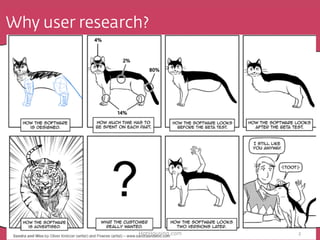
Why user research?
HotHousing.com 2
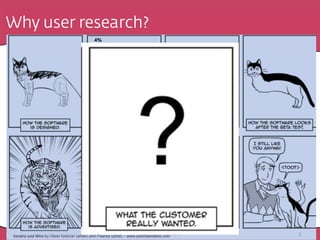
Why user research?
HotHousing.com 3
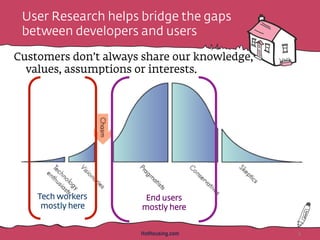
Customers don’t always share our knowledge,
values, assumptions or interests.
Tech workers
mostly here
User Research helps bridge the gaps
between developers and users
End users
mostly here
HotHousing.com 4
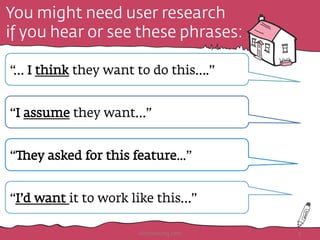
You might need user research
if you hear or see these phrases:
“… I think they want to do this….”
“I’d want it to work like this…”
“"ey asked for this feature...”
“I assume they want…”
HotHousing.com 5
HOW DO YOU DO
RAPID USER RESEARCH?
HotHousing.com 6
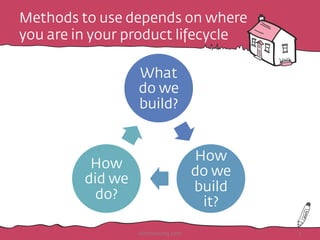
Methods to use depends on where
you are in your product lifecycle
HotHousing.com 7
What
do we
build?
How
do we
build
it?
How
did we
do?
And on what answers you need.
Understanding actual user behavior:
What are users doing? When? Where?
Understanding reasons for behavior
Why are users doing that?
Understanding user attitudes and opinions
How do your users feel about doing it?
HotHousing.com 8
HotHousing.com
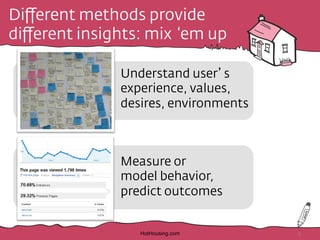
Different methods provide
different insights: mix ‘em up
Understand user’s
experience, values,
desires, environments
Measure or
model behavior,
predict outcomes
9
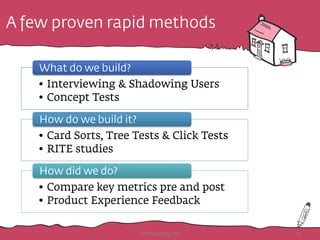
A few proven rapid methods
•  Interviewing & Shadowing Users
•  Concept Tests
What do we build?
•  Card Sorts, Tree Tests & Click Tests
•  RITE studies
How do we build it?
•  Compare key metrics pre and post
•  Product Experience Feedback
How did we do?
HotHousing.com 10
Rapid research requirements
1.  Executive and team buy-in
2.  Feedback from the right people
3.  Efficient data collection & analysis
4.  Actionable, understandable insights
5.  In-time reporting
HotHousing.com 11
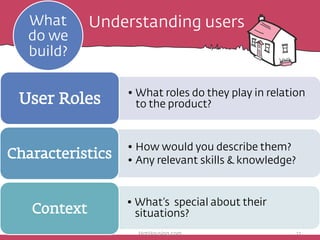
• What roles do they play in relation
to the product?User Roles
• How would you describe them?
• Any relevant skills & knowledge?
Characteristics
• What’s special about their
situations?Context
What
do we
build?
Understanding users
HotHousing.com 12
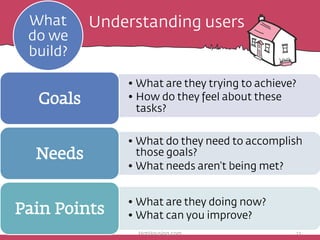
• What are they trying to achieve?
• How do they feel about these
tasks?
Goals
• What do they need to accomplish
those goals?
• What needs aren’t being met?
Needs
• What are they doing now?
• What can you improve?Pain Points
What
do we
build?
Understanding users
HotHousing.com 13
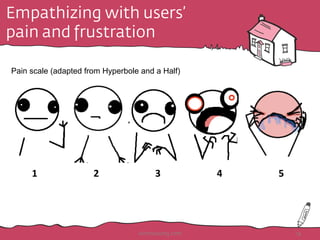
Empathizing with users’
pain and frustration
HotHousing.com 14
Pain scale (adapted from Hyperbole and a Half)
1	
   2	
   3	
   4	
   5	
  
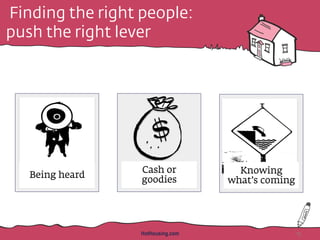
Being heard
Cash or
goodies
Knowing
what’s coming
HotHousing.com 15
Finding the right people:
push the right lever
Interviewing
Used to
– Explore needs,
feelings, opinions
– Obtain recollections
and rationales
– Gather feedback
HotHousing.com 16
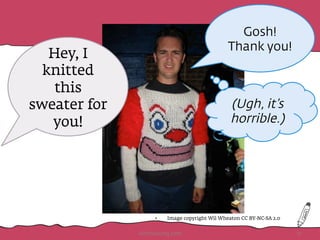
sweater and
asked you to
wear it.
•  Image copyright Wil Wheaton CC BY-NC-SA 2.0
Hey, I
knitted
this
sweater for
you!


Gosh!
Thank you!
(Ugh, it’s
horrible.)
HotHousing.com 17
Behavior: Observing vs. Asking
What people say,
what people do, and
what they say they do
are entirely different
things.”
HotHousing.com 18
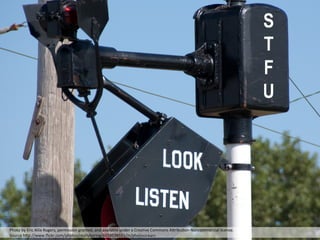
19Photo	
  by	
  Eric	
  Allix	
  Rogers,	
  permission	
  granted,	
  and	
  available	
  under	
  a	
  Crea<ve	
  Commons	
  A=ribu<on-­‐Noncommercial	
  license.	
  	
  
Source	
  h=p://www.flickr.com/photos/reallyboring/6054538551/in/photostream	
  HotHousing.com
Task Card: [task description]
Performed by Role: [role name]
Context of Use:
q  Where and when is it performed?
q  In what environment?
q  What corporate culture?
q  Where in development process?
q  Direction of information flow?
q  Device constraints/ media channels?
q  Needs for
q  Auditability
q  Accuracy & Credibility
q  Confidentiality
Task Characteristics:
q  Frequency
q  Regularity
q  Continuity
q  Intensity of use
q  Timeframe to act
q  Complexity
q  Predictability
q  Who controls the process?
q  Legal/regulatory restrictions
q  Operational/safety risks
q  Other roles involved:
HotHousing.com 20
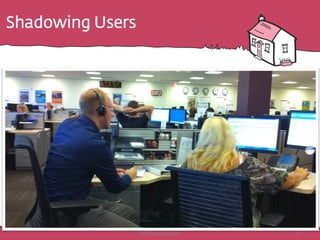
Shadowing Users
21HotHousing.com
22Photo	
  by	
  Jane	
  Mejdahl,	
  	
  used	
  under	
  CC	
  BY-­‐SA	
  2.0.	
  	
  
Source	
  h=p://www.flickr.com/photos/gullig/5016829583/	
   HotHousing.com
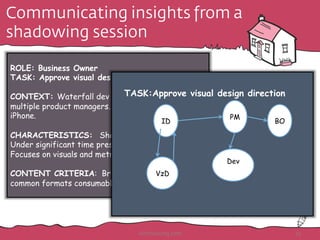
ROLE: Business Owner
TASK: Approve visual design direction
CONTEXT: Waterfall dev process. Supervises
multiple product managers. Frequently mobile; uses
iPhone.
CHARACTERISTICS: Short attention span.
Under significant time pressure.
Focuses on visuals and metrics.
CONTENT CRITERIA: Brief, clear presentation in
common formats consumable on mobile devices
ID
Dev
Mgr
VzD
PM
BO
TASK:Approve visual design direction
Communicating insights from a
shadowing session
HotHousing.com 23
What
do we
build?
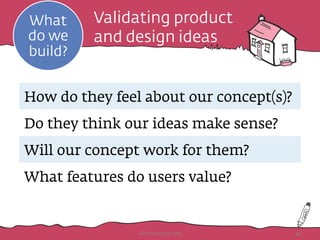
Validating product
and design ideas
How do they feel about our concept(s)?
Do they think our ideas make sense?
Will our concept work for them?
What features do users value?
HotHousing.com 24
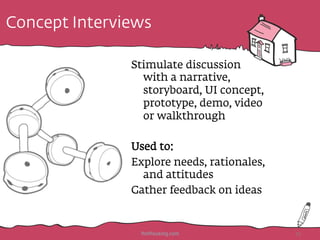
Concept Interviews
Stimulate discussion
with a narrative,
storyboard, UI concept,
prototype, demo, video
or walkthrough
Used to:
Explore needs, rationales,
and attitudes
Gather feedback on ideas
HotHousing.com 25
Mackenzie	
  is	
  building	
  a	
  data-­‐driven	
  site	
  and	
  isn’t	
  sure	
  
about	
  the	
  proposed	
  schema.	
  	
  
HotHousing.com 26
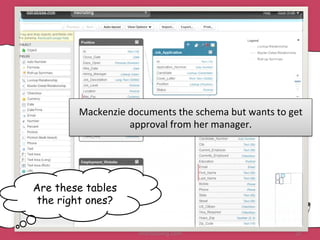
Are these tables
the right ones?
Mackenzie	
  documents	
  the	
  schema	
  but	
  wants	
  to	
  get	
  
approval	
  from	
  her	
  manager.	
  	
  
HotHousing.com 27
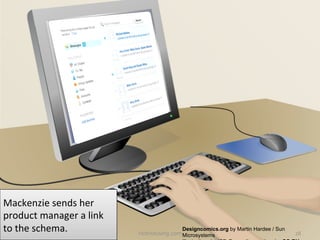
Mackenzie	
  sends	
  her	
  
product	
  manager	
  a	
  link	
  
to	
  the	
  schema.	
  	
   Designcomics.org by Martin Hardee / Sun
MicrosystemsHotHousing.com 28
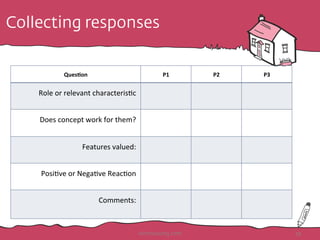
Collecting responses
Ques+on P1 P2 P3
Role	
  or	
  relevant	
  characteris<c	
  
Does	
  concept	
  work	
  for	
  them?	
  	
  
Features	
  valued:	
  	
  
Posi<ve	
  or	
  Nega<ve	
  Reac<on	
  
Comments:	


HotHousing.com 29
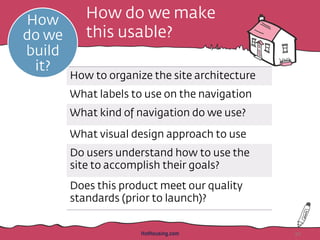
How to organize the site architecture
What labels to use on the navigation
What kind of navigation do we use?
What visual design approach to use
Do users understand how to use the
site to accomplish their goals?
Does this product meet our quality
standards (prior to launch)?
How do we make
this usable?
How
do we
build
it?
HotHousing.com 30
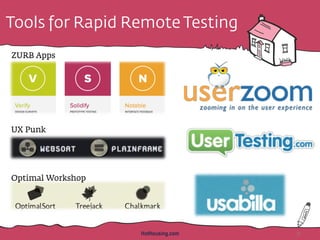
Tools for Rapid Remote Testing
HotHousing.com 31
ZURB Apps
UX Punk
Optimal Workshop
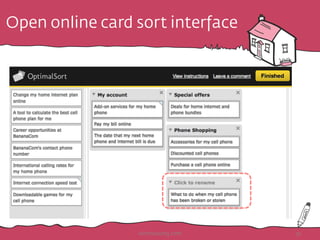
Open online card sort interface
HotHousing.com 32
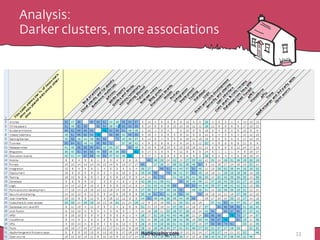
Analysis:
Darker clusters, more associations
HotHousing.com 33
34
Data clustering results
HotHousing.com
RITE Studies
Stands for Rapid Iterative
Testing and Evaluation.
USE IT TO:
•  Identify and resolve
usability issues in an
interface, increasing
levels of fidelity through
the process.
•  Improve and validate
ease of use.
35HotHousing.com
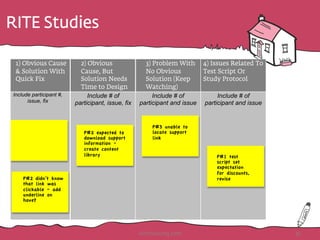
RITE Studies
36
1) Obvious Cause
& Solution With
Quick Fix
2) Obvious
Cause, But
Solution Needs
Time to Design
3) Problem With
No Obvious
Solution (Keep
Watching)
4) Issues Related To
Test Script Or
Study Protocol
Include participant #,
issue, fix
Include # of
participant, issue, fix
Include # of
participant and issue
Include # of
participant and issue
P#1 didn’t
scroll down to
see CTA-
move up?
P#2 expected to
download support
information –
create content
library
P#2 didn’t know
that link was
clickable – add
underline on
hove?
P#3 unable to
locate support
link
P#1 test
script set
expectation
for discounts,
revise
P
HotHousing.com
RITE Studies
CONSIDERATIONS
•  Participants must represent and/or share key characteristics with target users
•  Conduct session in person or remotely using screen sharing applications.
•  Decision-makers must attend all sessions because decisions are made after each one.
•  Prototypes and task scripts may change during the study, so don’t collect success metrics
that depend on experimental rigor (i.e. time on task, error rate.)
•  Use either concurrent or stimulated retrospective think aloud technique to understand users’
expectations for and understanding of design elements.
•  Number of participants may vary depending on number of iterations needed.
•  Leave some time between sessions to allow for debriefing and making design changes. Try
scheduling a day between every three or four sessions to allow for design changes that
require additional thought or time to implement.
ROLES
1 or 2 participants per session, 1 facilitator, stakeholder observers.
MORE PRACTICAL INFORMATION
Using the RITE Method to improve products: a definition and a case study. .Medlock, M. C., et al.
(2002). Usability Professionals Association, Orlando FL July 2002
37HotHousing.com
How
did we
do?
Evaluating success
after launch
Do users understand how to accomplish
their goals?
Are users satisfied with it?
Did we increase conversion/sales?
Are we keeping users engaged?...
HotHousing.com 38
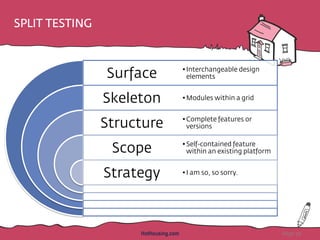
SPLIT TESTING
Page 39
Surface
Skeleton
Structure
Scope
Strategy
• Interchangeable design
elements
• Modules within a grid
• Complete features or
versions
• Self-contained feature
within an existing platform
• I am so, so sorry.
HotHousing.com
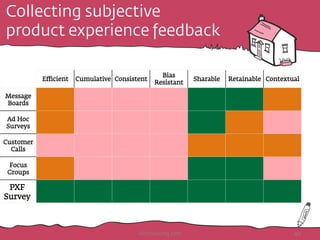
Efficient Cumulative Consistent
Bias
Resistant
Sharable Retainable Contextual
Message
Boards


Ad Hoc
Surveys


Customer
Calls


Focus
Groups


PXF
Survey 	


Collecting subjective
product experience feedback
HotHousing.com 40
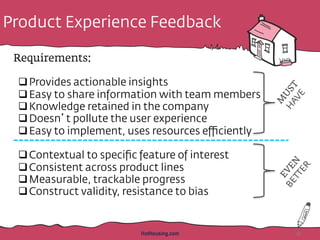
Product Experience Feedback
Requirements:
q Provides actionable insights
q Easy to share information with team members
q Knowledge retained in the company
q Doesn’t pollute the user experience
q Easy to implement, uses resources efficiently
q Contextual to specific feature of interest
q Consistent across product lines
q Measurable, trackable progress
q Construct validity, resistance to bias
HotHousing.com 41
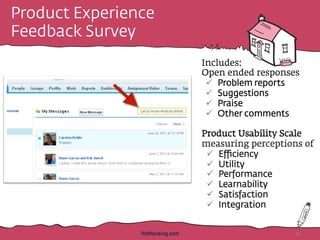
Product Experience
Feedback Survey
Includes:
Open ended responses
ü  Problem reports
ü  Suggestions
ü  Praise
ü  Other comments
Product Usability Scale
measuring perceptions of
ü  Efficiency
ü  Utility
ü  Performance
ü  Learnability
ü  Satisfaction
ü  Integration
HotHousing.com 42
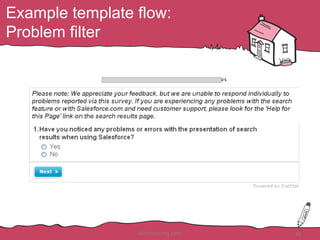
Example template flow:
Problem filter
HotHousing.com 43
Collect bugs first; then
group feedback by type
1.Have you experienced any problems or errors when using
[NAME OF FEATURE] in [PRODUCT NAME]?
(Yes/No-randomized)
2. Please describe any problems or errors you've noticed
while using [NAME OF FEATURE]
3. What, if anything, do you like most about [NAME OF
FEATURE]?
4. Do you have any ideas or suggestions for improving
[NAME OF FEATURE]?
 
5. If there is anything else you'd like us to know about the
[NAME OF FEATURE] in [PRODUCT NAME], tell us here.
HotHousing.com 44
Product Experience Ratings:
subjective experience metrics
6. Please rate how strongly you agree or disagree with
each of the following statements:
HotHousing.com 45
1) Strongly Disagree 2) Disagree 3) Neither agree nor disagree 4) Agree 5) Strongly Agree)
a.  I	
  expect	
  to	
  use	
  [NAME	
  OF	
  FEATURE]	
  within	
  [PRODUCT	
  NAME]	
  
frequently.	
  	
  
b.  [PERFORMING	
  KEY	
  USER	
  STORY]	
  with	
  [NAME	
  OF	
  FEATURE]	
  is	
  easy	
  
and	
  straighdorward.	


c.  I	
  am	
  sa<sfied	
  with	
  the	
  [NAME	
  OF	
  FEATURE]	
  in	
  [PRODUCT	
  NAME],	
  
d.  I	
  had	
  to	
  learn	
  a	
  lot	
  of	
  things	
  before	
  I	
  could	
  use	
  the	
  [NAME	
  OF	
  
FEATURE]	
  effec<vely.	
  	
  
e.  The	
  [NAME	
  OF	
  FEATURE]	
  works	
  seamlessly	
  with	
  the	
  rest	
  of	
  the	
  
[PRODUCT	
  NAME]	
  applica<on.	
  
f.  When	
  I	
  use	
  the	
  [NAME	
  OF	
  FEATURE]	
  it	
  feels	
  quick	
  and	
  responsive.	


Utility
Ease of Use
Satisfaction
Learnability
Integration
Performance
Rapid + Valuable = 6 steps
1.  Engage stakeholders early and often
2.  Keep plan focused
3.  Get a representative sample
4.  Ask questions and listen without bias
5.  Collect data efficiently (but follow up
hunches and surprises)
6.  Share actionable findings
HotHousing.com 46
"anks, y’all.
Send your flames, ideas, and
comments to @avivaux or
aviva@hothousing.com.

Rapid User Research - a talk from Agile 2013 by Aviva Rosenstein

  • 1.
    Rapid User Research #rapidresearch Apart of the HotHousing product kickoff & exploration framework Aviva Rosenstein, PhD UX Consultant, Evolve Beyond @avivaux Gabrielle Benefield CEO, Evolve Beyond @gbenefield HotHousing.com 1
  • 2.
  • 3.
  • 4.
    Customers don’t alwaysshare our knowledge, values, assumptions or interests. Tech workers mostly here User Research helps bridge the gaps between developers and users End users mostly here HotHousing.com 4
  • 5.
    You might needuser research if you hear or see these phrases: “… I think they want to do this….” “I’d want it to work like this…” “"ey asked for this feature...” “I assume they want…” HotHousing.com 5
  • 6.
    HOW DO YOUDO RAPID USER RESEARCH? HotHousing.com 6
  • 7.
    Methods to usedepends on where you are in your product lifecycle HotHousing.com 7 What do we build? How do we build it? How did we do?
  • 8.
    And on whatanswers you need. Understanding actual user behavior: What are users doing? When? Where? Understanding reasons for behavior Why are users doing that? Understanding user attitudes and opinions How do your users feel about doing it? HotHousing.com 8
  • 9.
    HotHousing.com Different methods provide differentinsights: mix ‘em up Understand user’s experience, values, desires, environments Measure or model behavior, predict outcomes 9
  • 10.
    A few provenrapid methods •  Interviewing & Shadowing Users •  Concept Tests What do we build? •  Card Sorts, Tree Tests & Click Tests •  RITE studies How do we build it? •  Compare key metrics pre and post •  Product Experience Feedback How did we do? HotHousing.com 10
  • 11.
    Rapid research requirements 1. Executive and team buy-in 2.  Feedback from the right people 3.  Efficient data collection & analysis 4.  Actionable, understandable insights 5.  In-time reporting HotHousing.com 11
  • 12.
    • What roles dothey play in relation to the product?User Roles • How would you describe them? • Any relevant skills & knowledge? Characteristics • What’s special about their situations?Context What do we build? Understanding users HotHousing.com 12
  • 13.
    • What are theytrying to achieve? • How do they feel about these tasks? Goals • What do they need to accomplish those goals? • What needs aren’t being met? Needs • What are they doing now? • What can you improve?Pain Points What do we build? Understanding users HotHousing.com 13
  • 14.
    Empathizing with users’ painand frustration HotHousing.com 14 Pain scale (adapted from Hyperbole and a Half) 1   2   3   4   5  
  • 15.
    Being heard Cash or goodies Knowing what’scoming HotHousing.com 15 Finding the right people: push the right lever
  • 16.
    Interviewing Used to – Explore needs, feelings,opinions – Obtain recollections and rationales – Gather feedback HotHousing.com 16
  • 17.
    sweater and asked youto wear it. •  Image copyright Wil Wheaton CC BY-NC-SA 2.0 Hey, I knitted this sweater for you!     Gosh! Thank you! (Ugh, it’s horrible.) HotHousing.com 17
  • 18.
    Behavior: Observing vs.Asking What people say, what people do, and what they say they do are entirely different things.” HotHousing.com 18
  • 19.
    19Photo  by  Eric  Allix  Rogers,  permission  granted,  and  available  under  a  Crea<ve  Commons  A=ribu<on-­‐Noncommercial  license.     Source  h=p://www.flickr.com/photos/reallyboring/6054538551/in/photostream  HotHousing.com
  • 20.
    Task Card: [taskdescription] Performed by Role: [role name] Context of Use: q  Where and when is it performed? q  In what environment? q  What corporate culture? q  Where in development process? q  Direction of information flow? q  Device constraints/ media channels? q  Needs for q  Auditability q  Accuracy & Credibility q  Confidentiality Task Characteristics: q  Frequency q  Regularity q  Continuity q  Intensity of use q  Timeframe to act q  Complexity q  Predictability q  Who controls the process? q  Legal/regulatory restrictions q  Operational/safety risks q  Other roles involved: HotHousing.com 20
  • 21.
  • 22.
    22Photo  by  Jane  Mejdahl,    used  under  CC  BY-­‐SA  2.0.     Source  h=p://www.flickr.com/photos/gullig/5016829583/   HotHousing.com
  • 23.
    ROLE: Business Owner TASK:Approve visual design direction CONTEXT: Waterfall dev process. Supervises multiple product managers. Frequently mobile; uses iPhone. CHARACTERISTICS: Short attention span. Under significant time pressure. Focuses on visuals and metrics. CONTENT CRITERIA: Brief, clear presentation in common formats consumable on mobile devices ID Dev Mgr VzD PM BO TASK:Approve visual design direction Communicating insights from a shadowing session HotHousing.com 23
  • 24.
    What do we build? Validating product anddesign ideas How do they feel about our concept(s)? Do they think our ideas make sense? Will our concept work for them? What features do users value? HotHousing.com 24
  • 25.
    Concept Interviews Stimulate discussion witha narrative, storyboard, UI concept, prototype, demo, video or walkthrough Used to: Explore needs, rationales, and attitudes Gather feedback on ideas HotHousing.com 25
  • 26.
    Mackenzie  is  building  a  data-­‐driven  site  and  isn’t  sure   about  the  proposed  schema.     HotHousing.com 26
  • 27.
    Are these tables theright ones? Mackenzie  documents  the  schema  but  wants  to  get   approval  from  her  manager.     HotHousing.com 27
  • 28.
    Mackenzie  sends  her   product  manager  a  link   to  the  schema.     Designcomics.org by Martin Hardee / Sun MicrosystemsHotHousing.com 28
  • 29.
    Collecting responses Ques+on P1P2 P3 Role  or  relevant  characteris<c   Does  concept  work  for  them?     Features  valued:     Posi<ve  or  Nega<ve  Reac<on   Comments:     HotHousing.com 29
  • 30.
    How to organizethe site architecture What labels to use on the navigation What kind of navigation do we use? What visual design approach to use Do users understand how to use the site to accomplish their goals? Does this product meet our quality standards (prior to launch)? How do we make this usable? How do we build it? HotHousing.com 30
  • 31.
    Tools for RapidRemote Testing HotHousing.com 31 ZURB Apps UX Punk Optimal Workshop
  • 32.
    Open online cardsort interface HotHousing.com 32
  • 33.
    Analysis: Darker clusters, moreassociations HotHousing.com 33
  • 34.
  • 35.
    RITE Studies Stands forRapid Iterative Testing and Evaluation. USE IT TO: •  Identify and resolve usability issues in an interface, increasing levels of fidelity through the process. •  Improve and validate ease of use. 35HotHousing.com
  • 36.
    RITE Studies 36 1) ObviousCause & Solution With Quick Fix 2) Obvious Cause, But Solution Needs Time to Design 3) Problem With No Obvious Solution (Keep Watching) 4) Issues Related To Test Script Or Study Protocol Include participant #, issue, fix Include # of participant, issue, fix Include # of participant and issue Include # of participant and issue P#1 didn’t scroll down to see CTA- move up? P#2 expected to download support information – create content library P#2 didn’t know that link was clickable – add underline on hove? P#3 unable to locate support link P#1 test script set expectation for discounts, revise P HotHousing.com
  • 37.
    RITE Studies CONSIDERATIONS •  Participantsmust represent and/or share key characteristics with target users •  Conduct session in person or remotely using screen sharing applications. •  Decision-makers must attend all sessions because decisions are made after each one. •  Prototypes and task scripts may change during the study, so don’t collect success metrics that depend on experimental rigor (i.e. time on task, error rate.) •  Use either concurrent or stimulated retrospective think aloud technique to understand users’ expectations for and understanding of design elements. •  Number of participants may vary depending on number of iterations needed. •  Leave some time between sessions to allow for debriefing and making design changes. Try scheduling a day between every three or four sessions to allow for design changes that require additional thought or time to implement. ROLES 1 or 2 participants per session, 1 facilitator, stakeholder observers. MORE PRACTICAL INFORMATION Using the RITE Method to improve products: a definition and a case study. .Medlock, M. C., et al. (2002). Usability Professionals Association, Orlando FL July 2002 37HotHousing.com
  • 38.
    How did we do? Evaluating success afterlaunch Do users understand how to accomplish their goals? Are users satisfied with it? Did we increase conversion/sales? Are we keeping users engaged?... HotHousing.com 38
  • 39.
    SPLIT TESTING Page 39 Surface Skeleton Structure Scope Strategy • Interchangeabledesign elements • Modules within a grid • Complete features or versions • Self-contained feature within an existing platform • I am so, so sorry. HotHousing.com
  • 40.
    Efficient Cumulative Consistent Bias Resistant SharableRetainable Contextual Message Boards                             Ad Hoc Surveys                             Customer Calls                             Focus Groups                             PXF Survey                             Collecting subjective product experience feedback HotHousing.com 40
  • 41.
    Product Experience Feedback Requirements: q Providesactionable insights q Easy to share information with team members q Knowledge retained in the company q Doesn’t pollute the user experience q Easy to implement, uses resources efficiently q Contextual to specific feature of interest q Consistent across product lines q Measurable, trackable progress q Construct validity, resistance to bias HotHousing.com 41
  • 42.
    Product Experience Feedback Survey Includes: Openended responses ü  Problem reports ü  Suggestions ü  Praise ü  Other comments Product Usability Scale measuring perceptions of ü  Efficiency ü  Utility ü  Performance ü  Learnability ü  Satisfaction ü  Integration HotHousing.com 42
  • 43.
    Example template flow: Problemfilter HotHousing.com 43
  • 44.
    Collect bugs first;then group feedback by type 1.Have you experienced any problems or errors when using [NAME OF FEATURE] in [PRODUCT NAME]? (Yes/No-randomized) 2. Please describe any problems or errors you've noticed while using [NAME OF FEATURE] 3. What, if anything, do you like most about [NAME OF FEATURE]? 4. Do you have any ideas or suggestions for improving [NAME OF FEATURE]?   5. If there is anything else you'd like us to know about the [NAME OF FEATURE] in [PRODUCT NAME], tell us here. HotHousing.com 44
  • 45.
    Product Experience Ratings: subjectiveexperience metrics 6. Please rate how strongly you agree or disagree with each of the following statements: HotHousing.com 45 1) Strongly Disagree 2) Disagree 3) Neither agree nor disagree 4) Agree 5) Strongly Agree) a.  I  expect  to  use  [NAME  OF  FEATURE]  within  [PRODUCT  NAME]   frequently.     b.  [PERFORMING  KEY  USER  STORY]  with  [NAME  OF  FEATURE]  is  easy   and  straighdorward.       c.  I  am  sa<sfied  with  the  [NAME  OF  FEATURE]  in  [PRODUCT  NAME],   d.  I  had  to  learn  a  lot  of  things  before  I  could  use  the  [NAME  OF   FEATURE]  effec<vely.     e.  The  [NAME  OF  FEATURE]  works  seamlessly  with  the  rest  of  the   [PRODUCT  NAME]  applica<on.   f.  When  I  use  the  [NAME  OF  FEATURE]  it  feels  quick  and  responsive.       Utility Ease of Use Satisfaction Learnability Integration Performance
  • 46.
    Rapid + Valuable= 6 steps 1.  Engage stakeholders early and often 2.  Keep plan focused 3.  Get a representative sample 4.  Ask questions and listen without bias 5.  Collect data efficiently (but follow up hunches and surprises) 6.  Share actionable findings HotHousing.com 46
  • 47.
    "anks, y’all. Send yourflames, ideas, and comments to @avivaux or aviva@hothousing.com.