EXPLAINING SKILL
Expression & transmission of knowledge to others
Presented By:
Megha Patidar
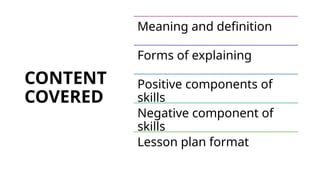
CONTENT
COVERED
Meaning and definition
Forms of explaining
Positive components of
skills
Negative component of
skills
Lesson plan format
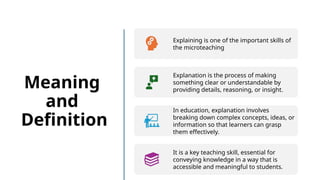
Meaning
and
Definition
Explaining is one of the important skills of
the microteaching
Explanation is the process of making
something clear or understandable by
providing details, reasoning, or insight.
In education, explanation involves
breaking down complex concepts, ideas, or
information so that learners can grasp
them effectively.
It is a key teaching skill, essential for
conveying knowledge in a way that is
accessible and meaningful to students.
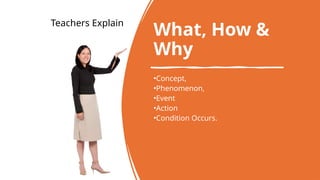
What, How &
Why
•Concept,
•Phenomenon,
•Event
•Action
•Condition Occurs.
Teachers Explain
Allied terms
• Exposition: It is the act of explaining or presenting information, often in a detailed and structured
way. It is commonly used in writing, speech, and teaching to convey ideas, concepts, or facts to an
audience. The goal of exposition is to inform, clarify, and provide context, helping the audience
understand a subject more thoroughly by connecting it with previous knowledge.
• Narration: It is the verbal picture or an event, incident or happening. Narration is a kind of speech
in which the teacher delivers lecture on an incident or content. During narration it is necessary to use
language and speech skillfully.
• Description: is a form of communication that provides detailed information about a person, place,
object, or event, often using sensory language to convey specific characteristics or qualities. The
purpose of description is to help the audience visualize or understand the subject by focusing on its
key attributes, such as appearance, texture, sound, smell, or behavior.
Forms of Explaining
Descriptive Explanation :
Explain process, function, structure. Example: Description of features of
microscope.
Interpretative :
Specifies the essence or zist of a term or statement or clarifies and issues.
Example: “Education is a scientific in nature.”
Reason Giving Type :
Causes for a phenomenon are given or conclusion are drawn based on
sequential steps. Example: Causes behind day and night on the earth.
Positive component of skills
Beginning Statements (BS)
Explaining Links (EL)
Technical Term Defined ( TTD)
Covering Essential Points (CEP)
Questions To Test Pupil’ Understanding (QTPU)
Questions Followed By Correct Pupil’ Response (QFCPR)
Concluding Statement (CS)
The teacher gives the introductory or the beginning
statement to focus the attention of students towards the
lesson or content to be presented. The students become
mentally prepared for the lesson. If the content is lengthy,
more than one beginning statements may be used.
An example of the beginning statement is given below:
Teacher is teaching about Newton's Third Law of
Motion.
Teacher: Today, we will study about the Newton's Third
Law of Motion.
Beginning Statement
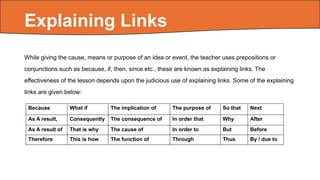
Explaining Links
While giving the cause, means or purpose of an idea or event, the teacher uses prepositions or
conjunctions such as because, if, then, since etc., these are known as explaining links. The
effectiveness of the lesson depends upon the judicious use of explaining links. Some of the explaining
links are given below:
Because What if The implication of The purpose of So that Next
As A result, Consequently The consequence of In order that Why After
As A result of That is why The cause of In order to But Before
Therefore This is how The function of Through Thus By / due to
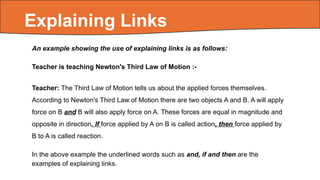
An example showing the use of explaining links is as follows:
Teacher is teaching Newton's Third Law of Motion :-
Teacher: The Third Law of Motion tells us about the applied forces themselves.
According to Newton's Third Law of Motion there are two objects A and B. A will apply
force on B and B will also apply force on A. These forces are equal in magnitude and
opposite in direction. If force applied by A on B is called action, then force applied by
B to A is called reaction.
In the above example the underlined words such as and, if and then are the
examples of explaining links.
Explaining Links
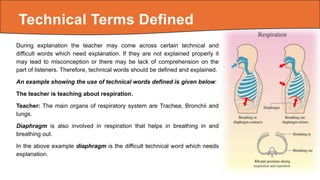
Technical Terms Defined
During explanation the teacher may come across certain technical and
difficult words which need explanation. If they are not explained properly it
may lead to misconception or there may be lack of comprehension on the
part of listeners. Therefore, technical words should be defined and explained.
An example showing the use of technical words defined is given below:
The teacher is teaching about respiration.
Teacher: The main organs of respiratory system are Trachea, Bronchii and
lungs.
Diaphragm is also involved in respiration that helps in breathing in and
breathing out.
In the above example diaphragm is the difficult technical word which needs
explanation.
During the presentation of the content a teacher may come across many interrelated
concepts. All these concepts should be clearly explained.
According to Jangira et al. (1982), "The complete explanation should cover all these
concepts. The completeness of explanation is determined by the scope of the concept or
organization as specified in the instructional objectives."
Brown (1975) has rightly remarked that "To cover the essential features it is necessary
to know what they are so you can separate the items that the student need to know from
these which it would be nice for them to know".
For example - While teaching the concept of fruit the teacher should clearly
explain the interrelated concepts like vegetables and nuts.
Covering Essential Points
The main purpose of the teaching learning process is comprehension of the taught content. In the skill
of explaining the comprehension of student is judged with the help of questions. Generally, these
questions are asked during concluding stage. These questions serve the purpose of feedback to the
teacher as to what extent students have understood the concept.
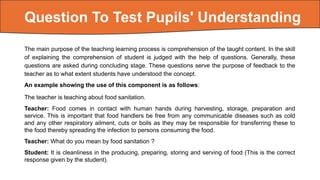
An example showing the use of this component is as follows:
The teacher is teaching about food sanitation.
Teacher: Food comes in contact with human hands during harvesting, storage, preparation and
service. This is important that food handlers be free from any communicable diseases such as cold
and any other respiratory ailment, cuts or boils as they may be responsible for transferring these to
the food thereby spreading the infection to persons consuming the food.
Teacher: What do you mean by food sanitation ?
Student: It is cleanliness in the producing, preparing, storing and serving of food (This is the correct
response given by the student).
Question To Test Pupils' Understanding
Questions followed by correct pupil response
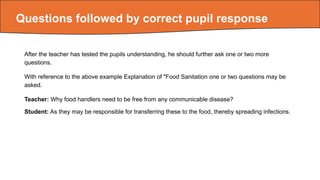
After the teacher has tested the pupils understanding, he should further ask one or two more
questions.
With reference to the above example Explanation of "Food Sanitation one or two questions may be
asked.
Teacher: Why food handlers need to be free from any communicable disease?
Student: As they may be responsible for transferring these to the food, thereby spreading infections.
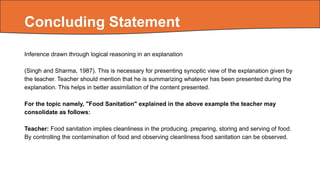
Concluding Statement
Inference drawn through logical reasoning in an explanation
(Singh and Sharma, 1987). This is necessary for presenting synoptic view of the explanation given by
the teacher. Teacher should mention that he is summarizing whatever has been presented during the
explanation. This helps in better assimilation of the content presented.
For the topic namely, "Food Sanitation" explained in the above example the teacher may
consolidate as follows:
Teacher: Food sanitation implies cleanliness in the producing. preparing, storing and serving of food.
By controlling the contamination of food and observing cleanliness food sanitation can be observed.
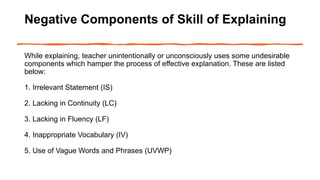
Negative Components of Skill of Explaining
While explaining, teacher unintentionally or unconsciously uses some undesirable
components which hamper the process of effective explanation. These are listed
below:
1. Irrelevant Statement (IS)
2. Lacking in Continuity (LC)
3. Lacking in Fluency (LF)
4. Inappropriate Vocabulary (IV)
5. Use of Vague Words and Phrases (UVWP)
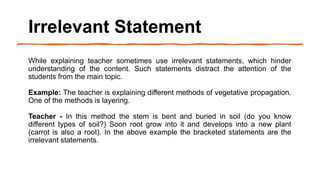
Irrelevant Statement
While explaining teacher sometimes use irrelevant statements, which hinder
understanding of the content. Such statements distract the attention of the
students from the main topic.
Example: The teacher is explaining different methods of vegetative propagation.
One of the methods is layering.
Teacher - In this method the stem is bent and buried in soil (do you know
different types of soil?) Soon root grow into it and develops into a new plant
(carrot is also a root). In the above example the bracketed statements are the
irrelevant statements.
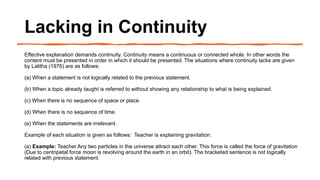
Lacking in Continuity
Effective explanation demands continuity. Continuity means a continuous or connected whole. In other words the
content must be presented in order in which it should be presented. The situations where continuity lacks are given
by Lalitha (1976) are as follows:
(a) When a statement is not logically related to the previous statement.
(b) When a topic already taught is referred to without showing any relationship to what is being explained.
(c) When there is no sequence of space or place.
(d) When there is no sequence of time.
(e) When the statements are irrelevant.
Example of each situation is given as follows: Teacher is explaining gravitation.
(a) Example: Teacher Any two particles in the universe attract each other. This force is called the force of gravitation
(Due to centripetal force moon is revolving around the earth in an orbit). The bracketed sentence is not logically
related with previous statement.
Lacking in Continuity
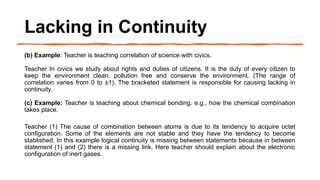
(b) Example: Teacher is teaching correlation of science with civics.
Teacher In civics we study about rights and duties of citizens. It is the duty of every citizen to
keep the environment clean, pollution free and conserve the environment. (The range of
correlation varies from 0 to ±1). The bracketed statement is responsible for causing lacking in
continuity.
(c) Example: Teacher is teaching about chemical bonding. e.g., how the chemical combination
takes place.
Teacher (1) The cause of combination between atoms is due to its tendency to acquire octet
configuration. Some of the elements are not stable and they have the tendency to become
stablished. In this example logical continuity is missing between statements because in between
statement (1) and (2) there is a missing link. Here teacher should explain about the electronic
configuration of inert gases.
Inappropriate Vocabulary
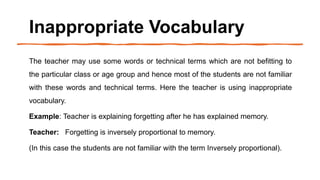
The teacher may use some words or technical terms which are not befitting to
the particular class or age group and hence most of the students are not familiar
with these words and technical terms. Here the teacher is using inappropriate
vocabulary.
Example: Teacher is explaining forgetting after he has explained memory.
Teacher: Forgetting is inversely proportional to memory.
(In this case the students are not familiar with the term Inversely proportional).
Vague Words and Phrases
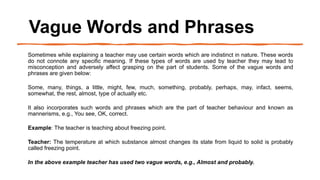
Sometimes while explaining a teacher may use certain words which are indistinct in nature. These words
do not connote any specific meaning. If these types of words are used by teacher they may lead to
misconception and adversely affect grasping on the part of students. Some of the vague words and
phrases are given below:
Some, many, things, a little, might, few, much, something, probably, perhaps, may, infact, seems,
somewhat, the rest, almost, type of actually etc.
It also incorporates such words and phrases which are the part of teacher behaviour and known as
mannerisms, e.g., You see, OK, correct.
Example: The teacher is teaching about freezing point.
Teacher: The temperature at which substance almost changes its state from liquid to solid is probably
called freezing point.
In the above example teacher has used two vague words, e.g., Almost and probably.
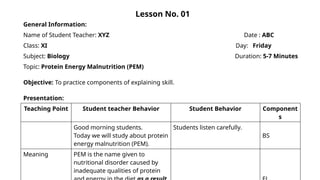
Lesson No. 01
General Information:
Name of Student Teacher: XYZ Date : ABC
Class: XI Day: Friday
Subject: Biology Duration: 5-7 Minutes
Topic: Protein Energy Malnutrition (PEM)
Objective: To practice components of explaining skill.
Presentation:
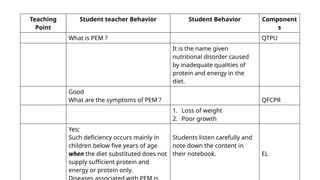
Teaching Point Student teacher Behavior Student Behavior Component
s
Good morning students.
Today we will study about protein
energy malnutrition (PEM).
Students listen carefully.
BS
Meaning PEM is the name given to
nutritional disorder caused by
inadequate qualities of protein
Teaching
Point
Student teacher Behavior Student Behavior Component
s
What is PEM ? QTPU
It is the name given
nutritional disorder caused
by inadequate qualities of
protein and energy in the
diet.
Good
What are the symptoms of PEM ? QFCPR
1. Loss of weight
2. Poor growth
Yes;
Such deficiency occurs mainly in
children below five years of age
when the diet substituted does not
supply sufficient protein and
energy or protein only.
Students listen carefully and
note down the content in
their notebook. EL
Teaching
Point
Student teacher Behavior Student Behavior Component
s
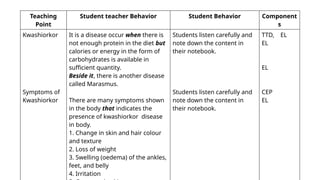
Kwashiorkor
Symptoms of
Kwashiorkor
It is a disease occur when there is
not enough protein in the diet but
calories or energy in the form of
carbohydrates is available in
sufficient quantity.
Beside it, there is another disease
called Marasmus.
There are many symptoms shown
in the body that indicates the
presence of kwashiorkor disease
in body.
1. Change in skin and hair colour
and texture
2. Loss of weight
3. Swelling (oedema) of the ankles,
feet, and belly
4. Irritation
Students listen carefully and
note down the content in
their notebook.
Students listen carefully and
note down the content in
their notebook.
TTD, EL
EL
EL
CEP
EL
Teaching
Point
Student teacher Behavior Student Behavior Component
s
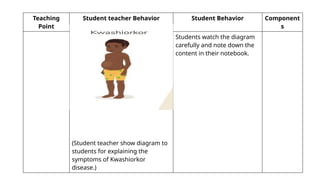
(Student teacher show diagram to
students for explaining the
symptoms of Kwashiorkor
disease.)
Students watch the diagram
carefully and note down the
content in their notebook.
Teaching
Point
Student teacher Behavior Student Behavior Component
s
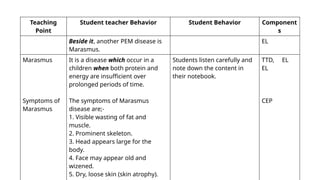
Beside it, another PEM disease is
Marasmus.
EL
Marasmus
Symptoms of
Marasmus
It is a disease which occur in a
children when both protein and
energy are insufficient over
prolonged periods of time.
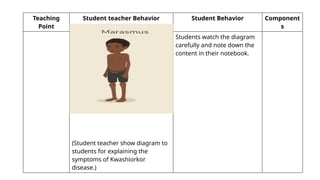
The symptoms of Marasmus
disease are;-
1. Visible wasting of fat and
muscle.
2. Prominent skeleton.
3. Head appears large for the
body.
4. Face may appear old and
wizened.
5. Dry, loose skin (skin atrophy).
Students listen carefully and
note down the content in
their notebook.
TTD, EL
EL
CEP
Teaching
Point
Student teacher Behavior Student Behavior Component
s
(Student teacher show diagram to
students for explaining the
symptoms of Kwashiorkor
disease.)
Students watch the diagram
carefully and note down the
content in their notebook.
Teaching
Point
Student teacher Behavior Student Behavior Component
s
Treatment of
PEM
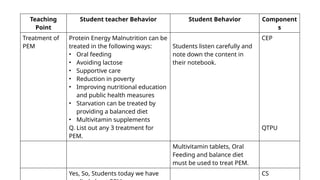
Protein Energy Malnutrition can be
treated in the following ways:
• Oral feeding
• Avoiding lactose
• Supportive care
• Reduction in poverty
• Improving nutritional education
and public health measures
• Starvation can be treated by
providing a balanced diet
• Multivitamin supplements
Q. List out any 3 treatment for
PEM.
Students listen carefully and
note down the content in
their notebook.
CEP
QTPU
Multivitamin tablets, Oral
Feeding and balance diet
must be used to treat PEM.
Yes, So, Students today we have CS
Lesson No. 1
General information:
Name of Student Teacher: XYZ
Class:- XI
Subject:- Biology
Topic:- Protein Energy Malnutrition (PEM)
Date:- ABC
Day:- Friday
Duration:- 5-7 Minutes
Objective:- To practice components of explaining skills.
Black Board Work:-
Signature Table:-
Student Teacher
Signature
Subject Teacher Signature Supervisor Signature
References
Passi, B. K. and Et.al. (). Introduction to microteaching. [ (P.78-85), (P .117-120) ].
Stanford Center For Health Education, (September 30, 2023). What is Malnutrition
[Video File]. You tube. https://youtu.be/jEd91r___5Y?si=kcbbVvwXHk-w-GAT
https://my.clevelandclinic.org/health/diseases/23296-marasmus
https://www.msdmanuals.com/en-in/professional/nutritional-disorders/undernutrition
/protein-energy-undernutrition-peu
https://www.careinsurance.com/blog/health-insurance-articles/let-s-decode-protein-en
ergy-malnutrition
https://byjus.com/biology/pem/
THANKYO
U

Explaining skill : An art of expressing knowledge.pptx

  • 1.
    EXPLAINING SKILL Expression &transmission of knowledge to others Presented By: Megha Patidar
  • 2.
    CONTENT COVERED Meaning and definition Formsof explaining Positive components of skills Negative component of skills Lesson plan format
  • 3.
    Meaning and Definition Explaining is oneof the important skills of the microteaching Explanation is the process of making something clear or understandable by providing details, reasoning, or insight. In education, explanation involves breaking down complex concepts, ideas, or information so that learners can grasp them effectively. It is a key teaching skill, essential for conveying knowledge in a way that is accessible and meaningful to students.
  • 4.
  • 5.
    Allied terms • Exposition:It is the act of explaining or presenting information, often in a detailed and structured way. It is commonly used in writing, speech, and teaching to convey ideas, concepts, or facts to an audience. The goal of exposition is to inform, clarify, and provide context, helping the audience understand a subject more thoroughly by connecting it with previous knowledge. • Narration: It is the verbal picture or an event, incident or happening. Narration is a kind of speech in which the teacher delivers lecture on an incident or content. During narration it is necessary to use language and speech skillfully. • Description: is a form of communication that provides detailed information about a person, place, object, or event, often using sensory language to convey specific characteristics or qualities. The purpose of description is to help the audience visualize or understand the subject by focusing on its key attributes, such as appearance, texture, sound, smell, or behavior.
  • 6.
    Forms of Explaining DescriptiveExplanation : Explain process, function, structure. Example: Description of features of microscope. Interpretative : Specifies the essence or zist of a term or statement or clarifies and issues. Example: “Education is a scientific in nature.” Reason Giving Type : Causes for a phenomenon are given or conclusion are drawn based on sequential steps. Example: Causes behind day and night on the earth.
  • 7.
    Positive component ofskills Beginning Statements (BS) Explaining Links (EL) Technical Term Defined ( TTD) Covering Essential Points (CEP) Questions To Test Pupil’ Understanding (QTPU) Questions Followed By Correct Pupil’ Response (QFCPR) Concluding Statement (CS)
  • 8.
    The teacher givesthe introductory or the beginning statement to focus the attention of students towards the lesson or content to be presented. The students become mentally prepared for the lesson. If the content is lengthy, more than one beginning statements may be used. An example of the beginning statement is given below: Teacher is teaching about Newton's Third Law of Motion. Teacher: Today, we will study about the Newton's Third Law of Motion. Beginning Statement
  • 9.
    Explaining Links While givingthe cause, means or purpose of an idea or event, the teacher uses prepositions or conjunctions such as because, if, then, since etc., these are known as explaining links. The effectiveness of the lesson depends upon the judicious use of explaining links. Some of the explaining links are given below: Because What if The implication of The purpose of So that Next As A result, Consequently The consequence of In order that Why After As A result of That is why The cause of In order to But Before Therefore This is how The function of Through Thus By / due to
  • 10.
    An example showingthe use of explaining links is as follows: Teacher is teaching Newton's Third Law of Motion :- Teacher: The Third Law of Motion tells us about the applied forces themselves. According to Newton's Third Law of Motion there are two objects A and B. A will apply force on B and B will also apply force on A. These forces are equal in magnitude and opposite in direction. If force applied by A on B is called action, then force applied by B to A is called reaction. In the above example the underlined words such as and, if and then are the examples of explaining links. Explaining Links
  • 11.
    Technical Terms Defined Duringexplanation the teacher may come across certain technical and difficult words which need explanation. If they are not explained properly it may lead to misconception or there may be lack of comprehension on the part of listeners. Therefore, technical words should be defined and explained. An example showing the use of technical words defined is given below: The teacher is teaching about respiration. Teacher: The main organs of respiratory system are Trachea, Bronchii and lungs. Diaphragm is also involved in respiration that helps in breathing in and breathing out. In the above example diaphragm is the difficult technical word which needs explanation.
  • 12.
    During the presentationof the content a teacher may come across many interrelated concepts. All these concepts should be clearly explained. According to Jangira et al. (1982), "The complete explanation should cover all these concepts. The completeness of explanation is determined by the scope of the concept or organization as specified in the instructional objectives." Brown (1975) has rightly remarked that "To cover the essential features it is necessary to know what they are so you can separate the items that the student need to know from these which it would be nice for them to know". For example - While teaching the concept of fruit the teacher should clearly explain the interrelated concepts like vegetables and nuts. Covering Essential Points
  • 13.
    The main purposeof the teaching learning process is comprehension of the taught content. In the skill of explaining the comprehension of student is judged with the help of questions. Generally, these questions are asked during concluding stage. These questions serve the purpose of feedback to the teacher as to what extent students have understood the concept. An example showing the use of this component is as follows: The teacher is teaching about food sanitation. Teacher: Food comes in contact with human hands during harvesting, storage, preparation and service. This is important that food handlers be free from any communicable diseases such as cold and any other respiratory ailment, cuts or boils as they may be responsible for transferring these to the food thereby spreading the infection to persons consuming the food. Teacher: What do you mean by food sanitation ? Student: It is cleanliness in the producing, preparing, storing and serving of food (This is the correct response given by the student). Question To Test Pupils' Understanding
  • 14.
    Questions followed bycorrect pupil response After the teacher has tested the pupils understanding, he should further ask one or two more questions. With reference to the above example Explanation of "Food Sanitation one or two questions may be asked. Teacher: Why food handlers need to be free from any communicable disease? Student: As they may be responsible for transferring these to the food, thereby spreading infections.
  • 15.
    Concluding Statement Inference drawnthrough logical reasoning in an explanation (Singh and Sharma, 1987). This is necessary for presenting synoptic view of the explanation given by the teacher. Teacher should mention that he is summarizing whatever has been presented during the explanation. This helps in better assimilation of the content presented. For the topic namely, "Food Sanitation" explained in the above example the teacher may consolidate as follows: Teacher: Food sanitation implies cleanliness in the producing. preparing, storing and serving of food. By controlling the contamination of food and observing cleanliness food sanitation can be observed.
  • 16.
    Negative Components ofSkill of Explaining While explaining, teacher unintentionally or unconsciously uses some undesirable components which hamper the process of effective explanation. These are listed below: 1. Irrelevant Statement (IS) 2. Lacking in Continuity (LC) 3. Lacking in Fluency (LF) 4. Inappropriate Vocabulary (IV) 5. Use of Vague Words and Phrases (UVWP)
  • 17.
    Irrelevant Statement While explainingteacher sometimes use irrelevant statements, which hinder understanding of the content. Such statements distract the attention of the students from the main topic. Example: The teacher is explaining different methods of vegetative propagation. One of the methods is layering. Teacher - In this method the stem is bent and buried in soil (do you know different types of soil?) Soon root grow into it and develops into a new plant (carrot is also a root). In the above example the bracketed statements are the irrelevant statements.
  • 18.
    Lacking in Continuity Effectiveexplanation demands continuity. Continuity means a continuous or connected whole. In other words the content must be presented in order in which it should be presented. The situations where continuity lacks are given by Lalitha (1976) are as follows: (a) When a statement is not logically related to the previous statement. (b) When a topic already taught is referred to without showing any relationship to what is being explained. (c) When there is no sequence of space or place. (d) When there is no sequence of time. (e) When the statements are irrelevant. Example of each situation is given as follows: Teacher is explaining gravitation. (a) Example: Teacher Any two particles in the universe attract each other. This force is called the force of gravitation (Due to centripetal force moon is revolving around the earth in an orbit). The bracketed sentence is not logically related with previous statement.
  • 19.
    Lacking in Continuity (b)Example: Teacher is teaching correlation of science with civics. Teacher In civics we study about rights and duties of citizens. It is the duty of every citizen to keep the environment clean, pollution free and conserve the environment. (The range of correlation varies from 0 to ±1). The bracketed statement is responsible for causing lacking in continuity. (c) Example: Teacher is teaching about chemical bonding. e.g., how the chemical combination takes place. Teacher (1) The cause of combination between atoms is due to its tendency to acquire octet configuration. Some of the elements are not stable and they have the tendency to become stablished. In this example logical continuity is missing between statements because in between statement (1) and (2) there is a missing link. Here teacher should explain about the electronic configuration of inert gases.
  • 20.
    Inappropriate Vocabulary The teachermay use some words or technical terms which are not befitting to the particular class or age group and hence most of the students are not familiar with these words and technical terms. Here the teacher is using inappropriate vocabulary. Example: Teacher is explaining forgetting after he has explained memory. Teacher: Forgetting is inversely proportional to memory. (In this case the students are not familiar with the term Inversely proportional).
  • 21.
    Vague Words andPhrases Sometimes while explaining a teacher may use certain words which are indistinct in nature. These words do not connote any specific meaning. If these types of words are used by teacher they may lead to misconception and adversely affect grasping on the part of students. Some of the vague words and phrases are given below: Some, many, things, a little, might, few, much, something, probably, perhaps, may, infact, seems, somewhat, the rest, almost, type of actually etc. It also incorporates such words and phrases which are the part of teacher behaviour and known as mannerisms, e.g., You see, OK, correct. Example: The teacher is teaching about freezing point. Teacher: The temperature at which substance almost changes its state from liquid to solid is probably called freezing point. In the above example teacher has used two vague words, e.g., Almost and probably.
  • 23.
    Lesson No. 01 GeneralInformation: Name of Student Teacher: XYZ Date : ABC Class: XI Day: Friday Subject: Biology Duration: 5-7 Minutes Topic: Protein Energy Malnutrition (PEM) Objective: To practice components of explaining skill. Presentation: Teaching Point Student teacher Behavior Student Behavior Component s Good morning students. Today we will study about protein energy malnutrition (PEM). Students listen carefully. BS Meaning PEM is the name given to nutritional disorder caused by inadequate qualities of protein
  • 24.
    Teaching Point Student teacher BehaviorStudent Behavior Component s What is PEM ? QTPU It is the name given nutritional disorder caused by inadequate qualities of protein and energy in the diet. Good What are the symptoms of PEM ? QFCPR 1. Loss of weight 2. Poor growth Yes; Such deficiency occurs mainly in children below five years of age when the diet substituted does not supply sufficient protein and energy or protein only. Students listen carefully and note down the content in their notebook. EL
  • 25.
    Teaching Point Student teacher BehaviorStudent Behavior Component s Kwashiorkor Symptoms of Kwashiorkor It is a disease occur when there is not enough protein in the diet but calories or energy in the form of carbohydrates is available in sufficient quantity. Beside it, there is another disease called Marasmus. There are many symptoms shown in the body that indicates the presence of kwashiorkor disease in body. 1. Change in skin and hair colour and texture 2. Loss of weight 3. Swelling (oedema) of the ankles, feet, and belly 4. Irritation Students listen carefully and note down the content in their notebook. Students listen carefully and note down the content in their notebook. TTD, EL EL EL CEP EL
  • 26.
    Teaching Point Student teacher BehaviorStudent Behavior Component s (Student teacher show diagram to students for explaining the symptoms of Kwashiorkor disease.) Students watch the diagram carefully and note down the content in their notebook.
  • 27.
    Teaching Point Student teacher BehaviorStudent Behavior Component s Beside it, another PEM disease is Marasmus. EL Marasmus Symptoms of Marasmus It is a disease which occur in a children when both protein and energy are insufficient over prolonged periods of time. The symptoms of Marasmus disease are;- 1. Visible wasting of fat and muscle. 2. Prominent skeleton. 3. Head appears large for the body. 4. Face may appear old and wizened. 5. Dry, loose skin (skin atrophy). Students listen carefully and note down the content in their notebook. TTD, EL EL CEP
  • 28.
    Teaching Point Student teacher BehaviorStudent Behavior Component s (Student teacher show diagram to students for explaining the symptoms of Kwashiorkor disease.) Students watch the diagram carefully and note down the content in their notebook.
  • 29.
    Teaching Point Student teacher BehaviorStudent Behavior Component s Treatment of PEM Protein Energy Malnutrition can be treated in the following ways: • Oral feeding • Avoiding lactose • Supportive care • Reduction in poverty • Improving nutritional education and public health measures • Starvation can be treated by providing a balanced diet • Multivitamin supplements Q. List out any 3 treatment for PEM. Students listen carefully and note down the content in their notebook. CEP QTPU Multivitamin tablets, Oral Feeding and balance diet must be used to treat PEM. Yes, So, Students today we have CS
  • 30.
    Lesson No. 1 Generalinformation: Name of Student Teacher: XYZ Class:- XI Subject:- Biology Topic:- Protein Energy Malnutrition (PEM) Date:- ABC Day:- Friday Duration:- 5-7 Minutes Objective:- To practice components of explaining skills. Black Board Work:- Signature Table:- Student Teacher Signature Subject Teacher Signature Supervisor Signature
  • 31.
    References Passi, B. K.and Et.al. (). Introduction to microteaching. [ (P.78-85), (P .117-120) ]. Stanford Center For Health Education, (September 30, 2023). What is Malnutrition [Video File]. You tube. https://youtu.be/jEd91r___5Y?si=kcbbVvwXHk-w-GAT https://my.clevelandclinic.org/health/diseases/23296-marasmus https://www.msdmanuals.com/en-in/professional/nutritional-disorders/undernutrition /protein-energy-undernutrition-peu https://www.careinsurance.com/blog/health-insurance-articles/let-s-decode-protein-en ergy-malnutrition https://byjus.com/biology/pem/
  • 32.