STIMULUS - VARIATION
SKILL
By
Dr. Smita Srivastava
Integral University, Lucknow
Stimulus
 Something that stirs or urges to action
 The reward was a stimulus for greater effort.
 An influence that acts usually from outside the body to partly change
bodily activity (as by exciting a receptor or sense organ)
 Light, heat, and sound are common physical stimuli.
 In classroom chart , model, activity ,demonstration , voice modulation etc.
are the common stimuli used by a teacher.
Stimulus- Variation
 The skillful change in the stimuli is known as the skill of stimulus variation.
 Just to avoid boredom, it is the teacher’s skills to stimulate the students,
increase their active participation, enthusiasm and spirit of study.
 Stimulus variation is a way of enhancing children learning by helping them
remain attentive.
 It is a way of maintaining students ‘ attention’.
 A teacher who is able to vary stimulus his/her lesson become effective as
there is high participation with learners and great achievements of the
lesson objectives.
Importance
 Draw and maintain attention of students
 Increase memory
 Knowledge retention
 Students’ participation
 Effective learning
 Complete information
 Interactive session
 Enhance academic achievement
Sub-skills
 Pause
 Voice modulation
 Chart/model/specimen etc.
 Facial expression/body gesture
 Demonstration/activity
 Variation in Questioning
 Oral-Visual Switching
 Variation in Interaction Style
MICRO-PLAN ( SAMPLE)
Sl.
N
o.
Pupil-teacher activity Students
response
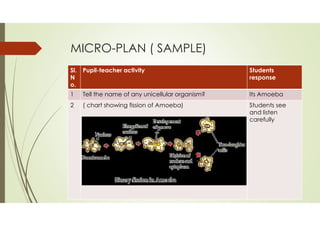
1 Tell the name of any unicellular organism? Its Amoeba
2 ( chart showing fission of Amoeba) Students see
and listen
carefully
MICRO-PLAN-II
Sl. Pupil-teacher’s activity Students’ response
3 What do you see in this chart Amoeba fission
4 As you can see that organism like
amoeba splits in two cells during division
and it can take any place.
Students listen carefully
5 After replicating its genetic material
through mitotic division, the cell divides
into two equal-sized daughter cells. In this
method, two similar individuals are
produced from a single parent cell.
( with proper voice modulation& pause)
Students listen carefully
6 This process is called binary fission. Students listen carefully
Reference/More readings
 http://www.vkmaheshwari.com/WP/?p=212#:~:text=The%20skill%20of%20sti
mulus%20variation%20involves%20deliberate%20change%20in%20attention,
changing
 Picture from Bing
 THANKS

Stimulus variation skill pdf

  • 1.
    STIMULUS - VARIATION SKILL By Dr.Smita Srivastava Integral University, Lucknow
  • 2.
    Stimulus  Something thatstirs or urges to action  The reward was a stimulus for greater effort.  An influence that acts usually from outside the body to partly change bodily activity (as by exciting a receptor or sense organ)  Light, heat, and sound are common physical stimuli.  In classroom chart , model, activity ,demonstration , voice modulation etc. are the common stimuli used by a teacher.
  • 3.
    Stimulus- Variation  Theskillful change in the stimuli is known as the skill of stimulus variation.  Just to avoid boredom, it is the teacher’s skills to stimulate the students, increase their active participation, enthusiasm and spirit of study.  Stimulus variation is a way of enhancing children learning by helping them remain attentive.  It is a way of maintaining students ‘ attention’.  A teacher who is able to vary stimulus his/her lesson become effective as there is high participation with learners and great achievements of the lesson objectives.
  • 4.
    Importance  Draw andmaintain attention of students  Increase memory  Knowledge retention  Students’ participation  Effective learning  Complete information  Interactive session  Enhance academic achievement
  • 5.
    Sub-skills  Pause  Voicemodulation  Chart/model/specimen etc.  Facial expression/body gesture  Demonstration/activity  Variation in Questioning  Oral-Visual Switching  Variation in Interaction Style
  • 6.
    MICRO-PLAN ( SAMPLE) Sl. N o. Pupil-teacheractivity Students response 1 Tell the name of any unicellular organism? Its Amoeba 2 ( chart showing fission of Amoeba) Students see and listen carefully
  • 7.
    MICRO-PLAN-II Sl. Pupil-teacher’s activityStudents’ response 3 What do you see in this chart Amoeba fission 4 As you can see that organism like amoeba splits in two cells during division and it can take any place. Students listen carefully 5 After replicating its genetic material through mitotic division, the cell divides into two equal-sized daughter cells. In this method, two similar individuals are produced from a single parent cell. ( with proper voice modulation& pause) Students listen carefully 6 This process is called binary fission. Students listen carefully
  • 8.