






EDU702 Research
    Methodology

Quantitative Research

       Prepared by
 Azurawati Binti Wok Zaki
       2011313879
        ED7701A2
Chapter 16:
Causal-Comparative
    Research

 (Ex post facto Research
Non-experimental research)
TH
  E
      AI
         M


         to determine the cause
         of existing differences
         among groups.
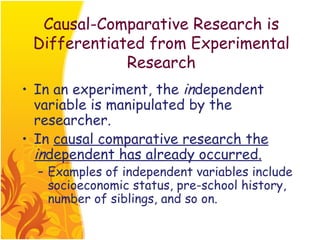
Causal-Comparative Research is
 Differentiated from Experimental
             Research
• In an experiment, the independent
  variable is manipulated by the
  researcher.
• In causal comparative research the
  independent has already occurred.
  – Examples of independent variables include
    socioeconomic status, pre-school history,
    number of siblings, and so on.
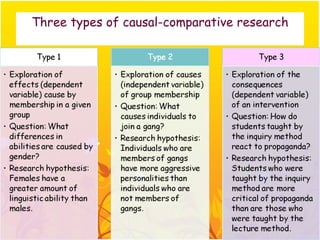
Three types of causal-comparative research
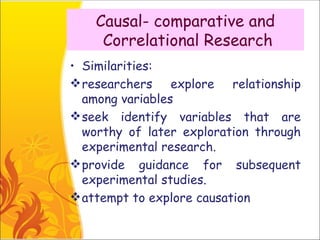
Causal- comparative and
     Correlational Research
• Similarities:
 researchers explore relationship
  among variables
 seek identify variables that are
  worthy of later exploration through
  experimental research.
 provide guidance for subsequent
  experimental studies.
 attempt to explore causation
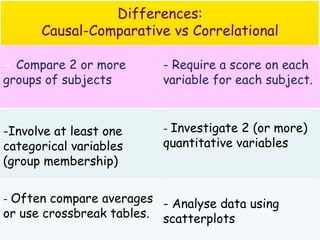
Differences:
      Causal-Comparative vs Correlational

- Compare 2 or more         - Require a score on each
groups of subjects          variable for each subject.


-Involve at least one       - Investigate 2 (or more)
categorical variables       quantitative variables
(group membership)


- Often compare averages - Analyse data using
or use crossbreak tables.   scatterplots
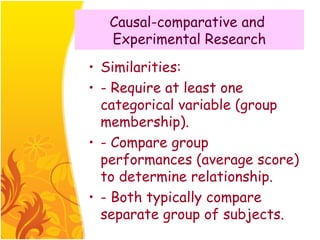
Causal-comparative and
   Experimental Research
• Similarities:
• - Require at least one
  categorical variable (group
  membership).
• - Compare group
  performances (average score)
  to determine relationship.
• - Both typically compare
  separate group of subjects.
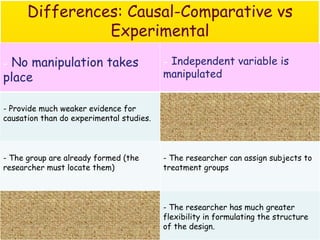
Differences: Causal-Comparative vs
                Experimental
-No manipulation takes                    -Independent variable is
place                                     manipulated


- Provide much weaker evidence for
causation than do experimental studies.


- The group are already formed (the       - The researcher can assign subjects to
researcher must locate them)              treatment groups


                                          - The researcher has much greater
                                          flexibility in formulating the structure
                                          of the design.
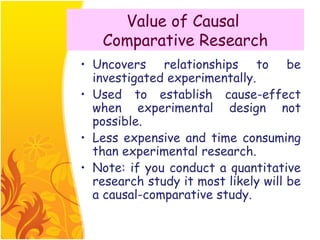
Value of Causal
   Comparative Research
• Uncovers relationships to be
  investigated experimentally.
• Used to establish cause-effect
  when experimental design not
  possible.
• Less expensive and time consuming
  than experimental research.
• Note: if you conduct a quantitative
  research study it most likely will be
  a causal-comparative study.
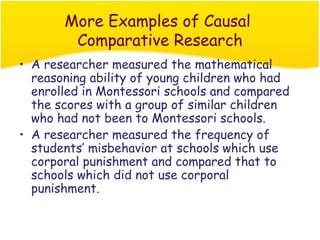
More Examples of Causal
        Comparative Research
• A researcher measured the mathematical
  reasoning ability of young children who had
  enrolled in Montessori schools and compared
  the scores with a group of similar children
  who had not been to Montessori schools.
• A researcher measured the frequency of
  students’ misbehavior at schools which use
  corporal punishment and compared that to
  schools which did not use corporal
  punishment.
More Examples of Causal
        Comparative Research
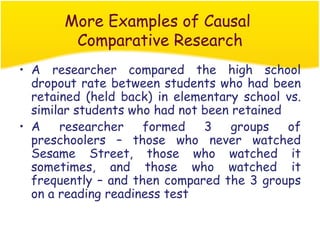
• A researcher compared the high school
  dropout rate between students who had been
  retained (held back) in elementary school vs.
  similar students who had not been retained
• A    researcher    formed    3    groups   of
  preschoolers – those who never watched
  Sesame Street, those who watched it
  sometimes, and those who watched it
  frequently – and then compared the 3 groups
  on a reading readiness test
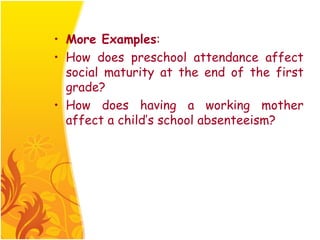
• More Examples:
• How does preschool attendance affect
  social maturity at the end of the first
  grade?
• How does having a working mother
  affect a child’s school absenteeism?
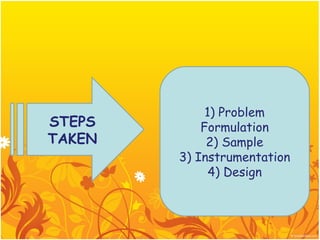
1) Problem
STEPS       Formulation
TAKEN        2) Sample
        3) Instrumentation
              4) Design
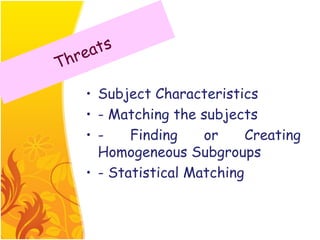
ats
T hre

    • Subject Characteristics
    • - Matching the subjects
    • -    Finding    or     Creating
      Homogeneous Subgroups
    • - Statistical Matching
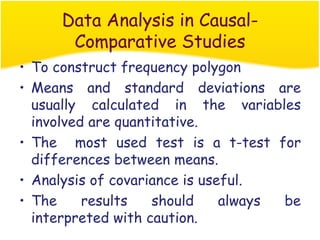
Data Analysis in Causal-
       Comparative Studies
• To construct frequency polygon
• Means and standard deviations are
  usually calculated in the variables
  involved are quantitative.
• The most used test is a t-test for
  differences between means.
• Analysis of covariance is useful.
• The     results   should     always be
  interpreted with caution.
Chapter 17:
    Survey Research
  The most popular technique for
 gathering primary data in which a
researcher interacts with people to
      obtain facts, opinions,
          and attitudes.
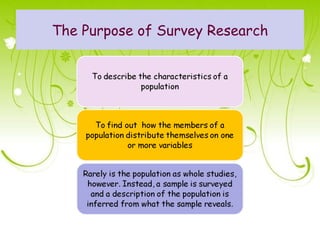
The Purpose of Survey Research
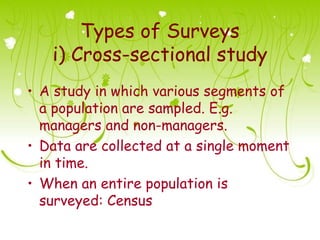
Types of Surveys
   i) Cross-sectional study
• A study in which various segments of
  a population are sampled. E.g.
  managers and non-managers.
• Data are collected at a single moment
  in time.
• When an entire population is
  surveyed: Census
example
• A professor of Mathematics might
  collect data from a sample of all the
  high school mathematics teachers in a
  particular state about their interests in
  earning a master’s degree in
  Mathematics from his university.
ii) Longitudinal study

• Longitudinal survey
• - information is collected at different
  points in time in order to study
  changes over time.
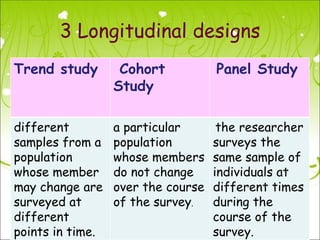
3 Longitudinal designs
Trend study        Cohort           Panel Study
                  Study

different         a particular       the researcher
samples from a    population        surveys the
population        whose members     same sample of
whose member      do not change     individuals at
may change are    over the course   different times
surveyed at       of the survey.    during the
different                           course of the
points in time.                     survey.
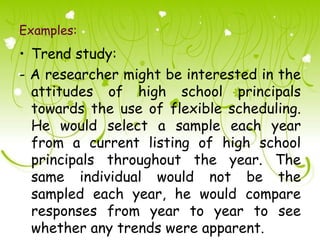
Examples:
• Trend study:
- A researcher might be interested in the
  attitudes of high school principals
  towards the use of flexible scheduling.
  He would select a sample each year
  from a current listing of high school
  principals throughout the year. The
  same individual would not be the
  sampled each year, he would compare
  responses from year to year to see
  whether any trends were apparent.
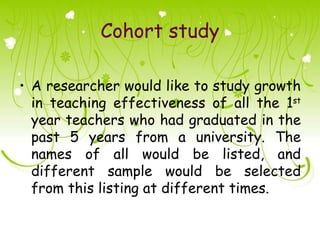
Cohort study

• A researcher would like to study growth
  in teaching effectiveness of all the 1st
  year teachers who had graduated in the
  past 5 years from a university. The
  names of all would be listed, and
  different sample would be selected
  from this listing at different times.
Panel study

• A researcher select a sample of last
  year’s graduates from a university who
  are 1st year teachers and survey on the
  same individual several times during the
  teaching years.
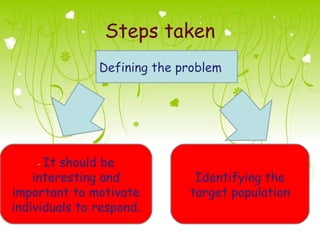
Steps taken
               Defining the problem


    - It should be
    interesting and           Identifying the
important to motivate        target population
individuals to respond.
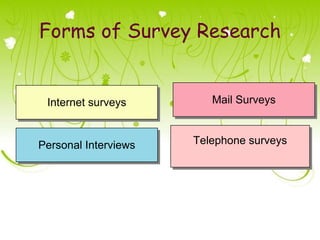
Forms of Survey Research


 Internet surveys        Mail Surveys


Personal Interviews   Telephone surveys
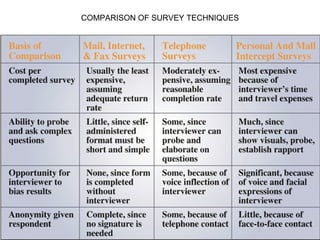
Comparison of three kinds of surveys SURVEY TECHNIQUES
                COMPARISON OF
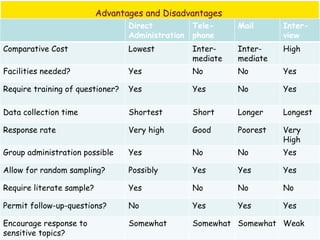
Advantages and Disadvantages
                                  Direct           Tele-     Mail      Inter-
                                  Administration   phone               view
Comparative Cost                  Lowest           Inter-    Inter-    High
                                                   mediate   mediate
Facilities needed?                Yes              No        No        Yes

Require training of questioner?   Yes              Yes       No        Yes

Data collection time              Shortest         Short     Longer    Longest

Response rate                     Very high        Good      Poorest   Very
                                                                       High
Group administration possible     Yes              No        No        Yes

Allow for random sampling?        Possibly         Yes       Yes       Yes

Require literate sample?          Yes              No        No        No

Permit follow-up-questions?       No               Yes       Yes       Yes

Encourage response to             Somewhat         Somewhat Somewhat Weak
sensitive topics?
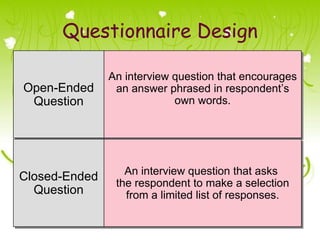
Questionnaire Design

               An interview question that encourages
Open-Ended      an answer phrased in respondent’s
 Question                   own words.


                  An interview question that asks
Closed-Ended
                the respondent to make a selection
  Question        from a limited list of responses.
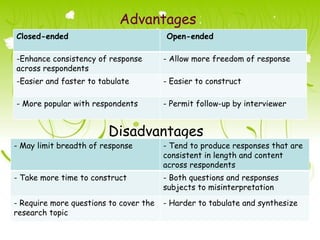
Advantages
Closed-ended                            Open-ended

-Enhance consistency of response        - Allow more freedom of response
across respondents
-Easier and faster to tabulate          - Easier to construct

- More popular with respondents         - Permit follow-up by interviewer


                        Disadvantages
- May limit breadth of response         - Tend to produce responses that are
                                        consistent in length and content
                                        across respondents
- Take more time to construct           - Both questions and responses
                                        subjects to misinterpretation
- Require more questions to cover the   - Harder to tabulate and synthesize
research topic
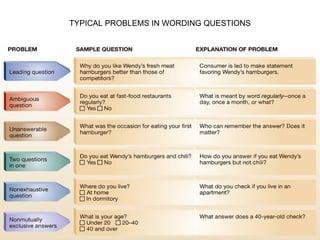
Typical problems in wording questions
             TYPICAL PROBLEMS IN WORDING QUESTIONS
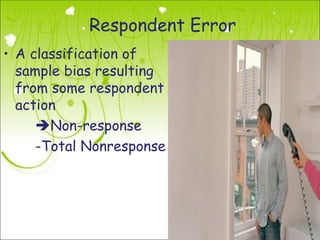
Respondent Error
• A classification of
  sample bias resulting
  from some respondent
  action
     Non-response
     -Total Nonresponse
Non-response
-total nonresponse

• Not enough people respond or
  refuse to respond
• NONRESPONDENTS - People
  who refuse to cooperate
• NOT-AT-HOMES
• SELF-SELECTION BIAS
  especially in case of self-
  administered questionnaire.
  People respond to only those
  they like.
Item Nonresponse

- The respondent may not know
  the answer to a particular
  question, the respondent may
  find the questions
  embarrassing or irrelevant.
The END

Thank You

Causal comparative n survey

  • 1.
    EDU702 Research Methodology Quantitative Research Prepared by Azurawati Binti Wok Zaki 2011313879 ED7701A2
  • 2.
    Chapter 16: Causal-Comparative Research (Ex post facto Research Non-experimental research)
  • 3.
    TH E AI M to determine the cause of existing differences among groups.
  • 4.
    Causal-Comparative Research is Differentiated from Experimental Research • In an experiment, the independent variable is manipulated by the researcher. • In causal comparative research the independent has already occurred. – Examples of independent variables include socioeconomic status, pre-school history, number of siblings, and so on.
  • 5.
    Three types ofcausal-comparative research
  • 6.
    Causal- comparative and Correlational Research • Similarities:  researchers explore relationship among variables  seek identify variables that are worthy of later exploration through experimental research.  provide guidance for subsequent experimental studies.  attempt to explore causation
  • 7.
    Differences: Causal-Comparative vs Correlational - Compare 2 or more - Require a score on each groups of subjects variable for each subject. -Involve at least one - Investigate 2 (or more) categorical variables quantitative variables (group membership) - Often compare averages - Analyse data using or use crossbreak tables. scatterplots
  • 8.
    Causal-comparative and Experimental Research • Similarities: • - Require at least one categorical variable (group membership). • - Compare group performances (average score) to determine relationship. • - Both typically compare separate group of subjects.
  • 9.
    Differences: Causal-Comparative vs Experimental -No manipulation takes -Independent variable is place manipulated - Provide much weaker evidence for causation than do experimental studies. - The group are already formed (the - The researcher can assign subjects to researcher must locate them) treatment groups - The researcher has much greater flexibility in formulating the structure of the design.
  • 10.
    Value of Causal Comparative Research • Uncovers relationships to be investigated experimentally. • Used to establish cause-effect when experimental design not possible. • Less expensive and time consuming than experimental research. • Note: if you conduct a quantitative research study it most likely will be a causal-comparative study.
  • 11.
    More Examples ofCausal Comparative Research • A researcher measured the mathematical reasoning ability of young children who had enrolled in Montessori schools and compared the scores with a group of similar children who had not been to Montessori schools. • A researcher measured the frequency of students’ misbehavior at schools which use corporal punishment and compared that to schools which did not use corporal punishment.
  • 12.
    More Examples ofCausal Comparative Research • A researcher compared the high school dropout rate between students who had been retained (held back) in elementary school vs. similar students who had not been retained • A researcher formed 3 groups of preschoolers – those who never watched Sesame Street, those who watched it sometimes, and those who watched it frequently – and then compared the 3 groups on a reading readiness test
  • 13.
    • More Examples: •How does preschool attendance affect social maturity at the end of the first grade? • How does having a working mother affect a child’s school absenteeism?
  • 14.
    1) Problem STEPS Formulation TAKEN 2) Sample 3) Instrumentation 4) Design
  • 15.
    ats T hre • Subject Characteristics • - Matching the subjects • - Finding or Creating Homogeneous Subgroups • - Statistical Matching
  • 16.
    Data Analysis inCausal- Comparative Studies • To construct frequency polygon • Means and standard deviations are usually calculated in the variables involved are quantitative. • The most used test is a t-test for differences between means. • Analysis of covariance is useful. • The results should always be interpreted with caution.
  • 17.
    Chapter 17: Survey Research The most popular technique for gathering primary data in which a researcher interacts with people to obtain facts, opinions, and attitudes.
  • 18.
    The Purpose ofSurvey Research
  • 20.
    Types of Surveys i) Cross-sectional study • A study in which various segments of a population are sampled. E.g. managers and non-managers. • Data are collected at a single moment in time. • When an entire population is surveyed: Census
  • 21.
    example • A professorof Mathematics might collect data from a sample of all the high school mathematics teachers in a particular state about their interests in earning a master’s degree in Mathematics from his university.
  • 22.
    ii) Longitudinal study •Longitudinal survey • - information is collected at different points in time in order to study changes over time.
  • 23.
    3 Longitudinal designs Trendstudy Cohort Panel Study Study different a particular the researcher samples from a population surveys the population whose members same sample of whose member do not change individuals at may change are over the course different times surveyed at of the survey. during the different course of the points in time. survey.
  • 24.
    Examples: • Trend study: -A researcher might be interested in the attitudes of high school principals towards the use of flexible scheduling. He would select a sample each year from a current listing of high school principals throughout the year. The same individual would not be the sampled each year, he would compare responses from year to year to see whether any trends were apparent.
  • 25.
    Cohort study • Aresearcher would like to study growth in teaching effectiveness of all the 1st year teachers who had graduated in the past 5 years from a university. The names of all would be listed, and different sample would be selected from this listing at different times.
  • 26.
    Panel study • Aresearcher select a sample of last year’s graduates from a university who are 1st year teachers and survey on the same individual several times during the teaching years.
  • 27.
    Steps taken Defining the problem - It should be interesting and Identifying the important to motivate target population individuals to respond.
  • 28.
    Forms of SurveyResearch Internet surveys Mail Surveys Personal Interviews Telephone surveys
  • 29.
    Comparison of threekinds of surveys SURVEY TECHNIQUES COMPARISON OF
  • 30.
    Advantages and Disadvantages Direct Tele- Mail Inter- Administration phone view Comparative Cost Lowest Inter- Inter- High mediate mediate Facilities needed? Yes No No Yes Require training of questioner? Yes Yes No Yes Data collection time Shortest Short Longer Longest Response rate Very high Good Poorest Very High Group administration possible Yes No No Yes Allow for random sampling? Possibly Yes Yes Yes Require literate sample? Yes No No No Permit follow-up-questions? No Yes Yes Yes Encourage response to Somewhat Somewhat Somewhat Weak sensitive topics?
  • 31.
    Questionnaire Design An interview question that encourages Open-Ended an answer phrased in respondent’s Question own words. An interview question that asks Closed-Ended the respondent to make a selection Question from a limited list of responses.
  • 32.
    Advantages Closed-ended Open-ended -Enhance consistency of response - Allow more freedom of response across respondents -Easier and faster to tabulate - Easier to construct - More popular with respondents - Permit follow-up by interviewer Disadvantages - May limit breadth of response - Tend to produce responses that are consistent in length and content across respondents - Take more time to construct - Both questions and responses subjects to misinterpretation - Require more questions to cover the - Harder to tabulate and synthesize research topic
  • 33.
    Typical problems inwording questions TYPICAL PROBLEMS IN WORDING QUESTIONS
  • 34.
    Respondent Error • Aclassification of sample bias resulting from some respondent action Non-response -Total Nonresponse
  • 35.
    Non-response -total nonresponse • Notenough people respond or refuse to respond • NONRESPONDENTS - People who refuse to cooperate • NOT-AT-HOMES • SELF-SELECTION BIAS especially in case of self- administered questionnaire. People respond to only those they like.
  • 36.
    Item Nonresponse - Therespondent may not know the answer to a particular question, the respondent may find the questions embarrassing or irrelevant.
  • 37.

Editor's Notes

  • #6 An independant variable is the variable which you change in an experiment. Note you can only have 1 variable that can change in an experiment and more than one independent variable will result in an unfair experiment.  An independant variable is the variable which you change in an experiment. Note you can only have 1 variable that can change in an experiment and more than one independent variable will result in an unfair experiment.  A dependent variable is the measure of the independent variable. Therefore it depends on the independent variable.  Weight depends on the amount of food (in calories) we eat. The more we eat, the more weight we gain. Weight is the dependent variable. The amount we eat is the independent variable.
  • #11 Used to establish cause-effect when experimental design not possible for legal, physical, ethical, or financial reasons Example: effects of smoking on health (even if ethical, might take 15 yrs to get answer and we might not want to wait)
  • #14 How does preschool attendance affect social maturity at the end of the first grade? The grouping variable is preschool attendance (i.e.; the variable can take one of the two values students attending preschool and student not attending). the dependent variable or effect is social maturity at the end of the first grade . The research identifies the group of first grade who attend the preschool and a group who did not, gathers data about their social maturity, and then compares the two groups. How does having a working mother affect a child’s school absenteeism? The grouping variable is the employment status of mother (again with 2 possible values the mother work or mother does not work); the dependent variable is absenteeism, measured as number of day absent. The researcher identifies the group of students who have working mother and group whose mother don’t work, gather information about their absenteeism and compares the groups.
  • #29 Chapter 7 Decision Support Systems and Marketing Research On Line: Hershey Go to Hershey’s and read its Idea Submission Policy under Consumer Info. Do you think the policy is a good idea? Notes: In home personal interviews: Provide high-quality information, but are expensive because of travel time and mileage costs for the interviewer. Not a popular survey tool. Mall Intercept interviews: Conducted in shopping malls or in a marketing research office in the mall. Surveys must be brief. It is hard to get a representative sample of the population. Telephone interviews: Cost less and provide one of the best samples of any traditional survey procedure. Many facilities for telephone interviews utilize computer-assisted interviewing, where information is directly input into a computer application. Mail Surveys: Benefits are low cost, elimination of interviews, centralized control, and anonymity for respondents. However, mail questionnaires usually produce low response rates. Executive interviews: Survey involves businesspeople at their offices regarding industrial products or services. This type of interviewing is expensive, due to the process of finding, qualifying, and interviewing respondents. Focus groups: A type of personal interviewing, characterized by seven to ten people gathered in a meeting place. The interaction provides group dynamics, with an interplay of responses yielding richer information than individual interviews.
  • #30 Chapter 7 Decision Support Systems and Marketing Research Marketing researchers must be aware of the trade-offs when collecting primary data through the three main types of questionnaires.
  • #32 Chapter 7 Decision Support Systems and Marketing Research Notes: Questionnaires contain three basic types of questions: Open-ended questions Closed-ended questions Scaled-response questions. Examples of these types of questions are shown on the next slide and in Exhibit 7.5.
  • #34 Chapter 7 Decision Support Systems and Marketing Research