Experimental Design
Data analysis
GROUP 5
PAIRED T-TEST
PRESENTER: TRAN THI NGAN GIANG
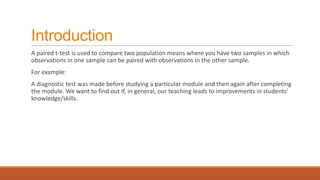
Introduction
A paired t-test is used to compare two population means where you have two samples in which
observations in one sample can be paired with observations in the other sample.
For example:
A diagnostic test was made before studying a particular module and then again after completing
the module. We want to find out if, in general, our teaching leads to improvements in students’
knowledge/skills.
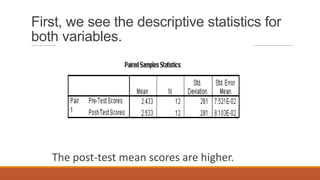
First, we see the descriptive statistics for
both variables.


   The post-test mean scores are higher.
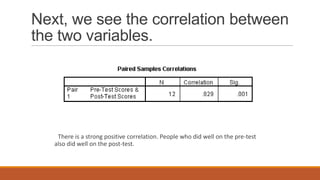
Next, we see the correlation between
the two variables.


    There is a strong positive correlation. People who did well on the pre-test
   also did well on the post-test.
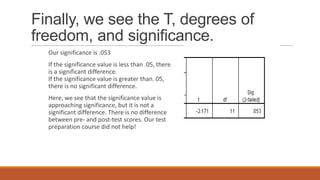
Finally, we see the T, degrees of
freedom, and significance.
  Our significance is .053
  If the significance value is less than .05, there
  is a significant difference.
  If the significance value is greater than. 05,
  there is no significant difference.
  Here, we see that the significance value is
  approaching significance, but it is not a
  significant difference. There is no difference
  between pre- and post-test scores. Our test
  preparation course did not help!
INDEPENDENT SAMPLES
T-TESTS
PRESENTER: DINH QUOC MINH DANG
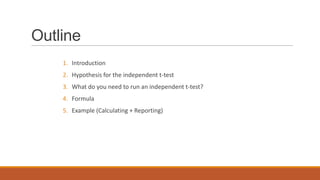
Outline
    1. Introduction
    2. Hypothesis for the independent t-test
    3. What do you need to run an independent t-test?
    4. Formula
    5. Example (Calculating + Reporting)
Introduction
The independent t-test, also called the two sample t-test or
student's t-test is an inferential statistical test that determines
whether there is a statistically significant difference between the
means in two unrelated groups.
Hypothesis for the independent t-test
The null hypothesis for the independent t-test is that the population means from the
two unrelated groups are equal:
H0: u1 = u2
In most cases, we are looking to see if we can show that we can reject the null
hypothesis and accept the alternative hypothesis, which is that the population means
are not equal:
HA: u1 ≠ u2
To do this we need to set a significance level (alpha) that allows us to either reject or
accept the alternative hypothesis. Most commonly, this value is set at 0.05.
What do you need to run an
independent t-test?
In order to run an independent t-test you need the
following:
  1. One independent, categorical variable that has two levels.
  2. One dependent variable
Formula


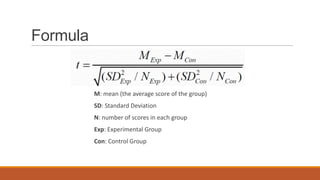
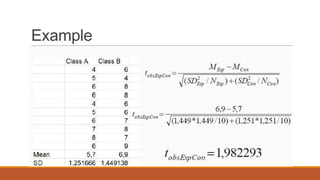
          M: mean (the average score of the group)
          SD: Standard Deviation
          N: number of scores in each group
          Exp: Experimental Group
          Con: Control Group
Formula
Example
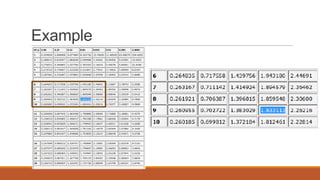
Example
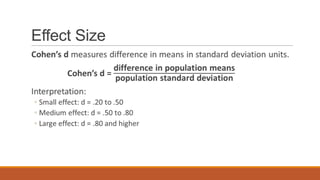
Effect Size
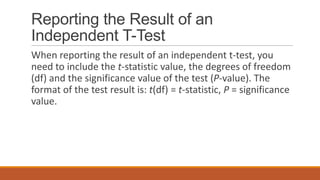
Reporting the Result of an
Independent T-Test
When reporting the result of an independent t-test, you
need to include the t-statistic value, the degrees of freedom
(df) and the significance value of the test (P-value). The
format of the test result is: t(df) = t-statistic, P = significance
value.
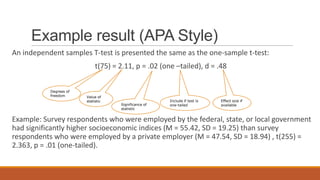
Example result (APA Style)
An independent samples T-test is presented the same as the one-sample t-test:
                             t(75) = 2.11, p = .02 (one –tailed), d = .48


           Degrees of
           freedom      Value of
                        statistic                      Include if test is   Effect size if
                                     Significance of   one-tailed           available
                                     statistic


Example: Survey respondents who were employed by the federal, state, or local government
had significantly higher socioeconomic indices (M = 55.42, SD = 19.25) than survey
respondents who were employed by a private employer (M = 47.54, SD = 18.94) , t(255) =
2.363, p = .01 (one-tailed).
Analysis of Variance
(ANOVA)
PRESENTER : MINH SANG
Introduction
We already learned about the chi square test for independence, which is useful for data that is
measured at the nominal or ordinal level of analysis.
If we have data measured at the interval level, we can compare two or more population groups
in terms of their population means using a technique called analysis of variance, or ANOVA.
Completely randomized design
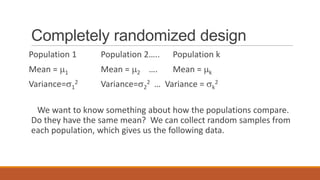
Population 1      Population 2…..       Population k
Mean =   1        Mean =   2    ….      Mean =     k
Variance=     2   Variance=     2   … Variance =        2
             1                 2                       k


 We want to know something about how the populations compare.
Do they have the same mean? We can collect random samples from
each population, which gives us the following data.
Completely randomized design
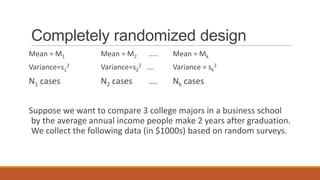
Mean = M1         Mean = M2    ..…   Mean = Mk
Variance=s12      Variance=s22 ….    Variance = sk2
N1 cases          N2 cases     ….    Nk cases


Suppose we want to compare 3 college majors in a business school
 by the average annual income people make 2 years after graduation.
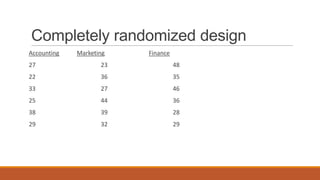
 We collect the following data (in $1000s) based on random surveys.
Completely randomized design
Accounting   Marketing   Finance
27                  23             48
22                  36             35
33                  27             46
25                  44             36
38                  39             28
29                  32             29
Completely randomized design
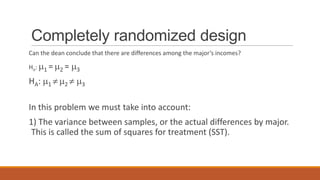
Can the dean conclude that there are differences among the major’s incomes?

Ho :   1=   2=   3
HA:    1     2       3


In this problem we must take into account:
1) The variance between samples, or the actual differences by major.
 This is called the sum of squares for treatment (SST).
Completely randomized design
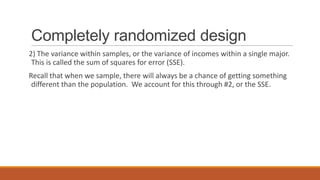
2) The variance within samples, or the variance of incomes within a single major.
 This is called the sum of squares for error (SSE).
Recall that when we sample, there will always be a chance of getting something
 different than the population. We account for this through #2, or the SSE.
F-Statistic
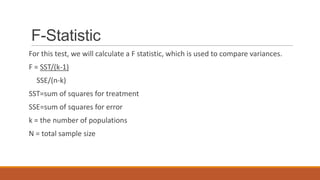
For this test, we will calculate a F statistic, which is used to compare variances.
F = SST/(k-1)
  SSE/(n-k)
SST=sum of squares for treatment
SSE=sum of squares for error
k = the number of populations
N = total sample size
F-statistic
Intuitively, the F statistic is:
F = explained variance
unexplained variance
Explained variance is the difference between majors
Unexplained variance is the difference based on random sampling for each group
(see Figure 10-1, page 327)
Calculating SST
SST = ni(Mi - )2
  = grand mean or =    Mi/k or the sum of all values for all groups divided by
total sample size
Mi = mean for each sample
k= the number of populations
Calculating SST
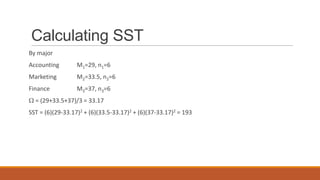
By major
Accounting        M1=29, n1=6
Marketing         M2=33.5, n2=6
Finance           M3=37, n3=6
  = (29+33.5+37)/3 = 33.17
SST = (6)(29-33.17)2 + (6)(33.5-33.17)2 + (6)(37-33.17)2 = 193
Calculating SST
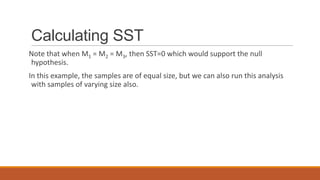
Note that when M1 = M2 = M3, then SST=0 which would support the null
hypothesis.
In this example, the samples are of equal size, but we can also run this analysis
 with samples of varying size also.
Calculating SSE
SSE = (Xit – Mi)2
In other words, it is just the variance for each sample added together.
SSE = (X1t – M1)2 + (X2t – M2)2 +
         (X3t – M3)2
SSE = [(27-29)2 + (22-29)2 +…+ (29-29)2]
       + [(23-33.5)2 + (36-33.5)2 +…]
       + [(48-37)2 + (35-37)2 +…+ (29-37)2]
SSE = 819.5
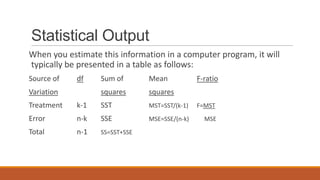
Statistical Output
When you estimate this information in a computer program, it will
typically be presented in a table as follows:
Source of   df    Sum of       Mean            F-ratio
Variation         squares      squares
Treatment   k-1   SST          MST=SST/(k-1)   F=MST
Error       n-k   SSE          MSE=SSE/(n-k)     MSE
Total       n-1   SS=SST+SSE
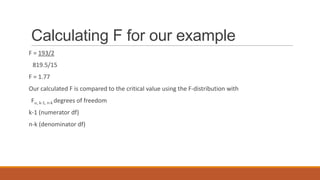
Calculating F for our example
F = 193/2
 819.5/15
F = 1.77
Our calculated F is compared to the critical value using the F-distribution with
F   , k-1, n-k degrees   of freedom
k-1 (numerator df)
n-k (denominator df)
The Results
For 95% confidence ( =.05), our critical F is 3.68 (averaging across the values at
 14 and 16
In this case, 1.77 < 3.68 so we must accept the null hypothesis.
The dean is puzzled by these results because just by eyeballing the data, it looks
 like finance majors make more money.
The Results
Many other factors may determine the salary level, such as GPA. The dean
decides to collect new data selecting one student randomly from each major
with the following average grades.
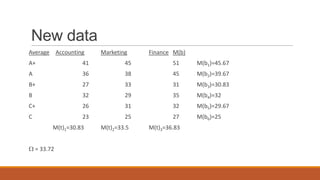
New data
Average Accounting       Marketing    Finance M(b)
A+                  41           45           51     M(b1)=45.67
A                   36           38           45     M(b2)=39.67
B+                  27           33           31     M(b3)=30.83
B                   32           29           35     M(b4)=32
C+                  26           31           32     M(b5)=29.67
C                   23           25           27     M(b6)=25
          M(t)1=30.83    M(t)2=33.5   M(t)3=36.83


    = 33.72
Randomized Block Design
Now the data in the 3 samples are not independent, they are matched by GPA
levels. Just like before, matched samples are superior to unmatched samples
because they provide more information. In this case, we have added a factor
that may account for some of the SSE.
Two way ANOVA
Now SS(total) = SST + SSB + SSE
Where SSB = the variability among blocks, where a block is a matched group of
observations from each of the populations
We can calculate a two-way ANOVA to test our null hypothesis. We will talk about
this next week.

Experimental design data analysis

  • 1.
  • 2.
  • 3.
    Introduction A paired t-testis used to compare two population means where you have two samples in which observations in one sample can be paired with observations in the other sample. For example: A diagnostic test was made before studying a particular module and then again after completing the module. We want to find out if, in general, our teaching leads to improvements in students’ knowledge/skills.
  • 4.
    First, we seethe descriptive statistics for both variables. The post-test mean scores are higher.
  • 5.
    Next, we seethe correlation between the two variables. There is a strong positive correlation. People who did well on the pre-test also did well on the post-test.
  • 6.
    Finally, we seethe T, degrees of freedom, and significance. Our significance is .053 If the significance value is less than .05, there is a significant difference. If the significance value is greater than. 05, there is no significant difference. Here, we see that the significance value is approaching significance, but it is not a significant difference. There is no difference between pre- and post-test scores. Our test preparation course did not help!
  • 7.
  • 8.
    Outline 1. Introduction 2. Hypothesis for the independent t-test 3. What do you need to run an independent t-test? 4. Formula 5. Example (Calculating + Reporting)
  • 9.
    Introduction The independent t-test,also called the two sample t-test or student's t-test is an inferential statistical test that determines whether there is a statistically significant difference between the means in two unrelated groups.
  • 10.
    Hypothesis for theindependent t-test The null hypothesis for the independent t-test is that the population means from the two unrelated groups are equal: H0: u1 = u2 In most cases, we are looking to see if we can show that we can reject the null hypothesis and accept the alternative hypothesis, which is that the population means are not equal: HA: u1 ≠ u2 To do this we need to set a significance level (alpha) that allows us to either reject or accept the alternative hypothesis. Most commonly, this value is set at 0.05.
  • 11.
    What do youneed to run an independent t-test? In order to run an independent t-test you need the following: 1. One independent, categorical variable that has two levels. 2. One dependent variable
  • 12.
    Formula M: mean (the average score of the group) SD: Standard Deviation N: number of scores in each group Exp: Experimental Group Con: Control Group
  • 13.
  • 14.
  • 15.
  • 16.
  • 17.
    Reporting the Resultof an Independent T-Test When reporting the result of an independent t-test, you need to include the t-statistic value, the degrees of freedom (df) and the significance value of the test (P-value). The format of the test result is: t(df) = t-statistic, P = significance value.
  • 18.
    Example result (APAStyle) An independent samples T-test is presented the same as the one-sample t-test: t(75) = 2.11, p = .02 (one –tailed), d = .48 Degrees of freedom Value of statistic Include if test is Effect size if Significance of one-tailed available statistic Example: Survey respondents who were employed by the federal, state, or local government had significantly higher socioeconomic indices (M = 55.42, SD = 19.25) than survey respondents who were employed by a private employer (M = 47.54, SD = 18.94) , t(255) = 2.363, p = .01 (one-tailed).
  • 19.
  • 20.
    Introduction We already learnedabout the chi square test for independence, which is useful for data that is measured at the nominal or ordinal level of analysis. If we have data measured at the interval level, we can compare two or more population groups in terms of their population means using a technique called analysis of variance, or ANOVA.
  • 21.
    Completely randomized design Population1 Population 2….. Population k Mean = 1 Mean = 2 …. Mean = k Variance= 2 Variance= 2 … Variance = 2 1 2 k We want to know something about how the populations compare. Do they have the same mean? We can collect random samples from each population, which gives us the following data.
  • 22.
    Completely randomized design Mean= M1 Mean = M2 ..… Mean = Mk Variance=s12 Variance=s22 …. Variance = sk2 N1 cases N2 cases …. Nk cases Suppose we want to compare 3 college majors in a business school by the average annual income people make 2 years after graduation. We collect the following data (in $1000s) based on random surveys.
  • 23.
    Completely randomized design Accounting Marketing Finance 27 23 48 22 36 35 33 27 46 25 44 36 38 39 28 29 32 29
  • 24.
    Completely randomized design Canthe dean conclude that there are differences among the major’s incomes? Ho : 1= 2= 3 HA: 1 2 3 In this problem we must take into account: 1) The variance between samples, or the actual differences by major. This is called the sum of squares for treatment (SST).
  • 25.
    Completely randomized design 2)The variance within samples, or the variance of incomes within a single major. This is called the sum of squares for error (SSE). Recall that when we sample, there will always be a chance of getting something different than the population. We account for this through #2, or the SSE.
  • 26.
    F-Statistic For this test,we will calculate a F statistic, which is used to compare variances. F = SST/(k-1) SSE/(n-k) SST=sum of squares for treatment SSE=sum of squares for error k = the number of populations N = total sample size
  • 27.
    F-statistic Intuitively, the Fstatistic is: F = explained variance unexplained variance Explained variance is the difference between majors Unexplained variance is the difference based on random sampling for each group (see Figure 10-1, page 327)
  • 28.
    Calculating SST SST =ni(Mi - )2 = grand mean or = Mi/k or the sum of all values for all groups divided by total sample size Mi = mean for each sample k= the number of populations
  • 29.
    Calculating SST By major Accounting M1=29, n1=6 Marketing M2=33.5, n2=6 Finance M3=37, n3=6 = (29+33.5+37)/3 = 33.17 SST = (6)(29-33.17)2 + (6)(33.5-33.17)2 + (6)(37-33.17)2 = 193
  • 30.
    Calculating SST Note thatwhen M1 = M2 = M3, then SST=0 which would support the null hypothesis. In this example, the samples are of equal size, but we can also run this analysis with samples of varying size also.
  • 31.
    Calculating SSE SSE =(Xit – Mi)2 In other words, it is just the variance for each sample added together. SSE = (X1t – M1)2 + (X2t – M2)2 + (X3t – M3)2 SSE = [(27-29)2 + (22-29)2 +…+ (29-29)2] + [(23-33.5)2 + (36-33.5)2 +…] + [(48-37)2 + (35-37)2 +…+ (29-37)2] SSE = 819.5
  • 32.
    Statistical Output When youestimate this information in a computer program, it will typically be presented in a table as follows: Source of df Sum of Mean F-ratio Variation squares squares Treatment k-1 SST MST=SST/(k-1) F=MST Error n-k SSE MSE=SSE/(n-k) MSE Total n-1 SS=SST+SSE
  • 33.
    Calculating F forour example F = 193/2 819.5/15 F = 1.77 Our calculated F is compared to the critical value using the F-distribution with F , k-1, n-k degrees of freedom k-1 (numerator df) n-k (denominator df)
  • 34.
    The Results For 95%confidence ( =.05), our critical F is 3.68 (averaging across the values at 14 and 16 In this case, 1.77 < 3.68 so we must accept the null hypothesis. The dean is puzzled by these results because just by eyeballing the data, it looks like finance majors make more money.
  • 35.
    The Results Many otherfactors may determine the salary level, such as GPA. The dean decides to collect new data selecting one student randomly from each major with the following average grades.
  • 36.
    New data Average Accounting Marketing Finance M(b) A+ 41 45 51 M(b1)=45.67 A 36 38 45 M(b2)=39.67 B+ 27 33 31 M(b3)=30.83 B 32 29 35 M(b4)=32 C+ 26 31 32 M(b5)=29.67 C 23 25 27 M(b6)=25 M(t)1=30.83 M(t)2=33.5 M(t)3=36.83 = 33.72
  • 37.
    Randomized Block Design Nowthe data in the 3 samples are not independent, they are matched by GPA levels. Just like before, matched samples are superior to unmatched samples because they provide more information. In this case, we have added a factor that may account for some of the SSE.
  • 38.
    Two way ANOVA NowSS(total) = SST + SSB + SSE Where SSB = the variability among blocks, where a block is a matched group of observations from each of the populations We can calculate a two-way ANOVA to test our null hypothesis. We will talk about this next week.