adeel_tc@hotmail.com 0315-4632432   4/26/2012   1
adeel_tc@hotmail.com 0315-4632432   4/26/2012   2
 Data  is a collection of facts, such as values or
  measurements.
 It can be
  numbers, words, measurements, observation
  s or even just descriptions of things.


         adeel_tc@hotmail.com 0315-4632432   4/26/2012   4
adeel_tc@hotmail.com 0315-4632432   4/26/2012   5
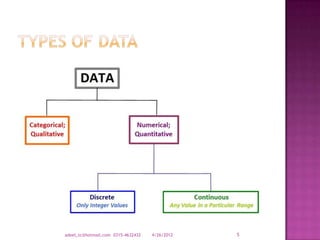
Data can be qualitative or quantitative.
 Qualitative data is descriptive information
  (it describes something)
 Quantitative data, is numerical information
  (numbers).


        adeel_tc@hotmail.com 0315-4632432   4/26/2012   6
 Discrete data can only take certain values
  (like whole numbers)
 Continuous data can take any value (within
  a range)

Discrete data is counted,
Continuous data is measured


        adeel_tc@hotmail.com 0315-4632432   4/26/2012   7
Qualitative:
 He is brown and black
 He has long hair
 He has lots of energy
Quantitative:
 Discrete:
    He has 4 legs
    He has 2 brothers
 Continuous:
    He weighs 400 pounds
    He is 3.5foot tall


           adeel_tc@hotmail.com 0315-4632432   4/26/2012   8
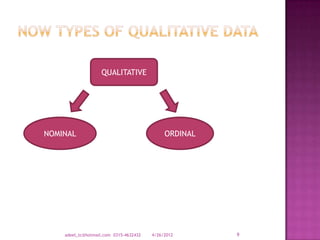
QUALITATIVE


NOMINAL                                      ORDINAL


    adeel_tc@hotmail.com 0315-4632432   4/26/2012      9
A type of categorical data in which objects
 fall into unordered categories.


 Type   of Bicycle
    Mountain bike, road bike,BMX.
 Smoking      status
    smoker, non-smoker


          adeel_tc@hotmail.com 0315-4632432   4/26/2012   10
A type of categorical data in which order is
  important.
 Class of degree-1st class, 2:1, 2:2, 3rd
  class, fail
 Opinion of students about stats classes-
 Very unhappy, unhappy, neutral, happy


        adeel_tc@hotmail.com 0315-4632432   4/26/2012   11
 The different sources of data are published and
  unpublished documents, govt
  magazines, personal diaries, memories, letters
  etc
 Data may be obtained from
    Internal sources
    External sources
    Surveys and experiments


                                                          12
          adeel_tc@hotmail.com 0315-4632432   4/26/2012
Organized representations of data that help to
  summarize and simplify
Many types:
    Ranked frequency distributions
    Simple frequency distributions
    Grouped frequency distributions


         adeel_tc@hotmail.com 0315-4632432   4/26/2012   13
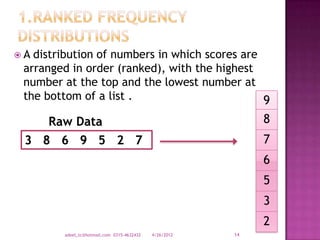
A distribution of numbers in which scores are
 arranged in order (ranked), with the highest
 number at the top and the lowest number at
 the bottom of a list .                        9
     Raw Data                                                8
 3 8 6 9 5 2 7                                               7
                                                             6
                                                             5
                                                             3
                                                             2
        adeel_tc@hotmail.com 0315-4632432   4/26/2012   14
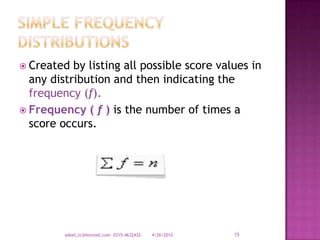
 Created  by listing all possible score values in
  any distribution and then indicating the
  frequency (f).
 Frequency ( f ) is the number of times a
  score occurs.


         adeel_tc@hotmail.com 0315-4632432   4/26/2012   15
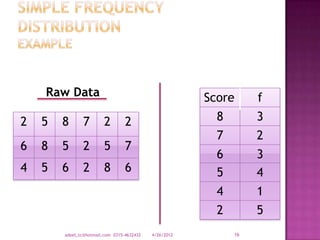
Raw Data                                            Score      f
2   5   8      7         2        2                       8        3
                                                          7        2
6   8   5      2         5        7
                                                          6        3
4   5   6      2         8        6                       5        4
                                                          4        1
                                                          2        5
        adeel_tc@hotmail.com 0315-4632432   4/26/2012         16
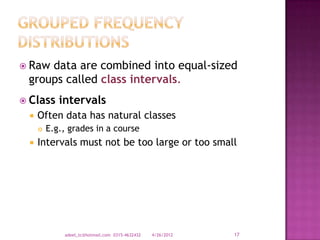
 Rawdata are combined into equal-sized
 groups called class intervals.
 Class     intervals
    Often data has natural classes
        E.g., grades in a course
    Intervals must not be too large or too small


             adeel_tc@hotmail.com 0315-4632432   4/26/2012   17
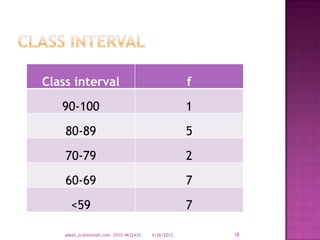
Class interval                                      f
   90-100                                           1
    80-89                                           5
    70-79                                           2
    60-69                                           7
      <59                                           7

    adeel_tc@hotmail.com 0315-4632432   4/26/2012       18
adeel_tc@hotmail.com 0315-4632432   4/26/2012   19

Data and its types by adeel

  • 1.
  • 2.
  • 4.
     Data is a collection of facts, such as values or measurements.  It can be numbers, words, measurements, observation s or even just descriptions of things. adeel_tc@hotmail.com 0315-4632432 4/26/2012 4
  • 5.
  • 6.
    Data can bequalitative or quantitative.  Qualitative data is descriptive information (it describes something)  Quantitative data, is numerical information (numbers). adeel_tc@hotmail.com 0315-4632432 4/26/2012 6
  • 7.
     Discrete datacan only take certain values (like whole numbers)  Continuous data can take any value (within a range) Discrete data is counted, Continuous data is measured adeel_tc@hotmail.com 0315-4632432 4/26/2012 7
  • 8.
    Qualitative:  He isbrown and black  He has long hair  He has lots of energy Quantitative:  Discrete:  He has 4 legs  He has 2 brothers  Continuous:  He weighs 400 pounds  He is 3.5foot tall adeel_tc@hotmail.com 0315-4632432 4/26/2012 8
  • 9.
    QUALITATIVE NOMINAL ORDINAL adeel_tc@hotmail.com 0315-4632432 4/26/2012 9
  • 10.
    A type ofcategorical data in which objects fall into unordered categories.  Type of Bicycle  Mountain bike, road bike,BMX.  Smoking status  smoker, non-smoker adeel_tc@hotmail.com 0315-4632432 4/26/2012 10
  • 11.
    A type ofcategorical data in which order is important.  Class of degree-1st class, 2:1, 2:2, 3rd class, fail  Opinion of students about stats classes- Very unhappy, unhappy, neutral, happy adeel_tc@hotmail.com 0315-4632432 4/26/2012 11
  • 12.
     The differentsources of data are published and unpublished documents, govt magazines, personal diaries, memories, letters etc  Data may be obtained from  Internal sources  External sources  Surveys and experiments 12 adeel_tc@hotmail.com 0315-4632432 4/26/2012
  • 13.
    Organized representations ofdata that help to summarize and simplify Many types:  Ranked frequency distributions  Simple frequency distributions  Grouped frequency distributions adeel_tc@hotmail.com 0315-4632432 4/26/2012 13
  • 14.
    A distribution ofnumbers in which scores are arranged in order (ranked), with the highest number at the top and the lowest number at the bottom of a list . 9 Raw Data 8 3 8 6 9 5 2 7 7 6 5 3 2 adeel_tc@hotmail.com 0315-4632432 4/26/2012 14
  • 15.
     Created by listing all possible score values in any distribution and then indicating the frequency (f).  Frequency ( f ) is the number of times a score occurs. adeel_tc@hotmail.com 0315-4632432 4/26/2012 15
  • 16.
    Raw Data Score f 2 5 8 7 2 2 8 3 7 2 6 8 5 2 5 7 6 3 4 5 6 2 8 6 5 4 4 1 2 5 adeel_tc@hotmail.com 0315-4632432 4/26/2012 16
  • 17.
     Rawdata arecombined into equal-sized groups called class intervals.  Class intervals  Often data has natural classes  E.g., grades in a course  Intervals must not be too large or too small adeel_tc@hotmail.com 0315-4632432 4/26/2012 17
  • 18.
    Class interval f 90-100 1 80-89 5 70-79 2 60-69 7 <59 7 adeel_tc@hotmail.com 0315-4632432 4/26/2012 18
  • 19.