

Welcome to
Pedagogy & Instructional Methodologies for Educational Technologies and Virtual
Classrooms
Christopher Jennings, Ed.D.
Virtual Environments
• A real-time, synchronous environment that
connects people in an animated virtual reality
that is created by the residents, known as
“avatars”
• Is a free, collaborative, immersive environment
with global participation
• Second Life (similar to the HiPiHi environment)
- the eye-in-hand logo, which many cultures
embrace as a symbol of creation that springs
from knowledge
A Viable Teaching Solution, or NOT?

• Sloan-C 2007 Study based on 5 Pillars of
Quality:
–
–
–
–
–

Student Satisfaction
Faculty Satisfaction
Learning Effectiveness
Cost Effectiveness, and
Access
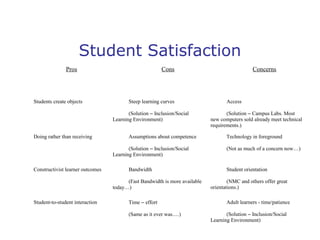
Student Satisfaction
Pros

Students create objects

Cons

Steep learning curves
(Solution – Inclusion/Social
Learning Environment)

Doing rather than receiving

Assumptions about competence
(Solution – Inclusion/Social
Learning Environment)

Constructivist learner outcomes

Bandwidth
(Fast Bandwidth is more available
today…)

Student-to-student interaction

Time – effort
(Same as it ever was….)

Concerns

Access
(Solution – Campus Labs. Most
new computers sold already meet technical
requirements.)
Technology in foreground
(Not as much of a concern now…)

Student orientation
(NMC and others offer great
orientations.)
Adult learners - time/patience
(Solution – Inclusion/Social
Learning Environment)
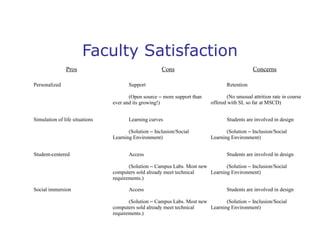
Faculty Satisfaction
Pros
Personalized

Cons
Support
(Open source – more support than
ever and its growing!)

Simulation of life situations

Learning curves
(Solution – Inclusion/Social
Learning Environment)

Student-centered

Access

Concerns
Retention
(No unusual attrition rate in course
offered with SL so far at MSCD)
Students are involved in design
(Solution – Inclusion/Social
Learning Environment)
Students are involved in design

(Solution – Campus Labs. Most new
(Solution – Inclusion/Social
computers sold already meet technical
Learning Environment)
requirements.)
Social immersion

Access

Students are involved in design

(Solution – Campus Labs. Most new
(Solution – Inclusion/Social
computers sold already meet technical
Learning Environment)
requirements.)
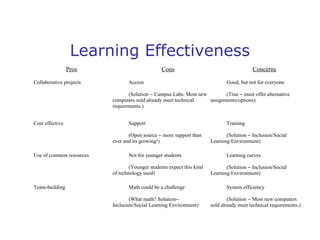
Learning Effectiveness
Pros
Collaborative projects

Cons
Access

Concerns
Good, but not for everyone

(Solution – Campus Labs. Most new
(True – must offer alternative
computers sold already meet technical
assignments/options)
requirements.)
Cost effective

Support
(Open source – more support than
ever and its growing!)

Use of common resources

Not for younger students
(Younger students expect this kind
of technology used)

Team-building

Math could be a challenge
(What math? Solution–
Inclusion/Social Learning Environment)

Training
(Solution – Inclusion/Social
Learning Environment)
Learning curves
(Solution – Inclusion/Social
Learning Environment)
System efficiency
(Solution – Most new computers
sold already meet technical requirements.)
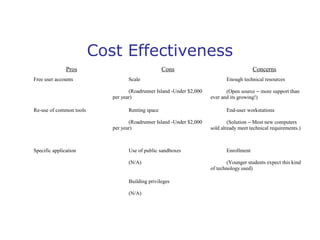
Cost Effectiveness
Pros
Free user accounts

Cons
Scale
(Roadrunner Island -Under $2,000
per year)

Re-use of common tools

Renting space
(Roadrunner Island -Under $2,000
per year)

Specific application

Use of public sandboxes
(N/A)


Building privileges
(N/A)

Concerns
Enough technical resources
(Open source – more support than
ever and its growing!)
End-user workstations
(Solution – Most new computers
sold already meet technical requirements.)

Enrollment
(Younger students expect this kind
of technology used)
 
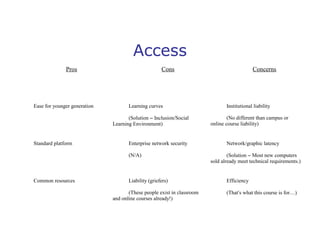
Access
Pros

Ease for younger generation

Cons

Learning curves
(Solution – Inclusion/Social
Learning Environment)

Standard platform

Enterprise network security
(N/A)

Common resources

Liability (griefers)
(These people exist in classroom
and online courses already!)

Concerns

Institutional liability
(No different than campus or
online course liability)

Network/graphic latency
(Solution – Most new computers
sold already meet technical requirements.)

Efficiency
(That’s what this course is for…)
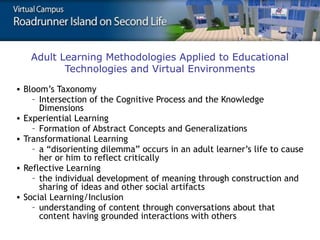
Adult Learning Methodologies Applied to Educational
Technologies and Virtual Environments
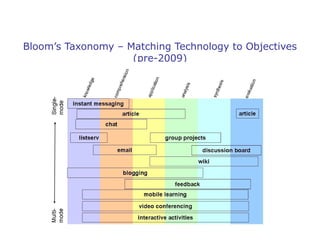
• Bloom’s Taxonomy
– Intersection of the Cognitive Process and the Knowledge
Dimensions
• Experiential Learning
– Formation of Abstract Concepts and Generalizations
• Transformational Learning
– a “disorienting dilemma” occurs in an adult learner’s life to cause
her or him to reflect critically
• Reflective Learning
– the individual development of meaning through construction and
sharing of ideas and other social artifacts
• Social Learning/Inclusion
– understanding of content through conversations about that
content having grounded interactions with others
Bloom’s Taxonomy – Matching Technology to Objectives
(pre-2009)
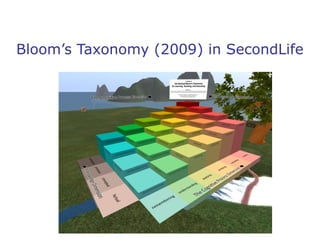
Bloom’s Taxonomy – 2009 in
SecondLife
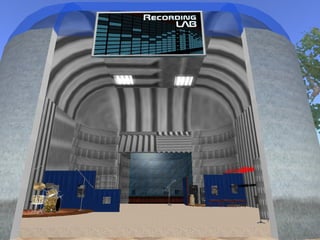
• Rex Heer (Thursday Xu in SecondLife) of
Iowa State University’s Center for
Excellence in Learning and Teaching
• Relevant design of teaching and learning
activities in virtual environments
• http://slurl.com/secondlife/Teaching%204/19
Bloom’s Taxonomy (2009) in SecondLife
Cognitive Process Dimension
1.Remember: Retrieve relevant knowledge from long-term
memory.
2.Understand: Construct meaning from instructional messages,
including oral, written, and graphic communication.
3.Apply: Carry out or use a procedure in a given situation.
4.Analyze: Break material into constituent parts and determine
how parts relate to one another and to an overall structure or
purpose.
5.Evaluate: Make judgments based on criteria and standards.
6.Create: Put elements together to form a coherent or
functional whole; reorganize elements into a new pattern or
structure.
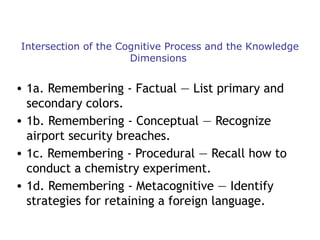
Knowledge Dimension
a. Factual Knowledge: The basic elements students must
know to be acquainted with a discipline or solve
problems in it.
b. Conceptual Knowledge: The interrelationships among
the basic elements within a larger structure that enable
them to function together.
c. Procedural Knowledge: How to do something, methods
of inquiry, and criteria for using skills, algorithms,
techniques, and methods.
d. Metacognitive Knowledge: Knowledge of cognition in
general as well as awareness and knowledge of one's own
cognition.
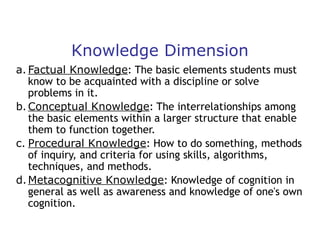
Intersection of the Cognitive Process and the Knowledge
Dimensions

• 1a. Remembering - Factual — List primary and
secondary colors.
• 1b. Remembering - Conceptual — Recognize
airport security breaches.
• 1c. Remembering - Procedural — Recall how to
conduct a chemistry experiment.
• 1d. Remembering - Metacognitive — Identify
strategies for retaining a foreign language.
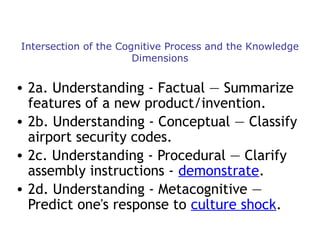
Intersection of the Cognitive Process and the Knowledge
Dimensions

• 2a. Understanding - Factual — Summarize
features of a new product/invention.
• 2b. Understanding - Conceptual — Classify
airport security codes.
• 2c. Understanding - Procedural — Clarify
assembly instructions - demonstrate.
• 2d. Understanding - Metacognitive —
Predict one's response to culture shock.
Intersection of the Cognitive Process and the Knowledge
Dimensions

• 3a. Applying - Factual — Respond to
frequently asked questions.
• 3b. Applying - Conceptual — Provide advice
to novices.
• 3c. Applying - Procedural — Carry out pH
tests of water samples.
• 3d. Applying - Metacognitive — Use
techniques that match one's strengths.
Intersection of the Cognitive Process and the Knowledge
Dimensions

• 4a. Analyzing - Factual — Select the most
complete list of instructions.
• 4b. Analyzing - Conceptual — Differentiate
high and low culture.
• 4c. Analyzing - Procedural — Integrate
compliance with new regulations.
• 4d. Analyzing - Metacognitive —
Deconstruct one's biases.
Intersection of the Cognitive Process and the Knowledge
Dimensions

• 5a. Evaluating - Factual — Check for
consistency among sources - validity.
• 5b. Evaluating - Conceptual — Determine
relevance of results.
• 5c. Evaluating - Procedural — Judge
efficiency of sampling techniques.
• 5d. Evaluating - Metacognitive — Reflect
on one's progress.
Intersection of the Cognitive Process and the Knowledge
Dimensions

• 6a. Creating - Factual — Generate a log of
daily activities (OurStory.com).
• 6b. Creating - Conceptual — Assemble a
team of experts.
• 6c. Creating - Procedural — Design an
efficient project workflow.
• 6d. Creating - Metacognitive — Create a
learning portfolio.
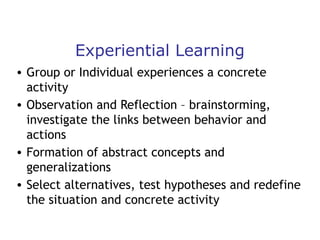
Experiential Learning
• Group or Individual experiences a concrete
activity
• Observation and Reflection – brainstorming,
investigate the links between behavior and
actions
• Formation of abstract concepts and
generalizations
• Select alternatives, test hypotheses and redefine
the situation and concrete activity
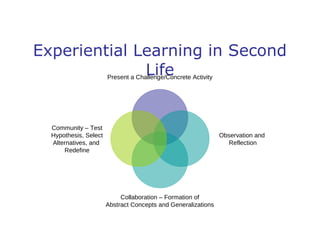
Experiential Learning in Second
Life
Present a Challenge/Concrete Activity

Community – Test
Hypothesis, Select
Alternatives, and
Redefine

Observation and
Reflection

Collaboration – Formation of
Abstract Concepts and Generalizations
Transformational Learning
• The “mental filing cabinet” concept
• End results are classified and defined by the
learner
• The learner explores options for new behaviors
and builds competence in new roles
• A plan of action is developed, and the learner
acquires knowledge and skills for implementing
the plan
Transformational Learning in SecondLife
• a “disorienting dilemma” occurs in an
adult learner’s life to cause her or him to
reflect critically (Merizow)
• the individual’s conception of him/herself
and worldview is inexorably changed
• Instruction can be designed, yet learning
can not be designed…experienced and
transformed by the learner…
Transformational Learning in SecondLife
(Con’t)

• fostering transformative learning in the
classroom on establishing meaningful,
genuine relationships with students
• Becoming bicultural is a transformational
learning process…allows the individual to
analyze his/her own behavior in a way
that was not possible before…
Reflective Learning
• Present in many online courses that use
the technology of discussion forums,
portfolios, and chat rooms as tools for
learners to document reflections.
• Recapture their experience, think about
it, evaluate it, and return to experience
• An outcome of both Experiential and
Transformational Learning
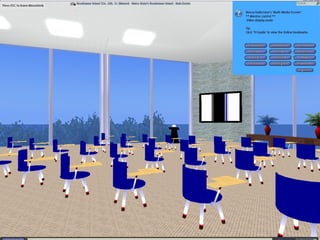
Reflective Learning in SecondLife
• a focus on collaborative discourse
• the individual development of meaning
through construction and sharing of ideas
and other social artifacts
• critical self-reflection
• connected online dialogue
• Constructivism
• Digital Storytelling (OurStory.com)
Social Learning/Inclusion
• Social Learning: understanding of content
through conversations about that content
having grounded interactions with others
• Creating a learning atmosphere in which
learners and teachers feel respected and
connected to one another poses its
challenges in online learning environments

Wlodkowski, R. J. (1999). Enhancing adult motivation to learn. San Fransisco, CA:
Jossey-Bass.
SecondLife Inclusion Strategies
Inclusion
Strategies

LMS

Introduction

Technical Abilities

s/
:

Expectations

=
Share Knowledge
?
?

You were new to
Teacher/Learn
er Communication: this once too!
?
?

Deepened
Understanding of
Inclusion:

Web 2.0

SecondLife

How is the
technology used for
learning
?
?

Don’t forget your
First Life!
?
?

How do learners
commonly use the
technology?
?

Experts become
instructors.
?
?

What are the best
Which
Learning Methods?
technologies work best
for each learner?
?
?
?
?

Let the learners
introduce you to
something new.
?
?
Resources

• MSCD Second Life Site:
http://www.mscd.edu/secondlife/
• Getting Students Started:
http://www.mscd.edu/secondlife/train00.sht
• Prepare to Teach:
http://www.mscd.edu/secondlife/train04.
shtml

Ed Technology Pedagogy 2014

  • 1.
    Welcome to Pedagogy &Instructional Methodologies for Educational Technologies and Virtual Classrooms Christopher Jennings, Ed.D.
  • 2.
    Virtual Environments • Areal-time, synchronous environment that connects people in an animated virtual reality that is created by the residents, known as “avatars” • Is a free, collaborative, immersive environment with global participation • Second Life (similar to the HiPiHi environment) - the eye-in-hand logo, which many cultures embrace as a symbol of creation that springs from knowledge
  • 3.
    A Viable TeachingSolution, or NOT? • Sloan-C 2007 Study based on 5 Pillars of Quality: – – – – – Student Satisfaction Faculty Satisfaction Learning Effectiveness Cost Effectiveness, and Access
  • 4.
    Student Satisfaction Pros Students createobjects Cons Steep learning curves (Solution – Inclusion/Social Learning Environment) Doing rather than receiving Assumptions about competence (Solution – Inclusion/Social Learning Environment) Constructivist learner outcomes Bandwidth (Fast Bandwidth is more available today…) Student-to-student interaction Time – effort (Same as it ever was….) Concerns Access (Solution – Campus Labs. Most new computers sold already meet technical requirements.) Technology in foreground (Not as much of a concern now…) Student orientation (NMC and others offer great orientations.) Adult learners - time/patience (Solution – Inclusion/Social Learning Environment)
  • 5.
    Faculty Satisfaction Pros Personalized Cons Support (Open source– more support than ever and its growing!) Simulation of life situations Learning curves (Solution – Inclusion/Social Learning Environment) Student-centered Access Concerns Retention (No unusual attrition rate in course offered with SL so far at MSCD) Students are involved in design (Solution – Inclusion/Social Learning Environment) Students are involved in design (Solution – Campus Labs. Most new (Solution – Inclusion/Social computers sold already meet technical Learning Environment) requirements.) Social immersion Access Students are involved in design (Solution – Campus Labs. Most new (Solution – Inclusion/Social computers sold already meet technical Learning Environment) requirements.)
  • 6.
    Learning Effectiveness Pros Collaborative projects Cons Access Concerns Good,but not for everyone (Solution – Campus Labs. Most new (True – must offer alternative computers sold already meet technical assignments/options) requirements.) Cost effective Support (Open source – more support than ever and its growing!) Use of common resources Not for younger students (Younger students expect this kind of technology used) Team-building Math could be a challenge (What math? Solution– Inclusion/Social Learning Environment) Training (Solution – Inclusion/Social Learning Environment) Learning curves (Solution – Inclusion/Social Learning Environment) System efficiency (Solution – Most new computers sold already meet technical requirements.)
  • 7.
    Cost Effectiveness Pros Free useraccounts Cons Scale (Roadrunner Island -Under $2,000 per year) Re-use of common tools Renting space (Roadrunner Island -Under $2,000 per year) Specific application Use of public sandboxes (N/A)   Building privileges (N/A) Concerns Enough technical resources (Open source – more support than ever and its growing!) End-user workstations (Solution – Most new computers sold already meet technical requirements.) Enrollment (Younger students expect this kind of technology used)  
  • 8.
    Access Pros Ease for youngergeneration Cons Learning curves (Solution – Inclusion/Social Learning Environment) Standard platform Enterprise network security (N/A) Common resources Liability (griefers) (These people exist in classroom and online courses already!) Concerns Institutional liability (No different than campus or online course liability) Network/graphic latency (Solution – Most new computers sold already meet technical requirements.) Efficiency (That’s what this course is for…)
  • 9.
    Adult Learning MethodologiesApplied to Educational Technologies and Virtual Environments • Bloom’s Taxonomy – Intersection of the Cognitive Process and the Knowledge Dimensions • Experiential Learning – Formation of Abstract Concepts and Generalizations • Transformational Learning – a “disorienting dilemma” occurs in an adult learner’s life to cause her or him to reflect critically • Reflective Learning – the individual development of meaning through construction and sharing of ideas and other social artifacts • Social Learning/Inclusion – understanding of content through conversations about that content having grounded interactions with others
  • 10.
    Bloom’s Taxonomy –Matching Technology to Objectives (pre-2009)
  • 11.
    Bloom’s Taxonomy –2009 in SecondLife • Rex Heer (Thursday Xu in SecondLife) of Iowa State University’s Center for Excellence in Learning and Teaching • Relevant design of teaching and learning activities in virtual environments • http://slurl.com/secondlife/Teaching%204/19
  • 12.
  • 13.
    Cognitive Process Dimension 1.Remember:Retrieve relevant knowledge from long-term memory. 2.Understand: Construct meaning from instructional messages, including oral, written, and graphic communication. 3.Apply: Carry out or use a procedure in a given situation. 4.Analyze: Break material into constituent parts and determine how parts relate to one another and to an overall structure or purpose. 5.Evaluate: Make judgments based on criteria and standards. 6.Create: Put elements together to form a coherent or functional whole; reorganize elements into a new pattern or structure.
  • 14.
    Knowledge Dimension a. FactualKnowledge: The basic elements students must know to be acquainted with a discipline or solve problems in it. b. Conceptual Knowledge: The interrelationships among the basic elements within a larger structure that enable them to function together. c. Procedural Knowledge: How to do something, methods of inquiry, and criteria for using skills, algorithms, techniques, and methods. d. Metacognitive Knowledge: Knowledge of cognition in general as well as awareness and knowledge of one's own cognition.
  • 15.
    Intersection of theCognitive Process and the Knowledge Dimensions • 1a. Remembering - Factual — List primary and secondary colors. • 1b. Remembering - Conceptual — Recognize airport security breaches. • 1c. Remembering - Procedural — Recall how to conduct a chemistry experiment. • 1d. Remembering - Metacognitive — Identify strategies for retaining a foreign language.
  • 17.
    Intersection of theCognitive Process and the Knowledge Dimensions • 2a. Understanding - Factual — Summarize features of a new product/invention. • 2b. Understanding - Conceptual — Classify airport security codes. • 2c. Understanding - Procedural — Clarify assembly instructions - demonstrate. • 2d. Understanding - Metacognitive — Predict one's response to culture shock.
  • 18.
    Intersection of theCognitive Process and the Knowledge Dimensions • 3a. Applying - Factual — Respond to frequently asked questions. • 3b. Applying - Conceptual — Provide advice to novices. • 3c. Applying - Procedural — Carry out pH tests of water samples. • 3d. Applying - Metacognitive — Use techniques that match one's strengths.
  • 19.
    Intersection of theCognitive Process and the Knowledge Dimensions • 4a. Analyzing - Factual — Select the most complete list of instructions. • 4b. Analyzing - Conceptual — Differentiate high and low culture. • 4c. Analyzing - Procedural — Integrate compliance with new regulations. • 4d. Analyzing - Metacognitive — Deconstruct one's biases.
  • 20.
    Intersection of theCognitive Process and the Knowledge Dimensions • 5a. Evaluating - Factual — Check for consistency among sources - validity. • 5b. Evaluating - Conceptual — Determine relevance of results. • 5c. Evaluating - Procedural — Judge efficiency of sampling techniques. • 5d. Evaluating - Metacognitive — Reflect on one's progress.
  • 21.
    Intersection of theCognitive Process and the Knowledge Dimensions • 6a. Creating - Factual — Generate a log of daily activities (OurStory.com). • 6b. Creating - Conceptual — Assemble a team of experts. • 6c. Creating - Procedural — Design an efficient project workflow. • 6d. Creating - Metacognitive — Create a learning portfolio.
  • 22.
    Experiential Learning • Groupor Individual experiences a concrete activity • Observation and Reflection – brainstorming, investigate the links between behavior and actions • Formation of abstract concepts and generalizations • Select alternatives, test hypotheses and redefine the situation and concrete activity
  • 23.
    Experiential Learning inSecond Life Present a Challenge/Concrete Activity Community – Test Hypothesis, Select Alternatives, and Redefine Observation and Reflection Collaboration – Formation of Abstract Concepts and Generalizations
  • 27.
    Transformational Learning • The“mental filing cabinet” concept • End results are classified and defined by the learner • The learner explores options for new behaviors and builds competence in new roles • A plan of action is developed, and the learner acquires knowledge and skills for implementing the plan
  • 28.
    Transformational Learning inSecondLife • a “disorienting dilemma” occurs in an adult learner’s life to cause her or him to reflect critically (Merizow) • the individual’s conception of him/herself and worldview is inexorably changed • Instruction can be designed, yet learning can not be designed…experienced and transformed by the learner…
  • 29.
    Transformational Learning inSecondLife (Con’t) • fostering transformative learning in the classroom on establishing meaningful, genuine relationships with students • Becoming bicultural is a transformational learning process…allows the individual to analyze his/her own behavior in a way that was not possible before…
  • 30.
    Reflective Learning • Presentin many online courses that use the technology of discussion forums, portfolios, and chat rooms as tools for learners to document reflections. • Recapture their experience, think about it, evaluate it, and return to experience • An outcome of both Experiential and Transformational Learning
  • 31.
    Reflective Learning inSecondLife • a focus on collaborative discourse • the individual development of meaning through construction and sharing of ideas and other social artifacts • critical self-reflection • connected online dialogue • Constructivism • Digital Storytelling (OurStory.com)
  • 32.
    Social Learning/Inclusion • SocialLearning: understanding of content through conversations about that content having grounded interactions with others • Creating a learning atmosphere in which learners and teachers feel respected and connected to one another poses its challenges in online learning environments Wlodkowski, R. J. (1999). Enhancing adult motivation to learn. San Fransisco, CA: Jossey-Bass.
  • 33.
    SecondLife Inclusion Strategies Inclusion Strategies LMS Introduction TechnicalAbilities s/ : Expectations = Share Knowledge ? ? You were new to Teacher/Learn er Communication: this once too! ? ? Deepened Understanding of Inclusion: Web 2.0 SecondLife How is the technology used for learning ? ? Don’t forget your First Life! ? ? How do learners commonly use the technology? ? Experts become instructors. ? ? What are the best Which Learning Methods? technologies work best for each learner? ? ? ? ? Let the learners introduce you to something new. ? ?
  • 34.
    Resources • MSCD SecondLife Site: http://www.mscd.edu/secondlife/ • Getting Students Started: http://www.mscd.edu/secondlife/train00.sht • Prepare to Teach: http://www.mscd.edu/secondlife/train04. shtml