Self-Determination Theory and Learning Learning Theories University of Connecticut, TCPCG Summer 2011
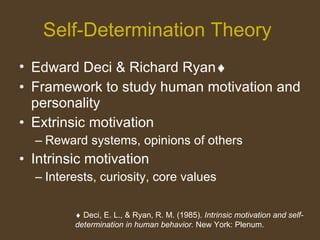
Self-Determination Theory  Edward Deci & Richard Ryan    Framework to study human motivation and personality Extrinsic motivation Reward systems, opinions of others Intrinsic motivation Interests, curiosity, core values    Deci, E. L., & Ryan, R. M. (1985).  Intrinsic motivation and self-determination in human behavior.  New York: Plenum.
“ The interplay between the extrinsic forces acting on persons and the intrinsic motives and needs inherent in human nature is the territory of SDT.”
 
“ SDT propositions also focus on how social and cultural factors facilitate or undermine people’s sense of volition and initiative, in addition to their well-being and the quality of their performance.”
 
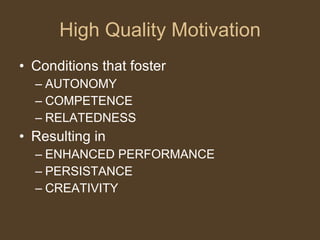
High Quality Motivation Conditions that foster AUTONOMY COMPETENCE RELATEDNESS Resulting in  ENHANCED PERFORMANCE PERSISTANCE CREATIVITY
BIG 3: Autonomy, Competency, Relatedness PRESENT: When all three needs are ongoingly satisfied, people will develop and function effectively and experience overall wellness ABSENT: When needs are thwarted, people more likely evidence ill-being and non-optimal functioning
SDT and Learning [self-study] THINK  of an example from your experience as a learner (formal or informal) when you felt autonomous, competent, and connected to others. PAIR  with your neighbor and share your stories. SHARE  with the class the commonalities & differences in your stories.
Harness Your Students' Digital Smarts |  Edutopia
SDT and Learning [case study] Describe the interaction between Vicki Davis’ pedagogy and her students’ SD?  Support your response with two examples of specific pedagogical practices you noted that may influence her students’ feelings of  autonomy, competency, and relatedness.  Formulate a theory to practice statement reflecting the relationship between pedagogy and students’ self-determination.
Connecting Concepts  Goleman’s  Emotional Intelligence (E.Q.) Intrinsic Motivation Extrinsic Motivation “Hot cognition”  The affective domain (the role of emotion in learning  “Baggage”  Pink’s autonomy, mastery, and purpose
Thank You Prepared by  GNA Garcia University of Connecticut, Educational Psychology Faculty

Self-Determination Theory and Learning

  • 1.
    Self-Determination Theory andLearning Learning Theories University of Connecticut, TCPCG Summer 2011
  • 2.
    Self-Determination Theory Edward Deci & Richard Ryan  Framework to study human motivation and personality Extrinsic motivation Reward systems, opinions of others Intrinsic motivation Interests, curiosity, core values  Deci, E. L., & Ryan, R. M. (1985). Intrinsic motivation and self-determination in human behavior. New York: Plenum.
  • 3.
    “ The interplaybetween the extrinsic forces acting on persons and the intrinsic motives and needs inherent in human nature is the territory of SDT.”
  • 4.
  • 5.
    “ SDT propositionsalso focus on how social and cultural factors facilitate or undermine people’s sense of volition and initiative, in addition to their well-being and the quality of their performance.”
  • 6.
  • 7.
    High Quality MotivationConditions that foster AUTONOMY COMPETENCE RELATEDNESS Resulting in ENHANCED PERFORMANCE PERSISTANCE CREATIVITY
  • 8.
    BIG 3: Autonomy,Competency, Relatedness PRESENT: When all three needs are ongoingly satisfied, people will develop and function effectively and experience overall wellness ABSENT: When needs are thwarted, people more likely evidence ill-being and non-optimal functioning
  • 9.
    SDT and Learning[self-study] THINK of an example from your experience as a learner (formal or informal) when you felt autonomous, competent, and connected to others. PAIR with your neighbor and share your stories. SHARE with the class the commonalities & differences in your stories.
  • 10.
    Harness Your Students'Digital Smarts | Edutopia
  • 11.
    SDT and Learning[case study] Describe the interaction between Vicki Davis’ pedagogy and her students’ SD? Support your response with two examples of specific pedagogical practices you noted that may influence her students’ feelings of autonomy, competency, and relatedness. Formulate a theory to practice statement reflecting the relationship between pedagogy and students’ self-determination.
  • 12.
    Connecting Concepts Goleman’s Emotional Intelligence (E.Q.) Intrinsic Motivation Extrinsic Motivation “Hot cognition” The affective domain (the role of emotion in learning “Baggage” Pink’s autonomy, mastery, and purpose
  • 13.
    Thank You Preparedby GNA Garcia University of Connecticut, Educational Psychology Faculty

Editor's Notes

  • #5 How does “ The interplay between the extrinsic forces acting on persons and the intrinsic motives and needs inherent in human nature is the territory of SDT.” relate to Maslow’s Hierarchy of Needs?
  • #7 How does “SDT propositions also focus on how social and cultural factors facilitate or undermine people’s sense of volition and initiative, in addition to their well-being and the quality of their performance.” relate to Vygotsky’s theory of cognitive development?