Fahimeh Vaziri
DENTAL TRAUMA TO PRIMARY
TEETH
Extrusion & Intrusion
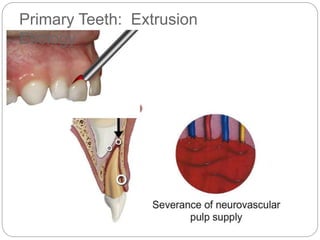
Primary Teeth: Extrusion
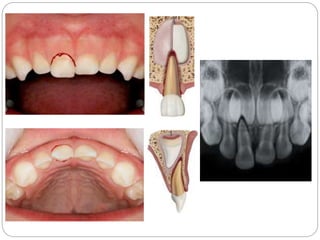
 Partial displacement of the tooth out of its socket
 partial or total separation of the periodontal
ligament loosening and displacement of the
tooth.
 The alveolar socket bone remains intact.
 axial displacement
 protrusive or retrusive orientation
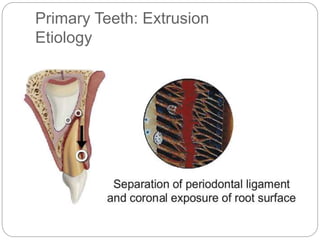
Primary Teeth: Extrusion
Etiology
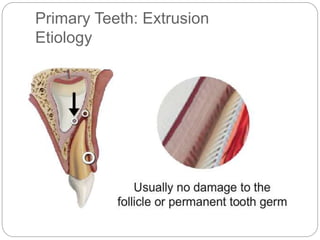
Primary Teeth: Extrusion
Etiology
Primary Teeth: Extrusion
Etiology
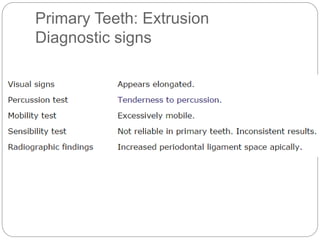
Primary Teeth: Extrusion
Diagnostic signs
Primary Teeth: Extrusion
Diagnostic signs
 Radiographs recommended occlusal exposure:
 evaluate the size of the displacement
 rule out the presence of a root fracture.
Primary Teeth: Extrusion
Treatment Guidelines
 The treatment choice should be based on the:
 Degree of displacement
 Mobility
 Root formation
 Ability of the child to cope with the emergency
situation.
Primary Teeth: Extrusion
Treatment Guidelines
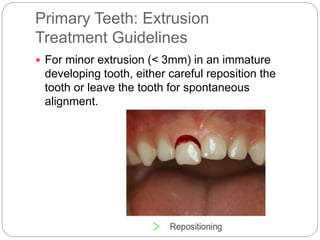
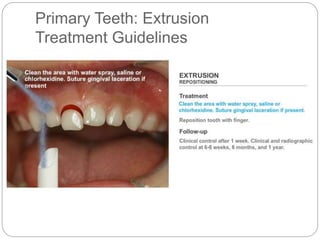
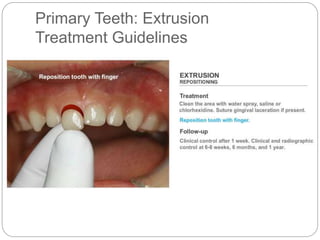
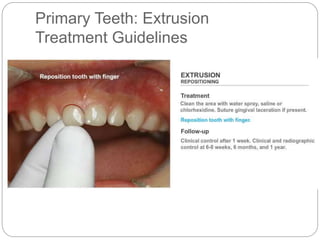
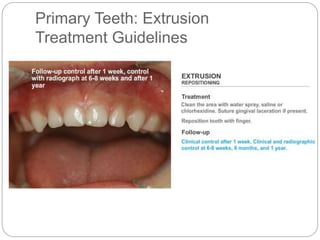
 For minor extrusion (< 3mm) in an immature
developing tooth, either careful reposition the
tooth or leave the tooth for spontaneous
alignment.
Primary Teeth: Extrusion
Treatment Guidelines
Primary Teeth: Extrusion
Treatment Guidelines
Primary Teeth: Extrusion
Treatment Guidelines
Primary Teeth: Extrusion
Treatment Guidelines
Primary Teeth: Extrusion
Treatment Guidelines
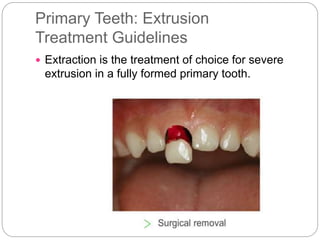
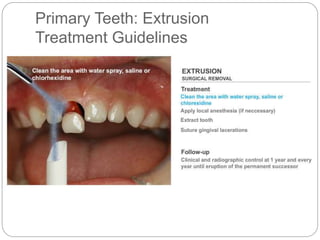
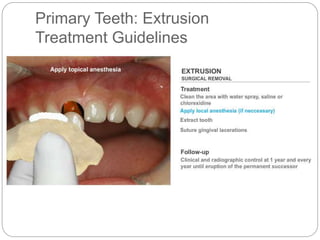
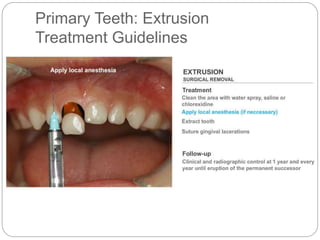
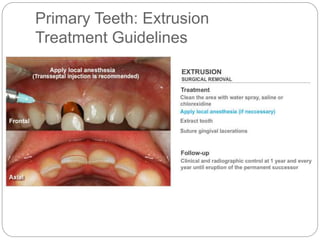
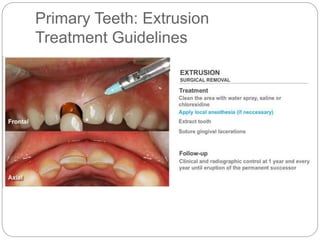
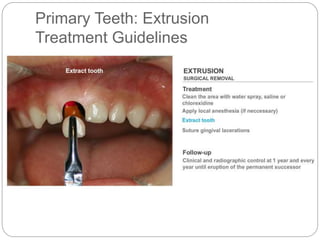
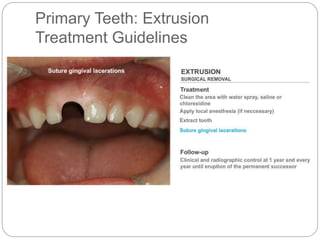
 Extraction is the treatment of choice for severe
extrusion in a fully formed primary tooth.
Primary Teeth: Extrusion
Treatment Guidelines
Primary Teeth: Extrusion
Treatment Guidelines
Primary Teeth: Extrusion
Treatment Guidelines
Primary Teeth: Extrusion
Treatment Guidelines
Primary Teeth: Extrusion
Treatment Guidelines
Primary Teeth: Extrusion
Treatment Guidelines
Primary Teeth: Extrusion
Treatment Guidelines
Primary Teeth: Extrusion
Treatment Guidelines
Primary Teeth: Extrusion
Patient instructions
 Soft food for 1 week.
 Good oral hygiene. Brush with a soft brush after
every meal and apply chlorhexidine 0.1 %
topically to the affected area with cotton swabs
twice a day for one week.
 Parents should be further advised about possible
complications that may occur, like swelling, dark
discoloration of the crown, increased mobility or
fistula. Children may not complain about pain;
however, infection may be present and parents
should watch for signs of swelling of the gums
and bring the child in for treatment.
Primary Teeth: Extrusion
Follow-up
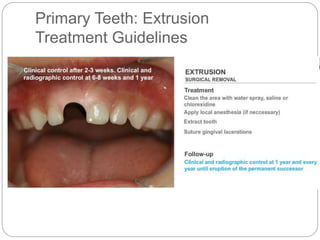
 Clinical control after 1 weeks. Clinical and
radiographic control at 6-8 weeks, 6 months, and
1 year.
Primary teeth: Intrusion
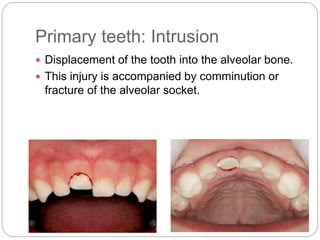
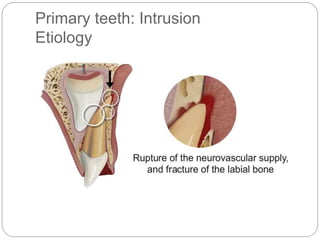
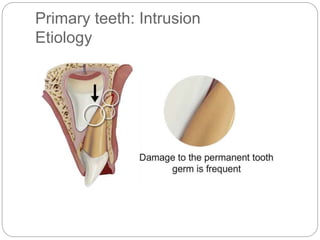
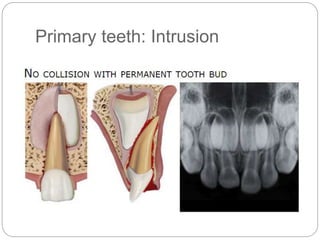
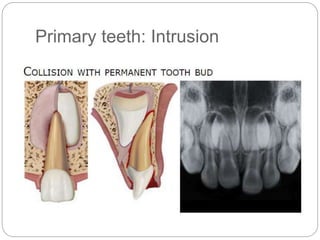
 Displacement of the tooth into the alveolar bone.
 This injury is accompanied by comminution or
fracture of the alveolar socket.
Primary teeth: Intrusion
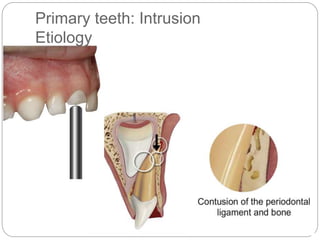
Etiology
Primary teeth: Intrusion
Etiology
Primary teeth: Intrusion
Etiology
Primary teeth: Intrusion
Visual signs
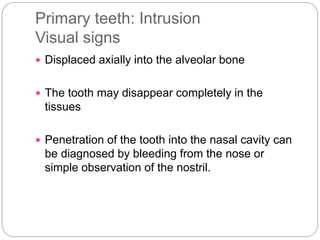
 Displaced axially into the alveolar bone
 The tooth may disappear completely in the
tissues
 Penetration of the tooth into the nasal cavity can
be diagnosed by bleeding from the nose or
simple observation of the nostril.
Primary teeth: Intrusion
Diagnostic signs
Primary teeth: Intrusion
Diagnostic signs
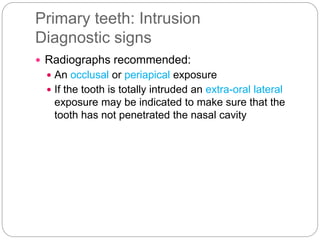
 Radiographs recommended:
 An occlusal or periapical exposure
 If the tooth is totally intruded an extra-oral lateral
exposure may be indicated to make sure that the
tooth has not penetrated the nasal cavity
Primary teeth: Intrusion
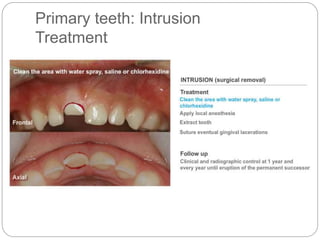
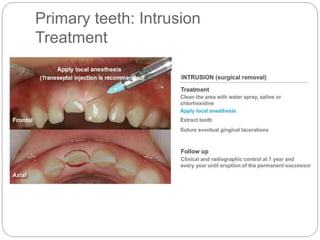
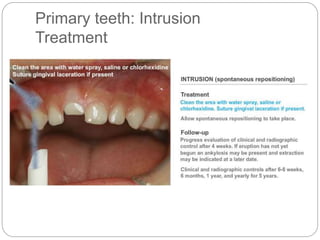
Treatment
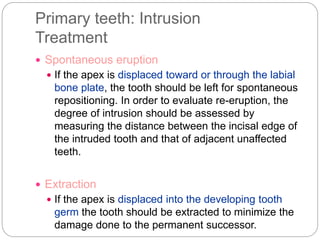
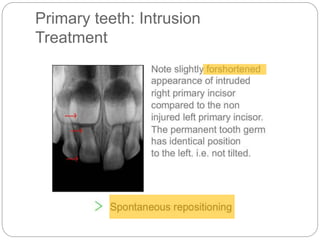
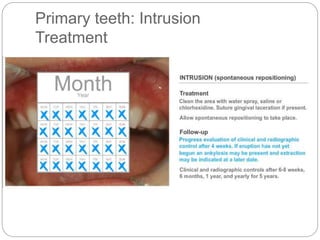
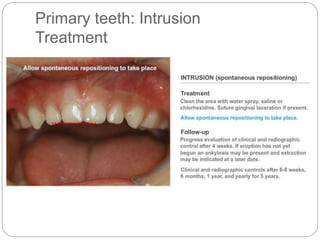
 Spontaneous eruption
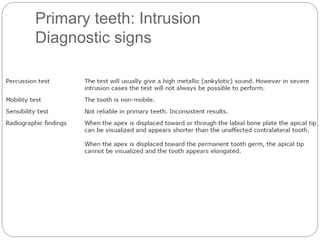
 If the apex is displaced toward or through the labial
bone plate, the tooth should be left for spontaneous
repositioning. In order to evaluate re-eruption, the
degree of intrusion should be assessed by
measuring the distance between the incisal edge of
the intruded tooth and that of adjacent unaffected
teeth.
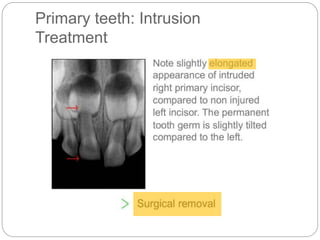
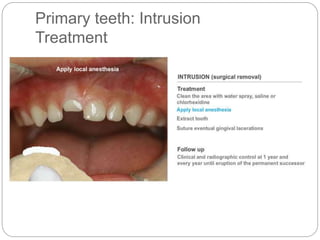
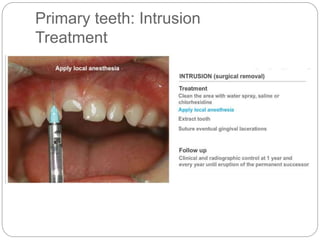
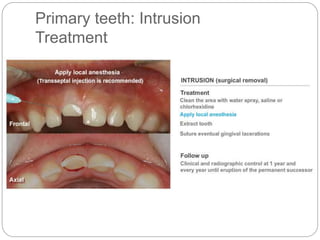
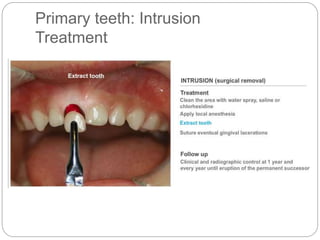
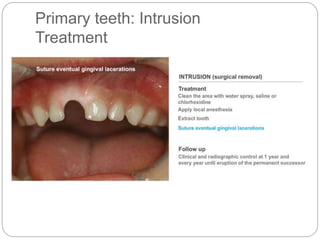
 Extraction
 If the apex is displaced into the developing tooth
germ the tooth should be extracted to minimize the
damage done to the permanent successor.
Primary teeth: Intrusion
Treatment
Primary teeth: Intrusion
Treatment
Primary teeth: Intrusion
Treatment
Primary teeth: Intrusion
Treatment
Primary teeth: Intrusion
Treatment
Primary teeth: Intrusion
Treatment
Primary teeth: Intrusion
Treatment
Primary teeth: Intrusion
Treatment
Primary teeth: Intrusion
Treatment
Primary teeth: Intrusion
Treatment
Primary teeth: Intrusion
Treatment
Primary teeth: Intrusion
Treatment
Primary teeth: Intrusion
Treatment
Primary teeth: Intrusion
Treatment
Primary teeth: Intrusion
Patient instructions
 Soft food for 10-14 days.
 Good oral hygiene. Brush with a soft brush after every meal and
apply chlorhexidine 0.1 % topically to the affected area with cotton
swabs twice a day for one week.
 Parents should be further advised about possible complications that
may occur, like swelling, dark discoloration of the crown, increased
mobility or fistula. Children may not complain about pain; however,
infection may be present and parents should watch for signs of
swelling of the gums and bring the child in for treatment.
 Inform the parent about possible complications in the development of
the permanent successor, especially following intrusion injuries
sustained in children under 3 years of age.
Primary teeth: Intrusion
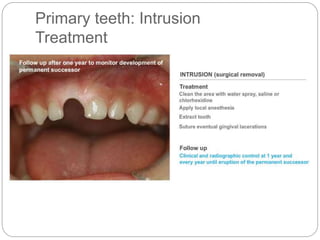
Follow-up
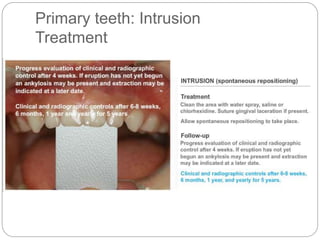
 Clinical control after 1 week. Clinical and
radiographic control at 3-4 weeks, 6-8 weeks,
6 month, 1 year and yearly clinical and
radiographic control until eruption of the
permanent successor.
Reference
 http://www.dentaltraumaguide.org/

Dental trauma to primary teeth