Presented by:
Aya Adel Abd El-Hafez
Rana Mohamed EL-Abassery
Objectives
• Identify the definition of MIH and its synonyms
• Know the etiology and prevalence of MIH
• Identify the clinical problems related to MIH
• Clinical presentation, diagnosis& severity of
MIH
• What is the differential diagnosis of MIH ?
• How to Prevent and Treat MIH ?
• Identify the Prognosis of MIH affected teeth
Introduction
• Enamel is the hardest tissue in human
body and contains the highest percentage
of minerals.
The defect caused during enamel
formation (Amelogenesis) is permanent as
the enamel lacks the ability to remodel
Definition
The Molar Incisor Hypomineralization (MIH) is defined as a
qualitative defect of enamel.
• Characterized by progressive hypomineralization of enamel
structure of the first permanent molars.
• May be associated with incisors.
Synonyms
• Hypomineralized permanent first molar.
• Idiopathic enamel hypomineralization.
• Nonfluoride hypomineralization.
• Non-endemic mottling of enamel of permanent first
molars.
• Cheese molars.
Etiology
Multifactorial
Parentally risks:
infection,
maternal
psychological
stress and
frequent exposure
to ultrasonic scans
Oxygen shortage
combined with low
birth weight
suspected to be
contributing
factor
Respiratory
diseases and
oxygen shortage of
the ameloblasts
Children born
with poor
general health
Children with
systemic
conditions in
their first 3
years
Prevalence
• Worldwide ranges from 3.6% to 40.2%
• Difference is due to lack of classification
index and standardized methodology of
assessment
• Most of the studies carried out in the
European countries
• NO gender difference in multiple studies
• Some studies reported that post eruptive
breakdown occurs more frequently in
boys
• Children under the age of 10 are more
highly affected by the disease (15.1%)
Clinical problems
• Hypersensitivity
• Difficult to anaesthetize
• Aesthetic problems
• Tooth breakdown and
restoration problems
Clinical presentation
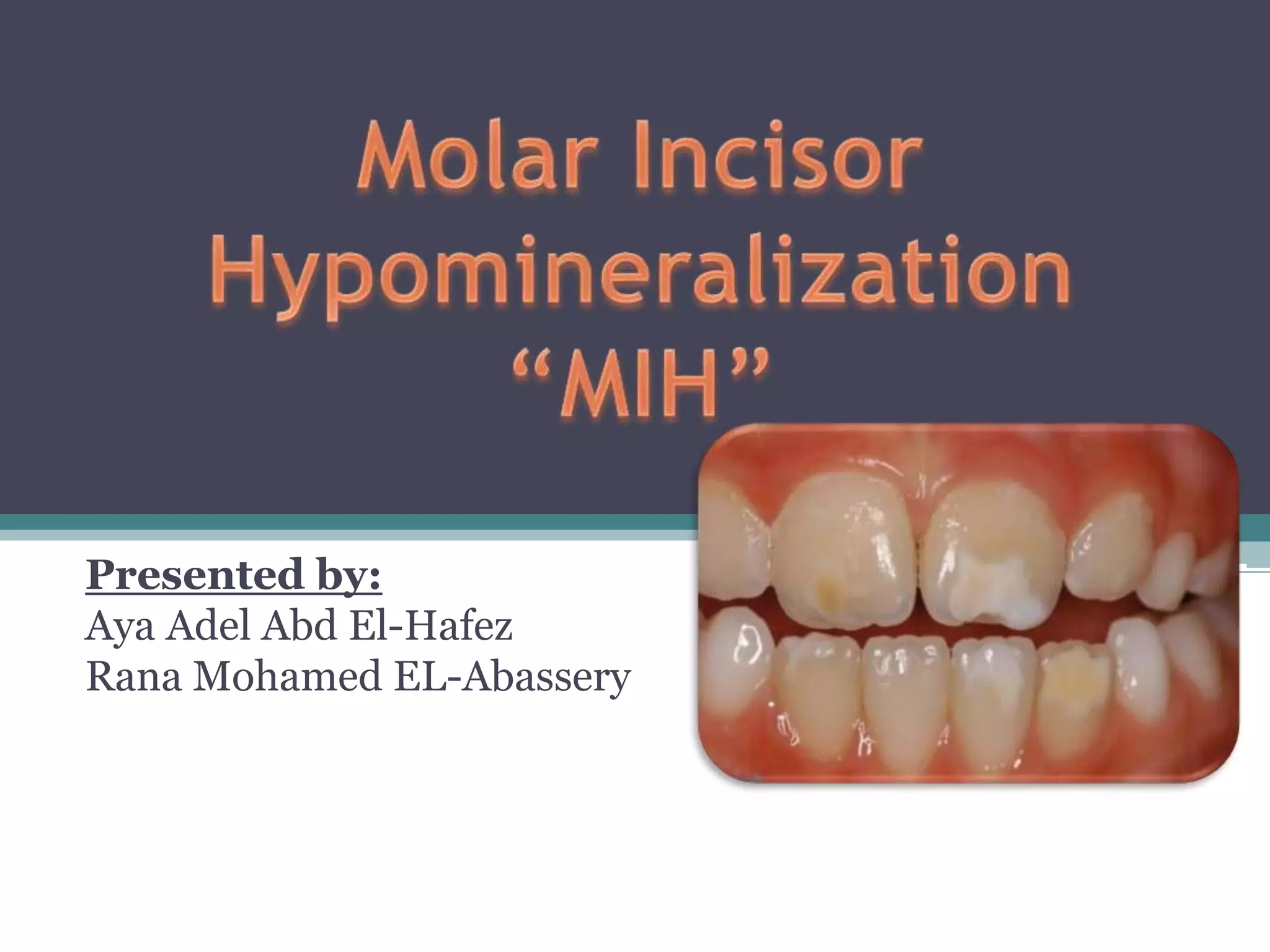
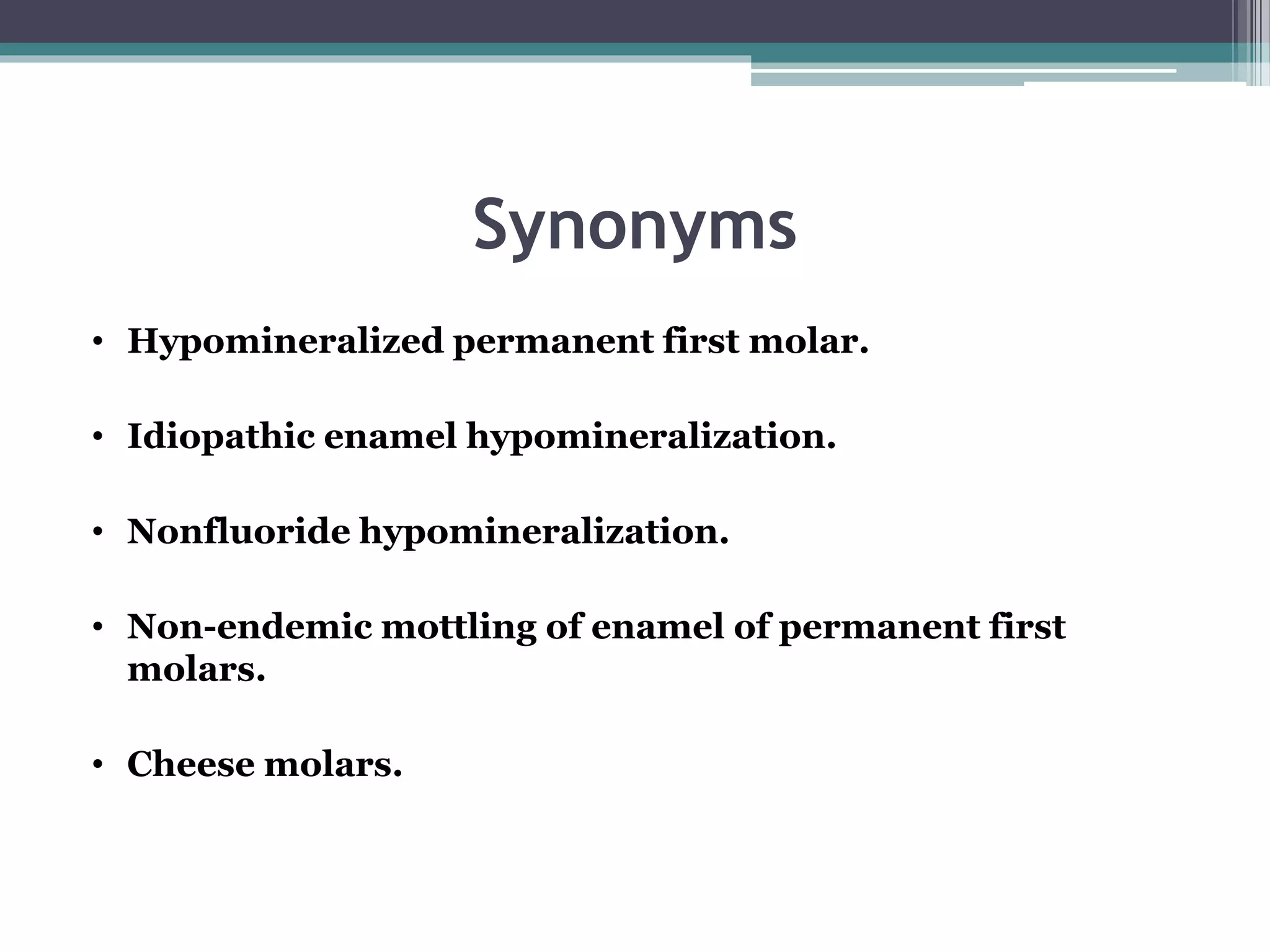
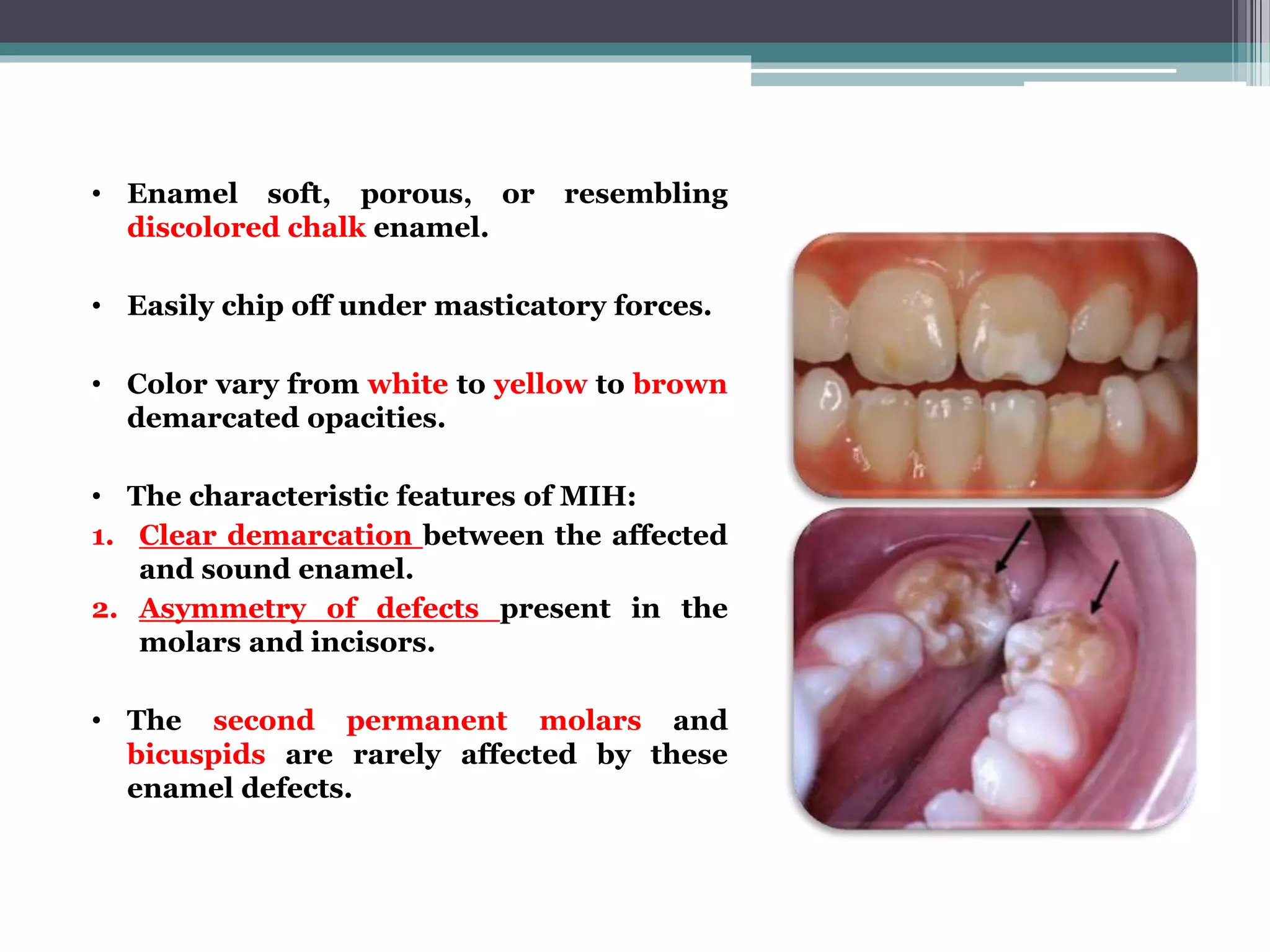
• Enamel soft, porous, or resembling
discolored chalk enamel.
• Easily chip off under masticatory forces.
• Color vary from white to yellow to brown
demarcated opacities.
• The characteristic features of MIH:
1. Clear demarcation between the affected
and sound enamel.
2. Asymmetry of defects present in the
molars and incisors.
• The second permanent molars and
bicuspids are rarely affected by these
enamel defects.
Diagnostic criteria
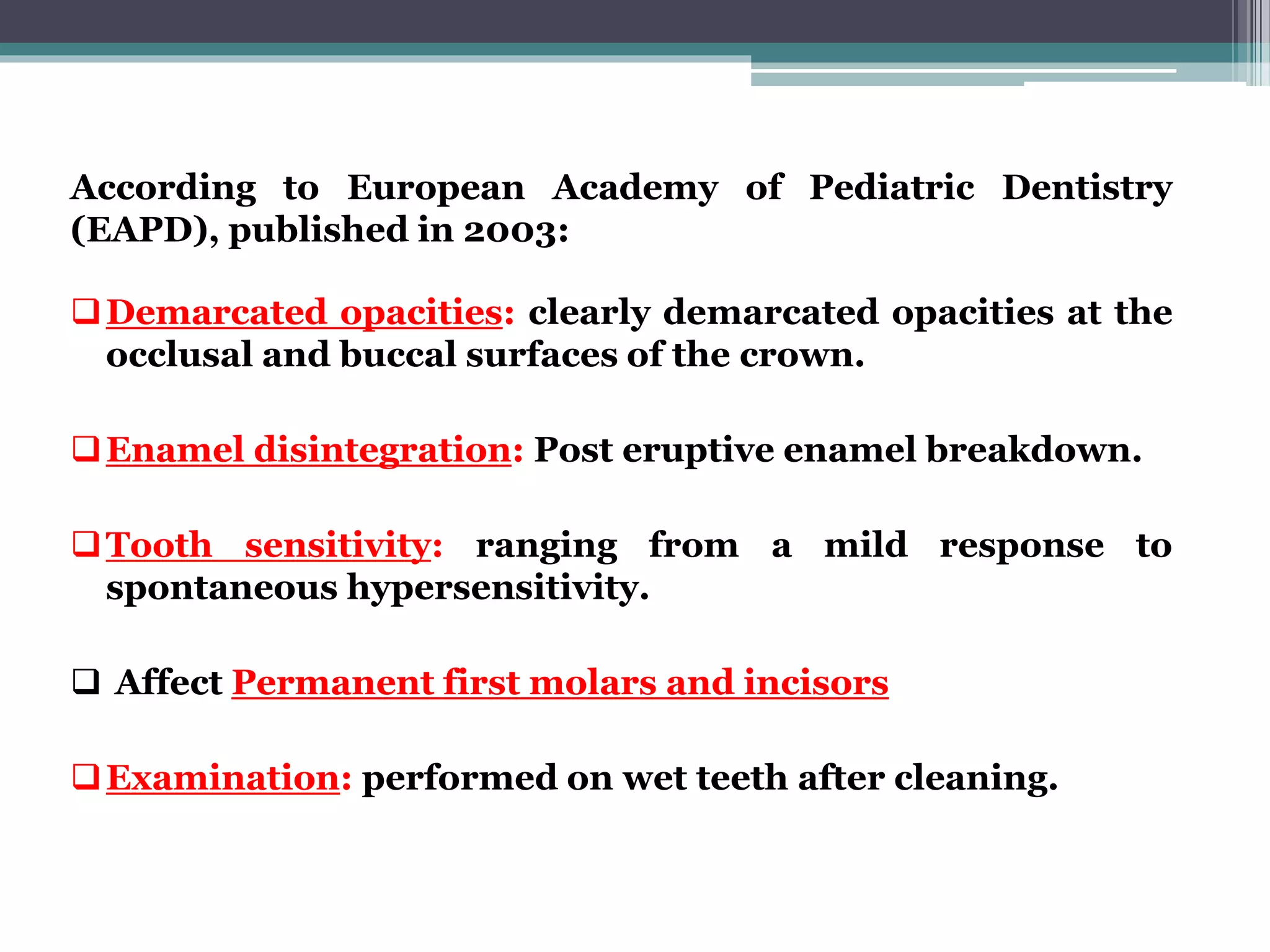
According to European Academy of Pediatric Dentistry
(EAPD), published in 2003:
Demarcated opacities: clearly demarcated opacities at the
occlusal and buccal surfaces of the crown.
Enamel disintegration: Post eruptive enamel breakdown.
Tooth sensitivity: ranging from a mild response to
spontaneous hypersensitivity.
 Affect Permanent first molars and incisors
Examination: performed on wet teeth after cleaning.
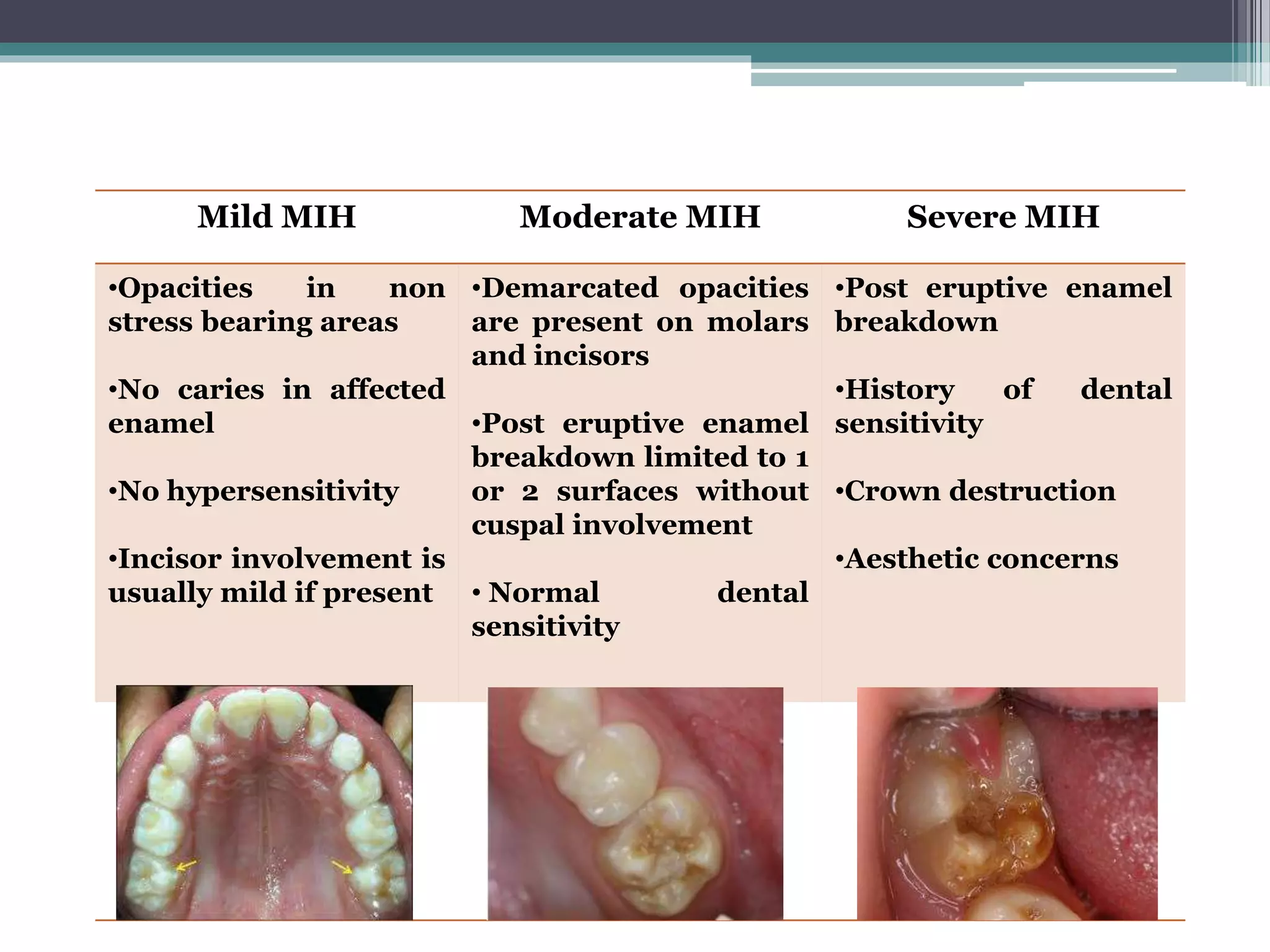
Severity
Mild MIH Moderate MIH Severe MIH
•Opacities in non
stress bearing areas
•No caries in affected
enamel
•No hypersensitivity
•Incisor involvement is
usually mild if present
•Demarcated opacities
are present on molars
and incisors
•Post eruptive enamel
breakdown limited to 1
or 2 surfaces without
cuspal involvement
• Normal dental
sensitivity
•Post eruptive enamel
breakdown
•History of dental
sensitivity
•Crown destruction
•Aesthetic concerns
Another severity scale was reported by European
Academy of Pediatric Dentistry (EAPD):
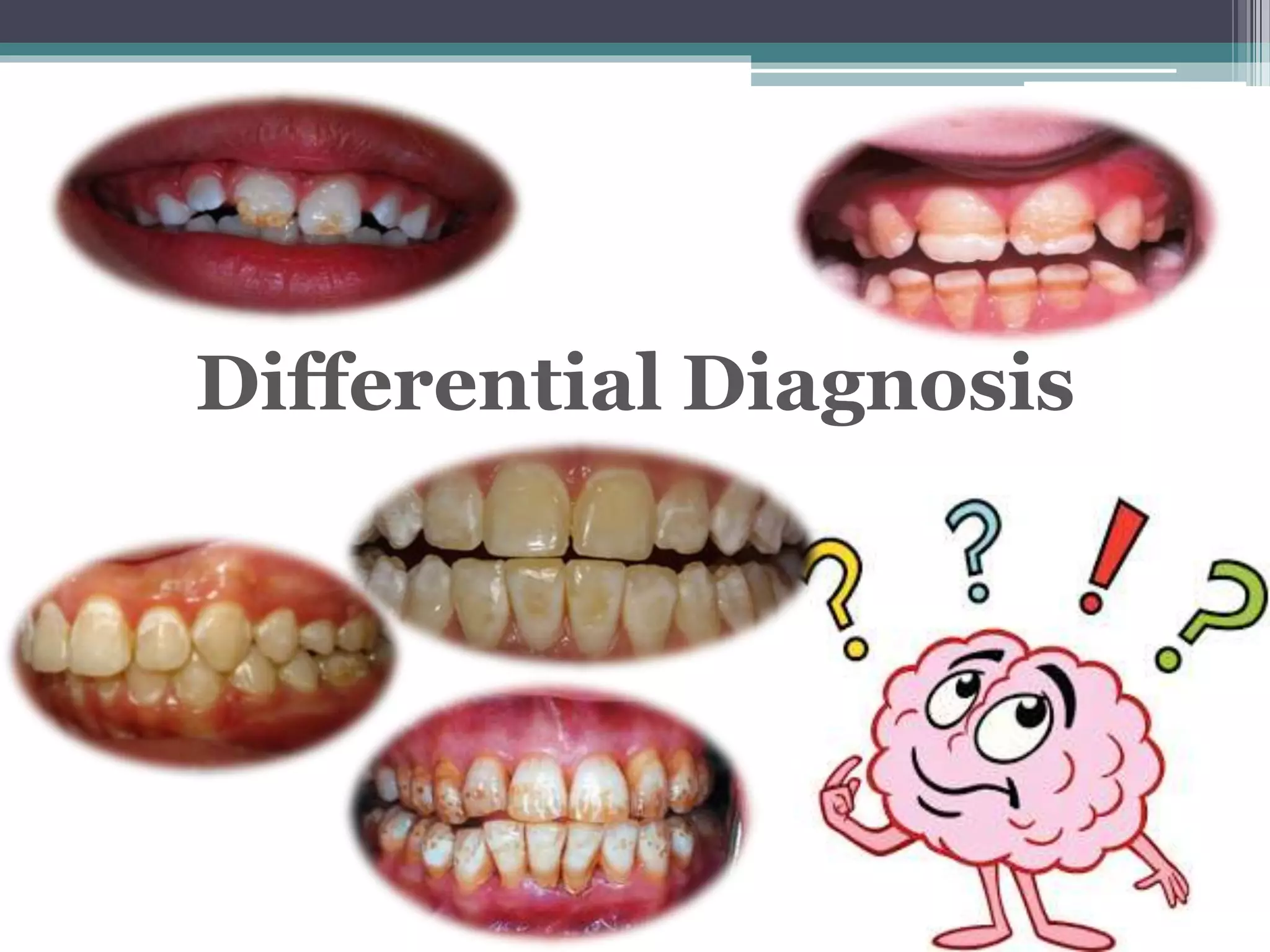
Differential Diagnosis
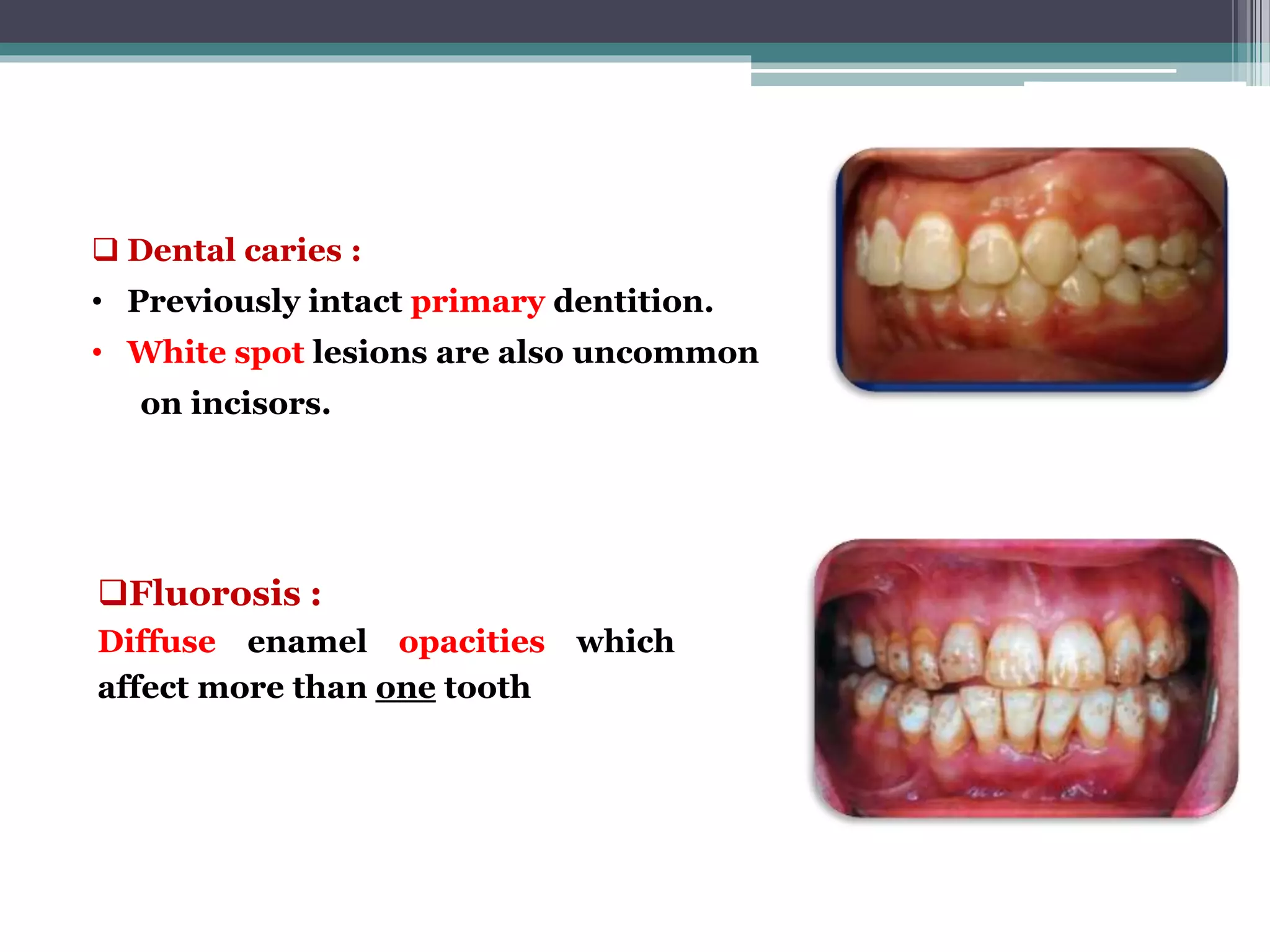
 Dental caries :
• Previously intact primary dentition.
• White spot lesions are also uncommon
on incisors.
Fluorosis :
Diffuse enamel opacities which
affect more than one tooth
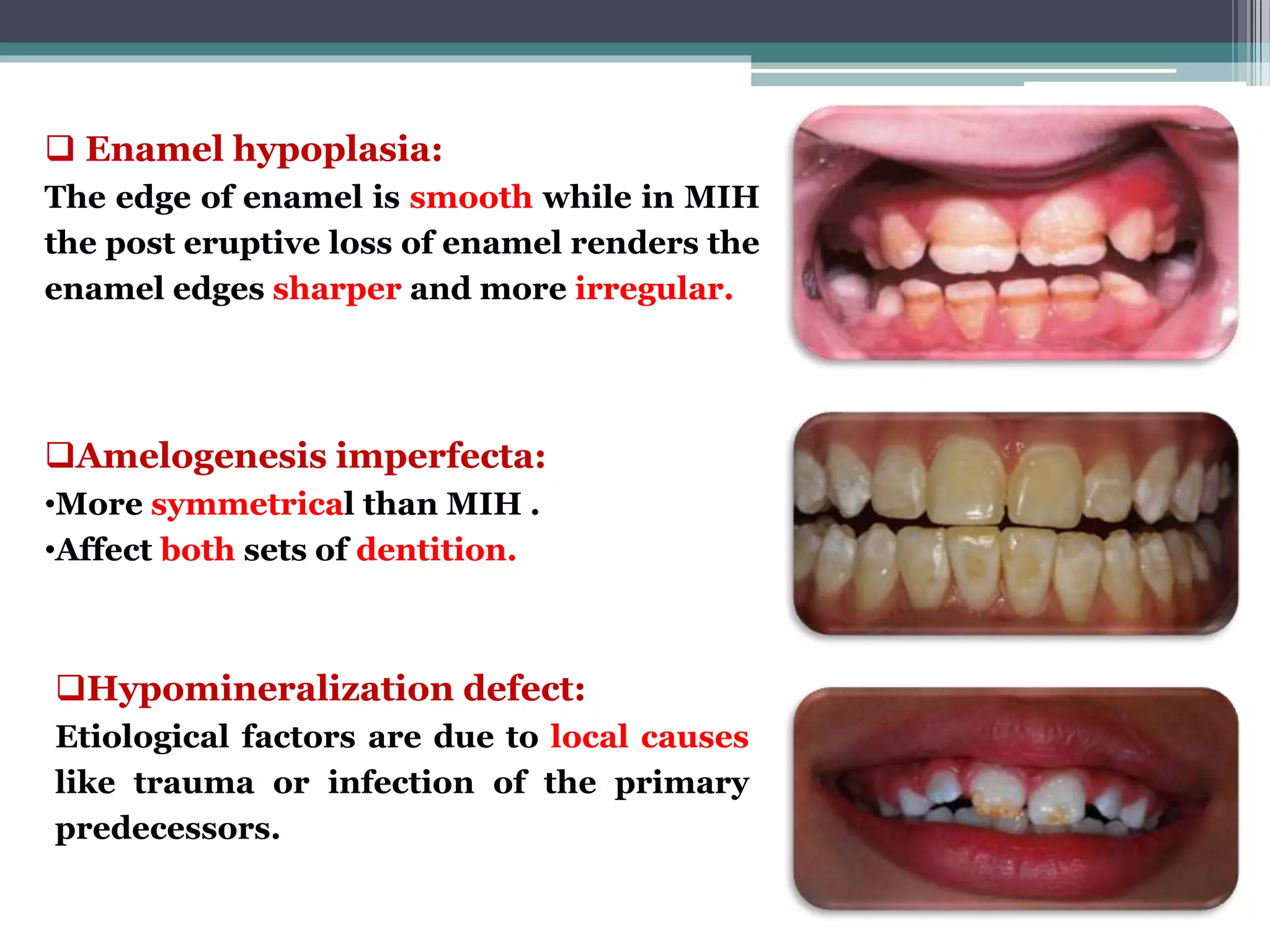
 Enamel hypoplasia:
The edge of enamel is smooth while in MIH
the post eruptive loss of enamel renders the
enamel edges sharper and more irregular.
Amelogenesis imperfecta:
•More symmetrical than MIH .
•Affect both sets of dentition.
Hypomineralization defect:
Etiological factors are due to local causes
like trauma or infection of the primary
predecessors.
Prevention
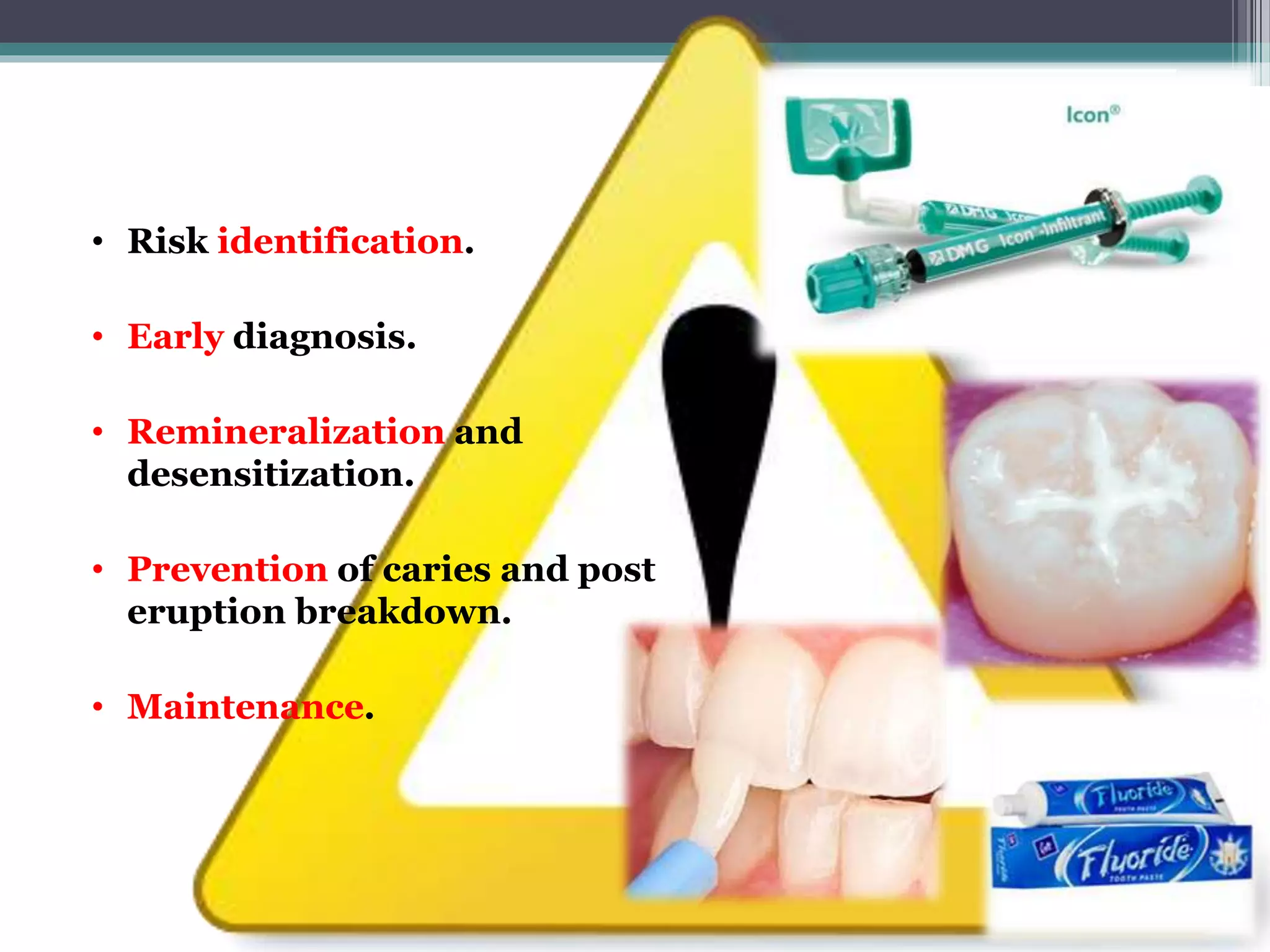
• Risk identification.
• Early diagnosis.
• Remineralization and
desensitization.
• Prevention of caries and post
eruption breakdown.
• Maintenance.
Treatment
Mild MIH
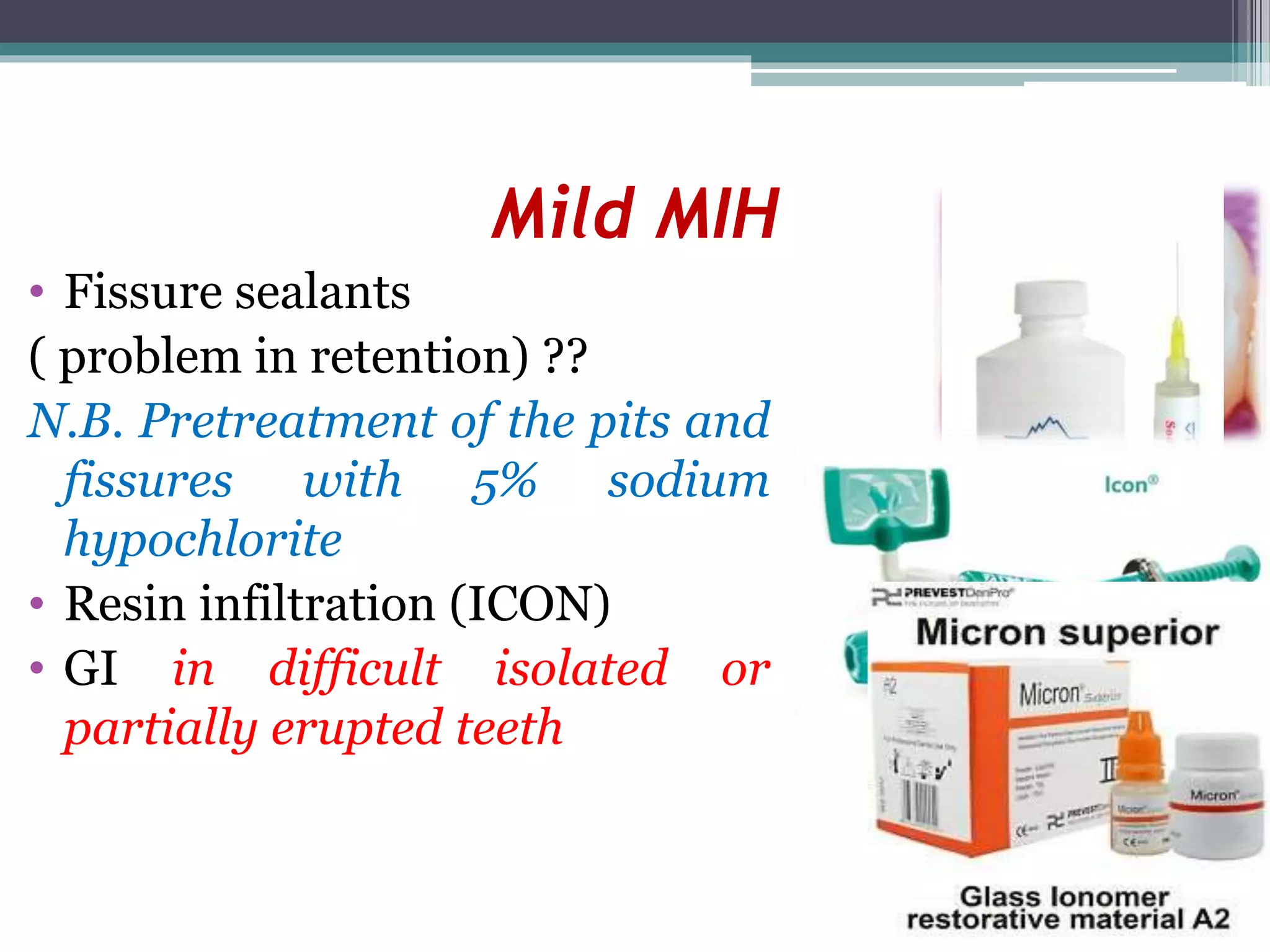
• Fissure sealants
( problem in retention) ??
N.B. Pretreatment of the pits and
fissures with 5% sodium
hypochlorite
• Resin infiltration (ICON)
• GI in difficult isolated or
partially erupted teeth
Moderate MIH
• extensive areas more
fracture
• If no enamel loss .. Ttt like
mild cases
• If enamel loss :
• Composite or GI
restoration .. Same
technique for sealants
• Amalgam could also be
used but not end on
severely affected areas
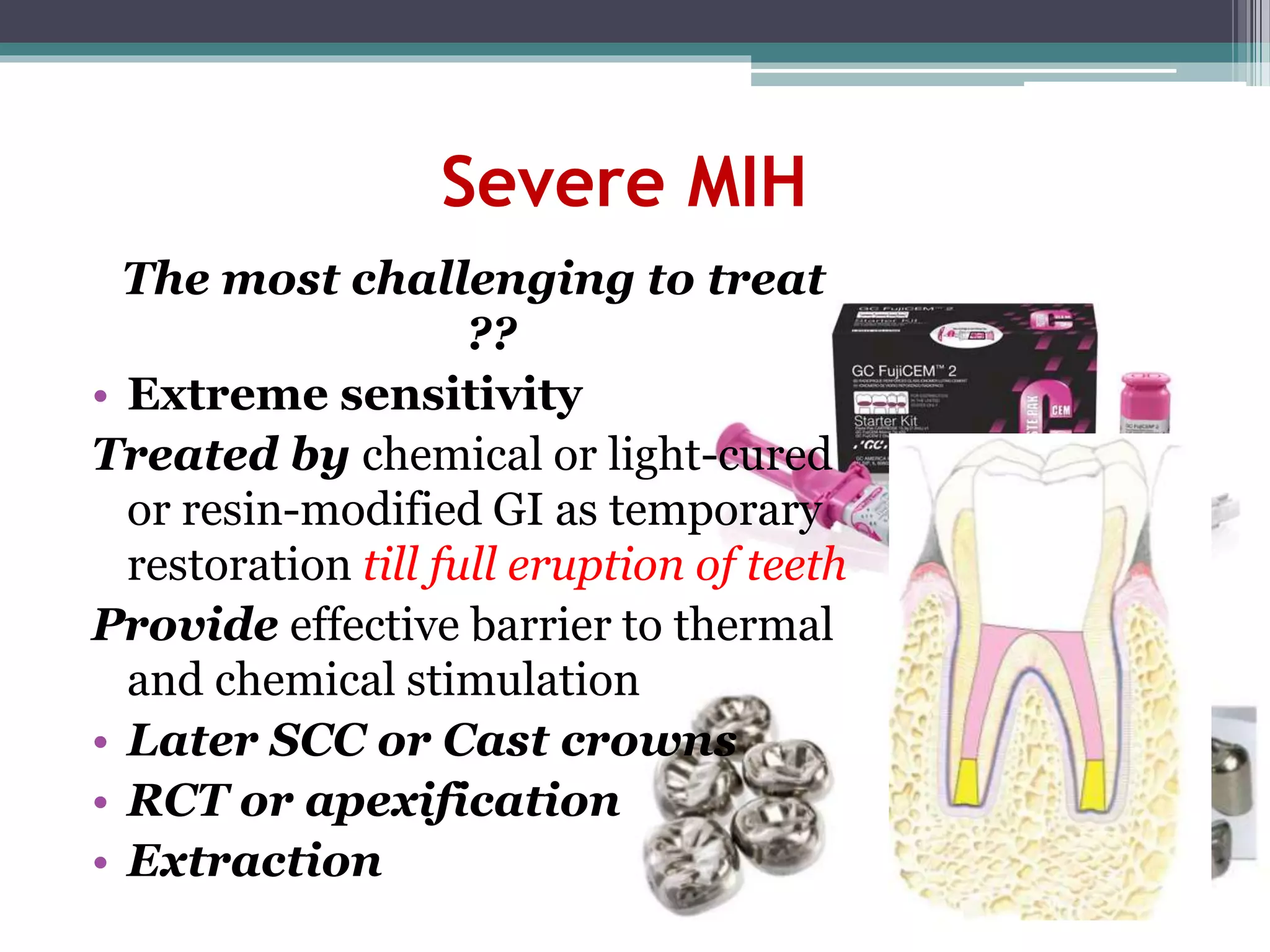
The most challenging to treat
??
• Extreme sensitivity
Treated by chemical or light-cured
or resin-modified GI as temporary
restoration till full eruption of teeth
Provide effective barrier to thermal
and chemical stimulation
• Later SCC or Cast crowns
• RCT or apexification
• Extraction
Severe MIH
Prognosis
• The quality of enamel supporting the restoration is fail so the
prognosis of restorations is poor.
• The need for evaluating restoration at regular intervals becomes
mandatory.
• However, failing restorations always necessitate treatment
planning for techniques and materials that last longer.
To sum it up !!
MIH
References
• Alaluusua, S., Aetiology of molar-incisor hypomineralisation: a systematic review.
European Archives of Paediatric Dentistry, 2010. 11(2): p. 53-58.
• Kirthiga, M., et al., Prevalence and severity of molar incisor hypomineralization in
children aged 11-16 years of a city in Karnataka, Davangere. J Indian Soc Pedod
Prev Dent, 2015. 33(3): p. 213-7.
• Murali, H., et al., Molar Incisor Hypomineralization. The journal of contemporary
dental practice, 2016. 17(7): p. 609-613.
• Jälevik, B., Prevalence and diagnosis of molar-incisor-hypomineralisation (MIH): a
systematic review. European archives of paediatric dentistry, 2010. 11(2): p. 59-64.
• Weerheijm, K.L. and I. Mejàre, Molar incisor hypomineralization: a questionnaire
inventory of its occurrence in member countries of the European Academy of
Paediatric Dentistry (EAPD). International Journal of Paediatric Dentistry, 2003.
13(6): p. 411-416.
• Allazzam, S.M., S.M. Alaki, and O.A. El Meligy, Molar incisor hypomineralization,
prevalence, and etiology. Int J Dent, 2014. 2014: p. 234508.
Molar incisor  hypomineralization

Molar incisor hypomineralization

  • 1.
    Presented by: Aya AdelAbd El-Hafez Rana Mohamed EL-Abassery
  • 2.
    Objectives • Identify thedefinition of MIH and its synonyms • Know the etiology and prevalence of MIH • Identify the clinical problems related to MIH • Clinical presentation, diagnosis& severity of MIH • What is the differential diagnosis of MIH ? • How to Prevent and Treat MIH ? • Identify the Prognosis of MIH affected teeth
  • 4.
  • 5.
    • Enamel isthe hardest tissue in human body and contains the highest percentage of minerals. The defect caused during enamel formation (Amelogenesis) is permanent as the enamel lacks the ability to remodel
  • 6.
  • 7.
    The Molar IncisorHypomineralization (MIH) is defined as a qualitative defect of enamel. • Characterized by progressive hypomineralization of enamel structure of the first permanent molars. • May be associated with incisors.
  • 8.
    Synonyms • Hypomineralized permanentfirst molar. • Idiopathic enamel hypomineralization. • Nonfluoride hypomineralization. • Non-endemic mottling of enamel of permanent first molars. • Cheese molars.
  • 9.
  • 10.
    Multifactorial Parentally risks: infection, maternal psychological stress and frequentexposure to ultrasonic scans Oxygen shortage combined with low birth weight suspected to be contributing factor Respiratory diseases and oxygen shortage of the ameloblasts Children born with poor general health Children with systemic conditions in their first 3 years
  • 11.
  • 12.
    • Worldwide rangesfrom 3.6% to 40.2% • Difference is due to lack of classification index and standardized methodology of assessment • Most of the studies carried out in the European countries • NO gender difference in multiple studies • Some studies reported that post eruptive breakdown occurs more frequently in boys • Children under the age of 10 are more highly affected by the disease (15.1%)
  • 13.
  • 14.
    • Hypersensitivity • Difficultto anaesthetize • Aesthetic problems • Tooth breakdown and restoration problems
  • 15.
  • 16.
    • Enamel soft,porous, or resembling discolored chalk enamel. • Easily chip off under masticatory forces. • Color vary from white to yellow to brown demarcated opacities. • The characteristic features of MIH: 1. Clear demarcation between the affected and sound enamel. 2. Asymmetry of defects present in the molars and incisors. • The second permanent molars and bicuspids are rarely affected by these enamel defects.
  • 17.
  • 18.
    According to EuropeanAcademy of Pediatric Dentistry (EAPD), published in 2003: Demarcated opacities: clearly demarcated opacities at the occlusal and buccal surfaces of the crown. Enamel disintegration: Post eruptive enamel breakdown. Tooth sensitivity: ranging from a mild response to spontaneous hypersensitivity.  Affect Permanent first molars and incisors Examination: performed on wet teeth after cleaning.
  • 19.
  • 20.
    Mild MIH ModerateMIH Severe MIH •Opacities in non stress bearing areas •No caries in affected enamel •No hypersensitivity •Incisor involvement is usually mild if present •Demarcated opacities are present on molars and incisors •Post eruptive enamel breakdown limited to 1 or 2 surfaces without cuspal involvement • Normal dental sensitivity •Post eruptive enamel breakdown •History of dental sensitivity •Crown destruction •Aesthetic concerns
  • 21.
    Another severity scalewas reported by European Academy of Pediatric Dentistry (EAPD):
  • 23.
  • 24.
     Dental caries: • Previously intact primary dentition. • White spot lesions are also uncommon on incisors. Fluorosis : Diffuse enamel opacities which affect more than one tooth
  • 25.
     Enamel hypoplasia: Theedge of enamel is smooth while in MIH the post eruptive loss of enamel renders the enamel edges sharper and more irregular. Amelogenesis imperfecta: •More symmetrical than MIH . •Affect both sets of dentition. Hypomineralization defect: Etiological factors are due to local causes like trauma or infection of the primary predecessors.
  • 26.
  • 27.
    • Risk identification. •Early diagnosis. • Remineralization and desensitization. • Prevention of caries and post eruption breakdown. • Maintenance.
  • 28.
  • 29.
    Mild MIH • Fissuresealants ( problem in retention) ?? N.B. Pretreatment of the pits and fissures with 5% sodium hypochlorite • Resin infiltration (ICON) • GI in difficult isolated or partially erupted teeth
  • 30.
    Moderate MIH • extensiveareas more fracture • If no enamel loss .. Ttt like mild cases • If enamel loss : • Composite or GI restoration .. Same technique for sealants • Amalgam could also be used but not end on severely affected areas
  • 31.
    The most challengingto treat ?? • Extreme sensitivity Treated by chemical or light-cured or resin-modified GI as temporary restoration till full eruption of teeth Provide effective barrier to thermal and chemical stimulation • Later SCC or Cast crowns • RCT or apexification • Extraction Severe MIH
  • 32.
  • 33.
    • The qualityof enamel supporting the restoration is fail so the prognosis of restorations is poor. • The need for evaluating restoration at regular intervals becomes mandatory. • However, failing restorations always necessitate treatment planning for techniques and materials that last longer.
  • 34.
    To sum itup !! MIH
  • 35.
    References • Alaluusua, S.,Aetiology of molar-incisor hypomineralisation: a systematic review. European Archives of Paediatric Dentistry, 2010. 11(2): p. 53-58. • Kirthiga, M., et al., Prevalence and severity of molar incisor hypomineralization in children aged 11-16 years of a city in Karnataka, Davangere. J Indian Soc Pedod Prev Dent, 2015. 33(3): p. 213-7. • Murali, H., et al., Molar Incisor Hypomineralization. The journal of contemporary dental practice, 2016. 17(7): p. 609-613. • Jälevik, B., Prevalence and diagnosis of molar-incisor-hypomineralisation (MIH): a systematic review. European archives of paediatric dentistry, 2010. 11(2): p. 59-64. • Weerheijm, K.L. and I. Mejàre, Molar incisor hypomineralization: a questionnaire inventory of its occurrence in member countries of the European Academy of Paediatric Dentistry (EAPD). International Journal of Paediatric Dentistry, 2003. 13(6): p. 411-416. • Allazzam, S.M., S.M. Alaki, and O.A. El Meligy, Molar incisor hypomineralization, prevalence, and etiology. Int J Dent, 2014. 2014: p. 234508.