Oral Halitosis
By
Halitosis …
Originates from two Latin words:
Halitus → breath
Osis → disease.
Halitosis
▪️ Unpleasant or offensive odour emanating from the breath.
▪️ Originates from oral or non-oral sources.
▪️ Halitosis should not be confused with the generally
temporary oral odour caused by intake of certain foods,
tobacco, or medications.
Definition
Breath malodor, defined as foul or offensive odor of expired
air, may be caused by a number of factors, both intra-oral &
extra-oral (gingivitis/ periodontitis, nasal inflammation,
chronic sinusitis, diabetes mellitus, liver insufficiency etc.,) &
can be linked to more serious underlying medical problems
including primary biliary cirrhosis, uremia, lung carcinoma,
decompensated liver cirrhosis & trimethylaminuria.
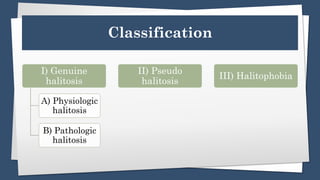
Classification
I) Genuine
halitosis
A) Physiologic
halitosis
B) Pathologic
halitosis
II) Pseudo
halitosis
III) Halitophobia
I) Genuine halitosis:
A) Physiological halitosis
- Morning breath odour, tobacco smoking & certain foods &
medications.
B) Pathological halitosis
- intra oral or extra oral origin.
- 90% of patients → oral cavity – Bacteria, volatile sulphur
compounds.
I) Genuine halitosis:
Intra oral origin
▪️ poor oral hygiene, dental caries, periodontal diseases in
particular NUG, NUP, periodontitis, pericoronitis, dry socket,
other oral infections, tongue coating & oral carcinoma.
▪️ The role of tongue coatings in the aetiology of oral malodour
has been extensively documented.
Tongue coatings include desquamated epithelial cells, food
debris, bacteria and salivary proteins and provide an ideal
environment for the generation of VSCs and other compounds
that contribute to malodour.
I) Genuine halitosis:
Extra oral origin
– 10-20%
– Gastro intestinal diseases
– Infections or malignancy in respiratory tract
– Chronic sinusitis and tonsillitis
– Stomach, intestine, liver or kidney affected by systemic
diseases
I) Genuine halitosis:
Extra oral origin
– Examples of systemic pathological conditions that cause
halitosis Systemic condition:
• Diabetes mellitus
• Renal failure
• Liver failure
• Tuberculosis/ lung abscess
• Internal hemorrhage/ blood disorders
• Fever.
II) Pseudo halitosis:
Apparently healthy individuals
III) Haltophobia:
– exaggerated fear of having halitosis
– also referred as delusional halitosis
– considered variant of monosymptomatic hypochondrial
psychosis.
Etiology
• Halitosis generally arises as a result of the bacterial
decomposition of food particles, cells, blood and some chemical
compounds of the saliva.
• Volatile sulphur compounds
• Non - sulphur containing substances
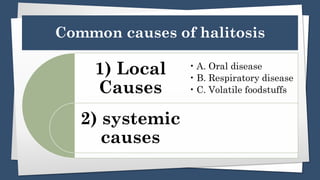
Common causes of halitosis
1) Local
Causes
2) systemic
causes
• A. Oral disease
• B. Respiratory disease
• C. Volatile foodstuffs
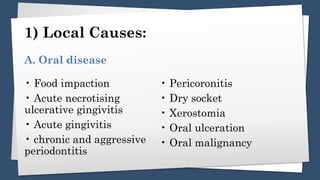
1) Local Causes:
• Food impaction
• Acute necrotising
ulcerative gingivitis
• Acute gingivitis
• chronic and aggressive
periodontitis
• Pericoronitis
• Dry socket
• Xerostomia
• Oral ulceration
• Oral malignancy
A. Oral disease
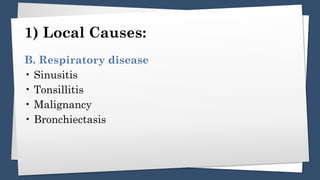
1) Local Causes:
B. Respiratory disease
• Sinusitis
• Tonsillitis
• Malignancy
• Bronchiectasis
1) Local Causes:
C. Volatile foodstuffs
• Garlic
• Onions
• Spiced foods
2) systemic causes
• Acute febrile illness
• Leukaemias
• Respiratory tract infection
(usually upper)
• Helicobacter pylori infection
• Pharyngo-oesophageal
diverticulum
• Gastrooesophageal reflux
disease
• Pyloric stenosis or duodenal
obstruction
• Hepatic failure (fetor
hepaticus)
• Renal failure (end stage)
• Diabetic ketoacidosis
• Trimethylaminuria
• Hypermethioninaemia
• Menstruation (menstrual
breath)
Role of volatile sulphur compounds in the
pathogenesis of halitosis:
• It increases the permeability of oral mucosa and crevicular
epithelium. It impairs oxygen utilization by host cells, and reacts
with cellular proteins, and interferes with collagen maturation.
• It also increases the collagen solubility.
• It decrease the DNA synthesis.
• It increases the secretion of collagenases, prostaglandins from
fibroblasts.
• VSC reduce the intracellular pH; inhibit cell growth, and
periodontal cell migration.
Correlation between the presence of a pathogenic
microflora in the subgingival microbiota and
halitosis:
Odor scores were significantly correlated with the
concentration of overall bacterial populations and that higher
levels of crevicular bacteria were associated with greater odor
scores.
Diagnosis
Fill history
Examination
Self assessment tests (subjective test)
Objective tests
Self assessment tests (subjective test)
▪️ Whole mouth malodor (Cupped breath): The subjects are
instructed to smell the odor emanating from their entire mouth by
cupping their hands over their mouth and breathing through the nose.
The presence or absence of malodor can be evaluated by the patient
himself/herself.
▪️ Wrist lick test: Subjects are asked to extend their tongue and lick
their wrist in a perpendicular fashion. The presence of odor is judged by
smelling the wrist after 5 seconds at a distance of about 3 cm.
▪️ Spoon test: Plastic spoon is used to scrape and scoop material from the
back region of the tongue. The odor is judged by smelling the spoon after
5 seconds at a distance of about 5 cm organoleptically.
▪️ Dental floss test: Unwaxed floss is passed through interproximal
contacts.
▪️ Saliva odor test: Involves having the subject expectorate approx. 1-2
ml of saliva into a petridish. The dish is covered immediately, incubated
at 370 C for five minutes and then presented for odor evaluation at a
distance of 4 cm from the examiner’s nose.
Objective tests
▪️ Organoleptic measurement
▪️ Gas chromatography (GC)
▪️ Sulphide monitoring
▪️ Electronic nose
▪️ BANA test
▪️ Tongue costing index
▪️ Dark Field or Phase Contrast Microscopy
▪️ Saliva Incubation
▪️ Halimeter
Preventive measures
Preventive measures rather than curative aspects are highly recommended.
– Visit dentist regularly
– Periodical tooth cleaning by dental professional.
– Brushing of teeth twice daily with appropriate brushing techniques and for a duration of 2-3
mins.
– Use of a tongue scraper to get rid of the lurking odour causing bacteria in the tongue surface.
– Flossing after brushing to remove food particles stuck in between the tooth surfaces.
– Limit intake of strong odour species.
– Limit sugar and caffeine intake.
– Drink plenty of liquids.
– Chew sugar free gum for a minute when mouth feels dry.
– Eat fresh fibrous vegetables such as carrots.
Management
(i) Mechanical reduction of intraoral nutrients and micro-
organisms.
(ii) Chemical reduction of oral microbial load.
(iii) Rendering malodorous gases nonvolatile.
(iv) Masking the malodor.
1. Mechanical reduction of intraoral nutrients and
micro-organisms:
- Tongue cleaning
- Tooth brush - Inter-dental cleaning
- Professional periodontal therapy
- Chewing gum
2. Chemical reduction of oral microbial load
- Chlorhexidine
- Essential oils
- Chlorine dioxide
- Two-phase oil
- water rinse
- Triclosan
- Aminefluoride/ Stannous fluoride
- Hydrogen peroxide
- Oxidising lozenges
3. Conversion of volatile sulfide compounds
- Metal salt solutions
- Toothpastes
- Chewing gum
4. Masking the malodor
- Rinses
- Mouth sprays
- Lozenges containing volatiles
- Chewing gum
THANK YOU

Oral Halitosis

  • 1.
  • 2.
    Halitosis … Originates fromtwo Latin words: Halitus → breath Osis → disease.
  • 3.
    Halitosis ▪️ Unpleasant oroffensive odour emanating from the breath. ▪️ Originates from oral or non-oral sources. ▪️ Halitosis should not be confused with the generally temporary oral odour caused by intake of certain foods, tobacco, or medications.
  • 4.
    Definition Breath malodor, definedas foul or offensive odor of expired air, may be caused by a number of factors, both intra-oral & extra-oral (gingivitis/ periodontitis, nasal inflammation, chronic sinusitis, diabetes mellitus, liver insufficiency etc.,) & can be linked to more serious underlying medical problems including primary biliary cirrhosis, uremia, lung carcinoma, decompensated liver cirrhosis & trimethylaminuria.
  • 5.
    Classification I) Genuine halitosis A) Physiologic halitosis B)Pathologic halitosis II) Pseudo halitosis III) Halitophobia
  • 6.
    I) Genuine halitosis: A)Physiological halitosis - Morning breath odour, tobacco smoking & certain foods & medications. B) Pathological halitosis - intra oral or extra oral origin. - 90% of patients → oral cavity – Bacteria, volatile sulphur compounds.
  • 7.
    I) Genuine halitosis: Intraoral origin ▪️ poor oral hygiene, dental caries, periodontal diseases in particular NUG, NUP, periodontitis, pericoronitis, dry socket, other oral infections, tongue coating & oral carcinoma. ▪️ The role of tongue coatings in the aetiology of oral malodour has been extensively documented. Tongue coatings include desquamated epithelial cells, food debris, bacteria and salivary proteins and provide an ideal environment for the generation of VSCs and other compounds that contribute to malodour.
  • 8.
    I) Genuine halitosis: Extraoral origin – 10-20% – Gastro intestinal diseases – Infections or malignancy in respiratory tract – Chronic sinusitis and tonsillitis – Stomach, intestine, liver or kidney affected by systemic diseases
  • 9.
    I) Genuine halitosis: Extraoral origin – Examples of systemic pathological conditions that cause halitosis Systemic condition: • Diabetes mellitus • Renal failure • Liver failure • Tuberculosis/ lung abscess • Internal hemorrhage/ blood disorders • Fever.
  • 10.
  • 11.
    III) Haltophobia: – exaggeratedfear of having halitosis – also referred as delusional halitosis – considered variant of monosymptomatic hypochondrial psychosis.
  • 12.
    Etiology • Halitosis generallyarises as a result of the bacterial decomposition of food particles, cells, blood and some chemical compounds of the saliva. • Volatile sulphur compounds • Non - sulphur containing substances
  • 13.
    Common causes ofhalitosis 1) Local Causes 2) systemic causes • A. Oral disease • B. Respiratory disease • C. Volatile foodstuffs
  • 14.
    1) Local Causes: •Food impaction • Acute necrotising ulcerative gingivitis • Acute gingivitis • chronic and aggressive periodontitis • Pericoronitis • Dry socket • Xerostomia • Oral ulceration • Oral malignancy A. Oral disease
  • 15.
    1) Local Causes: B.Respiratory disease • Sinusitis • Tonsillitis • Malignancy • Bronchiectasis
  • 16.
    1) Local Causes: C.Volatile foodstuffs • Garlic • Onions • Spiced foods
  • 17.
    2) systemic causes •Acute febrile illness • Leukaemias • Respiratory tract infection (usually upper) • Helicobacter pylori infection • Pharyngo-oesophageal diverticulum • Gastrooesophageal reflux disease • Pyloric stenosis or duodenal obstruction • Hepatic failure (fetor hepaticus) • Renal failure (end stage) • Diabetic ketoacidosis • Trimethylaminuria • Hypermethioninaemia • Menstruation (menstrual breath)
  • 18.
    Role of volatilesulphur compounds in the pathogenesis of halitosis: • It increases the permeability of oral mucosa and crevicular epithelium. It impairs oxygen utilization by host cells, and reacts with cellular proteins, and interferes with collagen maturation. • It also increases the collagen solubility. • It decrease the DNA synthesis. • It increases the secretion of collagenases, prostaglandins from fibroblasts. • VSC reduce the intracellular pH; inhibit cell growth, and periodontal cell migration.
  • 19.
    Correlation between thepresence of a pathogenic microflora in the subgingival microbiota and halitosis: Odor scores were significantly correlated with the concentration of overall bacterial populations and that higher levels of crevicular bacteria were associated with greater odor scores.
  • 20.
    Diagnosis Fill history Examination Self assessmenttests (subjective test) Objective tests
  • 21.
    Self assessment tests(subjective test) ▪️ Whole mouth malodor (Cupped breath): The subjects are instructed to smell the odor emanating from their entire mouth by cupping their hands over their mouth and breathing through the nose. The presence or absence of malodor can be evaluated by the patient himself/herself. ▪️ Wrist lick test: Subjects are asked to extend their tongue and lick their wrist in a perpendicular fashion. The presence of odor is judged by smelling the wrist after 5 seconds at a distance of about 3 cm.
  • 22.
    ▪️ Spoon test:Plastic spoon is used to scrape and scoop material from the back region of the tongue. The odor is judged by smelling the spoon after 5 seconds at a distance of about 5 cm organoleptically. ▪️ Dental floss test: Unwaxed floss is passed through interproximal contacts. ▪️ Saliva odor test: Involves having the subject expectorate approx. 1-2 ml of saliva into a petridish. The dish is covered immediately, incubated at 370 C for five minutes and then presented for odor evaluation at a distance of 4 cm from the examiner’s nose.
  • 23.
    Objective tests ▪️ Organolepticmeasurement ▪️ Gas chromatography (GC) ▪️ Sulphide monitoring ▪️ Electronic nose ▪️ BANA test ▪️ Tongue costing index ▪️ Dark Field or Phase Contrast Microscopy ▪️ Saliva Incubation ▪️ Halimeter
  • 24.
    Preventive measures Preventive measuresrather than curative aspects are highly recommended. – Visit dentist regularly – Periodical tooth cleaning by dental professional. – Brushing of teeth twice daily with appropriate brushing techniques and for a duration of 2-3 mins. – Use of a tongue scraper to get rid of the lurking odour causing bacteria in the tongue surface. – Flossing after brushing to remove food particles stuck in between the tooth surfaces. – Limit intake of strong odour species. – Limit sugar and caffeine intake. – Drink plenty of liquids. – Chew sugar free gum for a minute when mouth feels dry. – Eat fresh fibrous vegetables such as carrots.
  • 25.
    Management (i) Mechanical reductionof intraoral nutrients and micro- organisms. (ii) Chemical reduction of oral microbial load. (iii) Rendering malodorous gases nonvolatile. (iv) Masking the malodor.
  • 26.
    1. Mechanical reductionof intraoral nutrients and micro-organisms: - Tongue cleaning - Tooth brush - Inter-dental cleaning - Professional periodontal therapy - Chewing gum
  • 27.
    2. Chemical reductionof oral microbial load - Chlorhexidine - Essential oils - Chlorine dioxide - Two-phase oil - water rinse - Triclosan - Aminefluoride/ Stannous fluoride - Hydrogen peroxide - Oxidising lozenges
  • 28.
    3. Conversion ofvolatile sulfide compounds - Metal salt solutions - Toothpastes - Chewing gum
  • 29.
    4. Masking themalodor - Rinses - Mouth sprays - Lozenges containing volatiles - Chewing gum
  • 30.