D R . M A Y U R I J O H A R I
Exercise induced asthma in
athletes
Exercise induced asthma
 First described by Areteus
 (2008) The joint Task Force of the European
Respiratory Society and the European Academy of
Allergy and Clinical Immunology defined exercise-
induced asthma (EIA) as exercise-induced symptoms
and signs of asthma occurring after intensive physical
exercise. The reduction in lung function(FEV1)
occurring after a standardized exercise test is called
exercise-induced bronchoconstriction(EIB).
 Atopy and the type of sport have been identified as major
risk factors for asthma in athletes.
Clinical phenotypes of asthma in athletes
1) those who have had asthma from early childhood, often
accompanied by allergic sensitization
2) another distinct phenotype with onset of symptoms
during the sporting career, through repeated heavy
training and competitions, presenting with bronchial
responsiveness to a eucapnic hyperventilation test and a
variable association with atopic markers and eosinophilic
airway inflammation.
Mechanisms of athletes’ asthma
 Respiration inhaled air is warmed up to 37 C and is fully
saturated with vapour increased water and heat loss
due to increased minute ventilation reflex
parasympathetic nerve stimulation & efflux of water to
ECF mediator release, bronchoconstriction and reflex
vasoconstriction of bronchial venules to conserve heat
On cessation of exercise the increased ventilation
ceases reducing cooling stimulus rebound
vasodilatation causing mucosal edema with smooth
muscle constriction bronchospasm
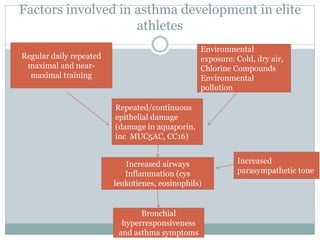
Factors involved in asthma development in elite
athletes
Regular daily repeated
maximal and near-
maximal training
Environmental
exposure: Cold, dry air,
Chlorine Compounds
Environmental
pollution
Repeated/continuous
epithelial damage
(damage in aquaporin,
inc MUC5AC, CC16)
Increased airways
Inflammation (cys
leukotienes, eosinophils)
Bronchial
hyperresponsiveness
and asthma symptoms
Increased
parasympathetic tone
Diagnosis of EIA
 Wheezing, cough, shortness of breath, chest tightness,
generally occurring within 5 to 30 min of intense exercise
and gradual spontaneous improvement is common after
finishing exercise.
 Physical examination often reveal expiratory wheezing or
rhonchi and other signs of bronchial obstruction, such as
intercostal retractions
 Presence of nasal symptoms like rhinitis, h/o allergy or
positive family h/o.
 Symptoms of ‘classical’ asthma may not be present in
elite athletes in whom non specific complaints are more
common.
Diagnostic methods and positivity criteria set by the
International Olympic Committee to document
exercise-induced bronchoconstriction in athletes
Method Protocol Criteria
Bronchodilatation
test
FEV1 before and 15 min
after inhalation of a b2-
agonist
FEV1 increase from baseline
>=200 mL and >=12% of
predicted
Bronchial provocation challenges
Methacholine test Provocative dose (PD20) or
concentration (PC20) of
inhaled methacholine
causing FEV1 decrease from
baseline >=20%
Not on ICS-PC20 <=4 mg/mL
or D20 <=400 mg (cumulative
dose), or <=200 mg
(noncumulative dose)
On ICS for at least 1 month-
PC20 <=16 mg/mL or PD20
<=1,600 mg (cumulative dose)
or <=800 mg (noncumulative
dose)
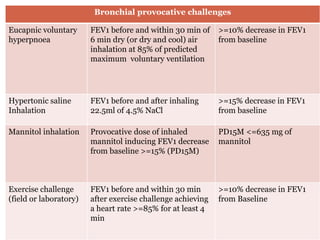
Bronchial provocative challenges
Eucapnic voluntary
hyperpnoea
FEV1 before and within 30 min of
6 min dry (or dry and cool) air
inhalation at 85% of predicted
maximum voluntary ventilation
>=10% decrease in FEV1
from baseline
Hypertonic saline
Inhalation
FEV1 before and after inhaling
22.5ml of 4.5% NaCl
>=15% decrease in FEV1
from baseline
Mannitol inhalation Provocative dose of inhaled
mannitol inducing FEV1 decrease
from baseline >=15% (PD15M)
PD15M <=635 mg of
mannitol
Exercise challenge
(field or laboratory)
FEV1 before and within 30 min
after exercise challenge achieving
a heart rate >=85% for at least 4
min
>=10% decrease in FEV1
from Baseline
Differential diagnoses of exercise-induced asthma
(EIA) in athletes
DDx Symptoms Signs Objective evidence
Vocal cord
dysfunction
Throat tightness, SOB,
increased inspiratory
effort, stridor and wheeze only
during maximum exercise,
and stopping right after
exercise (unless
hyperventilation)
Most often occurs in well-
trained teenage girls
Stridor
audible
during
inspiration
without signs
of bronchial
Obstruction
Flattened inspiratory
flow–volume loop during
stridor
No effect of asthma
medication.
Paradoxical vocal cord
movement on FOL
Swimming-
induced
pulmonary
oedema
Shortness of breath and cough
during or immediately after
swimming associated with
evidence of pulmonary
oedema
Sputum
production,
Haemoptysis,
reduction in
Spo2 and
Respiratory
distress
No or restrictive
spirometric pattern
persisting for up to
1 week
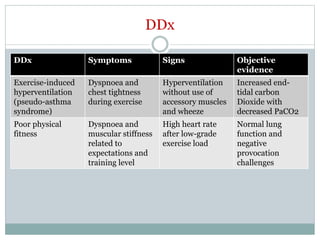
DDx
DDx Symptoms Signs Objective
evidence
Exercise-induced
hyperventilation
(pseudo-asthma
syndrome)
Dyspnoea and
chest tightness
during exercise
Hyperventilation
without use of
accessory muscles
and wheeze
Increased end-
tidal carbon
Dioxide with
decreased PaCO2
Poor physical
fitness
Dyspnoea and
muscular stiffness
related to
expectations and
training level
High heart rate
after low-grade
exercise load
Normal lung
function and
negative
provocation
challenges
Treatment of asthmatic athletes
 Several types of drug combinations are frequently
needed to fully control EIA/EIB in athletes, and
comprise two categories: controller (anti-inflammatory)
and reliever (pre-medication before exercise and t/t of
symptoms) medication
 The same principles for asthma management in the
general population are applicable to athletes, including a
‘‘step-up’’ approach if worsening of EIA symptoms occur,
as it may be a sign of inadequate control of underlying
asthma
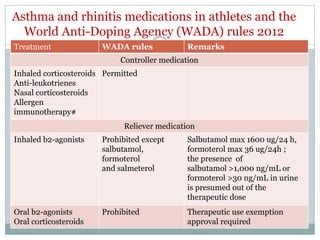
Asthma and rhinitis medications in athletes and the
World Anti-Doping Agency (WADA) rules 2012
Treatment WADA rules Remarks
Controller medication
Inhaled corticosteroids
Anti-leukotrienes
Nasal corticosteroids
Allergen
immunotherapy#
Permitted
Reliever medication
Inhaled b2-agonists Prohibited except
salbutamol,
formoterol
and salmeterol
Salbutamol max 1600 ug/24 h,
formoterol max 36 ug/24h ;
the presence of
salbutamol >1,000 ng/mL or
formoterol >30 ng/mL in urine
is presumed out of the
therapeutic dose
Oral b2-agonists
Oral corticosteroids
Prohibited Therapeutic use exemption
approval required
Inhaled or nasal
ipratropium
bromide
Permitted
Antihistamines Permitted Second-generation H1-
antihistamines
should be preferred
Ephedrine,
methylephedrine,
pseudoephedrine
Nasal application is
permitted
Ephedrine and
methylephedrine are
prohibited when its
concentration in
urine is >10 ug/mL
and Pseudo-ephedrine
>150 ug/ml
Prevention of EIB
 Allergen/irritant avoidance(esp smoking)
 Immunotherapy in patients with specific allergies
 Warm-up and cool-down exercises(atleast 15min)
 Encouragement of breathing through nose
 Appropriate management of co-morbidities(GERD,
Sinusitis)
Summary
 In athletes, asthma diagnosis is crucial because it is a
prevalent condition with potential implications not
only on their general health, but also on their
competing performance.
 Treatment of underlying asthma and rhinitis should
follow available guidelines acc to anti-doping
regulatons
 Use of most of the controller medications is
permitted.
 Preventive strategies can help reduce EIB

Exercise induced asthma

  • 1.
    D R .M A Y U R I J O H A R I Exercise induced asthma in athletes
  • 2.
    Exercise induced asthma First described by Areteus  (2008) The joint Task Force of the European Respiratory Society and the European Academy of Allergy and Clinical Immunology defined exercise- induced asthma (EIA) as exercise-induced symptoms and signs of asthma occurring after intensive physical exercise. The reduction in lung function(FEV1) occurring after a standardized exercise test is called exercise-induced bronchoconstriction(EIB).
  • 3.
     Atopy andthe type of sport have been identified as major risk factors for asthma in athletes. Clinical phenotypes of asthma in athletes 1) those who have had asthma from early childhood, often accompanied by allergic sensitization 2) another distinct phenotype with onset of symptoms during the sporting career, through repeated heavy training and competitions, presenting with bronchial responsiveness to a eucapnic hyperventilation test and a variable association with atopic markers and eosinophilic airway inflammation.
  • 4.
    Mechanisms of athletes’asthma  Respiration inhaled air is warmed up to 37 C and is fully saturated with vapour increased water and heat loss due to increased minute ventilation reflex parasympathetic nerve stimulation & efflux of water to ECF mediator release, bronchoconstriction and reflex vasoconstriction of bronchial venules to conserve heat On cessation of exercise the increased ventilation ceases reducing cooling stimulus rebound vasodilatation causing mucosal edema with smooth muscle constriction bronchospasm
  • 5.
    Factors involved inasthma development in elite athletes Regular daily repeated maximal and near- maximal training Environmental exposure: Cold, dry air, Chlorine Compounds Environmental pollution Repeated/continuous epithelial damage (damage in aquaporin, inc MUC5AC, CC16) Increased airways Inflammation (cys leukotienes, eosinophils) Bronchial hyperresponsiveness and asthma symptoms Increased parasympathetic tone
  • 6.
    Diagnosis of EIA Wheezing, cough, shortness of breath, chest tightness, generally occurring within 5 to 30 min of intense exercise and gradual spontaneous improvement is common after finishing exercise.  Physical examination often reveal expiratory wheezing or rhonchi and other signs of bronchial obstruction, such as intercostal retractions  Presence of nasal symptoms like rhinitis, h/o allergy or positive family h/o.  Symptoms of ‘classical’ asthma may not be present in elite athletes in whom non specific complaints are more common.
  • 7.
    Diagnostic methods andpositivity criteria set by the International Olympic Committee to document exercise-induced bronchoconstriction in athletes Method Protocol Criteria Bronchodilatation test FEV1 before and 15 min after inhalation of a b2- agonist FEV1 increase from baseline >=200 mL and >=12% of predicted Bronchial provocation challenges Methacholine test Provocative dose (PD20) or concentration (PC20) of inhaled methacholine causing FEV1 decrease from baseline >=20% Not on ICS-PC20 <=4 mg/mL or D20 <=400 mg (cumulative dose), or <=200 mg (noncumulative dose) On ICS for at least 1 month- PC20 <=16 mg/mL or PD20 <=1,600 mg (cumulative dose) or <=800 mg (noncumulative dose)
  • 8.
    Bronchial provocative challenges Eucapnicvoluntary hyperpnoea FEV1 before and within 30 min of 6 min dry (or dry and cool) air inhalation at 85% of predicted maximum voluntary ventilation >=10% decrease in FEV1 from baseline Hypertonic saline Inhalation FEV1 before and after inhaling 22.5ml of 4.5% NaCl >=15% decrease in FEV1 from baseline Mannitol inhalation Provocative dose of inhaled mannitol inducing FEV1 decrease from baseline >=15% (PD15M) PD15M <=635 mg of mannitol Exercise challenge (field or laboratory) FEV1 before and within 30 min after exercise challenge achieving a heart rate >=85% for at least 4 min >=10% decrease in FEV1 from Baseline
  • 9.
    Differential diagnoses ofexercise-induced asthma (EIA) in athletes DDx Symptoms Signs Objective evidence Vocal cord dysfunction Throat tightness, SOB, increased inspiratory effort, stridor and wheeze only during maximum exercise, and stopping right after exercise (unless hyperventilation) Most often occurs in well- trained teenage girls Stridor audible during inspiration without signs of bronchial Obstruction Flattened inspiratory flow–volume loop during stridor No effect of asthma medication. Paradoxical vocal cord movement on FOL Swimming- induced pulmonary oedema Shortness of breath and cough during or immediately after swimming associated with evidence of pulmonary oedema Sputum production, Haemoptysis, reduction in Spo2 and Respiratory distress No or restrictive spirometric pattern persisting for up to 1 week
  • 10.
    DDx DDx Symptoms SignsObjective evidence Exercise-induced hyperventilation (pseudo-asthma syndrome) Dyspnoea and chest tightness during exercise Hyperventilation without use of accessory muscles and wheeze Increased end- tidal carbon Dioxide with decreased PaCO2 Poor physical fitness Dyspnoea and muscular stiffness related to expectations and training level High heart rate after low-grade exercise load Normal lung function and negative provocation challenges
  • 11.
    Treatment of asthmaticathletes  Several types of drug combinations are frequently needed to fully control EIA/EIB in athletes, and comprise two categories: controller (anti-inflammatory) and reliever (pre-medication before exercise and t/t of symptoms) medication  The same principles for asthma management in the general population are applicable to athletes, including a ‘‘step-up’’ approach if worsening of EIA symptoms occur, as it may be a sign of inadequate control of underlying asthma
  • 12.
    Asthma and rhinitismedications in athletes and the World Anti-Doping Agency (WADA) rules 2012 Treatment WADA rules Remarks Controller medication Inhaled corticosteroids Anti-leukotrienes Nasal corticosteroids Allergen immunotherapy# Permitted Reliever medication Inhaled b2-agonists Prohibited except salbutamol, formoterol and salmeterol Salbutamol max 1600 ug/24 h, formoterol max 36 ug/24h ; the presence of salbutamol >1,000 ng/mL or formoterol >30 ng/mL in urine is presumed out of the therapeutic dose Oral b2-agonists Oral corticosteroids Prohibited Therapeutic use exemption approval required
  • 13.
    Inhaled or nasal ipratropium bromide Permitted AntihistaminesPermitted Second-generation H1- antihistamines should be preferred Ephedrine, methylephedrine, pseudoephedrine Nasal application is permitted Ephedrine and methylephedrine are prohibited when its concentration in urine is >10 ug/mL and Pseudo-ephedrine >150 ug/ml
  • 14.
    Prevention of EIB Allergen/irritant avoidance(esp smoking)  Immunotherapy in patients with specific allergies  Warm-up and cool-down exercises(atleast 15min)  Encouragement of breathing through nose  Appropriate management of co-morbidities(GERD, Sinusitis)
  • 15.
    Summary  In athletes,asthma diagnosis is crucial because it is a prevalent condition with potential implications not only on their general health, but also on their competing performance.  Treatment of underlying asthma and rhinitis should follow available guidelines acc to anti-doping regulatons  Use of most of the controller medications is permitted.  Preventive strategies can help reduce EIB

Editor's Notes

  • #5 minute ventilation :the total volume of gas in liters exhaled from the lungs per minute.= RR X Vt composed of dead space and alveolar ventilation. normal 5-6l/min
  • #6 MUC5AC- gel forming mucin detected by PCR analysis in induced sputum Cc16- clara cell protein secreted by non-ciliated clara cells, marker of alveolar inflammation Increased parasympathetic tone is inherited which increases inherent capacity of producing NO and potentiating cholinergic activity.
  • #9 MVV= max voluntary ventilation=max volume of gas that can be breathed in in a given time period.n =50-250l/min Maximal Voluntary Ventilation (MVV) is a relatively a short test used to evaluate a patients ability to maintain an elevated minute ventilation. This test, like all of the others, is very patient effort dependent and requires good coaching from the instructor. The MVV starts off with your patient breathing normally and then the patient starts breathing as DEEP and as FAST as they can for 12-15 seconds (depending on the computer system in the lab) and is then extrapolated to 1 minute. 
  • #11 Exercise rehabilitation or training can improve aerobic fitness and endurance and can shift the lactate/ventilatory threshold so more work is required before lactate accumulates and ventilation increases Improved aerobic fitness through exercise training can thus decrease the hyperpnoea and dyspnoea associated with exercise
  • #13 #Depends on appropriate patient selection (evidence of specific immunoglobulin E to clinical relevant allergens),There is no contraindication to perform allergen immunotherapy in athletes, with the precaution to avoid physical exercise just after receiving the injection
  • #15 breathing through nose allows cool dry air to humidify and become warm