GENITOURINARY SYSTEM
INTRODUCTION
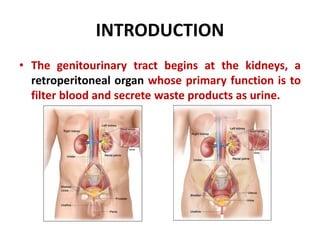
• The genitourinary tract begins at the kidneys, a
retroperitoneal organ whose primary function is to
filter blood and secrete waste products as urine.
SYSTEM CONSISTS OF
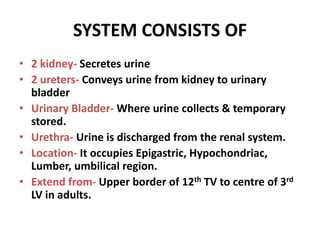
• 2 kidney- Secretes urine

• 2 ureters- Conveys urine from kidney to urinary
bladder
• Urinary Bladder- Where urine collects & temporary
stored.
• Urethra- Urine is discharged from the renal system.
• Location- It occupies Epigastric, Hypochondriac,
Lumber, umbilical region.
• Extend from- Upper border of 12th TV to centre of 3rd
LV in adults.
KIDNEY
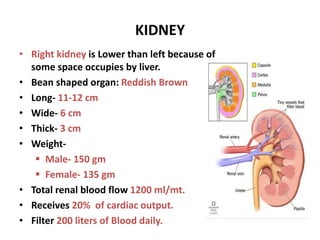
• Right kidney is Lower than left because of
some space occupies by liver.
• Bean shaped organ: Reddish Brown
• Long- 11-12 cm
• Wide- 6 cm
• Thick- 3 cm
• Weight-
 Male- 150 gm
 Female- 135 gm
• Total renal blood flow 1200 ml/mt.
• Receives 20% of cardiac output.
• Filter 200 liters of Blood daily.
URETERS
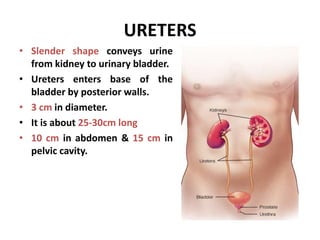
• Slender shape conveys urine
from kidney to urinary bladder.
• Ureters enters base of the
bladder by posterior walls.
• 3 cm in diameter.
• It is about 25-30cm long
• 10 cm in abdomen & 15 cm in
pelvic cavity.
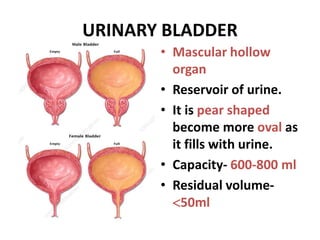
URINARY BLADDER
• Mascular hollow
organ
• Reservoir of urine.
• It is pear shaped
become more oval as
it fills with urine.
• Capacity- 600-800 ml
• Residual volume-
50ml
URETHRA
• Male- it is about 19-20cm long.
• Female- it is about 4cm long 6 mm in
diameter.
• Sizes of Urinary Catheter-
 Male- 16-18 Fr.
 Female- 14-16 Fr.
 Children- 6-8 Fr.
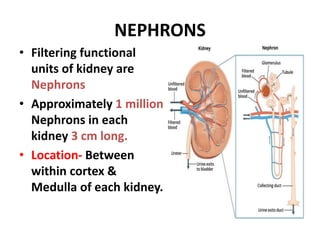
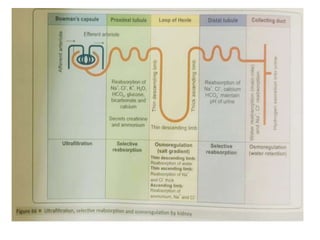
NEPHRONS
• Filtering functional
units of kidney are
Nephrons
• Approximately 1 million
Nephrons in each
kidney 3 cm long.
• Location- Between
within cortex &
Medulla of each kidney.
• Highly Nitrogenous toxic waste- Ammonia NH3 (9.5-
50 mcg/dl)
• Pressure in Bowman’s Capsular Space- 10mmHg
• Glomerular Capillaries Pressure- 50-70 mmHg
URINE
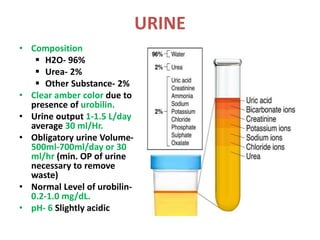
• Composition
 H2O- 96%
 Urea- 2%
 Other Substance- 2%
• Clear amber color due to
presence of urobilin.
• Urine output 1-1.5 L/day
average 30 ml/Hr.
• Obligatory urine Volume-
500ml-700ml/day or 30
ml/hr (min. OP of urine
necessary to remove
waste)
• Normal Level of urobilin-
0.2-1.0 mg/dL.
• pH- 6 Slightly acidic
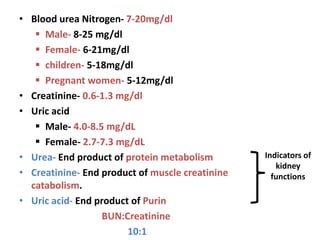
• Blood urea Nitrogen- 7-20mg/dl
 Male- 8-25 mg/dl
 Female- 6-21mg/dl
 children- 5-18mg/dl
 Pregnant women- 5-12mg/dl
• Creatinine- 0.6-1.3 mg/dl
• Uric acid
 Male- 4.0-8.5 mg/dL
 Female- 2.7-7.3 mg/dL
• Urea- End product of protein metabolism
• Creatinine- End product of muscle creatinine
catabolism.
• Uric acid- End product of Purin
BUN:Creatinine
10:1
Indicators of
kidney
functions
• Specific gravity- shows the concentration
of urine.
• Ranges- 1.010-1.025
 Hypersthenurea- Increased
 Isosthenurea
 Hyposthenurea- Decreased
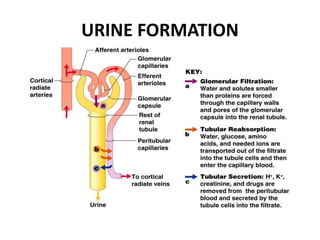
URINE FORMATION
FUNCTIONS
1. Filter- Every day, the kidneys filter fluid from
the bloodstream.
2. Waste processing- The kidneys then process
this filtrate, allowing wastes and excess
ions to leave the body in urine while
returning needed substances to the blood in
just the right proportions.
3. Elimination- Although the lungs and the skin
also play roles in excretion, the kidneys bear
the major responsibility for eliminating
nitrogenous wastes, toxins, and drugs from
the body.
4. Regulation- The kidneys also regulate the
blood’s volume and chemical makeup so
that the proper balance
between water and salts and
between acids and bases is maintained.
5. Other regulatory functions- By producing
the enzyme renin, they help regulate blood
pressure and their hormone erythropoietin
stimulates red blood cell production in the
bone marrow.
6. Conversion- Kidney cells also
convert vitamin D to its active form.
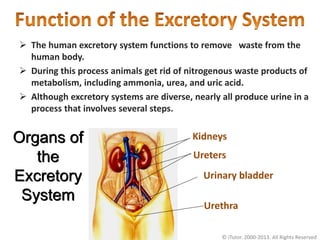
 The human excretory system functions to remove waste from the
human body.
 During this process animals get rid of nitrogenous waste products of
metabolism, including ammonia, urea, and uric acid.
 Although excretory systems are diverse, nearly all produce urine in a
process that involves several steps.
Kidneys
Ureters
Urinary bladder
Urethra
Organs of
the
Excretory
System
© iTutor. 2000-2013. All Rights Reserved
1. Filtration:
 The excretory tubule collects filtrate from the blood. Water
and solutes are forced by blood pressure across the selectively
permeable membranes of a cluster of capillaries and into the
excretory tubule.
2. Reabsorption:
 The transport epithelium reclaims valuable substances from
the filtrate and returns them.
3. Secretion:
 Other substances are extracted from body fluids and added to
the contents of the excretory tube.
4. Excretion:
 The filtrate leaves the system and the body.
© iTutor. 2000-2013. All Rights Reserved
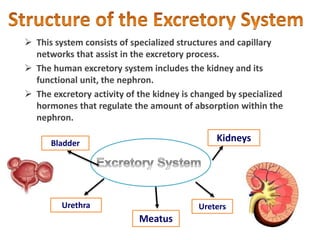
 This system consists of specialized structures and capillary
networks that assist in the excretory process.
 The human excretory system includes the kidney and its
functional unit, the nephron.
 The excretory activity of the kidney is changed by specialized
hormones that regulate the amount of absorption within the
nephron.
Bladder
Kidneys
Urethra Ureters
Meatus
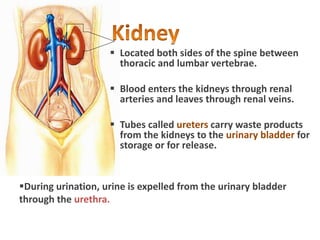
 Located both sides of the spine between
thoracic and lumbar vertebrae.
 Blood enters the kidneys through renal
arteries and leaves through renal veins.
 Tubes called ureters carry waste products
from the kidneys to the urinary bladder for
storage or for release.
During urination, urine is expelled from the urinary bladder
through the urethra.
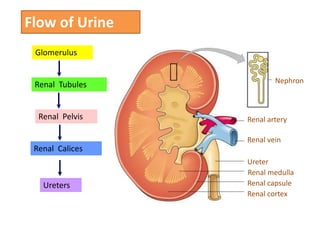
Flow of Urine
Flow of Urine
Glomerulus
Renal Tubules
Renal Pelvis
Renal Calices
Ureters
Renal cortex
Renal capsule
Renal medulla
Ureter
Renal vein
Renal artery
Nephron
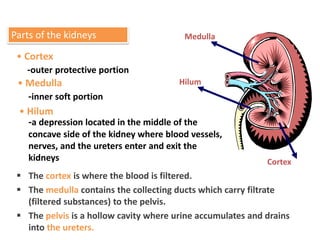
Parts of the Kidney
Parts of the kidneys
• Cortex
-outer protective portion
• Medulla
-inner soft portion
• Hilum
-a depression located in the middle of the
concave side of the kidney where blood vessels,
nerves, and the ureters enter and exit the
kidneys Cortex
Medulla
Hilum
 The cortex is where the blood is filtered.
 The medulla contains the collecting ducts which carry filtrate
(filtered substances) to the pelvis.
 The pelvis is a hollow cavity where urine accumulates and drains
into the ureters.
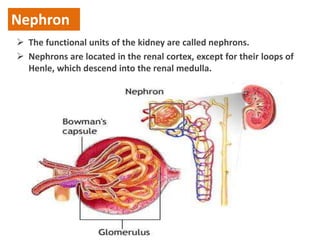
 The functional units of the kidney are called nephrons.
 Nephrons are located in the renal cortex, except for their loops of
Henle, which descend into the renal medulla.
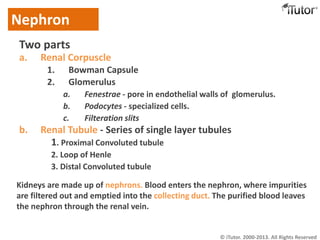
Nephron
Two parts
a. Renal Corpuscle
1. Bowman Capsule
2. Glomerulus
a. Fenestrae - pore in endothelial walls of glomerulus.
b. Podocytes - specialized cells.
c. Filteration slits
b. Renal Tubule - Series of single layer tubules
1. Proximal Convoluted tubule
2. Loop of Henle
3. Distal Convoluted tubule
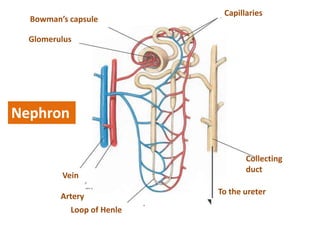
Nephron
Kidneys are made up of nephrons. Blood enters the nephron, where impurities
are filtered out and emptied into the collecting duct. The purified blood leaves
the nephron through the renal vein.
© iTutor. 2000-2013. All Rights Reserved
Artery
Vein
Loop of Henle
Bowman’s capsule
Glomerulus
Capillaries
Collecting
duct
To the ureter
Nephron
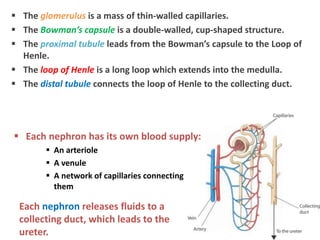
 The glomerulus is a mass of thin-walled capillaries.
 The Bowman’s capsule is a double-walled, cup-shaped structure.
 The proximal tubule leads from the Bowman’s capsule to the Loop of
Henle.
 The loop of Henle is a long loop which extends into the medulla.
 The distal tubule connects the loop of Henle to the collecting duct.
 Each nephron has its own blood supply:
 An arteriole
 A venule
 A network of capillaries connecting
them
Each nephron releases fluids to a
collecting duct, which leads to the
ureter.
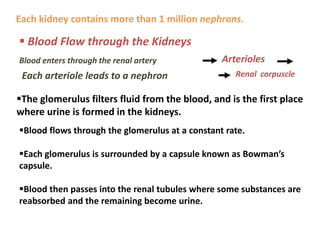
Each kidney contains more than 1 million nephrons.
 Blood Flow through the Kidneys
Blood enters through the renal artery Arterioles
Each arteriole leads to a nephron Renal corpuscle
The glomerulus filters fluid from the blood, and is the first place
where urine is formed in the kidneys.
Blood flows through the glomerulus at a constant rate.
Each glomerulus is surrounded by a capsule known as Bowman’s
capsule.
Blood then passes into the renal tubules where some substances are
reabsorbed and the remaining become urine.
– As blood enters a nephron through the
arteriole, impurities are filtered out and
emptied into the collecting duct.
– The purified blood exits the nephron through
the venule.
The mechanism of blood purification involves two
distinct processes:
Filtration
Reabsorption
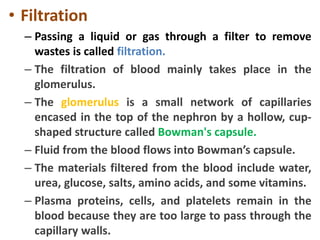
• Filtration
– Passing a liquid or gas through a filter to remove
wastes is called filtration.
– The filtration of blood mainly takes place in the
glomerulus.
– The glomerulus is a small network of capillaries
encased in the top of the nephron by a hollow, cup-
shaped structure called Bowman's capsule.
– Fluid from the blood flows into Bowman’s capsule.
– The materials filtered from the blood include water,
urea, glucose, salts, amino acids, and some vitamins.
– Plasma proteins, cells, and platelets remain in the
blood because they are too large to pass through the
capillary walls.
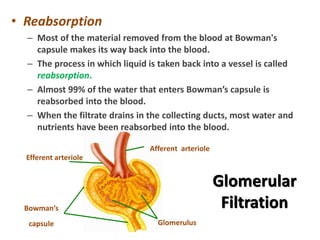
• Reabsorption
– Most of the material removed from the blood at Bowman's
capsule makes its way back into the blood.
– The process in which liquid is taken back into a vessel is called
reabsorption.
– Almost 99% of the water that enters Bowman’s capsule is
reabsorbed into the blood.
– When the filtrate drains in the collecting ducts, most water and
nutrients have been reabsorbed into the blood.
Glomerulus
Afferent arteriole
Efferent arteriole
Bowman’s
capsule
Glomerular
Filtration
 Remaining material, called urine, is emptied into a
collecting duct.
 Urine is primarily concentrated in the loop of Henle.
 The loop of Henle is a section of the nephron tubule
in which water is conserved and the volume of
urine minimized.
 As the kidney works, purified blood is returned to
circulation while urine is collected in the urinary
bladder.
 Urine is stored here until it is released from the
body through a tube called the urethra.
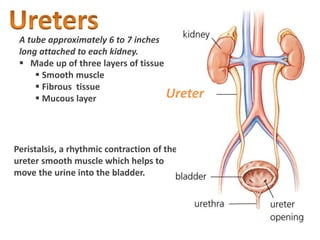
Ureters
Peristalsis, a rhythmic contraction of the
ureter smooth muscle which helps to
move the urine into the bladder.
A tube approximately 6 to 7 inches
long attached to each kidney.
 Made up of three layers of tissue
 Smooth muscle
 Fibrous tissue
 Mucous layer Ureter
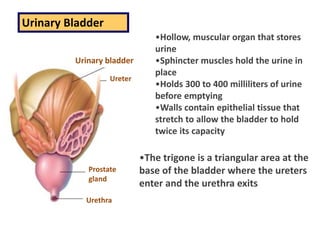
Urinary Bladder
Urinary Bladder
•Hollow, muscular organ that stores
urine
•Sphincter muscles hold the urine in
place
•Holds 300 to 400 milliliters of urine
before emptying
•Walls contain epithelial tissue that
stretch to allow the bladder to hold
twice its capacity
Urethra
Prostate
gland
Ureter
Urinary bladder
•The trigone is a triangular area at the
base of the bladder where the ureters
enter and the urethra exits
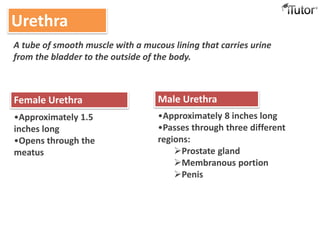
Urethra
Urethra
Female Urethra Male Urethra
•Approximately 1.5
inches long
•Opens through the
meatus
•Approximately 8 inches long
•Passes through three different
regions:
Prostate gland
Membranous portion
Penis
A tube of smooth muscle with a mucous lining that carries urine
from the bladder to the outside of the body.
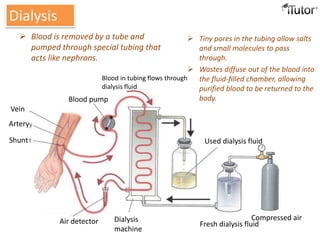
 Tiny pores in the tubing allow salts
and small molecules to pass
through.
 Wastes diffuse out of the blood into
the fluid-filled chamber, allowing
purified blood to be returned to the
body.
Dialysis
Air detector Dialysis
machine
Fresh dialysis fluid
Compressed air
Vein
Artery
Shunt
Blood pump
Blood in tubing flows through
dialysis fluid
Used dialysis fluid
 Blood is removed by a tube and
pumped through special tubing that
acts like nephrons.
Thank you

excretory system URINARY SYSTEM GENITOURINARY SYSTEM

  • 1.
  • 2.
    INTRODUCTION • The genitourinarytract begins at the kidneys, a retroperitoneal organ whose primary function is to filter blood and secrete waste products as urine.
  • 3.
    SYSTEM CONSISTS OF •2 kidney- Secretes urine • 2 ureters- Conveys urine from kidney to urinary bladder • Urinary Bladder- Where urine collects & temporary stored. • Urethra- Urine is discharged from the renal system. • Location- It occupies Epigastric, Hypochondriac, Lumber, umbilical region. • Extend from- Upper border of 12th TV to centre of 3rd LV in adults.
  • 4.
    KIDNEY • Right kidneyis Lower than left because of some space occupies by liver. • Bean shaped organ: Reddish Brown • Long- 11-12 cm • Wide- 6 cm • Thick- 3 cm • Weight-  Male- 150 gm  Female- 135 gm • Total renal blood flow 1200 ml/mt. • Receives 20% of cardiac output. • Filter 200 liters of Blood daily.
  • 5.
    URETERS • Slender shapeconveys urine from kidney to urinary bladder. • Ureters enters base of the bladder by posterior walls. • 3 cm in diameter. • It is about 25-30cm long • 10 cm in abdomen & 15 cm in pelvic cavity.
  • 6.
    URINARY BLADDER • Mascularhollow organ • Reservoir of urine. • It is pear shaped become more oval as it fills with urine. • Capacity- 600-800 ml • Residual volume- 50ml
  • 7.
    URETHRA • Male- itis about 19-20cm long. • Female- it is about 4cm long 6 mm in diameter. • Sizes of Urinary Catheter-  Male- 16-18 Fr.  Female- 14-16 Fr.  Children- 6-8 Fr.
  • 8.
    NEPHRONS • Filtering functional unitsof kidney are Nephrons • Approximately 1 million Nephrons in each kidney 3 cm long. • Location- Between within cortex & Medulla of each kidney.
  • 9.
    • Highly Nitrogenoustoxic waste- Ammonia NH3 (9.5- 50 mcg/dl) • Pressure in Bowman’s Capsular Space- 10mmHg • Glomerular Capillaries Pressure- 50-70 mmHg
  • 11.
    URINE • Composition  H2O-96%  Urea- 2%  Other Substance- 2% • Clear amber color due to presence of urobilin. • Urine output 1-1.5 L/day average 30 ml/Hr. • Obligatory urine Volume- 500ml-700ml/day or 30 ml/hr (min. OP of urine necessary to remove waste) • Normal Level of urobilin- 0.2-1.0 mg/dL. • pH- 6 Slightly acidic
  • 12.
    • Blood ureaNitrogen- 7-20mg/dl  Male- 8-25 mg/dl  Female- 6-21mg/dl  children- 5-18mg/dl  Pregnant women- 5-12mg/dl • Creatinine- 0.6-1.3 mg/dl • Uric acid  Male- 4.0-8.5 mg/dL  Female- 2.7-7.3 mg/dL • Urea- End product of protein metabolism • Creatinine- End product of muscle creatinine catabolism. • Uric acid- End product of Purin BUN:Creatinine 10:1 Indicators of kidney functions
  • 13.
    • Specific gravity-shows the concentration of urine. • Ranges- 1.010-1.025  Hypersthenurea- Increased  Isosthenurea  Hyposthenurea- Decreased
  • 14.
  • 15.
    FUNCTIONS 1. Filter- Everyday, the kidneys filter fluid from the bloodstream. 2. Waste processing- The kidneys then process this filtrate, allowing wastes and excess ions to leave the body in urine while returning needed substances to the blood in just the right proportions. 3. Elimination- Although the lungs and the skin also play roles in excretion, the kidneys bear the major responsibility for eliminating nitrogenous wastes, toxins, and drugs from the body.
  • 16.
    4. Regulation- Thekidneys also regulate the blood’s volume and chemical makeup so that the proper balance between water and salts and between acids and bases is maintained. 5. Other regulatory functions- By producing the enzyme renin, they help regulate blood pressure and their hormone erythropoietin stimulates red blood cell production in the bone marrow. 6. Conversion- Kidney cells also convert vitamin D to its active form.
  • 18.
     The humanexcretory system functions to remove waste from the human body.  During this process animals get rid of nitrogenous waste products of metabolism, including ammonia, urea, and uric acid.  Although excretory systems are diverse, nearly all produce urine in a process that involves several steps. Kidneys Ureters Urinary bladder Urethra Organs of the Excretory System © iTutor. 2000-2013. All Rights Reserved
  • 19.
    1. Filtration:  Theexcretory tubule collects filtrate from the blood. Water and solutes are forced by blood pressure across the selectively permeable membranes of a cluster of capillaries and into the excretory tubule. 2. Reabsorption:  The transport epithelium reclaims valuable substances from the filtrate and returns them. 3. Secretion:  Other substances are extracted from body fluids and added to the contents of the excretory tube. 4. Excretion:  The filtrate leaves the system and the body. © iTutor. 2000-2013. All Rights Reserved
  • 20.
     This systemconsists of specialized structures and capillary networks that assist in the excretory process.  The human excretory system includes the kidney and its functional unit, the nephron.  The excretory activity of the kidney is changed by specialized hormones that regulate the amount of absorption within the nephron. Bladder Kidneys Urethra Ureters Meatus
  • 21.
     Located bothsides of the spine between thoracic and lumbar vertebrae.  Blood enters the kidneys through renal arteries and leaves through renal veins.  Tubes called ureters carry waste products from the kidneys to the urinary bladder for storage or for release. During urination, urine is expelled from the urinary bladder through the urethra.
  • 22.
    Flow of Urine Flowof Urine Glomerulus Renal Tubules Renal Pelvis Renal Calices Ureters Renal cortex Renal capsule Renal medulla Ureter Renal vein Renal artery Nephron
  • 23.
    Parts of theKidney Parts of the kidneys • Cortex -outer protective portion • Medulla -inner soft portion • Hilum -a depression located in the middle of the concave side of the kidney where blood vessels, nerves, and the ureters enter and exit the kidneys Cortex Medulla Hilum  The cortex is where the blood is filtered.  The medulla contains the collecting ducts which carry filtrate (filtered substances) to the pelvis.  The pelvis is a hollow cavity where urine accumulates and drains into the ureters.
  • 24.
     The functionalunits of the kidney are called nephrons.  Nephrons are located in the renal cortex, except for their loops of Henle, which descend into the renal medulla. Nephron
  • 25.
    Two parts a. RenalCorpuscle 1. Bowman Capsule 2. Glomerulus a. Fenestrae - pore in endothelial walls of glomerulus. b. Podocytes - specialized cells. c. Filteration slits b. Renal Tubule - Series of single layer tubules 1. Proximal Convoluted tubule 2. Loop of Henle 3. Distal Convoluted tubule Nephron Kidneys are made up of nephrons. Blood enters the nephron, where impurities are filtered out and emptied into the collecting duct. The purified blood leaves the nephron through the renal vein. © iTutor. 2000-2013. All Rights Reserved
  • 26.
    Artery Vein Loop of Henle Bowman’scapsule Glomerulus Capillaries Collecting duct To the ureter Nephron
  • 27.
     The glomerulusis a mass of thin-walled capillaries.  The Bowman’s capsule is a double-walled, cup-shaped structure.  The proximal tubule leads from the Bowman’s capsule to the Loop of Henle.  The loop of Henle is a long loop which extends into the medulla.  The distal tubule connects the loop of Henle to the collecting duct.  Each nephron has its own blood supply:  An arteriole  A venule  A network of capillaries connecting them Each nephron releases fluids to a collecting duct, which leads to the ureter.
  • 28.
    Each kidney containsmore than 1 million nephrons.  Blood Flow through the Kidneys Blood enters through the renal artery Arterioles Each arteriole leads to a nephron Renal corpuscle The glomerulus filters fluid from the blood, and is the first place where urine is formed in the kidneys. Blood flows through the glomerulus at a constant rate. Each glomerulus is surrounded by a capsule known as Bowman’s capsule. Blood then passes into the renal tubules where some substances are reabsorbed and the remaining become urine.
  • 29.
    – As bloodenters a nephron through the arteriole, impurities are filtered out and emptied into the collecting duct. – The purified blood exits the nephron through the venule. The mechanism of blood purification involves two distinct processes: Filtration Reabsorption
  • 30.
    • Filtration – Passinga liquid or gas through a filter to remove wastes is called filtration. – The filtration of blood mainly takes place in the glomerulus. – The glomerulus is a small network of capillaries encased in the top of the nephron by a hollow, cup- shaped structure called Bowman's capsule. – Fluid from the blood flows into Bowman’s capsule. – The materials filtered from the blood include water, urea, glucose, salts, amino acids, and some vitamins. – Plasma proteins, cells, and platelets remain in the blood because they are too large to pass through the capillary walls.
  • 31.
    • Reabsorption – Mostof the material removed from the blood at Bowman's capsule makes its way back into the blood. – The process in which liquid is taken back into a vessel is called reabsorption. – Almost 99% of the water that enters Bowman’s capsule is reabsorbed into the blood. – When the filtrate drains in the collecting ducts, most water and nutrients have been reabsorbed into the blood. Glomerulus Afferent arteriole Efferent arteriole Bowman’s capsule Glomerular Filtration
  • 32.
     Remaining material,called urine, is emptied into a collecting duct.  Urine is primarily concentrated in the loop of Henle.  The loop of Henle is a section of the nephron tubule in which water is conserved and the volume of urine minimized.  As the kidney works, purified blood is returned to circulation while urine is collected in the urinary bladder.  Urine is stored here until it is released from the body through a tube called the urethra.
  • 33.
    Ureters Peristalsis, a rhythmiccontraction of the ureter smooth muscle which helps to move the urine into the bladder. A tube approximately 6 to 7 inches long attached to each kidney.  Made up of three layers of tissue  Smooth muscle  Fibrous tissue  Mucous layer Ureter
  • 34.
    Urinary Bladder Urinary Bladder •Hollow,muscular organ that stores urine •Sphincter muscles hold the urine in place •Holds 300 to 400 milliliters of urine before emptying •Walls contain epithelial tissue that stretch to allow the bladder to hold twice its capacity Urethra Prostate gland Ureter Urinary bladder •The trigone is a triangular area at the base of the bladder where the ureters enter and the urethra exits
  • 35.
    Urethra Urethra Female Urethra MaleUrethra •Approximately 1.5 inches long •Opens through the meatus •Approximately 8 inches long •Passes through three different regions: Prostate gland Membranous portion Penis A tube of smooth muscle with a mucous lining that carries urine from the bladder to the outside of the body.
  • 36.
     Tiny poresin the tubing allow salts and small molecules to pass through.  Wastes diffuse out of the blood into the fluid-filled chamber, allowing purified blood to be returned to the body. Dialysis Air detector Dialysis machine Fresh dialysis fluid Compressed air Vein Artery Shunt Blood pump Blood in tubing flows through dialysis fluid Used dialysis fluid  Blood is removed by a tube and pumped through special tubing that acts like nephrons.
  • 37.