Presented by: Sabita Paudel
B.Sc Nursing 3rd year
4/20/2013
BPKIHS,Dharan ,Nepal
To exchange all or part of an infant’s blood supply for
certain medical conditions is called exhange
transfusion.
•
4/20/2013
• A double volume exchange transfusion is replacing
the baby’s total blood volume twice, leaving the
intravascular amount the same.
• A partial exchange is either increasing or decreasing
an infant’s hematocrit, while maintaining a constant
blood volume.
4/20/2013
• General information
• Double Volume Exchange
Try to use the freshest blood available (procured within
3-5 days) for the double volume exchange. If whole
blood is not available, use a combination of Fresh
frozen plasma and packed red blood cells.
4/20/2013
• The exchange volume is twice the infant’s blood
volume, using 85 ml/kg as the infant’s blood volume.
This procedure should be done slowly, over a
minimum of 45 minutes and the blood volume should
be kept fairly constant. See nursing procedure for
further information. A consent must first be obtained
for blood transfusion.
4/20/2013
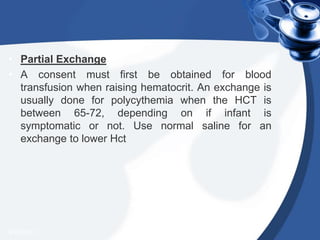
• Partial Exchange
• A consent must first be obtained for blood
transfusion when raising hematocrit. An exchange is
usually done for polycythemia when the HCT is
between 65-72, depending on if infant is
symptomatic or not. Use normal saline for an
exchange to lower Hct
4/20/2013
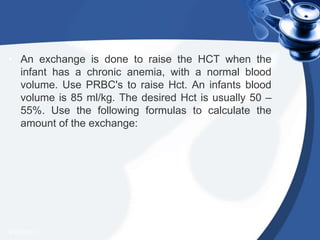
• An exchange is done to raise the HCT when the
infant has a chronic anemia, with a normal blood
volume. Use PRBC's to raise Hct. An infants blood
volume is 85 ml/kg. The desired Hct is usually 50 –
55%. Use the following formulas to calculate the
amount of the exchange:
4/20/2013
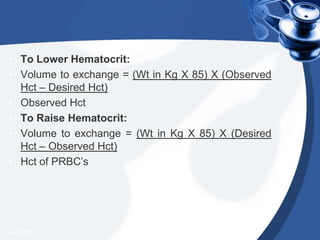
• To Lower Hematocrit:
• Volume to exchange = (Wt in Kg X 85) X (Observed
Hct – Desired Hct)
• Observed Hct
• To Raise Hematocrit:
• Volume to exchange = (Wt in Kg X 85) X (Desired
Hct – Observed Hct)
• Hct of PRBC’s
4/20/2013
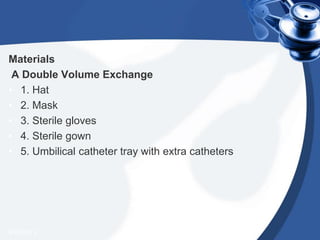
Materials
A Double Volume Exchange
• 1. Hat
• 2. Mask
• 3. Sterile gloves
• 4. Sterile gown
• 5. Umbilical catheter tray with extra catheters
4/20/2013
• 6. Heparinized flush solution
• 7. 10 or 20 ml syringes (depending on size of infant)
• 8. Blood warmer, filter, and tubing
• 9. Whole blood, or FFP and PRBC’s
• 10. Calcium Gluconate
4/20/2013
• Partial Exchange Transfusion
• 1. Hat
• 2. Mask
• 3. Sterile gloves
• 4. Sterile gown
• 5. Umbilical catheter tray with extra catheters
• 6. Heparinized flush solution
4/20/2013
• Double Volume Exchange:
• 1.Hyperbilirubemia
• 2.Hyperammonimia
• 3.To remove bacterial toxins
• 4. To correct life-threatening electrolyte and fluid
imbalance
Partial volume exchange
1. Severe anemia in the face of normal or excess blood
volume.
2. Clinical polycythemia
4/20/2013
• Double Volume Exchange
• 1. Same complications as UAC & UVC line insertion.
• 2. Microemboli
• 3. Arrhythmias
• 4. Volume overload.
4/20/2013
• 5. Cardiac arrest – from too rapid exchange or K+
toxicity.
• 6. Hyperkalemia, hypernatremia, hypocalcemia
• 7.Metabolic acidosis
• 8. Respiratory alkalosis
• 9. Thrombocytopenia
• 10. Infection
• 11. Transfusion reaction
4/20/2013
Partial Volume Exchange
1. Same complications as UAC & UVC line insertion.
2. Microemboli
3. Infection
4. Transfusion reaction
5. Anemia or polycythemia
4/20/2013
• 1. Perform time out with all appropriate steps.
• 2. If two catheters are in place, withdraw 5ml/kg
blood from the arterial catheter and infuse 5ml/kg
donor blood through venous catheter
simultaneously.
• .
4/20/2013
• If only an umbilical venous catheter is in place,
withdraw 5 ml/kg of infant’s blood first, then replace
with 5 ml/kg of donor blood.
• Continue in 5ml/kg aliquots until desired volume is
exchanged.
4/20/2013
• 3. Send first blood drawn for pre-exchange bilirubin,
blood gas and other lab investigations
• 4. The bedside nurse is to maintain strict in/out
record, monitor vital signs, and blood temperature.
• 5. Halfway through the exchange, send blood gas
and bilirubin.
4/20/2013
• Lab investigations before procedure
• (Donor blood - Hct, K, & pH )
• Infant –
• ABG, Total & direct bilirubin, Na, K, Ca, CBC, Plts,
Albumin
• During procedure
• ABG Q 100 ml if RDS
• Glucose screen Q 15-30 minutes
4/20/2013
After completion
Repeat type and cross
• Hct, ABG
• Total & direct bilirubin and repeat Q h
• X 2 Na, K, Ca, CBC, Platelets , Albumin
• Glucose screen at 15 & 30 minutes, then Q 1 hr X 4.
4-6 hrs post exchange :
• Hematocrit and Total & Direct bilirubin
4/20/2013
• Partial Volume Exchange – To lower hematocrit
• To Lower Hematocrit:
• 1. Perform time out with all appropriate steps.
• 2. Exchange the infant’s blood for normal saline, in
increments not to exceed 5% of the estimated total
blood volume.
4/20/2013
• Continue until the total exchange volume is reached.
• 3.mainintain a post-exchange hematocrit. If the Hct
is 55% or greater, take out an additional 5 ml/kg of
infant’s blood to prevent further hemoconcentration.
4/20/2013
• To Raise Hematocrit:
• 1. Perform time out with all appropriate steps.
• 2. Exchange the infant’s blood for donor blood, in
increments not to exceed 5% of the estimated total
blood volume. Continue until the total exchange
volume is reached.
4/20/2013
• E. Follow-up treatment
• Double Exchange Transfusion
• 1. At completion, send post-exchange labs (see
Table 1).
• 2. Resume phototherapy if exchange was done for
hyperbilirubinemia.
4/20/2013
• 3. Observe in ICN. Do not feed for at least 4 hrs
after umbilical lines removed.
• Partial Exchange Transfusion
• 1. Send hematocrit at completion of exchange and
4 hrs after completion.
• 2. Observe in baby for at least 4 hours and do not
feed until at least 4 hrs after umbilical catheters
removed .
4/20/2013

Exchange transfusion

  • 1.
    Presented by: SabitaPaudel B.Sc Nursing 3rd year 4/20/2013 BPKIHS,Dharan ,Nepal
  • 2.
    To exchange allor part of an infant’s blood supply for certain medical conditions is called exhange transfusion. • 4/20/2013
  • 3.
    • A doublevolume exchange transfusion is replacing the baby’s total blood volume twice, leaving the intravascular amount the same. • A partial exchange is either increasing or decreasing an infant’s hematocrit, while maintaining a constant blood volume. 4/20/2013
  • 4.
    • General information •Double Volume Exchange Try to use the freshest blood available (procured within 3-5 days) for the double volume exchange. If whole blood is not available, use a combination of Fresh frozen plasma and packed red blood cells. 4/20/2013
  • 5.
    • The exchangevolume is twice the infant’s blood volume, using 85 ml/kg as the infant’s blood volume. This procedure should be done slowly, over a minimum of 45 minutes and the blood volume should be kept fairly constant. See nursing procedure for further information. A consent must first be obtained for blood transfusion. 4/20/2013
  • 6.
    • Partial Exchange •A consent must first be obtained for blood transfusion when raising hematocrit. An exchange is usually done for polycythemia when the HCT is between 65-72, depending on if infant is symptomatic or not. Use normal saline for an exchange to lower Hct 4/20/2013
  • 7.
    • An exchangeis done to raise the HCT when the infant has a chronic anemia, with a normal blood volume. Use PRBC's to raise Hct. An infants blood volume is 85 ml/kg. The desired Hct is usually 50 – 55%. Use the following formulas to calculate the amount of the exchange: 4/20/2013
  • 8.
    • To LowerHematocrit: • Volume to exchange = (Wt in Kg X 85) X (Observed Hct – Desired Hct) • Observed Hct • To Raise Hematocrit: • Volume to exchange = (Wt in Kg X 85) X (Desired Hct – Observed Hct) • Hct of PRBC’s 4/20/2013
  • 9.
    Materials A Double VolumeExchange • 1. Hat • 2. Mask • 3. Sterile gloves • 4. Sterile gown • 5. Umbilical catheter tray with extra catheters 4/20/2013
  • 10.
    • 6. Heparinizedflush solution • 7. 10 or 20 ml syringes (depending on size of infant) • 8. Blood warmer, filter, and tubing • 9. Whole blood, or FFP and PRBC’s • 10. Calcium Gluconate 4/20/2013
  • 11.
    • Partial ExchangeTransfusion • 1. Hat • 2. Mask • 3. Sterile gloves • 4. Sterile gown • 5. Umbilical catheter tray with extra catheters • 6. Heparinized flush solution 4/20/2013
  • 12.
    • Double VolumeExchange: • 1.Hyperbilirubemia • 2.Hyperammonimia • 3.To remove bacterial toxins • 4. To correct life-threatening electrolyte and fluid imbalance
  • 13.
    Partial volume exchange 1.Severe anemia in the face of normal or excess blood volume. 2. Clinical polycythemia 4/20/2013
  • 14.
    • Double VolumeExchange • 1. Same complications as UAC & UVC line insertion. • 2. Microemboli • 3. Arrhythmias • 4. Volume overload. 4/20/2013
  • 15.
    • 5. Cardiacarrest – from too rapid exchange or K+ toxicity. • 6. Hyperkalemia, hypernatremia, hypocalcemia • 7.Metabolic acidosis • 8. Respiratory alkalosis • 9. Thrombocytopenia • 10. Infection • 11. Transfusion reaction 4/20/2013
  • 16.
    Partial Volume Exchange 1.Same complications as UAC & UVC line insertion. 2. Microemboli 3. Infection 4. Transfusion reaction 5. Anemia or polycythemia 4/20/2013
  • 17.
    • 1. Performtime out with all appropriate steps. • 2. If two catheters are in place, withdraw 5ml/kg blood from the arterial catheter and infuse 5ml/kg donor blood through venous catheter simultaneously. • . 4/20/2013
  • 18.
    • If onlyan umbilical venous catheter is in place, withdraw 5 ml/kg of infant’s blood first, then replace with 5 ml/kg of donor blood. • Continue in 5ml/kg aliquots until desired volume is exchanged. 4/20/2013
  • 19.
    • 3. Sendfirst blood drawn for pre-exchange bilirubin, blood gas and other lab investigations • 4. The bedside nurse is to maintain strict in/out record, monitor vital signs, and blood temperature. • 5. Halfway through the exchange, send blood gas and bilirubin. 4/20/2013
  • 20.
    • Lab investigationsbefore procedure • (Donor blood - Hct, K, & pH ) • Infant – • ABG, Total & direct bilirubin, Na, K, Ca, CBC, Plts, Albumin • During procedure • ABG Q 100 ml if RDS • Glucose screen Q 15-30 minutes 4/20/2013
  • 21.
    After completion Repeat typeand cross • Hct, ABG • Total & direct bilirubin and repeat Q h • X 2 Na, K, Ca, CBC, Platelets , Albumin • Glucose screen at 15 & 30 minutes, then Q 1 hr X 4. 4-6 hrs post exchange : • Hematocrit and Total & Direct bilirubin 4/20/2013
  • 22.
    • Partial VolumeExchange – To lower hematocrit • To Lower Hematocrit: • 1. Perform time out with all appropriate steps. • 2. Exchange the infant’s blood for normal saline, in increments not to exceed 5% of the estimated total blood volume. 4/20/2013
  • 23.
    • Continue untilthe total exchange volume is reached. • 3.mainintain a post-exchange hematocrit. If the Hct is 55% or greater, take out an additional 5 ml/kg of infant’s blood to prevent further hemoconcentration. 4/20/2013
  • 24.
    • To RaiseHematocrit: • 1. Perform time out with all appropriate steps. • 2. Exchange the infant’s blood for donor blood, in increments not to exceed 5% of the estimated total blood volume. Continue until the total exchange volume is reached. 4/20/2013
  • 25.
    • E. Follow-uptreatment • Double Exchange Transfusion • 1. At completion, send post-exchange labs (see Table 1). • 2. Resume phototherapy if exchange was done for hyperbilirubinemia. 4/20/2013
  • 26.
    • 3. Observein ICN. Do not feed for at least 4 hrs after umbilical lines removed. • Partial Exchange Transfusion • 1. Send hematocrit at completion of exchange and 4 hrs after completion. • 2. Observe in baby for at least 4 hours and do not feed until at least 4 hrs after umbilical catheters removed . 4/20/2013