PEDIATRIC
PARENTERAL
NUTRITION
Salmiah Hassan
Pharmacist, HTWU
Enteral Nutrition
Enteral Nutrition is given when oral route is not feasible
eg. intubated & sedated
Examples of enteral access are;
1. Feeding through nose (nasogastric, nasoduodenal &
nasojejunal)
2. Gastrostomy
3. Jejunostomy
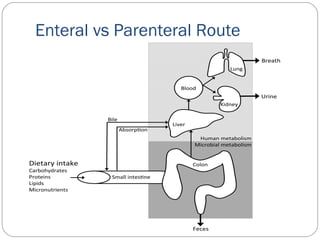
Undergoes complex process of digestion along
gastrointestinal tract and metabolism by liver before
being absorbed to blood circulation
Parenteral Nutrition
• Nutrients given to patient directly into the systemic
circulation
• Bypass the GI tract and the first circulation through the
liver
Enteral vs Parenteral Route
Enteral vs Parenteral Route?
Whenever possible, oral/enteral route should be the choice
for feeding (If the gut works,use it)
Advantages;
1. Prevention of mucosal atrophy by luminal supply of
substrates; support of the mucosal barrier against pathogens
2. Support of the intestinal immune system and improvement
of immuno-competence, prophylaxis against infection and
sepsis
3. Improvement of intestinal perfusions
TPN: OVERVIEW
OUTLINES
Indication of TPN
Assessment of Nutrition Support
Caloric requirement
Macronutrients
Micronutrients
Monitoring Parameter
Peripheral PN vs Central PN
Cyclical PN
TPN Requisition Form
Setting Up TPN
Adjustment of PN Run Rate
INDICATION OF TPN
INDICATION
PAEDIATRIC
Neonates
BW <1.5kg, (VLBW, ELBW)
<30wks gestational age
Necrotizing Enterocolitis (NEC)
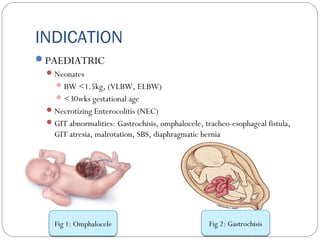
GIT abnormalities: Gastrochisis, omphalocele, tracheo-esophageal fistula,
GIT atresia, malrotation, SBS, diaphragmatic hernia
Fig 1: Omphalocele Fig 2: Gastrochisis
CONTRA-INDICATIONS
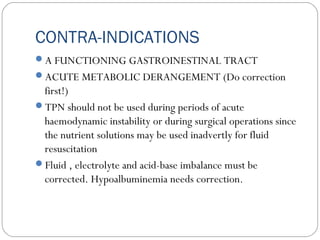
A FUNCTIONING GASTROINESTINAL TRACT
ACUTE METABOLIC DERANGEMENT (Do correction
first!)
TPN should not be used during periods of acute
haemodynamic instability or during surgical operations since
the nutrient solutions may be used inadvertly for fluid
resuscitation
Fluid , electrolyte and acid-base imbalance must be
corrected. Hypoalbuminemia needs correction.
WHEN TO START PN?
Within 12-24 hours of injury/ surgery or after stabilization
of vital organ function
Check:
-Impaired oxygenation
-Impaired perfusion or volume depletion
-Electrolytes & metabolic derangement
-Requirement for inotropes
Ensure these issues are settled and stabilized within
the first 24 hours
ASSESSMENT OF NUTRITION
SUPPORT
ASSESSMENT OF NUTRITION SUPPORT
-PAEDIATRIC
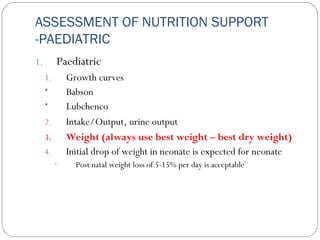
1. Paediatric
1. Growth curves
• Babson
• Lubchenco
2. Intake/Output, urine output
3. Weight (always use best weight – best dry weight)
4. Initial drop of weight in neonate is expected for neonate
• Post natal weight loss of 5-15% per day is acceptable
NORMAL GROWTH
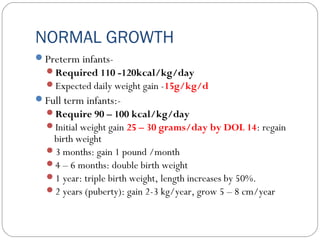
Preterm infants-
Required 110 -120kcal/kg/day
Expected daily weight gain -15g/kg/d
Full term infants:-
Require 90 – 100 kcal/kg/day
Initial weight gain 25 – 30 grams/day by DOL 14: regain
birth weight
3 months: gain 1 pound /month
4 – 6 months: double birth weight
1 year: triple birth weight, length increases by 50%.
2 years (puberty): gain 2-3 kg/year, grow 5 – 8 cm/year
CALORIC REQUIREMENT
CALORIC REQUIREMENT
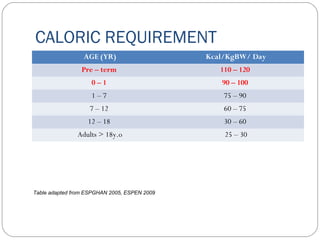
AGE (YR) Kcal/KgBW/ Day
Pre – term 110 – 120
0 – 1 90 – 100
1 – 7 75 – 90
7 – 12 60 – 75
12 – 18 30 – 60
Adults > 18y.o 25 – 30
Table adapted from ESPGHAN 2005, ESPEN 2009
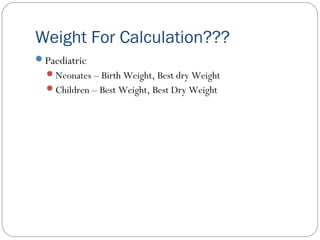
Weight For Calculation???
Paediatric
Neonates – Birth Weight, Best dry Weight
Children – Best Weight, Best Dry Weight
MACRONUTRIENTS
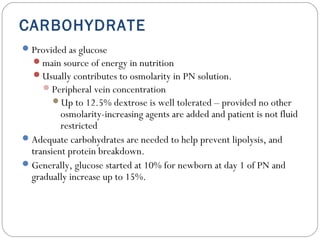
CARBOHYDRATE
Provided as glucose
main source of energy in nutrition
Usually contributes to osmolarity in PN solution.
Peripheral vein concentration
Up to 12.5% dextrose is well tolerated – provided no other
osmolarity-increasing agents are added and patient is not fluid
restricted
Adequate carbohydrates are needed to help prevent lipolysis, and
transient protein breakdown.
Generally, glucose started at 10% for newborn at day 1 of PN and
gradually increase up to 15%.
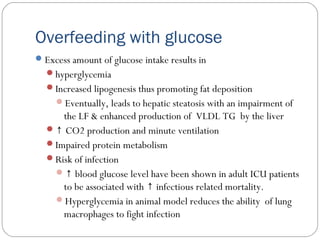
Overfeeding with glucose
Excess amount of glucose intake results in
hyperglycemia
Increased lipogenesis thus promoting fat deposition
Eventually, leads to hepatic steatosis with an impairment of
the LF & enhanced production of VLDL TG by the liver
↑ CO2 production and minute ventilation
Impaired protein metabolism
Risk of infection
↑ blood glucose level have been shown in adult ICU patients
to be associated with infectious related mortality.↑
Hyperglycemia in animal model reduces the ability of lung
macrophages to fight infection
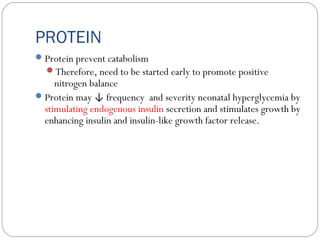
PROTEIN
Protein prevent catabolism
Therefore, need to be started early to promote positive
nitrogen balance
Protein may ↓ frequency and severity neonatal hyperglycemia by
stimulating endogenous insulin secretion and stimulates growth by
enhancing insulin and insulin-like growth factor release.
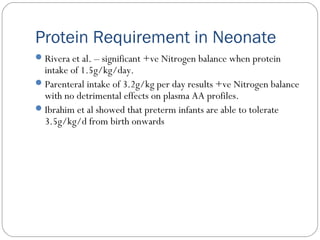
Protein Requirement in Neonate
Rivera et al. – significant +ve Nitrogen balance when protein
intake of 1.5g/kg/day.
Parenteral intake of 3.2g/kg per day results +ve Nitrogen balance
with no detrimental effects on plasma AA profiles.
Ibrahim et al showed that preterm infants are able to tolerate
3.5g/kg/d from birth onwards
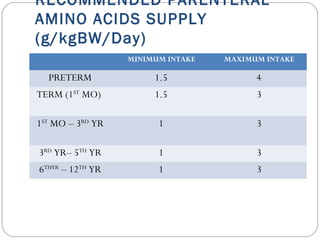
RECOMMENDED PARENTERAL
AMINO ACIDS SUPPLY
(g/kgBW/Day)
MINIMUM INTAKE MAXIMUM INTAKE
PRETERM 1.5 4
TERM (1ST
MO) 1.5 3
1ST
MO – 3RD
YR 1 3
3RD
YR– 5TH
YR 1 3
6THYR
– 12TH
YR 1 3
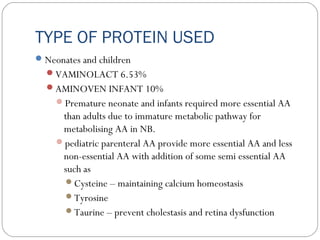
TYPE OF PROTEIN USED
Neonates and children
VAMINOLACT 6.53%
AMINOVEN INFANT 10%
Premature neonate and infants required more essential AA
than adults due to immature metabolic pathway for
metabolising AA in NB.
pediatric parenteral AA provide more essential AA and less
non-essential AA with addition of some semi essential AA
such as
Cysteine – maintaining calcium homeostasis
Tyrosine
Taurine – prevent cholestasis and retina dysfunction
Glutamine in children
No evidence to support the routine use of glutamine in preterm
babies
Studies show that no effects of glutamine supplementation on
sepsis or mortality, tolerance towards EN, NEC or growth
No available data in supporting glutamine used in older children.
SOLUTION A SOLUTION B SOLUTION C
Protein 4g 6g 8g
Glucose 10% 10%, 12.5%,
14%
10%, 12.5%,
14%
Na content 4mmol 4mmol 4mmol
Ca content 1.67mmol 1.67mmol 1.67mmol
Volume 200ml 200ml 200ml
STANDARD SOLUTION
FAT
Lipid
prevent essential FA deficiency,
provide high energy needs without CHO overload
improve delivery of fat soluble vitamins.
Maximum fat oxidation occurs when IVFE provide 40% of the
non-protein calories in newborns.
In infants, NB and preterm, IVFE – administered 24h
Essential FA deficiency
Ommission of IVFE may lead to EFA deficiency (Cooke RJ et al,
Lee EJ et al)
In newborn infants who cannot receive sufficient enteral feeding,
intravenous lipid emulsions should be started no later than on the
third day of life, but may be started on the first day of life
(ESPGHAN 2005)
In order to prevent EFA-deficiency,
0.25g/kg/d should be given to preterm infants
0.1g/kg/d – term infants and older children
Fat Requirement in Neonate
Start lipids at 1g/kg/day, at the same time as amino acids are
started, to prevent essential fatty acid deficiency; gradually
increase dose up to 3 g/kg/day (3.5g/kg/day in ELBW infants)
Exogenous lipid may interfere with respiratory function.
Suggested mechanisms include impaired gas exchange from
pulmonary intravascular accumulation or impaired lymph
drainage resulting in oedema. Lipid may also aggravate pulmonary
hypertension in susceptible individuals.
So, use smaller doses in sepsis, compromised pulmonary function,
hyperbilirubinaemia/ jaundice requiring phototherapy
(≤ 2g/kg/day) (Peads Protocols 2012)
LBW infants may have immature mechanisms for fat metabolism.
Some conditions inhibit lipid clearance e.g. infection, stress,
malnutrition
So, lipid clearance monitored by plasma triglyceride (TG) levels
(Max TG concentration ranges from 150 mg/dl to 200 mg/dl)
(Paediatric Protocols 2012)
Fat Requirement in Neonate
TYPE OF LIPID USED
Smoflipid 20%
LCT, MCT, olive oil, fish oil
Oxidized rapidly , reduced liver derangement, anti-
inflammatory effects
The syringe and infusion line should be shielded from ambient
light.
MICRONUTRIENTS
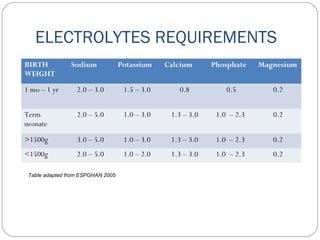
ELECTROLYTES REQUIREMENT Cont
Only basic requirement of electrolytes should be covered in PN
bag
PN is not meant for fast electrolytes or fluid correction!!
Profound deviations should be corrected independently from
nutrition therapy
ELECTROLYTES REQUIREMENTS
BIRTH
WEIGHT
Sodium Potassium Calcium Phosphate Magnesium
1 mo – 1 yr 2.0 – 3.0 1.5 – 3.0 0.8 0.5 0.2
Term
neonate
2.0 – 5.0 1.0 – 3.0 1.3 – 3.0 1.0 – 2.3 0.2
>1500g 3.0 – 5.0 1.0 – 3.0 1.3 – 3.0 1.0 – 2.3 0.2
<1500g 2.0 – 5.0 1.0 – 2.0 1.3 – 3.0 1.0 – 2.3 0.2
Table adapted from ESPGHAN 2005
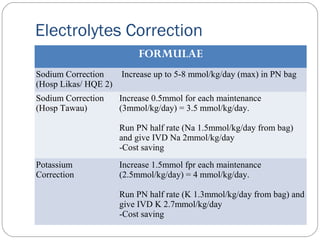
Electrolytes Correction
FORMULAE
Sodium Correction
(Hosp Likas/ HQE 2)
Increase up to 5-8 mmol/kg/day (max) in PN bag
Sodium Correction
(Hosp Tawau)
Increase 0.5mmol for each maintenance
(3mmol/kg/day) = 3.5 mmol/kg/day.
Run PN half rate (Na 1.5mmol/kg/day from bag)
and give IVD Na 2mmol/kg/day
-Cost saving
Potassium
Correction
Increase 1.5mmol fpr each maintenance
(2.5mmol/kg/day) = 4 mmol/kg/day.
Run PN half rate (K 1.3mmol/kg/day from bag) and
give IVD K 2.7mmol/kg/day
-Cost saving
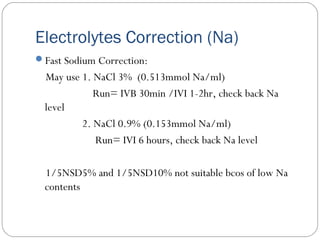
Electrolytes Correction (Na)
Fast Sodium Correction:
May use 1. NaCl 3% (0.513mmol Na/ml)
Run= IVB 30min /IVI 1-2hr, check back Na
level
2. NaCl 0.9% (0.153mmol Na/ml)
Run= IVI 6 hours, check back Na level
1/5NSD5% and 1/5NSD10% not suitable bcos of low Na
contents
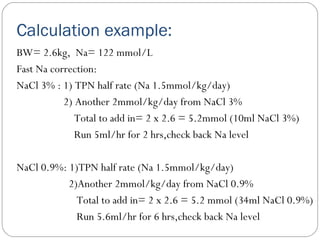
Calculation example:
BW= 2.6kg, Na= 122 mmol/L
Fast Na correction:
NaCl 3% : 1) TPN half rate (Na 1.5mmol/kg/day)
2) Another 2mmol/kg/day from NaCl 3%
Total to add in= 2 x 2.6 = 5.2mmol (10ml NaCl 3%)
Run 5ml/hr for 2 hrs,check back Na level
NaCl 0.9%: 1)TPN half rate (Na 1.5mmol/kg/day)
2)Another 2mmol/kg/day from NaCl 0.9%
Total to add in= 2 x 2.6 = 5.2 mmol (34ml NaCl 0.9%)
Run 5.6ml/hr for 6 hrs,check back Na level
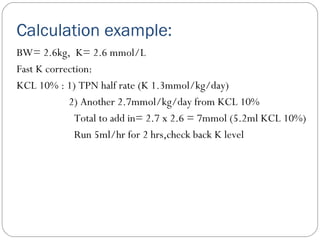
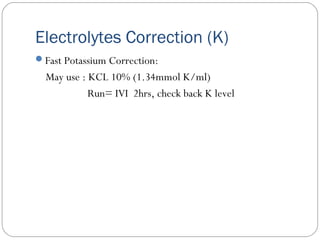
Electrolytes Correction (K)
Fast Potassium Correction:
May use : KCL 10% (1.34mmol K/ml)
Run= IVI 2hrs, check back K level
Calculation example:
BW= 2.6kg, K= 2.6 mmol/L
Fast K correction:
KCL 10% : 1) TPN half rate (K 1.3mmol/kg/day)
2) Another 2.7mmol/kg/day from KCL 10%
Total to add in= 2.7 x 2.6 = 7mmol (5.2ml KCL 10%)
Run 5ml/hr for 2 hrs,check back K level
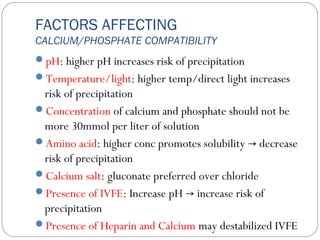
FACTORS AFFECTING
CALCIUM/PHOSPHATE COMPATIBILITY
pH: higher pH increases risk of precipitation
Temperature/light: higher temp/direct light increases
risk of precipitation
Concentration of calcium and phosphate should not be
more 30mmol per liter of solution
Amino acid: higher conc promotes solubility decrease→
risk of precipitation
Calcium salt: gluconate preferred over chloride
Presence of IVFE: Increase pH increase risk of→
precipitation
Presence of Heparin and Calcium may destabilized IVFE
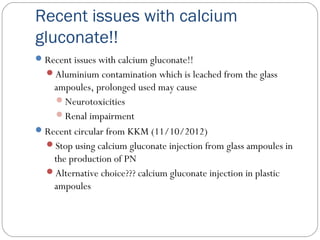
Recent issues with calcium
gluconate!!
Recent issues with calcium gluconate!!
Aluminium contamination which is leached from the glass
ampoules, prolonged used may cause
Neurotoxicities
Renal impairment
Recent circular from KKM (11/10/2012)
Stop using calcium gluconate injection from glass ampoules in
the production of PN
Alternative choice??? calcium gluconate injection in plastic
ampoules
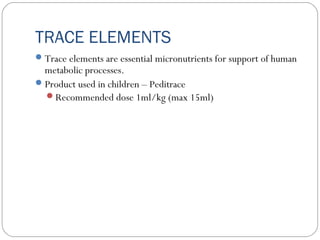
TRACE ELEMENTS
Trace elements are essential micronutrients for support of human
metabolic processes.
Product used in children – Peditrace
Recommended dose 1ml/kg (max 15ml)
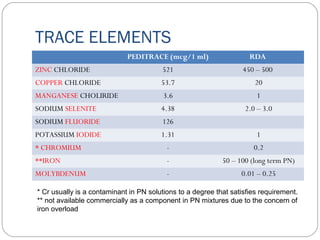
TRACE ELEMENTS
PEDITRACE (mcg/1 ml) RDA
ZINC CHLORIDE 521 450 – 500
COPPER CHLORIDE 53.7 20
MANGANESE CHOLIRIDE 3.6 1
SODIUM SELENITE 4.38 2.0 – 3.0
SODIUM FLUORIDE 126
POTASSIUM IODIDE 1.31 1
* CHROMIUM - 0.2
**IRON - 50 – 100 (long term PN)
MOLYBDENUM - 0.01 – 0.25
* Cr usually is a contaminant in PN solutions to a degree that satisfies requirement.
** not available commercially as a component in PN mixtures due to the concern of
iron overload
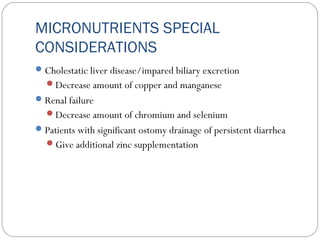
MICRONUTRIENTS SPECIAL
CONSIDERATIONS
Cholestatic liver disease/impared biliary excretion
Decrease amount of copper and manganese
Renal failure
Decrease amount of chromium and selenium
Patients with significant ostomy drainage of persistent diarrhea
Give additional zinc supplementation
VITAMINS
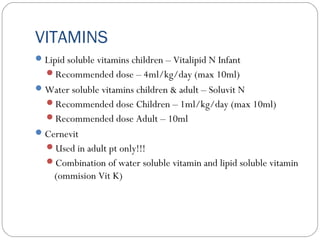
Lipid soluble vitamins children – Vitalipid N Infant
Recommended dose – 4ml/kg/day (max 10ml)
Water soluble vitamins children & adult – Soluvit N
Recommended dose Children – 1ml/kg/day (max 10ml)
Recommended dose Adult – 10ml
Cernevit
Used in adult pt only!!!
Combination of water soluble vitamin and lipid soluble vitamin
(ommision Vit K)
VITAMINS
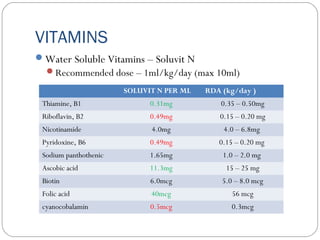
Water Soluble Vitamins – Soluvit N
Recommended dose – 1ml/kg/day (max 10ml)
SOLUVIT N PER ML RDA (kg/day )
Thiamine, B1 0.31mg 0.35 – 0.50mg
Riboflavin, B2 0.49mg 0.15 – 0.20 mg
Nicotinamide 4.0mg 4.0 – 6.8mg
Pyridoxine, B6 0.49mg 0.15 – 0.20 mg
Sodium panthothenic 1.65mg 1.0 – 2.0 mg
Ascobic acid 11.3mg 15 – 25 mg
Biotin 6.0mcg 5.0 – 8.0 mcg
Folic acid 40mcg 56 mcg
cyanocobalamin 0.5mcg 0.3mcg
VITAMINS
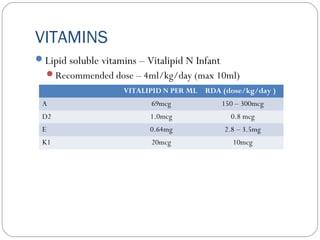
Lipid soluble vitamins – Vitalipid N Infant
Recommended dose – 4ml/kg/day (max 10ml)
VITALIPID N PER ML RDA (dose/kg/day )
A 69mcg 150 – 300mcg
D2 1.0mcg 0.8 mcg
E 0.64mg 2.8 – 3.5mg
K1 20mcg 10mcg
MONITORING PARAMETERS
Daily I/O, urine output, weight, DXT, ABG
Serum electrolytes including phosphorus, calcium,
magnesium
Daily for BUSE monitoring until serum is stable then twice a
week
Liver function test
initiation of PN and after 3-4 days of initiation of TPN then
weekly
Serum triglyceride
Initation of TPN then weekly especially patient that is expected
on long-term of PN
PERIPHERAL PN VS CENTRAL PN
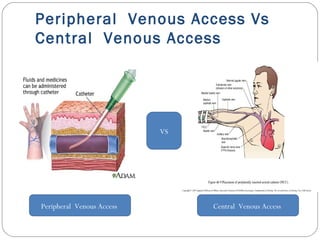
Peripheral Venous Access Vs
Central Venous Access
VS
Peripheral Venous Access Central Venous Access
Peripheral PN
Osmolarity – concentration of solute per liter solution
Osmolarity
Not more than 900 mOsm/L (ESPGHAN 2005)
Not more than 850 mOsm/L (ESPEN 2009)
Not more than 925mOsm/L (Mahshid Roayaee, The Pharmacy Practice, MAC 2002,
www.childrenmercy.org)
Possible to give PN with osmolality around 1100mOsm/kg for
up to 10 days via peripheral veins in most patient. (ESPEN 2009) – trial
on adult patient only!!!
Peripheral PN - Cont
Energy
Energy provided is less than energy given via central line
Require higher volume of solution i.e: TF 150ml/kg/day
(neonate)
Maximum dextrose content paed PN– 12.5%, provided
TF - 150ml/kg/d, Protein -2g/kg/d, Fat – 2g/kg/d, Na & K
-1.5mmol/kg/d and normal maintenance for Ca2+,
PO4
2
, Mg2+
For short-term PN only
Central PN
Osmolarity – can be given >900mOsm/L
Higher calorie can be provided
Suitable for patient that is fluid restricted
CYCLICAL PN
Cyclical PN
Refers to the administration of IV fluids intermittently with
regularly discontinuation of infusion.
E.g. IDPN
May be used for 3-6mo of age
Advantages
Alternating feeding and fasting allows changes in
insulin/glucagon balance and reduces lipogenesis
Allow patient mobilization
Lower the risk for the development of liver disease
Cyclical PN - cont
Disadvantages
Most available data comes from studies performed in stable
adults pt
May leads to hyperglycemia due to high glucose infusion rates
and risks of hypoglycemia upon discontinuation
PN REQUISITION FORM
 HTWU does not have TN manufacturing facility
PN ordered from HQE 2, KK – only Monday to Thursday.
Take around 2 days to receive the TPN bags (May also be on weekend)
 Incomplete TN form
Central line/ peripheral line?
Fluid maintenance? [Total Fluid (TF)]
PN regimen?
 Crucial info for TN administration
Centrally? Peripherally?
Content of PN?
Aseptic Technique?
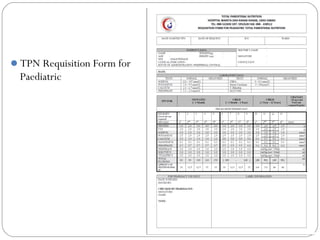
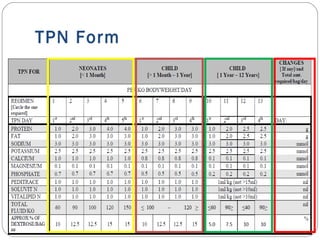
TPN Requisition Form for
Paediatric
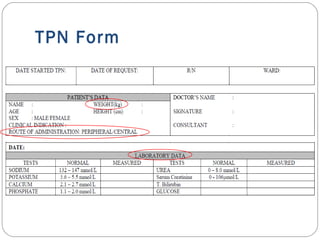
TPN Form
TPN Form
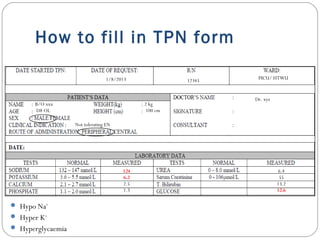
How to fill in TPN form
 Hypo Na+
 Hyper K+
 Hyperglycaemia
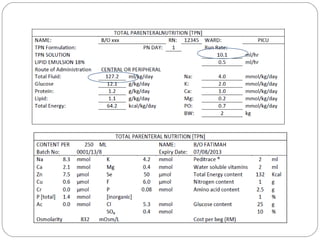
B/O xxx
D8 OL
2 kg
100 cm
1/8/2013 12345
PICU/ HTWU
Dr. xyz
124
6.2
2.5
1.3
6.4
55
13.2
12.6
Not tolerating EN
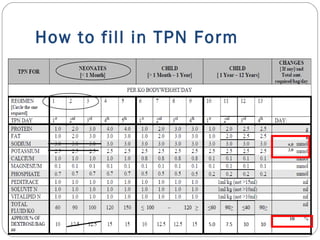
How to fill in TPN Form
4.0
2.0
10
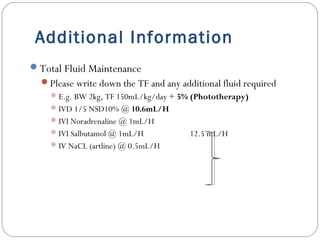
Additional Information
Total Fluid Maintenance
Please write down the TF and any additional fluid required
E.g. BW 2kg, TF 150mL/kg/day + 5% (Phototherapy)
IVD 1/5 NSD10% @ 10.6mL/H
IVI Noradrenaline @ 1mL/H
IVI Salbutamol @ 1mL/H 12.5 mL/H
IV NaCL (artline) @ 0.5mL/H
SETTING UP TPN
Complete TPN Set (Cold-
chain)
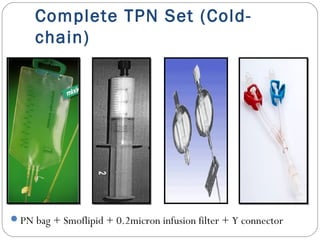
PN bag + Smoflipid + 0.2micron infusion filter + Y connector
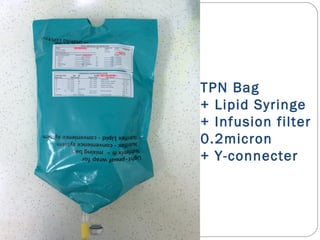
TPN Bag
+ Lipid Syringe
+ Infusion filter
0.2micron
+ Y-connecter
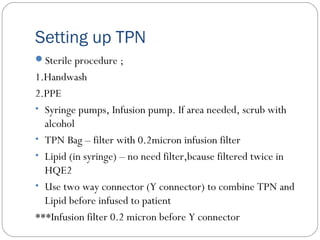
Setting up TPN
Sterile procedure ;
1.Handwash
2.PPE
• Syringe pumps, Infusion pump. If area needed, scrub with
alcohol
• TPN Bag – filter with 0.2micron infusion filter
• Lipid (in syringe) – no need filter,bcause filtered twice in
HQE2
• Use two way connector (Y connector) to combine TPN and
Lipid before infused to patient
***Infusion filter 0.2 micron before Y connector
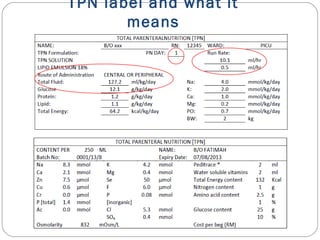
TPN label and what it
means
ADJUSTING TPN RUNNING RATE
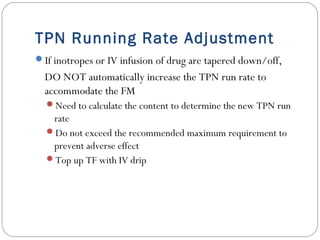
TPN Running Rate Adjustment
If inotropes or IV infusion of drug are tapered down/off,
DO NOT automatically increase the TPN run rate to
accommodate the FM
Need to calculate the content to determine the new TPN run
rate
Do not exceed the recommended maximum requirement to
prevent adverse effect
Top up TF with IV drip
How?
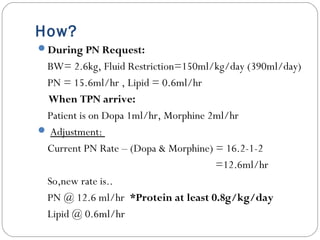
During PN Request:
BW= 2.6kg, Fluid Restriction=150ml/kg/day (390ml/day)
PN = 15.6ml/hr , Lipid = 0.6ml/hr
When TPN arrive:
Patient is on Dopa 1ml/hr, Morphine 2ml/hr
 Adjustment:
Current PN Rate – (Dopa & Morphine) = 16.2-1-2
=12.6ml/hr
So,new rate is..
PN @ 12.6 ml/hr *Protein at least 0.8g/kg/day
Lipid @ 0.6ml/hr
Example
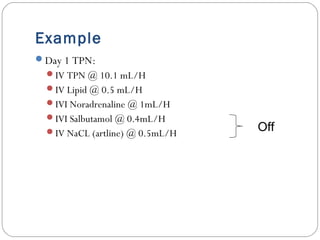
Day 1 TPN:
IV TPN @ 10.1 mL/H
IV Lipid @ 0.5 mL/H
IVI Noradrenaline @ 1mL/H
IVI Salbutamol @ 0.4mL/H
IV NaCL (artline) @ 0.5mL/H Off
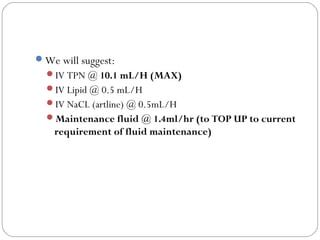
We will suggest:
IV TPN @ 10.1 mL/H (MAX)
IV Lipid @ 0.5 mL/H
IV NaCL (artline) @ 0.5mL/H
Maintenance fluid @ 1.4ml/hr (to TOP UP to current
requirement of fluid maintenance)
References:
1. MOH Pediatric Protocols 3rd
Edition,2012
2. European Society of Parenteral Enteral Nutrition (ESPEN)
2009
3. Journal of Pediatric Gastroenterology and Nutrition
(ESPGHAN) 2005
Thank you !

Pediatric Parenteral Nutrition

  • 1.
  • 2.
    Enteral Nutrition Enteral Nutritionis given when oral route is not feasible eg. intubated & sedated Examples of enteral access are; 1. Feeding through nose (nasogastric, nasoduodenal & nasojejunal) 2. Gastrostomy 3. Jejunostomy Undergoes complex process of digestion along gastrointestinal tract and metabolism by liver before being absorbed to blood circulation
  • 3.
    Parenteral Nutrition • Nutrientsgiven to patient directly into the systemic circulation • Bypass the GI tract and the first circulation through the liver
  • 4.
  • 5.
    Enteral vs ParenteralRoute? Whenever possible, oral/enteral route should be the choice for feeding (If the gut works,use it) Advantages; 1. Prevention of mucosal atrophy by luminal supply of substrates; support of the mucosal barrier against pathogens 2. Support of the intestinal immune system and improvement of immuno-competence, prophylaxis against infection and sepsis 3. Improvement of intestinal perfusions
  • 6.
  • 7.
    OUTLINES Indication of TPN Assessmentof Nutrition Support Caloric requirement Macronutrients Micronutrients Monitoring Parameter Peripheral PN vs Central PN Cyclical PN TPN Requisition Form Setting Up TPN Adjustment of PN Run Rate
  • 8.
  • 9.
    INDICATION PAEDIATRIC Neonates BW <1.5kg, (VLBW,ELBW) <30wks gestational age Necrotizing Enterocolitis (NEC) GIT abnormalities: Gastrochisis, omphalocele, tracheo-esophageal fistula, GIT atresia, malrotation, SBS, diaphragmatic hernia Fig 1: Omphalocele Fig 2: Gastrochisis
  • 10.
    CONTRA-INDICATIONS A FUNCTIONING GASTROINESTINALTRACT ACUTE METABOLIC DERANGEMENT (Do correction first!) TPN should not be used during periods of acute haemodynamic instability or during surgical operations since the nutrient solutions may be used inadvertly for fluid resuscitation Fluid , electrolyte and acid-base imbalance must be corrected. Hypoalbuminemia needs correction.
  • 11.
    WHEN TO STARTPN? Within 12-24 hours of injury/ surgery or after stabilization of vital organ function Check: -Impaired oxygenation -Impaired perfusion or volume depletion -Electrolytes & metabolic derangement -Requirement for inotropes Ensure these issues are settled and stabilized within the first 24 hours
  • 12.
  • 13.
    ASSESSMENT OF NUTRITIONSUPPORT -PAEDIATRIC 1. Paediatric 1. Growth curves • Babson • Lubchenco 2. Intake/Output, urine output 3. Weight (always use best weight – best dry weight) 4. Initial drop of weight in neonate is expected for neonate • Post natal weight loss of 5-15% per day is acceptable
  • 14.
    NORMAL GROWTH Preterm infants- Required110 -120kcal/kg/day Expected daily weight gain -15g/kg/d Full term infants:- Require 90 – 100 kcal/kg/day Initial weight gain 25 – 30 grams/day by DOL 14: regain birth weight 3 months: gain 1 pound /month 4 – 6 months: double birth weight 1 year: triple birth weight, length increases by 50%. 2 years (puberty): gain 2-3 kg/year, grow 5 – 8 cm/year
  • 15.
  • 16.
    CALORIC REQUIREMENT AGE (YR)Kcal/KgBW/ Day Pre – term 110 – 120 0 – 1 90 – 100 1 – 7 75 – 90 7 – 12 60 – 75 12 – 18 30 – 60 Adults > 18y.o 25 – 30 Table adapted from ESPGHAN 2005, ESPEN 2009
  • 17.
    Weight For Calculation??? Paediatric Neonates– Birth Weight, Best dry Weight Children – Best Weight, Best Dry Weight
  • 18.
  • 19.
    CARBOHYDRATE Provided as glucose mainsource of energy in nutrition Usually contributes to osmolarity in PN solution. Peripheral vein concentration Up to 12.5% dextrose is well tolerated – provided no other osmolarity-increasing agents are added and patient is not fluid restricted Adequate carbohydrates are needed to help prevent lipolysis, and transient protein breakdown. Generally, glucose started at 10% for newborn at day 1 of PN and gradually increase up to 15%.
  • 20.
    Overfeeding with glucose Excessamount of glucose intake results in hyperglycemia Increased lipogenesis thus promoting fat deposition Eventually, leads to hepatic steatosis with an impairment of the LF & enhanced production of VLDL TG by the liver ↑ CO2 production and minute ventilation Impaired protein metabolism Risk of infection ↑ blood glucose level have been shown in adult ICU patients to be associated with infectious related mortality.↑ Hyperglycemia in animal model reduces the ability of lung macrophages to fight infection
  • 21.
    PROTEIN Protein prevent catabolism Therefore,need to be started early to promote positive nitrogen balance Protein may ↓ frequency and severity neonatal hyperglycemia by stimulating endogenous insulin secretion and stimulates growth by enhancing insulin and insulin-like growth factor release.
  • 22.
    Protein Requirement inNeonate Rivera et al. – significant +ve Nitrogen balance when protein intake of 1.5g/kg/day. Parenteral intake of 3.2g/kg per day results +ve Nitrogen balance with no detrimental effects on plasma AA profiles. Ibrahim et al showed that preterm infants are able to tolerate 3.5g/kg/d from birth onwards
  • 23.
    RECOMMENDED PARENTERAL AMINO ACIDSSUPPLY (g/kgBW/Day) MINIMUM INTAKE MAXIMUM INTAKE PRETERM 1.5 4 TERM (1ST MO) 1.5 3 1ST MO – 3RD YR 1 3 3RD YR– 5TH YR 1 3 6THYR – 12TH YR 1 3
  • 24.
    TYPE OF PROTEINUSED Neonates and children VAMINOLACT 6.53% AMINOVEN INFANT 10% Premature neonate and infants required more essential AA than adults due to immature metabolic pathway for metabolising AA in NB. pediatric parenteral AA provide more essential AA and less non-essential AA with addition of some semi essential AA such as Cysteine – maintaining calcium homeostasis Tyrosine Taurine – prevent cholestasis and retina dysfunction
  • 25.
    Glutamine in children Noevidence to support the routine use of glutamine in preterm babies Studies show that no effects of glutamine supplementation on sepsis or mortality, tolerance towards EN, NEC or growth No available data in supporting glutamine used in older children.
  • 26.
    SOLUTION A SOLUTIONB SOLUTION C Protein 4g 6g 8g Glucose 10% 10%, 12.5%, 14% 10%, 12.5%, 14% Na content 4mmol 4mmol 4mmol Ca content 1.67mmol 1.67mmol 1.67mmol Volume 200ml 200ml 200ml STANDARD SOLUTION
  • 27.
    FAT Lipid prevent essential FAdeficiency, provide high energy needs without CHO overload improve delivery of fat soluble vitamins. Maximum fat oxidation occurs when IVFE provide 40% of the non-protein calories in newborns. In infants, NB and preterm, IVFE – administered 24h
  • 28.
    Essential FA deficiency Ommissionof IVFE may lead to EFA deficiency (Cooke RJ et al, Lee EJ et al) In newborn infants who cannot receive sufficient enteral feeding, intravenous lipid emulsions should be started no later than on the third day of life, but may be started on the first day of life (ESPGHAN 2005) In order to prevent EFA-deficiency, 0.25g/kg/d should be given to preterm infants 0.1g/kg/d – term infants and older children
  • 29.
    Fat Requirement inNeonate Start lipids at 1g/kg/day, at the same time as amino acids are started, to prevent essential fatty acid deficiency; gradually increase dose up to 3 g/kg/day (3.5g/kg/day in ELBW infants) Exogenous lipid may interfere with respiratory function. Suggested mechanisms include impaired gas exchange from pulmonary intravascular accumulation or impaired lymph drainage resulting in oedema. Lipid may also aggravate pulmonary hypertension in susceptible individuals. So, use smaller doses in sepsis, compromised pulmonary function, hyperbilirubinaemia/ jaundice requiring phototherapy (≤ 2g/kg/day) (Peads Protocols 2012)
  • 30.
    LBW infants mayhave immature mechanisms for fat metabolism. Some conditions inhibit lipid clearance e.g. infection, stress, malnutrition So, lipid clearance monitored by plasma triglyceride (TG) levels (Max TG concentration ranges from 150 mg/dl to 200 mg/dl) (Paediatric Protocols 2012) Fat Requirement in Neonate
  • 31.
    TYPE OF LIPIDUSED Smoflipid 20% LCT, MCT, olive oil, fish oil Oxidized rapidly , reduced liver derangement, anti- inflammatory effects The syringe and infusion line should be shielded from ambient light.
  • 32.
  • 33.
    ELECTROLYTES REQUIREMENT Cont Onlybasic requirement of electrolytes should be covered in PN bag PN is not meant for fast electrolytes or fluid correction!! Profound deviations should be corrected independently from nutrition therapy
  • 34.
    ELECTROLYTES REQUIREMENTS BIRTH WEIGHT Sodium PotassiumCalcium Phosphate Magnesium 1 mo – 1 yr 2.0 – 3.0 1.5 – 3.0 0.8 0.5 0.2 Term neonate 2.0 – 5.0 1.0 – 3.0 1.3 – 3.0 1.0 – 2.3 0.2 >1500g 3.0 – 5.0 1.0 – 3.0 1.3 – 3.0 1.0 – 2.3 0.2 <1500g 2.0 – 5.0 1.0 – 2.0 1.3 – 3.0 1.0 – 2.3 0.2 Table adapted from ESPGHAN 2005
  • 35.
    Electrolytes Correction FORMULAE Sodium Correction (HospLikas/ HQE 2) Increase up to 5-8 mmol/kg/day (max) in PN bag Sodium Correction (Hosp Tawau) Increase 0.5mmol for each maintenance (3mmol/kg/day) = 3.5 mmol/kg/day. Run PN half rate (Na 1.5mmol/kg/day from bag) and give IVD Na 2mmol/kg/day -Cost saving Potassium Correction Increase 1.5mmol fpr each maintenance (2.5mmol/kg/day) = 4 mmol/kg/day. Run PN half rate (K 1.3mmol/kg/day from bag) and give IVD K 2.7mmol/kg/day -Cost saving
  • 36.
    Electrolytes Correction (Na) FastSodium Correction: May use 1. NaCl 3% (0.513mmol Na/ml) Run= IVB 30min /IVI 1-2hr, check back Na level 2. NaCl 0.9% (0.153mmol Na/ml) Run= IVI 6 hours, check back Na level 1/5NSD5% and 1/5NSD10% not suitable bcos of low Na contents
  • 37.
    Calculation example: BW= 2.6kg,Na= 122 mmol/L Fast Na correction: NaCl 3% : 1) TPN half rate (Na 1.5mmol/kg/day) 2) Another 2mmol/kg/day from NaCl 3% Total to add in= 2 x 2.6 = 5.2mmol (10ml NaCl 3%) Run 5ml/hr for 2 hrs,check back Na level NaCl 0.9%: 1)TPN half rate (Na 1.5mmol/kg/day) 2)Another 2mmol/kg/day from NaCl 0.9% Total to add in= 2 x 2.6 = 5.2 mmol (34ml NaCl 0.9%) Run 5.6ml/hr for 6 hrs,check back Na level
  • 38.
    Electrolytes Correction (K) FastPotassium Correction: May use : KCL 10% (1.34mmol K/ml) Run= IVI 2hrs, check back K level
  • 39.
    Calculation example: BW= 2.6kg,K= 2.6 mmol/L Fast K correction: KCL 10% : 1) TPN half rate (K 1.3mmol/kg/day) 2) Another 2.7mmol/kg/day from KCL 10% Total to add in= 2.7 x 2.6 = 7mmol (5.2ml KCL 10%) Run 5ml/hr for 2 hrs,check back K level
  • 40.
    FACTORS AFFECTING CALCIUM/PHOSPHATE COMPATIBILITY pH:higher pH increases risk of precipitation Temperature/light: higher temp/direct light increases risk of precipitation Concentration of calcium and phosphate should not be more 30mmol per liter of solution Amino acid: higher conc promotes solubility decrease→ risk of precipitation Calcium salt: gluconate preferred over chloride Presence of IVFE: Increase pH increase risk of→ precipitation Presence of Heparin and Calcium may destabilized IVFE
  • 41.
    Recent issues withcalcium gluconate!! Recent issues with calcium gluconate!! Aluminium contamination which is leached from the glass ampoules, prolonged used may cause Neurotoxicities Renal impairment Recent circular from KKM (11/10/2012) Stop using calcium gluconate injection from glass ampoules in the production of PN Alternative choice??? calcium gluconate injection in plastic ampoules
  • 42.
    TRACE ELEMENTS Trace elementsare essential micronutrients for support of human metabolic processes. Product used in children – Peditrace Recommended dose 1ml/kg (max 15ml)
  • 43.
    TRACE ELEMENTS PEDITRACE (mcg/1ml) RDA ZINC CHLORIDE 521 450 – 500 COPPER CHLORIDE 53.7 20 MANGANESE CHOLIRIDE 3.6 1 SODIUM SELENITE 4.38 2.0 – 3.0 SODIUM FLUORIDE 126 POTASSIUM IODIDE 1.31 1 * CHROMIUM - 0.2 **IRON - 50 – 100 (long term PN) MOLYBDENUM - 0.01 – 0.25 * Cr usually is a contaminant in PN solutions to a degree that satisfies requirement. ** not available commercially as a component in PN mixtures due to the concern of iron overload
  • 44.
    MICRONUTRIENTS SPECIAL CONSIDERATIONS Cholestatic liverdisease/impared biliary excretion Decrease amount of copper and manganese Renal failure Decrease amount of chromium and selenium Patients with significant ostomy drainage of persistent diarrhea Give additional zinc supplementation
  • 45.
    VITAMINS Lipid soluble vitaminschildren – Vitalipid N Infant Recommended dose – 4ml/kg/day (max 10ml) Water soluble vitamins children & adult – Soluvit N Recommended dose Children – 1ml/kg/day (max 10ml) Recommended dose Adult – 10ml Cernevit Used in adult pt only!!! Combination of water soluble vitamin and lipid soluble vitamin (ommision Vit K)
  • 46.
    VITAMINS Water Soluble Vitamins– Soluvit N Recommended dose – 1ml/kg/day (max 10ml) SOLUVIT N PER ML RDA (kg/day ) Thiamine, B1 0.31mg 0.35 – 0.50mg Riboflavin, B2 0.49mg 0.15 – 0.20 mg Nicotinamide 4.0mg 4.0 – 6.8mg Pyridoxine, B6 0.49mg 0.15 – 0.20 mg Sodium panthothenic 1.65mg 1.0 – 2.0 mg Ascobic acid 11.3mg 15 – 25 mg Biotin 6.0mcg 5.0 – 8.0 mcg Folic acid 40mcg 56 mcg cyanocobalamin 0.5mcg 0.3mcg
  • 47.
    VITAMINS Lipid soluble vitamins– Vitalipid N Infant Recommended dose – 4ml/kg/day (max 10ml) VITALIPID N PER ML RDA (dose/kg/day ) A 69mcg 150 – 300mcg D2 1.0mcg 0.8 mcg E 0.64mg 2.8 – 3.5mg K1 20mcg 10mcg
  • 48.
  • 49.
    MONITORING PARAMETERS Daily I/O,urine output, weight, DXT, ABG Serum electrolytes including phosphorus, calcium, magnesium Daily for BUSE monitoring until serum is stable then twice a week Liver function test initiation of PN and after 3-4 days of initiation of TPN then weekly Serum triglyceride Initation of TPN then weekly especially patient that is expected on long-term of PN
  • 50.
    PERIPHERAL PN VSCENTRAL PN
  • 51.
    Peripheral Venous AccessVs Central Venous Access VS Peripheral Venous Access Central Venous Access
  • 52.
    Peripheral PN Osmolarity –concentration of solute per liter solution Osmolarity Not more than 900 mOsm/L (ESPGHAN 2005) Not more than 850 mOsm/L (ESPEN 2009) Not more than 925mOsm/L (Mahshid Roayaee, The Pharmacy Practice, MAC 2002, www.childrenmercy.org) Possible to give PN with osmolality around 1100mOsm/kg for up to 10 days via peripheral veins in most patient. (ESPEN 2009) – trial on adult patient only!!!
  • 53.
    Peripheral PN -Cont Energy Energy provided is less than energy given via central line Require higher volume of solution i.e: TF 150ml/kg/day (neonate) Maximum dextrose content paed PN– 12.5%, provided TF - 150ml/kg/d, Protein -2g/kg/d, Fat – 2g/kg/d, Na & K -1.5mmol/kg/d and normal maintenance for Ca2+, PO4 2 , Mg2+ For short-term PN only
  • 54.
    Central PN Osmolarity –can be given >900mOsm/L Higher calorie can be provided Suitable for patient that is fluid restricted
  • 55.
  • 56.
    Cyclical PN Refers tothe administration of IV fluids intermittently with regularly discontinuation of infusion. E.g. IDPN May be used for 3-6mo of age Advantages Alternating feeding and fasting allows changes in insulin/glucagon balance and reduces lipogenesis Allow patient mobilization Lower the risk for the development of liver disease
  • 57.
    Cyclical PN -cont Disadvantages Most available data comes from studies performed in stable adults pt May leads to hyperglycemia due to high glucose infusion rates and risks of hypoglycemia upon discontinuation
  • 58.
  • 59.
     HTWU doesnot have TN manufacturing facility PN ordered from HQE 2, KK – only Monday to Thursday. Take around 2 days to receive the TPN bags (May also be on weekend)  Incomplete TN form Central line/ peripheral line? Fluid maintenance? [Total Fluid (TF)] PN regimen?  Crucial info for TN administration Centrally? Peripherally? Content of PN? Aseptic Technique?
  • 60.
  • 61.
  • 62.
  • 63.
    How to fillin TPN form  Hypo Na+  Hyper K+  Hyperglycaemia B/O xxx D8 OL 2 kg 100 cm 1/8/2013 12345 PICU/ HTWU Dr. xyz 124 6.2 2.5 1.3 6.4 55 13.2 12.6 Not tolerating EN
  • 64.
    How to fillin TPN Form 4.0 2.0 10
  • 65.
    Additional Information Total FluidMaintenance Please write down the TF and any additional fluid required E.g. BW 2kg, TF 150mL/kg/day + 5% (Phototherapy) IVD 1/5 NSD10% @ 10.6mL/H IVI Noradrenaline @ 1mL/H IVI Salbutamol @ 1mL/H 12.5 mL/H IV NaCL (artline) @ 0.5mL/H
  • 66.
  • 67.
    Complete TPN Set(Cold- chain) PN bag + Smoflipid + 0.2micron infusion filter + Y connector
  • 68.
    TPN Bag + LipidSyringe + Infusion filter 0.2micron + Y-connecter
  • 69.
    Setting up TPN Sterileprocedure ; 1.Handwash 2.PPE • Syringe pumps, Infusion pump. If area needed, scrub with alcohol • TPN Bag – filter with 0.2micron infusion filter • Lipid (in syringe) – no need filter,bcause filtered twice in HQE2 • Use two way connector (Y connector) to combine TPN and Lipid before infused to patient ***Infusion filter 0.2 micron before Y connector
  • 70.
    TPN label andwhat it means
  • 71.
  • 72.
    TPN Running RateAdjustment If inotropes or IV infusion of drug are tapered down/off, DO NOT automatically increase the TPN run rate to accommodate the FM Need to calculate the content to determine the new TPN run rate Do not exceed the recommended maximum requirement to prevent adverse effect Top up TF with IV drip
  • 73.
    How? During PN Request: BW=2.6kg, Fluid Restriction=150ml/kg/day (390ml/day) PN = 15.6ml/hr , Lipid = 0.6ml/hr When TPN arrive: Patient is on Dopa 1ml/hr, Morphine 2ml/hr  Adjustment: Current PN Rate – (Dopa & Morphine) = 16.2-1-2 =12.6ml/hr So,new rate is.. PN @ 12.6 ml/hr *Protein at least 0.8g/kg/day Lipid @ 0.6ml/hr
  • 74.
    Example Day 1 TPN: IVTPN @ 10.1 mL/H IV Lipid @ 0.5 mL/H IVI Noradrenaline @ 1mL/H IVI Salbutamol @ 0.4mL/H IV NaCL (artline) @ 0.5mL/H Off
  • 76.
    We will suggest: IVTPN @ 10.1 mL/H (MAX) IV Lipid @ 0.5 mL/H IV NaCL (artline) @ 0.5mL/H Maintenance fluid @ 1.4ml/hr (to TOP UP to current requirement of fluid maintenance)
  • 77.
    References: 1. MOH PediatricProtocols 3rd Edition,2012 2. European Society of Parenteral Enteral Nutrition (ESPEN) 2009 3. Journal of Pediatric Gastroenterology and Nutrition (ESPGHAN) 2005
  • 78.

Editor's Notes

  • #10 Figure 1:Omphalocele involves the umbilical cord itself, and the organs remain enclosed in visceral peritoneum retrieved from http://www.cdc.gov/ncbddd/birthdefects/images/omphalocele-web.jpg Fig 2: Gastroschisis - defect in the anterior abdominal wall through which the abdominal contents freely protrude Retrieved from http://www.med.umich.edu/fdtc/diagnoses/fetal_diagnoses/abdominal/gastroschisis.shtml