Case Scenario
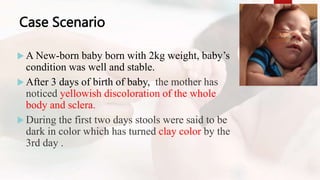
 A New-born baby born with 2kg weight, baby’s
condition was well and stable.
 After 3 days of birth of baby, the mother has
noticed yellowish discoloration of the whole
body and sclera.
 During the first two days stools were said to be
dark in color which has turned clay color by the
3rd day .
NEONATAL JAUNDICE
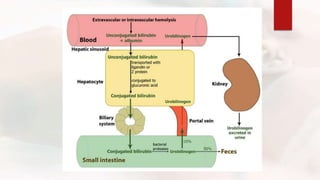
Swaraj Suman
MSc. 1st year student
What is the Neonatal Jaundice?
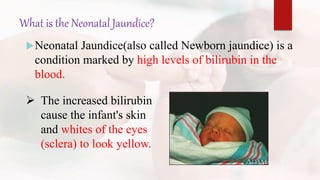
Neonatal Jaundice(also called Newborn jaundice) is a
condition marked by high levels of bilirubin in the
blood.
 The increased bilirubin
cause the infant's skin
and whites of the eyes
(sclera) to look yellow.
Neonatal Jaundice
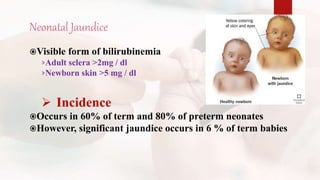
Visible form of bilirubinemia
›Adult sclera >2mg / dl
›Newborn skin >5 mg / dl
 Incidence
Occurs in 60% of term and 80% of preterm neonates
However, significant jaundice occurs in 6 % of term babies
Special characteristic in neonates
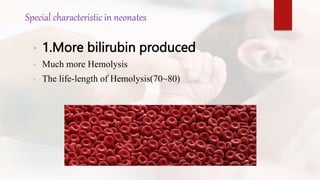
• 1.More bilirubin produced
• Much more Hemolysis
• The life-length of Hemolysis(70~80)
Special characteristic in neonates
• 2.The low capability of albumin on
unconjugated bilirubin transportation
• Acid intoxication
• Less albumin in neonates
Special characteristic in neonates
• 3.The low capability of hepatocyte
• The primary development of Hepato-enzyme system
• Easy-broken hepato-enzyme system
• After-born, the blood glucose level is very low.
Special characteristic in neonates
• 4.High workload of the hepato-enteric
circulation
• Less bacterial
• Low enzymatic activity in intestine
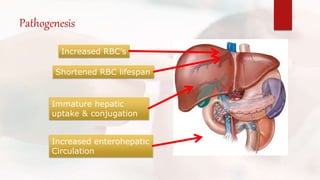
Increased RBC’s
Shortened RBC lifespan
Immature hepatic
uptake & conjugation
Increased enterohepatic
Circulation
Pathogenesis
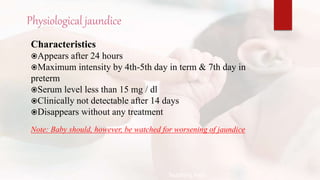
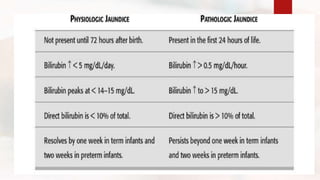
Physiological jaundice
Characteristics
Appears after 24 hours
Maximum intensity by 4th-5th day in term & 7th day in
preterm
Serum level less than 15 mg / dl
Clinically not detectable after 14 days
Disappears without any treatment
Note: Baby should, however, be watched for worsening of jaundice
Teaching Aids:
N
J
-
1
1
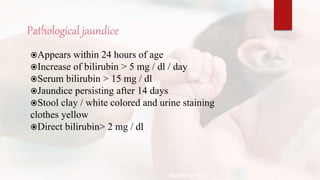
Pathological jaundice
Appears within 24 hours of age
Increase of bilirubin > 5 mg / dl / day
Serum bilirubin > 15 mg / dl
Jaundice persisting after 14 days
Stool clay / white colored and urine staining
clothes yellow
Direct bilirubin> 2 mg / dl
Teaching Aids:
N
J
-
1
2
Difference between pathological
and physiological Jaundice ?????
Causes of jaundice
 Appearing within 24 hours of age
Hemolytic disease of NB : Rh, ABO
Infections: TORCH, malaria, bacterial
G6PD deficiency
 Appearing between 24-72 hours of life
Physiological
Sepsis
Polycythemia
Concealed hemorrhage
Intraventricular hemorrhage
Increased entero-hepatic circulation
Teaching Aids:
N
J
-
1
5
Causes of jaundice
 After 72 hours of age
Sepsis
Cephalo-hematoma
Neonatal hepatitis
Extra-hepatic biliary atresia
Breast milk jaundice
Metabolic disorders
Teaching Aids:
N
J
-
1
6
Common causes in India
Physiological
Blood group incompatibility
G6PD deficiency
Bruising and cephalo-hematoma
Intrauterine and postnatal infections
Breast milk jaundice
Teaching Aids:
N
J
-
1
7
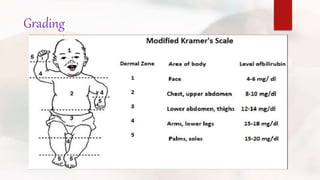
Grading
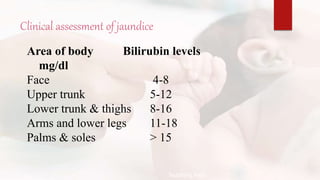
Clinical assessment of jaundice
Area of body Bilirubin levels
mg/dl
Face 4-8
Upper trunk 5-12
Lower trunk & thighs 8-16
Arms and lower legs 11-18
Palms & soles > 15
Teaching Aids:
N
J
-
1
9
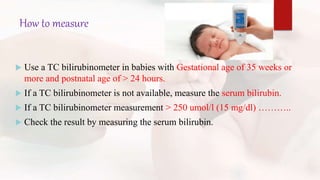
How to measure
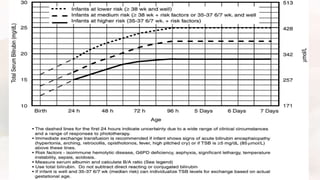
 Use a TC bilirubinometer in babies with Gestational age of 35 weeks or
more and postnatal age of > 24 hours.
 If a TC bilirubinometer is not available, measure the serum bilirubin.
 If a TC bilirubinometer measurement > 250 umol/l (15 mg/dl) ………..
 Check the result by measuring the serum bilirubin.
Approach to jaundiced baby
o Birth weight
o Gestation and postnatal age
o Assess clinical condition (well or ill)
Physiological or Pathological
o Look for evidence of kernicterus* in deeply jaundiced
Newborn
o *Lethargy and poor feeding, poor or absent Moro's,
opisthotonos or convulsions.
Teaching Aids:
N
J
-
2
1
Diagnosis
Maternal & perinatal history
Physical examination
Laboratory tests (must in all)
›Total & direct bilirubin*
›Blood group and Rh for mother and baby*
›Hematocrit, retic count and peripheral smear*
›Sepsis screen
›Liver and thyroid function
›TORCH titers, Liver scan when conjugated hyperbilirubinemia
Teaching Aids:
N
J
-
2
2
Management
Rationale: reduce level of serum bilirubin and
prevent bilirubin toxicity
Prevention of hyperbilirubinemia: early feeds,
adequate hydration
Reduction of bilirubin levels: phototherapy,
Exchange transfusion, Drugs
Teaching Aids:
N
J
-
2
4
Mechanism of phototherapy
 Photo-oxidation
 Configurational isomerization- Water – soluble E-Z isomers
 Structural isomerization- lumirubin
 Out of 3 mechanism structural isomerization is most
effective.
Principle of phototherapy
Native bilirubin Photo isomers of
bilirubin
Insoluble Soluble
NJ - 26
460-490nm
of light
Phototherapy
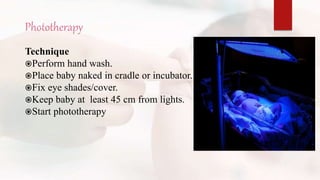
Technique
Perform hand wash.
Place baby naked in cradle or incubator.
Fix eye shades/cover.
Keep baby at least 45 cm from lights.
Start phototherapy
N
J
-
2
7
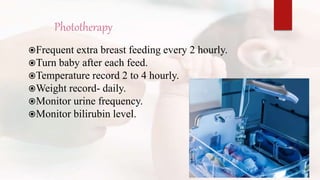
Phototherapy
Frequent extra breast feeding every 2 hourly.
Turn baby after each feed.
Temperature record 2 to 4 hourly.
Weight record- daily.
Monitor urine frequency.
Monitor bilirubin level.
Key point in the practical execution
of phototherapy
1.The infant should be naked except for diaper , eye to be
covered
2. Distance between the skin and light source (30-45cm) .
3. When used spotlight , the infant is placed in centre .
4. Routinely add 10-15% extra fluid .
5. Timing of follow –up and serum bilirubin testing must
be individualized.
Lights used in phototherapy
 1. Micro white halogen Light
 2. Fluoro- 2 blue and 2 white fluorescent lights
 Types of Phototherapy unit
 Single surface unit
 Double surface unit
 Triple surface unit
Side effects of phototherapy
Increased insensible water loss
Loose stools
Skin rash
Bronze baby syndrome
Hyperthermia
Upsets maternal baby interaction
May result in hypocalcemia
Teaching Aids:
N
J
-
3
2
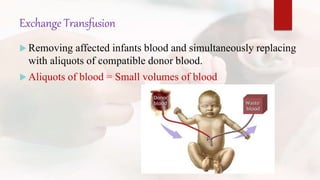
Exchange Transfusion
 Removing affected infants blood and simultaneously replacing
with aliquots of compatible donor blood.
 Aliquots of blood = Small volumes of blood
Indications
ABO incompatibility
Rh isoimmunization
Indirect serum bilirubin- 20mg/100 ml or more during first
5 days of life.
Septicemia
DIC
Life threatening metabolic disorders
Acute renal and hepatic failure
Poisoning
Symptomatic Polycythemia
Teaching Aids:
Method
1. Infants stomach should be emptied before transfusion to prevent aspiration.
2. Vital signs monitored.
3. With strict aseptic technique, the umbilical vein is cannulated with catheter.
4. Aspiration of 20ml of infant blood alternating with infusion of 20ml of donor
blood.
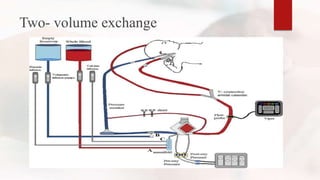
5. Goal- An isovolumetric exchange of approximately two blood volumes of the
infant .
Eg.- Double-volume exchange- 2 x blood volume = 2 x 80 cc/kg = 160 cc/kg
Choice of blood for exchange
blood transfusion
 ABO incompatibility
› Use O blood crossmatched against infant serum.
› In less severe cases- Identify ABO group of both mother and baby.
 Rh isoimmunization
› In Emergency- O Rh negative blood without crossmatching.
› In anticipated Rh sensitized infant birth- O Rh negative blood
crossmatched against maternal serum.
Criterions for Blood exchange transfusion :
 1. Transfuse blood as fresh as possible.
 2. Maintained at a temperature between 35 and 37° C throughout the
exchange transfusion.
 3. Kept well mixed and by gentle squeezing or agitation of the bag to
avoid sedimentation.
Types of exchange transfusion
 Three types of exchange transfusion are commonly used:
 A) Two- volume exchange
 B) Partial exchange ( For treatment polycythemia or anemia )
 C) Intrauterine exchanges
 A one volume exchange transfusion results in removal of 70% to 75% of the
neonates RBC.
 A two volume exchange replaces 90% the optimal volume for an exchange
transfusion is twice the infant’s blood volume.
Two- volume exchange
Contd..
 Traditionally, the rule of “10/30” was followed for RBC transfusion, according to
which a Hb level of 10 g/dl or a hematocrit of 30% was recommended in
surgical patients.
 Blood components must be transfused within 4 hours of issue.
 If the transfusion is interrupted for any reason, administration must be discontinued
after 4 hours even if the transfusion is not complete.
Complications of exchange transfusion
1. Anemia
2. Cholestasis
3. Inspissated bile syndrome
4. Portal vein thrombosis
5. Portal hypertension
DRUGS to treat neonatal jaundice
 Phenobarbitone - Induces liver enzymes-increases conjugation
 Metalloporphyrins- Inhibits heme oxygenase
 IVIG- Inhibits hemolysis
 Oral agar agar &cholestyramine- decreases entero-hepatic circulation
 Albumin infusions-increases bilirubin binding
Metalloporphyrins
 Metalloporphyrins are inhibitors of the rate-limiting enzyme,
heme oxygenase, in the pathway of heme degradation leading to
bilirubin production.
 Tin mesoporphyrin has been most extensively studied in
human infants and has been shown to reduce the need for
phototherapy.
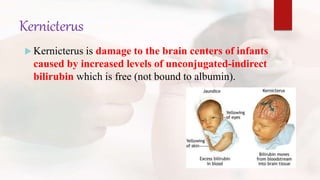
Kernicterus
 Kernicterus is damage to the brain centers of infants
caused by increased levels of unconjugated-indirect
bilirubin which is free (not bound to albumin).
Journal Review
 Hyperbilirubinemia in Neonates: Types, Causes, Clinical Examinations, Preventive Measures and Treatments: A Narrative
Review Article
 2016(May) -Sana ULLAH,1 Khaista RAHMAN,2 and Mehdi HEDAYATI3,*
 Methods - The main databases including Scopus, Pubmed, MEDLINE, Google scholar and Science Direct were researched to
obtain the original papers related to the newborns’ hyperbilirubinemia. The main terms used to literature search were
“newborns’ hyperbilirubinemia”, “newborns’ jaundice”, “Physiological Jaundice” and “Patholigical Jaundice”.
 Results - Neonatal jaundice due to breast milk feeding is also sometimes observed. Hemolytic jaundice occurs because of
the incompatibility of blood groups with ABO and Rh factors, when the fetus and mother blood groups are not compatible
and the fetus blood crosses the barrier of the umbilical cord before birth causing fetus blood hemolysis owing to severe
immune response.
 Conclusion: Jaundice is easily diagnosable however require quick and on the spot treatment. If not treated properly, it leads
to many complications. Currently the treatment options for jaundice include photo therapy, chemotherapy, and vaccinations.
summary
NEONATAL JAUNDICE .pptx

NEONATAL JAUNDICE .pptx

  • 1.
    Case Scenario  ANew-born baby born with 2kg weight, baby’s condition was well and stable.  After 3 days of birth of baby, the mother has noticed yellowish discoloration of the whole body and sclera.  During the first two days stools were said to be dark in color which has turned clay color by the 3rd day .
  • 2.
  • 3.
    What is theNeonatal Jaundice? Neonatal Jaundice(also called Newborn jaundice) is a condition marked by high levels of bilirubin in the blood.  The increased bilirubin cause the infant's skin and whites of the eyes (sclera) to look yellow.
  • 4.
    Neonatal Jaundice Visible formof bilirubinemia ›Adult sclera >2mg / dl ›Newborn skin >5 mg / dl  Incidence Occurs in 60% of term and 80% of preterm neonates However, significant jaundice occurs in 6 % of term babies
  • 6.
    Special characteristic inneonates • 1.More bilirubin produced • Much more Hemolysis • The life-length of Hemolysis(70~80)
  • 7.
    Special characteristic inneonates • 2.The low capability of albumin on unconjugated bilirubin transportation • Acid intoxication • Less albumin in neonates
  • 8.
    Special characteristic inneonates • 3.The low capability of hepatocyte • The primary development of Hepato-enzyme system • Easy-broken hepato-enzyme system • After-born, the blood glucose level is very low.
  • 9.
    Special characteristic inneonates • 4.High workload of the hepato-enteric circulation • Less bacterial • Low enzymatic activity in intestine
  • 10.
    Increased RBC’s Shortened RBClifespan Immature hepatic uptake & conjugation Increased enterohepatic Circulation Pathogenesis
  • 11.
    Physiological jaundice Characteristics Appears after24 hours Maximum intensity by 4th-5th day in term & 7th day in preterm Serum level less than 15 mg / dl Clinically not detectable after 14 days Disappears without any treatment Note: Baby should, however, be watched for worsening of jaundice Teaching Aids: N J - 1 1
  • 12.
    Pathological jaundice Appears within24 hours of age Increase of bilirubin > 5 mg / dl / day Serum bilirubin > 15 mg / dl Jaundice persisting after 14 days Stool clay / white colored and urine staining clothes yellow Direct bilirubin> 2 mg / dl Teaching Aids: N J - 1 2
  • 13.
    Difference between pathological andphysiological Jaundice ?????
  • 15.
    Causes of jaundice Appearing within 24 hours of age Hemolytic disease of NB : Rh, ABO Infections: TORCH, malaria, bacterial G6PD deficiency  Appearing between 24-72 hours of life Physiological Sepsis Polycythemia Concealed hemorrhage Intraventricular hemorrhage Increased entero-hepatic circulation Teaching Aids: N J - 1 5
  • 16.
    Causes of jaundice After 72 hours of age Sepsis Cephalo-hematoma Neonatal hepatitis Extra-hepatic biliary atresia Breast milk jaundice Metabolic disorders Teaching Aids: N J - 1 6
  • 17.
    Common causes inIndia Physiological Blood group incompatibility G6PD deficiency Bruising and cephalo-hematoma Intrauterine and postnatal infections Breast milk jaundice Teaching Aids: N J - 1 7
  • 18.
  • 19.
    Clinical assessment ofjaundice Area of body Bilirubin levels mg/dl Face 4-8 Upper trunk 5-12 Lower trunk & thighs 8-16 Arms and lower legs 11-18 Palms & soles > 15 Teaching Aids: N J - 1 9
  • 20.
    How to measure Use a TC bilirubinometer in babies with Gestational age of 35 weeks or more and postnatal age of > 24 hours.  If a TC bilirubinometer is not available, measure the serum bilirubin.  If a TC bilirubinometer measurement > 250 umol/l (15 mg/dl) ………..  Check the result by measuring the serum bilirubin.
  • 21.
    Approach to jaundicedbaby o Birth weight o Gestation and postnatal age o Assess clinical condition (well or ill) Physiological or Pathological o Look for evidence of kernicterus* in deeply jaundiced Newborn o *Lethargy and poor feeding, poor or absent Moro's, opisthotonos or convulsions. Teaching Aids: N J - 2 1
  • 22.
    Diagnosis Maternal & perinatalhistory Physical examination Laboratory tests (must in all) ›Total & direct bilirubin* ›Blood group and Rh for mother and baby* ›Hematocrit, retic count and peripheral smear* ›Sepsis screen ›Liver and thyroid function ›TORCH titers, Liver scan when conjugated hyperbilirubinemia Teaching Aids: N J - 2 2
  • 24.
    Management Rationale: reduce levelof serum bilirubin and prevent bilirubin toxicity Prevention of hyperbilirubinemia: early feeds, adequate hydration Reduction of bilirubin levels: phototherapy, Exchange transfusion, Drugs Teaching Aids: N J - 2 4
  • 25.
    Mechanism of phototherapy Photo-oxidation  Configurational isomerization- Water – soluble E-Z isomers  Structural isomerization- lumirubin  Out of 3 mechanism structural isomerization is most effective.
  • 26.
    Principle of phototherapy Nativebilirubin Photo isomers of bilirubin Insoluble Soluble NJ - 26 460-490nm of light
  • 27.
    Phototherapy Technique Perform hand wash. Placebaby naked in cradle or incubator. Fix eye shades/cover. Keep baby at least 45 cm from lights. Start phototherapy N J - 2 7
  • 28.
    Phototherapy Frequent extra breastfeeding every 2 hourly. Turn baby after each feed. Temperature record 2 to 4 hourly. Weight record- daily. Monitor urine frequency. Monitor bilirubin level.
  • 29.
    Key point inthe practical execution of phototherapy 1.The infant should be naked except for diaper , eye to be covered 2. Distance between the skin and light source (30-45cm) . 3. When used spotlight , the infant is placed in centre . 4. Routinely add 10-15% extra fluid . 5. Timing of follow –up and serum bilirubin testing must be individualized.
  • 30.
    Lights used inphototherapy  1. Micro white halogen Light  2. Fluoro- 2 blue and 2 white fluorescent lights  Types of Phototherapy unit  Single surface unit  Double surface unit  Triple surface unit
  • 32.
    Side effects ofphototherapy Increased insensible water loss Loose stools Skin rash Bronze baby syndrome Hyperthermia Upsets maternal baby interaction May result in hypocalcemia Teaching Aids: N J - 3 2
  • 33.
    Exchange Transfusion  Removingaffected infants blood and simultaneously replacing with aliquots of compatible donor blood.  Aliquots of blood = Small volumes of blood
  • 34.
    Indications ABO incompatibility Rh isoimmunization Indirectserum bilirubin- 20mg/100 ml or more during first 5 days of life. Septicemia DIC Life threatening metabolic disorders Acute renal and hepatic failure Poisoning Symptomatic Polycythemia Teaching Aids:
  • 35.
    Method 1. Infants stomachshould be emptied before transfusion to prevent aspiration. 2. Vital signs monitored. 3. With strict aseptic technique, the umbilical vein is cannulated with catheter. 4. Aspiration of 20ml of infant blood alternating with infusion of 20ml of donor blood. 5. Goal- An isovolumetric exchange of approximately two blood volumes of the infant . Eg.- Double-volume exchange- 2 x blood volume = 2 x 80 cc/kg = 160 cc/kg
  • 36.
    Choice of bloodfor exchange blood transfusion  ABO incompatibility › Use O blood crossmatched against infant serum. › In less severe cases- Identify ABO group of both mother and baby.  Rh isoimmunization › In Emergency- O Rh negative blood without crossmatching. › In anticipated Rh sensitized infant birth- O Rh negative blood crossmatched against maternal serum.
  • 37.
    Criterions for Bloodexchange transfusion :  1. Transfuse blood as fresh as possible.  2. Maintained at a temperature between 35 and 37° C throughout the exchange transfusion.  3. Kept well mixed and by gentle squeezing or agitation of the bag to avoid sedimentation.
  • 38.
    Types of exchangetransfusion  Three types of exchange transfusion are commonly used:  A) Two- volume exchange  B) Partial exchange ( For treatment polycythemia or anemia )  C) Intrauterine exchanges  A one volume exchange transfusion results in removal of 70% to 75% of the neonates RBC.  A two volume exchange replaces 90% the optimal volume for an exchange transfusion is twice the infant’s blood volume.
  • 39.
  • 40.
    Contd..  Traditionally, therule of “10/30” was followed for RBC transfusion, according to which a Hb level of 10 g/dl or a hematocrit of 30% was recommended in surgical patients.  Blood components must be transfused within 4 hours of issue.  If the transfusion is interrupted for any reason, administration must be discontinued after 4 hours even if the transfusion is not complete.
  • 41.
    Complications of exchangetransfusion 1. Anemia 2. Cholestasis 3. Inspissated bile syndrome 4. Portal vein thrombosis 5. Portal hypertension
  • 42.
    DRUGS to treatneonatal jaundice  Phenobarbitone - Induces liver enzymes-increases conjugation  Metalloporphyrins- Inhibits heme oxygenase  IVIG- Inhibits hemolysis  Oral agar agar &cholestyramine- decreases entero-hepatic circulation  Albumin infusions-increases bilirubin binding
  • 43.
    Metalloporphyrins  Metalloporphyrins areinhibitors of the rate-limiting enzyme, heme oxygenase, in the pathway of heme degradation leading to bilirubin production.  Tin mesoporphyrin has been most extensively studied in human infants and has been shown to reduce the need for phototherapy.
  • 44.
    Kernicterus  Kernicterus isdamage to the brain centers of infants caused by increased levels of unconjugated-indirect bilirubin which is free (not bound to albumin).
  • 45.
    Journal Review  Hyperbilirubinemiain Neonates: Types, Causes, Clinical Examinations, Preventive Measures and Treatments: A Narrative Review Article  2016(May) -Sana ULLAH,1 Khaista RAHMAN,2 and Mehdi HEDAYATI3,*  Methods - The main databases including Scopus, Pubmed, MEDLINE, Google scholar and Science Direct were researched to obtain the original papers related to the newborns’ hyperbilirubinemia. The main terms used to literature search were “newborns’ hyperbilirubinemia”, “newborns’ jaundice”, “Physiological Jaundice” and “Patholigical Jaundice”.  Results - Neonatal jaundice due to breast milk feeding is also sometimes observed. Hemolytic jaundice occurs because of the incompatibility of blood groups with ABO and Rh factors, when the fetus and mother blood groups are not compatible and the fetus blood crosses the barrier of the umbilical cord before birth causing fetus blood hemolysis owing to severe immune response.  Conclusion: Jaundice is easily diagnosable however require quick and on the spot treatment. If not treated properly, it leads to many complications. Currently the treatment options for jaundice include photo therapy, chemotherapy, and vaccinations.
  • 47.