Exam Preparation


   Module Leader: Dr Jane Chang
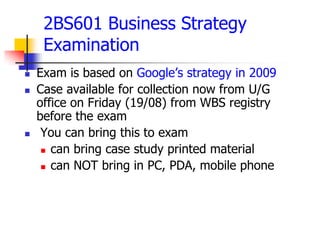
2BS601 Business Strategy
     Examination
   Exam is based on Google’s strategy in 2009
   Case available for collection now from U/G
    office on Friday (19/08) from WBS registry
    before the exam
    You can bring this to exam
      can bring case study printed material

      can NOT bring in PC, PDA, mobile phone
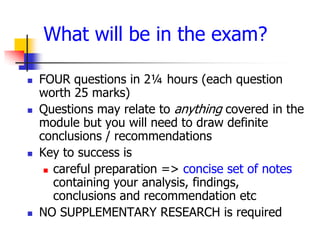
What will be in the exam?

   FOUR questions in 2¼ hours (each question
    worth 25 marks)
   Questions may relate to anything covered in the
    module but you will need to draw definite
    conclusions / recommendations
   Key to success is
      careful preparation => concise set of notes
       containing your analysis, findings,
       conclusions and recommendation etc
   NO SUPPLEMENTARY RESEARCH is required
The best answers show
     mature judgement
   Focus on a few key RELEVANT points and
    develop them IN DEPTH
   Use theory as basis of precise analysis
       But don’t regurgitate it without applying it
   Consider trade-offs, risks, limitations etc
   JUSTIFY your views / decisions by
       referring to the findings of your analysis including
        calculation derived from data provided in case
       theory
       referring to examples in case
   Clear CONCLUSIONS
       Questions may require you to combine the results of
        several analytical tools to form conclusions
You should
   Spend time fully analysing the case
    before the exam
   See the Guide for Case Study Analysis
    which is in your workbooks
   Bring a concise set of notes containing
    your analysis, findings, conclusions and
    recommendations into the exam with
    you
Google
   The case study describes the company’s
    strategy and examines the strategic
    challenges now facing the company.
   You are a management consultant who has
    been commissioned by Google’s senior
    management to advise them on their future
    strategy for the next 3 years.
The key strategic question is

   How can Google maintain its dominant
    position?
First step - Industry analysis

    Identify key driving forces capable of
     causing significant change in industry
     conditions
    Assess the attractiveness of the industry
       Opportunities and threats

       Potential to deliver value

    Analyse what a firm needs to:
       Survive in an industry

       Succeed in an industry
Clearly state
   The boundaries of your industry as it
    will have an impact on your analysis


   Are you including on-line,
    supermarkets etc inside or outside
    your industry boundary?
Driving Forces
   Derived from
      Porter’s Five Forces

      ILC

      PEST

   Combine / rationalise analysis findings
    to derive 3 or 4 Driving Forces which
    will have a SIGNIFICANT impact on
    Industry
Impact of Driving Forces on
    Future Profitability of Industry
   Key outcome of Industry Analysis is to assess
    impact on future Profitability of Industry
      What is the effect of the driving forces on
       demand?
      Are the driving forces increasing
       competition?
      Will the driving forces lead to higher
       profitability?
   Remember to consider assumptions,
    limitations, etc of your analysis
      State ranges and / or confidence rating of
       predictions
Survival and success factors
If industry has/is..    Survival factors (e.g.) Success factors (e.g.)

Powerful buyers with    Meeting minimum         Strong differentiation
low switching costs     buyer requirements      Negotiation skills
                                                Strong relationships
Powerful suppliers      Negotiation skills      Scale
                                                Relationships of trust
Low barriers to entry [Survival difficult       Strong differentiation
Threat of substitution without success]         Low costs
Fast-growing            Technology              Advanced technology
                        Cash for growth
Mature                  Minimum economic        Scale or other cost
                        scale, cost position    advantage
                                                Buyer relationships
Step 2 - Competitor / Market
Analysis

   What FUTURE moves are
                                Competitor
    they likely to make? What   Analysis:
    will be the impact on        Who are the
    Google’s revenues?          competition?
                                How are they
   Which company is in the     positioned?
    best position to be
    successful in the future?
Competitor Analysis – Key
Tools
   Strategic Group Maps
      Who are the competition?

      How are they positioned?


   Competitor Intelligence
     What strategic moves are

      competitors likely to make next?
From your Industry and
Competitor analyses you can
   Identify opportunities and threats for
    your SWOT

   Identify KPIs (SSFs + Competitor
    Analysis + Benchmarking) which give
    you the key skills, capabilities,
    competences (i.e. the strengths)
    required to be successful in the industry
Step 3 - Internal Analysis
(Strengths and Weaknesses)
   Internal Analysis determines if the
    company has these skills and resources
    i.e. Strengths and Weaknesses in SWOT

   Analysis Tools – Value Chain Analysis
    and Competitive Strength Analysis
In the case study…
   Some of the strengths and weaknesses are
    NOT explicitly mentioned
   You will need to infer / deduce them from
      Understanding what the company’s

       strategy & business model are (very
       important)
      Analysing the data given (particularly the

       financial data)
      NOTE: Financial data is also given for

       Google’s competitors so you can make
       comparisons
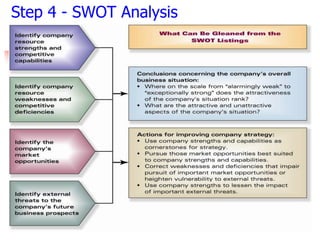
Step 4 - SWOT Analysis
Conclusions from SWOT
   What is Google’s overall situation?
       Does it have an attractive set of resource
        strengths?
       How serious are the weaknesses and competitive
        deficiencies?
       Do the strengths outweigh the weaknesses by an
        attractive margin?
       Are there attractive market opportunities that can
        be exploited using its strengths ?
       Are the threats alarming? Can it use its strengths
        to limit their impact?
       How strong is the overall situation?
Conclusions from SWOT
   What are the implications for strategic
    action?
       Which competitive capabilities need to be
        strengthened immediately?
       What actions should be taken to reduce
        the company’s competitive liabilities?
       Which market opportunities should be top
        priority in future strategic initiatives? Which
        opportunities should be ignored?
       What should the company be doing to
        guard against the threats to its well-being?
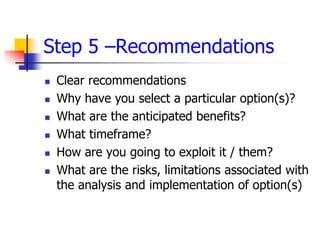
Step 5 –Recommendations
   Clear recommendations
   Why have you select a particular option(s)?
   What are the anticipated benefits?
   What timeframe?
   How are you going to exploit it / them?
   What are the risks, limitations associated with
    the analysis and implementation of option(s)

Exam preparation nbs

  • 1.
    Exam Preparation Module Leader: Dr Jane Chang
  • 2.
    2BS601 Business Strategy Examination  Exam is based on Google’s strategy in 2009  Case available for collection now from U/G office on Friday (19/08) from WBS registry before the exam  You can bring this to exam  can bring case study printed material  can NOT bring in PC, PDA, mobile phone
  • 3.
    What will bein the exam?  FOUR questions in 2¼ hours (each question worth 25 marks)  Questions may relate to anything covered in the module but you will need to draw definite conclusions / recommendations  Key to success is  careful preparation => concise set of notes containing your analysis, findings, conclusions and recommendation etc  NO SUPPLEMENTARY RESEARCH is required
  • 4.
    The best answersshow mature judgement  Focus on a few key RELEVANT points and develop them IN DEPTH  Use theory as basis of precise analysis  But don’t regurgitate it without applying it  Consider trade-offs, risks, limitations etc  JUSTIFY your views / decisions by  referring to the findings of your analysis including calculation derived from data provided in case  theory  referring to examples in case  Clear CONCLUSIONS  Questions may require you to combine the results of several analytical tools to form conclusions
  • 5.
    You should  Spend time fully analysing the case before the exam  See the Guide for Case Study Analysis which is in your workbooks  Bring a concise set of notes containing your analysis, findings, conclusions and recommendations into the exam with you
  • 6.
    Google  The case study describes the company’s strategy and examines the strategic challenges now facing the company.  You are a management consultant who has been commissioned by Google’s senior management to advise them on their future strategy for the next 3 years.
  • 7.
    The key strategicquestion is  How can Google maintain its dominant position?
  • 8.
    First step -Industry analysis  Identify key driving forces capable of causing significant change in industry conditions  Assess the attractiveness of the industry  Opportunities and threats  Potential to deliver value  Analyse what a firm needs to:  Survive in an industry  Succeed in an industry
  • 9.
    Clearly state  The boundaries of your industry as it will have an impact on your analysis  Are you including on-line, supermarkets etc inside or outside your industry boundary?
  • 10.
    Driving Forces  Derived from  Porter’s Five Forces  ILC  PEST  Combine / rationalise analysis findings to derive 3 or 4 Driving Forces which will have a SIGNIFICANT impact on Industry
  • 11.
    Impact of DrivingForces on Future Profitability of Industry  Key outcome of Industry Analysis is to assess impact on future Profitability of Industry  What is the effect of the driving forces on demand?  Are the driving forces increasing competition?  Will the driving forces lead to higher profitability?  Remember to consider assumptions, limitations, etc of your analysis  State ranges and / or confidence rating of predictions
  • 12.
    Survival and successfactors If industry has/is.. Survival factors (e.g.) Success factors (e.g.) Powerful buyers with Meeting minimum Strong differentiation low switching costs buyer requirements Negotiation skills Strong relationships Powerful suppliers Negotiation skills Scale Relationships of trust Low barriers to entry [Survival difficult Strong differentiation Threat of substitution without success] Low costs Fast-growing Technology Advanced technology Cash for growth Mature Minimum economic Scale or other cost scale, cost position advantage Buyer relationships
  • 13.
    Step 2 -Competitor / Market Analysis  What FUTURE moves are Competitor they likely to make? What Analysis: will be the impact on Who are the Google’s revenues? competition? How are they  Which company is in the positioned? best position to be successful in the future?
  • 14.
    Competitor Analysis –Key Tools  Strategic Group Maps  Who are the competition?  How are they positioned?  Competitor Intelligence  What strategic moves are competitors likely to make next?
  • 15.
    From your Industryand Competitor analyses you can  Identify opportunities and threats for your SWOT  Identify KPIs (SSFs + Competitor Analysis + Benchmarking) which give you the key skills, capabilities, competences (i.e. the strengths) required to be successful in the industry
  • 16.
    Step 3 -Internal Analysis (Strengths and Weaknesses)  Internal Analysis determines if the company has these skills and resources i.e. Strengths and Weaknesses in SWOT  Analysis Tools – Value Chain Analysis and Competitive Strength Analysis
  • 17.
    In the casestudy…  Some of the strengths and weaknesses are NOT explicitly mentioned  You will need to infer / deduce them from  Understanding what the company’s strategy & business model are (very important)  Analysing the data given (particularly the financial data)  NOTE: Financial data is also given for Google’s competitors so you can make comparisons
  • 18.
    Step 4 -SWOT Analysis
  • 19.
    Conclusions from SWOT  What is Google’s overall situation?  Does it have an attractive set of resource strengths?  How serious are the weaknesses and competitive deficiencies?  Do the strengths outweigh the weaknesses by an attractive margin?  Are there attractive market opportunities that can be exploited using its strengths ?  Are the threats alarming? Can it use its strengths to limit their impact?  How strong is the overall situation?
  • 20.
    Conclusions from SWOT  What are the implications for strategic action?  Which competitive capabilities need to be strengthened immediately?  What actions should be taken to reduce the company’s competitive liabilities?  Which market opportunities should be top priority in future strategic initiatives? Which opportunities should be ignored?  What should the company be doing to guard against the threats to its well-being?
  • 21.
    Step 5 –Recommendations  Clear recommendations  Why have you select a particular option(s)?  What are the anticipated benefits?  What timeframe?  How are you going to exploit it / them?  What are the risks, limitations associated with the analysis and implementation of option(s)