PRESENTER:
Deepti Kothari
Ad. No.-2013HS1M
Deptt. of Extension Education and Communication Management,
I.C. College of Home Science,
CCSHAU, Hisar
ANALYSIS
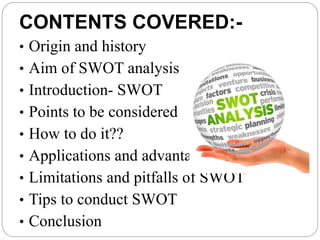
CONTENTS COVERED:-
• Origin and history
• Aim of SWOT analysis
• Introduction- SWOT
• Points to be considered
• How to do it??
• Applications and advantages
• Limitations and pitfalls of SWOT
• Tips to conduct SWOT
• Conclusion
SWOT
Analysis
Opportunity
Threats
Strength
Weakness
I
N
T
E
R
N
A
L
F
A
C
T
O
R
S
E
X
T
E
R
N
A
L
F
A
C
T
O
R
S
History and Origin
 The origins of the SWOT analysis technique is credited
by Albert Humphrey, who led a led a convention at the
Stanford Research Institute (now SRI International) in
the 1960s and 1970s using data from Fortune 500
companies.
 The goal was to identify why corporate planning failed.
 Humphrey and the original research team used the
categories “What is good in the present is Satisfactory,
good in the future is an Opportunity; bad in the present is
a Fault and bad in the future is a Threat.”
Cntd…
 SWOT Analysis was earlier known as SOFT Analysis.
 It was funded by fortune 500 company, and took 9 years
to develop.
 In 1964 Urick and Orr at a conference changed the Fault
of F to W for Weakness.
 The SWOT method was originally developed for
business and industry, but it is equally useful in other
arenas associated and dealing with personal growth.
SWOT
 A process generates information that is helpful in
matching an organization or group’s goals, programs, and
capacities to the social environment in which it operates.
• The SWOT analysis is great for developing an
understanding of an organization or situation and
decision-making for all sorts of situations in business,
organizations and for individuals.
• The SWOT analysis approach headings provide a good
framework for reviewing strategy, position and direction
of a company, product, project or person (career).
Aim of SWOT analysis
 Explore possibilities for new efforts or solutions to
problems and thus offer helpful perspectives at any stage of
an effort
 Make decisions about the best path for your initiative.
Identifying your opportunities for success in context of
threats to success can clarify directions and choices.
 Determine where change is possible. If you are at a point of
making a decision, an inventory of your strengths and
weaknesses can reveal priorities as well as possibilities.
 Adjust and refine plans mid-course. A new opportunity
might open wider avenues, while a new threat could close a
path that once existed.
 Offers simple way of communicating and is an excellent
way to organize gathered information from studies /surveys.
Cntd…
 SWOT analysis provides information that is helpful in matching
the firm's resources and capabilities to the competitive
environment in which it operates.
 Used as framework for organizing and using data and
information gained from situation analysis of internal and
external environment.
 To provide linearity to the decision making process allowing
complex ideas to be presented systematically.
 To organize the important factors linked to success and failure in
the business world.
 To bring a clearer common purpose and understanding of factors
for success.
 To help decision makers share and compare ideas.
STRENGTH- What you do very well – maybe
better than anyone else
• Positive tangible and intangible
attributes, internal to an
organization.
• They are within the organization’s
control.
• A good first step before a more in-
depth analysis or good summary of
detailed findings.
S
Examples of strengths
 Abundant financial resources,
 Well-known brand name,
 Economies of scale,
 Lower costs [raw materials or
processes],
 Superior management talent,
 Better marketing skills,
 Good distribution skills,
 Committed employees.
WEAKNESS- What you lack in or what
you don’t do very well
• Factors that are within an
organization’s control that weaken
ability to attain desired goal and
standards.
• Places organization at disadvantage
• Detracts and influences growth
• Are controllable and should be
minimized and eliminated.
W
Examples of weaknesses
 Limited financial resources,
 Weak spending on R & D,
 Very narrow product line,
 Limited distribution,
 Higher costs,
 Out-of-date products /
technology,
 Weak market image,
 Poor marketing skills,
 Limited management skills,
 Under-trained employees.
OPPORTUNITY - What is it that you
could do – but aren’t?
O
• Chances to make greater profit
• External attractive factors that
represent the reason for an
organization to exist and develop.
• Arise when organization takes
benefit of environmental
condition to plan and execute.
Examples of opportunities
 Rapid market growth,
 Rival firms are complacent,
 Changing customer
needs/tastes,
 New uses for product
discovered,
 Economic boom,
 Government deregulation,
 Sales decline for a substitute
product .
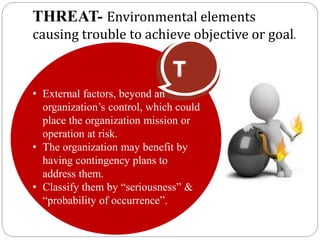
THREAT- Environmental elements
causing trouble to achieve objective or goal.
T
• External factors, beyond an
organization’s control, which could
place the organization mission or
operation at risk.
• The organization may benefit by
having contingency plans to
address them.
• Classify them by “seriousness” &
“probability of occurrence”.
Examples of threats
 Rapid market growth,
 Rival firms are complacent,
 Changing customer
needs/tastes,
 New uses for product
discovered,
 Economic boom,
 Government deregulation,
 Sales decline for a substitute
product .
!
Points to be considered in SWOT analysis
 How can we Use each Strength?
 How can we Stop each Weakness?
 How can we use each Opportunity?
 How can we Defend against each Threat?
Analyze internal and external environment
Perform SWOT and DOCUMENT
Prepare ACTION PLAN
1.
2.
3.
How to conduct SWOT Analysis?
1. Analyse Internal & External
Environment
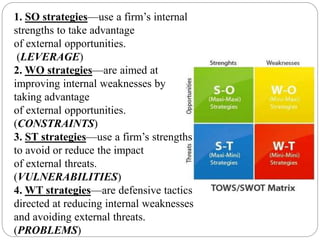
SWOT ANALYSIS MATRIX MODEL
• FUNDAMENTAL IDEA- The concept of determining
strengths, weaknesses, threats, and opportunities
• Graphical representation of the SWOT framework.
1. SO strategies—use a firm’s internal
strengths to take advantage
of external opportunities.
(LEVERAGE)
2. WO strategies—are aimed at
improving internal weaknesses by
taking advantage
of external opportunities.
(CONSTRAINTS)
3. ST strategies—use a firm’s strengths
to avoid or reduce the impact
of external threats.
(VULNERABILITIES)
4. WT strategies—are defensive tactics
directed at reducing internal weaknesses
and avoiding external threats.
(PROBLEMS)
2. Perform SWOT Analysis & Document
 Establish the objectives - Purpose of conducting a SWOT may
be wide / narrow, general / specific.
 Select contributors - Expert opinion may be required for SWOT
 Allocate research & information gathering tasks - Background
preparation can be carried out in two stages – Exploratory and
Detailed. Information on Strengths & Weaknesses should focus on
the internal factors.
 Create a workshop environment - Encourage an atmosphere
conducive to the free flow of information.
 Evaluate listed ideas against Objectives - With the lists
compiled, sort and group facts and ideas in relation to the
objectives.
 List Strengths, Weaknesses, Opportunities, & threats
 Carry your findings forward - Make sure that the SWOT
analysis is used in subsequent planning. Revisit your findings at
suitable time intervals.
3. Prepare Action Plan
Once the SWOT analysis has been completed, mark
each point with:
Things that MUST be addressed immediately
Things that can be handled now
Things that should be researched further
Things that should be planned for the future
Applications of SWOT
 A SWOT analysis can be used for:
 Workshop sessions
 Brainstorm meetings
 Problem solving
 Planning
 Product evaluation
 Competitor evaluation
 Personal Development Planning
 Decision Making
Advantages of SWOT
 In social work practice framework is beneficial because
it helps organizations decide whether or not an objective
is obtainable and therefore enables organizations to set
achievable goals, objectives, and steps to further the
social change or community development effort.
 In organisation it enables organizers to take visions and
produce practical and efficient outcomes in order to
effect long-lasting change, and it helps organizations
gather meaningful information in order to maximize their
potential.
 In a process regards the consideration of key
organizational priorities, such as gender and cultural
diversity, and fund-raising objectives.
Pitfalls of SWOT analysis
• May cause organizations to view circumstances as very
simple due to which certain key strategic contact may be
overlooked.
• Categorizing aspects as strengths, weaknesses, opportunities
& threats might be very subjective as there is great degree of
uncertainty in market.
• To be effective, SWOT needs to be conducted regularly. The
pace of change makes it difficult to anticipate developments.
• The data used in the analysis may be based on assumptions
that subsequently prove to be unfounded [good and bad].
• It lacks detailed structure, so key elements may get missed.
Limitations of SWOT
 SWOT can be misused as a technique, as it can be quickly
designed without critical thought leading to a
misrepresentation of SWOT, within an organization's
internal and external surroundings.
 Development of a swot analysis simply to defend
previously decided goals and objectives. Leads to:-
 Limitations on brainstorming possibilities and "real"
identification of barriers.
 Also places the organization’s interest above the well being
of the community.
 The design of a swot analysis by one or two community
workers is limiting to the realities of the forces specifically
external factors, and devalues the possible contributions of
community members.
Tips of conducting SWOT analysis
DO’S
 Be analytical and specific.
 Record all thoughts and ideas.
 Be selective in the final evaluation.
 Choose the right people for the
exercise.
 Choose a suitable SWOT leader or
facilitator.
 Think out of the box
 Be open to change
DON’T S
х Try to disguise weaknesses.
х Merely list errors and mistakes.
х Lose sight of external influences
and trends.
х Allow the SWOT to become a
blame-laying exercise.
х Ignore the outcomes at later stages
of the planning process.
Conclusion
 A SWOT analysis identifies your S, W, O and T to assist
you in making strategic plans and decisions.
 SWOT is a simple yet comprehensive way of assessing
the positive and negative forces within and without your
organization, so you can be better prepared to act
effectively
 The SWOT analysis prompts you to move in a balanced
way throughout your program.
 A SWOT analysis will be most helpful if used to support
the vision and mission of institution.
BRAINSTORM
 SITUATION: Opening of a coaching
institute in HAU Campus
Strengths???
Weaknesses???
Opportunities???
Threats???
Swot analysis
Swot analysis

Swot analysis

  • 2.
    PRESENTER: Deepti Kothari Ad. No.-2013HS1M Deptt.of Extension Education and Communication Management, I.C. College of Home Science, CCSHAU, Hisar ANALYSIS
  • 3.
    CONTENTS COVERED:- • Originand history • Aim of SWOT analysis • Introduction- SWOT • Points to be considered • How to do it?? • Applications and advantages • Limitations and pitfalls of SWOT • Tips to conduct SWOT • Conclusion
  • 4.
  • 5.
    History and Origin The origins of the SWOT analysis technique is credited by Albert Humphrey, who led a led a convention at the Stanford Research Institute (now SRI International) in the 1960s and 1970s using data from Fortune 500 companies.  The goal was to identify why corporate planning failed.  Humphrey and the original research team used the categories “What is good in the present is Satisfactory, good in the future is an Opportunity; bad in the present is a Fault and bad in the future is a Threat.”
  • 6.
    Cntd…  SWOT Analysiswas earlier known as SOFT Analysis.  It was funded by fortune 500 company, and took 9 years to develop.  In 1964 Urick and Orr at a conference changed the Fault of F to W for Weakness.  The SWOT method was originally developed for business and industry, but it is equally useful in other arenas associated and dealing with personal growth.
  • 7.
    SWOT  A processgenerates information that is helpful in matching an organization or group’s goals, programs, and capacities to the social environment in which it operates. • The SWOT analysis is great for developing an understanding of an organization or situation and decision-making for all sorts of situations in business, organizations and for individuals. • The SWOT analysis approach headings provide a good framework for reviewing strategy, position and direction of a company, product, project or person (career).
  • 8.
    Aim of SWOTanalysis  Explore possibilities for new efforts or solutions to problems and thus offer helpful perspectives at any stage of an effort  Make decisions about the best path for your initiative. Identifying your opportunities for success in context of threats to success can clarify directions and choices.  Determine where change is possible. If you are at a point of making a decision, an inventory of your strengths and weaknesses can reveal priorities as well as possibilities.  Adjust and refine plans mid-course. A new opportunity might open wider avenues, while a new threat could close a path that once existed.  Offers simple way of communicating and is an excellent way to organize gathered information from studies /surveys.
  • 9.
    Cntd…  SWOT analysisprovides information that is helpful in matching the firm's resources and capabilities to the competitive environment in which it operates.  Used as framework for organizing and using data and information gained from situation analysis of internal and external environment.  To provide linearity to the decision making process allowing complex ideas to be presented systematically.  To organize the important factors linked to success and failure in the business world.  To bring a clearer common purpose and understanding of factors for success.  To help decision makers share and compare ideas.
  • 10.
    STRENGTH- What youdo very well – maybe better than anyone else • Positive tangible and intangible attributes, internal to an organization. • They are within the organization’s control. • A good first step before a more in- depth analysis or good summary of detailed findings. S
  • 11.
    Examples of strengths Abundant financial resources,  Well-known brand name,  Economies of scale,  Lower costs [raw materials or processes],  Superior management talent,  Better marketing skills,  Good distribution skills,  Committed employees.
  • 12.
    WEAKNESS- What youlack in or what you don’t do very well • Factors that are within an organization’s control that weaken ability to attain desired goal and standards. • Places organization at disadvantage • Detracts and influences growth • Are controllable and should be minimized and eliminated. W
  • 13.
    Examples of weaknesses Limited financial resources,  Weak spending on R & D,  Very narrow product line,  Limited distribution,  Higher costs,  Out-of-date products / technology,  Weak market image,  Poor marketing skills,  Limited management skills,  Under-trained employees.
  • 14.
    OPPORTUNITY - Whatis it that you could do – but aren’t? O • Chances to make greater profit • External attractive factors that represent the reason for an organization to exist and develop. • Arise when organization takes benefit of environmental condition to plan and execute.
  • 15.
    Examples of opportunities Rapid market growth,  Rival firms are complacent,  Changing customer needs/tastes,  New uses for product discovered,  Economic boom,  Government deregulation,  Sales decline for a substitute product .
  • 16.
    THREAT- Environmental elements causingtrouble to achieve objective or goal. T • External factors, beyond an organization’s control, which could place the organization mission or operation at risk. • The organization may benefit by having contingency plans to address them. • Classify them by “seriousness” & “probability of occurrence”.
  • 17.
    Examples of threats Rapid market growth,  Rival firms are complacent,  Changing customer needs/tastes,  New uses for product discovered,  Economic boom,  Government deregulation,  Sales decline for a substitute product . !
  • 18.
    Points to beconsidered in SWOT analysis  How can we Use each Strength?  How can we Stop each Weakness?  How can we use each Opportunity?  How can we Defend against each Threat?
  • 19.
    Analyze internal andexternal environment Perform SWOT and DOCUMENT Prepare ACTION PLAN 1. 2. 3. How to conduct SWOT Analysis?
  • 20.
    1. Analyse Internal& External Environment
  • 21.
    SWOT ANALYSIS MATRIXMODEL • FUNDAMENTAL IDEA- The concept of determining strengths, weaknesses, threats, and opportunities • Graphical representation of the SWOT framework.
  • 22.
    1. SO strategies—usea firm’s internal strengths to take advantage of external opportunities. (LEVERAGE) 2. WO strategies—are aimed at improving internal weaknesses by taking advantage of external opportunities. (CONSTRAINTS) 3. ST strategies—use a firm’s strengths to avoid or reduce the impact of external threats. (VULNERABILITIES) 4. WT strategies—are defensive tactics directed at reducing internal weaknesses and avoiding external threats. (PROBLEMS)
  • 23.
    2. Perform SWOTAnalysis & Document  Establish the objectives - Purpose of conducting a SWOT may be wide / narrow, general / specific.  Select contributors - Expert opinion may be required for SWOT  Allocate research & information gathering tasks - Background preparation can be carried out in two stages – Exploratory and Detailed. Information on Strengths & Weaknesses should focus on the internal factors.  Create a workshop environment - Encourage an atmosphere conducive to the free flow of information.  Evaluate listed ideas against Objectives - With the lists compiled, sort and group facts and ideas in relation to the objectives.  List Strengths, Weaknesses, Opportunities, & threats  Carry your findings forward - Make sure that the SWOT analysis is used in subsequent planning. Revisit your findings at suitable time intervals.
  • 24.
    3. Prepare ActionPlan Once the SWOT analysis has been completed, mark each point with: Things that MUST be addressed immediately Things that can be handled now Things that should be researched further Things that should be planned for the future
  • 25.
    Applications of SWOT A SWOT analysis can be used for:  Workshop sessions  Brainstorm meetings  Problem solving  Planning  Product evaluation  Competitor evaluation  Personal Development Planning  Decision Making
  • 26.
    Advantages of SWOT In social work practice framework is beneficial because it helps organizations decide whether or not an objective is obtainable and therefore enables organizations to set achievable goals, objectives, and steps to further the social change or community development effort.  In organisation it enables organizers to take visions and produce practical and efficient outcomes in order to effect long-lasting change, and it helps organizations gather meaningful information in order to maximize their potential.  In a process regards the consideration of key organizational priorities, such as gender and cultural diversity, and fund-raising objectives.
  • 27.
    Pitfalls of SWOTanalysis • May cause organizations to view circumstances as very simple due to which certain key strategic contact may be overlooked. • Categorizing aspects as strengths, weaknesses, opportunities & threats might be very subjective as there is great degree of uncertainty in market. • To be effective, SWOT needs to be conducted regularly. The pace of change makes it difficult to anticipate developments. • The data used in the analysis may be based on assumptions that subsequently prove to be unfounded [good and bad]. • It lacks detailed structure, so key elements may get missed.
  • 28.
    Limitations of SWOT SWOT can be misused as a technique, as it can be quickly designed without critical thought leading to a misrepresentation of SWOT, within an organization's internal and external surroundings.  Development of a swot analysis simply to defend previously decided goals and objectives. Leads to:-  Limitations on brainstorming possibilities and "real" identification of barriers.  Also places the organization’s interest above the well being of the community.  The design of a swot analysis by one or two community workers is limiting to the realities of the forces specifically external factors, and devalues the possible contributions of community members.
  • 29.
    Tips of conductingSWOT analysis DO’S  Be analytical and specific.  Record all thoughts and ideas.  Be selective in the final evaluation.  Choose the right people for the exercise.  Choose a suitable SWOT leader or facilitator.  Think out of the box  Be open to change DON’T S х Try to disguise weaknesses. х Merely list errors and mistakes. х Lose sight of external influences and trends. х Allow the SWOT to become a blame-laying exercise. х Ignore the outcomes at later stages of the planning process.
  • 30.
    Conclusion  A SWOTanalysis identifies your S, W, O and T to assist you in making strategic plans and decisions.  SWOT is a simple yet comprehensive way of assessing the positive and negative forces within and without your organization, so you can be better prepared to act effectively  The SWOT analysis prompts you to move in a balanced way throughout your program.  A SWOT analysis will be most helpful if used to support the vision and mission of institution.
  • 31.
    BRAINSTORM  SITUATION: Openingof a coaching institute in HAU Campus Strengths??? Weaknesses??? Opportunities??? Threats???