Strategy for small business
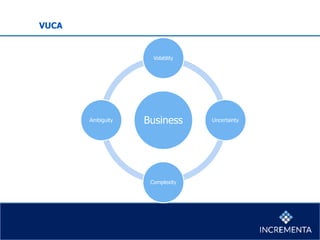
VUCA
Business
Volatility
Uncertainty
Complexity
Ambiguity
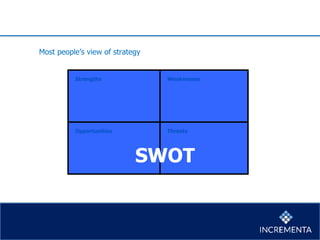
Most people’s view of strategy
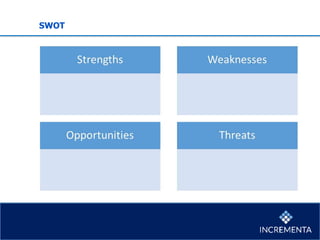
Strengths Weaknesses
Opportunities Threats
SWOT
Strategy
What is strategy
• Likely to be involved with the long term direction of the organisation,
i.e. 3-5 years
• Likely to involve all the activities of an organisation
• Usually the decisions are about trying to gain an advantage over the
competition.
• They normally attempt to match the activities of an organisation to its
external operating environment
• They can be affected by the values and expectations of the
organisations stakeholders. (Individuals or organisations that are
affected by the organisations decisions, i.e. customers)
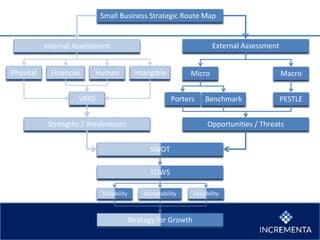
Small Business Strategic Route Map
Internal Assessment External Assessment
Physical Financial Human Intangible Micro Macro
Porters Benchmark PESTLEVRIO
Strengths / Weaknesses Opportunities / Threats
SWOT
TOWS
Suitability Acceptability Feasibility
Strategy for Growth
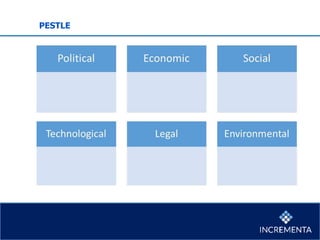
PESTLE
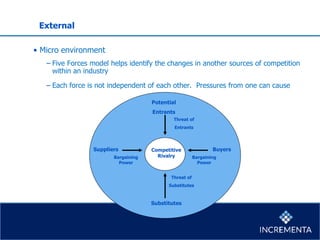
External
• Micro environment
− Five Forces model helps identify the changes in another sources of competition
within an industry
− Each force is not independent of each other. Pressures from one can cause
Competitive
Rivalry
Potential
Entrants
Buyers
Substitutes
Suppliers
Threat of
Entrants
Bargaining
Power
Threat of
Substitutes
Bargaining
Power
• Threat of entry
− Dependent upon the ability to overcome the barriers to entry
− These factors need to be overcome to compete successfully
− They can be viewed as providing only delays and not permanent barriers to
entry
− Economies of scale
− Capital requirement of entry
− Access to distribution channels
− Experience
− Expected retaliation
− Legislation or government action
− Differentiation
• Threat of substitutes
− Substitution reduces demand for a particular class of products or services, e.g.
email reducing the demand for postal services
− This depends on whether the substitute provides a higher perceived benefit or
value
− Substitution may take different forms
− Product for product substitution – email vs postal service
− Substitution of need – more reliable appliances require less maintenance
− Generic substitution – indirect competition
• Power of buyers and suppliers
− Buyer power high when
− Few buyers
− Alternative sources of supply
− Component or material cost is high percentage of total cost
− Switching cost is low
• Power of buyers and suppliers
− Supplier power high when:
− Few suppliers
− Switching costs are high
− The brand of the supplier is powerful
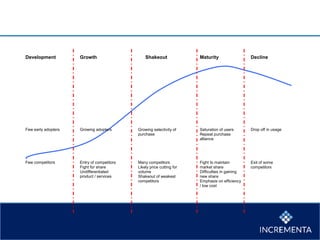
• Competitive rivalry
− Market growth rates affect rivalry
Development Growth Shakeout Maturity Decline
Few early adopters Growing adopters Growing selectivity of
purchase
Saturation of users
Repeat purchase
alliance
Drop off in usage
Few competitors Entry of competitors
Fight for share
Undifferentiated
product / services
Many competitors
Likely price cutting for
volume
Shakeout of weakest
competitors
Fight to maintain
market share
Difficulties in gaining
new share
Emphasis on efficiency
/ low cost
Exit of some
competitors
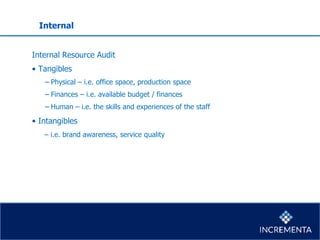
Internal
Internal Resource Audit
• Tangibles
− Physical – i.e. office space, production space
− Finances – i.e. available budget / finances
− Human – i.e. the skills and experiences of the staff
• Intangibles
– i.e. brand awareness, service quality
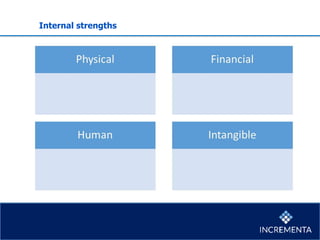
Internal strengths
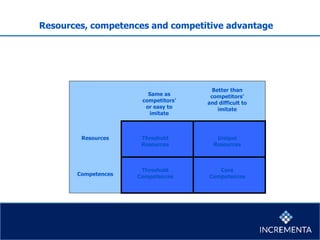
Resources, competences and competitive advantage
Same as
competitors’
or easy to
imitate
Better than
competitors’
and difficult to
imitate
Resources
Competences
Threshold
Resources
Threshold
Competences
Unique
Resources
Core
Competences
• Translating resources to competences
− Competences develop over time within an organisation
− Some are so difficult to imitate that they become a competitive advantage.
− These are known as “core competences”
− It is the identification of these that is important within the internal analysis.
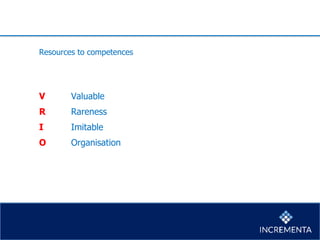
Resources to competences
V Valuable
R Rareness
I Imitable
O Organisation
SWOT
• Derived SWOT and TOWS
− Once we have the five factors for each aspect of the SWOT
− Now investigate the relationships and implications of the factors.
−How can strengths be used to take advantage of opportunities?
−How can strengths be used to avoid or defuse threats?
−How can weaknesses be overcome to take advantage of
opportunities?
−How can weaknesses be overcome to counteract or minimise
threats?
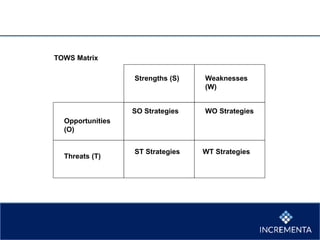
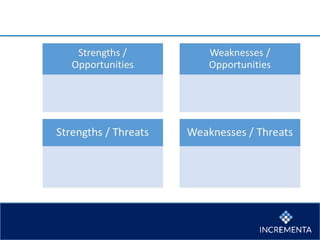
TOWS matrix investigates these relationships
Strengths (S) Weaknesses
(W)
Opportunities
(O)
Threats (T)
SO Strategies WO Strategies
ST Strategies WT Strategies
TOWS Matrix
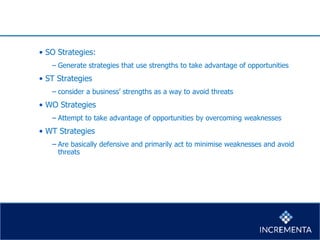
• SO Strategies:
− Generate strategies that use strengths to take advantage of opportunities
• ST Strategies
− consider a business’ strengths as a way to avoid threats
• WO Strategies
− Attempt to take advantage of opportunities by overcoming weaknesses
• WT Strategies
− Are basically defensive and primarily act to minimise weaknesses and avoid
threats
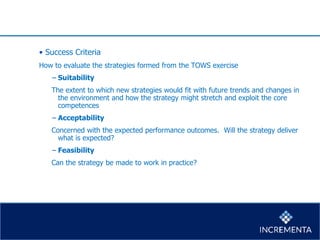
• Success Criteria
How to evaluate the strategies formed from the TOWS exercise
− Suitability
The extent to which new strategies would fit with future trends and changes in
the environment and how the strategy might stretch and exploit the core
competences
− Acceptability
Concerned with the expected performance outcomes. Will the strategy deliver
what is expected?
− Feasibility
Can the strategy be made to work in practice?
• Suitability
Do the strategies:
− Exploit opportunities in the environment and avoid threats
− Capitalise on an organisations strengths and avoid or remedy weaknesses
− Address stakeholder expectations
• The relative suitability of strategic options can be understood by:
− Ranking
− Decision trees
− Scenarios
• Acceptability
− Some criteria for understanding acceptability of strategic options:
−Profitability
−Cost Benefit analysis
−Sensitivity analysis
−Stakeholder reactions
• Feasibility
− Financial feasibility
− Resource deployment
Summary
• Environmental influences in two ways
−Macro environment – general influences
−Micro environment – specific to the industry / sector
• Basis of all effects from the environment are dynamic, e.g. changes over
time, changes to competitors
• Therefore organisations need to continually review and address these
environmental changes
• Strategic capability is the ability to provide products or services with
features that are valued by customers.
• Competitive advantage is therefore achieved by organisations that are able
to do this better that their competitors in ways that are difficult to imitate
• Strategic capability starts with resources. Some resources may be unique
to an organisation and be the basis of competitive advantage.
• Some activities or processes may be core competencies that underpin an
organisations competitive advantage
• Strategic competitive advantage can be obtained by matching external
factors with an organisations core competences.
• Once a series of strategies have been derived from the TOWS matrix each
one should be assessed.
• The one strategy that “fits” across the suitability, acceptability and
feasibility measurements can be implemented
• Implementation can be difficult but for small businesses it can be much
easier than larger businesses – speed boat vs oil tanker!

Strategy for small busines

  • 1.
  • 2.
  • 3.
    Most people’s viewof strategy Strengths Weaknesses Opportunities Threats SWOT
  • 4.
    Strategy What is strategy •Likely to be involved with the long term direction of the organisation, i.e. 3-5 years • Likely to involve all the activities of an organisation • Usually the decisions are about trying to gain an advantage over the competition. • They normally attempt to match the activities of an organisation to its external operating environment • They can be affected by the values and expectations of the organisations stakeholders. (Individuals or organisations that are affected by the organisations decisions, i.e. customers)
  • 5.
    Small Business StrategicRoute Map Internal Assessment External Assessment Physical Financial Human Intangible Micro Macro Porters Benchmark PESTLEVRIO Strengths / Weaknesses Opportunities / Threats SWOT TOWS Suitability Acceptability Feasibility Strategy for Growth
  • 6.
  • 7.
    External • Micro environment −Five Forces model helps identify the changes in another sources of competition within an industry − Each force is not independent of each other. Pressures from one can cause Competitive Rivalry Potential Entrants Buyers Substitutes Suppliers Threat of Entrants Bargaining Power Threat of Substitutes Bargaining Power
  • 8.
    • Threat ofentry − Dependent upon the ability to overcome the barriers to entry − These factors need to be overcome to compete successfully − They can be viewed as providing only delays and not permanent barriers to entry − Economies of scale − Capital requirement of entry − Access to distribution channels − Experience − Expected retaliation − Legislation or government action − Differentiation
  • 9.
    • Threat ofsubstitutes − Substitution reduces demand for a particular class of products or services, e.g. email reducing the demand for postal services − This depends on whether the substitute provides a higher perceived benefit or value − Substitution may take different forms − Product for product substitution – email vs postal service − Substitution of need – more reliable appliances require less maintenance − Generic substitution – indirect competition
  • 10.
    • Power ofbuyers and suppliers − Buyer power high when − Few buyers − Alternative sources of supply − Component or material cost is high percentage of total cost − Switching cost is low
  • 11.
    • Power ofbuyers and suppliers − Supplier power high when: − Few suppliers − Switching costs are high − The brand of the supplier is powerful
  • 12.
    • Competitive rivalry −Market growth rates affect rivalry
  • 13.
    Development Growth ShakeoutMaturity Decline Few early adopters Growing adopters Growing selectivity of purchase Saturation of users Repeat purchase alliance Drop off in usage Few competitors Entry of competitors Fight for share Undifferentiated product / services Many competitors Likely price cutting for volume Shakeout of weakest competitors Fight to maintain market share Difficulties in gaining new share Emphasis on efficiency / low cost Exit of some competitors
  • 14.
    Internal Internal Resource Audit •Tangibles − Physical – i.e. office space, production space − Finances – i.e. available budget / finances − Human – i.e. the skills and experiences of the staff • Intangibles – i.e. brand awareness, service quality
  • 15.
  • 16.
    Resources, competences andcompetitive advantage Same as competitors’ or easy to imitate Better than competitors’ and difficult to imitate Resources Competences Threshold Resources Threshold Competences Unique Resources Core Competences
  • 17.
    • Translating resourcesto competences − Competences develop over time within an organisation − Some are so difficult to imitate that they become a competitive advantage. − These are known as “core competences” − It is the identification of these that is important within the internal analysis.
  • 18.
    Resources to competences VValuable R Rareness I Imitable O Organisation
  • 19.
  • 20.
    • Derived SWOTand TOWS − Once we have the five factors for each aspect of the SWOT − Now investigate the relationships and implications of the factors. −How can strengths be used to take advantage of opportunities? −How can strengths be used to avoid or defuse threats? −How can weaknesses be overcome to take advantage of opportunities? −How can weaknesses be overcome to counteract or minimise threats? TOWS matrix investigates these relationships
  • 21.
    Strengths (S) Weaknesses (W) Opportunities (O) Threats(T) SO Strategies WO Strategies ST Strategies WT Strategies TOWS Matrix
  • 22.
    • SO Strategies: −Generate strategies that use strengths to take advantage of opportunities • ST Strategies − consider a business’ strengths as a way to avoid threats • WO Strategies − Attempt to take advantage of opportunities by overcoming weaknesses • WT Strategies − Are basically defensive and primarily act to minimise weaknesses and avoid threats
  • 24.
    • Success Criteria Howto evaluate the strategies formed from the TOWS exercise − Suitability The extent to which new strategies would fit with future trends and changes in the environment and how the strategy might stretch and exploit the core competences − Acceptability Concerned with the expected performance outcomes. Will the strategy deliver what is expected? − Feasibility Can the strategy be made to work in practice?
  • 25.
    • Suitability Do thestrategies: − Exploit opportunities in the environment and avoid threats − Capitalise on an organisations strengths and avoid or remedy weaknesses − Address stakeholder expectations • The relative suitability of strategic options can be understood by: − Ranking − Decision trees − Scenarios
  • 26.
    • Acceptability − Somecriteria for understanding acceptability of strategic options: −Profitability −Cost Benefit analysis −Sensitivity analysis −Stakeholder reactions • Feasibility − Financial feasibility − Resource deployment
  • 27.
    Summary • Environmental influencesin two ways −Macro environment – general influences −Micro environment – specific to the industry / sector • Basis of all effects from the environment are dynamic, e.g. changes over time, changes to competitors • Therefore organisations need to continually review and address these environmental changes • Strategic capability is the ability to provide products or services with features that are valued by customers. • Competitive advantage is therefore achieved by organisations that are able to do this better that their competitors in ways that are difficult to imitate
  • 28.
    • Strategic capabilitystarts with resources. Some resources may be unique to an organisation and be the basis of competitive advantage. • Some activities or processes may be core competencies that underpin an organisations competitive advantage • Strategic competitive advantage can be obtained by matching external factors with an organisations core competences. • Once a series of strategies have been derived from the TOWS matrix each one should be assessed. • The one strategy that “fits” across the suitability, acceptability and feasibility measurements can be implemented • Implementation can be difficult but for small businesses it can be much easier than larger businesses – speed boat vs oil tanker!